EP4398629A2 - Fingerabdruckpositionierung - Google Patents
Fingerabdruckpositionierung Download PDFInfo
- Publication number
- EP4398629A2 EP4398629A2 EP24177030.4A EP24177030A EP4398629A2 EP 4398629 A2 EP4398629 A2 EP 4398629A2 EP 24177030 A EP24177030 A EP 24177030A EP 4398629 A2 EP4398629 A2 EP 4398629A2
- Authority
- EP
- European Patent Office
- Prior art keywords
- location
- specific
- properties
- radio link
- mobile device
- Prior art date
- Legal status (The legal status is an assumption and is not a legal conclusion. Google has not performed a legal analysis and makes no representation as to the accuracy of the status listed.)
- Pending
Links
Images





Classifications
-
- H—ELECTRICITY
- H04—ELECTRIC COMMUNICATION TECHNIQUE
- H04W—WIRELESS COMMUNICATION NETWORKS
- H04W64/00—Locating users or terminals or network equipment for network management purposes, e.g. mobility management
-
- G—PHYSICS
- G01—MEASURING; TESTING
- G01S—RADIO DIRECTION-FINDING; RADIO NAVIGATION; DETERMINING DISTANCE OR VELOCITY BY USE OF RADIO WAVES; LOCATING OR PRESENCE-DETECTING BY USE OF THE REFLECTION OR RERADIATION OF RADIO WAVES; ANALOGOUS ARRANGEMENTS USING OTHER WAVES
- G01S11/00—Systems for determining distance or velocity not using reflection or reradiation
- G01S11/02—Systems for determining distance or velocity not using reflection or reradiation using radio waves
- G01S11/04—Systems for determining distance or velocity not using reflection or reradiation using radio waves using angle measurements
-
- G—PHYSICS
- G01—MEASURING; TESTING
- G01S—RADIO DIRECTION-FINDING; RADIO NAVIGATION; DETERMINING DISTANCE OR VELOCITY BY USE OF RADIO WAVES; LOCATING OR PRESENCE-DETECTING BY USE OF THE REFLECTION OR RERADIATION OF RADIO WAVES; ANALOGOUS ARRANGEMENTS USING OTHER WAVES
- G01S11/00—Systems for determining distance or velocity not using reflection or reradiation
- G01S11/02—Systems for determining distance or velocity not using reflection or reradiation using radio waves
- G01S11/06—Systems for determining distance or velocity not using reflection or reradiation using radio waves using intensity measurements
-
- G—PHYSICS
- G01—MEASURING; TESTING
- G01S—RADIO DIRECTION-FINDING; RADIO NAVIGATION; DETERMINING DISTANCE OR VELOCITY BY USE OF RADIO WAVES; LOCATING OR PRESENCE-DETECTING BY USE OF THE REFLECTION OR RERADIATION OF RADIO WAVES; ANALOGOUS ARRANGEMENTS USING OTHER WAVES
- G01S5/00—Position-fixing by co-ordinating two or more direction or position line determinations; Position-fixing by co-ordinating two or more distance determinations
- G01S5/02—Position-fixing by co-ordinating two or more direction or position line determinations; Position-fixing by co-ordinating two or more distance determinations using radio waves
- G01S5/0252—Radio frequency fingerprinting
- G01S5/02521—Radio frequency fingerprinting using a radio-map
-
- G—PHYSICS
- G01—MEASURING; TESTING
- G01S—RADIO DIRECTION-FINDING; RADIO NAVIGATION; DETERMINING DISTANCE OR VELOCITY BY USE OF RADIO WAVES; LOCATING OR PRESENCE-DETECTING BY USE OF THE REFLECTION OR RERADIATION OF RADIO WAVES; ANALOGOUS ARRANGEMENTS USING OTHER WAVES
- G01S5/00—Position-fixing by co-ordinating two or more direction or position line determinations; Position-fixing by co-ordinating two or more distance determinations
- G01S5/02—Position-fixing by co-ordinating two or more direction or position line determinations; Position-fixing by co-ordinating two or more distance determinations using radio waves
- G01S5/0252—Radio frequency fingerprinting
- G01S5/02521—Radio frequency fingerprinting using a radio-map
- G01S5/02524—Creating or updating the radio-map
- G01S5/02525—Gathering the radio frequency fingerprints
- G01S5/02526—Gathering the radio frequency fingerprints using non-dedicated equipment, e.g. user equipment or crowd-sourcing
-
- G—PHYSICS
- G01—MEASURING; TESTING
- G01S—RADIO DIRECTION-FINDING; RADIO NAVIGATION; DETERMINING DISTANCE OR VELOCITY BY USE OF RADIO WAVES; LOCATING OR PRESENCE-DETECTING BY USE OF THE REFLECTION OR RERADIATION OF RADIO WAVES; ANALOGOUS ARRANGEMENTS USING OTHER WAVES
- G01S5/00—Position-fixing by co-ordinating two or more direction or position line determinations; Position-fixing by co-ordinating two or more distance determinations
- G01S5/02—Position-fixing by co-ordinating two or more direction or position line determinations; Position-fixing by co-ordinating two or more distance determinations using radio waves
- G01S5/0252—Radio frequency fingerprinting
- G01S5/02521—Radio frequency fingerprinting using a radio-map
- G01S5/02524—Creating or updating the radio-map
- G01S5/02527—Detecting or resolving anomalies in the radio frequency fingerprints of the radio-map
-
- G—PHYSICS
- G06—COMPUTING OR CALCULATING; COUNTING
- G06F—ELECTRIC DIGITAL DATA PROCESSING
- G06F16/00—Information retrieval; Database structures therefor; File system structures therefor
- G06F16/90—Details of database functions independent of the retrieved data types
- G06F16/95—Retrieval from the web
- G06F16/953—Querying, e.g. by the use of web search engines
- G06F16/9537—Spatial or temporal dependent retrieval, e.g. spatiotemporal queries
-
- H—ELECTRICITY
- H04—ELECTRIC COMMUNICATION TECHNIQUE
- H04W—WIRELESS COMMUNICATION NETWORKS
- H04W24/00—Supervisory, monitoring or testing arrangements
- H04W24/10—Scheduling measurement reports ; Arrangements for measurement reports
Definitions
- Various embodiments relate to a mobile device, an access point node, and a fingerprint repository node configured to participate in generation of location-specific fingerprints of a radio link.
- HSPA transmits communication data on shared channels, in packets addressed to specific users.
- HSPA features short Transmission Time Interval (TTI), link adaptation, fast scheduling, fast retransmission and soft-combining, and advanced modulation, resulting in increased data rates, low latency, and increased system capacity.
- TTI Transmission Time Interval
- GPRS General Packet Radio Services
- EDGE Enhanced Data rates for GSM Evolution
- Fingerprint positioning typically relies on a snapshot of various properties of the radio link which is specific for the location.
- the various properties can, in some scenarios, include RTT, TDOA, A-GPS, and cell-ID data.
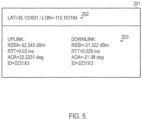
- Fingerprint positioning techniques are thus based on comparing a plurality of location-specific downlink properties of the radio link and / or a plurality of location-specific uplink properties against a database of location-specific fingerprints (fingerprint database), each fingerprint being associated with a respective location within the wireless communication network.
- the fingerprint database is typically populated based on reference measurements of the plurality of location-specific uplink and / or downlink properties of the radio link and reference measurements of the associated location. Fingerprint positioning techniques allow determining the location at a comparably high precision.
- techniques of populating a fingerprint database with fingerprints indicative of location-specific properties of a radio link are disclosed (offline stage).
- the properties may be indicative of an uplink (UL) channel of the radio link and / or may be indicative of a downlink (DL) channel of the radio link.
- the techniques allow for a flexible distribution of logic between a mobile device (UE), an access point node (AP), and a fingerprint repository node of a communications network. The UE and the AP communicate on the radio link.
- the location of a UE is determined when populating the fingerprint database.
- the UE may be referred to as a test UE.
- the UE may be implemented as an autonomously moving machine or robot.
- Each set of UL quantities and / or DL quantities is associated with a respective location of the UE. For this, the location of the UE is determined and the UL quantities and / or DL quantities are measured substantially at the determined location. Synchronization between the UE and the AP can be required to this end to measure the data at substantially the same point in time and the same location. To discriminate between the various locations, e.g., the location of the UE may be sampled at pre-determined intervals. Time tags or a numbering scheme may be implemented for keeping track of measurements performed at different locations for later association. Planned surveying allows to extensively cover a measurement area. However, collection of data can take significant time.
- Each set of measured DL and / or UL quantities may be processed to obtain a plurality of location-specific DL properties and / or UL properties; the DL properties and / or the UL properties can be later on fused to obtain a fingerprint.
- the fingerprints thus obtained for different locations can be used to populate the fingerprint database.
- the fingerprinting map is obtained by the plurality of fingerprints associated with different locations and stored in the fingerprint database.
- the specific type of the reference positioning technique is not germane for the functioning of the techniques of populating the fingerprint database.
- various reference positioning techniques are illustrated. Such techniques may be combined with each other to obtain more accurate results.
- cell ID positioning may be augmented by determining the RTT for packets communicated on the radio link between the AP 10 and the UE 12.
- the RRT positioning technique augments the cell ID with RTT in WCDMA or timing advance in GSM and LTE measurements.
- This principle for enhanced cell identity positioning aims at combining the cell extension model, e.g., modeled by a polygon, with a distance measure.
- the measurement principle is also depicted in FIG. 1 .
- the travel time of radio waves from the AP 10 to the UE 12 in the cell 14, and back, is measured, with the latency of the terminal subtracted.
- LMUs location measurement units
- a 3D positioning is performed. In other scenarios, a 2D positioning is performed.
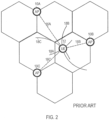
- At least three TDOA measurements are needed (cf. FIG. 2 ) in order to find a 3D terminal position and that at least two TDOA measurements are needed in order to find a 2D terminal location.
- This means that at least four sites need to be detected for 3D UE positioning and at least three sites need to be detected for 2D terminal positioning.
- accuracy of determining the location can be improved if more measurements are collected and a maximum likelihood solution is introduced.
- A-GPS accuracy can become as good as ten meters without differential operation. The accuracy becomes worse in dense urban areas and indoors where the sensitivity is often not high enough for detection of the very weak signals from the GPS satellites. Satellite based positioning like A-GPS positioning typically exhibits a limited accuracy in indoor scenarios. This may be due to radio propagation losses through walls, coated windows, and dense roofs which effectively shield the radio waves from the indoor environment. Sometimes position fixes can be achieved indoors with this technology near windows and in residential homes that are less dense than office buildings and commercial facilities.
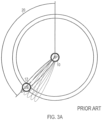
- FIG. 3A illustrates aspects of AoA (Angle of Arrival) positioning.
- AoA positioning exploits multiple antenna elements of an antenna array of a UE 12 to measure the AoA 20 of radio waves sent by the AP 10 and impinging on the antenna array.
- AoAs measured in non-colocated sites are required to compute a location of the UE 12 in the plane by means of triangulation. This typically makes pure AoA positioning a multi-cell technology, a fact that may increase the complexity and cost of implementation significantly. Further, in rural regions base station geometry may not allow measurement at multiple sites.
- the cell identification of the AP serving a given cell can be taken into account.
- the UE 120 determines its location in the cellular network 100.
- one or more reference positioning techniques may be employed, e.g.: A-GPS; AoA; TOA; TDOA; FTM; and / or INS as explained above.
- the UE 120 is manually positioned at a predefined location.
- one or more of the various reference positioning techniques may be flexibly combined.
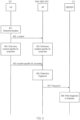
- the data 805 is received by the at least one AP 100A, 100B, 100C; the at least one AP 100A, 100B, 100C then determines the fingerprint 201, 806. For this, the at least one AP 100A, 100B, 100C fuses the plurality of location-specific DL properties and the plurality of location-specific UL properties to obtain the fingerprint 201. In the various scenarios described herein, fusing the fingerprint may include specific algorithms to improve the accuracy of the fingerprints 201 thus determined.
- 811 - 814 generally correspond to 801 - 804.
- the data 827 is received by the fingerprint repository node 112 which determines a plurality of fingerprints 201 of the radio link 190, 828.
- the fingerprint repository node 112 processes the collected measurements.
- the fingerprint repository node 112 stores the location coordinates and corresponding processed measurements as fingerprints in the fingerprint database 113.
- the processing procedure may involve specific algorithms to improve the accuracy of the fingerprints.
- the fingerprint repository node 112 determines the respective fingerprint for every location for which an iteration of 821 - 825 has been executed and location-specific UL properties 203 and location-specific DL properties 203 have been collected.
- FIG. 9 illustrates aspects of populating a fingerprint database, wherein the logic for determining the fingerprint 201 resides at the fingerprint repository node 112.
- the fingerprint 201 is fused based on, both, location-specific UL properties 203, as well as location-specific DL properties 203. In the various scenarios disclosed herein, it is possible that the fingerprint 201 is fused based on either the location-specific UL properties 203 or the location-specific DL properties 203, only.
- the memory 121 may store control data that may be executed by the processor 122. Executing the control data by the processor 122 may cause the processor 122 executing techniques relating to the populating of the fingerprint database 113 as illustrated herein. In particular, executing the control data may cause the processor 122 to obtain data indicative of the location of the UE 120 from the positioning unit 123 and thus determine the location of the UE 120. Further, executing the control data by the processor 122 may cause the processor 122 to determine location-specific DL properties 203. Further, executing the control data by the processor 122 may cause the processor 122 to determine a fingerprint 201 by fusing location-specific UL properties 203 and / or location-specific DL properties 203. Further, executing the control data by the processor 122 may cause the processor 122 to communicate with the at least one AP 100A, 100B, 100C and/or the fingerprint repository node 112 via the interface 124.
- FIG. 11 illustrates aspects of the APs 100A, 100B, 100C.
- the APs 100A, 100B, 100C comprise an interface 104 which comprises a receiver 106 and a transmitter 105 for transceiving on the radio link 190.
- the interface 104 is further configured to communicate with the UE 120 and/or the fingerprint repository node 112; such a communication may be implemented via the radio link 190 or a different RAT.
- the interface 104 is coupled with the processor 102.
- the processor 102 may be a multi-core processor.
- the processor 102 is coupled with a memory 101.
- the memory 101 may store control data that may be executed by the processor 102.
- Executing the control data by the processor 102 may cause the processor 102 executing techniques relating to the populating of the fingerprint database 113 as illustrated herein.
- executing the control data may cause the processor 102 to obtain data indicative of the location of the UE 120, e.g., via the interface 104.
- executing the control data by the processor 102 may cause the processor 102 to determine location-specific UL properties 203 of the radio link 190.
- executing the control data by the processor 102 may cause the processor 102 to determine a fingerprint 201 by fusing location-specific UL properties 203 and / or location-specific DL properties 203.
- executing the control data by the processor 102 may cause the processor 102 to communicate with the UE 120 and/or the fingerprint repository node 112 via the interface 104.
- FIG. 12 illustrates aspects of the fingerprint repository node 112.
- the fingerprint repository node 112 comprises an interface 112-4 which is configured to communicate with the UE 120 and/or the at least one AP 100A, 100B, 100C; such a communication may be implemented via the radio link 190 or a different RAT.
- the interface 112-4 is coupled with a processor 112-2.
- the processor 112-2 may be a multi-core processor.
- the processor 112-2 is coupled with a memory 112-1.
- the memory 112-1 may store control data that may be executed by the processor 112-2. Executing the control data by the processor 112-2 may cause the processor 112-2 executing techniques relating to the populating of the fingerprint database 113 as illustrated herein.
- executing the control data may cause the processor 100 to obtain data indicative of a plurality of location-specific UL properties 203 and/or a plurality of location-specific DL properties 203 of the radio link. Further, executing the control data by the processor 112-2 may cause the processor 112-2 to determine a fingerprint 201 by fusing location-specific UL properties 203 and / or location-specific DL properties 203. Further, executing the control data by the processor 112-2 may cause the processor 112-2 to communicate with the UE 120 and/or the at least one AP 100A, 100B, 100C via the interface 112-4.
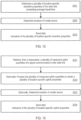
- a plurality of location-specific DL properties 203 of the radio link 190 are determined.
- FTM-based data may be determined at 2001.
- the FTM-based data may include the average travel time of a plurality of packets communicated via the radio link 190.
- the location of the UE 120 is determined.
- One or more reference positioning techniques as disclosed herein may be employed.
- the fingerprint 2001 is fused based on the plurality of location-specific DL properties of the radio link 190 as determined in 2001.
- a plurality of location-specific UL properties of the radio link 190 may also be taken into account when fusing the fingerprint 201; e.g., it may be possible that respective data is received from the at least one AP 100A, 100B, 100C that is indicative of the plurality of location-specific UL properties 203 of the radio link 190 (not shown in FIG. 13 ).s
- FIG. 15 is a flowchart of a method according to various embodiments which may be executed by the UE 120.
- a plurality of location-specific DL properties 203 of the radio link 190 are determined.
- the plurality of location-specific DL properties 203 of the radio link 190 comprise an average travel time of a plurality of packets communicated via the radio link 190.
- the plurality of location-specific DL properties 302 can comprise FTM-based data such that the average travel time of the plurality of packets communicated via the radio link 190.
- the location of the mobile device is determined.
- One or more reference positioning techniques as disclosed herein may be employed.
- FIG. 16 is a flowchart of a method according to various embodiments which may be executed by at least one AP 100A, 100B, 100C.
- the measured UL quantities are processed to obtain a plurality of location-specific UL properties 203.
- the location of the UE 120 is determined, e.g., by receiving the location report.
- One or more reference positioning techniques as disclosed herein may be employed.
- data indicative of the plurality of location-specific UL properties is sent, e.g., to the UE 120.
- the data center 2034 may indicate the measured UL quantities as retrieved in 2031 or may indicate the location-specific UL properties as obtained from said processing of 2032.
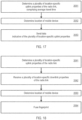
- FIG. 17 is a flowchart of a method according to various embodiments which may be executed by at least one AP 100A, 100B, 100C.
- the plurality of location-specific UL properties of the radio link 190 are determined, wherein the location-specific UL properties comprise an average travel time of a plurality of packets communicated via the radio link 190.
- the location-specific UL properties may include FTM-based data.
- 2052 generally corresponds to 2033.
- 2053 generally corresponds to 2034.
- FIG. 18 is a flowchart of a method according to various embodiments which may be executed by the at least one AP 100A, 100B, 100C.
- a plurality of location-specific UL properties 203 of the radio link 190 are determined.
- data indicative of a plurality of location-specific DL properties 203 of the radio link 190 is received, e.g., from the UE 120.
- the data received at 2062 may indicate measured DL quantities that have not been processed by the UE 122 to obtain the location-specific DL properties 203; in such a scenario, the corresponding processing can be implemented at the at least one AP 100A, 100B, 100C.
- the fingerprint 201 is determined by fusing the plurality of location-specific UL properties 203 of the radio link 190 and the plurality of location-specific DL properties 203 of the radio link 190.
- FIG. 19 is a flowchart according to various embodiments which may be executed by the fingerprint repository node 112.
- FIG. 20 is a flowchart of a method according to various embodiments which may be executed by the fingerprint repository node 112.
- data indicative of a plurality of location-specific DL properties 203 and further indicative of a plurality of location-specific UL properties is received.
- the data may be received from the UE 120 and/or the at least one AP 100A, 100B, 100C.
- the fingerprint is fused.
- data indicative of the fingerprint is written to the fingerprint database 113.
- FIG. 21 is a flowchart of a method according to various embodiments which may be executed by the fingerprint repository node 112.
- location-specific UL properties 203 and/or the location-specific DL properties 203 is received, e.g., from the UE 120 and/or the AP 100A, 100B, 100C.
- the location-specific UL and/or DL properties 203 comprise an average travel time of a plurality of packets communicated via the radio link 190.
- the location-specific UL and/or DL properties 203 can comprise FTM-based data.
- 2092, 2093 generally correspond to 2082, 2083.
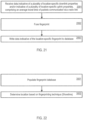
- FIG. 22 is a flowchart of a method illustrating fingerprinting techniques.
- the fingerprinting database 113 is populated, e.g., employing one of the methods as illustrated by the flowcharts of FIGs. 13 - 21 , 3001. 3001 is sometimes referred to as offline stage.
- the location of a UE may be determined during Showtime employing the fingerprinting positioning using the fingerprints as provided in the now populated fingerprint database 113, 3002.
- Reference measurements providing the location-specific UL properties of the radio link and / or the location-specific DL properties of the radio link and fingerprint determination allow constructing the fingerprint map for the fingerprinting method; the fingerprinting method that is popularly applied in WLAN/5G indoor positioning.
- the disclosed techniques enable the reference measurements and fingerprint determination in the offline stage for the fingerprinting method by defining necessary signaling and procedures.
- the techniques may be applied to populate a fingerprint database for WLAN and / or 5G cellular systems.
- a test UE is utilized to perform reference measurements to construct and maintain the fingerprint map. This is enabled by enhancing control signaling via WLAN and / or 5G radio links for at least the following scenarios:
Landscapes
- Engineering & Computer Science (AREA)
- Physics & Mathematics (AREA)
- General Physics & Mathematics (AREA)
- Radar, Positioning & Navigation (AREA)
- Remote Sensing (AREA)
- Signal Processing (AREA)
- Computer Networks & Wireless Communication (AREA)
- Databases & Information Systems (AREA)
- Theoretical Computer Science (AREA)
- Data Mining & Analysis (AREA)
- General Engineering & Computer Science (AREA)
- Mobile Radio Communication Systems (AREA)
- Position Fixing By Use Of Radio Waves (AREA)
Priority Applications (1)
| Application Number | Priority Date | Filing Date | Title |
|---|---|---|---|
| EP24177030.4A EP4398629A3 (de) | 2015-09-11 | 2015-09-11 | Fingerabdruckpositionierung |
Applications Claiming Priority (3)
| Application Number | Priority Date | Filing Date | Title |
|---|---|---|---|
| EP24177030.4A EP4398629A3 (de) | 2015-09-11 | 2015-09-11 | Fingerabdruckpositionierung |
| EP15760202.0A EP3348099B1 (de) | 2015-09-11 | 2015-09-11 | Fingerabdruck-positionierung für mobile endgeräte |
| PCT/EP2015/070808 WO2017041850A1 (en) | 2015-09-11 | 2015-09-11 | Fingerprint positioning for mobile terminals |
Related Parent Applications (1)
| Application Number | Title | Priority Date | Filing Date |
|---|---|---|---|
| EP15760202.0A Division EP3348099B1 (de) | 2015-09-11 | 2015-09-11 | Fingerabdruck-positionierung für mobile endgeräte |
Publications (2)
| Publication Number | Publication Date |
|---|---|
| EP4398629A2 true EP4398629A2 (de) | 2024-07-10 |
| EP4398629A3 EP4398629A3 (de) | 2024-10-09 |
Family
ID=54065378
Family Applications (2)
| Application Number | Title | Priority Date | Filing Date |
|---|---|---|---|
| EP15760202.0A Active EP3348099B1 (de) | 2015-09-11 | 2015-09-11 | Fingerabdruck-positionierung für mobile endgeräte |
| EP24177030.4A Pending EP4398629A3 (de) | 2015-09-11 | 2015-09-11 | Fingerabdruckpositionierung |
Family Applications Before (1)
| Application Number | Title | Priority Date | Filing Date |
|---|---|---|---|
| EP15760202.0A Active EP3348099B1 (de) | 2015-09-11 | 2015-09-11 | Fingerabdruck-positionierung für mobile endgeräte |
Country Status (3)
| Country | Link |
|---|---|
| US (1) | US10356741B2 (de) |
| EP (2) | EP3348099B1 (de) |
| WO (1) | WO2017041850A1 (de) |
Families Citing this family (10)
| Publication number | Priority date | Publication date | Assignee | Title |
|---|---|---|---|---|
| US10321270B2 (en) * | 2015-09-16 | 2019-06-11 | Ivani, LLC | Reverse-beacon indoor positioning system using existing detection fields |
| WO2017176376A1 (en) * | 2016-04-08 | 2017-10-12 | Intel IP Corporation | 60ghz-lwa support: discovery and keep alive |
| US10342067B2 (en) * | 2016-07-11 | 2019-07-02 | Veniam, Inc. | Systems and methods for vehicular positioning based on wireless fingerprinting data in a network of moving things including, for example, autonomous vehicles |
| US10292012B1 (en) * | 2016-10-31 | 2019-05-14 | Marvell International Ltd. | Reverse locationing with Bluetooth angle of arrival (AoA) |
| US12069536B2 (en) * | 2019-03-19 | 2024-08-20 | Invensense, Inc. | Revising an unstable location fingerprint database for an area |
| US10609519B1 (en) * | 2019-06-03 | 2020-03-31 | Arista Networks, Inc. | Location tracking configuration using user devices |
| FR3108767A1 (fr) * | 2020-03-30 | 2021-10-01 | Orange | Aide à la lutte contre la propagation d’une maladie, par des équipements en réseau |
| WO2021204356A1 (en) * | 2020-04-07 | 2021-10-14 | Huawei Technologies Co., Ltd. | Techniques for positioning using a communication network |
| FR3127666B1 (fr) | 2021-09-24 | 2025-04-18 | Sigfox | Coopération entre deux méthodes de géolocalisation d’un terminal d’un système de communication sans fil |
| KR102817718B1 (ko) * | 2022-10-14 | 2025-06-11 | 주식회사 스카이칩스 | 변동성 특징 기반의 실내 무선 측위 방법, 시스템 및 이를 위한 장치 |
Citations (1)
| Publication number | Priority date | Publication date | Assignee | Title |
|---|---|---|---|---|
| WO2011040856A1 (en) | 2009-09-30 | 2011-04-07 | Telefonaktiebolaget L M Ericsson (Publ) | Lte fingerprinting positioning references for other cellular systems |
Family Cites Families (12)
| Publication number | Priority date | Publication date | Assignee | Title |
|---|---|---|---|---|
| US7419425B1 (en) * | 2001-02-15 | 2008-09-02 | Bally Gaming, Inc. | Shared secondary game station and system |
| US7359718B2 (en) | 2004-04-30 | 2008-04-15 | Hong Kong Applied Science And Technology Research Institute Co., Ltd. | Location determination and location tracking in wireless networks |
| US20100241507A1 (en) * | 2008-07-02 | 2010-09-23 | Michael Joseph Quinn | System and method for searching, advertising, producing and displaying geographic territory-specific content in inter-operable co-located user-interface components |
| WO2012044246A1 (en) * | 2010-09-30 | 2012-04-05 | Telefonaktiebolaget L M Ericsson (Publ) | Methods and nodes for handling measurements |
| US9304187B2 (en) | 2012-02-10 | 2016-04-05 | Lg Electronics Inc. | Method for estimating positions of devices in wireless access systems supporting communication between devices, and apparatus for supporting same |
| US8996037B2 (en) * | 2012-02-24 | 2015-03-31 | Broadcom Corporation | Wireless communication device capable of performing enhanced fingerprint mapping and location identification |
| US9754255B1 (en) * | 2012-04-13 | 2017-09-05 | Maxim Integrated Products, Inc. | Geo-location based authentication in a mobile point-of-sale terminal |
| US9648492B2 (en) * | 2012-10-10 | 2017-05-09 | Apple Inc. | Location-based update of subscriber identity information in a wireless device |
| US9462412B1 (en) * | 2012-10-10 | 2016-10-04 | Google Inc. | Providing content based on previously determined device locations |
| US20150100330A1 (en) * | 2013-10-08 | 2015-04-09 | Assaf Shpits | Method and system of identifying infectious and hazardous sites, detecting disease outbreaks, and diagnosing a medical condition associated with an infectious disease |
| WO2015090517A1 (en) * | 2013-12-17 | 2015-06-25 | Belimo Holding Ag | Mobile communication device and method for managing operation of a plurality of actuators |
| CN107850656B (zh) * | 2015-06-09 | 2022-06-24 | 赫尔环球有限公司 | 用于确定定位目的的模型参数的方法、装置和系统 |
-
2015
- 2015-09-11 EP EP15760202.0A patent/EP3348099B1/de active Active
- 2015-09-11 EP EP24177030.4A patent/EP4398629A3/de active Pending
- 2015-09-11 US US15/755,577 patent/US10356741B2/en active Active
- 2015-09-11 WO PCT/EP2015/070808 patent/WO2017041850A1/en not_active Ceased
Patent Citations (1)
| Publication number | Priority date | Publication date | Assignee | Title |
|---|---|---|---|---|
| WO2011040856A1 (en) | 2009-09-30 | 2011-04-07 | Telefonaktiebolaget L M Ericsson (Publ) | Lte fingerprinting positioning references for other cellular systems |
Also Published As
| Publication number | Publication date |
|---|---|
| EP4398629A3 (de) | 2024-10-09 |
| US20180279251A1 (en) | 2018-09-27 |
| WO2017041850A1 (en) | 2017-03-16 |
| EP3348099B1 (de) | 2024-05-22 |
| EP3348099A1 (de) | 2018-07-18 |
| US10356741B2 (en) | 2019-07-16 |
Similar Documents
| Publication | Publication Date | Title |
|---|---|---|
| EP3348099B1 (de) | Fingerabdruck-positionierung für mobile endgeräte | |
| EP2484129B1 (de) | Lte-fingerabdruckpositionierungsreferenzen für andere zelluläre systeme | |
| US12057918B2 (en) | Non-line-of-sight path detection for user equipment positioning in wireless networks | |
| US9594149B2 (en) | Fingerprinting with radio channel related information | |
| EP1506686B1 (de) | Verbesserte positionsbestimmung in drahtlosen kommunikationssystemen | |
| US8233920B2 (en) | Angle of arrival downlink signaling | |
| EP2831617B1 (de) | Positionierung mit geteilten antennen pro zelle | |
| Radnosrati et al. | New trends in radio network positioning | |
| WO2020177041A1 (zh) | 信息处理的方法和终端设备 | |
| US20200393531A1 (en) | Signaling of scaled 3d position information | |
| Maigualema-Quimbita et al. | Positioning of unmanned aerial vehicles (UAVs) in urban environments using 5G networks: A hybrid approach based on multilateration and machine learning | |
| EP3569020B1 (de) | Verfahren und server zur positionierung einer benutzervorrichtung | |
| US20240064694A1 (en) | Position estimate based on transmission beam properties | |
| CN114245315A (zh) | 终端定位方法及装置 | |
| Yin et al. | Analysis of NR positioning evolution: From scenarios to techniques | |
| CN118402214A (zh) | 用于对用于定位估计的用户设备测量进行分类的方法、装置和系统 | |
| US12481067B2 (en) | Global navigation satellite system state space representation correction forwarding service | |
| US12618985B2 (en) | Cooperative positioning with multiple global navigation satellite system receivers | |
| US20240272309A1 (en) | Cooperative positioning with multiple global navigation satellite system receivers | |
| US20250227655A1 (en) | User equipment assisted mapping of access points | |
| US20240061065A1 (en) | Position estimate based on angle of departure | |
| Radnosrati | Time of Flight Estimation for Radio Network Positioning | |
| Razavi et al. | Standardization in 5G and 5G Advanced Positioning | |
| LaMarca et al. | Cellular-Based Systems |
Legal Events
| Date | Code | Title | Description |
|---|---|---|---|
| PUAI | Public reference made under article 153(3) epc to a published international application that has entered the european phase |
Free format text: ORIGINAL CODE: 0009012 |
|
| STAA | Information on the status of an ep patent application or granted ep patent |
Free format text: STATUS: THE APPLICATION HAS BEEN PUBLISHED |
|
| AC | Divisional application: reference to earlier application |
Ref document number: 3348099 Country of ref document: EP Kind code of ref document: P |
|
| AK | Designated contracting states |
Kind code of ref document: A2 Designated state(s): AL AT BE BG CH CY CZ DE DK EE ES FI FR GB GR HR HU IE IS IT LI LT LU LV MC MK MT NL NO PL PT RO RS SE SI SK SM TR |
|
| REG | Reference to a national code |
Ref country code: DE Ref legal event code: R079 Free format text: PREVIOUS MAIN CLASS: H04W0024100000 Ipc: H04W0064000000 |
|
| PUAL | Search report despatched |
Free format text: ORIGINAL CODE: 0009013 |
|
| AK | Designated contracting states |
Kind code of ref document: A3 Designated state(s): AL AT BE BG CH CY CZ DE DK EE ES FI FR GB GR HR HU IE IS IT LI LT LU LV MC MK MT NL NO PL PT RO RS SE SI SK SM TR |
|
| RIC1 | Information provided on ipc code assigned before grant |
Ipc: G01S 5/00 20060101ALN20240903BHEP Ipc: H04W 24/10 20090101ALI20240903BHEP Ipc: G06F 16/9537 20190101ALI20240903BHEP Ipc: G01S 5/02 20100101ALI20240903BHEP Ipc: H04W 64/00 20090101AFI20240903BHEP |
|
| STAA | Information on the status of an ep patent application or granted ep patent |
Free format text: STATUS: REQUEST FOR EXAMINATION WAS MADE |
|
| 17P | Request for examination filed |
Effective date: 20250409 |