EP4398638A2 - Améliorations pour dispositifs de nouvelle radio à capacité réduite - Google Patents
Améliorations pour dispositifs de nouvelle radio à capacité réduite Download PDFInfo
- Publication number
- EP4398638A2 EP4398638A2 EP24176628.6A EP24176628A EP4398638A2 EP 4398638 A2 EP4398638 A2 EP 4398638A2 EP 24176628 A EP24176628 A EP 24176628A EP 4398638 A2 EP4398638 A2 EP 4398638A2
- Authority
- EP
- European Patent Office
- Prior art keywords
- redcap
- ros
- processor
- dedicated
- ues
- Prior art date
- Legal status (The legal status is an assumption and is not a legal conclusion. Google has not performed a legal analysis and makes no representation as to the accuracy of the status listed.)
- Pending
Links
Images






Classifications
-
- H—ELECTRICITY
- H04—ELECTRIC COMMUNICATION TECHNIQUE
- H04W—WIRELESS COMMUNICATION NETWORKS
- H04W48/00—Access restriction; Network selection; Access point selection
- H04W48/08—Access restriction or access information delivery, e.g. discovery data delivery
- H04W48/12—Access restriction or access information delivery, e.g. discovery data delivery using downlink control channel
-
- H—ELECTRICITY
- H04—ELECTRIC COMMUNICATION TECHNIQUE
- H04W—WIRELESS COMMUNICATION NETWORKS
- H04W72/00—Local resource management
- H04W72/50—Allocation or scheduling criteria for wireless resources
- H04W72/51—Allocation or scheduling criteria for wireless resources based on terminal or device properties
-
- H—ELECTRICITY
- H04—ELECTRIC COMMUNICATION TECHNIQUE
- H04W—WIRELESS COMMUNICATION NETWORKS
- H04W74/00—Wireless channel access
- H04W74/08—Non-scheduled access, e.g. ALOHA
- H04W74/0833—Random access procedures, e.g. with 4-step access
-
- H—ELECTRICITY
- H04—ELECTRIC COMMUNICATION TECHNIQUE
- H04W—WIRELESS COMMUNICATION NETWORKS
- H04W74/00—Wireless channel access
- H04W74/08—Non-scheduled access, e.g. ALOHA
- H04W74/0833—Random access procedures, e.g. with 4-step access
- H04W74/0841—Random access procedures, e.g. with 4-step access with collision treatment
-
- H—ELECTRICITY
- H04—ELECTRIC COMMUNICATION TECHNIQUE
- H04W—WIRELESS COMMUNICATION NETWORKS
- H04W8/00—Network data management
- H04W8/22—Processing or transfer of terminal data, e.g. status or physical capabilities
- H04W8/24—Transfer of terminal data
-
- H—ELECTRICITY
- H04—ELECTRIC COMMUNICATION TECHNIQUE
- H04W—WIRELESS COMMUNICATION NETWORKS
- H04W48/00—Access restriction; Network selection; Access point selection
- H04W48/02—Access restriction performed under specific conditions
Definitions
- Some exemplary embodiments are related to a processor of a user equipment (UE) configured to perform operations.
- the operations include receiving a system information block (SIB) from a base station and transmitting an indication of a reduced capability (redcap) device type to the base station during a random access procedure, wherein the indication is associated with a UE configuration comprising one or more UE complexity reduction features.
- SIB system information block
- redcap reduced capability
- exemplary embodiments are related to a processor of a base station configured to perform operations.
- the operations include transmitting a system information block (SIB) to one or more user equipments (UEs) and receiving an indication of a reduced capability (redcap) device type from a UE during a random access procedure, wherein the indication is associated with a UE configuration comprising one or more UE complexity reduction features.
- SIB system information block
- UEs user equipments
- redcap reduced capability
- the exemplary embodiments may be further understood with reference to the following description and the related appended drawings, wherein like elements are provided with the same reference numerals.
- the exemplary embodiments relate to improving support for reduced capability (redcap) new radio (NR) devices.
- redcap device generally refers to a third generation partnership program (3GPP) concept for NR devices that have a lower cost and/or complexity compared to legacy NR devices.
- 3GPP third generation partnership program
- a redcap device may be characterized as a device with lower end capabilities relative to release 16 enhanced mobile broadband (eMBB) devices and ultra-reliable low latency communication (URLLC) devices.
- eMBB enhanced mobile broadband
- URLLC ultra-reliable low latency communication
- a redcap device may be associated with use cases such as, but not limited to, industrial wireless sensors, video surveillance and wearables.
- non-redcap device non-redcap UE
- legacy NR UE may be used interchangeably to represent any 3GPP NR device excluding 3GPP NR redcap devices.
- redcap device it may be beneficial for a redcap device to explicitly identify itself as a redcap device through an early indication. Accordingly, the exemplary embodiments introduce techniques that enable the redcap UE to explicitly identify itself during a random access procedure. These exemplary techniques provide an adequate balance between redcap device power consumption, cost reduction, implementation feasibility and network performance.
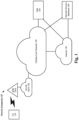
- Fig. 1 shows an exemplary network arrangement 100 according to various exemplary embodiments.
- the exemplary network arrangement 100 includes a UE 110.
- the UE 110 may be any type of electronic component that is configured to communicate via a network, e.g., mobile phones, tablet computers, desktop computers, smartphones, phablets, embedded devices, Internet of Things (IoT) devices, wearables (e.g., medical devices, augmented reality goggles, virtual reality googles, smart watches, etc.), industrial wireless sensors, video surveillance devices, etc.
- IoT Internet of Things
- wearables e.g., medical devices, augmented reality goggles, virtual reality googles, smart watches, etc.
- an actual network arrangement may include any number of UEs being used by any number of users.
- the example of a single UE 110 is merely provided for illustrative purposes.
- the 5G NR RAN 120 may be a portion of a cellular network that may be deployed by a network carrier (e.g., Verizon, AT&T, T-Mobile, etc.).
- the 5G NR RAN 120 may include, for example, nodes, cells or base stations (e.g., Node Bs, eNodeBs, HeNBs, eNBS, gNBs, gNodeBs, macrocells, microcells, small cells, femtocells, etc.) that are configured to send and receive traffic from UEs that are equipped with the appropriate cellular chip set.
- any association procedure may be performed for the UE 110 to connect to the 5G NR-RAN 120.
- the 5G NR-RAN 120 may be associated with a particular cellular provider where the UE 110 and/or the user thereof has a contract and credential information (e.g., stored on a SIM card).
- the UE 110 may transmit the corresponding credential information to associate with the 5G NR-RAN 120.
- the UE 110 may associate with a specific base station, e.g., the next generation Node B (gNB) 120A.
- gNB next generation Node B
- the network arrangement 100 also includes a cellular core network 130, the Internet 140, an IP Multimedia Subsystem (IMS) 150, and a network services backbone 160.
- the cellular core network 130 may be considered to be the interconnected set of components that manages the operation and traffic of the cellular network. It may include the evolved packet core (EPC) and/or the fifth generation core (5GC).
- the cellular core network 130 also manages the traffic that flows between the cellular network and the Internet 140.
- the IMS 150 may be generally described as an architecture for delivering multimedia services to the UE 110 using the IP protocol.
- the IMS 150 may communicate with the cellular core network 130 and the Internet 140 to provide the multimedia services to the UE 110.
- the network services backbone 160 is in communication either directly or indirectly with the Internet 140 and the cellular core network 130.
- the network services backbone 160 may be generally described as a set of components (e.g., servers, network storage arrangements, etc.) that implement a suite of services that may be used to extend the functionalities of the
- Fig. 2 shows an exemplary UE 110 according to various exemplary embodiments.
- the UE 110 will be described with regard to the network arrangement 100 of Fig. 1 .
- the UE 110 may include a processor 205, a memory arrangement 210, a display device 215, an input/output (I/O) device 220, a transceiver 225 and other components 230.
- the other components 230 may include, for example, an audio input device, an audio output device, a power supply, a data acquisition device, ports to electrically connect the UE 110 to other electronic devices, etc.
- the above noted engines 330, 335 each being an application (e.g., a program) executed by the processor 305 is only exemplary.
- the functionality associated with the engines 330, 335 may also be represented as a separate incorporated component of the base station 300 or may be a modular component coupled to the base station 300, e.g., an integrated circuit with or without firmware.
- the integrated circuit may include input circuitry to receive signals and processing circuitry to process the signals and other information.
- the functionality described for the processor 305 is split among a plurality of processors (e.g., a baseband processor, an applications processor, etc.).
- the exemplary embodiments may be implemented in any of these or other configurations of a base station.
- the exemplary embodiments introduce various ways in which the UE 110 may identify itself as a redcap device to the network.
- the total population of redcap devices may be categorized as a first type of redcap device or a second type of redcap device that is distinct from the first type of redcap device.
- redcap device type 1 and “redcap device type 2.”
- redcap device type 2 the term of redcap device types
- the exemplary embodiments may utilize any type of labeling or classifying to distinguish between different redcap device types.
- those skilled in the art will understand how the exemplary concepts described herein may apply to scenarios in which there is only one redcap device type and scenarios in which there are more than two redcap device types.
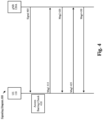
- Fig. 4 shows a signaling diagram 400 that illustrates a scenario during which various enhancements for redcap devices may be implemented.
- the exemplary embodiments are not limited to the scenario depicted in the signaling diagram 400.
- Each of the exemplary techniques described herein may be utilized in conjunction with other currently implemented redcap mechanisms, future implementations of redcap mechanisms or independently from other redcap mechanisms.
- a MIB may be configured to indicate whether a redcap device type is barred from the cell and/or frequency band.
- a sparse bit in the MIB payload may be repurposed to indicate that the cell and/or frequency band is barred for redcap UEs.
- the bit When the bit is set to a first value (e.g., 0), it may indicate that a redcap device type is barred from camping on the cell and/or frequency.
- a second value e.g., 1
- DCI may be configured to indicate whether a redcap device type is barred from the cell and/or frequency.
- DCI format 1_0 (which may be used to schedule SIB messages)
- SI system information
- RNTI system information-radio network temporary identifier
- One or more of the 15 reserved bits in DCI format 1_0 may be configured to indicate that the cell and/or frequency is barred for redcap UEs.
- the reserved bit is set to a first value (e.g., 0), it may indicate that a redcap device type is barred from camping on the cell and/or frequency.
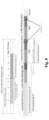
- Fig. 5 illustrates an example of DCI format 1_0 configured for redcap device access control.
- 2 out of the 15 reserved bits are to be considered for redcap access control.
- One advantage of the DCI format 1_0 approach is that the UE 110 may stop SIB1 acquisition once DCI format 1_0 is decoded and the access barring information is known.
- an IE (e.g., RedcapCellBarred IE or similar indication) may be added to SIB1 as an extension.
- a first value e.g., 0
- a second value e.g., 1
- the IE may be received in 405 as part of SIB1 and provide, at least in part, the basis for the access barring check in 410.
- an implicit indication based on one or more conditions may be utilized.
- the UE 110 may assume to be barred by the cell and/or frequency band if an initial downlink or uplink bandwidth part (BWP) is configured in SIB1 with a wider bandwidth than the maximum bandwidth supported by the redcap device type and there is no separate downlink or uplink BWP configured in SIB1 for redcap devices.
- BWP downlink or uplink bandwidth part
- the initial downlink and uplink BWP is equal to the maximum bandwidth for the redcap device type or there is a separate downlink and uplink BWP for redcap devices, it may indicate that the cell and/or frequency band are configured to provide access to redcap UEs or a particular redcap device type.
- these conditions may be indicated by a SIB1 received in 405.
- the signaling diagram 400 shows a 4-step random access procedure (e.g., Msg1, Msg2, Msg3, Msg4).
- Msg1, Msg2, Msg3, Msg4 e.g., Msg1, Msg2, Msg3, Msg4.
- the exemplary embodiments are not limited to a 4-step random access procedure.
- Those skilled in the art will understand how the exemplary embodiments may apply to a 2-step random access procedure (e.g., MsgA, MsgB).
- Msg1 of the 4-step random access procedure may apply to MsgA of the 2-step random access procedure
- Msg3 of the 4-step random access procedure may apply to MsgB of the 2-step random access procedure.
- each of these messages e.g., Msg1, Msg2, Msg3, Msg4, MsgA, MsgB
- 3GPP Standards 3GPP Standards.
- the UE 110 transmits Msg1 to the gNB 120A.
- Msg1 may comprise a PRACH preamble.
- the gNB 120A may transmit Msg2 to the UE 110 in response to Msg1.
- Msg2 may comprise a random access response (RAR) which may include a random access preamble ID (RAPID), a temporary RNTI and an uplink grant scheduling a physical uplink shared channel (PUSCH) (e.g., Msg3).
- RAR random access response
- RAPID random access preamble ID
- PUSCH physical uplink shared channel
- the UE 110 transmits Msg3 to the gNB 120A over the PUSCH.
- the gNB 120A transmits Msg4 to the UE 110.
- Msg4 may represent a contention resolution message.
- the exemplary embodiments introduce techniques for the UE 110 to identify itself as a redcap device through an early indication (e.g., during the random access procedure, prior to configuring RRC connected mode, etc.).
- the UE 110 may be identified by the network as a redcap device type based on selecting an uplink PRACH resource associated with redcap UEs. For this approach, it is assumed that an initial uplink BWP configured by SIB1 is shared by redcap devices and non-redcap devices.
- non-redcap UEs may use any of the ROs indexed 0-7 where ROs indexed 0-3 are shared with redcap UEs and ROs indexed 4-7 are dedicated for non-redcap UEs.
- the redcap UEs may use any of the ROs indexed 0-3.
- the IE "ssb-perRACH-OCcasionAndCB-PreamblesPerSSB-Redcap” may represent two values.
- a first value may convey the information about the number of SSBs per RO and the second value indications the number of contention based preambles per SSB. This parameter provides flexibility for the network to associate different preamble numbers for redcap UEs and non-redcap UEs under a same beam (e.g., SSB).
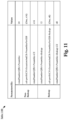
- Fig. 10 shows an example of splitting preambles within an RO for identifying redcap devices with and without CE and non-redcap devices with and without CE.
- several parameters may be introduced. An example of these parameters and corresponding values within the context of the scenario depicted in Fig. 10 is shown in table 1100 of Fig. 11 .
- a single information element provides an indication of a number of ROs in the set of dedicated redcap ROs and a number of ROs in the set of dedicated non-redcap ROs.
- the processor of the tenth example wherein the SIB includes an information element (IE) indicating a physical random access channel (PRACH) configuration index value specific to the redcap device type.
- IE information element
- PRACH physical random access channel
- the processor of the thirteenth example, wherein the set of dedicated redcap preambles comprises a number of preambles dedicated for a redcap UE operating in coverage enhancement (CE) mode.
- CE coverage enhancement
- the processor of the first example wherein the indication of the redcap device type is an information element (IE) received as part of message 3 (Msg3) payload during the random access procedure.
- IE information element
Landscapes
- Engineering & Computer Science (AREA)
- Computer Networks & Wireless Communication (AREA)
- Signal Processing (AREA)
- Computer Security & Cryptography (AREA)
- Databases & Information Systems (AREA)
- Mobile Radio Communication Systems (AREA)
Priority Applications (1)
| Application Number | Priority Date | Filing Date | Title |
|---|---|---|---|
| EP24176628.6A EP4398638A3 (fr) | 2021-08-05 | 2021-08-05 | Améliorations pour dispositifs de nouvelle radio à capacité réduite |
Applications Claiming Priority (3)
| Application Number | Priority Date | Filing Date | Title |
|---|---|---|---|
| PCT/CN2021/111004 WO2023010450A1 (fr) | 2021-08-05 | 2021-08-05 | Améliorations pour dispositifs de nouvelle radio à capacité réduite |
| EP21921682.7A EP4154604B1 (fr) | 2021-08-05 | 2021-08-05 | Améliorations pour dispositifs de nouvelle radio à capacité réduite |
| EP24176628.6A EP4398638A3 (fr) | 2021-08-05 | 2021-08-05 | Améliorations pour dispositifs de nouvelle radio à capacité réduite |
Related Parent Applications (2)
| Application Number | Title | Priority Date | Filing Date |
|---|---|---|---|
| EP21921682.7A Division EP4154604B1 (fr) | 2021-08-05 | 2021-08-05 | Améliorations pour dispositifs de nouvelle radio à capacité réduite |
| EP21921682.7A Division-Into EP4154604B1 (fr) | 2021-08-05 | 2021-08-05 | Améliorations pour dispositifs de nouvelle radio à capacité réduite |
Publications (2)
| Publication Number | Publication Date |
|---|---|
| EP4398638A2 true EP4398638A2 (fr) | 2024-07-10 |
| EP4398638A3 EP4398638A3 (fr) | 2024-09-04 |
Family
ID=85154076
Family Applications (4)
| Application Number | Title | Priority Date | Filing Date |
|---|---|---|---|
| EP21921682.7A Active EP4154604B1 (fr) | 2021-08-05 | 2021-08-05 | Améliorations pour dispositifs de nouvelle radio à capacité réduite |
| EP24176628.6A Pending EP4398638A3 (fr) | 2021-08-05 | 2021-08-05 | Améliorations pour dispositifs de nouvelle radio à capacité réduite |
| EP24176630.2A Pending EP4398639A3 (fr) | 2021-08-05 | 2021-08-05 | Améliorations pour dispositifs de nouvelle radio à capacité réduite |
| EP22196642.7A Active EP4161159B1 (fr) | 2021-08-05 | 2021-08-05 | Améliorations pour dispositifs de nouvelle radio à capacité réduite |
Family Applications Before (1)
| Application Number | Title | Priority Date | Filing Date |
|---|---|---|---|
| EP21921682.7A Active EP4154604B1 (fr) | 2021-08-05 | 2021-08-05 | Améliorations pour dispositifs de nouvelle radio à capacité réduite |
Family Applications After (2)
| Application Number | Title | Priority Date | Filing Date |
|---|---|---|---|
| EP24176630.2A Pending EP4398639A3 (fr) | 2021-08-05 | 2021-08-05 | Améliorations pour dispositifs de nouvelle radio à capacité réduite |
| EP22196642.7A Active EP4161159B1 (fr) | 2021-08-05 | 2021-08-05 | Améliorations pour dispositifs de nouvelle radio à capacité réduite |
Country Status (5)
| Country | Link |
|---|---|
| US (2) | US12526726B2 (fr) |
| EP (4) | EP4154604B1 (fr) |
| CN (2) | CN115913506B (fr) |
| MX (1) | MX2024001468A (fr) |
| WO (1) | WO2023010450A1 (fr) |
Families Citing this family (9)
| Publication number | Priority date | Publication date | Assignee | Title |
|---|---|---|---|---|
| CN114071552A (zh) * | 2020-07-29 | 2022-02-18 | 维沃移动通信有限公司 | 传输辅助信息的方法、终端设备和网络设备 |
| US20230051928A1 (en) * | 2021-08-13 | 2023-02-16 | Samsung Electronics Co., Ltd. | Early indication by user equipment |
| US12477570B2 (en) * | 2021-09-27 | 2025-11-18 | Samsung Electronics Co., Ltd. | Early indication for initial access in full-duplex systems |
| US12598592B2 (en) * | 2022-09-19 | 2026-04-07 | T-Mobile Usa, Inc. | Reservation of FDD frequencies for reduced capability devices |
| CN120677828A (zh) * | 2023-02-14 | 2025-09-19 | 苹果公司 | 用于标识无线网络中的增强型降低能力用户装备的技术 |
| WO2024207387A1 (fr) * | 2023-04-06 | 2024-10-10 | 北京小米移动软件有限公司 | Procédés, système et appareils de contrôle d'accès, dispositif de communication et support d'enregistrement |
| WO2025025194A1 (fr) * | 2023-08-03 | 2025-02-06 | Oppo广东移动通信有限公司 | Procédé et appareil d'envoi de message en liaison montante, dispositif et support de stockage |
| GB2637741A (en) * | 2024-02-01 | 2025-08-06 | Nokia Technologies Oy | Cell barring |
| WO2025211779A1 (fr) * | 2024-04-03 | 2025-10-09 | Samsung Electronics Co., Ltd. | Procédé et appareil d'accès aléatoire dans un système de communication sans fil |
Family Cites Families (16)
| Publication number | Priority date | Publication date | Assignee | Title |
|---|---|---|---|---|
| US9936524B2 (en) * | 2014-12-24 | 2018-04-03 | Intel Corporation | Random access procedure for handover |
| US10880867B2 (en) * | 2017-11-17 | 2020-12-29 | Qualcomm Incorporated | Selecting a new radio uplink resource to transmit a random access procedure communication |
| US11064473B2 (en) * | 2018-01-12 | 2021-07-13 | Apple Inc. | Transmission downlink control information for new radio (NR) system |
| US11310836B2 (en) * | 2019-08-19 | 2022-04-19 | Samsung Electronics Co., Ltd. | Repetition of PRACH preamble transmission for UEs |
| US11653389B2 (en) * | 2019-12-20 | 2023-05-16 | Qualcomm Incorporated | Methods and apparatus for indicating and switching UE capabilities |
| WO2021127962A1 (fr) * | 2019-12-24 | 2021-07-01 | Qualcomm Incorporated | Répétition efficace de nouveau message de lumière radio dans une procédure de canal d'accès aléatoire en deux étapes |
| CN119325154A (zh) | 2020-01-09 | 2025-01-17 | 瑞典爱立信有限公司 | 用于低复杂度用户设备的随机接入的方法和装置 |
| US11076344B1 (en) | 2020-01-20 | 2021-07-27 | PanPsy Technologies, LLC | Wireless device and wireless network processes for access control |
| CN116347631B (zh) | 2020-01-21 | 2025-09-23 | 中兴通讯股份有限公司 | 一种信息处理方法、装置、设备和存储介质 |
| US20230209542A1 (en) * | 2020-03-23 | 2023-06-29 | FG Innovation Company Limited | Method of initial access in wireless communications and related device |
| US11683840B2 (en) | 2020-04-15 | 2023-06-20 | Qualcomm Incorporated | Techniques for user equipment (UE) procedures for random access channel (RACH) type selection and random access response (RAR) monitoring in a wireless communication system |
| US12484064B2 (en) * | 2020-04-21 | 2025-11-25 | Beijing Xiaomi Mobile Software Co., Ltd. | Method of reporting user equipment capability, equipment, and computer readable storage medium |
| US12245178B2 (en) | 2020-05-14 | 2025-03-04 | Sony Group Corporation | Coverage enhancement in a wireless network |
| CN116868626A (zh) * | 2020-08-05 | 2023-10-10 | 紫藤科技有限公司 | 无线电访问方法、用户设备和基站 |
| US11683849B2 (en) | 2021-03-24 | 2023-06-20 | Nokia Technologies Oy | Redcap UE identification |
| US12232166B2 (en) * | 2021-05-11 | 2025-02-18 | Qualcomm Incorporated | Narrowband random access channel occasions |
-
2021
- 2021-08-05 WO PCT/CN2021/111004 patent/WO2023010450A1/fr not_active Ceased
- 2021-08-05 MX MX2024001468A patent/MX2024001468A/es unknown
- 2021-08-05 EP EP21921682.7A patent/EP4154604B1/fr active Active
- 2021-08-05 US US17/760,034 patent/US12526726B2/en active Active
- 2021-08-05 EP EP24176628.6A patent/EP4398638A3/fr active Pending
- 2021-08-05 EP EP24176630.2A patent/EP4398639A3/fr active Pending
- 2021-08-05 CN CN202211140753.3A patent/CN115913506B/zh active Active
- 2021-08-05 EP EP22196642.7A patent/EP4161159B1/fr active Active
- 2021-08-05 CN CN202180012697.2A patent/CN115943676A/zh active Pending
-
2025
- 2025-07-18 US US19/273,453 patent/US20250351197A1/en active Pending
Also Published As
| Publication number | Publication date |
|---|---|
| WO2023010450A1 (fr) | 2023-02-09 |
| EP4398639A3 (fr) | 2024-09-04 |
| EP4398639A2 (fr) | 2024-07-10 |
| EP4154604A4 (fr) | 2023-03-29 |
| EP4161159C0 (fr) | 2024-06-26 |
| US12526726B2 (en) | 2026-01-13 |
| US20250351197A1 (en) | 2025-11-13 |
| CN115913506A (zh) | 2023-04-04 |
| MX2024001468A (es) | 2024-02-27 |
| EP4161159A1 (fr) | 2023-04-05 |
| EP4154604B1 (fr) | 2024-06-26 |
| CN115913506B (zh) | 2026-03-17 |
| EP4154604A1 (fr) | 2023-03-29 |
| EP4398638A3 (fr) | 2024-09-04 |
| EP4154604C0 (fr) | 2024-06-26 |
| EP4161159B1 (fr) | 2024-06-26 |
| CN115943676A (zh) | 2023-04-07 |
| US20240187967A1 (en) | 2024-06-06 |
Similar Documents
| Publication | Publication Date | Title |
|---|---|---|
| US12382507B2 (en) | Enhancements for reduced capability new radio devices | |
| US12526726B2 (en) | Enhancements for reduced capability new radio devices | |
| EP4145750B1 (fr) | Capacités de positionnement de nouveaux dispositifs radio à capacité réduite | |
| EP3713135B1 (fr) | Procédé et dispositif d'émission et de réception d'informations | |
| AU2012319821B2 (en) | Wireless communication apparatus, wireless communication method, and wireless communication system | |
| US9742532B2 (en) | Method, system and device for using terminal identifier | |
| US20250185058A1 (en) | User equipment and base station performing transmission and reception operations | |
| US12068990B2 (en) | Physical downlink control channel transmission and reception techniques for dynamic spectrum sharing | |
| WO2020220311A1 (fr) | Systèmes et procédés de procédure d'accès aléatoire améliorée | |
| US12550196B2 (en) | Random access message transmissions for reduced capability user equipment | |
| US20250337555A1 (en) | Half Duplex Frequency Division Duplex Collision Handling | |
| US20250317992A1 (en) | Method and apparatus for random access procedure | |
| US12244547B2 (en) | Half duplex frequency division duplex for new radio | |
| US20220295565A1 (en) | Enhancements for New Radio Devices with a Reduced Number of Antenna Branches | |
| JP7680559B2 (ja) | 通信装置、基地局及び通信方法 | |
| WO2024167671A1 (fr) | Prise en charge de multiples avances temporelles pour de multiples points de transmission et de réception | |
| US20260067923A1 (en) | Message scheduling method and apparatus | |
| CN120239993A (zh) | 下行控制信息dci的传输方法、终端、网络设备 |
Legal Events
| Date | Code | Title | Description |
|---|---|---|---|
| PUAI | Public reference made under article 153(3) epc to a published international application that has entered the european phase |
Free format text: ORIGINAL CODE: 0009012 |
|
| STAA | Information on the status of an ep patent application or granted ep patent |
Free format text: STATUS: REQUEST FOR EXAMINATION WAS MADE |
|
| 17P | Request for examination filed |
Effective date: 20240517 |
|
| AC | Divisional application: reference to earlier application |
Ref document number: 4154604 Country of ref document: EP Kind code of ref document: P |
|
| AK | Designated contracting states |
Kind code of ref document: A2 Designated state(s): AL AT BE BG CH CY CZ DE DK EE ES FI FR GB GR HR HU IE IS IT LI LT LU LV MC MK MT NL NO PL PT RO RS SE SI SK SM TR |
|
| REG | Reference to a national code |
Ref country code: DE Ref legal event code: R079 Free format text: PREVIOUS MAIN CLASS: H04W0048020000 Ipc: H04W0048120000 |
|
| PUAL | Search report despatched |
Free format text: ORIGINAL CODE: 0009013 |
|
| AK | Designated contracting states |
Kind code of ref document: A3 Designated state(s): AL AT BE BG CH CY CZ DE DK EE ES FI FR GB GR HR HU IE IS IT LI LT LU LV MC MK MT NL NO PL PT RO RS SE SI SK SM TR |
|
| RIC1 | Information provided on ipc code assigned before grant |
Ipc: H04W 48/02 20090101ALN20240801BHEP Ipc: H04W 48/12 20090101AFI20240801BHEP |