EP4398663A1 - Procédé et appareil de surveillance, procédé et appareil de transmission de signal d'activation, terminal et dispositif côté réseau - Google Patents
Procédé et appareil de surveillance, procédé et appareil de transmission de signal d'activation, terminal et dispositif côté réseau Download PDFInfo
- Publication number
- EP4398663A1 EP4398663A1 EP22863326.9A EP22863326A EP4398663A1 EP 4398663 A1 EP4398663 A1 EP 4398663A1 EP 22863326 A EP22863326 A EP 22863326A EP 4398663 A1 EP4398663 A1 EP 4398663A1
- Authority
- EP
- European Patent Office
- Prior art keywords
- wake
- signal
- monitoring
- terminal
- duration
- Prior art date
- Legal status (The legal status is an assumption and is not a legal conclusion. Google has not performed a legal analysis and makes no representation as to the accuracy of the status listed.)
- Pending
Links
Images



Classifications
-
- H—ELECTRICITY
- H04—ELECTRIC COMMUNICATION TECHNIQUE
- H04W—WIRELESS COMMUNICATION NETWORKS
- H04W52/00—Power management, e.g. Transmission Power Control [TPC] or power classes
- H04W52/02—Power saving arrangements
- H04W52/0209—Power saving arrangements in terminal devices
- H04W52/0225—Power saving arrangements in terminal devices using monitoring of external events, e.g. the presence of a signal
- H04W52/0229—Power saving arrangements in terminal devices using monitoring of external events, e.g. the presence of a signal where the received signal is a wanted signal
- H04W52/0232—Power saving arrangements in terminal devices using monitoring of external events, e.g. the presence of a signal where the received signal is a wanted signal according to average transmission signal activity
-
- H—ELECTRICITY
- H04—ELECTRIC COMMUNICATION TECHNIQUE
- H04W—WIRELESS COMMUNICATION NETWORKS
- H04W52/00—Power management, e.g. Transmission Power Control [TPC] or power classes
- H04W52/02—Power saving arrangements
- H04W52/0209—Power saving arrangements in terminal devices
- H04W52/0225—Power saving arrangements in terminal devices using monitoring of external events, e.g. the presence of a signal
- H04W52/0229—Power saving arrangements in terminal devices using monitoring of external events, e.g. the presence of a signal where the received signal is a wanted signal
-
- H—ELECTRICITY
- H04—ELECTRIC COMMUNICATION TECHNIQUE
- H04L—TRANSMISSION OF DIGITAL INFORMATION, e.g. TELEGRAPHIC COMMUNICATION
- H04L5/00—Arrangements affording multiple use of the transmission path
- H04L5/0091—Signalling for the administration of the divided path, e.g. signalling of configuration information
- H04L5/0094—Indication of how sub-channels of the path are allocated
-
- H—ELECTRICITY
- H04—ELECTRIC COMMUNICATION TECHNIQUE
- H04W—WIRELESS COMMUNICATION NETWORKS
- H04W52/00—Power management, e.g. Transmission Power Control [TPC] or power classes
- H04W52/02—Power saving arrangements
- H04W52/0209—Power saving arrangements in terminal devices
- H04W52/0225—Power saving arrangements in terminal devices using monitoring of external events, e.g. the presence of a signal
- H04W52/0229—Power saving arrangements in terminal devices using monitoring of external events, e.g. the presence of a signal where the received signal is a wanted signal
- H04W52/0235—Power saving arrangements in terminal devices using monitoring of external events, e.g. the presence of a signal where the received signal is a wanted signal where the received signal is a power saving command
-
- H—ELECTRICITY
- H04—ELECTRIC COMMUNICATION TECHNIQUE
- H04W—WIRELESS COMMUNICATION NETWORKS
- H04W72/00—Local resource management
- H04W72/12—Wireless traffic scheduling
-
- H—ELECTRICITY
- H04—ELECTRIC COMMUNICATION TECHNIQUE
- H04W—WIRELESS COMMUNICATION NETWORKS
- H04W72/00—Local resource management
- H04W72/12—Wireless traffic scheduling
- H04W72/1263—Mapping of traffic onto schedule, e.g. scheduled allocation or multiplexing of flows
- H04W72/1273—Mapping of traffic onto schedule, e.g. scheduled allocation or multiplexing of flows of downlink data flows
-
- H—ELECTRICITY
- H04—ELECTRIC COMMUNICATION TECHNIQUE
- H04W—WIRELESS COMMUNICATION NETWORKS
- H04W52/00—Power management, e.g. Transmission Power Control [TPC] or power classes
- H04W52/02—Power saving arrangements
- H04W52/0209—Power saving arrangements in terminal devices
- H04W52/0212—Power saving arrangements in terminal devices managed by the network, e.g. network or access point is leader and terminal is follower
- H04W52/0216—Power saving arrangements in terminal devices managed by the network, e.g. network or access point is leader and terminal is follower using a pre-established activity schedule, e.g. traffic indication frame
-
- H—ELECTRICITY
- H04—ELECTRIC COMMUNICATION TECHNIQUE
- H04W—WIRELESS COMMUNICATION NETWORKS
- H04W52/00—Power management, e.g. Transmission Power Control [TPC] or power classes
- H04W52/02—Power saving arrangements
- H04W52/0209—Power saving arrangements in terminal devices
- H04W52/0261—Power saving arrangements in terminal devices managing power supply demand, e.g. depending on battery level
- H04W52/0274—Power saving arrangements in terminal devices managing power supply demand, e.g. depending on battery level by switching on or off the equipment or parts thereof
- H04W52/028—Power saving arrangements in terminal devices managing power supply demand, e.g. depending on battery level by switching on or off the equipment or parts thereof switching on or off only a part of the equipment circuit blocks
-
- H—ELECTRICITY
- H04—ELECTRIC COMMUNICATION TECHNIQUE
- H04W—WIRELESS COMMUNICATION NETWORKS
- H04W72/00—Local resource management
- H04W72/04—Wireless resource allocation
-
- H—ELECTRICITY
- H04—ELECTRIC COMMUNICATION TECHNIQUE
- H04W—WIRELESS COMMUNICATION NETWORKS
- H04W76/00—Connection management
- H04W76/20—Manipulation of established connections
- H04W76/28—Discontinuous transmission [DTX]; Discontinuous reception [DRX]
-
- Y—GENERAL TAGGING OF NEW TECHNOLOGICAL DEVELOPMENTS; GENERAL TAGGING OF CROSS-SECTIONAL TECHNOLOGIES SPANNING OVER SEVERAL SECTIONS OF THE IPC; TECHNICAL SUBJECTS COVERED BY FORMER USPC CROSS-REFERENCE ART COLLECTIONS [XRACs] AND DIGESTS
- Y02—TECHNOLOGIES OR APPLICATIONS FOR MITIGATION OR ADAPTATION AGAINST CLIMATE CHANGE
- Y02D—CLIMATE CHANGE MITIGATION TECHNOLOGIES IN INFORMATION AND COMMUNICATION TECHNOLOGIES [ICT], I.E. INFORMATION AND COMMUNICATION TECHNOLOGIES AIMING AT THE REDUCTION OF THEIR OWN ENERGY USE
- Y02D30/00—Reducing energy consumption in communication networks
- Y02D30/70—Reducing energy consumption in communication networks in wireless communication networks
Definitions
- Some services such as extended reality (Extended Reality, XR) services feature non-positive integer periods, and their service packets require data compression, rendering, and other processes at a server side, resulting in jitter within a specific time domain range at an actual time when a service packet reaches the network side.
- extended reality Extended Reality
- XR Extended Reality
- Embodiments of this application provide a monitoring method and apparatus, a wake-up signal transmission method and apparatus, a terminal, and a network-side device, so as to resolve a prior-art problem of failing to balance a data scheduling delay and power consumption of the terminal .
- a monitoring method including:
- a wake-up signal transmission method including:
- a wake-up signal transmission apparatus applied to a network-side device and including:
- a terminal including a processor and a communication interface.
- the communication interface is configured to configure wake-up signal configuration information
- the processor is configured to perform detection for a wake-up signal within a first duration according to the wake-up signal configuration information, where the first duration belongs to a physical downlink control channel PDCCH monitoring time period configured by the network-side device; and determine a monitoring behavior for a target channel based on the detection of the wake-up signal, where the target channel includes at least one of the following: physical downlink control channel PDCCH; physical downlink shared channel PDSCH; and physical uplink shared channel PUSCH.
- a network-side device includes a processor, a memory, and a program or instructions stored in the memory and capable of running on the processor, and when the program or instructions are executed by the processor, the steps of the method according to the second aspect are implemented.
- a network-side device including a processor and a communication interface, where the processor is configured to configure wake-up signal configuration information for a terminal via the communication interface, and transmit a wake-up signal within a first duration according to the wake-up signal configuration information, where the first duration belongs to a physical downlink control channel PDCCH monitoring time period configured by the network-side device.
- a readable storage medium where a program or instructions are stored in the readable storage medium, and when the program or instructions are executed by a processor, the steps of the method according to the first aspect are implemented, or the steps of the method according to the second aspect are implemented.
- a chip is provided, where the chip includes a processor and a communication interface, the communication interface is coupled to the processor, and the processor is configured to run a program or instructions to implement the method according to the first aspect or implement the method according to the second aspect.
- LTE Long Term Evolution
- LTE-A LTE-advanced
- LTE-A LTE-Advanced
- CDMA code division multiple access
- TDMA time division multiple access
- FDMA frequency division multiple access
- OFDMA Orthogonal Frequency Division Multiple Access
- SC-FDMA single-carrier Frequency-Division Multiple Access
- the base station may be referred to as a NodeB, an evolved NodeB, an access point, a base transceiver station (Base Transceiver Station, BTS), a radio base station, a radio transceiver, a basic service set (Basic Service Set, BSS), an extended service set (Extended Service Set, ESS), a NodeB, an evolved NodeB (Evolved Node B, eNB), a home NodeB, a home evolved NodeB, a wireless local area network (Wireless Local Area Networks, WLAN) access point, a wireless fidelity (Wireless Fidelity, WiFi) node, a transmission and reception point (Transmitting Receiving Point, TRP), or another appropriate term in the art.
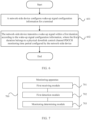
- Step 201 A terminal obtains wake-up signal configuration information.
- Step 203 The terminal determines a monitoring behavior for a target channel based on the detection of the wake-up signal, where the target channel includes at least one of the following:
- the PDCCH monitoring time period configured by the network-side device includes: DRX active time (DRX active time, where, for example, the running periods of DRX timers such as a DRX onduration timer and a DRX inactivity timer all belong to the DRX active time), and/or a monitoring time period that is corresponding to a PDCCH monitoring occasion and configured by using radio resource control (Radio Resource Control, RRC).
- DRX active time DRX active time
- RRC Radio Resource Control
- the terminal during the detecting for the wake-up signal, does not perform monitoring for a first channel, the first channel including at least one of PDCCH, PDSCH, and PUSCH.
- the terminal does not simultaneously monitor the target channel during detection for or monitoring for the wake-up signal. This enables the terminal to monitor only either of the wake-up signal and the target channel, thereby avoiding an increase in power consumption of the terminal.
- step 202 includes: in a case that the terminal detects the wake-up signal or in a case that the terminal detects the wake-up signal and the wake-up signal indicates monitoring the target channel, the terminal performs monitoring for the target channel.
- the terminal performing monitoring for the target channel includes: before the foregoing two cases occur, the terminal does not perform or performs monitoring for the target channel. In either of the foregoing two cases, the terminal starts to perform monitoring for the target channel, or the terminal resumes or continues monitoring for the target channel.
- step 202 includes: in a case that the terminal does not detect the wake-up signal or in a case that the terminal detects the wake-up signal and the wake-up signal indicates not monitoring the target channel, the terminal skips the monitoring for the target channel.
- the terminal detecting no wake-up signal means that the terminal performs detection for a wake-up signal but detects no wake-up signal. That the terminal cannot perform detection for the wake-up signal or does not perform detection for the wake-up signal does not belong to a case of the terminal detecting no wake-up signal .
- the terminal not performing monitoring for the target channel includes: the terminal performs monitoring or does not perform monitoring for the target channel before the foregoing two cases occur, and the terminal suspends monitoring for the target channel in either of the foregoing two cases.
- the step 202 includes: in a case that the terminal detects a wake-up signal and the wake-up signal indicates a first time interval, the terminal performs monitoring for the target channel when or after the ending of the first time interval, and/or the terminal skips the monitoring for the target channel within the first time interval.
- the method further includes: performing, by the terminal, detection for the wake-up signal within the first time interval.
- the terminal does not perform detection for the wake-up signal within the first time interval, so as to implement further power saving for the terminal.
- the "second-channel skipping indication" is used to indicate that the terminal suspends monitoring on the second channel or does not monitor the second channel during the second-channel skipping time period.
- the third channel includes at least one of PDCCH, PDSCH, and PUSCH.
- the third channel is PDCCH, and the PDCCH includes: a PDCCH corresponding to the type 3 CSS set and a PDCCH corresponding to the USS set.
- the "second-channel skipping indication" may be implemented by switching to a dormant search space group.
- the terminal switches to a dormant search space group, and does not perform monitoring on the third channel.
- the terminal in a case that the terminal receives a second-channel skipping indication, the terminal performs detection for the wake-up signal within the second-channel skipping duration indicated by the second-channel skipping indication, thereby implementing further power saving for the terminal.
- the method further includes:
- the time unit may be millisecond, symbol, slot, subframe, or the like, which is not limited herein.
- the terminal in a case that the terminal detects the wake-up signal or in a case that the terminal detects the wake-up signal and the wake-up signal indicates monitoring the target channel, the terminal adjusts the starting time of a DRX onduration timer to be the ending time of a time unit in which the wake-up signal is detected and performs monitoring for the target channel at the starting time of the adjusted DRX onduration timer.
- the terminal starts the DRX inactivity timer and performs monitoring for the target channel.
- the method further includes:
- the wake-up signal indicates the second time interval (that is, a wake-up time is indirectly indicated). If the second time interval is 6ms, the terminal does not perform monitoring for the target channel within the 6ms, and after the 6ms, the terminal starts the DRX inactivity timer and performs monitoring for the target channel. Further, the terminal performs detection for the wake-up signal during the 6ms, or the terminal does not perform detection for the wake-up signal within the 6ms.
- the wake-up signal configuration information includes at least one of the following:
- step 201 includes: the terminal performs detection on the wake-up signal monitoring occasion within the first duration, according to the wake-up signal configuration information.
- the first duration being a DRX onduration includes: a start time of the first duration being a start time of the DRX onduration, and an end time of the first duration being an end time of the DRX onduration.
- the first duration is a DRX onduration
- the network configures a wake-up signal monitoring occasion (that is, wake-up signal (Wake-up signal, WUS) monitoring occasion (Monitor Occasion, MO)) to be within the DRX onduration, as shown in FIG. 3 .
- the network further configures a time-frequency resource occupied by the WUS MO, a monitoring period of the WUS MO, and the like. For example, there is only one sequence for WUS, and if the terminal detects this WUS sequence, it means being awakened for PDCCH monitoring, and if it does not detect this sequence, which means that the terminal is not awakened for PDCCH monitoring, the terminal does not perform PDCCH monitoring.
- the terminal detects a wake-up signal, and then starts PDCCH monitoring.
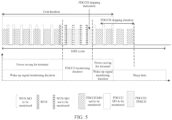
- the network configures a first duration, where the first duration is related to a service period and a service jitter delay range.
- the service is an XR service.
- the network configures a WUS MO to be within the first duration, that is, the terminal monitors the WUS within the first duration.
- the network also configures a PDCCH skipping indication for the terminal, such as a PDCCH skipping indication (PDCCH skipping indication) carried by downlink control information (Downlink Control Information, DCI).
- PDCCH skipping indication carried by downlink control information (Downlink Control Information, DCI).
- Content indicated by the PDCCH skipping indication is a value of a PDCCH skipping duration, as shown in FIG. 5 .
- the wake-up signal configuration information includes at least one of the following:
- the method further includes:
- the network-side device in a case that the network-side device transmits the wake-up signal or in a case that the network-side device transmits the wake-up signal and the wake-up signal indicates monitoring the target channel, the network-side device adjusts the starting time of a DRX onduration timer to be the ending time of a time unit in which the wake-up signal is detected and performs transmission of the target channel at the starting time of the adjusted DRX onduration timer.
- the target channel includes at least one of PDCCH, PDSCH, and PUSCH.
- the first duration being part of the DRX onduration includes:
- the wake-up signal is a low power wake-up signal, where low power means that a relative power consumed by the terminal for wake-up signal monitoring is lower than a power consumed for PDCCH monitoring.
- a relative power consumed for the wake-up signal is greater than a relative power consumed in a sleep state.
- a wake-up signal monitoring occasion is configured to be within a PDCCH monitoring time period configured by the network-side device, and the terminal determines a monitoring behavior for the target channel based on the detection of the wake-up signal (for example, monitoring on WUS MOs is preferentially performed within the first duration configured with the WUS MOs, and after a WUS indicating wake-up is detected, PDCCH monitoring is initiated).
- a monitoring behavior for the target channel for example, monitoring on WUS MOs is preferentially performed within the first duration configured with the WUS MOs, and after a WUS indicating wake-up is detected, PDCCH monitoring is initiated.
- the monitoring method or wake-up signal transmission method in the embodiments of this application may be executed by a monitoring apparatus or wake-up signal transmission apparatus, or by a control module for executing the monitoring method or wake-up signal transmission method in the monitoring apparatus or wake-up signal transmission apparatus.
- the monitoring apparatus or wake-up signal transmission apparatus provided by the embodiments of this application is described by using the monitoring method or wake-up signal transmission method being performed by the monitoring apparatus or wake-up signal transmission apparatus as an example.
- an embodiment of this application further provides a monitoring apparatus 700, applied to a terminal and including:
- a wake-up signal monitoring occasion is configured to be within a PDCCH monitoring time period configured by the network-side device, and the terminal determines a monitoring behavior for the target channel based on the detection of the wake-up signal (for example, monitoring on WUS MOs is preferentially performed within the first duration configured with the WUS MOs, and after a WUS indicating wake-up is detected, PDCCH monitoring is initiated).
- a monitoring behavior for the target channel for example, monitoring on WUS MOs is preferentially performed within the first duration configured with the WUS MOs, and after a WUS indicating wake-up is detected, PDCCH monitoring is initiated.
- An embodiment of this application further provides a chip, where the chip includes a processor and a communication interface.
- the communication interface is coupled to the processor, and the processor is configured to run a program or instructions to implement the processes of the foregoing embodiment of the monitoring method or the foregoing embodiment of the wake-up signal transmission method, with the same technical effects achieved. To avoid repetition, details are not described herein again.
Landscapes
- Engineering & Computer Science (AREA)
- Signal Processing (AREA)
- Computer Networks & Wireless Communication (AREA)
- Mobile Radio Communication Systems (AREA)
Applications Claiming Priority (2)
| Application Number | Priority Date | Filing Date | Title |
|---|---|---|---|
| CN202111021018.6A CN115767743A (zh) | 2021-09-01 | 2021-09-01 | 监听方法、唤醒信号传输方法、装置、终端及网络侧设备 |
| PCT/CN2022/115149 WO2023030189A1 (fr) | 2021-09-01 | 2022-08-26 | Procédé et appareil de surveillance, procédé et appareil de transmission de signal d'activation, terminal et dispositif côté réseau |
Publications (2)
| Publication Number | Publication Date |
|---|---|
| EP4398663A1 true EP4398663A1 (fr) | 2024-07-10 |
| EP4398663A4 EP4398663A4 (fr) | 2025-01-08 |
Family
ID=85332184
Family Applications (1)
| Application Number | Title | Priority Date | Filing Date |
|---|---|---|---|
| EP22863326.9A Pending EP4398663A4 (fr) | 2021-09-01 | 2022-08-26 | Procédé et appareil de surveillance, procédé et appareil de transmission de signal d'activation, terminal et dispositif côté réseau |
Country Status (4)
| Country | Link |
|---|---|
| US (1) | US20240196327A1 (fr) |
| EP (1) | EP4398663A4 (fr) |
| CN (1) | CN115767743A (fr) |
| WO (1) | WO2023030189A1 (fr) |
Families Citing this family (23)
| Publication number | Priority date | Publication date | Assignee | Title |
|---|---|---|---|---|
| WO2021104615A1 (fr) * | 2019-11-27 | 2021-06-03 | Telefonaktiebolaget Lm Ericsson (Publ) | Surveillance sélective de signal de réveil |
| WO2021104616A1 (fr) | 2019-11-27 | 2021-06-03 | Telefonaktiebolaget Lm Ericsson (Publ) | Optimisation de la surveillance de signaux de réveil |
| CN117479269A (zh) * | 2022-07-20 | 2024-01-30 | 维沃移动通信有限公司 | Lp-wus的监听和发送方法、终端及网络侧设备 |
| US20240259941A1 (en) * | 2023-01-31 | 2024-08-01 | Samsung Electronics Co., Ltd. | Triggering a main receiver |
| EP4674186A4 (fr) * | 2023-03-30 | 2026-04-22 | Zte Corp | Techniques d'économie d'énergie pour systèmes de communication |
| CN117939592A (zh) * | 2023-04-04 | 2024-04-26 | 中兴通讯股份有限公司 | 一种信号的监测、发送方法、通信节点及存储介质 |
| CN118828807A (zh) * | 2023-04-18 | 2024-10-22 | 维沃移动通信有限公司 | 传输处理方法、装置、终端及网络侧设备 |
| CN121195237A (zh) * | 2023-05-12 | 2025-12-23 | 华为技术有限公司 | 用于控制低功耗唤醒信号监测的设备、方法和系统 |
| CN118945773A (zh) * | 2023-05-12 | 2024-11-12 | 华为技术有限公司 | 通信方法与通信装置 |
| CN118984480A (zh) * | 2023-05-15 | 2024-11-19 | 维沃移动通信有限公司 | 传输处理方法、装置、终端及网络侧设备 |
| WO2024239166A1 (fr) * | 2023-05-19 | 2024-11-28 | 北京小米移动软件有限公司 | Procédés et appareils de communication |
| CN117136593A (zh) * | 2023-06-30 | 2023-11-28 | 北京小米移动软件有限公司 | 通信处理方法、终端、网络设备 |
| CN119277482A (zh) * | 2023-07-04 | 2025-01-07 | 维沃移动通信有限公司 | Lp-wus的监听方法、终端及网络侧设备 |
| CN119300054A (zh) * | 2023-07-10 | 2025-01-10 | 维沃移动通信有限公司 | 传输处理方法、装置、终端及网络侧设备 |
| CN119325149A (zh) * | 2023-07-11 | 2025-01-17 | 维沃移动通信有限公司 | Pdcch监听方法、信息发送方法、装置及设备 |
| CN117223320A (zh) * | 2023-07-31 | 2023-12-12 | 北京小米移动软件有限公司 | 通信处理方法及装置 |
| CN119892314A (zh) * | 2023-10-24 | 2025-04-25 | 维沃移动通信有限公司 | 监听处理方法、装置、终端及网络侧设备 |
| WO2025111887A1 (fr) * | 2023-11-29 | 2025-06-05 | Zte Corporation | Procédé, dispositif et produit-programme informatique pour communication sans fil |
| CN120075829A (zh) * | 2023-11-30 | 2025-05-30 | 华为技术有限公司 | 通信方法、装置及系统 |
| CN120390272A (zh) * | 2024-01-26 | 2025-07-29 | 维沃移动通信有限公司 | Wus监听方法、发送方法、装置、终端及网络侧设备 |
| CN120475480A (zh) * | 2024-02-08 | 2025-08-12 | 大唐移动通信设备有限公司 | 低功耗唤醒信号传输方法、装置及设备 |
| WO2025050816A2 (fr) * | 2024-07-09 | 2025-03-13 | 深圳传音控股股份有限公司 | Procédé de traitement, dispositif de communication et support de stockage |
| WO2026039933A1 (fr) * | 2024-08-19 | 2026-02-26 | Qualcomm Incorporated | Surveillance de signal de réveil à faible puissance |
Family Cites Families (10)
| Publication number | Priority date | Publication date | Assignee | Title |
|---|---|---|---|---|
| US7212843B2 (en) * | 2003-05-15 | 2007-05-01 | Motorola Inc. | Current reduction in a communication device |
| US9460321B1 (en) * | 2014-08-20 | 2016-10-04 | Sandia Corporation | Zero-power receiver |
| US11025456B2 (en) * | 2018-01-12 | 2021-06-01 | Apple Inc. | Time domain resource allocation for mobile communication |
| US11490334B2 (en) * | 2018-09-19 | 2022-11-01 | Ofinno, Llc | Power saving in a wireless communication system |
| US11751140B2 (en) * | 2019-02-11 | 2023-09-05 | Beijing Xiaomi Mobile Software Co., Ltd. | Channel monitoring methods and apparatuses |
| US11368911B2 (en) * | 2019-04-30 | 2022-06-21 | Hannibal Ip Llc | Method of physical downlink control channel monitoring and related device |
| CN111294902B (zh) * | 2019-07-05 | 2021-06-18 | 展讯通信(上海)有限公司 | 唤醒方法及装置、存储介质、终端 |
| CN110520840B (zh) * | 2019-07-17 | 2023-06-27 | 北京小米移动软件有限公司 | 唤醒信号处理、信息下发方法及装置、通信设备及介质 |
| CN112399529B (zh) * | 2019-08-15 | 2022-10-28 | 华为技术有限公司 | 一种通信方法及相关设备 |
| CN111800801B (zh) * | 2019-08-16 | 2022-05-27 | 维沃移动通信有限公司 | Pdcch的监听方法和设备 |
-
2021
- 2021-09-01 CN CN202111021018.6A patent/CN115767743A/zh active Pending
-
2022
- 2022-08-26 EP EP22863326.9A patent/EP4398663A4/fr active Pending
- 2022-08-26 WO PCT/CN2022/115149 patent/WO2023030189A1/fr not_active Ceased
-
2024
- 2024-02-26 US US18/586,890 patent/US20240196327A1/en active Pending
Also Published As
| Publication number | Publication date |
|---|---|
| WO2023030189A1 (fr) | 2023-03-09 |
| US20240196327A1 (en) | 2024-06-13 |
| CN115767743A (zh) | 2023-03-07 |
| EP4398663A4 (fr) | 2025-01-08 |
Similar Documents
| Publication | Publication Date | Title |
|---|---|---|
| EP4398663A1 (fr) | Procédé et appareil de surveillance, procédé et appareil de transmission de signal d'activation, terminal et dispositif côté réseau | |
| US20240022387A1 (en) | Transmission processing method, terminal and network-side device | |
| US12610426B2 (en) | Discontinuous transmission method, signal sending and processing method, and related device | |
| US20250071683A1 (en) | Monitoring method and apparatus, terminal, network-side device, and readable storage medium | |
| US20240430807A1 (en) | Discontinuous reception drx parameter configuration method and apparatus, terminal, and network-side device | |
| EP4274339B1 (fr) | Procédé de commutation de groupe d'espaces de recherche et appareil | |
| CN115883041A (zh) | 时间窗的确定方法、装置、终端及存储介质 | |
| US20230354471A1 (en) | Search space group switching method and apparatus | |
| US20250254620A1 (en) | Indication method and apparatus for delayed wake-up terminal, and device | |
| CN117156584A (zh) | 信号处理方法、终端及网络侧设备 | |
| WO2023020505A1 (fr) | Procédé et appareil de traitement de transmission, terminal, dispositif côté réseau et support de stockage | |
| KR20240027758A (ko) | 전송 처리 방법, 단말 및 네트워크 기기 | |
| EP4451767A1 (fr) | Procédé et appareil de détermination de référence, dispositif de communication et support de stockage lisible | |
| WO2023197961A1 (fr) | Procédé et appareil de transmission d'informations, et dispositif de communication | |
| CN115715018A (zh) | 非连续接收参数指示方法、装置、终端及网络侧设备 | |
| US12593373B2 (en) | Discontinuous reception configuration method and device | |
| CN116095859B (zh) | 信息处理方法、装置、通信设备及可读存储介质 | |
| CN115460698B (zh) | Pdcch监听方法及装置、终端、网络侧设备和可读存储介质 | |
| CN115987464B (zh) | 资源配置方法和设备 | |
| CN119697811A (zh) | Pdcch监听控制方法、装置、终端、网络侧设备及介质 | |
| CN116865919A (zh) | Pdcch监听方法、装置、终端、网络侧设备及介质 | |
| US20260046777A1 (en) | Transmission processing method and apparatus, terminal, and network side device | |
| WO2023001129A1 (fr) | Procédé et dispositif de transmission de trame d'image | |
| CN117500098A (zh) | 非连续接收处理方法及装置、终端及网络侧设备 | |
| WO2023093629A1 (fr) | Procédé de commande de comportement de terminal, terminal et dispositif du côté réseau |
Legal Events
| Date | Code | Title | Description |
|---|---|---|---|
| STAA | Information on the status of an ep patent application or granted ep patent |
Free format text: STATUS: THE INTERNATIONAL PUBLICATION HAS BEEN MADE |
|
| PUAI | Public reference made under article 153(3) epc to a published international application that has entered the european phase |
Free format text: ORIGINAL CODE: 0009012 |
|
| STAA | Information on the status of an ep patent application or granted ep patent |
Free format text: STATUS: REQUEST FOR EXAMINATION WAS MADE |
|
| 17P | Request for examination filed |
Effective date: 20240223 |
|
| AK | Designated contracting states |
Kind code of ref document: A1 Designated state(s): AL AT BE BG CH CY CZ DE DK EE ES FI FR GB GR HR HU IE IS IT LI LT LU LV MC MK MT NL NO PL PT RO RS SE SI SK SM TR |
|
| DAV | Request for validation of the european patent (deleted) | ||
| DAX | Request for extension of the european patent (deleted) | ||
| A4 | Supplementary search report drawn up and despatched |
Effective date: 20241206 |
|
| RIC1 | Information provided on ipc code assigned before grant |
Ipc: H04W 76/28 20180101ALN20241202BHEP Ipc: H04W 72/04 20230101ALN20241202BHEP Ipc: H04L 5/00 20060101ALN20241202BHEP Ipc: H04W 72/1273 20230101ALI20241202BHEP Ipc: H04W 52/02 20090101ALI20241202BHEP Ipc: H04W 72/12 20230101AFI20241202BHEP |