EP4398701A1 - Condensateurs latéraux de dispositifs semi-conducteurs - Google Patents
Condensateurs latéraux de dispositifs semi-conducteurs Download PDFInfo
- Publication number
- EP4398701A1 EP4398701A1 EP23195307.6A EP23195307A EP4398701A1 EP 4398701 A1 EP4398701 A1 EP 4398701A1 EP 23195307 A EP23195307 A EP 23195307A EP 4398701 A1 EP4398701 A1 EP 4398701A1
- Authority
- EP
- European Patent Office
- Prior art keywords
- dielectric
- electrode plate
- semiconductor device
- gate electrode
- isolation structure
- Prior art date
- Legal status (The legal status is an assumption and is not a legal conclusion. Google has not performed a legal analysis and makes no representation as to the accuracy of the status listed.)
- Pending
Links
Images


Classifications
-
- H—ELECTRICITY
- H10—SEMICONDUCTOR DEVICES; ELECTRIC SOLID-STATE DEVICES NOT OTHERWISE PROVIDED FOR
- H10D—INORGANIC ELECTRIC SEMICONDUCTOR DEVICES
- H10D86/00—Integrated devices formed in or on insulating or conducting substrates, e.g. formed in silicon-on-insulator [SOI] substrates or on stainless steel or glass substrates
- H10D86/80—Integrated devices formed in or on insulating or conducting substrates, e.g. formed in silicon-on-insulator [SOI] substrates or on stainless steel or glass substrates characterised by multiple passive components, e.g. resistors, capacitors or inductors
-
- H—ELECTRICITY
- H10—SEMICONDUCTOR DEVICES; ELECTRIC SOLID-STATE DEVICES NOT OTHERWISE PROVIDED FOR
- H10D—INORGANIC ELECTRIC SEMICONDUCTOR DEVICES
- H10D1/00—Resistors, capacitors or inductors
- H10D1/01—Manufacture or treatment
- H10D1/041—Manufacture or treatment of capacitors having no potential barriers
- H10D1/042—Manufacture or treatment of capacitors having no potential barriers using deposition processes to form electrode extensions
-
- H—ELECTRICITY
- H10—SEMICONDUCTOR DEVICES; ELECTRIC SOLID-STATE DEVICES NOT OTHERWISE PROVIDED FOR
- H10D—INORGANIC ELECTRIC SEMICONDUCTOR DEVICES
- H10D1/00—Resistors, capacitors or inductors
- H10D1/60—Capacitors
- H10D1/68—Capacitors having no potential barriers
-
- H—ELECTRICITY
- H10—SEMICONDUCTOR DEVICES; ELECTRIC SOLID-STATE DEVICES NOT OTHERWISE PROVIDED FOR
- H10D—INORGANIC ELECTRIC SEMICONDUCTOR DEVICES
- H10D1/00—Resistors, capacitors or inductors
- H10D1/60—Capacitors
- H10D1/68—Capacitors having no potential barriers
- H10D1/692—Electrodes
-
- H—ELECTRICITY
- H10—SEMICONDUCTOR DEVICES; ELECTRIC SOLID-STATE DEVICES NOT OTHERWISE PROVIDED FOR
- H10D—INORGANIC ELECTRIC SEMICONDUCTOR DEVICES
- H10D1/00—Resistors, capacitors or inductors
- H10D1/60—Capacitors
- H10D1/68—Capacitors having no potential barriers
- H10D1/692—Electrodes
- H10D1/711—Electrodes having non-planar surfaces, e.g. formed by texturisation
- H10D1/716—Electrodes having non-planar surfaces, e.g. formed by texturisation having vertical extensions
-
- H—ELECTRICITY
- H10—SEMICONDUCTOR DEVICES; ELECTRIC SOLID-STATE DEVICES NOT OTHERWISE PROVIDED FOR
- H10D—INORGANIC ELECTRIC SEMICONDUCTOR DEVICES
- H10D86/00—Integrated devices formed in or on insulating or conducting substrates, e.g. formed in silicon-on-insulator [SOI] substrates or on stainless steel or glass substrates
- H10D86/01—Manufacture or treatment
-
- H—ELECTRICITY
- H10—SEMICONDUCTOR DEVICES; ELECTRIC SOLID-STATE DEVICES NOT OTHERWISE PROVIDED FOR
- H10D—INORGANIC ELECTRIC SEMICONDUCTOR DEVICES
- H10D86/00—Integrated devices formed in or on insulating or conducting substrates, e.g. formed in silicon-on-insulator [SOI] substrates or on stainless steel or glass substrates
- H10D86/201—Integrated devices formed in or on insulating or conducting substrates, e.g. formed in silicon-on-insulator [SOI] substrates or on stainless steel or glass substrates the substrates comprising an insulating layer on a semiconductor body, e.g. SOI
-
- H—ELECTRICITY
- H10—SEMICONDUCTOR DEVICES; ELECTRIC SOLID-STATE DEVICES NOT OTHERWISE PROVIDED FOR
- H10P—GENERIC PROCESSES OR APPARATUS FOR THE MANUFACTURE OR TREATMENT OF DEVICES COVERED BY CLASS H10
- H10P90/00—Preparation of wafers not covered by a single main group of this subclass, e.g. wafer reinforcement
- H10P90/19—Preparing inhomogeneous wafers
- H10P90/1904—Preparing vertically inhomogeneous wafers
- H10P90/1906—Preparing SOI wafers
-
- H—ELECTRICITY
- H10—SEMICONDUCTOR DEVICES; ELECTRIC SOLID-STATE DEVICES NOT OTHERWISE PROVIDED FOR
- H10W—GENERIC PACKAGES, INTERCONNECTIONS, CONNECTORS OR OTHER CONSTRUCTIONAL DETAILS OF DEVICES COVERED BY CLASS H10
- H10W10/00—Isolation regions in semiconductor bodies between components of integrated devices
- H10W10/01—Manufacture or treatment
- H10W10/011—Manufacture or treatment of isolation regions comprising dielectric materials
- H10W10/014—Manufacture or treatment of isolation regions comprising dielectric materials using trench refilling with dielectric materials, e.g. shallow trench isolations
-
- H—ELECTRICITY
- H10—SEMICONDUCTOR DEVICES; ELECTRIC SOLID-STATE DEVICES NOT OTHERWISE PROVIDED FOR
- H10W—GENERIC PACKAGES, INTERCONNECTIONS, CONNECTORS OR OTHER CONSTRUCTIONAL DETAILS OF DEVICES COVERED BY CLASS H10
- H10W10/00—Isolation regions in semiconductor bodies between components of integrated devices
- H10W10/01—Manufacture or treatment
- H10W10/061—Manufacture or treatment using SOI processes together with lateral isolation, e.g. combinations of SOI and shallow trench isolations
-
- H—ELECTRICITY
- H10—SEMICONDUCTOR DEVICES; ELECTRIC SOLID-STATE DEVICES NOT OTHERWISE PROVIDED FOR
- H10W—GENERIC PACKAGES, INTERCONNECTIONS, CONNECTORS OR OTHER CONSTRUCTIONAL DETAILS OF DEVICES COVERED BY CLASS H10
- H10W10/00—Isolation regions in semiconductor bodies between components of integrated devices
- H10W10/10—Isolation regions comprising dielectric materials
- H10W10/17—Isolation regions comprising dielectric materials formed using trench refilling with dielectric materials, e.g. shallow trench isolations
-
- H—ELECTRICITY
- H10—SEMICONDUCTOR DEVICES; ELECTRIC SOLID-STATE DEVICES NOT OTHERWISE PROVIDED FOR
- H10W—GENERIC PACKAGES, INTERCONNECTIONS, CONNECTORS OR OTHER CONSTRUCTIONAL DETAILS OF DEVICES COVERED BY CLASS H10
- H10W10/00—Isolation regions in semiconductor bodies between components of integrated devices
- H10W10/10—Isolation regions comprising dielectric materials
- H10W10/181—Semiconductor-on-insulator [SOI] isolation regions, e.g. buried oxide regions of SOI wafers
-
- H—ELECTRICITY
- H10—SEMICONDUCTOR DEVICES; ELECTRIC SOLID-STATE DEVICES NOT OTHERWISE PROVIDED FOR
- H10W—GENERIC PACKAGES, INTERCONNECTIONS, CONNECTORS OR OTHER CONSTRUCTIONAL DETAILS OF DEVICES COVERED BY CLASS H10
- H10W20/00—Interconnections in chips, wafers or substrates
- H10W20/40—Interconnections external to wafers or substrates, e.g. back-end-of-line [BEOL] metallisations or vias connecting to gate electrodes
- H10W20/495—Capacitive arrangements or effects of, or between wiring layers
- H10W20/496—Capacitor integral with wiring layers
-
- H—ELECTRICITY
- H10—SEMICONDUCTOR DEVICES; ELECTRIC SOLID-STATE DEVICES NOT OTHERWISE PROVIDED FOR
- H10W—GENERIC PACKAGES, INTERCONNECTIONS, CONNECTORS OR OTHER CONSTRUCTIONAL DETAILS OF DEVICES COVERED BY CLASS H10
- H10W44/00—Electrical arrangements for controlling or matching impedance
- H10W44/601—Capacitive arrangements
Definitions
- the present disclosure relates generally to semiconductor devices, and more particularly to lateral capacitors of semiconductor devices and methods of forming the same.
- semiconductor devices enabling further device miniaturization to form highly functional IC chips on a smaller chip area, and methods of forming the same are provided.
- a semiconductor device includes a substrate, a first gate electrode, a second gate electrode, an isolation structure, a first electrode plate, and a second electrode plate.
- the first gate electrode and the second gate electrode are over the substrate.
- the isolation structure is in contact with the first electrode and the second gate electrode.
- the first electrode plate and the second electrode plate are in the isolation structure and spaced apart from each other.
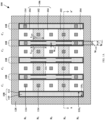
- FIG. 1A is a top-down view of a semiconductor device 100, according to an embodiment of the disclosure.
- the semiconductor device 100 may include a plurality of gate electrodes 102 and a plurality of doped structures 104 arranged in an array configuration of rows and columns.
- the array may include five rows R 1 through R 5 by four columns C 1 through C 4 .
- the plurality of doped structures 104 may be arranged in odd-numbered rows R 1 , R 3 , and R 5 , while the plurality of gate electrodes 102 may be arranged in even-numbered rows R 2 and R 4 .
- Each column, C 1 through C 4 may include a gate electrode 102 between a pair of doped structures 104.
- three doped structures 104 and two gate electrodes 102 are arranged in an alternating configuration of a doped structure 104 and a gate electrode 102.
- Each doped structure 104 may serve as either a drain region or a source region, and along with the gate electrode 102 therebetween, function as a transistor 106.
- the gate electrode 102 has a gate length L 102 extending between the doped structures 104.
- FIG. 1A illustrates the array as such, the plurality of gate electrodes 102 and the plurality of doped structures 104 may take on other array configurations without departing from the spirit and scope of the present disclosure.
- the semiconductor device 100 may further include a plurality of isolation structures 108.
- the isolation structures 108 may be at least interposed between columns C 1 through C 4 and serve to isolate columns C 1 through C 4 from each other at least electrically.
- an isolation structure 108 may be arranged between columns C 1 and C 2 , and electrically isolate column C 1 from column C 2 .
- Each isolation structure 108 may traverse rows R 1 through R 5 .
- the isolation structure 108 may be in contact with the gate electrodes 102 and the doped structures 104 in laterally adjacent columns.
- the isolation structure 108 that separates column C 2 from column C 3 may isolate the gate electrodes 102 and the doped structures 104 in their corresponding columns C 2 and C 3 from each other at least electrically.
- Each isolation structure 108 may include a dielectric core 110 and a dielectric liner 112 surrounding the dielectric core 110 at least laterally.
- the dielectric liner 112 may be conformal and may be arranged on at least the laterally adjacent side surfaces 110s of the dielectric core 110 that are in contact with the gate electrodes 102 and the doped structures 104.
- the dielectric core 110 may include a dielectric material, for example, silicon dioxide.
- the dielectric liner 112 may include a different dielectric material from the dielectric core 110, preferably a dielectric material having a higher dielectric constant than the dielectric core 110, for example, silicon nitride or silicon oxynitride.
- the semiconductor device 100 may yet further include a plurality of contact structures 114.
- the contact structures 114 may be arranged over each gate electrode 102 and each doped structure 104.
- the contact structures 114 may also be arranged in the isolation structures 108.
- the number of contact structures 114 in the isolation structures 108 may vary depending on the design requirements of the semiconductor device 100. For example, as illustrated, two contact structures 114 may be arranged in the isolation structure 108 separating column C 1 from column C 2 and the isolation structure 108 separating column C 3 from column C 4 . However, some isolation structures 108 may not include the contact structures 114 therein, for example, the isolation structure 108 that separates column C 2 from column C 3 . In another example, all isolation structures 108 in the semiconductor device 100 do not include any contact structures 114.
- Each contact structure 114 may include an electrically conductive material, for example, copper or tungsten. In an embodiment of the disclosure, the contact structures 114 may be line structures and/or via structures.
- the semiconductor device 100 may additionally include a plurality of electrode plates 116 in the isolation structures 108.
- Each electrode plate 116 may include a planar structure having a length L 116 and a substantially uniform width W 116 ; the length L 116 taken parallel to the gate length L 102 and the width W 116 taken perpendicular to and at the same plane as the length L 116 .
- the length L 116 of the electrode plate 116 may be at least as long as the gate length L 102 .
- each gate electrode 102 may have at least one electrode plate 116 arranged laterally adjacent thereto, though not necessarily so.
- the electrode plate 116 may be arranged directly on the dielectric liner 112 laterally adjacent to the gate electrode 102 such that the electrode plate 116 may be in contact with the dielectric liner 112 and the dielectric core 110. The portion of the dielectric liner 112 in contact with the electrode plate 116 may be at least in contact with the laterally adjacent gate electrode 102. As further illustrated, a pair of electrode plates 116 may be arranged in the isolation structure, and the pair of electrode plates 116 may be spaced apart from each other by the dielectric core 110.
- the presence of the electrode plate 116 in the isolation structure 108 may result in different width dimensions of the corresponding dielectric core 110 therein; the width of the dielectric core 110 is taken to the substantially parallel to the width W 116 of the electrode plate 116.
- the dielectric core 110 may have a width W 110A extending between opposite side surfaces that are in contact with the dielectric liner 112, and a width W 110B narrower than the width W 110A extending between opposite side surfaces that at least one side surface thereof is in contact with an electrode plate 116.
- a lateral capacitor in the semiconductor device 100 may result.
- the electrode plate 116 may serve as a first capacitor electrode
- the gate electrode 102 may serve as a second capacitor electrode
- the dielectric liner 112 laterally between the gate electrode 102 may serve as a capacitor dielectric of the lateral capacitor.
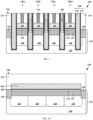
- FIG. 1B is a cross-sectional view of the semiconductor device 100, taken generally along line A-A' in FIG. 1A , according to an embodiment of the disclosure.
- the semiconductor device 100 may be arranged in and over a substrate 118.
- the substrate 118 has an upper substrate surface 118u.
- the substrate 118 may be a bulk semiconductor substrate.
- the substrate 118 may be a composite substrate, such as a semiconductor-on-insulator (SOI) substrate having a bulk layer 120, a buried insulator layer 122 over the bulk layer 120, and a semiconductor layer 124 over the buried insulator layer 122.
- SOI semiconductor-on-insulator
- the bulk layer 120 and the semiconductor layer 124 may include a semiconductor material, for example, silicon, germanium, silicon germanium, silicon carbide, or other II-VI or III-V semiconductor compounds, though not necessarily the same semiconductor material.
- the bulk layer 120 and the semiconductor layer 124 may be doped or undoped.
- the semiconductor layer 124 may also be referred to as a device layer or an active layer of the semiconductor device 100.
- the buried insulator layer 122 may serve to isolate the semiconductor layer 124 from the bulk layer 120 at least electrically.
- the buried insulator layer 122 may include an electrically insulating material, for example, silicon dioxide or aluminum oxide, and may also be referred to as a buried oxide (BOX) layer.
- BOX buried oxide
- the semiconductor device 100 may further include a plurality of doped regions 126 in the bulk layer 120 of the substrate 118.
- Each doped region 126 may be arranged vertically under a corresponding gate electrode 102 and may provide either n-type conductivity or p-type conductivity.
- the designation of "n-type” or "p-type” is based on the type of dopant and its conductivity in each doped region 126.
- n-type conductivity may be provided by n-type dopants, such as arsenic, phosphorus, or antimony
- p-type conductivity may be provided by p-type dopants, such as boron, aluminum, or gallium.
- Each gate electrode 102 may have an upper surface 102u, a lower surface 102 L , and laterally opposite side surfaces 102s.
- Each doped region 126 may not necessarily include the same conductivity, the same dopants, or the same dopant concentration from an immediately adjacent doped region 126.
- each doped region 126 may include a different conductivity from an immediately adjacent doped region 126.
- each doped region 126 may include the same conductivity as an immediately adjacent doped region 126.
- the plurality of transistors 106 may operate under different modes and may include n-type transistors, p-type transistors, or a combination of n-type transistors and p-type transistors.
- the semiconductor device 100 may include four transistors 106a, 106b, 106c, and 106d, and each transistor 106a, 106b, 106c, and 106d is either an n-type transistor or a p-type transistor.
- the transistor 106a may operate under the same mode as the immediately adjacent transistor 106b, for example, the transistor 106a and the transistor 106b are n-type transistors or p-type transistors.
- the transistor 106a may operate under a different mode from the immediately adjacent transistor 106b, for example, the transistor 106a is an n-type transistor and the transistor 106b is a p-type transistor, or vice versa.
- the corresponding doped regions 126 under the respective gate electrodes 102 may include different conductivities, either n-type conductivity or p-type conductivity.
- the doped region 126 vertically under the corresponding gate electrode 102 has p-type conductivity.
- the doped region 126 vertically under the corresponding gate electrode 102 has n-type conductivity.
- the semiconductor device 100 may also include a trench isolation structure 128.
- the trench isolation structure 128 may surround the array of gate electrodes 102 and doped structures 104, as illustrated in FIG. 1A .
- the trench isolation structure 128 may extend at least through the semiconductor layer 124.
- the trench isolation structure 128 may terminate within the bulk layer 120, as illustrated in FIG. 1B .
- the trench isolation structure 128 may terminate within the buried insulator layer 122 of the substrate 118.
- the trench isolation structure 128 may also be referred to as a shallow trench isolation (STI) structure.
- STI shallow trench isolation
- a dielectric layer 132 may be arranged over the substrate 118, the gate electrodes 102, and the trench isolation structure 128.
- the dielectric layer 132 may include an upper dielectric surface 132u.
- the dielectric layer 132 may include an electrically insulative material, for example, silicon dioxide, carbon-doped silicon dioxide, tetraethoxysilane (TEOS), borophosphosilicate glass (BPSG), undoped silicate glass (USG), or amorphous silicon.
- TEOS tetraethoxysilane
- BPSG borophosphosilicate glass
- USG undoped silicate glass
- amorphous silicon silicon dioxide
- the dielectric layer 132 may be referred to as a pre-metal dielectric layer.
- each isolation structure 108 may be arranged in the dielectric layer 132, while a lower portion thereof may be arranged in the substrate 118.
- Each isolation structure 108 may extend from the upper dielectric surface 132u of the dielectric layer 132 and terminate within the substrate 118 with a depth D 108 .
- the isolation structures 108 may extend through the doped regions 126 and terminate within the bulk layer 120 of the substrate 118, as illustrated in FIG. 1B .
- the isolation structures 108 may terminate within the plurality of doped regions 126, even though this embodiment is not illustrated in the accompanying drawings.
- the contact structures 114 may be arranged in the dielectric layer 132 and the isolation structures 108, and may have upper surfaces 114u substantially coplanar with each other.
- the upper surfaces 114 U of the contact structures 114 may be substantially coplanar with the upper dielectric surface 132u of the dielectric layer 132.
- the electrode plate 116 may have a side surface area larger than a side surface area of the gate electrode 102.
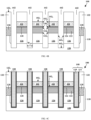
- FIG. 2 illustrates a cross-sectional view of a semiconductor device 200, according to another embodiment of the disclosure.
- the semiconductor device 200 may be similar to the semiconductor device 100, and thus common features are labeled with the same reference numerals and need not be separately discussed.
- the dielectric layer 234 may have an upper surface 234u substantially coplanar with the upper surface 116u of the electrode plate, and the dielectric layer 234 may extend to a substantially similar height in the isolation structure 108 as the electrode plate 116.
- the height of the dielectric layer 234 may be substantially similar to the height H 116 of the electrode plate 116.
- a portion of the dielectric core 110 may be arranged under the dielectric layer 234.
- the dielectric layer 234 may or may not have a similar length and width as the length L 116 and width W 116 of the electrode plate 116, even though FIG. 2 illustrates the dielectric layer 234 to have a substantially similar width.
- the spatial dimensions of the electrode plate 116 and the dielectric layer 234 may vary due to optimization to achieve the desired electrical characteristics of the semiconductor device 200.
- a dielectric layer 132 may be deposited over the substrate 118, the trench isolation structure 128, the layer of gate electrode material 440, and the doped structures.
- the dielectric layer 132 may be deposited using a deposition technique, including a CVD process.
- the dielectric layer 132 has an upper dielectric surface 132u.
- the trenches 442 may extend from the upper dielectric surface 132u of the dielectric layer 132 to a level within the substrate 118.
- the trenches 442 may at least extend through the layer of gate electrode material 440 and the layer of gate insulating material 438, and consequently divide the layer of gate electrode material 440 and the layer of gate insulating material 438 into a plurality of gate electrodes 102 and a plurality of gate insulating layers 130, respectively.
- the trenches 442 may be formed using a patterning technique, including lithography and etching processes.
- FIG. 4C is a cross-sectional view of the semiconductor device 100 at a fabrication stage subsequent to FIG. 4B , according to an embodiment of the disclosure.
- a dielectric liner 112 and a dielectric core 110 may be formed in the trenches 442.
- a layer of dielectric liner material may be conformally deposited in the trenches 442, lining the side surfaces 442s and the base 442 B thereof.
- the layer of dielectric liner material may be continuous and in contact with the side surfaces 102s of the gate electrodes 102, the side surfaces 130s of the gate insulating layers 130, the side surfaces 124s of the semiconductor layer 124, and the side surfaces 122 S of the buried insulator layer 122.
- the layer of dielectric liner material may further overlay the upper dielectric surface 132u of the dielectric layer 132.
- a layer of dielectric core material may be subsequently deposited over the layer of dielectric liner material to at least fill the trenches 442.
- the layer of dielectric liner material and the layer of dielectric core material may be deposited using a deposition technique, including a CVD process.
- the layer of dielectric liner material and the layer of dielectric core material may be subsequently planarized using a planarization technique, including a chemical-mechanical planarization (CMP) process, to form the dielectric liner 112 and the dielectric core 110, respectively, in the trenches 442.
- CMP chemical-mechanical planarization
- the planarization technique also achieves the formation of the upper surfaces of the dielectric liner 112 and the dielectric core 110 to be substantially coplanar with each other, and also with the upper dielectric surface 132 U of the dielectric layer 132.
- the dielectric liner 112 and the dielectric core 110 may form an isolation structure 108 in each trench 442.
- the upper surface of the dielectric liner and the dielectric core may be substantially coplanar with the upper dielectric surface 132 U of the dielectric layer 132.
- FIG. 4D is a cross-sectional view of the semiconductor device 100 at a fabrication stage subsequent to FIG. 4C , according to an embodiment of the disclosure. Openings 444 may be formed in the isolation structures 108 using a patterning technique, including lithography and etching processes.
- FIG. 4E is a cross-sectional view of the semiconductor device 100 at a fabrication stage subsequent to FIG. 4D , according to an embodiment of the disclosure.
- a layer of electrode material 446 may be conformally deposited in each opening 444, lining the exposed portion of the dielectric liner 112 and the upper surface of the recessed dielectric core 110 R .
- the layer of electrode material 446 may further overlay the upper dielectric surface 132 U of the dielectric layer 132.
- first and second features are formed in direct contact
- additional features may be formed interposing the first and second features, such that the first and second features may not be in direct contact.
Landscapes
- Insulated Gate Type Field-Effect Transistor (AREA)
Applications Claiming Priority (1)
| Application Number | Priority Date | Filing Date | Title |
|---|---|---|---|
| US18/151,509 US20240234448A1 (en) | 2023-01-09 | 2023-01-09 | Lateral capacitors of semiconductor devices |
Publications (1)
| Publication Number | Publication Date |
|---|---|
| EP4398701A1 true EP4398701A1 (fr) | 2024-07-10 |
Family
ID=87933601
Family Applications (1)
| Application Number | Title | Priority Date | Filing Date |
|---|---|---|---|
| EP23195307.6A Pending EP4398701A1 (fr) | 2023-01-09 | 2023-09-05 | Condensateurs latéraux de dispositifs semi-conducteurs |
Country Status (3)
| Country | Link |
|---|---|
| US (1) | US20240234448A1 (fr) |
| EP (1) | EP4398701A1 (fr) |
| CN (1) | CN118315376A (fr) |
Citations (2)
| Publication number | Priority date | Publication date | Assignee | Title |
|---|---|---|---|---|
| US20170092650A1 (en) * | 2015-09-25 | 2017-03-30 | Taiwan Semiconductor Manufacturing Co., Ltd. | Interdigitated capacitor in split-gate flash technology |
| US20190006458A1 (en) * | 2017-06-28 | 2019-01-03 | Taiwan Semiconductor Manufacturing Company, Ltd. | Hybrid Decoupling Capacitor and Method Forming Same |
-
2023
- 2023-01-09 US US18/151,509 patent/US20240234448A1/en active Pending
- 2023-09-05 EP EP23195307.6A patent/EP4398701A1/fr active Pending
- 2023-11-09 CN CN202311485692.9A patent/CN118315376A/zh active Pending
Patent Citations (2)
| Publication number | Priority date | Publication date | Assignee | Title |
|---|---|---|---|---|
| US20170092650A1 (en) * | 2015-09-25 | 2017-03-30 | Taiwan Semiconductor Manufacturing Co., Ltd. | Interdigitated capacitor in split-gate flash technology |
| US20190006458A1 (en) * | 2017-06-28 | 2019-01-03 | Taiwan Semiconductor Manufacturing Company, Ltd. | Hybrid Decoupling Capacitor and Method Forming Same |
Also Published As
| Publication number | Publication date |
|---|---|
| US20240234448A1 (en) | 2024-07-11 |
| CN118315376A (zh) | 2024-07-09 |
Similar Documents
| Publication | Publication Date | Title |
|---|---|---|
| US12048156B2 (en) | Vertical memory devices and methods of manufacturing the same | |
| US20210098377A1 (en) | Methods of manufacturing semiconductor devices | |
| US10903324B2 (en) | Semiconductor device including fin-FET and etch stop layers | |
| US20210242349A1 (en) | Semiconductor device | |
| US20260059790A1 (en) | Semiconductor devices | |
| US12268022B2 (en) | Semiconductor device including air gap regions below source/drain regions | |
| JP2025527634A (ja) | 半導体デバイスのためのバックサイド及びフロントサイドコンタクト | |
| US20250338629A1 (en) | Semiconductor device | |
| CN114664813A (zh) | 半导体装置 | |
| US20250151317A1 (en) | Gate structures in transistor devices and methods of forming same | |
| US12279445B2 (en) | Field effect transistors with gate fins and method of making the same | |
| KR102910857B1 (ko) | 스태거형 fet용 컨택트들 및 게이트들을 형성하는 방법 및 구조 | |
| US12464784B2 (en) | Isolation structures of semiconductor devices | |
| KR20230174071A (ko) | 반도체 소자 | |
| US20210391467A1 (en) | Semiconductor devices and methods of fabricating the same | |
| EP4398701A1 (fr) | Condensateurs latéraux de dispositifs semi-conducteurs | |
| US20230007959A1 (en) | Semiconductor device including multiple channel layers | |
| CN115036313A (zh) | 半导体器件及其制造方法 | |
| US20250393296A1 (en) | Semiconductor structure | |
| US12581682B2 (en) | Semiconductor device and method of manufacturing the same | |
| US20260032996A1 (en) | Semiconductor device with backside power delivery network | |
| US20240282830A1 (en) | Semiconductor devices | |
| US20260107497A1 (en) | Semiconductor device | |
| EP4365953A2 (fr) | Transistors ayant des structures de contact arrière | |
| US20260076214A1 (en) | Semiconductor devices |
Legal Events
| Date | Code | Title | Description |
|---|---|---|---|
| PUAI | Public reference made under article 153(3) epc to a published international application that has entered the european phase |
Free format text: ORIGINAL CODE: 0009012 |
|
| STAA | Information on the status of an ep patent application or granted ep patent |
Free format text: STATUS: REQUEST FOR EXAMINATION WAS MADE |
|
| 17P | Request for examination filed |
Effective date: 20230905 |
|
| AK | Designated contracting states |
Kind code of ref document: A1 Designated state(s): AL AT BE BG CH CY CZ DE DK EE ES FI FR GB GR HR HU IE IS IT LI LT LU LV MC ME MK MT NL NO PL PT RO RS SE SI SK SM TR |