EP4399059B1 - Procédé de nettoyage d'une zone dans un environnement industriel, système de commande et système de nettoyage - Google Patents
Procédé de nettoyage d'une zone dans un environnement industriel, système de commande et système de nettoyage Download PDFInfo
- Publication number
- EP4399059B1 EP4399059B1 EP21773740.2A EP21773740A EP4399059B1 EP 4399059 B1 EP4399059 B1 EP 4399059B1 EP 21773740 A EP21773740 A EP 21773740A EP 4399059 B1 EP4399059 B1 EP 4399059B1
- Authority
- EP
- European Patent Office
- Prior art keywords
- cleaning
- sensor data
- region
- cleaning process
- robot
- Prior art date
- Legal status (The legal status is an assumption and is not a legal conclusion. Google has not performed a legal analysis and makes no representation as to the accuracy of the status listed.)
- Active
Links
Images



Classifications
-
- A—HUMAN NECESSITIES
- A61—MEDICAL OR VETERINARY SCIENCE; HYGIENE
- A61L—METHODS OR APPARATUS FOR STERILISING MATERIALS OR OBJECTS IN GENERAL; DISINFECTION, STERILISATION OR DEODORISATION OF AIR; CHEMICAL ASPECTS OF BANDAGES, DRESSINGS, ABSORBENT PADS OR SURGICAL ARTICLES; MATERIALS FOR BANDAGES, DRESSINGS, ABSORBENT PADS OR SURGICAL ARTICLES
- A61L2/00—Disinfection or sterilisation of materials or objects, in general; Accessories therefor
- A61L2/16—Disinfection or sterilisation of materials or objects, in general; Accessories therefor using chemical substances
- A61L2/18—Liquid substances
-
- A—HUMAN NECESSITIES
- A61—MEDICAL OR VETERINARY SCIENCE; HYGIENE
- A61L—METHODS OR APPARATUS FOR STERILISING MATERIALS OR OBJECTS IN GENERAL; DISINFECTION, STERILISATION OR DEODORISATION OF AIR; CHEMICAL ASPECTS OF BANDAGES, DRESSINGS, ABSORBENT PADS OR SURGICAL ARTICLES; MATERIALS FOR BANDAGES, DRESSINGS, ABSORBENT PADS OR SURGICAL ARTICLES
- A61L2/00—Disinfection or sterilisation of materials or objects, in general; Accessories therefor
- A61L2/24—Apparatus using programmed or automatic operation
-
- A—HUMAN NECESSITIES
- A61—MEDICAL OR VETERINARY SCIENCE; HYGIENE
- A61L—METHODS OR APPARATUS FOR STERILISING MATERIALS OR OBJECTS IN GENERAL; DISINFECTION, STERILISATION OR DEODORISATION OF AIR; CHEMICAL ASPECTS OF BANDAGES, DRESSINGS, ABSORBENT PADS OR SURGICAL ARTICLES; MATERIALS FOR BANDAGES, DRESSINGS, ABSORBENT PADS OR SURGICAL ARTICLES
- A61L2/00—Disinfection or sterilisation of materials or objects, in general; Accessories therefor
- A61L2/26—Accessories
- A61L2/28—Devices for testing the effectiveness or completeness of sterilisation or disinfection, e.g. indicators which change colour
-
- B—PERFORMING OPERATIONS; TRANSPORTING
- B08—CLEANING
- B08B—CLEANING IN GENERAL; PREVENTION OF FOULING IN GENERAL
- B08B3/00—Cleaning by methods involving the use or presence of liquid or steam
- B08B3/02—Cleaning by the force of jets or sprays
- B08B3/024—Cleaning by means of spray elements moving over the surface to be cleaned
-
- B—PERFORMING OPERATIONS; TRANSPORTING
- B08—CLEANING
- B08B—CLEANING IN GENERAL; PREVENTION OF FOULING IN GENERAL
- B08B3/00—Cleaning by methods involving the use or presence of liquid or steam
- B08B3/04—Cleaning involving contact with liquid
-
- B—PERFORMING OPERATIONS; TRANSPORTING
- B25—HAND TOOLS; PORTABLE POWER-DRIVEN TOOLS; MANIPULATORS
- B25J—MANIPULATORS; CHAMBERS PROVIDED WITH MANIPULATION DEVICES
- B25J11/00—Manipulators not otherwise provided for
- B25J11/0045—Manipulators used in the food industry
-
- B—PERFORMING OPERATIONS; TRANSPORTING
- B25—HAND TOOLS; PORTABLE POWER-DRIVEN TOOLS; MANIPULATORS
- B25J—MANIPULATORS; CHAMBERS PROVIDED WITH MANIPULATION DEVICES
- B25J11/00—Manipulators not otherwise provided for
- B25J11/008—Manipulators for service tasks
- B25J11/0085—Cleaning
-
- B—PERFORMING OPERATIONS; TRANSPORTING
- B25—HAND TOOLS; PORTABLE POWER-DRIVEN TOOLS; MANIPULATORS
- B25J—MANIPULATORS; CHAMBERS PROVIDED WITH MANIPULATION DEVICES
- B25J19/00—Accessories fitted to manipulators, e.g. for monitoring, for viewing; Safety devices combined with or specially adapted for use in connection with manipulators
- B25J19/02—Sensing devices
-
- B—PERFORMING OPERATIONS; TRANSPORTING
- B25—HAND TOOLS; PORTABLE POWER-DRIVEN TOOLS; MANIPULATORS
- B25J—MANIPULATORS; CHAMBERS PROVIDED WITH MANIPULATION DEVICES
- B25J5/00—Manipulators mounted on wheels or on carriages
-
- A—HUMAN NECESSITIES
- A61—MEDICAL OR VETERINARY SCIENCE; HYGIENE
- A61L—METHODS OR APPARATUS FOR STERILISING MATERIALS OR OBJECTS IN GENERAL; DISINFECTION, STERILISATION OR DEODORISATION OF AIR; CHEMICAL ASPECTS OF BANDAGES, DRESSINGS, ABSORBENT PADS OR SURGICAL ARTICLES; MATERIALS FOR BANDAGES, DRESSINGS, ABSORBENT PADS OR SURGICAL ARTICLES
- A61L2103/00—Materials or objects being the target of disinfection or sterilisation
- A61L2103/75—Room floors or walls
-
- A—HUMAN NECESSITIES
- A61—MEDICAL OR VETERINARY SCIENCE; HYGIENE
- A61L—METHODS OR APPARATUS FOR STERILISING MATERIALS OR OBJECTS IN GENERAL; DISINFECTION, STERILISATION OR DEODORISATION OF AIR; CHEMICAL ASPECTS OF BANDAGES, DRESSINGS, ABSORBENT PADS OR SURGICAL ARTICLES; MATERIALS FOR BANDAGES, DRESSINGS, ABSORBENT PADS OR SURGICAL ARTICLES
- A61L2202/00—Aspects relating to methods or apparatus for disinfecting or sterilising materials or objects
- A61L2202/10—Apparatus features
- A61L2202/14—Means for controlling sterilisation processes, data processing, presentation and storage means, e.g. sensors, controllers, programs
-
- A—HUMAN NECESSITIES
- A61—MEDICAL OR VETERINARY SCIENCE; HYGIENE
- A61L—METHODS OR APPARATUS FOR STERILISING MATERIALS OR OBJECTS IN GENERAL; DISINFECTION, STERILISATION OR DEODORISATION OF AIR; CHEMICAL ASPECTS OF BANDAGES, DRESSINGS, ABSORBENT PADS OR SURGICAL ARTICLES; MATERIALS FOR BANDAGES, DRESSINGS, ABSORBENT PADS OR SURGICAL ARTICLES
- A61L2202/00—Aspects relating to methods or apparatus for disinfecting or sterilising materials or objects
- A61L2202/10—Apparatus features
- A61L2202/15—Biocide distribution means, e.g. nozzles, pumps, manifolds, fans, baffles, sprayers
-
- A—HUMAN NECESSITIES
- A61—MEDICAL OR VETERINARY SCIENCE; HYGIENE
- A61L—METHODS OR APPARATUS FOR STERILISING MATERIALS OR OBJECTS IN GENERAL; DISINFECTION, STERILISATION OR DEODORISATION OF AIR; CHEMICAL ASPECTS OF BANDAGES, DRESSINGS, ABSORBENT PADS OR SURGICAL ARTICLES; MATERIALS FOR BANDAGES, DRESSINGS, ABSORBENT PADS OR SURGICAL ARTICLES
- A61L2202/00—Aspects relating to methods or apparatus for disinfecting or sterilising materials or objects
- A61L2202/10—Apparatus features
- A61L2202/16—Mobile applications, e.g. portable devices, trailers, devices mounted on vehicles
-
- A—HUMAN NECESSITIES
- A61—MEDICAL OR VETERINARY SCIENCE; HYGIENE
- A61L—METHODS OR APPARATUS FOR STERILISING MATERIALS OR OBJECTS IN GENERAL; DISINFECTION, STERILISATION OR DEODORISATION OF AIR; CHEMICAL ASPECTS OF BANDAGES, DRESSINGS, ABSORBENT PADS OR SURGICAL ARTICLES; MATERIALS FOR BANDAGES, DRESSINGS, ABSORBENT PADS OR SURGICAL ARTICLES
- A61L2202/00—Aspects relating to methods or apparatus for disinfecting or sterilising materials or objects
- A61L2202/10—Apparatus features
- A61L2202/17—Combination with washing or cleaning means
Definitions
- the present disclosure generally relates to cleaning of industrial environments.
- a method of cleaning a region in an industrial environment using at least one industrial robot, a control system for controlling cleaning of a region in an industrial environment using at least one industrial robot, and a cleaning system comprising at least one industrial robot are provided.
- CN 109452910 A discloses a floor sweeping robot containing chemical liquid.
- US 2012223216 A1 discloses a sterilization system including a self-propelled robotic mobile platform for locating and eradicating infectious bacterial and virus strains on floors using one or more ultraviolet light sources.
- a controller allows the system to adjust the quantity of ultraviolet light received by a surface.
- the mobile platform may include a sensor capable of detecting fluorescence of biological contaminants irradiated with ultraviolet light to locate contaminated areas.
- the sterilization system is not suitable for washing an industrial environment, such as a food and beverage factory, and does not describe an efficient application of cleaning media.
- US 11 097 414 B1 discloses a method of cleaning a region in an industrial environment using at least one industrial robot carrying a cleaning device, the method comprising: providing sensor data identifying one or more surfaces in the region touched by an actor; and performing a cleaning process to clean the region, the cleaning process comprising applying cleaning media from the cleaning device to the one or more surfaces, and the cleaning process being performed based on the sensor data.
- One object of the present disclosure is to provide a method of cleaning a region in an industrial environment, which method enables a higher level of cleanliness.
- a further object of the present disclosure is to provide a method of cleaning a region in an industrial environment, which method is cost-efficient.
- a still further object of the present disclosure is to provide a method of cleaning a region in an industrial environment, which method enables an efficient cleaning.
- a still further object of the present disclosure is to provide a method of cleaning a region in an industrial environment, which method solves several or all of the foregoing objects in combination.
- a still further object of the present disclosure is to provide a control system for controlling cleaning of a region in an industrial environment, which control system solves one, several or all of the foregoing objects.
- a method of cleaning a region in an industrial environment using at least one industrial robot comprising obtaining radiation from the region by means of a sensor device; providing sensor data based on the radiation, the sensor data being indicative of a cleanliness of one or more surfaces in the region; and performing a cleaning process to clean the region, the cleaning process comprising applying cleaning media from a cleaning device to the one or more surfaces, and the cleaning process being performed based on the sensor data, wherein the industrial robot carries the sensor device and/or the cleaning device.
- the cleaning process can be adapted to the cleanliness.
- the cleaning of the industrial environment is thereby made more efficient. It can for example be avoided that the cleaning process is performed on surfaces without a need for cleaning. Alternatively, such surfaces may be cleaned at a reduced intensity (e.g. during a shorter time and/or with a reduced amount of cleaning media). In this way, the cleaning time, water and the cleaning media can be more efficiently utilized.
- the radiation may be reflective radiation from the one or more regions.
- Each of the at least one industrial robot may comprise a base and a manipulator movable relative to the base.
- the manipulator may be a serial manipulator comprising three or more axes, such as six or seven axes.
- At least one of the sensor device, the cleaning device and the one or more surfaces may be carried by one of the at least one industrial robot, such as by the manipulator thereof.
- the industrial robot may be mobile or stationary.
- a stationary robot may comprise a stationary base where the manipulator is movable relative to the stationary base.
- a mobile robot may comprise a mobile base where the manipulator is movable relative to the mobile base.
- the mobile base may be driven by a traction arrangement as described herein.
- the sensor device may be carried by one of the at least one industrial robot or by a human, or may be stationary.
- the cleaning device may be carried by the same industrial robot, may be stationary, may be carried by another of the at least one industrial robot, or may be carried by a human.
- the sensor device In case the sensor device is stationary, the sensor device can be integrated into machines or other equipment in the industrial environment.
- the cleaning device may be carried by one of the at least one industrial robot or by a human, or may be stationary.
- the sensor device may be carried by the same industrial robot, may be stationary, may be carried by another of the at least one industrial robot, or may be carried by a human.
- the cleaning device can be integrated into machines or other equipment in the industrial environment.
- the cleanliness may be associated with an amount of contamination, such as an amount of bacteria, and/or a type of contaminants, on the one or more surfaces.
- the cleaning media may comprise one or more cleaning detergents, one or more chemicals and/or one or more sanitizers.
- the cleaning media may additionally comprise water.
- the sensor data may be provided by the sensor device or by a control system in signal communication with the sensor device.
- the sensor data may indicate a presence of contaminants in the environment.
- the sensor data may also indicate a type of contaminants.
- the sensor device may however be configured to detect only the presence, and an optional amount of, one or a few types of contaminants and communicate this information as sensor data. A high amount of contaminants may correspond to a low cleanliness value and vice versa.
- the sensor data may optionally also contain position information of the contaminants.
- the sensor device may communicate sensor data containing such position information. If such position information is not provided by the sensor device, the industrial robot carrying the sensor device may determine the position information and add this to the sensor data. In this case, the position information may be determined by the industrial robot based on a position of the manipulator when the radiation is received by the sensor device.
- the sensor device may for example comprise a laser-induced breakdown spectroscopy (LIBS) sensor, a Fourier-transform infrared spectroscopy (FTIR) sensor, a Raman spectroscopy sensor, a biosensor, such as an optoacoustic biosensor and/or an optical biosensor.
- An optical biosensor may for example combine an optical effect and a thermal effect to reliably detect contaminants, such as pathogens.
- the sensor device can be a noninvasive or contactless sensor device.
- the sensor device may comprise a plurality of different types of sensors, e.g. to detect different types of contaminants.
- the industrial environment may for example be a food manufacturing environment, a beverage manufacturing environment, a chemical product manufacturing environment, a pharmaceutical product manufacturing environment, or an agricultural product manufacturing environment.
- the industrial environment may comprise at least one handling tool for handling produced items, such as a cutting tool for cutting meat.
- the industrial environment may comprise at least one packaging machine for packaging produced items.
- the method may be carried out with a cleaning system according to the present disclosure.
- the cleaning process may be performed using one or more cleaning parameters.
- cleaning parameters comprise pressure of the cleaning media, temperature of the cleaning media, concentration of the cleaning media (e.g. when solved in water), and time of application of the cleaning media to the one or more surfaces.
- the method may further comprise determining a cleanliness value based on the sensor data.
- the cleaning process may be performed based on the cleanliness value.
- the method according to this variant may comprise determining an actual cleanliness value based on the sensor data and comparing the actual cleanliness value with a reference cleanliness value. As long as the actual cleanliness value is higher than the reference cleanliness value, the cleaning process may be postponed. When the cleanliness value is lower than the reference cleanliness value, the cleaning process may be performed.
- the method may thus comprise monitoring contaminants on the one or more surfaces by means of the sensor device.
- the method may further comprise obtaining validation radiation from the region by means of the sensor device; generating validation sensor data based on the radiation; and evaluating the cleaning process based on the validation sensor data.
- the validation radiation may be obtained continuously or intermittently.
- the quality of the cleaning process can be monitored continuously or periodically.
- feedback regarding the cleanliness is provided. It can then be determined whether or not the cleaning process has provided a targeted cleanliness. This contributes to a more efficient cleaning and to a reduction of used cleaning media and water.
- the method may further comprise determining, based on the sensor data, a type of contaminant in the region. In this case, the method may further comprise performing the cleaning process based on the type of contaminant. Alternatively, or in addition, the method may further comprise selecting a type of cleaning media to be applied during the cleaning process based on the type of contaminant. In these ways, the cleaning process can be made even more efficient.
- the application of the cleaning media may be preceded by application of hot water, succeeded by application of cold water, and/or succeeded by application of hot water.
- the method may further comprise determining a distribution of contaminants in the region based on the sensor data; and performing the cleaning process based on the distribution.
- the cleaning process is made more efficient. For example, the method enables performance of the cleaning process locally, when needed.
- the relevant cleaning parameters can be adjusted for future cleaning processes and the cleaning process can be adjusted accordingly for other surfaces of the same material.
- the cleaning process may be improved by one or more machine learning algorithms.
- the machine learning algorithm can learn where contaminants often occur, how to improve cleanliness, how to reduce consumption of cleaning media and/or how to reduce cleaning time.
- the cleanliness condition may have the highest priority.
- one machine learning algorithm may build a model of the cleaning process using the sensor data, the surface properties, the cleanliness value and/or the cleaning parameters as training data. In this way, the cleaning system can be trained to optimize the cleaning performance.
- the sensor device may be carried by one of the at least one industrial robot.
- the sensor device may be carried by the manipulator.
- the method may comprise moving the sensor device by the manipulator to the one or more surfaces.
- the cleaning device may be carried by one of the at least one industrial robot.
- the cleaning device may be carried by the manipulator.
- the method may comprise moving the cleaning device by the manipulator to the one or more surfaces.
- the one or more manipulators Due to the one or more manipulators, agile, dexterous and accurate movements of the sensor device and/or the cleaning device are enabled.
- the sensor device and/or the cleaning device may be moved rapidly in three dimensions and can reach areas that are difficult to reach by humans.
- the use of one or more manipulators allows for exhaustive and reproducible coverage of the surfaces to be cleaned. The cleaning performance is thereby improved.
- One of the at least one industrial robot may be a mobile robot having a traction arrangement.
- the traction arrangement may be configured to move a base of the mobile robot over a base surface, such as a floor.
- the method may comprise moving the mobile robot by the traction arrangement in proximity to the one or more surfaces.
- the traction arrangement may comprise a plurality of wheels.
- the wheels may drive a base in the form of a platform. At least one of the wheels may be a driving wheel and at least one of the wheels may be a steering wheel.
- the wheels may provide two or three degrees of freedom of the base on the base surface.
- the traction arrangement may be a linear traction arrangement, such as a conveyor belt.
- the mobile robot and its manipulator may be moved autonomously.
- the method thereby enables an autonomous provision of sensor data indicative of the cleanliness.
- the method may further comprise providing a map representing the industrial environment, and mapping the sensor data in the map.
- the map may be a grid-based map.
- the sensor data, and/or a cleanliness value determined based on sensor data may be associated with one, several or all cells of the grid-based map.
- the map may be three-dimensional.
- Each mobile robot may be a collaborative robot.
- the method can thereby be carried out in human populated environment without needing to interrupt any process carried out by nearby humans.
- the method may further comprise controlling the traction arrangement to move the mobile robot to dock to a docking station; and supplying cleaning media from the docking station to one or more tanks of the mobile robot. In this way, the use of external hoses can be avoided.
- the method may further comprise electrically charging the mobile robot from the docking station when the mobile robot is docked to the docking station. In this way, the use of external cables can be avoided.
- the docking station may comprise a docking station cleaning robot.
- the docking station cleaning robot may be configured to clean the mobile robot when docked to the docking station using cleaning media from one or more tanks of the docking station.
- the method may further comprise communicating management data to a remote management system, the management data being associated with the sensor data and/or data associated with the cleaning process.
- the management system may receive such management data from a plurality of different industrial environments. In this way, the cleaning process can be improved using knowledge from other industrial environments.
- a control system for controlling cleaning of a region in an industrial environment using at least one industrial robot, the control system comprising at least one data processing device and at least one memory having at least one computer program stored thereon, the at least one computer program comprising program code which, when executed by the at least one data processing device, causes the at least one data processing device to perform the steps of commanding a sensor device to obtain radiation from the region; providing sensor data based on the radiation, the sensor data being indicative of a cleanliness of one or more surfaces in the region; and controlling performance of a cleaning process to clean the region, the cleaning process comprising applying cleaning media from a cleaning device to the one or more surfaces, and the cleaning process being controlled based on the sensor data.
- the at least one computer program may further comprise program code which, when executed by the at least one data processing device, causes the at least one data processing device to perform, or command performance of, any step of the method of the first aspect.
- the one or more machine learning algorithms may be implemented in the control system.
- a cleaning system comprising the control system according to the second aspect; the at least one industrial robot; the sensor device; and the cleaning device.
- the cleaning system may be of any type as described herein.
- the cleaning system may be configured to carry out any variant of the method according to the first aspect.
- the cleaning system may comprise a robot fleet of a plurality of industrial robots.
- One of the at least one industrial robot may be a mobile robot having a traction arrangement.
- the cleaning device may be carried by the mobile robot.
- the mobile robot may comprise a base and a manipulator movable relative to the base.
- the sensor device and/or the cleaning device may be carried by the manipulator.
- the cleaning system may further comprise a docking station.
- the at least one mobile robot and the docking station may be configured such that the at least one mobile robot can dock to the docking station and receive cleaning media therefrom.
- the docking station may also be configured to supply water, compressed air and/or electric power to the at least one mobile robot.
- Fig. 1 schematically represents a cleaning system 10.
- the cleaning system 10 comprises an industrial robot 12.
- the industrial robot 12 comprises a base 14 and a manipulator 16 movable relative to the base 14.
- the manipulator 16 may be a serial manipulator comprising three or more axes, such as six or seven axes.
- the cleaning system 10 further comprises a control system 18.
- the control system 18 of this example comprises a data processing device 20 and a memory 22.
- the memory 22 has a computer program stored thereon.
- the computer program comprises program code which, when executed by the data processing device 20, causes the data processing device 20 to perform, or command performance of, various steps as described herein.
- the control system 18 is in signal communication with the industrial robot 12 and here controls the industrial robot 12.
- the cleaning system 10 of this example further comprises a traction arrangement 24.
- the traction arrangement 24 is configured to move the base 14 over a base surface, such as a floor.
- the traction arrangement 24 may comprise a plurality of wheels.
- the traction arrangement 24 is in signal communication with the control system 18 for being controlled by the control system 18.
- the cleaning system 10 further comprises a sensor device 26.
- the sensor device 26 of this example is configured to irradiate a surface and to receive reflected radiation 28 from the surface.
- the sensor device 26 of the invention is further configured to provide sensor data 30 indicative of a cleanliness of the surface based on the radiation 28.
- the sensor device 26 may for example comprise an optical sensor, such as a laser-induced breakdown spectroscopy (LIBS) sensor.
- LIBS laser-induced breakdown spectroscopy
- the sensor device 26 can be carried by the manipulator 16.
- the control system 18 is in signal communication with the sensor device 26 and can receive the sensor data 30 from the sensor device 26.
- the sensor device 26 may optionally comprise a plurality of different types of sensors.
- the control system 18 is configured to control the sensor device 26, e.g. to control the sensor device 26 to irradiate an object for receiving the radiation 28.
- the cleaning system 10 further comprises a cleaning device 32.
- the cleaning device 32 may comprise one or more nozzles for applying cleaning media 34a and 34b.
- the cleaning device 32 of this specific example comprises a first nozzle 36a for applying a first type of cleaning media 34a and a second nozzle 36b for applying a different second type of cleaning media 34b.
- the cleaning media 34a and 34b may for example be different types of detergents or sanitizers.
- the cleaning media 34a and 34b may differ by concentration and/or by type of chemical.
- the cleaning system 10 of this example further comprises a first tank 38a containing the first cleaning media 34a and a second tank 38b containing the second cleaning media 34b.
- the cleaning media 34a and 34b may optionally be diluted with water.
- the cleaning system 10 may comprise a dedicated mixing system (not shown) to adjust a concentration of the cleaning media 34a and 34b prior to their application.
- the cleaning device 32, the tanks 34a and 34b and the optional mixing system can be carried by the industrial robot 12, such as by the traction arrangement 24 thereof.
- the cleaning device 32 is in signal communication with the control system 18 for being controlled by the control system 18.
- the cleaning system 10 of this example further comprises a docking station 40.
- the docking station 40 is configured to supply cleaning media 34a and 34b to the respective tanks 38a and 38b, and is configured to supply electric power to the industrial robot 12, such as to the traction arrangement 24.
- the docking station 40 is in signal communication with the control system 18 for being controlled by the control system 18.
- the sensor data 30 is evaluated by the control system 18.
- the control system 18 initially determines based on the sensor data 30 whether or not a cleaning process for the region 52 is necessary. To this end, the control system 18 may compare an actual cleanliness value determined based on, or constituted by, the sensor data 30 with a reference cleanliness value. The reference cleanliness value may be unique for each surface 60a-60c. If the region 52 is judged to be sufficiently clean, the mobile robot 12a may return to the docking station 40a. The mobile robot 12a may then return to the region 52 to make a new scan after a predetermined time period, or when commanded.
- the sensor device 26 is configured to provide sensor data 30 indicating a type of contaminant 58.
- the first cleaning media 34a may be selected for application to a surface 60a-60c where a first type of contaminant 58 has been detected and the second cleaning media 34b may be selected for application to a surface 60a-60c where a different second type of contaminant 58 has been detected.
- Other parameters of the cleaning process may alternatively or in addition be controlled based on the type of the contaminants 58.
- control system 18 may also control cleaning parameters associated therewith, such as a pressure of the cleaning media 34a and 34b, a temperature of the cleaning media 34a and 34b, a concentration of the cleaning media 34a and 34b, and a time of application of the cleaning media 34a and 34b to the respective surface 60a-60b, based on the sensor data 30.
- the mobile robot 12a enables automated inspection and cleaning of many different regions in the industrial environment 48, in addition to the region 52.
- the mobile robot 12a may again scan the region 52 with the sensor device 26 to validate the cleaning process.
- the sensor device 26 is controlled to obtain validation radiation 28 from the region 52 and to forward corresponding validation sensor data 30 to the control system 18.
- the process of obtaining validation radiation 28 and the validation sensor data 30 corresponds to the initial scan before the cleaning process.
- the cleaning process is then evaluated based on the validation sensor data 30. For example, cleanliness values before and after the cleaning process can be compared to evaluate the efficiency of the cleaning process.
- surface property values before and after the cleaning process can be compared to evaluate any potential wear caused by the cleaning process. In this way, the cleaning process can be repeatedly optimized, e.g. by selecting the most appropriate cleaning media 34a and 34b for a respective surface 60a-60c.
- the cleaning process can repeatedly be improved based on the sensor data 30 and the cleaning process parameters over several cleaning cycles.
- the sensor data 30 and the cleaning process parameters may for example be used as training data for a machine learning algorithm implemented in the control system 18. In this way, the cleaning process can efficiently be optimized for subsequent cleaning processes.
- Management data 46 associated with the cleaning process such as the sensor data 30 and/or various cleaning parameters, are also communicated to the remote management system 44.
- the remote management system 44 receives management data 46 from a plurality of different cleaning systems and can centrally provide instructions to the cleaning system 10a regarding various cleaning requirements and/or instructions.
- the management system 44 can control a fleet of industrial robots 12 to coordinate cleaning of the entire industrial environment 48.
- the mobile robot 12a may return to dock to the docking station 40a if no complementary cleaning measures are needed.
- the mobile robot 12a is then electrically recharged and refilled with cleaning media 34a and 34b.
- the docking station cleaning robot 42 is controlled to wash the mobile robot 12a. After cleaning, recharging and refilling of cleaning media 34a and 34b, the mobile robot 12a may again patrol the region 52 to evaluate the cleanliness thereof.
- the docking station 40a may alternatively be provided immediately adjacent to the surfaces 60a-60c, here adjacent to the conveyor 54, such as under the conveyor 54. In this way, the mobile robot 12a can remain connected to the docking station 40a during the cleaning process for a continuous supply of electric power and cleaning media 34a and 34b therefrom.
- Fig. 3 schematically represents a top view of a further example of a cleaning system 10b in the industrial environment 48. Mainly differences with respect to Fig. 2 will be described.
- the cleaning system 10b comprises a first mobile robot 12b and a second mobile robot 12c.
- the cleaning system 10b thus corresponds to the cleaning system 10 in Fig. 1 except for comprising two mobile robots 12b and 12c.
- the first mobile robot 12b comprises a manipulator 16 carrying the sensor device 26.
- the second mobile robot 12c comprises a manipulator 16 carrying the cleaning device 32.
- the second mobile robot 12c also carries the first and second tanks 38a and 38b.
- the cleaning system 10b further comprises a first docking station 40b and a second docking station 40c.
- the first docking station 40b comprises a mains supply 68 for electrically charging the first mobile robot 12b when docked thereto.
- the second docking station 40c comprises a mains supply 68 for electrically charging the second mobile robot 12c, and the first and second cleaning media supplies 70a and 70b for supplying the first and second cleaning media 34a and 34b, respectively.
- the first mobile robot 12b performs the scanning of the region 52 to obtain the sensor data 30 therefrom and the second mobile robot 12c performs the cleaning process.
- the control system 18 controls both the first and second mobile robots 12b and 12c.
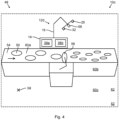
- Fig. 4 schematically represents a top view of a further example of a cleaning system 10c in the industrial environment 48. Mainly differences with respect to Fig. 2 will be described.
- the cleaning system 10c comprises a stationary robot 12d.
- the cleaning system 10c thus corresponds to the cleaning system 10 in Fig. 1 except for comprising the stationary robot 12d, no docking station 40, no docking station cleaning robot 42 and no traction arrangement 24.
- the stationary robot 12d of this example comprises a stationary base 14 containing the first and second tanks 38a and 38b and a manipulator 16 movable relative to the base 14.
- the manipulator 16 in Fig. 4 carries both the sensor device 26 and the cleaning device 32.
- the stationary robot 12d is also configured to scan each of the surfaces 60a-60c and to clean the same, substantially as described in connection with Fig. 2 .
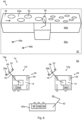
- Fig. 5 schematically represents a top view of a further example of a cleaning system 10d in the industrial environment 48. Mainly differences with respect to Fig. 2 will be described.
- the cleaning system 10d comprises a stationary robot 12e having a stationary base 14 and a manipulator 16 carrying the cutting tool 56.
- the cleaning system 10d corresponds to the cleaning system 10 in Fig. 1 except for comprising a stationary robot 12e, no docking station 40, no docking station cleaning robot 42 and no traction arrangement 24.
- the cleaning system 10d comprises a stationary sensor device 26 and a stationary cleaning device 32.
- the cutting tool 56 can first be moved by the manipulator 16 of the stationary robot 12e to the sensor device 26.
- the sensor device 26 can thereby obtain sensor data 30 based on radiation 28 from the surface 60a of the cutting tool 56.
- the stationary robot 12e can then be moved relative to the cleaning device 32 for carrying out a cleaning process as described above, but where the cleaning device 32 is stationary and the surface 60a moves with respect to the same.
- a continuous monitoring of the conveyor 54 is possible.
- Fig. 6 schematically represents a top view of a further example of a cleaning system 10e in the industrial environment 48. Mainly differences with respect to Figs. 2 and 3 will be described.
- the cleaning system 10e comprises a fleet 74 of mobile robots, here illustrated as a first mobile robot 12f and a second mobile robot 12g.
- the cleaning system 10e thus corresponds to the cleaning system 10 in Fig. 1 except for comprising two mobile robots 12f and 12g.
- the first mobile robot 12f comprises a manipulator 16 carrying a first sensor device 26a and a cleaning device 32 as described herein.
- the first mobile robot 12f carries the first tank 38a.
- the second mobile robot 12g comprises a manipulator 16 carrying a second sensor device 26b and a cleaning device 32 as described herein.
- the second mobile robot 12g carries the second tank 38b.
- Each of the sensor devices 26a and 26b is configured to obtain radiation 28 from the region 52 and to provide corresponding sensor data 30 indicative of a cleanliness of the surfaces 60a-60c.
- the first and second sensor devices 26a and 26b are of different types.
- Fig. 6 further schematically illustrates two different types of contaminants 58a and 58b present in the region 52.
- the first mobile robot 12f is configured to detect a first type of contaminant 58a by means of the first sensor device 26a and to clean the first type of contaminant 58a by means of the first cleaning media 34a contained in the first tank 38a.
- the second mobile robot 12g is configured to detect a second type of contaminant 58b by means of the second sensor device 26b and to clean the second type of contaminant 58b by means of the second cleaning media 34b contained in the second tank 38b.
- Each of the first and second mobile robots 12f and 12g is thus configured for a specific type of contamination 58a and 58b.
- the cleaning system 10e limits a risk of mixing the cleaning media 34a and 34b.
- the cleaning system 10e simplifies the design of the respective mobile robots 12f and 12g as they only need to be compatible with the respective cleaning media 34a and 34b.
Landscapes
- Engineering & Computer Science (AREA)
- Health & Medical Sciences (AREA)
- Robotics (AREA)
- Mechanical Engineering (AREA)
- Life Sciences & Earth Sciences (AREA)
- Veterinary Medicine (AREA)
- Epidemiology (AREA)
- Animal Behavior & Ethology (AREA)
- General Health & Medical Sciences (AREA)
- Public Health (AREA)
- General Chemical & Material Sciences (AREA)
- Chemical Kinetics & Catalysis (AREA)
- Chemical & Material Sciences (AREA)
- Food Science & Technology (AREA)
- Electric Vacuum Cleaner (AREA)
- Cleaning In General (AREA)
Claims (13)
- Procédé de nettoyage d'une région (52) dans un environnement industriel (48) à l'aide d'au moins un robot industriel (12 ; 12a-12g), le procédé consistant :- à obtenir un rayonnement (28) provenant de la région (52) au moyen d'un dispositif capteur (26 ; 26a, 26b) ;- à fournir des données de capteur (30) sur la base du rayonnement (28), les données de capteur (30) indiquant une propreté d'une ou de plusieurs surfaces (60a-60c) dans la région (52) ; et- à réaliser un processus de nettoyage pour nettoyer la région (52), le processus de nettoyage consistant à appliquer des milieux de nettoyage (34a, 34b) à partir d'un dispositif de nettoyage (32) auxdites une ou plusieurs surfaces (60a-60c), et le processus de nettoyage étant réalisé sur la base des données de capteur (30), dans lequel le robot industriel (12, 12a-12g) porte le dispositif capteur (26 ; 26a, 26b) et/ou le dispositif de nettoyage (32).
- Procédé selon la revendication 1, consistant en outre à déterminer, sur la base des données de capteur (30), si le processus de nettoyage doit être réalisé.
- Procédé selon l'une quelconque des revendications précédentes, consistant en outre :- à obtenir un rayonnement de validation (28) provenant de la région (52) au moyen du dispositif capteur (26 ; 26a, 26b) ;- à générer d'autres données de capteur (30) sur la base du rayonnement de validation (28) ; et- à évaluer le processus de nettoyage sur la base des données de capteur de validation (30).
- Procédé selon l'une quelconque des revendications précédentes, consistant en outre à sélectionner un type de milieux de nettoyage (34a, 34b) à appliquer pendant le processus de nettoyage sur la base des données de capteur (30).
- Procédé selon l'une quelconque des revendications précédentes, consistant en outre :- à déterminer une distribution de contaminants (58 ; 58a, 58b) dans la région (52) sur la base des données de capteur (30) ; et- à réaliser le processus de nettoyage sur la base de la distribution.
- Procédé selon l'une quelconque des revendications précédentes, consistant en outre :- à évaluer une propriété de surface desdites une ou plusieurs surfaces (60a-60c) dans la région (52) sur la base des données de capteur (30) ; et- à réaliser le processus de nettoyage sur la base de la propriété de surface.
- Procédé selon l'une quelconque des revendications précédentes, dans lequel l'un dudit au moins un robot industriel (12 ; 12a-12g) est un robot mobile (12a-12c ; 12f, 12g) comportant un agencement de traction (24).
- Procédé selon la revendication 7, consistant en outre :- à commander l'agencement de traction (24) pour déplacer le robot mobile (12a ; 12c ; 12f, 12g) afin qu'il s'arrime à une station d'accueil (40 ; 40a-40c) ; et- à alimenter en milieux de nettoyage (34a, 34b) un ou plusieurs réservoirs (38a, 38b) du robot mobile (12a ; 12c ; 12f, 12g) à partir de la station d'accueil (40 ; 40a-40c)
- Procédé selon l'une quelconque des revendications précédentes, consistant en outre à communiquer des données de gestion (46) à un système de gestion à distance (44), les données de gestion (46) étant associées aux données de capteur (30) et/ou associées au processus de nettoyage.
- Système de commande (18) pour commander le nettoyage d'une région (52) dans un environnement industriel (48) à l'aide d'au moins un robot industriel (12 ; 12a-12g), le système de commande (18) comprenant au moins un dispositif de traitement de données (20) et au moins une mémoire (22) sur laquelle est stocké au moins un programme informatique, ledit au moins un programme informatique comprenant un code de programme qui, lorsqu'il est exécuté par ledit au moins un dispositif de traitement de données (20), amène ledit au moins un dispositif de traitement de données (20) à réaliser les étapes consistant :- à ordonner à un dispositif capteur (26 ; 26a, 26b) d'obtenir un rayonnement (28) provenant de la région (52) ;- à fournir des données de capteur (30) sur la base du rayonnement (28), les données de capteur (30) indiquant une propreté d'une ou de plusieurs surfaces (60a-60c) dans la région (52) ; et- à commander la réalisation d'un processus de nettoyage pour nettoyer la région (52), le processus de nettoyage consistant à appliquer des milieux de nettoyage (34a, 34b) à partir d'un dispositif de nettoyage (32) auxdites une ou plusieurs surfaces (60a-60c), et le processus de nettoyage étant réalisé sur la base des données de capteur (34a), dans lequel le robot industriel (12, 12a-12g) porte le dispositif capteur (26 ; 26a, 26b) et/ou le dispositif de nettoyage (32).
- Système de nettoyage (10 ; 10a-10e) comprenant :- le système de commande (18) selon la revendication 10 ;- ledit au moins un robot industriel (12 ; 12a-12g) ;- le dispositif capteur (26 ; 26a, 26b) ; et- le dispositif de nettoyage (32).
- Système de nettoyage (10 ; 10a-10e) selon la revendication 10, dans lequel l'un dudit au moins un robot industriel (12 ; 12a-12g) est un robot mobile (12a-12c ; 12f, 12g) comportant un agencement de traction (24), et dans lequel le dispositif de nettoyage (32) est porté par le robot mobile (12a ; 12c ; 12f, 12g).
- Système de nettoyage (10 ; 10a-10e) selon la revendication 12, comprenant en outre une station d'accueil (40 ; 40a-40c), dans lequel le robot mobile (12a ; 12c ; 12f, 12g) et la station d'accueil (40 ; 40a-40c) sont configurés de telle sorte que ledit au moins un robot mobile (12a ; 12c ; 12f, 12g) puisse s'arrimer à la station d'accueil (40 ; 40a-40c) et recevoir des milieux de nettoyage (34a, 34b) en provenance de celle-ci.
Applications Claiming Priority (1)
| Application Number | Priority Date | Filing Date | Title |
|---|---|---|---|
| PCT/EP2021/074614 WO2023036405A1 (fr) | 2021-09-07 | 2021-09-07 | Procédé de nettoyage d'une région dans un environnement industriel, système de commande et système de nettoyage |
Publications (2)
| Publication Number | Publication Date |
|---|---|
| EP4399059A1 EP4399059A1 (fr) | 2024-07-17 |
| EP4399059B1 true EP4399059B1 (fr) | 2025-06-11 |
Family
ID=77897609
Family Applications (1)
| Application Number | Title | Priority Date | Filing Date |
|---|---|---|---|
| EP21773740.2A Active EP4399059B1 (fr) | 2021-09-07 | 2021-09-07 | Procédé de nettoyage d'une zone dans un environnement industriel, système de commande et système de nettoyage |
Country Status (4)
| Country | Link |
|---|---|
| US (1) | US20240269334A1 (fr) |
| EP (1) | EP4399059B1 (fr) |
| CN (1) | CN117881504A (fr) |
| WO (1) | WO2023036405A1 (fr) |
Families Citing this family (4)
| Publication number | Priority date | Publication date | Assignee | Title |
|---|---|---|---|---|
| US11935220B1 (en) * | 2023-08-14 | 2024-03-19 | Shiv S Naimpally | Using artificial intelligence (AI) to detect debris |
| EP4513281A1 (fr) * | 2023-08-25 | 2025-02-26 | Siemens Aktiengesellschaft | Procédé et système de commande de processus de nettoyage en place et installation industrielle |
| CN117697788B (zh) * | 2024-01-16 | 2024-06-11 | 浙江大学 | 一种中药生产环境巡检机器人及微生物含量测定方法 |
| WO2025195580A1 (fr) * | 2024-03-19 | 2025-09-25 | Abb Schweiz Ag | Procédé de nettoyage d'objets à l'aide d'un robot mobile, système électronique et système robot |
Family Cites Families (21)
| Publication number | Priority date | Publication date | Assignee | Title |
|---|---|---|---|---|
| SE524564C2 (sv) * | 2003-01-23 | 2004-08-31 | Jan Sandberg | Automatisk tvättanordning för djurstallar med ljudreglerad avstängning, samt förfarande för att stänga av en automatisk tvättanordning |
| US20060216193A1 (en) * | 2005-03-22 | 2006-09-28 | Johnson Kaj A | Cleaning tools with UV flash unit |
| US8779391B2 (en) * | 2011-03-03 | 2014-07-15 | Teckni-Corp | Sterilization system with ultraviolet emitter for eradicating biological contaminants |
| US8972061B2 (en) * | 2012-11-02 | 2015-03-03 | Irobot Corporation | Autonomous coverage robot |
| US20160271803A1 (en) * | 2013-05-03 | 2016-09-22 | Michael Stewart | Robotic disinfection system |
| KR102312661B1 (ko) * | 2014-10-13 | 2021-10-15 | 삼성전자주식회사 | 청소 로봇 |
| US10795377B2 (en) * | 2018-01-03 | 2020-10-06 | AI Incorporated | Method for autonomously controlling speed of components and functions of a robot |
| CN110946509A (zh) * | 2018-09-27 | 2020-04-03 | 广东美的生活电器制造有限公司 | 扫地机器人的清扫方法及扫地机器人的清扫装置 |
| CN111035328B (zh) * | 2018-10-12 | 2022-12-16 | 科沃斯机器人股份有限公司 | 机器人清洁方法及机器人 |
| KR20200069103A (ko) * | 2018-12-06 | 2020-06-16 | 삼성전자주식회사 | 로봇 청소기 및 로봇 청소기의 청소 경로 계획 방법 |
| US11938243B2 (en) * | 2019-03-22 | 2024-03-26 | Zeteo Tech, Inc. | Mobile systems for microwave assisted surface decontamination and decontamination methods |
| US20200397936A1 (en) * | 2019-05-21 | 2020-12-24 | ATOM, Inc. | Systems and Methods For Internet-Of-Things (IOT) Robotic Sterilization Device |
| AU2020260510B2 (en) * | 2019-11-06 | 2022-03-31 | Bissell Inc. | Surface cleaning apparatus |
| KR102803060B1 (ko) * | 2019-12-03 | 2025-05-07 | 삼성전자주식회사 | 오염원을 판단하는 로봇 청소기 및 그 동작 방법 |
| WO2021229309A1 (fr) * | 2020-05-11 | 2021-11-18 | Lk Lab S.R.L. | Dispositif d'aseptisation de locaux |
| IL301364A (en) * | 2020-09-14 | 2023-05-01 | Aeroclean Tech Llc | Air sanitizer and combined surface sanitizer |
| US11097414B1 (en) * | 2020-12-22 | 2021-08-24 | X Development Llc | Monitoring of surface touch points for precision cleaning |
| US20220313857A1 (en) * | 2021-04-01 | 2022-10-06 | Prescientx | Autonomous mobile disinfection platform method and apparatus |
| CN113243844A (zh) * | 2021-04-15 | 2021-08-13 | 北京顺造科技有限公司 | 清洁系统及控制方法 |
| EP4080311A1 (fr) * | 2021-04-23 | 2022-10-26 | Carnegie Robotics, LLC | Procédé de fonctionnement d'un ou de plusieurs robots |
| EP4373530A1 (fr) * | 2021-07-20 | 2024-05-29 | Abb Schweiz Ag | Procédé d'inactivation de pathogènes, système de commande et système de robot |
-
2021
- 2021-09-07 EP EP21773740.2A patent/EP4399059B1/fr active Active
- 2021-09-07 US US18/689,181 patent/US20240269334A1/en active Pending
- 2021-09-07 CN CN202180101945.0A patent/CN117881504A/zh active Pending
- 2021-09-07 WO PCT/EP2021/074614 patent/WO2023036405A1/fr not_active Ceased
Also Published As
| Publication number | Publication date |
|---|---|
| WO2023036405A1 (fr) | 2023-03-16 |
| CN117881504A (zh) | 2024-04-12 |
| US20240269334A1 (en) | 2024-08-15 |
| EP4399059A1 (fr) | 2024-07-17 |
Similar Documents
| Publication | Publication Date | Title |
|---|---|---|
| EP4399059B1 (fr) | Procédé de nettoyage d'une zone dans un environnement industriel, système de commande et système de nettoyage | |
| Teiwes et al. | Identifying the potential of human-robot collaboration in automotive assembly lines using a standardised work description | |
| CN217225533U (zh) | 用于容器加工设施的机器人系统 | |
| Cognominal et al. | Evolving field of autonomous mobile robotics: Technological advances and applications | |
| US11794335B2 (en) | Modular robot system for a container processing facility | |
| EP1220806B1 (fr) | Systeme de lubrification des transporteurs | |
| TWI723301B (zh) | 工作機械 | |
| US11550303B2 (en) | Robotic production line and methods of flexible and chaotic production | |
| Kabir et al. | Automated planning for robotic cleaning using multiple setups and oscillatory tool motions | |
| KR20120116516A (ko) | 작업 지원 로봇 시스템 | |
| CN114847812B (zh) | 消毒洗地机器人的自动控制方法、装置、设备及存储介质 | |
| JP7133906B2 (ja) | 自動走行車システム、制御システム、制御方法、及びプログラム | |
| US20170101078A1 (en) | Decontamination Methods | |
| US20040179924A1 (en) | Robotic package unloading machine | |
| Zaki et al. | Application of Realtime Robotics platform to execute unstructured industrial tasks involving industrial robots, cobots, and human operators | |
| CA2796638C (fr) | Procede et appareil pour utiliser des robots pour laver des camions utilises dans des environnements miniers et dans d'autres environnements sales | |
| KR20260010294A (ko) | 물류 로봇 및 이를 이용한 물류 시스템 | |
| US20180369854A1 (en) | Coating application with automated brushing | |
| CN110817231A (zh) | 一种面向物流场景订单拣选方法、设备和系统 | |
| Nikoleiski | Hygienic design and cleaning as an allergen control measure | |
| US20180117646A1 (en) | Cleaning Device for Surfaces | |
| US20110156417A1 (en) | Method of operating a robot and apparatus comprising a robot | |
| EP3700717B1 (fr) | Procédé de surveillance d'une zone de travail, système de robot et système de commande | |
| Brougham et al. | Design, installation and operation of cleaning and disinfectant chemical storage, distribution and application systems in food factories | |
| Karthik et al. | Creating a 6-axis robot for enhanced assembly line safety in automotive manufacturing |
Legal Events
| Date | Code | Title | Description |
|---|---|---|---|
| STAA | Information on the status of an ep patent application or granted ep patent |
Free format text: STATUS: UNKNOWN |
|
| STAA | Information on the status of an ep patent application or granted ep patent |
Free format text: STATUS: THE INTERNATIONAL PUBLICATION HAS BEEN MADE |
|
| PUAI | Public reference made under article 153(3) epc to a published international application that has entered the european phase |
Free format text: ORIGINAL CODE: 0009012 |
|
| STAA | Information on the status of an ep patent application or granted ep patent |
Free format text: STATUS: REQUEST FOR EXAMINATION WAS MADE |
|
| 17P | Request for examination filed |
Effective date: 20240226 |
|
| AK | Designated contracting states |
Kind code of ref document: A1 Designated state(s): AL AT BE BG CH CY CZ DE DK EE ES FI FR GB GR HR HU IE IS IT LI LT LU LV MC MK MT NL NO PL PT RO RS SE SI SK SM TR |
|
| DAV | Request for validation of the european patent (deleted) | ||
| DAX | Request for extension of the european patent (deleted) | ||
| GRAP | Despatch of communication of intention to grant a patent |
Free format text: ORIGINAL CODE: EPIDOSNIGR1 |
|
| STAA | Information on the status of an ep patent application or granted ep patent |
Free format text: STATUS: GRANT OF PATENT IS INTENDED |
|
| INTG | Intention to grant announced |
Effective date: 20250107 |
|
| GRAS | Grant fee paid |
Free format text: ORIGINAL CODE: EPIDOSNIGR3 |
|
| GRAA | (expected) grant |
Free format text: ORIGINAL CODE: 0009210 |
|
| STAA | Information on the status of an ep patent application or granted ep patent |
Free format text: STATUS: THE PATENT HAS BEEN GRANTED |
|
| AK | Designated contracting states |
Kind code of ref document: B1 Designated state(s): AL AT BE BG CH CY CZ DE DK EE ES FI FR GB GR HR HU IE IS IT LI LT LU LV MC MK MT NL NO PL PT RO RS SE SI SK SM TR |
|
| REG | Reference to a national code |
Ref country code: GB Ref legal event code: FG4D |
|
| REG | Reference to a national code |
Ref country code: CH Ref legal event code: EP |
|
| REG | Reference to a national code |
Ref country code: DE Ref legal event code: R096 Ref document number: 602021032175 Country of ref document: DE |
|
| REG | Reference to a national code |
Ref country code: IE Ref legal event code: FG4D |
|
| PG25 | Lapsed in a contracting state [announced via postgrant information from national office to epo] |
Ref country code: FI Free format text: LAPSE BECAUSE OF FAILURE TO SUBMIT A TRANSLATION OF THE DESCRIPTION OR TO PAY THE FEE WITHIN THE PRESCRIBED TIME-LIMIT Effective date: 20250611 Ref country code: ES Free format text: LAPSE BECAUSE OF FAILURE TO SUBMIT A TRANSLATION OF THE DESCRIPTION OR TO PAY THE FEE WITHIN THE PRESCRIBED TIME-LIMIT Effective date: 20250611 |
|
| PGFP | Annual fee paid to national office [announced via postgrant information from national office to epo] |
Ref country code: DE Payment date: 20250919 Year of fee payment: 5 |
|
| REG | Reference to a national code |
Ref country code: LT Ref legal event code: MG9D |
|
| PG25 | Lapsed in a contracting state [announced via postgrant information from national office to epo] |
Ref country code: GR Free format text: LAPSE BECAUSE OF FAILURE TO SUBMIT A TRANSLATION OF THE DESCRIPTION OR TO PAY THE FEE WITHIN THE PRESCRIBED TIME-LIMIT Effective date: 20250912 Ref country code: NO Free format text: LAPSE BECAUSE OF FAILURE TO SUBMIT A TRANSLATION OF THE DESCRIPTION OR TO PAY THE FEE WITHIN THE PRESCRIBED TIME-LIMIT Effective date: 20250911 |
|
| REG | Reference to a national code |
Ref country code: NL Ref legal event code: MP Effective date: 20250611 |
|
| PG25 | Lapsed in a contracting state [announced via postgrant information from national office to epo] |
Ref country code: BG Free format text: LAPSE BECAUSE OF FAILURE TO SUBMIT A TRANSLATION OF THE DESCRIPTION OR TO PAY THE FEE WITHIN THE PRESCRIBED TIME-LIMIT Effective date: 20250611 |
|
| PG25 | Lapsed in a contracting state [announced via postgrant information from national office to epo] |
Ref country code: HR Free format text: LAPSE BECAUSE OF FAILURE TO SUBMIT A TRANSLATION OF THE DESCRIPTION OR TO PAY THE FEE WITHIN THE PRESCRIBED TIME-LIMIT Effective date: 20250611 |
|
| PGFP | Annual fee paid to national office [announced via postgrant information from national office to epo] |
Ref country code: AT Payment date: 20251020 Year of fee payment: 5 |
|
| PG25 | Lapsed in a contracting state [announced via postgrant information from national office to epo] |
Ref country code: RS Free format text: LAPSE BECAUSE OF FAILURE TO SUBMIT A TRANSLATION OF THE DESCRIPTION OR TO PAY THE FEE WITHIN THE PRESCRIBED TIME-LIMIT Effective date: 20250911 |
|
| PG25 | Lapsed in a contracting state [announced via postgrant information from national office to epo] |
Ref country code: LV Free format text: LAPSE BECAUSE OF FAILURE TO SUBMIT A TRANSLATION OF THE DESCRIPTION OR TO PAY THE FEE WITHIN THE PRESCRIBED TIME-LIMIT Effective date: 20250611 |
|
| PG25 | Lapsed in a contracting state [announced via postgrant information from national office to epo] |
Ref country code: NL Free format text: LAPSE BECAUSE OF FAILURE TO SUBMIT A TRANSLATION OF THE DESCRIPTION OR TO PAY THE FEE WITHIN THE PRESCRIBED TIME-LIMIT Effective date: 20250611 |
|
| PG25 | Lapsed in a contracting state [announced via postgrant information from national office to epo] |
Ref country code: PT Free format text: LAPSE BECAUSE OF FAILURE TO SUBMIT A TRANSLATION OF THE DESCRIPTION OR TO PAY THE FEE WITHIN THE PRESCRIBED TIME-LIMIT Effective date: 20251013 |
|
| REG | Reference to a national code |
Ref country code: AT Ref legal event code: MK05 Ref document number: 1802008 Country of ref document: AT Kind code of ref document: T Effective date: 20250611 |
|
| PG25 | Lapsed in a contracting state [announced via postgrant information from national office to epo] |
Ref country code: IS Free format text: LAPSE BECAUSE OF FAILURE TO SUBMIT A TRANSLATION OF THE DESCRIPTION OR TO PAY THE FEE WITHIN THE PRESCRIBED TIME-LIMIT Effective date: 20251011 |
|
| PG25 | Lapsed in a contracting state [announced via postgrant information from national office to epo] |
Ref country code: AT Free format text: LAPSE BECAUSE OF FAILURE TO SUBMIT A TRANSLATION OF THE DESCRIPTION OR TO PAY THE FEE WITHIN THE PRESCRIBED TIME-LIMIT Effective date: 20250611 Ref country code: SM Free format text: LAPSE BECAUSE OF FAILURE TO SUBMIT A TRANSLATION OF THE DESCRIPTION OR TO PAY THE FEE WITHIN THE PRESCRIBED TIME-LIMIT Effective date: 20250611 |
|
| PG25 | Lapsed in a contracting state [announced via postgrant information from national office to epo] |
Ref country code: CZ Free format text: LAPSE BECAUSE OF FAILURE TO SUBMIT A TRANSLATION OF THE DESCRIPTION OR TO PAY THE FEE WITHIN THE PRESCRIBED TIME-LIMIT Effective date: 20250611 |
|
| PG25 | Lapsed in a contracting state [announced via postgrant information from national office to epo] |
Ref country code: PL Free format text: LAPSE BECAUSE OF FAILURE TO SUBMIT A TRANSLATION OF THE DESCRIPTION OR TO PAY THE FEE WITHIN THE PRESCRIBED TIME-LIMIT Effective date: 20250611 |
|
| PG25 | Lapsed in a contracting state [announced via postgrant information from national office to epo] |
Ref country code: EE Free format text: LAPSE BECAUSE OF FAILURE TO SUBMIT A TRANSLATION OF THE DESCRIPTION OR TO PAY THE FEE WITHIN THE PRESCRIBED TIME-LIMIT Effective date: 20250611 |
|
| PG25 | Lapsed in a contracting state [announced via postgrant information from national office to epo] |
Ref country code: SK Free format text: LAPSE BECAUSE OF FAILURE TO SUBMIT A TRANSLATION OF THE DESCRIPTION OR TO PAY THE FEE WITHIN THE PRESCRIBED TIME-LIMIT Effective date: 20250611 |
|
| PG25 | Lapsed in a contracting state [announced via postgrant information from national office to epo] |
Ref country code: RO Free format text: LAPSE BECAUSE OF FAILURE TO SUBMIT A TRANSLATION OF THE DESCRIPTION OR TO PAY THE FEE WITHIN THE PRESCRIBED TIME-LIMIT Effective date: 20250611 |
|
| REG | Reference to a national code |
Ref country code: DE Ref legal event code: R097 Ref document number: 602021032175 Country of ref document: DE |
|
| PG25 | Lapsed in a contracting state [announced via postgrant information from national office to epo] |
Ref country code: DK Free format text: LAPSE BECAUSE OF FAILURE TO SUBMIT A TRANSLATION OF THE DESCRIPTION OR TO PAY THE FEE WITHIN THE PRESCRIBED TIME-LIMIT Effective date: 20250611 |
|
| PG25 | Lapsed in a contracting state [announced via postgrant information from national office to epo] |
Ref country code: IT Free format text: LAPSE BECAUSE OF FAILURE TO SUBMIT A TRANSLATION OF THE DESCRIPTION OR TO PAY THE FEE WITHIN THE PRESCRIBED TIME-LIMIT Effective date: 20250611 |
|
| PLBE | No opposition filed within time limit |
Free format text: ORIGINAL CODE: 0009261 |
|
| STAA | Information on the status of an ep patent application or granted ep patent |
Free format text: STATUS: NO OPPOSITION FILED WITHIN TIME LIMIT |
|
| REG | Reference to a national code |
Ref country code: CH Ref legal event code: L10 Free format text: ST27 STATUS EVENT CODE: U-0-0-L10-L00 (AS PROVIDED BY THE NATIONAL OFFICE) Effective date: 20260423 |