EP4400047A2 - Procédé de conditionnement d'un capteur - Google Patents
Procédé de conditionnement d'un capteur Download PDFInfo
- Publication number
- EP4400047A2 EP4400047A2 EP24170633.2A EP24170633A EP4400047A2 EP 4400047 A2 EP4400047 A2 EP 4400047A2 EP 24170633 A EP24170633 A EP 24170633A EP 4400047 A2 EP4400047 A2 EP 4400047A2
- Authority
- EP
- European Patent Office
- Prior art keywords
- sensor
- potential
- current
- minutes
- measured
- Prior art date
- Legal status (The legal status is an assumption and is not a legal conclusion. Google has not performed a legal analysis and makes no representation as to the accuracy of the status listed.)
- Granted
Links
Images





Classifications
-
- A—HUMAN NECESSITIES
- A61—MEDICAL OR VETERINARY SCIENCE; HYGIENE
- A61B—DIAGNOSIS; SURGERY; IDENTIFICATION
- A61B5/00—Measuring for diagnostic purposes; Identification of persons
- A61B5/145—Measuring characteristics of blood in vivo, e.g. gas concentration or pH-value ; Measuring characteristics of body fluids or tissues, e.g. interstitial fluid or cerebral tissue
- A61B5/14532—Measuring characteristics of blood in vivo, e.g. gas concentration or pH-value ; Measuring characteristics of body fluids or tissues, e.g. interstitial fluid or cerebral tissue for measuring glucose, e.g. by tissue impedance measurement
-
- A—HUMAN NECESSITIES
- A61—MEDICAL OR VETERINARY SCIENCE; HYGIENE
- A61B—DIAGNOSIS; SURGERY; IDENTIFICATION
- A61B5/00—Measuring for diagnostic purposes; Identification of persons
- A61B5/0002—Remote monitoring of patients using telemetry, e.g. transmission of vital signals via a communication network
- A61B5/0031—Implanted circuitry
-
- A—HUMAN NECESSITIES
- A61—MEDICAL OR VETERINARY SCIENCE; HYGIENE
- A61B—DIAGNOSIS; SURGERY; IDENTIFICATION
- A61B5/00—Measuring for diagnostic purposes; Identification of persons
- A61B5/145—Measuring characteristics of blood in vivo, e.g. gas concentration or pH-value ; Measuring characteristics of body fluids or tissues, e.g. interstitial fluid or cerebral tissue
- A61B5/14539—Measuring characteristics of blood in vivo, e.g. gas concentration or pH-value ; Measuring characteristics of body fluids or tissues, e.g. interstitial fluid or cerebral tissue for measuring pH
-
- A—HUMAN NECESSITIES
- A61—MEDICAL OR VETERINARY SCIENCE; HYGIENE
- A61B—DIAGNOSIS; SURGERY; IDENTIFICATION
- A61B5/00—Measuring for diagnostic purposes; Identification of persons
- A61B5/145—Measuring characteristics of blood in vivo, e.g. gas concentration or pH-value ; Measuring characteristics of body fluids or tissues, e.g. interstitial fluid or cerebral tissue
- A61B5/14546—Measuring characteristics of blood in vivo, e.g. gas concentration or pH-value ; Measuring characteristics of body fluids or tissues, e.g. interstitial fluid or cerebral tissue for measuring analytes not otherwise provided for, e.g. ions, cytochromes
-
- A—HUMAN NECESSITIES
- A61—MEDICAL OR VETERINARY SCIENCE; HYGIENE
- A61B—DIAGNOSIS; SURGERY; IDENTIFICATION
- A61B5/00—Measuring for diagnostic purposes; Identification of persons
- A61B5/145—Measuring characteristics of blood in vivo, e.g. gas concentration or pH-value ; Measuring characteristics of body fluids or tissues, e.g. interstitial fluid or cerebral tissue
- A61B5/1468—Measuring characteristics of blood in vivo, e.g. gas concentration or pH-value ; Measuring characteristics of body fluids or tissues, e.g. interstitial fluid or cerebral tissue using chemical or electrochemical methods, e.g. by polarographic means
- A61B5/1473—Measuring characteristics of blood in vivo, e.g. gas concentration or pH-value ; Measuring characteristics of body fluids or tissues, e.g. interstitial fluid or cerebral tissue using chemical or electrochemical methods, e.g. by polarographic means invasive, e.g. introduced into the body by a catheter
-
- A—HUMAN NECESSITIES
- A61—MEDICAL OR VETERINARY SCIENCE; HYGIENE
- A61B—DIAGNOSIS; SURGERY; IDENTIFICATION
- A61B5/00—Measuring for diagnostic purposes; Identification of persons
- A61B5/145—Measuring characteristics of blood in vivo, e.g. gas concentration or pH-value ; Measuring characteristics of body fluids or tissues, e.g. interstitial fluid or cerebral tissue
- A61B5/1468—Measuring characteristics of blood in vivo, e.g. gas concentration or pH-value ; Measuring characteristics of body fluids or tissues, e.g. interstitial fluid or cerebral tissue using chemical or electrochemical methods, e.g. by polarographic means
- A61B5/1486—Measuring characteristics of blood in vivo, e.g. gas concentration or pH-value ; Measuring characteristics of body fluids or tissues, e.g. interstitial fluid or cerebral tissue using chemical or electrochemical methods, e.g. by polarographic means using enzyme electrodes, e.g. with immobilised oxidase
-
- A—HUMAN NECESSITIES
- A61—MEDICAL OR VETERINARY SCIENCE; HYGIENE
- A61B—DIAGNOSIS; SURGERY; IDENTIFICATION
- A61B5/00—Measuring for diagnostic purposes; Identification of persons
- A61B5/145—Measuring characteristics of blood in vivo, e.g. gas concentration or pH-value ; Measuring characteristics of body fluids or tissues, e.g. interstitial fluid or cerebral tissue
- A61B5/1468—Measuring characteristics of blood in vivo, e.g. gas concentration or pH-value ; Measuring characteristics of body fluids or tissues, e.g. interstitial fluid or cerebral tissue using chemical or electrochemical methods, e.g. by polarographic means
- A61B5/1486—Measuring characteristics of blood in vivo, e.g. gas concentration or pH-value ; Measuring characteristics of body fluids or tissues, e.g. interstitial fluid or cerebral tissue using chemical or electrochemical methods, e.g. by polarographic means using enzyme electrodes, e.g. with immobilised oxidase
- A61B5/14865—Measuring characteristics of blood in vivo, e.g. gas concentration or pH-value ; Measuring characteristics of body fluids or tissues, e.g. interstitial fluid or cerebral tissue using chemical or electrochemical methods, e.g. by polarographic means using enzyme electrodes, e.g. with immobilised oxidase invasive, e.g. introduced into the body by a catheter or needle or using implanted sensors
-
- A—HUMAN NECESSITIES
- A61—MEDICAL OR VETERINARY SCIENCE; HYGIENE
- A61B—DIAGNOSIS; SURGERY; IDENTIFICATION
- A61B5/00—Measuring for diagnostic purposes; Identification of persons
- A61B5/145—Measuring characteristics of blood in vivo, e.g. gas concentration or pH-value ; Measuring characteristics of body fluids or tissues, e.g. interstitial fluid or cerebral tissue
- A61B5/1495—Calibrating or testing of in-vivo probes
-
- A—HUMAN NECESSITIES
- A61—MEDICAL OR VETERINARY SCIENCE; HYGIENE
- A61B—DIAGNOSIS; SURGERY; IDENTIFICATION
- A61B5/00—Measuring for diagnostic purposes; Identification of persons
- A61B5/68—Arrangements of detecting, measuring or recording means, e.g. sensors, in relation to patient
- A61B5/6846—Arrangements of detecting, measuring or recording means, e.g. sensors, in relation to patient specially adapted to be brought in contact with an internal body part, i.e. invasive
-
- A—HUMAN NECESSITIES
- A61—MEDICAL OR VETERINARY SCIENCE; HYGIENE
- A61B—DIAGNOSIS; SURGERY; IDENTIFICATION
- A61B5/00—Measuring for diagnostic purposes; Identification of persons
- A61B5/68—Arrangements of detecting, measuring or recording means, e.g. sensors, in relation to patient
- A61B5/6846—Arrangements of detecting, measuring or recording means, e.g. sensors, in relation to patient specially adapted to be brought in contact with an internal body part, i.e. invasive
- A61B5/6847—Arrangements of detecting, measuring or recording means, e.g. sensors, in relation to patient specially adapted to be brought in contact with an internal body part, i.e. invasive mounted on an invasive device
- A61B5/6848—Needles
- A61B5/6849—Needles in combination with a needle set
-
- A—HUMAN NECESSITIES
- A61—MEDICAL OR VETERINARY SCIENCE; HYGIENE
- A61B—DIAGNOSIS; SURGERY; IDENTIFICATION
- A61B90/00—Instruments, implements or accessories specially adapted for surgery or diagnosis and not covered by any of the groups A61B1/00 - A61B50/00, e.g. for luxation treatment or for protecting wound edges
- A61B90/08—Accessories or related features not otherwise provided for
-
- G—PHYSICS
- G01—MEASURING; TESTING
- G01N—INVESTIGATING OR ANALYSING MATERIALS BY DETERMINING THEIR CHEMICAL OR PHYSICAL PROPERTIES
- G01N27/00—Investigating or analysing materials by the use of electric, electrochemical, or magnetic means
- G01N27/26—Investigating or analysing materials by the use of electric, electrochemical, or magnetic means by investigating electrochemical variables; by using electrolysis or electrophoresis
- G01N27/28—Electrolytic cell components
- G01N27/30—Electrodes, e.g. test electrodes; Half-cells
- G01N27/327—Biochemical electrodes, e.g. electrical or mechanical details for in vitro measurements
- G01N27/3271—Amperometric enzyme electrodes for analytes in body fluids, e.g. glucose in blood
- G01N27/3274—Corrective measures, e.g. error detection, compensation for temperature or hematocrit, calibration
-
- G—PHYSICS
- G01—MEASURING; TESTING
- G01N—INVESTIGATING OR ANALYSING MATERIALS BY DETERMINING THEIR CHEMICAL OR PHYSICAL PROPERTIES
- G01N27/00—Investigating or analysing materials by the use of electric, electrochemical, or magnetic means
- G01N27/26—Investigating or analysing materials by the use of electric, electrochemical, or magnetic means by investigating electrochemical variables; by using electrolysis or electrophoresis
- G01N27/416—Systems
- G01N27/49—Systems involving the determination of the current at a single specific value, or small range of values, of applied voltage for producing selective measurement of one or more particular ionic species
-
- A—HUMAN NECESSITIES
- A61—MEDICAL OR VETERINARY SCIENCE; HYGIENE
- A61B—DIAGNOSIS; SURGERY; IDENTIFICATION
- A61B2560/00—Constructional details of operational features of apparatus; Accessories for medical measuring apparatus
- A61B2560/02—Operational features
- A61B2560/0223—Operational features of calibration, e.g. protocols for calibrating sensors
Definitions
- Embodiments herein relate to the field of sensors, and, more specifically, to the conditioning of a sensor to obtain consistent readings and reduce background artifacts.
- Continuous sensors such as continuous glucose monitoring (CGM) sensors, are used to measure data continuously, e.g., in a continuous data stream and/or sampled data points over a time interval.
- CGM continuous glucose monitoring
- the data is inconsistent for a period of time as the sensor acclimates to the in vivo conditions.
- CGM systems require a so-called run-in time, and immediately after insertion of the sensor the measurement is not reliable. This, it would be advantageous if this time (which might differ from insertion site to insertion site) could be reduced.
- Coupled may mean that two or more elements are in direct physical or electrical contact. However, “coupled” may also mean that two or more elements are not in direct contact with each other, but yet still cooperate or interact with each other.
- a phrase in the form "A/B” or in the form “A and/or B” means (A), (B), or (A and B).
- a phrase in the form "at least one of A, B, and C” means (A), (B), (C), (A and B), (A and C), (B and C), or (A, B and C).
- a phrase in the form "(A)B” means (B) or (AB) that is, A is an optional element.
- Continuous glucose monitoring technology has been used in the management of diabetes for many years now. Traditional devices use enzymatic methods to measure glucose concentration and provide sample information. In future applications the continuous glucose sensor may become a critical component of the closed loop insulin delivery system and, as such, must be selective, rapid, predictable and acceptable for continuous patient use.
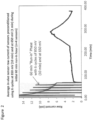
- this precondition also results in a sensor that is not as susceptible to current drift even after the run-in period. For example, as shown in Figure 1 even after the sensor has proceeded through the run-in time, when a potential of 650mV is applied the base line current drifts slowly downward as a function of time. This baseline drift can lead to erroneous glucose readings and/or the need to continually calibrate the sensor to measured blood glucose levels.
- In vivo conditioning may include modulation of a potential applied to the sensor, such as a glucose sensor implanted or otherwise inserted into the tissue, such as skin, of a subject.
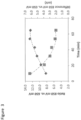
- the current generated at each potential is used to determine if the sensor is preconditioned and can be relied on to provide a stable signal (see for example Figures 3 , 6 , 7 and 10 ).
- the method is done in vitro for example prior to insertion of the sensor.
- Such conditioning may be done during or before packaging, or, alternatively, by a user prior to insertion, for example in an appropriate fluid environment.
- a computing device may be endowed with one or more components of the disclosed apparatuses and/or systems and may be employed to perform one or more methods as disclosed herein.
- the method includes applying a first potential to the sensor and measuring a first current at the first potential. After the first potential is applied, a second potential is applied to the sensor and a second current is measured at the second potential. The relationship, such as the ratio of or differential between, this first current measured to the second current measured is determined.
- steps are then repeated cyclically until the relationship, such as the ratio or the differential, between the first current measured and the second current measured has stabilized, thereby reducing sensor run-in time.
- the actually currents and the ratio or differential are not measured and/or determined. Instead, the sensor is cycled as described above between the two potentials for a predetermined amount of time.
- the first potential is greater than the second potential. While in other embodiments, the second potential is greater than the second.
- the first potential is higher than the second or visa-versa depends on the starting potential. What is most important is that there is a difference in the voltage potential applied.
- the second potential is between about 200 mV and about 900 mV, for example about 200 mV, 225 mV, 250 mV, 275 mV, 300 mV, 325 mV, 350 mV, 375 mV, 400 mV, 425 mV, 450 mV, 475 mV, 500 mV, 525 mV, 550 mV, 575 mV, 600 mV, 625 mV, 650 mV, 675 mV, 700 mV, 725 mV, 750 mV, 775 mV, 800 mV, 825 mV, 850 mV, 875 mV, or about 900 mV.
- the first potential is between about 300 mV and about 1000 mV, for example about 300 mV, 325 mV, 350 mV, 375 mV, 400 mV, 425 mV, 450 mV, 475 mV, 500 mV, 525 mV, 550 mV, 575 mV, 600 mV, 625 mV, 650 mV, 675 mV, 700 mV, 725 mV, 750 mV, 775 mV, 800 mV, 825 mV, 850 mV, 875 mV, 900 mV, 925 mV, 950 mV, 975 mV, or about 1000 mV.
- the potential is varied between 650 mV and 850 mV. When relationship, such as the ratio or the differential, between the current at both of these potentials has stabilized, the modulation is discontinued and the analysis and/or calibration can take place.
- the first voltage is greater than or equal to the running voltage of the sensor.
- the second the voltage is less than the voltage needed for water hydrolysis. For example with an operation potential of 450 mV conditioning modulation that might occur between 650 mV and 400 mV. Similarly, with an operation potential of 650 mV conditioning modulation that might occur between 850 mV and 650 mV.
- the cycling is repeated multiple times, such as between about 3 and 20 times. In some embodiments, the cycle is repeated between about 3 and about 10 times. In some embodiments, the first potential is applied for about 5 to about 15 minutes.
- the cycle time should be longer at this setting versus the cycle time for the lower voltage, for example 10 min at high voltage.
- the low voltage setting is used for estimating the completion stage of the run-in process by evaluating the two currents in relation to each other.
- the lower voltage cycle can therefore be kept relatively short (0.5-5 min), preferably 3-4 min.
- the second potential is applied for about 10 seconds to about 3 minutes.
- the cycling is repeated until the relationship, such as the ratio or the differential, between the currents at the two applied potentials is substantially consistent.
- the cycle is repeated for between about 5 minutes and about 120 minutes, and/or for example, until the relationship (for example the ratio or differential) of the currents at each applied potential is stable.
- phase I background current
- phase II phase II
- the method disclosed herein reduces the phase I background current in about 60 minutes and at the same time reduces the phase II background current as well.
- the phase I effect is reduced from greater than 3 hours to less than 60 minutes.
- the phase II effect is reduced about 12 hours to about 60 to about 90 minutes.
- the run-in time is reduced from about 8 to about 12 hours to between about 30 minutes and about 60 minutes, such as between about 30 minutes and about 60 minutes after insertion of a sensor into the tissue of a subject, such as a human or veterinary subject. Because not all sensors are identical, the modulation time may be different for each inserted sensor.
- the method is initiated a few moments after the sensor has been inserted into the tissue, such as the skin or subcutaneous tissue of a subject.
- preconditioning can be started after insertion of the sensor into the tissue of a subject, such as within 1 minute, within 2 minutes, within 3 minutes, within 4 minutes, within 5 minutes, within 6 minutes, within 7 minutes, within 8 minutes, within 9 minutes, within 10minutes, within 11 minutes, within 12 minutes, within 13 minutes, within 14 minutes, or within 15 minutes of insertion.
- the method is initiated after insertion.
- the preconditioning method disclosed herein can be performed after the sensor has been implanted for a substantial amount of time to test if the sensor is in good working condition, or perhaps needs to be replaced.
- the methods disclosed herein can be performed, for example recycled, to correct or recondition a sensor that is suffering from a non-glucose drift, for example to correct a sensor that is not functioning properly.
- the method can be preformed after a predetermined time period to determine if the sensor is functioning properly, for example hourly, weekly, or monthly, or at any other predetermined interval after insertion or as triggered by detection of signal drift that is not believed to be due to actual glucose levels. If, during this "reconditioning" the sensor is found to be behaving as it should, for example the relationship, such as the ratio or the differential, of the current from the first applied potential to the current from the second applied current is stable, then the sensor may be left in place.
- the wearer of the sensor may be prompted to change the sensor.
- the method is performed in response to a determination that the sensor (whether correct or not) is unstable, for example giving unexpected readings.
- preconditioning is performed prior to calibration of the sensor. In embodiments, such as during "reconditioning," the method is performed prior to calibration of the sensor. In some embodiments, the sensor comes from the factory or vendor calibrated and no additional calibration beyond preconditioning is needed.
- the measured current at the first potential and the second potential is between about 1 nA and about 50 nA. In certain embodiments, the ratio between the first measured current and the second measured current is between about 0.5 and about 40. While the method disclosed herein is particularly suited to the preconditioning of glucose sensors in vivo, the method can also be used to condition sensors for other analytes, such as O 2 , and ionic species, creatinine, urea, among others.
- the preconditioning is done in vivo. In certain embodiments, the preconditioning is done in vitro. In certain embodiments, the preconditioning is done in vitro. In certain embodiments, the preconditioning is done in a dual phase, for example conditioning can be done in vitro followed by insertion and continued conditioning in vivo.
- An untreated electrochemical glucose sensor was evaluated for its "normal" settling time according to the following procedure.
- the settling time of-the sensor was measured in vitro.
- a pig of approximately 40 Kg was placed under an inhaled anesthetic for a period of 6 to 7 hours.
- a total of 8 Waveform continuous glucose sensors are applied to the skin in the abdominal area of the pig.
- the sensors are applied using an applicator called a Sensor Insertion Tool.
- Each sensor in held in place in the skin using an acrylic adhesive patch.
- the sensor is operated by a devices called a transmitter that contains a potentiostat that is programed to provide different potentials to the sensors. These potentials can vary from about 400 to about 900 mVolts.
- the sensors are platinum based sensors that are coated with a GOx crosslinked glutaraldehyde enzyme layer on top of which is coated a polyurethane outer membrane.
- Glucose that is located in the interstitial fluid of the skin is analyzed by these sensors.
- the optimal potential for analysis of glucose is about 650 mV.
- the current that is generated is composed of two components. One is not related to the glucose concertation and is called the background current and the second is current generated that is directly related to the glucose concertation in the interstitial fluid of the skin.
- the transmitters were programed to go through a set of cycles and at a point in time, typically after 60 minutes, the potential is changed to 650 or some other potential and the glucose analysis is carried out.
- the initial analysis was conducted with the glucose maintained between 60 and 80 mg/dl in concertation. After the initial analysis a 20 % glucose solution was infused into a vein of the pig and the glucose concertation was increased to between about 220-270 mg/dl. This higher blood glucose concentration was maintained for about 60 minutes. The blood glucose was then reduced by reducing the amount of glucose that was being infused. The blood glucose levels were checked by using a blood glucose meter and glucose strips.
- the ear of the pig's was punctured and the capillary blood from the ear was obtained and applied to the blood glucose strips to determine the glucose level.
- the lower level blood glucose level was used to calibrate the ISF based continuous glucose sensors readings. This calibration process involves the conversion of glucose related current generated at the surface to blood glucose equivalent readings.
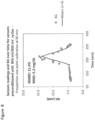
- After the conditioning is disclosed herein was done on a number of the sensors their performance was compared to unconditioned sensors. The comparison is made based on the plots shown as well as the MARD (Mean Absolute Relative Differences) calculations. The MARD calculations were made by comparing CGM glucose values to blood glucose concentrations collected at the same time. It was clear for both the graphing and the MARD analysis that conditioned sensors performed much better than those that were not conditioned.
- Figure 1 is a graph showing the average current from four sensors with an applied potential of 650mV.
- Figure 2 is a graph showing the average current from four sensors that were preconditioned with cycles of applied potentials of 850 mV and 650mV.
- Figure 3 is a graph showing the ratio of currents at 850 mV and 650mV over time and the difference in current at 850 mV and 650mV over time.
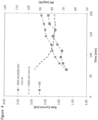
- Figure 4 is a graph of current over time for a sensor with a 650 mV conditioning (run-in), 850 mV/650 mV conditioning (run-in), overlaid with measured blood glucose levels.
- Figure 5 is a graph of current over time for a sensor with a 650 mV conditioning (run-in), 850 mV/650 mV conditioning (run-in), overlaid with measured blood glucose levels.
- Figure 6 is a graph of the measured current and the ratio of current for a sensor cyclically preconditioned at 850 mV and 650 mV demonstrating ratio stabilization.
- Figure 7 is a graph of the measured current and the ratio of current for a sensor cyclically preconditioned at 950 mV and 650 mV demonstrating ratio stabilization.
- Figure 8 is a graph illustrating that sensors cyclically preconditioned at 850 mV and 650 mV accurately track blood glucose measurements.
- Figure 9 is a graph illustrating that sensors that are not preconditioned do not accurately track blood glucose measurements.
- Figure 11 is graph illustrating that the run-in time (ratio convergence) for two sensors is less than about 40 minutes.
- Figure 10 is a graph showing that raw current is a function of time as the sensors are cycled between 850 mV and 650 mV.
- Figure 12 is a graph showing that raw current is a function of time for sensors preconditioned with 850 mV.
Landscapes
- Health & Medical Sciences (AREA)
- Life Sciences & Earth Sciences (AREA)
- Physics & Mathematics (AREA)
- Molecular Biology (AREA)
- Pathology (AREA)
- General Health & Medical Sciences (AREA)
- Surgery (AREA)
- Engineering & Computer Science (AREA)
- Veterinary Medicine (AREA)
- Heart & Thoracic Surgery (AREA)
- Animal Behavior & Ethology (AREA)
- Biomedical Technology (AREA)
- Public Health (AREA)
- Medical Informatics (AREA)
- Biophysics (AREA)
- Optics & Photonics (AREA)
- Chemical & Material Sciences (AREA)
- Chemical Kinetics & Catalysis (AREA)
- General Chemical & Material Sciences (AREA)
- Biochemistry (AREA)
- Emergency Medicine (AREA)
- Electrochemistry (AREA)
- Analytical Chemistry (AREA)
- General Physics & Mathematics (AREA)
- Immunology (AREA)
- Hematology (AREA)
- Nuclear Medicine, Radiotherapy & Molecular Imaging (AREA)
- Oral & Maxillofacial Surgery (AREA)
- Computer Networks & Wireless Communication (AREA)
- Measurement Of The Respiration, Hearing Ability, Form, And Blood Characteristics Of Living Organisms (AREA)
Applications Claiming Priority (3)
| Application Number | Priority Date | Filing Date | Title |
|---|---|---|---|
| US201762580376P | 2017-11-01 | 2017-11-01 | |
| EP18873219.2A EP3703565B1 (fr) | 2017-11-01 | 2018-11-01 | Procédé pour le conditionnement d'un capteur |
| PCT/US2018/058775 WO2019089976A1 (fr) | 2017-11-01 | 2018-11-01 | Procédé pour le conditionnement d'un capteur |
Related Parent Applications (1)
| Application Number | Title | Priority Date | Filing Date |
|---|---|---|---|
| EP18873219.2A Division EP3703565B1 (fr) | 2017-11-01 | 2018-11-01 | Procédé pour le conditionnement d'un capteur |
Publications (4)
| Publication Number | Publication Date |
|---|---|
| EP4400047A2 true EP4400047A2 (fr) | 2024-07-17 |
| EP4400047A3 EP4400047A3 (fr) | 2024-10-02 |
| EP4400047B1 EP4400047B1 (fr) | 2025-09-24 |
| EP4400047C0 EP4400047C0 (fr) | 2025-09-24 |
Family
ID=66244972
Family Applications (2)
| Application Number | Title | Priority Date | Filing Date |
|---|---|---|---|
| EP24170633.2A Active EP4400047B1 (fr) | 2017-11-01 | 2018-11-01 | Procédé de conditionnement d'un capteur |
| EP18873219.2A Active EP3703565B1 (fr) | 2017-11-01 | 2018-11-01 | Procédé pour le conditionnement d'un capteur |
Family Applications After (1)
| Application Number | Title | Priority Date | Filing Date |
|---|---|---|---|
| EP18873219.2A Active EP3703565B1 (fr) | 2017-11-01 | 2018-11-01 | Procédé pour le conditionnement d'un capteur |
Country Status (4)
| Country | Link |
|---|---|
| US (1) | US11484227B2 (fr) |
| EP (2) | EP4400047B1 (fr) |
| CN (2) | CN118892313A (fr) |
| WO (1) | WO2019089976A1 (fr) |
Families Citing this family (4)
| Publication number | Priority date | Publication date | Assignee | Title |
|---|---|---|---|---|
| EP3920798B1 (fr) * | 2019-02-05 | 2024-08-14 | Ascensia Diabetes Care Holdings AG | Appareil et procédés pour sonder une opération de capteur d'une détection d'analyte continue et auto-étalonnage |
| CN113646625A (zh) | 2019-02-22 | 2021-11-12 | 安晟信医疗科技控股公司 | 用于使用谐波关系监测分析物浓度的方法和设备 |
| US11963763B2 (en) | 2019-09-10 | 2024-04-23 | Ascensia Diabetes Care Holdings Ag | Methods and apparatus information gathering, error detection and analyte concentration determination during continuous analyte sensing |
| KR20230048038A (ko) | 2020-08-04 | 2023-04-10 | 어센시아 다이어비티즈 케어 홀딩스 아게 | 연결 함수에 의한 연속적인 분석물 모니터링 센서 교정 및 측정 |
Family Cites Families (18)
| Publication number | Priority date | Publication date | Assignee | Title |
|---|---|---|---|---|
| US4004462A (en) * | 1974-06-07 | 1977-01-25 | National Semiconductor Corporation | Temperature transducer |
| US5112455A (en) * | 1990-07-20 | 1992-05-12 | I Stat Corporation | Method for analytically utilizing microfabricated sensors during wet-up |
| IE72524B1 (en) * | 1994-11-04 | 1997-04-23 | Elan Med Tech | Analyte-controlled liquid delivery device and analyte monitor |
| JP4256588B2 (ja) * | 1998-05-20 | 2009-04-22 | アークレイ株式会社 | 統計的手法を用いた電気化学的測定方法および測定装置 |
| US7132041B2 (en) * | 2003-02-11 | 2006-11-07 | Bayer Healthcare Llc | Methods of determining the concentration of an analyte in a fluid test sample |
| DE10315080A1 (de) * | 2003-04-02 | 2004-11-04 | Infineon Technologies Ag | Sensor-Anordnung und Sensor-Array |
| ES2646312T3 (es) | 2003-12-08 | 2017-12-13 | Dexcom, Inc. | Sistemas y métodos para mejorar sensores de analito electromecánicos |
| US20070144247A1 (en) * | 2005-12-23 | 2007-06-28 | Seesink Peter H | Multiple function stable sensor circuitry |
| US20070173712A1 (en) * | 2005-12-30 | 2007-07-26 | Medtronic Minimed, Inc. | Method of and system for stabilization of sensors |
| WO2009076302A1 (fr) | 2007-12-10 | 2009-06-18 | Bayer Healthcare Llc | Marqueurs de contrôle pour la détection automatique d'une solution de contrôle et procédés d'utilisation |
| US8986208B2 (en) * | 2008-09-30 | 2015-03-24 | Abbott Diabetes Care Inc. | Analyte sensor sensitivity attenuation mitigation |
| US9149220B2 (en) * | 2011-04-15 | 2015-10-06 | Dexcom, Inc. | Advanced analyte sensor calibration and error detection |
| US10092229B2 (en) * | 2010-06-29 | 2018-10-09 | Abbott Diabetes Care Inc. | Calibration of analyte measurement system |
| WO2014018069A1 (fr) * | 2012-07-27 | 2014-01-30 | Bayer Healthcare Llc | Système et procédé pour la détection de détecteurs utilisés et secs |
| US20170038331A1 (en) | 2015-08-05 | 2017-02-09 | Lifescan Scotland Limited | System and method for compensating sample-related measurements based on polarization effects of test strips |
| CN105957866B (zh) * | 2016-05-04 | 2018-02-16 | 上海小海龟科技有限公司 | 半导体生物传感器及其制备方法 |
| CN106124581B (zh) * | 2016-06-12 | 2018-04-27 | 青岛大学 | 同一体系构建两种比率电化学传感器检测抗肿瘤药物方法 |
| US10856784B2 (en) * | 2017-06-30 | 2020-12-08 | Medtronic Minimed, Inc. | Sensor initialization methods for faster body sensor response |
-
2018
- 2018-11-01 WO PCT/US2018/058775 patent/WO2019089976A1/fr not_active Ceased
- 2018-11-01 EP EP24170633.2A patent/EP4400047B1/fr active Active
- 2018-11-01 CN CN202410746561.XA patent/CN118892313A/zh active Pending
- 2018-11-01 CN CN201880077066.7A patent/CN111683595B/zh active Active
- 2018-11-01 US US16/178,431 patent/US11484227B2/en active Active
- 2018-11-01 EP EP18873219.2A patent/EP3703565B1/fr active Active
Also Published As
| Publication number | Publication date |
|---|---|
| EP4400047B1 (fr) | 2025-09-24 |
| EP3703565A4 (fr) | 2021-07-28 |
| EP3703565C0 (fr) | 2024-04-24 |
| EP3703565A1 (fr) | 2020-09-09 |
| EP4400047A3 (fr) | 2024-10-02 |
| CN111683595A (zh) | 2020-09-18 |
| US11484227B2 (en) | 2022-11-01 |
| US20190125225A1 (en) | 2019-05-02 |
| EP4400047C0 (fr) | 2025-09-24 |
| CN118892313A (zh) | 2024-11-05 |
| WO2019089976A1 (fr) | 2019-05-09 |
| CN111683595B (zh) | 2024-07-02 |
| BR112020008671A2 (pt) | 2020-10-27 |
| EP3703565B1 (fr) | 2024-04-24 |
Similar Documents
| Publication | Publication Date | Title |
|---|---|---|
| US20240081700A1 (en) | Method and system for providing continuous calibration of implantable analyte sensors | |
| US20240260866A1 (en) | Accuracy of continuous glucose sensors | |
| EP4400047B1 (fr) | Procédé de conditionnement d'un capteur | |
| US6895263B2 (en) | Real time self-adjusting calibration algorithm | |
| EP1706022B1 (fr) | Systeme et procede de reetalonnage de capteur | |
| Diem et al. | Clinical performance of a continuous viscometric affinity sensor for glucose | |
| EP2369977B1 (fr) | Procédés et systèmes pour observer les paramètres d un capteur | |
| US8216138B1 (en) | Correlation of alternative site blood and interstitial fluid glucose concentrations to venous glucose concentration | |
| CN102264283B (zh) | 葡萄糖传感器校准系统和/或方法 | |
| EP1886113B1 (fr) | Utilisation de points de donnees multiples d'un filtrage dans un detecteur d'analyte | |
| EP2825096B1 (fr) | Systèmes et procédés de traitement de données de capteur de substance à analyser | |
| EP2485043B1 (fr) | Dispositif et procédé de test de capteurs électrochemiques | |
| BR112020008671B1 (pt) | Método para condicionamento de um sensor | |
| KR100560183B1 (ko) | 비효소 전극을 이용한 백그라운드 전류의 직접측정에기초하여 1회의 혈중 글루코즈 측정으로 투-포인트 보정을가능케하는 생체이식형 전류계 혈당센서를 위한 생체내보정 방법 및 이를 위한 시스템 |
Legal Events
| Date | Code | Title | Description |
|---|---|---|---|
| PUAI | Public reference made under article 153(3) epc to a published international application that has entered the european phase |
Free format text: ORIGINAL CODE: 0009012 |
|
| STAA | Information on the status of an ep patent application or granted ep patent |
Free format text: STATUS: THE APPLICATION HAS BEEN PUBLISHED |
|
| AC | Divisional application: reference to earlier application |
Ref document number: 3703565 Country of ref document: EP Kind code of ref document: P |
|
| AK | Designated contracting states |
Kind code of ref document: A2 Designated state(s): AL AT BE BG CH CY CZ DE DK EE ES FI FR GB GR HR HU IE IS IT LI LT LU LV MC MK MT NL NO PL PT RO RS SE SI SK SM TR |
|
| REG | Reference to a national code |
Ref country code: DE Ref legal event code: R079 Free format text: PREVIOUS MAIN CLASS: A61B0005149500 Ipc: A61B0005145000 Ref country code: DE Ref legal event code: R079 Ref document number: 602018085955 Country of ref document: DE Free format text: PREVIOUS MAIN CLASS: A61B0005149500 Ipc: A61B0005145000 |
|
| PUAL | Search report despatched |
Free format text: ORIGINAL CODE: 0009013 |
|
| AK | Designated contracting states |
Kind code of ref document: A3 Designated state(s): AL AT BE BG CH CY CZ DE DK EE ES FI FR GB GR HR HU IE IS IT LI LT LU LV MC MK MT NL NO PL PT RO RS SE SI SK SM TR |
|
| RIC1 | Information provided on ipc code assigned before grant |
Ipc: G01N 27/327 20060101ALI20240829BHEP Ipc: A61B 5/1473 20060101ALI20240829BHEP Ipc: A61B 5/00 20060101ALI20240829BHEP Ipc: A61B 5/1495 20060101ALI20240829BHEP Ipc: G01N 27/49 20060101ALI20240829BHEP Ipc: A61B 5/1486 20060101ALI20240829BHEP Ipc: A61B 5/145 20060101AFI20240829BHEP |
|
| RAP1 | Party data changed (applicant data changed or rights of an application transferred) |
Owner name: KONAMITE LIMITED |
|
| STAA | Information on the status of an ep patent application or granted ep patent |
Free format text: STATUS: REQUEST FOR EXAMINATION WAS MADE |
|
| GRAP | Despatch of communication of intention to grant a patent |
Free format text: ORIGINAL CODE: EPIDOSNIGR1 |
|
| STAA | Information on the status of an ep patent application or granted ep patent |
Free format text: STATUS: GRANT OF PATENT IS INTENDED |
|
| 17P | Request for examination filed |
Effective date: 20250326 |
|
| RIC1 | Information provided on ipc code assigned before grant |
Ipc: G01N 27/327 20060101ALI20250416BHEP Ipc: A61B 5/1473 20060101ALI20250416BHEP Ipc: A61B 5/00 20060101ALI20250416BHEP Ipc: A61B 5/1495 20060101ALI20250416BHEP Ipc: G01N 27/49 20060101ALI20250416BHEP Ipc: A61B 5/1486 20060101ALI20250416BHEP Ipc: A61B 5/145 20060101AFI20250416BHEP |
|
| INTG | Intention to grant announced |
Effective date: 20250428 |
|
| GRAS | Grant fee paid |
Free format text: ORIGINAL CODE: EPIDOSNIGR3 |
|
| GRAA | (expected) grant |
Free format text: ORIGINAL CODE: 0009210 |
|
| STAA | Information on the status of an ep patent application or granted ep patent |
Free format text: STATUS: THE PATENT HAS BEEN GRANTED |
|
| AC | Divisional application: reference to earlier application |
Ref document number: 3703565 Country of ref document: EP Kind code of ref document: P |
|
| AK | Designated contracting states |
Kind code of ref document: B1 Designated state(s): AL AT BE BG CH CY CZ DE DK EE ES FI FR GB GR HR HU IE IS IT LI LT LU LV MC MK MT NL NO PL PT RO RS SE SI SK SM TR |
|
| REG | Reference to a national code |
Ref country code: GB Ref legal event code: FG4D |
|
| REG | Reference to a national code |
Ref country code: CH Ref legal event code: EP |
|
| REG | Reference to a national code |
Ref country code: DE Ref legal event code: R096 Ref document number: 602018085955 Country of ref document: DE |
|
| REG | Reference to a national code |
Ref country code: IE Ref legal event code: FG4D |
|
| U01 | Request for unitary effect filed |
Effective date: 20250924 |
|
| U07 | Unitary effect registered |
Designated state(s): AT BE BG DE DK EE FI FR IT LT LU LV MT NL PT RO SE SI Effective date: 20251002 |
|
| U20 | Renewal fee for the european patent with unitary effect paid |
Year of fee payment: 8 Effective date: 20251110 |
|
| PGFP | Annual fee paid to national office [announced via postgrant information from national office to epo] |
Ref country code: GB Payment date: 20251114 Year of fee payment: 8 |
|
| PG25 | Lapsed in a contracting state [announced via postgrant information from national office to epo] |
Ref country code: NO Free format text: LAPSE BECAUSE OF FAILURE TO SUBMIT A TRANSLATION OF THE DESCRIPTION OR TO PAY THE FEE WITHIN THE PRESCRIBED TIME-LIMIT Effective date: 20251224 |
|
| PG25 | Lapsed in a contracting state [announced via postgrant information from national office to epo] |
Ref country code: HR Free format text: LAPSE BECAUSE OF FAILURE TO SUBMIT A TRANSLATION OF THE DESCRIPTION OR TO PAY THE FEE WITHIN THE PRESCRIBED TIME-LIMIT Effective date: 20250924 |
|
| PG25 | Lapsed in a contracting state [announced via postgrant information from national office to epo] |
Ref country code: GR Free format text: LAPSE BECAUSE OF FAILURE TO SUBMIT A TRANSLATION OF THE DESCRIPTION OR TO PAY THE FEE WITHIN THE PRESCRIBED TIME-LIMIT Effective date: 20251225 |
|
| PGFP | Annual fee paid to national office [announced via postgrant information from national office to epo] |
Ref country code: IE Payment date: 20251111 Year of fee payment: 8 |
|
| PG25 | Lapsed in a contracting state [announced via postgrant information from national office to epo] |
Ref country code: RS Free format text: LAPSE BECAUSE OF FAILURE TO SUBMIT A TRANSLATION OF THE DESCRIPTION OR TO PAY THE FEE WITHIN THE PRESCRIBED TIME-LIMIT Effective date: 20251224 |
|
| PG25 | Lapsed in a contracting state [announced via postgrant information from national office to epo] |
Ref country code: SM Free format text: LAPSE BECAUSE OF FAILURE TO SUBMIT A TRANSLATION OF THE DESCRIPTION OR TO PAY THE FEE WITHIN THE PRESCRIBED TIME-LIMIT Effective date: 20250924 |
|
| PG25 | Lapsed in a contracting state [announced via postgrant information from national office to epo] |
Ref country code: ES Free format text: LAPSE BECAUSE OF FAILURE TO SUBMIT A TRANSLATION OF THE DESCRIPTION OR TO PAY THE FEE WITHIN THE PRESCRIBED TIME-LIMIT Effective date: 20250924 |
|
| PG25 | Lapsed in a contracting state [announced via postgrant information from national office to epo] |
Ref country code: IS Free format text: LAPSE BECAUSE OF FAILURE TO SUBMIT A TRANSLATION OF THE DESCRIPTION OR TO PAY THE FEE WITHIN THE PRESCRIBED TIME-LIMIT Effective date: 20260124 |