EP4400324A1 - Produit comprenant un motif de marquage sur une zone de surface pour identifier le produit - Google Patents
Produit comprenant un motif de marquage sur une zone de surface pour identifier le produit Download PDFInfo
- Publication number
- EP4400324A1 EP4400324A1 EP23150941.5A EP23150941A EP4400324A1 EP 4400324 A1 EP4400324 A1 EP 4400324A1 EP 23150941 A EP23150941 A EP 23150941A EP 4400324 A1 EP4400324 A1 EP 4400324A1
- Authority
- EP
- European Patent Office
- Prior art keywords
- product
- marking
- pattern
- base
- patterns
- Prior art date
- Legal status (The legal status is an assumption and is not a legal conclusion. Google has not performed a legal analysis and makes no representation as to the accuracy of the status listed.)
- Withdrawn
Links
Images



Classifications
-
- B—PERFORMING OPERATIONS; TRANSPORTING
- B42—BOOKBINDING; ALBUMS; FILES; SPECIAL PRINTED MATTER
- B42D—BOOKS; BOOK COVERS; LOOSE LEAVES; PRINTED MATTER CHARACTERISED BY IDENTIFICATION OR SECURITY FEATURES; PRINTED MATTER OF SPECIAL FORMAT OR STYLE NOT OTHERWISE PROVIDED FOR; DEVICES FOR USE THEREWITH AND NOT OTHERWISE PROVIDED FOR; MOVABLE-STRIP WRITING OR READING APPARATUS
- B42D25/00—Information-bearing cards or sheet-like structures characterised by identification or security features; Manufacture thereof
- B42D25/30—Identification or security features, e.g. for preventing forgery
- B42D25/324—Reliefs
-
- B—PERFORMING OPERATIONS; TRANSPORTING
- B42—BOOKBINDING; ALBUMS; FILES; SPECIAL PRINTED MATTER
- B42D—BOOKS; BOOK COVERS; LOOSE LEAVES; PRINTED MATTER CHARACTERISED BY IDENTIFICATION OR SECURITY FEATURES; PRINTED MATTER OF SPECIAL FORMAT OR STYLE NOT OTHERWISE PROVIDED FOR; DEVICES FOR USE THEREWITH AND NOT OTHERWISE PROVIDED FOR; MOVABLE-STRIP WRITING OR READING APPARATUS
- B42D25/00—Information-bearing cards or sheet-like structures characterised by identification or security features; Manufacture thereof
- B42D25/30—Identification or security features, e.g. for preventing forgery
- B42D25/305—Associated digital information
Definitions
- This application relates to the field of product surface marking technologies for traceability and anti-counterfeiting purpose.
- Anti counterfeiting technology guide European Union Intellectual Property Office, 2021.
- these technologies add an element onto the item that is difficult to duplicate, or copy, or they characterize a specific physical or chemical feature of the item, similar to a fingerprint of the item.
- the challenge may be either technical, for instance on the reproduction of holograms, or require products which are not readily available on the market, such as rare isotopes or special inks.
- anti-counterfeiting features may be classified as overt technologies (visible, or more generally perceptible by the end user with his own body senses, without the need for specific detection equipment, such as for instance holograms on banknotes) or covert technologies (invisible/imperceptible, but detectable with a dedicated equipment).
- covert technologies are preferred for branded products because they do not interfere with the product surface artistic and/or marketing designs.
- Example of covert technologies include:
- the authentication of an object for any of the above technologies typically comprises a step of identifying, with a detector comprising a sensor adapted to the particular authentication technology employed for this object, whether the authentication technology can be retrieved from inspecting the object.
- the detector employs a camera for imaging the object surface.
- digital detection technologies have emerged which have facilitated the automation of this process and its generalization to non-specialized personnel, possibly also the general public, thanks to the use of digital signal processing algorithms embedded into software applications either embedded into the detector equipment (e.g., a smartphone) or executed on a computer in communication with the detector equipment (e.g., a scanner) through a communication network.
- the present application is based on the finding that combinations of marking base patterns over a product surface can facilitate a traceability of the product.
- the material shape (as may be prepared by embossing or engraving, for instance with a laser) or the printing structure (based on ink or varnish deposit) of an area of the product surface is enhanced by a plurality of marking patterns using a pre-defined geometrical arrangement relative to the product surface, such that the marked product surface shape does not visually disturb the product surface artwork or marketing design, while each of the combined marking patterns remain individually detectable by a marking pattern sensor independently from the other marking patterns out of the combined marking patterns on the product surface shape.
- product or “item” or “manufactured item” (used interchangeably) refer to a manufactured or an artisanal product.
- examples of products include, but are not limited to a luxury product, a pharmaceutical product, a cosmetics product, a food product, a tobacco product, a consumer electronics product, a sports product, a spare part product (e.g. automotive), a biomedical product, a coin, a bullion, a jewel, an artistic product, a banknote, a security document, a collectible card product, a precious metal, a watch, a leather product such as a bag.
- a product may also be a part of a manufactured object which is attached to or associated with this object, such as a component, a tag, a label, or a package.
- a product comprises at least one surface characterized by its shape and/or its structure which may be modified with a pattern by using various manufacturing or printing processes known in the art. Examples of modifications comprises changes of the diffuse properties, surface color and/or specular properties.
- product surfaces include, but are not limited to, an engraved surface, an embossed surface, a debossed surface, a metallized surface, a varnished surface, or a printed surface.
- the term "marking” refers to the result of a physical modification of a surface condition. Marking may be applied at the end of a manufacturing process to change the visual appearance or certain optical properties of a surface area relative to its surrounding areas, for instance a surface area on a product, or a surface area on a product part in association with a product.
- Examples of physical modifications comprise modifications of the surface shape or structure by processes such as for instance engraving, etching, embossing, debossing, stamping, printing, varnishing, and the like.
- Examples of visual appearance or optical properties for covert markings comprise surface diffuse reflection, color and/or specular properties which are non-visually disturbing to the naked eye when looking at the product surface design.
- the "marking" can be part of the manufacture process, e.g. the mold or the die from which the product is produced can comprise the marking pattern which is transferred to the surface area of the product.
- structural feature refers to an elementary component inherent to the marking process.
- a structural feature physically modifies the shape or structure of a surface area in the marking process.
- a structural feature may correspond to a dot and a structural feature value may correspond to a colour code (e.g. for printing), a depth or thickness of the dot (e.g. for engraving, embossing, debossing, or varnishing), or a size of the dot.
- a structural feature may be an embossing or debossing elementary shape of a predefined geometry.
- structural features are chosen so that their marking onto the surface causes changes to the surface diffuse reflection, color and/or specular properties which are visually non-disturbing to the end user, but can be detected with an optical detector.
- pattern refers to a one-dimensional (1D), a two-dimensional (2D) or a three-dimensional representation (3D) of the distribution of structural features along a line, within an area, or throughout a volume in the process of marking a product surface.
- a “base pattern” refers to a pre-defined distribution of structural features as may be represented in a computer-implemented form as a vector (1D), a matrix (2D) or a tensor (3D) of structural feature values.
- a "marking pattern” or a “combinatorial marking pattern” refers to a product surface marking which is made of a combination of one or more geometrical arrangements of one or more base patterns.
- a "digital pattern” may be produced as a data representation of a vector, a matrix or a tensor by a computer-implemented method such as a data encoding algorithm.
- Examples of 2D patterns suitable for use in a dot marking process comprise "image bitmaps", wherein each pixel represents a dot and the bitmap is used to guide the pattern marking process.
- density refers to the ratio of the number of actual structural features relative to the number of possible structural features within a pattern (e.g. ratio of active dots over the number of pixel positions in a bitmap).
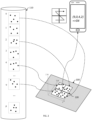
- Figure 1 shows an abstract representation of a first possible embodiment in which the shape or the structure of a surface area 120 of a product 100 is modified by using an overlay of a plurality of base patterns 131, 132, 133 selected in a database 110 of P pre-defined patterns.
- a database 110 of pre-defined base patterns is established wherein each base pattern is indexed as 0, 1, 2, 3..., P-1.
- the total number P of pre-defined base patterns in the database 110 is chosen such that the combination of a subset of k base patterns in the set of P pre-defined base patterns enables to identify, from the indices of the k base patterns in the set, a unique number in the range from 1 to N, where N is the number of products to be individually tracked out of the batch of products.
- the P pre-defined base patterns are prepared with a low density of a random or pseudo-random distribution of structural elements suitable for marking the product surface without being visually disturbing when the product user is looking at the product surface design.
- the density of structural elements shall be low enough to avoid significant overlap between any k separate base patterns in the set of P pre-defined base patterns. This preserves the ability to individually discriminate, at retrieval stage, k base patterns out of a combined marking pattern formed by overlaying the k patterns and used as the marking pattern at manufacturing stage.
- a statistical method such as for instance methods in relation with the Cryptoglyph technology from AlpVision, but other embodiments are also possible
- an empirical method such as using a trial and error test with different patterns
- a combination thereof may be used to this end in a preparatory stage to populate the database 110 with pre-defined based patterns.
- base patterns are chosen such as they are orthogonal to each other, to facilitate their retrieval in the detection process.
- base patterns are chosen such as they are partially orthogonal.
- Other embodiments are also possible with non-orthogonal patterns, for instance by combining them with further geometrical transforms in the marking process to facilitate their separation at retrieval time. It is also possible to design base patterns such that the structural feature satisfies specific layout conditions, for instance minimum distance between two structural features.
- the k base patterns 131, 132, 133 corresponding to indices 2,4 and 9 in the database 110 can be superposed to produce a combinatorial marking pattern on the surface area 120.
- the superposition of the k base patterns 131, 132, 133 into the combinatorial marking pattern virtually corresponds to a simple "stacking" geometrical arrangement along a z-axis perpendicular to the surface area.
- the subset of k base patterns 131, 132, 133 may be overlaid into a digital pattern (not represented) by a computer-implemented method, and the resulting digital pattern is then used to guide the surface shape or structure modification at manufacturing stage (virtual stacking).
- the subset of k base patterns 131, 132, 133 may be directly used to serially overlay the k patterns modifications each from a pattern-dedicated physical marking method, for instance by selecting k base patterns 131, 132, 133 out of P possible patterns in a sequential marking process (e.g. rolling stamp or multiple die stamps) (physical stacking). Both the virtual stacking and the physical stacking overlay marking embodiments enable to produce a combinatorial marking pattern on the product surface area 120 which is a mixture of k base patterns 131, 132, 133.
- an optical detection device 150 is used to capture one or more images from the combinatorial marking pattern over the product surface area 120, and a computer-implemented method is used to individually extract the k base patterns from the one or more images.
- the computer-implemented method can then retrieve the index of each of the k base patterns in the database (indices 2, 4 and 9 in the example of Figure 1 ) and decode accordingly the individual marking number of the product based on the retrieved indices.
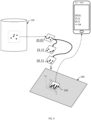
- Figure 2 shows an abstract representation of a second possible embodiment in which the shape or the structure of a surface area 120 of a product 100 is modified by using a marking pattern made of a plurality of geometrically arranged base patterns, for instance an array of juxtaposed base patterns over the product surface area 120.
- a database 110 of pre-defined base patterns is established wherein each base pattern is indexed as 0, 1, 2, 3..., P- 1.
- the total number P of pre-defined base patterns in the database 110 is chosen such that the ordered arrangements of a subset of k base patterns in the set of P base patterns enables to identify, from the indices of the k base patterns in the set, a unique number i in the range from 1 to N, where N is the number of products to be individually tracked out of the batch of products. As will be apparent to those skilled in the art of combinatorics, this corresponds to the number of permutations of k in P.
- the P and k values should be chosen such that their number of ordered arrangements P ! P ⁇ k ! is at least equal to the number N of products to be identified.
- Each product may then be identified by a marking number derived from a subset of k indices and their respective orders, for instance using a lookup table, a combinatorial numbering system such as combinadics, enumerative combinatorics, or other indexing encoding methods.
- the product 100 When the product 100 is produced with an individual marking number, it is possible to select, with a computer-implemented method, with the marking number as parameter, a subset of k base patterns out of the database 110 and to juxtapose them to produce an overlaid marking pattern on the surface area 120 so that the indices of the k base patterns enable to retrieve the individual marking number.
- the subset of k base patterns 131, 132, 133 may be virtually juxtaposed into a digital pattern (not represented) by a computer-implemented method, and the resulting array pattern is then used to guide the modification on the product surface area 120 at manufacturing stage.
- the subset of k base patterns may be directly used to physically juxtapose, one by one, the k base patterns modifications each from a pattern-dedicated physical marking method, for instance by selecting k patterns out of N possible patterns in a serial marking process and positioning them at a different position over the surface area 120 with an automated positioning mechanism (e.g robot arm, x-y table, conveyer belt, etc).
- an automated positioning mechanism e.g robot arm, x-y table, conveyer belt, etc.
- the computer-implemented method can then retrieve the ordered indices of the patterns in the database (9, 0, 4, 2 in the example of Figure 2 ) and decode accordingly the individual marking number of the product based on the retrieved ordered indices.
- Other embodiments for ordering are also possible.
- Figure 3 shows an abstract representation of another possible embodiment for producing a combinatorial marking pattern in which the shape or the structure of a surface area 120 of a product 100 is modified by using a selection of geometrical arrangements of a single predefined base pattern.
- Geometrical arrangements may comprise geometrical transforms such as rotations, translations, scaling, warping, mirroring and/or a combination thereof.
- Geometrical arrangements may also be specialized on sophisticated base patterns serving purposes such as increasing encoding space, introducing resilience to geometrical transformations, or allowing for the identification of rotations, translations, and scale.
- Such sophistication may consist for instance in adding shifted, rotated, or even mirrored versions of the base pattern. It is also possible to generate a base pattern with inherent geometrical properties to facilitate its retrieval with an optical sensor operating under different angles relative to the product surface area, for instance symmetries, such as rotational and/or central symmetries.
- the base pattern is translated 3 times to produce 3 different geometrical arrangements of the base patterns, indexed by the translation coordinates ((0,0), ⁇ 3,1 ⁇ , ⁇ 0,1 ⁇ ) along a x-axis and y-axis reference relative to the surface area 120.
- the marking number of the product can be derived from the indices of the actual retrieved geometrical arrangements coordinates as a subset selected out of a set of multiple possible geometrical arrangements of a base pattern.
- a geometrical arrangement of index ⁇ 2,5 ⁇ is illustrated, corresponding to a translation of D*2 pixels (where D is a parameter defining the minimum number of pixels between 2 translated base patterns in the marking pattern bitmap) along a horizontal axis (x-axis) and a translation of D*5 pixels along a vertical axis (y-axis).
- the total number P of pre-defined base patterns in the database 110 is chosen such that the combined encoding of the indices of a subset of k base patterns in the set of P base patterns and of the j sets of coordinates selected out of Q possible geometrical transforms enables to identify a marking number in the range from 1 to N, where N is the number of products to be individually tracked out of the batch of products.
- the number of base patterns in the database is only 1 and the indexing encoding solely depends on the numbers of its actual and possible geometrical transforms, so as to accelerate the matching process at retrieval time.
- Figure 1 , Figure 2 and Figure 3 may be combined to produce a combinatorial marking pattern made of one or more geometrical arrangements of at least one base pattern of structural features.
- This may be particularly advantageous in the case of a very large number of products. Indeed, increasing the number P of base pattern references as well as the number k of patterns to embed into a combinatorial marking pattern directly impacts the number of pattern matching detection operations and thus the computational efficiency of the detection stage .
- increasing the number of possible geometrical arrangements Q of a single base pattern is inherently limited by the size available for the combinatorial marking on the surface area 120 and the constraint to keep them individually separable at detection stage.
- the individual product marking number combinatorial encoding method may thus jointly employ a first selection of k values among P possibilities for the pre-defined reference base patterns and a second set of j values among Q possibilities for their possible geometrical arrangements, for instance using a lookup table, a combinatorial numbering system such as combinadics, enumerative combinatorics, or other indexing encoding methods.
- this may even comprise the addition of parity checks or error correction codes to increase the robustness of the encoding method to the noise induced by the physical marking process.
- Each individual product may then be identified from the combined encoding of the indices of a subset of k base patterns in the set of P patterns and of the geometrical transform coordinates of j geometrical arrangements of each base pattern in the set of Q possible geometrical arrangements of a base pattern.
- the geometrical transform of a base pattern may move some of its structural features beyond the borders of the product surface area 120 available space.
- the geometrical arrangement may employ pattern folding or wrap-around of the outside areas back into the regular base pattern area, for instance using the reconstruction scheme as illustrated on Figure 4b ) .
- this folded marking of products is particularly well suited when the geometrical transform is a translation along the x-axis and/or y-axis relative to the product surface are 120, and when the retrieval process uses cross-correlation to match to a base pattern reference, as the extraction of the cross-correlation calculated peaks enable to retrieve the number of translation steps along the x-axis as well as the y-axis (and thus the translation coordinates of the corresponding geometrical arrangements of the base pattern).
- the dashed square represents a translated base pattern and the parts exiting the base window represented by the black line are wrapped around. This wrap around has no impact on the cross-correlation signal of the translated base pattern with the original base pattern as recorded into the database 110 if the cross-correlation is computed using the Fourier transform.
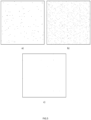
- Figure 5 shows 5a) a base pattern; 5b) the combinatorial marking pattern formed by overlaying 10 translated and wrapped around versions of the base pattern using the following translations (10 out of 49 possibilities), with following 10 vectors noted ⁇ dx,dy ⁇ for each translation ⁇ ⁇ 0,0 ⁇ , ⁇ 0,1 ⁇ , ⁇ 0,4 ⁇ , ⁇ 3,1 ⁇ , ⁇ 3,6 ⁇ , ⁇ 4,2 ⁇ , ⁇ 5,0 ⁇ , ⁇ 5,1 ⁇ , ⁇ 5,6 ⁇ , ⁇ 6,6 ⁇ ⁇ ; and 5c) the cross-correlation of the base pattern and of the combined pattern showing 10 peaks corresponding to each translation vector.
- the resulting modification can remain visually non-disturbing for the end-user of the product when looking at the product design, as the number k of base patterns to be combined in the surface marking pattern can be chosen low enough to maintain the property of low-density, random or pseudo-random structural features distribution in the combined marking pattern without significant difference from the properties of each of the k individual patterns.
- the structural features for pattern marking may be chosen such that they are inherently imperceptible to the human eye for instance through changes in size and/or contrast. This is significant compared to a naive method of product serial number tracking. To individually track 1 million of manufactured products, it is possible to produce and retrieve individual markings at a much lower cost than 1 million individual markings and retrievals, for example:
- Figure 6 shows the digital bitmap corresponding to a combinatorial marking pattern of low density adapted from a set of geometrically arranged Cryptoglyph base patterns.
- This combinatorial marking pattern is suitable for printing yellow dots or varnish dots on a 4cm*4cm surface area at serialization stage, at the end of a product package manufacturing process.
- the proposed method produces, with one of more processors of a computer-implemented digital marking pattern processing system, a marking pattern from a marking number through the steps of:
- the geometrical arrangements are defined and indexed along an x-axis, a y-axis, a z-axis, or a combination thereof, relative to a product surface area suitable for the product marking process, such that each geometrical arrangement of a base pattern over the product surface remains detectable independently from the other geometrical arrangements of base patterns in the combinatorial marking pattern.
- the proposed method retrieves from the combinatorial marking image, with one of more processors of a computer-implemented digital marking pattern detection system, the product marking number through the steps of:
Landscapes
- Printing Methods (AREA)
Priority Applications (4)
| Application Number | Priority Date | Filing Date | Title |
|---|---|---|---|
| EP23150941.5A EP4400324A1 (fr) | 2023-01-10 | 2023-01-10 | Produit comprenant un motif de marquage sur une zone de surface pour identifier le produit |
| CN202480007352.1A CN120500411A (zh) | 2023-01-10 | 2024-01-10 | 一种在表面区域上包括用于识别产品的标记图案的产品 |
| EP24700710.7A EP4648973A1 (fr) | 2023-01-10 | 2024-01-10 | Produit comprenant un motif de marquage sur une zone de surface pour identifier le produit |
| PCT/EP2024/050423 WO2024149774A1 (fr) | 2023-01-10 | 2024-01-10 | Produit comprenant un motif de marquage sur une zone de surface pour identifier le produit |
Applications Claiming Priority (1)
| Application Number | Priority Date | Filing Date | Title |
|---|---|---|---|
| EP23150941.5A EP4400324A1 (fr) | 2023-01-10 | 2023-01-10 | Produit comprenant un motif de marquage sur une zone de surface pour identifier le produit |
Publications (1)
| Publication Number | Publication Date |
|---|---|
| EP4400324A1 true EP4400324A1 (fr) | 2024-07-17 |
Family
ID=85036459
Family Applications (2)
| Application Number | Title | Priority Date | Filing Date |
|---|---|---|---|
| EP23150941.5A Withdrawn EP4400324A1 (fr) | 2023-01-10 | 2023-01-10 | Produit comprenant un motif de marquage sur une zone de surface pour identifier le produit |
| EP24700710.7A Pending EP4648973A1 (fr) | 2023-01-10 | 2024-01-10 | Produit comprenant un motif de marquage sur une zone de surface pour identifier le produit |
Family Applications After (1)
| Application Number | Title | Priority Date | Filing Date |
|---|---|---|---|
| EP24700710.7A Pending EP4648973A1 (fr) | 2023-01-10 | 2024-01-10 | Produit comprenant un motif de marquage sur une zone de surface pour identifier le produit |
Country Status (3)
| Country | Link |
|---|---|
| EP (2) | EP4400324A1 (fr) |
| CN (1) | CN120500411A (fr) |
| WO (1) | WO2024149774A1 (fr) |
Families Citing this family (1)
| Publication number | Priority date | Publication date | Assignee | Title |
|---|---|---|---|---|
| GB2637512A (en) * | 2024-01-24 | 2025-07-30 | Keller Services Fzco | Image authentication |
Citations (4)
| Publication number | Priority date | Publication date | Assignee | Title |
|---|---|---|---|---|
| WO2002025599A1 (fr) | 2000-09-20 | 2002-03-28 | Alpvision Sa | Procede destine a prevenir la contrefaçon ou l'alteration d'une surface imprimee ou gravee |
| WO2004028140A1 (fr) | 2002-09-20 | 2004-04-01 | Alpvision S.A. | Procédé de marquage spatial à modulation asymétrique robuste à un sous échantillonnage spatial |
| WO2006087351A2 (fr) | 2005-02-15 | 2006-08-24 | Alpvision S.A. | Procede permettant d'appliquer une marque invisible sur un support |
| US10332247B2 (en) | 2005-09-05 | 2019-06-25 | Alpvision, S.A. | Means for using microstructure of materials surface as a unique identifier |
-
2023
- 2023-01-10 EP EP23150941.5A patent/EP4400324A1/fr not_active Withdrawn
-
2024
- 2024-01-10 EP EP24700710.7A patent/EP4648973A1/fr active Pending
- 2024-01-10 CN CN202480007352.1A patent/CN120500411A/zh active Pending
- 2024-01-10 WO PCT/EP2024/050423 patent/WO2024149774A1/fr not_active Ceased
Patent Citations (4)
| Publication number | Priority date | Publication date | Assignee | Title |
|---|---|---|---|---|
| WO2002025599A1 (fr) | 2000-09-20 | 2002-03-28 | Alpvision Sa | Procede destine a prevenir la contrefaçon ou l'alteration d'une surface imprimee ou gravee |
| WO2004028140A1 (fr) | 2002-09-20 | 2004-04-01 | Alpvision S.A. | Procédé de marquage spatial à modulation asymétrique robuste à un sous échantillonnage spatial |
| WO2006087351A2 (fr) | 2005-02-15 | 2006-08-24 | Alpvision S.A. | Procede permettant d'appliquer une marque invisible sur un support |
| US10332247B2 (en) | 2005-09-05 | 2019-06-25 | Alpvision, S.A. | Means for using microstructure of materials surface as a unique identifier |
Non-Patent Citations (2)
| Title |
|---|
| "Handbuch der Printmedien : Technologien und Produktionsverfahren ; mit 85 Tabellen", 2000, SPRINGER VERLAG, Berlin Heidelberg New York, ISBN: 978-3-540-66941-8, article KIPPHAN HELMUT: "Raster and Intaglio", pages: 25 - 540, XP055901972 * |
| 2005, OPTICAL DOCUMENT SECURITY, XX, XX, ISBN: 978-1-58053-258-7, XP002789687 * |
Also Published As
| Publication number | Publication date |
|---|---|
| WO2024149774A1 (fr) | 2024-07-18 |
| CN120500411A (zh) | 2025-08-15 |
| EP4648973A1 (fr) | 2025-11-19 |
Similar Documents
| Publication | Publication Date | Title |
|---|---|---|
| US11721153B2 (en) | Means for using microstructure of materials surface as a unique identifier | |
| US10789463B2 (en) | Method and apparatus for authentication of a 3D structure | |
| EP2724332B1 (fr) | Systèmes de suivi et d'authentification de produits | |
| US8180174B2 (en) | Means for using microstructure of materials surface as a unique identifier | |
| JP5897003B2 (ja) | 消費者による製品のマーキング及び認証のための方法及び装置 | |
| US9400909B2 (en) | Method and apparatus for identification | |
| US20130088555A1 (en) | Method and Apparatus for Fractal Identification | |
| CN104537544A (zh) | 带覆盖层的基于背景纹理特征提取的商品二维码防伪方法及系统 | |
| CN106408063B (zh) | 打印介质及其生成方法和扫描方法和标签 | |
| TW201531958A (zh) | 一種用以鑑別光學可變之防僞元件的方法及一種光學可變之防僞元件 | |
| EP3084688B1 (fr) | Dispositifs de support d'informations composites | |
| US10290167B2 (en) | Method for making an object secure, and corresponding object | |
| US12094286B2 (en) | Means for using microstructure of materials surface as a unique identifier | |
| EP2761536A1 (fr) | Procédé et appareil pour l'identification par analyse fractale | |
| CN106372698A (zh) | 多维防伪标签及其防伪验证方法 | |
| EP4400324A1 (fr) | Produit comprenant un motif de marquage sur une zone de surface pour identifier le produit | |
| US11361177B2 (en) | Composite information bearing devices | |
| CN114663118B (zh) | 基于镭射随机组合图像的防伪方法 | |
| CN204833310U (zh) | 多维防伪标签 | |
| CN120337966B (zh) | 一种带自防伪功能的三维码元标签、其生成方法及验证方法 |
Legal Events
| Date | Code | Title | Description |
|---|---|---|---|
| PUAI | Public reference made under article 153(3) epc to a published international application that has entered the european phase |
Free format text: ORIGINAL CODE: 0009012 |
|
| STAA | Information on the status of an ep patent application or granted ep patent |
Free format text: STATUS: THE APPLICATION HAS BEEN PUBLISHED |
|
| AK | Designated contracting states |
Kind code of ref document: A1 Designated state(s): AL AT BE BG CH CY CZ DE DK EE ES FI FR GB GR HR HU IE IS IT LI LT LU LV MC ME MK MT NL NO PL PT RO RS SE SI SK SM TR |
|
| STAA | Information on the status of an ep patent application or granted ep patent |
Free format text: STATUS: THE APPLICATION IS DEEMED TO BE WITHDRAWN |
|
| 18D | Application deemed to be withdrawn |
Effective date: 20250118 |