EP4400540A2 - Fonctionnalisation de corps étrangers dans un procédé lyocell - Google Patents
Fonctionnalisation de corps étrangers dans un procédé lyocell Download PDFInfo
- Publication number
- EP4400540A2 EP4400540A2 EP24176982.7A EP24176982A EP4400540A2 EP 4400540 A2 EP4400540 A2 EP 4400540A2 EP 24176982 A EP24176982 A EP 24176982A EP 4400540 A2 EP4400540 A2 EP 4400540A2
- Authority
- EP
- European Patent Office
- Prior art keywords
- molded body
- cellulose
- starting material
- foreign substance
- lyocell
- Prior art date
- Legal status (The legal status is an assumption and is not a legal conclusion. Google has not performed a legal analysis and makes no representation as to the accuracy of the status listed.)
- Withdrawn
Links
Images
Classifications
-
- D—TEXTILES; PAPER
- D01—NATURAL OR MAN-MADE THREADS OR FIBRES; SPINNING
- D01F—CHEMICAL FEATURES IN THE MANUFACTURE OF ARTIFICIAL FILAMENTS, THREADS, FIBRES, BRISTLES OR RIBBONS; APPARATUS SPECIALLY ADAPTED FOR THE MANUFACTURE OF CARBON FILAMENTS
- D01F2/00—Monocomponent artificial filaments or the like of cellulose or cellulose derivatives; Manufacture thereof
-
- B—PERFORMING OPERATIONS; TRANSPORTING
- B29—WORKING OF PLASTICS; WORKING OF SUBSTANCES IN A PLASTIC STATE IN GENERAL
- B29C—SHAPING OR JOINING OF PLASTICS; SHAPING OF MATERIAL IN A PLASTIC STATE, NOT OTHERWISE PROVIDED FOR; AFTER-TREATMENT OF THE SHAPED PRODUCTS, e.g. REPAIRING
- B29C48/00—Extrusion moulding, i.e. expressing the moulding material through a die or nozzle which imparts the desired form; Apparatus therefor
- B29C48/022—Extrusion moulding, i.e. expressing the moulding material through a die or nozzle which imparts the desired form; Apparatus therefor characterised by the choice of material
-
- B—PERFORMING OPERATIONS; TRANSPORTING
- B29—WORKING OF PLASTICS; WORKING OF SUBSTANCES IN A PLASTIC STATE IN GENERAL
- B29C—SHAPING OR JOINING OF PLASTICS; SHAPING OF MATERIAL IN A PLASTIC STATE, NOT OTHERWISE PROVIDED FOR; AFTER-TREATMENT OF THE SHAPED PRODUCTS, e.g. REPAIRING
- B29C48/00—Extrusion moulding, i.e. expressing the moulding material through a die or nozzle which imparts the desired form; Apparatus therefor
- B29C48/03—Extrusion moulding, i.e. expressing the moulding material through a die or nozzle which imparts the desired form; Apparatus therefor characterised by the shape of the extruded material at extrusion
- B29C48/05—Filamentary, e.g. strands
-
- B—PERFORMING OPERATIONS; TRANSPORTING
- B29—WORKING OF PLASTICS; WORKING OF SUBSTANCES IN A PLASTIC STATE IN GENERAL
- B29C—SHAPING OR JOINING OF PLASTICS; SHAPING OF MATERIAL IN A PLASTIC STATE, NOT OTHERWISE PROVIDED FOR; AFTER-TREATMENT OF THE SHAPED PRODUCTS, e.g. REPAIRING
- B29C48/00—Extrusion moulding, i.e. expressing the moulding material through a die or nozzle which imparts the desired form; Apparatus therefor
- B29C48/03—Extrusion moulding, i.e. expressing the moulding material through a die or nozzle which imparts the desired form; Apparatus therefor characterised by the shape of the extruded material at extrusion
- B29C48/07—Flat, e.g. panels
- B29C48/08—Flat, e.g. panels flexible, e.g. films
-
- B—PERFORMING OPERATIONS; TRANSPORTING
- B29—WORKING OF PLASTICS; WORKING OF SUBSTANCES IN A PLASTIC STATE IN GENERAL
- B29C—SHAPING OR JOINING OF PLASTICS; SHAPING OF MATERIAL IN A PLASTIC STATE, NOT OTHERWISE PROVIDED FOR; AFTER-TREATMENT OF THE SHAPED PRODUCTS, e.g. REPAIRING
- B29C48/00—Extrusion moulding, i.e. expressing the moulding material through a die or nozzle which imparts the desired form; Apparatus therefor
- B29C48/25—Component parts, details or accessories; Auxiliary operations
- B29C48/88—Thermal treatment of the stream of extruded material, e.g. cooling
- B29C48/919—Thermal treatment of the stream of extruded material, e.g. cooling using a bath, e.g. extruding into an open bath to coagulate or cool the material
-
- C—CHEMISTRY; METALLURGY
- C08—ORGANIC MACROMOLECULAR COMPOUNDS; THEIR PREPARATION OR CHEMICAL WORKING-UP; COMPOSITIONS BASED THEREON
- C08J—WORKING-UP; GENERAL PROCESSES OF COMPOUNDING; AFTER-TREATMENT NOT COVERED BY SUBCLASSES C08B, C08C, C08F, C08G or C08H
- C08J11/00—Recovery or working-up of waste materials
- C08J11/04—Recovery or working-up of waste materials of polymers
- C08J11/06—Recovery or working-up of waste materials of polymers without chemical reactions
-
- C—CHEMISTRY; METALLURGY
- C08—ORGANIC MACROMOLECULAR COMPOUNDS; THEIR PREPARATION OR CHEMICAL WORKING-UP; COMPOSITIONS BASED THEREON
- C08J—WORKING-UP; GENERAL PROCESSES OF COMPOUNDING; AFTER-TREATMENT NOT COVERED BY SUBCLASSES C08B, C08C, C08F, C08G or C08H
- C08J11/00—Recovery or working-up of waste materials
- C08J11/04—Recovery or working-up of waste materials of polymers
- C08J11/06—Recovery or working-up of waste materials of polymers without chemical reactions
- C08J11/08—Recovery or working-up of waste materials of polymers without chemical reactions using selective solvents for polymer components
-
- D—TEXTILES; PAPER
- D01—NATURAL OR MAN-MADE THREADS OR FIBRES; SPINNING
- D01D—MECHANICAL METHODS OR APPARATUS IN THE MANUFACTURE OF ARTIFICIAL FILAMENTS, THREADS, FIBRES, BRISTLES OR RIBBONS
- D01D1/00—Treatment of filament-forming or like material
- D01D1/02—Preparation of spinning solutions
-
- D—TEXTILES; PAPER
- D01—NATURAL OR MAN-MADE THREADS OR FIBRES; SPINNING
- D01D—MECHANICAL METHODS OR APPARATUS IN THE MANUFACTURE OF ARTIFICIAL FILAMENTS, THREADS, FIBRES, BRISTLES OR RIBBONS
- D01D5/00—Formation of filaments, threads, or the like
- D01D5/06—Wet spinning methods
-
- D—TEXTILES; PAPER
- D01—NATURAL OR MAN-MADE THREADS OR FIBRES; SPINNING
- D01F—CHEMICAL FEATURES IN THE MANUFACTURE OF ARTIFICIAL FILAMENTS, THREADS, FIBRES, BRISTLES OR RIBBONS; APPARATUS SPECIALLY ADAPTED FOR THE MANUFACTURE OF CARBON FILAMENTS
- D01F1/00—General methods for the manufacture of artificial filaments or the like
- D01F1/02—Addition of substances to the spinning solution or to the melt
- D01F1/10—Other agents for modifying properties
-
- D—TEXTILES; PAPER
- D01—NATURAL OR MAN-MADE THREADS OR FIBRES; SPINNING
- D01F—CHEMICAL FEATURES IN THE MANUFACTURE OF ARTIFICIAL FILAMENTS, THREADS, FIBRES, BRISTLES OR RIBBONS; APPARATUS SPECIALLY ADAPTED FOR THE MANUFACTURE OF CARBON FILAMENTS
- D01F13/00—Recovery of starting material, waste material or solvents during the manufacture of artificial filaments or the like
- D01F13/02—Recovery of starting material, waste material or solvents during the manufacture of artificial filaments or the like of cellulose, cellulose derivatives or proteins
-
- D—TEXTILES; PAPER
- D01—NATURAL OR MAN-MADE THREADS OR FIBRES; SPINNING
- D01F—CHEMICAL FEATURES IN THE MANUFACTURE OF ARTIFICIAL FILAMENTS, THREADS, FIBRES, BRISTLES OR RIBBONS; APPARATUS SPECIALLY ADAPTED FOR THE MANUFACTURE OF CARBON FILAMENTS
- D01F2/00—Monocomponent artificial filaments or the like of cellulose or cellulose derivatives; Manufacture thereof
- D01F2/06—Monocomponent artificial filaments or the like of cellulose or cellulose derivatives; Manufacture thereof from viscose
- D01F2/08—Composition of the spinning solution or the bath
-
- B—PERFORMING OPERATIONS; TRANSPORTING
- B29—WORKING OF PLASTICS; WORKING OF SUBSTANCES IN A PLASTIC STATE IN GENERAL
- B29B—PREPARATION OR PRETREATMENT OF THE MATERIAL TO BE SHAPED; MAKING GRANULES OR PREFORMS; RECOVERY OF PLASTICS OR OTHER CONSTITUENTS OF WASTE MATERIAL CONTAINING PLASTICS
- B29B17/00—Recovery of plastics or other constituents of waste material containing plastics
- B29B17/02—Separating plastics from other materials
- B29B2017/0213—Specific separating techniques
- B29B2017/0268—Separation of metals
-
- B—PERFORMING OPERATIONS; TRANSPORTING
- B29—WORKING OF PLASTICS; WORKING OF SUBSTANCES IN A PLASTIC STATE IN GENERAL
- B29B—PREPARATION OR PRETREATMENT OF THE MATERIAL TO BE SHAPED; MAKING GRANULES OR PREFORMS; RECOVERY OF PLASTICS OR OTHER CONSTITUENTS OF WASTE MATERIAL CONTAINING PLASTICS
- B29B17/00—Recovery of plastics or other constituents of waste material containing plastics
- B29B17/02—Separating plastics from other materials
- B29B2017/0213—Specific separating techniques
- B29B2017/0268—Separation of metals
- B29B2017/0272—Magnetic separation
-
- B—PERFORMING OPERATIONS; TRANSPORTING
- B29—WORKING OF PLASTICS; WORKING OF SUBSTANCES IN A PLASTIC STATE IN GENERAL
- B29K—INDEXING SCHEME ASSOCIATED WITH SUBCLASSES B29B, B29C OR B29D, RELATING TO MOULDING MATERIALS OR TO MATERIALS FOR MOULDS, REINFORCEMENTS, FILLERS OR PREFORMED PARTS, e.g. INSERTS
- B29K2001/00—Use of cellulose, modified cellulose or cellulose derivatives, e.g. viscose, as moulding material
-
- B—PERFORMING OPERATIONS; TRANSPORTING
- B29—WORKING OF PLASTICS; WORKING OF SUBSTANCES IN A PLASTIC STATE IN GENERAL
- B29K—INDEXING SCHEME ASSOCIATED WITH SUBCLASSES B29B, B29C OR B29D, RELATING TO MOULDING MATERIALS OR TO MATERIALS FOR MOULDS, REINFORCEMENTS, FILLERS OR PREFORMED PARTS, e.g. INSERTS
- B29K2001/00—Use of cellulose, modified cellulose or cellulose derivatives, e.g. viscose, as moulding material
- B29K2001/08—Cellulose derivatives
-
- B—PERFORMING OPERATIONS; TRANSPORTING
- B29—WORKING OF PLASTICS; WORKING OF SUBSTANCES IN A PLASTIC STATE IN GENERAL
- B29K—INDEXING SCHEME ASSOCIATED WITH SUBCLASSES B29B, B29C OR B29D, RELATING TO MOULDING MATERIALS OR TO MATERIALS FOR MOULDS, REINFORCEMENTS, FILLERS OR PREFORMED PARTS, e.g. INSERTS
- B29K2105/00—Condition, form or state of moulded material or of the material to be shaped
- B29K2105/26—Scrap or recycled material
-
- B—PERFORMING OPERATIONS; TRANSPORTING
- B29—WORKING OF PLASTICS; WORKING OF SUBSTANCES IN A PLASTIC STATE IN GENERAL
- B29K—INDEXING SCHEME ASSOCIATED WITH SUBCLASSES B29B, B29C OR B29D, RELATING TO MOULDING MATERIALS OR TO MATERIALS FOR MOULDS, REINFORCEMENTS, FILLERS OR PREFORMED PARTS, e.g. INSERTS
- B29K2467/00—Use of polyesters or derivatives thereof as filler
-
- B—PERFORMING OPERATIONS; TRANSPORTING
- B29—WORKING OF PLASTICS; WORKING OF SUBSTANCES IN A PLASTIC STATE IN GENERAL
- B29K—INDEXING SCHEME ASSOCIATED WITH SUBCLASSES B29B, B29C OR B29D, RELATING TO MOULDING MATERIALS OR TO MATERIALS FOR MOULDS, REINFORCEMENTS, FILLERS OR PREFORMED PARTS, e.g. INSERTS
- B29K2475/00—Use of PU, i.e. polyureas or polyurethanes or derivatives thereof, as filler
-
- B—PERFORMING OPERATIONS; TRANSPORTING
- B29—WORKING OF PLASTICS; WORKING OF SUBSTANCES IN A PLASTIC STATE IN GENERAL
- B29K—INDEXING SCHEME ASSOCIATED WITH SUBCLASSES B29B, B29C OR B29D, RELATING TO MOULDING MATERIALS OR TO MATERIALS FOR MOULDS, REINFORCEMENTS, FILLERS OR PREFORMED PARTS, e.g. INSERTS
- B29K2995/00—Properties of moulding materials, reinforcements, fillers, preformed parts or moulds
- B29K2995/0037—Other properties
- B29K2995/0046—Elastic
-
- C—CHEMISTRY; METALLURGY
- C08—ORGANIC MACROMOLECULAR COMPOUNDS; THEIR PREPARATION OR CHEMICAL WORKING-UP; COMPOSITIONS BASED THEREON
- C08J—WORKING-UP; GENERAL PROCESSES OF COMPOUNDING; AFTER-TREATMENT NOT COVERED BY SUBCLASSES C08B, C08C, C08F, C08G or C08H
- C08J2301/00—Characterised by the use of cellulose, modified cellulose or cellulose derivatives
- C08J2301/02—Cellulose; Modified cellulose
-
- D—TEXTILES; PAPER
- D10—INDEXING SCHEME ASSOCIATED WITH SUBLASSES OF SECTION D, RELATING TO TEXTILES
- D10B—INDEXING SCHEME ASSOCIATED WITH SUBLASSES OF SECTION D, RELATING TO TEXTILES
- D10B2201/00—Cellulose-based fibres, e.g. vegetable fibres
- D10B2201/20—Cellulose-derived artificial fibres
- D10B2201/22—Cellulose-derived artificial fibres made from cellulose solutions
-
- D—TEXTILES; PAPER
- D10—INDEXING SCHEME ASSOCIATED WITH SUBLASSES OF SECTION D, RELATING TO TEXTILES
- D10B—INDEXING SCHEME ASSOCIATED WITH SUBLASSES OF SECTION D, RELATING TO TEXTILES
- D10B2201/00—Cellulose-based fibres, e.g. vegetable fibres
- D10B2201/20—Cellulose-derived artificial fibres
- D10B2201/22—Cellulose-derived artificial fibres made from cellulose solutions
- D10B2201/24—Viscose
-
- D—TEXTILES; PAPER
- D10—INDEXING SCHEME ASSOCIATED WITH SUBLASSES OF SECTION D, RELATING TO TEXTILES
- D10B—INDEXING SCHEME ASSOCIATED WITH SUBLASSES OF SECTION D, RELATING TO TEXTILES
- D10B2401/00—Physical properties
- D10B2401/06—Load-responsive characteristics
- D10B2401/061—Load-responsive characteristics elastic
-
- Y—GENERAL TAGGING OF NEW TECHNOLOGICAL DEVELOPMENTS; GENERAL TAGGING OF CROSS-SECTIONAL TECHNOLOGIES SPANNING OVER SEVERAL SECTIONS OF THE IPC; TECHNICAL SUBJECTS COVERED BY FORMER USPC CROSS-REFERENCE ART COLLECTIONS [XRACs] AND DIGESTS
- Y02—TECHNOLOGIES OR APPLICATIONS FOR MITIGATION OR ADAPTATION AGAINST CLIMATE CHANGE
- Y02P—CLIMATE CHANGE MITIGATION TECHNOLOGIES IN THE PRODUCTION OR PROCESSING OF GOODS
- Y02P20/00—Technologies relating to chemical industry
- Y02P20/50—Improvements relating to the production of bulk chemicals
- Y02P20/582—Recycling of unreacted starting or intermediate materials
Definitions
- the invention relates to a cellulosic molded body.
- Viscose fibers are chemical fibers or regenerated fibers that are produced using a wet spinning process known as the viscose process.
- the raw material used in the viscose process is cellulose, which is made from wood. Highly pure cellulose is obtained from this raw material, wood, in the form of chemical pulp.
- the pulp is first treated with caustic soda, which forms alkali cellulose. When this alkali cellulose is then reacted with carbon disulfide, cellulose xanthate is formed. From this, the viscose spinning solution is produced by adding more caustic soda, which is pumped through holes in shower-like spinnerets into a spinning bath. There, one viscose filament is produced by coagulation per spinneret hole. The viscose filaments produced in this way are then cut into viscose staple fibers.
- Lyocell is a type of regenerated fiber containing cellulose that is produced using a direct solvent process.
- the cellulose for the Lyocell process is extracted from the raw material wood.
- the pulp obtained in this way can then be dissolved in N-methylmorpholine-N-oxide (NMMO), a solvent, by removing water without chemical modification, filtered and then pressed through spinnerets.
- NMMO N-methylmorpholine-N-oxide
- the filaments formed in this way are precipitated in a bath with aqueous NMMO solution after passing through an air gap and then cut into staple fibers.
- a method for producing a regenerated cellulosic molded body comprising feeding a starting material comprising cellulose and at least one foreign substance, transferring at least a portion of the starting material with at least a portion of the at least one foreign substance into a spinning mass which additionally contains a solvent for dissolving at least a portion of the cellulose of the starting material in the solvent, and extruding the spinning mass to the molded body and subsequently precipitating it in a spinning bath (or coagulation bath), thereby obtaining the molded body, the molded body comprising cellulose and at least a portion of the at least one foreign substance.
- a starting material comprising cellulose and at least one foreign substance is used to produce a molded body by means of the Lyocell process, wherein the molded body contains cellulose and at least a portion of the at least one foreign substance.
- molded body can be understood in particular as a two- or three-dimensional geometric body that is a result of a process for producing or recovering cellulose.
- a molded body can be understood as a two- or three-dimensional object that has or consists of cellulose and is produced from dissolved pulp.
- Molded bodies can in particular be lyocell molded bodies, viscose molded bodies or modal molded bodies.
- Typical molded bodies are filaments, fibers, sponges and/or films. In principle, all types of cellulose molded bodies are suitable for embodiments of the invention.
- Fibers are understood to mean both continuous filaments and cut staple fibers with conventional dimensions (for example 38 mm in length) and short fibers.
- a film containing cellulose can also be produced as a molded body, i.e. a flat and essentially homogeneous film with or made of cellulose. Films can be produced in particular by setting the process parameters of a lyocell process so that coagulation is at least partially triggered only after the filaments have hit a receiving surface. Films can be understood as flat cellulose molded bodies, the thickness of these films being adjustable (for example by selecting a number of nozzle bars arranged in series).
- a molded body are a fabric and a fleece made of cellulose filaments or cellulose fibers, in particular a spunbond made of integrally fused ("merging") essentially continuous cellulose filaments ("melt blown").
- a fabric can be understood to mean in particular a textile fabric made of at least two (preferably at right angles or almost at right angles) crossed thread systems (or fiber systems), where threads (or fibers) in the longitudinal direction can be referred to as warp threads and threads (or fibers) in the transverse direction can be referred to as weft threads.
- a fleece or nonwoven can be referred to as a disordered (in particular random) structure made of filaments or fibers or cut yarns of limited length, which are joined together to form a fiber layer or a fiber pile and are connected to one another (in particular by friction).
- a molded body can also be created in the shape of a sphere.
- Cellulose-containing particles such as in particular beads (i.e. granules or small balls) or flakes, can also be provided as molded bodies, which can be further processed in this form. Possible cellulose molded bodies are therefore also particulate structures such as granules, spherical powders or fibrids.
- a molded body is preferably formed by extruding a cellulose-containing spinning solution through an extrusion nozzle, since in this way large quantities of the cellulose molded body with a very uniform shape can be produced.
- Another possible cellulose molded body is a sponge or, more generally, a porous molded body.
- the molded bodies mentioned can be produced according to exemplary embodiments for example, to produce yarns, textiles, gels or composite materials.
- the term "Lyocell process” can be understood in particular as a process for producing cellulose using a direct solvent process.
- the cellulose for the Lyocell process can be obtained from a starting material that contains this cellulose.
- the starting material can be dissolved in a suitable solvent (in particular containing tertiary amine oxides such as N-methylmorpholine-N-oxide (NMMO) and/or ionic liquids, i.e. low-melting salts that are made up of cations and anions). Dissolving can take place in particular by removing water and/or without chemical modification.
- NMMO N-methylmorpholine-N-oxide
- ionic liquids i.e. low-melting salts that are made up of cations and anions
- the solution obtained which can also be referred to as dope or spinning solution, can then be pressed through one or more spinnerets in the Lyocell process. Filaments thus formed can be precipitated during and/or after their free or controlled fall through an air gap in a water-containing bath (in particular in a bath with aqueous NMMO solution) and/or by atmospheric moisture contained in the air gap.
- a water-containing bath in particular in a bath with aqueous NMMO solution
- viscose process can be understood in particular as a process for producing cellulose using a wet spinning process.
- the cellulose for the viscose process can be obtained from a starting material (in particular wood or wood pulp) that contains this cellulose.
- the starting material can first be treated with a base (for example with caustic soda), which forms alkali cellulose.
- a base for example with caustic soda
- cellulose xanthate is formed.
- a viscose spinning solution can be produced by further addition of a base (in particular caustic soda), which can be pressed through one or more spinnerets. Viscose filaments are formed by coagulation in a spinning bath.
- the term "foreign substance” is understood to mean in particular at least one non-cellulosic material that remains in the molded body produced in addition to the cellulose (in particular attached to and/or embedded in cellulose fibers and/or arranged between cellulose fibers). This can be a concentration or amount of foreign substances that is above an unavoidable - as will be understood by a person skilled in the art - remaining minimal traces of non-cellulosic substances in the molded body.
- the one or more foreign substances can in particular be at least partially non-cellulosic fibers, such as fibers of synthetic plastic (for example made of polyester and/or elastane) that remain in the molded body.
- the at least one foreign substance that remains in the molded body can alternatively or additionally contain other constituents already contained in the starting material for producing the molded body, for example residues of buttons or seams or dyes originating from the starting material.
- the concentration or amount of the one or more foreign substances remaining in the molded body can be selected to be higher than a value that inevitably remains as traces in the molded body due to processes for removing such foreign substances during the manufacturing process for producing the molded body.
- the one or more foreign substances originating from the starting material and remaining in the molded body can be left in the molded body in a deliberately increased amount compared to unavoidable residues.
- the amount of the one or more foreign substances remaining in the molded body can be selected such that the at least one foreign substance remaining in the molded body is present there in such a concentration or amount that it appears functionally when the molded body or a product made from it is used, thus providing a function of the molded body or product made from it that cannot be achieved without the respective foreign substance.
- a starting material is converted into a shaped body by means of the Lyocell process, of the cellulose.
- at least a portion of one or more of such foreign substances is deliberately retained in the molded body, which molded body contains at least one foreign substance (preferably already present in the starting material).
- an exemplary embodiment of the invention makes a paradigm shift in this regard and deliberately leaves a certain concentration of at least one foreign substance in the finished molded body or a product made from it by further processing in order to use this at least one foreign substance to influence, induce or bring about an associated function in the molded body or product.
- the process according to an exemplary embodiment is advantageously adapted so that a sufficient residual concentration (above a technically achievable minimum concentration) of the at least one foreign substance remains in the molded body or a product made from it.
- a sufficient residual concentration (above a technically achievable minimum concentration) of the at least one foreign substance remains in the molded body or a product made from it.
- the increased functionality can be achieved by one or more foreign substances in the manufactured molded body giving the molded body or a product made from it an additional function or reinforcing such a function that would not be achievable without the sufficiently high concentration of the foreign substance.
- Exemplary embodiments also expand the possible uses of starting materials for the Lyocell process in that, unlike conventional approaches, starting materials that contain a significant amount of non-cellulosic foreign substances can now also be considered for the Lyocell process. For example, post-consumer old clothing that has already been used by a consumer and that contains a A plurality of foreign substances in high concentrations.
- the spinning bath contains in particular a mixture of water and solvent.
- the extruded spinning mass coagulates in the spinning bath because the solvent content is lower and the cellulose thus falls out of the narrow solubility window in the solvent.
- the molded body can be, for example, a fiber, a film or a micro-bead.
- a product can then be made from the molded body, for example a yarn, a fabric, etc.
- precipitation can be brought about by diluting the starting material dissolved in the spinning mass by means of an aqueous medium in the spinning bath.
- the spinning bath can be a water bath, furthermore in particular consisting essentially of water or a mixture of water and solvent (in particular NMMO).
- the water in particular a liquid bath with water and optionally a solvent
- the coagulation medium ie in particular the water bath
- the method can comprise at most partial or exactly partial removal (i.e. a part is removed and another part remains) of at least one of the at least one foreign substance. More precisely, the method can comprise only exactly partial removal of at least one of the at least one foreign substance by separating only exactly a part of the at least one foreign substance from the cellulose of the starting material (in particular before precipitation, further in particular before dissolution).
- the process control during the lyocell process is set such that the entire removable amount of foreign substance is deliberately not removed from the starting material in order to produce cellulosic molded bodies therefrom, but instead by setting the process parameters of a production apparatus such that more than just unavoidable traces of foreign substances of the starting material remain in the molded body produced.
- certain procedures for removing foreign substances can be dispensed with in whole or in part, for example the production process can be carried out without a bleaching step to remove dyes.
- a filter that filters a lyocell spinning solution before spinning and thereby partially removes foreign substances (in particular to dimension openings in the filter in such a way) that a certain amount of foreign substances (for example foreign substances with a size below a limit size up to which a filter retains particles from spinnerets) remains in a lyocell spinning solution and consequently in the finished molded body.
- the starting material may comprise or consist of a recyclable cellulose source, in particular entirely or partially from residues from clothing production and/or from used clothing.
- cellulose source can be understood in particular as a medium (in particular a solid medium) which provides the cellulose material used for this purpose as a basis for producing a molded body containing cellulose during a corresponding production process.
- a medium in particular a solid medium
- wood or wood pulp is a material which provides the cellulose material used for this purpose as a basis for producing a molded body containing cellulose during a corresponding production process.
- certain amounts of at least one foreign substance are deliberately used in the molded body produced to provide an additional function of the molded body produced, the spectrum of starting materials for the Lyocell process can be increased.
- the term "remains from clothing production” can be understood to mean in particular rejects and/or offcuts of a textile or yarn containing or consisting of cellulose, whereby these remnants arise during a process for producing clothing.
- a textile containing cellulose is produced as a starting material, from which flat parts (for example in the form of a T-shirt half) are then cut out. What remains are remnants which, according to an exemplary embodiment, can be fed back into a process for producing a molded body containing cellulose.
- Remains from clothing production can therefore be a starting material containing or consisting of cellulose, which can be used to recover cellulose before a consumer has used the remnants as clothing or in another way.
- Remains from clothing production can in particular consist of essentially pure Cellulose, in particular without separate and non-cellulose-containing foreign bodies (such as buttons, textile prints or seams).
- old clothes can be understood to mean, in particular, items of clothing containing cellulose which, when at least part of the cellulose is recovered, have already been used (in particular worn) by a consumer.
- Old clothes can therefore be a starting material containing cellulose which can (but does not have to) contain significant amounts of foreign substances and can be used to recover cellulose after a consumer has used the old clothes as clothing or in another way.
- Old clothes can in particular be made from a mixture of cellulose and one or more foreign substances, in particular containing synthetic plastic (such as polyester and/or elastane) (which is often used in clothing) and/or separate foreign bodies not containing cellulose (such as buttons, textile prints or seams).
- Polyesters are understood to mean, in particular, polymers with ester functions (R-[-CO-O-]-R) in their main chain. Polyesters include polycarbonates and polyethylene terephthalate. Elastane is understood to mean, in particular, a stretchable chemical fiber with high elasticity. An elastane-based block copolymer can contain a mass fraction of at least 85% polyurethane.
- the at least one foreign substance can comprise at least one of a group consisting of a dye, an optical brightener, a matting agent (in particular TiO 2 ) and an antimicrobial substance (in particular zinc oxide).
- a dye is retained in the molded body, which dye was already contained in the starting material, additional coloring of the molded body produced can be dispensed with.
- An optical brightener that was already contained in the starting material can also be reused in the molded body produced, so that the degree of recycling can also be increased in this respect.
- An antimicrobial substance such as zinc oxide can also be taken from the starting material into the finished molded body and can be used there as a inhibit or even eliminate unwanted growth of bacteria and the like. This is particularly advantageous for the use of the molded articles produced for products that can come into contact with the body of a user (for example, recycled clothing or medical devices as well as cosmetic items).
- the at least one foreign substance can comprise elastane, which is also at least partially dissolved when the cellulose is dissolved.
- Elastane is used in many textiles, in particular clothing, and in particular old clothing, and can be deliberately left as a foreign substance in the molded body containing cellulose. It has been found that elastane does not cause any interference in a recycled cellulose molded body and therefore does not have to be laboriously removed from the starting material up to a maximum achievable limit when a molded body is produced. It is even possible to give a certain elasticity to a cellulosic molded body by leaving elastane in the latter. In this way, molded bodies with elastic properties can also be produced.
- the at least one foreign substance can comprise polyester, which is at least partially left in the starting material when it is dissolved, in particular precipitated.
- Polyester is a foreign substance that is often found in post-consumer used clothing.
- at least part of this polyester can remain in the cellulose molded body produced.
- a residue of polyester in the molded body can function similarly to a hot-melt adhesive and mechanically strengthen a fiber fabric or a fiber fleece made of cellulose.
- a mechanically particularly robust cellulose material can be created, which can also be provided with thermoplastic properties. According to such an embodiment, the additional function provided by the foreign substance can therefore be seen in an increased mechanical robustness or stability of the molded body produced.
- the method may comprise at least partial removal of non-cellulosic fibers from the starting material before precipitation, in particular before dissolution.
- Such fibers may either be completely removed or partially left in the molded body.
- post-consumer old clothes to be recycled often have a significant amount of fibers that are not made of cellulose. Examples of this are polyester fibers.
- separation processes can be completely or partially omitted and molded bodies with mixed properties of cellulose fibers and synthetic fibers can be obtained.
- non-cellulosic fibers can be partially removed during the method for producing the molded bodies and another part can be left in. This measure allows the functionality of the at least one foreign substance remaining in the molded body in an adjustable amount to be adjusted by the user.
- the method can comprise at least partial, in particular complete, removal of metals from the starting material.
- Any metals contained in the starting material can advantageously be completely or partially removed from it, for example to avoid allergic reactions when it comes into contact with the skin of a user (for example nickel).
- one or more metals can also be left in the molded body.
- silver from the starting material can develop an antimicrobial effect in the recycled molded body.
- some of the metals can be removed as foreign substances from the starting material.
- the cellulose-containing molded body can be produced in the process without carrying out a bleaching process.
- dyes in a starting material can also be recycled. and a recycling rate can be increased. This improves sustainability and resource efficiency during the lyocell process.
- the raw material can optionally be pre-sorted into different color groups.
- the mentioned Ranges of weight percentages of one or more foreign substances in the molded body can be left in the molded body alone or together for each of the foreign substances described herein (in particular a dye, a synthetic plastic such as polyester or elastane, an antimicrobial substance such as zinc oxide or silver, an optical brightener, non-cellulosic foreign fibers, etc.).
- the values mentioned enable sufficient functionalization of the molded body with the one or more foreign substances.
- a proportion of polyester in the molded body or preform as a foreign substance originating from the starting material can amount to at least 0.001 percent by weight, in particular at least 0.01 percent by weight, more particularly at least 1 percent by weight, based on the total weight of the molded body or preform.
- a proportion of elastane in the molded body or preform as a foreign substance originating from the starting material can amount to at least 0.001 percent by weight, in particular at least 0.01 percent by weight, more particularly at least 1 percent by weight, based on the total weight of the molded body or preform.
- a proportion of dye (in particular indigo dye from denim fabrics) in the molded body or preform as a foreign substance originating from the starting material can amount to at least 0.001 percent by weight, in particular at least 0.01 percent by weight, more particularly at least 1 percent by weight, based on the total weight of the molded body or preform.
- a proportion of metal oxide originating from the starting material in the molded body or preform as a foreign substance can amount to at least 0.001 percent by weight, in particular at least 0.01 percent by weight, more particularly at least 1 percent by weight, based on the total weight of the molded body or preform.
- a proportion of an antimicrobial substance originating from the starting material in the molded body or preform as a foreign substance can amount to at least 0.001 percent by weight, in particular at least 0.01 percent by weight, more particularly at least 1 percent by weight, based on the total weight of the molded body. or the preform.
- Lyocell fibers may, according to an exemplary embodiment, contain, for example, from 0.004 weight percent to 0.01 weight percent or more of impurities after spinning.
- the method can comprise comminution, in particular mechanical comminution, further in particular shredding, of the starting material before dissolving the starting material in the solvent.
- the comminution can reduce the size of the starting material to fiber size.
- a starting material prepared in this way can also be transferred directly into solution without chemical pretreatment in order to produce a viscous spinning mass.
- the starting material can be at least partially freed of crosslinkers that crosslink fibers of the starting material before it precipitates (preferably even before it dissolves).
- This can be done, for example, by means of an alkaline and/or an acidic pretreatment, in particular depending on the type of crosslinker present.
- a lyocell fiber is a fibrillating fiber that can be crosslinked with molecules.
- a corresponding crosslinker can interfere because it can reduce the solubility of lyocell cellulose in lyocell solvent.
- the at least partial removal of the crosslinker by means of a pretreatment for example by carrying out an alkaline step and/or an acidic step
- partial or complete dissolution of the undesired crosslinking can increase the purity of the cellulose obtained.
- the starting material can be mixed with another cellulose source before it precipitates (in particular before it dissolves in the solvent).
- the other cellulose source can comprise at least one material from a group consisting of wood pulp, rag pulp (in particular pulp from fabric residues such as linen, rags, etc.), cotton (ie cellulose from a cotton plant, see Figure 5 ), cellulose produced using a Lyocell process (see Figure 3 ) and cellulose produced by a viscose process (see Figure 4 ).
- the starting material can also be an inhomogeneous blended fabric.
- the other Cellulose sources can be added flexibly and depending on availability. This means that the large-scale use of the Lyocell process is not affected by any temporary shortages of a particular cellulose source. Rather, it is possible, for example, to compensate or balance out any shortfalls in used clothing cellulose using other cellulose sources. However, it may be preferable to form the starting material only from used clothing.
- the dissolution of the starting material and/or the dissolution of the cellulose source can be carried out by means of a direct dissolution process.
- Tertiary amine oxides are preferably used as solvents, particularly preferably N-methylmorpholine-N-oxide (NMMO).
- the method can comprise post-processing of the molded body.
- Such optional post-processing can comprise, for example, drying, impregnating and/or reshaping the cellulose filaments obtained.
- post-processing it is possible to complete the molded body production in an application-specific manner at the end of the Lyocell method.
- the method for producing the molded body can be carried out in such a way that, based on a control command, a quantity of the molded bodies remaining in the molded bodies produced at least one foreign substance is set in a user-defined manner, in particular is set higher than a minimum value that can be achieved in a process-technically acceptable manner.
- a user is able to set the extent of the residual concentration of the at least one foreign substance in the molded body flexibly and with regard to a desired functionality of the molded body obtained.
- the method can comprise receiving a user-side signal for defining a target function of the molded bodies to be produced and setting process parameters for setting an amount of one or more foreign substances to be left in the molded bodies in order to achieve the target function.
- a database in which functions associated with individual foreign substances are stored can be used to select one or more foreign substances that are suitable for achieving the target function.
- the at least one process parameter can then be set so that the desired function is achieved.
- Possible process parameters in this context are setting a mechanical comminution process, setting a chemical cleaning process, setting a possible bleaching process, setting a filtering of lyocell spinning solution before spinning filaments, setting a possible process for physically separating constituents of a starting material, a washing process, etc.
- the molded articles produced according to the invention can be used, for example, as packaging material, fiber material, textile composites, fiber composites, fiber fleeces, needle felts, upholstery wadding, fabrics, knits, as home textiles such as bed linen, as clothing, as filler, flocking material, hospital textiles such as underlays, diapers or mattresses, as material for thermal blankets, shoe insoles and wound dressings.
- Embodiments of the invention can be used in a wide variety of technical areas as well as in medicine and in cosmetics and wellness.
- materials for wound treatment and wound healing can be made from a carrier that has the mechanical properties and be made of a biocompatible coating material that is particularly compatible with the skin and the surface of the wound. Numerous other applications are possible.
- a PU residue in the fibers can advantageously lead to thermoplastic deformability and/or increased mechanical stability of the molded bodies produced or a product made from them. Therefore, according to an exemplary embodiment of the invention, a complete, residue-free removal of the plastic components (such as polyethylene terephthalate (PET), polyamide (PA), polyurethane (PU), etc.) can be deliberately dispensed with, since such a complete removal is difficult and resource-intensive and, due to the function provided by the foreign substances within the framework of the molded bodies, is not even necessary or desirable, as was recognized according to exemplary embodiments of the invention. In particular, small amounts of such foreign substances can even contribute positive properties to the lyocell fibers and do not cause any damage.
- PET polyethylene terephthalate
- PA polyamide
- PU polyurethane
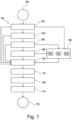
- Figure 1 shows a flow chart 50 of a method for producing a cellulose-containing or regenerated cellulosic molded body 102 (see Figure 2 ) according to an exemplary embodiment of the invention.
- starting material 110 clothing that has already been worn by a user and is no longer needed, i.e. post-consumer clothing that contains cellulose
- the Starting material 110 may have already been used by a consumer, see reference number 59.
- the cellulose may be present, for example, as a textile fabric, in particular using other constituents (for example synthetic plastics such as polyester and elastane). If the consumer disposes of the garment, it can be used as a post-consumer starting material 110 for a Figure 1
- the Lyocell process shown can be used, which is described in more detail below. Alternatively or additionally, it is also possible to use a pre-consumer starting material 110 containing cellulose for such a Lyocell process, for example offcuts from clothing production.
- the starting material 110 is fed to the Lyocell process, wherein the reused or recycled textile starting material 110 comprises cellulose and, in addition, various foreign substances.
- the cellulose and the foreign substances of the starting material 110 can be present in a common solid composite (for example as a textile fabric, fiber composite or molded body composite) during feeding 52, i.e. can be part of one or more bodies (for example items of clothing or offcuts) or particles (for example shredded or ground items of clothing or offcuts) in the solid phase.
- a mixture of the cellulose and the foreign substances can therefore be integrally connected to one another.
- the starting material 110 thus represents a cellulose source 154 to be recycled, which can be formed entirely or partially from residues from clothing production and/or from old clothes.
- the foreign substances contained therein can include a dye, an optical brightener, an antimicrobial substance such as zinc oxide, etc.
- the starting material 110 can include elastane as a further foreign substance, which can also be at least partially dissolved during a dissolution 54 of cellulose described below. Such elastane is often included as an additional fiber in items of clothing in order to give the items of clothing elasticity.
- the starting material 110 can also include polyester as an additional foreign substance, which remains on or in the cellulose during dissolution 54 and subsequent precipitation 56.
- the starting material 110 is fed to an apparatus 100 (see Figure 2 ) for carrying out a lyocell process, see reference number 52.
- the starting material 110 can optionally be pre-sorted by color into several color groups (see reference numeral 64), for example into several color-specific color groups (such as blue, red, green, yellow, black and white) and into a remaining group with color-unspecific starting material (for example, colored textiles).
- color groups see reference numeral 64
- color-specific color groups such as blue, red, green, yellow, black and white
- color-unspecific starting material for example, colored textiles.
- the addition of a separate dye for coloring the molded bodies 102 or products made therefrom can then be dispensed with or only required in reduced quantities. If, after the pre-sorting 64, the dye of a color group remains in the starting material 110 and determines the coloring of the molded bodies 102 produced, the molded body 102 containing cellulose can be produced without carrying out a bleaching procedure, thus in a simple and environmentally friendly manner.
- an optional but advantageous mechanical reduction 66 of the starting material 110 can be carried out by shredding. This allows a part of the large non-cellulosic contaminants to be removed from the starting material 110, for example buttons, seams and prints from the old clothes, which are required to produce the starting material 110 at least have been partially used.
- the starting material 110 can be separated into individual fibers, for example.
- the starting material 110 can thus be mixed with another starting material containing cellulose, see block 68.
- the starting material 110 can also contain another material containing cellulose, such as wood or pulp extracted therefrom. It is therefore possible to mix the starting material 110 to be recycled with another starting material 110 containing cellulose.
- the latter can, for example, contain rag pulp from textiles, cotton from a cotton plant, cellulose obtained from a viscose process and/or cotton linters (i.e., much shorter cotton strands than, for example, cotton lint which is approximately 38 mm long and which grow on the seeds of a cotton plant).
- the proportion of old clothing in the starting material 110 can, for example, be between 3 percent by weight and 100 percent by weight, in particular between 10 percent by weight and 80 percent by weight. It is particularly preferred if this proportion is 100 percent by weight.
- the method can further comprise an optional but advantageous only precise partial removal 58 of one, several or all of the foreign substances.
- This removal 58 can take place directly after the feeding 52 or after the crushing 66 or after the mixing 68. It is also possible to omit the procedure of removal 58 and to continue with a dissolving 54 of the starting material 110 immediately after the feeding 52, after the pre-sorting 64, after the crushing 66 or after the mixing 68.
- the removal procedure 58 can comprise a partial or complete removal 60 of non-cellulosic fibers from the starting material 110, for example if the presence of elastane fibers or polyester fibers in the finished molded bodies 102 is not desired.
- the removal procedure 58 can comprise a partial or complete removal 62 of metals from the starting material 110 if the presence of metals in the molded bodies 102 is not desired.
- the starting material 110 can be completely or partially freed of crosslinkers that crosslink fibers of the starting material 110 (see reference numeral 63).
- a crosslinker (depending on its chemical nature) can be removed, for example, by means of an alkaline and/or an acidic pretreatment. According to an exemplary embodiment of the invention, however, after the removal 58, a certain adjustable proportion of foreign substances always remains in the starting material 110 to be subsequently dissolved.
- the (pure or mixed) starting material 110 can advantageously be dissolved directly in a solvent 116 (for example tertiary amine oxides such as N-methylmorpholine-N-oxide (NMMO)) without chemical pretreatment.
- a solvent 116 for example tertiary amine oxides such as N-methylmorpholine-N-oxide (NMMO)
- Such dissolving 54 can be carried out by transferring the starting material 110 (together with the foreign substances contained therein) into a solvent 116, whereby a spinning mass is formed. More precisely, the starting material 110 pretreated as described can also be transferred directly into solution, in particular without chemical cleaning and without adjusting the viscosity.
- the production or recycling process can be carried out in an exceptionally simple and fast as well as environmentally friendly manner.
- foreign substances for example polyester or elastane
- certain amounts of elastane can remain in the cellulose fibers produced without impairing their properties.
- Certain amounts of remaining polyester also do not interfere with the product obtained, but can even strengthen the mechanical integrity of the molded body 102 to be produced.
- the resulting lyocell spinning solution can be pressed through one or more spinnerets, producing threads or filaments of honey-like viscosity (see block 70, which concerns this spinning or extrusion).
- these threads or filaments are brought into active connection with an aqueous environment and thereby diluted.
- the concentration of the solvent 116 of the threads or filaments is thereby reduced in an aqueous liquid bath to such an extent that the lyocell spinning solution is converted into a solid phase of cellulose filaments.
- the cellulose filaments are precipitated, felled or coagulated, see reference numeral 56. This results in a preform of the molded body 102.
- the spinning mass is thus extruded 70 to form molded bodies 102 by means of precipitation 56 in a spinning bath (see reference numeral 191 in Figure 2 ).
- the dissolving 54, spinning or extruding 70 and subsequent precipitation 56 by means of a lyocell process is therefore carried out based on a starting material 110, which in turn comprises or consists of cellulose material that can be reused or recycled and only needs to be partially freed from foreign substances.
- the method can comprise post-processing 74 of the precipitated lyocell cellulose to obtain the molded body 102 from the preform of the molded body 110.
- post-processing can include, for example, drying, impregnating and/or reshaping the resulting filaments to form the final molded body 102.
- the molded body 102 can be processed by the described manufacturing method into fibers, a film, a fabric, a fleece, a sphere, a porous sponge or beads and then used for further purposes (see reference numeral 76).
- the proportion of the at least one foreign substance in the molded body 102 or the preform can be at least 0.1 percent by weight, based on the total weight of the molded body 102.
- the deliberately and intentionally Residues of the foreign substances remaining in the molded body 102 can be used to exploit a function of the respective foreign substance in the context of the use of the molded body 102 or a product made from it.
- Elastane foreign substance remaining in a molded body 102 can be used functionally to impart elasticity to the molded body 102 produced.
- a polyester foreign substance remaining in the molded body 102 can be used functionally to provide the molded body 102 with thermoplastic deformability or to strengthen the mechanical robustness of the molded body 102 and a product made from it.
- the described embodiment of the invention assumes that the foreign substances in the starting material 110 for producing the molded bodies 102 do not all have to be removed as disruptive in as large an amount as possible, but should remain to a certain extent in the starting material 110 and the lyocell spinning solution 104 produced therefrom in order to give the molded bodies 102 produced one or more desired additional functions.
- These additional functions can consist of providing a color, increased elasticity, increased mechanical robustness, antimicrobial effect, etc.
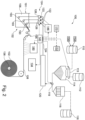
- Figure 2 shows an apparatus 100 for producing a cellulose-containing molded body 102 by means of a lyocell process according to an exemplary embodiment of the invention, which is described with reference to Figure 1 was described.
- Figure 2 shows an apparatus 100 according to an exemplary embodiment of the invention for producing a cellulose-containing molded body 102, which can be produced, for example, in the form of a nonwoven, as a fiber, film, ball, textile fabric, sponge or in the form of beads or flakes.
- the shaped body 102 is produced directly from a spinning solution 104.
- the latter is converted into cellulose fibers 108 as a shaped body 102 by means of a coagulation fluid 106 (in particular from atmospheric moisture) and/or a coagulation bath 191 (for example a water bath which optionally comprises tertiary amine oxides such as N-methylmorpholine-N-oxide (NMMO)).
- a coagulation fluid 106 in particular from atmospheric moisture
- a coagulation bath 191 for example a water bath which optionally comprises tertiary amine oxides such as N-methylmorpholine-N-oxide (NMMO)
- a lyocell process can be carried out by means of the apparatus 100.
- substantially continuous filaments or fibers 108 or mixtures of substantially continuous filaments and fibers 108 of discrete length can be produced as a shaped body 102.
- a plurality of nozzles, each having one or more openings 126 (which can also be referred to as spinning holes), are provided to eject lyocell spinning solution 104.
- a cellulose-based starting material 110 can be fed to a storage tank 114 via a dosing device 113.
- water can be introduced into the cellulose-based starting material 110 by means of a solvent 116 (in particular NMMO) described in more detail below.
- the cellulose-based starting material 110 itself can also already contain a certain residual moisture (dry pulp, for example, often has a residual moisture of 5% to 8% by weight).
- the starting material 110 can be added directly into a mixture of water and solvent 116 without pre-moistening.
- a solvent 116 in Figure 2 The optional water tank 112 shown can then be omitted.
- the cellulose-containing starting material 110 can be additionally moistened to thereby produce moist cellulose
- water from an optional water container 112 can be supplied to the storage tank 114 via the dosing device 113. Therefore, the dosing device 113, controlled by a control device 140, can supply adjustable relative amounts of water and starting material 110 to the storage tank 114.
- a suitable solvent 116 preferably tertiary amine oxides such as N-methylmorpholine-N-oxide (NMMO), or an aqueous mixture of the solvent 116, for example a 76% solution of NMMO in water, is contained in a solvent container.
- the concentration of the solvent 116 can be adjusted in a concentrating device 118 either by adding pure solvent or water.
- the solvent 116 can then be mixed with the starting material 110 with definable relative amounts in a mixing unit 119.
- the mixing unit 119 can also be controlled by means of the control unit 140.
- the cellulose-containing starting material 110 is dissolved in the concentrated solvent 116 in a dissolving device 120 with adjustable relative amounts, whereby the lyocell spinning solution 104 is obtained.
- the relative concentration ranges (also referred to as spinning windows) of the components starting material 110, water and solvent 116 in the spinning solution 104 for producing cellulosic regenerated molded bodies according to the lyocell process can be suitably adjusted, as is known to a person skilled in the art.
- the lyocell spinning solution 104 is fed to a fiber generating device 124 (which may be configured with a number of spinning beams or jets 122).
- the lyocell spinning solution 104 When the lyocell spinning solution 104 is passed through the openings 126 of the jets 122, it is divided into a plurality of parallel threads of lyocell spinning solution 104.
- the process described transforms the lyocell spinning solution 104 into increasingly long and thin threads, the properties of which can be adjusted by appropriate setting of the process conditions, controlled by the control unit 140.
- a gas flow can Accelerate Lyocell spinning solution 104 on its way from the openings 126 to a fiber take-up unit 132.
- the lyocell spinning solution 104 After the lyocell spinning solution 104 has moved through the jets 122 and further downwards, the long and thin threads of the lyocell spinning solution 104 interact with the coagulation fluid 106.
- the solvent concentration of the lyocell spinning solution 104 is reduced, so that the cellulose of the starting material 110 at least partially coagulates or precipitates as long and thin cellulose fibers 108 (which may still contain residues of solvent and water).
- the cellulose fibers 108 are taken up at the fiber take-up unit 132.
- the cellulose fibers 108 can be Figure 2 shown coagulation bath 191 (for example a water bath, optionally comprising a solvent such as NMMO) and can complete their precipitation upon interaction with the liquid of the coagulation bath 191.
- coagulation bath 191 for example a water bath, optionally comprising a solvent such as NMMO
- the cellulose can form cellulose fibers 108 (as shown, wherein the cellulose fibers 108 can be fused together ("merging") as a single material or integrally or can be present as separate cellulose fibers 108) or a film of cellulose can form on the fiber receiving unit 132 (not shown in Figure 2 shown).
- the cellulose fibers 108 are thus extruded from the spinnerets of the jets 122 and guided through the spinning bath or coagulation bath 191 (containing, for example, water and NMMO in low concentration for precipitation/coagulation), whereby the cellulose fibers 108 are guided around a respective deflection roller 193 in the coagulation bath 191 and fed outside the coagulation bath 191 to a take-off godet 195.
- the take-off godet 195 ensures further transport and post-stretching of the cellulose fibers 108 in order to achieve a desired titer.
- the fiber bundle is made up of the Cellulose fibers 108 are washed in a washing unit 180, optionally treated and finally cut (not shown).
- solvent 116 of the lyocell spinning solution 104 which has been removed from the cellulose fibers 108 during coagulation and subsequent washing in the washing unit 180, can be at least partially recovered or recycled and returned to the storage tank 114 in a subsequent cycle.
- the molded body 102 (here in the form of the cellulose fibers 108) can be washed by means of the washing unit 180, in which the latter supplies a washing liquid to remove solvent residues.
- the molded body 102 can then be dried.
- the fiber take-up unit 132 can feed the molded body 102 to a winding device 136, on which the molded body 102 can be wound.
- the molded body 102 can then be fed as rolled goods to an entity that produces products such as wipes or textiles based on the molded body 102.
- the control unit 140 can then, for example, access a database 152 (for example an electronic mass storage device such as a hard disk), where correlations between target functions of the molded body 102 to be produced and residual concentrations of foreign substances remaining in the molded body 102 can be stored, for example in the form of a lookup table.
- the lookup table can store that a corresponding pre-sorting of the starting material 110 according to color and an omission or corresponding configuration of a bleaching of the starting material 110 can be carried out during the implementation of the production process in order to achieve a specific color of the molded bodies 102 produced, without having to supply a separate dye.
- the look-up table can contain the information that by leaving a certain amount of elastane in the starting material 110 and consequently in the lyocell spinning solution 104, the molded bodies 102 produced can be provided with a certain elasticity.
- leaving a certain amount of polyester from the starting material 110 in the molded body 102 can be associated with achieving an increased mechanical strength of the molded bodies 102. Retaining a certain amount of zinc oxide from the starting material 110 in the molded bodies 102 can be correlated in the look-up table with an antimicrobial effect, which the molded bodies 102 produced can then exhibit.
- control unit 140 can use a target function of the molded bodies 102 desired by a user with the help of information from the database 152 to determine process parameters or individual process steps of the production process in accordance with Figure 1 and Figure 2 so that the desired function is achieved in the molded body 102. In this way, foreign substances can be left in the molded body 102 and used there to functionalize the molded body 102.
- An exemplary embodiment of the invention relates to the functionalization of non-wood additives as foreign substances, which originate from a recyclate and are specifically incorporated back into a produced fiber.
- special properties of these additives are utilized and/or special properties of the produced fiber are achieved.
- Embodiments of the invention thus show a way to realize or intensify recycling through special cycles. This can be done by dispensing with unnecessary or even functionally undesirable excessive purity and/or by making previous use a clear criterion for particularly preferred reuse.
- the use of recycled cellulose, preferably made from used textiles, to produce artificially produced cellulose fibers without completely removing foreign substances is ecologically very advantageous, since complex separation processes in pulp production are eliminated or can be replaced by simpler separation and/or cleaning processes.
- Recycled materials can be used in pulp production to produce pulp for use in lyocell processes.
- various foreign substances arise when a material cycle is closed. These are removed when a fiber is produced so that the technical or physical properties are similar or identical to those of a non-recycled fiber.
- Such foreign substances (such as foreign polymers, metals or other chemical compounds) are normally removed (for example by means of chemical reactions, bleaching, mechanical filtering, etc.).
- the present inventors have found that by specifically controlling the proportion of recycled material in a pulp, desired properties in a specific application of a lyocell fiber can be supported, controlled or otherwise influenced. It has also been shown that the environmental impact resulting from the logistics of a Multi-product range (i.e. producing, processing, delivering, etc. pulp differently, depending on their specific recyclables content) is significantly lower than a complete depletion of foreign materials in a recyclate.
- a pulp according to an exemplary embodiment of the invention used textiles based on cotton, viscose and/or lyocell cellulose, as well as mixtures thereof and/or with other constituents, can be used.
- a functionalization of the partial degradation of the chain lengths takes place during use.
- native cotton for example, is relatively poorly soluble in NMMO due to its high DP value (where DP stands for the average degree of polymerization, i.e. the number of monomer units per macromolecule).
- a recyclate with a corresponding cotton content is characterized by the fact that the DP value drops to a range that enables better dissolution in NMMO due to the previous production and subsequent use (in particular as a result of exposure to UV, heat, water, mechanical stress).
- Typical numerical values for this shift in the Gaussian mean of the DP values are from up to 3000 (and sometimes even more) for native cotton to a value for recyclates of less than 2000 mL/g, preferably less than 1000 mL/g, particularly preferably less than 800 mL/g.
- the values mentioned refer to the intrinsic viscosity number (which correlates with the degree of polymerization of the cellulose) in units of mL/g.
- a GVZ value in the range of 200 ml/g to 700 mL/g that is particularly suitable for the lyocell process can be achieved.
- the desired proportions of titanium dioxide (TiO 2 ) are adjusted from recycled materials.
- the pulp produced in this way or a mix composed of different pulps with the desired proportion of TiO 2 can be processed into a lyocell molded body 102. After further processing steps, a resulting staple fiber can therefore have a proportion of TiO 2 as a foreign substance with a matting function.
- residual polymers for example polyester, from recycled materials are used as adhesion enhancers under the cellulose fibers or as thermoplastic property enhancers within a lyocell molded body 102.
- Such polymers remain essentially inert until the corresponding procedures in the production process have been completed.
- subsequent stiffening of a fabric using heat can be achieved in this way (for example, advantageous for the production of non-iron shirts, pleats, etc.).
- a very simple process can thus be provided for the production of fabrics that are intended to have the property of high dimensional stability (for example, non-iron).
- a certain thermoplasticity can be achieved in a lyocell fiber as a molded body 102, which returns the corresponding proportion of residual polymers from the recyclate via a pulp according to an exemplary embodiment of the invention via the lyocell process into a fiber type (in the sense of a dedicated material cycle), which can be used, for example, to produce a dimensionally stable textile (for example a shirt).
- a fiber type in the sense of a dedicated material cycle
- synergistically molded bodies 102 or products resulting therefrom with improved properties can be obtained (for example, better, i.e. greater, water retention, because the improved dimensional stability inherent in the fiber means that less finish is needed to produce a non-iron quality).
- Such a production of a crease-reduced textile product or dimensionally stable nonwoven or fleece, carried out according to an exemplary embodiment of the invention represents a particularly ecological variant of a specifically controlled material cycle.
- a lyocell molded body 102 according to an exemplary embodiment of the invention which is made from a pulp with a defined and selected denim content, has a white value that differs from that of normal cotton fiber and can even be directly colored.
- a dyeing through the entire fiber realized according to such an exemplary embodiment of the invention allows the fiber produced in this way to be mixed with a normal fiber.
- the coloring of the normal fiber in particular can be controlled in such a way that the dye release is suitably adjusted to achieve the stonewash effect.
- the residual portion of a fiber produced as a molded body 102 according to an exemplary embodiment of the invention can ensure (since, for example, residual dyes are present throughout) that this stonewash effect does not particularly affect this fiber portion. Additional washing by the consumer does not result in any further discoloration.
- Another exemplary embodiment of the invention relating to the functionalization of molded bodies 102 based on foreign substances in recyclates consists in a targeted bleaching of the old denim dyes present. This can, for example, convert the indigo into isatin, which is what gives a denim textile product a typical yellowish tint due to age.
- the use of a pulp produced according to an exemplary embodiment of the invention also makes it possible to reduce the cotton fiber content in a denim product by using molded bodies 102 according to an exemplary embodiment of the invention as a substitute. This is advantageous in view of global resource optimization (in particular a reduction in the area used to grow cotton to enable an increase in the area used to grow food).
- recyclates are used to produce pulp with biocidal properties. By selecting and processing the recyclate appropriately, these materials are still biocidal even after the lyocell process.
- the cleaning effect of a fiber treated in this way as a molded body 102 according to an exemplary embodiment of the invention is advantageous here.
- recyclates with a substantial proportion of Lyocell fibers are used as molded bodies 102 in pulp production.
- a Pulp for the Lyocell process makes it possible to produce recycled products that differ only very slightly in their technical properties from a Lyocell fiber that was produced without recycled materials.
- the whiteness values and strengths are highly correlated with the Lyocell fiber without recycled materials.
- recyclates from used textiles based on lyocell and/or viscose are used. This makes it possible to achieve a low DP value that is advantageous for a lyocell process without additional measures.
- a pulp can be suitable for a lyocell process.
- a pulp can contain a recycled content of more than 3 percent by weight.
- a non-wood, non-pulp content can be present as a foreign substance in a corresponding molded body 102, in particular of more than 10 ppm, more particularly of more than 100 ppm.
- the said recycled content can advantageously come from used textiles that come from the same or comparable applications as the products produced from the pulp and/or can have the same or comparable raw material base as the products and/or intermediate products produced from the pulp.
- These non-wood components can come from the recycled material.
- the recyclates used can have a DP value of 100 mL/g to 2000 mL/g, preferably 150 mL/g to 1000 mL/g, particularly preferably 200 mL/g to 700 mL/g, each expressed as GVZ.
- the non-wood components mentioned can, for example, contain vat dyes (and their decomposition components, for example indigo or isatin), polyester, TiO 2 , optical brighteners, etc., greater than 1 ppm (preferably greater than 10 ppm or even greater than 100 ppm).
- the said pulp can be used for a lyocell process and/or a lyocell molded body 102 can be produced therefrom.
- the recycled content of inorganic substances can be more than 10 ppm, in particular more than 100 ppm.
- the recycled content of non-cellulose substances can be more than 100 ppm, in particular more than 1000 ppm.
- non-cellulose organic substances can make up more than 3 percent by weight of the recycled material content and be embedded in the pulp.
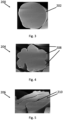
- FIG 3 shows a cellulose fiber 200 produced by means of a lyocell process in cross section.
- the cellulose fiber 200 produced by means of a lyocell process has a smooth, round outer surface 202 and is filled with cellulose material in a homogeneous manner and free of macroscopic holes. It can therefore be clearly distinguished by a person skilled in the art from cellulose fibers produced by means of a viscose process (see reference numeral 204 in Figure 4 ) and cellulose fibres from cotton plants (see reference 206 in Figure 5 ) can be distinguished.
- Figure 4 shows a cross-section of a cellulose fiber 204 produced by a viscose process.
- the cellulose fiber 204 is cloud-shaped and has a plurality of arc-shaped structures 208 along its outer circumference.
- Figure 5 shows a natural cellulose fiber 206 from a cotton plant in cross section.
- the cellulose fiber 206 is kidney-shaped and has a material-free lumen 210 inside as a fully enclosed cavity.
- Aspect 2 Method according to aspect 1, wherein the method comprises at most partial removal (58) of at least one of the at least one foreign substance by separating a part of the at least one foreign substance from the cellulose of the starting material (110), in particular before precipitation (56), further in particular before dissolution (54).
- the starting material (110) comprises or consists of a cellulose source (154) to be recycled, in particular is formed entirely or partially from residues from clothing production and/or from old clothing, in particular worn by a consumer.
- At least one foreign substance comprises at least one of a group consisting of a dye, an optical brightener, a matting agent, in particular titanium dioxide, and an antimicrobial substance, in particular zinc oxide.
- Aspect 5 Method according to one of aspects 1 to 4, wherein the at least one foreign substance comprises elastane, which is also at least partially dissolved during the dissolution (54) of the cellulose.
- Aspect 6 Method according to one of aspects 1 to 5, wherein the at least one foreign substance comprises polyester which is at least partially left in the starting material (110) when the starting material (110) is at least partially dissolved (54), in particular precipitated (56).
- Aspect 7 Method according to one of aspects 1 to 6, wherein the method comprises at least partially removing (60) non-cellulosic fibers from the starting material (110) before precipitation (56), in particular before dissolving (54).
- Aspect 8 Method according to one of aspects 1 to 7, wherein the method comprises at least partial, in particular complete, removal (62) of metals from the starting material (110).
- Aspect 9 Method according to one of aspects 1 to 8, wherein in the method the regenerated cellulosic molded body (102) is produced without carrying out a bleaching procedure.
- Aspect 10 Method according to one of aspects 1 to 9, wherein before dissolving (54) the starting material (110) is pre-sorted (64) by color into several color groups and only pre-sorted starting material (110) of a common color group is dissolved (54).
- Aspect 11 Method according to one of aspects 1 to 10, wherein the at least one foreign substance located in the shaped body (102) has a proportion of at least 0.01 percent by weight, in particular at least 0.1 percent by weight, further in particular at least 1 percent by weight, based on the total weight of the shaped body (102).
- Aspect 12 Method according to one of aspects 1 to 11, wherein the shaped body (102) is one from a group consisting of fibers, films, sponges or spheres.
- Aspect 14 Use of a starting material (110) comprising cellulose and at least one foreign substance for producing a regenerated cellulosic molded body (102) by means of the Lyocell process, wherein the molded body (102) contains cellulose and at least a portion of the at least one foreign substance.
Landscapes
- Engineering & Computer Science (AREA)
- Chemical & Material Sciences (AREA)
- Textile Engineering (AREA)
- Chemical Kinetics & Catalysis (AREA)
- Mechanical Engineering (AREA)
- General Chemical & Material Sciences (AREA)
- Manufacturing & Machinery (AREA)
- Sustainable Development (AREA)
- Life Sciences & Earth Sciences (AREA)
- Health & Medical Sciences (AREA)
- Medicinal Chemistry (AREA)
- Polymers & Plastics (AREA)
- Organic Chemistry (AREA)
- Physics & Mathematics (AREA)
- Thermal Sciences (AREA)
- Artificial Filaments (AREA)
- Manufacture Of Macromolecular Shaped Articles (AREA)
- Filtering Materials (AREA)
- Nonwoven Fabrics (AREA)
Priority Applications (1)
| Application Number | Priority Date | Filing Date | Title |
|---|---|---|---|
| EP24176982.7A EP4400540A3 (fr) | 2018-01-15 | 2018-01-15 | Fonctionnalisation de corps étrangers dans un procédé lyocell |
Applications Claiming Priority (2)
| Application Number | Priority Date | Filing Date | Title |
|---|---|---|---|
| EP18151692.3A EP3511447B1 (fr) | 2018-01-15 | 2018-01-15 | Fonctionnalisation de corps étrangers dans le procédé lyocell |
| EP24176982.7A EP4400540A3 (fr) | 2018-01-15 | 2018-01-15 | Fonctionnalisation de corps étrangers dans un procédé lyocell |
Related Parent Applications (2)
| Application Number | Title | Priority Date | Filing Date |
|---|---|---|---|
| EP18151692.3A Division EP3511447B1 (fr) | 2018-01-15 | 2018-01-15 | Fonctionnalisation de corps étrangers dans le procédé lyocell |
| EP18151692.3A Division-Into EP3511447B1 (fr) | 2018-01-15 | 2018-01-15 | Fonctionnalisation de corps étrangers dans le procédé lyocell |
Publications (2)
| Publication Number | Publication Date |
|---|---|
| EP4400540A2 true EP4400540A2 (fr) | 2024-07-17 |
| EP4400540A3 EP4400540A3 (fr) | 2024-10-30 |
Family
ID=60990713
Family Applications (2)
| Application Number | Title | Priority Date | Filing Date |
|---|---|---|---|
| EP24176982.7A Withdrawn EP4400540A3 (fr) | 2018-01-15 | 2018-01-15 | Fonctionnalisation de corps étrangers dans un procédé lyocell |
| EP18151692.3A Active EP3511447B1 (fr) | 2018-01-15 | 2018-01-15 | Fonctionnalisation de corps étrangers dans le procédé lyocell |
Family Applications After (1)
| Application Number | Title | Priority Date | Filing Date |
|---|---|---|---|
| EP18151692.3A Active EP3511447B1 (fr) | 2018-01-15 | 2018-01-15 | Fonctionnalisation de corps étrangers dans le procédé lyocell |
Country Status (6)
| Country | Link |
|---|---|
| US (2) | US11519101B2 (fr) |
| EP (2) | EP4400540A3 (fr) |
| KR (1) | KR102698080B1 (fr) |
| TW (1) | TWI715915B (fr) |
| WO (1) | WO2019138091A1 (fr) |
| ZA (1) | ZA202004207B (fr) |
Families Citing this family (3)
| Publication number | Priority date | Publication date | Assignee | Title |
|---|---|---|---|---|
| CN114402098A (zh) * | 2019-09-17 | 2022-04-26 | 阿尔托大学基金会 | 莱赛尔纤维及其生产方法 |
| WO2025070410A1 (fr) * | 2023-09-26 | 2025-04-03 | リンテック株式会社 | Procédé d'élimination de couche de revêtement |
| JP2026043279A (ja) * | 2024-08-28 | 2026-03-12 | リンテック株式会社 | コーティング層の除去方法 |
Family Cites Families (30)
| Publication number | Priority date | Publication date | Assignee | Title |
|---|---|---|---|---|
| US3801273A (en) | 1972-08-30 | 1974-04-02 | Johnson & Johnson | Methods of recovering waste cellulosic fibers |
| US3937671A (en) | 1974-11-18 | 1976-02-10 | Textile Research Institute | Method of recovering constituents from polyester and cellulosic textile waste |
| US4246221A (en) | 1979-03-02 | 1981-01-20 | Akzona Incorporated | Process for shaped cellulose article prepared from a solution containing cellulose dissolved in a tertiary amine N-oxide solvent |
| US4145533A (en) * | 1978-07-26 | 1979-03-20 | Olin Corporation | Method for recycling regenerated cellulose scrap |
| US4345039A (en) | 1981-06-01 | 1982-08-17 | Venture Chemicals, Inc. | Method of recovering polyester fibers and cellulosic powder from polyester/cotton textile waste |
| US4668454A (en) | 1985-06-12 | 1987-05-26 | E. I. Du Pont De Nemours And Company | Heat-strengthening process |
| US5240530A (en) | 1992-02-10 | 1993-08-31 | Tennessee Valley Performance Products, Inc. | Carpet and techniques for making and recycling same |
| US5342854A (en) | 1993-07-28 | 1994-08-30 | Hoechst Celanese Corporation | Polyester dissolution for polyester/cotton blend recycle |
| DE4409335A1 (de) | 1994-03-18 | 1994-09-29 | Thueringisches Inst Textil | Verfahren zum Abtrennen von Faserstoffkomponenten aus Mischtextilien |
| DE4416466A1 (de) | 1994-05-10 | 1995-11-16 | Zimmer Ag | Trennverfahren für Teppichböden |
| AT401392B (de) * | 1994-09-05 | 1996-08-26 | Chemiefaser Lenzing Ag | Verfahren zur herstellung eines cellulosischen formkörpers |
| DE4444245C1 (de) * | 1994-12-13 | 1996-07-04 | Hoechst Ag | Verfahren zum Recycling von gefärbten, cellulosischen Abfallprodukten zu Fasern |
| US5722603A (en) | 1995-11-28 | 1998-03-03 | Alliedsignal Inc. /Dsm N.V. | Process for separation and recovery of waste carpet components |
| GB2324064A (en) | 1997-04-11 | 1998-10-14 | Courtaulds Fibres | Modified lyocell fibre and method of its formation |
| AT407997B (de) * | 1999-08-10 | 2001-07-25 | Chemiefaser Lenzing Ag | Gefärbte cellulosische formkörper |
| EP1282743B1 (fr) * | 2000-05-15 | 2008-03-26 | Hansen Rubber Products, Inc. | Traverses de chemin de fer en catoutchouc recycle |
| US7579078B2 (en) * | 2001-09-21 | 2009-08-25 | Outlast Technologies, Inc. | Temperature regulating cellulosic fibers and applications thereof |
| US7255816B2 (en) | 2000-11-10 | 2007-08-14 | Kimberly-Clark Worldwide, Inc. | Method of recycling bonded fibrous materials and synthetic fibers and fiber-like materials produced thereof |
| NL1035521C2 (nl) * | 2008-06-03 | 2009-12-07 | Majac B V | Werkwijze voor het recycleren van gebruikte kleding en huishoudelijk textiel. |
| KR20130007581A (ko) * | 2010-03-25 | 2013-01-18 | 렌찡 악티엔게젤샤프트 | 셀룰로스 섬유의 용도 |
| CN102154722B (zh) * | 2011-05-16 | 2012-08-08 | 武汉纺织大学 | 一种弹性复合粘胶纤维及其制备方法 |
| FR2991600B1 (fr) | 2012-06-06 | 2014-07-18 | Fibers | Procede de separation du polyester et du coton pour le recyclage de dechets textiles |
| GB201216921D0 (en) | 2012-09-21 | 2012-11-07 | Worn Again Footwear And Accessories Ltd | Process |
| DE102012222045A1 (de) | 2012-12-03 | 2014-06-05 | Cht R. Beitlich Gmbh | Beschichtung von Luminophoren |
| WO2015053226A1 (fr) | 2013-10-07 | 2015-04-16 | 日東紡績株式会社 | Longues fibres de cellulose ayant une résistance élevée et une élasticité élevée |
| AT515152B1 (de) * | 2013-11-26 | 2015-12-15 | Chemiefaser Lenzing Ag | Verfahren zum Vorbehandeln von rückgewonnenen Baumwollfasern zur Verwendung bei der Herstellung von Formkörpern aus regenerierter Cellulose |
| WO2015163291A1 (fr) * | 2014-04-21 | 2015-10-29 | 日東紡績株式会社 | Procédé de fabrication de solution de cellulose |
| AT517020B1 (de) * | 2015-02-06 | 2020-02-15 | Chemiefaser Lenzing Ag | Recycling von cellulosischen Kunstfasern |
| EP3339504A1 (fr) | 2016-12-22 | 2018-06-27 | Lenzing Aktiengesellschaft | Procédé de réduction en pâte de matières premières à base de coton |
| EP3511140A1 (fr) | 2018-01-15 | 2019-07-17 | Lenzing Aktiengesellschaft | Procédé de séparation d'un composant cible fibreux à partir de déchets textiles |
-
2018
- 2018-01-15 EP EP24176982.7A patent/EP4400540A3/fr not_active Withdrawn
- 2018-01-15 EP EP18151692.3A patent/EP3511447B1/fr active Active
-
2019
- 2019-01-14 US US16/962,209 patent/US11519101B2/en active Active
- 2019-01-14 KR KR1020207021690A patent/KR102698080B1/ko active Active
- 2019-01-14 TW TW108101356A patent/TWI715915B/zh active
- 2019-01-14 WO PCT/EP2019/050739 patent/WO2019138091A1/fr not_active Ceased
-
2020
- 2020-07-09 ZA ZA2020/04207A patent/ZA202004207B/en unknown
-
2022
- 2022-12-02 US US18/073,906 patent/US20230095901A1/en active Pending
Also Published As
| Publication number | Publication date |
|---|---|
| US20230095901A1 (en) | 2023-03-30 |
| KR102698080B1 (ko) | 2024-08-22 |
| US20210062370A1 (en) | 2021-03-04 |
| WO2019138091A1 (fr) | 2019-07-18 |
| EP3511447A1 (fr) | 2019-07-17 |
| KR20200105490A (ko) | 2020-09-07 |
| EP4400540A3 (fr) | 2024-10-30 |
| TW201940764A (zh) | 2019-10-16 |
| TWI715915B (zh) | 2021-01-11 |
| US11519101B2 (en) | 2022-12-06 |
| ZA202004207B (en) | 2022-04-28 |
| EP3511447B1 (fr) | 2026-03-11 |
Similar Documents
| Publication | Publication Date | Title |
|---|---|---|
| EP3740605B1 (fr) | Procédé de recyclage du matériau textile comprenant de la cellulose | |
| EP3511449B1 (fr) | Recyclage de la cellulose lyocell pour procédé lyocell | |
| EP3980596B1 (fr) | Procédé de fabrication continue d'une matière de départ traitée contenant de la cellulose | |
| WO2019138094A1 (fr) | Procédé de recyclage d'un textile mixte contenant de la cellulose et une matière synthétique | |
| AT515152A1 (de) | Verfahren zum Vorbehandeln von rückgewonnenen Baumwollfasern zur Verwendung bei der Herstellung von Formkörpern aus regenerierter Cellulose | |
| US20230095901A1 (en) | Functionalization of foreign matters in lyocell-methods and molded bodies thereof | |
| WO2019138092A1 (fr) | Récupération de particules non solubles présentes dans une matière de départ contenant de la cellulose | |
| EP3868929B1 (fr) | Corps moulé, comportant de l'élastane incorporé dans la cellulose et procédé de fabrication | |
| EP3980237B1 (fr) | Procédé de fourniture d'une matière de départ traitée contenant de la cellulose ayant une répartition de longueur de fibre prédéfinie | |
| WO2019138096A1 (fr) | Codage d'un produit contenant de la cellulose | |
| EP3980595A1 (fr) | Traitement conjoint de matière première lignocellusique et de produit contenant de la cellulose et exempt de lignine |
Legal Events
| Date | Code | Title | Description |
|---|---|---|---|
| PUAI | Public reference made under article 153(3) epc to a published international application that has entered the european phase |
Free format text: ORIGINAL CODE: 0009012 |
|
| STAA | Information on the status of an ep patent application or granted ep patent |
Free format text: STATUS: THE APPLICATION HAS BEEN PUBLISHED |
|
| AC | Divisional application: reference to earlier application |
Ref document number: 3511447 Country of ref document: EP Kind code of ref document: P |
|
| AK | Designated contracting states |
Kind code of ref document: A2 Designated state(s): AL AT BE BG CH CY CZ DE DK EE ES FI FR GB GR HR HU IE IS IT LI LT LU LV MC MK MT NL NO PL PT RO RS SE SI SK SM TR |
|
| REG | Reference to a national code |
Ref country code: DE Ref legal event code: R079 Free format text: PREVIOUS MAIN CLASS: C08J0011060000 Ipc: D01F0002000000 |
|
| PUAL | Search report despatched |
Free format text: ORIGINAL CODE: 0009013 |
|
| AK | Designated contracting states |
Kind code of ref document: A3 Designated state(s): AL AT BE BG CH CY CZ DE DK EE ES FI FR GB GR HR HU IE IS IT LI LT LU LV MC MK MT NL NO PL PT RO RS SE SI SK SM TR |
|
| RIC1 | Information provided on ipc code assigned before grant |
Ipc: C08J 11/06 20060101ALI20240925BHEP Ipc: D01F 1/10 20060101ALI20240925BHEP Ipc: D01F 2/00 20060101AFI20240925BHEP |
|
| STAA | Information on the status of an ep patent application or granted ep patent |
Free format text: STATUS: THE APPLICATION IS DEEMED TO BE WITHDRAWN |
|
| 18D | Application deemed to be withdrawn |
Effective date: 20250501 |