EP4400574A1 - System und verfahren zur herstellung von flüchtigen natürlichen verbindungen unter verwendung von festen wachstumsmedien - Google Patents
System und verfahren zur herstellung von flüchtigen natürlichen verbindungen unter verwendung von festen wachstumsmedien Download PDFInfo
- Publication number
- EP4400574A1 EP4400574A1 EP23151430.8A EP23151430A EP4400574A1 EP 4400574 A1 EP4400574 A1 EP 4400574A1 EP 23151430 A EP23151430 A EP 23151430A EP 4400574 A1 EP4400574 A1 EP 4400574A1
- Authority
- EP
- European Patent Office
- Prior art keywords
- vocs
- flask
- growth medium
- collection compartment
- production
- Prior art date
- Legal status (The legal status is an assumption and is not a legal conclusion. Google has not performed a legal analysis and makes no representation as to the accuracy of the status listed.)
- Pending
Links
- 239000001963 growth medium Substances 0.000 title claims abstract description 42
- 238000004519 manufacturing process Methods 0.000 title claims abstract description 42
- 239000007787 solid Substances 0.000 title claims abstract description 27
- 229930014626 natural product Natural products 0.000 title claims abstract description 10
- 239000012855 volatile organic compound Substances 0.000 claims abstract description 85
- 238000000034 method Methods 0.000 claims abstract description 25
- 230000000813 microbial effect Effects 0.000 claims abstract description 23
- 239000003960 organic solvent Substances 0.000 claims abstract description 23
- 238000007789 sealing Methods 0.000 claims abstract description 20
- 238000002360 preparation method Methods 0.000 claims abstract description 18
- 239000007788 liquid Substances 0.000 claims abstract description 16
- 244000005700 microbiome Species 0.000 claims abstract description 10
- 238000011081 inoculation Methods 0.000 claims abstract description 7
- 238000011534 incubation Methods 0.000 claims abstract description 5
- 238000011049 filling Methods 0.000 claims abstract description 3
- XMGQYMWWDOXHJM-UHFFFAOYSA-N limonene Chemical compound CC(=C)C1CCC(C)=CC1 XMGQYMWWDOXHJM-UHFFFAOYSA-N 0.000 claims description 42
- 235000001510 limonene Nutrition 0.000 claims description 21
- 229940087305 limonene Drugs 0.000 claims description 21
- 239000000463 material Substances 0.000 claims description 18
- WQZGKKKJIJFFOK-GASJEMHNSA-N Glucose Natural products OC[C@H]1OC(O)[C@H](O)[C@@H](O)[C@@H]1O WQZGKKKJIJFFOK-GASJEMHNSA-N 0.000 claims description 16
- 239000008103 glucose Substances 0.000 claims description 16
- WQZGKKKJIJFFOK-VFUOTHLCSA-N beta-D-glucose Chemical compound OC[C@H]1O[C@@H](O)[C@H](O)[C@@H](O)[C@@H]1O WQZGKKKJIJFFOK-VFUOTHLCSA-N 0.000 claims description 12
- SNRUBQQJIBEYMU-UHFFFAOYSA-N dodecane Chemical compound CCCCCCCCCCCC SNRUBQQJIBEYMU-UHFFFAOYSA-N 0.000 claims description 12
- 241000588724 Escherichia coli Species 0.000 claims description 10
- 239000000411 inducer Substances 0.000 claims description 10
- 239000002699 waste material Substances 0.000 claims description 10
- 229920001817 Agar Polymers 0.000 claims description 9
- UHOVQNZJYSORNB-UHFFFAOYSA-N Benzene Chemical compound C1=CC=CC=C1 UHOVQNZJYSORNB-UHFFFAOYSA-N 0.000 claims description 9
- LYCAIKOWRPUZTN-UHFFFAOYSA-N Ethylene glycol Chemical compound OCCO LYCAIKOWRPUZTN-UHFFFAOYSA-N 0.000 claims description 9
- PEDCQBHIVMGVHV-UHFFFAOYSA-N Glycerine Chemical compound OCC(O)CO PEDCQBHIVMGVHV-UHFFFAOYSA-N 0.000 claims description 9
- 239000008272 agar Substances 0.000 claims description 9
- 108090000623 proteins and genes Proteins 0.000 claims description 9
- BKIMMITUMNQMOS-UHFFFAOYSA-N nonane Chemical compound CCCCCCCCC BKIMMITUMNQMOS-UHFFFAOYSA-N 0.000 claims description 8
- BPHPUYQFMNQIOC-NXRLNHOXSA-N isopropyl beta-D-thiogalactopyranoside Chemical compound CC(C)S[C@@H]1O[C@H](CO)[C@H](O)[C@H](O)[C@H]1O BPHPUYQFMNQIOC-NXRLNHOXSA-N 0.000 claims description 7
- OKKJLVBELUTLKV-UHFFFAOYSA-N Methanol Chemical compound OC OKKJLVBELUTLKV-UHFFFAOYSA-N 0.000 claims description 6
- YXFVVABEGXRONW-UHFFFAOYSA-N Toluene Chemical compound CC1=CC=CC=C1 YXFVVABEGXRONW-UHFFFAOYSA-N 0.000 claims description 6
- -1 (E)-b-ocimene Chemical compound 0.000 claims description 5
- CSCPPACGZOOCGX-UHFFFAOYSA-N Acetone Chemical compound CC(C)=O CSCPPACGZOOCGX-UHFFFAOYSA-N 0.000 claims description 5
- 230000003115 biocidal effect Effects 0.000 claims description 5
- 230000015572 biosynthetic process Effects 0.000 claims description 5
- IAZDPXIOMUYVGZ-UHFFFAOYSA-N dimethyl sulfoxide Natural products CS(C)=O IAZDPXIOMUYVGZ-UHFFFAOYSA-N 0.000 claims description 5
- 230000006698 induction Effects 0.000 claims description 5
- 238000003786 synthesis reaction Methods 0.000 claims description 5
- IAIHUHQCLTYTSF-UHFFFAOYSA-N 2,2,4-trimethylbicyclo[2.2.1]heptan-3-ol Chemical compound C1CC2(C)C(O)C(C)(C)C1C2 IAIHUHQCLTYTSF-UHFFFAOYSA-N 0.000 claims description 4
- IJGRMHOSHXDMSA-UHFFFAOYSA-N Atomic nitrogen Chemical compound N#N IJGRMHOSHXDMSA-UHFFFAOYSA-N 0.000 claims description 4
- OKTJSMMVPCPJKN-UHFFFAOYSA-N Carbon Chemical compound [C] OKTJSMMVPCPJKN-UHFFFAOYSA-N 0.000 claims description 4
- 108090000790 Enzymes Proteins 0.000 claims description 4
- 102000004190 Enzymes Human genes 0.000 claims description 4
- MOYAFQVGZZPNRA-UHFFFAOYSA-N Terpinolene Chemical compound CC(C)=C1CCC(C)=CC1 MOYAFQVGZZPNRA-UHFFFAOYSA-N 0.000 claims description 4
- 239000003242 anti bacterial agent Substances 0.000 claims description 4
- 229940088710 antibiotic agent Drugs 0.000 claims description 4
- CRPUJAZIXJMDBK-UHFFFAOYSA-N camphene Chemical compound C1CC2C(=C)C(C)(C)C1C2 CRPUJAZIXJMDBK-UHFFFAOYSA-N 0.000 claims description 4
- 229910052799 carbon Inorganic materials 0.000 claims description 4
- 235000011389 fruit/vegetable juice Nutrition 0.000 claims description 4
- 230000002538 fungal effect Effects 0.000 claims description 4
- 239000002609 medium Substances 0.000 claims description 4
- NDVASEGYNIMXJL-UHFFFAOYSA-N sabinene Chemical compound C=C1CCC2(C(C)C)C1C2 NDVASEGYNIMXJL-UHFFFAOYSA-N 0.000 claims description 4
- 239000002904 solvent Substances 0.000 claims description 4
- 239000000126 substance Substances 0.000 claims description 4
- 239000001913 cellulose Substances 0.000 claims description 3
- 229920002678 cellulose Polymers 0.000 claims description 3
- 230000014509 gene expression Effects 0.000 claims description 3
- 230000002906 microbiologic effect Effects 0.000 claims description 3
- NDVASEGYNIMXJL-NXEZZACHSA-N (+)-sabinene Natural products C=C1CC[C@@]2(C(C)C)[C@@H]1C2 NDVASEGYNIMXJL-NXEZZACHSA-N 0.000 claims description 2
- 229930006727 (-)-endo-fenchol Natural products 0.000 claims description 2
- WUOACPNHFRMFPN-SECBINFHSA-N (S)-(-)-alpha-terpineol Chemical compound CC1=CC[C@@H](C(C)(C)O)CC1 WUOACPNHFRMFPN-SECBINFHSA-N 0.000 claims description 2
- 241000193830 Bacillus <bacterium> Species 0.000 claims description 2
- SHZGCJCMOBCMKK-UHFFFAOYSA-N D-mannomethylose Natural products CC1OC(O)C(O)C(O)C1O SHZGCJCMOBCMKK-UHFFFAOYSA-N 0.000 claims description 2
- SHZGCJCMOBCMKK-JFNONXLTSA-N L-rhamnopyranose Chemical compound C[C@@H]1OC(O)[C@H](O)[C@H](O)[C@H]1O SHZGCJCMOBCMKK-JFNONXLTSA-N 0.000 claims description 2
- PNNNRSAQSRJVSB-UHFFFAOYSA-N L-rhamnose Natural products CC(O)C(O)C(O)C(O)C=O PNNNRSAQSRJVSB-UHFFFAOYSA-N 0.000 claims description 2
- PXRCIOIWVGAZEP-UHFFFAOYSA-N Primaeres Camphenhydrat Natural products C1CC2C(O)(C)C(C)(C)C1C2 PXRCIOIWVGAZEP-UHFFFAOYSA-N 0.000 claims description 2
- 240000004808 Saccharomyces cerevisiae Species 0.000 claims description 2
- 235000014680 Saccharomyces cerevisiae Nutrition 0.000 claims description 2
- 239000004098 Tetracycline Substances 0.000 claims description 2
- XCPQUQHBVVXMRQ-UHFFFAOYSA-N alpha-Fenchene Natural products C1CC2C(=C)CC1C2(C)C XCPQUQHBVVXMRQ-UHFFFAOYSA-N 0.000 claims description 2
- KQAZVFVOEIRWHN-UHFFFAOYSA-N alpha-thujene Natural products CC1=CCC2(C(C)C)C1C2 KQAZVFVOEIRWHN-UHFFFAOYSA-N 0.000 claims description 2
- 150000001408 amides Chemical class 0.000 claims description 2
- PYMYPHUHKUWMLA-WDCZJNDASA-N arabinose Chemical compound OC[C@@H](O)[C@@H](O)[C@H](O)C=O PYMYPHUHKUWMLA-WDCZJNDASA-N 0.000 claims description 2
- PYMYPHUHKUWMLA-UHFFFAOYSA-N arabinose Natural products OCC(O)C(O)C(O)C=O PYMYPHUHKUWMLA-UHFFFAOYSA-N 0.000 claims description 2
- SRBFZHDQGSBBOR-UHFFFAOYSA-N beta-D-Pyranose-Lyxose Natural products OC1COC(O)C(O)C1O SRBFZHDQGSBBOR-UHFFFAOYSA-N 0.000 claims description 2
- 229930006739 camphene Natural products 0.000 claims description 2
- ZYPYEBYNXWUCEA-UHFFFAOYSA-N camphenilone Natural products C1CC2C(=O)C(C)(C)C1C2 ZYPYEBYNXWUCEA-UHFFFAOYSA-N 0.000 claims description 2
- 239000003054 catalyst Substances 0.000 claims description 2
- 150000002170 ethers Chemical class 0.000 claims description 2
- 150000008282 halocarbons Chemical class 0.000 claims description 2
- 230000001939 inductive effect Effects 0.000 claims description 2
- 229910052500 inorganic mineral Inorganic materials 0.000 claims description 2
- 239000011707 mineral Substances 0.000 claims description 2
- 229910052757 nitrogen Inorganic materials 0.000 claims description 2
- 239000002243 precursor Substances 0.000 claims description 2
- 229930006696 sabinene Natural products 0.000 claims description 2
- 230000001954 sterilising effect Effects 0.000 claims description 2
- 238000004659 sterilization and disinfection Methods 0.000 claims description 2
- 150000003505 terpenes Chemical class 0.000 claims description 2
- 235000007586 terpenes Nutrition 0.000 claims description 2
- 229960002180 tetracycline Drugs 0.000 claims description 2
- 229930101283 tetracycline Natural products 0.000 claims description 2
- 235000019364 tetracycline Nutrition 0.000 claims description 2
- 150000003522 tetracyclines Chemical class 0.000 claims description 2
- LFJQCDVYDGGFCH-UHFFFAOYSA-N β-phellandrene Chemical compound CC(C)C1CCC(=C)C=C1 LFJQCDVYDGGFCH-UHFFFAOYSA-N 0.000 claims description 2
- YKFLAYDHMOASIY-UHFFFAOYSA-N γ-terpinene Chemical compound CC(C)C1=CCC(C)=CC1 YKFLAYDHMOASIY-UHFFFAOYSA-N 0.000 claims description 2
- XLYOFNOQVPJJNP-UHFFFAOYSA-N water Substances O XLYOFNOQVPJJNP-UHFFFAOYSA-N 0.000 abstract description 6
- 210000004027 cell Anatomy 0.000 description 21
- 239000002028 Biomass Substances 0.000 description 17
- XEKOWRVHYACXOJ-UHFFFAOYSA-N Ethyl acetate Chemical compound CCOC(C)=O XEKOWRVHYACXOJ-UHFFFAOYSA-N 0.000 description 12
- CSNNHWWHGAXBCP-UHFFFAOYSA-L Magnesium sulfate Chemical compound [Mg+2].[O-][S+2]([O-])([O-])[O-] CSNNHWWHGAXBCP-UHFFFAOYSA-L 0.000 description 8
- LFQSCWFLJHTTHZ-UHFFFAOYSA-N Ethanol Chemical compound CCO LFQSCWFLJHTTHZ-UHFFFAOYSA-N 0.000 description 6
- 210000000172 cytosol Anatomy 0.000 description 6
- 239000013612 plasmid Substances 0.000 description 5
- WEEGYLXZBRQIMU-UHFFFAOYSA-N Eucalyptol Chemical compound C1CC2CCC1(C)OC2(C)C WEEGYLXZBRQIMU-UHFFFAOYSA-N 0.000 description 4
- 238000004817 gas chromatography Methods 0.000 description 4
- 229910052943 magnesium sulfate Inorganic materials 0.000 description 4
- 238000011084 recovery Methods 0.000 description 4
- 238000004113 cell culture Methods 0.000 description 3
- 150000001875 compounds Chemical class 0.000 description 3
- 239000003814 drug Substances 0.000 description 3
- 238000002290 gas chromatography-mass spectrometry Methods 0.000 description 3
- 230000009466 transformation Effects 0.000 description 3
- QDXQAOGNBCOEQX-UHFFFAOYSA-N 1-methylcyclohexa-1,4-diene Chemical compound CC1=CCC=CC1 QDXQAOGNBCOEQX-UHFFFAOYSA-N 0.000 description 2
- 206010028980 Neoplasm Diseases 0.000 description 2
- 239000000654 additive Substances 0.000 description 2
- 230000000996 additive effect Effects 0.000 description 2
- 238000009835 boiling Methods 0.000 description 2
- OCKPCBLVNKHBMX-UHFFFAOYSA-N butylbenzene Chemical compound CCCCC1=CC=CC=C1 OCKPCBLVNKHBMX-UHFFFAOYSA-N 0.000 description 2
- 201000011510 cancer Diseases 0.000 description 2
- 238000005119 centrifugation Methods 0.000 description 2
- 235000013305 food Nutrition 0.000 description 2
- 239000000203 mixture Substances 0.000 description 2
- 238000011002 quantification Methods 0.000 description 2
- ZJMWRROPUADPEA-UHFFFAOYSA-N sec-butylbenzene Chemical compound CCC(C)C1=CC=CC=C1 ZJMWRROPUADPEA-UHFFFAOYSA-N 0.000 description 2
- 239000000243 solution Substances 0.000 description 2
- 239000004215 Carbon black (E152) Substances 0.000 description 1
- 239000006137 Luria-Bertani broth Substances 0.000 description 1
- 241001465754 Metazoa Species 0.000 description 1
- 239000002253 acid Substances 0.000 description 1
- 150000001298 alcohols Chemical class 0.000 description 1
- 150000001335 aliphatic alkanes Chemical class 0.000 description 1
- 125000000217 alkyl group Chemical group 0.000 description 1
- 150000001412 amines Chemical class 0.000 description 1
- 229960000723 ampicillin Drugs 0.000 description 1
- AVKUERGKIZMTKX-NJBDSQKTSA-N ampicillin Chemical compound C1([C@@H](N)C(=O)N[C@H]2[C@H]3SC([C@@H](N3C2=O)C(O)=O)(C)C)=CC=CC=C1 AVKUERGKIZMTKX-NJBDSQKTSA-N 0.000 description 1
- 238000004458 analytical method Methods 0.000 description 1
- 150000004945 aromatic hydrocarbons Chemical class 0.000 description 1
- 239000005667 attractant Substances 0.000 description 1
- 235000013361 beverage Nutrition 0.000 description 1
- 239000002551 biofuel Substances 0.000 description 1
- 239000012620 biological material Substances 0.000 description 1
- 206010006451 bronchitis Diseases 0.000 description 1
- 235000015218 chewing gum Nutrition 0.000 description 1
- 229940112822 chewing gum Drugs 0.000 description 1
- 238000004891 communication Methods 0.000 description 1
- 239000002537 cosmetic Substances 0.000 description 1
- 239000006071 cream Substances 0.000 description 1
- 230000001419 dependent effect Effects 0.000 description 1
- 238000007865 diluting Methods 0.000 description 1
- 238000007599 discharging Methods 0.000 description 1
- 229940079593 drug Drugs 0.000 description 1
- 238000001035 drying Methods 0.000 description 1
- 239000003344 environmental pollutant Substances 0.000 description 1
- 150000002148 esters Chemical class 0.000 description 1
- 239000007789 gas Substances 0.000 description 1
- 238000010353 genetic engineering Methods 0.000 description 1
- 238000003306 harvesting Methods 0.000 description 1
- 238000004128 high performance liquid chromatography Methods 0.000 description 1
- 229930195733 hydrocarbon Natural products 0.000 description 1
- 150000002430 hydrocarbons Chemical class 0.000 description 1
- 238000002347 injection Methods 0.000 description 1
- 239000007924 injection Substances 0.000 description 1
- 238000012966 insertion method Methods 0.000 description 1
- 230000003993 interaction Effects 0.000 description 1
- 238000002955 isolation Methods 0.000 description 1
- 150000002576 ketones Chemical class 0.000 description 1
- 239000000178 monomer Substances 0.000 description 1
- 239000002674 ointment Substances 0.000 description 1
- 230000003287 optical effect Effects 0.000 description 1
- 239000003973 paint Substances 0.000 description 1
- 230000037368 penetrate the skin Effects 0.000 description 1
- 239000002304 perfume Substances 0.000 description 1
- 238000007747 plating Methods 0.000 description 1
- 231100000719 pollutant Toxicity 0.000 description 1
- 238000012545 processing Methods 0.000 description 1
- 239000000047 product Substances 0.000 description 1
- 239000003507 refrigerant Substances 0.000 description 1
- 239000013049 sediment Substances 0.000 description 1
- 238000000527 sonication Methods 0.000 description 1
- 238000009987 spinning Methods 0.000 description 1
- 238000005507 spraying Methods 0.000 description 1
- 238000003860 storage Methods 0.000 description 1
- 230000004580 weight loss Effects 0.000 description 1
Images


Classifications
-
- C—CHEMISTRY; METALLURGY
- C12—BIOCHEMISTRY; BEER; SPIRITS; WINE; VINEGAR; MICROBIOLOGY; ENZYMOLOGY; MUTATION OR GENETIC ENGINEERING
- C12M—APPARATUS FOR ENZYMOLOGY OR MICROBIOLOGY; APPARATUS FOR CULTURING MICROORGANISMS FOR PRODUCING BIOMASS, FOR GROWING CELLS OR FOR OBTAINING FERMENTATION OR METABOLIC PRODUCTS, i.e. BIOREACTORS OR FERMENTERS
- C12M21/00—Bioreactors or fermenters specially adapted for specific uses
- C12M21/04—Bioreactors or fermenters specially adapted for specific uses for producing gas, e.g. biogas
-
- C—CHEMISTRY; METALLURGY
- C12—BIOCHEMISTRY; BEER; SPIRITS; WINE; VINEGAR; MICROBIOLOGY; ENZYMOLOGY; MUTATION OR GENETIC ENGINEERING
- C12M—APPARATUS FOR ENZYMOLOGY OR MICROBIOLOGY; APPARATUS FOR CULTURING MICROORGANISMS FOR PRODUCING BIOMASS, FOR GROWING CELLS OR FOR OBTAINING FERMENTATION OR METABOLIC PRODUCTS, i.e. BIOREACTORS OR FERMENTERS
- C12M23/00—Constructional details, e.g. recesses, hinges
- C12M23/02—Form or structure of the vessel
- C12M23/08—Flask, bottle or test tube
-
- C—CHEMISTRY; METALLURGY
- C12—BIOCHEMISTRY; BEER; SPIRITS; WINE; VINEGAR; MICROBIOLOGY; ENZYMOLOGY; MUTATION OR GENETIC ENGINEERING
- C12M—APPARATUS FOR ENZYMOLOGY OR MICROBIOLOGY; APPARATUS FOR CULTURING MICROORGANISMS FOR PRODUCING BIOMASS, FOR GROWING CELLS OR FOR OBTAINING FERMENTATION OR METABOLIC PRODUCTS, i.e. BIOREACTORS OR FERMENTERS
- C12M23/00—Constructional details, e.g. recesses, hinges
- C12M23/36—Means for collection or storage of gas; Gas holders
-
- C—CHEMISTRY; METALLURGY
- C12—BIOCHEMISTRY; BEER; SPIRITS; WINE; VINEGAR; MICROBIOLOGY; ENZYMOLOGY; MUTATION OR GENETIC ENGINEERING
- C12M—APPARATUS FOR ENZYMOLOGY OR MICROBIOLOGY; APPARATUS FOR CULTURING MICROORGANISMS FOR PRODUCING BIOMASS, FOR GROWING CELLS OR FOR OBTAINING FERMENTATION OR METABOLIC PRODUCTS, i.e. BIOREACTORS OR FERMENTERS
- C12M25/00—Means for supporting, enclosing or fixing the microorganisms, e.g. immunocoatings
- C12M25/14—Scaffolds; Matrices
-
- C—CHEMISTRY; METALLURGY
- C12—BIOCHEMISTRY; BEER; SPIRITS; WINE; VINEGAR; MICROBIOLOGY; ENZYMOLOGY; MUTATION OR GENETIC ENGINEERING
- C12P—FERMENTATION OR ENZYME-USING PROCESSES TO SYNTHESISE A DESIRED CHEMICAL COMPOUND OR COMPOSITION OR TO SEPARATE OPTICAL ISOMERS FROM A RACEMIC MIXTURE
- C12P5/00—Preparation of hydrocarbons or halogenated hydrocarbons
- C12P5/007—Preparation of hydrocarbons or halogenated hydrocarbons containing one or more isoprene units, i.e. terpenes
Definitions
- the present invention belongs to the field of methods for the preparation of compounds or compositions using microorganisms or enzymes, particularly to the field of methods for the preparation of volatile compounds.
- the invention relates to a system and a method for production of volatile natural compounds using microorganisms grown on solid growth media.
- Volatile organic compounds are typically small, odorous compounds ( ⁇ C 15 ) with low molecular mass ( ⁇ 300 Da), high vapor pressure, low boiling point, and a lipophilic moiety. High vapor pressure correlates with a low boiling point, which relates to the number of VOC molecules in the surrounding air. VOCs are responsible for the odour of scents and perfumes as well as pollutants. Further, VOCs play an important role in communication between animals and plants, e.g., attractants for pollinators, protection from predation, and even inter-plant interactions.
- VOCs are used and produced in the manufacture of various goods, such as foods, pharmaceuticals, cosmetics, household products, paints, and refrigerants.
- Limonene as an example of VOCs, is used to promote weight loss, prevent cancer, treat cancer, and treat bronchitis.
- limonene is used as a flavouring.
- limonene is added to help medicinal ointments and creams penetrate the skin.
- VOCs When produced in usual settings, the amount of obtained VOCs is limited and needs concentrating. It would be desirable if particularly useful VOCs were produced in substantially higher amounts or concentrations, respectively. Thus, it is an object of the present invention to provide a system and a method that allows producing VOCs in higher amounts and in higher purity.
- Patent application EP2850197A1 discloses a method for processing a biomass material comprising:
- Patent EP2850199B1 discloses use of biomass material in a method for producing at least one volatile organic compound, said method comprising the following steps:
- Zebec et al (2022; doi: 10.3390/life12091423) used the following protocol for production and isolation of limonene, wherein the growth media were liquid and prepared from various waste materials.
- E. coli cells transformed with plasmid pJBEI-6410 were used for the production of limonene.
- Three individual colonies were grown in 300 ⁇ L of non-selective LB medium in a 1.5 mL plastic tube for 3 h. After 3 h, 40 ⁇ L of the cell culture was used to inoculate 5 mL of M9 or LB media supplemented with the appropriate glucose juice as a carbon source. The final glucose concentration was set to 0.4%.
- Patent application WO2014165174A2 discloses various fungal strains able to produce 1, 8-cineole and 1-methyl-1,4-cyclohexadiene either in a liquid or solid medium.
- patent application US2011287471A1 describes fungal strains for production of VOCs, particularly 1,8-cineole, 1-methyl-1,4-cyclohexadiene, and (+)- ⁇ -methylene-a-fenchocamphorone. None of these documents disclose a system for production of VOC similar to the present invention.
- the present invention addresses the problem of efficiency of VOC production processes.
- the technical problem is solved as defined in the independent claims, wherein the preferred embodiments are defined in dependent claims.
- the essence of the invention is that a solid growth medium is used to produce VOC using suitably prepared microorganisms grown on said solid growth medium.
- the invention relates to a system (also called container) for production of VOCs.
- the invention relates to a method for producing VOCs.
- the system comprises:
- the collection compartment may be empty or may be filled with an organic solvent, in which the produced VOC is soluble.
- the produced VOCs are present on the walls of the collection compartment and/or in the organic solvent, if used.
- the collection compartment may be divided into two parts, wherein an inner part is arranged to receive the organic solvent, while the outer part surrounding said inner part is arranged to receive a substance in which the produced VOC is not soluble.
- the outer part functions as sealing means, as the non-soluble substance prevents the produced VOCs from escaping from the system.
- the orientation of the system may be:
- the system according to the invention is opened and the produced VOCs either condensed on the walls and/or in the collection compartment or in the solvent present in the collection compartment are collected in a fresh container, which may be any suitable container known to the skilled person.
- the solid growth medium is prepared according to standard microbiological procedures, poured in the sterile flask and left to solidify.
- a culture of selected microbial strain is inoculated, preferably sprayed onto the solidified growth medium, then the flask is turned upside down and closed with the collection compartment, which may be designed as an appropriate first vial comprising an organic solvent.
- the flask closed with the first vial is inserted into a second vial at least partially filled with water, said second vial being larger than the first vial.
- the second vial seals the flask and allows entrapment of produced VOCs.
- An additional seal may be installed to seal the system and the junction of vials and/or flask.
- the first and second vial may also be designed as one two-compartment vial, said compartments being arranged to receive two different liquids, i.e., one organic solvent and water.
- the collection compartment which may be empty or filled with an organic solvent, is after inoculation placed above the flask and a seal is installed between the flask and the collection compartment.
- the growth medium may be any suitable medium for cultivating microbial strain selected for the procedure of producing VOCs.
- the preferred media are Luria-Bertani (LB), Terrific Broth (TB), minimal growth medium M9 and similar defined mineral media provided with a suitable amount of agar, which is typically between 0.1 and 3%, preferably between 1 and 3% (1% is 1g per 100 mL of liquid).
- the selected growth medium may be further supplemented with one or more of the following:
- the organic solvents may be any suitable, in which the produced VOC is soluble, and can be selected in the group comprising:
- the organic solvents may be used alone or in any possible combination of the above-mentioned possible solvents.
- the second liquid is water or any other liquid, in which the produced VOC is not soluble.
- the second liquid is intended to prevent VOC from escaping from the container.
- the method for production of volatile natural compounds using microorganisms grown on solid growth media as the second aspect of the invention comprises at least the following steps:
- the microbial strain used in the process according to the invention may be any suitable strain known to naturally produce VOC or genetically engineered to produce VOC either spontaneously or following an induction with a suitable inducer.
- the preferred microbial strains are strains of genus Bacillus, Escherichia coli, Saccharomyces cerevisiae, fungal strains and similar well-known and well-studied strains.
- the selected strain may be further provided with one or more genes allowing production of VOCs, either by transformation or any other gene insertion method.
- any suitable gene-carrier may be used.
- transformation of competent cells is carried out with a plasmid comprising suitable heterologous genes for production of natural VOCs.
- plasmid pJBEI-6410 for production of limonene in E . coli may be used.
- Transformed cells are plated on agar plates with appropriate selective components, preferably antibiotic. Any colony observed on the agar plate may be used in the process as described above, wherein the growth medium is for so prepared cells provided with an inducer or the inducer is added later for triggering gene expression and thus VOC synthesis.
- the container and the method according to the invention may be used for the production of different VOCs, for example limonene, various terpenes, such as g-terpinene, fenchol, a-terpineol, sabinene, (E)-b-ocimene, camphene, b-phellandrene, and terpinolene.
- VOCs obtained with the container and the method according to the invention exhibit high purity and may be used in production of biofuels, value-added biochemicals and monomers for the production of biological drugs as well as advanced biological materials.
- the system and the method according to the invention allow simpler, more efficient, and more cost-efficient production of VOCs, wherein less energy is needed for the process in comparison to known methods that include fractioning.
- the system for production of VOCs comprises:
- the embodiment of the system shown in figure 1 has the orientation wherein the flask 1 with the growth medium 1c is placed on a surface and the collection compartment 2 is installed above the flask 1.
- the embodiment of the system shown in figure 2 has the orientation, in which the flask 1 with the growth medium 1c is turned upside-down and placed above the collection compartment 2, which is placed on a surface.
- the collection compartment is filled with an organic solvent, in which the produced VOC is soluble.
- the produced VOCs are present on the walls of the collection compartment and/or in the organic solvent.
- Preparation of the system includes preparation of a selected growth medium, such as LB, TB, M9, etc. containing Agar, inducer (IPTG), appropriate antibiotics with 1 ⁇ 2 concentration and pure carbon source (such as glucose, glycerol, etc.) or glucose source (directly or treated) from hydrolysed waste streams (glucose juice from cellulose containing waste; ethylene glycol from PET containing waste, etc.), which depend on the selected organism for production of VOCs. These particulars are adjusted with regards to the organism, conditions for growth, conditions for VOC production and are obvious to the skilled person.
- a selected growth medium such as LB, TB, M9, etc. containing Agar, inducer (IPTG), appropriate antibiotics with 1 ⁇ 2 concentration and pure carbon source (such as glucose, glycerol, etc.) or glucose source (directly or treated) from hydrolysed waste streams (glucose juice from cellulose containing waste; ethylene glycol from PET containing waste, etc.), which depend on the selected organism for production of
- Example 1 Microbial Strain preparation
- the preferred microbial strain for use in the method according to the invention is E . coli and the preparation comprises genetic manipulation of E. coli cells with heterologous genes allowing production of VOCs, said preparation comprising the following steps:
- the transformed cells are used in preparation of a suitable inoculate for the method for production of VOCs and the inoculate preparation comprises the following steps:
- Example 3 Preparation of the container for the production of VOCs and production of VOCs
- the preparation of the container comprises:
- the produced VOCs are present in the organic solvent and/or on the walls of the collection compartment.
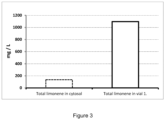
- Figure 2 shows produced limonene extracted from all cells (present in cytosol) and produced limonene captured in vial or in the organic solvent present in the vial.
- limonene For quantification of produced limonene present in the cytosol of cells, all cells growing on the agar were collected in PBS buffer. The cells were lysed by sonication to break the cells and release the cytosol. Limonene was extracted by ethyl acetate and quantified directly on GC/MS. The amount of limonene in cytosol vas 135.4 mg/L.
- the amount of limonene in collection compartment as determined in example 4 was 1096.3 mg/L, which is 8-fold higher than the amount of limonene in cytosol.
Landscapes
- Health & Medical Sciences (AREA)
- Chemical & Material Sciences (AREA)
- Life Sciences & Earth Sciences (AREA)
- Engineering & Computer Science (AREA)
- Organic Chemistry (AREA)
- Wood Science & Technology (AREA)
- Zoology (AREA)
- Bioinformatics & Cheminformatics (AREA)
- Genetics & Genomics (AREA)
- General Health & Medical Sciences (AREA)
- Microbiology (AREA)
- Biochemistry (AREA)
- Biotechnology (AREA)
- General Engineering & Computer Science (AREA)
- Sustainable Development (AREA)
- Biomedical Technology (AREA)
- General Chemical & Material Sciences (AREA)
- Clinical Laboratory Science (AREA)
- Molecular Biology (AREA)
- Chemical Kinetics & Catalysis (AREA)
- Immunology (AREA)
- Oil, Petroleum & Natural Gas (AREA)
- Preparation Of Compounds By Using Micro-Organisms (AREA)
Priority Applications (1)
| Application Number | Priority Date | Filing Date | Title |
|---|---|---|---|
| EP23151430.8A EP4400574A1 (de) | 2023-01-12 | 2023-01-12 | System und verfahren zur herstellung von flüchtigen natürlichen verbindungen unter verwendung von festen wachstumsmedien |
Applications Claiming Priority (1)
| Application Number | Priority Date | Filing Date | Title |
|---|---|---|---|
| EP23151430.8A EP4400574A1 (de) | 2023-01-12 | 2023-01-12 | System und verfahren zur herstellung von flüchtigen natürlichen verbindungen unter verwendung von festen wachstumsmedien |
Publications (1)
| Publication Number | Publication Date |
|---|---|
| EP4400574A1 true EP4400574A1 (de) | 2024-07-17 |
Family
ID=84981287
Family Applications (1)
| Application Number | Title | Priority Date | Filing Date |
|---|---|---|---|
| EP23151430.8A Pending EP4400574A1 (de) | 2023-01-12 | 2023-01-12 | System und verfahren zur herstellung von flüchtigen natürlichen verbindungen unter verwendung von festen wachstumsmedien |
Country Status (1)
| Country | Link |
|---|---|
| EP (1) | EP4400574A1 (de) |
Citations (8)
| Publication number | Priority date | Publication date | Assignee | Title |
|---|---|---|---|---|
| WO2007060233A1 (de) | 2005-11-28 | 2007-05-31 | Basf Se | Fermentative herstellung organischer verbindungen |
| WO2007060235A1 (de) | 2005-11-28 | 2007-05-31 | Basf Se | Fermentative herstellung organischer verbindungen |
| US20110287471A1 (en) | 2010-05-18 | 2011-11-24 | Strobel Gary A | System and Method of Producing Volatile Organic Compounds from Fungi |
| CN103243022A (zh) * | 2013-05-08 | 2013-08-14 | 江苏大学 | 一种用于收集细菌挥发性气体的简易装置及其方法 |
| WO2013173563A1 (en) * | 2012-05-17 | 2013-11-21 | Shell Oil Company | Process for producing volatile organic compounds from biomass material |
| WO2014165174A2 (en) | 2013-03-12 | 2014-10-09 | Strobel Gary A | Microorganisms for producing volatile organic compounds and methods using same |
| DE202021002555U1 (de) * | 2021-08-03 | 2021-09-02 | Thomas Kuhlmann | Pad und Reaktor zur Entwicklung von Terpenen und deren Verbreitung in der Raumluft |
| CN115305185A (zh) * | 2022-09-07 | 2022-11-08 | 南京农业大学 | 一种研究有益菌挥发性物质控制土传病害的装置 |
-
2023
- 2023-01-12 EP EP23151430.8A patent/EP4400574A1/de active Pending
Patent Citations (11)
| Publication number | Priority date | Publication date | Assignee | Title |
|---|---|---|---|---|
| WO2007060233A1 (de) | 2005-11-28 | 2007-05-31 | Basf Se | Fermentative herstellung organischer verbindungen |
| WO2007060235A1 (de) | 2005-11-28 | 2007-05-31 | Basf Se | Fermentative herstellung organischer verbindungen |
| EP1957656B1 (de) | 2005-11-28 | 2014-04-30 | Basf Se | Fermentative Herstellung von Lysin |
| US20110287471A1 (en) | 2010-05-18 | 2011-11-24 | Strobel Gary A | System and Method of Producing Volatile Organic Compounds from Fungi |
| WO2013173563A1 (en) * | 2012-05-17 | 2013-11-21 | Shell Oil Company | Process for producing volatile organic compounds from biomass material |
| EP2850197A1 (de) | 2012-05-17 | 2015-03-25 | Shell Internationale Research Maatschappij B.V. | Verfahren und systeme zur verarbeitung von biomasse |
| EP2850199B1 (de) | 2012-05-17 | 2020-11-04 | Shell International Research Maatschappij B.V. | Verfahren zur herstellung von flüchtigen organischen verbindungen aus einem biomassematerial |
| WO2014165174A2 (en) | 2013-03-12 | 2014-10-09 | Strobel Gary A | Microorganisms for producing volatile organic compounds and methods using same |
| CN103243022A (zh) * | 2013-05-08 | 2013-08-14 | 江苏大学 | 一种用于收集细菌挥发性气体的简易装置及其方法 |
| DE202021002555U1 (de) * | 2021-08-03 | 2021-09-02 | Thomas Kuhlmann | Pad und Reaktor zur Entwicklung von Terpenen und deren Verbreitung in der Raumluft |
| CN115305185A (zh) * | 2022-09-07 | 2022-11-08 | 南京农业大学 | 一种研究有益菌挥发性物质控制土传病害的装置 |
Non-Patent Citations (1)
| Title |
|---|
| ZHONG WEI ET AL: "Efficacy of-fortified organic fertiliser in controlling bacterial wilt of tomato in the field", APPLIED SOIL ECOLOGY, ELSEVIER, AMSTERDAM, NL, vol. 48, no. 2, 26 March 2011 (2011-03-26), pages 152 - 159, XP028211220, ISSN: 0929-1393, [retrieved on 20110403], DOI: 10.1016/J.APSOIL.2011.03.013 * |
Similar Documents
| Publication | Publication Date | Title |
|---|---|---|
| Petersen et al. | Effects of sieving, storage, and incubation temperature on the phospholipid fatty acid profile of a soil microbial community | |
| TW201224151A (en) | A process | |
| EP3339443B1 (de) | Streptomyces psammoticus omk-4 und verfahren zur herstellung von vanillin | |
| EP4400574A1 (de) | System und verfahren zur herstellung von flüchtigen natürlichen verbindungen unter verwendung von festen wachstumsmedien | |
| EP0648273B1 (de) | Verfahren zur Herstellung von Erzeugnissen mit bakterieller Aktivität, die zur Umwandlung von Glycerin in 1,3-Propandiol fähig sind, sowie die entsprechenden Stämme und deren Anwendung zur industrieller Herstellung von 1,3-Propandiol | |
| JPH01124393A (ja) | 有機化合物の製造方法 | |
| CN115725420A (zh) | 一株产黄酮类化合物的工业大麻内生真菌及其应用 | |
| Ahmad et al. | Effect of time, moisture content, and substrate amount on sorbitol production using entrapment of Lactobacillus plantarum (BAA-793) in sodium alginate beads | |
| EP3325639A1 (de) | Verfahren zur extraktion von carbonsäuren, die durch anaerobe gärung von vergärbarer biomasse produziert wurden | |
| Eaton | Dehydration of the off-flavor chemical 2-methylisoborneol by the R-limonene-degrading bacteria Pseudomonas sp. strain 19-rlim and Sphingomonas sp. strain BIR2-rlima | |
| Linares et al. | Exploration of α-pinene degradation pathway of Pseudomonas rhodesiae CIP 107491. Application to novalic acid production in a bioreactor | |
| Kumar et al. | Microbial community structure at different fermentation stages of Kutajarista, a herbal formulation | |
| Hosseini et al. | Biotransformation of atropine, 4-hydroxy coumarin, 8-hydroxy quinoline, indole and penicillin G by the natural microflora | |
| Brooks et al. | Changes in cell structure, morphology and activity of Streptomyces venezuelae during the growth, shocking and jadomycin production stages | |
| CN112813010A (zh) | 芽孢杆菌Bacillus-CAULIU-1及其应用 | |
| Crow et al. | Isolation of anaerobes using an oxygen reducing membrane fraction: experiments with acetone butanol producing organisms | |
| FR2485037A1 (fr) | Nouvelle souche bacterienne et ses mutants utiles pour stabiliser le vin, procede d'obtention de ces mutants, composition contenant cette souche ou ses mutants, procede de stabilisation du vin utilisant cette composition et vin ainsi stabilise | |
| TWI796053B (zh) | 聚羥基烷酸酯生產方法 | |
| TWI856592B (zh) | 芽孢桿菌及使用其生產聚羥基烷酸酯的方法 | |
| CN119709559B (zh) | 一株嗜气芽孢杆菌及其在制备香紫苏醇上的应用 | |
| AU2006217752A1 (en) | Method of modifying the viability of a lyophilized microorganism by treating the growth medium thereof with gases | |
| CN113337433B (zh) | 一种产吡咯喹啉醌的假单胞菌及其应用 | |
| AU2008243679A1 (en) | Pseudopterosin-producing bacteria and methods of use | |
| Kilgour et al. | A Photoactivatable Small‐Molecule Probe for the In Vivo Capture of Polyketide Intermediates | |
| CN121653002A (zh) | 一株产气克雷伯杆菌及其在将色氨酸转化为吲哚-3-羧酸中的应用 |
Legal Events
| Date | Code | Title | Description |
|---|---|---|---|
| PUAI | Public reference made under article 153(3) epc to a published international application that has entered the european phase |
Free format text: ORIGINAL CODE: 0009012 |
|
| STAA | Information on the status of an ep patent application or granted ep patent |
Free format text: STATUS: THE APPLICATION HAS BEEN PUBLISHED |
|
| AK | Designated contracting states |
Kind code of ref document: A1 Designated state(s): AL AT BE BG CH CY CZ DE DK EE ES FI FR GB GR HR HU IE IS IT LI LT LU LV MC ME MK MT NL NO PL PT RO RS SE SI SK SM TR |
|
| STAA | Information on the status of an ep patent application or granted ep patent |
Free format text: STATUS: REQUEST FOR EXAMINATION WAS MADE |
|
| 17P | Request for examination filed |
Effective date: 20250110 |