EP4400670A1 - Système de fixation - Google Patents
Système de fixation Download PDFInfo
- Publication number
- EP4400670A1 EP4400670A1 EP23151501.6A EP23151501A EP4400670A1 EP 4400670 A1 EP4400670 A1 EP 4400670A1 EP 23151501 A EP23151501 A EP 23151501A EP 4400670 A1 EP4400670 A1 EP 4400670A1
- Authority
- EP
- European Patent Office
- Prior art keywords
- exemplary
- plate
- fastening system
- receiver
- flange
- Prior art date
- Legal status (The legal status is an assumption and is not a legal conclusion. Google has not performed a legal analysis and makes no representation as to the accuracy of the status listed.)
- Pending
Links
Images








Classifications
-
- E—FIXED CONSTRUCTIONS
- E04—BUILDING
- E04F—FINISHING WORK ON BUILDINGS, e.g. STAIRS, FLOORS
- E04F13/00—Coverings or linings, e.g. for walls or ceilings
- E04F13/07—Coverings or linings, e.g. for walls or ceilings composed of covering or lining elements; Sub-structures therefor; Fastening means therefor
- E04F13/08—Coverings or linings, e.g. for walls or ceilings composed of covering or lining elements; Sub-structures therefor; Fastening means therefor composed of a plurality of similar covering or lining elements
- E04F13/0801—Separate fastening elements
- E04F13/0803—Separate fastening elements with load-supporting elongated furring elements between wall and covering elements
- E04F13/081—Separate fastening elements with load-supporting elongated furring elements between wall and covering elements with additional fastening elements between furring elements and covering elements
- E04F13/0812—Separate fastening elements with load-supporting elongated furring elements between wall and covering elements with additional fastening elements between furring elements and covering elements fixed by means of spring action
-
- E—FIXED CONSTRUCTIONS
- E04—BUILDING
- E04F—FINISHING WORK ON BUILDINGS, e.g. STAIRS, FLOORS
- E04F13/00—Coverings or linings, e.g. for walls or ceilings
- E04F13/07—Coverings or linings, e.g. for walls or ceilings composed of covering or lining elements; Sub-structures therefor; Fastening means therefor
- E04F13/08—Coverings or linings, e.g. for walls or ceilings composed of covering or lining elements; Sub-structures therefor; Fastening means therefor composed of a plurality of similar covering or lining elements
- E04F13/0801—Separate fastening elements
- E04F13/0803—Separate fastening elements with load-supporting elongated furring elements between wall and covering elements
- E04F13/0805—Separate fastening elements with load-supporting elongated furring elements between wall and covering elements with additional fastening elements between furring elements and the wall
-
- E—FIXED CONSTRUCTIONS
- E04—BUILDING
- E04F—FINISHING WORK ON BUILDINGS, e.g. STAIRS, FLOORS
- E04F13/00—Coverings or linings, e.g. for walls or ceilings
- E04F13/07—Coverings or linings, e.g. for walls or ceilings composed of covering or lining elements; Sub-structures therefor; Fastening means therefor
- E04F13/08—Coverings or linings, e.g. for walls or ceilings composed of covering or lining elements; Sub-structures therefor; Fastening means therefor composed of a plurality of similar covering or lining elements
- E04F13/0801—Separate fastening elements
- E04F13/0803—Separate fastening elements with load-supporting elongated furring elements between wall and covering elements
- E04F13/081—Separate fastening elements with load-supporting elongated furring elements between wall and covering elements with additional fastening elements between furring elements and covering elements
- E04F13/0816—Separate fastening elements with load-supporting elongated furring elements between wall and covering elements with additional fastening elements between furring elements and covering elements the additional fastening elements extending into the back side of the covering elements
-
- E—FIXED CONSTRUCTIONS
- E04—BUILDING
- E04F—FINISHING WORK ON BUILDINGS, e.g. STAIRS, FLOORS
- E04F13/00—Coverings or linings, e.g. for walls or ceilings
- E04F13/07—Coverings or linings, e.g. for walls or ceilings composed of covering or lining elements; Sub-structures therefor; Fastening means therefor
- E04F13/08—Coverings or linings, e.g. for walls or ceilings composed of covering or lining elements; Sub-structures therefor; Fastening means therefor composed of a plurality of similar covering or lining elements
- E04F13/0801—Separate fastening elements
- E04F13/0803—Separate fastening elements with load-supporting elongated furring elements between wall and covering elements
- E04F13/081—Separate fastening elements with load-supporting elongated furring elements between wall and covering elements with additional fastening elements between furring elements and covering elements
- E04F13/0816—Separate fastening elements with load-supporting elongated furring elements between wall and covering elements with additional fastening elements between furring elements and covering elements the additional fastening elements extending into the back side of the covering elements
- E04F13/0819—Separate fastening elements with load-supporting elongated furring elements between wall and covering elements with additional fastening elements between furring elements and covering elements the additional fastening elements extending into the back side of the covering elements inserted into grooves in the back side of the covering elements
Definitions
- the present disclosure generally relates to a fastening system suitable for use with cladding elements to form a building façade wherein the cladding elements are secured to a building surface or framework using the fastening system to form the building façade.
- the present disclosure relates to a concealed fastening system wherein the fastening system used to secure cladding elements to a building surface or framework is hidden from general view.
- the embodiments have been developed primarily for use as a concealed fastening system for fibre cement cladding elements and will be described hereinafter with reference to this application.
- the concealed fastening system is not limited to this particular field of use and that the embodiments can also be used with other building products including other types of cladding elements and/or other fibre cement building products.
- the embodiments of the concealed fastening system described hereinafter are with respect to a cladding system installed as an exterior building façade. It should be readily understood that the concealed fastening system of the present disclosure is also not limited to this particular application and that the embodiments hereinafter disclosed can also be used in an interior application if so desired.
- Cladding systems are widely known in building construction.
- systems where façade panels or cladding elements of various types of materials are fixed to a substrate it is often desired to use a concealed or hidden fastening system to secure the façade panels to avoid face fixing the façade panel to the substrate through the exterior face of the façade panel.
- Such concealed fastening systems usually comprise a horizontal and vertical supporting framework to which the façade panels are secured using a complicated clip system.
- Such systems are expensive and complex to install.
- Such systems also provide limited flexibility to allow for on-site adjustments if required during installation.
- the present disclosure relates generally to a fastening system for use with cladding elements and is suitable for securing a cladding element to a substrate.
- the concealed fastening system comprises a receiver comprising a base section and side sections extending from the base section such that a central cavity is formed, each side section comprising a first projection and a second projection wherein the first projection extends at an angle ⁇ from base section and the second projection extends at an angle ⁇ from the first projection remote from the base section and wherein the second projection remote from the first projection comprises a hook, wherein the base section of the receiver is configured to mount to either a cladding element or a substrate; a rail comprising a base element and side arms extending from the base element, each side arm comprising a first flange extending orthogonally from base element, a second flange extending orthogonally from the first flange remote from the base element, a third flange extending orthogonally from the second flange remote from the first flange and a fourth flange extending at an angle ⁇ from third flange remote from the second flange such that the fourth flanges of each side arm extend towards each
- angle ⁇ is approximately 94° and 158°+/- 2°. In a further embodiment, angle ⁇ is approximately 132° +/- 2°.
- angle ⁇ is approximately 92° and 156° +/- 2°. In a further embodiment, angle ⁇ is approximately 125° +/- 2°.
- ⁇ is approximately 93° and 157°+/- 2°. In a further embodiment, angle ⁇ is approximately 131° +/- 2°.
- angle ⁇ is approximately 132° +/- 2°
- angle ⁇ is approximately 125° +/- 2 and angle ⁇ is approximately 131° +/- 2°.
- the second flange of the rail further comprises a nub at the junction between the second flange and the third flange. In a further embodiment, the second flange of the rail further comprises a groove at the junction between the second flange and the third flange.
- the side sections of the receiver further comprise extended side sections wherein extended side sections are positioned between the base section and the first projection of the receiver.
- the second projection and hook of the receiver further comprise a central cut-away portion.
- the concealed fastening system further comprises a bracket comprising a first plate and a second plate wherein the second plate extends orthogonally from the first plate and the second plate is configured to attach to the substrate; and an adaptor plate comprising a main plate and a secondary plate wherein the secondary plate extends orthogonally from the main plate and the first plate of the bracket and the main plate of the adaptor plate are configured to attach to the substrate.
- the bracket further comprises a resiliently biased clip mechanism wherein the clip mechanism comprises a connective form extension comprising a first end connected to the first plate and second end remote from the first end wherein the second end is spaced apart from the first plate such that a gap is formed between the clip mechanism and the first plate.
- the bracket further comprises side walls extending orthogonally from first plate and/or second plate such that side walls are spaced apart from each other by width (W) of the bracket.
- the bracket further comprises a detent at the junction between the first plate and the second plate.
- the term 'comprise' shall have an inclusive meaning. Thus it is understood that it should be taken to mean an inclusion of not only the listed components it directly references, but also non specified components. Accordingly, the term 'comprise' is to be attributable with as broad an interpretation as possible and this rationale should also be used when the terms 'comprised' and/or 'comprising' are used.
- the concealed fastening system of the present disclosure is suitable for attaching or mounting one or more cladding elements to a substrate.
- the concealed fastening system comprises a receiver 120 comprising a base section 122 and side sections 124, 126 extending from the base section 122 such that a central cavity 121 is formed, each side section 124, 126 remote from the base section 122 terminates in a hook 127; and a rail 100 comprising a base element 102 and side arms 104, 106 extending from the base element 102.
- the rail 100 at least partially seats within the central cavity 121 of the receiver 120 such that the side arms 104, 106 of the rail abut hooks 127 of receiver 120 and the base section 122 of the receiver and the base element 102 of the rail are spaced apart from each other by a distance as will be described more fully below.
- the base section 122 of the receiver and the base element 102 of the rail are each configured to be secured to either of the substrate or the cladding elements such that the concealed fastening system of the present disclosure can be used whereby the receiver 120 is attached to the substrate and the rail 100 is attached to the cladding element or vice versa as desired by the end user and as disclosed more fully below.
- the concealed fastening system of the present disclosure further comprises a bracket 10, 20, 30, 40, 50 and adaptor plate 60, 70,80 as will be disclosed more fully below with reference to FIG's 1(a) to FIG. 9 .
- bracket 10, 20, 30, 40, 50 and adaptor plate 60, 70 80 components enable an installer/end user to overcome any surface defects or uneven surfaces on a substrate when installing the concealed fastening system of the present disclosure.
- Each of the following components of the concealed fastening system of the present disclosure may be formed from a range of materials including, but not limited to, metals such as steel or aluminium, or polymeric materials such as fibre reinforced polymer composites. It is preferable when using metals such as steel that the steel grades have mechanical properties which are equivalent to or exceed the requirements specified in EN 10346 2015 as associated with structural steel grades DX51, S220 and S450.
- brackets 10, 20, 30, 40, 50 of the present disclosure.
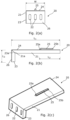
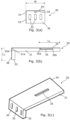
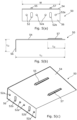
- Each of brackets 10, 20, 30, 40, 50 are substantially 'L-shaped' brackets comprising a first plate 14, 24, 34, 44, 54 and a second plate 16, 26, 36, 46, 56 wherein the second plate 16, 26, 36, 46, 56 extends substantially orthogonally from the first plate 14, 24, 34, 44, 54.
- one or more apertures 12, 22, 32, 42, 52 are provided in second plate 16, 26, 36, 46, 56.
- exemplary brackets 10, 20, 30, 40, 50 are secured to a substrate using appropriate fasteners which are secured to the substrate through one or more apertures 12, 22, 32, 42, 52 as will be disclosed more fully below.
- the apertures 12 of first exemplary bracket 10 comprise an elliptical or rounded oblong shape. This configuration of the apertures allows for adjustments during installation if so desired. It should be understood that the configuration of any one of the one or more apertures 12, 22, 32, 42, 52 in each of the exemplary brackets 10, 20, 30, 40, 50 can vary to accommodate various types of fasteners and/or substrates. For example, with reference to FIG.
- the one or more apertures 12 can be configured to comprise a central aperture 12a to allow for an appropriate fastener be used to secure the exemplary brackets of the present disclosure to a concrete or masonry substrate and one or more further apertures 12b, 12c surrounding the central aperture be configured to allow an appropriate fastener be used to secure the exemplary brackets of the present disclosure to a timber or metal (for example steel) substrate.
- Further exemplary configurations of apertures suitable for use are apertures 42, 52 shown in exemplary brackets 40 and 50 respectively. An installer can select the appropriate configuration of aperture(s) to use to secure the exemplary brackets 10, 20, 30, 40, 50 of the present disclosure to a substrate.
- First exemplary bracket 10 further comprises side walls 11, 13.
- Side walls 11 extend orthogonally from first plate 14 such that side walls 11 are spaced apart from each other by the width (W) of first exemplary bracket 10.
- side walls 13 extend orthogonally from second plate 16 such that side walls 13 are spaced apart from each other by the width (W) of first exemplary bracket 10.
- edges 11a and 13a of side walls 11 and 13 are configured to allow the side walls 11 and 13 seat together such that at least a portion of edges 11a and 13a are abutting edges.
- side walls 11 and 13 seat together such that at least a portion of side walls 11 and 13 overlap each other.
- Side walls 11 and 13 provide additional support to exemplary bracket 10 resisting or preventing rotational movement of bracket 10 when under load.
- the first plate 14 of first exemplary bracket 10 also comprises an optional clip mechanism 15.
- clip mechanism 15 comprises a connective form extension which comprises a first end 15a connected to first plate 15 and second end 15b remote from first end 15a and which is spaced apart from first plate 14 such that a gap is formed between clip mechanism 15 and first plate 14.
- clip mechanism 15 extends from first plate 14 in a direction opposite to that of second plate 16. Clip mechanism 15 is resiliently biased towards the first plate 14 and accommodates the main plate 62, 72, 82 of exemplary adaptor plates 60, 70 and 18 as illustrated in FIG. 9 and further disclosed below.
- clip mechanism 15 is configured to provide a resilient bias and can adopt any configuration known a person skilled in the art which will achieve this functionality.
- clip mechanism 15 is configured to have a 'duck bill profile' a profile that is recognised by a person skilled in the art to provide a resilient bias.
- first exemplary bracket 10 can comprise more than one clip mechanism if so desired.
- the width W of each of exemplary brackets 10, 20, 30, 40, 50 is variable and ranges between 50 to 200mm +/- 1.0mm.
- First exemplary bracket 10 comprises a width W that is approximately 80mm wide +/- 1.0mm.
- the length L 1 of the first plate 14, 24, 34, 44, 54 of exemplary brackets 10, 20, 30, 40, 50 14 is also variable and ranges between 40mm and 400mm +/- 1.0mm.
- Distance L 2 will be described with reference to first exemplary bracket 10 and is the distance between first end 15a and the end of first plate 14 remote from second plate 16. However, it should be understood that distance L 2 between the first end of the clip mechanism and the edge of the first plate remote from the second plate is dictated by the length L 4 of the adaptor plate as shown in FIG. 6(a) .
- distance L 2 of first exemplary bracket 10 is approximately 85mm +/- 1.0mm however this can be altered as required to accommodate the range of measurements provided for L 4 below.
- the length L 3 of second plate 16 is also variable and can range between approximately 50mm to 100mm +/- 1.0mm.
- Second exemplary bracket 20 as shown in FIG's 2(a) to 2(c) differs from that of first exemplary bracket 10 in that second exemplary bracket 20 has side walls 21, 23 on one side of bracket 20 only. As before, side walls 21 and 23 provide additional support to exemplary bracket 20 resisting or preventing rotational movement of bracket 20 when under load.
- Third exemplary bracket 30 as shown in Fig's 3(a) to 3(c) differs from that of the second exemplary bracket 20 in that the clip mechanism 35 of the third exemplary bracket 30 extends from first plate 35 in the same direction as that of second plate 36.
- Fourth exemplary bracket 40 as shown in FIG's 4(a) to 4(c) differs from that of first exemplary bracket 10 in that fourth exemplary bracket 40 has no side walls.
- Fourth exemplary bracket further comprises a detent 44a at the junction between the first plate 44 and the second plate 46 to prevent rotation of the first plate 44 relative to the second plate 46 when under load.
- the configuration of apertures 42 of fourth exemplary bracket comprises circular outer apertures 42a and an central oblong aperture 42b. It should be readily understood that apertures 42 could also be configured as described above with respect to the each of the first to third embodiments of exemplary brackets 10, 20 and 30.
- Fifth exemplary bracket 50 as shown in FIG's 5(a) to 5(c) is similar to that of fourth exemplary bracket 40, however in this exemplary embodiment the width W of fifth exemplary bracket 50 is approximately 150mm +/- 1.0mm wide.
- Fifth exemplary bracket further comprises a second clip mechanism 57 in first plate 54 and additional apertures in second plate 56. Second clip mechanism 57 is as described above in relation to clip mechanism 15 of first exemplary bracket 10. It should be understood that each of the differentiating features of the respective exemplary embodiments of brackets 10, 20, 30, 40, 50 are interchangeable and any one or more of those features can be used in any combination with each of the substantially 'L-shaped' exemplary brackets.
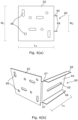
- Adaptor plates 60, 70 and 80 are substantially 'L-shaped' adaptor plates comprising main plate 62, 72, 82 and secondary plate 64, 74, 84 wherein the secondary plate 64, 74, 84 extends substantially orthogonally from the main plate 62, 72, 82.
- Main plate 62, 72, 82 further comprises a plurality of openings 66, 76, 86. In use, openings 66, 76, 86 allow the main plate 62, 72, 82 be secured to the first plate 14, 24, 34, 44, 54 of brackets 10, 20, 30, 40, 50 as will be described more fully below with respect to FIG. 9 .
- Secondary plate 64, 74, 84 of adaptor plates 60, 70 80 is further provided with one or more wing member(s) 68, 78, 88 which extend orthogonally from side edges 67, 87 of secondary plate 64, 74, 84 away from main plate 62, 72, 82.
- Secondary plate 64, 74, 84 of adaptor plates 60, 70,80 further comprises an optional elongate opening 65 as shown in FIG 6(b) .
- Elongate opening 65 provides an opening through which fasteners can be positioned to secure additional optional components such as for example internal and/or external corner trim fixing brackets 185 and 190 as shown in FIG's. 15 and 16 respectively to the concealed fastening system of the present disclosure as will be disclosed more fully below.
- main plate 62, 72, 82 is between approximately 46mm and 192mm +/- 1.0mm wide W 1 and between approximately 46mm and 192mm +/- 1.0mm long L 4 whilst secondary plate 64, 74, 84 is between approximately 33mm and 135mm +/- 1.0mm wide W 2 and between approximately 75mm and 180mm +/- 1.0mm long L 5 .
- width W 1 of the main plate 62, 72, 82 of the exemplary adaptor plate is approximately 4% to 8% less than the width W of the first plate 14, 24, 34, 44, 54 of the exemplary brackets 10, 20, 30, 40, 50.
- the main plate 62, 72, 82 of the adaptor plate 60, 70 80 and the first plate 14, 24, 34, 44, 54 of the bracket 10, 20, 30, 40, 50 prefferably has such an overlap between the main plate 62, 72, 82 of the adaptor plate 60, 70 80 and the first plate 14, 24, 34, 44, 54 of the bracket 10, 20, 30, 40, 50 to allow for load transfer and load distribution from the adaptor plate 60, 70, 80 across the width of the first plate 14, 24, 34, 44, 54 of the bracket 10, 20, 30, 40, 50.
- the width W 1 it is also possible for the width W 1 to be equal to or more than 8% less than the width W of the first plate 14, 24, 34, 44, 54 of the exemplary brackets 10, 20, 30, 40, 50.
- the width W 1 of the main plate 62, 72, 82 of the exemplary adaptor plate is approximately 4% to 75% less than the width W of the first plate 14, 24, 34, 44, 54 of the exemplary brackets 10, 20, 30, 40, 50.
- the width W 2 of secondary plate 64, 74, 84 is also variable and is dependent on the width of base element 102, 112 of rail 100, 110 as shown in FIG's. 10(a) and 10(b) and described more fully below.
- width W of first plate 14 of bracket 10 is approximately 80mm wide +/- 1.0mm
- width W 1 of main plate 62, 72, 82 is approximately 5% less than the width W of first plate or approximately 1475mm +/- 1.0mm wide.
- exemplary bracket 50 as shown in FIG. 5(a) to FIG. 5(c) , wherein width W of first plate 54 is approximately 150mm wide +/- 1.0mm, the width W 1 of the main plate 62, 72, 82 of exemplary adaptor plate 60, 70, 80 is approximately 5% less than the width W of exemplary bracket 50 or approximately 142.5mm +/- 1.0mm wide.
- Exemplary adaptor plates 60, 70 and 80 seat together with exemplary brackets 10, 20, 30, 40, 50 as shown in FIG. 9 .
- Main plate 82 of exemplary adaptor plate 80 is placed on exemplary bracket 30 and seated under clip mechanism 35.
- Clip mechanism 35 is resiliently biased towards the main plate 82 of exemplary adaptor plate 80 thereby holding exemplary adaptor plate 80 in position on exemplary bracket 30.
- additional fasteners are inserted through openings 86 to further secure exemplary adaptor plate 80 to exemplary bracket 30. It should be understood that in some instances clip mechanism 35 may not be present and in such embodiments, fasteners inserted through openings 86 will retain the adaptor plate 80 in position on exemplary bracket 30.
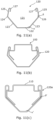
- Exemplary rails 100, 110 are substantially 'U' shaped articles comprising a base element 102, 112 from which side arms 104, 114, 106, 116 project orthogonally forming a recess 108, 118.
- side arms 104, 106 each comprise a first flange 103 wherein first flange 103 extends orthogonally from base element 102 such that side arms 104, 106 extend from base element 102 in the same direction but are spaced apart from each other.
- Side arms 104, 106 each further comprise a second flange 105 which extends orthogonally from first flange 103 remote from base element 102 in a direction away from base element 102 such that the second flange 105 extends in a plane parallel to but spaced apart from base element 102.
- the overall width W 3 of exemplary rail 100 is equivalent to the sum of the widths of the base element and each of the second flanges approximately, overall width W 3 ranges between approximately 40 mm and 150mm +/-1.0mm. In this exemplary embodiment overall width W 3 is approximately 48 mm +/- 1.0mm.
- the width of the base element 102 is such that the base element 102 can seat easily on either a substrate or the rear face of a cladding element or alternatively the secondary plate 64, 74, 84 of exemplary adaptor plates 60, 70, 80 when adaptor plates 60,70, 80 are present in the concealed fastening system of the present disclosure.
- the width of the base element 102 is variable. In the present embodiment as shown, the width of base element 102 approximately the same as W 2 i.e., is approximately 33mm +/- 1.0mm.
- Side arms 104, 106 each further comprise a third flange 107 which also extends in a direction away from base element 102 however third flange 107 extends orthogonally from second flange 105 in a plane parallel to but spaced apart from first flange 103.
- Side arms 104, 106 each further comprise fourth flange 109 which extends at an angle ⁇ from third flange 107 such that the fourth flanges 109 of each side arm 104, 106 extend towards each other forming an opening 109(a).
- Angle ⁇ in the exemplary rails of the present disclosure ranges between approximately 94° and 158°+/- 2° and more preferably is between approximately 125° and 145°+/- 2°.
- exemplary rails 100, 110 angle ⁇ is approximately 132° +/- 2°.
- the length of exemplary rails 100, 110 ranges between 25mm +/- 1.0mm and 20m +/- 1.0cm wherein the length of exemplary rail 100, 110 is the distance between opposing ends of the exemplary rail 100, 110 which is perpendicular to overall width W 3 .
- one or a plurality of rail elements can be used to mount a cladding element to a substrate.
- the concealed fastening system of the present disclosure could for example mount a cladding element that is 4.2m or 6m long using either an elongate rail that is approximately the same length as the cladding element or alternatively, using a plurality of discrete shorter rails that can be spaced apart along the same length as that of the cladding element as desired by the end user.
- exemplary rail 110 differs from that of FIG. 10(a) in that each of second flange 115 is provided with a nub 115a at the junction between second flange 115 and third flange 117.
- exemplary rail 110 can be provided with a groove or slot at the junction between second flange 115 and third flange 117.
- the groove or slot is provided in addition to nubs 115(a)
- the groove or slot is provided on second flange 115 between nubs 115(a) and first flange 113 to provide a seat for the end of hook 127 of receiver 120 as will be disclosed more fully below.
- Nubs 115(a) and/or grove or slot are provided in exemplary rail 110 to provide additional resistance to prevent the receiver from deflecting when in use as will be disclosed more fully below.
- First exemplary receiver 120 of the present disclosure is also a substantially 'U' shaped article with a complimentary configuration to that of the exemplary rail 100, 110. Further exemplary receivers are shown in each of FIG's 11(c) to 11(i) each of which have substantially the same 'U' shape configuration as that of first exemplary receiver 120.
- the configuration of each of the exemplary receivers 120, 120a, 130, 140, 150 allow the exemplary rails 100, 110 to seat within the cavity of each respective receiver 120, 120a, 130, 140, 150 as disclosed more fully below. Accordingly, exemplary receivers will be described generally in the following with reference to first exemplary receiver 120.
- First exemplary receiver 120 comprises a base section 122 from which side sections 124, 126 extend forming a central cavity 121 in the central internal area of the 'U' shaped article.
- the width of base section 122 is commensurate with base element 102 122 of exemplary rails 100, 110.
- Side sections 124, 126 each comprise a first projection 123 and a second projection 125, wherein first projections 123 extend at an angle ⁇ away from each side of base section 122 and second projections 125 extend at an angle ⁇ from the first projection 123 remote from base section 122.
- angle ⁇ between first projection 123 and second projection 125 is greater than angle ⁇ between first projection 123 and base section 122.
- Angle ⁇ in the exemplary receivers of the present disclosure ranges between approximately 93° and 157°+/- 2° and more preferably is between approximately 123° and 143°+/- 2°. In the exemplary receivers of the present disclosure ranges, angle ⁇ is approximately 131° +/- 2°.
- Angle ⁇ in the exemplary receivers of the present disclosure ranges between approximately 92° and 156° +/- 2° and more preferably is between approximately 120° and 140° +/- 2°. In the exemplary receivers of the present disclosure angle ⁇ in is approximately 125° +/- 2°. In the exemplary embodiments of the exemplary receivers 120, 120a, 130, 140, 150, angle ⁇ of exemplary rails 100, 110 is equal to or greater than angle ⁇ of the exemplary receivers 120, 120a, 130, 140, 150, of the present disclosure.
- each second projection 125 remote from first projection 123 is provided with a hook 127 in which the curved section is turned towards the central cavity 121.
- base section 122 is further provided with one or more holes to facilitate locating fasteners to allow the rail to be secured to the secondary plates 64, 74, 84 of adaptor plates 60, 70 ,80 or alternatively to the rear face 314 of a cladding panel 300 as shown in Fig 17(a) .
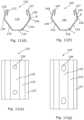
- Second exemplary receiver 120a as shown in FIG. 11(c) is similar to first exemplary receiver 120 however first projections 123 extend at an angle ⁇ ' away from each side of base section 122 and second projections 125 extend at an angle ⁇ ' from the first projection 123 remote from base section 122.
- each of side sections 124, 126 optionally further comprises one or more small projections or knurls.
- the one or more small projections are positioned on first projection 123 of side sections 124, 126.
- the one or more small projections reduce movement of the exemplary rails 100, 110 when seated within exemplary receivers 120, 120a, 130, 140, 150 (as further disclosed below) thus reducing noise created by such movement when in use.
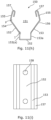
- first and second exemplary embodiments of the concealed fastening system of the present disclosure in which rails 100 and 110 respectively are shown seated together with first and second exemplary receivers 120, 120a such that rails 100 and 110 seat within the central cavity 121, 121a of receivers 120, 120a whereby the second flange 105,115 of rails 100, 110 abut the hook 127, 127a of receivers 120, 120a.
- the ends of hook 127,127a which abut the second flange 105,115 of rails 100, 110, seat within a groove or slot provided on the outer surface of second flange 105, 115 to retain the ends of hook 127, 127a in position and provide restraint to prevent the receiver from deflecting when in use.
- first exemplary receiver 120 it should be understood that the disclosure is applicable to each of exemplary receivers 120, 120a, 130, 140, 150.
- First and second projections 123, 125 are configured to allow for limited pivotal movement at the junctions between the first projection 123 and the base section122; and the first projection 123 and second projection 125 respectively to allow side sections 124, 126 move apart for rails 100, 110 to be resiliently inserted into the central cavity 121. Once rails 100, 110 are inserted into the central cavity 121, side sections 124, 126 move back into position to allow engagement with the rail such that the hook 127 abuts second flange 105, 115 respectively thereby preventing movement of rails 100, 110 out of the central cavity 121.
- rails 110, 110 can be inserted into the central cavity 121 but cannot be easily removed without physical intervention to disengage and remove the impediments caused by hooks 127 and second sections 124, 126 respectively.
- the reference numerals of the various sections of the exemplary rails and receiver have largely been omitted from FIG's 11(b) and 11(c) for clarity.
- nubs 115a of exemplary rail 110 are configured to seat within the curved section of hook 127 thus providing additional resistance when in use.
- Any one of the exemplary rail receiver systems of the present disclosure can be adapted to include nubs in the configuration of the rail component.
- fasteners such as for example, one or more screws can be placed through the exemplary rail 100, 110 and exemplary receiver 120, 120a, 130, 140, 150 when seated together in the concealed fastening system of the present disclosure thereby preventing lateral movement of the exemplary rail 100, 110 and exemplary receiver 120, 120a, 130, 140, 150.
- the fasteners are restricted to one location on the concealed fastening system of the present disclosure to allow for natural movement within the concealed fastening system to occur but prevent disengagement of the exemplary rail 100, 110 from the exemplary receiver 120, 120a, 130, 140, 150.
- Third, fourth and fifth exemplary receivers 130, 140 and 150 of the present disclosure are shown in FIG's 11(d) to 11(i) respectively.
- Third exemplary receiver 130 as shown in FIG 11(d) and 11(e) is substantially identical to that of first exemplary receiver 120, base section 132 of second exemplary receiver 130 in which a plurality of hexagonal holes 138 provided to facilitate locating fasteners to secure exemplary rail 130 to the secondary plate 64, 74, 84 of adaptor plates 60, 70 ,80 or alternatively to the rear face 314 of a cladding panel 300 is shown.
- fourth exemplary receiver 140 as shown in FIG. 11(f) and 11(g) is substantially identical to that of first and third exemplary receiver 120 and 130.
- Fourth exemplary receiver comprises a plurality of oblong shaped holes 148 in base section 142. It should be understood that alternate configurations and frequencies of holes 138, 148 and 158 on base section 122, 132, 142, 152 can be selected as desired by the end user.
- angle ⁇ ranges between approximately 92° and 156° +/- 2°.
- angle ⁇ is more preferably between approximately 120° and 140° +/-2°.
- Angle ⁇ in the receiver of the present disclosure ranges between approximately 93° and 157°+/- 2° and more preferably is between approximately 123° and 143°+/- 2°.
- angle ⁇ is approximately 131° +/- 2°.
- fifth exemplary receiver 150 as shown in FIG's 11(h) and 11(i), there is shown an exemplary receiver which is similar to that of first, second, third and fourth exemplary receivers 120, 120a, 130 and 140.
- Fifth exemplary receiver 150 comprises extended side sections 154, 156 to allow for adjustment of the distance between a cladding panel 300 and a substrate relative to the first, second and third exemplary receivers 120, 130 and 140. In this way it is possible for the concealed fastening system of the present disclosure to achieve a lapped siding aesthetic as will be disclosed more fully below with reference to FIG. 19 .
- Fifth exemplary receiver 150 comprises a base section 152 from which extended side sections 154, 156 project forming central cavity 151 in the internal area of the substantially 'U' shaped article.
- Side sections 154, 166 each comprise an extension section 153a positioned between base section 152 and first projection 153.
- Each extension section 153a projects substantially orthogonally in the same direction from each side of base section 152 such that extension sections 153a are spaced apart and parallel to each other.
- Each of first projections 153 extend from extension sections 153a remote from base section 152 such that first projections 153 extend at an angle away from base section 152.
- first projections 153 and extension sections 153a corresponds to angle ⁇ of first, second and third exemplary receivers 120, 130 and 140 less the angle from which extension sections 153a extend from base section 152 which in the embodiment shown is substantially 90°. It should be understood that if first projections 153 were extended to base section 152, the angle between first projections 153 and base section 152 would be equivalent to angle ⁇ of first, second and third exemplary receivers 120, 130 and 140.
- second projections 155 extend at an angle ⁇ from the first projection 153 remote from base section 152.
- the end of each second projection 155 remote from first projection 153 is also provided with a hook 157 in which the curved section is turned towards the central cavity 151.
- Base section 152 is further provided with hexagonal shaped holes 158 to facilitate locating fasteners to allow the rail to be secured to the secondary plates 64, 74, 84 of adaptor plates 60, 70 80 or alternatively to the rear face 314 of a cladding panel 300 as shown in Fig 17(a) .
- exemplary receivers 120, 120a, 130, 140, 150, 500 are commensurate with the width and length of exemplary rails 100, 110.
- each of the exemplary rails 100, 110 and/or exemplary receivers 120, 120a, 130, 140, 150, 500 can be further provided with water management features to allow water to flow through the concealed fastening system of the present disclosure.
- Such features are known to a person skilled in the art and generally comprise a series of openings which allow water to pass through the exemplary rails 100, 110 and exemplary receivers 120, 120a, 130, 140, 150, 500 rather than sit on the top surface when in use, positioned between the substrate and cladding element.
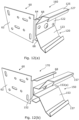
- FIG. 12(a) and 12(b) there is shown perspective views of exemplary adaptor plate 60 on which receivers 120 and 150 have been secured to secondary plate 64 respectively.
- FIG. 12(a) shows adaptor plate 60 together with receiver 120 forming a central section 160 of a concealed fastening system of the present disclosure.
- FIG. 12(b) shows adaptor plate 60 together with receiver 150 forming an alternate embodiment of a central section 170 of a concealed fastening system of the present disclosure.
- Receiver 120, 150 receives rail 100, 110 as disclosed above.
- exemplary rails 100, 110 can be secured to secondary plate 64 in similar way such that the configuration of a central section is reversed whereby rails 100, 110 are secured to the adaptor plate 60 and exemplary receivers 120, 130, 140 and 150 are then inserted into exemplary rails 100, 110 as shown in FIG's 13(b) and 13(c) and as described more fully below.
- additional optional components such as for example internal and/or external corner trim fixing brackets 185 and 190 as shown in FIG's. 15 and 16 are secured to the base element 102, 112 of exemplary rails 100, 110 or base section 122, 122a, 132, 142, 152, 502 of exemplary receivers 120, 120a, 130, 140, 150, 500.
- additional optional components such as for example internal and/or external corner trim fixing brackets 185 and 190 are also secured to the secondary plate, 64, 74, 84 of exemplary adaptor plates 60, 70, 80 via elongate opening 65.
- FIG. 13(a) shows a third exemplary embodiment of the concealed fastening system 200 of the present disclosure comprising a first exemplary embodiment bracket 10 to which a first exemplary embodiment adaptor plate 60 has been secured as outlined above with respect to exemplary bracket 30 and exemplary adaptor plate 80 as shown in FIG. 9 .
- First exemplary receiver 120 has been secured to secondary plate 64 of adaptor plate 60 as outlined above with respect to FIG. 12(a) and exemplary rail 100 has been inserted into first exemplary receiver 120 as outlined above with respect to FIG. 11(b) .
- FIG. 13(b) shows a fourth exemplary embodiment of the concealed fastening system 210 of the present disclosure in which the locations of the exemplary rail 100 and first exemplary receiver 120 have been reversed, that is, exemplary rail 100 has been secured to secondary plate 64 of adaptor plate 60 and then inserted into first exemplary receiver 120.
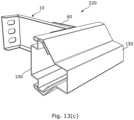
- FIG. 13(c) shows a fifth exemplary embodiment of the concealed fastening system 220 comprising a first exemplary embodiment bracket 10 and first exemplary embodiment adaptor plate 60 as before.
- Exemplary rail 100 has been secured to secondary plate 64 of adaptor plate 60 and then inserted into fourth exemplary receiver 150.
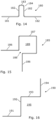
- FIG's 14, 15 and 16 there are shown an exemplary joint profile 180, an exemplary external corner profile 185 and an exemplary internal corner profile 190 respectively.
- Each of these profiles 180, 185 and 190 can be secured to the secured to the base element 102, 112 of exemplary rails 100, 110 or base section 122, 122a, 132, 142, 152, 502 of exemplary receivers 120, 120a, 130, 140, 150, 500 and also to the secondary plate 64, 74, 84 of adaptor plates 60, 70 80 via elongate opening 65 ( FIG 6(b) ) if adaptor plates 60, 70 80 are present.
- joint profiles such as joint profile 180 to provide a visible aesthetic joint between adjacent cladding elements.
- trim elements at the corners of buildings such as for example internal and external corner profiles 190 and 185 respectively to create the appropriate finish at a corner when installing cladding on a building structure.
- Joint profile 180 comprises fastening strips 181 on either side of protrusion 184 comprising side flanks 182 and base flank 183.
- joint profile 180 is secured to the secondary plate 64, 74 and 84 of one or more adaptor plates 60, 70 ,80 such that base flank 183 can be positioned between two adjacent cladding elements 300 ( FIG. 17(a) ) thereby forming the visible portion of a joint between the two adjacent cladding elements 300.
- internal corner profile 190 is secured to the secondary plate 64, 74, 84 of adaptor plates 60, 70 80 via side flanks 191, 194 such that internal flanks 192, 193 form an internal corner 195 between two cladding elements 300.
- external corner profile 185 is secured to the secondary plate 64, 74, 84 of adaptor plates 60, 70, 80 via side flanks 186 such that the box section 189 formed by internal flanks 187 forms an external corner between two cladding elements 300.
- Internal flanks 187 do not form a closed box section 189, a gap 188 is provided to allow some flexibility during the installation process and/or after installation.
- FIG. 17(a) is a perspective view of a building panel 300 comprising a front face 312, a rear face 314 spaced apart from the front face 312 and a side face 316 intermediate to and contiguous to each of the front face 312 and rear face 314.
- Building panel 300 is configured for installation on a building substructure such that major external surfaces or front face 312 of adjacent building panels 300 are positioned together in sequence as cladding panels 310 to create an external façade on the building.
- building panel 300 is a fibre cement cladding panel manufactured using the Hatschek process.
- Alternative suitable fibre cement manufacturing processes such as, for example, Flow-on or Fourdrinier or any other suitable manufacturing process known to the skilled person could also be used.
- building panel 300 can be made from any material suited to the intended application for example, timber, plasterboard, a panel which has alternate materials such as for example brick slips forming an external face of the panel or the like. Manufacturer's recommendations should be followed regarding suitability.
- a plurality of exemplary rails 100 are secured to the rear face 314 of cladding panel 300.
- exemplary rail 100 is installed using mechanical means or a combination of mechanical and chemical means.
- exemplary rails 100 secured to the rear face 314 of each building panel 300 is determined by the position of the corresponding exemplary receiver 120 on the substrate which will be determined in turn by the size and weight of building panels 300 to be secured to the substrate and also superimposed variable loading created by environmental conditions, for example wind loads which will be known and/or available to the person skilled in the art.
- one or more of exemplary rail 110 or alternatively in a reverse configuration one or more of exemplary receivers 120, 120a, 130, 140, 150 could be installed on the rear face 314 of cladding panel 300.
- exemplary rails 100, 110 are then installed directly or additionally with exemplary brackets 10, 20, 30, 40, 50 and adaptor plates 60, 70, 80 onto substrate 320.
- FIG. 17(b) is a partial perspective view of a building substrate 320 on which a number of horizontal and vertical framing members 324 and 326 respectively have been positioned on the external face 322 of building substrate 320.
- the position of the horizontal framing members 324 is such that the horizontal framing members 324 are aligned with the position of the exemplary rails 100 on the rear face 314 of building panel 300.
- the horizontal and vertical framing members 324 and 326 respectively are optional.
- horizontal and vertical framing members 324 and 326 respectively are often used to further assist when trying to overcome the instance where an external face 322 of a building substrate 322 has an uneven surface.
- Exemplary brackets 10 have been positioned on horizontal framing members 324.
- exemplary brackets 10 on horizontal framing members 324 is determined by a person skilled in the art and is determined by factors including the size and weight of building panels 300 to be secured to the substrate and also superimposed variable loading created by environmental conditions, for example wind loads. Any one of the exemplary brackets 10, 20, 30, 40, 50 of the present disclosure can be attached to the horizontal and vertical framing members 324 and 326 or directly to the building substrate 322 as desired by the installer.
- levelling of building sub-assemblies should be completed before installing any building panels for example, a floor top and base sub-assembly should be lined and levelled to the corners as determined necessary by the person skilled in the art. It is preferable that the preparatory works completed result in the substrate being weather protected before installation begins.
- building paper or house wrap may optionally also be installed on the external face 322 of the building substrate 322, between the external face 322 of the building substrate 322 and the horizontal and vertical framing members 324 and 326 (or exemplary brackets 10, 20, 30, 40, 50 of the present disclosure in the event that horizontal and vertical framing members 324 and 326 are not present).
- Building wrap is intended to provide additional protection against liquid water, such as from ingress of wind driven rain, through the external façade until it contacts a building frame where it may cause durability issues if it is resident there over extended periods of time.
- HardieWrap TM is a breathable non-woven polyolefin sheet, which prevents transmission of liquid water, but allows for transmission of water vapour, thereby allowing any water trapped against the frame to dry out over time.
- the building paper or building wrap is installed by nailing at predetermined intervals to the external face 322 of the building substrate 322, as per manufacturer's installation instructions.
- sheathing board as known to a person skilled in the art could be used to provide weather protection to the substrate.
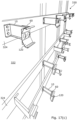
- FIG. 17(c) is a partial perspective side view 330 of the building substrate 320 of FIG. 17(b) which shows exemplary adaptor plate 60 and exemplary receiver 120 now secured to each of exemplary brackets 10 thereby forming a central section of a concealed fastening system of the present disclosure.
- the main plate of exemplary adaptor plate 60 is placed on the first plate of exemplary bracket 10.
- the main plate of exemplary adaptor plate 60 can also be placed and seated under a clip mechanism together with additional fasteners as desired to secure exemplary adaptor plate 60 to exemplary bracket 10.
- Exemplary receiver 120 has been secured to the secondary plate of adaptor plate 60 by fixings extending through holes in the base section of receiver 120.
- FIG. 17(d) is a partial perspective side view of the building substrate of FIG. 17(c) in which exemplary rail 100 positioned on the rear face 314 of building panels 300 has been placed in exemplary receiver 120.
- the building panel 300 is simply brought into alignment with the building substrate 320 and pushed into position so that the exemplary rail 100 is resiliently mounted within exemplary receiver 120 as disclosed above.
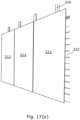
- FIG. 17(e) is a partial perspective front view of FIG. 17(d) showing building panels 300 installed using the concealed fastening system of the present disclosure.
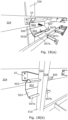
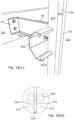
- FIG. 18(a) to 18(d) shows an alternate embodiment of an exemplary receiver 500 in position on an adaptor plate (not visible) and bracket 10 mounted to horizontal member 324 on building substrate 320.
- Exemplary receiver 500 has been designed to accommodate a support member 510.
- Support member 510 comprises a square faced beam structure comprising at least a front face 514 and side face 512.
- Support member 510 is used to provide additional support at a junction between adjacent building panels 300. Additional support member 510 can also be used to provide an aesthetic finish as disclosed further below.
- Exemplary receiver 500 is similar to that of first, second, third and fourth exemplary receivers 120, 120a, 130 and 140 comprising a base section 502 from which a first projection 503 and a second projection 505, wherein first projections 503 extend from each side of base section 502 and second projections 505 extend from the first projection 503 remote from base section 502.
- the end of each second projection 505 remote from first projection 505 is provided with a hook 507.
- First projection 503, second projection 505 and hook 507 have a central cut-away portion 503a, 507c forming a seating area for support member 510 as shown in FIG's 18(b) and 18(c).
- Cut-away portion 507c forms a first and second region 507a and 507b within second projection 505 and hook 507 which enables an installer to insert an exemplary rail of the present disclosure into exemplary receiver 500 such that the exemplary rail and panel can abut each side face 512 and front face 512 as shown in FIG. 18(c) , therein exemplary rail 100 positioned on the rear face of panel 300 has been inserted into second region 507b.
- FIG. 18(d) there is shown a joint aesthetic which is created using the exemplary receiver 500 (shown in dotted form to the rear of two adjacent panels).
- Rear face 314 of panel 300 is seated against the front face 514 of support member 510 such that side face 316 of panel 300 is slightly off centre and perpendicular to front face 514 of support member 510.
- the second panel is also positioned slightly off centre on the support member 510 such that a gap is formed between the first and second panel forming a joint aesthetic wherein the front face 514 of support member 510 forms the base of the joint aesthetic and the side faces 316 of the first and second panels 300 form the sides of the joint aesthetic as shown in FIG. 18(d) .
- One or more exemplary receivers 500 can be used to support the panels as needed along the length of the joint aesthetic as determined by the installer.
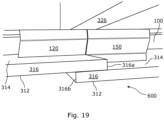
- FIG. 19 there is shown a further configuration 600 of two adjacent building panels 300 installed on a substrate using the concealed fastening system of the present disclosure such that the adjacent building panels 300 are installed in an overlapped configuration 600.
- Exemplary receivers 120 and 150 have both been secured to the rear face 314 of a panel 300 such that exemplary receiver 120 is located at the edge of rear face 314 adjacent first side face 316a and exemplary receiver 150 is secured slightly away from the edge of rear face 314 such that there is a space between exemplary receiver 150 and second side face 316b.
- receiver 150 is secured approximately 50mm +/- 0.5mm away from the edge of rear face 314.
- exemplary receiver 150 may be located at the edge of rear face 314 adjacent second side face 316b.
- the extended side sections 154, 156 of exemplary receiver 150 causes one side of panel 300 to project further than the opposing side of panel 300 to which exemplary receiver 120 is secured.
- the distance that exemplary receiver 150 projects further is equivalent to the approximate thickness of the building panel 300 such that the edge of one building panel 300 to which exemplary receiver 120 is secured can seat behind the edge of a second building panel 300 to which exemplary receiver 150 is secured forming an overlap is touching in the form of a shiplap joint as shown.
- exemplary receivers 120, 150 on first and second building panels 300 are collocated on exemplary rail 100 and first side face 316a abuts exemplary receiver 150.
- the distance that exemplary receiver 150 projects is greater than the approximate thickness of the building panel 300 such that the edge of one building panel 300 to which exemplary receiver 150 is secured is spaced apart from the edge of a second building panel 300 to which exemplary receiver 120 is secured forming an open-space lap joint.
- Each of the components of the concealed fastening system of the present disclosure may be formed from a range of materials including, but not limited to, metals such as steel or aluminium, or polymeric materials such as fibre reinforced polymer composites. It is preferable when using metals such as steel that the steel grades have mechanical properties which are equivalent to or exceed the requirements specified in EN 10346 2015 as associated with structural steel grades DX51, S220 and S450.
- the materials are formed into the desired configuration using known forming techniques such as but not limited to, for example, punching, rolling, pressing, forging or extrusion.
- the dimensions of the exemplary rails may change in accordance with the strength of the material used to form the component part for example if higher grade steel is used, greater loads can be carried by the concealed fastening system of the present disclosure. Consequently, either the size and/or frequency and/or positioning of the components of the concealed fastening system on a substrate/cladding element can be adjusted accordingly as determined by a person skilled in the art.
- the terms 'approximately', 'about', 'generally' and 'substantially' as used herein represent a value, amount, or characteristic close to the stated value, amount or characteristic that still performs a desired function or achieves a desired result.
- the terms 'approximately', 'about', 'generally' and 'substantially' may refer to an amount that is within less than or equal to 10% of, within less than or equal to 5% of, within less than or equal to 1% of, within less than or equal to 0.1% of, and within less than or equal to 0.01% of the stated amount.
Landscapes
- Engineering & Computer Science (AREA)
- Architecture (AREA)
- Civil Engineering (AREA)
- Structural Engineering (AREA)
- Connection Of Plates (AREA)
Priority Applications (4)
| Application Number | Priority Date | Filing Date | Title |
|---|---|---|---|
| EP23151501.6A EP4400670A1 (fr) | 2023-01-13 | 2023-01-13 | Système de fixation |
| AU2023285745A AU2023285745A1 (en) | 2023-01-13 | 2023-12-19 | A fastening system |
| CA3223813A CA3223813A1 (fr) | 2023-01-13 | 2023-12-19 | Systeme d~attache |
| US18/404,716 US20240240466A1 (en) | 2023-01-13 | 2024-01-04 | Fastening system |
Applications Claiming Priority (1)
| Application Number | Priority Date | Filing Date | Title |
|---|---|---|---|
| EP23151501.6A EP4400670A1 (fr) | 2023-01-13 | 2023-01-13 | Système de fixation |
Publications (1)
| Publication Number | Publication Date |
|---|---|
| EP4400670A1 true EP4400670A1 (fr) | 2024-07-17 |
Family
ID=84981290
Family Applications (1)
| Application Number | Title | Priority Date | Filing Date |
|---|---|---|---|
| EP23151501.6A Pending EP4400670A1 (fr) | 2023-01-13 | 2023-01-13 | Système de fixation |
Country Status (4)
| Country | Link |
|---|---|
| US (1) | US20240240466A1 (fr) |
| EP (1) | EP4400670A1 (fr) |
| AU (1) | AU2023285745A1 (fr) |
| CA (1) | CA3223813A1 (fr) |
Citations (5)
| Publication number | Priority date | Publication date | Assignee | Title |
|---|---|---|---|---|
| US3815309A (en) * | 1972-10-02 | 1974-06-11 | Specialties Const | Fastening system |
| DE9000858U1 (de) * | 1990-01-26 | 1990-04-05 | Wagner, Peter, Dipl.-Ing., 3303 Vechelde | Befestigungselement für Fassadenelemente, insbesondere Ziegel |
| WO2001038667A1 (fr) * | 1999-11-22 | 2001-05-31 | Ralph Essebier | Systeme pour fixer des lambris/panneaux sur un mur et un plafond |
| KR200235678Y1 (ko) * | 2001-03-14 | 2001-10-08 | 덕 수 강 | 석재 고정구 |
| WO2017042521A1 (fr) * | 2015-09-11 | 2017-03-16 | Stiplastics | Dispositif de maintien d'un élément de parement a distance d'une membrane pare-vapeur et système constructif a double armature comprenant un tel dispositif |
Family Cites Families (18)
| Publication number | Priority date | Publication date | Assignee | Title |
|---|---|---|---|---|
| US3144733A (en) * | 1961-12-26 | 1964-08-18 | United States Gypsum Co | Clip construction |
| US4408427A (en) * | 1980-10-03 | 1983-10-11 | Donn Incorporated | Framing system for demountable walls or the like |
| FR2522049A1 (fr) * | 1982-02-25 | 1983-08-26 | Guerin Gabriel | Dispositif de fixation d'un revetement en plaques de pierre reconstituee sur une structure murale |
| US5590502A (en) * | 1995-02-28 | 1997-01-07 | Usg Interiors, Inc. | Panel access clip for relocatable partitions |
| DE19908585A1 (de) * | 1999-02-27 | 2000-08-31 | Profil Vertrieb Gmbh | An einem Verankerungsgrund anbringbares Profil |
| JP4700455B2 (ja) * | 2005-09-21 | 2011-06-15 | ニチハ株式会社 | 留め付け金具及び外壁施工構造 |
| US8882065B2 (en) * | 2011-04-26 | 2014-11-11 | Kimball International, Inc. | Two piece track assembly |
| DE102013200211A1 (de) * | 2013-01-09 | 2014-07-10 | Hilti Aktiengesellschaft | Konsole |
| US20140196399A1 (en) * | 2013-01-14 | 2014-07-17 | II John David Egri | Expansion Bracket |
| US9206609B2 (en) * | 2013-05-02 | 2015-12-08 | Donald George White | Thermal break wall systems and thermal adjustable clip |
| WO2015150616A1 (fr) * | 2014-04-01 | 2015-10-08 | Control Y Desarrollo Empresarial, S.L. | Revêtement de surfaces et crampon pour ledit revêtement |
| CN105696754A (zh) * | 2014-12-10 | 2016-06-22 | 顺和系统有限公司 | 模块化装饰墙面板 |
| ES2586736B1 (es) * | 2015-04-15 | 2017-09-07 | Cupa Innovacion S.L.U. | Fachada ventilada |
| US9834941B1 (en) * | 2016-02-18 | 2017-12-05 | Henry H. Bilge | Thermal break system for wall panels secured to an existing wall |
| GB2593050B (en) * | 2021-02-23 | 2022-03-09 | Metalline Services Ltd | A multipart bracket and rainscreen cladding mount system including same |
| ES1286749Y (es) * | 2021-11-18 | 2022-05-09 | Sist Tecnicos Del Accesorio Y Componentes S L | Dispositivo de fijacion de fachadas ventiladas |
| US20240360677A1 (en) * | 2023-04-28 | 2024-10-31 | ECO Cladding | Façade cladding system and bracket therefor |
| US20250347121A1 (en) * | 2024-01-25 | 2025-11-13 | SFS Group International AG | Facade panel fastening system |
-
2023
- 2023-01-13 EP EP23151501.6A patent/EP4400670A1/fr active Pending
- 2023-12-19 CA CA3223813A patent/CA3223813A1/fr active Pending
- 2023-12-19 AU AU2023285745A patent/AU2023285745A1/en active Pending
-
2024
- 2024-01-04 US US18/404,716 patent/US20240240466A1/en active Pending
Patent Citations (5)
| Publication number | Priority date | Publication date | Assignee | Title |
|---|---|---|---|---|
| US3815309A (en) * | 1972-10-02 | 1974-06-11 | Specialties Const | Fastening system |
| DE9000858U1 (de) * | 1990-01-26 | 1990-04-05 | Wagner, Peter, Dipl.-Ing., 3303 Vechelde | Befestigungselement für Fassadenelemente, insbesondere Ziegel |
| WO2001038667A1 (fr) * | 1999-11-22 | 2001-05-31 | Ralph Essebier | Systeme pour fixer des lambris/panneaux sur un mur et un plafond |
| KR200235678Y1 (ko) * | 2001-03-14 | 2001-10-08 | 덕 수 강 | 석재 고정구 |
| WO2017042521A1 (fr) * | 2015-09-11 | 2017-03-16 | Stiplastics | Dispositif de maintien d'un élément de parement a distance d'une membrane pare-vapeur et système constructif a double armature comprenant un tel dispositif |
Also Published As
| Publication number | Publication date |
|---|---|
| CA3223813A1 (fr) | 2025-07-02 |
| US20240240466A1 (en) | 2024-07-18 |
| AU2023285745A1 (en) | 2024-08-01 |
Similar Documents
| Publication | Publication Date | Title |
|---|---|---|
| US10876299B2 (en) | Fastening system | |
| WO2008101320A1 (fr) | Appareil et méthode d'installation d'habillages sur des structure | |
| WO2016028500A1 (fr) | Système de plafond en treillis suspendu | |
| WO2014071450A1 (fr) | Ensemble de gainage | |
| AU2019283988A1 (en) | Multifunctional flashing device | |
| EP3631117B1 (fr) | Système de fixation de panneaux sur des facades de bâtiments | |
| EP1757751A1 (fr) | Structure extérieure de revêtement de mur d"isolation de revêtement de mur extérieur d"un immeuble et fourrure extérieure de son revêtement de mur, cadre de bande de fourrure latérale pour installer le matériau extérieur du revêtement de mur et p | |
| EP4400670A1 (fr) | Système de fixation | |
| RU2771308C2 (ru) | Подвесная система | |
| US7047702B1 (en) | Perimeter angle trim | |
| US20210164234A1 (en) | Clip for cast stone wall system | |
| EP1764455A2 (fr) | Système d'ancrage pour panneaux de revêtement et profilés, en particulier pour façades ventilées | |
| US20230183985A1 (en) | Building surface product including attachment structures, building surface system, and method of assembly | |
| US20240060310A1 (en) | A multipart bracket and rainscreen cladding mount system including same | |
| CZ2001800A3 (cs) | Připojovací profil pro stropní obklady | |
| US20230392384A1 (en) | Cladding installation system | |
| US20250172038A1 (en) | Architectural Panel Mounting Systems and Methods | |
| JP7777791B2 (ja) | パネル装置 | |
| EP3978699B1 (fr) | Système de cloison de séparation démontable | |
| JP7777788B2 (ja) | パネル設置構造 | |
| JP2019116785A (ja) | 天井パネル | |
| AU2023263540A1 (en) | Façade system | |
| WO2023087111A1 (fr) | Attache et système de parement mural pour parois de soutènement segmentaires | |
| IE20230197A1 (en) | A Cladding installation system | |
| WO2002095162A1 (fr) | Systeme de montage de briquettes |
Legal Events
| Date | Code | Title | Description |
|---|---|---|---|
| PUAI | Public reference made under article 153(3) epc to a published international application that has entered the european phase |
Free format text: ORIGINAL CODE: 0009012 |
|
| STAA | Information on the status of an ep patent application or granted ep patent |
Free format text: STATUS: THE APPLICATION HAS BEEN PUBLISHED |
|
| AK | Designated contracting states |
Kind code of ref document: A1 Designated state(s): AL AT BE BG CH CY CZ DE DK EE ES FI FR GB GR HR HU IE IS IT LI LT LU LV MC ME MK MT NL NO PL PT RO RS SE SI SK SM TR |
|
| STAA | Information on the status of an ep patent application or granted ep patent |
Free format text: STATUS: REQUEST FOR EXAMINATION WAS MADE |
|
| 17P | Request for examination filed |
Effective date: 20241218 |