EP4401018A2 - Verwaltung von betonmischdesignkatalogen - Google Patents
Verwaltung von betonmischdesignkatalogen Download PDFInfo
- Publication number
- EP4401018A2 EP4401018A2 EP24179633.3A EP24179633A EP4401018A2 EP 4401018 A2 EP4401018 A2 EP 4401018A2 EP 24179633 A EP24179633 A EP 24179633A EP 4401018 A2 EP4401018 A2 EP 4401018A2
- Authority
- EP
- European Patent Office
- Prior art keywords
- mix
- concrete
- slump
- designs
- design
- Prior art date
- Legal status (The legal status is an assumption and is not a legal conclusion. Google has not performed a legal analysis and makes no representation as to the accuracy of the status listed.)
- Pending
Links
Images



Classifications
-
- G—PHYSICS
- G06—COMPUTING OR CALCULATING; COUNTING
- G06Q—INFORMATION AND COMMUNICATION TECHNOLOGY [ICT] SPECIALLY ADAPTED FOR ADMINISTRATIVE, COMMERCIAL, FINANCIAL, MANAGERIAL OR SUPERVISORY PURPOSES; SYSTEMS OR METHODS SPECIALLY ADAPTED FOR ADMINISTRATIVE, COMMERCIAL, FINANCIAL, MANAGERIAL OR SUPERVISORY PURPOSES, NOT OTHERWISE PROVIDED FOR
- G06Q10/00—Administration; Management
- G06Q10/06—Resources, workflows, human or project management; Enterprise or organisation planning; Enterprise or organisation modelling
-
- G—PHYSICS
- G16—INFORMATION AND COMMUNICATION TECHNOLOGY [ICT] SPECIALLY ADAPTED FOR SPECIFIC APPLICATION FIELDS
- G16C—COMPUTATIONAL CHEMISTRY; CHEMOINFORMATICS; COMPUTATIONAL MATERIALS SCIENCE
- G16C20/00—Chemoinformatics, i.e. ICT specially adapted for the handling of physicochemical or structural data of chemical particles, elements, compounds or mixtures
- G16C20/70—Machine learning, data mining or chemometrics
-
- B—PERFORMING OPERATIONS; TRANSPORTING
- B28—WORKING CEMENT, CLAY, OR STONE
- B28C—PREPARING CLAY; PRODUCING MIXTURES CONTAINING CLAY OR CEMENTITIOUS MATERIAL, e.g. PLASTER
- B28C5/00—Apparatus or methods for producing mixtures of cement with other substances, e.g. slurries, mortars, porous or fibrous compositions
- B28C5/42—Apparatus specially adapted for being mounted on vehicles with provision for mixing during transport
- B28C5/4203—Details; Accessories
- B28C5/4206—Control apparatus; Drive systems, e.g. coupled to the vehicle drive-system
- B28C5/422—Controlling or measuring devices
-
- B—PERFORMING OPERATIONS; TRANSPORTING
- B28—WORKING CEMENT, CLAY, OR STONE
- B28C—PREPARING CLAY; PRODUCING MIXTURES CONTAINING CLAY OR CEMENTITIOUS MATERIAL, e.g. PLASTER
- B28C7/00—Controlling the operation of apparatus for producing mixtures of clay or cement with other substances; Supplying or proportioning the ingredients for mixing clay or cement with other substances; Discharging the mixture
- B28C7/02—Controlling the operation of the mixing
- B28C7/022—Controlling the operation of the mixing by measuring the consistency or composition of the mixture, e.g. with supply of a missing component
- B28C7/024—Controlling the operation of the mixing by measuring the consistency or composition of the mixture, e.g. with supply of a missing component by measuring properties of the mixture, e.g. moisture, electrical resistivity, density
-
- B—PERFORMING OPERATIONS; TRANSPORTING
- B28—WORKING CEMENT, CLAY, OR STONE
- B28C—PREPARING CLAY; PRODUCING MIXTURES CONTAINING CLAY OR CEMENTITIOUS MATERIAL, e.g. PLASTER
- B28C7/00—Controlling the operation of apparatus for producing mixtures of clay or cement with other substances; Supplying or proportioning the ingredients for mixing clay or cement with other substances; Discharging the mixture
- B28C7/02—Controlling the operation of the mixing
- B28C7/022—Controlling the operation of the mixing by measuring the consistency or composition of the mixture, e.g. with supply of a missing component
- B28C7/026—Controlling the operation of the mixing by measuring the consistency or composition of the mixture, e.g. with supply of a missing component by measuring data of the driving system, e.g. rotational speed, torque, consumed power
-
- G—PHYSICS
- G06—COMPUTING OR CALCULATING; COUNTING
- G06Q—INFORMATION AND COMMUNICATION TECHNOLOGY [ICT] SPECIALLY ADAPTED FOR ADMINISTRATIVE, COMMERCIAL, FINANCIAL, MANAGERIAL OR SUPERVISORY PURPOSES; SYSTEMS OR METHODS SPECIALLY ADAPTED FOR ADMINISTRATIVE, COMMERCIAL, FINANCIAL, MANAGERIAL OR SUPERVISORY PURPOSES, NOT OTHERWISE PROVIDED FOR
- G06Q50/00—Information and communication technology [ICT] specially adapted for implementation of business processes of specific business sectors, e.g. utilities or tourism
- G06Q50/08—Construction
-
- Y—GENERAL TAGGING OF NEW TECHNOLOGICAL DEVELOPMENTS; GENERAL TAGGING OF CROSS-SECTIONAL TECHNOLOGIES SPANNING OVER SEVERAL SECTIONS OF THE IPC; TECHNICAL SUBJECTS COVERED BY FORMER USPC CROSS-REFERENCE ART COLLECTIONS [XRACs] AND DIGESTS
- Y02—TECHNOLOGIES OR APPLICATIONS FOR MITIGATION OR ADAPTATION AGAINST CLIMATE CHANGE
- Y02P—CLIMATE CHANGE MITIGATION TECHNOLOGIES IN THE PRODUCTION OR PROCESSING OF GOODS
- Y02P90/00—Enabling technologies with a potential contribution to greenhouse gas [GHG] emissions mitigation
- Y02P90/80—Management or planning
- Y02P90/82—Energy audits or management systems therefor
Definitions
- the invention relates to the field of hydratable cementitious materials, and more particularly managing the mix design catalog of a concrete producer, based on identifying clusters of slump curve data obtained during in-transit concrete delivery monitoring of individual concrete loads made from various mix designs, and sorting each curve cluster based on selection factors as desired by the concrete producer.
- Concrete producers such as manufacturers of ready-mix or precast concrete, require different concrete mix designs to meet strength and slump targets for various customers and to address various applications (e.g., pavements, columns).
- the design of a concrete mix takes into consideration various factors including cement type, aggregate type and ratio, water-to-cement ratio (w/c), chemical admixture(s), air characteristics, placing methods, and numerous other factors.
- mix design catalog refers to the collection or accumulation of various concrete mix designs of a given concrete producer. Concrete producers rapidly accumulate concrete mix designs in their catalogs over time.
- Concrete producers collect concrete mix designs over time for numerous reasons. Such reasons include, as an example, different construction applications that require different aggregates, different aggregate blends, or different mix ratios (e.g., coarse to fine aggregate), different amounts of water depending on aggregate packages (See e.g., ACI 211-65), and different admixture components (e.g., air entrainers, corrosion inhibitors, plasticizers, etc.).
- mix ratios e.g., coarse to fine aggregate
- aggregate packages See e.g., ACI 211-65
- admixture components e.g., air entrainers, corrosion inhibitors, plasticizers, etc.
- a sales team or quality control department can generate new mix designs to satisfy individual customer requests. Putting new mix design codes on "new" mix designs might entail minor changes in the actual component mixture. This could result in negligible differences in terms of quality or performance between two different mix designs.
- the present invention facilitates the ability of a concrete producer to organize, to manage, and to select a mix design from within a highly populated concrete mix design catalog, and, ultimately, to reduce the number of mix designs required to be considered for meeting given project requirements, thus concentrating information per given mix design, eventually leading to less overdesign.
- the invention provides both a process and system that may be implemented, using monitoring devices and components that are commercially available in the concrete industry, in accordance with the teachings as shall be particularly described herein.
- An exemplary process of the invention for managing a plurality of mix designs within the mix design catalog of a concrete producer comprises: collecting slump curve data obtained during monitoring of individual concrete loads made from a plurality of various mix designs, wherein each mix design is identified by a different identification code regardless of whether the mix components are different or are identical; clustering (or collating) slump curve data having same movement characteristics into at least two slump curve data clusters; associating each mix design within the slump curve data cluster to an assigned strength value; and selecting a mix design to produce, to display, or both to produce and to display, from among the two or more individual mix designs within the same slump curve data cluster, the selection being based on same assigned strength value and on at least one selection factor chosen from cost, performance, physical aspect, quality, or combination thereof.
- An exemplary system of the invention for managing a plurality of mix designs within the mix design catalog of a concrete producer comprises: a plurality of concrete ready-mix delivery trucks each having a computer processor unit (CPU) communicative with a first sensor or sensors for measuring the energy associating with rotating a concrete mix load within a rotating mixer drum (e.g., such as a hydraulic pressure sensors, a strain or stress gauge type sensors, etc.) and communicative with a second sensor for measuring the rotational speed of the mixer drum (e.g., an accelerometer), wherein the CPUs are programed to store into CPU-accessible memory a plurality of slump data curves obtained during in-transit delivery monitoring of individual concrete loads made from a plurality of various mix designs (as identified by individual mix design number or identification code, regardless of whether its mix components are identical or different); and a computer processor unit which is programmed (the computer processor is chip, circuit, machine, hardware, etc., either on truck, remote location, e.g., so-called cloud-based system which
- the selection factor may be chosen from cost, performance, physical property or characteristic, or other considerations.
- selection factors can include (a) material cost of the mix design; (b) material cost of any of the mix components; (c) number of previous deliveries; (d) total volume delivered of a particular concrete mix design; (e) number of strength test results available; (f) submittal approval statuses; (g) source of materials used in the concrete mix; (h) a characteristic or property of an aggregate material used in the mix design; (i) a characteristic or property of hydration of cement used in the mix design; (j) a characteristic or property of packing density within the concrete mix; (k) a characteristic or property of the durability or reactive nature of the concrete mix; (I) a characteristic or property of the placement of the concrete mix; (m) chemical admixture used in the concrete mix; (n) air characteristic of the concrete; (o) diameter of hose or pipe used for conveying concrete from delivery truck, mixer, or pump to the actual placement site at the construction location
- the concrete producer may assign a strength value to a give concrete mix using any number of available methods.
- conservative estimates for the w/c can be used to achieve a given strength. For example, a 28 day strength of 6000 psi may be achieved with a w/c of 0.41 for a non-air entrained concrete mix, subject to an actual physically produced test mix made to ensure correct properties, such as slump and strength.
- standards such as ACI 318-14 to achieve a design strength (to satisfy the structural requirements of the concrete), one is forced to strive for higher strength averages.
- the mix design must be overdesigned to ensure that the design strength is met on a statistically acceptable basis.
- the design strength is designated, and for instances of this invention, can be one way to assign the strength criteria.
- Other factors may help to assign design strengths, for example, the producer might initially begin by using the standard w/c as an indication of strength value. More sophisticated strength methods exist. The producer might alternatively use the methods of Anderson et al. in US Patent No. 7,386,368 wherein strength, slump, and cost are estimated by using a "K factor" which involves consideration of the influence of a plant's materials on concrete strength, although the present inventors suspect this process could be overwhelming as material sources change over time.
- the present inventors unexpectedly found that mix designs could exist with vastly different mix constituents but that could surprisingly share the same rheology characteristics, and vice-versa, that mix designs with seemingly similar mix constituents could have different movement (e.g., slump) behavior.
- the present invention provides a process for managing highly populated mix design catalogs that have a high number of superfluous mix designs; and it affords a number of advantages, as described in the following paragraph.
- Quality control managers will be able to pare down from hundreds and possibly thousands of mix designs to perhaps twenty or thirty mix designs. This will facilitate quality control, allowing managers to focus on the variation of fewer mix designs, and perhaps to identify more quickly the causes of the variations. Fewer mix designs means that the concrete producer can spend more time per mix design, thus providing for greater volumes of information per mix design and hence accuracy in terms of slump monitoring as well as in strength testing; or, in other words, the producer can thus more rapidly obtain insight into how concrete mixes perform on a more statistically meaningful basis. This can result in avoidance of over-designing a mix (e.g., adding extra cement to ensure strength requirements are met), and allow the producer to optimize a mix design without, for example, spending money on extra cement.
- over-designing a mix e.g., adding extra cement to ensure strength requirements are met
- the invention also provides exemplary methods for generating new concrete mix designs based on information obtained from, such as interpolated from, existing an mix design catalog containing information of rheology and strength values, and actually or empirically derived based on existing mix designs.
- a process for creating a new concrete mix design comprising: collecting slump curve data obtained during monitoring of individual concrete loads made from a plurality of various concrete mix designs, wherein each concrete mix design corresponds to a different identification code regardless of whether the mix components are different or are identical; clustering slump curve data having same movement characteristics into at least two slump curve data clusters; associating each mix design within the slump curve data cluster to an assigned strength value; inputting a target strength and rheology; interpolating mix design components based on at least two existing mix designs wherein the strength and rheology targets are satisfied; and creating a new mix design to produce, to display, or both to produce and to display, based on the mix design components interpolated from the at least two existing mix designs.
- crete refers to a mixture of cement (which often contains supplementary cementitious materials such as limestone, fly ash, granulated blast furnace slag and other pozzolanic materials) and aggregates (e.g., fine aggregate such as sand, coarse aggregate such as gravel) and optionally one or more chemical admixtures (e.g., plasticizers for increasing workability, set accelerators, set retarders, air entrainers, air detrainers, plastic shrinkage reducing admixtures, corrosion inhibitors (for rebar) for modifying concrete in its plastic or hardened state.
- Concrete is considered to be hydratable material in that the addition of water into the mixture of cement and aggregates initiates a hardening reaction.
- cement includes hydratable cement such as Portland cement which is produced by pulverizing clinker consisting of hydraulic calcium silicates, aluminates and aluminoferrites, and one or more forms of calcium sulfate (e.g., gypsum) as an interground additive.
- Portland cement is combined with one or more supplemental cementitious materials, such as fly ash, granulated blast furnace slag, limestone, natural pozzolans, or mixtures thereof, and provided as a blend, all of which bind aggregates together to make concrete.
- aggregate means and refer to sand and stone particles, typically having average size of 0.5 to 50 mm. Aggregates may also comprise calciferous, siliceous or siliceous limestone minerals. Such aggregates may be of either the "natural” type (e.g., derived from glacial, alluvial, or marine deposits which are typically weathered such that the particles have smooth surfaces) or may be of the "manufactured” type, which are made using mechanical crushers or grinding devices. Coarse aggregate stone particles are typically grouped into various size fractions as described for instance in ASTM C33-16e.
- aggregate size is often a much considered factor in designing a concrete mix.
- aggregates can also mean and refer to lightweight aggregates, such as expanded shale, pumice, sintered fly ash or other low-density fillers.
- concrete mix design refers to the ingredients and proportions of ingredients used for making a given concrete having one or more desired properties, whether in a plastic state, hardened state, or both.
- a concrete mix is often designed based on various factors, such as, for example, cement type, aggregate type, w/c ratio, chemical admixture, air characteristic, and other factors or ingredients. These and various other “selection factors” will be further discussed hereinafter, once a general discussion of how various concrete mixes from a concrete producer's mix design catalog is monitored for slump curve data.
- mix design catalog refers generally to a collection, compilation, or repository of various mix designs within the control of a concrete producer and which is accessible by a computer-processor. This may refer to one or more electronic files or folders, including storage locations in the cloud or among various computer devices or computer-processor systems, under the control of and subject to access by the concrete producer.
- Mix designs are designated by a "mix code” or symbol which is an identifier for the particular proportions of ingredients.
- a set of identical proportions of ingredients may have different mix codes.
- a mix code within a given producer's collection of mix codes may refer to different proportions of ingredients. This case arises when the same basic mix design is used at different concrete plants owned or controlled by a single concrete producer. Because each individual concrete plant may source materials from different places (e.g. aggregates from different local quarries), the proportions of ingredients may vary slightly.
- the proportions of mix design components may be expressed as amounts of material per volume of concrete (e.g. 611 pounds of cement per cubic yard of concrete). The proportions may also be expressed as fractions or percentages (e.g. 3 ounces of a superplasticizer admixture per 100 pounds of cement).
- the concrete components are often described in terms of types: such as cement, supplementary cementitious materials, aggregates (fine, coarse, or both), water, and admixtures.
- the components may individually be characterized in terms of type or source.
- the mix design might indicate the particular type (e.g. cement ASTM Type I versus cement ASTM Type III, or ASTM C33 #57 stone versus ASTM C33 #7 stone), or source (e.g. coarse aggregate that is dug from a river bed versus coarse aggregate that is crushed from a quarry).
- type e.g. cement ASTM Type I versus cement ASTM Type III, or ASTM C33 #57 stone versus ASTM C33 #7 stone
- source e.g. coarse aggregate that is dug from a river bed versus coarse aggregate that is crushed from a quarry.
- Additional information may be included in the mix design, along with the proportions of ingredients, such as, for example, target performance values.
- target performance values may be a design strength (e.g. strength at 28 days), a target slump or slump range, a target air content or air range, a durability target or range (e.g. shrinkage, creep, etc.), etc.
- the term "assigned strength" refers to a strength value associated with a particular mix design.
- the concrete producer typically assigns a number corresponding to compressive strength value (usually in units of pounds per inch or PSI) such as obtained from empirical testing of cylinder samples made in accordance with standards such as ACI 211.1-91 and ACI 318-14.
- ACI 211.1-91 designates a design strength (i.e. strength to satisfy structural requirements)
- a required average strength is designated by ACI 318-14, where this value takes into account both the design strength and variability of the produced the mix design.
- the required average strength includes an overdesign from the design strength to ensure that the design strength is met on a statistically acceptable basis.
- the assigned strength value or number may be chosen to be the design strength or the required average strength.
- the concrete producer may assign a strength number based on w/c, cement content, packing fraction or other factors.
- slump curve data will refer to data required to predict slump or other rheological parameter such as yield stress, viscosity, thixotropy, etc., based on sensor readings monitoring mixing vessels such as a mixer drum on a concrete truck or stationary mixer in a precast concrete plant. Different applications may require different rheology considerations (e.g., lower viscosity for pumping through hoses). Examples of sensor readings include mixer drum rotation, energy required to rotate the drum, force on an internal probe within the mixer among others.
- the slump curve data allows prediction of the slump based on the movement of the concrete within the mixer, and hence provides a description of the movement of the concrete within the mixer.
- slump as used herein will refer to the property of concrete workability, such as determined using the conventional vertical drop measurement of concrete using a standard truncated cone (see e.g., ASTM C143-15a); but this could also include “slump flow” whereby workability is determined using horizontal spread measurement of concrete when released from cone (see e.g., ASTM C1611-14).
- slump characteristic may be used also to refer to either or both of these rheological properties and to emphasize that the present invention is not limited necessarily to either slump or slump flow measurements or monitoring, but can comprehend related rheology values such as yield stress as well.
- the term “slump” is used for sake of convenience herein in referring to concrete rheology and concrete management/monitoring systems.
- the "energy” (E) associated with rotating concrete within the mixer drum can be monitored using hydraulic pressures sensors whose output may be correlated with slump, slump flow, yield stress, viscosity, or other rheology value ( See e.g., US Patent 8,118,473 of Compton et al. , US Patent 8,020,431 of Cooley et al. , and US Patent 8,989,905 of Sostaric et al. , owned by Verifi LLC, a business unit of GCP Applied Technologies Inc. of Cambridge, Massachusetts, USA.
- US Patent 8,727,604 of Compton et al. also owned by Verifi, LLC
- sensors for monitoring hydraulic pressure associated with rotating the mixer drum could be used with rotational speed sensors to qualify a calculation of the current slump based on the hydraulic pressure required to rotate the mixer drum, such that an accurate history of slump behavior at various drum speeds could be recorded into computer-processor-accessible memory and used at a later time.
- such sensors are used on both the charge and discharge ports of the hydraulic system that controls the mixer drum motor.
- the energy associated with rotating the concrete in a mixer drum can also be monitored using force or stress probes within the concrete mixer drum.
- the force or stress of concrete on the probe is measured as the probe rotates through concrete during drum rotation and is correlated with slump of the concrete ( See e.g., US Patent Nos. 8,858,061 and 9,199,391 ).
- hydraulic pressure sensors, force or stress or strain gauges, and the like may be used in combination with rotational speed sensors (e.g., accelerometers as mentioned in US Patent 8,727,604 of Compton et al. ; US Pat. Publ. No. 2015/0142362 of Jordan et al. ; US Patent 9,199,391 of Beaupre et al. , and US Pat. Publ. No. 2015/0355160 of Berman , etc.) to provide output values that can be correlated with slump, slump flow, yield stress, viscosity, and/or other rheology values for monitoring or predicting the behavior or rheological state of a concrete mix in a rotatable mixer drum.
- rotational speed sensors e.g., accelerometers as mentioned in US Patent 8,727,604 of Compton et al. ; US Pat. Publ. No. 2015/0142362 of Jordan et al. ; US Patent 9,199,391 of Beaupre et al. , and
- the slump monitoring system may be based on use of a force sensor which is mounted within the drum, as taught for example in US Patent Nos. 8,848,061 and 9,625,891 of Berman (Sensocrete Inc., which is owned by GCP Applied Technologies Inc .), US Patent No. 9,199,391 of Denis Beaupre et al. (Command Alkon Inc .), or US Publication No. 2009/0171595 and WO 2007/060272 of Benegas .
- EVS energy/speed/slump
- EVS energy/speed/slump
- the inventors also like to consider the relationship between correlated energy (whether measured as a pressure, force, or stress reading) changes as the concrete mixer drum speed changes, such that the correlations between E, V, and S are not linear in nature. Accordingly, the present inventors have taken to describing the EVS relationship in terms of "slump curves" since a two-dimensional plot of energy (e.g., hydraulic pressure) associated with rotating the concrete at different drum speeds (V) appears as a curve or curvilinear shape rather than a straight line with respect to slump (or slump flow, viscosity, etc.).
- energy e.g., hydraulic pressure
- slump ladder process required the maker to adjust slump incrementally from one and nine inches or more through water or admixture additions; and to measure slump manually at each increment using the conventional slump cone method (e.g. ASTM C143-15a or ASTM C1611-14) to enable sensor data to be correlated with measured slump values.
- ASTM C143-15a or ASTM C1611-14 the conventional slump cone method
- the average drum speed and hydraulic pressures are recorded during a ladder test on each of three "step ups" in drum speed (as shown at times of 13:55, 14:00 and 14:02 in Fig. 1 ).
- a sample was removed from the drum, and pressure goes to "0".
- slump was adjusted as seen by the pressure dropping (at 14:10) so that the process of changing drum speed could be repeated to generate the slump curve data.
- Fig. 2 shows the results of multiple slump curves derived from multiple ladder testing.
- a slump of 4 inches at a constant drum rotation speed was seen to correspond with a range of hydraulic pressures from 1500 to 2000 pounds per inch (psi). This means that a reading of 1500 psi could correspond to a slump of 3.5 to 7 inches.
- psi pounds per inch
- Fig. 3 illustrates the exploding number of slump curves that were necessary, at one point, to be generated for a single concrete producer. Adding to this ladder testing complexity were several difficulties. One difficulty was the fact that the prescriptive grouping method tended to be inaccurate at higher drum speeds, since the effect of viscosity could be surprisingly different within a group of mix designs. This was particularly true at lower w/c and in higher-cement mixes, slump curve behavior would be more pronounced, thus requiring manual slump cone testing for certain mix designs in order for the monitoring system to be accurate. Lastly, the concrete producer's slump curve data was never updated; this became a problem as the component materials changed (without notice) and affected the performance of the concrete.
- drum speeds are constantly changing during delivery across a wide range of drum speeds, and that at multiple times the speed changes by more than 4 rpm (hence "jumps") in either direction (in mixing or discharge mode) and that the pressure or force corresponding to drum movement followed suit with those jumps. They also realized that this change took place in less than five seconds and that the actual slump of the concrete remained the same across those five seconds.
- one or two relationships between pressure and slump could be assumed to cover an entire concrete producer's mix designs.
- the second method involved one or two relationships between the slump and the slope and intercept from a drum rotation speed and pressure plot to cover the entire concrete producer's mix designs.
- Fig. 4 illustrates a typical concrete delivery from the "perspective" of pressure and drum speed sensors from which three jump speed data can be used for establishing slump curves that replace manually obtained slump ladders.
- the solid blue line (associated with the left vertical axis) illustrates the hydraulic pressure measurement while the dotted orange line (associated with the right vertical axis) illustrates the drum speed, both measured against time (horizontal axis).
- the truck drum speed jumps (at approximately 20:25) to perform high speed mixing (16-17 rpm). The drum speed then jumps back down and after which, the truck travels to the job site using in-transit drum speeds (2-4 rpm).
- slump curve data for different mix designs (i.e., having different mix codes) coincided or "clustered" about the same data curve shape or lines; the slump curve data is grouped based on performance (rheology), not a prescriptive measure (i.e. cement content, w/c, etc.).
- cluster or “clustered” or other variant thereof, as used in this document, means and refers to the act of collating or compiling mix designs (as identified by a mix code) having the same concrete movement behavior.
- the word cluster has both a passive and active sense. These clustered mix designs can then be sorted according to an assigned strength value.
- Fig. 5 graphically illustrates hydraulic pressure and slump relationships at one drum speed and at first appears to present four distinct curves
- Fig. 6 graphically illustrates that the data set, using different colors, corresponds in reality to six different concrete mix designs (i.e., mix designs having different codes and possibly different or similar or same recipes).
- the bottom-most curve is comprised of purple and green marks (x and o); the green line shown through this bottom curve represents the equation generated by that data. This means that the same equation or data curve can be used to predict slump for both mix designs. It also means that the concretes made from the two mix designs move in the same manner (i.e. performance based clustering versus prescriptive).
- the present inventors surprisingly discovered that two or more mix designs could have the same curve, and, hence, what they term a "cluster" of slump curve data that essentially appear as a single curve phenomenon. From the coincidence of the two mix designs illustrated in Fig. 6 , the present inventors realized that a clustering algorithm can be used that takes into account truck type and mix design to cluster mixes into a slump curve if the mix designs are determined to move in the same manner.
- the mathematical field of cluster analysis is a large and active field including over one-hundred published clustering algorithms. Thus, numerous mathematical methods can be employed to obtain slump curves that are similar to each other.
- centroid models such as the k-means algorithm
- distribution models such as the expectation-maximization algorithm
- density models such as the DBSCAN algorithm
- neural models such as the self-organizing map algorithm
- soft clustering models such as the fuzzy clustering models, which determines how objects belong to a cluster by their "degree" of fit.
- two slump curve data sets can be clustered if the resulting slump curve determined from each of the data sets predicts slump values sufficiently close to each other (e.g. the predictions are within 1 ⁇ 2 inch from each other).
- the present invention is predicated upon the ability to "cluster" slump curve data, i.e., when two or more (and preferably a plurality) of concrete mix designs are found to move similarly, or, in other words, to possess the same energy (e.g., pressure) / speed / slump relationship.
- the two individual mix designs i.e., having different mix codes
- clusters along the same curve.
- a mix design catalog containing 1000 mix codes can be reduced by cluster analysis to 20 characteristic slump data curves.
- many designs that do not have the same components or recipe can share the same slump curve and hence can be found within the same cluster of curve data points (e.g., as may be visually appreciated when the data is displayed on a graph).
- volume of slump curve data generated for the particular mix design, and hence the volume of strength test results (e.g., cylinder test, cube test); and this would provide a greater amount of quality control or accuracy in the slump curve predictions, for example, that could be made by the monitoring system processor unit.
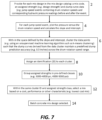
- Fig. 7 is a flow chart showing an exemplary process of the present invention.
- a mix design catalog (or a portion, e.g. all residential mixes), is provided that comprises mix designs with a mix code; assigned strengths (e.g. design strengths as determined using ACI 211.4-91 and ACI 318-14); and slump curve data.
- the slump curve data can be any data used to predict the rheology (i.e. slump) based on the movement detected in the rotating concrete mixer drum.
- the slump curve data can comprise jump speed events that include the drum rotation speed and corresponding hydraulic pressure readings before and after the event.
- the slump curve data is prepared for the clustering analysis.
- each jump speed event can be plotted on an x-y plot where the drum rotation speed is plotted on the x-axis and the hydraulic pressure is plotted on the y-axis.
- a line can be drawn through the two points (representing the drum rotation speed and pressure before and after the jump speed), and the slope and intercept can be calculated.
- a clustering algorithm can be used to determine clusters within the space.
- the clustering algorithm can be based upon any of a number of different clustering methods.
- an unsupervised machine learning algorithm can be used, such as a k-means algorithm (see e.g. Hartigan, J. A.; Wong, M. A. (1979). "Algorithm AS 136: A K-Means Clustering Algorithm”. Journal of the Royal Statistical Society. Series C (Applied Statistics).
- slump curve relationships can be created for each cluster, and subsequently, the prediction accuracy of each slump curve relationship can be determined. If the accuracy is not sufficient (above a pre-defined accuracy, e.g. 90% of the prediction are with 0.5 inches of the actual slump), the cluster analysis may be refined, for example, to have more finely-divided clusters).
- the jump speed events can be plotted on an x-y-z plot where, for example, the drum rotation speed is plotted on the x-axis, the hydraulic pressure is plotted on the y-axis and the slump is plotted on the z-axis.
- Cluster analysis can then be performed in this "EVS" space to determine slump curve data clusters.
- an identification code or nametag can be assigned to the cluster to facilitate subsequent grouping.
- the assigned strengths are grouped into pre-defined classes, for example, strengths between 3001 and 4000 psi are put into one class; strengths between 4001 and 5000 psi are put into another class. More preferably, smaller subdivisions can be used, and from a practical perspective, the classes are assigned by the minimum of the range, not the average. This imparts a conservative outlook on the data.
- a mix design can be chosen within the same slump curve cluster ID and assigned strength class, based on a cost, performance or other characteristic, for example lowest cost.
- This process can be achieved in several different ways. First, using a fixed selection characteristic (or group of selection characteristics), all mix design groups with the same slump curve cluster and strength class can be reduced to the minimal number of mix designs that still include the given selection characteristic. For example, within the same slump curve cluster and strength class, only the lowest cost mix may be retained for selection to batch, when a mix design requiring the given slump curve cluster rheology and strength class is needed. As another example, the mixes with the highest volume of deliveries may be kept for both an air-entrained version and a non-air-entrained version.
- the mix designs that are not retained in these two examples can, for example, be excluded from further consideration, archived, or deleted from the mix design catalog.
- the associated data can be merged with the retained mix design(s). Regardless of the fate of the non-retained mix designs, the retained mix designs, with their future use will accumulate quality control data in order to all better control.
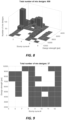
- Fig. 8 is a two-dimensional histogram in which 608 concrete mix designs (i.e., 608 different codes) were monitored.
- 608 concrete mix designs i.e., 608 different codes
- Nine different slump curves were discerned among these mix designs for various assigned strength values in the range of 4000 to 12000 psi.
- the tallest peak, indicating over 100 different mix designs (codes) can be readily seen for slump curve #1 at assigned strength of 7000 psi, and this visually represents a very data-dense slump curve.
- Fig. 9 is a two-dimensional representation of the histogram of Fig. 7 , which indicates that 608 concrete mix designs represent in actuality only 37 different slump curve - strength groups.
- new mixes can be tailored to a given application with much higher confidence.
- lab tests are performed to validate a design.
- this method may not represent the actual performance as mixing in a small lab mixer does not represent actual mixing experienced in a mixer truck.
- mix designs with precise strength and rheology characteristics (beyond a simple slump value) can be developed.
- the amount of associated data garners realistic validation compared to lab tests. Such data can be extremely useful as supporting data for submittals for a given job.
- the present invention provides a process for managing a plurality of mix designs within the mix design catalog of a concrete producer, comprising: collecting slump curve data obtained during monitoring of individual concrete loads made from a plurality of various mix designs, wherein each mix design is identified by a different identification code regardless of whether the mix components are different or are identical; clustering slump curve data having same movement characteristics into at least two slump curve data clusters; associating each mix design within the slump curve data cluster to an assigned strength value; and selecting a mix design to produce, to display, or both to produce and to display, from among the two or more individual mix designs within the same slump curve data cluster, the selection being based on same assigned strength value and on at least one selection factor chosen from cost, performance, physical aspect, quality, or combination thereof.
- the invention provides a process wherein, in selecting the mix design, the at least one selection factor is chosen from (a) material cost of the mix design; (b) material cost of any of the mix components; (c) number of previous deliveries; (d) total volume delivered of a particular concrete mix design; (e) number of strength test results available; (f) submittal approval statuses; (g) source of materials used in the concrete mix; (h) a characteristic or property of an aggregate material used in the mix design (e.g., mineralogical nature of the aggregate, shape or size of aggregate such as maximum particle size, pacing fraction, etc.); (i) a characteristic or property of hydration of cement used in the mix design (e.g., w/c, initial set time, final set time, etc.); (j) a characteristic or property of packing density within the concrete mix; (k) a characteristic or property of the durability or reactive nature of the concrete mix (e.g., chloride permeability
- the invention provides a process wherein the cluster comprises slump curve data sets associated with different mix designs whereby the slump predictions from the slump prediction relationships derived from each individual slump curve data are within a pre-defined tolerance (e.g. +/- 0.5 inch slump).
- a pre-defined tolerance e.g. +/- 0.5 inch slump
- the invention provides a process wherein, in collecting slump curve data obtained during monitoring of individual concrete loads made from a plurality of various mix designs, the slump curve data are derived from jump speed data wherein slump, drum rotation speed, and force associated with rotating the concrete mix in a rotating mixer drum are obtained before and after jumps in drum speed, wherein the jump in drum speed is at least three (and more preferably at least four) drum revolutions per minute difference.
- the jump in drum speed is at least three (and more preferably at least four) drum revolutions per minute difference.
- slump curve data can be defined in terms of force (e.g., hydraulic pressure sensor readings) as a function of drum speed (e.g., rotations per minute at a first drum speed and at a second drum speed which was suddenly changed by at least 3 or 4 RPM compared to the first drum speed).
- force e.g., hydraulic pressure sensor readings
- drum speed e.g., rotations per minute at a first drum speed and at a second drum speed which was suddenly changed by at least 3 or 4 RPM compared to the first drum speed.
- the data comprising the y-intercepts i.e., the pressure value when speed is extrapolated to zero
- slope of the pressure values at the two drum speed values
- cluster analysis to discern mix designs having common rheological behavior (such as may be suggested by a cloud of dots plotted on a graph which suggest a common trend or singular common grouping - or, in other words, where the dots appear to coincide).
- the invention provides a process wherein, in collecting slump curve data obtained during monitoring of individual concrete loads made from a plurality of various mix designs, the slump data curves are established using sensors for measuring force associated with rotating concrete mixes in a rotating mixer drum, said force sensors being chosen from hydraulic pressure sensor, stress or strain gauge device located within the rotating mixer drum, or both.
- the invention provides a process wherein, in collecting slump curve data obtained during monitoring of individual concrete loads made from a plurality of various mix designs, the slump data curves are established using hydraulic pressure sensors comprising a first sensor for measuring hydraulic pressure when the mixer drum is rotating in the charge direction, and a second sensor for measuring hydraulic pressure when the mixer drum is rotating in the discharge direction.
- the invention provides a process wherein, in collecting slump curve data obtained during monitoring of individual concrete loads made from a plurality of various mix designs, the slump data curves are established using a stress or strain gauge device located inside the mixer drum.
- the invention provides a process wherein, in collecting slump curve data obtained during in-transit delivery monitoring of individual concrete loads made from a plurality of various mix designs, the slump data curves are established using a drum speed sensor that comprises an accelerometer, a gyroscope, or combination thereof.
- the invention provides a process wherein, in the step of clustering curve data having same movement characteristics according to assigned strength value, at least two (more preferably at least three, and most preferably at least ten) different mix designs (which are identified as different by having different codes but have the same mix components) are used to make concrete mix loads from which slump curve data is obtained to define the same slump curve and hence define a slump curve data cluster.
- the invention provides a process wherein the assigned strength values are based on physical strength, modulus of elasticity, water content, cement content, maturity testing, or combination thereof.
- the invention provides a process wherein, in collecting slump curve data obtained during in-transit delivery monitoring of individual concrete loads made from a plurality of various mix designs, slump curve data establish at least three (and more preferably at least five) different slump curve data clusters; and are correlated with at least three (and, more preferably, at least five) assigned strength values.
- the invention provides a process wherein a concrete mix design is selected from a cluster of slump curve data for an assigned strength (e.g., value or number) by operation of computer processor, and a concrete mix is generated.
- the computer processor has been programmed to select the concrete mix design and to instruct that a concrete mix be made (e.g., by sending signal to the batching computer at the batch plant) according to the selected mix design.
- the computer processor is programmed to initiate this function without further inputs from a human operator or manager.
- the invention provides a process wherein a histogram (See e.g., Fig. 8 ) or chart (See e.g., Fig. 9 ) is generated to depict graphically, on a monitor screen or other visual display, the slump curve data clusters for each assigned strength value.
- a histogram See e.g., Fig. 8
- chart See e.g., Fig. 9
- the invention provides a process wherein the histogram or chart displayed on a monitor screen is a GUI (graphical user interface) allowing a user to click to view a list of mix codes for a given cluster of slump curve data.
- GUI graphical user interface
- the invention provides a process wherein, after selecting a mix design to produce, to display, or both to produce and to display, from among the two or more individual mix designs within the same slump curve data cluster, at least one mix design is removed from the same slump curve data cluster.
- the selection factors identified within the second exemplary aspect discussed above may be used for inactivating or removing from the producer's catalog those mix designs which exceed a given cost threshold, which employ a given cement or aggregate material, or which meet any other selection criteria based on the selection factors.
- the invention provides system for managing a plurality of mix designs within the mix design catalog of a concrete producer, comprising: a plurality of concrete ready-mix delivery trucks each having a computer processor unit (CPU) communicative with a first sensor or sensors for measuring the energy associating with rotating a concrete mix load within a rotating mixer drum (e.g., such as a hydraulic pressure sensors, a strain or stress gauge type sensors, etc.) and communicative with a second sensor for measuring the rotational speed of the mixer drum (e.g., an accelerometer), wherein the CPUs are programed to store into CPU-accessible memory a plurality of slump curve data obtained during in-transit delivery monitoring of individual concrete loads made from a plurality of various mix designs (as identified by individual mix design number or identification code, regardless of whether its mix components are identical or different); and a computer processor unit which is programmed (the computer processor is chip, circuit, machine, hardware, etc., either on truck, remote location, e.g., so-
- the computer processor is chip,
- the invention provides a system wherein, in selecting the mix design, the at least one selection factor is chosen from (a) material cost of the mix design; (b) material cost of any of the mix components; (c) number of previous deliveries; (d) total volume delivered of a particular concrete mix design; (e) number of strength test results available; (f) submittal approval statuses; (g) source of materials used in the concrete mix; (h) a characteristic or property of an aggregate material used in the mix design (e.g., mineralogical nature of the aggregate, shape or size of aggregate such as maximum particle size, pacing fraction, etc.); (i) a characteristic or property of hydration of cement used in the mix design (e.g., w/c, initial set time, final set time, etc.); (j) a characteristic or property of packing density within the concrete mix; (k) a characteristic or property of the durability or reactive nature of the concrete mix (e.g.
- a process for creating a new concrete mix design comprising: collecting slump curve data obtained during monitoring of individual concrete loads made from a plurality of various concrete mix designs, wherein each concrete mix design corresponds to a different identification code regardless of whether the mix components are different or are identical;clustering slump curve data having same movement characteristics into at least two slump curve data clusters; associating each mix design within the slump curve data cluster to an assigned strength value; inputting a target strength and rheology; interpolating mix design components based on at least two existing mix designs wherein the strength and rheology targets are satisfied; and creating a new mix design to produce, to display, or both to produce and to display, based on the mix design components interpolated from the at least two existing mix designs.
- This eighteenth example embodiment may be based upon, or incorporate any of the feature described above with respect to the first through seventeenth example embodiments.
- the present inventors considered the mix design catalog of an actual concrete producer which contained 608 mix designs (as identified by 608 different mix codes). This was actually a subset of the entire mix catalog because it was limited to a given region, which used the same aggregate source.
- the mix designs were filtered to include only coarse aggregates having a nominal size of one inch. This filtering process can occur, alternatively, after applying the inventive steps of Fig. 7 , when choosing at least one mix to represent a given strength and rheology characteristic.
- the histogram in Fig. 8 shows the numerous mix designs with the same properties.
- the histogram indicates that mix designs in the strength and rheology "buckets" or groupings shown in Fig. 9 constitute 37 in total, and this represents a reduction of 96% in terms of the previous total number of mix designs in the collection.
- the same reduced set of mix designs in the first example can be used to determine a new mix design with a given set of criteria such as a strength class and a rheology class.
- a concrete producer may want to supply a mix design with a slump curve and design strength in the space indicated by the bucket or square designated as "x" in Fig. 10 . Because no mix design currently exists (for certain combinations of strength and rheology classes), the producer will need to design a new mix.
- the producer may draw upon production data corresponding to adjacent buckets, such as using values interpolated based on adjacent buckets.
- an interpolation can be made by averaging mix proportions belonging to buckets 1a and 1b. Accordingly, a new mix for "x" can be designed.
- Further exemplary methods of the invention may include averaging of other adjacent mix designs, such as averaging bucket values of buckets of, e.g., 2a + 2b; 3a + 3b; 4a + 4b, or combinations thereof.
- the values interpolated for a given bucket "x" can involve values from adjacent spaces in the existing mix design catalog, such as from buckets that may be horizontally, vertically, or diagonally adjacent (in the two dimensional chart representation provided in Fig. 10 ).
- a major advantage of this exemplary method is that actual production data is used to create the new mix design as opposed to lab tests that may not reflect what will actually be produced.
- the invention provides an exemplary process for creating a new concrete mix design, comprising: collecting slump curve data obtained during monitoring of individual concrete loads made from a plurality of various concrete mix designs, wherein each concrete mix design corresponds to a different identification code regardless of whether the mix components are different or are identical; clustering slump curve data having same movement characteristics into at least two slump curve data clusters; associating each mix design within the slump curve data cluster to an assigned strength value; inputting a target strength and rheology; interpolating mix design components based on at least two existing mix designs wherein the strength and rheology targets are satisfied; and creating a new mix design to produce, to display, or both to produce and to display, based on the mix design components interpolated from the at least two existing mix designs.
Landscapes
- Engineering & Computer Science (AREA)
- Chemical & Material Sciences (AREA)
- Dispersion Chemistry (AREA)
- Business, Economics & Management (AREA)
- Theoretical Computer Science (AREA)
- Structural Engineering (AREA)
- Mechanical Engineering (AREA)
- Economics (AREA)
- Entrepreneurship & Innovation (AREA)
- Human Resources & Organizations (AREA)
- Strategic Management (AREA)
- Crystallography & Structural Chemistry (AREA)
- Medical Informatics (AREA)
- Computing Systems (AREA)
- Bioinformatics & Computational Biology (AREA)
- Bioinformatics & Cheminformatics (AREA)
- Life Sciences & Earth Sciences (AREA)
- Health & Medical Sciences (AREA)
- Artificial Intelligence (AREA)
- Computer Vision & Pattern Recognition (AREA)
- Data Mining & Analysis (AREA)
- Databases & Information Systems (AREA)
- Evolutionary Computation (AREA)
- General Health & Medical Sciences (AREA)
- Software Systems (AREA)
- Tourism & Hospitality (AREA)
- Operations Research (AREA)
- Marketing (AREA)
- Quality & Reliability (AREA)
- General Physics & Mathematics (AREA)
- General Business, Economics & Management (AREA)
- Physics & Mathematics (AREA)
- Game Theory and Decision Science (AREA)
- Educational Administration (AREA)
- Development Economics (AREA)
- Preparation Of Clay, And Manufacture Of Mixtures Containing Clay Or Cement (AREA)
Applications Claiming Priority (3)
| Application Number | Priority Date | Filing Date | Title |
|---|---|---|---|
| US201762609421P | 2017-12-22 | 2017-12-22 | |
| EP18891934.4A EP3727774B1 (de) | 2017-12-22 | 2018-12-11 | Verwaltung von betonmischdesignkatalogen |
| PCT/US2018/064822 WO2019125813A1 (en) | 2017-12-22 | 2018-12-11 | Managing concrete mix design catalogs |
Related Parent Applications (2)
| Application Number | Title | Priority Date | Filing Date |
|---|---|---|---|
| EP18891934.4A Division EP3727774B1 (de) | 2017-12-22 | 2018-12-11 | Verwaltung von betonmischdesignkatalogen |
| EP18891934.4A Division-Into EP3727774B1 (de) | 2017-12-22 | 2018-12-11 | Verwaltung von betonmischdesignkatalogen |
Publications (2)
| Publication Number | Publication Date |
|---|---|
| EP4401018A2 true EP4401018A2 (de) | 2024-07-17 |
| EP4401018A3 EP4401018A3 (de) | 2024-10-16 |
Family
ID=66992816
Family Applications (2)
| Application Number | Title | Priority Date | Filing Date |
|---|---|---|---|
| EP18891934.4A Active EP3727774B1 (de) | 2017-12-22 | 2018-12-11 | Verwaltung von betonmischdesignkatalogen |
| EP24179633.3A Pending EP4401018A3 (de) | 2017-12-22 | 2018-12-11 | Verwaltung von betonmischdesignkatalogen |
Family Applications Before (1)
| Application Number | Title | Priority Date | Filing Date |
|---|---|---|---|
| EP18891934.4A Active EP3727774B1 (de) | 2017-12-22 | 2018-12-11 | Verwaltung von betonmischdesignkatalogen |
Country Status (9)
| Country | Link |
|---|---|
| US (1) | US11594305B2 (de) |
| EP (2) | EP3727774B1 (de) |
| AU (1) | AU2018388777B2 (de) |
| CA (1) | CA3086587A1 (de) |
| ES (1) | ES2988728T3 (de) |
| MX (2) | MX2020006627A (de) |
| PL (1) | PL3727774T3 (de) |
| SG (1) | SG11202005816TA (de) |
| WO (1) | WO2019125813A1 (de) |
Families Citing this family (17)
| Publication number | Priority date | Publication date | Assignee | Title |
|---|---|---|---|---|
| MX2019009916A (es) * | 2017-02-21 | 2019-12-05 | Verifi Llc | Reducir al minimo la variacion debido a las sondas de humedad en el agregado para la construccion. |
| AU2020221924A1 (en) * | 2019-02-11 | 2021-08-26 | Construction Research & Technology Gmbh | Systems and methods for formulating or evaluating a construction admixture |
| WO2020231728A1 (en) * | 2019-05-10 | 2020-11-19 | Gcp Applied Technologies Inc. | Instrument for direct measurement of air content in a liquid using a resonant electroacoustic transducer |
| WO2021021983A1 (en) * | 2019-08-01 | 2021-02-04 | Gcp Applied Technologies Inc. | Rotated concrete volume determination |
| CA3148983A1 (en) * | 2019-08-01 | 2021-02-04 | Nathan A. Tregger | Coordinating concrete delivery and placement |
| CN111798931B (zh) * | 2020-06-17 | 2024-12-17 | 中国铁道科学研究院集团有限公司铁道建筑研究所 | 一种基于形变控制的机制砂石骨料预应力混凝土配合比设计方法 |
| CN111724869B (zh) * | 2020-06-17 | 2024-12-17 | 中国铁道科学研究院集团有限公司铁道建筑研究所 | 一种基于收缩控制的机制砂石骨料现浇混凝土配合比设计方法 |
| US12049024B2 (en) * | 2021-01-27 | 2024-07-30 | X Development Llc | Concrete preparation and recipe optimization |
| US11312039B1 (en) * | 2021-05-06 | 2022-04-26 | Command Alkon Incorporated | System and method for monitoring fresh concrete being handled in a concrete mixer using trained data processing engines |
| CN113848705B (zh) * | 2021-09-02 | 2023-05-30 | 上海建工集团股份有限公司 | 一种混凝土拌合物工作性信息化智能调控方法 |
| AU2022491309A1 (en) | 2022-12-22 | 2025-05-15 | Sika Technology Ag | Method to set desired properties of curable binder compositions |
| US12587274B2 (en) | 2023-03-28 | 2026-03-24 | Quantum Generative Materials Llc | Satellite optimization management system based on natural language input and artificial intelligence |
| EP4574801A1 (de) | 2023-12-22 | 2025-06-25 | Sika Technology AG | Systeme und verfahren zur bestimmung von konstruktionszusammensetzungen und der zugehörigen umweltbelastung |
| US12627372B2 (en) | 2023-12-27 | 2026-05-12 | Quantum Generative Materials Llc | Advanced mission control predictive systems for low earth orbit semi-autonomous satellites |
| US12603701B2 (en) | 2023-12-27 | 2026-04-14 | Quantum Generative Materials Llc | Distributed satellite constellation management and control system |
| US12368503B2 (en) | 2023-12-27 | 2025-07-22 | Quantum Generative Materials Llc | Intent-based satellite transmit management based on preexisting historical location and machine learning |
| CN119108046A (zh) * | 2024-08-14 | 2024-12-10 | 三峡大学 | 水工大体积混凝土配合比智能优化设计方法及系统 |
Citations (19)
| Publication number | Priority date | Publication date | Assignee | Title |
|---|---|---|---|---|
| WO2007060272A2 (es) | 2005-11-28 | 2007-05-31 | Eugenio Bonilla Benegas | Sistema automático de monitorización del amasado de conglomerados |
| US7386368B2 (en) | 2005-06-17 | 2008-06-10 | Icrete, Llc | Methods and systems for manufacturing optimized concrete |
| US8020431B2 (en) | 2007-06-19 | 2011-09-20 | Verifi, LLC | Method and system for calculating and reporting slump in delivery vehicles |
| US8118473B2 (en) | 2004-02-13 | 2012-02-21 | Verifi, LLC | System for calculating and reporting slump in delivery vehicles |
| US8311678B2 (en) | 2010-06-23 | 2012-11-13 | Verifi Llc | Method for adjusting concrete rheology based upon nominal dose-response profile |
| US8491717B2 (en) | 2011-12-12 | 2013-07-23 | Verifi Llc | Multivariate management of entrained air and rheology in cementitious mixes |
| US8818561B2 (en) | 2009-03-27 | 2014-08-26 | Verifi Llc | Slump flow monitoring |
| US8848061B2 (en) | 2012-06-27 | 2014-09-30 | Apple Inc. | Image and video quality assessment |
| US8858061B2 (en) | 2008-05-28 | 2014-10-14 | Dully Katzeff-Berman | Concrete slump measurement and control system |
| US8989905B2 (en) | 2007-06-19 | 2015-03-24 | Verifi Llc | Method and system for calculating and reporting slump in delivery vehicles |
| WO2015073825A1 (en) | 2013-11-15 | 2015-05-21 | Verifi Llc | Gyroscopic rotational monitoring system |
| WO2015160610A1 (en) | 2014-04-14 | 2015-10-22 | Verifi Llc | Dynamic segregation monitoring of concrete |
| US9199391B2 (en) | 2009-10-07 | 2015-12-01 | I.B.B. Rheologie Inc. | Probe and method for obtaining rheological property value |
| US20150355160A1 (en) | 2013-01-11 | 2015-12-10 | Dully Katzeff-Berman | Concrete mixture measurement sensor, system and method |
| US9466803B1 (en) | 2015-08-28 | 2016-10-11 | Duk San Neolux Co., Ltd. | Compound for organic electric element, organic electric element comprising the same and electronic device thereof |
| WO2017009711A1 (en) | 2015-07-13 | 2017-01-19 | Enzymotec Ltd. | Phospholipid preparations for the improvement of sleep |
| US9550312B2 (en) | 2012-10-15 | 2017-01-24 | Verifi Llc | Treating and reporting volume of concrete in delivery vehicle mixing drum |
| WO2017099771A1 (en) | 2015-12-10 | 2017-06-15 | Intel Corporation | Enclosure to recharge smart-charging clothing |
| WO2017099711A1 (en) | 2015-12-07 | 2017-06-15 | Verifi Llc | Wide speed range concrete monitoring calibration |
Family Cites Families (48)
| Publication number | Priority date | Publication date | Assignee | Title |
|---|---|---|---|---|
| GB1182590A (en) | 1966-02-21 | 1970-02-25 | Fred Gresty | Measurement and adjustment of the consistency of flowable concrete |
| JPS5112045B2 (de) | 1973-07-12 | 1976-04-15 | ||
| GB2144240B (en) | 1983-05-18 | 1986-10-01 | Ready Mixed Concrete | A system for controlling the mixing of concrete in a rotatable mixing drum |
| CA2037511A1 (en) * | 1991-03-04 | 1992-09-05 | Daniel Assh | System for control of the condition of mixed concrete |
| US5527387A (en) | 1992-08-11 | 1996-06-18 | E. Khashoggi Industries | Computer implemented processes for microstructurally engineering cementious mixtures |
| DE4237543C2 (de) | 1992-11-06 | 1999-01-21 | Kilian Gottfried Dipl Wirtsch | Verfahren zum Einstellen des Wassergehaltes und der Konsistenz von Mörtel bzw. Beton |
| DE4437970A1 (de) | 1994-10-24 | 1996-05-02 | Siemens Ag | Verfahren und Einrichtung zur Vorhersage der Konsistenz von Transportbeton |
| AUPN296495A0 (en) | 1995-05-15 | 1995-06-08 | Boral Resources (Vic) Pty Limited | Concrete mixing |
| FR2751911B1 (fr) | 1996-07-31 | 2000-06-16 | Mbt Holding Ag | Systeme de controle et de distribution pour malaxeur a beton et procede d'utilisation |
| US5895116A (en) | 1997-08-25 | 1999-04-20 | W.R. Grace & Co. -Conn. | Mobile admixture product manufacturing and delivery process and system |
| GB2329027B (en) | 1997-09-02 | 2001-12-19 | Tarmac Uk Ltd | Method of checking the slump of a ready-mix concrete load |
| US6227039B1 (en) * | 1998-01-06 | 2001-05-08 | Moshe Te'eni | System and method for controlling concrete production |
| US20020048212A1 (en) | 1999-08-25 | 2002-04-25 | Hill Russell L. | Concrete mix design systems and methods |
| JP4360451B2 (ja) | 1999-09-29 | 2009-11-11 | 東亜建設工業株式会社 | トラックミキサ車1台分のコンクリートのスランプ値自動表示方法 |
| US6611755B1 (en) | 1999-12-19 | 2003-08-26 | Trimble Navigation Ltd. | Vehicle tracking, communication and fleet management system |
| US6441054B1 (en) | 2000-03-02 | 2002-08-27 | W.R. Grace & Co.-Conn | Air management in cementitious mixtures having plasticizer and a clay-activity modifying agent |
| US6687559B2 (en) | 2000-04-04 | 2004-02-03 | Digital Site Systems, Inc. | Apparatus and method for a vertically integrated construction business |
| US6484079B2 (en) | 2000-04-28 | 2002-11-19 | Rmc Industries Corporation | Methods and systems for remotely monitoring sensor data in delivery vehicles |
| US20020015354A1 (en) | 2000-04-28 | 2002-02-07 | Rmc Industries Corporation | Methods and systems for remotely monitoring sensor data in delivery vehicles |
| GB2392502B (en) | 2002-08-31 | 2007-02-21 | Hymix Ltd | Monitoring a concrete mixer |
| GB2432675A (en) | 2002-08-31 | 2007-05-30 | Hymix Ltd | Monitoring system for a concrete mixing vehicle |
| FI125375B (fi) | 2003-12-31 | 2015-09-15 | Consolis Technology Oy Ab | Menetelmä ja laitteisto betonimassan valmistamiseksi |
| US7900228B2 (en) | 2004-04-30 | 2011-03-01 | Vulcan Inc. | Maintaining a graphical user interface state that is based on a selected piece of content |
| US20070192257A1 (en) | 2004-08-20 | 2007-08-16 | Amey Stephen L | Method of supplying admixture formulations for concrete |
| US20060039233A1 (en) | 2004-08-20 | 2006-02-23 | Construction Research & Technology Gmbh | Admixture dispensing method |
| US20070266905A1 (en) | 2004-08-20 | 2007-11-22 | Amey Stephen L | Admixture dispensing system and method |
| WO2007009097A1 (en) | 2005-07-13 | 2007-01-18 | Cidra Corporation | Method and apparatus for measuring parameters of a fluid flow using an array of sensors |
| US9518870B2 (en) | 2007-06-19 | 2016-12-13 | Verifi Llc | Wireless temperature sensor for concrete delivery vehicle |
| PA8770701A1 (es) | 2007-12-20 | 2009-07-23 | Icrete Llc | Composiciones de hormigon con alta funcionalidad y con minimo de exudacion y segregacion |
| US8764272B2 (en) | 2008-04-07 | 2014-07-01 | W. R. Grace & Co., -Conn. | Method for monitoring thixotropy in concrete mixing drum |
| MY157427A (en) | 2009-03-27 | 2016-06-15 | Verifi Llc | Mixer waveform analysis for monitoring and controlling concrete |
| US20110004332A1 (en) | 2009-07-01 | 2011-01-06 | Icrete International, Inc. | Method of designing a concrete compositions having desired slump with minimal water and plasticizer |
| US8557070B2 (en) * | 2009-09-14 | 2013-10-15 | Joel A. Stanley | Method of mounting objects to polymeric membranes |
| US9789629B2 (en) * | 2010-06-23 | 2017-10-17 | Verifi Llc | Method for adjusting concrete rheology based upon nominal dose-response profile |
| US8058377B1 (en) | 2010-06-24 | 2011-11-15 | W. R. Grace & Co.-Conn. | Phosphate-containing polycarboxylate polymer dispersants |
| US20130019235A1 (en) | 2011-07-11 | 2013-01-17 | Salesforce.Com, Inc. | Mechanism for facilitating management of metadata and metada-based update of software |
| US10088454B2 (en) | 2011-10-18 | 2018-10-02 | Cidra Corporate Services, Inc. | Speed of sound and/or density measurement using acoustic impedance |
| JP6105603B2 (ja) | 2011-10-18 | 2017-03-29 | シドラ コーポレイト サービシズ インコーポレイティド | 生コンクリート中のリアルタイム空気測定を提供するための方法および装置 |
| AU2013331622C1 (en) | 2012-10-15 | 2017-05-11 | Verifi Llc | Sneak water detection for concrete delivery vehicles |
| US9533429B2 (en) * | 2013-02-27 | 2017-01-03 | Command Alkon, Inc. | System and process for mixing concrete having desired strength characteristics |
| US9194855B2 (en) * | 2014-02-28 | 2015-11-24 | Quipip, Llc | Systems, methods and apparatus for providing to a driver of a vehicle carrying a mixture real-time information relating to a characteristic of the mixture |
| EP3172021A4 (de) | 2014-07-24 | 2018-04-04 | GCP Applied Technologies Inc. | Überwachung von selbstreinigender betonmischung |
| US10329202B2 (en) * | 2015-06-04 | 2019-06-25 | Verifi Llc | Post-batching CMA dosing into concrete |
| US10744676B2 (en) * | 2015-09-18 | 2020-08-18 | Schwing America, Inc. | Concrete mixer and controls therefor for controlling drum rotation |
| CA3047063C (en) * | 2016-12-22 | 2021-07-06 | Command Alkon Incorporated | Methods and systems for handling fresh concrete |
| CN115008610B (zh) | 2017-08-11 | 2024-08-06 | Gcp应用技术有限公司 | 灰水测量 |
| US12049024B2 (en) * | 2021-01-27 | 2024-07-30 | X Development Llc | Concrete preparation and recipe optimization |
| US11312039B1 (en) * | 2021-05-06 | 2022-04-26 | Command Alkon Incorporated | System and method for monitoring fresh concrete being handled in a concrete mixer using trained data processing engines |
-
2018
- 2018-12-11 CA CA3086587A patent/CA3086587A1/en active Pending
- 2018-12-11 ES ES18891934T patent/ES2988728T3/es active Active
- 2018-12-11 US US16/956,704 patent/US11594305B2/en active Active
- 2018-12-11 WO PCT/US2018/064822 patent/WO2019125813A1/en not_active Ceased
- 2018-12-11 EP EP18891934.4A patent/EP3727774B1/de active Active
- 2018-12-11 MX MX2020006627A patent/MX2020006627A/es unknown
- 2018-12-11 SG SG11202005816TA patent/SG11202005816TA/en unknown
- 2018-12-11 EP EP24179633.3A patent/EP4401018A3/de active Pending
- 2018-12-11 AU AU2018388777A patent/AU2018388777B2/en active Active
- 2018-12-11 PL PL18891934.4T patent/PL3727774T3/pl unknown
-
2020
- 2020-07-13 MX MX2025000999A patent/MX2025000999A/es unknown
Patent Citations (25)
| Publication number | Priority date | Publication date | Assignee | Title |
|---|---|---|---|---|
| US8727604B2 (en) | 2004-02-13 | 2014-05-20 | Verifi Llc | Method and system for calculating and reporting slump in delivery vehicles |
| US8118473B2 (en) | 2004-02-13 | 2012-02-21 | Verifi, LLC | System for calculating and reporting slump in delivery vehicles |
| US7386368B2 (en) | 2005-06-17 | 2008-06-10 | Icrete, Llc | Methods and systems for manufacturing optimized concrete |
| WO2007060272A2 (es) | 2005-11-28 | 2007-05-31 | Eugenio Bonilla Benegas | Sistema automático de monitorización del amasado de conglomerados |
| US20090171595A1 (en) | 2005-11-28 | 2009-07-02 | Eugenio Bonilla Benegas | Automatic System for Monitoring the Mixing of Conglomerates |
| US8020431B2 (en) | 2007-06-19 | 2011-09-20 | Verifi, LLC | Method and system for calculating and reporting slump in delivery vehicles |
| US8989905B2 (en) | 2007-06-19 | 2015-03-24 | Verifi Llc | Method and system for calculating and reporting slump in delivery vehicles |
| US8746954B2 (en) | 2007-06-19 | 2014-06-10 | Verifi Llc | Method and system for calculating and reporting slump in delivery vehicles |
| US9625891B2 (en) | 2008-05-28 | 2017-04-18 | GCP Applied Technologies, Inc. | Concrete slump measurement and control system |
| US8858061B2 (en) | 2008-05-28 | 2014-10-14 | Dully Katzeff-Berman | Concrete slump measurement and control system |
| US8818561B2 (en) | 2009-03-27 | 2014-08-26 | Verifi Llc | Slump flow monitoring |
| US9199391B2 (en) | 2009-10-07 | 2015-12-01 | I.B.B. Rheologie Inc. | Probe and method for obtaining rheological property value |
| US8311678B2 (en) | 2010-06-23 | 2012-11-13 | Verifi Llc | Method for adjusting concrete rheology based upon nominal dose-response profile |
| US8491717B2 (en) | 2011-12-12 | 2013-07-23 | Verifi Llc | Multivariate management of entrained air and rheology in cementitious mixes |
| US8764273B2 (en) | 2011-12-12 | 2014-07-01 | W. R. Grace & Co.-Conn. | Multivariate management of entrained air and rheology in cementitious mixes |
| US8848061B2 (en) | 2012-06-27 | 2014-09-30 | Apple Inc. | Image and video quality assessment |
| US9550312B2 (en) | 2012-10-15 | 2017-01-24 | Verifi Llc | Treating and reporting volume of concrete in delivery vehicle mixing drum |
| US20150355160A1 (en) | 2013-01-11 | 2015-12-10 | Dully Katzeff-Berman | Concrete mixture measurement sensor, system and method |
| WO2015073825A1 (en) | 2013-11-15 | 2015-05-21 | Verifi Llc | Gyroscopic rotational monitoring system |
| US20150142362A1 (en) | 2013-11-15 | 2015-05-21 | Verifi Llc | Determination of Gyroscopic Based Rotation |
| WO2015160610A1 (en) | 2014-04-14 | 2015-10-22 | Verifi Llc | Dynamic segregation monitoring of concrete |
| WO2017009711A1 (en) | 2015-07-13 | 2017-01-19 | Enzymotec Ltd. | Phospholipid preparations for the improvement of sleep |
| US9466803B1 (en) | 2015-08-28 | 2016-10-11 | Duk San Neolux Co., Ltd. | Compound for organic electric element, organic electric element comprising the same and electronic device thereof |
| WO2017099711A1 (en) | 2015-12-07 | 2017-06-15 | Verifi Llc | Wide speed range concrete monitoring calibration |
| WO2017099771A1 (en) | 2015-12-10 | 2017-06-15 | Intel Corporation | Enclosure to recharge smart-charging clothing |
Non-Patent Citations (1)
| Title |
|---|
| HARTIGAN, J. A.WONG, M. A.: "Algorithm AS 136: A K-Means Clustering Algorithm", JOURNAL OF THE ROYAL STATISTICAL SOCIETY. SERIES C (APPLIED STATISTICS, vol. 28, no. 1, 1979, pages 100 - 108, XP009120262, DOI: 10.2307/2346830 |
Also Published As
| Publication number | Publication date |
|---|---|
| SG11202005816TA (en) | 2020-07-29 |
| CA3086587A1 (en) | 2019-06-27 |
| US11594305B2 (en) | 2023-02-28 |
| ES2988728T3 (es) | 2024-11-21 |
| MX2020006627A (es) | 2020-09-14 |
| AU2018388777A1 (en) | 2020-07-09 |
| BR112020012749A2 (pt) | 2020-12-01 |
| EP4401018A3 (de) | 2024-10-16 |
| WO2019125813A1 (en) | 2019-06-27 |
| US20200402619A1 (en) | 2020-12-24 |
| EP3727774A1 (de) | 2020-10-28 |
| EP3727774B1 (de) | 2024-07-24 |
| EP3727774A4 (de) | 2021-08-11 |
| MX2025000999A (es) | 2025-03-07 |
| PL3727774T3 (pl) | 2024-12-16 |
| AU2018388777B2 (en) | 2024-05-02 |
Similar Documents
| Publication | Publication Date | Title |
|---|---|---|
| US11594305B2 (en) | Managing concrete mix design catalogs | |
| Aliha et al. | Geometry and size effects on fracture trajectory in a limestone rock under mixed mode loading | |
| JP7748850B2 (ja) | コンクリートの品質予測方法 | |
| US6546793B2 (en) | Method for manufacturing concrete | |
| US12528749B2 (en) | Adjusting concrete mixes and mix designs using diagnostic delta data curve | |
| Barry et al. | Manufactured crushed sand: packing fraction prediction and influence on mortar rheology | |
| Mohamad et al. | A consistency check of concrete compressive strength using pearson’s correlation coefficient | |
| Mertens et al. | Quantitative composition of ancient mortars from the Notre Dame Cathedral in Tournai (Belgium) | |
| Adam | Preliminary presentation of the Upper Palaeolithic and Mesolithic stone industries of Theopetra cave, Western Thessaly | |
| BR112020012749B1 (pt) | Processo e sistema para gerenciar uma pluralidade de projetos de mistura em um catálogo de projeto de mistura de um produtor de concreto, e processo para criar um novo projeto de mistura de concreto | |
| Ioannides et al. | Effect of Larger Sized Coarse Aggregates and of Microsilica on Environmental Properties of Portland Cement Concrete Pavements and Structures; Volume 1 of 2 | |
| CN117789866A (zh) | 一种用于混凝土工作性能的评估方法及系统 | |
| Dewar | Concrete mix design | |
| Stroeven et al. | Assessment of particle packing characteristics at interfaces by SPACE system | |
| Olanrewaju et al. | Estimating ready mixed concrete on-site dispatch time using concrete slump and volume: case study of a construction site in Nigeria | |
| Latham et al. | Abrasion testing and armourstone degradation | |
| Meier et al. | Industrial X-ray diffraction analysis of building materials | |
| Kasperkiewicz | A review of concrete mix design methods | |
| DiCocco | Quality Assurance for Portland Cement Concrete | |
| Domínguez et al. | Influence of mixing time on fresh and hardened cast-in-place Concrete | |
| Erdogan et al. | Prediction of elastic properties of concrete using the virtual cement and concrete testing laboratory | |
| Tennis et al. | User and producer perspectives on ASTM C 1157 | |
| Czarnecka et al. | The effect of orientation on the analysis of shape and texture of concrete aggregates by the modified Fourier method | |
| Salako et al. | Optimisation of Concrete Reinforced with Recycled Polypropylene Fibre from Cement Bags and Fly Ash using Scheffe Method | |
| Choi et al. | Properties of Recycled Aggregates and Related Specifications |
Legal Events
| Date | Code | Title | Description |
|---|---|---|---|
| PUAI | Public reference made under article 153(3) epc to a published international application that has entered the european phase |
Free format text: ORIGINAL CODE: 0009012 |
|
| STAA | Information on the status of an ep patent application or granted ep patent |
Free format text: STATUS: THE APPLICATION HAS BEEN PUBLISHED |
|
| AC | Divisional application: reference to earlier application |
Ref document number: 3727774 Country of ref document: EP Kind code of ref document: P |
|
| AK | Designated contracting states |
Kind code of ref document: A2 Designated state(s): AL AT BE BG CH CY CZ DE DK EE ES FI FR GB GR HR HU IE IS IT LI LT LU LV MC MK MT NL NO PL PT RO RS SE SI SK SM TR |
|
| REG | Reference to a national code |
Ref country code: DE Ref legal event code: R079 Free format text: PREVIOUS MAIN CLASS: G06Q0010060000 Ipc: B28C0005420000 |
|
| PUAL | Search report despatched |
Free format text: ORIGINAL CODE: 0009013 |
|
| AK | Designated contracting states |
Kind code of ref document: A3 Designated state(s): AL AT BE BG CH CY CZ DE DK EE ES FI FR GB GR HR HU IE IS IT LI LT LU LV MC MK MT NL NO PL PT RO RS SE SI SK SM TR |
|
| RIC1 | Information provided on ipc code assigned before grant |
Ipc: G06Q 10/06 20230101ALI20240906BHEP Ipc: G05B 1/11 20060101ALI20240906BHEP Ipc: B28C 5/42 20060101AFI20240906BHEP |
|
| STAA | Information on the status of an ep patent application or granted ep patent |
Free format text: STATUS: REQUEST FOR EXAMINATION WAS MADE |
|
| 17P | Request for examination filed |
Effective date: 20241122 |
|
| RBV | Designated contracting states (corrected) |
Designated state(s): AL AT BE BG CH CY CZ DE DK EE ES FI FR GB GR HR HU IE IS IT LI LT LU LV MC MK MT NL NO PL PT RO RS SE SI SK SM TR |
|
| STAA | Information on the status of an ep patent application or granted ep patent |
Free format text: STATUS: EXAMINATION IS IN PROGRESS |
|
| 17Q | First examination report despatched |
Effective date: 20250502 |