EP4401143A2 - Bildsensor und elektronische vorrichtung mit dem bildsensor - Google Patents
Bildsensor und elektronische vorrichtung mit dem bildsensor Download PDFInfo
- Publication number
- EP4401143A2 EP4401143A2 EP24151310.0A EP24151310A EP4401143A2 EP 4401143 A2 EP4401143 A2 EP 4401143A2 EP 24151310 A EP24151310 A EP 24151310A EP 4401143 A2 EP4401143 A2 EP 4401143A2
- Authority
- EP
- European Patent Office
- Prior art keywords
- pixel
- nanoposts
- image sensor
- pixel correspondence
- light
- Prior art date
- Legal status (The legal status is an assumption and is not a legal conclusion. Google has not performed a legal analysis and makes no representation as to the accuracy of the status listed.)
- Pending
Links
Images








Classifications
-
- H—ELECTRICITY
- H10—SEMICONDUCTOR DEVICES; ELECTRIC SOLID-STATE DEVICES NOT OTHERWISE PROVIDED FOR
- H10F—INORGANIC SEMICONDUCTOR DEVICES SENSITIVE TO INFRARED RADIATION, LIGHT, ELECTROMAGNETIC RADIATION OF SHORTER WAVELENGTH OR CORPUSCULAR RADIATION
- H10F39/00—Integrated devices, or assemblies of multiple devices, comprising at least one element covered by group H10F30/00, e.g. radiation detectors comprising photodiode arrays
- H10F39/80—Constructional details of image sensors
- H10F39/806—Optical elements or arrangements associated with the image sensors
- H10F39/8063—Microlenses
-
- H—ELECTRICITY
- H10—SEMICONDUCTOR DEVICES; ELECTRIC SOLID-STATE DEVICES NOT OTHERWISE PROVIDED FOR
- H10F—INORGANIC SEMICONDUCTOR DEVICES SENSITIVE TO INFRARED RADIATION, LIGHT, ELECTROMAGNETIC RADIATION OF SHORTER WAVELENGTH OR CORPUSCULAR RADIATION
- H10F39/00—Integrated devices, or assemblies of multiple devices, comprising at least one element covered by group H10F30/00, e.g. radiation detectors comprising photodiode arrays
- H10F39/80—Constructional details of image sensors
- H10F39/806—Optical elements or arrangements associated with the image sensors
-
- H—ELECTRICITY
- H04—ELECTRIC COMMUNICATION TECHNIQUE
- H04N—PICTORIAL COMMUNICATION, e.g. TELEVISION
- H04N25/00—Circuitry of solid-state image sensors [SSIS]; Control thereof
- H04N25/10—Circuitry of solid-state image sensors [SSIS]; Control thereof for transforming different wavelengths into image signals
- H04N25/11—Arrangement of colour filter arrays [CFA]; Filter mosaics
- H04N25/13—Arrangement of colour filter arrays [CFA]; Filter mosaics characterised by the spectral characteristics of the filter elements
-
- H—ELECTRICITY
- H10—SEMICONDUCTOR DEVICES; ELECTRIC SOLID-STATE DEVICES NOT OTHERWISE PROVIDED FOR
- H10F—INORGANIC SEMICONDUCTOR DEVICES SENSITIVE TO INFRARED RADIATION, LIGHT, ELECTROMAGNETIC RADIATION OF SHORTER WAVELENGTH OR CORPUSCULAR RADIATION
- H10F39/00—Integrated devices, or assemblies of multiple devices, comprising at least one element covered by group H10F30/00, e.g. radiation detectors comprising photodiode arrays
- H10F39/10—Integrated devices
- H10F39/12—Image sensors
- H10F39/15—Charge-coupled device [CCD] image sensors
- H10F39/151—Geometry or disposition of pixel elements, address lines or gate electrodes
-
- H—ELECTRICITY
- H10—SEMICONDUCTOR DEVICES; ELECTRIC SOLID-STATE DEVICES NOT OTHERWISE PROVIDED FOR
- H10F—INORGANIC SEMICONDUCTOR DEVICES SENSITIVE TO INFRARED RADIATION, LIGHT, ELECTROMAGNETIC RADIATION OF SHORTER WAVELENGTH OR CORPUSCULAR RADIATION
- H10F39/00—Integrated devices, or assemblies of multiple devices, comprising at least one element covered by group H10F30/00, e.g. radiation detectors comprising photodiode arrays
- H10F39/10—Integrated devices
- H10F39/12—Image sensors
- H10F39/18—Complementary metal-oxide-semiconductor [CMOS] image sensors; Photodiode array image sensors
-
- H—ELECTRICITY
- H10—SEMICONDUCTOR DEVICES; ELECTRIC SOLID-STATE DEVICES NOT OTHERWISE PROVIDED FOR
- H10F—INORGANIC SEMICONDUCTOR DEVICES SENSITIVE TO INFRARED RADIATION, LIGHT, ELECTROMAGNETIC RADIATION OF SHORTER WAVELENGTH OR CORPUSCULAR RADIATION
- H10F39/00—Integrated devices, or assemblies of multiple devices, comprising at least one element covered by group H10F30/00, e.g. radiation detectors comprising photodiode arrays
- H10F39/10—Integrated devices
- H10F39/12—Image sensors
- H10F39/18—Complementary metal-oxide-semiconductor [CMOS] image sensors; Photodiode array image sensors
- H10F39/182—Colour image sensors
-
- H—ELECTRICITY
- H10—SEMICONDUCTOR DEVICES; ELECTRIC SOLID-STATE DEVICES NOT OTHERWISE PROVIDED FOR
- H10F—INORGANIC SEMICONDUCTOR DEVICES SENSITIVE TO INFRARED RADIATION, LIGHT, ELECTROMAGNETIC RADIATION OF SHORTER WAVELENGTH OR CORPUSCULAR RADIATION
- H10F39/00—Integrated devices, or assemblies of multiple devices, comprising at least one element covered by group H10F30/00, e.g. radiation detectors comprising photodiode arrays
- H10F39/80—Constructional details of image sensors
-
- H—ELECTRICITY
- H10—SEMICONDUCTOR DEVICES; ELECTRIC SOLID-STATE DEVICES NOT OTHERWISE PROVIDED FOR
- H10F—INORGANIC SEMICONDUCTOR DEVICES SENSITIVE TO INFRARED RADIATION, LIGHT, ELECTROMAGNETIC RADIATION OF SHORTER WAVELENGTH OR CORPUSCULAR RADIATION
- H10F39/00—Integrated devices, or assemblies of multiple devices, comprising at least one element covered by group H10F30/00, e.g. radiation detectors comprising photodiode arrays
- H10F39/80—Constructional details of image sensors
- H10F39/802—Geometry or disposition of elements in pixels, e.g. address-lines or gate electrodes
-
- H—ELECTRICITY
- H10—SEMICONDUCTOR DEVICES; ELECTRIC SOLID-STATE DEVICES NOT OTHERWISE PROVIDED FOR
- H10F—INORGANIC SEMICONDUCTOR DEVICES SENSITIVE TO INFRARED RADIATION, LIGHT, ELECTROMAGNETIC RADIATION OF SHORTER WAVELENGTH OR CORPUSCULAR RADIATION
- H10F39/00—Integrated devices, or assemblies of multiple devices, comprising at least one element covered by group H10F30/00, e.g. radiation detectors comprising photodiode arrays
- H10F39/80—Constructional details of image sensors
- H10F39/803—Pixels having integrated switching, control, storage or amplification elements
-
- H—ELECTRICITY
- H10—SEMICONDUCTOR DEVICES; ELECTRIC SOLID-STATE DEVICES NOT OTHERWISE PROVIDED FOR
- H10F—INORGANIC SEMICONDUCTOR DEVICES SENSITIVE TO INFRARED RADIATION, LIGHT, ELECTROMAGNETIC RADIATION OF SHORTER WAVELENGTH OR CORPUSCULAR RADIATION
- H10F39/00—Integrated devices, or assemblies of multiple devices, comprising at least one element covered by group H10F30/00, e.g. radiation detectors comprising photodiode arrays
- H10F39/80—Constructional details of image sensors
- H10F39/805—Coatings
-
- H—ELECTRICITY
- H10—SEMICONDUCTOR DEVICES; ELECTRIC SOLID-STATE DEVICES NOT OTHERWISE PROVIDED FOR
- H10F—INORGANIC SEMICONDUCTOR DEVICES SENSITIVE TO INFRARED RADIATION, LIGHT, ELECTROMAGNETIC RADIATION OF SHORTER WAVELENGTH OR CORPUSCULAR RADIATION
- H10F39/00—Integrated devices, or assemblies of multiple devices, comprising at least one element covered by group H10F30/00, e.g. radiation detectors comprising photodiode arrays
- H10F39/80—Constructional details of image sensors
- H10F39/805—Coatings
- H10F39/8053—Colour filters
Definitions
- the disclosure relates to an image sensor and an electronic apparatus including the same.
- Image sensors generally sense the color of incident light by using a color filter.
- a color filter may have low light utilization efficiency because the color filter absorbs light of colors other than the intended color of light. For example, in the case of using a red-green-blue (RGB) color filter, only one third of the incident light passes through while the remaining two-third of the incident light is absorbed. Thus, the light utilization efficiency is only about 33%. Most light loss in an image sensor occurs in a color filter. Accordingly, various attempts have been made to find alternative methods of separating colors by using each pixel in an image sensor without using a color filter.
- RGB red-green-blue
- One or more example embodiments provide an image sensor including a color separation lens array capable of separating incident light according to wavelengths and effectively condensing the separated light.
- an image sensor may include: a sensor substrate including a first pixel and a fourth pixel each configured to detect green light, a second pixel configured to detect blue light, and a third pixel configured to detect red light; and a color separation lens array configured to separate incident light according to wavelengths and condense the incident light onto the first to fourth pixels.
- the color separation lens array may include first, second, third, and fourth pixel correspondence regions (i.e. first to fourth pixel regions) respectively facing the first to fourth pixels, the first to fourth pixel correspondence regions respectively including a plurality of first, second, third, and fourth nanoposts that are arranged in different arrangement patterns in the first to fourth pixel correspondence regions.
- Ratios of inner areas that are formed by connecting centers of outermost nanoposts to areas of the first to third pixel correspondence regions, in cross-sections of the first to third pixel correspondence regions, are first, second, and third occupancy rates, respectively.
- Each of the first to third occupancy rates is equal to or greater than 45 %.
- the third occupancy rate is equal to or greater than the first occupancy rate, and the first occupancy rate is equal to or greater than the second occupancy rate.
- Each of the first to fourth pixels may include a 2x2 array of four photosensitive cells.
- a second central nanopost having a largest cross-sectional width is disposed to overlap a center point of the second pixel correspondence region.
- a third central nanopost having a largest cross-sectional width is disposed to not overlap a center point of the third pixel correspondence region.
- a width of the second central nanopost may be equal to or greater than a width of the third central nanopost.
- a first central nanopost having a largest cross-sectional width among the plurality of first nanoposts may be disposed so as to not overlap a center point of the first pixel correspondence region.
- a ratio of a sum of areas of the cross-sections of the first to fourth nanoposts to a sum of areas of the first to fourth pixel correspondence regions may be equal to or greater than 13 %.
- Each of the first occupancy rate, the second occupancy rate, and the third occupancy rate may be equal to or less than 75 %.
- the third occupancy rate may be equal to or greater than 60 %.
- the plurality of third nanoposts include third nanoposts having three or more different cross-sectional sizes.
- the third nanoposts having the three or more different cross-sectional sizes are arranged such that cross-sectional sizes thereof remain same or become smaller as a distance from a center of the third pixel correspondence region increases.
- the plurality of first nanoposts include three or more types of first nanoposts having different cross-sectional sizes.
- the three or more types of first nanoposts are arranged such that cross-sectional sizes thereof remain same or become smaller as a distance from a horizontal line passing through a center of the first pixel correspondence region, increases.
- the three or more types of first nanoposts are arranged such that cross-sectional sizes thereof remain same or become smaller as a distance from a vertical line passing through the center of the first pixel correspondence region and perpendicular to the horizontal line, increases.
- An arrangement pattern of the plurality of fourth nanoposts of the fourth pixel correspondence region is 90 degrees rotationally symmetrical with an arrangement pattern of the plurality of first nanoposts of the first pixel correspondence region.
- the plurality of second nanoposts include second nanoposts having three or more different cross-sectional sizes.
- the second nanoposts having three or more different cross-sectional sizes are arranged such that cross-sectional sizes thereof remain same or become smaller as a distance from a center of the second pixel correspondence region increases.
- the number of the plurality of third nanoposts may be equal to or greater than the number of the plurality of second nanoposts.
- Each of the plurality of first to fourth nanoposts may be stacked and arranged in a plurality of layers.
- a distance between the sensor substrate and the color separation lens array may be equal to or smaller than twice a pixel pitch of the sensor substrate.
- the image sensor may further include a filter layer disposed between the sensor substrate and the color separation lens array, a distance between the sensor substrate and the filter layer may be equal to or smaller than a pixel pitch of the sensor substrate.
- an electronic apparatus may include: a lens assembly configured to focus light; an image sensor configured to convert the light into an electrical signal; and a processor configured to process the electrical signal to generate an image.
- the image sensor may include: a sensor substrate including a first pixel and a fourth pixel each configured to detect green light, a second pixel configured to detect blue light, and a third pixel configured to detect red light; and a color separation lens array configured to separate incident light according to wavelengths and condense the incident light onto the first to fourth pixels.
- the color separation lens array may include first, second, third, and fourth pixel correspondence regions respectively facing the first to fourth pixels, the first to fourth pixel correspondence regions respectively including a plurality of first, second, third, and fourth nanoposts that are arranged in different arrangement patterns in the first to fourth pixel correspondence regions.
- Ratios of inner areas that are formed by connecting centers of outermost nanoposts to areas of the first to third pixel correspondence regions, in cross-sections of the first to third pixel correspondence regions, are first to third occupancy rates, respectively.
- Each of the first to third occupancy rates is equal to or greater than 45 %.
- the third occupancy rate is equal to or greater than the first occupancy rate, and the first occupancy rate is equal to or greater than the second occupancy rate.
- a second central nanopost having a largest cross-sectional width is positioned to overlap a center point of the second pixel correspondence region.
- a third central nanopost having a largest cross-sectional width is positioned to not overlap a center point of the third pixel correspondence region.
- an image sensor may include: a sensor substrate including a two-by-two array of four pixels, the four pixels including a first pixel and a fourth pixel configured to detect green light, a second pixel configured to detect blue light, and a third pixel configured to detect red light; and a color separation lens array configured to separate incident light according to wavelengths and condense the incident light onto the first to fourth pixels, respectively.
- the color separation lens array may include first, second, third, and fourth pixel correspondence regions respectively facing the first to fourth pixels. In each of the first to fourth pixel correspondence regions, a nanopost closest to a center has a greater cross-sectional width compared to a nanopost located farther away from the center. In the second pixel correspondence region, a nanopost having a largest cross-sectional width is provided at the center. In the first, the third, and the fourth correspondence regions, all nanoposts are positioned away from the center.
- ... unit a unit for processing at least one function or operation, and this may be implemented with hardware or software or a combination of hardware and software.
- an image sensor 1000 may include a pixel array 1100, a timing controller 1010, a row decoder 1020, and an output circuit 1030.
- the image sensor 1000 may include a charge-coupled device (CCD) image sensor or a complementary metal oxide semiconductor (CMOS) image sensor.
- CCD charge-coupled device
- CMOS complementary metal oxide semiconductor
- the pixel array 1100 includes pixels that are two-dimensionally arranged in a plurality of rows and columns.
- the row decoder 1020 selects one of the rows in the pixel array 1100 in response to a row address signal output from the timing controller 1010.
- the output circuit 1030 outputs a photosensitive signal, in a column unit, from a plurality of pixels arranged in the selected row.
- the output circuit 1030 may include a column decoder and an analog-to-digital converter (ADC).
- ADC analog-to-digital converter
- the output circuit 1030 may include a plurality of ADCs, each corresponding to the columns between the column decoder and the pixel array 1100.
- a single ADC may be arranged at an output end of the column decoder.
- the timing controller 1010, the row decoder 1020, and the output circuit 1030 may be integrated into a single chip or may be implemented as separate chips.
- a processor for processing an image signal output from the output circuit 1030 may be integrated into a single chip along with the timing controller 1010, the row decoder 1020, and the output circuit 1030.
- the pixel array 1100 may include a plurality of pixels PX that sense light of different wavelengths.
- the pixel arrangement may be implemented in various ways.
- the pixel array 1100 may include a color separation lens array that separates incident light according to wavelengths so that light of different wavelengths may be incident on the plurality of pixels PX.
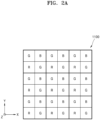
- FIG. 2A is a plan view showing a color arrangement of a pixel array in an image sensor according to an embodiment.
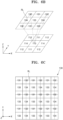
- FIGS. 2B and 2C are plan views showing a sensor substrate and a color separation lens array included in the pixel array of the image sensor according to an embodiment.
- the image sensor may adopt a Bayer color pattern arrangement, as shown in FIG. 2A .
- one unit pattern may include four quadrant regions, and first to fourth quadrant regions may respectively represent blue (B), green (G), red (R), and green (G) colors.
- These unit patterns may be repeatedly and two-dimensionally arranged in a first direction (X direction) and a second direction (Y direction).
- X direction first direction
- Y direction second direction
- two green pixels are arranged diagonally in one direction
- one blue pixel and one red pixel are diagonally arranged in another direction in a unit pattern of a 2 ⁇ 2 array.
- a first row includes alternating green pixels and blue pixels while in the second direction
- a second row includes alternating red pixels and green pixels.
- the color arrangement of FIG. 2A is an example, and the disclosure is not limited thereto.
- a CYGM method in which magenta (M), cyan (C), yellow (Y), and green (G) are represented in one unit pattern
- an RGBW method in which green, red, blue, and white are represented in one unit pattern
- the unit patterns may be implemented in a 3x2 array, and the pixels in the pixel array 1100 may be arranged in various ways according to color characteristics of the image sensor 1000.
- the pixel array 1100 of the image sensor 1000 has the Bayer pattern, but the operating principles may be applied to other patterns of pixel arrangements than the Bayer pattern.
- the pixel array 1100 of the image sensor 1000 may include a sensor substrate 110 having a pixel arrangement that is aligned with the aforementioned color arrangement. Additionally, the pixel array 1100 may include a color separation lens array 130 configured to focus or condense light of specific colors onto corresponding pixels.
- FIGS. 2B and 2C are plan views showing the sensor substrate 110 and the color separation lens array 130.
- the sensor substrate 110 may include a plurality of pixels sensing incident light.
- the sensor substrate 110 may include a plurality of unit pixel groups 110G.
- the unit pixel group 110G may include a first pixel 111, a second pixel 112, a third pixel 113, and a fourth pixel 114 that convert incident light into electrical signals, to allow image signals to be generated based on the electrical signals.
- the unit pixel group 110G may include a pixel arrangement in the Bayer pattern type. The pixel arrangement in the sensor substrate 110 is for sensing the incident light after distinguishing the incident light according to unit patterns such as the Bayer patterns, as shown in FIG. 2A .
- the first and fourth pixels 111 and 114 may act as green pixels sensing green light
- the second pixel 112 may act as a blue pixel sensing blue light
- the third pixel 113 may act as a red pixel sensing red light.
- the pixel arrangement of the image sensor may be used interchangeably with the pixel arrangement of the sensor substrate.
- the first pixel 111 and the fourth pixel 114 may be interchangeably referred to as a first green pixel and a second green pixel
- the second pixel 112 may be interchangeably referred to as a blue pixel
- the third pixel 113 may be interchangeably referred to as a red pixel.
- this is for convenience of description, and the disclosure is not limited thereto.
- Each of the first to fourth pixels 111, 112, 113, and 114 may include a plurality of photosensitive cells that independently sense incident light.
- each of the first to fourth pixels 111, 112, 113, and 114 may include first to fourth photosensitive cells c1, c2, c3, and c4.
- the first to fourth photosensitive cells c1, c2, c3, and c4 may be two-dimensionally arranged in the first direction (X direction) and the second direction (Y direction).
- the first to fourth photosensitive cells c1, c2, c3, and c4 may be arranged in a 2x2 array.
- FIG. 2B shows an example in which each of the first to fourth pixels 111, 112, 113, and 114 includes four photosensitive cells that are grouped and two-dimensionally arranged, but each of the first to fourth pixels 111, 112, 113, and 114 may include varying numbers of photosensitive cells.
- the first to fourth pixels 111, 112, 113, and 114 may include one photosensitive cell, two photosensitive cells, or four or more independent photosensitive cells that are grouped and arranged in different configurations.
- each of the first to fourth pixels 111, 112, 113, and 114 may include a plurality of independent photosensitive cells that are grouped and arranged in a 3x3 array or 4x4 array.
- each of the first to fourth pixels 111, 112, 113, and 114 includes the photosensitive cells arranged in a 2x2 array will be described for convenience of description.
- some of the plurality of pixels each including the plurality of photosensitive cells sensing the light of the same color may be used as auto-focusing pixels.
- an auto-focusing signal may be obtained from a difference between output signals of adjacent photosensitive cells.
- an auto-focusing signal in the first direction may be generated based on a difference between output signals from the first photosensitive cell c1 and the second photosensitive cell c2, a difference between output signals from the third photosensitive cell c3 and the fourth photosensitive cell c4, or a difference between a sum of the output signals from the first photosensitive cell c1 and the third photosensitive cell c3 and a sum of the output signals from the second photosensitive cell c2 and the fourth photosensitive cell c4.
- an auto-focusing signal in the second direction may be generated based on a difference between output signals from the first photosensitive cell c1 and the third photosensitive cell c3, a difference between output signals from the second photosensitive cell c2 and the fourth photosensitive cell c4, or a difference between a sum of the output signals from the first photosensitive cell c1 and the second photosensitive cell c2 and a sum of the output signals from the third photosensitive cell c3 and the fourth photosensitive cell c4.
- Auto-focusing performance using such an auto-focusing signal may depend on specific shapes of nanoposts provided within the color separation lens array 130. As the auto-focus contrast increases, the auto-focus sensitivity increases, ultimately enhancing the performance of the auto-focusing system.
- an image signal may be obtained by adding output signals of the first to fourth photosensitive cells c1, c2, c3, and c4.
- a first green image signal may be generated by adding the output signals from the first to fourth photosensitive cells c1, c2, c3, and c4 of the first pixel 111
- a blue image signal may be generated by adding the output signals from the first to fourth photosensitive cells c1, c2, c3, and c4 of the second pixel 112
- a red image signal may be generated by adding the output signals from the first to fourth photosensitive cells c1, c2, c3, and c4 of the third pixel 113
- a second green image signal may be generated by adding the output signals from the first to fourth photosensitive cells c1, c2, c3, and c4 of the fourth pixel 114.
- each of the first to fourth photosensitive cells c1, c2, c3, and c4 is used as an individual pixel to obtain each output signal. In this case, a high-resolution image may be obtained.
- the color separation lens array 130 may include a plurality of pixel correspondence regions, each including nanoposts.
- the division of regions of the color separation lens array 130 and the shapes and arrangement of nanoposts provided in each region may be set to form a phase profile that separates incident light according to wavelengths and condenses the incident light to facing pixels.
- color separation in a visible light band will be described, but is not limited thereto, and a wavelength band may extend to a range of visible light to infrared light, or various other ranges.
- the color separation lens array 130 includes a plurality of pixel correspondence groups 130G respectively corresponding to the plurality of unit pixel groups 110G of the sensor substrate 110 shown in FIG. 2B .
- the pixel correspondence group 130G includes first to fourth pixel correspondence regions 131, 132, 133, and 134 corresponding to the first to fourth pixels 111, 112, 113, and 114.
- the first to fourth pixel correspondence regions 131, 132, 133, and 134 each include a plurality of nanoposts.
- the plurality of nanoposts are configured to separate incident light according to wavelengths and condense the light to the corresponding first to fourth pixels 111, 112, 113, and 114 according to the wavelengths. As described above with reference to FIG.
- the first pixel 111 and the fourth pixel 114 may be respectively a first green pixel and a second green pixel
- the second pixel 112 may be a blue pixel
- the third pixel 113 may be a red pixel.
- the first pixel correspondence region 131 and the fourth pixel correspondence region 134 may be interchangeably referred to as a first green pixel correspondence region and a second green pixel correspondence region
- the second pixel correspondence region 132 may be interchangeably referred to as a blue pixel correspondence region
- the third pixel correspondence region 133 may be interchangeably referred to as a red pixel correspondence region.
- FIGS. 3A and 3B are different cross-sectional views of a pixel array in an image sensor according to an embodiment.
- FIG. 4 is a plan view showing an arrangement form of nanoposts provided in a pixel correspondence region of a color separation lens array provided in a pixel array of an image sensor according to an embodiment.
- the pixel array 1100 of the image sensor includes the sensor substrate 110 and the color separation lens array 130 arranged on the sensor substrate 110.
- the sensor substrate 110 may include the first pixel 111, the second pixel 112, the third pixel 113, and the fourth pixel 114 sensing light as described above with reference to FIG. 2B , and each of the first pixel 111, the second pixel 112, the third pixel 113, and the fourth pixel 114 may include a plurality of photosensitive cells.
- a separator for separating cells may be further formed on a boundary between cells.
- the color separation lens array 130 may include a first pixel correspondence region 131 and a fourth pixel correspondence region 134 respectively corresponding to the first pixel 111 and the fourth pixel 114 onto which green light is condensed, a second pixel correspondence region 132 corresponding to the second pixel 112 onto which blue light is condensed, and a third pixel correspondence region 133 corresponding to the third pixel 113 onto which red light is condensed.
- the first pixel correspondence region 131 may include a plurality of first nanoposts NP1, the second pixel correspondence region 132 may include a plurality of second nanoposts NP2, and the third pixel correspondence region 133 may include a plurality of third nanoposts NP3, and the fourth pixel correspondence region 134 may include a plurality of fourth nanoposts NP4. Due to the shapes and arrangement of the first to fourth nanoposts NP1, NP2, NP3, and NP4, incident light may be separated according to wavelengths and condensed onto each of the first to fourth pixels 111, 112, 113, and 114.
- the color separation lens array 130 may provide different phase profiles for different wavelength lights.
- the phase profile of the color separation lens array 130 may vary across different wavelengths. For example, a refractive index of the first pixel correspondence region 131 with respect to the first wavelength light and a refractive index of the first pixel correspondence region 131 with respect to the second wavelength light may be different from each other.
- phase delay of the first wavelength light passing through the first pixel correspondence region 131 may differ from the phase delay experienced by the second wavelength light passing through the same region (i.e., the first pixel correspondence region 131). Therefore, when the color separation lens array 130 is designed based on the characteristics of light, different phase profiles may be provided with respect to the first wavelength light and the second wavelength light.
- the plurality of first to fourth nanoposts NP1, NP2, NP3, and NP4 included in the color separation lens array 130 may be arranged according to a certain rule to form different phase profiles with respect to light of a plurality of wavelengths.
- the rule may be applied to parameters, such as the shapes, sizes (e.g., width and height), distances, and the arrangement form of the first to fourth nanoposts NP1, NP2, NP3, and NP4, and these parameters may be determined according to a phase profile to be implemented by the color separation lens array 130.
- first to fourth nanoposts NP1, NP2, NP3, and NP4 will be collectively referred to as nanoposts NP with respect to common aspects of the first to fourth nanoposts NP1, NP2, NP3, and NP4.
- the nanoposts NP may have a shape dimension of a sub wavelength.
- the sub-wavelength refers to a wavelength that is less than a wavelength band of light to be branched.
- the nanoposts NP may have a cylindrical shape having a cross-sectional diameter of a sub wavelength.
- the shape of the nanoposts NP is not limited thereto, that is, the nanoposts NP may have an elliptical post shape or a polygonal post shape. Otherwise, the nanoposts NP may have post shapes having symmetrical or asymmetrical cross-sectional shape.
- the nanoposts NP are shown so that a width in the direction perpendicular to a height direction (Z-direction) is constant, that is, a cross-section parallel to the height direction has a rectangular shape, but the above shape is an example. Contrary to what is shown, the widths of the nanoposts NP in the direction perpendicular to the height direction may not be consistent, for example, the cross-section parallel to the height direction may have a trapezoidal shape or an inversed trapezoidal shape. When the incident light is a visible ray, the cross-sectional diameter of the nanoposts NP may be less than, for example, 400 nm, 300 nm, or 200 nm.
- a height of the nanoposts NP may be about 500 nm to about 1500 nm, which is greater than the cross-sectional diameter of the nanopost.
- the nanoposts NP may be obtained by combining two or more posts stacked in the height direction (Z direction).
- the height of the nanoposts NP may be a few times greater than the sub wavelength to a wavelength.
- the height of the nanoposts NP may be five times, four times, or three times or less the peak wavelength of a wavelength band separated by the color separation lens array 130.
- the nanoposts NP are shown to have the identical height, but are not limited thereto. Details of the nanoposts NP may be determined in consideration of detailed process conditions together with phase profile for color separation.
- a peripheral material having a refractive index that is different from that of the nanopost NP may be filled among the nanoposts NP.
- the nanoposts NP may include a material having a higher refractive index than that of a peripheral material.
- the nanoposts NP may include c-Si, p-Si, a-Si and a Group III-V compound semiconductor (GaP, GaN, GaAs etc.), SiC, TiO 2 , SiN, and/or a combination thereof.
- the nanoposts NP having a different refractive index from the refractive index of the peripheral material may change the phase of light that passes through the nanoposts NP.
- a peripheral material of the nanoposts NP may include a dielectric material having a lower refractive index than that of the nanoposts NP.
- the peripheral material may include SiO 2 or air.
- the disclosure is not limited thereto, that is, the materials of the nanoposts NP and the peripheral material may be set so that the nanoposts NP may have a lower refractive index than that of the peripheral material.
- a transparent spacer layer 120 may be arranged between the sensor substrate 110 and the color separation lens array 130.
- the spacer layer 120 supports the color separation lens array 130 and may have a thickness, denoted as d, that satisfies a regulation about a distance between the sensor substrate 110 and the color separation lens array 130, that is, a distance between an upper surface of the sensor substrate 110 and a lower surface of the color separation lens array 130.
- the spacer layer 120 may include a material transparent with respect to the visible ray, for example, a dielectric material having a lower refractive index than that of the nanoposts NP and low absorption coefficient in the visible ray band, e.g., SiO 2 , siloxane-based spin on glass (SOG), etc.
- a dielectric material having a lower refractive index than that of the nanoposts NP and low absorption coefficient in the visible ray band e.g., SiO 2 , siloxane-based spin on glass (SOG), etc.
- SOG siloxane-based spin on glass
- the first to fourth nanoposts NP1, NP2, NP3, and NP4 respectively provided in the first to fourth pixel correspondence regions 131, 132, 133, and 134 of the color separation lens array 130 have an arrangement form that implements a desired phase profile for each color and reduces resolution deterioration.
- the color separation lens array 130 exhibits high light efficiency by minimizing light loss caused by the color filter used in the related art.
- the image sensor 1000 including the color separation lens array 130 exhibits a lower resolution than the image sensor of the related art including a micro lens array and a color filter. This reduction in resolution occurs because each pixel in the image sensor 1000 including the color separation lens array 130, collects signals from a wider area than a pixel size. Therefore, for example, the lowest signal level measured in a pixel having an input signal level of 0 on the original image may be higher than that of the image sensor of the related art.
- This resolution deterioration may be analyzed as occurring by a region in which no nanopost is disposed when the first to fourth nanoposts NP1, NP2, NP3, and NP4 are arranged in the first to fourth pixel correspondence regions 131, 132, 133, and 134, respectively. Small-sized nanoposts may be disposed in such a region so that the resolution deterioration may be reduced.
- a design method of arranging the first to fourth nanoposts NP1, NP2, NP3, and NP4 in the first to fourth pixel correspondence regions 131, 132, 133, and 134 respectively according to the desired phase profile for each color, and further disposing nanoposts each having a small cross-sectional size in appropriate positions where no nanopost is disposed, may be performed.
- the position and the cross-sectional width of the nanopost disposed in the positon may be set to minimize a change in the phase profile for each color and reduce resolution deterioration.
- a figure PG1 connecting the centers of the first nanoposts NP1 located on the outer edges within the first pixel correspondence region 131, a figure PG2 connecting the centers of the second nanoposts NP2 located on the outer edges within the second pixel correspondence region 132, a figure PG3 connecting the centers of the third nanoposts NP3 located on the outer edges within the third pixel correspondence region 133, and a figure PG4 connecting the centers of the fourth nanoposts NP4 located on the outermost edges within the fourth pixel correspondence region 134 may be defined. Connecting the centers of the outermost first nanoposts NP1 of the first pixel may form an inner region with a boundary represented by the figure PG1.
- connecting the centers of the outermost second nanoposts NP2 of the second pixel, connecting the centers of the outermost third nanoposts NP3 of the third pixel, and connecting the centers of the outermost fourth nanoposts NP4 of the fourth pixel may form inner regions with boundaries represented by the figure PG2, the figure PG3, and the figure PG4, respectively.
- the outer edge is defined with respect to each center on a cross-section where the first to fourth pixel correspondence regions 131, 132, 133, and 134 face the first to fourth pixels 111, 112, 113, and 114, respectively.
- a first occupancy rate of the inner region represented by the figure PG1 to the (entire) area of the first pixel correspondence region 131, a second occupancy rate of the inner region represented by the figure PG2 to the (entire) area of the first pixel correspondence region 132, a third occupancy rate of the inner region represented by the figure PG3 to the (entire) area of the third pixel correspondence region 133, and a fourth occupancy rate of the inner region represented by the figure PG4 to the (entire) area of the fourth pixel correspondence region 134 may be defined.
- the area is an area on the illustrated plan view, that is, the area of the cross-section facing each of the first to fourth pixels 111, 112, 113, and 114.
- Each of the first to fourth occupancy rates may be equal to or greater than 45 %. Alternatively, each of the first to fourth occupancy rates may be equal to or greater than 47 % or equal to or greater than 50 %.
- the first to fourth occupancy rates may be different from each other according to colors of related pixel correspondence regions.
- the third occupancy defined in the third pixel correspondence region 133 which is a red pixel correspondence region may be equal to or greater than the first occupancy rate defined in the first pixel correspondence region 131 which is a green pixel correspondence region, and may be equal to or greater than the second occupancy rate defined in the second pixel correspondence region 132 which is a blue pixel correspondence region.
- the third occupancy rate may be, for example, equal to or greater than 60 %, but is not limited thereto.
- the first occupancy rate may be equal to or greater than the second occupancy rate defined in the second pixel correspondence region 132 which is the blue pixel correspondence region.
- the first and fourth occupancy rates may be the same.
- Each of the first to fourth occupancy rates may be equal to or less than 75 %.
- the design process of arranging the first to fourth nanoposts NP1, NP2, NP3, and NP4 according to the phase profile for each color and further disposing nanoposts each having a small cross-sectional size may be a designing process of increasing the first to fourth occupancy rates defined above.
- the resulting nanopost array may also meet the phase profile requirements for each color by setting an upper occupancy rate limit.
- a pattern density may be a ratio of the sum of the cross-sectional areas of the nanoposts provided in the first to fourth pixel correspondence regions 131, 132, 133, and 134 with respect to the sum of the areas of the first to fourth pixel correspondence regions 131, 132, 133, and 134.
- the pattern density may be, for example, equal to or greater than 13 %.
- the first to fourth nanoposts NP1, NP2, NP3, and NP4 having various cross-sectional sizes may be respectively provided in the first to fourth pixel correspondence regions 131, 132, 133, and 134.
- the cross-sectional sizes may have two or more types.
- the third nanoposts NP3 may include, for example, three or more types of third nanoposts NP3 having different cross-sectional sizes. As described above, the third nanoposts NP3 having different cross-sectional sizes may be arranged such that the cross-sectional sizes remain the same or become smaller as a distance from the center of the third pixel correspondence region 133 increases. In other words, the third nanopost NP3 located at a greater distance from the center of the third pixel correspondence region 133 may have the same as or a smaller cross-sectional size than the third nanopost NP3 positioned closer to the center of the third pixel correspondence region 133.
- the second nanoposts NP2 may also include three or more types of second nanoposts NP2 having different cross-sectional sizes. Similar to the third nanoposts NP3 of the third pixel correspondence region 133, the second nanoposts NP2 having different cross-sectional sizes may be arranged such that the cross-sectional sizes remain the same or become smaller as a distance from the center of the second pixel correspondence region 132 increases. In other words, the cross-sectional size of the second nanopost NP2 located at a greater distance from the center of the second pixel correspondence region 132 may be the same as or smaller than the cross-sectional size of the second nanopost NP2 positioned closer to the center of the second pixel correspondence region 132.
- the first nanopost NP1 may also include three or more types of first nanoposts NP1 having different cross-sectional sizes.
- the arrangement of the first nanoposts NP1 in the first pixel correspondence region 131 is slightly different from the arrangement of the third nanoposts NP3 in the third pixel correspondence region 133 and the arrangement of the second nanoposts NP2 in the second pixel correspondence region 132.
- the size arrangement of the first nanoposts NP1 is set with respect to a straight line passing through the center of the first pixel correspondence region 131 and parallel to the first direction (X direction) or the second direction (Y direction).
- the cross-sectional sizes of the first nanoposts NP1 may remain the same or become smaller as a distance from the horizontal center line of the first pixel correspondence region 131 increases.
- the cross-sectional size of the first nanopost NP1 located at a greater distance from the horizontal center line of the first pixel correspondence region 131 may be the same as or smaller than the cross-sectional size of the first nanopost NP1 positioned closer to the horizontal center line of the first pixel correspondence region 131.
- This relationship is also established with respect to the vertical center line of the first pixel correspondence region 131. That is, the cross-sectional sizes of the first nanoposts NP1 may be the same or smaller as a distance from the vertical center line of the first pixel correspondence region 131 increases.
- a change tendency of the cross-sectional size of the first nanopost NP1 as a distance from the horizonta center line increases may be different from a change tendency of the cross-sectional size of the first nanopost NP1 as a distance from the vertical center line increases.
- the fourth nanoposts NP4 of the fourth pixel correspondence region 134 may be arranged similarly to the first nanoposts NP1 of the first pixel correspondence region 131 and may also have an arrangement rule of 90 degree rotational symmetry.
- a nanopost having a larger cross-sectional size than that of the periphery is disposed at center portions of each of the first to fourth pixel correspondence regions 131, 132, 133, and 134.
- the second nanopost NP2 having the largest cross-sectional size may be positioned at a center point of the second pixel correspondence region 132, to partially or entirely overlap the center point of the second pixel correspondence region 132.
- the third nanopost NP3 having the largest cross-sectional size may be positioned in a way that the third nanopost NP3 does not to overlap a center point of the third pixel correspondence region 133, and for example, four third nanoposts NP3 may be arranged to overlap a center portion of the third pixel correspondence region 133, with a center point of an arrangement of the four third nonoposts NP3 overlapping a center point of the third pixel correspondence region 133.
- first nanoposts NP1 and four third nanoposts NP3 may be disposed in a center portion of a position that does not overlap the center point of each of the first pixel correspondence region 131 and the fourth pixel correspondence region 134.
- the cross-sectional size of the second nanopost NP2 disposed in the center of the second pixel correspondence region 132 may be equal to or larger than the cross-sectional sizes of the first nanopost NP1, the third nanopost NP3, and the fourth nanopost NP4 disposed in the center of the remaining pixel correspondence region.
- the cross-sectional size of the first nanopost NP1 disposed in the center of the first pixel correspondence region 131 may be equal to or smaller than the cross-sectional sizes of the second nanopost NP2 and the third nanopost NP3 respectively disposed in the centers of the second pixel correspondence region 132 and the third pixel correspondence region 133.
- the number of nanoposts provided in each of the first to fourth pixel correspondence regions 131, 132, 133, and 134 may be different from each other.
- the number of third nanoposts NP3 provided in the third pixel correspondence region 133 may be equal to or greater than the number of second nanoposts NP2 provided in the second pixel correspondence region 132 or the number of first nanoposts NP1 provided in the first pixel correspondence region 131.
- this is an example, and the disclosure is not limited thereto.
- the resolution deterioration described above may be reduced by adjusting the distance between the sensor substrate 110 and the color separation lens array 130.
- the distance between the upper surface of the sensor substrate 110 and the lower surface of the color separation lens array 130 may be determined with respect to the focal length of light condensed by the color separation lens array 130.
- the lowest signal level measured in a pixel having an input signal level of 0 on the original image may be reduced.
- This space may be, for example, equal to or smaller than twice or 1.5 times the pixel pitch of the sensor substrate 110.
- the pixel pitch means a period in which the first to fourth pixels 111, 112, 113, and 114 are arranged on the sensor substrate 110.
- the pixel pitch may be, for example, in a range of about 0.5 ⁇ m to about 1.5 ⁇ m, but this is an example.
- the thickness of the spacer layer 120 may be set in accordance with a specified distance. When a color filter is provided between the sensor substrate 110 and the color separation lens array 130, the thickness of the spacer layer 120 may be smaller considering the thickness and effective refractive index of the color filter.
- one pixel correspondence group 130G including the first to fourth pixel correspondence regions 131, 132, 133, and 134 is partitioned into 12 ⁇ 12 regions, and the first to fourth nanoposts NP1, NP2, NP3, and NP4 are arranged one by one in appropriate positions in a selected region among the partitioned regions.
- FIG. 5A is a diagram showing phase profiles of green light and blue light that have passed through the color separation lens array 130 on a cross-section of FIG. 3A .
- the color separation lens array 130 may form different phase profiles with respect to green light and blue light included in incident light.
- the color separation lens array 130 may allow green light to have a first green light phase profile PPG1 and blue light to have a blue light phase profile PPB at a position immediately after passing through the color separation lens array 130, e.g., on a lower surface of the color separation lens array 130, such that the green light and the blue light may be respectively condensed onto the corresponding first and second pixels 111 and 112.
- the green light that has passed through the color separation lens array 130 may have the first green light phase profile PPG1 that is the largest at the center of the first green pixel correspondence region 131 and is reduced away from the center of the first green pixel correspondence region 131.
- the phase of the green light is the largest at the center of the first green pixel correspondence region 131 and reduced as a concentric circle away from the center of the first green pixel correspondence region 131.
- the phase is the smallest at the centers of the blue and red pixel correspondence regions 132 and 133 in the X and Y directions, and at contact points between the first green pixel correspondence region 131 and the second green pixel correspondence region 134 in the diagonal direction.
- a phase of the green light is set as 2 ⁇ based on the phase of light emitted from the center of the first green pixel correspondence region 131
- the light having a phase of about 0.9 ⁇ to about 1.1 ⁇ may be emitted from the centers of the blue and red pixel correspondence regions 132 and 133
- the light having a phase of about 1.1 ⁇ to about 1.5 ⁇ may be emitted from a contact point between the first green pixel correspondence region 131 and the second green pixel correspondence region 134.
- a difference between the phase of the green light that has passed through the center of the first green pixel correspondence region 131 and the phase of the green light that has passed through the centers of the blue and red pixel correspondence regions 132 and 133 may be about 0.9 ⁇ to about 1.1 rr.
- the first green light phase profile PPG1 does not necessarily indicate that the phase delay amount of the light that passing through the center of the first green pixel correspondence region 131 is the largest. Instead, when the phase of light passing through the first green pixel correspondence region 131 is 2 ⁇ and a phase delay amount of the light passing through another point is greater and has a phase value of 2 ⁇ or greater, the first green light phase profile PPG1 may denote a value remaining after subtracting 2n rr, that is, wrapped phase profile.
- the blue light that has passed through the color separation lens array 130 may have the blue light phase profile PPB that is largest at the center of the blue pixel correspondence region 132 and reduces away from the center of the blue pixel correspondence region 132.
- the phase of the blue light is the largest at the center of the blue pixel correspondence region 132 and reduced as a concentric circle away from the center of the blue pixel correspondence region 132, the phase is the smallest at the centers of the first and second green pixel correspondence regions 131 and 134 in the X direction and the Y direction and the smallest at the center of the red pixel correspondence region 133 in the diagonal direction.
- the phase at the centers of the first and second green pixel correspondence regions 131 and 134 may be about, for example, about 0.9 ⁇ to about 1.1 ⁇ , and the phase at the center of the red pixel correspondence region 133 may be less than that at the centers of the first and second green pixel correspondence regions 131 and 134, for example, about 0.5 ⁇ to about 0.9 rr.
- FIGS. 5B and 5C are diagrams respectively showing examples of a proceeding direction of green light incident on a first green light condensing region and an array of the first green light condensing region
- FIGS. 5D and 5E are diagrams respectively showing examples of a proceeding direction of blue light incident on a blue light condensing region and an array of the blue light condensing region.
- the green light incident on the first green pixel correspondence region 131 and the vicinity of the first green pixel correspondence region 131 is condensed to the first green pixel 111 by the color separation lens array 130, and the green light from the blue and red pixel correspondence regions 132 and 133, in addition to the first green pixel correspondence region 131, is also incident on the first green pixel 111. That is, according to the phase profile of the green light described above with reference to FIG. 5A , the green light that has passed through a first green light condensing region GL1 that is obtained by connecting centers of two blue pixel correspondence regions 132 and two red pixel correspondence regions 133 that are adjacent to the first green pixel correspondence region 131 is condensed onto the first green pixel 111. Therefore, as shown in FIG.
- the color separation lens array 130 may operate as a first green light condensing region array for condensing the green light onto the first green pixel 111.
- the first green light condensing region GL1 may have a greater area than that of the corresponding first green pixel 111, e.g., may be 1.2 times to two times greater than that of the first green pixel 111.
- the blue light is condensed onto the blue pixel 112 by the color separation lens array 130, and the blue light from the pixel correspondence regions 131, 132, 133, and 134 is incident on the blue pixel 112.
- the blue light that has passed through a blue light condensing region BL that is obtained by connecting centers of four red pixel correspondence regions 133 adjacent to the blue pixel correspondence region 132 at apexes is condensed onto the blue pixel 112. Therefore, as shown in FIG. 5E , the color separation lens array 130 may operate as a blue light condensing region array for condensing the blue light to the blue pixel.
- the blue light condensing region BL has an area greater than that of the blue pixel 112, e.g., may be 1.5 to 4 times greater.
- the blue light condensing region BL may partially overlap the first green light condensing region GL1 described above, and a second green light condensing region GL2 and a red light condensing region RL which are to be described.
- FIG. 6A is a diagram showing phase profiles of red light and green light that have passed through the color separation lens array 130 on a cross-section of FIG. 3B .
- the color separation lens array 130 may form different phase profiles with respect to red light and green light included in incident light.
- the color separation lens array 130 may allow green light to have a second green light phase profile PPG2 and red light to have a red light phase profile PPR at a position immediately after passing through the color separation lens array 130, e.g., on a lower surface of the color separation lens array 130, such that the red light and the green light may be respectively condensed onto the corresponding third and fourth pixels 113 and 114.
- the red light that has passed through the color separation lens array 130 may have the red light phase profile PPR that is largest at the center of the red pixel correspondence region 133 and reduces away from the center of the red pixel correspondence region 133.
- the phase at the centers of the first and second green pixel correspondence regions 131 and 134 may be about, for example, about 0.9 ⁇ to about 1.1 ⁇
- the phase at the center of the blue pixel correspondence region 132 may be less than that at the centers of the first and second green pixel correspondence regions 131 and 134, for example, about 0.5 ⁇ to about 0.9 ⁇ .
- the green light that has passed through the color separation lens array 130 may have the second green light phase profile PPG2 that is largest at the center of the second green pixel correspondence region 134 and reduces away from the center of the second green pixel correspondence region 134, similarly to the green light described above with reference to FIG. 5A .
- the second green light phase profile PPG2 is obtained by moving in parallel with the first green light phase profile PPG1 by one-pixel pitch in the X direction and the Y direction, and descriptions about the first green light phase profile PPG1 may be applied to the others.
- FIGS. 6B and 6C are diagrams respectively showing examples of a proceeding direction of red light incident on a red light condensing region and an array of the red light condensing region
- FIGS. 6D and 6E are diagrams respectively showing examples of a proceeding direction of green light incident on a second green light condensing region and an array of the second green light condensing region.
- the red light that has passed through a red light condensing region RL which is formed by connecting centers of four blue pixel correspondence regions 132 adjacent to the red pixel correspondence region 133 at apexes, is condensed onto the red pixel 113. Therefore, as shown in FIG. 6C , the color separation lens array 130 may operate as a red light condensing region array for condensing the red light to the red pixel.
- the area of the red light condensing region RL may be, e.g., 1.5 to 4 times, larger than that of the red pixel 113.
- the red light condensing region RL may partially overlap the first and second green light condensing regions GL1 and GL2 and the blue light condensing region BL.
- the green light incident on the second green pixel correspondence region 134 and the vicinity of the second green pixel correspondence region 134 proceeds similarly to the green light incident on the first green pixel correspondence region 131 and the vicinity of the first green pixel correspondence region 131, and as shown in FIG. 6D , the green light is condensed onto the second green pixel 114. Therefore, as shown in FIG. 6E , the color separation lens array 130 may operate as a second green light condensing region array for condensing the green light onto the second green pixel 114.
- the area of the second green light condensing region GL2 may be, e.g., 1.2 times to twice, larger than that of the corresponding second green pixel 114.
- the first to fourth pixels 111, 112, 113, and 114 respectively collect light of the first green light condensing region GL1, the blue light condensing region BL, the red light condensing region RL, and the second green light condensing region GL2 each having an area larger than the pixel area.
- the lowest signal level measured in a pixel having an input signal level of 0 on the original image may be higher than that of a general image sensor, that is, an image sensor including a color filter and a micro lens array.
- the image sensor 1000 sets the sizes and arrangement rules of the first to fourth nanoposts NP1, NP2, NP3, and NP4 respectively disposed in the first to fourth pixel correspondence regions 131 to 134, so as to reduce such resolution deterioration.
- FIG. 7 is a plan view showing a nanopost arrangement of pixel correspondence regions in a color separation lens array of an image sensor according to a comparative example.
- the arrangement of the first to fourth nanoposts NP1, NP2, NP3, and NP4 in the first to fourth pixel correspondence regions 131, 132, 133, and 134 shown in FIG. 7 is similar to that of the embodiment shown in FIG. 4 , but is different from first to fourth occupancy rates of the figures PG1, PG2, PG3, and PG4 connecting the centers of the outside nanoposts defined in the first to fourth pixel correspondence regions 131, 132, 133, and 134, respectively.
- the first to fourth occupancy rates are 47.2 %, 47.2 %, 63.9 %, and 47.2 %, respectively.
- the first to fourth occupancy rates are 30.6 %, 47.2 %, 47.2 %, and 30.6 %, respectively. That is, the third occupancy rate related to a red pixel correspondence region, and the first occupancy rate and the fourth occupancy rate related to a green pixel correspondence region of the embodiment are higher than those of the comparative example.
- FIG. 8 is a graph showing a comparison of a modulation transfer function (MTF) of image sensors in an embodiment and a comparative example.
- MTF modulation transfer function
- the MTF indicates transfer of an original image to pixels of an image sensor, and may be a measure of resolution performance of the image sensor.
- a reference line shown in the graph represents a general image sensor including a color filter and a microlens array, but without a color separation lens array.
- the embodiment represents a color separation lens array including nanoposts in the arrangement shown in FIG. 4 .
- the comparative example represents an image sensor with a color separation lens array including nanoposts in the arrangement shown in FIG. 7 .
- the graph illustrates that the MTF in the embodiment is closer to the reference line, compared to the comparative example. This indicates that the performance is improved in the embodiment compared to the comparative example and is almost close to the reference line.
- FIG. 9 is a schematic cross-sectional view of a pixel array of an image sensor according to an embodiment.
- a pixel array 1101 of the embodiment further includes a filter layer CF disposed between the sensor substrate 110 and the color separation lens array 130.
- the filter layer CF includes a green filter GF, a blue filter BF, a red filter, and a green filter respectively corresponding to the first to fourth pixels 111, 112, 113, and 114.
- FIG. 9 is a cross-sectional view corresponding to the cross-section of FIG. 3A .
- the filter layer CF may improve a color purity by supplementing some errors that may occur during the color separation of the color separation lens array 130.
- the effective refractive index of the filter layer CF and the spacer layer 120 may be considered.
- a distance dc between the color separation lens array 130 and the filter layer CF may be appropriately set in consideration of the distance d determined as described above and the thickness of the filter layer CF.
- dc may be, for example, less than or equal to the pixel pitch of the sensor substrate 110 or less than or equal to half of the pixel pitch.
- the pixel pitch may be, for example, about 0.5 ⁇ m to about 1.5 ⁇ m, but this is an example.
- the arrangement criteria of the first to fourth nanoposts NP1, NP2, NP3, and NP4 described with reference to FIG. 4 may be similarly applied, and light efficiency, MTF performance, and autofocusing performance may also be considered together.
- the filter layer CF shown in FIG. 9 may also be provided in a pixel array as an example in the following description.
- FIGS. 10 and 11 are plan views illustrating a color separation lens array that may be included in each of pixel arrays of an image sensor according to an embodiment.
- the color separation lens array 130 of a pixel array 1102 illustrated in FIG. 10 is another example in which the first to fourth nanoposts NP1, NP2, NP3, and NP4 are arranged in a manner similar to the reference described in FIG. 4 , and is different from that of FIG. 4 in the arrangement form of the second nanoposts NP2 of the second pixel correspondence region 132 and the third nanoposts NP3 of the third pixel correspondence region 133.
- the color separation lens array 130 of a pixel array 1103 illustrated in FIG. 11 is another example using the reference described in FIG. 4 .
- the unit region including the first to fourth pixel correspondence regions 131, 132, 133, and 134 may be partitioned into 10 ⁇ 10, and the first to fourth nanoposts NP1, NP2, NP3, and NP4 may be disposed with respect to lattice points. That is, the first to fourth nanoposts NP1, NP2, NP3, and NP4 having a specified cross-sectional size may be disposed in a selected position among 11 ⁇ 11 positions.
- the color separation lens array 130 including the first to fourth nanoposts NP1, NP2, NP3, and NP4 arranged in a single layer has been described as an example, but the first to fourth nanoposts NP1, NP2, NP3, and NP4 may be arranged in a plurality of layers. In a structure of the plurality of layers, the arrangement reference of the first to fourth nanoposts NP1, NP2, NP3, and NP4 described in FIG. 4 may be applied to any one of the plurality of layers.
- FIG. 12A is a schematic cross-sectional view of a pixel array of an image sensor according to an embodiment
- FIGS. 12B and 12C are plan views showing a first layer and a second layer of a color separation lens array included in the pixel array of FIG. 12A , respectively.
- each of the first to fourth nanoposts NP1, NP2, NP3, and NP4 is arranged in two layers.
- the color separation lens array 130 includes a first layer LE1 and a second layer LE2 stacked in a third direction (Z direction). That is, the first to fourth pixel correspondence regions 131, 132, 133, and 134 provided in the color separation lens array 130 may respectively include a plurality of first to fourth nanoposts NP1, NP2, NP3, and NP4 located in the first layer LE1, and may respectively include the plurality of first to fourth nanoposts NP1, NP2, NP3, and NP4 located in the second layer LE2.
- the arrangement forms of the first to fourth nanoposts NP1, NP2, NP3, and NP4 of the first layer LE1 and the second layer LE2 may be different from each other.
- the arrangement reference of the first to fourth nanoposts NP1, NP2, NP3, and NP4 described with reference to FIG. 4 may be applied to any one of the first layer LE1 and the second layer LE2, for example, the first layer LE1. However, this is an example and may be applied to both the first layer LE1 and the second layer LE2.
- An etch stop layer may be further disposed between the first layer LE1 and the second layer LE2.
- the etch stop layer may be provided to safeguard the first layer LE1 against potential image that may occur during a manufacturing process of the second layer LE2 when the second layer LE2 is formed on top of the first layer LE1.
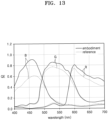
- FIG. 13 is a graph showing quantum efficiency of an image sensor illustrated in FIGS. 12A to 12C for each wavelength.
- a reference shown in the graph represents a general image sensor including a color filter and a microlens array and excluding a color separation lens array.
- the reference has a lower light efficiency than the embodiment, and may serve as a basis for comparing MTF performance of the embodiment.
- the MTF performance of the embodiment is measured as approximately 95.1 % compared to the reference at the Nyquist sampling limit of 0.5 cycles/pitch, and the AF contrast is measured as 2.27 that is the average of R, G, and B.
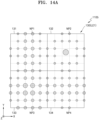
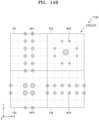
- FIGS. 14A and 14B are plan views showing a first layer and a second layer of a color separation lens array included in an image sensor pixel array according to an embodiment
- FIG. 15 is a graph showing quantum efficiency of the image sensor illustrated in FIGS. 14A and 14B for each wavelength.
- An increase in light efficiency of the embodiment compared to the reference is similar to that of FIG. 13 , and the MTF performance of the embodiment is analyzed to be approximately 95.2 % compared to the reference at the Nyquist sampling limit of 0.5 cycles/pitch, and the AF contrast is measured as 2.2 that is the average of R, G, and B.
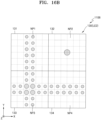
- FIGS. 16A and 16B are plan views showing a first layer and a second layer of a color separation lens array included in an image sensor pixel array according to an embodiment
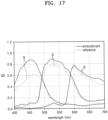
- FIG. 17 is a graph showing quantum efficiency of the image sensor illustrated in FIGS. 16A and 16B for each wavelength.
- An increase in light efficiency of the embodiment compared to the reference is similar to that of FIG. 13 , and the MTF performance is measured as approximately 95 % compared to the reference at the Nyquist sampling limit of 0.5 cycles/pitch, and the AF contrast is measured as 2.46 that is the average of R, G, and B.
- FIG. 18 is a block diagram of an electronic apparatus including an image sensor according to some embodiments.
- the electronic apparatus ED01 may communicate with another electronic apparatus ED02 via a first network ED98 (short-range wireless communication network, etc.), or may communicate with another electronic apparatus ED04 and/or a server ED08 via a second network ED99 (long-range wireless communication network, etc.)
- the electronic apparatus ED01 may communicate with the electronic apparatus ED04 via the server ED08.
- the electronic apparatus ED01 may include a processor ED20, a memory ED30, an input device ED50, a sound output device ED55, a display device ED60, an audio module ED70, a sensor module ED76, an interface ED77, a haptic module ED79, a camera module ED80, a power management module ED88, a battery ED89, a communication module ED90, a subscriber identification module ED96, and/or an antenna module ED97.
- some (display device ED60, etc.) of the elements may be omitted or another element may be added. Some of the elements may be configured as one integrated circuit.
- the sensor module ED76 a fingerprint sensor, an iris sensor, an illuminance sensor, etc.
- the display device ED60 display, etc.
- the processor ED20 may control one or more elements (hardware, software elements, etc.) of the electronic apparatus ED01 connected to the processor ED20 by executing software (program ED40, etc.), and may perform various data processes or operations. As a part of the data processing or operations, the processor ED20 may load a command and/or data received from another element (sensor module ED76, communication module ED90, etc.) to a volatile memory ED32, may process the command and/or data stored in the volatile memory ED32, and may store result data in a non-volatile memory ED34.
- another element sensor module ED76, communication module ED90, etc.
- the processor ED20 may include a main processor ED21 (central processing unit, application processor, etc.) and an auxiliary processor ED23 (graphic processing unit, image signal processor, sensor hub processor, communication processor, etc.) that may be operated independently from or along with the main processor ED21.
- the auxiliary processor ED23 may use less power than that of the main processor ED21, and may perform specified functions.
- the auxiliary processor ED23 on behalf of the main processor ED21 while the main processor ED21 is in an inactive state (sleep state) or along with the main processor ED21 while the main processor ED21 is in an active state (application executed state), may control functions and/or states related to some (display device ED60, sensor module ED76, communication module ED90, etc.) of the elements in the electronic apparatus ED01.
- the auxiliary processor ED23 image signal processor, communication processor, etc.
- the memory ED30 may store various data required by the elements (processor ED20, sensor module ED76, etc.) of the electronic apparatus ED01.
- the data may include, for example, input data and/or output data about software (program ED40, etc.) and commands related thereto.
- the memory ED30 may include the volatile memory ED32 and/or the non-volatile memory ED34.
- the program ED40 may be stored as software in the memory ED30, and may include an operation system ED42, middleware ED44, and/or an application ED46.
- the input device ED50 may receive commands and/or data to be used in the elements (processor ED20, etc.) of the electronic apparatus ED01, from outside (user, etc.) of the electronic apparatus ED01.
- the input device ED50 may include a microphone, a mouse, a keyboard, and/or a digital pen (stylus pen).
- the sound output device ED55 may output a sound signal to outside of the electronic apparatus ED01.
- the sound output device ED55 may include a speaker and/or a receiver.
- the speaker may be used for a general purpose such as multimedia reproduction or record play, and the receiver may be used to receive a call.
- the receiver may be coupled as a part of the speaker or may be implemented as an independent device.
- the display device ED60 may provide visual information to outside of the electronic apparatus ED01.
- the display device ED60 may include a display, a hologram device, or a projector, and a control circuit for controlling the corresponding device.
- the display device ED60 may include a touch circuitry set to sense a touch, and/or a sensor circuit (pressure sensor, etc.) that is set to measure a strength of a force generated by the touch.
- the audio module ED70 may convert sound into an electrical signal or vice versa.
- the audio module ED 70 may acquire sound through the input device ED50, or may output sound via the sound output device ED55 and/or a speaker and/or a headphone of another electronic apparatus (electronic apparatus ED02, etc.) connected directly or wirelessly to the electronic apparatus ED01.
- the sensor module ED76 may sense an operating state (power, temperature, etc.) of the electronic apparatus ED01, or an outer environmental state (user state, etc.), and may generate an electrical signal and/or data value corresponding to the sensed state.
- the sensor module ED76 may include a gesture sensor, a gyro-sensor, a pressure sensor, a magnetic sensor, an acceleration sensor, a grip sensor, a proximity sensor, a color sensor, an infrared (IR) ray sensor, a vivo sensor, a temperature sensor, a humidity sensor, and/or an illuminance sensor.
- the interface ED77 may support one or more designated protocols that may be used in order for the electronic apparatus ED01 to be directly or wirelessly connected to another electronic apparatus (electronic apparatus ED02, etc.)
- the interface ED77 may include a high-definition multimedia interface (HDMI), a universal serial bus (USB) interface, an SD card interface, and/or an audio interface.
- HDMI high-definition multimedia interface
- USB universal serial bus
- SD card interface Secure Digital
- the connection terminal ED78 may include a connector by which the electronic apparatus ED01 may be physically connected to another electronic apparatus (electronic apparatus ED02, etc.).
- the connection terminal ED78 may include an HDMI connector, a USB connector, an SD card connector, and/or an audio connector (headphone connector, etc.).
- the haptic module ED79 may convert the electrical signal into a mechanical stimulation (vibration, motion, etc.) or an electric stimulation that the user may sense through a tactile or motion sensation.
- the haptic module ED79 may include a motor, a piezoelectric device, and/or an electric stimulus device.
- the camera module ED80 may capture a still image and a video.
- the camera module ED80 may include a lens assembly including one or more lenses, the image sensor 1000 described above, image signal processors, and/or flashes.
- the lens assembly included in the camera module ED80 may collect light emitted from an object that is an object to be captured.
- the power management module ED88 may manage the power supplied to the electronic apparatus ED01.
- the power management module ED88 may be implemented as a part of a power management integrated circuit (PMIC).
- PMIC power management integrated circuit
- the battery ED89 may supply electric power to components of the electronic apparatus ED01.
- the battery ED89 may include a primary battery that is not rechargeable, a secondary battery that is rechargeable, and/or a fuel cell.
- the communication module ED90 may support the establishment of a direct (wired) communication channel and/or a wireless communication channel between the electronic apparatus ED01 and another electronic apparatus (electronic apparatus ED02, electronic apparatus ED04, server ED08, etc.), and execution of communication through the established communication channel.
- the communication module ED90 may be operated independently from the processor ED20 (application processor, etc.), and may include one or more communication processors that support the direct communication and/or the wireless communication.
- the communication module ED90 may include a wireless communication module ED92 (cellular communication module, a short-range wireless communication module, a global navigation satellite system (GNSS) communication module) and/or a wired communication module ED94 (local area network (LAN) communication module, a power line communication module, etc.).
- GNSS global navigation satellite system
- a corresponding communication module may communicate with another electronic apparatus via a first network ED09 (short-range communication network such as Bluetooth, WiFi direct, or infrared data association (IrDA)) or a second network ED99 (long-range communication network such as a cellular network, Internet, or computer network (LAN, WAN, etc.)).
- first network ED09 short-range communication network such as Bluetooth, WiFi direct, or infrared data association (IrDA)
- second network ED99 long-range communication network such as a cellular network, Internet, or computer network (LAN, WAN, etc.)
- Such above various kinds of communication modules may be integrated as one element (single chip, etc.) or may be implemented as a plurality of elements (a plurality of chips) separately from one another.
- the wireless communication module ED92 may identify and authenticate the electronic apparatus ED01 in a communication network such as the first network ED98 and/or the second network ED99 by using subscriber information (international mobile subscriber identifier (IMSI), etc.) stored in the subscriber identification module ED96.
- subscriber information international mobile subscriber identifier (IMSI), etc.
- the antenna module ED97 may transmit or receive the signal and/or power to/from outside (another electronic apparatus, etc.).
- An antenna may include a radiator formed as a conductive pattern formed on a substrate (PCB, etc.).
- the antenna module ED97 may include one or more antennas.
- an antenna that is suitable for the communication type used in the communication network such as the first network ED98 and/or the second network ED99 may be selected by the communication module ED90.
- the signal and/or the power may be transmitted between the communication module ED90 and another electronic apparatus via the selected antenna.
- Another component (RFIC, etc.) other than the antenna may be included as a part of the antenna module ED97.
- Some of the elements may be connected to one another via the communication method among the peripheral devices (bus, general purpose input and output (GPIO), serial peripheral interface (SPI), mobile industry processor interface (MIPI), etc.) and may exchange signals (commands, data, etc.).
- peripheral devices bus, general purpose input and output (GPIO), serial peripheral interface (SPI), mobile industry processor interface (MIPI), etc.
- GPIO general purpose input and output
- SPI serial peripheral interface
- MIPI mobile industry processor interface
- the command or data may be transmitted or received between the electronic apparatus ED01 and the external electronic apparatus ED04 via the server ED08 connected to the second network ED99.
- Other electronic apparatuses ED02 and ED04 may be the devices that are the same as or different kinds from the electronic apparatus ED01. All or some of the operations executed in the electronic apparatus ED01 may be executed in one or more devices among the other electronic apparatuses ED02, ED04, and ED08. For example, when the electronic apparatus ED01 has to perform a certain function or service, the electronic apparatus ED01 may request one or more other electronic apparatuses to perform some or entire function or service, instead of executing the function or service by itself.
- One or more electronic apparatuses receiving the request execute an additional function or service related to the request and may transfer a result of the execution to the electronic apparatus ED01.
- an additional function or service related to the request may transfer a result of the execution to the electronic apparatus ED01.
- a cloud computing, a distributed computing, or a client-server computing technique may be used.
- FIG. 19 is a block diagram of the camera module ED80 included in the electronic apparatus ED01 of FIG. 18 .
- the camera module ED80 may include a lens assembly 1170, a flash 1120, an image sensor 1000, an image stabilizer 1140, an AF controller 1130, a memory 1150 (buffer memory, etc.), an actuator 1180, and/or an image signal processor (ISP) 1160.
- ISP image signal processor
- the lens assembly 1170 may collect light emitted from an object that is to be captured.
- the lens assembly 1170 may include one or more optical lenses.
- the lens assembly 1170 may include a path switching member which switches the optical path toward the image sensor 1000. According to whether the path switching member is provided and the arrangement type with the optical lens, the camera module ED80 may have a vertical type or a folded type.
- the camera module ED80 may include a plurality of lens assemblies 1170, and in this case, the camera module ED80 may include a dual camera module, a 360-degree camera, or a spherical camera. Some of the plurality of lens assemblies 1170 may have the same lens properties (viewing angle, focal distance, auto-focus, F number, optical zoom, etc.) or different lens properties.
- the lens assembly 1170 may include a wide-angle lens or a telephoto lens.
- the actuator 1180 may drive the lens assembly 1170. At least some of the otpical lens and the path switching member included in the lens assembly 1170 may be moved by the actuator 1180.
- the optical lens may be moved along the optical axis, and when the distance between adjacent lenses is adjusted by moving at least some of the optical lenses included in the lens assembly 1170, an optical zoom ratio may be adjusted.
- the actuator 1180 may adjust the position of any one of the optical lenses in the lens assembly 1170 so that the image sensor 1000 may be located at the focal length of the lens assembly 1170.
- the actuator 1180 may drive the lens assembly 1170 according to an AF driving signal transferred from the AF controller 1130.
- the flash 1120 may emit light that is used to strengthen the light emitted or reflected from the object.
- the flash 1120 may emit visible light or infrared-ray light.
- the flash 1120 may include one or more light-emitting diodes (red-green-blue (RGB) LED, white LED, infrared LED, ultraviolet LED, etc.), and/or a Xenon lamp.
- the image sensor 1000 may be the image sensor 1000 described above with reference to FIG. 1 , that is, any one of the above-described pixel arrays 1100, 1101, 1102, 1103, 1104, 1105, and 1106 having various color separation lens arrays, or a combination or modified structure thereof.
- the image sensor 1000 may obtain an image corresponding to a subject by converting the light emitted or reflected from the subject and transferred through the lens assembly 1170 into an electrical signal.
- the image sensor 1000 includes a color separation lens array in which shapes and arrangement of nanoposts are set, to increase light efficiency and reduce resolution deterioration, and thus, the obtained image quality may be improved.
- Such an image quality improvement effect may be better achieved when the camera module ED80 is a telephoto camera, that is, when the lens assembly 1170 is a telephoto lens.
- each pixel of the image sensor 1000 may include a plurality of photosensitive cells forming a plurality of channels, for example, the plurality of photosensitive cells arranged in a 2x2 array.
- Some of the pixels may be used as AF pixels, and the image sensor 1000 may generate an AF driving signal from the signals from the plurality of channels in the AF pixels.
- the size and arrangement of the nanoposts may be designed so that the autofocus contrast ratio of the color separation lens array provided in the image sensor 1000 may increase, and the accuracy of AF driving may be improved.
- the image stabilizer 1140 in response to a motion of the camera module ED80 or the electronic apparatus ED01 including the camera module ED80, moves one or more lenses included in the lens assembly 1170 or the image sensor 1000 in a certain direction or controls the operating characteristics of the image sensor 1000 (adjusting of a read-out timing, etc.) in order to compensate for a negative influence of the motion.
- the image stabilizer 1140 may sense the movement of the camera module ED80 or the electronic apparatus ED01 by using a gyro sensor or an acceleration sensor arranged in or out of the camera module ED80.
- the image stabilizer 1140 may be implemented as an optical type.
- the AF controller 1130 may generate the AF driving signal from signal values sensed from the AF pixels in the image sensor 1000.
- the AF controller 1130 may control the actuator 1180 according to the AF driving signal.
- the memory 1150 may store some or entire data of the image obtained through the image sensor 1000 for next image processing operation. For example, when a plurality of images are obtained at a high speed, obtained original data (Bayer-patterned data, high resolution data, etc.) is stored in the memory 1150, and a low resolution image is only displayed. Then, original data of a selected image (user selection, etc.) may be transferred to the image signal processor 1160.
- the memory 1150 may be integrated with the memory ED30 of the electronic apparatus ED01, or may include an additional memory that is operated independently.
- the ISP 1160 may perform image treatment on the image obtained through the image sensor 1000 or the image data stored in the memory 1150.
- the image treatments may include a depth map generation, a three-dimensional modeling, a panorama generation, extraction of features, an image combination, and/or an image compensation (noise reduction, resolution adjustment, brightness adjustment, blurring, sharpening, softening, etc.).
- the image signal processor 1160 may perform controlling (exposure time control, read-out timing control, etc.) of the elements (image sensor 1000, etc.) included in the camera module ED80.
- the image processed by the image signal processor 1160 may be stored again in the memory 1150 for additional process, or may be provided to an external element of the camera module ED80 (e.g., the memory ED30, the display device ED60, the electronic apparatus ED02, the electronic apparatus ED04, the server ED08, etc.).
- the image signal processor 1160 may be integrated with the processor ED20, or may be configured as an additional processor that is independently operated from the processor ED20. When the image signal processor 1160 is configured as an additional processor separately from the processor ED20, the image processed by the image signal processor 1160 undergoes through an additional image treatment by the processor ED20 and then may be displayed on the display device ED60.
- the AF controller 1130 may be integrated with the image signal processor 1160.
- the image signal processor 1160 may generate the AF signal by processing signals from the AF pixels of the image sensor 1000, and the AF controller 1130 may convert the AF signal into a driving signal of the actuator 1180 and transfer the signal to the actuator 1180.
- the electronic apparatus ED01 may further include one or a plurality of camera modules having different properties or functions.
- the camera module may include elements similar to those of the camera module ED80 of FIG. 19 , and the image sensor included in the camera module may be implemented as a charge coupled device (CCD) sensor and/or a complementary metal oxide semiconductor (CMOS) sensor and may include one or a plurality of sensors selected from the image sensors having different properties, such as an RGB sensor, a black and white (BW) sensor, an IR sensor, or a UV sensor.
- CCD charge coupled device
- CMOS complementary metal oxide semiconductor
- one of the plurality of camera modules ED80 may include a wide-angle camera and another camera module ED80 may include a telephoto camera.
- one of the plurality of camera modules ED80 may include a front camera and another camera module ED80 may include a rear camera.
- the image sensor 1000 may be applied to various electronic apparatuses.
- the image sensor 1000 may be applied to a mobile phone or a smartphone, a tablet or a smart tablet, a digital camera or a camcorder, a laptop computer, or a television or a smart television.
- the smartphone or the smart tablet may include a plurality of high-resolution cameras each including a high-resolution image sensor. Depth information of objects in an image may be extracted, out focusing of the image may be adjusted, or objects in the image may be automatically identified by using the high-resolution cameras.
- the image sensor 1000 may be applied to a smart refrigerator, a surveillance camera, a robot, a medical camera, etc.
- the smart refrigerator may automatically recognize food in the refrigerator by using the image sensor, and may notify the user of an existence of a certain kind of food, kinds of food put into or taken out, etc. through a smartphone.
- the surveillance camera may provide an ultra-high-resolution image and may allow the user to recognize an object or a person in the image even in dark environment by using high sensitivity.
- the robot may be input to a disaster or industrial site that a person may not directly access, to provide the user with high-resolution images.
- the medical camera may provide high-resolution images for diagnosis or surgery, and may dynamically adjust a field of view.
- the image sensor 1000 may be applied to a vehicle.
- the vehicle may include a plurality of vehicle cameras arranged on various locations. Each of the vehicle cameras may include the image sensor according to an embodiment.
- the vehicle may provide a driver with various information about inside the vehicle or around the vehicle by using the plurality of vehicle cameras, and may automatically recognize an object or a person in the image to provide information required to the autonomous travel.
- the color separation lens array included in the image sensor described above may separate the incident light by wavelengths and condense the separated light without absorbing or blocking the incident light, and thus, the light utilization efficiency of an image sensor may be improved.
- the color separation lens array included in the image sensor described above may be configured to reduce resolution deterioration owing to the improvement of light efficiency, and thus, the image quality of the image sensor may be improved.
Landscapes
- Physics & Mathematics (AREA)
- Spectroscopy & Molecular Physics (AREA)
- Engineering & Computer Science (AREA)
- Multimedia (AREA)
- Signal Processing (AREA)
- Solid State Image Pick-Up Elements (AREA)
- Transforming Light Signals Into Electric Signals (AREA)
Applications Claiming Priority (1)
| Application Number | Priority Date | Filing Date | Title |
|---|---|---|---|
| KR1020230005642A KR20240113276A (ko) | 2023-01-13 | 2023-01-13 | 이미지 센서 및 이를 포함하는 전자 장치 |
Publications (2)
| Publication Number | Publication Date |
|---|---|
| EP4401143A2 true EP4401143A2 (de) | 2024-07-17 |
| EP4401143A3 EP4401143A3 (de) | 2024-07-31 |
Family
ID=89619276
Family Applications (1)
| Application Number | Title | Priority Date | Filing Date |
|---|---|---|---|
| EP24151310.0A Pending EP4401143A3 (de) | 2023-01-13 | 2024-01-11 | Bildsensor und elektronische vorrichtung mit dem bildsensor |
Country Status (4)
| Country | Link |
|---|---|
| US (1) | US20240243148A1 (de) |
| EP (1) | EP4401143A3 (de) |
| KR (1) | KR20240113276A (de) |
| CN (1) | CN118352368A (de) |
Families Citing this family (2)
| Publication number | Priority date | Publication date | Assignee | Title |
|---|---|---|---|---|
| US20260123076A1 (en) * | 2024-10-24 | 2026-04-30 | Samsung Electronics Co., Ltd. | Image sensor and electronic device including the image sensor |
| EP4734711A1 (de) * | 2024-10-28 | 2026-04-29 | Samsung Electronics Co., Ltd. | Bildsensor mit nanophotonischer linsenanordnung und elektronische vorrichtung mit dem bildsensor |
Family Cites Families (3)
| Publication number | Priority date | Publication date | Assignee | Title |
|---|---|---|---|---|
| KR102765854B1 (ko) * | 2019-10-25 | 2025-02-11 | 삼성전자주식회사 | 색분리 렌즈 어레이를 적용한 영상 획득 장치 및 방법 |
| KR102698295B1 (ko) * | 2020-10-30 | 2024-08-26 | 삼성전자주식회사 | 색분리 렌즈 어레이를 구비하는 이미지 센서 및 이를 포함하는 전자 장치 |
| KR102830280B1 (ko) * | 2020-11-10 | 2025-07-04 | 삼성전자주식회사 | 색분리 렌즈 어레이를 적용한 영상 획득 장치 및 방법 |
-
2023
- 2023-01-13 KR KR1020230005642A patent/KR20240113276A/ko active Pending
- 2023-12-20 CN CN202311769423.5A patent/CN118352368A/zh active Pending
-
2024
- 2024-01-05 US US18/405,539 patent/US20240243148A1/en active Pending
- 2024-01-11 EP EP24151310.0A patent/EP4401143A3/de active Pending
Also Published As
| Publication number | Publication date |
|---|---|
| KR20240113276A (ko) | 2024-07-22 |
| US20240243148A1 (en) | 2024-07-18 |
| CN118352368A (zh) | 2024-07-16 |
| EP4401143A3 (de) | 2024-07-31 |
Similar Documents
| Publication | Publication Date | Title |
|---|---|---|
| US12055730B2 (en) | Image sensor including color separating lens array and electronic apparatus including the image sensor | |
| US12255259B2 (en) | Optical sensor including planar nano-photonic microlens array and electronic apparatus including the same | |
| US12300710B2 (en) | Image sensor including color separating lens array and electronic apparatus including the image sensor | |
| US12575206B2 (en) | Image sensor, method of manufacturing image sensor, and electronic device including image sensor | |
| US12169288B2 (en) | Image sensor including color separating lens array and electronic apparatus including the image sensor | |
| EP4187606B1 (de) | Bildsensor und elektronische vorrichtung damit | |
| EP4345902A1 (de) | Bildsensor und elektronische vorrichtung damit | |
| EP4401143A2 (de) | Bildsensor und elektronische vorrichtung mit dem bildsensor | |
| US20260082117A1 (en) | Image sensor including nano-photonic microlens array and electronic apparatus including the image sensor | |
| EP4418323B1 (de) | Bildsensor mit nanophotonischer linsenanordnung und elektronische vorrichtung mit dem bildsensor | |
| EP4325572B1 (de) | Bildsensor mit strukturierter antireflexionsschicht und elektronische vorrichtung damit | |
| US20240079430A1 (en) | Image sensor and electronic apparatus including the same | |
| EP4489076A1 (de) | Bildsensor und elektronische vorrichtung damit | |
| EP4404266A1 (de) | Bildsensor und elektronische vorrichtung mit dem bildsensor | |
| EP4734712A1 (de) | Bildsensor und elektronische vorrichtung mit dem bildsensor | |
| EP4719003A1 (de) | Bildsensor und elektronische vorrichtung damit | |
| US20250221075A1 (en) | Image sensor and electronic apparatus including the same | |
| EP4734711A1 (de) | Bildsensor mit nanophotonischer linsenanordnung und elektronische vorrichtung mit dem bildsensor | |
| EP4561303A1 (de) | Bildsensor mit nanophotonischer linsenanordnung und elektronische vorrichtung mit dem bildsensor |
Legal Events
| Date | Code | Title | Description |
|---|---|---|---|
| PUAI | Public reference made under article 153(3) epc to a published international application that has entered the european phase |
Free format text: ORIGINAL CODE: 0009012 |
|
| STAA | Information on the status of an ep patent application or granted ep patent |
Free format text: STATUS: REQUEST FOR EXAMINATION WAS MADE |
|
| PUAL | Search report despatched |
Free format text: ORIGINAL CODE: 0009013 |
|
| 17P | Request for examination filed |
Effective date: 20240328 |
|
| AK | Designated contracting states |
Kind code of ref document: A2 Designated state(s): AL AT BE BG CH CY CZ DE DK EE ES FI FR GB GR HR HU IE IS IT LI LT LU LV MC ME MK MT NL NO PL PT RO RS SE SI SK SM TR |
|
| AK | Designated contracting states |
Kind code of ref document: A3 Designated state(s): AL AT BE BG CH CY CZ DE DK EE ES FI FR GB GR HR HU IE IS IT LI LT LU LV MC ME MK MT NL NO PL PT RO RS SE SI SK SM TR |
|
| RIC1 | Information provided on ipc code assigned before grant |
Ipc: H01L 27/146 20060101AFI20240624BHEP |
|
| REG | Reference to a national code |
Ref country code: DE Ref legal event code: R079 Free format text: PREVIOUS MAIN CLASS: H01L0027146000 Ipc: H10F0039000000 |
|
| GRAP | Despatch of communication of intention to grant a patent |
Free format text: ORIGINAL CODE: EPIDOSNIGR1 |
|
| STAA | Information on the status of an ep patent application or granted ep patent |
Free format text: STATUS: GRANT OF PATENT IS INTENDED |
|
| RIC1 | Information provided on ipc code assigned before grant |
Ipc: H10F 39/00 20250101AFI20260306BHEP Ipc: H10F 39/18 20250101ALI20260306BHEP |
|
| INTG | Intention to grant announced |
Effective date: 20260326 |