EP4401465A1 - Kommunikationsverfahren, -vorrichtung und -system - Google Patents
Kommunikationsverfahren, -vorrichtung und -system Download PDFInfo
- Publication number
- EP4401465A1 EP4401465A1 EP22877871.8A EP22877871A EP4401465A1 EP 4401465 A1 EP4401465 A1 EP 4401465A1 EP 22877871 A EP22877871 A EP 22877871A EP 4401465 A1 EP4401465 A1 EP 4401465A1
- Authority
- EP
- European Patent Office
- Prior art keywords
- node
- pdu session
- information
- service
- qos
- Prior art date
- Legal status (The legal status is an assumption and is not a legal conclusion. Google has not performed a legal analysis and makes no representation as to the accuracy of the status listed.)
- Pending
Links
- 238000004891 communication Methods 0.000 title claims abstract description 223
- 238000000034 method Methods 0.000 title claims abstract description 223
- 230000005540 biological transmission Effects 0.000 claims abstract description 70
- 238000005516 engineering process Methods 0.000 claims abstract description 40
- 238000013507 mapping Methods 0.000 claims description 169
- 230000015654 memory Effects 0.000 claims description 55
- HRULVFRXEOZUMJ-UHFFFAOYSA-K potassium;disodium;2-(4-chloro-2-methylphenoxy)propanoate;methyl-dioxido-oxo-$l^{5}-arsane Chemical compound [Na+].[Na+].[K+].C[As]([O-])([O-])=O.[O-]C(=O)C(C)OC1=CC=C(Cl)C=C1C HRULVFRXEOZUMJ-UHFFFAOYSA-K 0.000 claims description 54
- 238000004590 computer program Methods 0.000 claims description 26
- 238000003860 storage Methods 0.000 claims description 18
- 230000011664 signaling Effects 0.000 abstract description 13
- 230000006870 function Effects 0.000 description 62
- 238000012545 processing Methods 0.000 description 38
- 230000008569 process Effects 0.000 description 18
- 230000001413 cellular effect Effects 0.000 description 14
- 238000010586 diagram Methods 0.000 description 13
- 238000013461 design Methods 0.000 description 11
- 238000007726 management method Methods 0.000 description 10
- 230000004044 response Effects 0.000 description 5
- 230000001360 synchronised effect Effects 0.000 description 5
- 230000003993 interaction Effects 0.000 description 4
- 230000007774 longterm Effects 0.000 description 4
- 239000004984 smart glass Substances 0.000 description 4
- 230000001960 triggered effect Effects 0.000 description 4
- 230000010267 cellular communication Effects 0.000 description 3
- 230000003068 static effect Effects 0.000 description 3
- 238000005406 washing Methods 0.000 description 3
- 239000003795 chemical substances by application Substances 0.000 description 2
- 230000000295 complement effect Effects 0.000 description 2
- 238000012217 deletion Methods 0.000 description 2
- 230000037430 deletion Effects 0.000 description 2
- 238000001914 filtration Methods 0.000 description 2
- 230000000977 initiatory effect Effects 0.000 description 2
- 230000014759 maintenance of location Effects 0.000 description 2
- 230000007246 mechanism Effects 0.000 description 2
- 238000012986 modification Methods 0.000 description 2
- 230000004048 modification Effects 0.000 description 2
- 230000003287 optical effect Effects 0.000 description 2
- 230000002195 synergetic effect Effects 0.000 description 2
- 102100035409 Dehydrodolichyl diphosphate synthase complex subunit NUS1 Human genes 0.000 description 1
- 101100240466 Homo sapiens NUS1 gene Proteins 0.000 description 1
- 238000006243 chemical reaction Methods 0.000 description 1
- 238000013500 data storage Methods 0.000 description 1
- 238000009826 distribution Methods 0.000 description 1
- 239000011521 glass Substances 0.000 description 1
- 238000004519 manufacturing process Methods 0.000 description 1
- 238000010295 mobile communication Methods 0.000 description 1
- 238000012544 monitoring process Methods 0.000 description 1
- 239000013307 optical fiber Substances 0.000 description 1
- 230000000737 periodic effect Effects 0.000 description 1
- 239000004065 semiconductor Substances 0.000 description 1
Images





Classifications
-
- H—ELECTRICITY
- H04—ELECTRIC COMMUNICATION TECHNIQUE
- H04W—WIRELESS COMMUNICATION NETWORKS
- H04W28/00—Network traffic management; Network resource management
- H04W28/16—Central resource management; Negotiation of resources or communication parameters, e.g. negotiating bandwidth or QoS [Quality of Service]
- H04W28/24—Negotiating SLA [Service Level Agreement]; Negotiating QoS [Quality of Service]
-
- H—ELECTRICITY
- H04—ELECTRIC COMMUNICATION TECHNIQUE
- H04L—TRANSMISSION OF DIGITAL INFORMATION, e.g. TELEGRAPHIC COMMUNICATION
- H04L47/00—Traffic control in data switching networks
- H04L47/10—Flow control; Congestion control
- H04L47/24—Traffic characterised by specific attributes, e.g. priority or QoS
- H04L47/2491—Mapping quality of service [QoS] requirements between different networks
-
- H—ELECTRICITY
- H04—ELECTRIC COMMUNICATION TECHNIQUE
- H04W—WIRELESS COMMUNICATION NETWORKS
- H04W48/00—Access restriction; Network selection; Access point selection
- H04W48/16—Discovering, processing access restriction or access information
-
- H—ELECTRICITY
- H04—ELECTRIC COMMUNICATION TECHNIQUE
- H04W—WIRELESS COMMUNICATION NETWORKS
- H04W76/00—Connection management
- H04W76/10—Connection setup
-
- Y—GENERAL TAGGING OF NEW TECHNOLOGICAL DEVELOPMENTS; GENERAL TAGGING OF CROSS-SECTIONAL TECHNOLOGIES SPANNING OVER SEVERAL SECTIONS OF THE IPC; TECHNICAL SUBJECTS COVERED BY FORMER USPC CROSS-REFERENCE ART COLLECTIONS [XRACs] AND DIGESTS
- Y02—TECHNOLOGIES OR APPLICATIONS FOR MITIGATION OR ADAPTATION AGAINST CLIMATE CHANGE
- Y02D—CLIMATE CHANGE MITIGATION TECHNOLOGIES IN INFORMATION AND COMMUNICATION TECHNOLOGIES [ICT], I.E. INFORMATION AND COMMUNICATION TECHNOLOGIES AIMING AT THE REDUCTION OF THEIR OWN ENERGY USE
- Y02D30/00—Reducing energy consumption in communication networks
- Y02D30/70—Reducing energy consumption in communication networks in wireless communication networks
Definitions
- Embodiments of this application relate to the field of communication technologies, and in particular, to a communication method, apparatus, and system.
- Different communication systems are often converged, to complement advantages of each other.
- a communication distance is limited, but power consumption of a terminal and costs are low.
- 5G 5th generation
- macro coverage can be provided, a communication range is wide, but power consumption of a terminal and costs are high.
- the short-range communication system and the 5G cellular network communication system may be converged, so that a converged communication system can implement long-range transmission with low power consumption and low costs.
- the terminals need to access a cellular network through another short-range node (for example, a management node or a gateway node), to indirectly enjoy a service provided by a 5G core network.
- a short-range node for example, a management node or a gateway node
- Embodiments of this application provide a communication method, apparatus, and system, to better meet a requirement of a terminal device that does not support NAS signaling transmission.
- an embodiment of this application provides a communication method, which may be used in a second node.
- the method includes: receiving first information from a first node, where the first information is used to request to establish a first protocol data unit PDU session; sending second information to the first node, where the second information indicates an identifier of the first PDU session and a first quality of service QoS configuration policy corresponding to the first PDU session; and sending third information to the first node, where the third information indicates a data routing policy corresponding to the first PDU session, and the data routing policy includes session information of the first PDU session.
- the second node can configure a PDU session for the first node based on a requirement of the first node, so that a service provided by a core network can better meet a requirement of a terminal that does not support NAS signaling transmission.
- the first QoS configuration policy may include a correspondence between the first PDU session and at least one session parameter included in the first information.
- the first QoS configuration policy includes the correspondence between the first PDU session and the at least one session parameter does not mean that the first QoS configuration policy actually includes a correspondence between one first PDU session and the at least one session parameter, but may be understood as that because the first QoS configuration policy is associated with the first PDU session and is a PDU session established based on the first information, the first QoS configuration policy may include the correspondence between the first PDU session and the at least one session parameter included in the first information.
- the method includes performing, based on the data routing policy, data transmission through the first PDU session.
- the first QoS configuration policy includes one or more of the following mapping relationships: a mapping relationship between a service flow identifier QFI and a differentiated service code point DSCP of data, a mapping relationship between a DSCP and a quality of service identifier XQI, or a mapping relationship between an XQI and a QoS parameter.
- this application provides content included in the first QoS configuration policy.
- the data routing policy includes one or more of a number of QoS flows included in the first PDU session, a mapping manner of the first PDU session, a number of first nodes included in the first PDU session, or a type of mapping between the QoS flow and the first node.
- this application provides content included in the data routing policy.
- the second information further indicates a QoS short-range control policy of the first node; and the QoS short-range control policy of the first node includes a mapping relationship between a differentiated service code point (Differentiated Service Code Point, DSCP) and a transmission channel identifier (Transmission Channel Identifier, TCID) or a mapping relationship between a TCID and both a DSCP and an internet protocol version 6 IPv6 flow label.
- DSCP differentiated service code point
- TCID Transmission Channel Identifier
- this application provides another indication function of the second information.
- the second information further indicates the QoS short-range control policy of the first node, so that a corresponding TCID to which transmitted data needs to be mapped can be determined based on the second information.
- the method includes: receiving fourth information from a third node, where the fourth information indicates a second QoS configuration policy of the first PDU session, and the second QoS configuration policy includes a 5G quality of service indicator 5QI, or the second QoS configuration policy indicates a mapping relationship between a 5QI and a QFI.
- the second QoS configuration policy further indicates a mapping relationship between a 5QI and another session parameter or a mapping relationship between other session parameters
- a mapping relationship indicated by the second QoS configuration policy is not specifically limited to the mapping relationship between a service flow identifier QFI and a differentiated service code point DSCP of data, the mapping relationship between a DSCP and a quality of service identifier XQI, or the mapping relationship between an XQI and a QoS parameter.
- the third node delivers the second QoS configuration policy based on the requirement of the first node, and the second node configures a PDU session for the first node based on the second QoS configuration policy delivered by the third node, so that the service provided by the core network can better meet the requirement of the terminal that does not support NAS signaling transmission.
- the fourth information is carried in a NAS message.
- this application provides a manner of sending the fourth information.
- the method before the receiving fourth information from a third node, the method further includes: sending first request information, where the first request information is used to request the second QoS configuration policy of the first PDU session.
- this application provides a case in which the third node is triggered to send the fourth information.
- the first request information is carried in a registration request sent to the third node; or after a registration request is sent to the third node and before the first information is received, the first request information is sent.
- this application provides a plurality of manners of sending the first request information.
- the first information includes one or more session parameters of the QoS parameter, an application type, a terminal type, a PSK type, and a DNN; the DNN indicates a type of the first PDU session; and the application type indicates a type of a service that the first PDU session is used to transmit or carry.
- this application provides content included in the first information.
- the method further includes: determining that the first node is included in a trustlist of a second node; or determining to establish the first PDU session for the first node.
- this application provides a plurality of cases in which the second node is triggered to establish the first PDU session for the first node.
- the data routing policy indicates to perform data transmission through a first PDU session established based on an IP address of the first node; or the data routing policy indicates to perform data transmission through a first PDU session established based on a MAC address of the first node.
- this application provides a plurality of indication functions of the data routing policy.
- communication with the first node is performed by using a first communication technology; and communication with the third node is performed by using a second communication technology.
- an embodiment of this application provides a communication method, which may be used in a first node.
- the method includes:
- the second node can configure a PDU session for the first node based on a requirement of the first node, so that a service provided by a core network can better meet a requirement of a terminal that does not support NAS signaling transmission.
- the method further includes performing, based on the data routing policy, data transmission through the first PDU session.
- the first QoS configuration policy includes at least one of the following mapping relationships: a mapping relationship between a service flow identifier QFI and a differentiated service code point DSCP of data, a mapping relationship between a DSCP and a quality of service identifier XQI, or a mapping relationship between an XQI and a QoS parameter.
- this application provides content included in the first QoS configuration policy.
- the data routing policy includes one or more of a number of QoS flows included in the first PDU session, a mapping manner of the first PDU session, a number of first nodes included in the first PDU session, or a type of mapping between the QoS flow and the first node.
- this application provides content included in the data routing policy.
- the second information further indicates a QoS short-range control policy of the first node; and the QoS short-range control policy of the first node includes a mapping relationship between a DSCP and a transmission channel identifier TCID or a mapping relationship between a TCID and both a DSCP and an internet protocol version 6 IPv6 flow label.
- this application provides another indication function of the second information.
- the second information further indicates the QoS short-range control policy of the first node, so that a corresponding TCID to which transmitted data needs to be mapped can be determined based on the second information.
- the first information includes one or more session parameters of the QoS parameter, an application type, a terminal type, a PSK type, and a DNN; the DNN indicates a type of the first PDU session; and the application type indicates a type of a service that the first PDU session is used to transmit or carry.
- this application provides content included in the first information.
- the data routing policy indicates to perform data transmission through a first PDU session established based on an IP address of the first node; or the data routing policy indicates to perform data transmission through a first PDU session established based on a MAC address of the first node.
- this application provides a plurality of indication functions of the data routing policy.
- the method before the sending first information to a second node, the method further includes: determining that no PDU session meets a current service requirement.
- this application provides a case in which the first node is triggered to send the first information.
- communication with the second node is performed by using a first communication technology; and a service provided by using a second communication technology is obtained through a third node.
- an embodiment of this application provides a communication method, which may be used in a third node.
- the method includes: sending fourth information to a second node, where the fourth information indicates a second quality of service QoS configuration policy of a first PDU session, and the second QoS configuration policy includes a 5G quality of service indicator 5QI, or the second QoS configuration policy indicates a mapping relationship between a 5QI and a service flow identifier QFI.
- the third node delivers the second QoS configuration policy based on a requirement of a first node, and the second node configures a PDU session for the first node based on the second QoS configuration policy delivered by the third node, so that a service provided by a core network can better meet a requirement of a terminal that does not support NAS signaling transmission.
- the fourth information is carried in a NAS message.
- this application provides a manner of sending the fourth information.
- the method before the sending fourth information to a second node, the method further includes receiving first request information, where the first request information is used to request the second QoS configuration policy of the first PDU session.
- this application provides a case in which the third node is triggered to send the fourth information.
- the first request information is carried in a registration request received from the second node, or the first request information is obtained after a registration request is received from the second node.
- this application provides a plurality of manners of sending the first request information.
- communication with the second node is performed by using a second communication technology; and a service is provided, by using the second communication technology, for a first node that uses a first communication technology.
- an embodiment of this application provides a communication apparatus.
- the apparatus is configured to implement the method according to any one of the first aspect or the possible implementations of the first aspect, and includes corresponding functional modules or units, which are respectively configured to implement the steps in the method according to the first aspect.
- Functions may be implemented by hardware, or may be implemented by hardware by executing corresponding software.
- the hardware or the software includes one or more modules or units corresponding to the foregoing function.
- an embodiment of this application provides a communication apparatus.
- the apparatus is configured to implement the method according to any one of the second aspect or the possible implementations of the second aspect, and includes corresponding functional modules or units, which are respectively configured to implement the steps in the method according to the second aspect.
- Functions may be implemented by hardware, or may be implemented by hardware by executing corresponding software.
- the hardware or the software includes one or more modules or units corresponding to the foregoing function.
- an embodiment of this application provides a communication apparatus.
- the apparatus is configured to implement the method according to any one of the third aspect or the possible implementations of the third aspect, and includes corresponding functional modules or units, which are respectively configured to implement the steps in the method according to the third aspect.
- Functions may be implemented by hardware, or may be implemented by hardware by executing corresponding software.
- the hardware or the software includes one or more modules or units corresponding to the foregoing function.
- a communication apparatus includes a processor and a memory.
- the memory is configured to store a computer program or instructions, and the processor is coupled to the memory.
- the apparatus executes the computer program or the instructions, the apparatus is enabled to perform the method according to any one of the first aspect or the possible implementations of the first aspect.
- the communication apparatus may be a first apparatus or an apparatus that can support a first apparatus in implementing functions required for the method provided in the first aspect, for example, a chip system.
- the communication apparatus may be a terminal device or some components (for example, a chip) in a terminal device.
- the terminal device may be an intelligent mobile terminal, a smart home device, an intelligent vehicle, or an intelligent wearable device.
- the intelligent mobile terminal is a mobile phone, a tablet computer, a notebook computer, an ultra-mobile personal computer (ultra-mobile personal computer, UMPC), a netbook computer, or a personal digital assistant (personal digital assistant, PDA).
- the smart home device is a smart refrigerator, a smart washing machine, a smart television, or a smart speaker.
- the intelligent vehicle wearable device is a smart headset, smart glasses, smart clothing, or smart shoes.
- a communication apparatus includes a processor and a memory.
- the memory is configured to store a computer program or instructions, and the processor is coupled to the memory.
- the apparatus executes the computer program or the instructions, the apparatus is enabled to perform the method according to any one of the second aspect or the possible implementations of the second aspect.
- the communication apparatus may be a second apparatus or an apparatus that can support a second apparatus in implementing functions required for the method provided in the second aspect, for example, a chip system.
- the communication apparatus may be a terminal device or some components (for example, a chip) in a terminal device.
- the terminal device may be an intelligent mobile terminal, a smart home device, an intelligent vehicle, or an intelligent wearable device.
- the intelligent mobile terminal is a mobile phone, a tablet computer, a notebook computer, an ultra-mobile personal computer (ultra-mobile personal computer, UMPC), a netbook computer, or a personal digital assistant (personal digital assistant, PDA).
- the smart home device is a smart refrigerator, a smart washing machine, a smart television, or a smart speaker.
- the intelligent vehicle wearable device is a smart headset, smart glasses, smart clothing, or smart shoes.
- a communication apparatus includes a processor and a memory.
- the memory is configured to store a computer program or instructions, and the processor is coupled to the memory.
- the apparatus executes the computer program or the instructions, the apparatus is enabled to perform the method according to any one of the third aspect or the possible implementations of the third aspect.
- the communication apparatus may be a third apparatus or an apparatus that can support a third apparatus in implementing functions required for the method provided in the third aspect, for example, a chip system.
- the communication apparatus may be a terminal device or some components (for example, a chip) in a terminal device.
- the terminal device may be an intelligent mobile terminal, a smart home device, an intelligent vehicle, or an intelligent wearable device.
- the intelligent mobile terminal is a mobile phone, a tablet computer, a notebook computer, an ultra-mobile personal computer (ultra-mobile personal computer, UMPC), a netbook computer, or a personal digital assistant (personal digital assistant, PDA).
- the smart home device is a smart refrigerator, a smart washing machine, a smart television, or a smart speaker.
- the intelligent vehicle wearable device is a smart headset, smart glasses, smart clothing, or smart shoes.
- a terminal may include the apparatus in the fourth aspect or the seventh aspect and the apparatus in the fifth aspect or the eighth aspect.
- the apparatus may be a smart home device, an intelligent manufacturing device, an intelligent transportation device, or the like, for example, a vehicle, an uncrewed aerial vehicle, an automobile and a vehicle, or a robot.
- the apparatus may be a mouse, a keyboard, a wearable device, a TWS headset, or the like.
- this application provides a chip, where the chip is connected to a memory, and is configured to: read and execute a computer program or instructions stored in the memory, to implement the method according to any one of the first aspect or the possible implementations of the first aspect; and implement the method according to any one of the second aspect or the possible implementations of the second aspect; or implement the method according to any one of the third aspect or the possible implementations of the third aspect.
- a computer-readable storage medium stores a computer program or instructions, and when the computer program or the instructions are executed by an apparatus, the apparatus is enabled to perform the method according to any one of the first aspect or the possible implementations of the first aspect, or the apparatus is enabled to perform the method according to any one of the second aspect or the possible implementations of the second aspect, or the apparatus is enabled to perform the method according to any one of the third aspect or the possible implementations of the third aspect.
- this application provides a computer program product, where the computer program product includes a computer program or instructions, and when the computer program or the instructions are executed by an apparatus, the apparatus is enabled to perform the method according to any one of the first aspect or the possible implementations of the first aspect, or the apparatus is enabled to perform the method according to any one of the second aspect or the possible implementations of the second aspect, or the apparatus is enabled to perform the method according to any one of the third aspect or the possible implementations of the third aspect.
- Embodiments of this application provide a communication method and apparatus, so that a service indirectly provided by a 5G network for a T node can meet a requirement of a terminal node that does not support a NAS.
- the communication method provided in embodiments of this application may be applied to a 5th generation (5th generation, 5G) communication system, for example, a 5G new radio (new radio, NR), or may be applied to various future communication systems, for example, a 6th generation (6th generation, 6G) communication system. This is not limited herein.
- 5G 5th generation
- 5G new radio new radio, NR
- 6G 6th generation
- an embodiment of this application provides an architecture of a communication system to which the communication method is applicable.
- the communication system may include a first node 100, a second node 110, and a third node 120.
- the first node may be connected to the second node, and the second node may be connected to the third node.
- the communication system may be a communication system obtained by converging different communication systems, for example, a communication system obtained by converging a short-range wireless communication system and a 5G cellular network communication system. This is not limited herein.
- the converged communication system may also be referred to as a tight interworking (tight interworking) communication system or an interworking (interworking) communication system.
- the converged communication system is described by using the communication system obtained by converging the short-range wireless communication system and the 5G cellular network communication system as an example.
- a terminal node supporting short-range wireless communication may access a 5G network by using a control node or a gateway node, and further use a service provided by the 5G network.
- the 5G network may perform data transmission policy configuration and management on the terminal node based on subscription information and link status information of the terminal node, to provide a refined service.
- the short-range wireless communication system and the 5G cellular network communication system may work interactively to complement advantages of each other.
- the short-range wireless communication system described in this application may be any possible short-range communication system, for example, Bluetooth, Wi-Fi, a vehicle-mounted universal short-range communication system, and a short-range communication system that is likely to emerge now and in the future, for example, SparkLink.
- a short-range communication system has a small coverage area and a short communication distance.
- a specific communication distance or coverage area of the short-range communication system is not specifically limited in this application, and a short communication distance for the 5G communication system is used.
- the first node is a node (for example, a T node) for applying for a service, and may be a terminal device or a communication apparatus that can support a terminal device in implementing a function required by the method, or may be a network device or a communication apparatus that can support a network device in implementing a function required by the method.
- the first node may alternatively be another communication apparatus, for example, a chip system.
- the second node is a node (for example, a G node) for authorizing and authenticating the first node, and may be a network device or a communication apparatus that can support a network device in implementing a function required by the method, or may be a terminal device or a communication apparatus that can support a terminal device in implementing a function required by the method.
- the second node may alternatively be another communication apparatus, for example, a chip system.
- the third node is a node (for example, a core network node) for providing a service for the first node, and may be a network device or a communication apparatus that can support a network device in implementing a function required by the method, for example, an access and mobility management function (access and mobility management function, AMF), or may be a terminal device or a communication apparatus that can support a terminal device in implementing a function required by the method.
- AMF access and mobility management function
- the third node may alternatively be another communication apparatus, for example, a chip system.
- the terminal device in embodiments of this application may be a device for implementing a wireless communication function, for example, a terminal or a chip that may be used in a terminal.
- a handheld device with a wireless connection function or a processing device connected to a wireless modem may be included.
- the terminal device may communicate with a core network through a radio access network (radio access network, RAN), and exchange a voice and/or data with the RAN.
- RAN radio access network
- the terminal device may include user equipment (user equipment, UE), a wireless terminal device, a mobile terminal device, a subscriber unit (subscriber unit), a subscriber station (subscriber station), a mobile station (mobile station), a mobile console (mobile), a remote station (remote station), an access point (access point, AP), a remote terminal (remote terminal), an access terminal (access terminal), a user terminal (user terminal), a user agent (user agent), a user device (user device), or the like.
- the terminal device may include a mobile phone (or referred to as a "cellular" phone), a computer with a mobile terminal device, a portable, pocket-sized, handheld, computer built-in, or vehicle-mounted mobile apparatus, or an intelligent wearing device.
- the terminal device may be a device, for example, a personal communication service (personal communication service, PCS) phone, a cordless telephone set, a session initiation protocol (session initiation protocol, SIP) phone, a wireless local loop (wireless local loop, WLL) station, or a personal digital assistant (personal digital assistant, PDA).
- the terminal device may further include a limited device, for example, a device with low power consumption, a device with a limited storage capability, or a device with a limited computing capability.
- the terminal device includes an information sensing device, for example, a barcode, radio frequency identification (radio frequency identification, RFID), a sensor, a global positioning system (global positioning system, GPS), or a laser scanner.
- the terminal device may alternatively be a wearable device.
- the wearable device may also be referred to as a wearable intelligent device, and is a general term of a wearable device that is intelligently designed and developed for daily wear by using a wearable technology, for example, glasses, gloves, a watch, clothing, and shoes.
- the wearable device is a portable device that can be directly worn on the body or integrated into clothes or an accessory of a user.
- the wearable device is not only a hardware device, but also implements a powerful function through software support, data exchange, and cloud interaction.
- wearable intelligent devices include full-featured and large-sized devices that can implement all or some of functions without depending on smartphones, for example, smart watches or smart glasses, and include devices that focus on only one type of application function and need to collaboratively work with other devices such as smartphones, for example, various smart bands, smart helmets, or smart jewelry for monitoring physical signs.
- the network device in embodiments of this application may include an access network (access network, AN) device and a radio access network (radio access network, RAN) device.
- the access network device for example, a base station (for example, an access point), may be a device that communicates with a wireless terminal device over an air interface in an access network by using one or more cells.
- the base station may be configured to mutually convert a received over-the-air frame and an internet protocol (IP) packet, and serve as a router between the terminal device and other parts of the access network, where the other parts of the access network may include an IP network.
- IP internet protocol
- the network side device may further coordinate attribute management of the air interface.
- the network device may include an evolved NodeB (NodeB, eNB, or e-NodeB, evolved NodeB) in a long term evolution (long term evolution, LTE) system or a long term evolution-advanced (long term evolution-advanced, LTE-A) system; may include a next generation NodeB (next generation NodeB, gNB), a next generation evolved NodeB (next generation evolved NodeB, ng-eNB), or an enhanced next generation NodeB (enhanced next generation NodeB, en-gNB) in a 5th generation (5th generation, 5G) mobile communication technology new radio (new radio, NR) system; may include a central unit (centralized unit, CU) and a distributed unit (distributed unit, DU) in a cloud radio access network (cloud radio access network, Cloud RAN) system; or may further include a relay device.
- NodeB evolved NodeB
- LTE long term evolution
- this application further provides another communication system.
- the communication system may further include functional entities such as a session management function (Session Management Function, SMF), a user plane function (User Plane Function, UPF), and a DN.
- SMF Session Management Function
- UPF User Plane Function
- the terminal device communicates with an AMF through a next generation (next generation, N) 1 interface (briefly referred to as N1), the network device communicates with the AMF through an N2 interface (briefly referred to as N2), the network device communicates with a local UPF through an N3 interface (briefly referred to as N3), and the UPF communicates with the DN through an N6 interface (briefly referred to as N6).
- N11 next generation
- N4 an interface in a 4 interface
- Functions included in the communication system may also be referred to as functional entities, network elements, or other names.
- the SMF may be referred to as an SMF entity.
- functions in embodiments of this application may be implemented by one device, or may be jointly implemented by a plurality of devices, or may be implemented by one or more functional modules in one device. This is not specifically limited in embodiments of this application. It may be understood that the functions in embodiments of this application may be a network element in a hardware device, a software function running on dedicated hardware, a combination of hardware and software, or a virtualization function instantiated on a platform (for example, a cloud platform).
- the functions may also include another functional entity formed by converging any plurality of functions, for example, a functional entity having two functions of session management and policy control, a functional entity having three functions of session management, access and mobility management, and policy control, or a functional entity having two functions of network openness and application function.
- the communication system shown in FIG. 1 and FIG. 2 does not constitute a limitation on a communication system to which embodiments of this application are applicable.
- a number of terminal devices in FIG. 2 is merely an example.
- the network device may serve a plurality of terminal devices.
- the network device and all or some of the plurality of terminal devices each may determine a scheduling limitation according to a method provided in embodiments of this application.
- the communication system architecture shown in FIG. 1 and/or FIG. 2 may be a non-roaming 5G system architecture.
- the method in embodiments of this application is further applicable to a roaming 5G system architecture and various future communication networks.
- Functions and devices in embodiments of this application may also be referred to as communication apparatuses, and each may be a general-purpose device or a dedicated device. This is not specifically limited in embodiments of this application.
- a service provided by the core network usually cannot meet a requirement of a terminal that does not support NAS signaling transmission.
- embodiments of this application provide a communication method, so that a service provided by a core network better meets a requirement of a terminal that does not support NAS signaling transmission.
- the method and the apparatus are based on a same technical concept. Because problem-resolving principles of the method and the device are similar, mutual reference may be made to implementation of the device and the method, and repeated parts are not described.
- FIG. 3 is a flowchart of the method.
- a first node sends first information to a second node, where the first information is used to request to establish a first protocol data unit (Protocol Data Unit, PDU) session (session).
- PDU Protocol Data Unit
- the first information may be a first PDU session establishment request.
- the first information may include one or more session parameters of a quality of service (Quality of Service, QoS) parameter, an application type, a terminal type, a pre-shared key (pre share key, PSK) type, and a data network name (data network name, DNN).
- QoS Quality of Service
- PSK pre-share key
- DNN data network name
- the QoS parameter in embodiments of this application may be a 5G converged QoS parameter, and includes one or more of code, a port number, a priority, a delay, a packet loss rate, a throughput rate, a guard bit rate (Guard Bit Rate, GBR), a non-guard bit rate (Non-Guard Bit Rate, NGBR), a maximum flow bit rate (Maximum Flow Bit Rate, MFBR), an allocation and retention priority (Allocation and Retention Priority, ARP), fifth generation communication system core network (The Fifth Generation Communication System Core, 5GC) notification control (the 5GC is notified when QoS does not meet a requirement), and short-range notification control (a peer node is notified when QoS does not meet a requirement).
- GBR Guard Bit Rate
- NGBR non-Guard Bit Rate
- MFBR maximum flow bit rate
- ARP allocation and retention priority
- ARP allocation and retention priority
- 5GC The Fifth Generation Communication System Core, 5GC notification control
- the 5GC
- the DNN indicates a type of the first PDU session.
- the session type is web browsing, the session type is a WeChat service, or the session type is an Alipay service.
- the application type indicates a type of a service that the first PDU session is used to transmit or carry.
- the application type indicates that the type of the service carried by the first PDU session is an audio streaming service, a video streaming service, a periodic service, or an aperiodic service.
- the application type indicates a delay requirement, a reliability requirement, a throughput requirement, and the like that the first PDU session is used to transmit.
- the terminal type indicates a terminal status of the first PDU session.
- the terminal type is a 5G converged terminal.
- the PSK type is used to determine a trustlist filtering mechanism used for the first PDU session.
- the PSK type is a 5G trusted PSK. It may be understood that, when a PSK type of the first node is the 5G trusted PSK, it may be considered that the first node is in a trustlist; or when a PSK type of the first node is a 5G untrusted PSK, it may be considered that the first node is not in a trustlist.
- the trustlist filtering mechanism in embodiments of this application includes but is not limited to the terminal type and the PSK type.
- the second node communicates with the first node by using a first communication technology.
- the communication system may be a communication system obtained by converging a first communication system and a second communication system
- the first communication system and the second communication system are different.
- a communication system obtained by converging a short-range wireless communication system (the first communication system) and a 5G cellular network communication system (the second communication system) is used as an example for description.
- the second node may communicate with the first node located in the short-range wireless communication system, so that the first node that supports short-range wireless communication can access the 5G cellular network communication system via the second node, and further use a service provided by a 5G network.
- This implements interaction between the short-range wireless communication system and the 5G cellular network communication system, and complements advantages of each other.
- the first node determines that no PDU session meets a current service requirement.
- the first node determines that a PDU session meets a requirement, for example, a PDU session that the first node previously requests the second node to establish can meet a current service requirement of an application layer, and in this case, the second node has not notified the first node that the PDU session has been released, it indicates that the PDU session is available, and therefore the first node does not need to send the first information to the second node. Conversely, if the first node determines that no PDU session meets a requirement, the first node sends the first information to the second node.
- a requirement for example, a PDU session that the first node previously requests the second node to establish can meet a current service requirement of an application layer, and in this case, the second node has not notified the first node that the PDU session has been released, it indicates that the PDU session is available, and therefore the first node does not need to send the first information to the second node.
- the first node determines that no PDU session meets a requirement,
- S301 The second node receives the first information from the first node.
- the second node may further determine, based on the first information, whether to establish a new PDU session for the first node.
- the second node may determine, based on the following two aspects, whether to establish the new PDU session for the first node.
- the second node may determine whether the first node is in the trustlist; and if the second node determines that the first node is in the trustlist, the second node may determine to establish the new PDU session for the first node; or if the second node determines that the first node is not in the trustlist, the second node may determine not to establish the new PDU session for the first node.
- the second node may determine whether a PDU session meets the current service requirement; and if there is the PDU session, the second node may determine not to establish the new PDU session for the first node; or if there is no PDU session, the second node may determine to establish the new PDU session for the first node.
- the second node when the second node may meet the foregoing two aspects, the second node determines to establish the new PDU session; or when the second node meets any one of the foregoing aspects, the second node determines to establish the new PDU session. This is not specifically limited in embodiments of this application.
- the second node sends second information to the first node, where the second information indicates an identifier of the first PDU session and a first QoS configuration policy corresponding to the first PDU session.
- the first QoS configuration policy includes a correspondence between the first PDU session and at least one session parameter included in the first information.
- the first QoS configuration policy includes the correspondence between the first PDU session and the at least one session parameter does not mean that the first QoS configuration policy actually includes a correspondence between one first PDU session and the at least one session parameter, but may be understood as that because the first QoS configuration policy is associated with the first PDU session and is a PDU session established based on the first information, the first QoS configuration policy may include the correspondence between the first PDU session and the at least one session parameter included in the first information.
- Mapping relationship 1 a mapping relationship between a service flow identifier (Service Flow Identifier, QFI) and a differentiated service code point (Differentiated Service Code Point, DSCP).
- QFI Service Flow Identifier
- DSCP Differentiated Service Code Point
- Mapping relationship 2 a mapping relationship between a DSCP and an XQI.
- Mapping relationship 3 a mapping relationship between an XQI and a QoS parameter.
- the XQI in embodiments of this application may be a quality of service identifier of the short-range wireless communication system.
- the XQI may be understood as a 5G quality of service indicator (5G QoS Identifier, 5QI) in the 5G cellular communication system.
- the second information may be determined by the second node, or the second information is determined by the second node based on received fourth information sent by a third node.
- the fourth information indicates a second QoS configuration policy of the first PDU session, and the second QoS configuration policy includes a 5QI, or the second QoS configuration policy indicates a mapping relationship between a 5QI and a QFI.
- the second QoS configuration policy further indicates a mapping relationship between a 5QI and another session parameter or a mapping relationship between other session parameters
- a mapping relationship indicated by the second QoS configuration policy is not specifically limited to the mapping relationship between a service flow identifier QFI and a differentiated service code point DSCP of data, the mapping relationship between a DSCP and a quality of service identifier XQI, or the mapping relationship between an XQI and a QoS parameter.
- the second QoS configuration policy in embodiments of this application may be a QoS flow-based configuration policy, a first PDU session-based configuration policy, a radio access bearer (Radio Access Bearer, RAB)-based configuration policy, or the like. This is not limited in embodiments of this application.
- RAB Radio Access Bearer
- the second node communicates with the third node by using a second communication technology
- the third node may provide, by using the second communication technology, a service for the first node that uses the first communication technology.
- the communication system may be the communication system obtained by converging the first communication system and the second communication system
- the first communication system and the second communication system are different.
- the communication system obtained by converging the short-range wireless communication system (the first communication system) and the 5G cellular network communication system (the second communication system) is used as an example for description.
- the second node may communicate with the third node located in the 5G cellular network communication system, so that the third node that supports 5G cellular network communication can provide a 5G network service for the first node that supports short-range wireless communication.
- This implements interaction between the short-range wireless communication system and the 5G cellular network communication system, and complements advantages of each other.
- the fourth information may be carried in a non-access stratum (Non-Access Stratum, NAS) message.
- Non-Access Stratum Non-Access Stratum
- the second node receives a NAS message from the third node.
- the NAS message carries the fourth information, so that the second node that receives the NAS message can determine the second information based on the fourth information carried in the NAS message.
- the third node before sending the fourth information to the second node, the third node receives first request information, where the first request information is used to request the second QoS configuration policy of the first PDU session.
- the first request information may be carried in a registration request received from the second node, or the first request information is obtained after a registration request is received from the second node.
- the second information may indicate a QoS short-range control policy of the first node.
- a SparkLink short-range QoS mapping configuration procedure is used in this application.
- the second node may configure a QoS policy related to short-range communication for the first node based on a channel mapping configuration message.
- the second node may send a mapping configuration between an IP flow and a transmission channel to the first node.
- the mapping configuration may be based on the mapping between a DSCP and a TCID, the mapping between a TCID and both a DSCP and an IPv6 flow label, and the like. This is not limited herein.
- the first node maps an original IP data flow to a corresponding TCID for transmission.
- the first node may further send an acknowledgment of the mapping configuration between an IP flow and a transmission channel to the second node.
- a same TCID may carry data of different PDU sessions.
- a priority of an IP data packet may be determined based on the DSCP and/or the IPv6 flow label. Then, when the IP data packet is mapped to a transmission channel TCID, IP data may be mapped to a corresponding TCID by referring to the mapping relationship between a TCID and a DSCP and/or an IPv6 flow label.
- a PDU session may not be considered in the mapping relationship between a DSCP and a TCID or the mapping relationship between a TCID and both a DSCP and an IPv6 flow label included in the QoS short-range control policy of the first node, that is, different PDU sessions may be transmitted on a same TCID.
- S303 The first node receives the second information sent by the second node.
- the second node sends third information to the first node, where the third information indicates a data routing policy corresponding to the first PDU session.
- the data routing policy includes session information of the first PDU session.
- the session information may be understood as information related to the first PDU session.
- the data routing policy may include one or more types of information, and the session information is not specifically limited to one or more of the following four types of information:
- the data routing policy may indicate to perform data transmission through a first PDU session established based on an IP address of the first node.
- IP Internet Protocol
- the data routing policy may indicate to perform data transmission through a first PDU session established based on a MAC address of the first node.
- media access control Media Access Control, MAC
- the data routing policy may indicate to perform data transmission through a first PDU session established based on a port number of the first node.
- mapping in embodiments of this application may be a one-to-one mapping, a one-to-many mapping, or a many-to-many mapping.
- S305 The first node receives the third information sent by the second node.
- the first node and the second node when the first node and the second node perform the communication method, the first node and the second node are in a connected state.
- the second node can configure a PDU session for the first node based on a requirement of the first node, so that a service provided by a core network can better meet a requirement of a terminal that does not support NAS signaling transmission.
- the communication method is further described in detail based on content shown in FIG. 3 and with reference to the following two scenarios. Some steps in the following scenarios may be optional, and a step sequence does not represent an actual execution sequence. Therefore, the following steps and sequences are not limited in this application.
- Scenario 1 A second node determines, based on fourth information received from a third node, a QoS policy corresponding to an established first PDU session.
- a method corresponding to the scenario 1 may include the following steps.
- the second node sends first request information to the third node, where the first request information is used to request a second QoS configuration policy of the first PDU session.
- the first request information may be carried in a registration request sent by the second node to the third node.
- the first request information may be sent by the second node to the third node after the second node sends a registration request to the third node.
- a first node sends first information to the second node, where the first information is used to request to establish the first PDU session.
- S402 The second node receives the first information from the first node.
- S403 The second node determines whether the first PDU session needs to be established for the first node, and if the first PDU session needs to be established, performs S404; or if the first PDU session does not need to be established, performs S405.
- the second node may determine, based on the two aspects described in S301, whether to establish the first PDU session for the first node. For brevity, details are not described herein again.
- the second node may convert a related parameter in the first information into a PDU session parameter that can be understood by the third node, and initiate a first PDU session establishment request to the third node.
- S406 The second node receives the fourth information fed back by the third node.
- the fourth information indicates the second QoS configuration policy of the first PDU session, and the second QoS configuration policy includes a 5QI, or the second QoS configuration policy indicates a mapping relationship between a 5QI and a QFI.
- the fourth information may be carried in a first PDU session establishment acceptance response fed back by the third node.
- the second node receives the fourth information sent by the third node.
- the fourth information may be carried in a NAS message.
- the fourth information is determined by the third node based on the first request information received from the second node in S400.
- the second node determines second information based on the fourth information, where the second information indicates an identifier of the first PDU session and a first QoS configuration policy corresponding to the first PDU session.
- the first QoS configuration policy may include one or more mapping relationships, which are not specifically limited to the following three mapping relationships.
- Mapping relationship 1 a mapping relationship between a QFI and a DSCP.
- Mapping relationship 2 a mapping relationship between a DSCP and an XQI.
- Mapping relationship 3 a mapping relationship between an XQI and a QoS parameter.
- the XQI in embodiments of this application may be a quality of service identifier of a short-range wireless communication system.
- the XQI may be understood as a 5QI in a 5G cellular communication system.
- the second node may record and maintain a mapping relationship between the first node and the first PDUI session.
- the second information may indicate a QoS short-range control policy of the first node.
- the QoS short-range control policy of the first node may include a mapping relationship between a DSCP and a TCID or a mapping relationship between a TCID and both a DSCP and an IPv6 flow label.
- a priority of an IP data packet may be determined based on the DSCP and/or the IPv6 flow label. Then, when the IP data packet is mapped to a transmission channel TCID, IP data may be mapped to a corresponding TCID by referring to the mapping relationship between a TCID and a DSCP and/or an IPv6 flow label.
- a PDU session may not be considered in the mapping relationship between a DSCP and a TCID or the mapping relationship between a TCID and both a DSCP and an IPv6 flow label included in the QoS short-range control policy of the first node, that is, different PDU sessions may be transmitted on a same TCID.
- S408 The second node sends the second information to the first node.
- S409 The first node receives the second information from the second node.
- the second node sends third information to the first node, where the third information indicates a data routing policy corresponding to the first PDU session.
- the data routing policy includes session information of the first PDU session.
- mapping in embodiments of this application may be a one-to-one mapping, a one-to-many mapping, or a many-to-many mapping.
- S411 The first node receives the third information sent by the second node.
- S412 The first node and the second node perform, based on the data routing policy, data transmission through the first PDU session.
- sequence numbers of the steps do not mean execution sequences.
- An execution sequence of the processes should be determined based on functions and internal logic of the processes, and should not be construed as any limitation on the implementation processes in embodiments of this application.
- the method procedure shown in FIG. 4 is not limited to the foregoing steps. Any addition, deletion, deformation, or the like to the foregoing steps falls within the protection scope of this application.
- the third node delivers the second QoS configuration policy based on a requirement of a first node, and the second node configures a PDU session for the first node based on the second QoS configuration policy delivered by the third node, so that a service provided by a core network can better meet a requirement of a terminal that does not support NAS signaling transmission.
- Scenario 2 A second node determines a QoS policy corresponding to an established first PDU session.
- a method corresponding to the scenario 2 may include the following steps.
- a first node sends first information to the second node, where the first information is used to request to establish the first PDU session.
- S501 The second node receives the first information from the first node.
- S503 The second node requests a third node to establish the first PDU session.
- the second node may convert a related parameter in the first information into a PDU session parameter that can be understood by the third node, and initiate a first PDU session establishment request to the third node.
- the first QoS configuration policy may include one or more mapping relationships, which are not specifically limited to the following three mapping relationships.
- Mapping relationship 1 a mapping relationship between a QFI and a DSCP.
- Mapping relationship 2 a mapping relationship between a DSCP and an XQI.
- Mapping relationship 3 a mapping relationship between an XQI and a QoS parameter.
- the XQI in embodiments of this application may be a quality of service identifier of a short-range wireless communication system.
- the XQI may be understood as a 5QI in a 5G cellular communication system.
- the second information may indicate a QoS short-range control policy of the first node.
- the QoS short-range control policy of the first node may include a mapping relationship between a DSCP and a TCID or a mapping relationship between a TCID and both a DSCP and an IPv6 flow label.
- a priority of an IP data packet may be determined based on the DSCP and/or the IPv6 flow label. Then, when the IP data packet is mapped to a transmission channel TCID, IP data may be mapped to a corresponding TCID by referring to the mapping relationship between a TCID and a DSCP and/or an IPv6 flow label.
- a PDU session may not be considered in the mapping relationship between a DSCP and a TCID or the mapping relationship between a TCID and both a DSCP and an IPv6 flow label included in the QoS short-range control policy of the first node, that is, different PDU sessions may be transmitted on a same TCID.
- S507 The second node sends the second information to the first node.
- S508 The first node receives the second information from the second node.
- the second node sends third information to the first node, where the third information indicates a data routing policy corresponding to the first PDU session.
- the data routing policy includes session information of the first PDU session.
- the data routing policy may include one or more types of information, which is not specifically limited to the following four types of information:
- the data routing policy may indicate to perform data transmission through a first PDU session established based on an IP address of the first node.
- the data routing policy may indicate to perform data transmission through a first PDU session established based on a MAC address of the first node.
- the data routing policy may indicate to perform data transmission through a first PDU session established based on a port number of the first node.
- S510 The first node receives the third information sent by the second node.
- S511 The first node and the second node perform, based on the data routing policy, data transmission through the first PDU session.
- the first node and the second node when the first node and the second node perform the communication method, the first node and the second node are in a connected state.
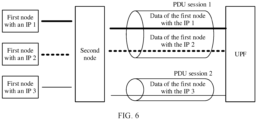
- a plurality of PDU session pipes may be established between a UPF and a second node, and one PDU session may include data flows of a plurality of first nodes.
- a plurality of PDU session pipes may be established between a UPF and the second node.
- two PDU session pipes are established: a PDU session 1 and a PDU session 2.
- Each PDU session may include data flows of one or more first nodes.
- the PDU session 1 includes a data flow of one first node with an IP address 1 and a data flow of one first node with an IP address 2
- the PDU session 2 includes a data flow of one first node with an IP address 3.
- a first node to which data in the PDU session is sent or a PDU session to which data of the first node is mapped may be specifically determined based on a mapping relationship between the IP of the first node and the PDU session shown in Table 1.
- Table 1 Mapping relationship between the IP address of the first node and the PDU session IP of the first node Identifier of the PDU session IP 1 PDU session 1 IP 2 IP 3 PDU session 2
- Each PDU session may include data flows of one or more first nodes.
- the PDU session 1 includes a data flow of a first node with a MCA address A and a data flow of a first node with a MCA address B; and the PDU session 2 includes a data flow of a first node with a MCA address C.
- the second node may determine, based on content in Table 3, that the data of the first node in this application is mapped to the PDU session 1.
- Design manner 4 The second node generates a plurality of temporary MAC addresses, and the second node establishes a mapping relationship with the PDU session based on the temporary MAC address, to finally establish a mapping relationship between the first node and the PDU session.
- the design manner of the correspondence between the PDU session and the first node may be determined based on third information sent by the second node to the first node.
- a plurality of PDU session pipes may be established between a UPF and the second node.
- two PDU session pipes are established: a PDU session 1 and a PDU session 2.
- Each PDU session may include data flows of one or more first nodes.
- the PDU session 1 includes a data flow of a first node with a temporary MCA address A and a data flow of a first node with temporary MCA address B; and the PDU session 2 includes a data flow of a first node with a temporary MCA address C.
- a first node to which data in the PDU session is sent or a PDU session to which data of the first node is mapped may be specifically determined based on a mapping relationship between the temporary MAC address of the first node and the PDU session shown in Table 4.
- Table 4 Mapping relationship between the temporary MAC address of the first node and the PDU session Temporary MAC address of the first node Identifier of the PDU session Temporary MAC address A PDU session 1 Temporary MAC address B Temporary MAC address C PDU session 2
- the second node may determine, based on content in Table 4, that the data of the first node in this application is mapped to the PDU session 1.
- the foregoing correspondence is set, so that a mapping between the first node and the PDU session can be implemented, to better determine a data routing direction.
- the processing unit 1001 is further configured to: perform, based on the data routing policy, data transmission through the first PDU session.
- the first QoS configuration policy includes one or more of the following mapping relationships: a mapping relationship between a service flow identifier QFI and a differentiated service code point DSCP of data, a mapping relationship between a DSCP and a quality of service identifier XQI, or a mapping relationship between an XQI and a QoS parameter.
- the data routing policy includes one or more of a number of QoS flows included in the first PDU session, a mapping manner of the first PDU session, a number of first nodes included in the first PDU session, or a type of mapping between the QoS flow and the first node.
- the communication unit 1002 is further configured to receive fourth information from a third node, where the fourth information indicates a second QoS configuration policy of the first PDU session, and the second QoS configuration policy includes a 5G quality of service indicator 5QI, or the second QoS configuration policy indicates a mapping relationship between a 5QI and a QFI.
- the fourth information is carried in a non-access stratum NAS message.
- the communication unit 1002 before receiving the fourth information from the third node, is further configured to send first request information, where the first request information is used to request the second QoS configuration policy of the first PDU session.
- the processing unit 1001 is further configured to determine that the first node is included in a trustlist of a second node, or determine to establish the first PDU session for the first node.
- the processing unit 1001 is further configured to perform, based on the data routing policy, data transmission through the first PDU session.
- the data routing policy indicates to perform data transmission through a first PDU session established based on an internet protocol IP address of the first node; or the data routing policy indicates to perform data transmission through a first PDU session established based on a media access control MAC address of the first node.
- the processing unit 1001 is further configured to determine that no PDU session meets a current service requirement.
- the communication unit 1002 communicates with the second node by using a first communication technology; and obtains, by using a third node, a service provided by using a second communication technology.
- the communication unit 1002 is configured to send fourth information to a second node, where the fourth information indicates a second quality of service QoS configuration policy of a first PDU session, and the second QoS configuration policy includes a 5G quality of service indicator 5QI, or the second QoS configuration policy indicates a mapping relationship between a 5QI and a service flow identifier QFI.
- the fourth information is carried in a NAS message.
- the communication unit 1002 before sending the fourth information to the second node, is further configured to receive first request information, where the first request information is used to request the second QoS configuration policy of the first PDU session.
- the communication unit 1002 communicates with the second node by using a second communication technology, and the communication unit 1002 provides, by using the second communication technology, a service for a first node that uses a first communication technology.
- division into the units is an example, and is merely a logical function division. In actual implementation, another division manner may be used.
- functional units in embodiments of this application may be integrated into one processor, or each of the units may exist alone physically, or two or more units are integrated into one unit.
- the integrated unit may be implemented in a form of hardware, or may be implemented in a form of a software functional unit.
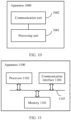
- FIG. 11 is a schematic diagram of an apparatus 1100 according to an embodiment of this application.
- the apparatus 1100 may be a node, or a component in a node, for example, a chip or an integrated circuit.
- the apparatus 1100 may include at least one processor 1102 and a communication interface 1104. Further, optionally, the apparatus may include at least one memory 1101. Further, optionally, a bus 1103 may be included.
- the memory 1101, the processor 1102, and the communication interface 1104 are connected through the bus 1103.
- the processor when the processor is a general-purpose processor, an ASIC, an FPGA or another programmable logic device, a discrete gate or a transistor logic device, or a discrete hardware component, the memory (storage module) may be integrated into the processor.
- the apparatus 1100 may be the first apparatus in the foregoing method embodiments or a component in the first apparatus, for example, a chip or an integrated circuit.
- the processor 1102 in the apparatus 1100 is configured to read the computer program stored in the memory 1101, to control the first apparatus to perform following operations: receiving first information from a first node, where the first information is used to request to establish a first protocol data unit PDU session; sending second information to the first node, where the second information indicates an identifier of the first PDU session and a first quality of service QoS configuration policy corresponding to the first PDU session, and the first QoS configuration policy includes a correspondence between the first PDU session and at least one session parameter included in the first information; and sending third information to the first node, where the third information indicates a data routing policy corresponding to the first PDU session, and the data routing policy includes session information of the first PDU session.
- the processor 1102 in the first apparatus may be further configured to: read a program in the memory 1101, and perform the method procedure performed by the first node in S300 to S306 shown in FIG. 3 , or perform the method procedure performed by the first node in S400 to S412 shown in FIG. 4 , or perform the method procedure performed by the first node in S500 to S511 shown in FIG. 5 .
- the apparatus 1100 may be the second apparatus in the foregoing method embodiments or a component in the second apparatus, for example, a chip or an integrated circuit.
- the processor 1102 in the apparatus 1100 is configured to read the computer program stored in the memory 1101, to control the second apparatus to perform following operations: sending first information to a second node, where the first information is used to request to establish a first protocol data unit PDU session; receiving second information sent by the second node, where the second information indicates an identifier of the first PDU session and a first quality of service QoS configuration policy corresponding to the first PDU session, and the first QoS configuration policy includes a correspondence between the first PDU session and at least one session parameter included in the first information; and receiving third information sent by the second node, where the third information indicates a data routing policy corresponding to the first PDU session, and the data routing policy includes session information of the first PDU session.
- the processor 1102 in the second apparatus may be further configured to: read a program in the memory 1101, and perform the method procedure performed by the second node in S300 to S306 shown in FIG. 3 , or perform the method procedure performed by the second node in S400 to S412 shown in FIG. 4 , or perform the method procedure performed by the second node in S500 to S5 11 shown in FIG. 5 .
- the processor 1102 in the second apparatus may be further configured to: read a program in the memory 1101, and perform the method procedure performed by the second node in S300 to S306 shown in FIG. 3 , or perform the method procedure performed by the second node in S400 to S412 shown in FIG. 4 , or perform the method procedure performed by the second node in S500 to S5 11 shown in FIG. 5 .
- FIG. 12 is a schematic diagram of a simplified structure of a terminal device.
- the terminal device includes a processor, a memory, a radio frequency circuit, an antenna, and an input/output apparatus.
- the processor is mainly configured to: process a communication protocol and communication data, control the terminal device, execute a software program, process data of the software program, and the like.
- the memory is mainly configured to store the software program and data.
- the radio frequency circuit is mainly configured to: perform conversion between a baseband signal and a radio frequency signal, and process the radio frequency signal.
- the antenna and the radio frequency circuit that have receiving and sending functions may be considered as a transceiver unit of the terminal device, and the processor that has a processing function may be considered as a processing unit of the terminal device.
- the terminal device includes a transceiver unit 1210 and a processing unit 1220.
- the transceiver unit may also be referred to as a transceiver, a transceiver machine, a transceiver apparatus, or the like.
- the processing unit may also be referred to as a processor, a processing board, a processing module, a processing apparatus, or the like.
- the transceiver unit 1210 is configured to perform receiving and sending steps of the first node in the embodiment shown in FIG. 3 , for example, S300, and/or support another process of the technology described in this specification.
- the processing unit 1220 is configured to perform an operation on the terminal device side in the embodiment shown in FIG. 3 other than the sending and receiving operations, for example, S306, and/or configured to support another process of the technology described in this specification.
- the transceiver unit 1210 is configured to perform receiving and sending steps of the first node in the embodiment shown in FIG. 4 , for example, S401, and/or support another process of the technology described in this specification.
- the processing unit 1220 is configured to perform an operation on the first node side in the embodiment shown in FIG. 4 other than the sending and receiving operations, for example, S412, and/or configured to support another process of the technology described in this specification.
- the chip When the communication apparatus is a chip, the chip includes a transceiver unit and a processing unit.
- the transceiver unit may be an input/output circuit or a communication interface.
- the processing unit is a processor, a microprocessor, or an integrated circuit integrated on the chip.
- An embodiment of this application further provides a computer-readable storage medium, including instructions.
- the instructions When the instructions are run on a computer, the computer is enabled to perform the method described in the foregoing embodiments.
- An embodiment of this application further provides a chip system.
- the chip system includes at least one processor and an interface circuit. Further, optionally, the chip system may include a memory or an external memory.
- the processor is configured to execute instructions and/or data interaction through the interface circuit, to implement the method in the foregoing method embodiments.
- the chip system may include a chip, or may include a chip and another discrete device.
- An embodiment of this application further provides a computer program product, including instructions.
- the instructions When the instructions are run on a computer, the computer is enabled to perform the method described in the foregoing embodiments.
- the processor may be a general-purpose processor, a digital signal processor, an application-specific integrated circuit, a field programmable gate array or another programmable logic device, a discrete gate or transistor logic device, a discrete hardware component, or a synergistic processing unit, and may implement or execute the methods, steps, and logical block diagrams disclosed in embodiments of this application.
- the general-purpose processor may be a microprocessor, any conventional processor, or the like. The steps of the method disclosed with reference to embodiments of this application may be directly performed by a hardware processor, or may be performed by using a combination of hardware in the processor and a software module.
- the memory may be a non-volatile memory, for example, a hard disk drive (hard disk drive, HDD) or a solid-state drive (solid-state drive, SSD), or may be a volatile memory (volatile memory), for example, a random access memory (random access memory, RAM).
- the memory is any other medium that can carry or store expected program code in a form of an instruction or a data structure and that can be accessed by a computer, but is not limited thereto.
- the memory in embodiments of this application may alternatively be a circuit or any other apparatus that can implement a storage function, and is configured to store program instructions and/or data.
- the computer instructions may be transmitted from a website, computer, server, or data center to another website, computer, server, or data center in a wired (for example, a coaxial cable, an optical fiber, or a digital subscriber line (digital subscriber line, briefly referred to as DSL)) or wireless (for example, infrared, radio, or microwave) manner.
- the computer-readable storage medium may be any usable medium accessible by the computer, or a data storage device such as a server or a data center, integrating one or more usable media.
- the units described as separate parts may or may not be physically separate, and parts displayed as units may or may not be physical units, that is, may be located in one position, or may be distributed on a plurality of network units. Some or all of the units may be selected based on actual requirements to achieve the objectives of the solutions of embodiments.
Landscapes
- Engineering & Computer Science (AREA)
- Computer Networks & Wireless Communication (AREA)
- Signal Processing (AREA)
- Quality & Reliability (AREA)
- Computer Security & Cryptography (AREA)
- Mobile Radio Communication Systems (AREA)
Applications Claiming Priority (2)
| Application Number | Priority Date | Filing Date | Title |
|---|---|---|---|
| CN202111179354.3A CN115967992A (zh) | 2021-10-08 | 2021-10-08 | 一种通信方法、装置及系统 |
| PCT/CN2022/121385 WO2023056852A1 (zh) | 2021-10-08 | 2022-09-26 | 一种通信方法、装置及系统 |
Publications (2)
| Publication Number | Publication Date |
|---|---|
| EP4401465A1 true EP4401465A1 (de) | 2024-07-17 |
| EP4401465A4 EP4401465A4 (de) | 2025-01-01 |
Family
ID=85803885
Family Applications (1)
| Application Number | Title | Priority Date | Filing Date |
|---|---|---|---|
| EP22877871.8A Pending EP4401465A4 (de) | 2021-10-08 | 2022-09-26 | Kommunikationsverfahren, -vorrichtung und -system |
Country Status (4)
| Country | Link |
|---|---|
| US (1) | US20240251300A1 (de) |
| EP (1) | EP4401465A4 (de) |
| CN (1) | CN115967992A (de) |
| WO (1) | WO2023056852A1 (de) |
Families Citing this family (6)
| Publication number | Priority date | Publication date | Assignee | Title |
|---|---|---|---|---|
| US20240155413A1 (en) * | 2022-11-03 | 2024-05-09 | Charter Communications Operating, Llc | Configuration and use of intermediate networks to support wireless communications |
| CN119729834A (zh) * | 2023-09-27 | 2025-03-28 | 华为技术有限公司 | 一种通信方法及装置 |
| CN119728047A (zh) * | 2023-09-28 | 2025-03-28 | 中国移动通信有限公司研究院 | 一种数据传输方法、装置、通信设备和存储介质 |
| CN117751614A (zh) * | 2023-11-02 | 2024-03-22 | 北京小米移动软件有限公司 | 通信方法、网元、通信系统和存储介质 |
| CN117796122A (zh) * | 2023-11-02 | 2024-03-29 | 北京小米移动软件有限公司 | 业务数据流的处理方法、网络设备、通信设备和存储介质 |
| CN120456331A (zh) * | 2024-02-08 | 2025-08-08 | 华为技术有限公司 | 一种通信方法、装置以及系统 |
Family Cites Families (11)
| Publication number | Priority date | Publication date | Assignee | Title |
|---|---|---|---|---|
| WO2018062949A1 (en) * | 2016-09-30 | 2018-04-05 | Samsung Electronics Co., Ltd. | Method and apparatus for establishing dual-connectivity to transmit data in new radio communication architecture |
| CN108632953A (zh) * | 2017-02-10 | 2018-10-09 | 中兴通讯股份有限公司 | 一种实现多接入管理的方法及装置 |
| US20190132251A1 (en) * | 2017-10-31 | 2019-05-02 | Huawei Technologies Co., Ltd. | Method and system for supporting multiple qos flows for unstructured pdu sessions |
| CN110048873A (zh) * | 2018-01-16 | 2019-07-23 | 华为技术有限公司 | 多锚点协议数据单元会话的策略控制的方法和通信装置 |
| CN110366271B (zh) * | 2018-04-10 | 2023-11-17 | 华为技术有限公司 | 通信方法和通信装置 |
| CN110557786B (zh) * | 2018-05-31 | 2022-04-05 | 华为技术有限公司 | 一种无线承载建立、业务流的监测方法及装置 |
| CN111436081B (zh) * | 2019-03-06 | 2023-06-30 | 维沃移动通信有限公司 | 数据传送的保障方法及通信设备 |
| CN111770545B (zh) * | 2019-04-02 | 2022-08-26 | 华为技术有限公司 | 一种业务流路由控制方法、装置及系统 |
| CN112584458B (zh) * | 2019-09-30 | 2023-01-06 | 华为技术有限公司 | 数据传输方法及装置 |
| CN113038553B (zh) * | 2021-02-25 | 2023-10-27 | 腾讯科技(深圳)有限公司 | 基于切换过程的消息发送方法、装置、设备及介质 |
| US20240015569A1 (en) * | 2022-12-21 | 2024-01-11 | Intel Corporation | Quality of service management for 5g networks |
-
2021
- 2021-10-08 CN CN202111179354.3A patent/CN115967992A/zh active Pending
-
2022
- 2022-09-26 WO PCT/CN2022/121385 patent/WO2023056852A1/zh not_active Ceased
- 2022-09-26 EP EP22877871.8A patent/EP4401465A4/de active Pending
-
2024
- 2024-04-05 US US18/627,523 patent/US20240251300A1/en active Pending
Also Published As
| Publication number | Publication date |
|---|---|
| CN115967992A (zh) | 2023-04-14 |
| EP4401465A4 (de) | 2025-01-01 |
| US20240251300A1 (en) | 2024-07-25 |
| WO2023056852A1 (zh) | 2023-04-13 |
Similar Documents
| Publication | Publication Date | Title |
|---|---|---|
| US20240251300A1 (en) | Communication method, apparatus, and system | |
| WO2022021247A1 (zh) | 基于条件的辅节点或主辅小区变更方法及设备 | |
| CN113873492B (zh) | 一种通信方法以及相关装置 | |
| EP4391599A1 (de) | Verfahren und vorrichtung zur kommunikation zwischen vorrichtungen | |
| WO2020050138A1 (ja) | コアネットワーク装置、アクセスネットワーク装置、通信端末、通信システム、及び通信方法 | |
| US12096271B2 (en) | Methods for service transmission, core network device, and access network device | |
| US12470462B2 (en) | Communication method and communication apparatus for optimizing session establishment in wireless networks using network slice information | |
| WO2020150876A1 (zh) | 会话建立方法、终端设备和网络设备 | |
| CN115567991B (zh) | 传输方式切换的方法和相关装置 | |
| CN116866981A (zh) | 通信方法和装置 | |
| WO2024051313A1 (zh) | 通信资源管理方法、装置、系统及存储介质 | |
| US20240340709A1 (en) | Communication method and apparatus | |
| WO2022237857A1 (zh) | 确定安全保护开启方式的方法、通信方法及通信装置 | |
| US20240380730A1 (en) | Enabling distributed non-access stratum terminations | |
| CN116488759A (zh) | 授时方法及装置 | |
| US20240349044A1 (en) | Communication method, apparatus, and system | |
| US20240267433A1 (en) | Communication method, apparatus, and system | |
| CN111836325A (zh) | 小区切换方法以及装置 | |
| WO2023137760A1 (zh) | 无线通信方法、远端ue、ausf以及amf | |
| CN114731544B (zh) | 一种基于网络切片的数据传输方法、装置和系统 | |
| WO2022160205A1 (zh) | 一种数据传输方法、终端设备和网络设备 | |
| WO2022213779A1 (zh) | 参数配置方法、终端设备和网络设备 | |
| CN117641320A (zh) | 一种业务流路由方法及装置 | |
| WO2022160275A1 (zh) | 无线通信方法、设备及存储介质 | |
| CN115226164B (zh) | 中继通信方法和装置 |
Legal Events
| Date | Code | Title | Description |
|---|---|---|---|
| STAA | Information on the status of an ep patent application or granted ep patent |
Free format text: STATUS: THE INTERNATIONAL PUBLICATION HAS BEEN MADE |
|
| PUAI | Public reference made under article 153(3) epc to a published international application that has entered the european phase |
Free format text: ORIGINAL CODE: 0009012 |
|
| STAA | Information on the status of an ep patent application or granted ep patent |
Free format text: STATUS: REQUEST FOR EXAMINATION WAS MADE |
|
| 17P | Request for examination filed |
Effective date: 20240412 |
|
| AK | Designated contracting states |
Kind code of ref document: A1 Designated state(s): AL AT BE BG CH CY CZ DE DK EE ES FI FR GB GR HR HU IE IS IT LI LT LU LV MC MK MT NL NO PL PT RO RS SE SI SK SM TR |
|
| A4 | Supplementary search report drawn up and despatched |
Effective date: 20241204 |
|
| RIC1 | Information provided on ipc code assigned before grant |
Ipc: H04W 76/10 20180101ALI20241128BHEP Ipc: H04L 47/2491 20220101ALI20241128BHEP Ipc: H04W 48/16 20090101ALI20241128BHEP Ipc: H04W 28/24 20090101AFI20241128BHEP |
|
| DAV | Request for validation of the european patent (deleted) | ||
| DAX | Request for extension of the european patent (deleted) |