EP4403202A1 - Mit einem arzneimittel beschichtete mikronadelanordnung - Google Patents
Mit einem arzneimittel beschichtete mikronadelanordnung Download PDFInfo
- Publication number
- EP4403202A1 EP4403202A1 EP22870036.5A EP22870036A EP4403202A1 EP 4403202 A1 EP4403202 A1 EP 4403202A1 EP 22870036 A EP22870036 A EP 22870036A EP 4403202 A1 EP4403202 A1 EP 4403202A1
- Authority
- EP
- European Patent Office
- Prior art keywords
- drug
- needle
- microneedle array
- microneedle
- tip section
- Prior art date
- Legal status (The legal status is an assumption and is not a legal conclusion. Google has not performed a legal analysis and makes no representation as to the accuracy of the status listed.)
- Pending
Links
Images


Classifications
-
- A—HUMAN NECESSITIES
- A61—MEDICAL OR VETERINARY SCIENCE; HYGIENE
- A61M—DEVICES FOR INTRODUCING MEDIA INTO, OR ONTO, THE BODY; DEVICES FOR TRANSDUCING BODY MEDIA OR FOR TAKING MEDIA FROM THE BODY; DEVICES FOR PRODUCING OR ENDING SLEEP OR STUPOR
- A61M37/00—Other apparatus for introducing media into the body; Percutany, i.e. introducing medicines into the body by diffusion through the skin
-
- A—HUMAN NECESSITIES
- A61—MEDICAL OR VETERINARY SCIENCE; HYGIENE
- A61M—DEVICES FOR INTRODUCING MEDIA INTO, OR ONTO, THE BODY; DEVICES FOR TRANSDUCING BODY MEDIA OR FOR TAKING MEDIA FROM THE BODY; DEVICES FOR PRODUCING OR ENDING SLEEP OR STUPOR
- A61M37/00—Other apparatus for introducing media into the body; Percutany, i.e. introducing medicines into the body by diffusion through the skin
- A61M37/0015—Other apparatus for introducing media into the body; Percutany, i.e. introducing medicines into the body by diffusion through the skin by using microneedles
-
- A—HUMAN NECESSITIES
- A61—MEDICAL OR VETERINARY SCIENCE; HYGIENE
- A61K—PREPARATIONS FOR MEDICAL, DENTAL OR TOILETRY PURPOSES
- A61K47/00—Medicinal preparations characterised by the non-active ingredients used, e.g. carriers or inert additives; Targeting or modifying agents chemically bound to the active ingredient
- A61K47/30—Macromolecular organic or inorganic compounds, e.g. inorganic polyphosphates
- A61K47/32—Macromolecular compounds obtained by reactions only involving carbon-to-carbon unsaturated bonds, e.g. carbomers, poly(meth)acrylates, or polyvinyl pyrrolidone
-
- A—HUMAN NECESSITIES
- A61—MEDICAL OR VETERINARY SCIENCE; HYGIENE
- A61K—PREPARATIONS FOR MEDICAL, DENTAL OR TOILETRY PURPOSES
- A61K47/00—Medicinal preparations characterised by the non-active ingredients used, e.g. carriers or inert additives; Targeting or modifying agents chemically bound to the active ingredient
- A61K47/30—Macromolecular organic or inorganic compounds, e.g. inorganic polyphosphates
- A61K47/34—Macromolecular compounds obtained otherwise than by reactions only involving carbon-to-carbon unsaturated bonds, e.g. polyesters, polyamino acids, polysiloxanes, polyphosphazines, copolymers of polyalkylene glycol or poloxamers
-
- A—HUMAN NECESSITIES
- A61—MEDICAL OR VETERINARY SCIENCE; HYGIENE
- A61K—PREPARATIONS FOR MEDICAL, DENTAL OR TOILETRY PURPOSES
- A61K47/00—Medicinal preparations characterised by the non-active ingredients used, e.g. carriers or inert additives; Targeting or modifying agents chemically bound to the active ingredient
- A61K47/30—Macromolecular organic or inorganic compounds, e.g. inorganic polyphosphates
- A61K47/36—Polysaccharides; Derivatives thereof, e.g. gums, starch, alginate, dextrin, hyaluronic acid, chitosan, inulin, agar or pectin
-
- A—HUMAN NECESSITIES
- A61—MEDICAL OR VETERINARY SCIENCE; HYGIENE
- A61K—PREPARATIONS FOR MEDICAL, DENTAL OR TOILETRY PURPOSES
- A61K47/00—Medicinal preparations characterised by the non-active ingredients used, e.g. carriers or inert additives; Targeting or modifying agents chemically bound to the active ingredient
- A61K47/30—Macromolecular organic or inorganic compounds, e.g. inorganic polyphosphates
- A61K47/36—Polysaccharides; Derivatives thereof, e.g. gums, starch, alginate, dextrin, hyaluronic acid, chitosan, inulin, agar or pectin
- A61K47/38—Cellulose; Derivatives thereof
-
- A—HUMAN NECESSITIES
- A61—MEDICAL OR VETERINARY SCIENCE; HYGIENE
- A61K—PREPARATIONS FOR MEDICAL, DENTAL OR TOILETRY PURPOSES
- A61K9/00—Medicinal preparations characterised by special physical form
- A61K9/0012—Galenical forms characterised by the site of application
- A61K9/0019—Injectable compositions; Intramuscular, intravenous, arterial, subcutaneous administration; Compositions to be administered through the skin in an invasive manner
- A61K9/0021—Intradermal administration, e.g. through microneedle arrays or needleless injectors
-
- A—HUMAN NECESSITIES
- A61—MEDICAL OR VETERINARY SCIENCE; HYGIENE
- A61M—DEVICES FOR INTRODUCING MEDIA INTO, OR ONTO, THE BODY; DEVICES FOR TRANSDUCING BODY MEDIA OR FOR TAKING MEDIA FROM THE BODY; DEVICES FOR PRODUCING OR ENDING SLEEP OR STUPOR
- A61M37/00—Other apparatus for introducing media into the body; Percutany, i.e. introducing medicines into the body by diffusion through the skin
- A61M37/0015—Other apparatus for introducing media into the body; Percutany, i.e. introducing medicines into the body by diffusion through the skin by using microneedles
- A61M2037/0023—Drug applicators using microneedles
-
- A—HUMAN NECESSITIES
- A61—MEDICAL OR VETERINARY SCIENCE; HYGIENE
- A61M—DEVICES FOR INTRODUCING MEDIA INTO, OR ONTO, THE BODY; DEVICES FOR TRANSDUCING BODY MEDIA OR FOR TAKING MEDIA FROM THE BODY; DEVICES FOR PRODUCING OR ENDING SLEEP OR STUPOR
- A61M37/00—Other apparatus for introducing media into the body; Percutany, i.e. introducing medicines into the body by diffusion through the skin
- A61M37/0015—Other apparatus for introducing media into the body; Percutany, i.e. introducing medicines into the body by diffusion through the skin by using microneedles
- A61M2037/0046—Solid microneedles
-
- A—HUMAN NECESSITIES
- A61—MEDICAL OR VETERINARY SCIENCE; HYGIENE
- A61M—DEVICES FOR INTRODUCING MEDIA INTO, OR ONTO, THE BODY; DEVICES FOR TRANSDUCING BODY MEDIA OR FOR TAKING MEDIA FROM THE BODY; DEVICES FOR PRODUCING OR ENDING SLEEP OR STUPOR
- A61M37/00—Other apparatus for introducing media into the body; Percutany, i.e. introducing medicines into the body by diffusion through the skin
- A61M37/0015—Other apparatus for introducing media into the body; Percutany, i.e. introducing medicines into the body by diffusion through the skin by using microneedles
- A61M2037/0053—Methods for producing microneedles
-
- A—HUMAN NECESSITIES
- A61—MEDICAL OR VETERINARY SCIENCE; HYGIENE
- A61M—DEVICES FOR INTRODUCING MEDIA INTO, OR ONTO, THE BODY; DEVICES FOR TRANSDUCING BODY MEDIA OR FOR TAKING MEDIA FROM THE BODY; DEVICES FOR PRODUCING OR ENDING SLEEP OR STUPOR
- A61M2205/00—General characteristics of the apparatus
- A61M2205/02—General characteristics of the apparatus characterised by a particular materials
- A61M2205/0238—General characteristics of the apparatus characterised by a particular materials the material being a coating or protective layer
-
- A—HUMAN NECESSITIES
- A61—MEDICAL OR VETERINARY SCIENCE; HYGIENE
- A61M—DEVICES FOR INTRODUCING MEDIA INTO, OR ONTO, THE BODY; DEVICES FOR TRANSDUCING BODY MEDIA OR FOR TAKING MEDIA FROM THE BODY; DEVICES FOR PRODUCING OR ENDING SLEEP OR STUPOR
- A61M2207/00—Methods of manufacture, assembly or production
Definitions
- the present invention relates to a microneedle array with a drug applied, and relates to the field of transdermal absorption preparations.
- Non-Patent Document 1 a transdermal administration method without pain using a microneedle array has recently been attracting attention.
- a microneedle In the transdermal administration of a medicine, skin stratum corneum works as a barrier to medicine permeation, so that enough permeability is not always provided by only applying the medicine on a skin surface. In contrast, perforation of stratum corneum by using a minute needle, i.e., a microneedle can remarkably improve medicine permeation efficiency compared to the application method.
- An article in which a large number of such microneedles are integrated on a substrate is a microneedle array.
- a product in which a pressure-sensitive adhesive sheet for adhering a microneedle array to a skin, a release sheet for protecting a pressure-sensitive adhesive surface, or the like is added to the microneedle array to facilitate its use is called a microneedle patch.
- Patent Documents 1 to 4 Some attempts to efficiently utilize expensive medicines are already known. Methods in which surfaces of microneedles are coated with a medicine by using a medicine solution (Patent Documents 1 to 4) and a method in which a medicine is granulated and the medicine is converged to the tips of microneedles by centrifugation while the microneedles maintain softness (Patent Document 5) have been reported.
- the method of coating the surfaces of microneedles with a medicine and the method of adhering a medicine to the tips of microneedles from a medicine solution have a problem that the medicine must be heated or that the adhered medicine falls away during insertion of the microneedles.
- Patent Document 6 a method in which through dissolving a medicine in a solvent of a microneedle material, a microneedle body and a medicine adhered thereto are integrated together and the adhered medicine is prevented from falling away has been proposed.
- Patent Documents 1 to 4, 6 The method of immersing the tips of microneedles into a medicine solution to adhere the medicine to the tips of microneedles is easily put into practical use due to its convenience (Patent Documents 1 to 4, 6). However, it is very difficult to quantitatively apply the medicine to the tips of microneedles with little unevenness.
- microneedles made of a hydrophobic material it is very difficult to apply a medicine from its aqueous solution.
- the aqueous medicine solution extremely easily moves up among needles. Accordingly, it is extremely difficult to make a microneedle array hold a medicine quantitatively through immersing the microneedle array into an aqueous medicine solution to a certain fixed depth although many attempts have been repeated.
- Patent Document 2 In order to prevent the capillary phenomenon, a method of masking any place other than the tip section of microneedles before applying a medicine has been proposed (Patent Document 2). A method of enhancing the quantitativeness of a medicine adhesion amount through putting a drug into a large number of holes and inserting microneedles into the holes (Patent Document 4) has also been proposed. However, it is very cumbersome to implement these methods.
- Patent Document 7 a microneedle provided with a step and maintaining a sharp tip section with a drug carried at the stepped part and with the tip of the microneedle exposed
- Patent Document 8 a technique of holding a medicine at a tip section and the step and thereby quantitatively administering the medicine
- Patent Document 9 a technique in which, when a drug is applied to a microneedle having a specific length, the position of the lower end of the applied portion or the maximum diameter of the applied portion is adjusted to minimize a part of the drug to remain in the stratum corneum after skin administration.
- Non-Patent Document 1 Ying-shu Quan, Fumio Kamiyama, "The Course of Productization of Microneedle", The Archives of Practical Pharmacy, The Academy of Pharmaceutical Science and Technology, Japan, July 2009, Vol. 69, No. 4, pp. 272-276
- the present inventors actually applied a microneedle array with a drug applied to a microneedle tip section to an animal or a skin substitute (laminated parafilm), and evaluated the skin insertability of the microneedle in detail.
- the microneedle itself (before medicine application) is a circular, elliptical, or polygonal thin needle having a diameter of a needle tip section apex of 15 um or more and 100 um or less, a needle length of 350 um or more and 1,500 um or less, and an aspect ratio of 3 or more, and the microneedle itself has good skin insertability.
- a medicine dissolved in a base is applied on the microneedle, the thickness of the needle increases and the skin insertability of the needle deteriorates.
- An object of the present invention is to provide a practical microneedle preparation through finding an appropriate application condition regarding a geometric shape and a position on a needle of an applied material in a coated type microneedle.
- the present inventors have conducted detailed studies on an application amount, an application position, an application diameter, and the like of a drug for a wide variety of microneedles with a drug applied, and as a result of intensive studies on the skin insertability of a needle, have found that the intended object can be achieved by combining a microneedle having a specific shape with a specific ratio of a drug-applied portion, and have accomplished the present invention.
- the present invention is as follows.
- the microneedles installed in the microneedle array of the present invention each have a shape with a needle length of 350 um or more and 1,500 um or less and a diameter of a tip section apex of 15 pm or more and 100 pm or less.
- the needle itself (the needle before drug application) preferably has an aspect ratio of 3 or more, and specifically, the needle itself is a circular, elliptical, or polygonal thin needle, and the needle density is 50 to 1,500 needles/cm 2 .
- the microneedle array of the present invention may be one comprising a non-biosoluble substance as a material.
- a non-biosoluble substance for example, titanium, stainless steel, or the like can be used.
- the microneedle array of the present invention comprises a non-biosoluble polymer as a base.
- the non-biosoluble polymer refers to a polymer having a property not to completely dissolve for at least 15 minutes after being molded into a microneedle and inserted into a skin.
- a polymer capable of being easily injection-molded or press-molded is preferable, and examples thereof include a polymer selected from the group consisting of nylon, polycarbonate, polylactic acid, poly(lactic acid-glycolic acid) copolymer, polyglycolic acid, polyethylene terephthalate, COP (cyclic olefin polymer), and mixtures thereof.
- the base of the microneedle array of the present invention may be a polymer selected from the group consisting of hyaluronic acid, dextran, polyvinylpyrrolidone, sodium chondroitin sulfate, hydroxypropyl cellulose, polyvinyl alcohol, and mixtures thereof as long as the polymer has a property not to completely dissolve for at least 15 minutes after being molded into a microneedle and inserted into a skin.
- the microneedle array of the present invention is characterized in that the upper end of the drug-applied portion is at a position 30 um or more lower than the upper end of the needle. That is, there is no drug at the upper end section of the microneedle with a drug applied, and it is clear that the upper end section of the microneedle is not coated.
- the lower end and the upper end of the drug-applied portion are values obtained by measuring the lower end and the upper end of the microneedle with the drug applied, respectively, in a vertical direction from the substrate of the microneedle array.
- the length of the drug-applied portion is expressed by the difference between the lower end and the upper end of the microneedle with the drug applied.
- a microneedle array with a drug applied to a needle tip section significantly improves a medicine permeation efficiency by piercing a skin stratum corneum acting as a barrier to medicine permeation during transdermal administration of the drug.
- the application position of the drug has an important role on the skin insertability of the needle, and thus on the skin delivery property of the medicine.
- the medicine-coated microneedle array containing no drug at the needle upper end and retaining the sharp and thin shape of the microneedle has exhibited extremely good skin insertability.
- microneedle array having an applied material on a needle upper portion receives large skin resistance at the time of insertion, resulting in poor skin insertability of the needle.
- the microneedle array of the present invention has succeeded in reducing the residue of the drug in the stratum corneum through specifying the shape of the microneedle and the position of the drug-applied portion.
- the microneedle array of the present invention is a transdermal absorption preparation with further enhanced transdermal drug delivery efficiency.
- the microneedle array of the present invention can deliver a rare medicine to a dermis layer with less burden on the body and transfer the medicine to blood to maintain a blood medicine concentration.
- Each microneedle constituting the microneedle array has a needle length of 350 um or more and 1,500 um or less, preferably 400 um or more and 1,000 um or less, in order to ensure transdermal absorption of a medicine.
- a needle length of less than 350 um is unsuitable because it leads to a narrow applied portion. If the needle length exceeds 1,500 um, there is a risk of bleeding.
- the diameter of the tip section apex of the needle is 15 pm or more and 100 pm or less, preferably 20 pm or more and 60 pm or less in order to facilitate insertion into the skin and reduce the medicine residue in the skin.
- the tip section is less than 15 um, the tip section is weak, and when the microneedle is inserted into the skin, the tip section may bend due to skin resistance, resulting in defective insertion. If the diameter of the tip section exceeds 100 um, the tip section is excessively large and it has difficulty in insertion into the skin.
- the needle itself (the needle before medicine application) has an aspect ratio of 3 or more, and the needle is a thin needle with a shape of the bottom face (the outer shape of the bottom face) of the needle being circular, elliptical, or polygonal.
- the aspect ratio is less than 3, the microneedle is sharply thickened from the tip section, and thus there is a risk that the microneedle is pushed back from the skin in a short time even if the microneedle is once inserted into the skin by impactive administration.
- the diameter (B) of the needle root section means the diameter of a circle when the shape of the needle root section (the shape of the bottom face of the needle) is circular, means the major axis of an ellipse when the shape of the needle root section (the shape of the bottom face of the needle) is elliptical, and means the length of a diagonal line of a polygon when the shape of the needle root section (the shape of the bottom face of the needle) is polygonal.
- the needle density is 50 to 1,500 needles/cm 2 .
- the medicine application amount is small, and when the needle density exceeds 1,500 needles/cm 2 , a problem often occurs in insertion of the needle into the skin due to the high density.
- Each microneedle is in a cylindrical or conical shape with a circle bottom face, or in an elliptical cylindrical or elliptical conical shape with an elliptical bottom face.
- the size of the ellipse is expressed, it is expressed using the major axis as a diameter, and the minor axis is shorter than the major axis as long as an ellipse can be formed.
- Microneedles having these shapes may have a step.
- the step refers to a portion where the cross-sectional area of the microneedle is discontinuously reduced from a certain point of the microneedle toward the tip and where a cross section has a stepped shape as shown in FIG. 1 .
- This example is a two-stage stepped microneedle.
- the shape of the stepped microneedle will be described with reference to FIG. 1 .
- a length of a tip section is 50 to 450 ⁇ m and the rest is a bottom section.
- the size of the margin 2 of the step between the tip section and the bottom section is preferably larger than 10 um and smaller than 100 um.
- the size of the margin is more preferably 14 to 50 um.
- Reference numeral 4 denotes a substrate of the microneedle array.
- FIG. 1 illustrates an example of a two-stage step, but there may be more steps. In a three-stage stepped microneedle, it is preferable that the microneedle has a tip section, an intermediate section, and a bottom section, and each of them has a length of 50 to 450 um.
- the margin 2 of the step is a face perpendicular to the axis of the microneedle (a face parallel to the substrate) within a range of machining accuracy.
- the size of the margin 2 of the step refers to a difference in radius between the tip section and the bottom section on the stepped part.
- the tip section may be in a conical shape, a cylindrical shape, an elliptical cylindrical shape, or an elliptical conical shape depending on the shape of the microneedle.
- the bottom section may be a circular truncated cone, a circular cylinder, an elliptic cylinder, or an elliptic truncated cone depending on the shape of the microneedle.
- the microneedle array of the present invention has a drug-applied portion.
- the drug-applied portion is characterized by not being a tip section of the microneedle but being at a position of 30 um or less from the tip section of the microneedle. In other words, when the tip of the microneedle is directed upward, the upper end of the drug-applied portion is at a position 30 um or more lower than the tip of the needle.
- the length of the drug-applied portion is typically 100 um or more and 800 um or less, and preferably 150 um or more and 600 um or less.
- the length of the drug-applied portion is a value obtained by measuring the lower end and the upper end of the microneedle with the drug applied each in a vertical direction from the substrate of the microneedle array.
- the length of the drug-applied portion is a distance from the lower end of the drug-applied portion to the upper end of the drug-applied portion along the length direction of the microneedle.
- the drug-applied portion varies in thickness depending on the drug-containing application liquid and the number of times of application.
- the thickness of the applied portion can be expressed by the maximum diameter in the vicinity of the center of the drug-applied portion.
- the diameter in the vicinity of the center of the drug-applied portion is larger than the diameter of the microneedle before the drug application.
- the maximum diameter of the drug-applied portion is 300 um or less.
- the maximum diameter of the drug-applied portion is desirably 200 um or less, and more desirably 150 um or less.
- the maximum diameter of the drug-applied portion may be 50 um or more, or may be 100 um or more.
- the total weight of the applied material including the drug per needle is desirably 0.001 to 30 ⁇ g.
- the total weight of the drug applied per needle is desirably 0.001 to 30 ⁇ g.
- the present inventors have found that, in addition to the position of the drug-applied portion of a microneedle, when the thickest diameter in the vicinity of the center of the drug-applied portion is within the prescribed range, the residue of the drug in the stratum corneum is reduced, and a practical microneedle array can be realized.
- the drug is not particularly limited as long as it is a drug conventionally used as a transdermal absorption preparation.
- the drug include antipyretic analgesic, steroidal antiinflammatory agent, vasodilator, antiarrhythmic agent, antihypertensive agent, local anesthetic, hormone, antihistamine, general anesthetic, sedative hypnotic agent, anti-temper tantrum agent, psychoneurosis agent, skeletal muscle relaxant, autonomic agent, antiparkinsonian, diuretic, vasoconstrictor, respiratory stimulant, narcotic, and antigenic components against pathogens (e.g., vaccine antigenic protein).
- the content of the medicinal ingredient can be appropriately set depending on the characteristic of the ingredient, the purpose of administration, the administration subject, the number of administrations, and the like.
- the drug may be a raw material for cosmetics, particularly a valuable component.
- a medicine refers to a substance having a pharmacological action
- a drug is as described above, but the terms “drug” and “medicine” can be used interchangeably.
- drugs are low molecular weight compounds having a molecular weight of 600 or less, but high molecular weight drugs can also be used.
- high molecular weight drugs include physiologically active peptides and derivatives thereof, nucleic acids, oligonucleotides, various antigenic proteins, bacteria, and viral fragments.
- physiologically active peptides and derivatives thereof include calcitonin, adrenocorticotropic hormone, epidermal growth factor (EGF), parathyroid hormone (PTH), hPTH (1 ⁇ 34), insulin, atrial natriuretic peptide, growth hormone, growth hormone-releasing hormone, endothelin, and salts thereof.
- these medicinal ingredients can be administered not only for humans but also for animals.
- antigenic proteins include influenza virus antigen, Japanese encephalitis virus antigen, diphtheria, tetanus antigens, HBs surface antigen, and HBe antigen.
- the base of the microneedle is preferably a polymer capable of being easily injection-molded or press-molded, and examples thereof include nylon, polycarbonate, polylactic acid, poly(lactic acid-glycolic acid) copolymer, polyglycolic acid, polyethylene terephthalate, COP (cyclic olefin polymer), and mixtures thereof.
- the non-biosoluble polymer may be hyaluronic acid, dextran, polyvinylpyrrolidone, sodium chondroitin sulfate, hydroxypropyl cellulose, polyvinyl alcohol, or a mixture thereof as long as the non-biosoluble polymer has a property not to completely dissolve for at least 15 minutes after being molded into a microneedle and inserted into a skin.
- the microneedle array can be mass-produced using a mold (a die).
- a microneedle array comprising an injection-moldable polymer as a base may be produced by injection-molding the base using a mold (e.g., the method described in JP 2003-238347 A , [0017] and [0018]).
- a mold e.g., the method described in JP 2003-238347 A , [0017] and [0018]
- stainless steel, heat resistant steel, superalloy, or the like can be used.
- a typical die has cavities corresponding to microneedles at a density of 100 to 1000 cavities per square centimeter in order to form microneedle shapes.
- a fine processing means such as a grinder can be used.
- an aqueous solution of the base may be poured into a mold, dried, and then removed (e.g., the method described in JP 2009-273872 A , [0029] to [0031]).
- a microneedle array has a needle length of 350 pm or more and 1,500 um or less and a diameter of a needle tip section apex of 15 um or more and 100 um or less and comprising a non-biosoluble polymer as a base is prepared.
- the drug is applied to the microneedle array by immersing the tips of microneedles in a drug-containing application liquid to hold the medicine on the tips of the microneedles.
- the drug-containing application liquid is typically an aqueous solution, but may contain a solvent other than water in order to dissolve the medicine.
- the medicine may be completely dissolved or may be dispersed in a solvent.
- the coexistent substance is required to be a substance that does not impair the stability of the medicine, and for example, water-soluble polymer substances such as hyaluronic acid, collagen, dextrin, dextran, sodium chondroitin sulfate, hydroxypropyl cellulose, ethyl cellulose, sodium carboxymethyl cellulose salt, and alginic acid, low molecular weight saccharides such as glucose, sucrose, maltose, and trehalose, or mixtures thereof are suitable.
- water-soluble polymer substances such as hyaluronic acid, collagen, dextrin, dextran, sodium chondroitin sulfate, hydroxypropyl cellulose, ethyl cellulose, sodium carboxymethyl cellulose salt, and alginic acid, low molecular weight saccharides such as glucose, sucrose, maltose, and trehalose, or mixtures thereof are suitable.
- the viscosity of the application liquid is preferably 50 to 2,000 mPa ⁇ s (25°C).
- the viscosity is excessively low, the application amount to the microneedles tends to be small.
- the viscosity is excessively high, application itself becomes difficult due to a decrease in fluidity due to the high viscosity.
- the solution viscosity is measured using a B-type viscometer and an HB2 spindle at a rotation speed of 30 rpm.
- the coexistent substance is only a water-soluble polymer substance
- a dissolution time of a coating film in the skin may be long at transdermal administration of the microneedles.
- a coating film made of only a low molecular weight saccharide has insufficient mechanical strength. Therefore, as the coexistent substance for the drug-containing application liquid into which the microneedles are to be immersed, a mixture of a water-soluble polymer and a low molecular weight saccharide is desirable.
- the proportion of the low molecular weight saccharide is desirably 80% by mass or less with respect to the total weight of the coexistent substances.
- the concentration of the coexistent substance in the drug-containing application liquid is desirably 2% by mass to 50% by mass in consideration of the viscosity of the application liquid. At a concentration lower than 2% by mass, the viscosity of the drug-containing application liquid is low, and the application adhesion amount at the time of immersion is small. When the concentration is more than 50% by mass, medicine application is not stable.
- the immersion time and the number of immersions can be set depending on the affinity between the base of the microneedles and the drug-containing application liquid, and the drug-containing application liquid is applied such that the diameter in the vicinity of the center of the drug-applied portion is a desired value.
- the drug-containing application liquid is dried until the solvent is evaporated.
- the drug-containing application liquid may be naturally dried or forcibly dried by blowing dry air, nitrogen gas or the like.
- the drug-containing application liquid is filled in the medicine solution reservoir, and the microneedle array is immersed from above to adhere the medicine to the needles.
- the application device needs to be capable of controlling the immersion depth with an accuracy of about 20 microns in order to strictly define the immersion depth of the microneedle array. Whether the drug-containing application liquid is applied concentratedly to the needle upper end section or applied to the lower portion is adjusted by the immersion distance and the immersion time in the drug-containing application liquid.
- the transdermal absorption preparation of the present invention is composed of a microneedle array having a drug-applied portion.
- the transdermal absorption preparation of the present invention is administered to an animal having a skin tissue.
- the animal include fish, amphibians, reptiles, birds (e.g., poultries such as chickens, quails, turkeys, ducks, gooses, call ducks, and ostrich), and mammals. Mammals may or may not include humans. Examples of the mammals other than humans include: rodents such as mice, rats, hamsters, and guinea pigs; pets such as rabbits, cats, and dogs; domestic animals such as pigs, cows, horses, sheep, and goats; and primates such as monkeys, orangutans, gorillas, and chimpanzees.
- the transdermal absorption preparation of the present invention is preferably administered to mammals.
- FIG. 2 is images illustrating an example in which a drug is applied to a microneedle tip and an example in which a drug is not applied to a microneedle tip, and photographs corresponding to Comparative Example 1 and Example 1.
- the PGA-MN substrate has an elliptical shape with a major axis of 1.4 mm, a minor axis of 1.2 mm, and a thickness of 1.0 mm, and has a pedestal section with a thickness of 1.0 mm on an upper portion thereof.
- Each needle had a three-stage structure, had an overall length of 900 um, and also had a length of 300 um for each of the tip section, the intermediate section, and the root section.
- the total number of needles was 193.
- the diameter of the tip section was 40 um, and the diameter of the root section was 190 um.
- the application liquid and the application conditions are as follows.
- Example 1 has a needle insertability better than that of the product of Comparative Example 1 although the weight of the applied portion is 1.7 times.
- Example 1 has a needle insertability to a pig skin better than that of the product of Comparative Example 1 although the weight of the applied portion is 1.7 times.
- FIG. 4 An overall image of the PGA-MN subjected to the experiment is shown in FIG. 4 .
- the PGA-MN substrate has an elliptical shape with a major axis of 1.4 mm, a minor axis of 1.2 mm, and a thickness of 1.0 mm, and has a pedestal section with a thickness of 1.0 mm on an upper portion thereof.
- the needles had a three-stage structure, the overall length was 900 um, and the total number of needles was 232.
- the diameter of the tip section was 40 um, and the diameter of the root section was 190 um.
- the same application liquid as in Example 1 was applied to the microneedles to prepare four types of microneedles as shown in Table 2.
- the viscosity was 260 mPa ⁇ s.
- the test of Test Example 1 (application to parafilm) was performed in the same manner as in Example 1, and the reached depth (insertion depth) was measured.
- Example 2 95 460 110 650
- Example 3 110 490 245 650
- microneedle administration by an applicator was performed under the spring condition specified by a spring constant of 0.26 N/mm and a length of 70 mm. In the case of an applicator having a smaller spring constant, the difference between the microneedle with the applied tip section and the non-applied microneedle was observed to be larger.
- the present invention is considered to be important for obtaining a practical microneedle preparation.
- Microneedles were molded using polyglycolic acid (Kuredux, Kureha Corporation) as a raw material under the same production conditions as in Example 2.
- the shape and size of the molded microneedles were the same as those of the microneedle in Example 2 except that the needle tip section diameter was 28 um.
- the drug was applied using these microneedles.
- the application liquid was an aqueous solution containing 10% by mass of hyaluronic acid and 0.001% by mass of rhodamine B.
- the solution viscosity was 450 mPa ⁇ s (25°C).
- the tip of each of the microneedles was immersed in the application liquid placed in a container, pulled up, and dried to form an application layer.
- the maximum thickness of an applied portion was adjusted by varying the immersion distance and the number of immersions.
- FIGS. 5 and 6 are micrographs of the applied microneedles having the maximum diameters of the applied portions of 240 um and 310 um, respectively.
- the main dimensions are summarized in Table 3.
- a 10% by mass solution of polylactic acid in acetone was poured into a dented mold having a thin tip section, then pressurized by centrifugation to form a needle, and then removed from the mold, affording a microneedle array.
- the tip thickness was 11 um.
- the application liquid was an aqueous solution containing 10% by mass of hyaluronic acid and 0.001% by mass of rhodamine B.
- the tip of each of the microneedles was immersed in the application liquid placed in a container, pulled up, and dried to form an application layer.
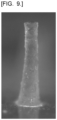
- a photograph of the microneedle before application is shown in FIG. 7 .
- Example 6 900 28 190 240 510 232 (1) 5 Comparative Example 2 900 28 190 310 430 232 (2) 6 Comparative Example 3 1,000 11 230 230 400 200 (3) 7 (before application) Example 7 960 80 290 230 420 200 (1) 8 (before application) Comparative Example 4 960 150 290 240 420 200 (4) 9 (before application)
- Test Example 3 Administration to excised pig skin of coated microneedles of five types of microneedle arrays
- the diameter of the needle tip section apex is preferably 15 um or more and 100 um or less, and the maximum diameter of the applied portion is preferably 300 um or less.
Landscapes
- Health & Medical Sciences (AREA)
- Life Sciences & Earth Sciences (AREA)
- Chemical & Material Sciences (AREA)
- Animal Behavior & Ethology (AREA)
- Veterinary Medicine (AREA)
- Public Health (AREA)
- General Health & Medical Sciences (AREA)
- Engineering & Computer Science (AREA)
- Dermatology (AREA)
- Pharmacology & Pharmacy (AREA)
- Medicinal Chemistry (AREA)
- Epidemiology (AREA)
- Inorganic Chemistry (AREA)
- Hematology (AREA)
- Heart & Thoracic Surgery (AREA)
- Biomedical Technology (AREA)
- Anesthesiology (AREA)
- Medical Informatics (AREA)
- Proteomics, Peptides & Aminoacids (AREA)
- Media Introduction/Drainage Providing Device (AREA)
- Medicinal Preparation (AREA)
- Materials For Medical Uses (AREA)
Applications Claiming Priority (2)
| Application Number | Priority Date | Filing Date | Title |
|---|---|---|---|
| JP2021149939 | 2021-09-15 | ||
| PCT/JP2022/034612 WO2023042889A1 (ja) | 2021-09-15 | 2022-09-15 | 薬剤を塗布したマイクロニードルアレイ |
Publications (2)
| Publication Number | Publication Date |
|---|---|
| EP4403202A1 true EP4403202A1 (de) | 2024-07-24 |
| EP4403202A4 EP4403202A4 (de) | 2025-10-01 |
Family
ID=85602983
Family Applications (1)
| Application Number | Title | Priority Date | Filing Date |
|---|---|---|---|
| EP22870036.5A Pending EP4403202A4 (de) | 2021-09-15 | 2022-09-15 | Mit einem arzneimittel beschichtete mikronadelanordnung |
Country Status (6)
| Country | Link |
|---|---|
| US (1) | US20250128035A1 (de) |
| EP (1) | EP4403202A4 (de) |
| JP (1) | JP2023043192A (de) |
| KR (1) | KR20240054293A (de) |
| CN (1) | CN117940186A (de) |
| WO (1) | WO2023042889A1 (de) |
Family Cites Families (15)
| Publication number | Priority date | Publication date | Assignee | Title |
|---|---|---|---|---|
| JP4090018B2 (ja) | 2002-02-18 | 2008-05-28 | For Head株式会社 | 機能性マイクロパイル及びその製造方法 |
| PL1638468T3 (pl) | 2003-06-30 | 2008-01-31 | Alza Corp | Sposób powlekania mikrowystępów do przekłuwania skóry |
| KR101224257B1 (ko) | 2004-11-18 | 2013-01-18 | 쓰리엠 이노베이티브 프로퍼티즈 컴파니 | 마이크로니들 어레이를 코팅하기 위한 마스킹 방법 |
| CA2629393C (en) | 2005-09-06 | 2014-06-10 | Theraject, Inc. | Solid solution perforator containing drug particle and/or drug-adsorbed particles |
| JP2008029710A (ja) | 2006-07-31 | 2008-02-14 | Hamamatsu Kagaku Gijutsu Kenkyu Shinkokai | マイクロニードル型パッチ及びその製造方法 |
| JP2008139648A (ja) | 2006-12-04 | 2008-06-19 | Konica Minolta Business Technologies Inc | 転写ユニットの製造方法 |
| US8771781B2 (en) | 2007-05-15 | 2014-07-08 | Hisamitsu Pharmaceutical Co., Inc. | Method of coating microneedle |
| JP4427691B2 (ja) | 2008-04-14 | 2010-03-10 | コスメディ製薬株式会社 | マイクロニードルアレイ |
| JP2011224308A (ja) | 2010-04-21 | 2011-11-10 | Kosumedei Seiyaku Kk | マイクロニードル溶着法 |
| ES2542012T3 (es) * | 2011-03-07 | 2015-07-29 | 3M Innovative Properties Company | Dispositivos de microagujas y métodos |
| WO2013162053A1 (ja) * | 2012-04-25 | 2013-10-31 | 帝人株式会社 | マイクロニードルおよびマイクロニードルアレイ |
| JP5472771B1 (ja) | 2012-09-28 | 2014-04-16 | コスメディ製薬株式会社 | 段差に薬物を保持したマイクロニードル |
| JP2015109963A (ja) | 2013-10-30 | 2015-06-18 | 帝人株式会社 | 薬剤でコーティングされたマイクロニードルアレイの製造方法 |
| EP3225276A4 (de) * | 2014-11-28 | 2018-06-27 | Terumo Kabushiki Kaisha | Mikronadelvorrichtung |
| US20190344062A1 (en) | 2016-12-28 | 2019-11-14 | Cosmed Pharmaceutical Co., Ltd. | Microneedle array coated with drug |
-
2022
- 2022-09-15 WO PCT/JP2022/034612 patent/WO2023042889A1/ja not_active Ceased
- 2022-09-15 KR KR1020247008119A patent/KR20240054293A/ko active Pending
- 2022-09-15 US US18/691,443 patent/US20250128035A1/en active Pending
- 2022-09-15 CN CN202280062008.3A patent/CN117940186A/zh active Pending
- 2022-09-15 JP JP2022147444A patent/JP2023043192A/ja active Pending
- 2022-09-15 EP EP22870036.5A patent/EP4403202A4/de active Pending
Also Published As
| Publication number | Publication date |
|---|---|
| KR20240054293A (ko) | 2024-04-25 |
| JP2023043192A (ja) | 2023-03-28 |
| WO2023042889A1 (ja) | 2023-03-23 |
| CN117940186A (zh) | 2024-04-26 |
| EP4403202A4 (de) | 2025-10-01 |
| US20250128035A1 (en) | 2025-04-24 |
Similar Documents
| Publication | Publication Date | Title |
|---|---|---|
| EP3563900B1 (de) | Mit einem arzneimittel beschichtete mikronadelanordnung | |
| EP3845216B1 (de) | Implantierbares mikronadel-pflaster mit verzögerter freisetzung und verfahren zu seiner herstellung | |
| JP6894455B2 (ja) | 治療剤の送達のためのマイクロアレイ、使用方法および製造方法 | |
| CN100464800C (zh) | 具有被涂覆的微突物的经皮药物传输装置 | |
| RU2282468C2 (ru) | Устройство для трансдермальной доставки лекарственных средств, имеющее микровыступы с покрытием | |
| JP5902390B2 (ja) | マイクロニードルデバイス | |
| US9687641B2 (en) | Method and device for transdermal delivery of parathyroid hormone using a microprojection array | |
| US9993423B2 (en) | Microneedle deposition method | |
| CN106806354B (zh) | 一种聚丙烯酸酯柔曲性溶胀微针 | |
| CN110870846A (zh) | 一种可快速植入型缓释微针贴片及其制备方法 | |
| JP2016512754A5 (de) | ||
| CN104066475A (zh) | 迅速溶解型微针 | |
| WO2021241486A1 (ja) | 高性能マイクロニードルアレイ | |
| WO2018155431A1 (ja) | マイクロニードルデバイス | |
| EP4403202A1 (de) | Mit einem arzneimittel beschichtete mikronadelanordnung | |
| KR102127123B1 (ko) | 마이크로구조체 제조방법 | |
| JP2018039761A (ja) | 双針型マイクロニードル |
Legal Events
| Date | Code | Title | Description |
|---|---|---|---|
| STAA | Information on the status of an ep patent application or granted ep patent |
Free format text: STATUS: THE INTERNATIONAL PUBLICATION HAS BEEN MADE |
|
| PUAI | Public reference made under article 153(3) epc to a published international application that has entered the european phase |
Free format text: ORIGINAL CODE: 0009012 |
|
| STAA | Information on the status of an ep patent application or granted ep patent |
Free format text: STATUS: REQUEST FOR EXAMINATION WAS MADE |
|
| 17P | Request for examination filed |
Effective date: 20240313 |
|
| AK | Designated contracting states |
Kind code of ref document: A1 Designated state(s): AL AT BE BG CH CY CZ DE DK EE ES FI FR GB GR HR HU IE IS IT LI LT LU LV MC MK MT NL NO PL PT RO RS SE SI SK SM TR |
|
| DAV | Request for validation of the european patent (deleted) | ||
| DAX | Request for extension of the european patent (deleted) | ||
| REG | Reference to a national code |
Ref country code: DE Ref legal event code: R079 Free format text: PREVIOUS MAIN CLASS: A61M0037000000 Ipc: A61K0009000000 |
|
| A4 | Supplementary search report drawn up and despatched |
Effective date: 20250903 |
|
| RIC1 | Information provided on ipc code assigned before grant |
Ipc: A61K 9/00 20060101AFI20250828BHEP Ipc: A61M 37/00 20060101ALI20250828BHEP |