EP4403203A1 - Tube de guidage d'aspiration et système d'aspiration - Google Patents
Tube de guidage d'aspiration et système d'aspiration Download PDFInfo
- Publication number
- EP4403203A1 EP4403203A1 EP21956841.7A EP21956841A EP4403203A1 EP 4403203 A1 EP4403203 A1 EP 4403203A1 EP 21956841 A EP21956841 A EP 21956841A EP 4403203 A1 EP4403203 A1 EP 4403203A1
- Authority
- EP
- European Patent Office
- Prior art keywords
- suction
- target
- guide
- main body
- pipe
- Prior art date
- Legal status (The legal status is an assumption and is not a legal conclusion. Google has not performed a legal analysis and makes no representation as to the accuracy of the status listed.)
- Pending
Links
Images


Classifications
-
- A—HUMAN NECESSITIES
- A61—MEDICAL OR VETERINARY SCIENCE; HYGIENE
- A61M—DEVICES FOR INTRODUCING MEDIA INTO, OR ONTO, THE BODY; DEVICES FOR TRANSDUCING BODY MEDIA OR FOR TAKING MEDIA FROM THE BODY; DEVICES FOR PRODUCING OR ENDING SLEEP OR STUPOR
- A61M39/00—Tubes, tube connectors, tube couplings, valves, access sites or the like, specially adapted for medical use
- A61M39/10—Tube connectors; Tube couplings
- A61M39/12—Tube connectors; Tube couplings for joining a flexible tube to a rigid attachment
-
- A—HUMAN NECESSITIES
- A61—MEDICAL OR VETERINARY SCIENCE; HYGIENE
- A61M—DEVICES FOR INTRODUCING MEDIA INTO, OR ONTO, THE BODY; DEVICES FOR TRANSDUCING BODY MEDIA OR FOR TAKING MEDIA FROM THE BODY; DEVICES FOR PRODUCING OR ENDING SLEEP OR STUPOR
- A61M16/00—Devices for influencing the respiratory system of patients by gas treatment, e.g. ventilators; Tracheal tubes
- A61M16/04—Tracheal tubes
- A61M16/0463—Tracheal tubes combined with suction tubes, catheters or the like; Outside connections
-
- A—HUMAN NECESSITIES
- A61—MEDICAL OR VETERINARY SCIENCE; HYGIENE
- A61M—DEVICES FOR INTRODUCING MEDIA INTO, OR ONTO, THE BODY; DEVICES FOR TRANSDUCING BODY MEDIA OR FOR TAKING MEDIA FROM THE BODY; DEVICES FOR PRODUCING OR ENDING SLEEP OR STUPOR
- A61M16/00—Devices for influencing the respiratory system of patients by gas treatment, e.g. ventilators; Tracheal tubes
- A61M16/08—Bellows; Connecting tubes ; Water traps; Patient circuits
- A61M16/0816—Joints or connectors
-
- A—HUMAN NECESSITIES
- A61—MEDICAL OR VETERINARY SCIENCE; HYGIENE
- A61M—DEVICES FOR INTRODUCING MEDIA INTO, OR ONTO, THE BODY; DEVICES FOR TRANSDUCING BODY MEDIA OR FOR TAKING MEDIA FROM THE BODY; DEVICES FOR PRODUCING OR ENDING SLEEP OR STUPOR
- A61M39/00—Tubes, tube connectors, tube couplings, valves, access sites or the like, specially adapted for medical use
- A61M39/10—Tube connectors; Tube couplings
Definitions
- the present invention relates to a suction-target guide pipe and a suction-target suction system.
- a substance a suction target
- examples of the substance including sputum, saliva, and nasal discharge accumulated in the pharynx due to aging or illness.
- the suction target When such a suction target enters the trachea, the suction target causes dyspnea, suffocation, pneumonia, atelectasis, or the like, and thus, the suction target needs to be suctioned and removed by using, for example, a suction catheter connected to a suction tube of a suction device.
- Japanese Unexamined Patent Application Publication 1 discloses a collecting device that guides sputum in a patient's lungs to the upper respiratory tract by mechanical insufflation-exsufflation (hereinafter referred to as "MI-E") for mechanically generating positive pressure in the lungs and then applying negative pressure to the lungs and then sucks in and collects the sputum by a suction catheter.
- MI-E mechanical insufflation-exsufflation
- MI-E mechanical insufflation-exsufflation
- the present invention has been made in view of the above problem, and it is an object of the present invention to enable minimally invasive suctioning of a suction target by guiding the suction target more easily to the side on which the upper respiratory tract is present.
- a suction target is guided to the upper respiratory tract side by only bringing the suction-target guide pipe into close contact with a human-body-wearable ventilation member such that the suction-target guide pipe and the human-body-wearable ventilation member communicate with each other after the suction-target guide pipe has been attached to an end of the suction tube of the suction device, so that minimally invasive suctioning of the suction target can be efficiently performed.
- a suction target is guided to the upper respiratory tract side by bringing the suction-target guide pipe into close contact with a human-body-wearable ventilation member such that the suction-target guide pipe and the human-body-wearable ventilation member communicate with each other after the suction-target guide pipe has been attached to an end of the suction tube of the suction device, so that minimally invasive suctioning of the suction target can be easily performed.
- minimally invasive suctioning of a suction target can be achieved by more easily guiding the suction target to the side on which an upper respiratory tract is present.
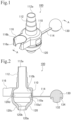
- Fig. 1 is a perspective view illustrating a usage state of the suction-target guide pipe according to the first embodiment of the present invention.
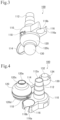
- Fig. 2 is a cross-sectional view taken along line A-A of Fig. 1 .
- Fig. 3 is a perspective view illustrating an unused state of the suction-target guide pipe according to the first embodiment of the present invention.
- a suction-target guide pipe 100 of the present embodiment is used as a member that is attached to an end of a suction tube connected to a suction device (a stationary or portable sputum aspirator) so as to guide the suction target to the side on which the upper respiratory tract is present by using the suction force (negative pressure) of the suction device.
- the suction-target guide pipe 100 includes a guide-pipe main body 110, a lid 120, and an end cap 130.
- the guide-pipe main body 110 includes a connection pipe 112 formed on a surface thereof, and the connection pipe 112 serves as a connecting portion that is connected to the suction tube.
- a portion of the guide-pipe main body 110 that faces the connection pipe 112 on the opposite side has an opening 110a whose inner diameter is, for example, about 17 mm, and an inner peripheral surface 110b of the guide-pipe main body 110 is a continuous curved surface extending toward the proximal end of the connection pipe 112.
- an opening 110a whose inner diameter is, for example, about 17 mm
- an inner peripheral surface 110b of the guide-pipe main body 110 is a continuous curved surface extending toward the proximal end of the connection pipe 112.
- the guide-pipe main body 110 has an engagement recess 110a1 formed on the proximal end side, and an engagement projection 120d of the lid 120 that is formed on the proximal end side can be fitted into the engagement recess 110a1.
- the inner peripheral surface 110b of the guide-pipe main body 110 is a gently curved surface whose diameter decreases from the upper end side of the engagement recess 110a1 to the proximal end side of the connection pipe 112.
- connection pipe 112 of the guide-pipe main body 110 has a shape whose diameter decreases toward the distal end of the connection pipe 112, and the distal end has an opening 112a.
- the inner diameter of the opening 112a is, for example, about 7.0 mm.
- shape of the connection pipe 112 is not limited to a shape whose diameter decreases in a stepwise manner toward the distal end as illustrated in Fig. 1 as long as the diameter of the connection pipe 112 decreases toward the distal end.
- connection pipe 112 is included in the guide-pipe main body 110 so as to serve as a "connecting portion” that is connected to the suction tube
- the connecting portion is not limited to the connection pipe 112 that is inserted into the suction tube.
- a hole into which the suction tube can be inserted so as to be fixed in place may be formed in a surface of the guide-pipe main body 110.
- a holder 116 that is capable of holding a tubular member is provided at an end of the outer periphery of the guide-pipe main body 110 on the lower end side of the guide-pipe main body 110.
- the holder 116 includes a pair of holding portions 116a that project from the end of the lower-end-side outer periphery of the guide-pipe main body 110, and for example, as a tubular member, the suction tube of the suction device can be fixed in place by the holder 116 such that an end of the suction tube faces upward.
- the holder 116 has an inner peripheral surface 116b whose diameter increases from the proximal end side to the distal end side, and the inner peripheral surface 116b is an inner tapered surface.
- the lid 120 that allows a suction target, which is to be suctioned, to be introduced into the suction-target guide pipe 100 is connected to the portion of the guide-pipe main body 110, which faces the connection pipe 112, by a hinge mechanism 118 so as to be openable and closable.
- the lid 120 is a hinge cap that is movable by the hinge mechanism 118 so as to open and close the opening 110a of the guide-pipe main body 110.
- the lid 120 is not limited to being a hinge cap that is connected to the guide-pipe main body 110 by the hinge mechanism 118, and a different mounting form of the lid 120 may be employed.
- the lid 120 may be openable and closable with respect to the guide-pipe main body 110 by forming a recess and a projection that engage each other in and on a connection portion of the lid 120 and a connection portion of the guide-pipe main body 110, respectively.
- the hinge mechanism 118 connecting the guide-pipe main body 110 and the lid 120 to each other does not need to be provided, and the guide-pipe main body 110 and the lid 120 may be separate members.
- the lid 120 has an inner peripheral surface 120b that is formed of a curved surface whose diameter decreases from the proximal end side to the distal end side.
- the inner peripheral surface 120b becomes a curved surface that is contiguous to the inner peripheral surface 110b of the guide-pipe main body 110, and the inner peripheral surface 120b of the lid 120 and the inner peripheral surface 110b of the guide-pipe main body 110 define a space having a so-called olive shape.
- the lid 120 has an opening 120a formed at the distal end thereof, and the inner diameter of the opening 120a is, for example, about 4.0 mm.
- a tapered surface 120c extends from the outer edge of the opening 120a, which is formed at the distal end of the lid 120, so as to have a predetermined length while its diameter increases toward the proximal end of the lid 120.
- the end cap 130 is connected to the lid 120 by a connection cord 114 that is connected to an end of the lid 120, and the end cap 130 is movable so as to open and close the opening 120a of the lid 120.
- the end cap 130 has a projection 132 formed at the center thereof so as to close the opening 120a of the lid 120 and a groove 134 formed along the outer edge of the projection 132.
- the configuration of the end cap 130 is not limited to that illustrated in Fig. 2 and may have a different structure.
- the engagement projection 120d which can be fitted into the engagement recess 110a1 formed in the inner edge of the opening 110a of the guide-pipe main body 110, is formed at the proximal end of the lid 120 that is located on the side opposite to the side on which the opening 120a is formed.
- the structure on the proximal end side of the lid 120 is not limited to that illustrated in Fig. 2 and may be a different structure.
- the suction-target guide pipe 100 of the present embodiment is used by being connected to the suction tube of the suction device to perform suctioning of sputum or the like, when sputum or the like in the respiratory tract is suctioned as a suction target, the lid 120 is opened with respect to the opening 110a of the guide-pipe main body 110.
- the inner peripheral surface 110b of the guide-pipe main body 110 is brought close to and brought into close contact with an end of a tracheal tube, a tracheal cannula, or the like that is attached to a patient so as to perform, by using the suction force (negative pressure) of the suction device, vacuuming (guiding) for moving a suction target such as sputum in the lower respiratory tract, which extends from the trachea to the terminal bronchioles in the lungs, to the upper respiratory tract side.
- a suction target such as sputum
- the suction target guided to the upper respiratory tract side can be suctioned by a suction device such as a suction catheter.
- the lid 120 When nasal discharge in the nasal cavity is suctioned as a suction target, as illustrated in Fig. 1 and Fig. 2 , the lid 120 covers the opening 110a of the guide-pipe main body 110, and the end cap 130 is moved so as to open the opening 120a. Then, the tapered surface 120c formed at the outer edge of the opening 120a of the lid 120 is brought close to and brought into close contact with the nasal cavity. Subsequently, vacuuming for moving the suction target, such as nasal discharge in the nasal cavity, to the front side of the nasal cavity is performed, and in this state, the suction target can be suctioned and removed. Alternatively, the suction target that has been moved to the front side of the nasal cavity by the vacuuming can be suctioned and removed by a suction device such as a suction catheter.
- a suction device such as a suction catheter.
- the lid 120 covers the opening 110a of the guide-pipe main body 110, and the end cap 130 serves as a lid and covers the opening 120a.
- Fig. 4 is a perspective view illustrating an unfolded state of the suction-target guide pipe according to the first embodiment of the present invention.
- Fig. 5 is a front view illustrating the unfolded state of the suction-target guide pipe according to the first embodiment of the present invention.
- Fig. 6 is a plan view illustrating the unfolded state of the suction-target guide pipe according to the first embodiment of the present invention.
- Fig. 7 is a bottom view illustrating the unfolded state of the suction-target guide pipe according to the first embodiment of the present invention.
- the guide-pipe main body 110, the lid 120, the hinge mechanism 118, the end cap 130, and the connection cord 114 are formed of an integrally molded body.
- the components of the suction-target guide pipe 100 are integrally formed into one molded body by injection molding using a thermoplastic resin such as a polyethylene (PE), polypropylene (PP), polyvinyl chloride (PVC), ABS resin, or acrylic resin (PMMA).
- a thermoplastic resin such as a polyethylene (PE), polypropylene (PP), polyvinyl chloride (PVC), ABS resin, or acrylic resin (PMMA).
- the hinge mechanism 118 is provided so as to be capable of performing opening and closing operations in directions that are perpendicular to a direction in which the holder 116 of the guide-pipe main body 110 is oriented.
- the hinge mechanism 118 includes a hinge connecting portion 118a that connects the guide-pipe main body 110 and the lid 120 to each other and plate springs 118b that are arranged on opposite sides of the hinge connecting portion 118a.
- the lid 120 when the lid 120 is opened with respect to the guide-pipe main body 110, the lid 120 can be maintained in the open state by the restoring force of the plate springs 118b.
- connection cord 114 is provided so as to extend in a direction perpendicular to a direction in which the hinge mechanism 118 of the lid 120 is oriented. More specifically, the connection cord 114 is provided so as to be located at a position facing the holder 116 and so as to extend in the direction perpendicular to the direction in which the hinge mechanism 118 of the lid 120 is oriented when the suction-target guide pipe 100 is viewed in plan view from the connection pipe 112 in a state where the lid 120 is closed with respect to the guide-pipe main body 110.
- the components of the suction-target guide pipe 100 of the present embodiment are arranged in this manner, so that the opening and closing operations of the lid 120 with respect to the opening 110a of the guide-pipe main body 110 and the opening and closing operations of the end cap 130 with respect to the opening 120a of the lid 120 do not interfere with each other. This improves the efficiency with which the opening and closing operations of the lid 120 and the end cap 130 are performed when the suction-target guide pipe 100 is used.
- FIG. 8 is a schematic diagram illustrating the configuration of the suction-target suction system according to the first embodiment of the present invention that uses the suction-target guide pipe 100 according to the first embodiment. Note that Fig.
- FIG. 8 illustrates, as an embodiment of the suction-target guide pipe 100, a suction-target suction system 1, and the suction-target guiding method using the suction-target suction system 1, a state in which sputum, which is a suction target, is suctioned by being guided through a tracheal cannula (a ventilation member to be worn on the human body, which will be referred to as a human-body-wearable ventilation member) that is attached to a patient by performing a tracheotomy.
- a tracheal cannula a ventilation member to be worn on the human body, which will be referred to as a human-body-wearable ventilation member
- the suction-target suction system 1 is used when suctioning a suction target that is a body fluid or the like such as sputum clogging, for example, a trachea A1, which is an airway of a patient P1 who is a living body, or the lungs (not illustrated).
- a suction target that is a body fluid or the like such as sputum clogging, for example, a trachea A1, which is an airway of a patient P1 who is a living body, or the lungs (not illustrated).
- the suction-target suction system 1 is configured such that the above-described suction-target guide pipe 100 is connected to an end of a suction tube 12 of a suction device 10.
- the suction device 10 includes a suction pump 14 serving as a negative pressure source that generates a suction pressure in the suction tube 12 made of, for example, a resin having flexibility such as polyurethane and a container 16 that contains a suction target suctioned through the suction tube 12, and the suction device 10 has a function of suctioning a suction target.
- the portable suction device can be used by directly connecting the suction-target guide pipe 100 of the present embodiment thereto, and thus, in this case, the suction tube 12 does not need to be provided.
- suction-target guide pipe 100 is attached to the end of the suction tube 12
- a configuration in which the suction-target guide pipe 100 and the suction tube 12 are integrally formed may be employed.
- the lid 120 of the suction-target guide pipe 100 is opened with respect to the guide-pipe main body 110, and then, as illustrated in Fig. 8 , the guide-pipe main body 110 is brought close to a tracheal cannula 20 that is inserted in an incision hole A2 formed in the throat of the patient P1 and fixed in place by a fixing plate 22 and a cuff 24. Then, the inner peripheral surface 110b of the guide-pipe main body 110 of the suction-target guide pipe 100 is brought into contact with an end 20a of the tracheal cannula 20, and a suctioning operation using the suction device 10 is started.
- the suction force (negative pressure) of the suction device 10 is transmitted to the tracheal cannula 20 through the suction-target guide pipe 100, so that vacuuming (guiding) for moving a suction target such as sputum in the lower respiratory tract, which extends from the trachea A1 to the terminal bronchioles in the lungs, to the upper respiratory tract side is performed.
- the suction-target suction system 1 and the suction-target guiding method of the present embodiment move a suction target such as sputum suctioned through the tracheal cannula 20 to the upper respiratory tract side by bringing the suction-target guide pipe 100 connected to the suction tube 12 into close contact with the end 20a of the tracheal cannula 20, which is inserted in the incision hole A2 so as to reach the trachea A1.
- the suction target such as sputum that has been guided in the trachea A1 to the upper respiratory tract side is suctioned by a suction catheter.
- the diameter of the opening 110a of the suction-target guide pipe 100 is slightly larger than the diameter of the end 20a of the tracheal cannula 20 so as to allow leeway. More specifically, in the case where the outer diameter of the end 20a of the tracheal cannula 20 is, for example, 15 mm, the inner diameter of the opening 110a of the suction-target guide pipe 100 is set to 17 mm, so that the tracheal cannula 20 and the suction-target guide pipe 100 may be easily brought into close contact with each other, and the probability that a patient will have a suffocation accident as a result of an excessive operation for bringing these members into close contact with each other, that is, connection of these members, can be reduced.
- the suction-target guide pipe 100 performs vacuuming for moving a suction target such as sputum in the lower respiratory tract, which extends from the trachea A1 to the terminal bronchioles, to the upper respiratory tract side, and then the suction target that has been guided in the trachea A1 to the upper respiratory tract side is suctioned by a suction device such as a suction catheter.
- a suction target such as sputum in the lower respiratory tract
- the suction-target guide pipe 100 of the suction-target suction system 1 of the present embodiment is used as an attachment that guides a suction target such as sputum in the lower respiratory tract, which extends from the trachea A1 to the terminal bronchioles, toward a portion of the trachea A1 that is located on the upper respiratory tract side in order to make it easier to suction the suction target by a suction device such as a suction catheter.
- a method of suctioning sputum that can be performed by using the suction-target suction system 1 will now be described.
- a suction target such as sputum is suctioned from the lower respiratory tract of the patient P1
- a stethoscopic examination of the lungs or the like of the patient P1 is performed by using a stethoscope first, and then, pressure ventilation is performed by using, for example, a bag valve mask at a positive pressure of 40 cmH 2 O for five seconds so as to inflate the lungs.
- pressure ventilation is performed before the suctioning operation.
- the pressure ventilation is performed before the suction operation, the pressure ventilation is performed by mixing oxygen so as to stabilize the patient's condition, and the suctioning operation is started.
- highly-concentrated oxygen may be mixed in the pressure ventilation in order to stabilize the condition of the patient P1 in a short time, if there is no request to perform the pressure ventilation in a short time, the pressure ventilation may be performed with normal air containing oxygen.
- a pressure ventilation device such as a bag valve mask may be included as a component in the suction-target suction system 1 of the present embodiment.
- vacuuming is performed at a negative pressure of, for example, 60 cmH 2 O for five seconds so as to deflate the entire lungs, and the suction target such as sputum is guided to the upper respiratory tract side.
- the suction target such as sputum guided to the upper respiratory tract side is suctioned by a suction device such as a suction catheter.
- pressure ventilation is performed again at a positive pressure of 40 cmH 2 O for five seconds, so that the air is taken into the lungs, and the states of the lungs return to normal.
- pressure ventilation is performed before and after the suctioning operation that is performed by deflating the entire lungs by vacuuming with a negative pressure.
- the cycle of pressure ventilation with a negative pressure after a stethoscopic examination of the patient P1, vacuuming with a negative pressure, suctioning of a suction target that has been guided to the upper respiratory tract side, and another pressure ventilation with a negative pressure is repeated until the patient P1's symptom is improved.
- the suction-target guide pipe 100 is connected to the end of the suction tube 12 of the suction device 10, and a vacuuming operation of guiding a suction target in the lower respiratory tract toward the upper respiratory tract side.
- a suctioning operation of suctioning the suction target, which has been guided to the upper respiratory tract side, by using a suction device such as a suction catheter is performed, so that minimally invasive suctioning of sputum may easily be achieved.
- pressure ventilation is performed before and after the suctioning operation, so that minimally invasive sputum suctioning that further reduces the amount of pain experienced by the patient P1 may be achieved.
- suction-target suction system 1 of the present embodiment vacuuming is performed by bringing the inner peripheral surface 110b of the guide-pipe main body 110 of the suction-target guide pipe 100 connected to the suction tube 12 into contact with the tracheal cannula 20 attached to the throat of the patient P1, and then, a suction target guided to the upper respiratory tract side is suctioned by a suction catheter or the like.
- the suction-target suction system 1 is also applicable to a different situation.
- the opening 120a of the lid 120 on the distal end side may be brought into close contact with the incision hole A2 after the lid 120 has been closed with respect to the guide-pipe main body 110 of the suction-target guide pipe 100, and vacuuming may be performed so as to guide a suction target such as sputum in the lower respiratory tract, which extends from the trachea A1 to the terminal bronchioles, toward the upper respiratory tract side.
- a suction target such as sputum in the lower respiratory tract, which extends from the trachea A1 to the terminal bronchioles, toward the upper respiratory tract side.
- the suction target which has been guided to the upper respiratory tract side, may be suctioned and removed by a suction device such as a suction catheter.
- the suction-target suction system 1 of the present embodiment may be configured as illustrated in Fig. 9 even if a human-body-wearable ventilation member such as the tracheal cannula 20 is not intubated.
- Fig. 9 illustrates, as an embodiment of the suction-target guide pipe 100, a suction-target suction system 1, and the suction-target guiding method using the suction-target suction system 1, an embodiment in which the suction-target guide pipe 100 connected to the suction tube 12 of the suction device 10 is brought into close contact with a branch port 54 that is branched from a connecting member 52 attached to an end portion of an artificial ventilation mask 50, which covers the oral cavity of the patient P1, so as to guide a suction target.
- a mask that covers the patient's nose and mouth can be used as the artificial ventilation mask 50.
- the diameter of the opening 110a of the suction-target guide pipe 100 is slightly larger than the diameter of the branch port 54 of the connecting member 52 so as to allow leeway. More specifically, in the case where the outer diameter of the branch port 54 of the connecting member 52 is, for example, 15 mm, the inner diameter of the opening 110a of the suction-target guide pipe 100 is set to 17 mm, so that the connecting member 52 and the suction-target guide pipe 100 may be easily brought into close contact with each other, and the probability that the patient will have a suffocation accident as a result of an excessive operation for bringing these members into close contact with each other, that is, connection of these members, can be reduced.
- the inner peripheral surface 110b of the guide-pipe main body 110 of the suction-target guide pipe 100 is brought into close contact with the branch port 54 of the connecting member 52 of the artificial ventilation mask 50 from the side on which the opening 110a of the guide-pipe main body 110 is formed, and a suction target such as sputum in the lower respiratory tract, which extends from the trachea A1 to the terminal bronchioles, is vacuumed, so that the suction target can be guided into the oral cavity of the upper respiratory tract.
- a suction target guided into the oral cavity of the upper respiratory tract can be easily suctioned by a suction device such as a suction catheter.
- a suction device such as a suction catheter.
- by performing vacuuming through the artificial ventilation mask 50 not only a suction target in the oral cavity but also a suction target in the nasal cavity can be guided toward the artificial ventilation mask 50 and can be suctioned.
- a suction-target guide pipe 200 such as that illustrated in Fig. 10 , that is formed as a long cap with a lid 220 having a length of, for example, about 140 mm is used as a suction-target guide pipe that is connected to the suction tube 12, it is not necessary to use a suction device such as a suction catheter.
- the lid 220 that is openable and closable with respect to a guide-pipe main body 210 which includes a connection pipe 212 and a holder 216, includes a distal end portion 221 that has a circular shape and that has an opening 221a formed at an end thereof, a proximal end portion 223 that is connected to the guide-pipe main body 210, and a hollow elongated pipe portion 222 that extends between the distal end portion 221 and the proximal end portion 223, a suction target can be guided into the oral cavity and suctioned by using only the suction-target guide pipe 200 that is connected to the suction tube 12.
- the lid 220 is opened with respect to the guide-pipe main body 210 of the suction-target guide pipe 200, and vacuuming is performed by bringing the guide-pipe main body 210 into close contact with the branch port 54 of the connecting member 52 of the artificial ventilation mask 50 so as to guide a suction target such as sputum in the lower respiratory tract of the patient P1 to the upper respiratory tract.
- the lid 220 having the shape of a long cap is closed with respect to the guide-pipe main body 210, and the artificial ventilation mask 50 is removed from the face of the patient P1.
- the distal end portion 221 of the lid 220 is directly inserted into the oral cavity of the patient P1.
- the suction target guided into the oral cavity is suctioned through the opening 221a of the distal end portion 221 of the lid 220.
- the suction-target guide pipe 200 of the present embodiment since the distal end portion 221 of the lid 220 has a circular shape, the probability that the oral cavity will be injured when a suction target is suctioned by inserting the lid 220 into the oral cavity can be reduced.
- the suction-target guide pipe 200 of the present embodiment can also be applied, as a so-called olive-shaped pipe, to suctioning of a suction target such as nasal discharge in the nasal cavity.
- the suction-target guide pipe 200 of the present embodiment is applied as a suction pipe used for suctioning in the oral cavity, and thus, the pipe portion 222 may have, for example, a bent portion that is bent about 75 degrees so as to be easily inserted into the oral cavity.
- an end cap that is movable so as to open and close the opening 221a of the distal end portion 221 of the lid 220 may be provided.
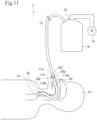
- the suction-target suction system 1 of the present embodiment may be configured as illustrated in Fig. 11 .
- the suction-target suction system 1 of the present embodiment is used when a suction target such as sputum is suctioned and removed from the patient P1 who is in an intensive care unit (ICU) or the like after surgery and under the control of a respirator with a tracheal tube 30 intubated into the trachea A1 through the mouth of the patient P1.
- ICU intensive care unit
- the tracheal tube 30 is inserted toward the trachea A1 and fixed in place at its distal end side by a cuff 32, and the suction-target guide pipe 100 is brought into close contact with a joint portion 30a of the tracheal tube 30 that is provided on the proximal end side of the tracheal tube 30 so as to guide the suction target such as sputum toward the upper respiratory tract side. Then, the suction target guided to the upper respiratory tract side is suctioned by a suction device such as a suction catheter, so that the suction target is removed.
- a suction device such as a suction catheter
- the diameter of the opening 110a of the suction-target guide pipe 100 is slightly larger than the diameter of the joint portion 30a of the tracheal tube 30 so as to allow leeway. More specifically, in the case where the outer diameter of the joint portion 30a of the tracheal tube 30 is, for example, 15 mm, the inner diameter of the opening 110a of the suction-target guide pipe 100 is set to 17 mm, so that the joint portion 30a and the suction-target guide pipe 100 may be easily brought into close contact with each other, and the probability that the patient will have a suffocation accident as a result of an excessive operation for bringing these members into close contact with each other, that is, connection of these members, can be reduced.
- connection pipe 112 of the guide-pipe main body 110 that is connected to the end of the suction tube 12 of the suction device 10 is formed so as to have a diameter decreasing toward the distal end thereof. Accordingly, the degree of contact between the connection pipe 112 of the guide-pipe main body 110 and the end of the suction tube 12 increases, and thus, a suction pressure from the suction device 10 is reliably applied to the inside of the suction-target guide pipe 100.
- a suction target such as sputum that is present in the lower respiratory tract which extends from the trachea to the terminal bronchioles, can be efficiently guided to the upper respiratory tract side so as to be easily suctioned by a suction device, such as a suction catheter, through the suction-target guide pipe 100, so that, the suction efficiency is improved.
- the suction-target guide pipe 100 of the present embodiment is brought into contact with a human-body-wearable ventilation member, such as the tracheal tube 30, the tracheal cannula 20, or the artificial ventilation mask 50, which is attached to a patient, such that the suction-target guide pipe 100 and the human-body-wearable ventilation member communicate with each other, and this facilitates guiding of a suction target to the upper respiratory tract side, so that the suction target can be guided to the upper respiratory tract side by a simple technique. Therefore, minimally invasive suctioning of the suction target from the upper respiratory tract side (minimally invasive discharge of the suction target to the outside the body) can be easily performed.
- a human-body-wearable ventilation member such as the tracheal tube 30, the tracheal cannula 20, or the artificial ventilation mask 50
- Vacuuming using the negative pressure from the suction device 10 can also be performed by bringing the suction tube 12 into close contact with a human-body-wearable ventilation member such as the tracheal tube 30 or the tracheal cannula 20.
- a human-body-wearable ventilation member such as the tracheal tube 30 or the tracheal cannula 20.
- the suction tube 12 is used by being cut with scissors, the cross-sectional shape of the suction tube 12 is irregular, and also the tube diameter of the suction tube 12 varies. Consequently, it is difficult to bring the suction tube 12 into close contact with the human-body-wearable ventilation member, such as the tracheal tube 30 or the tracheal cannula 20, and the effect of vacuuming varies depending on the skill of a practitioner.
- the degree of contact between the suction tube 12 and a human-body-wearable ventilation member, such as the tracheal tube 30 or the tracheal cannula 20, is increased by attaching the suction-target guide pipe 100, in which the connection pipe 112 is included in the guide-pipe main body 110, to the end of the suction tube 12 so as to increase the degree of contact between the suction tube 12 and the connection pipe 112. Therefore, according to the present embodiment, even if a practitioner is not skilled, vacuuming effect equivalent to that obtained by a skilled practitioner can be obtained, and vacuuming equivalent to that performed by a skilled practitioner can be performed by anyone.
- the lid 120 is openable and closable with respect to the opening 110a of the guide-pipe main body 110, which includes the connection pipe 112.
- the inner peripheral surface 110b of the guide-pipe main body 110 may be easily brought into close contact with one of various human-body-wearable ventilation members such as the tracheal cannula 20 that is attached to the patient P1.
- the suction pressure from the suction device 10 is easily transmitted to various human-body-wearable ventilation members through the suction-target guide pipe 100, and thus, a suction target such as sputum or a foreign matter in the periphery of the lower respiratory tract, which extends from the trachea A1 to the terminal bronchioles, can be easily moved to the upper respiratory tract side.
- the suction target guided to the upper respiratory tract side comes close to a suction device, such as a suction catheter, that is used when the suction target is suctioned, and thus, the suction target can be easily suctioned, so that the efficiency with which the suction target is suctioned is improved.
- a suction device such as a suction catheter
- the inner peripheral surface 110b of the guide-pipe main body 110 and the inner peripheral surface 120b of the lid 120 form a continuous curved surface, and an olive-shaped space is formed in the suction-target guide pipe 100.
- a suction target such as nasal discharge can be guided to the front side of the nasal cavity through the olive-shaped space and suctioned efficiently as in the case of using a so-called olive-shaped pipe.
- vacuuming and a suction operation are performed by closing the lid 120 with respect to the guide-pipe main body 110 and bringing the tracheal cannula 20 into close contact with the opening 120a of the lid 120, so that a suction target can be suctioned after being guided to the upper respiratory tract side, and thus, the suction efficiency can be improved.
- the lid 120 of the suction-target guide pipe 100 in accordance with the types or forms of the suction tube 12 of the suction device 10 and various human-body-wearable ventilation members such as the tracheal cannula 20 and a suction catheter that are used when suctioning a suction target such as sputum from the patient P1, the contact portions of the suction-target guide pipe 100 and the various human-body-wearable ventilation members can be changed, so that the degree of contact between them can be increased.
- the suction-target guide pipe 100 of the present embodiment functions as a guide pipe that guides a suction target such as sputum that is present on the lower respiratory tract side to the upper respiratory tract side by being attached as an attachment that is interposed between various human-body-wearable ventilation members that are used by, for example, being inserted into or attaching to the patient P1, and the suction tube 12 of the suction device 10, and suctioning of the suction target such as sputum guided to the upper respiratory tract side can be easily performed, so that minimally invasive suctioning of a suction target such as sputum can be achieved.
- MI-E mechanical insufflation-exsufflation
- MI-E mechanical insufflation-exsufflation
- the suction-target guide pipe 100 of the present embodiment is attached to the end of the suction tube 12 and then using the suction-target guide pipe 100 as an attachment that is brought into close contact with a human-body-wearable ventilation member such as the tracheal cannula 20 or the tracheal tube 30 that is attached to the patient P1
- a human-body-wearable ventilation member such as the tracheal cannula 20 or the tracheal tube 30 that is attached to the patient P1
- the degree of contact between the suction-target guide pipe 100 and the suction tube 12 and the degree of contact between the suction-target guide pipe 100 and the human-body-wearable ventilation member can both be increased.
- the suction force (negative pressure) of the suction device 10 does not leak from the portion in which the suction-target guide pipe 100 is in close contact with the suction tube 12 or the human-body-wearable ventilation member and is transmitted to the human-body-wearable ventilation member such as the tracheal cannula 20 or the tracheal tube 30.
- connection pipe 112 of the suction-target guide pipe 100 has been connected to the end of the suction tube 12
- the inner peripheral surface 110b of the guide-pipe main body 110 of the suction-target guide pipe 100 is brought into close contact with the human-body-wearable ventilation member such as the tracheal cannula 20 or the tracheal tube 30 that is attached to the patient P1
- a suction target such as sputum or a foreign matter in the periphery of the lower respiratory tract of the patient P1 is guided to the upper respiratory tract side by vacuuming through the guide-pipe main body 110.
- the suction target that has moved to the upper respiratory tract side can be easily suctioned and removed by using a suction device, such as a suction catheter.
- a suction device such as a suction catheter.
- pressure ventilation with a positive pressure is performed by using a bag valve mask or the like before the vacuuming operation with a negative pressure and after the operation of suctioning the suction target, which has been guided to the upper respiratory tract side, so that minimally invasive suction and removal of a suction target such as sputum can be easily performed.
- a suction target can be easily guided to the upper respiratory tract side, and this makes it easier to suction the suction target guided to the upper respiratory tract side, so that the suction efficiency is improved.
- the suction-target guide pipe 100 since the suction-target guide pipe 100 has a simple configuration, mass production of the suction-target guide pipe 100 can be performed at a low price, and the time and effort needed for preparation and cleaning up can be reduced compared with the case of a sputum suction method using mechanical insufflation-exsufflation (e.g., MI-E) or a device (e.g., a bronchoscope or a percussive ventilator).
- a suction target can be guided more reliably than in the case of using a sputum suction method such as postural drainage or squeezing (a manual breathing assist technique).
- vacuuming according to the present embodiment can obtain the effect of suctioning a suction target regardless of the patient's posture, and thus, the risk of bone fractures that occurs as a result of changing the patient's posture can be reduced.
- the lid 120 since the lid 120 is openable and closable with respect to the guide-pipe main body 110 by the hinge mechanism 118, the lid 120 can be easily opened and closed with one hand during the period when the suction-target guide pipe 100 is used in sputum suction or the like, and thus, the efficiency with which sputum suction or the like is performed is improved.
- maintenance such as cleaning can be easily performed by opening the lid 120 with respect to the guide-pipe main body 110.
- the holder 116 that is capable of holding a tubular member such as the suction tube 12 is provided at the end of the lower-end-side outer periphery of the guide-pipe main body 110.
- the suction tube 12 can be fixed in place such that an end of the suction tube 12 faces upward in order to prevent a discharged fluid remaining in the suction tube 12, which has been used, from dripping.
- the suction tube 12 made of a resin having flexibility can be easily fit into the holder 116 from the proximal end side to the distal end side of the holder 116 so as to be fixed in place.
- the guide-pipe main body 110, the lid 120, the hinge mechanism 118, the end cap 130, and the connection cord 114 that are included in the suction-target guide pipe 100 are integrally formed into one member made of a resin.
- the suction-target guide pipe 100 including these components can be easily manufactured in an unfolded state by performing injection molding using a thermoplastic resin.
- the suction-target guide pipe 100 in the unfolded state as an integrally molded body while paying attention to the arrangements of the hinge mechanism 118 connecting the guide-pipe main body 110 and the lid 120 to each other and the connection cord 114 connecting the lid 120 and the end cap 130 to each other, the suction-target guide pipe 100 becomes easy to handle, and its usability when a medical worker or the like uses the suction-target guide pipe 100 is improved.
- the suction-target guide pipe 100 is formed of a plurality of separable components, there is a possibility that the components will be lost.
- the suction-target guide pipe 100 of the present embodiment is formed of a single resin molded member, it is unlikely that the components will be lost.
- suction-target guide pipe and the configuration and operation of the suction-target suction system are not limited to the above-described embodiments of the present invention, and various modifications can be made.
Landscapes
- Health & Medical Sciences (AREA)
- Heart & Thoracic Surgery (AREA)
- Pulmonology (AREA)
- Engineering & Computer Science (AREA)
- Anesthesiology (AREA)
- Biomedical Technology (AREA)
- Hematology (AREA)
- Life Sciences & Earth Sciences (AREA)
- Animal Behavior & Ethology (AREA)
- General Health & Medical Sciences (AREA)
- Public Health (AREA)
- Veterinary Medicine (AREA)
- Emergency Medicine (AREA)
- External Artificial Organs (AREA)
- Surgical Instruments (AREA)
Applications Claiming Priority (1)
| Application Number | Priority Date | Filing Date | Title |
|---|---|---|---|
| PCT/JP2021/033546 WO2023037546A1 (fr) | 2021-09-13 | 2021-09-13 | Tube de guidage d'aspiration et système d'aspiration |
Publications (2)
| Publication Number | Publication Date |
|---|---|
| EP4403203A1 true EP4403203A1 (fr) | 2024-07-24 |
| EP4403203A4 EP4403203A4 (fr) | 2025-06-25 |
Family
ID=85506261
Family Applications (1)
| Application Number | Title | Priority Date | Filing Date |
|---|---|---|---|
| EP21956841.7A Pending EP4403203A4 (fr) | 2021-09-13 | 2021-09-13 | Tube de guidage d'aspiration et système d'aspiration |
Country Status (4)
| Country | Link |
|---|---|
| EP (1) | EP4403203A4 (fr) |
| CN (1) | CN117255704A (fr) |
| CA (1) | CA3218639A1 (fr) |
| WO (1) | WO2023037546A1 (fr) |
Families Citing this family (1)
| Publication number | Priority date | Publication date | Assignee | Title |
|---|---|---|---|---|
| CN118750719B (zh) * | 2024-08-16 | 2025-08-26 | 中国人民解放军总医院第二医学中心 | 一种用于开放气道及可吸痰的无创呼吸机面罩 |
Family Cites Families (9)
| Publication number | Priority date | Publication date | Assignee | Title |
|---|---|---|---|---|
| US3731684A (en) * | 1971-04-08 | 1973-05-08 | Cenco Medical Health Supply Co | Closed irrigation and urinary drainage system apparatus |
| US4349024A (en) * | 1981-04-01 | 1982-09-14 | Ralston Jr Philip G | Multiple adapter device for interconnecting tubing of different sizes |
| US5057093A (en) * | 1989-09-07 | 1991-10-15 | Abbott Laboratories | Medical device improvements for enteral feeding |
| US5507535A (en) * | 1995-01-09 | 1996-04-16 | Mckamey; Floyd | Conduit swivel connector |
| AU1151497A (en) * | 1995-12-15 | 1997-07-14 | Medisystems Technology Corporation | Medical connector with integral closure |
| US5674209A (en) * | 1996-01-22 | 1997-10-07 | Yarger; Richard J. | Connector for attachment to a drain tube |
| GB0623535D0 (en) * | 2006-11-25 | 2007-01-03 | Smiths Group Plc | Suction apparatus and connectors |
| FR2960155B1 (fr) * | 2010-05-21 | 2014-01-17 | Technoflex | Connecteur pour un circuit de liquide |
| US10532007B2 (en) * | 2014-12-19 | 2020-01-14 | Kpr U.S., Llc | System, apparatus and method employed with enteral systems |
-
2021
- 2021-09-13 CA CA3218639A patent/CA3218639A1/fr active Pending
- 2021-09-13 EP EP21956841.7A patent/EP4403203A4/fr active Pending
- 2021-09-13 CN CN202180097814.XA patent/CN117255704A/zh active Pending
- 2021-09-13 WO PCT/JP2021/033546 patent/WO2023037546A1/fr not_active Ceased
Also Published As
| Publication number | Publication date |
|---|---|
| EP4403203A4 (fr) | 2025-06-25 |
| CA3218639A1 (fr) | 2023-03-16 |
| WO2023037546A1 (fr) | 2023-03-16 |
| CN117255704A (zh) | 2023-12-19 |
Similar Documents
| Publication | Publication Date | Title |
|---|---|---|
| US6860264B2 (en) | Method and apparatus for endotracheal intubation using a light wand and curved guide | |
| US5509408A (en) | Neonatal resuscitation device | |
| RU2355433C2 (ru) | Фиксирующее устройство для эндотрахеальной трубки | |
| US5853004A (en) | Pharyngeal bulb airway | |
| EP1436032A2 (fr) | Dispositif anatomique de ventilation, d'intubation et de reanimation pour voies aeriennes de patients | |
| KR102872216B1 (ko) | 가스 샘플링 인터페이스 및 조립체 | |
| KR101789171B1 (ko) | 기도유지 및 삽관 가이드장치 | |
| WO2019162024A1 (fr) | Tube respiratoire de ventilation de tuba et bloc de morsure | |
| CN110464957A (zh) | 一种无创呼吸机用辅助排痰面罩 | |
| US12539381B2 (en) | Suction-target guide pipe and suction-target suction system | |
| EP4403203A1 (fr) | Tube de guidage d'aspiration et système d'aspiration | |
| JP7546888B2 (ja) | 被吸引物誘導管、及び被吸引物吸引システム | |
| US20080257357A1 (en) | Dental laryngeal mask | |
| CN210077621U (zh) | 一种带有吸痰功能的喉镜 | |
| US20240165354A1 (en) | Aspirate-guiding apparatus and aspirate-suctioning system | |
| CN210992441U (zh) | 一种麻醉面罩 | |
| JPH0857054A (ja) | 人工呼吸用フェイスマスク | |
| EP4304688A1 (fr) | Voie aérienne de masque laryngé | |
| CN119868676B (zh) | 一种新生儿外科用吸痰装置 | |
| CN212914135U (zh) | 贴附装置、采样组件、气管插管组件以及喉镜组件 | |
| CN222788283U (zh) | 气囊上易吸引式气管导管 | |
| WO2026042891A1 (fr) | Dispositif et système de soupape de régulation de pression d'aspiration | |
| EP3939641B1 (fr) | Dispositif de tamponnade oropharyngée | |
| CN209475323U (zh) | 一种免固定的经鼻气管插管 | |
| IT202100001085A1 (it) | Tubo endotracheale |
Legal Events
| Date | Code | Title | Description |
|---|---|---|---|
| STAA | Information on the status of an ep patent application or granted ep patent |
Free format text: STATUS: THE INTERNATIONAL PUBLICATION HAS BEEN MADE |
|
| PUAI | Public reference made under article 153(3) epc to a published international application that has entered the european phase |
Free format text: ORIGINAL CODE: 0009012 |
|
| STAA | Information on the status of an ep patent application or granted ep patent |
Free format text: STATUS: REQUEST FOR EXAMINATION WAS MADE |
|
| 17P | Request for examination filed |
Effective date: 20231108 |
|
| AK | Designated contracting states |
Kind code of ref document: A1 Designated state(s): AL AT BE BG CH CY CZ DE DK EE ES FI FR GB GR HR HU IE IS IT LI LT LU LV MC MK MT NL NO PL PT RO RS SE SI SK SM TR |
|
| DAV | Request for validation of the european patent (deleted) | ||
| DAX | Request for extension of the european patent (deleted) | ||
| A4 | Supplementary search report drawn up and despatched |
Effective date: 20250526 |
|
| RIC1 | Information provided on ipc code assigned before grant |
Ipc: A61M 16/08 20060101ALI20250520BHEP Ipc: A61M 16/04 20060101ALI20250520BHEP Ipc: A61M 1/00 20060101ALI20250520BHEP Ipc: A61M 39/12 20060101ALI20250520BHEP Ipc: A61M 39/10 20060101AFI20250520BHEP |
|
| STAA | Information on the status of an ep patent application or granted ep patent |
Free format text: STATUS: EXAMINATION IS IN PROGRESS |
|
| 17Q | First examination report despatched |
Effective date: 20260211 |