EP4403531A1 - Kristallisiertes glas - Google Patents
Kristallisiertes glas Download PDFInfo
- Publication number
- EP4403531A1 EP4403531A1 EP22867082.4A EP22867082A EP4403531A1 EP 4403531 A1 EP4403531 A1 EP 4403531A1 EP 22867082 A EP22867082 A EP 22867082A EP 4403531 A1 EP4403531 A1 EP 4403531A1
- Authority
- EP
- European Patent Office
- Prior art keywords
- component
- crystallized glass
- glass
- less
- crystallized
- Prior art date
- Legal status (The legal status is an assumption and is not a legal conclusion. Google has not performed a legal analysis and makes no representation as to the accuracy of the status listed.)
- Pending
Links
Images

Classifications
-
- C—CHEMISTRY; METALLURGY
- C03—GLASS; MINERAL OR SLAG WOOL
- C03B—MANUFACTURE, SHAPING, OR SUPPLEMENTARY PROCESSES
- C03B32/00—Thermal after-treatment of glass products not provided for in groups C03B19/00, C03B25/00 - C03B31/00 or C03B37/00, e.g. crystallisation, eliminating gas inclusions or other impurities; Hot-pressing vitrified, non-porous, shaped glass products
- C03B32/02—Thermal crystallisation, e.g. for crystallising glass bodies into glass-ceramic articles
-
- C—CHEMISTRY; METALLURGY
- C03—GLASS; MINERAL OR SLAG WOOL
- C03C—CHEMICAL COMPOSITION OF GLASSES, GLAZES OR VITREOUS ENAMELS; SURFACE TREATMENT OF GLASS; SURFACE TREATMENT OF FIBRES OR FILAMENTS MADE FROM GLASS, MINERALS OR SLAGS; JOINING GLASS TO GLASS OR OTHER MATERIALS
- C03C10/00—Devitrified glass ceramics, i.e. glass ceramics having a crystalline phase dispersed in a glassy phase and constituting at least 50% by weight of the total composition
-
- C—CHEMISTRY; METALLURGY
- C03—GLASS; MINERAL OR SLAG WOOL
- C03C—CHEMICAL COMPOSITION OF GLASSES, GLAZES OR VITREOUS ENAMELS; SURFACE TREATMENT OF GLASS; SURFACE TREATMENT OF FIBRES OR FILAMENTS MADE FROM GLASS, MINERALS OR SLAGS; JOINING GLASS TO GLASS OR OTHER MATERIALS
- C03C10/00—Devitrified glass ceramics, i.e. glass ceramics having a crystalline phase dispersed in a glassy phase and constituting at least 50% by weight of the total composition
- C03C10/0018—Devitrified glass ceramics, i.e. glass ceramics having a crystalline phase dispersed in a glassy phase and constituting at least 50% by weight of the total composition containing SiO2, Al2O3 and monovalent metal oxide as main constituents
-
- C—CHEMISTRY; METALLURGY
- C03—GLASS; MINERAL OR SLAG WOOL
- C03C—CHEMICAL COMPOSITION OF GLASSES, GLAZES OR VITREOUS ENAMELS; SURFACE TREATMENT OF GLASS; SURFACE TREATMENT OF FIBRES OR FILAMENTS MADE FROM GLASS, MINERALS OR SLAGS; JOINING GLASS TO GLASS OR OTHER MATERIALS
- C03C10/00—Devitrified glass ceramics, i.e. glass ceramics having a crystalline phase dispersed in a glassy phase and constituting at least 50% by weight of the total composition
- C03C10/0018—Devitrified glass ceramics, i.e. glass ceramics having a crystalline phase dispersed in a glassy phase and constituting at least 50% by weight of the total composition containing SiO2, Al2O3 and monovalent metal oxide as main constituents
- C03C10/0027—Devitrified glass ceramics, i.e. glass ceramics having a crystalline phase dispersed in a glassy phase and constituting at least 50% by weight of the total composition containing SiO2, Al2O3 and monovalent metal oxide as main constituents containing SiO2, Al2O3, Li2O as main constituents
-
- C—CHEMISTRY; METALLURGY
- C03—GLASS; MINERAL OR SLAG WOOL
- C03C—CHEMICAL COMPOSITION OF GLASSES, GLAZES OR VITREOUS ENAMELS; SURFACE TREATMENT OF GLASS; SURFACE TREATMENT OF FIBRES OR FILAMENTS MADE FROM GLASS, MINERALS OR SLAGS; JOINING GLASS TO GLASS OR OTHER MATERIALS
- C03C10/00—Devitrified glass ceramics, i.e. glass ceramics having a crystalline phase dispersed in a glassy phase and constituting at least 50% by weight of the total composition
- C03C10/0036—Devitrified glass ceramics, i.e. glass ceramics having a crystalline phase dispersed in a glassy phase and constituting at least 50% by weight of the total composition containing SiO2, Al2O3 and a divalent metal oxide as main constituents
- C03C10/0045—Devitrified glass ceramics, i.e. glass ceramics having a crystalline phase dispersed in a glassy phase and constituting at least 50% by weight of the total composition containing SiO2, Al2O3 and a divalent metal oxide as main constituents containing SiO2, Al2O3 and MgO as main constituents
-
- C—CHEMISTRY; METALLURGY
- C03—GLASS; MINERAL OR SLAG WOOL
- C03C—CHEMICAL COMPOSITION OF GLASSES, GLAZES OR VITREOUS ENAMELS; SURFACE TREATMENT OF GLASS; SURFACE TREATMENT OF FIBRES OR FILAMENTS MADE FROM GLASS, MINERALS OR SLAGS; JOINING GLASS TO GLASS OR OTHER MATERIALS
- C03C10/00—Devitrified glass ceramics, i.e. glass ceramics having a crystalline phase dispersed in a glassy phase and constituting at least 50% by weight of the total composition
- C03C10/0054—Devitrified glass ceramics, i.e. glass ceramics having a crystalline phase dispersed in a glassy phase and constituting at least 50% by weight of the total composition containing PbO, SnO2, B2O3
-
- C—CHEMISTRY; METALLURGY
- C03—GLASS; MINERAL OR SLAG WOOL
- C03C—CHEMICAL COMPOSITION OF GLASSES, GLAZES OR VITREOUS ENAMELS; SURFACE TREATMENT OF GLASS; SURFACE TREATMENT OF FIBRES OR FILAMENTS MADE FROM GLASS, MINERALS OR SLAGS; JOINING GLASS TO GLASS OR OTHER MATERIALS
- C03C21/00—Treatment of glass, not in the form of fibres or filaments, by diffusing ions or metals in the surface
-
- C—CHEMISTRY; METALLURGY
- C03—GLASS; MINERAL OR SLAG WOOL
- C03C—CHEMICAL COMPOSITION OF GLASSES, GLAZES OR VITREOUS ENAMELS; SURFACE TREATMENT OF GLASS; SURFACE TREATMENT OF FIBRES OR FILAMENTS MADE FROM GLASS, MINERALS OR SLAGS; JOINING GLASS TO GLASS OR OTHER MATERIALS
- C03C21/00—Treatment of glass, not in the form of fibres or filaments, by diffusing ions or metals in the surface
- C03C21/001—Treatment of glass, not in the form of fibres or filaments, by diffusing ions or metals in the surface in liquid phase, e.g. molten salts, solutions
- C03C21/002—Treatment of glass, not in the form of fibres or filaments, by diffusing ions or metals in the surface in liquid phase, e.g. molten salts, solutions to perform ion-exchange between alkali ions
-
- C—CHEMISTRY; METALLURGY
- C03—GLASS; MINERAL OR SLAG WOOL
- C03C—CHEMICAL COMPOSITION OF GLASSES, GLAZES OR VITREOUS ENAMELS; SURFACE TREATMENT OF GLASS; SURFACE TREATMENT OF FIBRES OR FILAMENTS MADE FROM GLASS, MINERALS OR SLAGS; JOINING GLASS TO GLASS OR OTHER MATERIALS
- C03C3/00—Glass compositions
- C03C3/04—Glass compositions containing silica
- C03C3/076—Glass compositions containing silica with 40% to 90% silica, by weight
- C03C3/083—Glass compositions containing silica with 40% to 90% silica, by weight containing aluminium oxide or an iron compound
- C03C3/085—Glass compositions containing silica with 40% to 90% silica, by weight containing aluminium oxide or an iron compound containing an oxide of a divalent metal
- C03C3/087—Glass compositions containing silica with 40% to 90% silica, by weight containing aluminium oxide or an iron compound containing an oxide of a divalent metal containing calcium oxide, e.g. common sheet or container glass
-
- C—CHEMISTRY; METALLURGY
- C03—GLASS; MINERAL OR SLAG WOOL
- C03C—CHEMICAL COMPOSITION OF GLASSES, GLAZES OR VITREOUS ENAMELS; SURFACE TREATMENT OF GLASS; SURFACE TREATMENT OF FIBRES OR FILAMENTS MADE FROM GLASS, MINERALS OR SLAGS; JOINING GLASS TO GLASS OR OTHER MATERIALS
- C03C2214/00—Nature of the non-vitreous component
- C03C2214/16—Microcrystallites, e.g. of optically or electrically active material
Definitions
- the present disclosure relates to transparent crystallized glass having a novel composition.
- glass has been used as cover glass for protecting a display of portable electronic devices such as smartphones and tablet PCs, and as a protector for protecting a lens of in-vehicle optical devices. Furthermore, in recent years, there is a demand for use in a housing or the like serving as an exterior of an electronic device. And there is an increasing demand for a material having a high strength so that such devices can withstand a severe use. Furthermore, as for these applications, there is a demand for a material maintaining high strength and having high transmittance.
- crystallized glass obtained by increasing the strength of glass.
- the crystallized glass is obtained by precipitating crystals inside the glass, and has a superior mechanical strength to glass.
- Patent Document 1 discloses a material composition of a crystallized glass substrate for an information magnetic recording medium.
- Patent Document 1 states that a glass ceramic substrate having a crystalline phase such as enstatite has a high Young's modulus corresponding to a high-speed rotation and is suitable for an information magnetic recording medium.
- the present inventors have applied for novel glass in Japanese Patent Application No. 2020-134653 .
- the glass can be crystallized and chemically strengthened, which can increase its mechanical strength.
- applications requiring crystallized glass with good transmittance and high transparency while maintaining the mechanical strength of the crystallized glass obtained in the examples of the present application are desired.
- Patent Document 1 Japanese Unexamined Patent Application Publication No. 2001-048581
- An object of the present disclosure is to provide a high-strength and transparent crystallized glass.
- the present inventors through intensive studies to solve the above problem, found that crystallized glass obtained by crystallizing glass having a predetermined composition under predetermined conditions has high transmittance and hardness, and by chemically strengthening the crystallized glass, the hardness can be further increased. Thus, the present inventors completed the present disclosure. The contents of the present disclosure are specifically described below.
- the crystallized glass or strengthened crystallized glass according to the present disclosure may be used for a protective member and the like of a device by taking advantage of its high strength and transparency.
- the crystallized glass or strengthened crystallized glass according to the present disclosure may be utilized as cover glass or a housing of a smartphone, a member of a portable electronic device such as a tablet PC and a wearable terminal, and a protective protector, a member of a substrate for a head-up display, or the like used in a transport vehicle such as a car and an airplane.
- the crystallized glass or strengthened crystallized glass according to the present disclosure may be used for other electronic devices and machinery, a building member, a member for a solar panel, a member for a projector, and cover glass (windshield) for eyeglasses and a watch, for example.
- Crystallized glass can be obtained by heat-treating glass to precipitate crystals inside the glass.
- a crystalline phase of the crystallized glass is determined by using a peak angle appearing in an X-ray diffraction pattern in X-ray diffraction analysis, and by using, if necessary, an electron diffraction method.
- the crystallized glass of the present disclosure contains, for example, (Mg, Ti)O, MgAl 2 Si 2 O 8 , MgSiO 3 , MgTi 2 O 5 , Mg 2 SiO 4 , Na 2 TiSiO 5 , MgAl 2 O 4 , Mg 2 Al 2 Si 3 O 12 , or a solid solution of the substances, as a crystalline phase.
- the crystals include granular microcrystals with a lower limit of a particle size as preferably 1 nm or more, and an upper limit of a particle size as preferably 50 nm or less, more preferably 30 nm or less, and even more preferably 20 nm or less.
- by oxide-equivalent mass% means, if it is assumed that all the constituent components included in the glass are dissolved and converted into oxides, when a total amount of the oxides is 100 mass%, an amount of oxides in each of the components contained in the glass is expressed by mass%.
- a content of each component is expressed as "by oxide-equivalent mass%", unless otherwise specified.
- A% to B% represents A% or more and B% or less. Further, “0” in “containing 0 to C%” refers to a content of 0%.
- composition range of each component constituting the glass according to the present disclosure will be specifically described below.
- a SiO 2 component is an essential component forming a glass network structure.
- the lower limit of the content of the SiO 2 component may be, for example, 40.0% or more, 41.0% or more, or 42.0% or more.
- the upper limit of the content of the SiO 2 component may be, for example, 55.0% or less, 50.0% or less, 49.0% or less, or 48.0% or less.
- an Al 2 O 3 component is an essential component that forms the glass network structure and may serve as a component constituting a crystalline phase by heat treatment of glass yet to be crystallized. Also, such a component contributes to the improvement of mechanical strength.
- the lower limit of the content of the Al 2 O 3 component may be, for example, 10.0% or more, 13.5% or more, or 15.0% or more.
- the upper limit of the content of the Al 2 O 3 component may be, for example, 30.0% or less, 25.0% or less, or 23.0% or less.
- a MgO component is one of the components that may constitute the crystalline phase and is an essential component. Also, such a component contributes to the improvement of mechanical strength.
- the lower limit of the content of the MgO component may be, for example, 10.0% or more, 13.5% or more, or 15.0% or more.
- the upper limit of the content of the MgO component may be, for example, 30.0% or less, 25.0% or less, or 23.0% or less.
- a TiO 2 component is an essential component that plays a role of nucleation for precipitating crystals. Also, such a component contributes to the improvement of mechanical strength.
- the lower limit of the content of the TiO 2 component may be, for example, 5.0% or more, 6.0% or more, or 7.0% or more.
- the upper limit of the content of the TiO 2 component may be, for example, 15.0% or less, 14.0% or less, or 13.0% or less.
- a Na 2 O component is an essential component involved in chemical strengthening and contributes to the improvement of mechanical strength.
- the lower limit of the content of the Na 2 O component may be, for example, more than 0%, 0.5% or more, 1.0% or more, 2.0% or more, or 3.0% or more.
- the upper limit of the content of the Na 2 O component may be, for example, 8.0% or less, 6.0% or less, 5.0% or less, or 4.5% or less.
- a B 2 O 3 component and a P 2 O 5 component can be added as optional components.
- the optional components may or may not be contained.
- the content may be 0% or more.
- the upper limit of the content of these components may be, for example, 5.0% or less, 3.0% or less, or 2.0% or less, respectively.
- the content of the B 2 O 3 component may be 0 to less than 2.0% or 0 to 1.0%.
- a Li 2 O component is an optional component involved in chemical strengthening and contributes to the improvement of mechanical strength.
- the upper limit of the content of the Li 2 O component may be, for example, 4.0% or less, 3.0% or less, 2.0% or less, or 1.0% or less.
- Both the Na 2 O component and the Li 2 O component are involved in chemical strengthening, but if the total content is 5.0% or less, deterioration of devitrification can be suppressed, and so the total content is preferably 5.0% or less, and more preferably 4.0% or less.
- a K 2 O component, a CaO component, a SrO component, a BaO component, and a ZnO component can be added as optional components.
- the upper limit of the content of these components may be, for example, 5.0% or less, 3.0% or less, or 2.0% or less, respectively.
- the lower limit can be preferably more than 0%, and more preferably 0.5% or more in order to improve mechanical strength.
- the ZrO 2 component is an optional component that can play a role of nucleation for precipitating crystals.
- the upper limit of the content of the ZrO 2 component may be, for example, 8.0% or less, 5.0% or less, or 3.0% or less.
- the glass may contain a Gd 2 O 3 component, a TeO 2 component, a FeO component, a La 2 O 3 component, a Y 2 O 3 component, a Nb 2 O 5 component, a Ta 2 O 5 component, and a WO 3 component as optional components.
- the content of each component may be 0 to 2.0% or 0.5 to 1.0%.
- the glass may contain, as a clarifying agent, from 0% to 2.0%, preferably from 0.005% to 1.0%, and more preferably from 0.01% to 0.5% of one or more selected from a Sb 2 O 3 component, a SnO 2 component, and a CeO 2 component.
- a total of the SiO 2 component, the Al 2 O 3 component, the MgO component, the TiO 2 component, and the Na 2 O component may be 80.0% or more, 85.0% or more, 90.0% or more, 92.0% or more, or 95.0% or more.
- the strengthened crystallized glass according to the present disclosure includes a compressive stress layer on the surface. Assuming that an outermost surface has a depth of zero, the compressive stress of the outermost surface (surface compressive stress) is CS. DOLzero denotes a depth of the compressive stress layer when the compressive stress is 0 MPa.
- the surface compressive stress value (CS) of the compressive stress layer is preferably 200 MPa or more, more preferably 350 MPa or more, and even more preferably 450 MPa or more.
- the upper limit of CS may be, for example, 1000 MPa or less or 900 MPa or less.
- the central tensile stress (CT) is preferably 3 MPa or more, more preferably 4 MPa or more, and even more preferably 10 MPa or more.
- the upper limit of CT may be, for example, 60 MPa or less or 50 MPa or less.
- the depth (DOLzero) of the compressive stress layer is preferably 4 ⁇ m or more, more preferably 5 ⁇ m or more, and even more preferably 10 ⁇ m or more.
- the upper limit may be, for example, 80 ⁇ m or less or 60 ⁇ m or less.
- a lower limit of a thickness of the glass substrate may be, for example, 0.10 mm or more, 0.20 mm or more, or 0.40 mm or more.
- An upper limit of the thickness of the glass substrate may be, for example, 10.00 mm or less, 5.00 mm or less, 1.00 mm or less, 0.90 mm or less, or 0.80 mm or less.
- the Vickers hardness (Hv) of the crystallized glass or strengthened crystallized glass measured in Examples is preferably 700 or more, and more preferably 800 or more. When such impact resistance is provided, the crystallized glass or strengthened crystallized glass withstands an impact generated when dropped if used as a protective member.
- the spectral transmittance of the crystallized glass or strengthened crystallized glass at 400 nm is desirably 50.00% or more, more preferably 60.00% or more, and most preferably 70.00% or more.
- the crystallized glass or strengthened crystallized glass has a high visible light transmittance, particularly a high transmittance of light on the shorter wavelength side of the visible light, and thereby has little coloration.
- the shortest wavelength ( ⁇ 80) exhibiting a spectral transmittance of 80% in a 1-mm thick sample of the crystallized glass or strengthened crystallized glass according to the present disclosure has an upper limit of preferably 500 nm or less, more preferably 480 nm or less, and even more preferably 450 nm or less.
- the shortest wavelength ( ⁇ 80) exhibiting a spectral transmittance of 80% can have a lower limit of, for example, 200 nm or more or 300 nm or more.
- the shortest wavelength ( ⁇ 5) exhibiting a spectral transmittance of 5% in a 1-mm thick sample of the crystallized glass or strengthened crystallized glass of the present disclosure has an upper limit of preferably 400 nm or less, more preferably 380 nm or less, and even more preferably 350 nm or less.
- the shortest wavelength ( ⁇ 5) exhibiting a spectral transmittance of 5% can have a lower limit of, for example, 150 nm or more or 200 nm or more.
- the glass and crystallized glass according to the present disclosure may be produced by the following method, for example.
- the raw materials are uniformly mixed, and the resulting mixture is melted, stirred for homogenization, and then molded and slowly cooled to produce glass. Next, the glass is crystallized to produce crystallized glass. Further, by chemically strengthening crystallized glass as a base material, a strengthened crystallized glass can be formed.
- the glass is subjected to heat treatment to precipitate crystals inside the glass.
- the heat treatment may be performed at a one-stage temperature or a two-stage temperature.
- the crystallization temperature and time are adjusted so that the crystallized glass does not become cloudy, causing the transmittance to decrease.
- the two-stage heat treatment includes a nucleation step of firstly performing heat treatment at a first temperature and a crystal growth step of treating, after the nucleation step, the glass by heat at a second temperature higher than that in the nucleation step.
- the nucleation step and the crystal growth step are continuously performed at the one-stage temperature.
- the temperature is raised to a predetermined heat treatment temperature, is maintained for a certain period of time after reaching the predetermined heat treatment temperature, and is then lowered.
- the retention time at the heat treatment temperature is preferably 30 minutes to 500 minutes, and more preferably 60 minutes to 400 minutes.
- the retention time at the heat treatment temperature is preferably less than 30 minutes.
- An example of a method for forming the compressive stress layer includes a chemical strengthening method in which an alkaline component present in a surface layer of the crystallized glass substrate is subject to exchange reaction with an alkaline component with a larger ionic radius to form a compressive stress layer on the surface layer.
- Other examples include a heat strengthening method in which the crystallized glass substrate is heated, and then, is quenched and an ion implantation method in which ions are implanted into the surface layer of the crystallized glass substrate.
- the chemical strengthening method may be implemented according to the following steps, for example.
- Crystallized glass is contacted to or immersed in a molten salt of a salt containing potassium or sodium, for example, potassium nitrate (KNO 3 ), sodium nitrate (NaNO 3 ) or a mixed salt or a complex salt thereof.
- KNO 3 potassium nitrate
- NaNO 3 sodium nitrate
- the treatment of contacting or immersing the crystallized glass to or in the molten salt may be performed in one stage or in two stages.
- the crystallized glass is contacted to or immersed in a sodium salt or a mixed salt of potassium and sodium heated at 350°C to 550°C for 1 to 1440 minutes.
- the resultant glass is contacted to or immersed in a potassium salt or a mixed salt of potassium and sodium heated at 350°C to 550°C for 1 to 1440 minutes.
- the crystallized glass is contacted to or immersed in a salt containing potassium or sodium heated at 350°C to 550°C or a mixed salt thereof for 1 to 1440 minutes, preferably 90 to 600 minutes.
- the heat strengthening method is not particularly limited, but, for example, the crystallized glass may be heated to 300°C to 600°C, and thereafter, be subjected to rapid cooling such as water cooling and/or air cooling to form the compressive stress layer by a temperature difference between the surface and the inside of the crystallized glass substrate. Besides, when the heat strengthening method is combined with the above chemical treatment method, it is possible to more effectively form the compressive stress layer.
- the ion implantation method is not particularly limited, but, for example, any ion may be collided on the surface of the crystallized glass (base material) with an acceleration energy and an acceleration voltage that would not destroy the surface of the base material to implant the ions into the surface of the base material. Thereafter, by performing heat treatment as necessary, it is possible to form the compressive stress layer on the surface in a similar manner as in the other methods.
- Raw materials such as oxides, hydroxides, carbonates, nitrates, fluorides, chlorides, and metaphosphate compounds corresponding to a raw material of each component of glass were selected, and the selected raw materials were weighed and mixed uniformly to have the compositions (mass%) shown in Table 1.
- the mixed raw materials were fed into a platinum crucible and melted in an electric furnace in a temperature range from 1300°C to 1540°C depending on the degree of meltability of the glass composition. Subsequently, the molten glass was stirred and homogenized, cast into a mold, and slowly cooled to manufacture glass.
- the obtained glass was subjected to one-stage heat treatment at the crystallization temperatures shown in Table 1 to prepare crystallized glass.
- the retention time was 360 minutes at 750°C
- Comparative Examples 1 and 2 the retention time was 360 minutes at 800°C.
- the crystallized glass in Examples 1 to 6 was transparent, and the crystallized glass in Comparative Examples 1 and 2 was cloudy.
- the glass used in Comparative Examples 1 and 2 had the same composition as Examples 1 and 2, and Comparative Examples 1 and 2 differed from Examples 1 and 2 only in terms of the crystallization temperature.
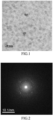
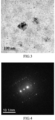
- Example 4 The presence or absence of crystals in the obtained crystallized glass of Example 4 and Comparative Example 1 was confirmed by TEM.
- the crystalline phase was confirmed using a 200 kV field emission transmission electron microscope JEM-2100F (manufactured by JEOL Ltd.) at an acceleration voltage of 200 kV during observation.
- FIG. 1 illustrates a TEM photograph of Example 4, and
- FIG. 2 illustrates an electron diffraction pattern. It was confirmed that (Mg, Ti)O was included as the crystalline phase in Examples 1 to 6.
- FIG. 3 illustrates a TEM photograph of Comparative Example 1
- FIG. 4 illustrates an electron diffraction pattern.
- the crystallized glass thus produced was cut and ground, and in Examples 1 to 6 and Comparative Examples 1 and 2, the opposite surfaces were subjected to parallel polishing to result in a thickness of 1.00 mm, and a crystallized glass substrate was obtained.
- Example 1 to 6 and Comparative Examples 1 and 2 the crystallized glass substrate was immersed in a KNO 3 salt bath at 500°C for eight hours (480 minutes) to perform chemical strengthening and obtain a strengthened crystallized glass.
- Table 2 shows the Vickers hardness (Hv) of the crystallized glass (before strengthening) and the strengthened crystallized glass (after strengthening).
- a square pyramid diamond indenter having an angle of 136°C between opposing sides was used to measure the Vickers hardness as a value obtained by dividing the load when the pyramid-shaped depression was formed on the test surface by the surface area (mm 2 ) calculated from the length of the depression.
- the Vickers hardness was measured with a test load of 200 gf and a retention time of 15 seconds using a micro Vickers hardness tester HMV-G21D manufactured by Shimadzu Corporation.
- the spectral transmittance of a 1-mm thick sample of crystallized glass (before strengthening) with opposite surfaces subjected to parallel polishing was measured using a U-4100 spectrophotometer manufactured by Hitachi, Ltd. according to the Japan Optical Glass Industry Standard JOGIS-02 (2019)"Measuring Method for Color-Degree of Optical Glass".
- ⁇ 80 and ⁇ 5 are wavelengths (nm) exhibiting a transmittance of 80% and 5% in the spectral transmittance curve.
- the crystallized glass of Examples 1 to 6 had a spectral transmittance of 50% or more at 400 nm.
- the crystallized glass of Comparative Examples 1 and 2 had a spectral transmittance of around 13% at 400 nm.
- FIG. 5 illustrates the transmittance with respect to the wavelength for the 1-mm thick crystallized glass substrates obtained in Example 4 and Comparative Example 1.
- the particle size (diameter) of the granular microcrystals was determined from a TEM image.
- the crystallized glass in Example 4 contained granular microcrystals with a particle size of 5 to 15 nm.
- the crystallized glass in Comparative Example 1 had a larger particle size than the crystallized glass of Examples 1 to 6, and contained granular microcrystals with a particle size of 50 to 100 nm.
- the surface compressive stress value (CS) was measured by using a glass surface stress meter FSM-6000LE series manufactured by Orihara Manufacturing Co., LTD.
- a light source of the measurement device used in the CS measurement a light source having a wavelength of 596 nm was selected.
- a refractive index value at 596 nm was used.
- the refractive index value at a wavelength of 596 nm was calculated by using a quadratic approximation expression from the measured values of the refractive index at the wavelengths of a C-line, a d-line, an F-line, and a g-line according to the V-block method specified in JIS B 7071-2:2018.
- a value of a photoelastic constant at a wavelength of 596 nm used for the CS measurement was calculated by using a quadratic approximation expression from the measured values of the photoelastic constants at a wavelength of 435.8 nm, a wavelength of 546.1 nm, and a wavelength of 643.9 nm.
- a depth DOLzero ( ⁇ m) and a central tensile stress (CT) of the compressive stress layer was measured by using a scattered light photoelastic stress meter SLP-1000.
- a wavelength of the measurement light source used for the DOLzero and the CT measurement a light source having a wavelength of 640 nm was selected.
- a value of a refractive index at 640 nm was used as a refractive index used in the DOLzero and the CT measurement. Besides, it is noted that the refractive index value at a wavelength of 640 nm was calculated by using a quadratic approximation expression from the measured values of the refractive index at the wavelengths of a C-line, a d-line, an F-line, and a g-line according to the V-block method specified in JIS B 7071-2:2018.
- a value of the photoelastic constant at 640 nm used for the DOLzero and the CT measurement used for the measurement was calculated by using a quadratic approximation expression from the measured values of the photoelastic constants at a wavelength of 435.8 nm, a wavelength of 546.1 nm, and a wavelength of 643.9 nm.
Landscapes
- Chemical & Material Sciences (AREA)
- Engineering & Computer Science (AREA)
- Organic Chemistry (AREA)
- Materials Engineering (AREA)
- Chemical Kinetics & Catalysis (AREA)
- Life Sciences & Earth Sciences (AREA)
- General Chemical & Material Sciences (AREA)
- Geochemistry & Mineralogy (AREA)
- Crystallography & Structural Chemistry (AREA)
- Ceramic Engineering (AREA)
- Dispersion Chemistry (AREA)
- Physics & Mathematics (AREA)
- Thermal Sciences (AREA)
- Glass Compositions (AREA)
- Surface Treatment Of Glass (AREA)
Applications Claiming Priority (2)
| Application Number | Priority Date | Filing Date | Title |
|---|---|---|---|
| JP2021148510A JP7460586B2 (ja) | 2021-09-13 | 2021-09-13 | 結晶化ガラス |
| PCT/JP2022/027481 WO2023037760A1 (ja) | 2021-09-13 | 2022-07-12 | 結晶化ガラス |
Publications (2)
| Publication Number | Publication Date |
|---|---|
| EP4403531A1 true EP4403531A1 (de) | 2024-07-24 |
| EP4403531A4 EP4403531A4 (de) | 2025-08-27 |
Family
ID=85506483
Family Applications (1)
| Application Number | Title | Priority Date | Filing Date |
|---|---|---|---|
| EP22867082.4A Pending EP4403531A4 (de) | 2021-09-13 | 2022-07-12 | Kristallisiertes glas |
Country Status (7)
| Country | Link |
|---|---|
| US (1) | US20240375994A1 (de) |
| EP (1) | EP4403531A4 (de) |
| JP (1) | JP7460586B2 (de) |
| KR (1) | KR20240052949A (de) |
| CN (1) | CN117940387A (de) |
| TW (1) | TWI912550B (de) |
| WO (1) | WO2023037760A1 (de) |
Families Citing this family (1)
| Publication number | Priority date | Publication date | Assignee | Title |
|---|---|---|---|---|
| JP7189181B2 (ja) * | 2020-08-07 | 2022-12-13 | 株式会社オハラ | ガラスおよび結晶化ガラス |
Family Cites Families (17)
| Publication number | Priority date | Publication date | Assignee | Title |
|---|---|---|---|---|
| JPS6452632A (en) * | 1987-05-07 | 1989-02-28 | Asahi Glass Co Ltd | Production of crystallized glass |
| JP4680347B2 (ja) | 1999-06-01 | 2011-05-11 | 株式会社オハラ | 高剛性ガラスセラミックス基板 |
| WO2001021539A1 (en) | 1999-09-21 | 2001-03-29 | Kabushiki Kaisha Ohara | Holding member for information storage disk and information storage disk drive device |
| US6660669B2 (en) | 1999-10-18 | 2003-12-09 | Corning Incorporated | Forsterite glass-ceramics of high crystallinity and chrome content |
| US6813903B2 (en) * | 1999-10-18 | 2004-11-09 | Corning Incorporated | Method of making forsterite glass-ceramics |
| US7465687B2 (en) | 2006-05-31 | 2008-12-16 | Corning Incorporated | Tough cordierite glass-ceramics |
| JP4815002B2 (ja) * | 2009-06-04 | 2011-11-16 | 株式会社オハラ | 情報記録媒体用結晶化ガラス基板およびその製造方法 |
| JP5829447B2 (ja) | 2011-07-22 | 2015-12-09 | 株式会社オハラ | 結晶化ガラスおよび情報記録媒体用結晶化ガラス基板 |
| JP6161413B2 (ja) | 2012-07-19 | 2017-07-12 | キヤノン株式会社 | 画像加熱装置 |
| US9604871B2 (en) * | 2012-11-08 | 2017-03-28 | Corning Incorporated | Durable glass ceramic cover glass for electronic devices |
| JP6026926B2 (ja) | 2012-11-16 | 2016-11-16 | 株式会社オハラ | 結晶化ガラスおよび情報記録媒体用結晶化ガラス基板 |
| JP6765748B2 (ja) * | 2015-06-04 | 2020-10-07 | 株式会社オハラ | 結晶化ガラス及び結晶化ガラス基板 |
| US11104607B2 (en) * | 2017-02-24 | 2021-08-31 | Ohara Inc. | Crystallized glass |
| JP7034738B2 (ja) * | 2017-06-26 | 2022-03-14 | 株式会社オハラ | 結晶化ガラス基板 |
| JP7258589B2 (ja) | 2019-02-18 | 2023-04-17 | キヤノン株式会社 | 照明装置およびその制御方法、撮像装置 |
| CN113544103A (zh) * | 2019-03-06 | 2021-10-22 | 株式会社小原 | 无机组成物产品以及结晶化玻璃 |
| JP7296306B2 (ja) * | 2019-11-27 | 2023-06-22 | 株式会社オハラ | 光フィルター用ガラスセラミックスおよび光フィルター |
-
2021
- 2021-09-13 JP JP2021148510A patent/JP7460586B2/ja active Active
-
2022
- 2022-07-12 CN CN202280059735.4A patent/CN117940387A/zh active Pending
- 2022-07-12 KR KR1020247008095A patent/KR20240052949A/ko active Pending
- 2022-07-12 US US18/691,497 patent/US20240375994A1/en active Pending
- 2022-07-12 EP EP22867082.4A patent/EP4403531A4/de active Pending
- 2022-07-12 WO PCT/JP2022/027481 patent/WO2023037760A1/ja not_active Ceased
- 2022-08-19 TW TW111131217A patent/TWI912550B/zh active
Also Published As
| Publication number | Publication date |
|---|---|
| JP2023041251A (ja) | 2023-03-24 |
| WO2023037760A1 (ja) | 2023-03-16 |
| CN117940387A (zh) | 2024-04-26 |
| TWI912550B (zh) | 2026-01-21 |
| US20240375994A1 (en) | 2024-11-14 |
| KR20240052949A (ko) | 2024-04-23 |
| EP4403531A4 (de) | 2025-08-27 |
| TW202319358A (zh) | 2023-05-16 |
| JP7460586B2 (ja) | 2024-04-02 |
Similar Documents
| Publication | Publication Date | Title |
|---|---|---|
| US11807568B2 (en) | Inorganic composition article | |
| JP7013623B1 (ja) | 結晶化ガラスおよび強化結晶化ガラス | |
| CN117776533A (zh) | 一种微晶玻璃以及微晶玻璃基板 | |
| US20240010546A1 (en) | Inorganic composition article | |
| US20220324749A1 (en) | Crystallized glass and reinforced crystallized glass | |
| EP4194413A1 (de) | Glas und kristallisiertes glas | |
| EP4403531A1 (de) | Kristallisiertes glas | |
| US20250128979A1 (en) | Inorganic composition article | |
| EP4438570A1 (de) | Artikel aus einer anorganischen zusammensetzung | |
| EP4474361A1 (de) | Kristallisierter artikel aus einer anorganischen zusammensetzung | |
| WO2024190443A1 (ja) | 結晶化ガラス | |
| US20260028268A1 (en) | Inorganic composition article | |
| WO2024014507A1 (ja) | 無機組成物物品 |
Legal Events
| Date | Code | Title | Description |
|---|---|---|---|
| STAA | Information on the status of an ep patent application or granted ep patent |
Free format text: STATUS: THE INTERNATIONAL PUBLICATION HAS BEEN MADE |
|
| PUAI | Public reference made under article 153(3) epc to a published international application that has entered the european phase |
Free format text: ORIGINAL CODE: 0009012 |
|
| STAA | Information on the status of an ep patent application or granted ep patent |
Free format text: STATUS: REQUEST FOR EXAMINATION WAS MADE |
|
| 17P | Request for examination filed |
Effective date: 20240312 |
|
| AK | Designated contracting states |
Kind code of ref document: A1 Designated state(s): AL AT BE BG CH CY CZ DE DK EE ES FI FR GB GR HR HU IE IS IT LI LT LU LV MC MK MT NL NO PL PT RO RS SE SI SK SM TR |
|
| DAV | Request for validation of the european patent (deleted) | ||
| DAX | Request for extension of the european patent (deleted) | ||
| REG | Reference to a national code |
Ref country code: DE Ref legal event code: R079 Free format text: PREVIOUS MAIN CLASS: C03C0010100000 Ipc: C03C0010080000 |
|
| A4 | Supplementary search report drawn up and despatched |
Effective date: 20250724 |
|
| RIC1 | Information provided on ipc code assigned before grant |
Ipc: C03C 10/08 20060101AFI20250718BHEP Ipc: C03C 10/10 20060101ALI20250718BHEP Ipc: C03C 10/00 20060101ALI20250718BHEP Ipc: C03C 3/085 20060101ALI20250718BHEP Ipc: C03C 3/087 20060101ALI20250718BHEP Ipc: C03C 21/00 20060101ALI20250718BHEP Ipc: C03B 32/02 20060101ALI20250718BHEP |