EP4404014B1 - Surveillance de vibrations pour la détection de défauts dans l'automatisation de processus - Google Patents
Surveillance de vibrations pour la détection de défauts dans l'automatisation de processus Download PDFInfo
- Publication number
- EP4404014B1 EP4404014B1 EP23152059.4A EP23152059A EP4404014B1 EP 4404014 B1 EP4404014 B1 EP 4404014B1 EP 23152059 A EP23152059 A EP 23152059A EP 4404014 B1 EP4404014 B1 EP 4404014B1
- Authority
- EP
- European Patent Office
- Prior art keywords
- criterion
- sensor data
- monitoring method
- computer
- level
- Prior art date
- Legal status (The legal status is an assumption and is not a legal conclusion. Google has not performed a legal analysis and makes no representation as to the accuracy of the status listed.)
- Active
Links
Images

Classifications
-
- G—PHYSICS
- G01—MEASURING; TESTING
- G01M—TESTING STATIC OR DYNAMIC BALANCE OF MACHINES OR STRUCTURES; TESTING OF STRUCTURES OR APPARATUS, NOT OTHERWISE PROVIDED FOR
- G01M99/00—Subject matter not provided for in other groups of this subclass
- G01M99/005—Testing of complete machines, e.g. washing-machines or mobile phones
-
- G—PHYSICS
- G05—CONTROLLING; REGULATING
- G05B—CONTROL OR REGULATING SYSTEMS IN GENERAL; FUNCTIONAL ELEMENTS OF SUCH SYSTEMS; MONITORING OR TESTING ARRANGEMENTS FOR SUCH SYSTEMS OR ELEMENTS
- G05B23/00—Testing or monitoring of control systems or parts thereof
- G05B23/02—Electric testing or monitoring
- G05B23/0205—Electric testing or monitoring by means of a monitoring system capable of detecting and responding to faults
- G05B23/0218—Electric testing or monitoring by means of a monitoring system capable of detecting and responding to faults characterised by the fault detection method dealing with either existing or incipient faults
- G05B23/0224—Process history based detection method, e.g. whereby history implies the availability of large amounts of data
- G05B23/024—Quantitative history assessment, e.g. mathematical relationships between available data; Functions therefor; Principal component analysis [PCA]; Partial least square [PLS]; Statistical classifiers, e.g. Bayesian networks, linear regression or correlation analysis; Neural networks
-
- G—PHYSICS
- G05—CONTROLLING; REGULATING
- G05B—CONTROL OR REGULATING SYSTEMS IN GENERAL; FUNCTIONAL ELEMENTS OF SUCH SYSTEMS; MONITORING OR TESTING ARRANGEMENTS FOR SUCH SYSTEMS OR ELEMENTS
- G05B23/00—Testing or monitoring of control systems or parts thereof
- G05B23/02—Electric testing or monitoring
- G05B23/0205—Electric testing or monitoring by means of a monitoring system capable of detecting and responding to faults
- G05B23/0259—Electric testing or monitoring by means of a monitoring system capable of detecting and responding to faults characterized by the response to fault detection
- G05B23/0275—Fault isolation and identification, e.g. classify fault; estimate cause or root of failure
- G05B23/0281—Quantitative, e.g. mathematical distance; Clustering; Neural networks; Statistical analysis
-
- G—PHYSICS
- G06—COMPUTING OR CALCULATING; COUNTING
- G06F—ELECTRIC DIGITAL DATA PROCESSING
- G06F17/00—Digital computing or data processing equipment or methods, specially adapted for specific functions
- G06F17/10—Complex mathematical operations
- G06F17/18—Complex mathematical operations for evaluating statistical data, e.g. average values, frequency distributions, probability functions, regression analysis
-
- G—PHYSICS
- G05—CONTROLLING; REGULATING
- G05B—CONTROL OR REGULATING SYSTEMS IN GENERAL; FUNCTIONAL ELEMENTS OF SUCH SYSTEMS; MONITORING OR TESTING ARRANGEMENTS FOR SUCH SYSTEMS OR ELEMENTS
- G05B2219/00—Program-control systems
- G05B2219/30—Nc systems
- G05B2219/37—Measurements
- G05B2219/37435—Vibration of machine
Definitions
- the invention relates to a computer-implemented monitoring method for vibration analysis for fault detection of a machine or hardware fault in process automation.
- EP 0 934 567 A1 is a method for classifying the statistical dependence of a measurable time series, in which iterative tests with different null hypotheses are described.
- the object of the invention is to be able to propose a monitoring method for error detection which enables particularly reliable error detection.
- the monitoring method according to the invention is intended to be used in process automation for vibration analysis.
- a machine with a rotor such as a fan
- the monitoring method according to the invention for detecting a machine error or a hardware error that results from a vibration analysis in a machine-executed process also initially includes the recording of at least one series of sensor data measured during the process. This sensor-recorded data is often recorded in chronological order.
- the series of sensor data represents a local sequence or a local progression, for example if sensors are to be used to record whether the same distance is always maintained between two parts or whether a component does not leave its intended storage position due to heating, imbalance or other irregularities.
- the teaching of the invention is characterized by the fact that the desired error detection can also include error prediction.
- the invention recognizes that machine or hardware errors often "announce" themselves, especially when monitoring vibrations or rotations, i.e. a sudden, spontaneous failure of the machine rarely occurs without any signs; rather, symptomatic phenomena occur that indicate the error and that are measurable because, for example, measured variables in connection with the machine / hardware gradually change.
- the changed measured variables can usually be detected by sensors, such as an output current, an input current, a speed (e.g. in the case of a fan), etc. It is not uncommon for the machine or hardware to continue to perform its work, sometimes initially with little or no noticeable loss of quality in production, until the machine then suffers a major failure.
- the invention also makes it possible to optimize maintenance intervals, i.e. to predict when maintenance is due for existing machine stocks and how long or short the maintenance intervals should be.
- the difficulty was recognized that the measured sensor data are covered by statistical errors, in particular statistical noise, which makes it difficult to carry out an evaluation of individual measured sensor data, since these are subject to statistical errors and can deviate from predetermined target values even though no error is present.
- the invention takes into account for the first time that errors that occur can often affect the recorded sensor data in various ways. According to the invention, statistical irregularities are therefore taken into account during the evaluation and investigation, i.e. initially regardless of their cause of the error, because simple comparisons and recording of individual value deviations have proven to be an insufficient criterion to enable reliable error detection.
- the method according to the invention can therefore be used universally for a large number of applications, since no special requirements are necessary with regard to the monitored machines and, as a rule, only the general expected behavior of a sensor-recorded measurement variable needs to be known, even if, for example, it is only a value that is constant over time.
- At least three criteria are checked before a warning signal is issued.
- a basic criterion which is assumed to be of fundamental importance in error detection according to the invention, it is checked whether the measurement data are constant up to a predetermined tolerance range.
- the basic criterion is of central importance and also represents the more general test in relation to other criteria such as a trend analysis or an investigation into sudden changes, which is the basic condition for a trend deviation or sudden deviation
- the basic criterion is checked in a first step. Only if this shows a deviation are further criteria checked. These subsequent criteria are also evaluated in parallel for faster evaluation.
- an embodiment of the invention also provides a multi-stage, at least three-stage warning system, in which a separate warning level is displayed depending on the number of criteria fulfilled when detecting an error.
- a monitoring method is also provided that weights the errors that occur so that the operator is made aware of the severity of the irregularities and can also make a more targeted assessment of whether and with what measures a process or the execution of a machine should be intervened in.
- the warning system can also be advantageously adapted to this, i.e. it can issue at least a two-stage warning which takes this classification into account.
- the invention is particularly suitable for the process automation of systems that are used in continuous operation and whose vibration behavior or vibration properties are particularly relevant for operation. Examples include the monitoring of vacuum pumps for clean room applications or the monitoring of fans that are operated 24 hours a day, 7 days a week.
- the analysis of the vibration signal according to the invention can advantageously provide an indication of incipient damage at a very early stage, so that the machine or system can be repaired or maintained in good time before major damage and failure occurs.
- the maintenance intervals can also be adjusted based on several such indications. if it can be estimated how often such damage occurs during operation and when it can be expected.
- the system can be adapted very quickly for long-term monitoring in various applications.
- vibration sensors are used as sensors to monitor fans, bearings, pumps, vacuum pumps or other motors in continuous operation.
- An advantageous application could be in the field of medical technology, for example, where there is an interaction between technical and biological processes, which favors statistical deviations and makes it more difficult to distinguish an error detection that requires intervention from a simple statistical deviation.
- Another advantageous application is in the field of cooling production processes (ventilators, fans, etc.).
- a statistical evaluation of at least one recorded series or of a part of the at least one recorded series is therefore provided.
- at least three criteria are also checked in order to be able to assign corresponding warning levels depending on how many of these criteria are met at once.
- the monitoring method according to the invention is generally carried out as a computer-implemented method in which the sensor data is evaluated electronically or computer-aided. It thus also overcomes the technical prejudice that signals containing statistical errors or noise cannot be statistically evaluated from errors and plausibility.
- the statistical evaluation according to the invention is carried out by setting up a null hypothesis. If the null hypothesis is deviated from or if the probability of deviating from the null hypothesis is above a predetermined significance level ⁇ , a warning is issued.
- the expected behavior can be described by a model function that is composed of a sum of a function that describes stationary behavior, a function that represents a random walk to model the noise, and a linear function that describes trend behavior over time/local distance in order to be able to depict typical effects such as background noise or drifting of the measured values.
- This model description makes it possible to make a statistical evaluation of the expected errors mathematically tangible in relation to possible errors.
- This model description can be used to calculate statistical quantities such as the expected value, the standard deviation or the variance. In the case of stationary behavior, the expected value can be determined by averaging.
- the model can also be used to calculate the deviations of the measured values from the model function, the residuals.
- the first criterion is a check to see whether a jump in the mean measurement data level suddenly occurs, a so-called level shift.
- the volatility of the random walk component c t is equal to zero according to a null hypothesis and only differs from zero in the case of overall non-stationary behavior (even taking into account underlying noise).
- the expected value also changes, provided it is re-determined over successive time intervals. In this case, statistically speaking, a jump has occurred that shifts the measured values so strongly overall that a deviation from the expected value for a certain variance due to underlying noise can no longer be explained by the noise behavior.
- the third criterion whether the range of fluctuation or susceptibility to fluctuation is constantly increasing, it is sufficient to compare the variances in two different test phases or measurement ranges.
- the null hypothesis to be checked is that the variances always agree or at least only deviate with a given probability. If the range of fluctuation increases, the variance in a subsequent time or measurement interval also increases. The amount of test data can be smaller than when checking the second criterion for the trend.
- the significance can again be determined in relation to a fixed probability value, whereby if the significance falls below this probability value, the range of fluctuation becomes larger and the third criterion is met.
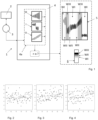
- Figure 1 shows a schematic representation of a computer-implemented monitoring method 1 for error detection and error prediction according to the invention.
- a system 2 is monitored by means of a sensor 3, which sends the measured data to a computer-controlled evaluation unit 4.
- This evaluation unit 4 can be a control unit or controller, for example within the machine, but it can also run separately on a computer.
- null hypothesis Whether one of the criteria is met is determined using a so-called null hypothesis.
- a model function is used that represents statistical errors, for example via a random walk, but also has a term that can describe the essentially unwanted trend behavior.
- the trend behavior is initially considered non-existent, i.e. the term describing the trend is set to zero.
- Test statistics can also be used to determine the behavior and check whether the measured value behavior is sufficiently close to the test statistics.
- the expected value changes in the level shift behavior (criterion I).
- a test statistic can be used. Not as much measurement data is required here because the level shift is expected to take place rather quickly and therefore should not be averaged over a longer period of time in order to be able to reliably record the signal change.
- a first warning level WI is issued by the evaluation unit 4.
- a second, more critical warning level WII is signalled and if three criteria are met, a particularly high warning level WIII is signalled.
- Figure 1 is the temporal course 5 of the measurement data displayed, with the areas WI, WII, WIII, in each of which one to three criteria are fulfilled, being displayed. It is also conceivable that a measure for the deviation from the respective null hypothesis is determined and the warning levels WI, WII, or WIII are selected accordingly.
- the warning levels WI, WII, WIII can either only be displayed, e.g. via a signal light or signal column 6, but depending on the design it is also conceivable that the evaluation unit 4 sends corresponding control commands to the system 2. These commands can also be adapted to which error sources typically exist for certain criteria I, II, III.
- Fig. 2 shows a signal that is clearly overlaid with noise, recorded as a series of measurement data. On average, however, the measurement data remain at a constant level, which is shown as a dotted line. Despite the high variance of the measured values, there is therefore a constant volatility in this case; because the variance does not become larger over time, but the measurement data in this section remain in essentially constant dispersion around the mean/expected value. Over the period of time, there are therefore on average no signal fluctuations, apart from statistical outliers in the measured values. According to an evaluation according to the third criterion III, a constant volatility would be recognized.
- Fig. 3 also shows a signal superimposed by noise. However, over time the measured values increase continuously, there is a trend.
- the dotted line which shows the mean values of the measured data, is a straight line with a positive slope and indicates the rising level. However, since the statistical fluctuations or variance of the data are high here too, this trend is difficult to recognize without evaluating a mean or expected value. This trend is recognized according to the second criterion II.
- Fig. 4 shows an analogous situation regarding the Fig. 2-3 , i.e. there is a noisy signal, whereby an evaluation of the mean or expected value shows that there is a sudden jump in the measured values (level shift) to a higher level.
- the mean or expected value is shown with a dotted line that shows a sudden jump (level shift).
- the measured data are on average constant in these time periods. In this case, an evaluation according to the first criterion I is relevant.
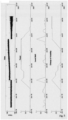
- the behavior of the measurement data from June 30th to July 5th is different.
- the deviations are continuously increasing, while the signal level remains constant on average.
- the variance is increasing.
- the increasing deviations increase the Volatility value as of June 30th.
- the constant signal level on average is shown by a trend value in the range of 0 during this period.
- the signal level changes abruptly, which is noticeable in the third line by an isolated peak at exactly this time.
- the trend and volatility also show changes at these times, also as singular peaks in the signal curve, because the jump also changed the signal curve (trend) or a deviation occurred, which here also exceeds the variance.
- the third line of Fig. 5 shows the level shift term, where, as described above, the peaks in the area around June 22, 123 and June 30 are particularly noticeable. Outside of these two peaks, the level term remains in the area around 0, but shows irregular deviations. This is because the measurement signal ("value") is not always statistically constant on average, depending on which area is being considered, i.e. the signal level, which is already subject to noise, changes slightly.
- Figure 6 shows a diagram of a system for monitoring vacuum pumps with vibration sensors with diagnostic electronics for process monitoring. These are vibration sensors of the manufacturer type "ifm VSE".
- the signals are sent to a processor for evaluation.
- Several cycles of the clocked process are combined into a machine cycle. This is done continuously, Supported by numerical evaluation software, an analysis of the measurement data (continuous pattern monitoring) in order to analyze volatility, step-like changes (level shifts) or trends. Mean or expected values are also calculated for this purpose.
- probability calculation methods an extrapolation of the last measurement data is carried out to predict the data development, or it is checked whether the measurement data lies with a certain probability in specified areas of a confidence band or outside the confidence band.
- FIG. 7 and 8 show two variants of determining the criteria.
- Three criteria including the basic criterion K as well as the analysis of a trend II and the occurrence of jumps I, are determined in parallel.
- one of the warnings (or possibly several warnings) WK, WI, WII is issued.
- Fig.8 shows a step-by-step determination of criteria: First, the basic criterion K is checked, then, if a deviation is found, the other two criteria I, II follow in parallel.
- a two-stage warning signal WI, WII is sufficient as an output, depending on whether the non-constant measurement data show jumps or trends.
- the monitoring method according to the invention advantageously makes it possible to carry out a statistical evaluation of measurement data, some of which are also subject to statistical errors, for example, superimposed by noise, and to detect any errors in this way.
- the method according to the invention primarily uses statistical methods and is largely universal, regardless of the type of machine/hardware to be monitored, because basically the occurrence of statistical errors is differentiated from errors caused by real malfunctions. According to the invention, this is done by determining deviations from a null hypothesis and evaluating a statistical significance against a predetermined significance level. The classification into different categories based on the number of error criteria met and/or based on the degree of deviation enables the severity of the situation to be classified in a further development.
Landscapes
- Engineering & Computer Science (AREA)
- Physics & Mathematics (AREA)
- General Physics & Mathematics (AREA)
- Mathematical Physics (AREA)
- Data Mining & Analysis (AREA)
- Pure & Applied Mathematics (AREA)
- Mathematical Analysis (AREA)
- Mathematical Optimization (AREA)
- Theoretical Computer Science (AREA)
- Computational Mathematics (AREA)
- Probability & Statistics with Applications (AREA)
- Algebra (AREA)
- Automation & Control Theory (AREA)
- Evolutionary Computation (AREA)
- Artificial Intelligence (AREA)
- Life Sciences & Earth Sciences (AREA)
- Bioinformatics & Computational Biology (AREA)
- Evolutionary Biology (AREA)
- Operations Research (AREA)
- Databases & Information Systems (AREA)
- Software Systems (AREA)
- General Engineering & Computer Science (AREA)
- Bioinformatics & Cheminformatics (AREA)
- Measurement Of Mechanical Vibrations Or Ultrasonic Waves (AREA)
- Testing Or Calibration Of Command Recording Devices (AREA)
Claims (12)
- Procédé de surveillance mis en œuvre par ordinateur (1) destiné à l'analyse de vibrations pour la reconnaissance de défauts d'un défaut de machine et/ou d'un défaut matériel lors de l'automatisation de processus dans un processus de production fonctionnant et/ou assisté par machine, comprenant les étapes consistant à :• détecter au moins une série dans le processus de données de capteur mesurées (5) dans une séquence temporelle et/ou locale,• dans lequel une évaluation statistique (4) de ladite au moins une série ou du moins d'une partie de ladite au moins une série est effectuée pour établir respectivement un écart des données de capteur mesurées (5) selon au moins trois critères (K, I, II, III),dans lequel l'évaluation statistique :• fournit une hypothèse nulle,• fournit une valeur attendue pour les données de capteur mesurées,• prévoit le calcul de la signification statistique concernant l'écart par rapport à l'hypothèse nulle prédéfinie, et• émet un avertissement si la signification statistique s'écarte de l'hypothèse nulle et/ou si pour un niveau de signification prédéfini α la probabilité d'un écart par rapport à l'hypothèse nulle est supérieure au niveau de signification α,caractérisé en ce que• lors de l'évaluation statistique (4), les écarts des données de capteur mesurées sont établis selon les critères suivants (K, I, II ; III) avant l'émission de l'avertissement, dans lequel :i. lors de l'évaluation statistique (4) pour tester un critère de base (K), il est vérifié si le niveau de données de capteur moyen reste constant dans la séquence temporelle et/ou locale à l'intérieur d'une tolérance prédéfinie par le critère de base (K), etii. lors de l'évaluation statistique (4) pour tester un deuxième des critères (II), il est vérifié si une tendance d'une variation continue du niveau de données de capteur moyen existe dans la séquence temporelle et/ou locale, et/ouiii. lors de l'évaluation statistique (4) pour tester un premier des critères (I), il est vérifié s'il existe un saut du niveau de données de capteur moyen dans la séquence temporelle et/ou locale, dans lequel le saut a eu lieu si le saut décale les valeurs mesurées globalement à tel point que l'écart par rapport à la valeur attendue pour une variance déterminée suite à un bruit sous-jacent ne peut plus s'expliquer par le comportement de bruit, et/ouiv. lors de l'évaluation statistique pour tester un troisième des critères (III), il est vérifié si la tendance à la fluctuation dans la série varie dans la séquence temporelle et/ou locale, dans lequelv. le critère de base (K) est toujours vérifié lors de l'évaluation statistique (4), dans lequel l'évaluation statistique (4) des écarts des données de capteur mesurées est d'abord effectuée selon le critère de base (K) et est ensuite établie en recouvrement en même temps ou avec un recouvrement temporel selon deux des autres critères (I, II, III).
- Procédé de surveillance mis en œuvre par ordinateur (1) destiné à l'analyse de vibrations selon la revendication 1, caractérisé en ce que l'évaluation statistique prévoit l'émission d'un avertissement (WK, WI, WII, WIII) à au moins trois, en particulier quatre niveaux, dans lequel respectivement un niveau d'avertissement (WK, WI, WII, WIII) est associé à chaque nombre de critères satisfaits parmi les critères (K, I, II, III).
- Procédé de surveillance mis en œuvre par ordinateur (1) destiné à l'analyse de vibrations selon la revendication 1, caractérisé en ce que l'analyse statistique prévoit l'émission d'un avertissement à au moins deux niveaux, en fonction du fait que le premier ou le deuxième critère révèle aussi un écart en plus du critère de base.
- Procédé de surveillance mis en œuvre par ordinateur (1) destiné à l'analyse de vibrations selon l'une quelconque des revendications précédentes, caractérisé en ce que comme fonction modèle pour le comportement des données de capteur (5) dans la série, la fonction suivante est utilisée :

- Procédé de surveillance mis en œuvre par ordinateur (1) destiné à l'analyse de vibrations selon l'une quelconque des revendications précédentes, caractérisé en ce que l'hypothèse nulle est utilisée pour la vérification du premier critère (I), en ce que la variance en tant qu'écart quadratique moyen par rapport à la valeur attendue et à la volatilité des termes de marche aléatoire ct est nulle, dans lequel il est supposé en particulier concernant la fonction modèle que la tendance δ = 0.
- Procédé de surveillance mis en œuvre par ordinateur (1) destiné à l'analyse de vibrations selon l'une quelconque des revendications précédentes, caractérisé en ce que pour la vérification du premier et/ou du deuxième critère (I), un test KPSS stationnaire est effectué, dans lequel comme hypothèse nulle, il est vérifié si une statistique de test est satisfaite avec une probabilité prédéfinie, dans lequel on utilise comme statistique de test en particulier

- Procédé de surveillance mis en œuvre par ordinateur (1) destiné à l'analyse de vibrations selon l'une quelconque des revendications précédentes, caractérisé en ce que pour la vérification du premier et/ou du deuxième critère et/ou du critère de base (I, II, K), des auto-corrélations sont utilisées qui sont prises en compte et/ou calculées et/ou ignorées en particulier en cas de retards de signal sous la forme de données de capteur influencées par un retard.
- Procédé de surveillance mis en œuvre par ordinateur (1) destiné à l'analyse de vibrations selon l'une quelconque des revendications précédentes, caractérisé en ce que pour la vérification du deuxième critère (II), une plus grande partie de la séquence avec plus de données de capteur est utilisée que pour la vérification du premier critère (I).
- Procédé de surveillance mis en œuvre par ordinateur (1) destiné à l'analyse de vibrations selon l'une quelconque des revendications précédentes, caractérisé en ce que pour la vérification du troisième critère (III), au moins deux séquences partielles de données de capteur sont enregistrées.
- Procédé de surveillance mis en œuvre par ordinateur (1) destiné à l'analyse de vibrations selon l'une quelconque des revendications précédentes, caractérisé en ce que pour la vérification du troisième critère (III), comme hypothèse nulle, une statistique de test F est utilisée qui constitue le rapport entre les variances des deux séquences de test, et comme hypothèse nulle il est supposé que F = 1.
- Procédé de surveillance mis en œuvre par ordinateur (1) destiné à l'analyse de vibrations selon l'une quelconque des revendications précédentes, caractérisé en ce que les avertissements sont transmis à une colonne de signalisation, dans lequel :• en fonction du nombre des avertissements, un autre symbole lumineux sur la colonne de signalisation est associé à chaque niveau d'avertissement, et/ouen fonction de l'écart par rapport à l'hypothèse nulle, un autre symbole lumineux sur la colonne de signalisation est associé.
- Procédé de surveillance mis en œuvre par ordinateur (1) destiné à l'analyse de vibrations selon l'une quelconque des revendications précédentes, caractérisé en ce que lors de la détection, les données d'une période de temps sont chargées qui est stationnaire et ne contient en particulier aucun des modèles, dans lequel ensuite l'algorithme est entraîné de telle sorte que dans la période de temps sélectionnée, il n'aurait émis aucune alarme et/ou aucun signal d'avertissement tout en étant paramétré avec un maximum de sensibilité, par exemple par une bande de confiance étroite, c'est-à-dire qu'il réagirait en cas de variations et/ou de modèles faibles.
Priority Applications (5)
| Application Number | Priority Date | Filing Date | Title |
|---|---|---|---|
| ES23152059T ES3015090T3 (en) | 2023-01-17 | 2023-01-17 | Vibration monitoring for fault detection in process automation |
| EP23152059.4A EP4404014B1 (fr) | 2023-01-17 | 2023-01-17 | Surveillance de vibrations pour la détection de défauts dans l'automatisation de processus |
| CN202480007914.2A CN120569685A (zh) | 2023-01-17 | 2024-01-05 | 用于在过程自动化中识别故障的振动监测 |
| PCT/EP2024/050234 WO2024153480A1 (fr) | 2023-01-17 | 2024-01-05 | Surveillance de vibrations pour la détection d'erreurs dans l'automatisation de processus |
| US19/148,516 US20260110599A1 (en) | 2023-01-17 | 2024-01-05 | Vibration monitoring in order to detect an error during a process automation |
Applications Claiming Priority (1)
| Application Number | Priority Date | Filing Date | Title |
|---|---|---|---|
| EP23152059.4A EP4404014B1 (fr) | 2023-01-17 | 2023-01-17 | Surveillance de vibrations pour la détection de défauts dans l'automatisation de processus |
Publications (3)
| Publication Number | Publication Date |
|---|---|
| EP4404014A1 EP4404014A1 (fr) | 2024-07-24 |
| EP4404014C0 EP4404014C0 (fr) | 2025-01-15 |
| EP4404014B1 true EP4404014B1 (fr) | 2025-01-15 |
Family
ID=84982444
Family Applications (1)
| Application Number | Title | Priority Date | Filing Date |
|---|---|---|---|
| EP23152059.4A Active EP4404014B1 (fr) | 2023-01-17 | 2023-01-17 | Surveillance de vibrations pour la détection de défauts dans l'automatisation de processus |
Country Status (5)
| Country | Link |
|---|---|
| US (1) | US20260110599A1 (fr) |
| EP (1) | EP4404014B1 (fr) |
| CN (1) | CN120569685A (fr) |
| ES (1) | ES3015090T3 (fr) |
| WO (1) | WO2024153480A1 (fr) |
Families Citing this family (4)
| Publication number | Priority date | Publication date | Assignee | Title |
|---|---|---|---|---|
| US12598339B1 (en) * | 2024-12-20 | 2026-04-07 | Paramount Global | Methods and systems for generating and providing program guides and content |
| CN120800805B (zh) * | 2025-09-09 | 2025-11-25 | 山东康沃控股有限公司 | 一种发动机故障检测方法及系统 |
| CN121504443B (zh) * | 2026-01-13 | 2026-06-09 | 杭州利环环境集团有限公司 | 一种基于大数据分析的人行地砖运维管理方法及系统 |
| CN121614951B (zh) * | 2026-01-22 | 2026-06-05 | 施努卡(苏州)智能装备有限公司 | 一种基于机器学习的汽车电机生产设备的故障预测方法 |
Family Cites Families (5)
| Publication number | Priority date | Publication date | Assignee | Title |
|---|---|---|---|---|
| DE69713600T2 (de) * | 1996-04-29 | 2003-02-27 | Pulp And Paper Research Institute Of Canada, Pointe Claire | System zur überwachung und diagnose von automatischen regelschleifen |
| DE19643918C1 (de) | 1996-10-30 | 1998-02-05 | Siemens Ag | Verfahren zur Klassifikation der statistischen Abhängigkeit einer meßbaren Zeitreihe |
| DE102018222562A1 (de) | 2018-12-20 | 2020-06-25 | Robert Bosch Gmbh | Verfahren zum Erkennen eines Fehlerzustands einer elektrischen Maschine |
| DE102019107363B4 (de) | 2019-03-22 | 2023-02-09 | Schaeffler Technologies AG & Co. KG | Verfahren und System zum Bestimmen einer Eigenschaft einer Maschine, insbesondere einer Werkzeugmaschine, ohne messtechnisches Erfassen der Eigenschaft sowie Verfahren zum Bestimmen eines voraussichtlichen Qualitätszustands eines mit einer Maschine gefertigten Bauteils |
| EP4120038A1 (fr) * | 2021-07-15 | 2023-01-18 | ifm electronic gmbh | Procédé de surveillance destiné à la détection d'une erreur de machine ou matérielle |
-
2023
- 2023-01-17 ES ES23152059T patent/ES3015090T3/es active Active
- 2023-01-17 EP EP23152059.4A patent/EP4404014B1/fr active Active
-
2024
- 2024-01-05 CN CN202480007914.2A patent/CN120569685A/zh active Pending
- 2024-01-05 US US19/148,516 patent/US20260110599A1/en active Pending
- 2024-01-05 WO PCT/EP2024/050234 patent/WO2024153480A1/fr not_active Ceased
Also Published As
| Publication number | Publication date |
|---|---|
| EP4404014A1 (fr) | 2024-07-24 |
| ES3015090T3 (en) | 2025-04-29 |
| US20260110599A1 (en) | 2026-04-23 |
| CN120569685A (zh) | 2025-08-29 |
| EP4404014C0 (fr) | 2025-01-15 |
| WO2024153480A1 (fr) | 2024-07-25 |
Similar Documents
| Publication | Publication Date | Title |
|---|---|---|
| EP4404014A1 (fr) | Surveillance de vibrations pour la détection de défauts dans l'automatisation de processus | |
| DE102017211737B4 (de) | Überwachungsvorrichtung und Verfahren zur Überwachung eines Systems | |
| DE102019219332A1 (de) | Lerndatenprüfung-Unterstütztungsvorrichtung, Maschinelles-Lernen-Vorrichtung und Ausfallvorhersagevorrichtung | |
| EP4100803B1 (fr) | Procédé et dispositif de fonctionnement d'une machine avec un outil | |
| DE102007048602A1 (de) | Verfahren zum Diagnostizieren von Anomalitäten und Vorrichtung hierfür | |
| EP3210088B1 (fr) | Procédé et système d'assistance pour la détection d'une défaillance dans une installation | |
| DE112019006255B4 (de) | Anomalieursache-schätzeinrichtung, anomalieursache- schätzverfahren und medium | |
| EP1607192B1 (fr) | Méthode et système pour estimer l'usure des articulations d'un bras de robot | |
| AT507019B1 (de) | Verfahren zur überwachung einer industrieanlage | |
| EP3591482B1 (fr) | Surveillance d'une installation technique | |
| EP3796117B1 (fr) | Procédé de diagnostic et système de diagnostic pour une installation technique industrielle | |
| EP3679433B1 (fr) | Procédé de surveillance d'une machine-outil, notamment pour détecter un outil cassé | |
| EP4120038A1 (fr) | Procédé de surveillance destiné à la détection d'une erreur de machine ou matérielle | |
| DE4438854A1 (de) | Überwachungssystem für eine technische Anlage | |
| DE10348608A1 (de) | Spindelvorrichtung mit Zustandsüberwachung sowie entsprechendes Überwachungsverfahren und -system | |
| DE69713600T2 (de) | System zur überwachung und diagnose von automatischen regelschleifen | |
| DE112017003824T5 (de) | Erkennung von hoher Reibung in einem Servolektric-Lenkgetriebe aufgrund von Rost | |
| DE102021110536A1 (de) | Verfahren zur Überwachung einer Förderanlage mit Förderelementen, Computerprogramm sowie elektronisch lesbarer Datenträger | |
| EP3975066A1 (fr) | Procédé de vérification d'une fonction technique d'un premier dispositif électrique et/ou mécanique d'un système ferroviaire | |
| DE10085170B4 (de) | Statistischer Trendgenerator zur prädiktiven Instrumentenwartung | |
| DE10222187A1 (de) | Verfahren und Vorrichtung zum Bestimmen von Restnutzungsintervallen | |
| DE102022110119B3 (de) | Verfahren zur Überprüfung der Funktionsfähigkeit wenigstens einer Prüfvorrichtung zur Prüfung von Schraubwerkzeugen sowie eine Anordnung umfassend wenigstens zwei Prüfvorrichtungen | |
| EP4443258A1 (fr) | Procédé de détection d'erreurs dans des systèmes techniques | |
| DE102013100411B4 (de) | Verfahren und Vorrichtung zur Zustandsüberwachung einer Kälteanlage | |
| DE102023207829B4 (de) | Verfahren und System zum Erkennen von Anomalien in einem Satz von Signalen |
Legal Events
| Date | Code | Title | Description |
|---|---|---|---|
| PUAI | Public reference made under article 153(3) epc to a published international application that has entered the european phase |
Free format text: ORIGINAL CODE: 0009012 |
|
| STAA | Information on the status of an ep patent application or granted ep patent |
Free format text: STATUS: REQUEST FOR EXAMINATION WAS MADE |
|
| 17P | Request for examination filed |
Effective date: 20240105 |
|
| AK | Designated contracting states |
Kind code of ref document: A1 Designated state(s): AL AT BE BG CH CY CZ DE DK EE ES FI FR GB GR HR HU IE IS IT LI LT LU LV MC ME MK MT NL NO PL PT RO RS SE SI SK SM TR |
|
| GRAP | Despatch of communication of intention to grant a patent |
Free format text: ORIGINAL CODE: EPIDOSNIGR1 |
|
| STAA | Information on the status of an ep patent application or granted ep patent |
Free format text: STATUS: GRANT OF PATENT IS INTENDED |
|
| INTG | Intention to grant announced |
Effective date: 20240911 |
|
| RIN1 | Information on inventor provided before grant (corrected) |
Inventor name: HOFFMANN, ALEXANDER Inventor name: VARMA, ROGER Inventor name: FRIEDRICH, CHRISTIAN Inventor name: BOGUNIA, LUKAS Inventor name: KLEMM, MATTHIAS Inventor name: AJOUZ, ALI |
|
| GRAS | Grant fee paid |
Free format text: ORIGINAL CODE: EPIDOSNIGR3 |
|
| GRAA | (expected) grant |
Free format text: ORIGINAL CODE: 0009210 |
|
| STAA | Information on the status of an ep patent application or granted ep patent |
Free format text: STATUS: THE PATENT HAS BEEN GRANTED |
|
| AK | Designated contracting states |
Kind code of ref document: B1 Designated state(s): AL AT BE BG CH CY CZ DE DK EE ES FI FR GB GR HR HU IE IS IT LI LT LU LV MC ME MK MT NL NO PL PT RO RS SE SI SK SM TR |
|
| REG | Reference to a national code |
Ref country code: CH Ref legal event code: EP Ref country code: GB Ref legal event code: FG4D Free format text: NOT ENGLISH |
|
| REG | Reference to a national code |
Ref country code: DE Ref legal event code: R096 Ref document number: 502023000450 Country of ref document: DE |
|
| REG | Reference to a national code |
Ref country code: IE Ref legal event code: FG4D Free format text: LANGUAGE OF EP DOCUMENT: GERMAN |
|
| U01 | Request for unitary effect filed |
Effective date: 20250115 |
|
| U07 | Unitary effect registered |
Designated state(s): AT BE BG DE DK EE FI FR IT LT LU LV MT NL PT RO SE SI Effective date: 20250121 |
|
| REG | Reference to a national code |
Ref country code: ES Ref legal event code: FG2A Ref document number: 3015090 Country of ref document: ES Kind code of ref document: T3 Effective date: 20250429 |
|
| U20 | Renewal fee for the european patent with unitary effect paid |
Year of fee payment: 3 Effective date: 20250327 |
|
| PG25 | Lapsed in a contracting state [announced via postgrant information from national office to epo] |
Ref country code: RS Free format text: LAPSE BECAUSE OF FAILURE TO SUBMIT A TRANSLATION OF THE DESCRIPTION OR TO PAY THE FEE WITHIN THE PRESCRIBED TIME-LIMIT Effective date: 20250415 |
|
| PG25 | Lapsed in a contracting state [announced via postgrant information from national office to epo] |
Ref country code: PL Free format text: LAPSE BECAUSE OF FAILURE TO SUBMIT A TRANSLATION OF THE DESCRIPTION OR TO PAY THE FEE WITHIN THE PRESCRIBED TIME-LIMIT Effective date: 20250115 |
|
| PG25 | Lapsed in a contracting state [announced via postgrant information from national office to epo] |
Ref country code: IS Free format text: LAPSE BECAUSE OF FAILURE TO SUBMIT A TRANSLATION OF THE DESCRIPTION OR TO PAY THE FEE WITHIN THE PRESCRIBED TIME-LIMIT Effective date: 20250515 Ref country code: NO Free format text: LAPSE BECAUSE OF FAILURE TO SUBMIT A TRANSLATION OF THE DESCRIPTION OR TO PAY THE FEE WITHIN THE PRESCRIBED TIME-LIMIT Effective date: 20250415 |
|
| PG25 | Lapsed in a contracting state [announced via postgrant information from national office to epo] |
Ref country code: HR Free format text: LAPSE BECAUSE OF FAILURE TO SUBMIT A TRANSLATION OF THE DESCRIPTION OR TO PAY THE FEE WITHIN THE PRESCRIBED TIME-LIMIT Effective date: 20250115 |
|
| PG25 | Lapsed in a contracting state [announced via postgrant information from national office to epo] |
Ref country code: GR Free format text: LAPSE BECAUSE OF FAILURE TO SUBMIT A TRANSLATION OF THE DESCRIPTION OR TO PAY THE FEE WITHIN THE PRESCRIBED TIME-LIMIT Effective date: 20250416 |
|
| PG25 | Lapsed in a contracting state [announced via postgrant information from national office to epo] |
Ref country code: SM Free format text: LAPSE BECAUSE OF FAILURE TO SUBMIT A TRANSLATION OF THE DESCRIPTION OR TO PAY THE FEE WITHIN THE PRESCRIBED TIME-LIMIT Effective date: 20250115 |
|
| PG25 | Lapsed in a contracting state [announced via postgrant information from national office to epo] |
Ref country code: MC Free format text: LAPSE BECAUSE OF FAILURE TO SUBMIT A TRANSLATION OF THE DESCRIPTION OR TO PAY THE FEE WITHIN THE PRESCRIBED TIME-LIMIT Effective date: 20250115 |
|
| PG25 | Lapsed in a contracting state [announced via postgrant information from national office to epo] |
Ref country code: CZ Free format text: LAPSE BECAUSE OF FAILURE TO SUBMIT A TRANSLATION OF THE DESCRIPTION OR TO PAY THE FEE WITHIN THE PRESCRIBED TIME-LIMIT Effective date: 20250115 |
|
| PG25 | Lapsed in a contracting state [announced via postgrant information from national office to epo] |
Ref country code: SK Free format text: LAPSE BECAUSE OF FAILURE TO SUBMIT A TRANSLATION OF THE DESCRIPTION OR TO PAY THE FEE WITHIN THE PRESCRIBED TIME-LIMIT Effective date: 20250115 |
|
| PLBE | No opposition filed within time limit |
Free format text: ORIGINAL CODE: 0009261 |
|
| STAA | Information on the status of an ep patent application or granted ep patent |
Free format text: STATUS: NO OPPOSITION FILED WITHIN TIME LIMIT |
|
| 26N | No opposition filed |
Effective date: 20251016 |
|
| PG25 | Lapsed in a contracting state [announced via postgrant information from national office to epo] |
Ref country code: IE Free format text: LAPSE BECAUSE OF NON-PAYMENT OF DUE FEES Effective date: 20250117 |
|
| U20 | Renewal fee for the european patent with unitary effect paid |
Year of fee payment: 4 Effective date: 20260128 |
|
| PGFP | Annual fee paid to national office [announced via postgrant information from national office to epo] |
Ref country code: ES Payment date: 20260217 Year of fee payment: 4 |
|
| PG25 | Lapsed in a contracting state [announced via postgrant information from national office to epo] |
Ref country code: CY Free format text: LAPSE BECAUSE OF FAILURE TO SUBMIT A TRANSLATION OF THE DESCRIPTION OR TO PAY THE FEE WITHIN THE PRESCRIBED TIME-LIMIT Effective date: 20250115 |
|
| PG25 | Lapsed in a contracting state [announced via postgrant information from national office to epo] |
Ref country code: TR Free format text: LAPSE BECAUSE OF FAILURE TO SUBMIT A TRANSLATION OF THE DESCRIPTION OR TO PAY THE FEE WITHIN THE PRESCRIBED TIME-LIMIT Effective date: 20250115 |