EP4404338A1 - Elektrochemische vorrichtung und elektronische vorrichtung - Google Patents
Elektrochemische vorrichtung und elektronische vorrichtung Download PDFInfo
- Publication number
- EP4404338A1 EP4404338A1 EP23866679.6A EP23866679A EP4404338A1 EP 4404338 A1 EP4404338 A1 EP 4404338A1 EP 23866679 A EP23866679 A EP 23866679A EP 4404338 A1 EP4404338 A1 EP 4404338A1
- Authority
- EP
- European Patent Office
- Prior art keywords
- protruding portion
- electrochemical apparatus
- main body
- pole
- hole
- Prior art date
- Legal status (The legal status is an assumption and is not a legal conclusion. Google has not performed a legal analysis and makes no representation as to the accuracy of the status listed.)
- Pending
Links
Images



Classifications
-
- H—ELECTRICITY
- H01—ELECTRIC ELEMENTS
- H01M—PROCESSES OR MEANS, e.g. BATTERIES, FOR THE DIRECT CONVERSION OF CHEMICAL ENERGY INTO ELECTRICAL ENERGY
- H01M50/00—Constructional details or processes of manufacture of the non-active parts of electrochemical cells other than fuel cells, e.g. hybrid cells
- H01M50/10—Primary casings; Jackets or wrappings
- H01M50/102—Primary casings; Jackets or wrappings characterised by their shape or physical structure
- H01M50/103—Primary casings; Jackets or wrappings characterised by their shape or physical structure prismatic or rectangular
-
- H—ELECTRICITY
- H01—ELECTRIC ELEMENTS
- H01M—PROCESSES OR MEANS, e.g. BATTERIES, FOR THE DIRECT CONVERSION OF CHEMICAL ENERGY INTO ELECTRICAL ENERGY
- H01M50/00—Constructional details or processes of manufacture of the non-active parts of electrochemical cells other than fuel cells, e.g. hybrid cells
- H01M50/10—Primary casings; Jackets or wrappings
- H01M50/102—Primary casings; Jackets or wrappings characterised by their shape or physical structure
-
- H—ELECTRICITY
- H01—ELECTRIC ELEMENTS
- H01M—PROCESSES OR MEANS, e.g. BATTERIES, FOR THE DIRECT CONVERSION OF CHEMICAL ENERGY INTO ELECTRICAL ENERGY
- H01M50/00—Constructional details or processes of manufacture of the non-active parts of electrochemical cells other than fuel cells, e.g. hybrid cells
- H01M50/50—Current conducting connections for cells or batteries
- H01M50/543—Terminals
- H01M50/547—Terminals characterised by the disposition of the terminals on the cells
- H01M50/55—Terminals characterised by the disposition of the terminals on the cells on the same side of the cell
-
- H—ELECTRICITY
- H01—ELECTRIC ELEMENTS
- H01M—PROCESSES OR MEANS, e.g. BATTERIES, FOR THE DIRECT CONVERSION OF CHEMICAL ENERGY INTO ELECTRICAL ENERGY
- H01M10/00—Secondary cells; Manufacture thereof
- H01M10/42—Methods or arrangements for servicing or maintenance of secondary cells or secondary half-cells
- H01M10/425—Structural combination with electronic components, e.g. electronic circuits integrated to the outside of the casing
- H01M10/4257—Smart batteries, e.g. electronic circuits inside the housing of the cells or batteries
-
- H—ELECTRICITY
- H01—ELECTRIC ELEMENTS
- H01M—PROCESSES OR MEANS, e.g. BATTERIES, FOR THE DIRECT CONVERSION OF CHEMICAL ENERGY INTO ELECTRICAL ENERGY
- H01M50/00—Constructional details or processes of manufacture of the non-active parts of electrochemical cells other than fuel cells, e.g. hybrid cells
- H01M50/10—Primary casings; Jackets or wrappings
- H01M50/172—Arrangements of electric connectors penetrating the casing
- H01M50/174—Arrangements of electric connectors penetrating the casing adapted for the shape of the cells
- H01M50/176—Arrangements of electric connectors penetrating the casing adapted for the shape of the cells for prismatic or rectangular cells
-
- H—ELECTRICITY
- H01—ELECTRIC ELEMENTS
- H01M—PROCESSES OR MEANS, e.g. BATTERIES, FOR THE DIRECT CONVERSION OF CHEMICAL ENERGY INTO ELECTRICAL ENERGY
- H01M50/00—Constructional details or processes of manufacture of the non-active parts of electrochemical cells other than fuel cells, e.g. hybrid cells
- H01M50/10—Primary casings; Jackets or wrappings
- H01M50/183—Sealing members
- H01M50/184—Sealing members characterised by their shape or structure
-
- H—ELECTRICITY
- H01—ELECTRIC ELEMENTS
- H01M—PROCESSES OR MEANS, e.g. BATTERIES, FOR THE DIRECT CONVERSION OF CHEMICAL ENERGY INTO ELECTRICAL ENERGY
- H01M50/00—Constructional details or processes of manufacture of the non-active parts of electrochemical cells other than fuel cells, e.g. hybrid cells
- H01M50/10—Primary casings; Jackets or wrappings
- H01M50/183—Sealing members
- H01M50/19—Sealing members characterised by the material
- H01M50/191—Inorganic material
-
- H—ELECTRICITY
- H01—ELECTRIC ELEMENTS
- H01M—PROCESSES OR MEANS, e.g. BATTERIES, FOR THE DIRECT CONVERSION OF CHEMICAL ENERGY INTO ELECTRICAL ENERGY
- H01M50/00—Constructional details or processes of manufacture of the non-active parts of electrochemical cells other than fuel cells, e.g. hybrid cells
- H01M50/50—Current conducting connections for cells or batteries
- H01M50/528—Fixed electrical connections, i.e. not intended for disconnection
-
- H—ELECTRICITY
- H01—ELECTRIC ELEMENTS
- H01M—PROCESSES OR MEANS, e.g. BATTERIES, FOR THE DIRECT CONVERSION OF CHEMICAL ENERGY INTO ELECTRICAL ENERGY
- H01M50/00—Constructional details or processes of manufacture of the non-active parts of electrochemical cells other than fuel cells, e.g. hybrid cells
- H01M50/50—Current conducting connections for cells or batteries
- H01M50/531—Electrode connections inside a battery casing
-
- H—ELECTRICITY
- H01—ELECTRIC ELEMENTS
- H01M—PROCESSES OR MEANS, e.g. BATTERIES, FOR THE DIRECT CONVERSION OF CHEMICAL ENERGY INTO ELECTRICAL ENERGY
- H01M50/00—Constructional details or processes of manufacture of the non-active parts of electrochemical cells other than fuel cells, e.g. hybrid cells
- H01M50/50—Current conducting connections for cells or batteries
- H01M50/531—Electrode connections inside a battery casing
- H01M50/533—Electrode connections inside a battery casing characterised by the shape of the leads or tabs
-
- H—ELECTRICITY
- H01—ELECTRIC ELEMENTS
- H01M—PROCESSES OR MEANS, e.g. BATTERIES, FOR THE DIRECT CONVERSION OF CHEMICAL ENERGY INTO ELECTRICAL ENERGY
- H01M50/00—Constructional details or processes of manufacture of the non-active parts of electrochemical cells other than fuel cells, e.g. hybrid cells
- H01M50/50—Current conducting connections for cells or batteries
- H01M50/531—Electrode connections inside a battery casing
- H01M50/536—Electrode connections inside a battery casing characterised by the method of fixing the leads to the electrodes, e.g. by welding
-
- H—ELECTRICITY
- H01—ELECTRIC ELEMENTS
- H01M—PROCESSES OR MEANS, e.g. BATTERIES, FOR THE DIRECT CONVERSION OF CHEMICAL ENERGY INTO ELECTRICAL ENERGY
- H01M50/00—Constructional details or processes of manufacture of the non-active parts of electrochemical cells other than fuel cells, e.g. hybrid cells
- H01M50/50—Current conducting connections for cells or batteries
- H01M50/543—Terminals
- H01M50/552—Terminals characterised by their shape
- H01M50/553—Terminals adapted for prismatic, pouch or rectangular cells
-
- H—ELECTRICITY
- H01—ELECTRIC ELEMENTS
- H01M—PROCESSES OR MEANS, e.g. BATTERIES, FOR THE DIRECT CONVERSION OF CHEMICAL ENERGY INTO ELECTRICAL ENERGY
- H01M50/00—Constructional details or processes of manufacture of the non-active parts of electrochemical cells other than fuel cells, e.g. hybrid cells
- H01M50/60—Arrangements or processes for filling or topping-up with liquids; Arrangements or processes for draining liquids from casings
- H01M50/609—Arrangements or processes for filling with liquid, e.g. electrolytes
- H01M50/627—Filling ports
- H01M50/636—Closing or sealing filling ports, e.g. using lids
- H01M50/645—Plugs
-
- H—ELECTRICITY
- H01—ELECTRIC ELEMENTS
- H01M—PROCESSES OR MEANS, e.g. BATTERIES, FOR THE DIRECT CONVERSION OF CHEMICAL ENERGY INTO ELECTRICAL ENERGY
- H01M2220/00—Batteries for particular applications
- H01M2220/30—Batteries in portable systems, e.g. mobile phone, laptop
-
- Y—GENERAL TAGGING OF NEW TECHNOLOGICAL DEVELOPMENTS; GENERAL TAGGING OF CROSS-SECTIONAL TECHNOLOGIES SPANNING OVER SEVERAL SECTIONS OF THE IPC; TECHNICAL SUBJECTS COVERED BY FORMER USPC CROSS-REFERENCE ART COLLECTIONS [XRACs] AND DIGESTS
- Y02—TECHNOLOGIES OR APPLICATIONS FOR MITIGATION OR ADAPTATION AGAINST CLIMATE CHANGE
- Y02E—REDUCTION OF GREENHOUSE GAS [GHG] EMISSIONS, RELATED TO ENERGY GENERATION, TRANSMISSION OR DISTRIBUTION
- Y02E60/00—Enabling technologies; Technologies with a potential or indirect contribution to GHG emissions mitigation
- Y02E60/10—Energy storage using batteries
Definitions
- This application relates to the field of electrochemical apparatus technologies, and particularly, to an electrochemical apparatus and an electric apparatus.
- a distance between two ends of the first protruding portion in a thickness direction of the main body is 1.00 mm to 3.00 mm.
- the first protruding portion further includes a second bottom wall, and along the thickness direction of the main body, the second bottom wall is disposed opposite the second top wall, and the second bottom wall is flush with the first bottom wall.
- the first side wall of the housing includes a first zone and a second zone, the first side wall extends along the length direction of the main body to form the first protruding portion, and the first protruding portion and the second zone form an accommodating space.
- the electrochemical apparatus further includes a circuit board, where the circuit board is fixed in the accommodating space, and the circuit board is provided with a first electrical connection portion configured in such a way that a side closer to the first protruding portion extends out of the circuit board, where the first electrical connection portion is electrically connected to the pole assembly, and the first electrical connection portion is arranged between the first top wall and the second top wall.
- the circuit board is provided with a second electrical connection portion
- the electrochemical apparatus further includes a second tab, where one end of the second tab is electrically connected to the electrode assembly, and another end of the second tab and the second electrical connection portion are both electrically connected to the housing.
- the pole assembly includes a pole, a connecting member, and an adhesive layer sandwiched between the pole and the connecting member.
- the connecting member is fixed to the first protruding portion
- the pole is provided with a first end portion and a connecting portion, where the first end portion is located outside the first protruding portion, the first end portion is electrically connected to the circuit board, one end of the connecting portion is connected to the first end portion, and another end of the connecting portion sequentially runs through the adhesive layer, the connecting member, and the first through hole to connect to another end of the first tab, and there is a gap between an outer periphery of the connecting portion and wall surface of the first through hole.
- the pole assembly includes a pole, a first insulation gasket, and a second insulation gasket.
- the pole is provided with a first end portion, a connecting portion, and a second end portion, where the first end portion is located outside the first protruding portion and is electrically connected to the circuit board, the second end portion is located inside the second cavity and is electrically connected to the electrode assembly, and the connecting portion runs through the first through hole and is connected to the first end portion and the second end portion; and under a contraction effect of the first end portion and the second end portion, the first insulation gasket is sandwiched between the first end portion and the first protruding portion, and the second insulation gasket is sandwiched between the second end portion and the second protruding portion, where the first insulation gasket insulates the first protruding portion from the connecting portion.
- the pole assembly further includes a metal gasket, where the metal gasket is sandwiched between the first end portion and the first insulation gasket.
- the first protruding portion is further provided with a second through hole, and the second through hole communicates with the second cavity.
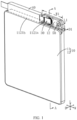
- Coordinate axis W represents a first direction, which is a direction in which a third side wall 1123 and a fourth side wall 1124 of the housing 10 are disposed opposite each other, parallel to a plane on which the electrochemical apparatus is located, and also a width direction of the main body of the electrochemical apparatus.
- Coordinate axis L represents a second direction, which is a direction in which a first side wall 1121 and a second side wall 1122 of the main body 11 are disposed opposite each other, parallel to the plane on which the electrochemical apparatus is located, and also a length direction of the main body of the electrochemical apparatus.
- Coordinate axis D represents a third direction, which is a direction in which a first top wall 111 and a first bottom wall 113 of the main body 11 are disposed opposite each other, is also a stacking direction of the electrode plates in the electrode assembly 20, as well as a thickness direction of the main body of the electrochemical apparatus, and is perpendicular to the plane on which the electrochemical apparatus is located.
- any two of the coordinate axes D, L, and W are perpendicular to each other.
- the housing 10 can be made of a conductive metal material such as steel or steel alloy, and has a corrosion-resistant coating inside to withstand complex working conditions such as high temperature, high pressure, and high corrosion inside the housing 10.
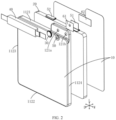
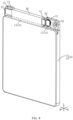
- the housing 10 is substantially in a shape of a flat square and includes a main body 11 and a first protruding portion 12.
- the first protruding portion 12 and the main body 11 together define an accommodating space (not shown) for accommodating the circuit board 40.
- the first protruding portion 12 is provided with a second top wall 121, a second bottom wall 122, and a second frame (not shown) formed by bending and extending from the second top wall 121 along the periphery of the second top wall 121.
- the second top wall 121 is formed by bending the first side wall 1121 of the main body 11 in the first zone 1121a of the first side wall 1121 along the first direction W and then bending and extending along the direction (the second direction L) toward the outside of the main body 11. That is, the second top wall 121, the first frame, the first top wall 111 of the main body, and the first frame of the main body form an integral structure.
- An end surface of the first frame farther away from the first top wall 111 can be attached to the first bottom wall 113 by, but not limited to, adhering, gluing, welding, mechanical fastening, or coupling, so as to define, together with the first bottom wall 113, a first cavity 11a for sealing the electrode assembly 20.
- An end surface of the second frame farther away from the second top wall 121 can be connected to the second bottom wall 122 using the same connection methods, so as to define, together with the second bottom wall 122, a second cavity 12a for accommodating a first tab 51.
- the second top wall 121 of the first protruding portion 12 is provided with a first through hole 121a and a second through hole 121b, both of which are in communication with the second cavity 12a.
- the first through hole 121a is used for installing the pole assembly 30 to be described below.
- the second through hole 121b may serve as an electrolyte injection hole.
- the first through hole 121a and the second through hole 121b are spaced apart on a same surface of the second top wall 121.
- the number of times of turning over the electrochemical apparatus can be reduced, and the installation of the pole assembly 30 and the electrolyte injection operation can be completed together, thereby improving assembly efficiency of the electrochemical apparatus.
- the second through hole 121b is closer to one side of the fourth side wall 1124 of the main body 11 than the first through hole 121a.
- the first through hole 121a is adjacent to the accommodating space of the housing 10, and the pole assembly 30 is disposed at the first through hole 121a.
- the electrical connection between the circuit board 40 and the pole assembly 30 may block the zone between them. Since the second through hole 121b is far away from the first through hole 121a, the second through hole 121b is less likely to be blocked by the blocked zone. That is, the second through hole 121b can always be exposed on the second top wall 121 of the first protruding portion 12, facilitating subsequent electrolyte replenishment process of the electrochemical apparatus.
- the electrode assembly 20 is accommodated within the second cavity 12a of the main body 11 and is insulated from the inner surface of the main body 11.
- the electrode assembly 20 includes at least one first electrode plate (not shown in the figure), at least one second electrode plate (not shown in the figure), and a separator (not shown in the figure) that separates the first electrode plate and the second electrode plate.
- the first electrode plate and the second electrode plate have opposite polarities.
- a first electrode plate, a separator, and a second electrode plate are alternately stacked to form a laminated structure.
- the second tab 52 can be made of a metal conductive material such as copper or nickel, and thus, each second electrode plate can be a negative electrode plate. It should be understood that a specific structure of the electrode assembly 20 is not limited. For example, in some other embodiments of this application, the electrode assembly 20 can alternatively be a wound electrode assembly 20. In addition, there are various options for the first electrode plate and the second electrode plate in the electrode assembly 20. For example, the first electrode plate and the second electrode plate may be current collectors coated with an active material layer on one side or current collectors coated with active material layers on both sides.
- the pole assembly 30 is disposed at the first through hole 121a of the second top wall 121 and is electrically connected to another end of the first tab 51.
- the electrochemical apparatus When the electrochemical apparatus is electrically connected to a load of the electric apparatus, electric energy can be sequentially output to the load through the first tab 51, the pole assembly 30, and the circuit board 40.
- the electrochemical apparatus When the electrochemical apparatus is electrically connected to the power supply apparatus, the electric energy can be input to the electrode assembly 20 through the circuit board 40, the pole assembly 30, and the first tab 51.
- the pole assembly 30 includes a pole 31, a connecting member 32, and an adhesive layer 33 sandwiched between the pole 31 and the connecting member 32.
- a cross section of the pole 31 is generally T-shaped and the pole 31 can be made of a conductive metal material such as aluminum or aluminum alloy.
- the pole 31 is provided with a first end portion (not shown) and a connecting portion (not shown) integrally formed with the first end portion. The first end portion is exposed on the second top wall 121 of the first protruding portion 12 and is electrically connected to the circuit board 40 accommodated within the accommodating space of the housing 10. The first end portion is connected to the connecting member 32 via the adhesive layer 33 to form an integral structure.
- the pole assembly 30 can be a universal component suitable for different sizes of electrochemical apparatuses.
- the connecting member 32 is adhered, glued, welded, or coupled to surface of the second top wall 121 away from the second cavity 12a to achieve an airtight seal therebetween.
- the connecting portion extends from a middle portion of the first end portion through the adhesive layer 33, the connecting member 32, and the first through hole 121a of the second top wall 121, and then extends into the second cavity 12a to electrically connect to another end of the first tab 51. It should be noted that since the housing 10 is electrically connected to the second electrode plate of the electrode assembly 20 through the second tab 52, the pole 31 is electrically connected to the first electrode plate of the electrode assembly 20 through the first tab 51.
- outer diameters of the first end portion of the pole 31, the adhesive layer 33, and the connecting member 32 increase successively and they form a stepped distribution as a whole.
- the advantage of this arrangement is that, on the one hand, the first end portion of the pole 31 has a larger contact area compared to the connecting portion, making it convenient to externally connect to the first end portion of the pole 31.
- the pole assembly 30 may include only the pole 31 in the foregoing structure.
- the first end portion of the pole 31 can be adhered or glued to surface of the second top wall 121 away from the second cavity 12a via an insulating sealing adhesive or an adhesive member, allowing the connecting portion to extend from the middle portion of the first end portion through the first through hole 121a of the second top wall 121 and into the second cavity 12a to electrically connect to another end of the first tab 51.
- the first end portion of the pole 31 can further be welded or coupled to the surface of the second top wall 121 away from the second cavity 12a.
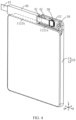
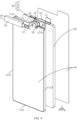
- a pole assembly 30' differs from the foregoing pole assembly 30 in that the pole assembly 30' can further include a first insulation gasket 32' and a second insulation gasket 33' in addition to the pole 31'.
- a cross section of the pole 31' is generally H-shaped and the pole 31' can be made of a conductive metal material such as aluminum or aluminum alloy.
- riveting enhances connection strength between the pole 31' and the first protruding portion 12, thereby strengthening a stress weak point at the second through hole 121b of the housing and enhancing the mechanical reliability and stability of the electrochemical apparatus.
- a metal gasket 34' is provided between the first end portion and the first insulation gasket 32' to disperse pressure of the pole 31' on the first insulation gasket 32', thereby reducing a failure rate of the riveting of the pole assembly 30'.
- the circuit board 40 is generally of a flat rectangular shape. A longer and thinner end of the circuit board 40 can be fixed to the first side wall 1121 of the housing 10 using an adhesive member or a structure such as a snap-fit, allowing the circuit board 40 to be accommodated within the accommodating space of the housing 10 in a manner that reduces thickness of the electrochemical apparatus.
- a first electrical connection portion 41 connecting the circuit board 40 and the pole 31 of the pole assembly 30 and a second electrical connection portion 42 connecting the circuit board 40 and the housing 10 are configured in such a way that a side closer to the first protruding portion 12 extends out of the circuit board 40, while a third electrical connection portion 43 for connecting the circuit board 40 to the outside is configured in such a way that a side farther away from the first protruding portion 12 extends out of the circuit board 40.
- the second electrical connection portion 42 of the circuit board 40 can be connected to any outer surface of the housing 10 and is not limited to this.
- thickness (a distance between two ends of the main body 11 in the third direction D) of the main body 11 is greater than or equal to 1 mm and less than 3 mm, for example, a total thickness of 1.8 mm, 1.7 mm, 1.6 mm, or 1.5 mm.
- the first side wall 1121 of the main body 11 further extends to form a second protruding portion 13.
- a specific structure of the second protruding portion 13 is similar to that of the first protruding portion 12 and can be referred to the description of the first protruding portion 12, and is not repeated here.
- the first protruding portion 12 is located at one end of the first side wall 1121
- the second protruding portion 13 is located at another end of the first side wall 1121.
- the first protruding portion 12 and the second protruding portion 13 jointly enclose an accommodating space for accommodating the circuit board 40.
- the third electrical connection portion 43 for external connections of the circuit board 40 can be configured to be fixed to the second protruding portion 13 and insulated from the second protruding portion 13.
- the connection area between the circuit board 40 and the housing 10 is further increased, and the two ends of the circuit board 40 are respectively protected by the first protruding portion 12 and the second protruding portion 13, thereby improving the drop resistance performance of the electrochemical apparatus in the third direction D.
- the blank current collector of each second electrode plate can be configured to be located near one end of the second protruding portion 13.
Landscapes
- Chemical & Material Sciences (AREA)
- Chemical Kinetics & Catalysis (AREA)
- Electrochemistry (AREA)
- General Chemical & Material Sciences (AREA)
- Engineering & Computer Science (AREA)
- Microelectronics & Electronic Packaging (AREA)
- Manufacturing & Machinery (AREA)
- Inorganic Chemistry (AREA)
- Connection Of Batteries Or Terminals (AREA)
- Sealing Battery Cases Or Jackets (AREA)
- Battery Mounting, Suspending (AREA)
Applications Claiming Priority (2)
| Application Number | Priority Date | Filing Date | Title |
|---|---|---|---|
| CN202211546439.5A CN115566328B (zh) | 2022-12-05 | 2022-12-05 | 电化学装置以及用电装置 |
| PCT/CN2023/115592 WO2024119911A1 (zh) | 2022-12-05 | 2023-08-29 | 电化学装置以及电子装置 |
Publications (2)
| Publication Number | Publication Date |
|---|---|
| EP4404338A1 true EP4404338A1 (de) | 2024-07-24 |
| EP4404338A4 EP4404338A4 (de) | 2025-07-30 |
Family
ID=84770406
Family Applications (1)
| Application Number | Title | Priority Date | Filing Date |
|---|---|---|---|
| EP23866679.6A Pending EP4404338A4 (de) | 2022-12-05 | 2023-08-29 | Elektrochemische vorrichtung und elektronische vorrichtung |
Country Status (5)
| Country | Link |
|---|---|
| US (1) | US20240243392A1 (de) |
| EP (1) | EP4404338A4 (de) |
| JP (1) | JP2025539144A (de) |
| CN (1) | CN115566328B (de) |
| WO (1) | WO2024119911A1 (de) |
Families Citing this family (3)
| Publication number | Priority date | Publication date | Assignee | Title |
|---|---|---|---|---|
| CN115566328B (zh) * | 2022-12-05 | 2023-03-10 | 宁德新能源科技有限公司 | 电化学装置以及用电装置 |
| CN116190935A (zh) * | 2023-03-21 | 2023-05-30 | 宁德新能源科技有限公司 | 电化学装置及电子设备 |
| CN119726002B (zh) * | 2024-12-31 | 2025-11-11 | 东莞新能德科技有限公司 | 电化学装置以及用电设备 |
Family Cites Families (19)
| Publication number | Priority date | Publication date | Assignee | Title |
|---|---|---|---|---|
| JP3221872B2 (ja) * | 2000-03-03 | 2001-10-22 | 松下電器産業株式会社 | 電池保護回路を備えた二次電池 |
| JP2003142043A (ja) * | 2001-07-09 | 2003-05-16 | Hitachi Maxell Ltd | 電 池 |
| KR100389968B1 (ko) * | 2001-07-23 | 2003-07-04 | 한국 파워셀 주식회사 | 리튬이온 이차전지 |
| JP4137881B2 (ja) * | 2002-05-14 | 2008-08-20 | 日立マクセル株式会社 | 薄型電池およびその製造方法 |
| US20040064163A1 (en) * | 2002-09-30 | 2004-04-01 | Aamodt Paul B. | Contoured battery for implantable medical devices and method of manufacture |
| JP4191469B2 (ja) * | 2002-12-18 | 2008-12-03 | パナソニック株式会社 | 角形電池 |
| TWM427683U (en) * | 2011-09-28 | 2012-04-21 | Uer Technology Corp | Thin type battery and package structure thereof |
| KR101684349B1 (ko) * | 2013-09-30 | 2016-12-08 | 주식회사 엘지화학 | 보호회로모듈 케이스를 포함하는 전지팩 |
| JP2015176782A (ja) * | 2014-03-17 | 2015-10-05 | 日立マクセル株式会社 | 電池パック |
| CN207038571U (zh) * | 2017-08-04 | 2018-02-23 | 宁德时代新能源科技股份有限公司 | 二次电池 |
| CN109671983B (zh) * | 2017-10-16 | 2024-06-07 | 东莞新能德科技有限公司 | 电池单元 |
| CN110071254B (zh) * | 2018-01-23 | 2022-09-09 | 东莞新能德科技有限公司 | 一种电池及其制备方法 |
| JP2021044147A (ja) * | 2019-09-11 | 2021-03-18 | 株式会社豊田自動織機 | 蓄電装置及び蓄電装置の製造方法 |
| CN212011033U (zh) * | 2020-04-30 | 2020-11-24 | 东莞新能德科技有限公司 | 电池及具有所述电池的电子装置 |
| CN111403803B (zh) * | 2020-04-30 | 2022-06-03 | 东莞新能德科技有限公司 | 电池及具有所述电池的电子装置 |
| CN115398719A (zh) * | 2020-06-18 | 2022-11-25 | 宁德新能源科技有限公司 | 电池及具有所述电池的用电装置 |
| CN214957173U (zh) * | 2021-04-20 | 2021-11-30 | 东莞新能安科技有限公司 | 电池包与用电装置 |
| CN216850095U (zh) * | 2022-01-26 | 2022-06-28 | 中山市臻铭智能科技有限公司 | 一种结构紧凑的电池组件 |
| CN115566328B (zh) * | 2022-12-05 | 2023-03-10 | 宁德新能源科技有限公司 | 电化学装置以及用电装置 |
-
2022
- 2022-12-05 CN CN202211546439.5A patent/CN115566328B/zh active Active
-
2023
- 2023-08-29 JP JP2025529223A patent/JP2025539144A/ja active Pending
- 2023-08-29 EP EP23866679.6A patent/EP4404338A4/de active Pending
- 2023-08-29 WO PCT/CN2023/115592 patent/WO2024119911A1/zh not_active Ceased
-
2024
- 2024-03-29 US US18/622,158 patent/US20240243392A1/en active Pending
Also Published As
| Publication number | Publication date |
|---|---|
| CN115566328B (zh) | 2023-03-10 |
| EP4404338A4 (de) | 2025-07-30 |
| CN115566328A (zh) | 2023-01-03 |
| US20240243392A1 (en) | 2024-07-18 |
| JP2025539144A (ja) | 2025-12-03 |
| WO2024119911A9 (zh) | 2024-07-18 |
| WO2024119911A1 (zh) | 2024-06-13 |
Similar Documents
| Publication | Publication Date | Title |
|---|---|---|
| EP4404338A1 (de) | Elektrochemische vorrichtung und elektronische vorrichtung | |
| KR102335021B1 (ko) | 이차 전지 및 그 모듈 | |
| EP2228852B1 (de) | Wiederaufladbare Batterie mit Stromsammlerplatten mit verbesserter Struktur | |
| EP3109926B1 (de) | Wiederaufladbare batterie und wiederaufladbares batteriemodul | |
| US20240243443A1 (en) | Battery and battery pack | |
| EP2388847B1 (de) | Sekundärbatterie mit ersten und zweiten Stromsammelplatten, die ineinander verstrickt sind | |
| US8623537B2 (en) | Rechargeable battery and battery module | |
| KR102453383B1 (ko) | 이차 전지 모듈 | |
| EP3490034B1 (de) | Elektrodenelement, elektrodenanordnung und wiederaufladbare batterie | |
| KR102361705B1 (ko) | 커버를 갖는 이차 전지 | |
| JP2006040899A (ja) | 二次電池 | |
| EP3806180B1 (de) | Batteriemodul | |
| EP4068490B1 (de) | Batteriezelle, batterie, elektrische vorrichtung, herstellungsverfahren und vorrichtung für eine batteriezelle | |
| KR101666876B1 (ko) | 이차 전지 및 그 모듈 | |
| US11929510B2 (en) | Secondary battery and manufacturing method thereof, battery module, and apparatus | |
| US12087972B2 (en) | Sealed battery | |
| CN116097517B (zh) | 电池、用电设备和电池的制备方法 | |
| EP2978061B1 (de) | Beutelartige sekundärbatterie und sekundärbatteriemodul damit | |
| US12315960B2 (en) | Current collecting member and manufacturing method thereof, secondary battery and manufacturing method thereof, battery module, and apparatus | |
| KR20120118569A (ko) | 이차 전지 | |
| CN118040003A (zh) | 电芯及用电设备 | |
| CN220290868U (zh) | 一种单体电池 | |
| CN220290877U (zh) | 电池单体、电池和用电装置 | |
| US20240113399A1 (en) | Electrochemical apparatus and electrical device | |
| CN115000642A (zh) | 一种方形叠片电池 |
Legal Events
| Date | Code | Title | Description |
|---|---|---|---|
| STAA | Information on the status of an ep patent application or granted ep patent |
Free format text: STATUS: UNKNOWN |
|
| STAA | Information on the status of an ep patent application or granted ep patent |
Free format text: STATUS: THE INTERNATIONAL PUBLICATION HAS BEEN MADE |
|
| PUAI | Public reference made under article 153(3) epc to a published international application that has entered the european phase |
Free format text: ORIGINAL CODE: 0009012 |
|
| STAA | Information on the status of an ep patent application or granted ep patent |
Free format text: STATUS: REQUEST FOR EXAMINATION WAS MADE |
|
| 17P | Request for examination filed |
Effective date: 20240402 |
|
| AK | Designated contracting states |
Kind code of ref document: A1 Designated state(s): AL AT BE BG CH CY CZ DE DK EE ES FI FR GB GR HR HU IE IS IT LI LT LU LV MC ME MK MT NL NO PL PT RO RS SE SI SK SM TR |
|
| RIN1 | Information on inventor provided before grant (corrected) |
Inventor name: ZHANG, GUOWEN Inventor name: LIU, NING Inventor name: YANG, JIANHUI |
|
| REG | Reference to a national code |
Ref country code: DE Ref legal event code: R079 Free format text: PREVIOUS MAIN CLASS: H01M0050102000 Ipc: H01M0050528000 |
|
| A4 | Supplementary search report drawn up and despatched |
Effective date: 20250701 |
|
| RIC1 | Information provided on ipc code assigned before grant |
Ipc: H01M 50/528 20210101AFI20250625BHEP Ipc: H01M 50/533 20210101ALI20250625BHEP Ipc: H01M 50/536 20210101ALI20250625BHEP Ipc: H01M 50/55 20210101ALI20250625BHEP Ipc: H01M 50/553 20210101ALI20250625BHEP |
|
| DAV | Request for validation of the european patent (deleted) | ||
| DAX | Request for extension of the european patent (deleted) |