EP4404501A1 - Schutz gegen seitenkanalangriffe eines kryptografischen algorithmus mit einem substitutionstisch - Google Patents
Schutz gegen seitenkanalangriffe eines kryptografischen algorithmus mit einem substitutionstisch Download PDFInfo
- Publication number
- EP4404501A1 EP4404501A1 EP24150924.9A EP24150924A EP4404501A1 EP 4404501 A1 EP4404501 A1 EP 4404501A1 EP 24150924 A EP24150924 A EP 24150924A EP 4404501 A1 EP4404501 A1 EP 4404501A1
- Authority
- EP
- European Patent Office
- Prior art keywords
- function
- variable
- aff
- masking
- substitution table
- Prior art date
- Legal status (The legal status is an assumption and is not a legal conclusion. Google has not performed a legal analysis and makes no representation as to the accuracy of the status listed.)
- Granted
Links
Images



Classifications
-
- H—ELECTRICITY
- H04—ELECTRIC COMMUNICATION TECHNIQUE
- H04L—TRANSMISSION OF DIGITAL INFORMATION, e.g. TELEGRAPHIC COMMUNICATION
- H04L9/00—Cryptographic mechanisms or cryptographic arrangements for secret or secure communications; Network security protocols
- H04L9/002—Countermeasures against attacks on cryptographic mechanisms
- H04L9/003—Countermeasures against attacks on cryptographic mechanisms for power analysis, e.g. differential power analysis [DPA] or simple power analysis [SPA]
-
- H—ELECTRICITY
- H04—ELECTRIC COMMUNICATION TECHNIQUE
- H04L—TRANSMISSION OF DIGITAL INFORMATION, e.g. TELEGRAPHIC COMMUNICATION
- H04L2209/00—Additional information or applications relating to cryptographic mechanisms or cryptographic arrangements for secret or secure communication H04L9/00
- H04L2209/04—Masking or blinding
- H04L2209/043—Masking or blinding of tables, e.g. lookup, substitution or mapping
Definitions
- the present invention belongs to the field of cryptography. More particularly, the invention relates to a method for protecting a cryptographic algorithm against side-channel attacks when the algorithm uses a substitution table. The invention also relates to an electronic device implementing such a method.
- Such an electronic device corresponds for example to a smart card, an integrated circuit of the microcontroller type, or an electronic device comprising a cryptographic component (computer, mobile telephone, payment card, device for creating an electronic signature, etc.).
- the cryptographic algorithms considered in the present application use a secret key to calculate output information from input information. This may for example be an encryption, decryption, authentication, signature or signature verification procedure.
- AES encryption (English acronym for “Advanced Encryption Standard”) is an example of a symmetric cryptographic algorithm. It is today considered relatively secure and used in many applications (for example in the encryption of certain communication applications or in the encryption of the contents of a hard drive).
- Cryptographic algorithms are constructed in such a way that it is not in practice possible to discover the secret key solely from the input information and the output information.
- the operations executed by the processor of the electronic device to implement the cryptographic algorithm generate variations in certain physical quantities such as electrical consumption, electromagnetic radiation, temperature, acoustic intensity or execution time. These variations are dependent on the data used in the different operations. More particularly, to the extent that certain operations of the algorithm involve the secret key, the variations observed may present a correlation with the value of the secret key. A malicious person can then take measurements of one or more physical quantities, then use these measurements by statistical analysis in order to obtain information on the secret key used by the algorithm.
- SCA Segment-Channel Attack
- the order of a side-channel attack is generally defined based on the number of variables the attacker seeks to determine from the observed measurements. For example, for a first-order attack, the attacker is only interested in the value of a variable at a given time. For a second-order attack, the attacker is interested in the value of two different variables at two potentially different given times. It is generally accepted that the difficulty of implementing a side-channel attack increases exponentially with the order of the attack.
- Boolean masking is a combination of Boolean masking and multiplicative masking.
- affine masking is a combination of Boolean masking and multiplicative masking.
- the S-Box' table must then be recalculated each time the masking variables are changed, which can significantly impact the performance of the algorithm.
- the operations " . » and “+” correspond here respectively to the multiplication and addition of finite fields.
- the present invention aims to remedy all or part of the drawbacks of the prior art.
- the first substitution table T pow corresponds to the function of raising to the power k
- the function associated with the substitution table T pow includes a step of raising to the power k (in other words the function associated with T pow is not necessarily limited to an elevation to the power k )
- the second substitution table T aff corresponds to the affine function Aff
- the function associated with the substitution table T aff comprises a step of application of the affine function Aff (in other words the function associated with T pow is not necessarily limited to the affine function Aff ) .
- the function Aff is not necessarily affine on the finite field E; on the other hand the function Lin is linear with respect to an addition operation of the finite field E.
- Affine masking makes it possible to secure the use of the secret variable s.
- the use of the two tables T pow and T aff makes it easier to take masking into account when applying the Sub substitution function to the secret variable s ; in fact, the two tables T pow and T aff are precalculated and used in such a way that we obtains at the output of T aff a result which corresponds to a masked representation (with affine masking presenting the same multiplicative mask m ) of the result which would have been obtained if the function Sub had been applied to the secret variable s.
- the use of the two tables T pow and T aff is particularly robust against side-channel attacks because only a strict subset of the shares obtained by masking is used to evaluate each of the tables.
- the use of the two tables T pow and T aff also makes it possible to limit the impact of masking on the memory footprint.
- the invention may also include one or more of the following characteristics, taken individually or in all technically possible combinations.
- variable b is chosen from a strict subset E b of E, each of the values that can be taken by the variable b is associated with an index, and the application of the first table of substitution T pow is carried out according to the index associated with the variable b.
- variable m is chosen from a strict subset E m of E , each of the values that can be taken by the variable m is associated with an index, and the application of the second table of substitution T aff is carried out according to the index associated with the variable m.
- variable p is chosen from a smaller set E p of natural integers defined such that, for any natural integer k' not belonging to E p , there exists a value k belonging to E p such that, for any variable x belonging to E, x 2 k' is equal to x 2 k .
- the set E p can correspond to the set ⁇ 0, 1, 2, ..., 7 ⁇ . Only the values belonging to E p are taken into account to construct the substitution table T aff .
- the set E p could also correspond to ⁇ 1, 2, 3, ..., 8 ⁇ , or to ⁇ 2, 3, 4, ..., 9 ⁇ , etc.
- variable p can also advantageously be chosen from a strict subset of the set E p (to further limit the number of possible values that can be taken by p, and thus limit the size of the table T aff ) .
- each of the values that can be taken by the variable p is associated with an index, and the application of the second substitution table T aff is carried out as a function of the index associated with the variable p .
- the affine mask or the multiplicative mask (rather than using the mask value directly) allows you to strengthen security against a side-channel attack and limit the impact of masking on the memory footprint.
- the subset E m and the subset E b are different and chosen so as to obtain a constant Hamming weight for all the values that can be taken by a concatenation of M ( s ) with the index corresponding to m or b.
- a leak in transition is a leak resulting from the use of the same material resource by two variables one after the other; the leak then depends simultaneously on the values of the two variables.
- a leak in transition is typically modeled by a Hamming distance between the two variables.
- the cryptographic algorithm is the “Advanced Encryption Standard” algorithm, also known by the acronym AES.
- the present invention relates to a computer program product for executing a cryptographic algorithm.
- the program includes code instructions which, when executed by a processor of an electronic device, configure said processor to execute a method according to any of the preceding embodiments.
- the present invention relates to an electronic device comprising a memory storing such a computer program product, and a processor configured to execute it.
- FIG. 1 schematically describes an electronic device 10 comprising a processor 11 configured to execute a cryptographic algorithm.
- the processor 11 is configured by code instructions 13 saved in a memory 12 of the electronic device 10.
- the code instructions 13 form a computer program (or computer program) which implements the cryptographic algorithm.
- the electronic device 10 corresponds for example to a smart card, a cryptographic component (for example an integrated circuit of the microcontroller type), or an electronic device comprising a cryptographic component (computer, mobile telephone, payment card, signature creation device electronics, etc.).
- a cryptographic component for example an integrated circuit of the microcontroller type
- an electronic device comprising a cryptographic component computer, mobile telephone, payment card, signature creation device electronics, etc.
- the cryptographic algorithm manipulates variables belonging to a finite body E. It may be a finite binary body, and in this case the operation of adding the finite binary body E corresponds to “exclusive OR” (XOR) . However, it can also be a non-binary finite body, and in this case the operation of adding the finite body E corresponds to a modular addition.
- XOR exclusive OR
- the cryptographic algorithm considered may correspond to all or part of a symmetric cryptographic algorithm such as AES.
- the Sub function can in fact correspond to the function associated with the substitution table (S-Box) of the AES algorithm.
- the AES S-Box is in fact composed of an inversion and an affine function in the binary finite field GF (2 8 ) .
- FIG. 5 schematically represents the main steps of a method 100 for protecting such a cryptographic algorithm against side channel attacks.
- the method 100 includes masking 101 of the secret variable s by a masking function.
- it may be an affine masking.
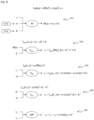
- THE figures 3 And 4 describe the steps of the method 100 in the case where affine masking is considered.
- it may also be a combination of affine masking with square masking, or a combination of Boolean masking with square masking.
- affine masking combined with square masking will be described later with reference to the figures 6 And 7 .
- the masking step 101 of the secret variable s comprises a random drawing ("rand") of a value for a variable m corresponding to a multiplicative mask, and a random drawing of a value for a variable b corresponding to a Boolean mask (or an “arithmetic” mask if placed in a finite non-binary body).
- Each of the variables m and b is chosen randomly from the elements of E or from a subset of E.
- the variable m is chosen to be non-zero.
- M ( s ), m and b then correspond to the three parts (“shares”) of masking the secret variable s.
- the invention is advantageously based on a decomposition of the S-Box' table into at least two substitution tables, by exploiting on the one hand the properties of multiplicative masking with respect to the function of elevation to the power k , and on the other hand the properties of Boolean masking with respect to the affine function Aff.
- the method 100 includes an application 102 of a first substitution table T pow to the hidden representation M ( s ) of the secret variable.
- This first substitution table T pow corresponds to the step of raising the non-linear function Sub to the power k .
- the substitution function associated with T pow includes a calculation of an elevation to the power k applied to M ( s ) .
- the variable b' can possibly be chosen from a set different from the set used to choose the variable b. Preferably, the variable b' is chosen to take non-zero values at least for certain values of M ( s ) and b.
- T pow table is evaluated based on M ( s ) and b but without using the variable m.
- the method 100 comprises an application 103 of a second substitution table T aff to the result r 1 obtained at the output of the first substitution table T pow .
- This second substitution table T aff corresponds to the affine step Aff of the non-linear function Sub.
- the substitution function associated with T aff includes a calculation of the affine function Aff applied (indirectly) to r 1 .
- the affine function Aff is applied to ( m -k .r 1 )).
- T aff table is evaluated based on r 1 and m but without using the variable b.
- the method 100 can include two additional steps 104 and 105 to eliminate the term m . Lin ( m -k .b') obtained at the output of the substitution table T aff .
- the method 100 includes an application 104 of a third substitution table T cor to the variables m and b' .
- T cor a third substitution table
- all the elements of the T cor table are previously calculated for the different values that can be taken by b' and m.
- T cor table is evaluated based on b' and m but without using M ( s ).
- the variable b" is a variable determined as a function of m and/or b' .
- the variable b" can optionally be chosen from a set different from the set used to choose the variable b' . Preferably, the variable b" is chosen to take non-zero values at least for certain values of m and b'.
- the subtraction step 105 could also be optional.
- the substitution table T cor could in fact directly provide the value of the Boolean part of the result r 2 obtained at the output of the table T aff .
- the T cor table takes b' and m as input and calculates m. Lin ( m -k .b').
- the memory impact of the method 100 depends on the size of the sets from which the variables b , b' and m are chosen. As indicated previously, these variables can each be chosen from a subset of E. Let us denote C E as the cardinal of the set E, C b and C b , the cardinals of the sets from which the variables b and b' respectively are chosen. (sets of Boolean masks), and C m the cardinal of the set from which the variable m is chosen (set of multiplicative masks).
- the number of elements in the table T pow is equal to C E ⁇ C b ; the number of elements in table T aff is equal to C E ⁇ C m and the number of elements in table T cor is equal to C b , ⁇ C m .
- the method 100 makes it possible to improve the level of security because each evaluation with one of the substitution tables T pow , T aff and T cor is carried out by manipulating a strict subset of the parts (“shares”). ) obtained by masking, and this makes a side-channel attack more difficult.
- the method 100 offers good performance in terms of speed of execution. Indeed, each evaluation with one of the substitution tables T pow , T aff and T cor is quick to perform because the tables are precalculated.
- substitution tables T pow , T aff and T cor each take two variables as input. It is possible to implement them using tables with two entries, or using tables whose unique entry is a combination of the two variables concerned (for example for the substitution table T pow , we can concatenate M ( s ) with the index of the Boolean mask b ) .
- the subset E m and the subset E b can be different and chosen so that the concatenation of M ( s ) with the index of the mask m or b has a constant Hamming weight whatever the the value of s, or even so that the Hamming distance between a mask and this concatenation is also constant.
- Such provisions make it possible to avoid leaks in value and further limit leaks in transition.
- affine masking is the combination of multiplicative masking with arithmetic masking
- the operation of adding the non-binary finite field corresponds to a modular addition (and in this case the term "boolean” used below before in the description of figures 3 And 4 can be replaced by the term "arithmetic")
- multiplication is the modular multiplication operation.
- the multiplicative masks must be chosen in the set of prime numbers with the modulo (for example, in the set of odd numbers in the case of a finite field having a cardinal that can be written as a power of two).
- THE figures 6 And 7 illustrate the case where the method 100 described in Figure 5 is based on a combination of affine masking with square masking (instead of simple affine masking as in the case described above with reference to figures 3 And 4 ).
- the finite field E must be a binary finite field.
- Square masking involves determining a random variable p and raising the secret variable to the power 2 p .
- Square masking performs particularly well for addition, multiplication, and power operations as binary finite field operations due to the linear behavior of these operations with respect to raising to a power of two. Additionally, square masking is particularly robust against transition leaks.
- the masking step 101 of the secret variable s then comprises a random drawing ("rand") of a value for a variable m corresponding to a multiplicative mask, a random drawing of a value for a variable b corresponding to a Boolean mask, and a random drawing of a value for a variable p corresponding to the square masking.
- the case where the variable p is zero corresponds to the case of affine masking described above with reference to the figures 3 And 4 .
- the case where the variable m is chosen from the set ⁇ 1 ⁇ corresponds to the case of a combination of a square masking with a Boolean masking.
- M ( s ), m, b and p then correspond to the four parts (“shares”) of masking the secret variable s.
- the S-Box' table is broken down into at least two substitution tables.
- the method 100 includes an application 102 of a first substitution table T pow to the hidden representation M ( s ) of the secret variable.
- This first substitution table T pow corresponds to the step of raising the non-linear function Sub to the power k .
- the substitution function associated with T pow includes a calculation of an elevation to the power k applied to M ( s ) .
- the variable b' can possibly be chosen from a different set of the set used to choose variable b. Preferably, the variable b' is chosen to take non-zero values at least for certain values of M ( s ) and b.
- T pow table is evaluated based on M ( s ) and b but without using the variables m and p.
- the method 100 comprises an application 103 of a second substitution table T aff to the result r 1 obtained at the output of the first substitution table T pow .
- This second substitution table T aff corresponds to the affine step Aff of the non-linear function Sub.
- the substitution function associated with T aff includes a calculation of the affine function Aff applied (indirectly) to r 1 .
- the affine function Aff is applied to ( m -k .r 1 ) 2- p ).
- all the elements of the table T aff are calculated beforehand for the different values that can be taken by r 1 , m and p.
- T aff table is evaluated based on r 1; m and p but without using the variable b.
- Affiliate m ⁇ k . r 1 2 ⁇ p 2 p The result r 2 at the output of the table T aff can then be written (using the linearity of the Lin function and the linearity of the elevation to a power of a power of two):
- r 2 m .
- Affiliate m ⁇ k . r 1 2 ⁇ p 2 p m .
- vs 2 p m .
- Linen s k .2 p + m ⁇ k . b ′ 2 ⁇ p 2 p + m . vs 2 p m .
- Linen s k + m ⁇ k .2 ⁇ p . b ′ 2 ⁇ p 2 p + m . vs 2 p m .
- Linen s k 2 p + m . linen m ⁇ k .2 ⁇ p . b ′ 2 ⁇ p 2 p + m . vs 2 p m .
- the method 100 can include two additional steps 104 and 105 to overcome the term m . linen m ⁇ k .2 ⁇ p . b ′ 2 ⁇ p 2 p obtained at the output of the substitution table T aff .
- the method 100 includes an application 104 of a third substitution table T cor to the variables b' , m and p.
- T cor substitution table
- Tcor table is evaluated based on b', m and p but without using M ( s ).
- the variable b" is a variable determined as a function of one or more elements among m, b' and p.
- the variable b" can optionally be chosen from a set different from the set used to choose the variable b' .
- the variable b" is chosen to take non-zero values at least for certain values of m, b' and p.
- the subtraction step 105 could also be optional.
- the substitution table T cor could in fact directly provide the value of the Boolean part of the result r 2 obtained at the output of the table T aff .
- the table T aff takes as input b' , m and p and calculates m . Linen m ⁇ k .2 ⁇ p . b ′ 2 ⁇ p 2 p .
- C c the cardinal of the set from which the variable p is chosen (set of square masks). Then, the number of elements in the table T pow is equal to C E ⁇ C b ; the number of elements in the table T aff is equal to C E ⁇ C m ⁇ C c and the number of elements in the table T cor is equal to C b' ⁇ C m ⁇ C c .
- substitution tables T pow , T aff and T cor each take two or three variables as input. It is possible to implement them using tables with two or three entries, or using tables whose only entry is a combination of the two or three variables concerned (for example for the substitution table T aff , we can concatenate r 1 with the index of the Boolean mask m and with the index of the square mask p ) .
- the function Lin is defined on GF (2) and it is linear with respect to the “exclusive or” in the finite field F.
- the Boolean mask b and the multiplicative mask m are each chosen from a subset of sixteen possible values.
- the values of the subset of Boolean masks and the subset of multiplicative masks were chosen so as to minimize from a theoretical point of view the leakage in Hamming weight and Hamming distance of the variables manipulated during the calculations.
- An STM32F7 microcontroller was used for this evaluation.
- Executing a hidden AES using the method 100 according to the invention for evaluating the S-Box takes 7061 clock cycles.
- a direct implementation of the insecure AES standard takes 7145 clock cycles. Both implementations are compiled with the compiler optimizations enabled at their highest level (-O3).
- An implementation of AES with boolean masking of order '1' using recomputed tables for the S-Box takes 10831 cycles.
- the implementation according to the invention is therefore more efficient than an implementation by Boolean masking, and it has very good performance in terms of speed of execution (substantially as fast as an insecure basic implementation).
- the implementation according to the invention has an execution time two to four times longer long, but much better than the order '1' Boolean masking implementation which has a runtime three to six times longer.
- the implementation according to the invention shows no leak following a non-specific t-test involving 400,000 electromagnetic measurements (measured t-value of 4.24, lower than the detection limit of t -test which is 4.5).
- an unprotected implementation shows t-value peaks at more than 300 (to be compared once again to the limit set at 4.5), and the Boolean masking implementation shows peaks at more than 40 (notably due to uncontrolled effects such as transition leaks, which are better taken care of by affine masking).
- the solution proposed by the invention therefore makes it possible to obtain a very good compromise between security and performance.
- the present invention achieves the objectives set.
- the invention makes it possible to optimize (in terms of calculation time and memory footprint) the taking into account of affine masking possibly combined with square masking during the application of a Sub substitution function. nonlinear to a secret variable s.
Landscapes
- Engineering & Computer Science (AREA)
- Computer Security & Cryptography (AREA)
- Computer Networks & Wireless Communication (AREA)
- Signal Processing (AREA)
- Storage Device Security (AREA)
- Financial Or Insurance-Related Operations Such As Payment And Settlement (AREA)
Applications Claiming Priority (1)
| Application Number | Priority Date | Filing Date | Title |
|---|---|---|---|
| FR2300615A FR3145222B1 (fr) | 2023-01-23 | 2023-01-23 | Protection contre les attaques par canal auxiliaire d’un algorithme cryptographique impliquant une table de substitution |
Publications (2)
| Publication Number | Publication Date |
|---|---|
| EP4404501A1 true EP4404501A1 (de) | 2024-07-24 |
| EP4404501B1 EP4404501B1 (de) | 2026-05-27 |
Family
ID=86604215
Family Applications (1)
| Application Number | Title | Priority Date | Filing Date |
|---|---|---|---|
| EP24150924.9A Active EP4404501B1 (de) | 2023-01-23 | 2024-01-09 | Schutz gegen seitenkanalangriffe eines kryptografischen algorithmus mit einem substitutionstisch |
Country Status (2)
| Country | Link |
|---|---|
| EP (1) | EP4404501B1 (de) |
| FR (1) | FR3145222B1 (de) |
Citations (2)
| Publication number | Priority date | Publication date | Assignee | Title |
|---|---|---|---|---|
| FR2203809A1 (de) | 1972-10-18 | 1974-05-17 | Crinos Industria Farmaco | |
| EP2296307B1 (de) * | 2009-09-04 | 2018-11-07 | IDEMIA France | Gegen Seitenkanalangriffe gesichertes kryptografisches Datenverarbeitungsverfahren |
-
2023
- 2023-01-23 FR FR2300615A patent/FR3145222B1/fr active Active
-
2024
- 2024-01-09 EP EP24150924.9A patent/EP4404501B1/de active Active
Patent Citations (2)
| Publication number | Priority date | Publication date | Assignee | Title |
|---|---|---|---|---|
| FR2203809A1 (de) | 1972-10-18 | 1974-05-17 | Crinos Industria Farmaco | |
| EP2296307B1 (de) * | 2009-09-04 | 2018-11-07 | IDEMIA France | Gegen Seitenkanalangriffe gesichertes kryptografisches Datenverarbeitungsverfahren |
Non-Patent Citations (5)
| Title |
|---|
| G. FUMAROLI ET AL., AFFINE MASKING AGAINST HIGHER-ORDER SIDE CHANNEL ANALYSIS |
| GUILLAUME FUMAROLI ET AL: "Affine Masking against Higher-Order Side Channel Analysis", IACR, INTERNATIONAL ASSOCIATION FOR CRYPTOLOGIC RESEARCH, vol. 20101012:131709, 11 October 2010 (2010-10-11), pages 1 - 25, XP061004272 * |
| L. GENELLE ET AL., SECURE MULTIPLICATIVE MASKING OF POWER FUNCTIONS |
| M. NASSAR ET AL., FORMAI ANALYSIS OF THE ENTROPY /SECURITY TRADE-OFF IN FIRST-ORDER MASKING COUNTERMEASURES AGAINST SIDE-CHANNEL ATTACKS |
| TUNSTALL MICHAEL ET AL: "Masking Tables-An Underestimated Security Risk", 8 July 2014, 16TH EUROPEAN CONFERENCE - COMPUTER VISION - ECCV 2020, CORNELL UNIVERSITY LIBRARY, 201 OLIN LIBRARY CORNELL UNIVERSITY ITHACA, NY 14853, PAGE(S) 425 - 444, XP047608349 * |
Also Published As
| Publication number | Publication date |
|---|---|
| FR3145222B1 (fr) | 2025-11-07 |
| EP4404501B1 (de) | 2026-05-27 |
| FR3145222A1 (fr) | 2024-07-26 |
Similar Documents
| Publication | Publication Date | Title |
|---|---|---|
| EP1358732B2 (de) | Verfahren zur gesicherten verschlüsselung und baustein zur ausführung eines solchen verschlüsselungsverfahrens | |
| EP2380306B1 (de) | Kryptografieschaltung mit schutz vor beobachtungsangriffen, im besonderen höherer ordnung | |
| EP2215768B1 (de) | Verfahren und vorrichtung zum schutz einer mikroschaltung gegen angriffe zur gewinnung geheimer daten | |
| EP1358733B1 (de) | Verfahren zur gesicherten kryptographischen berechnung mit geheimschlüssel und baustein zur ausführung des verfahrens | |
| EP2638660B1 (de) | Schutz gegen passives ausspähen | |
| FR3001315A1 (fr) | Procede de cryptographie comprenant une operation de multiplication par un scalaire ou une exponentiation | |
| EP2391051B1 (de) | Verfahren zur Bestimmung der Darstellung einer Multiplikation von zwei Elementen eines endlichen Körpers | |
| EP1895404A1 (de) | Maskierung einer gemäß eines RSA-CRT-Algorithmus durchgeführten Berechnung | |
| Rossi | Extended security of lattice-based cryptography | |
| EP2983083B1 (de) | Kryptografie-verfahren auf einer elliptischen kurve, das eine fehlererfassung umfasst | |
| EP1807967B1 (de) | Verfahren zur abgesicherten delegation einer bilinearfunktionsberechnung | |
| FR2888690A1 (fr) | Procede cryptographique pour la mise en oeuvre securisee d'une exponentiation et composant associe | |
| FR3145222A1 (fr) | Protection contre les attaques par canal auxiliaire d’un algorithme cryptographique impliquant une table de substitution | |
| EP3100403B1 (de) | Unausgeglichene montgomery-leiter gegen seteinkanalangriffe | |
| EP3579491A1 (de) | Bestimmungsverfahren des modularen kehrwerts und entsprechende kryptographische verarbeitungsvorrichtung | |
| EP4270855A1 (de) | Schutz gegen seitenkanalangriffe mit quadratischer maskierung | |
| EP4617853B1 (de) | Verfahren zur bestimmung einer modularen inverse, elektronische vorrichtung und computerprogramme dafür | |
| WO2006067057A1 (fr) | Procede d'exponentiation securisee et compacte pour la cryptographie | |
| EP4525353A1 (de) | Verfahren zur sicheren multiplikation zwischen einem hohlen polynom und einem dichten polynom in einem kryptographischen algorithmus, elektronische vorrichtung und computerprogramm dafür | |
| EP4687318A1 (de) | Verfahren zum sicheren nullvergleich, elektronische vorrichtung und computerprogramm dafür | |
| EP4572223A1 (de) | Verfahren zur durchrechnung einer funktion im white-box kontext und system dafür | |
| FR3157599A1 (fr) | Procédé de traitement de données | |
| WO2001017159A1 (fr) | Methode d'encryptage multi-modules | |
| EP2544398B1 (de) | Verfahren zur Berechnung einer Kodierungsfunktion in einer elliptischen Kurve, und entsprechender kryptografischer Koprozessor | |
| WO2008001009A1 (fr) | Systeme et procede cryptographique a cle publique pour l'authentification d'une premiere entite par une seconde entite |
Legal Events
| Date | Code | Title | Description |
|---|---|---|---|
| PUAI | Public reference made under article 153(3) epc to a published international application that has entered the european phase |
Free format text: ORIGINAL CODE: 0009012 |
|
| STAA | Information on the status of an ep patent application or granted ep patent |
Free format text: STATUS: REQUEST FOR EXAMINATION WAS MADE |
|
| 17P | Request for examination filed |
Effective date: 20240109 |
|
| AK | Designated contracting states |
Kind code of ref document: A1 Designated state(s): AL AT BE BG CH CY CZ DE DK EE ES FI FR GB GR HR HU IE IS IT LI LT LU LV MC ME MK MT NL NO PL PT RO RS SE SI SK SM TR |
|
| RAP3 | Party data changed (applicant data changed or rights of an application transferred) |
Owner name: COMMISSARIAT A L'ENERGIE ATOMIQUE ET AUX ENERGIESALTERNATIVES |
|
| GRAP | Despatch of communication of intention to grant a patent |
Free format text: ORIGINAL CODE: EPIDOSNIGR1 |
|
| STAA | Information on the status of an ep patent application or granted ep patent |
Free format text: STATUS: GRANT OF PATENT IS INTENDED |
|
| RIC1 | Information provided on ipc code assigned before grant |
Ipc: H04L 9/00 20220101AFI20251120BHEP |
|
| GRAJ | Information related to disapproval of communication of intention to grant by the applicant or resumption of examination proceedings by the epo deleted |
Free format text: ORIGINAL CODE: EPIDOSDIGR1 |
|
| STAA | Information on the status of an ep patent application or granted ep patent |
Free format text: STATUS: REQUEST FOR EXAMINATION WAS MADE |
|
| INTG | Intention to grant announced |
Effective date: 20251218 |
|
| INTC | Intention to grant announced (deleted) | ||
| GRAP | Despatch of communication of intention to grant a patent |
Free format text: ORIGINAL CODE: EPIDOSNIGR1 |
|
| STAA | Information on the status of an ep patent application or granted ep patent |
Free format text: STATUS: GRANT OF PATENT IS INTENDED |
|
| INTG | Intention to grant announced |
Effective date: 20260220 |
|
| GRAS | Grant fee paid |
Free format text: ORIGINAL CODE: EPIDOSNIGR3 |
|
| GRAA | (expected) grant |
Free format text: ORIGINAL CODE: 0009210 |
|
| STAA | Information on the status of an ep patent application or granted ep patent |
Free format text: STATUS: THE PATENT HAS BEEN GRANTED |
|
| AK | Designated contracting states |
Kind code of ref document: B1 Designated state(s): AL AT BE BG CH CY CZ DE DK EE ES FI FR GB GR HR HU IE IS IT LI LT LU LV MC ME MK MT NL NO PL PT RO RS SE SI SK SM TR |
|
| REG | Reference to a national code |
Ref country code: CH Ref legal event code: F10 Free format text: ST27 STATUS EVENT CODE: U-0-0-F10-F00 (AS PROVIDED BY THE NATIONAL OFFICE) Effective date: 20260527 Ref country code: GB Ref legal event code: FG4D Free format text: NOT ENGLISH |
|
| REG | Reference to a national code |
Ref country code: DE Ref legal event code: R096 Ref document number: 602024005026 Country of ref document: DE |