EP4404509A2 - Révocation de justificatifs d'identité après un accès à un service - Google Patents
Révocation de justificatifs d'identité après un accès à un service Download PDFInfo
- Publication number
- EP4404509A2 EP4404509A2 EP24167516.4A EP24167516A EP4404509A2 EP 4404509 A2 EP4404509 A2 EP 4404509A2 EP 24167516 A EP24167516 A EP 24167516A EP 4404509 A2 EP4404509 A2 EP 4404509A2
- Authority
- EP
- European Patent Office
- Prior art keywords
- vehicle
- service
- information
- access
- user
- Prior art date
- Legal status (The legal status is an assumption and is not a legal conclusion. Google has not performed a legal analysis and makes no representation as to the accuracy of the status listed.)
- Pending
Links
Images



Classifications
-
- H—ELECTRICITY
- H04—ELECTRIC COMMUNICATION TECHNIQUE
- H04W—WIRELESS COMMUNICATION NETWORKS
- H04W12/00—Security arrangements; Authentication; Protecting privacy or anonymity
- H04W12/08—Access security
-
- H—ELECTRICITY
- H04—ELECTRIC COMMUNICATION TECHNIQUE
- H04L—TRANSMISSION OF DIGITAL INFORMATION, e.g. TELEGRAPHIC COMMUNICATION
- H04L63/00—Network architectures or network communication protocols for network security
- H04L63/10—Network architectures or network communication protocols for network security for controlling access to devices or network resources
-
- H—ELECTRICITY
- H04—ELECTRIC COMMUNICATION TECHNIQUE
- H04W—WIRELESS COMMUNICATION NETWORKS
- H04W12/00—Security arrangements; Authentication; Protecting privacy or anonymity
- H04W12/08—Access security
- H04W12/082—Access security using revocation of authorisation
-
- H—ELECTRICITY
- H04—ELECTRIC COMMUNICATION TECHNIQUE
- H04W—WIRELESS COMMUNICATION NETWORKS
- H04W12/00—Security arrangements; Authentication; Protecting privacy or anonymity
- H04W12/30—Security of mobile devices; Security of mobile applications
- H04W12/35—Protecting application or service provisioning, e.g. securing SIM application provisioning
-
- H—ELECTRICITY
- H04—ELECTRIC COMMUNICATION TECHNIQUE
- H04W—WIRELESS COMMUNICATION NETWORKS
- H04W4/00—Services specially adapted for wireless communication networks; Facilities therefor
- H04W4/30—Services specially adapted for particular environments, situations or purposes
- H04W4/40—Services specially adapted for particular environments, situations or purposes for vehicles, e.g. vehicle-to-pedestrians [V2P]
-
- H—ELECTRICITY
- H04—ELECTRIC COMMUNICATION TECHNIQUE
- H04W—WIRELESS COMMUNICATION NETWORKS
- H04W4/00—Services specially adapted for wireless communication networks; Facilities therefor
- H04W4/50—Service provisioning or reconfiguring
Definitions
- Vehicles have become increasingly technologically sophisticated.
- users in the proximity of the vehicles are able to access the services of the vehicles.
- the users are able to establish wireless links with the vehicles to access the services of the vehicles.
- a "vehicle” can refer to any or some combination of a truck, a trailer, a tractor, a car, a railed vehicle (e.g., a train), a watercraft (e.g., a ship), an aircraft, a spacecraft, or any other moveable structure that can carry cargo or people.
- a truck can refer to any or some combination of a truck, a trailer, a tractor, a car, a railed vehicle (e.g., a train), a watercraft (e.g., a ship), an aircraft, a spacecraft, or any other moveable structure that can carry cargo or people.
- a vehicle can include one or more services that are accessible by users in a proximity of the vehicle.
- the service(s) of the vehicle can be accessible by the occupants (driver and/or passenger) of the vehicle.
- the service(s) of the vehicle can be accessible to a user that is outside but near the vehicle.
- Such a user can be a technician that is servicing the vehicle, a valet parker, or any other user that is near the vehicle (i.e., within a communication range of the vehicle).
- a security credential can refer to information that allows or disallows for a secured access of a service. Examples of security credentials include encryption keys, passwords, certificates and so forth.
- Profile information can refer to information relating to an identification of the service or an access point (AP) of a wireless network, information describing a service, wireless pairing information (e.g., Bluetooth pairing information, Near Field Communication (NFC) pairing information, etc.) for remote access to the vehicle or access to applications (e.g., Waze, Spotify, etc.), and so forth.
- wireless local area network that operates according to the Institute of Electrical and Electronics Engineers (IEEE) 802.11 standards
- an identifier of an AP can include a service set identifier (SSID).
- SSID service set identifier
- the access of a service of a vehicle can be temporary.
- the vehicle may be a rental vehicle, a taxi, a shared vehicle, and so forth.
- a user can access a service so long as the user occupies or has possession of the vehicle.
- a second user can access a service of the vehicle.
- a security credential and other information associated with the access of the service by the first user may persist even after the service access is complete (or terminated).
- one user may be able to access personal information of another user who has accessed or is accessing a service of the vehicle.
- Fig. 1 is a block diagram of an example arrangement that includes a vehicle 102, a user device 104, and an operator system 106 that is associated with an operator of the vehicle 102.
- An "operator” can refer to an entity that manages the vehicle 102, such as for vehicle sharing, vehicle rental, taxi ride service, and so forth.
- the operator can be an enterprise, such as a business organization (e.g., a rental company, a taxi company, a vehicle sharing management company, etc.). In other examples, the operator can be an individual that owns or otherwise manages the vehicle 102.
- the vehicle 102, the user device 104, and the operator system 106 are able to communicate over a network 108.
- the network 108 can include a public network such as the Internet.
- the network 108 can include a private network such as a local area network (LAN), a wide area network (WAN), and so forth.
- LAN local area network
- WAN wide area network
- the user device 104 and the vehicle 102 can establish communications using a wireless link 110.
- the wireless link 110 can include a short-range wireless link, such as a Bluetooth wireless link, an NFC link, or other types of short-range wireless links.
- the wireless link 110 can include a WI-FI wireless link according to the IEEE 802.11 and Wi-Fi Alliance standards, in which case the vehicle 102 includes a WLAN AP to communicate over the WI-FI wireless link with the user device 104.
- the user device 104 includes a secure connection establishment module 112 that is able to obtain information that can be used to establish a secure connection over the wireless link 110 with a secure connection establishment module 114 of the vehicle 102.
- module can refer to a hardware processing circuit, such as any or some combination of the following: a microprocessor, a core of a multi-core microprocessor, a microcontroller, a programmable integrated circuit device, a programmable gate array, or another hardware processing circuit.
- a “module” can refer to a combination of a hardware processing circuit and machine-readable instructions executable on the hardware processing circuit.
- the vehicle 102 similarly includes an information revoking module 122 that revokes information used by the user device 104 to access the vehicle service, in response to completion of the service access.
- authentication and configuration (collectively referred to as “provisioning") of the user device 104 to allow for access of a service of the vehicle 102 can be according to the Wi-Fi Alliance Device Provisioning Protocol (DPP).
- DPP provides a provisioning scheme in which a dedicated network infrastructure for use in provisioning of wireless devices does not have to be implemented.
- AAA Authentication, Authorization, and Accounting
- Both the configurator device and enrollee device generate public/private key pairs that are used to authenticate and establish a secure configuration channel.
- the secure configuration channel is then used to pass configuration information between the devices.
- the enrollee device sends a set of attributions (e.g., requirements and associated parameters), and in response, the configurator device sends configuration information to the enrollee device.
- the configuration information can include credentials to obtain network access, and/or a configurator signing key.
- the configuration information can also include a list of configurator identities, a list of enrollees (in the case of a configurator), and so forth.
- provisioning techniques according to DPP, it is noted that in further examples, additional or alternative provisioning techniques can also be employed.
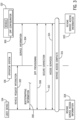
- Fig. 2 is a message flow diagram in which a DPP Configurator 200 is part of the operator system 106.
- the user device 104 performs a vehicle request interaction (at 202) with the operator system 106 to allow a user of the user device 104 to obtain access of the vehicle 102.
- the interaction (202) can include an online reservation in which the user uses the user device 104 to access a website of the operator system 106 to make a reservation for the vehicle 102.
- the interaction (202) can be based on a user requesting a vehicle using an application of the user device 104 to hail a ride.
- the user device 104 can be provided with location information of the vehicle 102, such as a street address or other indication of the vehicle's location.
- the operator system 106 can provide (at 204) service information to the vehicle at 102, where the service information indicates the service(s) that (is) are available to the user device 104.
- the service information can include any or some combination of the following: Bluetooth pairing information that enables the user device 104 to establish a Bluetooth connection with the vehicle 102; information of the vehicle's navigation service; information of a feature of the vehicle 102 to access local information; information of the vehicle's multimedia service; information of a toll road access service; information of priority access to special traffic lanes (such as car pool lanes); information relating to electrical charging of the vehicle 102; information enabling multi-device access; and so forth.
- the user device 104 receives (at 206) bootstrapping information.
- the bootstrapping information can be obtained from any of various different sources.
- the bootstrapping information can be provided by the operator system 106.
- the bootstrapping information can be acquired by the user device 104 by scanning, using a camera of the user device 104, a specified code that includes the bootstrapping information.
- the bootstrapping information can be provided in a Bluetooth Low Energy (BLE) beacon transmitted using Bluetooth signals in the vehicle 102, or provided in NFC signals.
- BLE Bluetooth Low Energy
- the bootstrapping information can be received over a cable (such as a Universal Serial Bus or USB cable).
- the bootstrapping information can be obtained from another source.
- proximity can be one of two things. It can be bounded by the distance the radio can operate and thus be the radius of the particular wireless technology. Or it can be a specifically measured distance using technology such as received signal strength (RSSI) or round trip time (RTT). Examples of proximity protocols include Bluetooth PXP profile, IEEE 802.11 Fine Timing Measurement, Wi-Fi Alliance Location and Wi-Fi Aware Ranging.
- RSSI received signal strength
- RTT round trip time
- the configuration information can include a DPP configuration object provided to the user device 104 by the DPP Configurator 200.
- the configuration information can include WI-FI credentials, Bluetooth pairing information, an expiration time of a DPP Connector, and so forth.
- the configuration information can also include the DPP Connector, which includes information identifying service(s) of the vehicle 102 accessible by the user device 104.
- the DPP Connector can also include a credential useable to establish a secure connection for accessing the service(s) of the vehicle 102.
- the user device 104 can establish a secure connection (at 212) with the vehicle 102. Following establishment of the secure connection (at 212), the user device 104 is able to access (at 214) a service (or services) of the vehicle 102.
- the user access of the vehicle 102 is temporary (e.g., taxi or ridesharing, vehicle rental, vehicle sharing, etc.), it is noted that techniques according to some implementations can be applied in a more permanent context where the user is intended to have permanent access of the vehicle 102.
- the user may be the owner of the vehicle 102, and is granted the service access information to access the service(s) of the vehicle 102.
- the vehicle 102 may be stolen or borrowed by another driver (e.g., a family member, a friend, etc.), in which case the service access information can be revoked while the user is not in possession of the vehicle 102.
- FIG. 2 depicts indirect provisioning of the user device 104 by the DPP Configurator 200 of the operator system 106
- Fig. 3 shows an alternative example in which a DPP Configurator 300 of the vehicle 102 can perform direct provisioning of the user device 104 that is to access a service of the vehicle 102.
- Fig. 3 it is assumed that the vehicle 102 has network connectivity with the operator system 106 used to manage the service, and the operator system 106 has the ability to push provisioning information (such as the bootstrapping information and policy information for the device session to the vehicle).
- provisioning information such as the bootstrapping information and policy information for the device session to the vehicle.
- the user device 104 performs a vehicle request interaction (at 302) with the operator system 106 to allow a user of the user device 104 to obtain access of the vehicle 102 (a process similar to the interaction 202 of Fig. 2 ).
- the operator system 106 can provide (at 304) service information to the vehicle at 102, where the service information indicates the service(s) that (is) are available to the user device 104.
- the user device 104 can perform, using the bootstrapping information, DPP provisioning (at 308) with the DPP Configurator 300 of the vehicle 102.
- the DPP provisioning includes authenticating the user device 104 and providing configuration information to the user device 104.
- an existing authenticated connection between the user device 104 and the vehicle 102 can be used.
- the service access information can be revoked once the ride is over and payment has been made for the ride.
- the bootstrapping information can be obtained in the following ways.
- the user can be provided with a specified code (e.g., QR code or barcode) including the bootstrapping information with a time expiry set to the end of rental period at booking time or through the vehicle 102 directly.
- the specified code can be provided to the user device 104 at the time of making the vehicle reservation, or alternatively, the specified code can be displayed by a display device of the vehicle 102, and can be scanned by a camera of the user device 104.
- the specified code can include a token that uniquely identifies a rental agreement governing the rental of the vehicle 102.
- the specified code can be used to provision multiple user devices, if enabled by the vehicle rental company.
- the vehicle rental information provided to the user device 104 can include Bluetooth pairing information to allow the user device 104 to establish a Bluetooth connection with the vehicle 104, or alternatively, the vehicle rental information can include Bluetooth bootstrapping information to establish a WI-FI connection with the vehicle 102.
- DPP provisioning of the user device 104 can be performed using a vehicle rental application on the user device 104, or based on access of a website by the user device 104.
- bootstrapping involves the user device 104 obtaining a public key of a peer device (e.g., the vehicle 102) that will be used for DPP authentication.
- Bootstrapping information can be encoded as a uniform resource identifier (URI).
- URI uniform resource identifier
- Bootstrapping mechanisms utilize any or some combination of the following technologies according to the DPP specification to obtain bootstrapping information: scanning a QR code, static or dynamic NFC communication of the bootstrapping information, BLE communication of the bootstrapping information, exchanging a shared secret, and so forth.
- the bootstrapping information can be enforced in either one-way authentication (the user device 104 authenticates the vehicle 102) or mutual authentication (bi-directional authentication between the user device 104 and the vehicle 102). If mutual authentication is used, the user device 104 can exchange bootstrapping keys over the secure connection with the operator system 106.
- the bootstrapping information can contain a domain name or IP address.
- the bootstrapping information encoding can be modified to add a domain name:
- DPP provisioning authentication and configuration
- the user device 104 and a DPP Configurator can perform DPP authentication using bootstrapping information.
- the user device 104 sends a DPP Configuration Request frame to the DPP Configurator (200 in Fig. 2 or 300 in Fig. 3 ). If the user device 104 obtained a token during the vehicle request interaction (202 in Fig. 2 or 302 in Fig. 3 ), the user device 104 would transmit the token to the DPP Configurator in order to obtain the correct configuration.
- the DPP Configuration Request frame can contain a public key that can be used to perform out-of-band Bluetooth pairing.
- DPP Configuration Request attributes are encoded using JavaScript Object Notation (JSON) and can have the following form:
- the DPP Configurator Upon successful reception of the DPP Configuration Request frame, the DPP Configurator can construct a configuration response containing a DPP Configuration Object and a DPP Connector.
- the DPP Configuration object and DPP Connector are encoded using JSON, for example.
- An example DPP connector object can be as follows:
- the various Serviceld fields of the DPP Connector identify respective services.
- the netAccessKey is a credential that can be used to set up a secure connection between the user device 104 and the vehicle 102 to access the service(s) of the vehicle 102.
- the user device 104 uses the service information (the Serviceld fields) in the DPP Connector to establish service connectivity to applications running on the vehicle 102.
- the user device 104 can exchange personal preference information and application configuration information with the vehicle 102.
- this application credential can be used to proxy connectivity to the vehicle 102 to establish the secure connection between the user device 104 and the vehicle 102.
- the service access information can be revoked by the vehicle 102 in response to the user triggering the end of access of the vehicle 102.
- the following describes revocation of the service access information on the vehicle 102 (or more specifically, on the AP of the vehicle 102 in examples where the vehicle 102 provides a WLAN).
- the operator system 106 establishes a secure connection with the vehicle 102 to delete the DPP Connector, for example.
- a configuration key allows the DPP Configurator to re-establish a connection to the vehicle 102.
- the configuration key can be a new key derived as a result of successful DPP authentication, or existing keys such as the netAccessKey from the enrollee device (the vehicle 102) and the configurator signing key from the DPP Configurator.
- the DPP Configurator in the operator system 106 uses its configuration key to authenticate itself to the vehicle 102.
- the following describes revocation of the service access information on the user device 104.
- the user device 104 establishes a connection to either the DPP Configurator in the operator system 106 or the DPP Configurator in the vehicle 102 using a configuration key.
- the revocation process can be as follows.
- the DPP Configurator establishes a secure connection with the user device 104.
- the DPP Configurator securely sends a Configuration Request frame to the user device 104 containing revocation information.
- the revocation of a service access information may cause the user device 104 (such as an application or an operating system in the vehicle 104) to query the information revoking store 124 in the operator system 106 over another connection (e.g., a cellular connection different from the vehicle's wireless network).
- the user device 104 can verify if the revocation was due to the normal completion of access of the vehicle 102, or for some other purpose (e.g., the vehicle 102 was reported stolen). This information may be used to determine whether the service access information should be stored and reused later on, or deleted.
- the information in the query response may also be displayed to the user.
- Fig. 4 is a block diagram of an electronic device or system 400 according to some examples.
- the electronic device or system 400 can include any of the user device 104, the vehicle 102, or the operator system 106 discussed above.
- the machine-readable instructions include service access and information revocation instructions 406 that can allow a user device to access a vehicle's service, and to revoke service access information upon completion of the service access.
- the storage medium 404 can include any or some combination of the following: a semiconductor memory device such as a dynamic or static random access memory (a DRAM or SRAM), an erasable and programmable read-only memory (EPROM), an electrically erasable and programmable read-only memory (EEPROM) and flash memory; a magnetic disk such as a fixed, floppy and removable disk; another magnetic medium including tape; an optical medium such as a compact disk (CD) or a digital video disk (DVD); or another type of storage device.
- a semiconductor memory device such as a dynamic or static random access memory (a DRAM or SRAM), an erasable and programmable read-only memory (EPROM), an electrically erasable and programmable read-only memory (EEPROM) and flash memory
- a magnetic disk such as a fixed, floppy and removable disk
- another magnetic medium including tape an optical medium such as a compact disk (CD) or a digital video disk (DVD); or another type of storage device.
- CD compact disk
Landscapes
- Engineering & Computer Science (AREA)
- Computer Networks & Wireless Communication (AREA)
- Signal Processing (AREA)
- Computer Security & Cryptography (AREA)
- Computer Hardware Design (AREA)
- Computing Systems (AREA)
- General Engineering & Computer Science (AREA)
- Mobile Radio Communication Systems (AREA)
Applications Claiming Priority (3)
| Application Number | Priority Date | Filing Date | Title |
|---|---|---|---|
| US16/004,798 US11924639B2 (en) | 2018-06-11 | 2018-06-11 | Revoking credentials after service access |
| PCT/CA2019/050739 WO2019237183A1 (fr) | 2018-06-11 | 2019-05-30 | Révocation de justificatifs d'identité après un accès à un service |
| EP19819710.5A EP3804380B1 (fr) | 2018-06-11 | 2019-05-30 | Révocation de justificatifs d'identité après un accès à un service |
Related Parent Applications (2)
| Application Number | Title | Priority Date | Filing Date |
|---|---|---|---|
| EP19819710.5A Division EP3804380B1 (fr) | 2018-06-11 | 2019-05-30 | Révocation de justificatifs d'identité après un accès à un service |
| EP19819710.5A Division-Into EP3804380B1 (fr) | 2018-06-11 | 2019-05-30 | Révocation de justificatifs d'identité après un accès à un service |
Publications (2)
| Publication Number | Publication Date |
|---|---|
| EP4404509A2 true EP4404509A2 (fr) | 2024-07-24 |
| EP4404509A3 EP4404509A3 (fr) | 2024-07-31 |
Family
ID=68764500
Family Applications (2)
| Application Number | Title | Priority Date | Filing Date |
|---|---|---|---|
| EP19819710.5A Active EP3804380B1 (fr) | 2018-06-11 | 2019-05-30 | Révocation de justificatifs d'identité après un accès à un service |
| EP24167516.4A Pending EP4404509A3 (fr) | 2018-06-11 | 2019-05-30 | Révocation de justificatifs d'identité après un accès à un service |
Family Applications Before (1)
| Application Number | Title | Priority Date | Filing Date |
|---|---|---|---|
| EP19819710.5A Active EP3804380B1 (fr) | 2018-06-11 | 2019-05-30 | Révocation de justificatifs d'identité après un accès à un service |
Country Status (4)
| Country | Link |
|---|---|
| US (2) | US11924639B2 (fr) |
| EP (2) | EP3804380B1 (fr) |
| CN (1) | CN112219417B (fr) |
| WO (1) | WO2019237183A1 (fr) |
Families Citing this family (8)
| Publication number | Priority date | Publication date | Assignee | Title |
|---|---|---|---|---|
| US10873842B2 (en) * | 2016-04-08 | 2020-12-22 | Blackberry Limited | Managed object to provision a device according to one of plural provisioning techniques |
| JP7296701B2 (ja) | 2018-09-06 | 2023-06-23 | キヤノン株式会社 | 通信装置、制御方法、およびプログラム |
| US10880361B2 (en) * | 2018-09-26 | 2020-12-29 | Micron Technology, Inc. | Sharing a memory resource among physically remote entities |
| EP3694238A1 (fr) * | 2019-02-11 | 2020-08-12 | Koninklijke Philips N.V. | Rapport d'état d'une connexion précédente |
| US12096214B2 (en) | 2022-04-14 | 2024-09-17 | Hewlett Packard Enterprise Development Lp | Establishing a backup connectivity between a sensor and a management system |
| US11695772B1 (en) * | 2022-05-03 | 2023-07-04 | Capital One Services, Llc | System and method for enabling multiple auxiliary use of an access token of a user by another entity to facilitate an action of the user |
| US12520156B2 (en) * | 2022-12-29 | 2026-01-06 | Qualcomm Incorporated | Neighbor awareness networking pairing termination |
| CN117939573A (zh) * | 2023-06-12 | 2024-04-26 | 小米汽车科技有限公司 | 车载网络接入方法、装置、存储介质及芯片 |
Family Cites Families (25)
| Publication number | Priority date | Publication date | Assignee | Title |
|---|---|---|---|---|
| AU7346800A (en) * | 1999-09-02 | 2001-03-26 | Automated Business Companies | Communication and proximity authorization systems |
| US7366677B1 (en) * | 2000-08-31 | 2008-04-29 | International Business Machines Corporation | Access control for rental cars |
| IL154091A0 (en) * | 2003-01-23 | 2003-07-31 | A method and a system for unauthorized vehicle control | |
| US7757076B2 (en) * | 2003-12-08 | 2010-07-13 | Palo Alto Research Center Incorporated | Method and apparatus for using a secure credential infrastructure to access vehicle components |
| US8543824B2 (en) * | 2005-10-27 | 2013-09-24 | Apple Inc. | Safe distribution and use of content |
| US20080027602A1 (en) * | 2006-05-30 | 2008-01-31 | Yeap Tet H | System and method for deterring theft of vehicles and other products having integral computer means |
| US8191124B2 (en) | 2006-09-06 | 2012-05-29 | Devicescape Software, Inc. | Systems and methods for acquiring network credentials |
| US8341717B1 (en) | 2008-11-13 | 2012-12-25 | Sprint Communications Company L.P. | Dynamic network policies based on device classification |
| US8619735B2 (en) | 2009-07-16 | 2013-12-31 | Blackberry Limited | Methods and apparatus to register with external networks in wireless network environments |
| US8989820B2 (en) * | 2010-11-10 | 2015-03-24 | Ipcomm | Method for suspending transmission and reception of text messages and phone calls |
| US20120221695A1 (en) * | 2011-02-28 | 2012-08-30 | Scott Douglas Rose | Methods and apparatus to integrate logical and physical access control |
| GB2496841B (en) * | 2011-11-15 | 2016-07-20 | Rosberg System As | Method of securing a computing device |
| US9258712B2 (en) | 2012-09-04 | 2016-02-09 | Nokia Technologies Oy | Method, apparatus, and computer program product for sharing wireless network configurations |
| EP2954728A4 (fr) | 2013-02-05 | 2016-09-14 | Intel Corp | Techniques d'approvisionnement d'inscription en ligne pour connexions de point d'accès sans fil |
| US9499128B2 (en) * | 2013-03-14 | 2016-11-22 | The Crawford Group, Inc. | Mobile device-enhanced user selection of specific rental vehicles for a rental vehicle reservation |
| US9902343B2 (en) * | 2013-07-31 | 2018-02-27 | Driverdo Llc | Digital vehicle tag and method of integration in vehicle allocation system |
| US9948359B2 (en) | 2013-09-20 | 2018-04-17 | At&T Intellectual Property I, L.P. | Secondary short-range wireless assist for wireless-based access control |
| US20150146706A1 (en) | 2013-11-22 | 2015-05-28 | Lantronix, Inc. | Remotely Provisioning And Operating A Headless WIFI Device |
| US9800581B2 (en) | 2014-03-14 | 2017-10-24 | Cable Television Laboratories, Inc. | Automated wireless device provisioning and authentication |
| US9701280B2 (en) | 2015-04-03 | 2017-07-11 | GM Global Technology Operations LLC | Revocation of mobile device communication control privileges |
| US20160360407A1 (en) | 2015-06-05 | 2016-12-08 | Qualcomm Incorporated | Distributed configurator entity |
| US11632710B2 (en) | 2016-03-02 | 2023-04-18 | Blackberry Limited | Provisioning a device in a network |
| US20170265448A1 (en) * | 2016-03-21 | 2017-09-21 | Liam Duffy | Fishing Lure Container |
| US10873842B2 (en) * | 2016-04-08 | 2020-12-22 | Blackberry Limited | Managed object to provision a device according to one of plural provisioning techniques |
| WO2018002904A1 (fr) | 2016-07-01 | 2018-01-04 | Cnathanson Martin D | Système d'authentification et d'autorisation d'accès à un environnement véhiculaire à accès sans fil par des dispositifs clients et de comptabilisation de la consommation à cet effet |
-
2018
- 2018-06-11 US US16/004,798 patent/US11924639B2/en active Active
-
2019
- 2019-05-30 WO PCT/CA2019/050739 patent/WO2019237183A1/fr not_active Ceased
- 2019-05-30 CN CN201980029867.0A patent/CN112219417B/zh active Active
- 2019-05-30 EP EP19819710.5A patent/EP3804380B1/fr active Active
- 2019-05-30 EP EP24167516.4A patent/EP4404509A3/fr active Pending
-
2024
- 2024-01-22 US US18/418,659 patent/US20240244433A1/en active Pending
Also Published As
| Publication number | Publication date |
|---|---|
| US20240244433A1 (en) | 2024-07-18 |
| US20190380034A1 (en) | 2019-12-12 |
| EP4404509A3 (fr) | 2024-07-31 |
| CN112219417A (zh) | 2021-01-12 |
| EP3804380A4 (fr) | 2022-02-16 |
| WO2019237183A1 (fr) | 2019-12-19 |
| EP3804380B1 (fr) | 2024-09-18 |
| EP3804380A1 (fr) | 2021-04-14 |
| CA3094831A1 (fr) | 2019-12-19 |
| US11924639B2 (en) | 2024-03-05 |
| CN112219417B (zh) | 2024-01-05 |
| EP3804380C0 (fr) | 2024-09-18 |
Similar Documents
| Publication | Publication Date | Title |
|---|---|---|
| US20240244433A1 (en) | Revoking credentials after service access | |
| CN114268943B (zh) | 授权方法及装置 | |
| US12041452B2 (en) | Non-3GPP device access to core network | |
| CN108781216B (zh) | 用于网络接入的方法和设备 | |
| JP4864094B2 (ja) | 通信制御システム | |
| US20140127994A1 (en) | Policy-based resource access via nfc | |
| US20190090174A1 (en) | Vehicle as public wireless hotspot | |
| CN102111766B (zh) | 网络接入方法、装置及系统 | |
| US20060075222A1 (en) | System for personal group management based on subscriber certificates | |
| US20240171982A1 (en) | Non-3gpp device acess to core network | |
| JP2016506152A (ja) | タグ付けによるデバイスの認証 | |
| US20140259124A1 (en) | Secure wireless network connection method | |
| WO2019056971A1 (fr) | Procédé et dispositif d'authentification | |
| CN110636495A (zh) | 一种雾计算系统中的终端用户安全漫游认证的方法 | |
| US8862881B2 (en) | Method and system for mutual authentication of wireless communication network nodes | |
| CN117641342A (zh) | 通信方法及装置 | |
| CA3094831C (fr) | Revocation de justificatifs d'identite apres un acces a un service | |
| CN101742507A (zh) | 一种WAPI终端访问Web应用站点的系统及方法 | |
| HK40034415B (zh) | 服务访问之後撤销凭证 | |
| HK40034415A (zh) | 服务访问之後撤销凭证 | |
| CN116980218A (zh) | 一种楼宇设备的生命周期管控SaaS系统及方法 | |
| Jeong et al. | Secure user authentication mechanism in digital home network environments | |
| US20230109583A1 (en) | Method for managing user account using near-field communication in wireless communication system, and apparatus for same | |
| CN118537003B (zh) | 一种基于区块链的金融交易安全与透明度保障方法 | |
| KR20250054533A (ko) | 무선랜 시스템에서 위치 기반의 접속 제어를 위한 장치 및 방법 |
Legal Events
| Date | Code | Title | Description |
|---|---|---|---|
| PUAI | Public reference made under article 153(3) epc to a published international application that has entered the european phase |
Free format text: ORIGINAL CODE: 0009012 |
|
| STAA | Information on the status of an ep patent application or granted ep patent |
Free format text: STATUS: THE APPLICATION HAS BEEN PUBLISHED |
|
| REG | Reference to a national code |
Ref country code: DE Ref legal event code: R079 Free format text: PREVIOUS MAIN CLASS: H04L0009400000 Ipc: H04W0012080000 |
|
| PUAL | Search report despatched |
Free format text: ORIGINAL CODE: 0009013 |
|
| AC | Divisional application: reference to earlier application |
Ref document number: 3804380 Country of ref document: EP Kind code of ref document: P |
|
| AK | Designated contracting states |
Kind code of ref document: A2 Designated state(s): AL AT BE BG CH CY CZ DE DK EE ES FI FR GB GR HR HU IE IS IT LI LT LU LV MC MK MT NL NO PL PT RO RS SE SI SK SM TR |
|
| AK | Designated contracting states |
Kind code of ref document: A3 Designated state(s): AL AT BE BG CH CY CZ DE DK EE ES FI FR GB GR HR HU IE IS IT LI LT LU LV MC MK MT NL NO PL PT RO RS SE SI SK SM TR |
|
| RIC1 | Information provided on ipc code assigned before grant |
Ipc: H04L 9/40 20220101ALI20240621BHEP Ipc: H04W 12/30 20210101ALI20240621BHEP Ipc: H04W 12/082 20210101ALI20240621BHEP Ipc: H04W 4/50 20180101ALI20240621BHEP Ipc: H04W 4/40 20180101ALI20240621BHEP Ipc: H04W 8/18 20090101ALI20240621BHEP Ipc: H04W 76/18 20180101ALI20240621BHEP Ipc: H04W 12/08 20210101AFI20240621BHEP |
|
| STAA | Information on the status of an ep patent application or granted ep patent |
Free format text: STATUS: REQUEST FOR EXAMINATION WAS MADE |
|
| 17P | Request for examination filed |
Effective date: 20250120 |
|
| GRAP | Despatch of communication of intention to grant a patent |
Free format text: ORIGINAL CODE: EPIDOSNIGR1 |
|
| STAA | Information on the status of an ep patent application or granted ep patent |
Free format text: STATUS: GRANT OF PATENT IS INTENDED |
|
| INTG | Intention to grant announced |
Effective date: 20260303 |