EP4404636A1 - Übertragungsverfahren und -vorrichtung unter diskontinuierlichem empfang - Google Patents
Übertragungsverfahren und -vorrichtung unter diskontinuierlichem empfang Download PDFInfo
- Publication number
- EP4404636A1 EP4404636A1 EP22869260.4A EP22869260A EP4404636A1 EP 4404636 A1 EP4404636 A1 EP 4404636A1 EP 22869260 A EP22869260 A EP 22869260A EP 4404636 A1 EP4404636 A1 EP 4404636A1
- Authority
- EP
- European Patent Office
- Prior art keywords
- sensing
- sensing mode
- mode
- terminal
- drx
- Prior art date
- Legal status (The legal status is an assumption and is not a legal conclusion. Google has not performed a legal analysis and makes no representation as to the accuracy of the status listed.)
- Pending
Links
Images


Classifications
-
- H—ELECTRICITY
- H04—ELECTRIC COMMUNICATION TECHNIQUE
- H04W—WIRELESS COMMUNICATION NETWORKS
- H04W76/00—Connection management
- H04W76/20—Manipulation of established connections
- H04W76/28—Discontinuous transmission [DTX]; Discontinuous reception [DRX]
-
- H—ELECTRICITY
- H04—ELECTRIC COMMUNICATION TECHNIQUE
- H04W—WIRELESS COMMUNICATION NETWORKS
- H04W24/00—Supervisory, monitoring or testing arrangements
- H04W24/08—Testing, supervising or monitoring using real traffic
-
- H—ELECTRICITY
- H04—ELECTRIC COMMUNICATION TECHNIQUE
- H04W—WIRELESS COMMUNICATION NETWORKS
- H04W52/00—Power management, e.g. Transmission Power Control [TPC] or power classes
- H04W52/02—Power saving arrangements
-
- H—ELECTRICITY
- H04—ELECTRIC COMMUNICATION TECHNIQUE
- H04W—WIRELESS COMMUNICATION NETWORKS
- H04W52/00—Power management, e.g. Transmission Power Control [TPC] or power classes
- H04W52/02—Power saving arrangements
- H04W52/0209—Power saving arrangements in terminal devices
- H04W52/0212—Power saving arrangements in terminal devices managed by the network, e.g. network or access point is leader and terminal is follower
- H04W52/0216—Power saving arrangements in terminal devices managed by the network, e.g. network or access point is leader and terminal is follower using a pre-established activity schedule, e.g. traffic indication frame
-
- H—ELECTRICITY
- H04—ELECTRIC COMMUNICATION TECHNIQUE
- H04W—WIRELESS COMMUNICATION NETWORKS
- H04W72/00—Local resource management
- H04W72/02—Selection of wireless resources by user or terminal
-
- H—ELECTRICITY
- H04—ELECTRIC COMMUNICATION TECHNIQUE
- H04W—WIRELESS COMMUNICATION NETWORKS
- H04W72/00—Local resource management
- H04W72/50—Allocation or scheduling criteria for wireless resources
-
- H—ELECTRICITY
- H04—ELECTRIC COMMUNICATION TECHNIQUE
- H04W—WIRELESS COMMUNICATION NETWORKS
- H04W72/00—Local resource management
- H04W72/50—Allocation or scheduling criteria for wireless resources
- H04W72/53—Allocation or scheduling criteria for wireless resources based on regulatory allocation policies
-
- H—ELECTRICITY
- H04—ELECTRIC COMMUNICATION TECHNIQUE
- H04W—WIRELESS COMMUNICATION NETWORKS
- H04W72/00—Local resource management
- H04W72/50—Allocation or scheduling criteria for wireless resources
- H04W72/54—Allocation or scheduling criteria for wireless resources based on quality criteria
- H04W72/542—Allocation or scheduling criteria for wireless resources based on quality criteria using measured or perceived quality
-
- Y—GENERAL TAGGING OF NEW TECHNOLOGICAL DEVELOPMENTS; GENERAL TAGGING OF CROSS-SECTIONAL TECHNOLOGIES SPANNING OVER SEVERAL SECTIONS OF THE IPC; TECHNICAL SUBJECTS COVERED BY FORMER USPC CROSS-REFERENCE ART COLLECTIONS [XRACs] AND DIGESTS
- Y02—TECHNOLOGIES OR APPLICATIONS FOR MITIGATION OR ADAPTATION AGAINST CLIMATE CHANGE
- Y02D—CLIMATE CHANGE MITIGATION TECHNOLOGIES IN INFORMATION AND COMMUNICATION TECHNOLOGIES [ICT], I.E. INFORMATION AND COMMUNICATION TECHNOLOGIES AIMING AT THE REDUCTION OF THEIR OWN ENERGY USE
- Y02D30/00—Reducing energy consumption in communication networks
- Y02D30/70—Reducing energy consumption in communication networks in wireless communication networks
Definitions
- This application pertains to the field of wireless communication technologies, and specifically relates to a discontinuous reception-based transmission method and apparatus.
- a discontinuous reception (Discontinuous Reception, DRX) mechanism is introduced into both long term evolution (Long Term Evolution, LTE) and new radio (New Radio, NR), and DRX on (DRX on) and DRX off (DRX off) durations are set to implement power saving for user equipments (User Equipment, UE, also referred to as terminal).
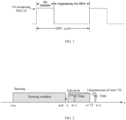
- an on duration (on duration) is interval period of DRX on. In the case of no scheduling, after the on duration elapses, the UE will enter an off duration of one DRX cycle, that is, opportunity for DRX (Opportunity for DRX).
- sensing In LTE sidelink (sidelink, SL), resource selection needs to be performed through sensing (Sensing).
- sensing window As follows: measurement is performed in a sensing window (sensing window), and scheduling assignment (scheduling assignment, SA) and interference measurement are performed in each sensing transmission time interval (Transmission Time Interval, TTI).
- SA scheduling assignment
- TTI Transmission Time Interval
- sensing-based resource selection is supported in resource allocation mode 2 (Mode 2), which is specifically in the following manner: (1) The transmit end (TX) UE determines a resource selection window after resource selection is triggered. (2) Before resource selection, the UE needs to determine a candidate resource set (candidate resource set) for resource selection by comparing a reference signal received power (Reference Signal Received Power, RSRP) measured on resources in a resource selection window against a corresponding RSRP threshold (threshold) and then adding the resources into the candidate resource set if the RSRP is lower than the RSRP threshold. (3) After the resource set is determined, the UE randomly selects a transmission resource from the candidate resource set. In addition, the UE may reserve a transmission resource for a next transmission during a current transmission.
- RSRP Reference Signal Received Power
- the DRX mechanism is introduced into NR sidelink to achieve the purpose of power saving, and the terminal needs to perform sensing (sensing) or measurement in a DRX inactive state to guarantee reliability of service transmission.
- the terminal needs to perform sensing or measurement in a DRX inactive state as in a DRX active state, without limiting the sensing (sensing) or measurement behavior, the effect of power saving in DRX may be weakened, failing to achieve the purpose of introducing the DRX mechanism. Therefore, it is necessary to study the sensing or measurement behavior in the DRX inactive state, so as to achieve the purpose of power saving while guaranteeing service reliability.
- Embodiments of this application provide a discontinuous reception-based transmission method and apparatus, so as to resolve the problem that existing solutions do not specify a sensing or measurement behavior in a DRX inactive state, making it difficult to achieve the purpose of power saving while guaranteeing service reliability.
- a discontinuous reception-based transmission method including: determining, by a terminal, a sensing and/or measurement behavior in a DRX inactive state according to a resource allocation scheme, where the resource allocation scheme includes a partial sensing mode, a full sensing mode, and/or random selection.
- a discontinuous reception-based transmission apparatus including: a determining module, configured to determine a sensing and/or measurement behavior in a DRX inactive state according to a resource allocation scheme, where the resource allocation scheme includes a partial sensing mode, a full sensing mode, and/or random selection.
- a terminal includes a processor, a memory, and a program or instructions stored in the memory and capable of running on the processor, and when the program or the instructions are executed by the processor, the steps of the discontinuous reception-based transmission method according to the first aspect are implemented.
- a terminal including a processor and a communication interface, where the processor is configured to determine a sensing and/or measurement behavior in a DRX inactive state according to a resource allocation scheme, where the resource allocation scheme includes a partial sensing mode, a full sensing mode, and/or random selection.
- a readable storage medium where a program or instructions are stored in the readable storage medium, and when the program or the instructions are executed by a processor, the steps of the method according to the first aspect are implemented.
- a chip is provided, where the chip includes a processor and a communication interface, the communication interface is coupled to the processor, and the processor is configured to run a program or instructions to implement the method according to the first aspect.
- a computer program/program product is provided, where the computer program/program product is stored in a non-volatile storage medium, and the program/program product is executed by at least one processor to implement the steps of the method according to the first aspect.
- a communication device is configured to perform the steps of the transmission method according to the first aspect.
- a specific sensing (sensing) or measurement behavior of the terminal in the inactive state is clarified, so that the terminal performs sensing or measurement in the DRX inactive state to achieve the purpose of power saving while guaranteeing service reliability.
- first and second are intended to distinguish between similar objects but do not necessarily indicate a specific order or sequence. It should be understood that the terms used in this way are interchangeable in appropriate circumstances so that the embodiments of this application can be implemented in other orders than the order illustrated or described herein, and “first” and “second” are usually for distinguishing same-type objects but not limiting the number of objects, for example, there may be one or more first objects.
- first and second are usually for distinguishing same-type objects but not limiting the number of objects, for example, there may be one or more first objects.
- “and/or” in this specification and claims indicates at least one of connected objects, and the symbol “/" generally indicates that the associated objects are in an "or” relationship.
- LTE Long Term Evolution
- LTE-A LTE-advanced
- LTE-A LTE-Advanced
- CDMA code division multiple access
- TDMA time division multiple access
- FDMA frequency division multiple access
- OFDMA Orthogonal Frequency Division Multiple Access
- SC-FDMA single-carrier Frequency-Division Multiple Access
- system and “network” in the embodiments of this application are usually used interchangeably. Techniques described herein may be used in the aforementioned systems and radio technologies, and may also be used in other systems and radio technologies.
- New Radio New Radio
- NR New Radio
- NR terms are used in most of the following descriptions, although these technologies may also be applied to other applications than an NR system application, for example, the 6th generation (6 th Generation, 6G) communication system.
- FIG. 1 is a block diagram of a wireless communication system to which the embodiments of this application are applicable.
- the wireless communication system includes a terminal 11 and a network-side device 12.
- the terminal 11 may also be referred to as a terminal device or user equipment (User Equipment, UE), and the terminal 11 may be a terminal-side device, such as a mobile phone, a tablet computer (Tablet Personal Computer), a laptop computer (Laptop Computer) or a notebook computer, a personal digital assistant (Personal Digital Assistant, PDA), a palmtop computer, a netbook, an ultra-mobile personal computer (ultra-mobile personal computer, UMPC), a mobile Internet device (Mobile Internet Device, MID), a wearable device (Wearable Device) or vehicle user equipment (VUE), or pedestrian user equipment (PUE).
- a terminal device such as a mobile phone, a tablet computer (Tablet Personal Computer), a laptop computer (Laptop Computer) or a notebook computer, a personal digital assistant (Personal Digital Assistant, P
- the wearable device includes: a smart watch, a wrist band, earphones, glasses, or the like. It should be noted that a specific type of the terminal 11 is not limited in the embodiments of this application.
- the network-side device 12 may be a base station or a core network.
- the base station may be referred to as a NodeB, an evolved NodeB, an access point, a base transceiver station (Base Transceiver Station, BTS), a radio base station, a radio transceiver, a basic service set (Basic Service Set, BSS), an extended service set (Extended Service Set, ESS), a NodeB, an evolved NodeB (eNB), a home NodeB, a home evolved NodeB, a WLAN access point, a Wi-Fi node, a transmission and reception Point (Transmitting Receiving Point, TRP), or another appropriate term in the art.
- the base station is not limited to a specific technical term. It should be noted that in the embodiments of this application, the base station in the NR system is merely used as an example, and a specific type of the base station is not limited.
- DRX onduration timer DRX onduration timer
- DRX inactivity timer DRX inactivity timer
- DRX retransmission timer DRX retransmission timer
- longDRX-CycleStartOffset DRX ondurationTimer
- DRX inactivity timer DRX inactivity timer
- DRX retransmission timer DRX retransmission timer
- longDRX-CycleStartOffset longDRX-CycleStartOffset
- DRX After DRX is configured for the UE, if decoding of transmitted or received data fails, the UE needs to enter an active time to monitor a control channel and wait for retransmission scheduled by the network.
- the timer drx-InactivityTimer (DRX inactivity timer) is started or restarted whenever the UE is scheduled to perform initial data transmission, and the UE remains in an active state until the timer expires.
- the UE For downlink data reception, after receiving downlink data transmission indicated by a physical downlink control channel (Physical Downlink Control channel, PDCCH) and feeding back the hybrid automatic repeat request (Hybrid automatic repeat request, HARQ) information, the UE starts a downlink round trip time timer (HARQ RTT (Round Trip Time) Timer) for a corresponding HARQ process. If the HARQ RTT timer expires and data of the HARQ process is not successfully decoded, the UE starts a retransmission timer (drx-RetransmissionTimer), monitors the PDCCH, and waits for transmission.
- HARQ RTT Red Trip Time
- the UE For uplink data transmission, after receiving uplink data transmission that is indicated by the PDCCH, the UE starts an uplink round trip time timer HARQ RTT Timer for the corresponding HARQ process. After the HARQ RTT timer expires, the UE starts a retransmission timer (drx-ULRetransmissionTimer), enters the active state to monitor the PDCCH, and waits for transmission scheduled by the network.
- drx-ULRetransmissionTimer retransmission timer
- Partial sensing in LTE V2X is mainly designed for power saving to support pedestrian UE to vehicle UE (Pedestrian UE to Vehicle UE, P2V) communication.
- UEs support resource selection of two modes. One is random resource selection; and the other is first performing partial sensing and then performing resource selection based on a partial sensing result, implementing semi-persistent resource reservation.
- Which mode to be selected by the UE is configured by using radio resource control (Radio Resource Control, RRC), and when RRC configuration indicates supporting two resource selection modes, the UE determines one resource selection manner to be used.
- RRC Radio Resource Control
- the terminal performs partial sensing and performs resource sensing in the following manner:
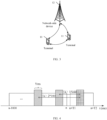
- a sensing window for the UE is a window of a slashed portion in a range of [n-1000, n], with a length of Y and k being a parameter configured by using RRC.
- the value of k may be in a range of ⁇ 1,2,3,...,10 ⁇ .
- a lattice window within [n+T1, n+T2] is a selection window of the UE configured by the higher layer.
- the UE performs sensing on sidelink control information (Sidelink Control Information, SCI) sent by other terminals in a slashed sensing window, and based on detected SCI and a reserved period, a resource reservation status for other terminals within the lattice window is speculated, and the UE may exclude, based on such information, a resource not satisfying a condition in the selection window. At least 20% of the remaining resources (20% of the window length Y) are used as the candidate resource set, and are reported to the media access control (Media Access Control, MAC) layer.
- Media Access Control Media Access Control
- the MAC layer randomly selects a resource from the candidate resource set as a candidate resource of the UE.
- the UE performs periodic reservation for the selected resource, and the reservation period is indicated in SCI.
- the TX UE performs resource reservation (reservation includes periodic reservation and aperiodic reservation) for its allocated resources, and the reserved resource is to be used for later physical sidelink control channel (Physical Sidelink Control Channel, PSCCH)/physical sidelink shared channel (Physical Sidelink Shared Channel, PSSCH) transmission.
- Aperiodic reservation may be implemented through a time resource assignment (Time resource assignment) field in SCI, and the reserved resource can be at least used for transmission of one TB.
- the periodic reservation may be implemented through a resource reservation period (Resource reservation period) field in the SCI, and the periodic resources reserved in a current period may be used for transmission of a next TB.
- a resource pre-emption (pre-emption) mechanism is supported, and the mechanism is briefly described as follows.
- One resource reserved or selected by the UE overlaps (or partially overlaps) with a resources reserved or selected by another UE with a higher-priority service, and if an SL-RSRP measurement value on a related resource is greater than a specific associated SL-RSRP threshold, the UE triggers resource reselection.
- the service priority and the SL-RSRP threshold are determined based on TB transmission on the resource.
- the UE determines whether a resource (PSCCH or PSSCH resource) reserved or selected has been preempted.
- the UE performs re-evaluation for resource selection at least at a moment 'm-T3', where a moment 'm' is a moment in which the resource is located or a moment in which resource reservation information is sent, and T3 includes at least a duration for resource selection processing by the UE.
- sensing may refer to receiving a physical sidelink control channel (Physical Sidelink Control Channel, PSCCH), sidelink control information (Sidelink Control Information, SCI), and the like.
- PSCCH Physical Sidelink Control Channel
- SCI Sidelink Control Information
- Partial sensing may include at least one of the following: periodic-based partial sensing (Periodic-Based Partial Sensing, PBPS) and contiguous partial sensing (Contiguous Partial Sensing, CPS).
- PBPS Period-based Partial Sensing
- CPS Contiguous Partial Sensing
- a time unit may be expressed as symbol, slot, subframe, frame, millisecond, second, the number of times, and the like.
- FIG. 6 is a schematic flowchart of a discontinuous reception-based transmission method according to an embodiment of this application. The method includes the following step.
- Step 61 A terminal determines a sensing and/or measurement behavior in a DRX inactive state according to a resource allocation scheme, where the resource allocation scheme includes a partial sensing mode, a full sensing mode, and/or random selection.
- a specific sensing (sensing) and/or measurement behavior of the terminal in the inactive state is clarified, so that the terminal performs sensing or measurement in the DRX inactive state to achieve the purpose of power saving while guaranteeing service reliability.
- two sets of configuration information are configured for the terminal, one set is configuration of the number and/or positions of sensing occasions for the first sensing mode in a case with DRX not configured, and the other set is configuration of the number and/or positions of sensing occasions for the first sensing mode in a case with DRX configured.
- the configuration information is predefined by a protocol, configured by a network, preconfigured by the network, indicated by the network, configured by the terminal, preconfigured by the terminal, or indicated by the terminal.
- the number and/or positions of sensing occasions configured in the configuration information is the number and/or positions of sensing occasions in the DRX inactive state.
- the number and/or positions of sensing occasions configured in the configuration information is determined from the 1st sensing occasion in the DRX inactive state.
- the 1st sensing occasion is determined forward using a first moment as a reference point, the first moment is a resource selection trigger time, the P-th slot in candidate slots for resource selection, or a resource reporting time, and P is a positive integer greater than or equal to 1.
- remaining sensing occasions other than the 1st sensing occasion configured in the configuration information include a sensing occasion in a DRX active state and a sensing occasion in the DRX inactive state.
- the number and/or positions of sensing occasions configured in the configuration information are determined starting from a first moment used as a reference point, where the first moment is a resource selection trigger time, the P-th slot in candidate slots for resource selection, or a resource reporting time, P being a positive integer greater than or equal to 1.
- the number and/or positions of sensing occasions configured in the configuration information are determined forward starting from the first moment.
- the discontinuous reception-based transmission method further includes: the terminal performs sensing and/or measurement on a second sensing occasion, where the second sensing occasion is a sensing occasion in a DRX active state and prior to the sensing occasion configured in the configuration information. That is, sensing and/or measurement also needs to be performed on a sensing occasion between the configured sensing occasion and the first moment within an onduration time.
- the determining, by a terminal, a sensing and/or measurement behavior in a DRX inactive state according to a resource allocation scheme includes:
- the configuration information is predefined by the protocol, configured by the network, preconfigured by the network, indicated by the network, configured by the terminal, preconfigured by the terminal, or indicated by the terminal.
- the number and/or positions of sensing occasions configured in the configuration information is the number and/or positions of sensing occasions in the DRX inactive state.
- the number and/or positions of sensing occasions configured in the configuration information is determined from the 1st sensing occasion in the DRX inactive state.
- the 1st sensing occasion is determined forward using a first moment as a reference point, the first moment is a resource selection trigger time, the P-th slot in candidate slots for resource selection, or a resource reporting time, and P is a positive integer greater than or equal to 1.
- remaining sensing occasions other than the 1st sensing occasion configured in the configuration information include a sensing occasion in a DRX active state and a sensing occasion in the DRX inactive state.
- the number and/or positions of sensing occasions configured in the configuration information are determined starting from a first moment used as a reference point, where the first moment is a resource selection trigger time, the P-th slot in candidate slots for resource selection, or a resource reporting time, P being a positive integer greater than or equal to 1.
- the number and/or positions of sensing occasions configured in the configuration information are determined forward starting from the first moment.
- the discontinuous reception-based transmission method further includes: performing, by the terminal, sensing and/or measurement on a second sensing occasion, where the second sensing occasion is a sensing occasion in a DRX active state and prior to the sensing occasion configured in the configuration information.
- the partial sensing mode includes a first sensing mode, the first sensing mode being periodic-based partial sensing (PBPS) and the determining, by a terminal, a sensing and/or measurement behavior in a DRX inactive state according to a resource allocation scheme includes at least one of the following:
- the so-called “nearest to the first moment” may be, for example, a sensing occasion corresponding to the smallest k value before the first moment in t y - k * P reserve or the most recent sensing occasion, where P reserve is a sensing period for partial sensing, y is a candidate slot, and k is a sensing step.
- the terminal performs sensing regardless of whether the N sensing occasions nearest to the first moment are in the inactive state; or the number and/or positions of sensing occasions is determined starting from the 1st sensing occasion in the inactive state, that is, the indicated N sensing occasions are determined not starting from a sensing occasion nearest to the first moment in the actual time domain, but are determined starting from the 1st sensing occasion nearest to the first moment in the inactive state.
- sensing and/or measurement is performed by default if a sensing occasion within the on duration is present before.
- the first moment is a resource selection trigger time
- the P-th slot in candidate slots for resource selection or a resource reporting time
- P is a positive integer greater than or equal to 1
- the number and/or positions of sensing occasions are determined forward from the first moment.
- a value of N is predefined by the protocol, configured by the network, preconfigured by the network, indicated by the network, preconfigured by the terminal, configured by the terminal, or indicated by the terminal.
- a value of N is related to at least one of the following parameters: power saving mode, resource allocation scheme, DRX cycle, DRX on duration, DRX inactive state duration, transmission period of data packet, battery power level, priority of data or service, and first measurement quantity, where the first measurement quantity includes at least one of the following: QoS of a system, carrier, BWP, resource pool, user, or connection group, channel occupancy ratio, channel usage, channel busy ratio, channel blocking ratio, channel blocking amount, channel idle ratio, channel idle amount, the number of ACKs, the number of successful data packet transmissions, success rate of data packet transmission, the number of NACKs, the number of failed data packet transmissions, failure rate of data packet transmissions, the number of discontinuous transmissions DTXs, the number of missing detections, and the number of false detections.
- QoS of a system carrier, BWP, resource pool, user, or connection group, channel occupancy ratio, channel usage, channel busy ratio, channel blocking ratio, channel blocking amount, channel idle ratio, channel idle amount, the number
- each of the foregoing first measurement quantities may be a first measurement quantity for a system, a carrier, a BWP, a resource pool, a user, or a connection group.
- sensing is always performed in a sensing occasion between the configured sensing occasion and the first moment within the onduration time, and therefore during calculation of the sensing occasion, only the sensing occasion in the DRX inactive state is calculated.
- the first moment is a resource selection trigger time
- the P-th slot in candidate slots for resource selection or a resource reporting time
- P is a positive integer greater than or equal to 1
- the number and/or positions of sensing occasions are determined forward from the first moment.
- a value of N is predefined by the protocol, configured by the network, preconfigured by the network, indicated by the network, preconfigured by the terminal, configured by the terminal, or indicated by the terminal.
- a value of N is related to at least one of the following parameters: power saving mode, resource allocation scheme, DRX cycle, DRX on duration, DRX inactive state duration, transmission period of data packet, battery power level, priority of data or service, and first measurement quantity, where the first measurement quantity includes at least one of the following: QoS of a system, carrier, BWP, resource pool, user, or connection group, channel occupancy ratio, channel usage, channel busy ratio, channel blocking ratio, channel blocking amount, channel idle ratio, channel idle amount, the number of ACKs, the number of successful data packet transmissions, success rate of data packet transmission, the number of NACKs, the number of failed data packet transmissions, failure rate of data packet transmissions, the number of discontinuous transmissions DTXs, the number of missing detections, and the number of false detections.
- QoS of a system carrier, BWP, resource pool, user, or connection group, channel occupancy ratio, channel usage, channel busy ratio, channel blocking ratio, channel blocking amount, channel idle ratio, channel idle amount, the number
- the first moment is a resource selection trigger time
- the P-th slot in candidate slots for resource selection or a resource reporting time
- P is a positive integer greater than or equal to 1
- the number and/or positions of sensing occasions are determined forward from the first moment.
- a value of N is predefined by the protocol, configured by the network, preconfigured by the network, indicated by the network, preconfigured by the terminal, configured by the terminal, or indicated by the terminal.
- a value of N is related to at least one of the following parameters: power saving mode, resource allocation scheme, DRX cycle, DRX on duration, DRX inactive state duration, transmission period of data packet, battery power level, priority of data or service, and first measurement quantity, where the first measurement quantity includes at least one of the following: QoS of a system, carrier, BWP, resource pool, user, or connection group, channel occupancy ratio, channel usage, channel busy ratio, channel blocking ratio, channel blocking amount, channel idle ratio, channel idle amount, the number of ACKs, the number of successful data packet transmissions, success rate of data packet transmission, the number of NACKs, the number of failed data packet transmissions, failure rate of data packet transmissions, the number of discontinuous transmissions DTXs, the number of missing detections, and the number of false detections.
- QoS of a system carrier, BWP, resource pool, user, or connection group, channel occupancy ratio, channel usage, channel busy ratio, channel blocking ratio, channel blocking amount, channel idle ratio, channel idle amount, the number
- the number of sensing occasions of the terminal, communication link, or communication group satisfies a first criterion, the first criterion being less than a first threshold and/or greater than a second threshold.
- At least one of the first threshold and the second threshold is predefined by the protocol, configured by the network, preconfigured by the network, indicated by the network, preconfigured by the terminal, configured by the terminal, or indicated by the terminal.
- a value of at least one of the first threshold and the second threshold is related to at least one of the following parameters: power saving mode, resource allocation scheme, DRX cycle, DRX on duration, DRX inactive state duration, transmission period of data packet, battery power level, priority of data or service, and first measurement quantity, where the first measurement quantity includes at least one of the following: QoS of a system, carrier, BWP, resource pool, user, or connection group, channel occupancy ratio, channel usage, channel busy ratio, channel blocking ratio, channel blocking amount, channel idle ratio, channel idle amount, the number of ACKs, the number of successful data packet transmissions, success rate of data packet transmission, the number of NACKs, the number of failed data packet transmissions, failure rate of data packet transmissions, the number of discontinuous transmissions DTXs, the number of missing detections, and the number of false detections.
- QoS of a system carrier, BWP, resource pool, user, or connection group, channel occupancy ratio, channel usage, channel busy ratio, channel blocking ratio, channel blocking amount, channel
- the number of sensing time units of the terminal, communication link, or communication group satisfies a second criterion, the second criterion being less than a third threshold and/or greater than a fourth threshold.
- At least one of the third threshold and the fourth threshold is predefined by the protocol, configured by the network, preconfigured by the network, indicated by the network, preconfigured by the terminal, configured by the terminal, or indicated by the terminal.
- a value of at least one of the third threshold and the fourth threshold is related to at least one of the following parameters: power saving mode, resource allocation scheme, DRX cycle, DRX on duration, DRX inactive state duration, transmission period of data packet, battery power level, priority of data or service, and first measurement quantity, where the first measurement quantity includes at least one of the following: QoS of a system, carrier, BWP, resource pool, user, or connection group, channel occupancy ratio, channel usage, channel busy ratio, channel blocking ratio, channel blocking amount, channel idle ratio, channel idle amount, the number of ACKs, the number of successful data packet transmissions, success rate of data packet transmission, the number of NACKs, the number of failed data packet transmissions, failure rate of data packet transmissions, the number of discontinuous transmissions DTXs, the number of missing detections, and the number of false detections.
- QoS of a system carrier, BWP, resource pool, user, or connection group, channel occupancy ratio, channel usage, channel busy ratio, channel blocking ratio, channel blocking amount, channel
- a ratio or difference between the number of sensing occasions in the DRX inactive state and the number of sensing occasions in a DRX active state for the terminal, communication link, or communication group satisfies a fifth threshold; or a ratio or difference between the number of sensing occasions in the DRX inactive state and the total number of sensing occasions in a DRX cycle satisfies a sixth threshold.
- At least one of the fifth threshold and the sixth threshold is predefined by the protocol, configured by the network, preconfigured by the network, indicated by the network, preconfigured by the terminal, configured by the terminal, or indicated by the terminal.
- a value of at least one of the fifth threshold and the sixth threshold is related to at least one of the following parameters: power saving mode, resource allocation scheme, DRX cycle, DRX on duration, DRX inactive state duration, transmission period of data packet, battery power level, priority of data or service, and first measurement quantity, where the first measurement quantity includes at least one of the following: QoS of a system, carrier, BWP, resource pool, user, or connection group, channel occupancy ratio, channel usage, channel busy ratio, channel blocking ratio, channel blocking amount, channel idle ratio, channel idle amount, the number of ACKs, the number of successful data packet transmissions, success rate of data packet transmission, the number of NACKs, the number of failed data packet transmissions, failure rate of data packet transmissions, the number of discontinuous transmissions DTXs, the number of missing detections, and the number of false detections.
- QoS of a system carrier, BWP, resource pool, user, or connection group, channel occupancy ratio, channel usage, channel busy ratio, channel blocking ratio, channel blocking amount, channel
- a minimum interval between every two sensing occasions is greater than or equal to a seventh threshold, and/or a maximum interval is less than or equal to an eighth threshold.
- the terminal can enter a light sleep (light sleep) or deep sleep (deep sleep) state, thereby reducing energy consumption.
- a minimum interval between every two sensing occasions in the DRX inactive state is greater than or equal to a seventh threshold, and/or a maximum interval is less than or equal to an eighth threshold.
- the sensing occasion being in the inactive state includes at least one of the following:
- At least one of the seventh threshold and the eighth threshold is predefined by the protocol, configured by the network, preconfigured by the network, indicated by the network, preconfigured by the terminal, configured by the terminal, or indicated by the terminal.
- a value of at least one of the seventh threshold and the eighth threshold is related to at least one of the following parameters: power saving mode, resource allocation scheme, DRX cycle, DRX on duration, DRX inactive state duration, transmission period of data packet, battery power level, priority of data or service, and first measurement quantity, where the first measurement quantity includes at least one of the following: QoS of a system, carrier, BWP, resource pool, user, or connection group, channel occupancy ratio, channel usage, channel busy ratio, channel blocking ratio, channel blocking amount, channel idle ratio, channel idle amount, the number of ACKs, the number of successful data packet transmissions, success rate of data packet transmission, the number of NACKs, the number of failed data packet transmissions, failure rate of data packet transmissions, the number of discontinuous transmissions DTXs, the number of missing detections, and the number of false detections.
- QoS of a system carrier, BWP, resource pool, user, or connection group, channel occupancy ratio, channel usage, channel busy ratio, channel blocking ratio, channel blocking amount, channel
- N is a positive integer greater than or equal to 1.
- the partial sensing mode is a second sensing mode, the second sensing mode being a contiguous partial sensing (CPS) mode and the determining, by a terminal, a sensing and/or measurement behavior in a DRX inactive state according to a resource allocation scheme includes:
- a sensing window or sensing duration of the second sensing mode is less than or equal to a ninth threshold, or the sensing window or sensing duration of the second sensing mode in the DRX inactive state is less than or equal to a tenth threshold.
- the sensing duration for the second sensing mode may be one or more times, that is, the number of sensing windows and the sensing duration may be cumulatively counted for one or more processes or one or more data packets.
- At least one of the ninth threshold and the tenth threshold is predefined by the protocol, configured by the network, preconfigured by the network, indicated by the network, preconfigured by the terminal, configured by the terminal, or indicated by the terminal.
- a value of at least one of the ninth threshold and the tenth threshold is related to at least one of the following parameters: power saving mode, resource allocation scheme, DRX cycle, DRX on duration, DRX inactive state duration, transmission period of data packet, battery power level, priority of data or service, and first measurement quantity, where the first measurement quantity includes at least one of the following: QoS of a system, carrier, BWP, resource pool, user, or connection group, channel occupancy ratio, channel usage, channel busy ratio, channel blocking ratio, channel blocking amount, channel idle ratio, channel idle amount, the number of ACKs, the number of successful data packet transmissions, success rate of data packet transmission, the number of NACKs, the number of failed data packet transmissions, failure rate of data packet transmissions, the number of discontinuous transmissions DTXs, the number of missing detections, and the number of false detections.
- QoS of a system carrier, BWP, resource pool, user, or connection group, channel occupancy ratio, channel usage, channel busy ratio, channel blocking ratio, channel blocking
- the discontinuous reception-based transmission method further includes: configuring a candidate resource set for a first data packet to be related to a candidate resource set for a second data packet, where the first data packet and the second data packet are packets of different processes, and the second data packet is a data packet of an existing process; and the configuring the candidate resource set for the first data packet includes at least one of the following:
- the first data packet and second data packet may alternatively be HARQ processes, SL processes, transport blocks (TB), MAC PDUs, or the like.
- the discontinuous reception-based transmission method further includes: triggering or switching, by the terminal, a resource selection or resource allocation scheme.
- switching of the resource allocation scheme in this application may refer to switching between different resource allocation schemes, such as switching between the full sensing mode and the partial sensing mode, or switching within a same resource allocation scheme, such as switching between the first sensing mode and the second sensing mode in the partial sensing mode.
- the terminal triggers or switches the resource selection or resource allocation scheme in a case that at least one of the following conditions is satisfied:
- a value of the preset threshold is predefined by the protocol, configured by the network, preconfigured by the network, preconfigured by the terminal, configured by the terminal, or indicated by the terminal.
- a value of the preset threshold is related to at least one of the following parameters: power saving mode, resource allocation scheme, DRX cycle, DRX on duration, DRX inactive state duration, transmission period of data packet, battery power level, priority of data or service, and first measurement quantity, where the first measurement quantity includes at least one of the following: QoS of a system, carrier, BWP, resource pool, user, or connection group, channel occupancy ratio, channel usage, channel busy ratio, channel blocking ratio, channel blocking amount, channel idle ratio, channel idle amount, the number of ACKs, the number of successful data packet transmissions, success rate of data packet transmission, the number of NACKs, the number of failed data packet transmissions, failure rate of data packet transmissions, the number of discontinuous transmissions DTXs, the number of missing detections, and the number of false detections.
- QoS of a system carrier, BWP, resource pool, user, or connection group, channel occupancy ratio, channel usage, channel busy ratio, channel blocking ratio, channel blocking amount, channel idle ratio, channel idle amount
- the partial sensing mode includes a first sensing mode and a second sensing mode
- the first sensing mode is periodic-based partial sensing
- the second sensing mode is continuous partial sensing
- the triggering or switching, by the terminal, a resource selection or resource allocation scheme includes at least one of the following:
- the partial sensing mode includes a first sensing mode and a second sensing mode
- the first sensing mode is periodic-based partial sensing
- the second sensing mode is contiguous partial sensing
- the determining, by a terminal, a sensing and/or measurement behavior in a DRX inactive state according to a resource allocation scheme includes at least one of the following:
- the partial sensing mode includes a first sensing mode, the first sensing mode being periodic-based partial sensing; and the determining, by a terminal, a sensing and/or measurement behavior in a DRX inactive state according to a resource allocation scheme includes: in a case that the terminal triggers the first sensing mode, performing, by the terminal, sensing and/or measurement within a corresponding sensing window. Further, when the terminal triggers the first sensing mode, the terminal can, should, or must perform sensing and/or measurement in the inactive state within the corresponding sensing window.
- the partial sensing mode includes a second sensing mode, the second sensing mode being contiguous partial sensing and the determining, by a terminal, a sensing and/or measurement behavior in a DRX inactive state according to a resource allocation scheme includes: in a case that the terminal triggers the second sensing mode, performing, by the terminal, sensing and/or measurement within a corresponding sensing window. Further, when the terminal triggers the second sensing mode, the terminal can, should, or must perform sensing and/or measurement in the inactive state within the corresponding sensing window.
- the determining, by a terminal, a sensing and/or measurement behavior in a DRX inactive state according to a resource allocation scheme includes: performing, by the terminal, sensing and/or measurement in a corresponding sensing slot during re-evaluation or preemption checking. Further, during re-evaluation or preemption checking by the terminal, the terminal can, should, or must perform sensing and/or measurement in the inactive state in the corresponding sensing slot.
- the partial sensing mode includes a second sensing mode, the second sensing mode being contiguous partial sensing and the determining, by a terminal, a sensing and/or measurement behavior in a DRX inactive state according to a resource allocation scheme includes: in a case that a sensing window is larger than a minimum sensing window of the second sensing mode, performing, by the terminal, sensing and/or measurement in M most recent slots within the sensing window, M being a size of the minimum sensing window in the second sensing mode, or M is equal to a first preset time minus a processing time, the processing time being an SCI processing time and/or a data packet preparation time.
- the first preset time may be 32 slots, and, certainly, may be any other values.
- the minimum sensing window is predefined by the protocol, configured by the network, preconfigured by the network, indicated by the network, configured by the terminal, preconfigured by the terminal, or indicated by the terminal.
- the determining, by a terminal, a sensing and/or measurement behavior in a DRX inactive state according to a resource allocation scheme further includes: in a case that a minimum sensing window or a minimum candidate slot is indicated as predefined by the protocol, configured by the network, preconfigured by the network, indicated by the network, configured by the terminal, preconfigured by the terminal, or indicated by the terminal, performing, by the terminal, sensing and/or measurement in a corresponding sensing slot, where the sensing slot includes a sensing slot corresponding to a sensing mode triggered by a current packet and/or a sensing slot corresponding to a sensing mode triggered by an existing data packet.
- the terminal can, should, or must perform sensing and/or measurement in the inactive state.
- the sensing slot corresponding to the sensing mode triggered by the existing data packet may be a sensing slot falling in a sensing slot within a sensing window or sensing occasion corresponding to the sensing mode triggered by the current packet, or may be the sensing slot corresponding to the sensing mode triggered by the existing data packet.
- a sensing window k may be limited to achieve the purpose of power saving, where k described herein indicates a position of a sensing occasion determined from a reference point n at a first moment.
- sensing is performed on a most recent (most recent) sensing occasion, when the most recent sensing occasion before the first moment is located in the DRX inactive state, sensing is performed on the most recent sensing occasion in the inactive state; otherwise, sensing is not performed in the inactive state.
- preconfigured by the network, indicated by the network, configured by the terminal preconfigured by the terminal, or indicated by the terminal, when the terminal is configured with DRX, sensing and/or measurement is performed based on parameter configuration for DRX, or configuration is interpreted in an interpretation manner for a case with DRX configured, assuming that only a sensing occasion in the inactive state is considered in this case.
- a sensing window k is limited to achieve the purpose of power saving.
- a sensing window corresponding to the resource selection for the first data packet can be made coincide with a sensing window corresponding to the resource selection for the second data packet as much as possible during selection of a candidate resource Y1 for the first data packet. This can shorten a length of the sensing window in the inactive state or make an interval between sensing windows corresponding to the two data packets smaller, avoiding the terminal from frequently performing RF switching or from being unable to switch to a more power-saving sleep state due to frequent waking up.
- the terminal has an aperiodic service and cannot perform sensing in advance, during selection of the 1st slot in the candidate resource Y1 corresponding to the first data packet, a smaller distance may be ensured as much as possible from the 1st slot in the candidate resource Y2 for the second data packet that arrives first, so that CPS windows overlap as much as possible, thereby achieving the effect of power saving.
- the execution body may be a discontinuous reception-based transmission apparatus, or a control module for executing the discontinuous reception-based transmission method in the discontinuous reception-based transmission apparatus.
- the discontinuous reception-based transmission apparatus provided by the embodiments of this application is described by using the discontinuous reception-based transmission method being executed by the discontinuous reception-based transmission apparatus as an example.
- an embodiment of this application further provides a discontinuous reception-based transmission apparatus 120, including: a determining module 121, configured to determine a sensing and/or measurement behavior in a DRX inactive state according to a resource allocation scheme, where the resource allocation scheme includes a partial sensing mode, a full sensing mode, and/or random selection.
- a determining module 121 configured to determine a sensing and/or measurement behavior in a DRX inactive state according to a resource allocation scheme, where the resource allocation scheme includes a partial sensing mode, a full sensing mode, and/or random selection.
- a specific sensing (sensing) or measurement behavior of the terminal in an inactive state is clarified, so that the terminal performs sensing or measurement in the DRX inactive state to achieve the purpose of power saving while guaranteeing service reliability.
- the partial sensing mode includes a first sensing mode, the first sensing mode being a periodic-based partial sensing mode; and the determining module is configured to: determine the number and/or positions of sensing occasions for the first sensing mode based on configuration information, where the configuration information includes first configuration information and/or second configuration information, the first configuration information is configuration information for the number and/or positions of sensing occasions for the first sensing mode in a case with DRX not configured, and the second configuration information is configuration information for the number and/or positions of sensing occasions for the first sensing mode in a case with DRX configured; and perform sensing and/or measurement in the DRX inactive state based on the number and/or positions of sensing occasions for the first sensing mode in a case with DRX configured.
- the configuration information includes first configuration information and/or second configuration information
- the first configuration information is configuration information for the number and/or positions of sensing occasions for the first sensing mode in a case with DRX not configured
- the second configuration information is configuration information for the number
- the determining module is configured to: determine, based on configuration information, the number and/or positions of sensing occasions in a case with DRX configured, where the configuration information includes configuration information for the number and/or positions of sensing occasions; and perform sensing and/or measurement in the DRX inactive state based on the determined number and/or positions of sensing occasions in a case with DRX configured.
- the configuration information is predefined by a protocol, configured by a network, preconfigured by the network, indicated by the network, configured by the terminal, preconfigured by the terminal, or indicated by the terminal.
- the number and/or positions of sensing occasions configured in the configuration information is the number and/or positions of sensing occasions in the DRX inactive state.
- the number and/or positions of sensing occasions configured in the configuration information is determined from the 1st sensing occasion in the DRX inactive state.
- the 1st sensing occasion is determined forward using a first moment as a reference point, the first moment is a resource selection trigger time, the P-th slot in candidate slots for resource selection, or a resource reporting time, and P is a positive integer greater than or equal to 1.
- remaining sensing occasions other than the 1st sensing occasion configured in the configuration information include a sensing occasion in a DRX active state and a sensing occasion in the DRX inactive state.
- the number and/or positions of sensing occasions configured in the configuration information are determined starting from a first moment used as a reference point, where the first moment is a resource selection trigger time, the P-th slot in candidate slots for resource selection, or a resource reporting time, P being a positive integer greater than or equal to 1.
- the number and/or positions of sensing occasions configured in the configuration information are determined forward starting from the first moment.
- the apparatus further includes: a first processing module, configured to perform sensing and/or measurement on a second sensing occasion, where the second sensing occasion is a sensing occasion in a DRX active state and prior to the sensing occasion configured in the configuration information.
- a first processing module configured to perform sensing and/or measurement on a second sensing occasion, where the second sensing occasion is a sensing occasion in a DRX active state and prior to the sensing occasion configured in the configuration information.
- the partial sensing mode is a first sensing mode, the first sensing mode being a periodic-based partial sensing mode; and the determining module is configured to perform at least one of the following:
- the first moment is a resource selection trigger time, the P-th slot in candidate slots for resource selection, or a resource reporting time, P is a positive integer greater than or equal to 1, and the number and/or positions of sensing occasions are determined forward from the first moment.
- a value of at least one of N, the first threshold, the second threshold, the third threshold, the fourth threshold, the fifth threshold, the sixth threshold, the seventh threshold, and the eighth threshold is related to at least one of the following parameters: power saving mode, resource allocation scheme, DRX cycle, DRX on duration, DRX inactive state duration, transmission period of data packet, battery power level, priority of data or service, and first measurement quantity, where the first measurement quantity includes at least one of the following: QoS of a system, carrier, BWP, resource pool, user, or connection group, channel occupancy ratio, channel usage, channel busy ratio, channel blocking ratio, channel blocking amount, channel idle ratio, channel idle amount, the number of ACKs, the number of successful data packet transmissions, success rate of data packet transmission, the number of NACKs, the number of failed data packet transmissions, failure rate of data packet transmissions, the number of discontinuous transmissions DTXs, the number of missing detections, and the number of false detections.
- QoS of a system carrier, BWP, resource
- the partial sensing mode is a second sensing mode, and when the second sensing mode is a contiguous partial sensing mode, a sensing window or sensing duration for the second sensing mode is less than or equal to a ninth threshold, or a sensing window or sensing duration for the second sensing mode in the DRX inactive state is less than or equal to a tenth threshold.
- a value of at least one of the ninth threshold and the tenth threshold is related to at least one of the following parameters: power saving mode, resource allocation scheme, DRX cycle, DRX on duration, DRX inactive state duration, transmission period of data packet, battery power level, priority of data or service, and first measurement quantity, where the first measurement quantity includes at least one of the following: QoS of a system, carrier, BWP, resource pool, user, or connection group, channel occupancy ratio, channel usage, channel busy ratio, channel blocking ratio, channel blocking amount, channel idle ratio, channel idle amount, the number of ACKs, the number of successful data packet transmissions, success rate of data packet transmission, the number of NACKs, the number of failed data packet transmissions, failure rate of data packet transmissions, the number of discontinuous transmissions DTXs, the number of missing detections, and the number of false detections.
- QoS of a system carrier, BWP, resource pool, user, or connection group, channel occupancy ratio, channel usage, channel busy ratio, channel blocking ratio, channel blocking
- the apparatus further includes: a configuration module, configured to configure a candidate resource set for a first data packet to be related to a candidate resource set for a second data packet, where the first data packet and the second data packet are packets of different processes, and the second data packet is a data packet of an existing process; and the configuring the candidate resource set for the first data packet includes at least one of the following:
- the apparatus further includes: a second processing module, configured to trigger or switch a resource selection or resource allocation scheme.
- a second processing module configured to trigger or switch a resource selection or resource allocation scheme.
- the second processing module is configured to trigger or switch the resource selection or resource allocation scheme in a case that at least one of the following conditions is satisfied:
- a value of the preset threshold is related to at least one of the following parameters: power saving mode, resource allocation scheme, DRX cycle, DRX on duration, DRX inactive state duration, transmission period of data packet, battery power level, priority of data or service, and first measurement quantity, where the first measurement quantity includes at least one of the following: QoS of a system, carrier, BWP, resource pool, user, or connection group, channel occupancy ratio, channel usage, channel busy ratio, channel blocking ratio, channel blocking amount, channel idle ratio, channel idle amount, the number of ACKs, the number of successful data packet transmissions, success rate of data packet transmission, the number of NACKs, the number of failed data packet transmissions, failure rate of data packet transmissions, the number of discontinuous transmissions DTXs, the number of missing detections, and the number of false detections.
- QoS of a system carrier, BWP, resource pool, user, or connection group, channel occupancy ratio, channel usage, channel busy ratio, channel blocking ratio, channel blocking amount, channel idle ratio, channel idle amount
- the partial sensing mode includes a first sensing mode and a second sensing mode, the first sensing mode is periodic-based partial sensing, and the second sensing mode is contiguous partial sensing; and the determining module performs at least one of the following:
- the partial sensing mode includes a first sensing mode and a second sensing mode, the first sensing mode is periodic-based partial sensing, and the second sensing mode is contiguous partial sensing; and the determining module performs at least one of the following:
- the partial sensing mode includes a first sensing mode, the first sensing mode being periodic-based partial sensing; and the determining module is configured to: in a case that the terminal triggers the first sensing mode, perform sensing and/or measurement within a corresponding sensing window. Further, when the first sensing mode is triggered, sensing and/or measurement can, should, or must be performed in the inactive state within the corresponding sensing window.
- the partial sensing mode includes a second sensing mode, the second sensing mode being contiguous partial sensing; and the determining module is configured to: in a case that the terminal triggers the second sensing mode, perform sensing and/or measurement within a corresponding sensing window. Further, when the second sensing mode is triggered, sensing and/or measurement can, should, or must be performed in the inactive state within the corresponding sensing window.
- the determining module is configured to: perform sensing and/or measurement in a corresponding sensing slot during re-evaluation or preemption checking. Further, during re-evaluation or preemption checking, sensing and/or measurement can, should, or must be performed in the inactive state within the corresponding sensing window.
- the partial sensing mode includes a second sensing mode, the second sensing mode being contiguous partial sensing
- the determining module is configured to: in a case that a sensing window is larger than a minimum sensing window of the second sensing mode, perform, for the terminal, sensing and/or measurement in M most recent slots within the sensing window, M being a size of the minimum sensing window in the second sensing mode, or M is equal to a first preset time minus a processing time, the processing time being an SCI processing time and/or a data packet preparation time; where the minimum sensing window is predefined by a protocol, configured by a network, preconfigured by the network, indicated by the network, configured by the terminal, preconfigured by the terminal, or indicated by the terminal.
- the determining module is configured to: in a case that a minimum sensing window or a minimum candidate slot is indicated as predefined by a protocol, configured by a network, preconfigured by the network, indicated by the network, configured by the terminal, preconfigured by the terminal, or indicated by the terminal, perform sensing and/or measurement in a corresponding sensing slot, where the sensing slot includes a sensing slot corresponding to a sensing mode triggered by a current packet and/or a sensing slot corresponding to a sensing mode triggered by an existing data packet. Further, sensing and/or measurement can, should, or must be performed in the inactive state in the corresponding sensing slot.
- the discontinuous reception-based transmission apparatus in this embodiment of this application may be an apparatus, or an apparatus or electric device having an operating system, or may be a component, an integrated circuit, or a chip in the terminal.
- the apparatus or electric device may be a mobile terminal or a non-mobile terminal.
- the mobile terminal may include but is not limited to the types of the terminal 11 listed above, and the non-mobile terminal may be a server, a network attached storage (Network Attached Storage, NAS), a personal computer (personal computer, PC), a television (television, TV), a teller machine, a self-service machine, or the like, which is not specifically limited in this embodiment of this application.
- Network Attached Storage Network Attached Storage
- the discontinuous reception-based transmission apparatus provided in this embodiment of this application can implement the processes implemented in the method embodiment in FIG. 6 , with the same technical effects achieved. To avoid repetition, details are not described herein again.
- an embodiment of this application further provides a terminal 130, including a processor 131, a memory 132, and a program or instructions stored in the memory 132 and capable of running on the processor 131.
- a terminal 130 including a processor 131, a memory 132, and a program or instructions stored in the memory 132 and capable of running on the processor 131.
- the program or the instructions are executed by the processor 131, the processes of the foregoing embodiments of the discontinuous reception-based transmission method are implemented, with the same technical effects achieved. To avoid repetition, details are not described herein again.
- An embodiment of this application further provides a terminal, including a processor and a communication interface, where the processor is configured to determine a sensing and/or measurement behavior in a DRX inactive state according to a resource allocation scheme, where the resource allocation scheme includes a partial sensing mode, a full sensing mode, and/or random selection.
- the terminal embodiments correspond to the foregoing terminal-side method embodiments, and the implementation processes and implementations of the foregoing method embodiments can be applied to the terminal embodiments, with the same technical effects achieved.
- FIG. 14 is a schematic diagram of a hardware structure of a terminal for implementing the embodiments of this application.
- the terminal 140 includes but is not limited to at least part of components such as a radio frequency unit 141, a network module 142, an audio output unit 143, an input unit 144, a sensor 145, a display unit 146, a user input unit 147, an interface unit 148, a memory 149, and a processor 1410.
- the terminal 140 may further include a power supply (for example, a battery) supplying power to the components, and the power supply may be logically connected to the processor 1410 through a power management system. In this way, functions such as charge management, discharge management, and power consumption management are implemented by using the power management system.
- a power supply for example, a battery
- the structure of the terminal shown in FIG. 14 does not constitute any limitation on the terminal.
- the terminal may include more or fewer components than shown in the figure, or a combination of some components, or the components disposed differently. Details are not described herein again.
- the input unit 144 may include a graphics processing unit (Graphics Processing Unit, GPU) 1441 and a microphone 1442.
- the graphics processing unit 1441 processes image data of a still picture or video obtained by an image capture apparatus (such as a camera) in a video capture mode or an image capture mode.
- the display unit 146 may include a display panel 1461, and the display panel 1461 may be configured in a form of a liquid crystal display, an organic light-emitting diode, and the like.
- the user input unit 147 may include a touch panel 1471 and other input devices 1472.
- the touch panel 1471 is also referred to as a touchscreen.
- the touch panel 1471 may include two parts: a touch detection apparatus and a touch controller.
- the other input devices 1472 may include but are not limited to a physical keyboard, a function key (such as a volume control key or a power on/off key), a trackball, a mouse, a joystick, and the like. Details are not described herein.
- the radio frequency unit 141 receives downlink data from a network-side device, and then sends the downlink data to the processor 1410 for processing; and also sends uplink data to the network-side device.
- the radio frequency unit 141 includes but is not limited to an antenna, at least one amplifier, a transceiver, a coupler, a low noise amplifier, a duplexer, and the like.
- the memory 149 may be configured to store software programs or instructions and various data.
- the memory 149 may include a program or instruction storage area and a data storage area.
- the program or instruction storage area may store an operating system, an application program or instruction required by at least one function (for example, a sound playback function or an image playback function), and the like.
- the memory 149 may include a high-speed random access memory, and may further include a non-volatile memory.
- the non-volatile memory may be a read-only memory (Read-Only memory, ROM), a programmable read-only memory (Programmable ROM, PROM), an erasable programmable read-only memory (Erasable PROM, EPROM), an electrically erasable programmable read-only memory (Electrically EPROM, EEPROM), or a flash memory, for example, at least one disk storage device, a flash memory device, or another volatile solid-state storage device.
- ROM Read-Only memory
- PROM programmable read-only memory
- Erasable PROM Erasable PROM
- EPROM electrically erasable programmable read-only memory
- EEPROM electrically erasable programmable read-only memory
- flash memory for example, at least one disk storage device, a flash memory device, or another volatile solid-state storage device.
- the processor 1410 may include one or more processing units.
- an application processor and a modem processor may be integrated in the processor 1410.
- the application processor primarily processes an operating system, user interfaces, application programs or instructions, and the like.
- the modem processor primarily processes radio communication, for example, being a baseband processor. It can be understood that the modem processor may alternatively be not integrated in the processor 1410.
- the processor 1410 is configured to determine a sensing and/or measurement behavior in a DRX inactive state according to a resource allocation scheme, where the resource allocation scheme includes a partial sensing mode, a full sensing mode, and/or random selection.
- a specific sensing (sensing) or measurement behavior of the terminal in an inactive state is clarified, so that the terminal performs sensing or measurement in the DRX inactive state to achieve the purpose of power saving while guaranteeing service reliability.
- the partial sensing mode includes a first sensing mode, the first sensing mode being a periodic-based partial sensing mode; and the processor 1410 is configured to: determine the number and/or positions of sensing occasions for the first sensing mode based on configuration information, where the configuration information includes first configuration information and/or second configuration information, the first configuration information is configuration information for the number and/or positions of sensing occasions for the first sensing mode in a case with DRX not configured, and the second configuration information is configuration information for the number and/or positions of sensing occasions for the first sensing mode in a case with DRX configured; and perform sensing and/or measurement in the DRX inactive state based on the number and/or positions of sensing occasions for the first sensing mode in a case with DRX configured.
- the configuration information includes first configuration information and/or second configuration information
- the first configuration information is configuration information for the number and/or positions of sensing occasions for the first sensing mode in a case with DRX not configured
- the second configuration information is configuration information for the number
- the processor 1410 is configured to: determine, based on configuration information, the number and/or positions of sensing occasions in a case with DRX configured, where the configuration information includes configuration information for the number and/or positions of sensing occasions; and perform sensing and/or measurement in the DRX inactive state based on the determined number and/or positions of sensing occasions in a case with DRX configured.
- the configuration information is predefined by a protocol, configured by a network, preconfigured by the network, indicated by the network, configured by the terminal, preconfigured by the terminal, or indicated by the terminal.
- the number and/or positions of sensing occasions configured in the configuration information is the number and/or positions of sensing occasions in the DRX inactive state.
- the number and/or positions of sensing occasions configured in the configuration information is determined from the 1st sensing occasion in the DRX inactive state.
- the 1st sensing occasion is determined forward using a first moment as a reference point, the first moment is a resource selection trigger time, the P-th slot in candidate slots for resource selection, or a resource reporting time, and P is a positive integer greater than or equal to 1.
- remaining sensing occasions other than the 1st sensing occasion configured in the configuration information include a sensing occasion in a DRX active state and a sensing occasion in the DRX inactive state.
- the number and/or positions of sensing occasions configured in the configuration information are determined starting from a first moment used as a reference point, where the first moment is a resource selection trigger time, the P-th slot in candidate slots for resource selection, or a resource reporting time, P being a positive integer greater than or equal to 1.
- the number and/or positions of sensing occasions configured in the configuration information are determined forward starting from the first moment.
- the processor 1410 is configured to perform sensing and/or measurement on a second sensing occasion, where the second sensing occasion is a sensing occasion in a DRX active state and prior to the sensing occasion configured in the configuration information.
- the partial sensing mode is a first sensing mode, the first sensing mode being a periodic-based partial sensing mode; and the processor 1410 is configured to perform at least one of the following:
- the first moment is a resource selection trigger time, the P-th slot in candidate slots for resource selection, or a resource reporting time, P is a positive integer greater than or equal to 1, and the number and/or positions of sensing occasions are determined forward from the first moment.
- a value of at least one of N, the first threshold, the second threshold, the third threshold, the fourth threshold, the fifth threshold, the sixth threshold, the seventh threshold, and the eighth threshold is related to at least one of the following parameters: power saving mode, resource allocation scheme, DRX cycle, DRX on duration, DRX inactive state duration, transmission period of data packet, battery power level, priority of data or service, and first measurement quantity, where the first measurement quantity includes at least one of the following: QoS of a system, carrier, BWP, resource pool, user, or connection group, channel occupancy ratio, channel usage, channel busy ratio, channel blocking ratio, channel blocking amount, channel idle ratio, channel idle amount, the number of ACKs, the number of successful data packet transmissions, success rate of data packet transmission, the number of NACKs, the number of failed data packet transmissions, failure rate of data packet transmissions, the number of discontinuous transmissions DTXs, the number of missing detections, and the number of false detections.
- QoS of a system carrier, BWP, resource
- the partial sensing mode is a second sensing mode, and when the second sensing mode is a contiguous partial sensing mode, a sensing window or sensing duration for the second sensing mode is less than or equal to a ninth threshold, or a sensing window or sensing duration for the second sensing mode in the DRX inactive state is less than or equal to a tenth threshold.
- a value of at least one of the ninth threshold and the tenth threshold is related to at least one of the following parameters: power saving mode, resource allocation scheme, DRX cycle, DRX on duration, DRX inactive state duration, transmission period of data packet, battery power level, priority of data or service, and first measurement quantity, where the first measurement quantity includes at least one of the following: QoS of a system, carrier, BWP, resource pool, user, or connection group, channel occupancy ratio, channel usage, channel busy ratio, channel blocking ratio, channel blocking amount, channel idle ratio, channel idle amount, the number of ACKs, the number of successful data packet transmissions, success rate of data packet transmission, the number of NACKs, the number of failed data packet transmissions, failure rate of data packet transmissions, the number of discontinuous transmissions DTXs, the number of missing detections, and the number of false detections.
- QoS of a system carrier, BWP, resource pool, user, or connection group, channel occupancy ratio, channel usage, channel busy ratio, channel blocking ratio, channel blocking
- the processor 1410 is configured to configure a candidate resource set for a first data packet to be related to a candidate resource set for a second data packet, where the first data packet and the second data packet are packets of different processes, and the second data packet is a data packet of an existing process; and the configuring the candidate resource set for the first data packet includes at least one of the following:
- the processor 1410 is configured to trigger or switch a resource selection or resource allocation scheme.
- the resource selection or resource allocation scheme is triggered or switched in a case that at least one of the following conditions is satisfied:
- a value of the preset threshold is related to at least one of the following parameters: power saving mode, resource allocation scheme, DRX cycle, DRX on duration, DRX inactive state duration, transmission period of data packet, battery power level, priority of data or service, and first measurement quantity, where the first measurement quantity includes at least one of the following: QoS of a system, carrier, BWP, resource pool, user, or connection group, channel occupancy ratio, channel usage, channel busy ratio, channel blocking ratio, channel blocking amount, channel idle ratio, channel idle amount, the number of ACKs, the number of successful data packet transmissions, success rate of data packet transmission, the number of NACKs, the number of failed data packet transmissions, failure rate of data packet transmissions, the number of discontinuous transmissions DTXs, the number of missing detections, and the number of false detections.
- QoS of a system carrier, BWP, resource pool, user, or connection group, channel occupancy ratio, channel usage, channel busy ratio, channel blocking ratio, channel blocking amount, channel idle ratio, channel idle amount
- the partial sensing mode includes a first sensing mode and a second sensing mode, the first sensing mode is periodic-based partial sensing, and the second sensing mode is contiguous partial sensing; and the triggering or switching a resource selection or resource allocation scheme includes at least one of the following:
- the partial sensing mode includes a first sensing mode and a second sensing mode, the first sensing mode is periodic-based partial sensing, and the second sensing mode is contiguous partial sensing; and the processor 1410 is configured to perform at least one of the following:
- the partial sensing mode includes a first sensing mode, the first sensing mode being periodic-based partial sensing; and the processor 1410 is configured to: in a case that the terminal triggers the first sensing mode, perform sensing and/or measurement within a corresponding sensing window. Further, when the first sensing mode is triggered, sensing and/or measurement can, should, or must be performed in the inactive state within the corresponding sensing window.
- the partial sensing mode includes a second sensing mode, the second sensing mode being contiguous partial sensing; and the processor 1410 is configured to: in a case that the terminal triggers the second sensing mode, perform sensing and/or measurement within a corresponding sensing window. Further, when the second sensing mode is triggered, sensing and/or measurement can, should, or must be performed in the inactive state within the corresponding sensing window.
- the processor 1410 is configured to: perform sensing and/or measurement in a corresponding sensing slot during re-evaluation or preemption checking. Further, during re-evaluation or preemption checking, sensing and/or measurement can, should, or must be performed in the inactive state within the corresponding sensing window.
- the partial sensing mode includes a second sensing mode, the second sensing mode being contiguous partial sensing
- the processor 1410 is configured to: in a case that a sensing window is larger than a minimum sensing window of the second sensing mode, perform, for the terminal, sensing and/or measurement in M most recent slots within the sensing window, M being a size of the minimum sensing window in the second sensing mode, or M is equal to a first preset time minus a processing time, the processing time being an SCI processing time and/or a data packet preparation time; where the minimum sensing window is predefined by a protocol, configured by a network, preconfigured by the network, indicated by the network, configured by the terminal, preconfigured by the terminal, or indicated by the terminal.
- the processor 1410 is configured to: in a case that a minimum sensing window or a minimum candidate slot is indicated as predefined by a protocol, configured by a network, preconfigured by the network, indicated by the network, configured by the terminal, preconfigured by the terminal, or indicated by the terminal, perform, for the terminal, sensing and/or measurement in a corresponding sensing slot, where the sensing slot includes a sensing slot corresponding to a sensing mode triggered by a current packet and/or a sensing slot corresponding to a sensing mode triggered by an existing data packet. Further, sensing and/or measurement can, should, or must be performed in the inactive state in the corresponding sensing slot.
- An embodiment of this application further provides a readable storage medium, where a program or instructions are stored in the readable storage medium.
- a program or instructions are stored in the readable storage medium.
- the processor is a processor in the terminal described in the foregoing embodiments.
- the readable storage medium includes a computer-readable storage medium, for example, a computer read-only memory (Read-Only Memory, ROM), a random access memory (Random Access Memory, RAM), a magnetic disk, or an optical disc.
- An embodiment of this application further provides a chip, where the chip includes a processor and a communication interface, the communication interface is coupled to the processor, and the processor is configured to run a program or instructions to implement the processes of the foregoing discontinuous reception-based transmission method embodiments, with the same technical effects achieved. To avoid repetition, details are not repeated herein.
- the chip mentioned in the embodiments of this application may also be referred to as a system-level chip, a system chip, a chip system, a system-on-chip, or the like.
- An embodiment of this application further provides a communication device, the communication device may be an electronic device such as the terminal described above, and the communication device is configured to implement the processes of the embodiments of the discontinuous reception-based transmission method.
- the computer software product is stored in a storage medium (such as a ROM/RAM, a magnetic disk, or an optical disc), and includes several instructions for instructing a terminal (which may be a mobile phone, a computer, a server, a network device, or the like) to perform the methods described in the embodiments of this application.
- a storage medium such as a ROM/RAM, a magnetic disk, or an optical disc
Landscapes
- Engineering & Computer Science (AREA)
- Computer Networks & Wireless Communication (AREA)
- Signal Processing (AREA)
- Quality & Reliability (AREA)
- Mobile Radio Communication Systems (AREA)
Applications Claiming Priority (2)
| Application Number | Priority Date | Filing Date | Title |
|---|---|---|---|
| CN202111081585.0A CN115843088B (zh) | 2021-09-15 | 2021-09-15 | 非连续接收下的传输方法及装置 |
| PCT/CN2022/118722 WO2023040891A1 (zh) | 2021-09-15 | 2022-09-14 | 非连续接收下的传输方法及装置 |
Publications (2)
| Publication Number | Publication Date |
|---|---|
| EP4404636A1 true EP4404636A1 (de) | 2024-07-24 |
| EP4404636A4 EP4404636A4 (de) | 2025-01-01 |
Family
ID=85574174
Family Applications (1)
| Application Number | Title | Priority Date | Filing Date |
|---|---|---|---|
| EP22869260.4A Pending EP4404636A4 (de) | 2021-09-15 | 2022-09-14 | Übertragungsverfahren und -vorrichtung unter diskontinuierlichem empfang |
Country Status (6)
| Country | Link |
|---|---|
| US (1) | US20240224382A1 (de) |
| EP (1) | EP4404636A4 (de) |
| JP (1) | JP2024531777A (de) |
| KR (1) | KR20240053076A (de) |
| CN (1) | CN115843088B (de) |
| WO (1) | WO2023040891A1 (de) |
Family Cites Families (10)
| Publication number | Priority date | Publication date | Assignee | Title |
|---|---|---|---|---|
| WO2021146940A1 (en) * | 2020-01-21 | 2021-07-29 | Lenovo (Beijing) Limited | Method and apparatus for power saving on nr sidelink |
| KR20220126759A (ko) * | 2020-01-21 | 2022-09-16 | 에프쥐 이노베이션 컴퍼니 리미티드 | 사이드링크 패킷 교환 동작을 위한 방법 및 사용자 장비 |
| IL295523B1 (en) * | 2020-02-12 | 2026-04-01 | Idac Holdings Inc | Methods for performing discontinuous reception on a side link |
| CN119136287A (zh) * | 2020-02-12 | 2024-12-13 | 交互数字专利控股公司 | 用于功率节省侦听和资源分配的方法 |
| US12302289B2 (en) * | 2020-08-14 | 2025-05-13 | Nokia Technologies Oy | Facilitating sidelink mode 2 random selection for support of sidelink DRX |
| EP4271117B1 (de) * | 2021-01-14 | 2026-01-28 | Guangdong Oppo Mobile Telecommunications Corp., Ltd. | Diskontinuierliche empfangsbasierte erfassung |
| EP4316074A1 (de) * | 2021-03-30 | 2024-02-07 | InterDigital Patent Holdings, Inc. | Auf teilweiser erfassung basierende ressourcenzuweisung |
| CN117083947A (zh) * | 2021-04-06 | 2023-11-17 | 株式会社Ntt都科摩 | 终端和通信方法 |
| EP4307761A4 (de) * | 2021-05-08 | 2024-05-15 | Guangdong Oppo Mobile Telecommunications Corp., Ltd. | Verfahren zur messung des kanalbelegten verhältnisses, endgerätevorrichtung und netzwerkvorrichtung |
| US20240323919A1 (en) * | 2021-07-21 | 2024-09-26 | Guangdong Oppo Mobile Telecommunications Corp., Ltd. | Resource reselection method and apparatus, device and storage medium |
-
2021
- 2021-09-15 CN CN202111081585.0A patent/CN115843088B/zh active Active
-
2022
- 2022-09-14 KR KR1020247012163A patent/KR20240053076A/ko active Pending
- 2022-09-14 EP EP22869260.4A patent/EP4404636A4/de active Pending
- 2022-09-14 JP JP2024516931A patent/JP2024531777A/ja active Pending
- 2022-09-14 WO PCT/CN2022/118722 patent/WO2023040891A1/zh not_active Ceased
-
2024
- 2024-03-15 US US18/606,209 patent/US20240224382A1/en active Pending
Also Published As
| Publication number | Publication date |
|---|---|
| JP2024531777A (ja) | 2024-08-29 |
| EP4404636A4 (de) | 2025-01-01 |
| US20240224382A1 (en) | 2024-07-04 |
| CN115843088A (zh) | 2023-03-24 |
| KR20240053076A (ko) | 2024-04-23 |
| WO2023040891A1 (zh) | 2023-03-23 |
| CN115843088B (zh) | 2026-02-06 |
Similar Documents
| Publication | Publication Date | Title |
|---|---|---|
| US20150305084A1 (en) | Transmission control method, transmission method, and device | |
| US20230208563A1 (en) | Discontinuous reception control method and apparatus, terminal, and readable storage medium | |
| EP4280707A1 (de) | Übertragungskonfigurationsverfahren und -vorrichtung sowie zugehörige vorrichtung | |
| US20230354271A1 (en) | Transmission configuration method and apparatus, and terminal | |
| US20240224380A1 (en) | Transmission method and apparatus in discontinuous reception | |
| EP4192065B1 (de) | Verfahren zur auswahl von sidelink-ressourcen und endgerät | |
| US20240114554A1 (en) | Method and Device for Determining Resource in Shared Band | |
| KR20230169148A (ko) | 사이드링크 통신을 위한 방법들 및 장치들 | |
| JP7618818B2 (ja) | リソース選択方法、省電力処理方法、装置及び機器 | |
| US20230362891A1 (en) | Terminal operation configuration method and apparatus, and energy-saving method and apparatus for terminal | |
| EP4404636A1 (de) | Übertragungsverfahren und -vorrichtung unter diskontinuierlichem empfang | |
| JP7721667B2 (ja) | リソースの処理方法及び装置、端末並びに可読記憶媒体 | |
| EP4301037A1 (de) | Verfahren und vorrichtung zur verarbeitung von sidelink-ressourcen, verfahren und vorrichtung zur anzeige von sidelink-ressourcen, endgerät und netzwerkseitige vorrichtung | |
| JP2024502344A (ja) | 省電力処理方法、及び省電力処理装置 | |
| CN114765836B (zh) | 资源的选择方法及装置、资源的推荐方法及装置 | |
| US20240008142A1 (en) | Discontinuous Reception Method and Apparatus, and Terminal | |
| CN114071502B (zh) | 配置方法及装置 |
Legal Events
| Date | Code | Title | Description |
|---|---|---|---|
| STAA | Information on the status of an ep patent application or granted ep patent |
Free format text: STATUS: THE INTERNATIONAL PUBLICATION HAS BEEN MADE |
|
| PUAI | Public reference made under article 153(3) epc to a published international application that has entered the european phase |
Free format text: ORIGINAL CODE: 0009012 |
|
| STAA | Information on the status of an ep patent application or granted ep patent |
Free format text: STATUS: REQUEST FOR EXAMINATION WAS MADE |
|
| 17P | Request for examination filed |
Effective date: 20240415 |
|
| AK | Designated contracting states |
Kind code of ref document: A1 Designated state(s): AL AT BE BG CH CY CZ DE DK EE ES FI FR GB GR HR HU IE IS IT LI LT LU LV MC MK MT NL NO PL PT RO RS SE SI SK SM TR |
|
| DAV | Request for validation of the european patent (deleted) | ||
| DAX | Request for extension of the european patent (deleted) | ||
| A4 | Supplementary search report drawn up and despatched |
Effective date: 20241204 |
|
| RIC1 | Information provided on ipc code assigned before grant |
Ipc: H04W 24/08 20090101ALI20241128BHEP Ipc: H04W 76/28 20180101ALI20241128BHEP Ipc: H04W 52/02 20090101AFI20241128BHEP |