EP4406997A1 - Procédé de fabrication d'un article moulé de particules expansées en résine à base de polypropylène - Google Patents
Procédé de fabrication d'un article moulé de particules expansées en résine à base de polypropylène Download PDFInfo
- Publication number
- EP4406997A1 EP4406997A1 EP22892384.3A EP22892384A EP4406997A1 EP 4406997 A1 EP4406997 A1 EP 4406997A1 EP 22892384 A EP22892384 A EP 22892384A EP 4406997 A1 EP4406997 A1 EP 4406997A1
- Authority
- EP
- European Patent Office
- Prior art keywords
- expanded beads
- polypropylene
- based resin
- molded article
- mold
- Prior art date
- Legal status (The legal status is an assumption and is not a legal conclusion. Google has not performed a legal analysis and makes no representation as to the accuracy of the status listed.)
- Pending
Links
Images

Classifications
-
- C—CHEMISTRY; METALLURGY
- C08—ORGANIC MACROMOLECULAR COMPOUNDS; THEIR PREPARATION OR CHEMICAL WORKING-UP; COMPOSITIONS BASED THEREON
- C08J—WORKING-UP; GENERAL PROCESSES OF COMPOUNDING; AFTER-TREATMENT NOT COVERED BY SUBCLASSES C08B, C08C, C08F, C08G or C08H
- C08J9/00—Working-up of macromolecular substances to porous or cellular articles or materials; After-treatment thereof
- C08J9/22—After-treatment of expandable particles; Forming foamed products
- C08J9/228—Forming foamed products
-
- B—PERFORMING OPERATIONS; TRANSPORTING
- B29—WORKING OF PLASTICS; WORKING OF SUBSTANCES IN A PLASTIC STATE IN GENERAL
- B29C—SHAPING OR JOINING OF PLASTICS; SHAPING OF MATERIAL IN A PLASTIC STATE, NOT OTHERWISE PROVIDED FOR; AFTER-TREATMENT OF THE SHAPED PRODUCTS, e.g. REPAIRING
- B29C44/00—Shaping by internal pressure generated in the material, e.g. swelling or foaming ; Producing porous or cellular expanded plastics articles
- B29C44/34—Auxiliary operations
- B29C44/3415—Heating or cooling
- B29C44/3426—Heating by introducing steam in the mould
-
- B—PERFORMING OPERATIONS; TRANSPORTING
- B29—WORKING OF PLASTICS; WORKING OF SUBSTANCES IN A PLASTIC STATE IN GENERAL
- B29C—SHAPING OR JOINING OF PLASTICS; SHAPING OF MATERIAL IN A PLASTIC STATE, NOT OTHERWISE PROVIDED FOR; AFTER-TREATMENT OF THE SHAPED PRODUCTS, e.g. REPAIRING
- B29C44/00—Shaping by internal pressure generated in the material, e.g. swelling or foaming ; Producing porous or cellular expanded plastics articles
- B29C44/34—Auxiliary operations
- B29C44/35—Component parts; Details or accessories
- B29C44/355—Characteristics of the foam, e.g. having particular surface properties or structure
-
- B—PERFORMING OPERATIONS; TRANSPORTING
- B29—WORKING OF PLASTICS; WORKING OF SUBSTANCES IN A PLASTIC STATE IN GENERAL
- B29C—SHAPING OR JOINING OF PLASTICS; SHAPING OF MATERIAL IN A PLASTIC STATE, NOT OTHERWISE PROVIDED FOR; AFTER-TREATMENT OF THE SHAPED PRODUCTS, e.g. REPAIRING
- B29C44/00—Shaping by internal pressure generated in the material, e.g. swelling or foaming ; Producing porous or cellular expanded plastics articles
- B29C44/34—Auxiliary operations
- B29C44/36—Feeding the material to be shaped
- B29C44/38—Feeding the material to be shaped into a closed space, i.e. to make articles of definite length
- B29C44/44—Feeding the material to be shaped into a closed space, i.e. to make articles of definite length in solid form
-
- B—PERFORMING OPERATIONS; TRANSPORTING
- B29—WORKING OF PLASTICS; WORKING OF SUBSTANCES IN A PLASTIC STATE IN GENERAL
- B29C—SHAPING OR JOINING OF PLASTICS; SHAPING OF MATERIAL IN A PLASTIC STATE, NOT OTHERWISE PROVIDED FOR; AFTER-TREATMENT OF THE SHAPED PRODUCTS, e.g. REPAIRING
- B29C44/00—Shaping by internal pressure generated in the material, e.g. swelling or foaming ; Producing porous or cellular expanded plastics articles
- B29C44/34—Auxiliary operations
- B29C44/36—Feeding the material to be shaped
- B29C44/38—Feeding the material to be shaped into a closed space, i.e. to make articles of definite length
- B29C44/44—Feeding the material to be shaped into a closed space, i.e. to make articles of definite length in solid form
- B29C44/445—Feeding the material to be shaped into a closed space, i.e. to make articles of definite length in solid form in the form of expandable granules, particles or beads
-
- C—CHEMISTRY; METALLURGY
- C08—ORGANIC MACROMOLECULAR COMPOUNDS; THEIR PREPARATION OR CHEMICAL WORKING-UP; COMPOSITIONS BASED THEREON
- C08J—WORKING-UP; GENERAL PROCESSES OF COMPOUNDING; AFTER-TREATMENT NOT COVERED BY SUBCLASSES C08B, C08C, C08F, C08G or C08H
- C08J9/00—Working-up of macromolecular substances to porous or cellular articles or materials; After-treatment thereof
- C08J9/16—Making expandable particles
- C08J9/18—Making expandable particles by impregnating polymer particles with the blowing agent
-
- C—CHEMISTRY; METALLURGY
- C08—ORGANIC MACROMOLECULAR COMPOUNDS; THEIR PREPARATION OR CHEMICAL WORKING-UP; COMPOSITIONS BASED THEREON
- C08J—WORKING-UP; GENERAL PROCESSES OF COMPOUNDING; AFTER-TREATMENT NOT COVERED BY SUBCLASSES C08B, C08C, C08F, C08G or C08H
- C08J9/00—Working-up of macromolecular substances to porous or cellular articles or materials; After-treatment thereof
- C08J9/22—After-treatment of expandable particles; Forming foamed products
- C08J9/224—Surface treatment
-
- C—CHEMISTRY; METALLURGY
- C08—ORGANIC MACROMOLECULAR COMPOUNDS; THEIR PREPARATION OR CHEMICAL WORKING-UP; COMPOSITIONS BASED THEREON
- C08J—WORKING-UP; GENERAL PROCESSES OF COMPOUNDING; AFTER-TREATMENT NOT COVERED BY SUBCLASSES C08B, C08C, C08F, C08G or C08H
- C08J9/00—Working-up of macromolecular substances to porous or cellular articles or materials; After-treatment thereof
- C08J9/22—After-treatment of expandable particles; Forming foamed products
- C08J9/228—Forming foamed products
- C08J9/232—Forming foamed products by sintering expandable particles
-
- B—PERFORMING OPERATIONS; TRANSPORTING
- B29—WORKING OF PLASTICS; WORKING OF SUBSTANCES IN A PLASTIC STATE IN GENERAL
- B29C—SHAPING OR JOINING OF PLASTICS; SHAPING OF MATERIAL IN A PLASTIC STATE, NOT OTHERWISE PROVIDED FOR; AFTER-TREATMENT OF THE SHAPED PRODUCTS, e.g. REPAIRING
- B29C44/00—Shaping by internal pressure generated in the material, e.g. swelling or foaming ; Producing porous or cellular expanded plastics articles
- B29C44/34—Auxiliary operations
- B29C44/3461—Making or treating expandable particles
-
- B—PERFORMING OPERATIONS; TRANSPORTING
- B29—WORKING OF PLASTICS; WORKING OF SUBSTANCES IN A PLASTIC STATE IN GENERAL
- B29K—INDEXING SCHEME ASSOCIATED WITH SUBCLASSES B29B, B29C OR B29D, RELATING TO MOULDING MATERIALS OR TO MATERIALS FOR MOULDS, REINFORCEMENTS, FILLERS OR PREFORMED PARTS, e.g. INSERTS
- B29K2023/00—Use of polyalkenes or derivatives thereof as moulding material
- B29K2023/10—Polymers of propylene
- B29K2023/12—PP, i.e. polypropylene
-
- B—PERFORMING OPERATIONS; TRANSPORTING
- B29—WORKING OF PLASTICS; WORKING OF SUBSTANCES IN A PLASTIC STATE IN GENERAL
- B29K—INDEXING SCHEME ASSOCIATED WITH SUBCLASSES B29B, B29C OR B29D, RELATING TO MOULDING MATERIALS OR TO MATERIALS FOR MOULDS, REINFORCEMENTS, FILLERS OR PREFORMED PARTS, e.g. INSERTS
- B29K2105/00—Condition, form or state of moulded material or of the material to be shaped
- B29K2105/04—Condition, form or state of moulded material or of the material to be shaped cellular or porous
- B29K2105/048—Expandable particles, beads or granules
-
- B—PERFORMING OPERATIONS; TRANSPORTING
- B29—WORKING OF PLASTICS; WORKING OF SUBSTANCES IN A PLASTIC STATE IN GENERAL
- B29K—INDEXING SCHEME ASSOCIATED WITH SUBCLASSES B29B, B29C OR B29D, RELATING TO MOULDING MATERIALS OR TO MATERIALS FOR MOULDS, REINFORCEMENTS, FILLERS OR PREFORMED PARTS, e.g. INSERTS
- B29K2995/00—Properties of moulding materials, reinforcements, fillers, preformed parts or moulds
- B29K2995/0037—Other properties
- B29K2995/0063—Density
-
- B—PERFORMING OPERATIONS; TRANSPORTING
- B29—WORKING OF PLASTICS; WORKING OF SUBSTANCES IN A PLASTIC STATE IN GENERAL
- B29K—INDEXING SCHEME ASSOCIATED WITH SUBCLASSES B29B, B29C OR B29D, RELATING TO MOULDING MATERIALS OR TO MATERIALS FOR MOULDS, REINFORCEMENTS, FILLERS OR PREFORMED PARTS, e.g. INSERTS
- B29K2995/00—Properties of moulding materials, reinforcements, fillers, preformed parts or moulds
- B29K2995/0037—Other properties
- B29K2995/0082—Flexural strength; Flexion stiffness
-
- B—PERFORMING OPERATIONS; TRANSPORTING
- B29—WORKING OF PLASTICS; WORKING OF SUBSTANCES IN A PLASTIC STATE IN GENERAL
- B29K—INDEXING SCHEME ASSOCIATED WITH SUBCLASSES B29B, B29C OR B29D, RELATING TO MOULDING MATERIALS OR TO MATERIALS FOR MOULDS, REINFORCEMENTS, FILLERS OR PREFORMED PARTS, e.g. INSERTS
- B29K2995/00—Properties of moulding materials, reinforcements, fillers, preformed parts or moulds
- B29K2995/0037—Other properties
- B29K2995/0094—Geometrical properties
-
- C—CHEMISTRY; METALLURGY
- C08—ORGANIC MACROMOLECULAR COMPOUNDS; THEIR PREPARATION OR CHEMICAL WORKING-UP; COMPOSITIONS BASED THEREON
- C08J—WORKING-UP; GENERAL PROCESSES OF COMPOUNDING; AFTER-TREATMENT NOT COVERED BY SUBCLASSES C08B, C08C, C08F, C08G or C08H
- C08J2323/00—Characterised by the use of homopolymers or copolymers of unsaturated aliphatic hydrocarbons having only one carbon-to-carbon double bond; Derivatives of such polymers
- C08J2323/02—Characterised by the use of homopolymers or copolymers of unsaturated aliphatic hydrocarbons having only one carbon-to-carbon double bond; Derivatives of such polymers not modified by chemical after treatment
- C08J2323/10—Homopolymers or copolymers of propene
- C08J2323/12—Polypropene
Definitions
- the present invention relates to a method for manufacturing a molded article of polypropylene-based resin expanded beads.
- a molded article of polypropylene-based resin expanded beads is lightweight and excellent in cushioning property, rigidity and the like, and therefore is used for various applications such as packaging materials, containers, and cushioning materials.
- the use of the molded article of polypropylene-based resin expanded beads has been increasingly expanded, and accordingly, it is required to mold polypropylene-based resin expanded beads into various shapes.
- the molded article of polypropylene-based resin expanded beads is manufactured, for example, by a method called an in-mold molding method in which polypropylene-based resin expanded beads are filled in a mold, and then a heating medium such as steam is supplied into the mold to perform heating.
- a heating medium such as steam
- the expanded beads are secondarily expanded, and the surfaces thereof are melted.
- the expanded beads in the mold are mutually fusion-bonded, and a molded article having a shape corresponding to the shape of a cavity of the mold can be obtained. Since the molded article immediately after molding easily swells due to secondary expanding, the molded article is cooled with water, air, or the like in the mold and then released from the mold.
- the cracking filling since the expanded beads are compressed in one direction by clamping of the mold, a difference in compression amount of the expanded beads locally increases depending on the shape of a desired molded article, and there is a problem that a portion having a high density and a portion having a low density are likely to be formed in the obtained molded article.
- a molded article having a thick portion and a thin portion thinner than the thick portion is manufactured, there is a problem that a difference in density is likely to occur between the thick portion and the thin portion.
- the cracking filling has a problem that a filling property of the expanded beads into the thin portion is low.
- the expanded beads can be relatively uniformly filled over the entire mold. Since the compression filling is excellent in the filling property of the expanded beads into the thin portion, a molded article having the thick portion and the thin portion can be easily manufactured by performing the compression filling.
- the present invention has been made in view of such circumstances, and is directed to provide a method for manufacturing a molded article of polypropylene-based resin expanded beads, which is excellent in a filling property of expanded beads into a mold, has a short cooling time after in-mold molding even when a compression ratio is increased, and can easily obtain a lightweight and favorable molded article of expanded beads.
- One aspect of the present invention is a method for manufacturing a molded article of polypropylene-based resin expanded beads, the method including filling a mold with polypropylene-based resin expanded beads in a state of being compressed by pressurized gas, and then supplying a heating medium into the mold to perform in-mold molding on the polypropylene-based resin expanded beads in the mold, wherein
- a represents a mass (unit: kg) of the polypropylene-based resin expanded beads filled in the mold
- b represents a bulk density (unit: kg/m 3 ) of the polypropylene-based resin expanded beads
- c represents an internal volume (unit: m 3 ) of the mold.
- a method for manufacturing a molded article of polypropylene-based resin expanded beads which is excellent in a filling property of expanded beads into a mold, has a short cooling time after in-mold molding even when a compression ratio is increased, and can easily obtain a lightweight and favorable molded article of expanded beads.
- an expanded bead 1 used in the manufacturing method has a tubular shape with a through-hole 11.
- An average hole diameter d of the through-holes 11 is 0.1 mm or more and less than 1 mm, and a ratio d/D of the average hole diameter d of the through-holes 11 to an average outer diameter D of the expanded beads 1 is 0.4 or less.
- a more detailed configuration of the expanded bead 1 will be described later.
- the expanded beads having the specific shape are filled in a mold while being compressed by pressurized gas.
- pressurized gas for example, compressed air or the like can be used.
- an internal pressure applying step of applying internal pressure to the expanded beads before being filled in the mold may be performed, and the expanded beads may be filled in the mold in a state where the pressure in cells of the expanded beads is increased; however, as described later, the expanded beads have high secondary expandability, and thus a good molded article can be easily obtained even when the internal pressure is not applied in advance.
- the pressure in the cells of the expanded beads filled in the mold is preferably 0.1 MPa (G) or less, more preferably 0.05 MPa (G) or less, still more preferably 0.03 MPa (G) or less in terms of gauge pressure, and 0 MPa (G), that is, it is preferable to perform compression filling without increasing the pressure in the cells of the expanded beads.
- the pressure (internal pressure) in the cell can be measured by, for example, a method described in JP 2003-201361 A .
- the pressure in the mold is released.
- the expanded beads compressed by pressurized gas in the mold are restored to their original size, and the inside of the mold is filled with the expanded beads.
- a heating medium is supplied into the mold to heat the expanded beads.
- the heating medium for example, steam or the like can be used.
- the expanded beads in the mold are heated by the heating medium and fusion-bonded to each other while being secondarily expanded. Thereby, the expanded beads in the mold can be integrated to form a molded article.
- the molded article in the mold is cooled to stabilize the shape. Thereafter, the molded article is taken out from the mold, whereby the in-mold molding is completed.
- an aging step of allowing the molded article to stand in a high-temperature atmosphere to curtail shrinkage and deformation of the molded article may be performed; however, according to the manufacturing method, the shrinkage and deformation of the molded article can be curtailed even when the aging step is not performed as described later.
- the aging step specifically refers to a step of allowing the molded article taken out from the mold to stand in an atmosphere at about 60 to 80°C for 12 hours or longer to stabilize the shape of the molded article.
- a compression ratio P of the expanded beads in the mold in a state where the compression filling is completed is set to 20% or more and 80% or less.
- the compression ratio P of the expanded beads is represented by the following formula (1) using the mass a (unit: kg) of the expanded beads filled in the mold, the bulk density b (unit: kg/m 3 ) of the expanded beads, and the internal volume c (unit: m 3 ) of the mold.
- P a / b ⁇ c ⁇ 1 ⁇ 100
- the compression ratio P of the expanded beads By setting the compression ratio P of the expanded beads to 20% or more, the filling property of the expanded beads into the mold is enhanced, and the expanded beads can be uniformly filled in the entire mold even in the case of preparing a molded article having a shape in which the difference in thickness between the thick portion and the thin portion is large or a complicated shape. In this case, it is possible to reduce local variations in density of the obtained molded article. In addition, the formation of a gap between the expanded beads on a surface of the molded article can be curtailed, and a good molded article can be obtained.
- the compression ratio P of the expanded beads is preferably higher than 25%, more preferably 30% or more, and still more preferably 40% or more.
- the compression ratio P of the expanded beads is too low, it may be difficult to uniformly fill the expanded beads in the mold in the case of preparing a molded article having a shape in which the difference in thickness between the thick portion and the thin portion is large or a complicated shape. In this case, the gap between the expanded beads is likely to be formed on the surface of the molded article, which may cause deterioration in the appearance of the molded article.
- the compression ratio of the expanded beads By setting the compression ratio of the expanded beads to 80% or less, a lightweight molded article can be easily obtained utilizing the bulk density of the expanded beads.
- the heating medium is easily supplied throughout the inside of the mold during in-mold molding, and fusion bondability between the expanded beads is improved. Even when the expanded beads are heated at a low molding heating temperature (that is, a low molding pressure), a good molded article can be easily obtained. In addition, a cooling time of the molded article in the mold can be shortened.
- the compression ratio P of the expanded beads is preferably 72% or less, and more preferably 65% or less.
- the compression ratio P of the expanded beads is preferably 72% or less, and more preferably 65% or less.
- the compression ratio P of the expanded beads is preferably more than 25% and 72% or less, and more preferably 30% or more and 65% or less.
- the expanded bead 1 has a tubular shape with the through-hole 11.
- the average hole diameter d of the through-holes 11 is 0.1 mm or more and less than 1 mm, and the ratio d/D of the average hole diameter d of the through-holes 11 to the average outer diameter D of the expanded beads 1 is 0.4 or less.
- the filling property of the expanded beads into the mold can be enhanced, and the cooling time after the in-mold molding can be shortened even when the compression ratio P is relatively high.
- the expanded beads having the specific shape it is possible to easily obtain a lightweight and favorable molded article in the wide range of the compression ratio P described above.
- the shape of the entire expanded bead may be, for example, a columnar shape or a prismatic shape.
- the through-hole preferably penetrates the expanded bead in an axial direction.
- the number of through-holes may be one or more.
- the compression ratio P of the expanded beads is further increased in order to avoid formation of the gap between the expanded beads, irregularities derived from the through-hole, and the like, the density of the molded article becomes remarkably high, and it may be difficult to obtain a lightweight molded article. Furthermore, when the compression ratio P is further increased, the molding heating temperature necessary for obtaining a good molded article is increased.
- the average hole diameter d of the through-holes is preferably 0.95 mm or less, more preferably 0.92 mm or less, and still more preferably 0.90 mm or less.
- the average hole diameter d of the through-holes is preferably 0.2 mm or more, and more preferably 0.4 mm or more.
- the average hole diameter d of the through-holes is preferably 0.2 mm or more and 0.95 mm or less, and more preferably 0.4 mm or more and 0.92 mm or less.
- the average hole diameter d of the through-holes can be adjusted within the specific range by adjusting an average hole diameter dr of through-holes of resin particles described later.
- the average hole diameter d of the through-holes can also be adjusted by adjusting the apparent density and the like of the expanded bead.
- the average hole diameter d can be more easily adjusted to a small value by forming the expanded beads into second-step expanded beads produced by second expanding.
- the molded article obtained by the manufacturing method is less likely to shrink or deform even when the aging step is not performed.
- the following reasons can be considered. Since the expanded bead has the through-hole, it is considered that the heating medium can pass through the through-hole when the heating medium is supplied into the mold. As a result, it is considered that the heating medium easily reaches the inside of the mold, and the entire expanded beads in the mold can be easily heated. As described later, the expanded bead has sufficient secondary expandability. Thus, it is possible to obtain a molded article having excellent fusion bondability and a good appearance even under a condition where the molding heating temperature during in-mold molding is low.
- the molding heating temperature during in-mold molding can be lowered, heat received by the expanded beads from the heating medium such as steam during in-mold molding can be suppressed to be low. Further, an excessive increase in the internal temperature of the molded article after released is curtailed. As a result, the dimension of the molded article after the in-mold molding is easily stabilized early.
- the molded article after the in-mold molding has fine voids derived from the through-holes of the expanded beads, and it is considered that the voids are continuous from the surface to the inside of the molded article.
- the air quickly flows into the cells in the molded article through the voids, and as a result, the internal pressure of the molded article is stabilized early.
- the effect obtained by reducing the molding pressure and the effect of early stabilizing the internal pressure of the molded article act synergistically, whereby the shrinkage and deformation of the molded article can be curtailed without performing the aging step.
- the aging step is omitted, for example, the shape of the molded article can be stabilized by allowing the released molded article to stand in an environment of 23°C for 12 hours or longer.
- the average hole diameter d of the through-holes of the expanded beads is determined as follows. First, as shown in Fig. 2 , the expanded bead is cut perpendicularly to a penetration direction of the through-hole at a position where an area of the cut surface is maximum. Next, a photograph of the cut surface is taken, and a cross-sectional area (specifically, opening area) of the through-hole is calculated. Then, a diameter of a virtual perfect circle having the same area as the cross-sectional area of the through-hole is calculated, and this value is taken as the hole diameter of the through-hole of each expanded bead.
- the above operation is performed on 50 or more expanded beads, and an arithmetic average value of the obtained hole diameters of the through-holes is taken as the average hole diameter d of the through-holes of the expanded beads. Even when the hole diameter of the through-hole of each expanded bead is not uniform in the penetration direction, the through-hole diameter of each expanded bead is determined by the hole diameter at the position where the area of the cut surface of the expanded bead is maximized as described above.
- the average outer diameter D of the expanded beads is preferably 2 mm or more, more preferably 2.5 mm or more, and still more preferably 3 mm or more from the viewpoint that the secondary expandability of the expanded bead and the rigidity of the molded article are improved by increase in a wall thickness of the tubular expanded bead.
- the average outer diameter D of the expanded beads is preferably 5 mm or less, more preferably 4.5 mm or less, and still more preferably 4.3 mm or less.
- the average outer diameter D of the expanded bead is preferably 2 mm or more and 5 mm or less, more preferably 2.5 mm or more and 4.5 mm or less, and still more preferably 3 mm or more and 4.3 mm or less.
- the ratio d/D of the average hole diameter d of the through-holes to the average outer diameter D of the expanded beads is 0.4 or less.
- the ratio d/D exceeds 0.4, the secondary expandability of the expanded bead during in-mold molding may be deteriorated, the appearance of the molded article may be deteriorated, and the rigidity may be deteriorated.
- d/D is preferably 0.35 or less, more preferably 0.3 or less, and still more preferably 0.25 or less.
- the ratio d/D is preferably 0.1 or more from the viewpoint of further curtailing crushing and closing of the through-hole of the expanded bead during in-mold molding and more reliably exhibiting the effect of the through-hole.
- the ratio d/D is preferably 0.1 or more and 0.4 or less, more preferably 0.1 or more and 0.35 or less, still more preferably 0.1 or more and 0.3 or less, and particularly preferably 0.1 or more and 0.25 or less.
- the average outer diameter D of the expanded beads is determined as follows. First, as shown in Fig. 2 , the expanded bead is cut perpendicularly to a penetration direction of the through-hole at a position where an area of the cut surface is maximum. Next, a photograph of the cut surface of the expanded bead is taken, and the cross-sectional area of the expanded bead including the opening area of the through-hole is calculated. Then, the diameter of a virtual perfect circle having the same area as the cross-sectional area of the expanded bead is calculated, and this value is taken as the outer diameter of each expanded bead.
- the above operation is performed on 50 or more expanded beads, and an arithmetic average value of the obtained outer diameters of the expanded beads is taken as the average outer diameter D of the expanded beads. Even when the outer diameter of each expanded bead is not uniform in the penetration direction, the outer diameter of each expanded bead is determined by the outer diameter at the position where the area of the cut surface of the expanded bead in the direction perpendicular to the penetration direction is maximized as described above.
- a good molded article can be easily obtained even when no internal pressure is applied to the expanded beads before being filled in the mold.
- the internal pressure applying step of impregnating cells of the expanded beads with an inorganic gas such as air to increase the internal pressure of the cells is performed, and the expanded beads to which an expanding ability has been applied are filled in the mold to perform the in-mold molding in many cases.
- the compression filling since the expanded beads are filled in the mold in the state of being compressed by the pressurized gas, the pressure in the cells of the expanded beads in a state where the filling is completed is higher than the atmospheric pressure, and the secondary expandability of the expanded beads can be supplemented by the restoring force at the time of pressure release.
- the average hole diameter d and the ratio d/D are within predetermined ranges, and the expanded bead has excellent secondary expandability. Therefore, according to the manufacturing method, the internal pressure applying step can be omitted, the manufacturing step of the molded article can be further simplified, and the productivity can be enhanced.
- the bulk density of the expanded beads is preferably 10 kg/m 3 or more and 100 kg/m 3 or less, more preferably 10 kg/m 3 or more and 50 kg/m 3 or less, still more preferably 15 kg/m 3 or more and 50 kg/m 3 or less, and particularly preferably 20 kg/m 3 or more and 40 kg/m 3 or less.
- the lightweight and rigidity of the molded article can be improved in a well-balanced manner.
- a ratio of the apparent density of the expanded bead to the bulk density of the expanded bead is preferably more than 1.6 and 2.0 or less, and more preferably 1.7 or more and 1.9 or less.
- the cooling time after the in-mold molding can be further shortened, and a lightweight and favorable molded article of expanded beads can be more easily obtained. It is possible to more reliably curtail the deformation and shrinkage of the molded article when the aging step is omitted.
- a method for calculating the bulk density of the expanded beads is as follows. First, the expanded beads are left to stand for 24 hours or longer in an environment of a relative humidity of 50%, a temperature of 23°C, and an atmospheric pressure of 1 atm to thereby condition the expanded beads. The expanded beads thus obtained are filled in a measuring cylinder so as to be naturally deposited, and a bulk volume (unit: L) of the expanded beads is read from a scale of the measuring cylinder. Then, the mass (unit: g) of the expanded beads in the measuring cylinder is divided by the above-described bulk volume, and the unit of the resulting value is converted to thereby obtain the bulk density (unit: kg/m 3 ) of the expanded beads. It is noted that the bulk density of the expanded beads is a value obtained in an environment of an atmospheric pressure of 1 atm using the expanded beads in a natural state which are not compressed.
- a method for calculating the apparent density of the expanded beads is as follows. First, the expanded beads are left to stand for 1 day in the environment of a relative humidity of 50%, a temperature of 23°C, and an atmospheric pressure of 1 atm to thereby condition the expanded beads. After measuring the mass (unit: g) of the expanded beads, the expanded beads are submerged in a measuring cylinder containing an alcohol (for example, ethanol) having a temperature of 23°C using a wire mesh or the like, and the volume (unit: L) of the expanded beads is determined based on increase in liquid level. Thereafter, the mass of the expanded beads is divided by the volume of the expanded beads, and the unit of the resulting value is converted to thereby obtain the apparent density (unit: kg/m 3 ) of the expanded beads.
- an alcohol for example, ethanol
- An average value of circularity of the through-holes of the expanded beads is preferably 0.90 or more, more preferably 0.92 or more, and still more preferably 0.95 or more. Since the through-hole having a high circularity is not easily crushed by compression from each direction, the through-hole is not easily closed even in a state where the pressure in the mold is released after the compression filling. Thus, the expanded beads in which the average value of the circularity of the through-holes is within the above-mentioned specific range can more reliably exhibit the effect of lowering the molding heating temperature and the effect of shortening the cooling time after the in-mold molding even when the compression ratio P is increased.
- the average value of the circularity of the through-holes can be adjusted within the above range by, for example, changing the shape of a die for forming the through-hole or adjusting the water temperature at the time of cooling an extruded product, which is usually performed at a water temperature of about 25°C, to a low temperature (for example, 15°C or lower) in a method for producing resin particles to be described later.
- the upper limit of the average value of the circularity of the through-holes is 1.
- the average hole diameter d of the through-holes of the expanded bead is 0.1 mm or more and less than 1 mm.
- the average value of the circularity of the through-holes is calculated by the following method. First, as shown in Fig. 2 , the expanded bead is cut perpendicularly to a penetration direction of the through-hole at a position where an area of the cut surface is maximum. Next, a photograph of the cut surface of the expanded bead is taken, and a cross-sectional area S (that is, the opening area of the through-hole in the cut surface) and a peripheral length C (that is, the length of the contour of the through-hole in the cut surface) of the through-hole are obtained.
- a cross-sectional area S that is, the opening area of the through-hole in the cut surface
- a peripheral length C that is, the length of the contour of the through-hole in the cut surface
- the circularity of the through-hole of each expanded bead is a value calculated based on the following formula (2) using the cross-sectional area S and the peripheral length C of the through-hole described above, and a circular constant ⁇ .
- Circularity 4 ⁇ S / C ⁇ C
- the average value of the circularity of the through-holes can be obtained. Even when the hole diameter of the through-hole of each expanded bead is not uniform in the penetration direction, the circularity of the through-hole of each expanded bead is determined by the cross-sectional area and the peripheral length of the through-hole at the position where the area of the cut surface of the expanded bead is maximized as described above.
- An average wall thickness t of the expanded bead is preferably 1.2 mm or more and 2 mm or less.
- the rigidity of the expanded bead becomes higher, the shape of the through-hole is easily maintained even in the state where the pressure in the mold is released after compression filling, and the through-hole is more difficult to be closed.
- the secondary expandability of the expanded bead can be further improved.
- the average wall thickness t of the expanded bead is preferably 1.3 mm or more and 2 mm or less, and more preferably 1.4 mm or more and 2 mm or less.
- the average wall thickness t of the expanded bead is a distance from the surface (that is, the outer surface) of the expanded bead to an outer edge (that is, the inner surface of the expanded bead) of the through-hole, and is a value obtained by the following formula (3).
- t D ⁇ d / 2
- d represents the average hole diameter (unit: mm) of the through-holes
- D represents the average outer diameter (unit: mm) of the expanded beads.
- the expanded bead has a foamed layer containing a polypropylene-based resin as a base resin and including a through-hole.
- the polypropylene-based resin refers to a homopolymer of a propylene monomer and a propylene-based copolymer containing 50% by mass or more of a propylene-derived structural unit.
- the polypropylene-based resin is preferably a propylene-based copolymer obtained by copolymerizing propylene with another monomer.
- propylene-based copolymer examples include copolymers of propylene and an ⁇ -olefin having 4 to 10 carbon atoms, such as an ethylene-propylene copolymer, a butene-propylene copolymer, a hexenepropylene copolymer, and an ethylene-propylene-butene copolymer. These copolymers are, for example, random copolymers, block copolymers, or the like, and are preferably random copolymers.
- the polypropylene-based resin may contain a plurality of types of polypropylene-based resins.
- the expanded bead which has a foamed layer including a polypropylene-based resin is generally called polypropylene-based resin expanded bead.
- the foamed layer may contain a polymer other than the polypropylene-based resin as long as the above-described actions and effects are not impaired.
- the other polymer include thermoplastic resins other than polypropylene-based resins such as polyethylene-based resins and polystyrene-based resins, and thermoplastic elastomers.
- An amount of the other polymer in the foamed layer is preferably 20% by mass or less, more preferably 10% by mass or less, still more preferably 5% by mass or less, and particularly preferably 0% by mass, that is, it is particularly preferable that the foamed layer substantially contains only a polypropylene-based resin as a polymer.
- the polypropylene-based resin constituting the foamed layer is preferably an ethylene-propylene random copolymer having an ethylene component content of 0.5% by mass or more and 3.5% by mass or less.
- the rigidity of the foamed layer is increased, the through-hole is less likely to be closed even when the compression ratio P of the expanded beads is increased during compression filling.
- the effect such as shortening of the cooling time of the molded article can be more reliably obtained.
- the rigidity of the molded article can be increased, the shrinkage and deformation of the molded article can be more effectively curtailed even when the molded article taken out from the mold is not subjected to the aging step.
- the amount of the ethylene component in the ethylene-propylene random copolymer is more preferably 0.5% by mass or more and 3.5% by mass or less, still more preferably 0.5% by mass or more and 2.8% by mass or less, and particularly preferably 0.5% by mass or more and 2.0% by mass or less.
- the amount of the ethylene component in the ethylene-propylene random copolymer is more preferably 1.0% by mass or more and 3.5% by mass or less, still more preferably 1.5% by mass or more and 3.5% by mass or less, and particularly preferably more than 2.0% by mass and 3.5% by mass or less from the viewpoint that a molded article having good fusion bondability and appearance can be formed at a lower molding heating temperature.
- the ethylene-propylene random copolymer refers to a random copolymer including an ethylene component and a propylene component, and the total of the ethylene component and the propylene component is 100% by mass.
- the amount of the monomer component in the ethylene-propylene random copolymer can be calculated based on an infrared absorption spectrum of the copolymer.
- the ethylene component and the propylene component of the ethylene-propylene copolymer mean a constituent unit derived from ethylene and a constituent unit derived from propylene in the ethylene-propylene copolymer, respectively.
- the amount of each monomer component in the copolymer means the amount of a constituent unit derived from each monomer in the copolymer.
- a melting point Tmc of the polypropylene-based resin constituting the foamed layer is preferably 158°C or lower, more preferably 155°C or lower, still more preferably 150°C or lower, and particularly preferably 148°C or lower. In this case, it is possible to form a good molded article having sufficient rigidity at a lower molding heating temperature (that is, low molding pressure).
- the melting point Tmc of the polypropylene-based resin constituting the foamed layer is preferably 135°C or higher, more preferably 138°C or higher, and still more preferably 140°C or higher.
- the melting point Tmc of the polypropylene-based resin constituting the foamed layer is preferably 135°C or higher and 158°C or lower, more preferably 138°C or higher and 155°C or lower, and still more preferably 140°C or higher and 150°C or lower.
- the melting point of the polypropylene-based resin is determined based on JIS K7121:1987. Specifically, first, a test piece composed of a polypropylene-based resin is prepared, and is conditioned based on "(2) The case of measurement of melting temperature after a definite heat treatment" described in JIS K 7121:1987. A DSC curve is obtained by raising the temperature of the conditioned test piece from 30°C to 200°C at a heating rate of 10°C/min, and a vertex temperature of a melting peak appearing in the DSC curve is defined as the melting point Tmc. When a plurality of the melting peaks appear in the DSC curve, the vertex temperature of the melting peak having the largest area is taken as the melting point Tmc.
- the flexural modulus of the polypropylene-based resin constituting the foamed layer is preferably 800 MPa or more and 1600 MPa or less.
- the rigidity of the foamed layer is increased, the through-hole is less likely to be closed even when the compression ratio P of the expanded beads is increased during compression filling.
- the effect such as shortening of the cooling time of the molded article can be more reliably obtained.
- the rigidity of the molded article can be increased, the shrinkage and deformation of the molded article can be more effectively curtailed even when the molded article removed from the mold is not subjected to the aging step.
- the flexural modulus of the polypropylene-based resin is more preferably 900 MPa or more and 1600 MPa or less, still more preferably 1000 MPa or more and 1600 MPa or less, and even more preferably 1200 MPa or more and 1600 MPa or less.
- the flexural modulus of the polypropylene-based resin is more preferably 800 MPa or more and 1500 MPa or less, still more preferably 800 MPa or more and 1300 MPa or less, and particularly preferably 800 MPa or more and less than 1200 MPa from the viewpoint that a molded article excellent in fusion bondability and surface properties can be molded at a lower molding heating temperature.
- the flexural modulus of the polypropylene-based resin can be determined based on JIS K 7171:2008.
- the expanded bead may include the foamed layer and a cover layer covering the foamed layer.
- the foamed layer covered with the cover layer is also called a "foamed core layer".
- the cover layer may cover the entire outer surface of the foamed core layer, or may cover a part of the outer surface. More specifically, the expanded bead may include, for example, a multilayer structure called a core-sheath structure including a tubular foamed core layer with a through-hole, and a cover layer covering a side peripheral surface of the foamed core layer.
- the cover layer may be in a foamed state, and is preferably in a substantially non-foamed state. "Substantially non-foamed" means having little cellular structure.
- the thickness of the cover layer is, for example, 0.5 to 50 ⁇ m.
- the base resin of the cover layer for example, a polyolefin-based resin can be adopted.
- the polyolefin-based resin include polyethylene-based resins, polypropylene-based resins, and polybutene-based resins.
- the polyolefin-based resin constituting the cover layer is preferably a polyethylene-based resin or a polypropylene-based resin, and more preferably the polypropylene-based resin.
- polypropylene-based resin examples include an ethylene-propylene copolymer, an ethylene-butene copolymer, an ethylene-propylene-butene copolymer, and a propylene homopolymer, and among them, the ethylene-propylene copolymer or the ethylene-propylene-butene copolymer is preferable.
- polyethylene-based resin examples include linear low density polyethylene, low density polyethylene, and high density polyethylene, and among them, linear low density polyethylene is preferable.
- the cover layer may contain a polymer other than the polyolefin-based resin as long as the above-described actions and effects are not impaired.
- the other polymer include thermoplastic resins other than polyolefin-based resins such as polystyrene-based resins, and thermoplastic elastomers.
- An amount of the other polymer in the cover layer is preferably 20% by mass or less, more preferably 10% by mass or less, still more preferably 5% by mass or less, and particularly preferably 0% by mass, that is, it is particularly preferable that the cover layer substantially contains only a polyolefin-based resin as a polymer.
- the cover layer is, for example, a layer capable of improving the fusion bondability of the expanded bead.
- the melting point Tms of the polyolefin-based resin constituting the cover layer is preferably lower than the melting point Tmc of the polypropylene-based resin constituting the foamed core layer.
- a difference Tmc - Tms between the melting point Tmc of the polypropylene-based resin and the melting point Tms of the polyolefin-based resin is preferably 5°C or more, more preferably 6°C or more, and still more preferably 8°C or more.
- the difference Tmc - Tms between the melting point Tmc of the polypropylene-based resin and the melting point Tms of the polyolefin-based resin is preferably 35 °C or less, more preferably 25 °C or less, and still more preferably 20 °C or less from the viewpoint of curtailing peeling between the foamed core layer and the cover layer, adhesion between the expanded beads, and the like.
- the difference Tmc - Tms is preferably 5°C or more and 35°C or less, more preferably 6°C or more and 25°C or less, and still more preferably 8°C or more and 20°C or less from the viewpoint of further improving the fusion bondability between the expanded beads during in-mold molding and more effectively curtailing peeling between the foamed core layer and the cover layer, adhesion between the expanded beads, and the like.
- the melting point Tms of the polyolefin-based resin constituting the cover layer is preferably 120°C or higher and 145°C or lower, and more preferably 125°C or higher and 140°C or lower.
- a method for measuring the melting point of the polyolefin-based resin constituting the cover layer is the same as the method for measuring the melting point of the polypropylene-based resin constituting the foamed layer described above except that a test piece composed of a polyolefin-based resin is used instead of a test piece composed of a polypropylene-based resin. It is noted that when a plurality of melting peaks appear in the DSC curve, the vertex temperature of the melting peak on the lowest temperature side is set as the melting point Tms.
- a mass ratio of the cover layer to a total mass of the foamed core layer and the cover layer is preferably 0.5% or more and 15% or less.
- the effect of the cover layer described above can be reliably obtained.
- the mass ratio of the cover layer is more preferably 1% or more, and still more preferably 3% or more.
- the mass ratio of the cover layer is more preferably 12% or less, and still more preferably 10% or less.
- the mass ratio of the cover layer is more preferably 1% or more and 12% or less, and still more preferably 3% or more and 10% or less from the viewpoint of more reliably obtaining the effect of the cover layer and more easily obtaining a molded article having smaller shrinkage and deformation even when the aging step is omitted.
- the mass ratio between the foamed core layer and the cover layer in the expanded bead corresponds to the mass ratio between a core layer and a cover layer in a multilayer resin particle described later.
- Additives such as a cell adjusting agent, a crystal nucleating agent, a colorant, a flame retardant, a flame retardant aid, a plasticizer, an antistatic agent, an antioxidant, an ultraviolet inhibitor, a light stabilizer, a conductive filler, and an antibacterial agent can be added to the expanded bead as necessary.
- inorganic powders such as talc, mica, zinc borate, calcium carbonate, silica, titanium oxide, gypsum, zeolite, borax, aluminum hydroxide, and carbon; and organic powders such as a phosphoric acidbased nucleating agent, a phenolic nucleating agent, an amine-based nucleating agent, and a polyfluoroethylene-based resin powder can be used.
- an amount of the cell adjusting agent is preferably 0.01 parts by mass or more and 1 part by mass or less with respect to 100 parts by mass of the polypropylene-based resin.
- carbon black is preferably used as the colorant.
- An amount of carbon black is preferably 0.5 parts by mass or more and 5 parts by mass or less with respect to 100 parts by mass of the polypropylene-based resin.
- the expanded beads are produced by performing a dispersion step, a blowing agent impregnation step, and an expansion step.
- a dispersion step tubular resin particles with a through-hole are dispersed in a dispersion medium in a sealed container.
- the blowing agent impregnation step the resin particles dispersed in the dispersion medium are impregnated with a blowing agent.
- the expansion step the resin particles containing the blowing agent are expanded.
- the expansion step is performed by, for example, a method of releasing resin particles containing a blowing agent together with a dispersion medium under low pressure (that is, dispersion medium release expanding method).
- dispersion medium release expanding method that is, dispersion medium release expanding method
- the resin particle used for producing an expanded bead has a tubular core layer containing a polypropylene-based resin as a base resin and including a through-hole.
- the resin particle may further have a cover layer including a polyolefin-based resin and covering the core layer.
- the core layer of the resin particle corresponds to the foamed layer of the expanded bead.
- the cover layer of the resin particle corresponds to the cover layer of the expanded bead. Therefore, in the case of obtaining a single-layered expanded bead including only the foamed layer, it is sufficient to prepare a resin particle having only the core layer.
- the resin particle including the core layer and the cover layer may be referred to as a "multilayer resin particle".
- a single-layered resin particle is produced, for example, as follows. First, a polypropylene-based resin for forming a core layer and an additive or the like added as necessary are melt-kneaded using an extruder to prepare a resin melt for forming a core layer. The resin melt for forming a core layer is extruded from a small hole of a die of the extruder to prepare a tubular extruded product with a through-hole, and then the extruded product is cut to a desired length, whereby resin particles can be obtained.
- a method for cutting the extruded product is not particularly limited, and can be appropriately selected from a strand cutting method, a hot cutting method, an underwater cutting method, and the like.
- the resin particles it is preferable to adopt a strand cutting method in which a tubular extruded product is cooled in water having a water temperature of 15°C or lower and then cut.
- the circularity of the through-hole of the resin particle can be further increased, and the average value of the circularity of the through-holes in the finally obtained expanded beads can be further increased.
- a coextrusion apparatus including an extruder for forming a core layer, an extruder for forming a cover layer, and a coextrusion die connected to these two extruders may be used.
- a polypropylene-based resin for forming a core layer and an additive or the like added as necessary are melt-kneaded to prepare a melt-kneaded product for forming a core layer.
- a polyolefin-based resin for forming a cover layer and an additive or the like added as necessary are melt-kneaded to prepare a melt-kneaded product for forming a cover layer.
- melt-kneaded products are co-extruded and joined in the die to form a multilayer structure composite including a tubular core layer in the non-foamed state and a cover layer in the non-foamed state covering an outer surface of the tubular core layer.
- this composite is extruded from the small hole of the die of the extruder to prepare a tubular extruded product with a through-hole, and then the extruded product is cut to a desired length, whereby multilayer resin particles can be obtained.
- the particle size of the resin particle is preferably 0.1 mm or more and 3.0 mm or less, and more preferably 0.3 mm or more and 1.5 mm or less.
- a ratio of the length to the outer diameter of the resin particle is preferably 0.5 or more and 5.0 or less, and more preferably 1.0 or more and 3.0 or less.
- An average mass per one resin particle is preferably 0.1 mg or more and 20 mg or less, more preferably 0.2 mg or more and 10 mg or less, still more preferably 0.3 mg or more and 5 mg or less, and particularly preferably 0.4 mg or more and 2 mg or less.
- the average mass per one resin particle is a value obtained by dividing the mass of randomly selected 200 resin particles by the number of resin particles.
- the average hole diameter d of the through-holes of the foamed core layers in the expanded beads can be adjusted to the specific range. More specifically, by setting the average hole diameter dr of the through-holes of the resin particles to 0.10 mm or more and less than 0.25 mm, preferably 0.12 mm or more and less than 0.24 mm, and more preferably 0.15 mm or more and less than 0.22 mm, expanded beads having an average hole diameter d of the through-holes of 0.1 mm or more and less than 1 mm can be easily produced.
- the average hole diameter dr of the through-holes of the core layers of the resin particles can be adjusted by, for example, a hole diameter (that is, the inner diameter of the die) of a small hole of the die for forming the through-hole.
- the average outer diameter and the average wall thickness of the expanded beads can be adjusted within the above-described ranges. More specifically, by setting a ratio dr/Dr of the average hole diameter dr of the through-holes to the average outer diameter Dr of the resin particles to 0.4 or less, preferably 0.3 or less, more preferably 0.25 or less, and still more preferably 0.2 or less, expanded beads in which the ratio d/D of the average hole diameter d of the through-holes to the average outer diameter D of the expanded beads is 0.4 or less can be easily produced.
- the average hole diameter dr of the through-holes of the resin particles is preferably 0.1 mm or more, and the ratio dr/Dr of the average hole diameter dr of the through-holes to the average outer diameter Dr of the resin particles is preferably 0.1 or more.
- the ratio dr/Dr in the resin particles is preferably 0.1 or more and 0.4 or less, more preferably 0.1 or more and 0.3 or less, still more preferably 0.1 or more and 0.25 or less, and particularly preferably 0.1 or more and 0.2 or less.
- the method for calculating the average hole diameter dr of the through-holes of the resin particles and the average outer diameter Dr of the resin particles is the same as the method for calculating the average hole diameter d of the through-holes of the expanded beads and the average outer diameter D of the expanded beads described above except that the resin particles are used instead of the expanded beads.
- the particle size, length/outer diameter ratio, and average mass of the resin particles can be adjusted by cutting the extruded product while appropriately changing an extrusion speed, a take-up speed, a cutter speed, and the like during extrusion of the resin melt.
- the resin particles are dispersed in a dispersion medium in a sealed container.
- a dispersion medium an aqueous dispersion medium containing water as a main component is used.
- the aqueous dispersion medium may include a hydrophilic organic solvent such as ethylene glycol, glycerin, methanol, or ethanol.
- the ratio of water in the aqueous dispersion medium is preferably 60% by mass or more, more preferably 70% by mass or more, and still more preferably 80% by mass or more.
- a dispersant to the dispersion medium.
- fusion-bonding between the resin particles heated in the container can be curtailed in the expansion step.
- An amount of the dispersant added is preferably about 0.001 to 5 parts by mass per 100 parts by mass of the resin particles.
- the dispersant although an organic dispersant or an inorganic dispersant can be used, it is preferable to use a fine particulate inorganic substance as the dispersant from the viewpoint of ease of handling.
- the dispersant for example, clay minerals such as amsnite, kaolin, mica, and clay, aluminum oxide, titanium oxide, basic magnesium carbonate, basic zinc carbonate, calcium carbonate, iron oxide, and the like can be used. These dispersants may be used alone, or two or more kinds of dispersants may be used in combination. Among them, a clay mineral is preferably used as the dispersant.
- the clay mineral may be natural or synthetic.
- an anionic surfactant such as sodium dodecylbenzenesulfonate, sodium alkylbenzene sulfonate, sodium lauryl sulfate, or sodium oleate is preferably used in combination as a dispersion aid.
- An amount of the dispersion aid added is preferably 0.001 parts by mass or more and 1 part by mass or less per 100 parts by mass of the resin particles.
- a blowing agent is supplied into a sealed container to impregnate resin particles in the container with the blowing agent.
- a physical blowing agent is preferably used.
- an inorganic physical blowing agent may be used, or an organic physical blowing agent may be used. Examples of the inorganic physical blowing agent include carbon dioxide, air, nitrogen, helium, and argon.
- organic physical blowing agent examples include aliphatic hydrocarbons such as propane, butane, and hexane, cyclic aliphatic hydrocarbons such as cyclopentane and cyclohexane, and halogenated hydrocarbons such as chlorofluoromethane, trifluoromethane, 1,1-difluoromethane, 1-chloro-1,1-dichloroethane, 1,2,2,2-tetrafluoroethane, methyl chloride, ethyl chloride, and methylene chloride.
- These physical blowing agents may be used alone, or two or more physical blowing agents may be used in combination. From the viewpoint of environmental load and handleability, it is preferable to use the inorganic physical blowing agent as the physical blowing agent, and it is more preferable to use carbon dioxide or air.
- An amount of the blowing agent added is preferably 0.1 parts by mass or more and 30 parts by mass or less, and more preferably 0.5 parts by mass or more and 15 parts by mass or less with respect to 100 parts by mass of the resin particles.
- the core layer in the resin particle is expanded by releasing a content in the sealed container into an atmosphere having a pressure lower than the pressure in the sealed container. Thereby, expanded beads can be obtained.
- the internal pressure of the sealed container at the time of expanding in the expansion step is preferably 0.5 MPa (G) or more as a gauge pressure.
- the internal pressure of the sealed container is preferably 4.0 MPa (G) or less.
- the expanded beads obtained after the expansion step may be used as they are for preparing a molded article, a second expansion step may be performed as necessary thereby further reducing the apparent density.
- the second expanding step first, the expanded beads are put into a pressurizable sealed container, and then the pressure in the sealed container is increased using an inorganic gas such as air to impregnate the expanded beads with the inorganic gas, so that the pressure in the cells of the expanded beads is increased. Thereafter, the expanded beads are heated in the container for a predetermined time with a heating medium such as steam to be thereby further expanded. As a result, the apparent density of the expanded beads can be further reduced.
- the production method includes a filling step of filling the polypropylene-based resin expanded beads into a molding space in a pressurized state formed in a mold while compressing the polypropylene-based resin expanded beads with pressurized gas, a pressure release step of restoring the expanded beads in the compressed state to an uncompressed state by releasing a pressure in the mold after the filling step, and a heating step of heating the expanded beads by supplying a heating medium into the mold after the pressure release step to fusion-bond the expanded beads to each other.
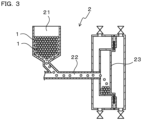
- a molding apparatus 2 including a filling hopper 21 that accommodates polypropylene-based resin expanded beads 1 and a transfer path 22 that connects the filling hopper 21 and a mold 23 can be used.
- each of the inside of the filling hopper 21, the inside of the transfer path 22, and the inside of the mold 23 is pressurized by pressurized gas, and the expanded beads 1 accommodated in the filling hopper 21 are compressed.
- This pressurization is preferably performed such that a pressure (A) in the filling hopper 21 is 0.15 MPa (G) or more and 0.30 MPa (G) or less as the gauge pressure.
- the expanded beads 1 accommodated in the filling hopper 21 can be sufficiently compressed, and the filling property of the expanded beads 1 into the mold 23 can be easily enhanced.
- the pressurized gas that pressurizes the inside of the filling hopper 21, the inside of the transfer path 22, and the inside of the mold 23 is preferably an inorganic gas from the viewpoint of reducing the environmental load, and more preferably air, nitrogen, or carbon dioxide.
- the expanded beads 1 compressed in the filling hopper 21 are filled into the mold 23 via the transfer path 22 while maintaining the compressed state.
- This pressurization is preferably performed such that a pressure (B) in the mold is 0.12 MPa (G) or more and 0.28 MPa (G) or less, and a difference [(A) - (B)] between the pressure (A) in the filling hopper and a pressure (B) in the mold is more than 0 MPa and 0.10 MPa or less.
- the expanded beads 1 can be more smoothly transferred from the filling hopper 21 to the mold 23. As a result, the filling property of the expanded beads 1 into the mold 23 can be further enhanced.
- the transfer path 22 is closed. Thereafter, by releasing the pressure in the mold 23, the expanded beads 1 in the mold 23 are restored to the original shape. Even after this restoration, voids between the expanded beads are still maintained, through which the heating medium to be supplied in the next heating step can sufficiently pass.
- in-mold molding is performed in which a heating medium is supplied into the mold to fusion-bond the expanded beads 1 to each other.
- a heating medium steam is preferable.
- the molded article After the heating step is completed, the molded article is cooled in the mold with water, air, or the like. Thereafter, the molded article is released from the mold, whereby the in-mold molding is completed. Although the released molded article may be subjected to the aging step, the aging step may be omitted as described above.
- the molded article obtained by the manufacturing method includes a large number of expanded beads fusion-bonded to each other.
- the molded article has minute voids communicating with the outside of the molded article.
- the minute voids of the molded article are formed by complicatedly connecting voids formed by the through-holes of the plurality of expanded beads communicating with each other, voids formed by the through-holes of the expanded beads communicating with spaces formed between the expanded beads, voids formed by the spaces between the expanded beads communicating with each other, open cell portions of the expanded beads included in the molded article, and the like.
- the density of the molded article is preferably 10 kg/m 3 or more and 100 kg/m 3 or less.
- the lightweight and rigidity of the molded article can be improved in a well-balanced manner.
- the density of the molded article is more preferably 15 kg/m 3 or more, still more preferably 20 kg/m 3 or more, and particularly preferably 25 kg/m 3 or more.
- the density of the molded article is more preferably 45 kg/m 3 or less, still more preferably 40 kg/m 3 or less, and still more preferably 38 kg/m 3 or less.
- the density of the molded article is more preferably 15 kg/m 3 or more and 45 kg/m 3 or less, still more preferably 20 kg/m 3 or more and 40 kg/m 3 or less, and particularly preferably 25 kg/m 3 or more and 38 kg/m 3 or less.
- the density of the molded article is preferably set within the above range.
- the density of the molded article is calculated by dividing the mass (unit: g) of the molded article by the volume (unit: L) obtained from the outer dimension of the molded article and performing unit conversion. When it is not easy to determine the volume from the outer dimension of the mold, the volume of the molded article can be determined by a submersion method.
- a voidage of the molded article is preferably 4% or more, more preferably 4.5% or more, and still more preferably 5% or more.
- the voidage of the molded article is preferably 12% or less, more preferably 10% or less, and still more preferably 8% or less.
- the voidage of the molded article is preferably 4% or more and 12% or less, more preferably 4.5% or more and 10% or less, and still more preferably 5% or more and 8% or less.
- the molded article is also used as a sound absorbing material, an impact absorbing material, a cushioning material, and the like in various fields such as a vehicle field such as an automobile and a building field.
- Table 1 shows the properties, etc. of the polypropylene-based resin used for producing expanded beads. All of Ethylene-propylene copolymers and an ethylene-propylene-butene copolymer used in the present examples are random copolymers.
- a method for measuring physical properties of the polypropylene-based resins shown in Table 1 is as follows.
- a polypropylene-based resin was heat-pressed at 230°C to prepare a 4 mm sheet, and a test piece having a length of 80 mm ⁇ a width of 10 mm ⁇ a thickness of 4 mm was cut out from the sheet.
- the flexural modulus of the test piece was determined in accordance with JIS K 7171:2008.
- a radius R1 of an indenter and a radius R2 of a support base were both 5 mm, an inter-fulcrum distance was 64 mm, and a test speed was 2 mm/min.
- the melting point of the polypropylene-based resin was determined based on JIS K7121:1987. Specifically, first, a test piece composed of a polypropylene-based resin was conditioned based on "(2) The case of measurement of melting temperature after a definite heat treatment" described in JIS K 7121:1987. The temperature of the test piece after the conditioning was increased from 30°C to 200°C at a heating rate of 10°C/min to obtain a DSC curve. Then, the vertex temperature of the melting peak appearing in the DSC curve was taken as the melting point. As a measuring apparatus, a heat flux differential scanning calorimeter (manufactured by SII NanoTechnology Inc., model number: DSC 7020) was used.
- a melt flow rate (that is, MFR) of the polypropylene-based resin was measured under conditions of a temperature of 230°C and a load of 2.16 kg in accordance with JIS K 7210-1:2014.
- the molded article of Example 1 is obtained by performing in-mold molding on expanded beads containing a tubular foamed core layer containing PP1 as a base resin and having a through-hole, and a cover layer containing PP3 as a base resin and covering a side peripheral surface of the foamed core layer.
- a method for preparing expanded beads is as follows.
- an extruded product extruded from the coextrusion apparatus was cut by the strand cutting method to produce multilayer resin particles.
- PP1 shown in Table 1 and a cell adjusting agent were supplied to the extruder for forming a core layer, and melt-kneaded at a maximum set temperature of 245°C in the extruder to obtain a melt-kneaded product for forming a core layer.
- Zinc borate was used as the cell adjusting agent, and an amount of zinc borate added was 500 ppm by mass with respect to the polypropylene-based resin.
- PP3 shown in Table 1 was melt-kneaded at a maximum set temperature of 245°C in the extruder for forming a cover layer to obtain a melt-kneaded product for forming a cover layer.
- melt-kneaded products were co-extruded and joined in the die to form a tubular composite including a tubular core layer in the non-foamed state and a cover layer in the non-foamed state covering the outer surface of the tubular core layer.
- the extruded product was cooled with cold water at a water temperature of 10°C while being taken up, and cut to an appropriate length using a pelletizer to obtain multilayer resin particles including a tubular core layer which has a through-hole, and a cover layer which covers the core layer.
- the mass per multilayer resin particle was about 1.5 mg.
- the molding apparatus 2 shown in Fig. 3 including the filling hopper 21 that accommodates polypropylene-based resin expanded beads 1 and the transfer path 22 that connects the filling hopper 21 and the mold 23 was used.
- the mold 23 a flat plate mold capable of molding a flat plate-shaped molded article of 300 mm in length ⁇ 250 mm in width ⁇ 60 mm in thickness was used.
- the expanded beads obtained by the above-described method were dried at a temperature of 23°C for 24 hours, and then put into the filling hopper 21.
- the pressure in the cells in the expanded beads put into the filling hopper 21 was set to 0 MPa (G) as the gauge pressure. That is, in the present example, the expanded beads were put into the filling hopper 21 without being subjected to the internal pressure applying step of increasing the pressure in the cells.
- the inside of the filling hopper 21, the inside of the transfer path 22, and the inside of the mold 23 were pressurized using compressed air as pressurized gas, and the expanded beads 1 in the filling hopper 21 were compressed.
- the pressure (A) in the filling hopper 21 and the pressure (B) in the mold 23 were set as shown in Table 2.
- the expanded beads 1 compressed in the filling hopper 21 were supplied from the transfer path 22 into the mold 23 while maintaining the compressed state, and the expanded beads 1 were filled in the mold 23.
- the compression ratio P of the expanded beads at the time of the completion of the filling was set as shown in Table 2.
- An inner dimension of the cavity of the mold 23 is 300 mm in length ⁇ 250 mm in width ⁇ 60 mm in thickness.
- the transfer path 22 was closed. Then, by releasing the pressure in the mold 23, the shape of the expanded beads 1 in the mold 23 was restored to the original shape. Thereafter, steam as a heating medium was supplied into the mold to perform in-mold molding of the expanded beads 1, thereby obtaining a flat plate-shaped molded article of 300 mm in length ⁇ 250 mm in width ⁇ 60 mm in thickness.
- the in-mold molding was performed by the following procedure. First, after the transfer path 22 was closed, an exhaust step of supplying steam from both surfaces in the thickness direction of the mold for 5 seconds to preheat the mold was performed. Thereafter, steam was supplied from one surface side of the mold to perform one-side heating until the pressure of the steam became lower than the molding pressure shown in Table 2 by 0.08 MPa (G). Next, steam was supplied from the other surface side of the mold to perform one-side heating until the pressure of the steam became lower than the molding pressure shown in Table 2 by 0.04 MPa. Thereafter, steam was supplied from both surfaces of the mold to perform main heating until the pressure of the steam reached the molding pressure shown in Table 2.
- Example 2 molded articles were produced by the same method as in Example 1, except that the pressure (A) in the filling hopper and the pressure in the transfer path when the expanded beads were filled into the mold were changed to the values shown in Table 2, and the compression ratio P of the expanded beads in the mold was made higher than that in Example 1.
- a molded article was produced by the same method as in Example 1 except that expanded beads including a foamed core layer containing PP2 as a base resin and a cover layer containing PP3 as a base resin and covering the foamed core layer were used as shown in Table 2.
- the internal pressure applying step was performed in advance, and compression filling and in-mold molding were performed using expanded beads in which the pressure in cells has been increased.
- the same expanded beads as in Example 1 were pressurized with compressed air to increase the internal pressure of the expanded beads (that is, the pressure in the cell) to 0.08 MPa (G).
- the expanded beads were put into the filling hopper 21, and then the pressure (A) in the filling hopper and the pressure in the transfer path at the time of filling the expanded beads into the mold were changed to the values shown in Table 2, and the compression ratio P of the expanded beads in the mold was made lower than that in Example 1.
- the procedure and conditions of the in-mold molding in this example are the same as those in Example 1.
- a molded article was produced by the same method as in Example 1, except that the pressure (A) in the filling hopper and the pressure in the transfer path when the expanded beads were filled into the mold were changed to the values shown in Table 3, whereby the compression ratio P of the expanded beads in the mold was made sufficiently lower than that in Example 1.
- the compression ratio P of the expanded beads in the mold was made higher than that in Example 3. Specifically, the pressure (A) in the filling hopper and the pressure in the transfer path when the expanded beads were filled in the mold were changed to the values shown in Table 3. Since the compression ratio P of the expanded beads increased, a good molded article could not be obtained at the same molding pressure as in Example 3, and therefore the molding pressure was changed to the value shown in Table 3. A molded article was produced by the same method as in Example 3 except for these points.
- Comparative Examples 5 to 7 molded articles were produced by the same method as in Example 1 except that expanded beads having a large average hole diameter d of the through-holes were used as shown in Tables 3 and 4 and the molding conditions were changed as shown in Tables 3 and 4.
- molded articles were produced by the same method as in Example 1, although including some exceptions as follows. That is, expanded beads used in those Examples each include a foamed core layer that contains PP2 as a base resin and a cover layer that contains PP3 as a base resin and covers the foamed core layer.
- the foamed core layers have a through-hole of which an average hole diameter d is large. And the molding conditions were changed as shown in Table 4.
- the average hole diameter d of the through-holes of the expanded beads was determined as follows. First, the expanded beads were left to stand for 24 hours or longer in an environment of a relative humidity of 50%, a temperature of 23°C, and an atmospheric pressure of 1 atm to condition the expanded beads. Each of the 100 expanded beads randomly selected from the expanded bead group after the conditioning was cut perpendicularly to the penetration direction of the through-hole at a position where the area of the cut surface was substantially the maximum. A photograph of the cut surface of each expanded bead was taken, and the cross-sectional area (opening area) of a through-hole portion in the cross-sectional photograph was obtained. The diameter of a virtual perfect circle having the same area as the cross-sectional area was calculated, and the arithmetic average value thereof was taken as the average hole diameter d (unit: mm) of the through-holes of the expanded beads.
- the expanded beads were left to stand for 24 hours or more in an environment of a relative humidity of 50%, a temperature of 23°C, and an atmospheric pressure of 1 atm to thereby condition the expanded beads.
- the expanded beads after the conditioning were filled up to a scale of 1 L in a measuring cylinder having a volume of 1 L so as to be in a natural deposition state. Then, the bulk density (unit: kg/m 3 ) of the expanded bead was calculated by dividing the mass (unit: g) of the expanded beads in the measuring cylinder by the bulk volume (that is, 1 L) and then converting the unit.
- the expanded beads were left to stand for 24 hours or longer in an environment of a relative humidity of 50%, a temperature of 23°C, and an atmospheric pressure of 1 atm to thereby condition the expanded beads.
- the mass of the expanded beads after the conditioning was measured, and then the expanded bead group was submerged in a measuring cylinder containing ethanol at a temperature of 23°C using a wire mesh. Then, in consideration of the volume of the wire mesh, the volume of the expanded beads read from a water level rise was measured.
- the apparent density (unit: kg/m 3 ) of the expanded bead was calculated by dividing the mass (unit: g) of the expanded beads thus obtained by the volume (unit: L) and then converting the unit.
- the average outer diameter D of the expanded beads was determined as follows. First, the expanded beads were left to stand for 24 hours or longer in an environment of a relative humidity of 50%, a temperature of 23°C, and an atmospheric pressure of 1 atm to thereby condition the expanded beads. Each of the 100 expanded beads randomly selected from the expanded bead group after the conditioning was cut perpendicularly to the penetration direction of the through-hole at a position where the area of the cut surface was substantially the maximum. A photograph of the cut surface of each expanded bead was taken to determine the cross-sectional area of the expanded bead (including the opening of the through-hole).
- the diameter of a virtual perfect circle having the same area as the cross-sectional area was calculated, and the arithmetic average value thereof was taken as the average outer diameter D (unit: mm) of the expanded beads.
- Tables 2 to 4 also show the value of the ratio d/D of the average hole diameter d of the through-holes to the average outer diameter D of the expanded beads.
- the circularity of the expanded bead was determined as follows. First, the expanded beads were left to stand for 24 hours or longer in an environment of a relative humidity of 50%, a temperature of 23°C, and an atmospheric pressure of 1 atm to thereby condition the expanded bead. Each of the 100 expanded beads randomly selected from the expanded bead group after the conditioning was cut perpendicularly to the penetration direction of the through-hole at a position where the area of the cut surface was substantially the maximum. Next, a photograph of a cut surface of each expanded bead was taken, and the cross-sectional area S (opening area) and the peripheral length C (circumference) of the through-hole portion were obtained.
- Circularity 4 ⁇ S / C ⁇ C
- the density (unit: kg/m 3 ) of the molded article was calculated by dividing the mass (unit: g) of the molded article by the volume (unit: L) obtained from the outer dimension of the molded article and then performing unit conversion.
- Tables 2 to 4 also show a ratio (molded article density/expanded beads bulk density) of the density of the molded article to the bulk density of the expanded beads. It means that the smaller the value of the ratio of the densities, the more effectively the bulk density of the original expanded beads could be utilized to obtain a lightweight molded article.
- a test piece having a rectangular parallelepiped shape (20 mm in length ⁇ 100 mm in width ⁇ 20 mm in height) was cut out from the central portion of the molded article.
- the test piece was immersed in a measuring cylinder containing ethanol, and the true volume Vc (unit: L) of the test piece was determined from the increase in the liquid level of ethanol.
- the apparent volume Vd (unit: L) was obtained from an outer dimension of the test piece.
- the appearance of the molded article was evaluated based on the results of visual observation of the molded article.
- a symbol “A” was described when the number of gaps between the expanded beads was small on the surface of the molded article and the irregularities caused by the through-holes and the like were not conspicuous
- a symbol “B” was described when the space(s) between beads and/or the irregularities caused by the through-hole and the like were slightly observed on the surface of the molded article
- a symbol “C” was described when the space(s) between beads and/or the irregularities caused by the through-hole and the like were remarkably observed on the surface of the molded article.
- the molded article was bent so as to be substantially equally divided in the length direction and broken. Thereafter, the broken surface of the test piece was observed, and the number of expanded beads in which the expanded beads themselves were broken (material fracture) and the number of expanded beads peeled off between interfaces of the expanded beads were each visually counted. Then, a ratio of the number of expanded beads on which material fracture occurred to the total number of expanded beads present on the broken surface was calculated, and the value expressed as a percentage was taken as a material fracture rate (unit: %) of the test piece.
- the recoverability of the shape of the molded article was evaluated based on the shrinkage and deformation of the molded article after the aging step. Specifically, in a plan view of the molded article viewed from the thickness direction, the thickness of the molded article at four positions 10 mm inward from respective vertices in the center direction and the thickness of the molded article at the central portion were measured. Next, a ratio (unit: %) of the thickness of the central portion to the thickness of the thickest position among the four measurement positions near the vertices was calculated. In the column of "recoverability" in Tables 2 to 4, the symbol “A” was described when the thickness ratio was 95% or more, and the symbol “B” was described when the thickness ratio was less than 95%.
- a molded article having "A" in all of the evaluations of appearance, fusion bondability, and recoverability can be judged as a "good molded article".
- the molded article was removed from the mold, and then the molded article not subjected to the aging step was used to evaluate the shape stability. Specifically, the released molded article was left to stand for 24 hours under conditions of a relative humidity of 50%, 23°C, and 1 atm to thereby condition the molded article. Then, similarly to the evaluation of the recoverability as described above, the thickness at the positions near the vertices and the thickness at the central portion in the molded article after the conditioning were measured, and the ratio (unit: %) of the thickness at the central portion to the thickness at the thickest position among the four measurement positions near the vertices was calculated.
- the symbol “A” was described when the thickness ratio was 95% or more, and the symbol “B” was described when the thickness ratio was less than 95%.
- the symbol “A” in the evaluation of the shape stability when the aging step is omitted means that the shrinkage and deformation of the molded article are curtailed and a good molded article can be obtained even when the aging step is omitted.
- a good molded article was not obtained after the aging step was performed, that is, when the determination of one or more of the appearance, fusion bondability, and recoverability described above was other than "A”
- the shape stability when the aging step was omitted was not evaluated.
- the symbol "-" was described in the same column.
- the compression ratio P of the expanded beads is too high, and the expanded beads in the mold are likely to be excessively compressed.
- the ratio of the molded article density to the bulk density of the expanded beads exceeds 2.0, and it becomes difficult to obtain a lightweight molded article utilizing the bulk density of the original expanded beads.
- the time required for cooling the molded article in the mold tends to be long.
- Comparative Example 8 and Comparative Example 9 although the hole diameter of the through-hole of the expanded bead is smaller than that in Comparative Examples 5 to 7, the hole diameter of the through-hole is larger than that in Examples 1 to 5, and thus gaps between the expanded beads and irregularities derived from the through-hole are likely to be formed on the surface of the molded article obtained after in-mold molding. Thus, it is difficult to obtain a molded article having a good appearance.
- Comparative Example 10 in order to obtain a molded article having a good appearance, as a result of setting the compression ratio P of the expanded beads to be higher than those in Comparative Example 8 and Comparative Example 9, the expanded beads in the mold are likely to be excessively compressed. Thus, the ratio of the molded article density to the bulk density of the expanded beads exceeds 2.0, and it becomes difficult to obtain a lightweight molded article. In addition, it is necessary to increase the molding pressure in order to sufficiently fusion-bond the expanded beads to each other. As a result, it is necessary to perform the aging step in order to curtail the shrinkage and deformation of the molded article.
- the specific aspect of the method for manufacturing a molded article of polypropylene-based resin expanded beads has been described above based on Examples, the specific aspect of the method for manufacturing a molded article of polypropylene-based resin expanded beads according to the present invention is not limited to the aspect of Examples, and the configuration can be appropriately changed without impairing the gist of the present invention.
Landscapes
- Chemical & Material Sciences (AREA)
- Engineering & Computer Science (AREA)
- Materials Engineering (AREA)
- Health & Medical Sciences (AREA)
- Chemical Kinetics & Catalysis (AREA)
- Medicinal Chemistry (AREA)
- Polymers & Plastics (AREA)
- Organic Chemistry (AREA)
- Mechanical Engineering (AREA)
- Manufacture Of Porous Articles, And Recovery And Treatment Of Waste Products (AREA)
- Molding Of Porous Articles (AREA)
Applications Claiming Priority (2)
| Application Number | Priority Date | Filing Date | Title |
|---|---|---|---|
| JP2021184121A JP7735161B2 (ja) | 2021-11-11 | 2021-11-11 | ポリプロピレン系樹脂発泡粒子成形体の製造方法 |
| PCT/JP2022/032907 WO2023084881A1 (fr) | 2021-11-11 | 2022-09-01 | Procédé de fabrication d'un article moulé de particules expansées en résine à base de polypropylène |
Publications (2)
| Publication Number | Publication Date |
|---|---|
| EP4406997A1 true EP4406997A1 (fr) | 2024-07-31 |
| EP4406997A4 EP4406997A4 (fr) | 2025-02-12 |
Family
ID=86335415
Family Applications (1)
| Application Number | Title | Priority Date | Filing Date |
|---|---|---|---|
| EP22892384.3A Pending EP4406997A4 (fr) | 2021-11-11 | 2022-09-01 | Procédé de fabrication d'un article moulé de particules expansées en résine à base de polypropylène |
Country Status (8)
| Country | Link |
|---|---|
| US (1) | US20240286324A1 (fr) |
| EP (1) | EP4406997A4 (fr) |
| JP (1) | JP7735161B2 (fr) |
| KR (1) | KR20240101942A (fr) |
| CN (1) | CN117980386A (fr) |
| MX (1) | MX2024005506A (fr) |
| TW (1) | TWI903112B (fr) |
| WO (1) | WO2023084881A1 (fr) |
Cited By (1)
| Publication number | Priority date | Publication date | Assignee | Title |
|---|---|---|---|---|
| EP4461501A4 (fr) * | 2022-03-17 | 2025-04-09 | JSP Corporation | Procédé de production d'un corps moulé en particules de mousse de résine thermoplastique |
Families Citing this family (2)
| Publication number | Priority date | Publication date | Assignee | Title |
|---|---|---|---|---|
| KR20240165406A (ko) * | 2022-03-17 | 2024-11-22 | 가부시키가이샤 제이에스피 | 열가소성 수지 발포 입자 성형체의 제조방법 |
| JP2025184407A (ja) * | 2024-06-07 | 2025-12-18 | 株式会社ジェイエスピー | ポリプロピレン系樹脂発泡粒子成形体の製造方法 |
Family Cites Families (16)
| Publication number | Priority date | Publication date | Assignee | Title |
|---|---|---|---|---|
| DE1704462A1 (de) | 1967-02-14 | 1971-05-19 | Basf Ag | Verfahren zur Herstellung von Schaumstoff-Formkoerpern aus AEthylen- oder Propylenpolymerisaten |
| JPS62151325A (ja) | 1985-12-26 | 1987-07-06 | Mitsubishi Yuka Badische Co Ltd | ポリプロピレン系樹脂発泡粒子の型内成形法 |
| MY116615A (en) * | 1992-07-13 | 2004-03-31 | Aron Kasei Kk | Process for producing expanded plastics with skin and molding apparatus therefor |
| JP3341418B2 (ja) * | 1993-11-16 | 2002-11-05 | 株式会社ジエイエスピー | 連通した空隙を有するプロピレン系樹脂発泡成型体の製造方法 |
| JP3341419B2 (ja) * | 1993-11-16 | 2002-11-05 | 株式会社ジエイエスピー | 連通した空隙を有するプロピレン系樹脂発泡成型体の製造方法 |
| JP2805286B2 (ja) * | 1994-08-16 | 1998-09-30 | 株式会社ジェイエスピー | 連通した空隙を有するポリオレフィン系樹脂発泡成形体及びその製造方法 |
| JP4050374B2 (ja) * | 1998-01-26 | 2008-02-20 | 株式会社ジェイエスピー | 表皮付き発泡成型体の製造方法及び表皮付き発泡成型体 |
| JP4023911B2 (ja) * | 1998-06-01 | 2007-12-19 | 株式会社ジェイエスピー | 貫通穴を有する筒状のポリオレフィン系樹脂発泡粒子及び連通した空隙を有するポリオレフィン系樹脂発泡成型体の製造方法 |
| JP4761414B2 (ja) * | 2000-12-21 | 2011-08-31 | 株式会社ジェイエスピー | 熱可塑性樹脂発泡小片成型体の製造方法 |
| JP4128850B2 (ja) | 2001-11-01 | 2008-07-30 | 株式会社ジェイエスピー | ポリプロピレン系樹脂発泡粒子の型内発泡成形体の製造方法 |
| JP4276489B2 (ja) * | 2002-07-22 | 2009-06-10 | 株式会社ジェイエスピー | ポリプロピレン系樹脂発泡粒子の製造方法及びポリプロピレン系樹脂発泡粒子 |
| JP4883681B2 (ja) * | 2005-03-29 | 2012-02-22 | 株式会社ジェイエスピー | ポリプロピレン系樹脂発泡粒子、ポリプロピレン系樹脂発泡粒子成形体の製造方法およびポリプロピレン系樹脂発泡粒子成形体 |
| JP5727210B2 (ja) * | 2010-12-15 | 2015-06-03 | 株式会社ジェイエスピー | ポリオレフィン系樹脂発泡粒子成形体の製造方法、及びポリオレフィン系樹脂発泡粒子成形体 |
| WO2017030124A1 (fr) * | 2015-08-20 | 2017-02-23 | 株式会社カネカ | Particules de mousse en résine à base de polypropylène ainsi que procédé de fabrication de celles-ci, et corps moulé en mousse dans un moule de résine à base de polypropylène ainsi que procédé de fabrication de celui-ci |
| JP7152480B2 (ja) * | 2018-05-15 | 2022-10-12 | 株式会社カネカ | ポリプロピレン系樹脂発泡粒子、ポリプロピレン系樹脂型内発泡成形体、およびポリプロピレン系樹脂発泡粒子の製造方法 |
| CN115427487B (zh) * | 2020-02-04 | 2023-10-20 | 株式会社Jsp | 聚丙烯系树脂发泡珠粒和聚丙烯系树脂发泡珠粒模制品 |
-
2021
- 2021-11-11 JP JP2021184121A patent/JP7735161B2/ja active Active
-
2022
- 2022-09-01 CN CN202280064568.2A patent/CN117980386A/zh active Pending
- 2022-09-01 EP EP22892384.3A patent/EP4406997A4/fr active Pending
- 2022-09-01 WO PCT/JP2022/032907 patent/WO2023084881A1/fr not_active Ceased
- 2022-09-01 KR KR1020247019216A patent/KR20240101942A/ko active Pending
- 2022-09-01 MX MX2024005506A patent/MX2024005506A/es unknown
- 2022-09-15 TW TW111134857A patent/TWI903112B/zh active
-
2024
- 2024-05-07 US US18/656,664 patent/US20240286324A1/en active Pending
Cited By (1)
| Publication number | Priority date | Publication date | Assignee | Title |
|---|---|---|---|---|
| EP4461501A4 (fr) * | 2022-03-17 | 2025-04-09 | JSP Corporation | Procédé de production d'un corps moulé en particules de mousse de résine thermoplastique |
Also Published As
| Publication number | Publication date |
|---|---|
| MX2024005506A (es) | 2024-05-23 |
| JP2023071381A (ja) | 2023-05-23 |
| KR20240101942A (ko) | 2024-07-02 |
| WO2023084881A1 (fr) | 2023-05-19 |
| JP7735161B2 (ja) | 2025-09-08 |
| CN117980386A (zh) | 2024-05-03 |
| TWI903112B (zh) | 2025-11-01 |
| EP4406997A4 (fr) | 2025-02-12 |
| TW202321365A (zh) | 2023-06-01 |
| US20240286324A1 (en) | 2024-08-29 |
Similar Documents
| Publication | Publication Date | Title |
|---|---|---|
| EP4506400B1 (fr) | Particules de mousse de résine de polyoléfine et leur procédé de fabrication | |
| EP4406997A1 (fr) | Procédé de fabrication d'un article moulé de particules expansées en résine à base de polypropylène | |
| EP4047043B1 (fr) | Billes expansées et leurs procédés de production | |
| EP1707592A2 (fr) | Procédé de préparation de perles de polypropylène expansé. | |
| EP4234223B1 (fr) | Méthode de fabrication de stratifié | |
| EP4339233A1 (fr) | Particules de mousse de résine de polypropylène, leur procédé de production et corps moulé de particules de mousse de résine de polypropylène | |
| EP4464492B1 (fr) | Procédé de production de corps moulé en particules expansées de résine thermoplastique | |
| US20240124674A1 (en) | Molded article of polypropylene-based resin expanded beads and method for producing same | |
| EP4310134B1 (fr) | Perles expansées de résine à base de polypropylène et article moulé associé | |
| EP4461501A1 (fr) | Procédé de production d'un corps moulé en particules de mousse de résine thermoplastique | |
| EP4393986B1 (fr) | Particules de résine à base de polypropylène expansées et procédé pour la production d'un objet moulé à base de particules expansées | |
| EP4480998A1 (fr) | Particules de résine thermoplastique cristalline expansée, objet moulé à partir de particules de résine thermoplastique cristalline expansée, et leur procédé de production | |
| EP4079797B1 (fr) | Perles expansées multicouches et article moulé correspondant | |
| EP4610302A1 (fr) | Corps moulé de particules de mousse de résine de polyéthylène et son procédé de production | |
| EP4306583B1 (fr) | Bille expansée de résine thermoplastique et article moulé de billes expansées de résine thermoplastique | |
| EP4722280A1 (fr) | Bille expansée de résine à base de polypropylène, article moulé de billes expansées de résine à base de polypropylène, noyau de pare-chocs d'automobile et boîte d'outil d'automobile | |
| EP4400538A1 (fr) | Particules de mousse de résine à base de polyéthylène ainsi que procédé de production de celles-ci | |
| BR112024016851B1 (pt) | Método para a produção de artigo moldado de grânulos expandidos de resina termoplástica |
Legal Events
| Date | Code | Title | Description |
|---|---|---|---|
| STAA | Information on the status of an ep patent application or granted ep patent |
Free format text: STATUS: THE INTERNATIONAL PUBLICATION HAS BEEN MADE |
|
| PUAI | Public reference made under article 153(3) epc to a published international application that has entered the european phase |
Free format text: ORIGINAL CODE: 0009012 |
|
| STAA | Information on the status of an ep patent application or granted ep patent |
Free format text: STATUS: REQUEST FOR EXAMINATION WAS MADE |
|
| 17P | Request for examination filed |
Effective date: 20240425 |
|
| AK | Designated contracting states |
Kind code of ref document: A1 Designated state(s): AL AT BE BG CH CY CZ DE DK EE ES FI FR GB GR HR HU IE IS IT LI LT LU LV MC MK MT NL NO PL PT RO RS SE SI SK SM TR |
|
| A4 | Supplementary search report drawn up and despatched |
Effective date: 20250115 |
|
| RIC1 | Information provided on ipc code assigned before grant |
Ipc: B29K 23/00 20060101ALI20250109BHEP Ipc: B29C 44/44 20060101ALI20250109BHEP Ipc: B29C 44/00 20060101ALI20250109BHEP Ipc: C08J 9/228 20060101AFI20250109BHEP |
|
| DAV | Request for validation of the european patent (deleted) | ||
| DAX | Request for extension of the european patent (deleted) | ||
| GRAP | Despatch of communication of intention to grant a patent |
Free format text: ORIGINAL CODE: EPIDOSNIGR1 |
|
| STAA | Information on the status of an ep patent application or granted ep patent |
Free format text: STATUS: GRANT OF PATENT IS INTENDED |
|
| INTG | Intention to grant announced |
Effective date: 20260204 |
|
| RIN1 | Information on inventor provided before grant (corrected) |
Inventor name: SASAKI, KENTA |
|
| P01 | Opt-out of the competence of the unified patent court (upc) registered |
Free format text: CASE NUMBER: UPC_APP_0008469_4406997/2026 Effective date: 20260303 |
|
| GRAS | Grant fee paid |
Free format text: ORIGINAL CODE: EPIDOSNIGR3 |
|
| GRAA | (expected) grant |
Free format text: ORIGINAL CODE: 0009210 |
|
| STAA | Information on the status of an ep patent application or granted ep patent |
Free format text: STATUS: THE PATENT HAS BEEN GRANTED |