EP4407547A1 - Verfahren zur verwaltung einer finanztransaktion - Google Patents
Verfahren zur verwaltung einer finanztransaktion Download PDFInfo
- Publication number
- EP4407547A1 EP4407547A1 EP23305116.8A EP23305116A EP4407547A1 EP 4407547 A1 EP4407547 A1 EP 4407547A1 EP 23305116 A EP23305116 A EP 23305116A EP 4407547 A1 EP4407547 A1 EP 4407547A1
- Authority
- EP
- European Patent Office
- Prior art keywords
- payment instrument
- payment
- tap
- personal device
- transaction
- Prior art date
- Legal status (The legal status is an assumption and is not a legal conclusion. Google has not performed a legal analysis and makes no representation as to the accuracy of the status listed.)
- Withdrawn
Links
Images

Classifications
-
- G—PHYSICS
- G06—COMPUTING OR CALCULATING; COUNTING
- G06Q—INFORMATION AND COMMUNICATION TECHNOLOGY [ICT] SPECIALLY ADAPTED FOR ADMINISTRATIVE, COMMERCIAL, FINANCIAL, MANAGERIAL OR SUPERVISORY PURPOSES; SYSTEMS OR METHODS SPECIALLY ADAPTED FOR ADMINISTRATIVE, COMMERCIAL, FINANCIAL, MANAGERIAL OR SUPERVISORY PURPOSES, NOT OTHERWISE PROVIDED FOR
- G06Q20/00—Payment architectures, schemes or protocols
- G06Q20/30—Payment architectures, schemes or protocols characterised by the use of specific devices or networks
- G06Q20/34—Payment architectures, schemes or protocols characterised by the use of specific devices or networks using cards, e.g. integrated circuit [IC] cards or magnetic cards
- G06Q20/352—Contactless payments by cards
-
- G—PHYSICS
- G06—COMPUTING OR CALCULATING; COUNTING
- G06Q—INFORMATION AND COMMUNICATION TECHNOLOGY [ICT] SPECIALLY ADAPTED FOR ADMINISTRATIVE, COMMERCIAL, FINANCIAL, MANAGERIAL OR SUPERVISORY PURPOSES; SYSTEMS OR METHODS SPECIALLY ADAPTED FOR ADMINISTRATIVE, COMMERCIAL, FINANCIAL, MANAGERIAL OR SUPERVISORY PURPOSES, NOT OTHERWISE PROVIDED FOR
- G06Q20/00—Payment architectures, schemes or protocols
- G06Q20/08—Payment architectures
- G06Q20/20—Point-of-sale [POS] network systems
- G06Q20/204—Point-of-sale [POS] network systems comprising interface for record bearing medium or carrier for electronic funds transfer or payment credit
-
- G—PHYSICS
- G06—COMPUTING OR CALCULATING; COUNTING
- G06Q—INFORMATION AND COMMUNICATION TECHNOLOGY [ICT] SPECIALLY ADAPTED FOR ADMINISTRATIVE, COMMERCIAL, FINANCIAL, MANAGERIAL OR SUPERVISORY PURPOSES; SYSTEMS OR METHODS SPECIALLY ADAPTED FOR ADMINISTRATIVE, COMMERCIAL, FINANCIAL, MANAGERIAL OR SUPERVISORY PURPOSES, NOT OTHERWISE PROVIDED FOR
- G06Q20/00—Payment architectures, schemes or protocols
- G06Q20/30—Payment architectures, schemes or protocols characterised by the use of specific devices or networks
- G06Q20/34—Payment architectures, schemes or protocols characterised by the use of specific devices or networks using cards, e.g. integrated circuit [IC] cards or magnetic cards
- G06Q20/353—Payments by cards read by M-devices
-
- G—PHYSICS
- G07—CHECKING-DEVICES
- G07F—COIN-FREED OR LIKE APPARATUS
- G07F7/00—Mechanisms actuated by objects other than coins to free or to actuate vending, hiring, coin or paper currency dispensing or refunding apparatus
- G07F7/08—Mechanisms actuated by objects other than coins to free or to actuate vending, hiring, coin or paper currency dispensing or refunding apparatus by coded identity card or credit card or other personal identification means
- G07F7/0873—Details of the card reader
- G07F7/0893—Details of the card reader the card reader reading the card in a contactless manner
Definitions
- the present invention relates to methods for managing a financial transaction during a face-to-face payment transaction involving a payment instrument. It relates particularly to methods of controlling execution of a financial transaction between a payment instrument and a payment terminal involved in an in-person payment transaction.
- Financial transactions or electronic funds transfers are done today through the interaction of a payment instrument with a connected payment terminal, and the exchange of a payload with a remote server.
- the financial transaction may be a payment carried out via a Point-Of-Sale (POS) terminal or a cash withdrawal via an Automated Teller Machine (ATM).
- POS Point-Of-Sale
- ATM Automated Teller Machine
- Such transactions are called in-person transactions (or proximity transactions or face-to-face transactions) because the cardholder is at the same location as the payment terminal.
- Conventional payment terminals are devices designed to interface with payment instruments to make electronic funds transfers.
- Conventional payment terminals are considered as secure devices because some of their essential hardware components and their software/firmware components passed security tests.
- the PIN pad is tamper resistant and embeds cryptographic keys to cipher the PIN entry.
- the Payment Card Industry - PIN Transaction Security (PCI PTS) certification brings a high security level guarantee to conventional payment terminals.
- SoftPOS or Software POS
- COTS Commercial Off-The-Shelf
- a SoftPOS comprises a POS terminal software application able to accept payments, which runs on a standard NFC mobile phone that could be owned by the merchant which can be a taxi driver, a plumber, a street vendor, a clothing store or a supermarket for instance.
- Payment Card Industry - PIN Transaction Security (PCI PTS) standard cannot apply on such devices, considering their commercial off-the-shelf nature. It becomes consequently possible to cheat a customer with a fake POS terminal application loaded by a fraudulent merchant on their mobile phone, and to perform a financial transaction for a different amount of money than the one displayed by a fake POS terminal.
- the invention aims at solving the above-mentioned technical problem.
- An object of the present invention is a payment instrument assigned to a user.
- the payment instrument is configured to get a transaction data from a payment terminal in response to a first tap with the payment terminal leading to the start of a financial transaction.
- the payment instrument comprises a preset parameter indicating whether a three-tap option is enabled.
- the payment instrument is configured to monitor the parameter during the first tap. If the payment instrument detects that the parameter indicates that the three-tap option is enabled, the payment instrument is configured:
- the payment instrument may comprise a hardware sensor and if the payment instrument detects that the sensor is activated during the first tap, the payment instrument may be configured to invert the parameter.
- the senor may be a push button, a capacitive button, a biometric sensor, a mechanical sensor, an optical sensor or an electrical sensor.
- the payment instrument may be configured to reset said first indicator and said second indicator after performing the check.
- the transaction data may comprise a first identifier of the payment terminal.
- the payment instrument may be configured to receive from the payment terminal a second identifier of the payment terminal and said security policy may specify that said first identifier should be equal to said second identifier.
- the transaction data may comprise a first timestamp.
- the payment instrument may be configured to receive from the payment terminal a second timestamp and said security policy may specify that the difference between said first and second timestamps should be less than a preset duration.
- the security policy may specify that the payment instrument should have received an acknowledgement data generated by the personal device after capturing from the user an agreement entry that reflects acknowledgement of awareness of the subset by the user.
- the financial transaction may be a payment transaction and the subset may comprise a payment amount.
- the payment instrument may be a smart card, a ring, a keychain, a bracelet or a microchip inserted in the body of the user.
- Another object of the present invention is a system comprising a payment instrument according to the invention and a personal device.
- the payment instrument may comprise a first key and the personal device may comprise a second key, both said first and second keys having being defined during a pairing operation.
- the payment instrument and the personal device may be configured to establish a secure channel using both said first and second keys; and the payment instrument and the personal device may be configured to exchange data through the secure channel.
- the personal device may be a phone, a tablet PC, a Personal Digital Assistant or a wearable device like a ring, a keychain, a bracelet or a pair of glasses.
- Another object of the present invention is a method for managing a financial transaction between a payment terminal and a payment instrument assigned to a user.
- the financial transaction starts and the payment instrument gets a transaction data from the payment terminal.
- the payment instrument comprises a preset parameter indicating whether a three-tap option is enabled.
- the payment instrument monitors the parameter during the first tap; and if the payment instrument detects that the parameter indicates that a three-tap option is enabled:
- the payment instrument may comprise a hardware sensor. If the payment instrument detects that the sensor is activated during the first tap, the payment instrument may invert the parameter.
- the transaction data may comprise a first identifier of the payment terminal
- the payment instrument in response to the third tap, may receive from the payment terminal a second identifier of the payment terminal and said security policy may specify that the said first identifier should be equal to said second identifier.
- the transaction data may comprise a first timestamp.
- the payment instrument may receive from the payment terminal a second timestamp and said security policy may specify that the difference between said first and second timestamps should be less than a preset duration.
- the invention may apply to any type of contactless payment instrument usually associated to a user (i.e. cardholder).
- the payment instrument may be a physical smart card, a smartwatch, a wearable device or a digital bank card hosted in a mobile phone for instance.
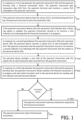
- Figure 1 shows an exemplary flow diagram for managing a payment transaction according to an example of the invention.
- the payment instrument 10 is a physical banking card intended to be used by its associated genuine user 50 (i.e. bank customer) for payment transaction or cash withdrawal.
- the payment instrument 10 embeds a secure element comprising a hardware processing unit, a memory storing an operating system and a banking application designed to contribute to payment services.
- the payment instrument 10 is a proximity card able to communicate through a contactless protocol as defined by the ISO 14443 standard or Near Field Communications (NFC) standards for instance.
- the payment instrument may be configured to communicate through a contact communication protocol in addition to the contactless communication protocol.
- the payment instrument is adapted to exchange data with a personal device 30 through a contactless communication session relying on a contactless technology like Wi-Fi (as defined by ISO/CEI 8802-11 standard), Bluetooth Low Energy ® (BLE) or Ultra Wideband (UWB) for instance.
- a contactless technology like Wi-Fi (as defined by ISO/CEI 8802-11 standard), Bluetooth Low Energy ® (BLE) or Ultra Wideband (UWB) for instance.
- the personal device 30 is a smartphone used by the user of the payment instrument.
- the user of the payment instrument wants to perform a face-to-face payment transaction with a payment terminal 20.
- the payment instrument and the payment terminal are placed close to each other.
- the user may tap the payment instrument on the payment terminal to allow the start of the payment transaction at step S10.
- a tap is to manually bring the payment instrument closed enough to the payment terminal so that a contactless communication channel can be established between the payment instrument and the payment terminal.
- the payment instrument receives a transaction data 61 from the payment terminal.
- the transaction data 61 typically contains a money amount and may comprise other transaction parameters like the date, a reference of the payment instrument or a reference of the merchant.
- the payment instrument comprises a preset parameter 19 indicating whether the three-tap option is enabled (i.e. has been activated) and monitors the parameter 19 during the session established between the payment instrument and the payment terminal by the initial tap.
- the personal device 30 If the personal device 30 received the subset 31 of the transaction data, the personal device provides the user 50 of the payment instrument with the subset 31. For instance, the personal device may display the subset on its own screen. Alternatively, the user may get the subset through an audio channel. Since the user 50 is informed of the relevant transaction parameter(s) (e.g. the money amount declared by the terminal to the payment instrument), they can make the decision whether to perform the third tap (step S20) or not to continue the financial transaction.
- the relevant transaction parameter(s) e.g. the money amount declared by the terminal to the payment instrument
- the payment instrument can behave like a conventional contactless payment instrument that may authorize continuation of the financial transaction in response to the new tap with the payment terminal.
- the payment instrument resets (or erases) the first indicator and the second indicator after performing the check specified by the security policy 14 regardless of the result of the check.
- the payment instrument may embed a sensor 52 allowing switching the parameter 19.
- the payment instrument may comprise a hardware sensor 52 and monitor the sensor during the session established between the payment instrument and the payment terminal by the initial tap. If the payment instrument detects that the sensor is activated (by the user 50) during the first tap, the payment instrument inverts the parameter 19.
- the parameter 19 is preset to a value indicating that the three-tap option is disabled. If the payment instrument detects that the sensor is activated (by the user 50) during the session established with the payment terminal by the initial tap, the payment instrument changes the parameter 19 to a value indicating that the three-tap option is enabled.
- the senor 52 can be a push button, a capacitive button, a mechanical sensor, an optical sensor or an electrical sensor.
- the senor 52 can be a biometric sensor and the payment instrument can consider the sensor as activated either when the sensor detects the presence of a part of the user's body near its detection area or if the captured biometric data corresponds to a prerecorded reference pattern.
- the biometric sensor may be a fingerprint sensor.
- the payment instrument may check that the initial tap (step S10) and the last tap (step S20) are done with the same payment terminal and refuse to continue the transaction if this is not the case.
- the transaction data 61 may comprise a first identifier of the payment terminal
- the payment instrument may receive from the payment terminal a second identifier of the payment terminal in response to the third tap
- the security policy 14 may specify that the first identifier should be equal to the second identifier to continue the transaction.
- the payment instrument may check that the initial tap and the last tap are done within a limited time period and refuse to continue the transaction if this is not the case.
- the transaction data 61 may comprise a first timestamp.
- the payment instrument may receive from the payment terminal a second timestamp and the security policy 14 may specify that the difference between the first and second timestamps should be less than a preset duration 18.
- the security policy 14 may specify that the payment instrument should have received an acknowledgement data 32 generated by the personal device 30 after capturing from the user an agreement entry 38 reflecting acknowledgement of awareness of the subset by the user.
- the payment instrument may wait for the acknowledgement data 32 before accepting to continue treatments required by the transaction.
- the payment instrument may deny the transaction if no acknowledgement data 32 has been received after a predefined duration.
- the payment instrument may comprise a first key 13 and the personal device 30 may comprise a second key 33.
- both said first and second keys may have being defined and stored during a prior pairing operation between the payment instrument and the personal device. These keys may be symmetric keys or based on a public/private key pair.
- the payment instrument and the personal device may automatically establish a secure channel using both the first and second keys. Then they may exchange messages and data through the secure channel.
- the card has the guarantee that the subset 31 is not unduly received or spied by an unwanted device.
- the personal device is not limited to a phone and may be a tablet PC, a Personal Digital Assistant (PDA) or a wearable device like a ring, a keychain, a bracelet or a pair of glasses for instance.
- PDA Personal Digital Assistant
- the payment instrument is not limited to a smart card and may be a ring, a keychain, a bracelet or a microchip inserted in the body of the user for instance.
- Figure 2 shows a diagram of architecture of a system 80 for managing a face-to-face payment transaction according to an example of the invention.
- the system 80 is a payment system comprising both a payment instrument 10 assigned to a user 50 and a personal device 30.
- the payment instrument 10 is a smart card having a secure element 17 including both a hardware processor and a non-volatile memory.
- the smart card 10 comprises a physical communication interface 16 able to exchange data with a payment terminal 20 through a contactless channel.
- the smart card 10 comprises a physical communication interface 15 able to exchange data with the personal device 30 through a contactless communication session relying on a contactless technology.
- the smart card 10 is designed to communicate with the personal device 30 through a Bluetooth Low Energy ® (BLE) channel.
- BLE Bluetooth Low Energy ®
- the payment terminal 20 may be a SoftPOS terminal. It comprises a hardware processor (not shown), a physical communication interface 22 adapted to exchange data with the payment instrument 10 in contactless mode.
- the communication interface 22 may be adapted to exchange data through an ISO/IEC-14443 or a Near Field Communications (NFC) communication session.
- NFC Near Field Communications
- the payment terminal may be a commercial off-the-shelf smartphone comprising a memory 23 storing a Point-Of-Sale terminal software application 24.
- the payment terminal may be a conventional Point-Of-Sale terminal or an Automated Teller Machine (ATM).
- ATM Automated Teller Machine
- the payment instrument 10 In response to a first tap leading to the start of a financial transaction with the payment terminal 20, the payment instrument 10 is configured to receive a transaction data 61 prepared and sent by the payment terminal.
- the payment instrument comprises a preset parameter 19 that indicates whether the three-tap option is enabled (i.e. is activated).
- the payment instrument is configured to monitor the parameter 19 during the first tap.
- the payment instrument detects that the parameter 19 indicates that the three-tap option is enabled, the payment instrument is configured: to record in its own memory a first indicator 11 indicating that the financial transaction is in progress;
- the payment instrument may send to the payment terminal 20 a response 71 containing an element reflecting the decision it made to pursue or reject the pending transaction.
- the payment instrument use the first indicator 11 to link the first and third taps.
- the payment instrument may comprise a hardware sensor 52 and the payment instrument may be configured to monitor the hardware sensor 52 during the first tap. If the payment instrument detects that the sensor is activated during the first tap, the payment instrument may be configured to inverts the parameter 19. For example, the payment instrument may replace a value indicating that the three-tap option is disabled with a new value indicating that the three-tap option is enabled in the parameter 19.
- the payment instrument can adapt its behavior for the continuation of the processing of the payment transaction.
- the user 50 can deliberately activate the three-tap option when starting a transaction with a suspicious payment terminal.
- the hardware sensor 52 may be a push button, a capacitive button, a mechanical sensor, an optical sensor or an electrical sensor.
- hardware sensor 52 may be a biometric sensor like a fingerprint scanner.
- the payment instrument is configured to reset both the first indicator and second indicator after performing the check, whether the check is successful or not.
- the security policy 14 can be implemented as a set of rule(s).
- a first rule specifies that both the financial transaction should be in progress and said subset 31 should have been sent to the personal device to pursue the transaction.
- the security policy 14 may comprise any combination of supplementary rule(s) as detailed below.
- the transaction data 61 may comprise a first identifier 25 of the payment terminal.
- the payment instrument may be configured to receive (and store) from the payment terminal a second identifier of the payment terminal.
- the security policy 14 may comprise a rule specifying that the first identifier should be equal to a second identifier to pursue the transaction.
- the payment terminal may be configured to check that the first and third taps are performed with the same payment instrument.
- the transaction data 61 may comprise a first timestamp.
- the payment instrument may be configured to receive from the payment terminal a second timestamp.
- the security policy 14 may comprise a rule specifying that the difference between said first and second timestamps should be less than a preset duration 18 to pursue the transaction.
- the payment terminal may be configured to check that the first and third taps are performed within a limited time.
- the security policy 14 may comprise a rule specifying that the payment instrument should have received an acknowledgement data 32 generated by the personal device after capturing from the user an agreement entry 38 reflecting acknowledgement of awareness of the subset 31 by the user.
- the payment terminal may be configured to reject the transaction if did not received an acknowledgement data 32 from the personal device 30.
- the personal device 30 may comprise a banking application 37 designed to receive the subset 31 sent by the payment instrument and to present the subset 31 to the user 50.
- the banking application 37 may be configured to capture the agreement entry 38 from the user 50 through a physical user interface of the personal device 30 and to generate and send the acknowledgement data 32 reflecting a successful capture of the agreement entry 38.
- the banking application 37 is implemented as a set of program instructions executed by a hardware computer embedded in the personal device.
- the invention is not limited to Banking smart cards and applies to any payment instruments able to participate to a payment transaction like digital cards for instance.
- the invention may apply to EMV ⁇ transactions, Central Bank Digital Currencies (CBDC) transactions or any other banking flows.
- CBDC Central Bank Digital Currencies
- the payment instrument can check that the cardholder had the opportunity to control one or more transaction parameters (through the user interface of the personal device) before accepting or rejecting the transaction.
- a hacked or fake payment terminal cannot cheat the user by displaying an amount different from the transaction amount sent to the payment instrument.
- Some embodiments of the invention are well suited for increasing security of transaction carried out via SoftPOS terminals, they can be used on any type of payment terminal.
- Some embodiments of the invention solve the apprehension that a cardholder may experience when making a purchase from a merchant equipped with a SoftPOS terminal, which looks like a standard mobile device.
- the duration of the whole payment transaction remains reasonable for the user and easy to perform.
Landscapes
- Business, Economics & Management (AREA)
- Engineering & Computer Science (AREA)
- Accounting & Taxation (AREA)
- Physics & Mathematics (AREA)
- General Physics & Mathematics (AREA)
- Strategic Management (AREA)
- General Business, Economics & Management (AREA)
- Theoretical Computer Science (AREA)
- Finance (AREA)
- Microelectronics & Electronic Packaging (AREA)
- Computer Networks & Wireless Communication (AREA)
- Economics (AREA)
- Development Economics (AREA)
- Financial Or Insurance-Related Operations Such As Payment And Settlement (AREA)
Priority Applications (5)
| Application Number | Priority Date | Filing Date | Title |
|---|---|---|---|
| EP23305116.8A EP4407547A1 (de) | 2023-01-30 | 2023-01-30 | Verfahren zur verwaltung einer finanztransaktion |
| AU2024215678A AU2024215678A1 (en) | 2023-01-30 | 2024-01-16 | System for managing a financial transaction |
| PCT/EP2024/050923 WO2024160537A1 (en) | 2023-01-30 | 2024-01-16 | System for managing a financial transaction |
| EP24701152.1A EP4659176A1 (de) | 2023-01-30 | 2024-01-16 | System zur verwaltung einer finanztransaktion |
| MX2025008475A MX2025008475A (es) | 2023-01-30 | 2025-07-21 | Sistema para gestionar una transaccion financiera |
Applications Claiming Priority (1)
| Application Number | Priority Date | Filing Date | Title |
|---|---|---|---|
| EP23305116.8A EP4407547A1 (de) | 2023-01-30 | 2023-01-30 | Verfahren zur verwaltung einer finanztransaktion |
Publications (1)
| Publication Number | Publication Date |
|---|---|
| EP4407547A1 true EP4407547A1 (de) | 2024-07-31 |
Family
ID=86328710
Family Applications (2)
| Application Number | Title | Priority Date | Filing Date |
|---|---|---|---|
| EP23305116.8A Withdrawn EP4407547A1 (de) | 2023-01-30 | 2023-01-30 | Verfahren zur verwaltung einer finanztransaktion |
| EP24701152.1A Pending EP4659176A1 (de) | 2023-01-30 | 2024-01-16 | System zur verwaltung einer finanztransaktion |
Family Applications After (1)
| Application Number | Title | Priority Date | Filing Date |
|---|---|---|---|
| EP24701152.1A Pending EP4659176A1 (de) | 2023-01-30 | 2024-01-16 | System zur verwaltung einer finanztransaktion |
Country Status (4)
| Country | Link |
|---|---|
| EP (2) | EP4407547A1 (de) |
| AU (1) | AU2024215678A1 (de) |
| MX (1) | MX2025008475A (de) |
| WO (1) | WO2024160537A1 (de) |
Citations (5)
| Publication number | Priority date | Publication date | Assignee | Title |
|---|---|---|---|---|
| WO2011056745A1 (en) * | 2009-11-06 | 2011-05-12 | Mastercard International, Inc. | Methods for risk management in payment-enabled mobile device |
| WO2012140625A1 (en) * | 2011-04-13 | 2012-10-18 | Logomotion, S.R.O. | Payment card, cashless payment method |
| US20190272532A1 (en) * | 2012-05-24 | 2019-09-05 | Google Llc | Systems, methods, and computer program products for providing a contactless protocol |
| US20190392453A1 (en) * | 2018-06-21 | 2019-12-26 | Mastercard International Incorporated | Payment transaction methods and systems enabling verification of payment amount by fingerprint of customer |
| EP4053772A1 (de) * | 2021-03-04 | 2022-09-07 | Thales DIS France SA | Verfahren zur verwaltung einer transaktion mit einer chipkarte |
-
2023
- 2023-01-30 EP EP23305116.8A patent/EP4407547A1/de not_active Withdrawn
-
2024
- 2024-01-16 EP EP24701152.1A patent/EP4659176A1/de active Pending
- 2024-01-16 WO PCT/EP2024/050923 patent/WO2024160537A1/en not_active Ceased
- 2024-01-16 AU AU2024215678A patent/AU2024215678A1/en active Pending
-
2025
- 2025-07-21 MX MX2025008475A patent/MX2025008475A/es unknown
Patent Citations (5)
| Publication number | Priority date | Publication date | Assignee | Title |
|---|---|---|---|---|
| WO2011056745A1 (en) * | 2009-11-06 | 2011-05-12 | Mastercard International, Inc. | Methods for risk management in payment-enabled mobile device |
| WO2012140625A1 (en) * | 2011-04-13 | 2012-10-18 | Logomotion, S.R.O. | Payment card, cashless payment method |
| US20190272532A1 (en) * | 2012-05-24 | 2019-09-05 | Google Llc | Systems, methods, and computer program products for providing a contactless protocol |
| US20190392453A1 (en) * | 2018-06-21 | 2019-12-26 | Mastercard International Incorporated | Payment transaction methods and systems enabling verification of payment amount by fingerprint of customer |
| EP4053772A1 (de) * | 2021-03-04 | 2022-09-07 | Thales DIS France SA | Verfahren zur verwaltung einer transaktion mit einer chipkarte |
Also Published As
| Publication number | Publication date |
|---|---|
| AU2024215678A1 (en) | 2025-08-14 |
| EP4659176A1 (de) | 2025-12-10 |
| MX2025008475A (es) | 2025-08-01 |
| WO2024160537A1 (en) | 2024-08-08 |
Similar Documents
| Publication | Publication Date | Title |
|---|---|---|
| US11620633B2 (en) | Biometric reader in card | |
| RU2679343C1 (ru) | Верификация бесконтактной платежной карты для выдачи платежного удостоверения мобильному устройству | |
| AU2009292921B2 (en) | Apparatus and method for preventing unauthorized access to payment application installed in contactless payment device | |
| US12051058B2 (en) | Validating transactions | |
| US20200356984A1 (en) | Transaction recording | |
| EP3555827A1 (de) | Digitales transaktionssystem und verfahren mit einer virtuellen begleitkarte | |
| US20190043045A1 (en) | Limited operational life password for digital transactions | |
| US11392957B2 (en) | User verification for credential device | |
| JP2019502204A (ja) | トランザクションの代理 | |
| JP2018538625A (ja) | トランザクションについてのユーザ認証 | |
| TWI794155B (zh) | 與數位交易處理單元通信的裝置與方法 | |
| AU2017210752A1 (en) | Indirect security system and method | |
| EP4659176A1 (de) | System zur verwaltung einer finanztransaktion | |
| EP4575960A1 (de) | Verfahren zum erhalt der vereinbarung des benutzers zum absuchen einer kontaktlosen finanztransaktion | |
| EP4369270A1 (de) | Verfahren zur authentifizierung eines benutzers eines bezahlinstruments während einer gesichts-zu-gesichts-bezahlungstransaktion | |
| EP4518388A1 (de) | Verfahren zum schutz von geldtransaktionen vor relayangriffen | |
| US20260094145A1 (en) | Method for providing a user with control over a payment card | |
| EP4535266A1 (de) | Verfahren zur autorisierung einer geldtransaktion | |
| WO2025124887A1 (en) | Method for managing a payment transaction | |
| AU2017212145A1 (en) | Apparatus and method for directly communicating with a digital transaction processing unit (DTPU) | |
| AU2016253607A1 (en) | Apparatus and method for preventing unauthorized access to application installed in a device |
Legal Events
| Date | Code | Title | Description |
|---|---|---|---|
| PUAI | Public reference made under article 153(3) epc to a published international application that has entered the european phase |
Free format text: ORIGINAL CODE: 0009012 |
|
| STAA | Information on the status of an ep patent application or granted ep patent |
Free format text: STATUS: THE APPLICATION HAS BEEN PUBLISHED |
|
| AK | Designated contracting states |
Kind code of ref document: A1 Designated state(s): AL AT BE BG CH CY CZ DE DK EE ES FI FR GB GR HR HU IE IS IT LI LT LU LV MC ME MK MT NL NO PL PT RO RS SE SI SK SM TR |
|
| STAA | Information on the status of an ep patent application or granted ep patent |
Free format text: STATUS: THE APPLICATION IS DEEMED TO BE WITHDRAWN |
|
| 18D | Application deemed to be withdrawn |
Effective date: 20250201 |