EP4407558A1 - Gewinnung eines medizinischen bildes auf einer zielebene - Google Patents
Gewinnung eines medizinischen bildes auf einer zielebene Download PDFInfo
- Publication number
- EP4407558A1 EP4407558A1 EP23153399.3A EP23153399A EP4407558A1 EP 4407558 A1 EP4407558 A1 EP 4407558A1 EP 23153399 A EP23153399 A EP 23153399A EP 4407558 A1 EP4407558 A1 EP 4407558A1
- Authority
- EP
- European Patent Office
- Prior art keywords
- volume
- anatomical structure
- plane
- medical
- target plane
- Prior art date
- Legal status (The legal status is an assumption and is not a legal conclusion. Google has not performed a legal analysis and makes no representation as to the accuracy of the status listed.)
- Withdrawn
Links
Images



Classifications
-
- G—PHYSICS
- G06—COMPUTING OR CALCULATING; COUNTING
- G06T—IMAGE DATA PROCESSING OR GENERATION, IN GENERAL
- G06T7/00—Image analysis
- G06T7/70—Determining position or orientation of objects or cameras
- G06T7/73—Determining position or orientation of objects or cameras using feature-based methods
- G06T7/74—Determining position or orientation of objects or cameras using feature-based methods involving reference images or patches
-
- G—PHYSICS
- G06—COMPUTING OR CALCULATING; COUNTING
- G06T—IMAGE DATA PROCESSING OR GENERATION, IN GENERAL
- G06T2207/00—Indexing scheme for image analysis or image enhancement
- G06T2207/10—Image acquisition modality
- G06T2207/10132—Ultrasound image
- G06T2207/10136—3D ultrasound image
-
- G—PHYSICS
- G06—COMPUTING OR CALCULATING; COUNTING
- G06T—IMAGE DATA PROCESSING OR GENERATION, IN GENERAL
- G06T2207/00—Indexing scheme for image analysis or image enhancement
- G06T2207/20—Special algorithmic details
- G06T2207/20081—Training; Learning
-
- G—PHYSICS
- G06—COMPUTING OR CALCULATING; COUNTING
- G06T—IMAGE DATA PROCESSING OR GENERATION, IN GENERAL
- G06T2207/00—Indexing scheme for image analysis or image enhancement
- G06T2207/30—Subject of image; Context of image processing
- G06T2207/30004—Biomedical image processing
- G06T2207/30048—Heart; Cardiac
Definitions
- the invention relates to a method for obtaining a medical image at a target plane.
- the method relates to extracting medical images from 3D volumes at a target plane.
- a user comparing exams over time in a longitudinal study has to compensate for any effects of different acquisition.
- Simple registration of the images may not work as rigid registration cannot always align the views and elastic registration might destroy subtle differences in the anatomy.
- a method for obtaining a medical image at a target plane comprising: obtaining a three-dimensional, 3D, volume containing an anatomical structure:
- an anatomical structure in the 3D volume is identified and the geometry of the anatomical structure is analyzed. This analysis of the geometry allows the target plane to be precisely aligned/registered to the 3D volume.
- Analyzing the geometry of the anatomical structure may comprise matching features/landmarks in the identified anatomical structure to features expected in the medical image at the target plane.
- the geometry may include the size of anatomical features, the distance between anatomical features etc.
- Registering a first plane/image/volume to a second plane/image/volume generally involves determining the transformation needed to transform the first plane/image/volume to the coordinate system of the second plane/image/volume.
- Identifying the anatomical structure may comprise using a model-based segmentation algorithm trained on a model of the anatomical structure.
- Model-based segmentation increases the precision of the segmentation as the segmentation algorithm has a-priori information on the anatomical structure which it is segmenting.
- medical scans are purposefully performed on target anatomical structures.
- model-based segmentation is particularly suitable as various algorithms can be trained on target anatomical structures (e.g., heart model, fetal model etc.).
- Registering the target plane to the 3D volume may comprise registering the identified anatomical structure to the model of the anatomical structure, wherein the target plane is pre-registered to the model of the anatomical structure.
- Different models could be used for different purposes. For example, for cardiac imaging, different models may be available for different types of heart (e.g., pediatric, adult etc.) and/or for different times during the heart cycle. A generic model could also be transformed for the different purposes.
- Extracting the medical image may comprise extracting a plurality of medical images from the 3D volume in the vicinity of the registered target plane, determining quality scores for the medical images and selecting a medical image, from the plurality of extracted medical images, based on the quality scores.
- Extracting a plurality of medical images from the 3D volume in the vicinity of the registered target plane may include extracting a medical image at the registered target plane.
- the medical image extracted at the target plane may not be of suitable quality (or may not have the best quality). As such, it is proposed to extract medical images at other planes in the vicinity of the target plane. Thus, a medical image at a nearby plane, having a higher quality score, may be more appropriate, for example, for comparison with other images taken at different times.
- Each medical image may have a single quality score. Alternatively, each medical image may have a plurality of quality scores.
- the quality score may be based on a noise level, an artifact count, a field of view coverage, a visibility of an anatomical structure etc.
- a quality score for a medical image is a composite score of the above criteria.
- each medical image has a plurality of individual quality score for the above criteria.
- the 3D volume can be labelled as a first 3D volume, and the method may further comprise obtaining a second 3D volume containing the anatomical structure, identifying the anatomical structure in the second 3D volume, analyzing the geometry of the anatomical structure in the second 3D volume, registering the target plane to the second 3D volume based on the analysis of the geometry of the anatomical structure in the second 3D volume and extracting a second medical image from the second 3D volume at the registered target plane.
- Extracting the second medical image may comprise extracting a plurality of second medical images from the second 3D volume in the vicinity of the registered target plane, determining quality scores for the second medical images and selecting a second medical image, from the plurality of second medical images, based on the quality scores.
- Extracting the first medical image (from the first 3D volume) and extracting the second medical image may be based on the quality scores for the extracted first medical images (of the first 3D volume) and the quality scores for the second medical images.
- the plane for the extracted first medical image and the extracted second medical image may be the same (or within a maximum displacement threshold). This may enable comparability, at an appropriate quality, between two extracted medical images without being limited to a strict target plane (which may, for example, be noisy).
- the acquisition process may sometimes be gated to obtain the anatomical structure at the same point during a cycle (e.g., for cardiac imaging).
- the method may further comprise obtaining a two-dimensional, 2D, medical scan of the anatomical structure and determining an anatomical plane from the 2D medical scan, wherein the target plane can be selected as the determined anatomical plane.
- the method may further comprise obtaining a 3D reference volume registered to the 2D medical scan, wherein determining the anatomical plane from the 2D medical scan comprises identifying the anatomical plane relative to the 3D reference volume.
- the method may further comprise obtaining a first 2D medical scan of the anatomical structure at a first time, obtaining a second 2D medical scan of the anatomical structure at a third time, obtaining the 3D medical volume at a second time, between the first time and the third time and determining a first anatomical plane from the first 2D medical scan and/or a second anatomical plane from the second 2D medical scan, wherein the target plane is one of the first anatomical plane or the second anatomical plane.
- the user may be able to choose whether the extracted image is based on a previously obtained image (e.g., at the first time) or based on a later obtained image (e.g., at the third time).
- Determining an anatomical plane from a 2D medical scan may comprise using a regression network trained to identify an anatomical plane from any 2D medical scan comprising the anatomical structure.
- plane regression techniques can be used to identify the anatomical plane of the 2D medical scans.
- Extracting the medical image from the 3D medical volume may comprise using multi-planar reformation, MPR, on the 3D medical volume.
- MPR multi-planar reformation
- the 3D medical volume may be a 3D ultrasound volume. Of course, other types of 3D medical data could be used.
- the invention also provides a computer program carrier comprising computer program code which, when executed on a processing system, causes the processing system to perform all of the steps of the afore-mentioned methods.
- the computer program carrier may, for example, be a data storage system (e.g., a hard drive, a solid-state drive etc.) or a temporary carrier (e.g., a bit-stream).
- a data storage system e.g., a hard drive, a solid-state drive etc.
- a temporary carrier e.g., a bit-stream
- the invention also provides a system for obtaining a medical image at a target plane, the system comprising a processor configured to: obtain a three-dimensional, 3D, volume containing an anatomical structure:
- the system may also comprise an imaging device for obtaining the 3D volume.
- the imaging device may be a 3D ultrasound transducer.
- the processor may be configured to identify the anatomical structure by using a model-based segmentation algorithm trained on a model of the anatomical structure.
- the processor may be configured to extract the medical image by extracting a plurality of medical images from the 3D volume in the vicinity of the registered target plane, determining quality scores for the medical images and selecting a medical image, from the plurality of extracted medical images, based on the quality scores.
- the 3D volume may be labelled as a first 3D volume, and the processor may be further configured to obtain a second 3D volume containing the anatomical structure, identify the anatomical structure in the second 3D volume, analyze the geometry of the anatomical structure in the second 3D volume, register the target plane to the second 3D volume based on the analysis of the geometry of the anatomical structure in the second 3D volume and extract a second medical image from the second 3D volume at the registered target plane.
- the processor may be further configured to obtain a two-dimensional, 2D, medical scan of the anatomical structure and determine an anatomical plane from the 2D medical scan, wherein the target plane is the determined anatomical plane.
- the invention provides a method for obtaining a medical image at a target plane.
- the method comprises obtaining a three-dimensional, 3D, volume containing an anatomical structure and identifying the anatomical structure in the 3D volume.
- the geometry of the anatomical structure in the 3D volume is analyzed and the target plane is registered to the 3D volume based on the analysis of the geometry of the anatomical structure.
- the medical image is extracted from the 3D volume at the registered target plane.
- FIGs. 1 illustrates 2D scanning of an anatomical structure 102 at three separate times.
- the anatomical structure 102 is shown as a heart for illustrative purposes only. It will be appreciated that other anatomical structures (e.g., lung, liver, fetus etc.) could be imaged instead.
- the imaging device e.g., a transducer for ultrasound imaging
- the imaging device must be aligned all three times to the target plane 104. This means that the angle of the imaging device has to be carefully reproduced (e.g., at each separate exam) such that the field of view 106 of the imaging device captures the target plane 104 each time.
- the 2D acquisition may be at a different plane and thus would not be comparable to the previous/later acquisitions obtained at the target plane.
- Fig. 2 illustrates 3D scanning of an anatomical structure 102 at three separate times.
- the angle of the imaging device (not shown) is not critical as the field of view 202 is much greater during 3D acquisitions, compared to during 2D acquisitions (as shown in Fig. 1 ).
- the target plane 104 can be sliced/extracted from the 3D acquisitions.
- slicing 2D anatomical planes from a 3D acquisition relaxes the dependency on the angle of the imaging device during acquisition as a plane that is not axis-aligned with the imaging device can be sliced from the volume, as shown in Fig. 2 .
- the user does not have to be as precise with their positioning/angle of the imaging device at different times (e.g., at during different exams in a longitudinal study).
- the user may want to compare a current 2D slice, at the target plane 104, with a previous 2D slice. This would have only been possible if the user had also previously acquired a 2D slice at the target plane 104.
- the user may have previously acquired a 3D volume of the anatomical structure 102.
- the user can extract a 2D slice from the previously acquired 3D volume at the target plane to compare to the current 2D slice.
- Fig. 3 shows a 3D acquisition process.
- Fig. 3 shows an anatomical structure being scanned at three different times, t 1 , t 2 and t 3 , during three different exams.
- the angle of the imaging device (not shown) is not critical as the 3D acquisition can obtain all the necessary information on the anatomical structure 102 due to the large field of view 202 and store it in a 3D volume 302.
- the 3D volumes 302 can be stored, for example, in Cartesian or polar coordinates.
- the 3D volumes can be sliced (e.g., at a later date) to obtain a medical image 304 at an arbitrary target plane.
- storing the 3D volumes 302 enables the user to extract/slice the 3D volume at a target plane on demand, thereby to obtain comparable medical images 304.
- the target plane can be registered to the volume(s) by first identifying the anatomical structure in the 3D volume.
- a segmentation algorithm can be used to identify the anatomical structure in the 3D volume.
- an anatomical model-based segmentation can be used to more accurately identify the anatomical structure.
- a segmentation algorithm can be trained from one or more models of the anatomical structure (e.g., heart, fetus etc.) to more accurately identify the anatomical model in the 3D volume.
- the segmented structure can be treated as an anatomical model. This means that the geometry of the features expected in the target plane can be mapped to features in the segmented anatomical structure.
- Standard target planes can be carefully defined and validated using combinations of vertices (e.g., center of gravity, axes, distances, etc.) of a certain anatomical structure.
- a target plane could be defined by taking all ⁇ mitral valve annulus' vertices to compute the mitral valve center, which also forms the image center. Letting the first axis point towards the left ventricle apex (which is defined by another set of vertices) and letting a second axis point towards the aortic valve center (computed as above), a coordinate system can be derived to register the target plane to the 3D volume. Finally, the size of the medical image can be given by the scaling factor used to adapt an anatomical model to the acquired 3D volume (e.g., during segmentation).
- standard target planes can be defined in a heart coordinate system of an anatomical model and transformed to the 3D volume in the same way the anatomical structure does (e.g., during model-based segmentation).
- the geometry of features in the 3D volume can be matched to the geometry of the features expected in an image at the target plane in order to register the target plane to the 3D volume.
- the target plane could be a plane at or near a standard plane which has already been registered to an anatomical coordinate system (e.g., the coordinate system of a model of the heart structure).
- anatomical coordinate system e.g., the coordinate system of a model of the heart structure.
- the geometry of the segmented anatomical structure can thus be used to register the target plane to the segmented anatomical structure.
- arbitrary planes can be mapped from one volume to another by describing the plane in reference to the segmentation mesh of the anatomical structure in the first volume, transforming the plane references to the second volume via corresponding vertices in the mesh (that can be subject to affine but also non-rigid deformation), and finally deriving the corresponding plane in the second volume.
- an anatomical model is used to establish vertex-to-vertex correspondences such that the arbitrary plane can be established for all volumes.
- a combined optimization can be run over all studies consisting of segmenting each 3D volume (e.g., via an anatomical model), extracting a target anatomical plane that is desired for review (e.g., a standard target plane or an arbitrary target plane) and choosing the slice resulting in maximum comparability over the various studies, allowing for a small deviation from the target plane.
- a target anatomical plane e.g., a standard target plane or an arbitrary target plane
- the optimization can take into account the noise level, artifact count, FOV coverage, visibility of anatomical structures etc. when selecting the slices to be compared. This results in an optimized series of respective 2D slices per exam/point in time which are comparable, thus resulting in a higher diagnostic confidence.
- a 2D scan of the anatomical structure already exists at the target plane (e.g., from a prior study/exam).
- the 2D scan can be used to obtain the target plane and thus extract a further 2D slice from a 3D volume of the anatomical structure.
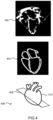
- Fig. 4 illustrates an approach for obtaining a target plane from a 2D slice.
- the target plane 408 can be used to slice the 3D volume such that the 2D slices can be compared.
- the anatomical plane can be determined using a plane regression technique.
- the input 2D image 402 is segmented to identify the borders 404 of the anatomical structure.
- the plane parameters can then be derived by a regression convolutional neural network that has been trained with, for example, artificial pairs of contours and plane parameters.
- the target plane 408 can be defined, relative to an anatomical model 410, using the plane parameters.
- the 3D volumes can then be segmented using a heart model or a deep-learning segmentation method and a corresponding slice can be generated, for example, using multi-planar reformation (MPR), with the determined plane parameters for the target plane 408.
- MPR multi-planar reformation
- the longitudinal series can now be presented for any plane found in the 2D scans.
- the user can select any 2D scan and the 3D acquisitions can thus be re-formatted to optimally review changes over time with respect to the selected scan's orientation.
- a similar technique can be used in a 2D workflow that is done with a 3D probe. Most of the scans during an exam may still be recorded in 2D. However, at certain times (e.g., during end-diastolic frames), the system could record a single frame 3D image in the background, possibly with lower resolution. These recorded 2D slices would now have a 3D reference that can be analyzed. In other words, the plane of the 2D slices would be registered to a 3D model of the anatomical structure (i.e., via the 3D reference acquisitions). This way, the 2D workflow that many physicians are used to is kept and the target plane can be obtained for later use (e.g., to obtain further 2D slices at the target plane from later 3D acquisitions). This can be useful to not sacrifice framerate when scanning (e.g., for valve or larger field-of-view scanning).
- the use of the 3D reference may provide more precise target planes as the target plane is already defined relative to a 3D reference of the anatomical structure and thus there is no need to apply plane regression to the 2D slices.
- plane regression may not always be precise.
- subsequent scans can be compared with each other, and if, for example, an acquisition plane does not align with a previous acquisition, a 2D slice can be obtained from the subsequent 3D acquisitions.
- Slicing/extracting 2D slices from 3D volumes of an anatomical structure can be used to fill gaps in longitudinal series of 2D scans.
- Fig. 5 shows a time series of scans including a first 2D scan 502, a second 3D scan 504, a third 3D scan 508, a fourth 2D scan 512 and a fifth 3D scan 514.
- the first 2D scan 502 and the fourth 2D scan 512 may be scans of an anatomical structure at a same target plane.
- the 3D scans obtained in between (and, possibly, before and/or after) the 2D scans can be sliced at the target plane corresponding to the first 2D scan 502 and/or the fourth 2D scan 512.
- Extracting 2D scans from the 3D volume may involve using multi-planar reformation (MPR) on the 3D scans at the target plane.
- the target plane can be obtained by identifying the plane of the first 2D scan 502 and/or identifying the plane of the fourth 2D scan 512.
- the second 3D scan 504 can then be sliced at the target plane to obtain MPR slice 506.
- the third 3D scan 508 can be sliced at the target plane to obtain MPR slice 510 and the fifth 3D scan 514 can be sliced at the target plane to obtain MPR slice 516.
- the first 2D scan 502 and the fourth 2D scan 512 can be compared to the MPR slices 506, 510 and 516.
- the target plane can be detected or estimated from the other 2D scans and subsequently sliced from the 3D volumes.
- the sonographer can review a comparable slice also for the exam where originally acquisition of the 2D plane has failed or was forgotten.
- the operator/user could decide to align the MPR slices to any of the 2D scans by selecting it (e.g., via click) and thus the MPR slices are matched to the selected scan. In case multiple 2D slices are selected, matching MPRs for each of them can be displayed simultaneously. This can give further insight as to whether differences in 2D scans originate from the different locations only (e.g., if the differences are also present when displaying corresponding MPRs from a single 3D scan) or from disease progression.
- Fig. 6 shows a method for obtaining a medical image at a target plane using a three-dimensional, 3D, volume containing an anatomical structure.
- the anatomical structure is identified in the 3D volume in step 602.
- a segmentation algorithm can be applied to the 3D volume.
- the segmentation algorithm may be a model-based segmentation algorithm trained on one or more models of the anatomical structure.
- the target plane is then registered to the 3D volume in step 604. This may be achieved by analyzing the geometry of the segmented anatomical structure. For example, the relative position of features in the anatomical structure can be used to register the segmented anatomical structure to a model of the anatomical structure to which the target plane is already registered to (e.g., a segmented anatomical structure obtained from a previous exam). The target plane can then be transformed to the segmented anatomical structure. A medical image can then be extracted from the 3D volume at the registered target plane in step 606.
- the concepts escribed herein are particularly advantageous for obtaining standard views from 3D volumes.
- standard views are of particular importance.
- the target planes described herein may correspond to said standard views.
- each step of a flow chart may represent a different action performed by a processor, and may be performed by a respective module of the processor.
- the system makes use of processor to perform the data processing.
- the processor can be implemented in numerous ways, with software and/or hardware, to perform the various functions required.
- the processor typically employs one or more microprocessors that may be programmed using software (e.g., microcode) to perform the required functions.
- the processor may be implemented as a combination of dedicated hardware to perform some functions and one or more programmed microprocessors and associated circuitry to perform other functions.
- circuitry examples include, but are not limited to, conventional microprocessors, application specific integrated circuits (ASICs), and field-programmable gate arrays (FPGAs).
- ASICs application specific integrated circuits
- FPGAs field-programmable gate arrays
- the processor may be associated with one or more storage media such as volatile and non-volatile computer memory such as RAM, PROM, EPROM, and EEPROM.
- the storage media may be encoded with one or more programs that, when executed on one or more processors and/or controllers, perform the required functions.
- Various storage media may be fixed within a processor or controller or may be transportable, such that the one or more programs stored thereon can be loaded into a processor.
- a single processor or other unit may fulfill the functions of several items recited in the claims.
- a computer program may be stored/distributed on a suitable medium, such as an optical storage medium or a solid-state medium supplied together with or as part of other hardware, but may also be distributed in other forms, such as via the Internet or other wired or wireless telecommunication systems.
- a suitable medium such as an optical storage medium or a solid-state medium supplied together with or as part of other hardware, but may also be distributed in other forms, such as via the Internet or other wired or wireless telecommunication systems.
Landscapes
- Engineering & Computer Science (AREA)
- Computer Vision & Pattern Recognition (AREA)
- Physics & Mathematics (AREA)
- General Physics & Mathematics (AREA)
- Theoretical Computer Science (AREA)
- Ultra Sonic Daignosis Equipment (AREA)
- Image Analysis (AREA)
Priority Applications (5)
| Application Number | Priority Date | Filing Date | Title |
|---|---|---|---|
| EP23153399.3A EP4407558A1 (de) | 2023-01-26 | 2023-01-26 | Gewinnung eines medizinischen bildes auf einer zielebene |
| CN202480009303.1A CN120604264A (zh) | 2023-01-26 | 2024-01-21 | 获得在目标平面处的医学图像 |
| PCT/EP2024/051326 WO2024156627A1 (en) | 2023-01-26 | 2024-01-21 | Obtaining a medical image at a target plane |
| EP24700830.3A EP4655754A1 (de) | 2023-01-26 | 2024-01-21 | Gewinnung eines medizinischen bildes auf einer zielebene |
| JP2025534927A JP2026503395A (ja) | 2023-01-26 | 2024-01-21 | ターゲット平面での医用画像の取得 |
Applications Claiming Priority (1)
| Application Number | Priority Date | Filing Date | Title |
|---|---|---|---|
| EP23153399.3A EP4407558A1 (de) | 2023-01-26 | 2023-01-26 | Gewinnung eines medizinischen bildes auf einer zielebene |
Publications (1)
| Publication Number | Publication Date |
|---|---|
| EP4407558A1 true EP4407558A1 (de) | 2024-07-31 |
Family
ID=85122423
Family Applications (2)
| Application Number | Title | Priority Date | Filing Date |
|---|---|---|---|
| EP23153399.3A Withdrawn EP4407558A1 (de) | 2023-01-26 | 2023-01-26 | Gewinnung eines medizinischen bildes auf einer zielebene |
| EP24700830.3A Pending EP4655754A1 (de) | 2023-01-26 | 2024-01-21 | Gewinnung eines medizinischen bildes auf einer zielebene |
Family Applications After (1)
| Application Number | Title | Priority Date | Filing Date |
|---|---|---|---|
| EP24700830.3A Pending EP4655754A1 (de) | 2023-01-26 | 2024-01-21 | Gewinnung eines medizinischen bildes auf einer zielebene |
Country Status (4)
| Country | Link |
|---|---|
| EP (2) | EP4407558A1 (de) |
| JP (1) | JP2026503395A (de) |
| CN (1) | CN120604264A (de) |
| WO (1) | WO2024156627A1 (de) |
Citations (3)
| Publication number | Priority date | Publication date | Assignee | Title |
|---|---|---|---|---|
| US20170007208A1 (en) * | 2014-01-27 | 2017-01-12 | Koninklijke Philips N.V. | An ultrasound imaging system and an ultrasound imaging method |
| US20200134825A1 (en) * | 2018-10-29 | 2020-04-30 | Hitachi, Ltd. | Medical imaging apparatus, image processing apparatus, and image processing method |
| US20210338203A1 (en) * | 2018-10-15 | 2021-11-04 | Koninklijke Philips N.V. | Systems and methods for guiding the acquisition of an ultraound image |
Family Cites Families (1)
| Publication number | Priority date | Publication date | Assignee | Title |
|---|---|---|---|---|
| JP6560465B1 (ja) | 2016-09-30 | 2019-08-21 | ガーダント ヘルス, インコーポレイテッド | 無細胞核酸の多重解像度分析のための方法 |
-
2023
- 2023-01-26 EP EP23153399.3A patent/EP4407558A1/de not_active Withdrawn
-
2024
- 2024-01-21 JP JP2025534927A patent/JP2026503395A/ja active Pending
- 2024-01-21 CN CN202480009303.1A patent/CN120604264A/zh active Pending
- 2024-01-21 EP EP24700830.3A patent/EP4655754A1/de active Pending
- 2024-01-21 WO PCT/EP2024/051326 patent/WO2024156627A1/en not_active Ceased
Patent Citations (3)
| Publication number | Priority date | Publication date | Assignee | Title |
|---|---|---|---|---|
| US20170007208A1 (en) * | 2014-01-27 | 2017-01-12 | Koninklijke Philips N.V. | An ultrasound imaging system and an ultrasound imaging method |
| US20210338203A1 (en) * | 2018-10-15 | 2021-11-04 | Koninklijke Philips N.V. | Systems and methods for guiding the acquisition of an ultraound image |
| US20200134825A1 (en) * | 2018-10-29 | 2020-04-30 | Hitachi, Ltd. | Medical imaging apparatus, image processing apparatus, and image processing method |
Also Published As
| Publication number | Publication date |
|---|---|
| WO2024156627A1 (en) | 2024-08-02 |
| JP2026503395A (ja) | 2026-01-29 |
| EP4655754A1 (de) | 2025-12-03 |
| CN120604264A (zh) | 2025-09-05 |
Similar Documents
| Publication | Publication Date | Title |
|---|---|---|
| CN111971752B (zh) | 医学图像数据的显示 | |
| US8265363B2 (en) | Method and apparatus for automatically identifying image views in a 3D dataset | |
| US7916919B2 (en) | System and method for segmenting chambers of a heart in a three dimensional image | |
| US8369593B2 (en) | Systems and methods for robust learning based annotation of medical radiographs | |
| JP6537981B2 (ja) | 複数の三次元ビューからの大きな対象のセグメンテーション | |
| US8437521B2 (en) | Systems and methods for automatic vertebra edge detection, segmentation and identification in 3D imaging | |
| US7555151B2 (en) | System and method for tracking anatomical structures in three dimensional images | |
| JP6267707B2 (ja) | 3dの通常の超音波画像およびコントラスト向上超音波画像における統合セグメンテーション | |
| US8948484B2 (en) | Method and system for automatic view planning for cardiac magnetic resonance imaging acquisition | |
| CN113362272A (zh) | 具有不确定性估计的医学图像分割 | |
| US9142030B2 (en) | Systems, methods and computer readable storage media storing instructions for automatically segmenting images of a region of interest | |
| US8781552B2 (en) | Localization of aorta and left atrium from magnetic resonance imaging | |
| RU2526752C1 (ru) | Система и способ для автоматического планирования двухмерных видов в объемных медицинских изображениях | |
| US20170360396A1 (en) | Ultrasound imaging apparatus and method for segmenting anatomical objects | |
| EP1652122B1 (de) | Automatische registration von medizinischen intra-modalitäts-volumenbildern durch verwendung einer affinen transformation | |
| JP4964191B2 (ja) | 画像処理装置および方法ならびにプログラム | |
| Badakhshannoory et al. | A model-based validation scheme for organ segmentation in CT scan volumes | |
| Shanmuganathan et al. | Two-step rigid and non-rigid image registration for the alignment of three-dimensional echocardiography sequences from multiple views | |
| EP2498222A2 (de) | Verfahren und System für die 4D-Mitralklappensegmentierung auf Regressionsbasis von 2D+T-Magnetresonanz-Bildgebungsschichten | |
| EP4407558A1 (de) | Gewinnung eines medizinischen bildes auf einer zielebene | |
| JP2007521862A (ja) | 心臓機能の確率的解析 | |
| CN111587449B (zh) | 图像数据处理方法、设备和系统 | |
| Liu et al. | Learning-based scan plane identification from fetal head ultrasound images | |
| Lu et al. | Automatic delineation of left and right ventricles in cardiac MRI sequences using a joint ventricular model | |
| US20060074312A1 (en) | Medical diagnostic ultrasound signal extraction |
Legal Events
| Date | Code | Title | Description |
|---|---|---|---|
| PUAI | Public reference made under article 153(3) epc to a published international application that has entered the european phase |
Free format text: ORIGINAL CODE: 0009012 |
|
| STAA | Information on the status of an ep patent application or granted ep patent |
Free format text: STATUS: THE APPLICATION HAS BEEN PUBLISHED |
|
| AK | Designated contracting states |
Kind code of ref document: A1 Designated state(s): AL AT BE BG CH CY CZ DE DK EE ES FI FR GB GR HR HU IE IS IT LI LT LU LV MC ME MK MT NL NO PL PT RO RS SE SI SK SM TR |
|
| STAA | Information on the status of an ep patent application or granted ep patent |
Free format text: STATUS: THE APPLICATION IS DEEMED TO BE WITHDRAWN |
|
| 18D | Application deemed to be withdrawn |
Effective date: 20250201 |