EP4407573A1 - Procédé et système de vérification de l'authenticité d'un utilisateur dans un système de contrôle d'accès - Google Patents
Procédé et système de vérification de l'authenticité d'un utilisateur dans un système de contrôle d'accès Download PDFInfo
- Publication number
- EP4407573A1 EP4407573A1 EP24153386.8A EP24153386A EP4407573A1 EP 4407573 A1 EP4407573 A1 EP 4407573A1 EP 24153386 A EP24153386 A EP 24153386A EP 4407573 A1 EP4407573 A1 EP 4407573A1
- Authority
- EP
- European Patent Office
- Prior art keywords
- user
- access
- reader
- access reader
- authenticity
- Prior art date
- Legal status (The legal status is an assumption and is not a legal conclusion. Google has not performed a legal analysis and makes no representation as to the accuracy of the status listed.)
- Pending
Links
Images




Classifications
-
- G—PHYSICS
- G07—CHECKING-DEVICES
- G07C—TIME OR ATTENDANCE REGISTERS; REGISTERING OR INDICATING THE WORKING OF MACHINES; GENERATING RANDOM NUMBERS; VOTING OR LOTTERY APPARATUS; ARRANGEMENTS, SYSTEMS OR APPARATUS FOR CHECKING NOT PROVIDED FOR ELSEWHERE
- G07C9/00—Individual registration on entry or exit
- G07C9/00174—Electronically operated locks; Circuits therefor; Nonmechanical keys therefor, e.g. passive or active electrical keys or other data carriers without mechanical keys
- G07C9/00182—Electronically operated locks; Circuits therefor; Nonmechanical keys therefor, e.g. passive or active electrical keys or other data carriers without mechanical keys operated with unidirectional data transmission between data carrier and locks
-
- G—PHYSICS
- G06—COMPUTING OR CALCULATING; COUNTING
- G06F—ELECTRIC DIGITAL DATA PROCESSING
- G06F21/00—Security arrangements for protecting computers, components thereof, programs or data against unauthorised activity
- G06F21/30—Authentication, i.e. establishing the identity or authorisation of security principals
- G06F21/31—User authentication
- G06F21/32—User authentication using biometric data, e.g. fingerprints, iris scans or voiceprints
-
- G—PHYSICS
- G06—COMPUTING OR CALCULATING; COUNTING
- G06F—ELECTRIC DIGITAL DATA PROCESSING
- G06F21/00—Security arrangements for protecting computers, components thereof, programs or data against unauthorised activity
- G06F21/30—Authentication, i.e. establishing the identity or authorisation of security principals
- G06F21/45—Structures or tools for the administration of authentication
-
- G—PHYSICS
- G06—COMPUTING OR CALCULATING; COUNTING
- G06N—COMPUTING ARRANGEMENTS BASED ON SPECIFIC COMPUTATIONAL MODELS
- G06N20/00—Machine learning
-
- G—PHYSICS
- G07—CHECKING-DEVICES
- G07C—TIME OR ATTENDANCE REGISTERS; REGISTERING OR INDICATING THE WORKING OF MACHINES; GENERATING RANDOM NUMBERS; VOTING OR LOTTERY APPARATUS; ARRANGEMENTS, SYSTEMS OR APPARATUS FOR CHECKING NOT PROVIDED FOR ELSEWHERE
- G07C9/00—Individual registration on entry or exit
- G07C9/00174—Electronically operated locks; Circuits therefor; Nonmechanical keys therefor, e.g. passive or active electrical keys or other data carriers without mechanical keys
- G07C9/00563—Electronically operated locks; Circuits therefor; Nonmechanical keys therefor, e.g. passive or active electrical keys or other data carriers without mechanical keys using personal physical data of the operator, e.g. finger prints, retinal images, voicepatterns
-
- G—PHYSICS
- G07—CHECKING-DEVICES
- G07C—TIME OR ATTENDANCE REGISTERS; REGISTERING OR INDICATING THE WORKING OF MACHINES; GENERATING RANDOM NUMBERS; VOTING OR LOTTERY APPARATUS; ARRANGEMENTS, SYSTEMS OR APPARATUS FOR CHECKING NOT PROVIDED FOR ELSEWHERE
- G07C9/00—Individual registration on entry or exit
- G07C9/20—Individual registration on entry or exit involving the use of a pass
- G07C9/22—Individual registration on entry or exit involving the use of a pass in combination with an identity check of the pass holder
- G07C9/25—Individual registration on entry or exit involving the use of a pass in combination with an identity check of the pass holder using biometric data, e.g. fingerprints, iris scans or voice recognition
- G07C9/26—Individual registration on entry or exit involving the use of a pass in combination with an identity check of the pass holder using biometric data, e.g. fingerprints, iris scans or voice recognition using a biometric sensor integrated in the pass
-
- H—ELECTRICITY
- H04—ELECTRIC COMMUNICATION TECHNIQUE
- H04B—TRANSMISSION
- H04B1/00—Details of transmission systems, not covered by a single one of groups H04B3/00 - H04B13/00; Details of transmission systems not characterised by the medium used for transmission
- H04B1/69—Spread spectrum techniques
- H04B1/7163—Spread spectrum techniques using impulse radio
-
- H—ELECTRICITY
- H04—ELECTRIC COMMUNICATION TECHNIQUE
- H04L—TRANSMISSION OF DIGITAL INFORMATION, e.g. TELEGRAPHIC COMMUNICATION
- H04L9/00—Cryptographic mechanisms or cryptographic arrangements for secret or secure communications; Network security protocols
- H04L9/32—Cryptographic mechanisms or cryptographic arrangements for secret or secure communications; Network security protocols including means for verifying the identity or authority of a user of the system or for message authentication, e.g. authorization, entity authentication, data integrity or data verification, non-repudiation, key authentication or verification of credentials
- H04L9/3226—Cryptographic mechanisms or cryptographic arrangements for secret or secure communications; Network security protocols including means for verifying the identity or authority of a user of the system or for message authentication, e.g. authorization, entity authentication, data integrity or data verification, non-repudiation, key authentication or verification of credentials using a predetermined code, e.g. password, passphrase or PIN
- H04L9/3231—Biological data, e.g. fingerprint, voice or retina
-
- H—ELECTRICITY
- H04—ELECTRIC COMMUNICATION TECHNIQUE
- H04W—WIRELESS COMMUNICATION NETWORKS
- H04W4/00—Services specially adapted for wireless communication networks; Facilities therefor
- H04W4/80—Services using short range communication, e.g. near-field communication [NFC], radio-frequency identification [RFID] or low energy communication
-
- G—PHYSICS
- G07—CHECKING-DEVICES
- G07C—TIME OR ATTENDANCE REGISTERS; REGISTERING OR INDICATING THE WORKING OF MACHINES; GENERATING RANDOM NUMBERS; VOTING OR LOTTERY APPARATUS; ARRANGEMENTS, SYSTEMS OR APPARATUS FOR CHECKING NOT PROVIDED FOR ELSEWHERE
- G07C9/00—Individual registration on entry or exit
- G07C9/00174—Electronically operated locks; Circuits therefor; Nonmechanical keys therefor, e.g. passive or active electrical keys or other data carriers without mechanical keys
- G07C9/00182—Electronically operated locks; Circuits therefor; Nonmechanical keys therefor, e.g. passive or active electrical keys or other data carriers without mechanical keys operated with unidirectional data transmission between data carrier and locks
- G07C2009/00198—Electronically operated locks; Circuits therefor; Nonmechanical keys therefor, e.g. passive or active electrical keys or other data carriers without mechanical keys operated with unidirectional data transmission between data carrier and locks the keyless data carrier having more than one limited data transmission ranges
-
- G—PHYSICS
- G07—CHECKING-DEVICES
- G07C—TIME OR ATTENDANCE REGISTERS; REGISTERING OR INDICATING THE WORKING OF MACHINES; GENERATING RANDOM NUMBERS; VOTING OR LOTTERY APPARATUS; ARRANGEMENTS, SYSTEMS OR APPARATUS FOR CHECKING NOT PROVIDED FOR ELSEWHERE
- G07C2209/00—Indexing scheme relating to groups G07C9/00 - G07C9/38
- G07C2209/60—Indexing scheme relating to groups G07C9/00174 - G07C9/00944
- G07C2209/63—Comprising locating means for detecting the position of the data carrier, i.e. within the vehicle or within a certain distance from the vehicle
Definitions
- the disclosure generally relates to a method and a system for verifying user authenticity in an access control system.
- Each access control system may have its own distinct set of features, advantages, and disadvantages.
- organizations may use one or more of card readers and key cards as their primary form of access control, keypad readers in conjunction with physical key cards (card readers) to increase security, or biometric readers.
- card readers may have multiple shortcomings.
- a method at an access reader for verifying authenticity of a user includes detecting, by the access reader, that the user is in proximity to the access reader based on one of a command received from the user or an electronic communication device, associated with the user, present within a predefined threshold distance from the access reader. Furthermore, the method includes transmitting a signal to the electronic communication device in response to detecting that the user is in proximity to the access reader, wherein the signal is indicative of verifying the authenticity of the user. Furthermore, the method includes receiving, from the electronic communication device, biometric information associated with the user for verifying the authenticity of the user after transmitting the signal to the electronic communication device. Furthermore, the method includes verifying, by the access reader, the authenticity of the user based on the verification of the biometric information with user data stored in a database in communication with the access reader.
- the method may include triggering a command to provide access to the user based on the verification of the authenticity of the user.
- the method may include recording, by the access reader at the database, an access log associated with the verification of the authenticity of the user.
- the method may include establishing a secure wireless communication link with the access reader, wherein the wireless communication link may be one of a Bluetooth communication link, Ultra-wideband communication link, or another near-field communication link.
- Receiving the biometric information may comprise receiving a voice signature from the user.
- a method at the electronic communication device for verifying the authenticity of the user.
- the method includes generating a prompt message for the user to confirm whether to access the access reader within a vicinity of the electronic communication device. Furthermore, the method includes receiving an input associated with biometric information of the user to access the access reader in response to the generation of the prompt message. Furthermore, the method includes transmitting, to the access reader, the input associated with the biometric information of the user, wherein the biometric information is verified by the access reader to provide access to the access reader.
- the method may include receiving a signal from the access reader based on the reception of one of a command received from the user or the electronic communication device, associated with the user, present within a predefined threshold distance from the access reader, wherein the signal may be indicative of verifying the authenticity of the user.
- Receiving the input from the user to access the access reader may comprise receiving an identity of the access reader, from among the plurality of access readers.
- the method may include establishing the secure wireless communication link with the access reader, wherein the wireless communication link is one of the Bluetooth or Ultra-wideband communication link(s).
- a system at an access reader for verifying the authenticity of the user includes an access control engine coupled with a processor and a memory.
- the access control engine is configured to detect that the user is in proximity to the access reader based on one of the command received from the user or the electronic communication device, associated with the user, present within the predefined threshold distance from the access reader. Furthermore, the access control engine is configured to transmit the signal to the electronic communication device in response to detecting that the user is in proximity to the access reader, wherein the signal is indicative of verifying the authenticity of the user.
- the access control engine is configured to receive, from the electronic communication device, biometric information associated with the user for verifying the authenticity of the user after transmitting the signal to the electronic communication device. Furthermore, the access control engine is configured to verify the authenticity of the user based on the verification of the biometric information with user data stored in a database in communication with the access reader.
- the access control engine may be configured to trigger a command to provide access to the user based on the verification of the authenticity of the user.
- the access control engine may be configured to record, by the access reader at the database, an access log associated with the verification of the authenticity of the user.
- the access control engine may be configured to establish a secure wireless communication link with the access reader, wherein the wireless communication link may be one of a Bluetooth communication link, Ultra-wideband communication link, or another near-field communication link.
- the access control engine may be configured to receive the biometric information, the access control engine is further configured to receive a voice signature from the user.
- a system at the electronic communication device for verifying the authenticity of a user.
- the system includes an access control engine coupled with a processor and a memory.
- the access control engine is configured to generate the prompt message for the user to confirm whether to access the access reader within the vicinity of the electronic communication device.
- the access control engine is configured to receive the input associated with biometric information of the user to access the access reader in response to the generation of the prompt message.
- the access control engine is configured to transmit, to the access reader, the input associated with the biometric information of the user, wherein the biometric information is verified by the access reader to provide access to the access reader.
- the access control engine may be configured to, prior to generation of the prompt message, receive a signal from the access reader based on the reception of one of a command received from the user or the electronic communication device, associated with the user, present within a predefined threshold distance from the access reader, wherein the signal may be indicative of verifying the authenticity of the user.
- the access control engine may be configured to receive the input from the user to access the access reader, the access control engine is configured to receive an identity of the access reader, from among the plurality of access readers.
- the access control engine may be configured to establish a secure wireless communication link with the access reader, wherein the wireless communication link is one of a Bluetooth or Ultra-wideband communication link(s).
- circuits may, for example, be embodied in one or more semiconductor chips, or on substrate supports such as printed circuit boards and the like.
- circuits constituting a block may be implemented by dedicated hardware, or by a processor (e.g., one or more programmed microprocessors and associated circuitry), or by a combination of dedicated hardware to perform some functions of the block and a processor to perform other functions of the block.
- a processor e.g., one or more programmed microprocessors and associated circuitry
- Each block of the embodiments may be physically separated into two or more interacting and discrete blocks without departing from the scope of the invention, as defined by the claims.
- the blocks of the embodiments may be physically combined into more complex blocks without departing from the scope of the disclosure.
- access control system refers to physical or technological security measures that govern entrances and exits from spaces within and around a building.
- the access control system includes everything from a physical lock on a door to a key card/ electronic device that opens specific storage areas.
- access control readers when installing the access control system (e.g., card readers, keypad readers, two-factor or multifactor authentication readers, biometric readers, etc.).
- Each access control system has its own distinct set of features, advantages, and disadvantages.
- card readers For example, in one scenario, many organizations use card readers as their primary form of access control. To gain access, card readers use key cards rather than physical keys or codes. There are two types of access control key card readers, viz., proximity and magnetic. Both of these key card options enable organizations to view a history of which cards are used at which entry points, making it simple to narrow down users in the event of a security incident. The disadvantage of using key card readers is that users can easily lose or lend their cards, making an organization's security less effective. In another scenario, keypad readers can be used in conjunction with physical key cards (card readers) to increase security. These are referred to as two-factor or multifactor authentication readers.
- biometric readers such as fingerprints would be used for access control rather than key cards or PIN numbers.
- Biometric access control especially when combined with another type of access control reader, is by far the most effective form of security for organizations seeking the ultimate in access control. Although biometric readers are effective, they are also more expensive than others.
- Another disadvantage of using fingerprints to prove identity and gain access is the resulting high-touch surface, which may pose a sanitation issue and become an uninvited source of virus and bacteria transmission.
- the user may be unable to tap the card readers/electronic device and/or provide the fingerprint and/or use face recognition mechanism to the access control system to gain access to entrances and exits from the spaces within and around the building for a variety of reasons, including having bags in both hands, lab devices in both hands, speaking to another person, and so on.
- the present disclosure addresses the above-mentioned disadvantages or other shortcomings or at least provide a useful alternative for verifying user authenticity in the access control system.
- FIGS. 1 to 7B where similar reference characters denote corresponding features consistently throughout the figures, there are shown preferred embodiments.
- FIG. 1 illustrates a block diagram of an access reader 100 for verifying user authenticity in an access control system.
- the access reader 100 include, but not limited to card readers, keypad readers, two-factor or multifactor authentication readers, biometric readers, etc.
- the access reader 100 may include a system 101.
- the system 101 may include a memory 110, a processor 120, a communicator 130, and an access control engine 140.
- the memory 110 may store instructions to be executed by the processor 120 for verifying authenticity of a user, as discussed throughout the disclosure.
- the memory 110 may include non-volatile storage elements. Examples of such non-volatile storage elements may include magnetic hard discs, optical discs, floppy discs, flash memories, or forms of electrically programmable memories (EPROM) or electrically erasable and programmable (EEPROM) memories.
- EPROM electrically programmable memories
- EEPROM electrically erasable and programmable
- the memory 110 may, in some examples, be considered a non-transitory storage medium.
- the term “non-transitory” may indicate that the storage medium is not embodied in a carrier wave or a propagated signal. However, the term “non-transitory” should not be interpreted that the memory 110 is non-movable.
- the memory 110 can be configured to store larger amounts of information than the memory.
- a non-transitory storage medium may store data that can, over time, change (e.g., in Random Access Memory (RAM) or cache).
- RAM Random Access Memory
- the memory 110 can be an internal storage unit, or it can be an external storage unit of the access reader 100, a cloud storage, or any other type of external storage.
- the processor 120 may communicate with the memory 110, the communicator 130, and the access control engine 140.
- the processor 120 may be configured to execute instructions stored in the memory 110 and to perform various processes for verifying authenticity of the user, as discussed throughout the disclosure.
- the processor 120 may include one or a plurality of processors, which may be a general-purpose processor, such as, a central processing unit (CPU), an application processor (AP), or the like, a graphics-only processing unit such as a graphics processing unit (GPU), a visual processing unit (VPU), and/or an Artificial intelligence (AI) dedicated processor such as a neural processing unit (NPU).
- a general-purpose processor such as, a central processing unit (CPU), an application processor (AP), or the like
- a graphics-only processing unit such as a graphics processing unit (GPU), a visual processing unit (VPU), and/or an Artificial intelligence (AI) dedicated processor such as a neural processing unit (NPU).
- GPU central processing unit
- AP application processor
- AI Artificial intelligence
- the communicator 130 may be configured to communicate internally between internal hardware components and with external devices (e.g., server, electronic communication device, etc.) via one or more networks (e.g., radio technology, bluetooth, bluetooth low energy (BLE), wireless fidelity (Wi-Fi), etc.), as described in conjunction with FIG. 5 , FIG. 6 , FIG. 7A , and FIG. 7B .
- the communicator 130 may include an electronic circuit specific to a standard that enables wired or wireless communication.
- the communicator 130 may transmit a signal to an electronic communication device when the user is in proximity to the access reader 100, where the signal is indicative of verifying the authenticity of the user.
- the communicator 130 may receive biometric information associated with the user for verifying the authenticity of the user after transmitting the signal to the electronic communication device.
- the access control engine 140 may be implemented by processing circuitry such as logic gates, integrated circuits, microprocessors, microcontrollers, memory circuits, passive electronic components, active electronic components, optical components, hardwired circuits, or the like, and may optionally be driven by firmware.
- the circuits may, for example, be embodied in one or more semiconductor chips, or on substrate supports such as printed circuit boards and the like.
- the access control engine 140 may include a sensor(s) 141, an inputoutput (I/O) controller 142, a verification engine 143, an access log controller 144, and an AI engine 145.
- the sensor(s) 141 may be configured to capture sensor data associated with the access reader 100.
- Examples of the sensor(s) 141 include, but not limited to, a camera, a microphone, a temperature sensor, an audio sensor, an accelerometer, a pressure sensor, a location sensor, a humidity sensor, a global positioning system (GPS) sensor, a magnetic field sensor, an electric field sensor, a light sensor, an infrared light sensor, a proximity sensor, a biometric sensor (e.g., fingerprint, iris, facial pattern, etc.), and so on, as illustrated in FIG. 7A and FIG. 7B .
- the sensor data is, for example, a signal transmitted by the sensor(s) 141 in response to physical stimulation.
- the access reader 100 may take a security-related action based on the security-related data of the sensors(s) 141.
- the security-related sensor data or action is data, or an action related to controlling or restricting access to an area protected by the access reader 100.
- An example of the area protected by the access reader 100 is the inside of an object whose access is controlled or restricted by an apparatus, such as a door, gate, lid, drawer, etc., that can be secured and locked in a closed position by the access reader 100 that is coupled to the apparatus.
- the object includes a house, a building, an automobile, a safe, a container, a cabinet, and so on.
- the security-related data for a motion sensor may indicate the motion of the door, gate, lid, drawer, or other apparatus to which the access reader 100 is connected.
- the motion of the door or other apparatus indicates that the door or other apparatus is being opened/closed to allow/restrict access to the area.
- the security-related data for a proximity sensor may indicate that the user is near a door and may attempt to break/open through the door, that the door is closed or open based on its proximity to a door frame in which the door is installed, and so on.
- the proximity sensor's security-related data includes a count of users who pass by the access reader 100 and the number of users who enter or exit the protected area.
- the sensor(s) 141 sends a message indicating the counts to the owner or administrator of the access reader 100/access log controller 144, a third party, etc.
- the security-related data for a microphone may indicate that a user is knocking on the door.
- the microphone may determine that the user is knocking on the door, the microphone then sends a signal to a wirelessly connected light sensor/light bulb, causing the light bulb to illuminate an area near the access reader 100.
- the light bulb can illuminate the area in front of the door, the area inside the house containing the door, and so on.
- the security-related data for the proximity sensor may indicate that the user is within a predetermined distance/ predefined threshold distance (e.g., 2 meters) of the access reader 100, the access reader 100 may initiate a video stream to the administrator/owner of the access reader 100 via the camera and an audio stream via the microphone to the administrator/owner of the access reader 100.
- the administrator/owner uses the video stream to see what is going on near the door, and the access reader 100 may use a two-way audio stream to communicate with the user who is nearby.
- the security-related data may indicate a potential security issue in which the access reader 100 communicates via a signal to be sent to a speaker/audio sensor, causing the speaker to emit an alarm sound.
- the access reader 100 may send a signal that causes the camera to start recording or taking images, for example, to capture an image or video of a burglar attempting to break into the area protected by the access reader 100.
- the I/O controller 142 may include an input device(s) and an output device(s).
- the input device(s) allows the user to communicate with the access reader 100, as illustrated in FIG. 5 , FIG. 7A , and FIG. 7B .
- Examples of input devices include, but not limited to, a keypad, a camera, a microphone, and so on.
- the user may enter a password, passcode, or other information using the keypad.
- the camera is used as the input device(s)
- the camera recognizes the user's face or other identifiable body parts, as well as physical gestures used for communication.
- the input device(s) is/are a microphone, the user can speak commands, passwords, passphrases, and so on, which the microphone receives and speech or voice recognition can be used to understand the words spoken, identify the user, and so on.
- the verification engine 143 may verify the authenticity of the user based on verification of the biometric information with user data stored at a database (e.g., cloud server) (not shown in FIG. 1 ) in communication with the access reader 100, as described in conjunction with FIG. 5 , FIG. 7A , and FIG. 7B .
- the biometric information may include a voice signature (e.g., voice command to open the door, "please open the door") from the user.
- the verification engine 143 may establish a secure wireless communication link, by utilizing the communicator 130, with the access reader 100, wherein the wireless communication link is one of a Bluetooth communication link, ultra-wideband communication link, or another near-field communication link.
- the access log controller 144 may record an access log associated with the verification of the authenticity of the user in the database.
- a function associated with the AI engine 145 may be performed through the non-volatile memory, the volatile memory, and the processor 120.
- One or a plurality of processors controls the processing of the input data in accordance with a predefined operating rule or AI model stored in the non-volatile memory and the volatile memory.
- the predefined operating rule or AI model is provided through training or learning.
- being provided through learning means that, by applying a learning algorithm to a plurality of learning data, a predefined operating rule or AI model of the desired characteristic is made.
- the learning may be performed in a device itself in which AI according to an embodiment is performed, and/or may be implemented through a separate server/system.
- the learning algorithm is a method for training a predetermined target device (for example, a robot) using a plurality of learning data to cause, allow, or control the target device (e.g., access reader 100) to decide or predict the authenticity of the user.
- Examples of learning algorithms include, but not limited to, supervised learning, unsupervised learning, semi-supervised learning, or reinforcement learning.
- the AI engine 145 may consist of a plurality of neural network layers. Each layer has a plurality of weight values and performs a layer operation through a calculation of a previous layer and an operation of a plurality of weights.
- Examples of neural networks include, but not limited to, convolutional neural network (CNN), deep neural network (DNN), recurrent neural network (RNN), restricted boltzmann machine (RBM), deep belief network (DBN), bidirectional recurrent deep neural network (BRDNN), generative adversarial networks (GAN), and deep Q-networks.
- FIG. 1 shows various hardware components of the access reader 100, but it is to be understood that other embodiments are not limited thereon.
- the access reader 100 may include less or more number of components.
- the labels or names of the components are used only for illustrative purpose and does not limit the scope of the invention.
- One or more components can be combined to perform the same or substantially similar functions to verify the authenticity of the user in the access control system.
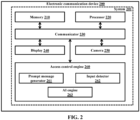
- FIG. 2 illustrates a block diagram of an electronic communication device 200 for verifying user authenticity in the access control system.
- the electronic communication device 200 include, but not limited to, a smartphone, a tablet computer, a Personal Digital Assistance (PDA), an Internet of Things (IoT) device, a wearable device, etc.
- PDA Personal Digital Assistance
- IoT Internet of Things
- the electronic communication device 200 may include a system 201.
- the system 201 may include a memory 210, a processor 220, a communicator 230, a display 240, a camera 250, and an access control engine 260.
- the memory 210 may store instructions to be executed by the processor 220 for verifying authenticity of the user, as discussed throughout the disclosure.
- the memory 210 may include non-volatile storage elements. Examples of such non-volatile storage elements may include magnetic hard discs, optical discs, floppy discs, flash memories, or forms of electrically programmable memories (EPROM) or electrically erasable and programmable (EEPROM) memories.
- EPROM electrically programmable memories
- EEPROM electrically erasable and programmable
- the memory 210 may, in some examples, be considered a non-transitory storage medium. The term "non-transitory" may indicate that the storage medium is not embodied in a carrier wave or a propagated signal.
- non-transitory should not be interpreted that the memory 210 is non-movable.
- the memory 210 can be configured to store larger amounts of information than the memory.
- a non-transitory storage medium may store data that can, over time, change (e.g., in Random Access Memory (RAM) or cache).
- RAM Random Access Memory
- the memory 210 can be an internal storage unit, or it can be an external storage unit of the electronic communication device 200, a cloud storage, or any other type of external storage.
- the processor 220 may communicate with the memory 210, the communicator 230, the display 240, the camera 250, and the access control engine 260.
- the processor 220 may be configured to execute instructions stored in the memory 210 and to perform various processes for verifying authenticity of the user, as discussed throughout the disclosure.
- the processor 220 may include one or a plurality of processors, maybe a general-purpose processor, such as a central processing unit (CPU), an application processor (AP), or the like, a graphics-only processing unit such as a graphics processing unit (GPU), a visual processing unit (VPU), and/or an Artificial intelligence (AI) dedicated processor such as a neural processing unit (NPU).
- a general-purpose processor such as a central processing unit (CPU), an application processor (AP), or the like
- a graphics-only processing unit such as a graphics processing unit (GPU), a visual processing unit (VPU), and/or an Artificial intelligence (AI) dedicated processor such as a neural processing unit (NPU).
- AI Artificial intelligence
- the communicator 230 may be configured to communicate internally between internal hardware components and with external devices (e.g., access reader 100) via one or more networks (e.g., radio technology), as illustrated in FIG. 5 , FIG. 6 , FIG. 7A , and FIG. 7B .
- the communicator 230 may include an electronic circuit specific to a standard that enables wired or wireless communication.
- the display 240 can accept user inputs and is made of a liquid crystal display (LCD), a light emitting diode (LED), an organic light emitting diode (OLED), or another type of display, as illustrated in FIG. 7A , and FIG. 7B .
- the user inputs may include, but not limited to, touch, swipe, drag, gesture, voice command, and so on.
- the camera 250 may include one or more image sensors (e.g., charged coupled device (CCD), complementary metal-oxide semiconductor (CMOS)) to capture one or more images/image frames.
- CCD charged coupled device
- CMOS complementary metal-oxide semiconductor
- the access control engine 260 may be implemented by processing circuitry such as logic gates, integrated circuits, microprocessors, microcontrollers, memory circuits, passive electronic components, active electronic components, optical components, hardwired circuits, or the like, and may optionally be driven by firmware.
- the circuits may, for example, be embodied in one or more semiconductor chips, or on substrate supports such as printed circuit boards and the like.
- the access control engine 260 may include a prompt message generator 261, an input detector 262, and an AI engine 263.
- the prompt message generator 261 may generate a prompt message (e.g., voice message, display message, etc.) for the user to confirm whether to access the access reader 100 within a vicinity of the electronic communication device 200, as illustrated in FIG. 5 .
- a prompt message e.g., voice message, display message, etc.
- the access control engine 260 may include a prompt message generator 261, an input detector 262, and an AI engine 263.
- the prompt message generator 261 may generate a prompt message (e.g., voice message, display message, etc.) for the user to confirm whether to access the access reader 100 within a vicinity of the electronic communication device 200, as illustrated in FIG. 5 .
- a signal from the access reader 100 Prior to generating the prompt message, receiving, by the communicator 230, a signal from the access reader 100 based on the reception of one of a command (e.g., open the door) received from the
- the input detector 262 may receive an input (e.g., voice signature) associated with the biometric information of the user to access the access reader 100 in response to the generation of the prompt message, as described in conjunction with FIG. 5 , and FIG. 7A . Furthermore, the input detector 262 may receive the input from the user to access the access reader 100 including receiving an identity of the access reader 100 (e.g., Door-1), from among the plurality of access readers (100n) (e.g., Door-1 to Door-n), not shown in FIG.2 . The communicator 230 then may transmit the input associated with the biometric information of the user to the access reader 100, where the biometric information is verified by the access reader 100 to provide access to the access reader 100, as illustrated in FIG. 5 , FIG. 6 , FIG. 7A , and FIG. 7B . The communicator 230 may establish the secure wireless communication link with the access reader 100, where the wireless communication link is, for example, one of the Bluetooth or ultra-wideband communication link(s).
- an input e.
- a function associated with the AI engine 263 may be performed through the non-volatile memory, the volatile memory, and the processor 220.
- One or a plurality of processors controls the processing of the input data (e.g., voice signature) in accordance with a predefined operating rule or AI model stored in the non-volatile memory and the volatile memory.
- the predefined operating rule or AI model is provided through training or learning.
- being provided through learning means that, by applying a learning algorithm to a plurality of learning data, a predefined operating rule or AI model of the desired characteristic is made.
- the learning may be performed in a device itself in which AI according to an embodiment is performed, and/or may be implemented through a separate server/system.
- the learning algorithm is a method for training a predetermined target device (for example, a robot) using a plurality of learning data to cause, allow, or control the target device to decide or predict.
- Examples of learning algorithms include, but not limited to, supervised learning, unsupervised learning, semi-supervised learning, or reinforcement learning.
- the AI engine 263 may consist of a plurality of neural network layers. Each layer has a plurality of weight values and performs a layer operation through a calculation of a previous layer and an operation of a plurality of weights.
- Examples of neural networks include, but not limited to, convolutional neural network (CNN), deep neural network (DNN), recurrent neural network (RNN), restricted boltzmann machine (RBM), deep belief network (DBN), bidirectional recurrent deep neural network (BRDNN), generative adversarial networks (GAN), and deep Q-networks.
- FIG. 2 shows various hardware components of the electronic communication device 200, but it is to be understood that other embodiments are not limited thereon.
- the electronic communication device 200 may include less or more number of components.
- the labels or names of the components are used only for illustrative purpose and does not limit the scope of the invention.
- One or more components can be combined to perform the same or substantially similar functions to verify the authenticity of the user in the access control system.
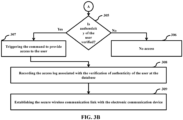
- FIGS. 3A-3B is a flow diagram illustrating a method 300 at the access reader 100 for verifying user authenticity in the access control system. Steps (301 to 309 ) may be performed by the access reader 100 to verify the authenticity of the user in the access control system.
- the method 300 may include detecting that the user is in proximity to the access reader 100 based on one of the command(s) received from the user or the electronic communication device 200, associated with the user, present within the predefined threshold distance from the access reader 100, as illustrated in FIG. 5 and FIG. 7B .
- the method 300 may include transmitting the signal to the electronic communication device 200 in response to detecting that the user is in proximity to the access reader 100, where the signal is indicative of verifying the authenticity of the user, as illustrated in FIG. 5 and FIG. 7B .
- the method 300 may include receiving from the electronic communication device 200, the biometric information associated with the user for verifying the authenticity of the user after transmitting the signal to the electronic communication device 200, as illustrated in FIG. 5 , FIG. 7A and FIG. 7B .
- the biometric information may include the voice signature from the user.
- the method 300 may include verifying the authenticity of the user based on verification of the biometric information with user data stored in the database in communication with the access reader 100, as illustrated in FIG. 5 and FIG. 7B .
- the method 300 may include determining whether the received biometric information associated with the user matches the stored biometric information, in the database, associated with the user, as illustrated in FIG. 5 and FIG. 7B .
- the method 300 may include no access in response to determining that the received biometric information associated with the user does not match the stored biometric information.
- the method 300 may include triggering the command to provide access to the user in response to determining that the received biometric information associated with the user matches the stored biometric information, as illustrated in FIG. 5 and FIG. 7B .
- the method 300 may include recording the access log associated with the verification of the authenticity of the user in the database, as illustrated in FIG. 5 and FIG. 7B .
- the method 300 may include establishing the secure wireless communication link with the electronic communication device 200, as illustrated in FIG. 5 and FIG. 7B .
- FIG. 4 is a flow diagram 400 illustrating the method at the electronic communication device 200 for verifying user authenticity in the access control system. Steps (401 to 404) may be performed by the electronic communication device 200 to verify the authenticity of the user in the access control system.
- the method 400 may include receiving the signal from the access reader 100, where the signal is indicative of verifying the authenticity of the user, as illustrated in FIG. 5 and FIG. 7B .
- the method 400 may include generating the prompt message for the user to confirm whether to access the access reader 100 within the vicinity of the electronic communication device 200, as illustrated in FIG. 5 and FIG. 7B .
- the method 400 may include receiving the signal from the access reader 100 based on reception of one of the command received from the user or the electronic communication device 200, associated with the user, present within the predefined threshold distance from the access reader 100, wherein the signal is indicative of verifying the authenticity of the user.
- the method 400 may include receiving the input associated with the biometric information of the user to access the access reader 100 in response to the generation of the prompt message, as illustrated in FIG. 5 and FIG. 7B .
- the method 400 may include receiving the input from the user to access the access reader 100 comprises receiving the identity of the access reader 100, from among the plurality of access readers (100n).
- the method 400 may include transmitting the input associated with the biometric information of the user, where the biometric information is verified by the access reader 100 to provide access to the access reader 100, as illustrated in FIG. 5 and FIG. 7B .
- the method 400 may include establishing the secure wireless communication link with the access reader 100, wherein the wireless communication link is one of the Bluetooth or Ultra-wideband communication link.
- FIG. 5 is an example sequence diagram illustrating the method for verifying user authenticity in the access control system 500.
- the access reader 100 may detect the user 200A is in proximity to the access reader based on the command/mobile command (e.g., the voice command "open the door") received from the user 200A and/or the electronic communication device 200 associated with the user 200A, when the user 200A is present within the predefined threshold distance from the access reader 100, which relates to step 301 of FIG. 3 .
- the access reader 100 may transmit the signal to the electronic communication device 200 in response to detecting that the user 200A is in proximity to the access reader 100, where the signal is indicative of verifying the authenticity of the user 200A, which relates to step 302 of FIG. 3 .
- the electronic communication device 200 may generate the prompt message (e.g., a message displayed on a screen of the electronic communication device 200 "Please enter your registered information for validation", a voice message "provide a password to open the door") for the user 200A to confirm whether or not to access the access reader 100 located near the electronic communication device 200, which relates to step 402 of FIG. 4 .
- the electronic communication device 200 receives input (e.g., voice signature) associated with the user's biometric information to access the access reader 100, which relates to step 403 of FIG. 4 .
- the electronic communication device 200 may transmit the input associated with the biometric information of the user 200A to the database (e.g., cloud database 500B) for verifying the authenticity of the user 200A, which relates to step 404 of FIG. 4 .
- the database e.g., cloud database 500B
- the cloud database 500B may determine whether the received biometric information associated with the user 200A matches the stored biometric information associated with the user 200A, which relates to step 305 of FIG. 3 .
- the cloud database 500B may trigger the command to provide access to the user 200A in response to determining that the received biometric information associated with the user 200A matches the stored biometric information (i.e., valid user), which relates to step 307 of FIG. 3 .
- the cloud database 500B may record the access log associated with the verification of authenticity of the user 200A at the cloud database 500B, which relates to step 308 of FIG. 3 .
- the secure wireless communication link establishes between the access reader 100 and the electronic communication device 200, which relates to step 309 of FIG. 3 .
- the electronic communication device 200 may send a message signal to access the access reader 100 to the user 200A.
- Example of the message signal includes, but not limited to a message displayed on the screen of the electronic communication device 200 "Please enter door identity/door number", a voice message "provide a door identity”, a voice message "would you like to open door-100A or 100B or 100N?", etc. , which relates to step 403 of FIG. 4 .
- the access reader 100 may receive the message signal from the user 200A via the electronic communication device 200.
- Example of the received message signal includes, but not limited to a message displayed on the screen of the electronic communication device 200 "Please confirm by pressing the OK button", a voice message "please open the door-100A", etc., which relates to step 403 of FIG. 4
- the access reader 100 may trigger the command to provide access to the user 200A based on the verification of the authenticity of the user 200A and the received message.
- the access reader 100 triggers the command, to building space/door 500A, to provide access to the user 200A based on the verification of the authenticity of the user 200A and the received message, which relates to step 309 of FIG. 3 .
- the access reader 100 may record the access log associated with the verification of the authenticity of the user 200A in the cloud database 500B, which relates to step 308 of FIG. 3 .
- FIG. 6 is another example sequence diagram illustrating the method for verifying user authenticity in the access control system 600.
- the access reader 100 may detect the user 200A is in proximity to the access reader 100 based on the command/mobile command (e.g., the voice command "open the door") received from the user 200A and/or the electronic communication device 200 associated with the user 200A when the user 200A is present within the predefined threshold distance from the access reader 100, which relates to step 301 of FIG. 3 .
- the access reader 100 speaks to the user 200A via the electronic communication device 200 (e.g., an application associated with mobile credential access control).
- the electronic communication device 200 may receive the input (e.g., biometric information, the identity of the access reader 100, etc.) from the user 200A (e.g., a voice message/signature "please open the door-100A"), which relates to step 403 of FIG. 4 .
- the electronic communication device 200 may send the received input to the access reader 100, which relates to step 404 of FIG. 4 .
- the access reader 100 then verifies the received input by utilizing the cloud database 500B and the cloud database 500B triggers the command to provide access to the user 200A when the received biometric information associated with the user 200A matches the stored biometric information (i.e., valid user), which relates to step 305 of FIG. 3 .
- the access reader 100 may trigger the command, which relates to step 307 of FIG. 3 , to building space/door 500A, to provide access to the user 200A based on the verification of the authenticity of the user 200A and the received message and the secure wireless communication link establishes between the access reader 100 and the electronic communication device 200, which relates to step 309 of FIG. 3 .
- the access reader 100 may record the access log associated with the verification of the authenticity of the user 200A in the cloud database 500B, which relates to step 308 of FIG. 3 .
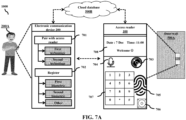
- FIGS. 7A-7B is an exemplary scenario illustrating the method for verifying user authenticity in the access control system 1000.
- the user 200A of the electronic communication device 200 may pair 701 with the access reader 100 by using various technologies of the electronic communication device 200, where the access reader 100 mounted on door/wall 500A (building space/door).
- the various technologies include, but not limited to, first technology as Bluetooth and second technology as WI-FI, etc.
- the user 200A registers 702 the biometric information with the access reader 100 and/or the cloud database 500B.
- biometric information include, but not limited to, first biometric as voice signature, second biometric as fingerprint, etc.
- the access reader 100 of the door 100A may include various sensors(s) 141 to capture sensor data, and the input device(s) and the output device(s).
- Examples of the sensors(s) 141 include, but not limited to, the camera 703, the microphone 704, the biometric sensor 705, the audio sensor 706, and the proximity sensor (not shown in FIG. 7A ).
- Examples of the input device(s) include, but not limited to, a keypad 707.
- Examples of the output device(s) include, but not limited to, a display 708.
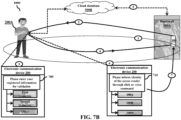
- the access reader 100 may detect the user 200A is in proximity to the access reader 100 based on the command/mobile command (e.g., the voice command "open the door") received from the user 200A and/or the electronic communication device 200 associated with the user 200A when the user 200A is present within the predefined threshold distance (1) from the access reader 100, which relates to step 501 of FIG. 5 .
- the access reader 100 may transmit the signal (2) to the electronic communication device 200 in response to detecting that the user 200A is in proximity to the access reader 100, where the signal is indicative of verifying the authenticity of the user 200A, which relates to step 502 of FIG. 5 .
- the electronic communication device 200 may generate a prompt message (3) (e.g., a message displayed 709 on a screen of the electronic communication device 200 "Please enter your registered information for validation", a voice message "provide a password to open the door") for the user 200A to confirm whether or not to access the access reader 100 located near the electronic communication device 200, which relates to step 503 of FIG. 5 .
- the electronic communication device 200 may receive input (e.g., voice signature) associated with the user's biometric information to access the access reader 100, which relates to step 503 of FIG. 5 .
- the electronic communication device 200 may transmit (4) the input associated with the biometric information of the user 200A to the database (e.g., cloud database 500B) for verifying (5) the authenticity of the user 200A, which relates to step 504 of FIG. 5 .
- the cloud database 500B determines whether the received biometric information associated with the user 200A matches the stored biometric information associated with the user 200A, which relates to step 505 of FIG. 5 .
- the cloud database 500B may trigger the command to provide access to the user 200A in response to determining that the received biometric information associated with the user 200A matches the stored biometric information (i.e., valid user), which relates to step 505 of FIG. 5 .
- the cloud database 500B may record the access log associated with the verification of authenticity of the user 200A at the cloud database 500B.
- the secure wireless communication link may establish between the access reader 100 and the electronic communication device 200.
- the electronic communication device 200 may send a message signal (6) to access the access reader 100 to the user 200A, which relates to step 506 of FIG. 5 .
- Example of the message signal includes, but not limited to a message displayed 710 on the screen of the electronic communication device 200 "Please enter door identity/door number", a voice message "provide a door identity”, a voice message "would you like to open door-100A or 100B or 100N?", etc.
- the access reader 100 may receive the message signal (7) from the user 200A via the electronic communication device 200.
- Example of the received message signal includes, but is not limited to, a message displayed on the screen of the electronic communication device 200 "Please confirm by pressing the OK button", a voice message "please open the door-100A", etc., which relates to step 507 of FIG. 5 .
- the access reader 100 may trigger the command to provide access to the user 200A based on the verification of the authenticity of the user 200A and the received message, which relates to step 508 of FIG. 5 .
- the access reader 100 then may record (5) the access log associated with the verification of the authenticity of the user 200A in the cloud database 500B, which relates to step 509 of FIG. 5 .
- the disclosed method/system uses the electronic communication device 200 (e.g., mobile phones, smartphones, tablets, wearable electronic devices, and so on) and allows the electronic communication device 200 to serve as a user's credentials to gain access to, for example, offices or other business facilities or any organization.
- the disclosed method/system shall provide a mechanism for adding an extra layer of security to any organization.
- the disclosed method/system provides secure access to, for example, offices or other business facilities with just a few clicks on the electronic communication device 200 and ensures a higher level of security.
- the disclosed method/system also detects and prevents tailgating.
- the disclosed method/system provides a low-cost solution for efficiently managing user credentials identification. Because of its simplicity and ease of use, the disclosed method/system is an undeniably promising alternative to physical cards/expensive biometric readers for verifying the user's authenticity.
- the embodiments disclosed herein can be implemented using at least one hardware device and performing network management functions to control the elements.
Landscapes
- Engineering & Computer Science (AREA)
- General Physics & Mathematics (AREA)
- Physics & Mathematics (AREA)
- Theoretical Computer Science (AREA)
- Computer Security & Cryptography (AREA)
- Human Computer Interaction (AREA)
- Computer Networks & Wireless Communication (AREA)
- Software Systems (AREA)
- Signal Processing (AREA)
- General Engineering & Computer Science (AREA)
- Computer Hardware Design (AREA)
- Biomedical Technology (AREA)
- Evolutionary Computation (AREA)
- Medical Informatics (AREA)
- Data Mining & Analysis (AREA)
- Computer Vision & Pattern Recognition (AREA)
- Computing Systems (AREA)
- Artificial Intelligence (AREA)
- General Health & Medical Sciences (AREA)
- Mathematical Physics (AREA)
- Biodiversity & Conservation Biology (AREA)
- Life Sciences & Earth Sciences (AREA)
- Health & Medical Sciences (AREA)
- Telephonic Communication Services (AREA)
Applications Claiming Priority (1)
| Application Number | Priority Date | Filing Date | Title |
|---|---|---|---|
| US202363481559P | 2023-01-25 | 2023-01-25 |
Publications (1)
| Publication Number | Publication Date |
|---|---|
| EP4407573A1 true EP4407573A1 (fr) | 2024-07-31 |
Family
ID=89707912
Family Applications (1)
| Application Number | Title | Priority Date | Filing Date |
|---|---|---|---|
| EP24153386.8A Pending EP4407573A1 (fr) | 2023-01-25 | 2024-01-23 | Procédé et système de vérification de l'authenticité d'un utilisateur dans un système de contrôle d'accès |
Country Status (3)
| Country | Link |
|---|---|
| US (1) | US20240249572A1 (fr) |
| EP (1) | EP4407573A1 (fr) |
| CN (1) | CN118395407A (fr) |
Families Citing this family (1)
| Publication number | Priority date | Publication date | Assignee | Title |
|---|---|---|---|---|
| US12548420B2 (en) * | 2024-05-14 | 2026-02-10 | The Adt Security Corporation | Optically capturable passcodes and audible passcodes for premises access |
Citations (2)
| Publication number | Priority date | Publication date | Assignee | Title |
|---|---|---|---|---|
| US20160055694A1 (en) * | 2014-08-20 | 2016-02-25 | Gate Labs Inc. | Access management and resource sharing system based on biometric identity |
| EP3509040A1 (fr) * | 2016-09-05 | 2019-07-10 | JRD Communication Inc. | Procédé et système de déverrouillage de terminal mobile fondé sur une reconnaissance d'empreinte digitale et une ccp |
Family Cites Families (3)
| Publication number | Priority date | Publication date | Assignee | Title |
|---|---|---|---|---|
| US9269221B2 (en) * | 2006-11-13 | 2016-02-23 | John J. Gobbi | Configuration of interfaces for a location detection system and application |
| US10304051B2 (en) * | 2010-04-09 | 2019-05-28 | Paypal, Inc. | NFC mobile wallet processing systems and methods |
| US11438767B2 (en) * | 2018-06-15 | 2022-09-06 | Proxy, Inc. | Methods and apparatus for preauthorizing reader devices |
-
2024
- 2024-01-23 EP EP24153386.8A patent/EP4407573A1/fr active Pending
- 2024-01-23 CN CN202410091608.3A patent/CN118395407A/zh active Pending
- 2024-01-24 US US18/420,871 patent/US20240249572A1/en active Pending
Patent Citations (2)
| Publication number | Priority date | Publication date | Assignee | Title |
|---|---|---|---|---|
| US20160055694A1 (en) * | 2014-08-20 | 2016-02-25 | Gate Labs Inc. | Access management and resource sharing system based on biometric identity |
| EP3509040A1 (fr) * | 2016-09-05 | 2019-07-10 | JRD Communication Inc. | Procédé et système de déverrouillage de terminal mobile fondé sur une reconnaissance d'empreinte digitale et une ccp |
Also Published As
| Publication number | Publication date |
|---|---|
| US20240249572A1 (en) | 2024-07-25 |
| CN118395407A (zh) | 2024-07-26 |
Similar Documents
| Publication | Publication Date | Title |
|---|---|---|
| US12248549B2 (en) | Biometric authentication | |
| EP3494553B1 (fr) | Procédé et système pour système de commande d'accès physique automatisé utilisant une reconnaissance biométrique couplée à une authentification d'étiquette | |
| US11102648B2 (en) | System, method, and apparatus for enhanced personal identification | |
| US12537008B2 (en) | Audio-based access control | |
| US9875592B1 (en) | Drone used for authentication and authorization for restricted access via an electronic lock | |
| EP3149984B1 (fr) | Autorisation dynamique | |
| US20190236249A1 (en) | Systems and methods for authenticating device users through behavioral analysis | |
| CN107018124A (zh) | 用于控制访问的远程应用 | |
| CN116264830A (zh) | 用于连续用户认证的系统和方法 | |
| US20240296847A1 (en) | Systems and methods for contactless authentication using voice recognition | |
| US10037419B2 (en) | System, method, and apparatus for personal identification | |
| US12315319B2 (en) | Tailgating detection using multimodal entry data | |
| US20230138176A1 (en) | User authentication using a mobile device | |
| US20190045042A1 (en) | Natural language user interface | |
| US20240249572A1 (en) | Method and system for verifying user authenticity in an access control system | |
| WO2022208598A1 (fr) | Système et procédé d'authentification | |
| US20190158496A1 (en) | System, Method, and Apparatus for Personal Identification | |
| KR20260003551A (ko) | Uhf 대역을 이용한 부정출입자 실시간 모니터링 방법 및 장치 | |
| Anamika et al. | Internet of Things-Based Smart Security Provisioning Using Voice-Controlled Door Locking System | |
| Karim et al. | VoicePass Multi-factor User Authentication Method for E-Wallet | |
| CN117523713A (zh) | 一种基于姿态识别的智能锁人机交互方法及系统 |
Legal Events
| Date | Code | Title | Description |
|---|---|---|---|
| PUAI | Public reference made under article 153(3) epc to a published international application that has entered the european phase |
Free format text: ORIGINAL CODE: 0009012 |
|
| STAA | Information on the status of an ep patent application or granted ep patent |
Free format text: STATUS: THE APPLICATION HAS BEEN PUBLISHED |
|
| AK | Designated contracting states |
Kind code of ref document: A1 Designated state(s): AL AT BE BG CH CY CZ DE DK EE ES FI FR GB GR HR HU IE IS IT LI LT LU LV MC ME MK MT NL NO PL PT RO RS SE SI SK SM TR |
|
| STAA | Information on the status of an ep patent application or granted ep patent |
Free format text: STATUS: REQUEST FOR EXAMINATION WAS MADE |
|
| 17P | Request for examination filed |
Effective date: 20250130 |