EP4407579A2 - Verfahren, vorrichtungen und systeme zur konfiguration einer vorrichtung zur erkennung von flammenzonen - Google Patents
Verfahren, vorrichtungen und systeme zur konfiguration einer vorrichtung zur erkennung von flammenzonen Download PDFInfo
- Publication number
- EP4407579A2 EP4407579A2 EP23209893.9A EP23209893A EP4407579A2 EP 4407579 A2 EP4407579 A2 EP 4407579A2 EP 23209893 A EP23209893 A EP 23209893A EP 4407579 A2 EP4407579 A2 EP 4407579A2
- Authority
- EP
- European Patent Office
- Prior art keywords
- optical signal
- incoming optical
- flame zone
- flame
- mirror
- Prior art date
- Legal status (The legal status is an assumption and is not a legal conclusion. Google has not performed a legal analysis and makes no representation as to the accuracy of the status listed.)
- Pending
Links
Images





Classifications
-
- G—PHYSICS
- G08—SIGNALLING
- G08B—SIGNALLING SYSTEMS, e.g. PERSONAL CALLING SYSTEMS; ORDER TELEGRAPHS; ALARM SYSTEMS
- G08B17/00—Fire alarms; Alarms responsive to explosion
- G08B17/12—Actuation by presence of radiation or particles, e.g. of infrared radiation or of ions
-
- G—PHYSICS
- G02—OPTICS
- G02B—OPTICAL ELEMENTS, SYSTEMS OR APPARATUS
- G02B26/00—Optical devices or arrangements for the control of light using movable or deformable optical elements
- G02B26/08—Optical devices or arrangements for the control of light using movable or deformable optical elements for controlling the direction of light
- G02B26/0816—Optical devices or arrangements for the control of light using movable or deformable optical elements for controlling the direction of light by means of one or more reflecting elements
- G02B26/0833—Optical devices or arrangements for the control of light using movable or deformable optical elements for controlling the direction of light by means of one or more reflecting elements the reflecting element being a micromechanical device, e.g. a MEMS mirror, DMD
-
- G—PHYSICS
- G02—OPTICS
- G02B—OPTICAL ELEMENTS, SYSTEMS OR APPARATUS
- G02B26/00—Optical devices or arrangements for the control of light using movable or deformable optical elements
- G02B26/08—Optical devices or arrangements for the control of light using movable or deformable optical elements for controlling the direction of light
- G02B26/10—Scanning systems
- G02B26/12—Scanning systems using multifaceted mirrors
- G02B26/127—Adaptive control of the scanning light beam, e.g. using the feedback from one or more detectors
- G02B26/128—Focus control
-
- G—PHYSICS
- G08—SIGNALLING
- G08B—SIGNALLING SYSTEMS, e.g. PERSONAL CALLING SYSTEMS; ORDER TELEGRAPHS; ALARM SYSTEMS
- G08B17/00—Fire alarms; Alarms responsive to explosion
- G08B17/12—Actuation by presence of radiation or particles, e.g. of infrared radiation or of ions
- G08B17/125—Actuation by presence of radiation or particles, e.g. of infrared radiation or of ions by using a video camera to detect fire or smoke
Definitions
- Exemplary embodiments of the present disclosure relate generally to flame zone detecting apparatuses, and more particularly, to methods, apparatuses, and systems for detecting multiple fire and flame zones or positions.
- Flame zone detecting apparatuses may be present in environments where there is a possibility of fire.
- the flame zone detecting apparatuses may comprise flame zone detecting components (e.g., optical mirrors, optical lens, and optical sensors) configured to monitor a field of view and generate alerts or alarms based on detected environmental conditions.
- flame zone detecting components e.g., optical mirrors, optical lens, and optical sensors
- Many flame zone detecting apparatuses are plagued by technical challenges and limitations. Through applied effort, ingenuity, and innovation, many of these identified problems have been solved by developing solutions that are included in embodiments of the present disclosure, many examples of which are described in detail herein.
- Various embodiments described herein relate to methods, apparatuses, and systems for configuring an apparatus, for example a flame zone detecting apparatus.
- an apparatus may comprise a controller component; and at least one flame zone detecting component in electronic communication with the controller component.
- Each of the at least one flame zone detecting component comprises a freeform mirror, a micro-electro-mechanical system (MEMS) mirror, and a sensor, and the controller component is configured to: control a reflecting surface of the freeform mirror to reflect an incoming optical signal; control a reflecting surface of the MEMS mirror to reflect the incoming optical signal reflected by the freeform mirror; detect the incoming optical signal reflected by the MEMS mirror by the sensor; and determine a flame zone according to the incoming optical signal.
- MEMS micro-electro-mechanical system
- the freeform mirror is an on-axis or an off-axis mirror
- each of the at least one flame zone detecting component further comprises a lens located between the MEMS mirror and the sensor and configured to focus the incoming optical signal reflected by the MEMS mirror to the sensor.
- the lens is a converging lens.
- each of the at least one flame zone detecting component further comprises: a slit located between the lens and the sensor and configured to adjust an amount of light of the incoming optical signal to enter the sensor.
- each of the at least one flame zone detecting component further comprises: a beam shifting indicator located between the lens and the slit and configured to indicate a beam shifting of the incoming optical signal.
- the controller component is further configured to rotate the MEMS mirror, such that the at least one flame zone detecting component is able to scan a field of view (FOV) of the at least one flame zone detecting component.
- FOV field of view
- determining the flame zone according to the incoming optical signal includes: detecting if a flame event occurred according to the incoming optical signal; and determining the flame zone according to the incoming optical signal in an instance in which the flame event is detected.
- detecting if the flame event occurred according to the incoming optical signal includes: comparing the incoming optical signal with a flame event detection database; and determining whether the incoming optical signal indicates a presence of the flame event.
- comparing the incoming optical signal with the flame event detection database includes: generating an intensity spectrum of the incoming optical signal; and comparing the intensity spectrum of the incoming optical signal with the flame event detection database.
- the controller component is further configured to trigger a flame alarm corresponding to the flame zone.
- a method for detecting a flame zone by a controller component may comprise scanning a target zone of at least one flame zone detecting component; receiving an incoming optical signal from the target zone; comparing the incoming optical signal with a flame event database; determining whether a flame event occurs according to the comparison of the incoming optical signal with the flame event database.
- ком ⁇ онент or feature may,” “can,” “could,” “should,” “would,” “preferably,” “possibly,” “typically,” “optionally,” “for example,” “often,” or “might” (or other such language) be included or have a characteristic, that a specific component or feature is not required to be included or to have the characteristic. Such components or features may be optionally included in some embodiments, or may be excluded.
- electrostatically coupled or “in electronic communication with” in the present disclosure refer to two or more electrical elements (for example, but not limited to, an example processing circuitry, communication module, input/output module, memory, flame zone detecting component) and/or electric circuit(s) being connected through wired means (for example but not limited to, conductive wires or traces) and/or wireless means (for example but not limited to, wireless network, electromagnetic field), such that data and/or information (for example, electronic indications, signals) may be transmitted to and/or received from the electrical elements and/or electric circuit(s) that are electronically coupled.
- electrical elements for example, but not limited to, an example processing circuitry, communication module, input/output module, memory, flame zone detecting component
- electric circuit(s) being connected through wired means (for example but not limited to, conductive wires or traces) and/or wireless means (for example but not limited to, wireless network, electromagnetic field), such that data and/or information (for example, electronic indications, signals) may be transmitted to and/or received from the
- electromagnetic radiation may refer to various kinds of electromagnetic radiant energy that exhibits properties of waves and particles including visible light, radio waves, microwaves, infrared (IR), ultraviolet (UV), X-rays and gamma rays.
- Visible light may refer to electromagnetic radiation that can be detected by a human eye.
- the electromagnetic spectrum comprises a range of all known types of electromagnetic radiation, including electromagnetic radiation that cannot be detected by the human eye.
- Various portions of the electromagnetic spectrum are associated with electromagnetic radiation that has certain characteristics (e.g., certain wavelengths and frequencies). For example, visible light emits electromagnetic radiation with wavelengths ranging between 380 and 750 nanometers (nm). In contrast, IR electromagnetic radiation may comprise wavelengths ranging between 0.7 and 5 microns.
- a fire source produces electromagnetic radiation with certain characteristics.
- flames associated with a fire source may emit electromagnetic radiation with particular IR, visible light and UV characteristics/properties (e.g., wavelengths, frequencies, and/or the like). These characteristics and properties may depend on characteristics of the fire source (e.g., fuel type).
- flames generated by a hydrocarbon fuel source may emit IR radiation with a frequency between 2.7 microns and 4.5 microns and a UV signal with a frequency of 0.2 microns. While the visible light radiation produced by a fire can be perceived visually (e.g., as red and yellow flames), the IR and UV radiation cannot be detected by the human eye.
- Flame zone detecting apparatuses may be configured to monitor a field of view and generate alerts or alarms and/or activate a fire suppression system based on detected environmental conditions.
- An example flame zone detecting apparatus may include optical components to reflect or concentrate the incoming optical signal to improve the signal strength of the incoming optical signal, reduce the noise of the incoming optical signal, and increase a size of the field of view of the flame zone detecting apparatus.
- the flame zone detecting apparatuses may be configured to identify the flame zones or the flame incidents according to the incoming optical signal.
- flame zone detecting apparatuses may be required and/or installed in environments where there is a high likelihood of a fire and/or where certain types of combustible materials are utilized or stored. For example, flame zone detecting apparatuses may be required at power plants, chemical storage and production facilities, hydrocarbon facilities or the like.
- a flame zone detecting apparatus may comprise at least one flame zone detecting component for detecting radiation (e.g., flames) within a field of view of the flame zone detecting apparatus.
- An example field of view may be or define a coverage area, range and/or angle of view in a vicinity of the flame zone detecting apparatus.
- the field of view of a flame zone detecting apparatus may be manually and/or programmatically adjustable.
- the field of view may be manually adjustable by directing (e.g., pointing) the flame zone detecting component in a direction of a likely source of fire within an environment.
- the field of view may be a programmatically selected distance or range (e.g., 15 meters, 30 meters, 45 meters or 60 meters).
- the example flame zone detecting apparatus may be configured to identify radiation characteristics (e.g., a modulation rate or flicker rate) associated with a fire source.
- the flame zone detecting apparatus may store information (e.g., algorithms) such that it can process received information in order to identify radiation associated with fire sources.
- An example flame zone detecting component may be or comprise an optical component, for example, without limitation, a photodetector, an IR sensor, UV sensor, and/or the like.
- the flame zone detecting apparatus may comprise combinations of flame zone detecting components.
- flame zone detecting apparatuses may be configured in the field using wired communication protocols such as Modbus, HART, RS485 and/or the like which require a cable to provide a communication channel between the flame zone detecting apparatus and a specialized control device. Additionally, end users are often unable to operate such control devices and may require a skilled technician in order to make even minor changes to configuration settings.
- existing flame zone detecting apparatuses are not configured to wirelessly receive and transmit data/information and typically have no wireless functionalities such as Wi-Fi, Bluetooth, ZigBee or the like. Wireless functionalities are generally foregone due to technical challenges such as design limitations and difficulty meeting various safety and certification standards when such wireless functionalities are introduced. In some cases, for security reasons, regulations do no permit wireless functionality for flame zone detecting apparatuses due to safety concerns. Additionally, incorporating wireless functionalities in flame zone detecting apparatuses increases overall production costs and production complexity.
- example methods, apparatuses and systems are provided.
- an example schematic diagram depicts an example flame zone detecting component 100 in accordance with various embodiments of the present disclosure.
- the example flame zone detecting component 100 includes a freeform mirror 101, a micro-electro-mechanical system (MEMS) mirror 106, and a sensor 104.
- MEMS micro-electro-mechanical system
- the freeform mirror 101 is configured to reflect an incoming optical signal 108 on a reflecting surface of the freeform mirror 101.
- the freeform mirror 101 may be a refractive freeform mirror, a spherical lens, or an aspheric lens, configured to reflect the incoming optical signal 108.
- the freeform mirror 101 may be coated with a reflective coating suitable for a maximum reflectivity in a spectrum range of the incoming optical signal 108.
- the freeform mirror 101 may take the incoming optical signal 108 from a wide angle of field of view and concentrate the incoming optical signal 108 on the micro-electro-mechanical system (MEMS) mirror 106.
- the freeform mirror 101 may be an off-axial mirror.
- the freeform mirror 101 may be an on-axial mirror.
- the freeform mirror 101 may be obscured.
- the micro-electro-mechanical system (MEMS) mirror 106 is configured to further reflect the incoming optical signal 108 reflected by the freeform mirror 101 on a reflecting surface of the MEMS mirror 106.
- the reflecting surface of the MEMS mirror 106 may be coated with a reflective coating suitable for maximum reflectivity in the spectrum range of the incoming optical signal 108.
- the micro-electro-mechanical system (MEMS) mirror 106 may be configured to tilt or rotate, such that the incoming optical signal 108 is reflected and concentrated on the sensor 104.
- the micro-electro-mechanical system (MEMS) mirror 106 may be controlled by controlling parameters of the micro-electro-mechanical system (MEMS) mirror 106.
- the controlling parameters of the micro-electro-mechanical system (MEMS) mirror 106 may include deflection angles of the MEMS mirror 106.
- the MEMS mirror 106 may be a single plane mirror in a circular shape or a rectangular shape.
- the MEMS mirror 106 may be a mirror with a diagonal in a range from 0.01 mm to 1 mm, preferably in a range from 0.1 mm to 0.3 mm.
- the MEMS mirror 106 may be a MEMS mirror matrix.
- a MEMS mirror matrix may include a plurality of micro mirrors connected to an array chip. Each of the plurality of micro mirrors may have a diagonal in a range from 0.1 ⁇ m to 50 ⁇ m, preferably in a range from 2.5 ⁇ m to 10 ⁇ m.
- each of the plurality of micro mirrors may be controlled independently by a controller component through the array chip to tilt or rotate, such that the incoming optical signal 108 is reflected and concentrated on the sensor 104.
- the micro-electro-mechanical system (MEMS) mirror 106 may be controlled by a controller component to locate a selected zone of the field of view.
- MEMS micro-electro-mechanical system
- the sensor 104 is configured to detect the incoming optical signal 108 reflected by the MEMS mirror 106.
- the sensor 104 may be a long wavelength infrared (LWIR) camera configured to detect one or more fire by products of the one or more fire.
- LWIR long wavelength infrared
- One such byproduct of fire is carbon dioxide (CO 2 ).
- the sensor 104 may be configured to detect infrared radiation peak that may be produced by the carbon dioxide byproduct of fire at wavelengths about 2 to 6 micron, more preferably 3.5 to 5 micron, and most preferably about 4.3 micron.
- water (H 2 O) is also a byproduct of fire.
- the senor 104 may be configured to detect, in some examples, an infrared radiation emitted by the water byproduct of a fire to detect the fire.
- the infrared radiation emitted by the water byproduct of fire in some examples, has a unique pattern/signature in the wavelength range of about 7 microns to about 8 microns.
- the sensor 104 for detecting a fire event may use long wavelength infrared (LWIR) camera(s) with, in some examples, bandpass filters with passband between about 7 microns to about 14 microns.
- LWIR long wavelength infrared
- the senor 104 may be configured to detect optical movement.
- the sensor 104 may be an optical sensor to detect movement and directions of the movements.
- the senor 104 may be a non-image sensor.
- the non-image sensor does not produce any optical image of the source, such that privacy may be protected.
- the senor 104 may include a plurality of sensor units distributed in an array.
- the plurality of sensor units are photodetectors, and the photodetectors may convert an incoming optical signal 108 into an electrical signal.
- an example sensor unit of the plurality of sensor units may be configured to detect the incoming optical signal from the selected zone of the field of view.
- the MEMS mirror 106 may be configured to rotate, such that the flame zone detecting component 100 is able to scan a field of view 107 of the flame zone detecting component and determine a flame zone based on the incoming optical signal 108.
- the flame zone detecting component 100 may further include a lens 102 located between the MEMS mirror 106 and the sensor 104.
- the lens 102 may be configured to focus the incoming optical signal 108 reflected by the MEMS mirror 106 on the sensor 104.
- the lens 102 may be a converging lens, which is configured to focus the incoming optical signal 108 on the sensor 104.
- the flame zone detecting component 100 may further include at least one slit 103 located between the lens 102 and the sensor 104.
- the at least one slit 103 is configured to allow the incoming optical signal 108 to pass through and be detected by the sensor 104.
- a width of each of the at least one slit 103 may determine the amount of light of the incoming optical signal 108 to be able to enter the sensor 104.
- random reflection light may be minimized by using optical components, such as the freeform mirror 101, the MEMS mirror 106, the lens 102, and the slit 103. As such, false alarms due to the random reflection light may be avoided, in some examples.
- the flame zone detecting component 100 may further include a beam shifting indicator 105 located between the lens 102 and the at least one slit 103.
- the beam shifting indicator 105 may be configured to monitor the beam shifting of the incoming optical signal 108.
- the flame zone detecting apparatus 150 includes a flame zone detecting component 100 and a controller component 152.
- the flame zone detecting component 100 and the controller component 152 are in electronic communication with one another such that they can exchange data (e.g., receive and transmit data) with one another, defining a bi-directional communication channel 151.
- the flame zone detecting component 100 and the controller component 152 can transmit control signals including information (e.g., messages/control signals, electrical signals corresponding to the incoming optical signals) to one another.
- the controller component 152 may actuate/rotate the MEMS mirror, such that the flame zone detecting apparatus 150 can traverse the FOV.
- the flame zone detecting apparatus 150 can traverse and/or otherwise scan the FOV in incremental steps or in discrete steps.
- the FOV may be customized by the controller component 152 in real time.
- the FOV may be adjusted in real time by directing (e.g., pointing) the flame zone detecting component 100 in a direction of a likely source of a fire event.
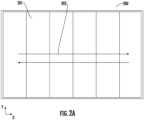
- an example FOV 200 may include a plurality of zones 201.
- each of the plurality of zones 201 are continuous aligned in a horizonal direction X.
- the MEMS mirror 106 may be configured to rotate in a one-dimension mode, such that the flame zone detecting component 100 is able to traverse and/or otherwise scan the FOV 200 along a scanning direction 202.
- the plurality of zones 201 within the FOV 200 may be traversed and/or otherwise scanned in incremental steps.
- the plurality of zones 201 within the FOV 200 may be traversed and/or otherwise scanned in discrete steps.
- the sensor 104 may be configured to convert the incoming optical signal 108 into an electrical signal and the controller component 152 may be configured to receive the electrical signal.
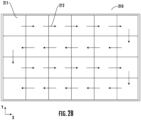
- an example FOV 210 may include a plurality of zones 211.
- the plurality of zones 211 are distributed in a two dimensional array.
- the MEMS mirror 106 may be configured to rotate in a two-dimension mode, such that the flame zone detecting component 100 is able to traverse and/or otherwise scan the FOV 210 along a scanning direction 212 and cover each of the plurality of zones 211.
- the plurality of zones 211 within the FOV 210 may be traversed and/or otherwise scanned in incremental steps.
- the plurality of zones 211 within the FOV 210 may be traversed and/or otherwise scanned in discrete steps.
- the sensor 104 may be configured to convert the incoming optical signal 108 into an electrical signal and the controller component 152 may be configured to receive the electrical signal.
- an example FOV 230 may include a plurality of sub-FOVs 231.
- each of the plurality of sub-FOVs 231 are continuous and aligned in a horizonal direction X.
- each of the plurality of sub-FOVs 231 may be traversed and/or otherwise scanned by the flame zone detecting component.
- a MEMS mirror 106 of the flame zone detecting component 100 may be configured to rotate in a one-dimension mode, such that the flame zone detecting component 100 is able to traverse and/or otherwise scan the plurality of sub-FOVs 231 along a scanning direction 233.
- the sensor 104 may include a plurality of sensor units and one of the plurality of sensor units may be configured to convert an incoming optical signal 108 into an electrical signal and the controller component 152 may be configured to receive the electrical signal.
- each of the plurality of sub-FOVs 231 may include a plurality of zones 232, and the plurality of zones 232 within each of the plurality of sub-FOVs 231 may be traversed and/or otherwise scanned in incremental steps. In some embodiments, the plurality of zones 232 within each of the plurality of sub-FOVs 231 may be traversed and/or otherwise scanned in discrete steps along the scanning direction 233. In some embodiment, an incoming optical signal 108 from each of the plurality of sub-FOVs 231 may be detected by a corresponding sensor unit and converted into an electrical signal, and the controller component 152 may be configured to receive the electrical signal.
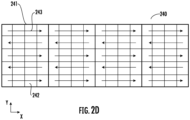
- an example FOV 240 may include a plurality of sub-FOVs 241.
- the plurality of sub-FOVs 241 are continuously aligned in a horizonal direction X.
- each of the plurality of sub-FOVs 241 may be traversed and/or otherwise scanned by the flame zone detecting component 100.
- a MEMS mirror 106 of the flame zone detecting component 100 may be configured to rotate in a one-dimension mode, such that the flame zone detecting component 100 is able to traverse and/or otherwise scan each of the plurality of sub-FOVs 241 along a scanning direction 243.
- the sensor 104 may include a plurality of sensor units and one of the plurality of sensor units may be configured to convert an incoming optical signal 108 into an electrical signal and the controller component 152 may be configured to receive the electrical signal.
- each of the plurality of sub-FOVs 241 may include a plurality of zones 242, and the plurality of zones 242 within each of the plurality of sub-FOVs 241 may be traversed and/or otherwise scanned in incremental steps.
- the MEMS mirror 106 of the flame zone detecting component 100 may be configured to rotate in a two-dimension mode, such that the flame zone detecting component 100 is able to traverse and/or otherwise scan the plurality of zones 242 within each of the plurality of sub-FOVs 241 along a scanning direction 243.
- the plurality of zones 242 within each of the plurality of sub-FOVs 241 may be traversed and/or otherwise scanned in discrete steps.
- an incoming optical signal 108 from each of the plurality of sub-FOVs 241 may be detected by a corresponding sensor unit and converted into an electrical signal, and the controller component 152 may be configured to receive the electrical signal.
- the flame zone detecting component 100 may be configured to traverse and/or otherwise scan each of sub-FOVs of the FOV and the controller component 152 may determine at which of the sub-FOVs of the FOV a fire event occurs.
- the flame zone detecting component 100 may be further configured to traverse and/or otherwise scan each zone of the particular sub-FOV where the fire event occurs, such that the controller component 152 may determine at which zone the fire event occurs.
- the speed of detection of a fire event may be improved by using a plurality of sensor units to monitor sub-FOVs of the FOV and zones of each of the sub-FOVs independently.
- multiple fire events may be detected by the flame zone detecting component 100.
- the controller component 152 may determine the exact zone of each of the multiple fire events according to the incoming optical signal 100 and controlling parameters of the MEMS mirror 106. Installation cost and power consumption cost may be lowered by using one flame zone detecting apparatus to detect multiple fire evens.
- the flame zone detecting apparatus 300 includes a flame zone detecting component 100 and a controller component 152 in electronic communication with the flame zone detecting component 100.
- the controller component 152 includes processing circuitry 301, a communication module 303, input/output module 305, a memory 307 and/or other components configured to perform various operations, procedures, functions or the like described herein.
- the controller component 152 (such as the processing circuitry 301, communication module 303, input/output module 305 and memory 307) is electrically coupled to and/or in electronic communication with a flame zone detecting component 100.
- flame zone detecting component 100 may exchange (e.g., transmit and receive) data with the processing circuitry 301 of the controller component 152.
- the processing circuitry 301 may be implemented as, for example, various devices including one or a plurality of microprocessors with accompanying digital signal processors; one or a plurality of processors without accompanying digital signal processors; one or a plurality of coprocessors; one or a plurality of multi-core processors; one or a plurality of controllers; processing circuits; one or a plurality of computers; and various other processing elements (including integrated circuits, such as ASICs or FPGAs, or a certain combination thereof).
- the processing circuitry 301 may include one or more processors.
- the processing circuitry 301 is configured to execute instructions stored in the memory 307 or otherwise accessible by the processing circuitry 301.
- these instructions When executed by the processing circuitry 301, these instructions may enable the controller component 152 to execute one or a plurality of the functions as described herein.
- the processing circuitry 301 may include entities capable of executing operations according to the embodiments of the present invention when correspondingly configured. Therefore, for example, when the processing circuitry 301 is implemented as an ASIC, an FPGA, or the like, the processing circuitry 301 may include specially configured hardware for implementing one or a plurality of operations described herein.
- the instructions may specifically configure the processing circuitry 301 to execute one or a plurality of algorithms and operations described herein, such as those discussed with reference to FIG. 5.
- the memory 307 may include, for example, a volatile memory, a non-volatile memory, or a certain combination thereof. Although illustrated as a single memory in FIG. 3 , the memory 307 may include a plurality of memory components. In various embodiments, the memory 307 may include, for example, a hard disk drive, a random access memory, a cache memory, a flash memory, a Compact Disc Read-Only Memory (CD-ROM), a Digital Versatile Disk Read-Only Memory (DVD-ROM), an optical disk, a circuit configured to store information, or a certain combination thereof. The memory 307 may be configured to store information, data, application programs, instructions, and etc., so that the controller component 152 can execute various functions according to the embodiments of the present disclosure.
- the memory 307 is configured to cache input data for processing by the processing circuitry 301. Additionally or alternatively, in at least some embodiments, the memory 307 is configured to store program instructions for execution by the processing circuitry 301. The memory 307 may store information in the form of static and/or dynamic information. When the functions are executed, the stored information may be stored and/or used by the controller component 152.
- the communication module 303 may be implemented as any apparatus included in a circuit, hardware, a computer program product or a combination thereof, which is configured to receive and/or transmit data from/to another component or apparatus.
- the computer program product includes computer-readable program instructions stored on a computer-readable medium (for example, the memory 307) and executed by a controller component 152 (for example, the processing circuitry 301).
- the communication module 303 (as with other components discussed herein) may be at least partially implemented as the processing circuitry 301 or otherwise controlled by the processing circuitry 301. In this regard, the communication module 303 may communicate with the processing circuitry 301, for example, through a bus.
- the communication module 303 may include, for example, antennas, transmitters, receivers, transceivers, network interface cards and/or supporting hardware and/or firmware/software, and is used for establishing communication with another apparatus.
- the communication module 303 may be configured to receive and/or transmit any data that may be stored by the memory 307 by using any protocol that can be used for communication between apparatuses.
- the communication module 303 may additionally or alternatively communicate with the memory 307, the input/output module 305 and/or any other component of the controller component 152, for example, through a bus.
- the controller component 152 may include an input/output module 305.
- the input/output module 305 may communicate with the processing circuitry 301 to receive instructions input by the user and/or to provide audible, visual, mechanical or other outputs to the user. Therefore, the input/output module 305 may be in electronic communication with supporting devices, such as a keyboard, a mouse, a display, a touch screen display, and/or other input/output mechanisms. Alternatively, at least some aspects of the input/output module 305 may be implemented on a device used by the user to communicate with the controller component 152.
- the input/output module 305 may communicate with the memory 307, the communication module 303 and/or any other component, for example, through a bus. One or a plurality of input/output modules and/or other components may be included in the controller component 152.
- FIG. 4 a flowchart diagram illustrating an example method 400, in accordance with various embodiments of the present disclosure is provided.
- the method 400 may be performed by a processing circuitry (for example, but not limited to, an application-specific integrated circuit (ASIC), a central processing unit (CPU)).
- the processing circuitry may be electrically coupled to and/or in electronic communication with other circuitries of the example apparatus, such as, but not limited to, a flame zone detecting component, an indication element, a IR source element, a memory (such as, for example, random access memory (RAM) for storing computer program instructions), and/or a display circuitry (for rendering information on a display).
- a processing circuitry for example, but not limited to, an application-specific integrated circuit (ASIC), a central processing unit (CPU)
- the processing circuitry may be electrically coupled to and/or in electronic communication with other circuitries of the example apparatus, such as, but not limited to, a flame zone detecting component, an indication element, a IR source element, a memory (such as, for example, random access memory (RAM) for storing computer program instructions), and/or a display circuitry
- one or more of the procedures described in FIG. 4 may be embodied by computer program instructions, which may be stored by a memory (such as a non-transitory memory) of a system employing an embodiment of the present disclosure and executed by a processing circuitry (such as a processor) of the system.
- These computer program instructions may direct the system to function in a particular manner, such that the instructions stored in the memory circuitry produce an article of manufacture, the execution of which implements the function specified in the flow diagram step/operation(s).
- the system may include one or more other circuitries.
- Various circuitries of the system may be electronically coupled between and/or among each other to transmit and/or receive energy, data and/or information.
- embodiments may take the form of a computer program product on a non-transitory computer-readable storage medium storing computer-readable program instruction (e.g., computer software). Any suitable computer-readable storage medium may be utilized, including non-transitory hard disks, CD-ROMs, flash memory, optical storage devices, or magnetic storage devices.
- a processing circuitry (such as, but not limited to, the processing circuitry 301 of the controller component 152 illustrated in connection with FIG. 3 , discussed above) instructs or otherwise causes a flame zone detecting component 100 to traverse and/or otherwise scan a target zone.
- the target zone may be one of the plurality of zone 201 as illustrated in FIG. 2A .
- the target zone may be one of the plurality of zones 211 as illustrated in FIG. 2B .
- the processing circuitry receives an incoming optical signal 108 through a sensor 104 of a flame zone detecting component 100.
- the incoming optical signal 108 may be reflected by a reflecting surface of a freeform mirror 101.
- the incoming optical signal 108 may be further reflected by a reflecting surface of a MEMS mirror 106.
- the incoming optical signal 108 may be further focused by a lens 102 on the sensor 104 and detected by the sensor 104.
- the controller component 152 may receive an electrical signal corresponding to the incoming optical signal 108 from the sensor.
- the MEMS mirror 106 may be configured to rotate, such that the flame zone detecting component 100 is able to traverse and/or otherwise scan a field of view 107 of the flame zone detecting component and determine a flame zone based on the incoming optical signal 108.
- the controller component 152 may rotate the MEMS mirror by varying a control signal to the MEMS mirror.
- the MEMS mirror 106 may be a single plane mirror. In some embodiments, the MEMS mirror 106 may be a MEMS mirror matrix.
- the MEMS mirror 106 may be connected to a fixture that allow it to rotate/tilt on a single axis or biaxially.
- the MEMS mirror 106 may be configured to rotate/tilt on a single axis, such that the flame zone detecting component 100 may scan a field of view 200 as shown in FIG. 2A .
- the MEMS mirror 106 may be configured to rotate/tilt biaxially, such that the flame zone detecting component 100 may traverse and/or otherwise scan a field of view 210 as shown in FIG. 2B .
- the MEMS mirror 106 may be configured to rotate/tilt on a single axis, such that the flame zone detecting component 100 may traverse and/or otherwise scan multiple sub-FOVs 231 of a field of view 230 as shown in FIG. 2C .
- the MEMS mirror 106 may be configured to rotate/tilt biaxially, such that the flame zone detecting component 100 may traverse and/or otherwise scan multiple sub-FOVs 241 of a field of view 240 as shown in FIG. 2D .
- the MEMS mirror 106 may be programmed to locate each zone of the FOV. For example, each zone of the FOV may be identified by a rotated angle of the MEMS mirror 106.
- the processing circuitry (such as, but not limited to, the processing circuitry 301 of the controller component 152 illustrated in connection with FIG. 3 , discussed above) compares the incoming optical signal 108 with example fire signals of a flame event detection database.
- an intensity spectrum may be generated according to the received signal corresponding to the incoming optical signal 108.
- fire generates byproducts including carbon dioxide (CO 2 ), water (H 2 O), and carbon particles (soot).
- CO 2 carbon dioxide
- water water
- carbon particles carbon particles
- this unique feature and/or signature may be caused by infrared absorption and/or emission of the water byproduct in fire.
- the distinguishing feature/signature may determine if a fire event may have occurred.
- the processing circuitry determines whether the incoming optical signal 108 indicates a presence of fire according to the comparation of the intensity spectrum of the received signal corresponding to the incoming optical signal 108 with the example intensity spectrum of fire signals of the flame event detection database. If the processing circuitry 301 of the controller component 152 determines that the incoming optical signal 108 indicates a presence of fire, the example method may proceed to step/operation 409. If the processing circuitry 301 of the controller component 152 determines that the incoming optical signal 108 does not indicate a presence of fire, the example method may proceed to step/operation 413.
- the processing circuitry (such as, but not limited to, the processing circuitry 301 of the controller component 152 illustrated in connection with FIG. 3 , discussed above) triggers corresponding alarms for the target zone.
- the corresponding alarms may be alerts, fire alarms, or a first suppression system for the target zone corresponding to the incoming optical signal 108.
- the processing circuitry determines whether the FOV has been traversed and/or otherwise scanned fully. If the processing circuitry 301 of the controller component 152 determines that the FOV has been traversed and/or otherwise scanned fully, the example method may proceed to step/operation 401 . If the processing circuitry 301 of the controller component 152 determines the FOV has not been traversed and/or otherwise scanned fully, the example method may proceed to step/operation 413.
- an example FOV 200 may include a plurality of zones 201.
- an example FOV 210 may include a plurality of zones 211.
- an example FOV 230 may include a plurality of sub-FOVs 231, and each of the plurality of sub-FOVs 231 may include a plurality of zones 232.
- an example FOV 240 may include a plurality of sub-FOVs 241, and each of the plurality of sub-FOVs 241 may include a plurality of zones 242.
- the processing circuitry (such as, but not limited to, the processing circuitry 301 of the controller component 152 illustrated in connection with FIG. 3 , discussed above) instructs the flame zone detecting component 100 to traverse and/or otherwise scan a next target zone.
- the next target zone may be one of the plurality of zone 201, which is located next to the target zone according to the scanning direction 202 as illustrated in FIG. 2A .
- the next target zone may be one of the plurality of zone 211, which is located next to the target zone according to the scanning direction 212 as illustrated in FIG. 2B .
Landscapes
- Physics & Mathematics (AREA)
- General Physics & Mathematics (AREA)
- Optics & Photonics (AREA)
- Business, Economics & Management (AREA)
- Emergency Management (AREA)
- Photometry And Measurement Of Optical Pulse Characteristics (AREA)
Applications Claiming Priority (1)
| Application Number | Priority Date | Filing Date | Title |
|---|---|---|---|
| IN202311005059 | 2023-01-25 |
Publications (2)
| Publication Number | Publication Date |
|---|---|
| EP4407579A2 true EP4407579A2 (de) | 2024-07-31 |
| EP4407579A3 EP4407579A3 (de) | 2024-10-16 |
Family
ID=88834045
Family Applications (1)
| Application Number | Title | Priority Date | Filing Date |
|---|---|---|---|
| EP23209893.9A Pending EP4407579A3 (de) | 2023-01-25 | 2023-11-14 | Verfahren, vorrichtungen und systeme zur konfiguration einer vorrichtung zur erkennung von flammenzonen |
Country Status (2)
| Country | Link |
|---|---|
| US (1) | US20240248299A1 (de) |
| EP (1) | EP4407579A3 (de) |
Family Cites Families (7)
| Publication number | Priority date | Publication date | Assignee | Title |
|---|---|---|---|---|
| FR2541484B1 (fr) * | 1983-01-13 | 1986-06-13 | Brown De Colstoun Francois | Procede pour la detection d'une source de chaleur notamment d'un incendie de foret dans une zone surveillee, et systeme pour la mise en oeuvre de ce procede |
| US8792531B2 (en) * | 2003-02-25 | 2014-07-29 | Finisar Corporation | Optical beam steering for tunable laser applications |
| US7218222B2 (en) * | 2004-08-18 | 2007-05-15 | Honeywell International, Inc. | MEMS based space safety infrared sensor apparatus and method for detecting a gas or vapor |
| US7145455B2 (en) * | 2004-08-18 | 2006-12-05 | Honeywell International, Inc. | MEMS based space safety infrared sensor apparatus and method |
| JP4668641B2 (ja) * | 2005-02-16 | 2011-04-13 | ホーチキ株式会社 | 走査型火災検出器の調整方法 |
| CN101833838B (zh) * | 2010-05-27 | 2012-06-06 | 王巍 | 一种大范围火灾分析预警系统 |
| DE102017208047A1 (de) * | 2017-05-12 | 2018-11-15 | Robert Bosch Gmbh | LIDAR-Vorrichtung und Verfahren mit vereinfachter Detektion |
-
2023
- 2023-11-14 EP EP23209893.9A patent/EP4407579A3/de active Pending
- 2023-11-28 US US18/521,567 patent/US20240248299A1/en active Pending
Also Published As
| Publication number | Publication date |
|---|---|
| EP4407579A3 (de) | 2024-10-16 |
| US20240248299A1 (en) | 2024-07-25 |
Similar Documents
| Publication | Publication Date | Title |
|---|---|---|
| US10061021B2 (en) | Clutter filter configuration for safety laser scanner | |
| EP1992961B1 (de) | Abtast-Ladar mit einstellbaren Betriebsparametern | |
| EP1692459B1 (de) | Proximitätsdetektor | |
| EP1373940A1 (de) | Laser-sensor für kollimierte strahlenbündel mit justierbarem spiegel | |
| EP1787269B1 (de) | Mems-basierte raumsicherheitsinfrarotsensorvorrichtung und -verfahren | |
| US20190107622A1 (en) | Scanning LiDAR System and Method with Source Laser Beam Splitting Apparatus and Method | |
| CN112534305A (zh) | 用于光学监视至少一个区域的装置和方法 | |
| US20220229206A1 (en) | Light curtain system and enhanced geometric configurations | |
| US9588252B2 (en) | Laser alignment and calibration system for scanning lasers | |
| US20240248299A1 (en) | Methods, apparatuses, and systems for configuring a flame zone detecting apparatus | |
| KR101887477B1 (ko) | 안전 및 보안 시스템을 위한 가이드 광원을 포함하는 광대역 광센서 시스템 | |
| US11935382B2 (en) | Methods, apparatuses, and systems for configuring a flame detection apparatus using flame detecting components | |
| US20090084935A1 (en) | Apparatus and methods for an area scanner | |
| EP3505986B1 (de) | Systeme und verfahren zum einstellen von optischen sicherheitssensorspiegeln | |
| RU186704U1 (ru) | Устройство лазерной локации заданной области пространства | |
| US20120235018A1 (en) | Optical touch system and method | |
| RU2729948C1 (ru) | Устройство локации пространства с двойной зоной чувствительности | |
| EP4390345B1 (de) | Sensor mit einem omnidirektionalen sichtfeld | |
| US11940570B2 (en) | Virtual windows for LiDAR safety systems and methods | |
| US20060208883A1 (en) | Device for generating plane beam/conical shape beam and security device using generated plane beam/cone beam | |
| CN112130129A (zh) | 激光雷达设备 | |
| US20230392989A1 (en) | Passive infrared sensor and method of control | |
| KR100505345B1 (ko) | 평면빔을 적용한 보안시스템 | |
| JP3114117U (ja) | 反射鏡 | |
| EP3617752B1 (de) | Detektionssystem und detektionsverfahren |
Legal Events
| Date | Code | Title | Description |
|---|---|---|---|
| PUAI | Public reference made under article 153(3) epc to a published international application that has entered the european phase |
Free format text: ORIGINAL CODE: 0009012 |
|
| STAA | Information on the status of an ep patent application or granted ep patent |
Free format text: STATUS: REQUEST FOR EXAMINATION WAS MADE |
|
| 17P | Request for examination filed |
Effective date: 20231114 |
|
| AK | Designated contracting states |
Kind code of ref document: A2 Designated state(s): AL AT BE BG CH CY CZ DE DK EE ES FI FR GB GR HR HU IE IS IT LI LT LU LV MC ME MK MT NL NO PL PT RO RS SE SI SK SM TR |
|
| PUAL | Search report despatched |
Free format text: ORIGINAL CODE: 0009013 |
|
| AK | Designated contracting states |
Kind code of ref document: A3 Designated state(s): AL AT BE BG CH CY CZ DE DK EE ES FI FR GB GR HR HU IE IS IT LI LT LU LV MC ME MK MT NL NO PL PT RO RS SE SI SK SM TR |
|
| RIC1 | Information provided on ipc code assigned before grant |
Ipc: G08B 17/12 20060101AFI20240910BHEP |