EP4407765A1 - Batteriepack und verfahren zur herstellung eines batteriepacks - Google Patents
Batteriepack und verfahren zur herstellung eines batteriepacks Download PDFInfo
- Publication number
- EP4407765A1 EP4407765A1 EP23835830.3A EP23835830A EP4407765A1 EP 4407765 A1 EP4407765 A1 EP 4407765A1 EP 23835830 A EP23835830 A EP 23835830A EP 4407765 A1 EP4407765 A1 EP 4407765A1
- Authority
- EP
- European Patent Office
- Prior art keywords
- base plate
- frame
- battery pack
- mounting region
- battery
- Prior art date
- Legal status (The legal status is an assumption and is not a legal conclusion. Google has not performed a legal analysis and makes no representation as to the accuracy of the status listed.)
- Pending
Links
Images







Classifications
-
- H—ELECTRICITY
- H01—ELECTRIC ELEMENTS
- H01M—PROCESSES OR MEANS, e.g. BATTERIES, FOR THE DIRECT CONVERSION OF CHEMICAL ENERGY INTO ELECTRICAL ENERGY
- H01M50/00—Constructional details or processes of manufacture of the non-active parts of electrochemical cells other than fuel cells, e.g. hybrid cells
- H01M50/20—Mountings; Secondary casings or frames; Racks, modules or packs; Suspension devices; Shock absorbers; Transport or carrying devices; Holders
- H01M50/262—Mountings; Secondary casings or frames; Racks, modules or packs; Suspension devices; Shock absorbers; Transport or carrying devices; Holders with fastening means, e.g. locks
-
- H—ELECTRICITY
- H01—ELECTRIC ELEMENTS
- H01M—PROCESSES OR MEANS, e.g. BATTERIES, FOR THE DIRECT CONVERSION OF CHEMICAL ENERGY INTO ELECTRICAL ENERGY
- H01M10/00—Secondary cells; Manufacture thereof
- H01M10/60—Heating or cooling; Temperature control
- H01M10/61—Types of temperature control
- H01M10/613—Cooling or keeping cold
-
- H—ELECTRICITY
- H01—ELECTRIC ELEMENTS
- H01M—PROCESSES OR MEANS, e.g. BATTERIES, FOR THE DIRECT CONVERSION OF CHEMICAL ENERGY INTO ELECTRICAL ENERGY
- H01M10/00—Secondary cells; Manufacture thereof
- H01M10/60—Heating or cooling; Temperature control
- H01M10/62—Heating or cooling; Temperature control specially adapted for specific applications
- H01M10/625—Vehicles
-
- H—ELECTRICITY
- H01—ELECTRIC ELEMENTS
- H01M—PROCESSES OR MEANS, e.g. BATTERIES, FOR THE DIRECT CONVERSION OF CHEMICAL ENERGY INTO ELECTRICAL ENERGY
- H01M10/00—Secondary cells; Manufacture thereof
- H01M10/60—Heating or cooling; Temperature control
- H01M10/65—Means for temperature control structurally associated with the cells
- H01M10/655—Solid structures for heat exchange or heat conduction
- H01M10/6556—Solid parts with flow channel passages or pipes for heat exchange
-
- H—ELECTRICITY
- H01—ELECTRIC ELEMENTS
- H01M—PROCESSES OR MEANS, e.g. BATTERIES, FOR THE DIRECT CONVERSION OF CHEMICAL ENERGY INTO ELECTRICAL ENERGY
- H01M10/00—Secondary cells; Manufacture thereof
- H01M10/60—Heating or cooling; Temperature control
- H01M10/65—Means for temperature control structurally associated with the cells
- H01M10/656—Means for temperature control structurally associated with the cells characterised by the type of heat-exchange fluid
- H01M10/6567—Liquids
-
- H—ELECTRICITY
- H01—ELECTRIC ELEMENTS
- H01M—PROCESSES OR MEANS, e.g. BATTERIES, FOR THE DIRECT CONVERSION OF CHEMICAL ENERGY INTO ELECTRICAL ENERGY
- H01M10/00—Secondary cells; Manufacture thereof
- H01M10/60—Heating or cooling; Temperature control
- H01M10/65—Means for temperature control structurally associated with the cells
- H01M10/656—Means for temperature control structurally associated with the cells characterised by the type of heat-exchange fluid
- H01M10/6567—Liquids
- H01M10/6568—Liquids characterised by flow circuits, e.g. loops, located externally to the cells or cell casings
-
- H—ELECTRICITY
- H01—ELECTRIC ELEMENTS
- H01M—PROCESSES OR MEANS, e.g. BATTERIES, FOR THE DIRECT CONVERSION OF CHEMICAL ENERGY INTO ELECTRICAL ENERGY
- H01M50/00—Constructional details or processes of manufacture of the non-active parts of electrochemical cells other than fuel cells, e.g. hybrid cells
- H01M50/20—Mountings; Secondary casings or frames; Racks, modules or packs; Suspension devices; Shock absorbers; Transport or carrying devices; Holders
- H01M50/204—Racks, modules or packs for multiple batteries or multiple cells
-
- H—ELECTRICITY
- H01—ELECTRIC ELEMENTS
- H01M—PROCESSES OR MEANS, e.g. BATTERIES, FOR THE DIRECT CONVERSION OF CHEMICAL ENERGY INTO ELECTRICAL ENERGY
- H01M50/00—Constructional details or processes of manufacture of the non-active parts of electrochemical cells other than fuel cells, e.g. hybrid cells
- H01M50/20—Mountings; Secondary casings or frames; Racks, modules or packs; Suspension devices; Shock absorbers; Transport or carrying devices; Holders
- H01M50/204—Racks, modules or packs for multiple batteries or multiple cells
- H01M50/207—Racks, modules or packs for multiple batteries or multiple cells characterised by their shape
- H01M50/209—Racks, modules or packs for multiple batteries or multiple cells characterised by their shape adapted for prismatic or rectangular cells
-
- H—ELECTRICITY
- H01—ELECTRIC ELEMENTS
- H01M—PROCESSES OR MEANS, e.g. BATTERIES, FOR THE DIRECT CONVERSION OF CHEMICAL ENERGY INTO ELECTRICAL ENERGY
- H01M50/00—Constructional details or processes of manufacture of the non-active parts of electrochemical cells other than fuel cells, e.g. hybrid cells
- H01M50/20—Mountings; Secondary casings or frames; Racks, modules or packs; Suspension devices; Shock absorbers; Transport or carrying devices; Holders
- H01M50/233—Mountings; Secondary casings or frames; Racks, modules or packs; Suspension devices; Shock absorbers; Transport or carrying devices; Holders characterised by physical properties of casings or racks, e.g. dimensions
- H01M50/242—Mountings; Secondary casings or frames; Racks, modules or packs; Suspension devices; Shock absorbers; Transport or carrying devices; Holders characterised by physical properties of casings or racks, e.g. dimensions adapted for protecting batteries against vibrations, collision impact or swelling
-
- H—ELECTRICITY
- H01—ELECTRIC ELEMENTS
- H01M—PROCESSES OR MEANS, e.g. BATTERIES, FOR THE DIRECT CONVERSION OF CHEMICAL ENERGY INTO ELECTRICAL ENERGY
- H01M50/00—Constructional details or processes of manufacture of the non-active parts of electrochemical cells other than fuel cells, e.g. hybrid cells
- H01M50/20—Mountings; Secondary casings or frames; Racks, modules or packs; Suspension devices; Shock absorbers; Transport or carrying devices; Holders
- H01M50/244—Secondary casings; Racks; Suspension devices; Carrying devices; Holders characterised by their mounting method
-
- H—ELECTRICITY
- H01—ELECTRIC ELEMENTS
- H01M—PROCESSES OR MEANS, e.g. BATTERIES, FOR THE DIRECT CONVERSION OF CHEMICAL ENERGY INTO ELECTRICAL ENERGY
- H01M50/00—Constructional details or processes of manufacture of the non-active parts of electrochemical cells other than fuel cells, e.g. hybrid cells
- H01M50/20—Mountings; Secondary casings or frames; Racks, modules or packs; Suspension devices; Shock absorbers; Transport or carrying devices; Holders
- H01M50/289—Mountings; Secondary casings or frames; Racks, modules or packs; Suspension devices; Shock absorbers; Transport or carrying devices; Holders characterised by spacing elements or positioning means within frames, racks or packs
-
- H—ELECTRICITY
- H01—ELECTRIC ELEMENTS
- H01M—PROCESSES OR MEANS, e.g. BATTERIES, FOR THE DIRECT CONVERSION OF CHEMICAL ENERGY INTO ELECTRICAL ENERGY
- H01M2220/00—Batteries for particular applications
- H01M2220/20—Batteries in motive systems, e.g. vehicle, ship, plane
-
- Y—GENERAL TAGGING OF NEW TECHNOLOGICAL DEVELOPMENTS; GENERAL TAGGING OF CROSS-SECTIONAL TECHNOLOGIES SPANNING OVER SEVERAL SECTIONS OF THE IPC; TECHNICAL SUBJECTS COVERED BY FORMER USPC CROSS-REFERENCE ART COLLECTIONS [XRACs] AND DIGESTS
- Y02—TECHNOLOGIES OR APPLICATIONS FOR MITIGATION OR ADAPTATION AGAINST CLIMATE CHANGE
- Y02E—REDUCTION OF GREENHOUSE GAS [GHG] EMISSIONS, RELATED TO ENERGY GENERATION, TRANSMISSION OR DISTRIBUTION
- Y02E60/00—Enabling technologies; Technologies with a potential or indirect contribution to GHG emissions mitigation
- Y02E60/10—Energy storage using batteries
Definitions
- the present invention relates to a battery pack accommodating a battery module and a method of manufacturing the battery pack.
- the present invention relates to a battery pack capable of simplifying a structure of a pack housing while efficiently distributing a load of a battery module, and a method of manufacturing the battery pack.
- Battery packs applied to electric vehicles and the like have a structure in which multiple battery modules including a plurality of secondary batteries are connected in series or parallel to obtain high output.
- the secondary battery is capable of repeated charging and discharging through electrochemical reactions between components including positive and negative electrode current collectors, separators, active materials, electrolytes, and the like.
- the battery pack Since the battery pack is equipped with multiple battery modules, the battery pack needs to be designed to have a structure capable of stably supporting the load of the modules. Further, in order to save energy and improve energy efficiency, there is a need to develop technology capable of reducing the weight of the battery pack while maintaining or improving its mechanical rigidity.
- FIG. 1 is a schematic diagram illustrating a battery pack manufacturing process in the related art, which has been suggested by the present applicant
- FIG. 2 is a schematic diagram illustrating a structure of a manufactured battery pack.
- a front frame 11, a rear frame 12, and side frames 13 and 14 on both sides are coupled to create a square-shaped frame ( FIG. 1A ), a center frame 21 and a plurality of side beams 22 are coupled to the square-shaped frame to form a skeletal frame 20 of the battery pack ( FIG. 1B ) and then the skeletal frame 20 is turned over ( FIG. 1C ), a cooling panel 30 in which a cooling channel is formed is coupled to a lower part of the skeletal frame 20 ( FIG. 1D ), and a base plate 40 is positioned on the cooling panel, and the base plate 40 is coupled to the skeletal frame 20 ( FIG. 1E ).
- FIG. 2 shows a cross-sectional structure of a battery pack 1 manufactured in this way.
- the base plate 40 is manufactured in a size that may accommodate and support an entire lower surface area of a battery module M, and an upper surface of an edge 41 of the base plate 40 is welded and joined to lower ends of the side frames to form joint parts B.
- the battery pack 1 with the above structure has the following drawbacks.
- the base plate 40 supports the entire load of the battery module M, the load in a height direction, that is, in a Z-axis direction, is concentrated on the edge 41 of the base plate and the welded joint parts B of the side frames. Therefore, when the battery pack is repeatedly used for a long period of time, due to the load in the Z-axis direction, there is a risk that the edge 41 of the base plate may sag down from the welded joint parts of the side frames 13 and 14 or the joint parts B may open.
- the present invention has been made to solve the above problems and to provide a battery pack having a simple structure while effectively distributing a load of battery modules in the battery pack and a method of manufacturing the same.
- a battery pack according to the present invention is a battery pack having a module mounting region where a plurality of battery modules are accommodated, the battery pack including a base plate on which the battery modules are mounted, a front frame coupled to a front end of the base plate, a rear frame coupled to a rear end of the base plate, and side frames coupled to both sides of the base plate, in which the base plate has a size that forms only a portion of the module mounting region, and each of the side frames includes a side wall part facing the battery modules and a first extension part extending from a lower portion of the side wall part toward the base plate to be coupled to a side surface of the base plate and supporting a load of the battery modules by forming the module mounting region together with the base plate.
- the first extension part may extend a predetermined length to support at least a portion of a lower area of the battery module.
- an upper surface of the base plate and an upper surface of the first extension part may form a plane of the same height.
- stepped portions shaped to engage with each other may be provided on a side surface of the base plate and a side surface of the first extension part coupled thereto.
- the side frame further may include a second extension part extending outside the battery pack.
- the second extension part may have a greater thickness than the first extension part and may be fixedly supported on a structure on which the battery pack is installed.
- the battery pack may further include a center frame extending from the front frame to the rear frame and coupled to the base plate, a module mounting region may be formed between the center frame and the side wall part of the side frame, and the module mounting region may include at least a portion of an upper surface of the first extension part of the side frame and an upper surface of the base plate.
- the base plate may be disposed one on each side of the center frame, so that the side surfaces of the base plates on both sides and both side surfaces of the center frame are coupled.
- the center frame may include a vertical partition part and a horizontal extension part extending right and left from a lower portion of the vertical partition part toward the base plate and coupled to the base plate, and an upper surface of the horizontal extension part and the upper surface of the base plate may be positioned on the same plane.
- the battery pack may further include a plurality of side beams installed to extend between the vertical partition part of the center frame and the side frames on both sides, and each of the side beams may partition the module mounting region into a plurality of regions by being coupled to the vertical partition part and a side frame part.
- the battery module may be fastened to the side wall part of the side frame.
- At least one of the base plate and the side frame may have an outer wall and an inner space surrounded by the outer wall, and the inner space may form a plurality of hollow channels by being divided by a plurality of partition walls extending from the outer wall.
- the base plate may be a cooling-integrated base plate in which a first cooling channel is provided in the hollow channel.
- the first extension part of the side frame may have hollow channels, and a second cooling channel may be provided in the hollow channel.
- each of the front frame and the rear frame may have a third cooling channel communicating with the first cooling channel and the second cooling channel, and a refrigerant inlet and a refrigerant outlet communicating with the third cooling channel may be formed in one of the front frame and the rear frame.
- each of the front frame and the rear frame may have a third cooling channel communicating with the first cooling channel and the second cooling channel, a refrigerant inlet communicating with the third cooling channel may be formed in one of the front frame and the rear frame, and a refrigerant outlet communicating with the third cooling channel may be formed in the other.
- a predetermined length of the first extension part provided on each of the side frames on both sides may be the same as a predetermined length of the other, and a ratio of 1/2 of a length of the base plate extending between the side frames on both sides and the predetermined length may range from 6:4 to 9:1.
- Predetermined lengths of the first extension parts respectively provided in the side frame on one side and the side frame on the other side may be the same, two base plates coupled to respective corresponding side frames and having the same size may be positioned between the side frame on one side and the side frame on the other side, and a ratio of a length of each base plate extending to the corresponding side frame and the predetermined length may range from 6:4 to 9:1.
- the present invention also provides a method of manufacturing the battery pack.
- the method of manufacturing the battery pack is a method of manufacturing a battery pack having a module mounting region where a plurality of battery modules are accommodated, the method including coupling side surfaces of first extension parts of side frames on both sides extending toward a base plate having a size that forms only a portion of the module mounting region and forming the module mounting region together with the base plate to both side surfaces of the base plate, respectively, coupling a front frame and a rear frame to front and rear ends of the base plate and the first extension parts, respectively, and mounting a plurality of battery modules on the module mounting region including at least a portion of upper surfaces of the first extension parts and an upper surface of the base plate.
- a method of manufacturing a battery pack according to another embodiment of the present invention is a method of manufacturing a battery pack having a module mounting region where a plurality of battery modules are accommodated, the method including disposing base plates on both sides of a center frame, respectively, and coupling the base plates on both sides to the center frame, coupling a first extension part of the side frame on one side extending toward the base plate on one side of the center frame and forming a module mounting region together with the base plate on one side to the base plate on one side, coupling a first extension part of the side frame on the other side extending toward the base plate on the other side of the center frame and forming a module mounting region together with the base plate on the other side to the base plate on the other side, coupling a front frame and a rear frame to first extension parts of the one and the other side frames and front and rear ends of the base plates on both sides, respectively, and mounting a plurality of battery modules on the module mounting region including at least a portion of upper surfaces of the first extension parts and an upper surface of the
- the load is effectively distributed on the base plate and the side frames, it is possible to reduce the thickness of the base plate, thereby reducing the weight of a battery pack.
- a battery pack is a battery pack having a module mounting region where a plurality of battery modules are accommodated, the battery pack including a base plate on which the battery modules are mounted, a front frame coupled to a front end of the base plate, a rear frame coupled to a rear end of the base plate, and side frames coupled to both sides of the base plate, in which the base plate has a size that forms only a portion of the module mounting region, and the side frame includes a side wall part facing the battery modules and a first extension part extending from a lower portion of the side wall part toward the base plate and coupled to a side surface of the base plate and supporting a load of the battery modules by forming the module mounting region together with the base plate.
- the present invention also provides a method of manufacturing the battery pack.
- the method of manufacturing the battery pack is a method of manufacturing a battery pack having a module mounting region where a plurality of battery modules are accommodated, the method including coupling side surfaces of first extension parts of side frames on both sides extending toward a base plate having a size that forms only a portion of the module mounting region and forming the module mounting region together with the base plate to both side surfaces of the base plate, respectively, coupling a front frame and a rear frame to front and rear ends of the base plate and the first extension parts, respectively, and mounting a plurality of battery modules on the module mounting region including at least a portion of upper surfaces of the first extension parts and an upper surface of the base plate.
- a method of manufacturing a battery pack according to another embodiment of the present invention is a method of manufacturing a battery pack having a module mounting region where a plurality of battery modules are accommodated, the method including disposing base plates on both sides of a center frame, respectively, and coupling the base plates on both sides to the center frame, coupling a first extension part of the side frame on one side extending toward the base plate on one side of the center frame and forming a module mounting region together with the base plate on one side to the base plate on one side, coupling a first extension part of the side frame on the other side extending toward the base plate on the other side of the center frame and forming a module mounting region together with the base plate on the other side to the base plate on the other side, coupling a front frame and a rear frame to first extension parts of the one and the other side frames and front and rear ends of the base plates on both sides, respectively, and mounting a plurality of battery modules on the module mounting region including at least a portion of upper surfaces of the first extension parts and an upper surface of the
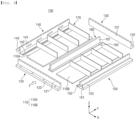
- FIG. 3 is an exploded perspective view illustrating a battery pack of one embodiment of the present invention
- FIG. 4 is an assembled perspective view illustrating the battery pack of one embodiment of the present invention
- FIG. 5 is an assembled perspective view illustrating the battery pack with some components excluded
- FIG. 6 is a schematic diagram illustrating one example of a coupling structure of a base plate and a side frame according to the present invention.
- a battery pack 100 of the present invention includes a base plate 110, a front frame 120, a rear frame 130, and side frames 140 and 150 on both sides.
- a plurality of battery modules M are mounted on the base plate 110.
- the battery module M may be provided with a module housing for accommodating a plurality of battery cells.
- the battery cell is a secondary battery, and may be a pouch-type secondary battery, a prismatic secondary battery, or a cylindrical secondary battery. That is, for the battery cell, various battery cells known at the time of filing the present invention may be employed.
- the battery module M may be provided with at least one busbar (not shown) configured to electrically interconnect a plurality of battery cells. Further, the plurality of battery modules M may be electrically connected to each other through a power cable or the busbar.
- the detailed configuration of the battery modules M may be a generally known configuration. Therefore, detailed description thereof will be omitted in the present specification.
- the battery pack 100 may accommodate an electrical equipment assembly (not shown).
- the electrical equipment assembly may accommodate relay devices, current sensors, fuses, a BMS, and a manual service disconnector (MSD). Together with battery modules, the electrical equipment assembly may be packaged within the battery pack 100 so as not to be exposed to the outside.
- the base plate 110 may have a plate shape extending in a horizontal direction.
- the horizontal direction means a direction of the plane of the flat ground.
- the base plate 110 may be made of a metal material with excellent mechanical rigidity.
- each of the front frame 120, the rear frame 130, and the side frames 140 and 150 on both sides is coupled to the base plate 110.
- the coupling method may be, for example, friction stir welding.
- the front frame 120 When viewed from the front based on the arrow F in FIG. 3 , the front frame 120 may be coupled to a front end of the base plate 110 to cover the front of the battery module M, and the rear frame 130 may be coupled to a rear end of the base plate 110.
- directions such as front, rear, left, right, up, and down may vary depending on a position of an observer or an arrangement of the object. However, in the present specification, for convenience of description, directions such as front, rear, left, right, up, and down will be separately indicated based on the view from the direction of the arrow F in FIG. 3 .
- a plurality of battery modules M may be positioned on the base plate 110. Accordingly, an upper surface of the base plate 110 forms a module mounting region where the plurality of battery modules are accommodated.
- FIG. 5 illustrates a battery pack housing excluding a side beam, which will be described later, to more clearly display a module mounting region A.
- a width of the base plate 110 of the present invention that is, a length in an X direction, is smaller than a width (a length in the X direction) of the entire battery pack.
- the base plate 110 of the present invention has a side-to-side width that is smaller than the width of the module mounting region A in the battery pack. That is, a size of the base plate width is smaller than the length of the module mounting region A in the X direction. Therefore, the base plate 110 has a size that forms only a portion of the module mounting region A. Accordingly, a portion of a lower area of the plurality of battery modules is supported by the base plate 110, but remaining region portions are positioned outside the base plate 110. These remaining lower area portions are supported by side frames, as will be described below.
- the meaning of the base plate 110 "having a size that forms only a portion of the module mounting region” basically includes a case where, first, when one base plate 110 is installed at the bottom of the battery pack, the width of the base plate 110 is formed to be smaller than the width of the module mounting region A. Further, as shown in FIGS. 3 and 4 , the meaning also includes a case where, when a center frame 160 is coupled between two base plates 110A and 110B and the module mounting region A is positioned between the center frame 160 and side frames 140 and 150 on both sides, each of two base plates 110A and 110B has a small size (width) such that each base plate forms only a portion of the module mounting region A.
- the base plate 110 for constructing the battery pack in the present specification may not make up the entire width of the module mounting region A with its own width alone, and forms the entire width of module mounting region only when combined with another component (a first extension part of the side frame to be described below).
- a length (a Y-direction length) of the base plate 110 may be equal to a length of the battery pack 100 in a Y direction.
- the front frame 120 may extend long in a right and left direction (the X direction), and may have a shape of being erect in a height direction (a Z direction). A lower surface of the front frame 120 may be coupled to the upper surface of the base plate 110. Further, the lower surfaces of right and left ends of the front frame 120 may be coupled to upper surfaces of first extension parts of the side frames, which will be described below.
- the front frame 120 may include a front cover part 121 extending in the height direction and a front plate part 122 protruding forward from a lower portion of the front cover part.
- the front plate part 122 may be fixedly coupled to a structure such as a vehicle.
- the rear frame 130 may extend long in the right and left direction (the X direction), and may have an erect shape in the height direction (the Z direction).
- a lower surface of the rear frame 130 may be coupled to the upper surface of the base plate 110, and lower surfaces of right and left ends of the rear frame 130 may be coupled to the upper surfaces of the first extension parts of the side frames, which will be described below.
- the rear frame 130 may have a shape the same as or different from the front frame. In FIGS. 3 and 4 , the rear frame 130 has the same shape as the front frame by being provided with a rear cover part 131 extending in the height direction and a rear plate portion 132 protruding rearward from a lower portion of the rear cover part 131.
- the rear plate part 132 may be fixedly coupled to a structure such as a vehicle.
- the side frames 140 and 150 on both sides may have a shape extending long in a front-to-rear direction (the Y direction).
- the side frames include a first side frame 140 that covers the left side of the battery module and a second side frame 150 that covers the right side.
- the first side frame 140 is coupled to a left end of the base plate
- the second side frame 150 is coupled to a right end of the base plate. That is, the side frames are coupled to both sides of the base plate.
- the first side frame 140 may be coupled to a left end of the left base plate 110A
- the second side frame 150 may be coupled to a right end of the right base plate 110B.
- the present invention is provided with the front frame 120, the rear frame 130, and the first and second side frames 140 and 150 to cover the front, rear, left, and right sides of the battery module.
- the first side frame 140 includes a side wall part 141 facing the battery module, and a first extension part 142 extending from a lower portion of the side wall part toward the (left) base plate 110A.
- the second side frame 150 also includes a side wall part 151 facing the battery module and a first extension part 152 extending from a lower portion of the side wall part toward the (right) base plate 110B.
- a characteristic feature of the present invention is that the first extension parts 142 and 152 are respectively coupled to the side surfaces of the left and right base plates and form the module mounting region A together with the base plates. That is, the first extension parts 142 and 152 of the first and second side frames 140 and 150 extend a predetermined length toward the base plate 110 to support at least a portion of the lower area of the battery module.
- the upper surfaces of the first extension parts 142 and 152 and the upper surfaces of the base plates 110A and 110B form the module mounting region A together.
- the widths of the base plates 110A and 110B are larger than the widths of the first extension parts 142 and 152
- the lower area of the battery module supported by the base plates is larger than the lower area of the battery module supported by the first extension parts.
- the first extension parts 142 and 152 support the lower surface of the battery module with a relatively smaller area than the base plates.
- the base plates and the side frames, specifically the first extension parts 142 and 152 of the side frames and the base plates 110A and 110B support the load of the battery module together, the battery module may be stably supported.
- the lengths of the first extension part 142 provided in the first side frame 140 and the first extension part 152 provided in the second side frame 150 may be the same. That is, the extension length (a predetermined length) of each of the first extension part 142 and 152 extending from the lower portions of side wall parts towards the base plates may be the same. In this case, a single base plate may be positioned between the first and second side frames 140 and 150.
- a ratio of 1/2 of the length of the single base plate extending between the first side frame 140 and the second side frame 150 and a predetermined length of each of the first extension parts 142 and 152 may range from 6:4 to 9:1.
- the ratio between the lengths is less than 6:4
- the length of the first extension part may become too large, and thus the weight of the first side frame may be increased, and welding of the first side frame may become cumbersome.
- the ratio between the lengths is greater than 9:1, the length of the first extension part may become too small, and a load distribution effect of the battery module may be halved.
- two base plates 110A and 110B of the same size may be positioned between the first side frame 140 and the second side frame 150.
- the ratio of a length (an X-direction length) of each of the base plates 110A and 110B extending to the corresponding side frame and the predetermined length may range from 6.4 to 9:1.
- the first and second side frames 140 and 150 include second extension parts 143 and 153 extending in an outward direction of the battery pack, respectively.
- the second extension parts 143 and 153 are parts that are fixedly supported on a structure on which the battery pack 100 is installed, for example, a vehicle. That is, the second extension parts 143 and 153 include fastening points to the vehicle. Since the second extension parts 143 and 153 are directly fastened to the vehicle, the second extension parts 143 and 153 receive a greater load than the first extension parts 142 and 152. Therefore, in order to stably fasten and fix the battery pack to the vehicle, the second extension parts 143 and 153 are formed to be thicker than the first extension parts 142 and 152.
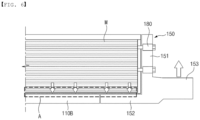
- FIG. 6 clearly shows the effect of distributing the load by the battery pack according to the present invention.
- a right surface of the right base plate 110B and one side surface of the first extension part 152 of the second side frame 150 are coupled.
- the coupling may be performed, for example, by welding.
- the second extension part 153 of the second side frame 150 is fixedly coupled to a structure such as a vehicle.
- a right surface of the base plate and a side surface of the first extension part are coupled so that the upper surface of the base plate 110B and the upper surface of the first extension part 152 form a plane of the same height. Accordingly, the battery module may be stably supported on a flat plane of the same height. As shown in FIG. 6 , most of the lower surface of the battery module M is supported by the upper surface of the base plate 110B, but one side of the lower surface is supported by the upper surface of the first extension part 152. That is, since the lower surface of the battery module M is evenly supported across the upper surface of the base plate 110B and the first extension part 152, the load of the battery module is supported by the base plate and the first extension part together.
- the second extension part 153 is fixed to the structure and receives stress in an opposite direction to the load of the battery module, but since the second extension part 153 is formed to be thicker than the first extension part 152, the second extension part 153 may sufficiently handle the stress.
- the first extension parts 142 and 152 of the side frames 140 and 150 and the base plate 110 form the module mounting region A together, so that the load of the battery module may be uniformly distributed. Therefore, there is no need to install a separate reinforcement structure to reinforce the base plate as in the related art. Further, there is no need to make the width of the base plate as long as in the related art, and the thickness of the base plate may be reduced as the side frames distribute a load and bear the distributed load. Accordingly, the structure of the battery pack, such as the base plate, may be simplified. Further, as will be described below, when the base plate is constructed as a cooling-integrated type, the structure of the battery pack may be constructed more compactly.
- FIG. 6 the coupling structure of the right base plate 110B and the second side frame 150 is shown, but the coupling structure of the left base plate 110A and the first side frame 140 is also the same.
- FIG. 7 is a schematic diagram illustrating another example of a coupling structure of a base plate and a side frame according to the present invention.
- stepped portions 115 and 155 shaped to engage with each other are formed on a side surface of a base plate 110B and a side surface of a first extension part 152 of a second side frame 150 coupled thereto. That is, a right surface of the right base plate 110B is provided with a stepped portion 115 consisting of two vertical surfaces and a horizontal surface disposed between the two vertical surfaces.
- a left surface of the first extension part 152 is also provided with a stepped portion 155 consisting of two vertical surfaces and a horizontal plane disposed between the two vertical surfaces and shaped to engage with the stepped portion 115 of the base plate.
- the load may be more efficiently distributed than in the example of FIG. 5 .
- the base plate 110B and the first extension part 152 of the second side frame 150 may be easily coupled.
- the battery module M mounted on the base plate 110B and the first extension part 152 may be fastened to the side wall part 151 of the side frame by fastening members 180.
- Module fastening by the fastening members 180 has various technical meanings. First, by fixing the battery module M to the side wall part 151 by the fastening members 180, the battery module may be accurately positioned in the set module mounting region A in the battery pack 100. Second, by fastening the battery module M to the side wall part 151 of the side frame, even when vibrations occur while the vehicle is driven, the battery module may be stably maintained in the module mounting region A in the battery pack without moving.
- the load of the battery module M may be further distributed.
- the load of the battery module since the load of the battery module is distributed to and supported by the base plate 110B, the side wall part 151 of the side frame, and the first extension part 152, there is an advantage in that the problem of load concentration may be avoided as much as possible.
- the battery pack 100 of the present embodiment further includes the center frame 160 between the left and right base plates 110A and 110B.
- the center frame 160 serves to partition the plurality of battery modules M into the left and right, extends from the front frame 120 to the rear frame 130, and is coupled to the base plate 110.
- the battery module M is mounted between the center frame 160 and the side wall parts 141 and 151 of the side frames 140 and 150. That is, the module mounting region is formed between the center frame 160 and the side wall parts of the side frames.
- the left and right base plates 110A and 110B are coupled to the first extension parts 142 and 152 of the first and second side frames 140 and 150, respectively, and the module mounting region A is at least a portion of the upper surfaces of the first extension parts 142 and 152 of the side frames and the upper surface of the base plate (see FIG. 5 ).
- the center frame 160 may have a vertical partition part 161 and horizontal extension parts 162 extending left and right from the lower portion of the vertical partition part and coupled to the left and right base plates 110A and 110B, respectively.
- the center frame 160 and the left and right base plates 110A and 110B may be coupled.
- the upper surfaces of the horizontal extension parts 162 and the upper surfaces of the base plates 110A and 110B are positioned on the same plane. That is, since the upper surfaces of the horizontal extension parts 162 and the base plates 110A and 110B form a flat surface, the battery module may be stably supported on the flat surface.
- the horizontal extension parts 162 may also form the module mounting region together with the base plates 110A and 110B and the first extension parts 142 and 152.
- the base plate has a size that forms only a portion of the module mounting region
- FIGS. 3 and 4 where the horizontal extension parts of the center frame form a portion of the module mounting region is included.
- the center frame 160 is provided with horizontal extension parts 162, but it is also possible that the center frame 160 does not have a horizontal extension part. That is, it is possible that the center frame is formed only with the vertical partition part 161 and the left and right base plates are coupled to both lower sides of the vertical partition part.
- the battery pack 100 of the present embodiment further includes side beams 170 for partitioning each battery module.
- the side beams 170 are installed to extend between the vertical partition part 161 of the center frame 160 and the side frames 140 and 150 on both sides. That is, each of a plurality of side beams 170 is installed between the vertical partition part 161 and the first side frame 140 and between the vertical partition part 161 and the second side frame 150.
- the lower surface of the battery pack that is partitioned by the side beams 170 becomes the module mounting region A.
- An arrangement of the plurality of battery modules in the battery pack is determined depending on an arrangement of the center frame 160 and the side beams 170.
- the battery modules are arranged in four rows to face each other.
- the arrangement of the battery module is not limited thereto, and it is also possible to arrange the battery module in a different form depending on the arrangement of the center frame 160 and/or the side beams 170.
- the module mounting region A where the battery module is mounted is formed on the base plate 110 and the first extension parts 142 and 152 of the side frames. As shown in FIG. 5 , the upper surface of the horizontal extension part of the center frame may also be included in the module mounting region.
- the battery module M When the battery module M is positioned close to the side wall part 151 of the side frame, almost the entire upper surface of the first extension part 152 is included in the module mounting region A.
- the battery module M and the side wall part 151 are spaced apart by a predetermined distance as shown in FIGS. 5 and 6 .
- a portion of the upper surface of the first extension part 152 on which the module is placed is included in the module mounting region A.
- the first extension part 152 may stably support a portion of the lower surface of the module, and thus the load of the module may be uniformly distributed.
- FIGS. 3 to 5 a case where the side frames 140 and 150 are disposed on the left and right sides of the battery module has been disclosed.
- side frames may be disposed on the front and rear sides of the battery module.
- frames corresponding to the front and rear frames of FIGS. 3 to 5 may be installed on the left and right sides of the battery module.
- the first extension part 142 of the first side frame 140 may extend long along a longitudinal direction (the Y direction) of the battery pack, but the first extension part formed on the front frame 120 may extend along a width direction (the X direction) of the battery pack, but may be formed not to extend to a portion where the first extension part 142 of the first side frame 140 is positioned.
- an insulating pad or a thermally conductive resin layer such as thermal resin may be interposed between the base plate and the module.
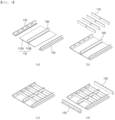
- FIG. 8 is a schematic diagram illustrating a process of manufacturing a battery pack according to the present invention.
- a skeletal frame of the battery pack is made and then a base plate is coupled to a lower portion of the skeletal frame. Accordingly, as described above, the load is concentrated on a side end of the battery pack where the base plate and the skeletal frame are joined. Further, in the related art, since a separate cooling panel is coupled before joining the base plate to the skeletal frame, the structure is complicated.
- the method of manufacturing a battery pack having a module mounting region where a plurality of battery modules are accommodated includes coupling side surfaces of first extension parts 142 and 152 of side frames 140 and 150 on both sides extending toward a base plate 110 having a size that forms only a portion of the module mounting region A and forming the module mounting region A together with the base plate to both side surfaces of the base plate, respectively, coupling a front frame 120 and a rear frame 130 to front and rear ends of the base plate 110 and the first extension parts 142 and 152, respectively, and mounting a plurality of battery modules M on the module mounting region A including at least a portion of upper surfaces of the first extension parts 142 and 152 and an upper surface of the base plate 110.
- first and second side frames 140 and 150 on both sides are first coupled to both sides of the base plates 142 and 152.
- the first extension parts 142 and 152 of the first and second side frames 140 and 150 are respectively coupled to both sides of the base plate 110.
- the base plate 110 has a size that forms only a portion of the module mounting region A, and the first extension parts 142 and 152 form the module mounting region together with the base plate 110.
- the front frame 120 and the rear frame 130 are coupled to the front and rear ends of the base plate 110, respectively.
- the first extension parts 142 and 152 of the first and second side frames 140 and 150 are positioned at left and right ends of the base plate, and the left and rear ends of the front frame 120 and the rear frame 130 are coupled to the first extension parts 142 and 152 of the first and second side frames 140 and 150, respectively.
- a plurality of battery modules are mounted on the module mounting region A including at least a portion of upper surfaces of the first extension parts 142 and 152 and an upper surface of the base plate.
- a portion of the lower surface of the battery module M may be supported by first extension parts 142 and 152 in addition to the base plate, and since coupling points between the base plate and the first extension parts are positioned at ends of the first extension parts 142 and 152 that extend a predetermined length inside the battery pack, the load of the battery module may be uniformly distributed without being biased.
- a method of manufacturing a battery pack is a method of manufacturing a battery pack having a module mounting region where a plurality of battery modules are accommodated, the method including disposing base plates 110A and 110B on both sides of a center frame 160, respectively, and coupling the base plates 110A and 110B on both sides and the center frame 160, coupling a first extension part 142 of the side frame 140 on one side extending toward the base plate 110A on one side of the center frame and forming a module mounting region together with the base plate 110A on one side to the base plate 110A on one side, coupling a first extension part 152 of the side frame 150 on the other side extending toward the base plate 110B on the other side of the center frame and forming a module mounting region together with the base plate 110B on the other side to the base plate 110B on the other side, coupling a front frame 120 and a rear frame 130 to first extension parts 142 and 152 of the one and the other side frames and front and rear ends of the base plates 110
- the present embodiment is a manufacturing method for a case in which the center frame 160 and the two base plates 110A and 110B are provided on the left and right sides of the center frame. Accordingly, before coupling the base plates 110A and 110B to the first extension parts 142 and 152, an operation of coupling the center frame 160 and the base plates 110A and 110B is first performed. That is, (left and right) base plates 110A and 110B are disposed on both sides of the center frame 160, respectively, and the base plates on both sides are coupled to the center frame.
- the first extension part 142 of the first side frame 140 is coupled to the left surface of the base plate 110A on one side (left side) of the center frame 160.
- the first extension part 152 of the second side frame 150 is coupled to the right surface of the base plate 110B on the other (right) side of the center frame 160.
- the order of coupling the first and second side frames to the base plates may be reversed.
- the front frame 120 and the rear frame 130 are coupled to the front and rear ends of the first extension parts 142 and 152 of the first and second side frames and the front and rear ends of the base plates 110A and 110B on both sides, respectively.
- a plurality of battery modules are mounted on the module mounting region including at least a portion of upper surfaces of the first extension parts 142 and 152 and upper surfaces of the base plates 110A and 110B.
- an operation of fastening a plurality of side beams 170 between the center frame and the first and second side frames may be performed.
- a step of coupling the front frame 120 and the rear frame 130 to the base plates 110A and 110B and the side frames 140 and 150 may be performed.
- FIG. 9 is an exploded perspective view illustrating a battery pack of another embodiment of the present invention
- FIG. 10 is an assembled perspective view illustrating the battery pack of another embodiment of the present invention
- FIG. 11 is a schematic diagram illustrating an example of a coupling structure of a base plate and a side frame according to the embodiment of FIG. 9 .
- At least one of base plates 210A and 210B and side frames 240 and 250 has an outer wall W and an inner space H surrounded by the outer wall. Further, the inner space H may form a plurality of hollow channels by being divided by a plurality of partition walls P extending from the outer wall W.
- the base plates 210A and 210B and/or the side frames 240 and 250 may be manufactured as hollow frames by extruding a metal material such as aluminum so that an empty space is formed therein.
- a metal material such as aluminum
- the hollow channels may be formed in either or both of the side frames 240 and 250 and the base plates 210A and 210B.
- the hollow channels may be formed in all of the first extension parts 242 and 252, side wall parts 241 and 251, and second extension parts 243 and 253 of the side frames 240 and 250, as shown in FIG. 11 .
- a plurality of hollow channels in left and right base plates 210A and 210B extend in a longitudinal direction (a Y direction), and a first cooling channel 214 is installed in each hollow channel.
- a direction and arrangement of the first cooling channels 214 are determined according to the direction and arrangement of the hollow channels. Therefore, when the hollow channels are formed in a width direction (an X direction), the first cooling channels 214 are also installed in the width direction.
- first extension parts 242 and 252 of the side frames may also have hollow channels, and second cooling channels 244 and 254 may be installed in the hollow channels.
- second cooling channel 254 is shown as being installed to extend along the longitudinal direction in the hollow channel of the first extension part 252. That is, all the first and second cooling channels 214, 244, and 254 form refrigerant flow passages extending in the longitudinal direction of the battery pack.
- the load distribution effect by the first extension parts 242 and 252 is achieved. That is, as shown in FIG. 11 , the first extension part 252 of the side frame 250 extending toward one side surface of the base plate 210B is coupled to the base plate 210B.
- stepped portions 215 and 255 shaped to engage with each other are formed on the coupling side surfaces of the base plate 210B and the first extension part 252, respectively. Accordingly, the load of the battery module may be more uniformly distributed.
- both the base plate 210B and the side frame 250 may be made of a light extruded frame with hollow channels, thereby reducing the load of the battery pack.
- a cooling-integrated structure with first and second cooling channels within the hollow channels of the base plates and side frames there is no need to install a separate cooling panel.
- the front frame 220 and the rear frame 230 of the present embodiment include third cooling channels 224 and 234 communicating with the first cooling channels 214 and the second cooling channels 244 and 254.
- the front frame 220 includes a front cover part 221 and a front plate part 222 installed on the lower portion of the front cover part 221 and including the third cooling channel 224.
- communication holes 225 that communicate with the first and second cooling channels are provided in a rear surface of the front plate part 222.
- coupling protrusions 226 for coupling with the base plates 210A and 210B and the first extension parts 242 and 252 may be provided at upper and lower ends of the rear surface of the front plate part 222.
- the front frame 220 may be coupled to the base plates and the first extension parts by bringing the coupling protrusions 226 into contact with the upper and lower surfaces of the base plates 210A and 210B and the first extension parts 242 and 252 and welding the coupling protrusions 226.
- the rear frame 230 also includes a rear cover part 231 and a rear plate part 232 installed on the lower portion of the rear cover part and having the third cooling channel 234.
- communication holes 235 that communicate with the first and second cooling channels are provided in a front surface of the rear plate part 232.
- coupling protrusions 236 for coupling with the base plates and the first extension parts may be provided at upper and lower ends of the front surface of the rear plate part 232.
- the rear frame 230 may be coupled to the base plates and the first extension parts by bringing the coupling protrusions 236 into contact with the upper and lower surfaces of the base plates 210A and 210B and the first extension parts 242 and 252 and welding the coupling protrusions 236.
- FIG. 12 is a schematic diagram illustrating one example of a cooling path of the battery pack in the embodiment of FIG. 10 .
- a refrigerant inlet I and a refrigerant outlet O may be formed at the front of the front plate part 222. That is, both the refrigerant inlet I and the refrigerant outlet O may be formed on a front side of the battery pack 200. Alternatively, the refrigerant inlet I and the refrigerant outlet O may be formed at the rear of the rear plate part 232.
- a refrigerant e.g., water
- a refrigerant injected into the refrigerant inlet I is introduced into the first cooling channels 214 on one side of the base plate and the second cooling channel 254 of the first extension part 252 of the second side frame 250 through the third cooling channel 224 and the communication holes 225 of the front frame 220.
- the refrigerant flows along the longitudinal direction of the battery pack and reaches the third cooling channel 234 through the communication holes 235 of the rear frame 230.
- the refrigerant returns from the third cooling channel of the rear frame 230 so that a cooling path returning the refrigerant outlet O of the front frame 220 through the first cooling channels 214 on the other side of the base plate and the second cooling channel 244 of the first extension part 242 of the first side frame 240 is formed.
- FIG. 13 is a schematic diagram illustrating another example of a cooling path of the battery pack.
- the front frame 220 is provided with the refrigerant inlet I
- the rear frame 230 is provided with the refrigerant outlet O.
- a cooling path may be formed along the refrigerant inlet I of the front frame 220 - the third cooling channel 224 of the front frame 230 - the first cooling channel 214 of the base plate and the second cooling channel 254 of the first extension part 252 -third cooling channel 234 of the rear frame 230 - the first cooling channel 214 of the base plate - the third cooling channel 224 of the front frame - the first cooling channel 214 of the base plate and the second cooling channel 244 of the first extension part 242 - the third cooling channel 234 of the rear frame 230 - the refrigerant outlet O.
- the cooling path may be formed in various ways by installing cooling channels in the base plate and the first extension part of the side frame.
- the battery pack may include a pack cover (not shown) that covers the top of the battery module and is coupled to the side frames.
Landscapes
- Chemical & Material Sciences (AREA)
- Chemical Kinetics & Catalysis (AREA)
- Electrochemistry (AREA)
- General Chemical & Material Sciences (AREA)
- Engineering & Computer Science (AREA)
- Manufacturing & Machinery (AREA)
- Battery Mounting, Suspending (AREA)
- Secondary Cells (AREA)
Applications Claiming Priority (3)
| Application Number | Priority Date | Filing Date | Title |
|---|---|---|---|
| KR20220083118 | 2022-07-06 | ||
| KR1020230070867A KR20240006431A (ko) | 2022-07-06 | 2023-06-01 | 배터리 팩 및 배터리 팩의 제조방법 |
| PCT/KR2023/009509 WO2024010364A1 (ko) | 2022-07-06 | 2023-07-05 | 배터리 팩 및 배터리 팩의 제조방법 |
Publications (2)
| Publication Number | Publication Date |
|---|---|
| EP4407765A1 true EP4407765A1 (de) | 2024-07-31 |
| EP4407765A4 EP4407765A4 (de) | 2025-09-10 |
Family
ID=89453770
Family Applications (1)
| Application Number | Title | Priority Date | Filing Date |
|---|---|---|---|
| EP23835830.3A Pending EP4407765A4 (de) | 2022-07-06 | 2023-07-05 | Batteriepack und verfahren zur herstellung eines batteriepacks |
Country Status (4)
| Country | Link |
|---|---|
| US (1) | US20240413464A1 (de) |
| EP (1) | EP4407765A4 (de) |
| JP (1) | JP7764594B2 (de) |
| WO (1) | WO2024010364A1 (de) |
Families Citing this family (1)
| Publication number | Priority date | Publication date | Assignee | Title |
|---|---|---|---|---|
| JP7701903B2 (ja) * | 2022-11-02 | 2025-07-02 | 株式会社神戸製鋼所 | 車両用バッテリーケース |
Family Cites Families (11)
| Publication number | Priority date | Publication date | Assignee | Title |
|---|---|---|---|---|
| KR102740288B1 (ko) * | 2017-01-12 | 2024-12-09 | 삼성에스디아이 주식회사 | 배터리 팩 하우징 및 이를 포함하는 배터리 팩 |
| CN207781673U (zh) * | 2017-12-05 | 2018-08-28 | 北京普莱德新能源电池科技有限公司 | 一种一体式水冷动力电池箱 |
| CN209249545U (zh) * | 2019-03-05 | 2019-08-13 | 爱驰汽车有限公司 | 电池包 |
| CN212571214U (zh) | 2020-07-29 | 2021-02-19 | 恒大新能源技术(深圳)有限公司 | 电池包支撑结构和电池包 |
| WO2022050780A1 (ko) | 2020-09-04 | 2022-03-10 | 주식회사 엘지에너지솔루션 | 배터리 팩, 및 자동차, 및 이를 포함하는 전자 디바이스 |
| CN112072025A (zh) * | 2020-09-04 | 2020-12-11 | 东风汽车集团有限公司 | 抗挤压电池下箱体的集成化下底板及其制备方法 |
| CN112201891A (zh) | 2020-11-16 | 2021-01-08 | 厦门金龙汽车新能源科技有限公司 | 一种可拓展式电池包及可拓展式电池包集成于底盘的电动客车 |
| CN114597536A (zh) * | 2020-12-04 | 2022-06-07 | 比亚迪股份有限公司 | 一种电池包及电动车 |
| KR102481549B1 (ko) | 2020-12-11 | 2022-12-23 | 남달리 | 도어 개폐 조절장치 |
| CN113782884A (zh) * | 2021-09-16 | 2021-12-10 | 远景能源有限公司 | 一种电池包箱体及电池包 |
| KR20230070867A (ko) | 2021-11-15 | 2023-05-23 | 주식회사 엘지에너지솔루션 | 이차전지 압연 시스템 및 이를 이용한 이차전지 불량 예측 방법 |
-
2023
- 2023-07-05 US US18/702,549 patent/US20240413464A1/en active Pending
- 2023-07-05 JP JP2024523233A patent/JP7764594B2/ja active Active
- 2023-07-05 WO PCT/KR2023/009509 patent/WO2024010364A1/ko not_active Ceased
- 2023-07-05 EP EP23835830.3A patent/EP4407765A4/de active Pending
Also Published As
| Publication number | Publication date |
|---|---|
| WO2024010364A1 (ko) | 2024-01-11 |
| JP7764594B2 (ja) | 2025-11-05 |
| EP4407765A4 (de) | 2025-09-10 |
| JP2024536555A (ja) | 2024-10-04 |
| US20240413464A1 (en) | 2024-12-12 |
Similar Documents
| Publication | Publication Date | Title |
|---|---|---|
| KR102754816B1 (ko) | 배터리 팩 및 이를 포함하는 자동차 | |
| US20240204318A1 (en) | Power battery pack and electric vehicle | |
| KR102276261B1 (ko) | 전지 서브 모듈 캐리어, 전지 서브 모듈, 전지 시스템 및 자동차 | |
| KR20240006431A (ko) | 배터리 팩 및 배터리 팩의 제조방법 | |
| KR101261736B1 (ko) | 배터리 팩 | |
| KR102613200B1 (ko) | 배터리, 전력 소비 장치, 배터리 제조 방법 및 장치 | |
| EP2450980B1 (de) | Batteriemodul | |
| EP4407765A1 (de) | Batteriepack und verfahren zur herstellung eines batteriepacks | |
| EP4451446A1 (de) | Batteriemodul und batteriepack damit | |
| WO2025081792A1 (zh) | 箱体、电池和用电装置 | |
| KR102770779B1 (ko) | 접속 플레이트를 구비한 배터리 팩 | |
| CN115911639B (zh) | 蓄电装置 | |
| KR20220151560A (ko) | 버스바 어셈블리, 이를 포함하는 배터리 팩 및 자동차 | |
| KR20240046898A (ko) | 전지, 전기기기, 전지를 제조하기 위한 방법 및 장비 | |
| EP4462569A1 (de) | Batteriepack | |
| US20240347832A1 (en) | Battery pack | |
| CN118202507A (zh) | 电池组及电池组的制造方法 | |
| EP4601105A1 (de) | Batteriepack und fahrzeug damit | |
| KR102815257B1 (ko) | 배터리 팩 | |
| CN222440726U (zh) | 电池包及储能系统 | |
| US20250385369A1 (en) | Battery pack and battery module | |
| KR20250040390A (ko) | 배터리 팩 및 이를 포함하는 자동차 | |
| WO2025255940A1 (zh) | 电池、用电装置及储能装置 | |
| KR20240083050A (ko) | 배터리 팩 | |
| WO2026036394A1 (zh) | 电池装置及用电装置 |
Legal Events
| Date | Code | Title | Description |
|---|---|---|---|
| STAA | Information on the status of an ep patent application or granted ep patent |
Free format text: STATUS: THE INTERNATIONAL PUBLICATION HAS BEEN MADE |
|
| PUAI | Public reference made under article 153(3) epc to a published international application that has entered the european phase |
Free format text: ORIGINAL CODE: 0009012 |
|
| STAA | Information on the status of an ep patent application or granted ep patent |
Free format text: STATUS: REQUEST FOR EXAMINATION WAS MADE |
|
| 17P | Request for examination filed |
Effective date: 20240424 |
|
| AK | Designated contracting states |
Kind code of ref document: A1 Designated state(s): AL AT BE BG CH CY CZ DE DK EE ES FI FR GB GR HR HU IE IS IT LI LT LU LV MC ME MK MT NL NO PL PT RO RS SE SI SK SM TR |
|
| A4 | Supplementary search report drawn up and despatched |
Effective date: 20250811 |
|
| RIC1 | Information provided on ipc code assigned before grant |
Ipc: H01M 50/204 20210101AFI20250805BHEP Ipc: H01M 50/244 20210101ALI20250805BHEP Ipc: H01M 10/613 20140101ALI20250805BHEP Ipc: H01M 10/6556 20140101ALI20250805BHEP Ipc: H01M 10/6567 20140101ALI20250805BHEP Ipc: H01M 50/289 20210101ALI20250805BHEP Ipc: H01M 50/242 20210101ALI20250805BHEP |
|
| DAV | Request for validation of the european patent (deleted) | ||
| DAX | Request for extension of the european patent (deleted) | ||
| STAA | Information on the status of an ep patent application or granted ep patent |
Free format text: STATUS: EXAMINATION IS IN PROGRESS |
|
| 17Q | First examination report despatched |
Effective date: 20260216 |