EP4410514A1 - Système de moulage, machine d'extraction d'article moulé, dispositif de moulage et méthode de fabrication d'un article moulé creux - Google Patents
Système de moulage, machine d'extraction d'article moulé, dispositif de moulage et méthode de fabrication d'un article moulé creux Download PDFInfo
- Publication number
- EP4410514A1 EP4410514A1 EP22876448.6A EP22876448A EP4410514A1 EP 4410514 A1 EP4410514 A1 EP 4410514A1 EP 22876448 A EP22876448 A EP 22876448A EP 4410514 A1 EP4410514 A1 EP 4410514A1
- Authority
- EP
- European Patent Office
- Prior art keywords
- molded product
- hollow molded
- mold
- suction
- wall surface
- Prior art date
- Legal status (The legal status is an assumption and is not a legal conclusion. Google has not performed a legal analysis and makes no representation as to the accuracy of the status listed.)
- Pending
Links
Images




Classifications
-
- B—PERFORMING OPERATIONS; TRANSPORTING
- B29—WORKING OF PLASTICS; WORKING OF SUBSTANCES IN A PLASTIC STATE IN GENERAL
- B29C—SHAPING OR JOINING OF PLASTICS; SHAPING OF MATERIAL IN A PLASTIC STATE, NOT OTHERWISE PROVIDED FOR; AFTER-TREATMENT OF THE SHAPED PRODUCTS, e.g. REPAIRING
- B29C49/00—Blow-moulding, i.e. blowing a preform or parison to a desired shape within a mould; Apparatus therefor
- B29C49/42—Component parts, details or accessories; Auxiliary operations
- B29C49/70—Removing or ejecting blown articles from the mould
-
- B—PERFORMING OPERATIONS; TRANSPORTING
- B29—WORKING OF PLASTICS; WORKING OF SUBSTANCES IN A PLASTIC STATE IN GENERAL
- B29C—SHAPING OR JOINING OF PLASTICS; SHAPING OF MATERIAL IN A PLASTIC STATE, NOT OTHERWISE PROVIDED FOR; AFTER-TREATMENT OF THE SHAPED PRODUCTS, e.g. REPAIRING
- B29C45/00—Injection moulding, i.e. forcing the required volume of moulding material through a nozzle into a closed mould; Apparatus therefor
- B29C45/17—Component parts, details or accessories; Auxiliary operations
- B29C45/72—Heating or cooling
- B29C45/73—Heating or cooling of the mould
-
- B—PERFORMING OPERATIONS; TRANSPORTING
- B29—WORKING OF PLASTICS; WORKING OF SUBSTANCES IN A PLASTIC STATE IN GENERAL
- B29C—SHAPING OR JOINING OF PLASTICS; SHAPING OF MATERIAL IN A PLASTIC STATE, NOT OTHERWISE PROVIDED FOR; AFTER-TREATMENT OF THE SHAPED PRODUCTS, e.g. REPAIRING
- B29C49/00—Blow-moulding, i.e. blowing a preform or parison to a desired shape within a mould; Apparatus therefor
- B29C49/42—Component parts, details or accessories; Auxiliary operations
- B29C49/4205—Handling means, e.g. transfer, loading or discharging means
- B29C49/42069—Means explicitly adapted for transporting blown article
-
- B—PERFORMING OPERATIONS; TRANSPORTING
- B29—WORKING OF PLASTICS; WORKING OF SUBSTANCES IN A PLASTIC STATE IN GENERAL
- B29C—SHAPING OR JOINING OF PLASTICS; SHAPING OF MATERIAL IN A PLASTIC STATE, NOT OTHERWISE PROVIDED FOR; AFTER-TREATMENT OF THE SHAPED PRODUCTS, e.g. REPAIRING
- B29C49/00—Blow-moulding, i.e. blowing a preform or parison to a desired shape within a mould; Apparatus therefor
- B29C49/42—Component parts, details or accessories; Auxiliary operations
- B29C49/4205—Handling means, e.g. transfer, loading or discharging means
- B29C49/42073—Grippers
- B29C49/42079—Grippers using vacuum for gripping
-
- B—PERFORMING OPERATIONS; TRANSPORTING
- B29—WORKING OF PLASTICS; WORKING OF SUBSTANCES IN A PLASTIC STATE IN GENERAL
- B29C—SHAPING OR JOINING OF PLASTICS; SHAPING OF MATERIAL IN A PLASTIC STATE, NOT OTHERWISE PROVIDED FOR; AFTER-TREATMENT OF THE SHAPED PRODUCTS, e.g. REPAIRING
- B29C49/00—Blow-moulding, i.e. blowing a preform or parison to a desired shape within a mould; Apparatus therefor
- B29C49/42—Component parts, details or accessories; Auxiliary operations
- B29C49/4205—Handling means, e.g. transfer, loading or discharging means
- B29C49/42073—Grippers
- B29C49/42085—Grippers holding inside the neck
-
- B—PERFORMING OPERATIONS; TRANSPORTING
- B29—WORKING OF PLASTICS; WORKING OF SUBSTANCES IN A PLASTIC STATE IN GENERAL
- B29C—SHAPING OR JOINING OF PLASTICS; SHAPING OF MATERIAL IN A PLASTIC STATE, NOT OTHERWISE PROVIDED FOR; AFTER-TREATMENT OF THE SHAPED PRODUCTS, e.g. REPAIRING
- B29C49/00—Blow-moulding, i.e. blowing a preform or parison to a desired shape within a mould; Apparatus therefor
- B29C49/02—Combined blow-moulding and manufacture of the preform or the parison
- B29C2049/023—Combined blow-moulding and manufacture of the preform or the parison using inherent heat of the preform, i.e. 1 step blow moulding
-
- B—PERFORMING OPERATIONS; TRANSPORTING
- B29—WORKING OF PLASTICS; WORKING OF SUBSTANCES IN A PLASTIC STATE IN GENERAL
- B29C—SHAPING OR JOINING OF PLASTICS; SHAPING OF MATERIAL IN A PLASTIC STATE, NOT OTHERWISE PROVIDED FOR; AFTER-TREATMENT OF THE SHAPED PRODUCTS, e.g. REPAIRING
- B29C49/00—Blow-moulding, i.e. blowing a preform or parison to a desired shape within a mould; Apparatus therefor
- B29C49/42—Component parts, details or accessories; Auxiliary operations
- B29C49/48—Moulds
- B29C49/4802—Moulds with means for locally compressing part(s) of the parison in the main blowing cavity
- B29C2049/4807—Moulds with means for locally compressing part(s) of the parison in the main blowing cavity by movable mould parts in the mould halves
-
- B—PERFORMING OPERATIONS; TRANSPORTING
- B29—WORKING OF PLASTICS; WORKING OF SUBSTANCES IN A PLASTIC STATE IN GENERAL
- B29C—SHAPING OR JOINING OF PLASTICS; SHAPING OF MATERIAL IN A PLASTIC STATE, NOT OTHERWISE PROVIDED FOR; AFTER-TREATMENT OF THE SHAPED PRODUCTS, e.g. REPAIRING
- B29C49/00—Blow-moulding, i.e. blowing a preform or parison to a desired shape within a mould; Apparatus therefor
- B29C49/42—Component parts, details or accessories; Auxiliary operations
- B29C49/48—Moulds
- B29C2049/4879—Moulds characterised by mould configurations
- B29C2049/4884—Mould halves are made of one piece
-
- B—PERFORMING OPERATIONS; TRANSPORTING
- B29—WORKING OF PLASTICS; WORKING OF SUBSTANCES IN A PLASTIC STATE IN GENERAL
- B29C—SHAPING OR JOINING OF PLASTICS; SHAPING OF MATERIAL IN A PLASTIC STATE, NOT OTHERWISE PROVIDED FOR; AFTER-TREATMENT OF THE SHAPED PRODUCTS, e.g. REPAIRING
- B29C49/00—Blow-moulding, i.e. blowing a preform or parison to a desired shape within a mould; Apparatus therefor
- B29C49/42—Component parts, details or accessories; Auxiliary operations
- B29C49/48—Moulds
- B29C2049/4879—Moulds characterised by mould configurations
- B29C2049/4892—Mould halves consisting of an independent main and bottom part
-
- B—PERFORMING OPERATIONS; TRANSPORTING
- B29—WORKING OF PLASTICS; WORKING OF SUBSTANCES IN A PLASTIC STATE IN GENERAL
- B29C—SHAPING OR JOINING OF PLASTICS; SHAPING OF MATERIAL IN A PLASTIC STATE, NOT OTHERWISE PROVIDED FOR; AFTER-TREATMENT OF THE SHAPED PRODUCTS, e.g. REPAIRING
- B29C49/00—Blow-moulding, i.e. blowing a preform or parison to a desired shape within a mould; Apparatus therefor
- B29C49/42—Component parts, details or accessories; Auxiliary operations
- B29C49/70—Removing or ejecting blown articles from the mould
- B29C2049/701—Ejecting means
- B29C2049/702—Air pressure
-
- B—PERFORMING OPERATIONS; TRANSPORTING
- B29—WORKING OF PLASTICS; WORKING OF SUBSTANCES IN A PLASTIC STATE IN GENERAL
- B29C—SHAPING OR JOINING OF PLASTICS; SHAPING OF MATERIAL IN A PLASTIC STATE, NOT OTHERWISE PROVIDED FOR; AFTER-TREATMENT OF THE SHAPED PRODUCTS, e.g. REPAIRING
- B29C49/00—Blow-moulding, i.e. blowing a preform or parison to a desired shape within a mould; Apparatus therefor
- B29C49/02—Combined blow-moulding and manufacture of the preform or the parison
- B29C49/06—Injection blow-moulding
- B29C49/061—Injection blow-moulding with parison holding means displaceable between injection and blow stations
- B29C49/062—Injection blow-moulding with parison holding means displaceable between injection and blow stations following an arcuate path, e.g. rotary or oscillating-type
- B29C49/063—Injection blow-moulding with parison holding means displaceable between injection and blow stations following an arcuate path, e.g. rotary or oscillating-type with the parison axis held in the plane of rotation
-
- B—PERFORMING OPERATIONS; TRANSPORTING
- B29—WORKING OF PLASTICS; WORKING OF SUBSTANCES IN A PLASTIC STATE IN GENERAL
- B29C—SHAPING OR JOINING OF PLASTICS; SHAPING OF MATERIAL IN A PLASTIC STATE, NOT OTHERWISE PROVIDED FOR; AFTER-TREATMENT OF THE SHAPED PRODUCTS, e.g. REPAIRING
- B29C49/00—Blow-moulding, i.e. blowing a preform or parison to a desired shape within a mould; Apparatus therefor
- B29C49/28—Blow-moulding apparatus
-
- B—PERFORMING OPERATIONS; TRANSPORTING
- B29—WORKING OF PLASTICS; WORKING OF SUBSTANCES IN A PLASTIC STATE IN GENERAL
- B29C—SHAPING OR JOINING OF PLASTICS; SHAPING OF MATERIAL IN A PLASTIC STATE, NOT OTHERWISE PROVIDED FOR; AFTER-TREATMENT OF THE SHAPED PRODUCTS, e.g. REPAIRING
- B29C49/00—Blow-moulding, i.e. blowing a preform or parison to a desired shape within a mould; Apparatus therefor
- B29C49/42—Component parts, details or accessories; Auxiliary operations
- B29C49/48—Moulds
- B29C49/54—Moulds for undercut articles
- B29C49/541—Moulds for undercut articles having a recessed undersurface
-
- B—PERFORMING OPERATIONS; TRANSPORTING
- B29—WORKING OF PLASTICS; WORKING OF SUBSTANCES IN A PLASTIC STATE IN GENERAL
- B29K—INDEXING SCHEME ASSOCIATED WITH SUBCLASSES B29B, B29C OR B29D, RELATING TO MOULDING MATERIALS OR TO MATERIALS FOR MOULDS, REINFORCEMENTS, FILLERS OR PREFORMED PARTS, e.g. INSERTS
- B29K2995/00—Properties of moulding materials, reinforcements, fillers, preformed parts or moulds
- B29K2995/0037—Other properties
- B29K2995/0059—Degradable
- B29K2995/006—Bio-degradable, e.g. bioabsorbable, bioresorbable or bioerodible
-
- B—PERFORMING OPERATIONS; TRANSPORTING
- B29—WORKING OF PLASTICS; WORKING OF SUBSTANCES IN A PLASTIC STATE IN GENERAL
- B29L—INDEXING SCHEME ASSOCIATED WITH SUBCLASS B29C, RELATING TO PARTICULAR ARTICLES
- B29L2031/00—Other particular articles
- B29L2031/712—Containers; Packaging elements or accessories, Packages
- B29L2031/7158—Bottles
Definitions
- the present invention relates to a molding system, an apparatus for taking out molded product, a mold equipment, a molding machine, and a method for manufacturing a hollow molded product.
- blow molding is widely used for molding a hollow resin container such as a polyethylene terephthalate (PET) bottle.
- a hollow preform (parison) is arranged in a blow mold and subsequently a blow pin is arranged in the preform.
- a blow air is blown into the preform through the blow pin, the preform is molded into a shape corresponding to the cavity of the blow mold.
- the molded product is taken out of the blow mold when being opened by an apparatus for taking out molded product.
- an apparatus for taking out molded product When being taken-out, a method of making the molded product fall out of the blow mold (for example, Patent Literature 1) or a method of taking out the molded product from the blow mold in the state where a flange portion (cap screw portion) of the preform protruding out of the blow mold, when the preform is arranged in the blow mold, is supported or the like (for example, Patent Literature 2) is adopted.
- the above-mentioned method for taking out, in which the flange portion of the preform is supported can avoid damage to the molded product since each molded product can be separately taken out.
- An object of the present invention is to provide a molding system that can take out a molded product from the blow mold without coming into contact with the opening portion or the inner surface of the hollow molded product even if the molded product does not have a portion protruding from a blow mold.
- Another object of the present invention is to provide an apparatus for taking out molded product that is suitable for using in the molding system.
- Still another object of the present invention is to provide a mold equipment that is suitable for using in the molding system.
- Still another object of the present invention is to provide a method for manufacturing a hollow molded product, using the molding system.
- the molding system according to the present invention is assumed to be a molding system for manufacturing a hollow molded product 20 by blow molding.
- the molding system according to the present invention has a molding machine 110 and an apparatus for taking out molded product 120.
- the molding machine 110 has a mold equipment 114 in which a hollow molded product is blow-molded in a cavity (221, 241, 251).
- the apparatus for taking out molded product 110 sucks the hollow molded product molded in the mold equipment 114 by a suction portion 10 and takes out the hollow molded product from the mold equipment.
- the suction portion 10 has an insert portion 12, an abutting portion 13, a recess 14 provided between the insert portion 12 and the abutting portion 13, and a suction port 12b.
- the insert portion 12 is inserted in the hollow molded product through an opening portion 21 served as a blow pin extraction port of the hollow molded product.
- the abutting portion 13 is arranged, spaced apart from the insert portion 12, and abuts on a part of an outer circumferential surface 22 of the hollow molded product 20 that is spaced apart by a predetermined distance from the opening portion 21 served as the blow pin extraction port.
- the recess 14 is provided between the insert portion 12 and the abutting portion 13 and forms a closed space 26 communicating with an internal space 24 in the hollow molded product when the part of the hollow molded product where the opening portion 21 served as the blow pin extraction port is formed is accommodated in the recess 14 in the state where the abutting portion 13 is abutting on the outer circumferential surface 22 of the hollow molded product.
- the suction port 12b is provided in the insert portion 12 and sucks the air in the internal space 24 and the closed space 26.
- the insert portion 12 when the insert portion 12 is inserted through the blow pin extraction port (opening portion 21) of the hollow molded product molded in the mold equipment 114 and the mold equipment is opened in the state where the ambient atmosphere is sucked from the suction port 12b of the insert portion, the hollow molded product 20 moves toward the proximal end side of the insert portion 12 due to an air flow that flows in from the opening portion 21 of the hollow molded product 20, which is the blow pin extraction port. With this movement of the hollow molded product, the opening portion 21 of the hollow molded product, which is the blow pin extraction port, is accommodated in the recess 14.
- the outer circumferential surface 22 of the hollow molded product spaced apart by the predetermined distance from the opening portion 21, which is the blow pin extraction port, abuts on the abutting portion 13.
- the recess 14 and the internal space 24 in the hollow molded product 20 form a continuous closed space 26. Since the suction of the ambient atmosphere from the suction port 12b of the insert portion 12 is continued even in this state, the outer circumferential surface 22 of the hollow molded product is pressed against the abutting portion 13 and the outer circumferential surface 22 of the hollow molded product can be supported by the abutting portion 13 more securely.
- a coupling portion 11 that couples the insert portion 12 with the abutting portion 13 and that forms a recess between the insert portion and the abutting portion is provided.
- An additional suction port 13c that sucks the outer circumferential surface 22 of the hollow molded product is provided at an abutting surface 13b abutting on the hollow molded product, of the abutting portion 13.
- an air flow path 13d communicating with the suction port 12b and the additional suction port 13c is formed in the insert portion 12, the coupling portion 11, and the abutting portion 13.
- the suction port 12b of the insert portion 12 and the additional suction port 13c can also be used as an injection port to inject a pressurized gas.
- the insert portion 12 has an injection port to inject a pressurized gas
- the insert portion 12 is inserted through the opening portion 21 of the hollow molded product molded in the mold equipment and a pressurized gas is injected from the injection port 12b of the insert portion, the hollow molded product 20 is pressed against the mold equipment.
- the mold equipment is in a split-mold opened state except for a mold portion corresponding to a bottom portion of the hollow molded product 20 that faces the distal end of the insert portion 12, the bottom portion of the hollow molded product 20 is held in the state of being pressed against the mold portion corresponding to this bottom portion.
- the abutting portion 13 is advanced, and when the abutting portion 13 has advanced to a position to abut on the outer circumferential surface 22 of the hollow molded product, the suction of the ambient atmosphere is started from the suction port 12b of the insert portion 12.
- the outer circumferential surface 22 of the hollow molded product 20 is pressed against the abutting portion 13, and the outer circumferential surface 22 of the hollow molded product 20 is supported by the abutting portion 13. Therefore, the outer circumferential surface 22 of the hollow molded product can be made to securely abut on the abutting surface 13b of the abutting portion 13.
- the suction port 13c of the abutting portion 13 is switched to the injection port and the pressurized gas is injected from the injection port 13c of the abutting portion 13 when taking out the molded product that has been taken out, from the apparatus for taking out molded product, the molded product can be released more securely.
- the abutting portion 13 may also have an elastic member 13e at the abutting surface abutting on the hollow molded product.
- the elastic member 13e is provided, the shape of the abutting surface of the abutting portion 13 is deformed in a state aligned with the outer circumferential surface of the molded product and therefore the contact area between the outer circumferential surface of the molded product and the abutting surface of the abutting portion 13 increases. As a result, the outer circumferential surface of the molded product can be supported by the abutting portion more securely.
- the mold equipment 114 used in the molding system according to the present invention has a first mold member 252 forming a part of the cavity 251, and a second mold member 253 provided adjacent to the first mold member 252 and forming a part of the cavity 251.
- the mold equipment 114 may be configured in such a way that a constituent surface 251Aa of the cavity of the first mold member 252 and a constituent surface 251Ab of the cavity of the second mold member are arranged differently from a closed-mold state and that the hollow molded product molded in the cavity is sucked and held in the state of abutting on the constituent surface 251Aa of the cavity of the first mold member.
- the first mold member 252 has the first bottom wall surface portion 251Aa of a bottom wall surface 251A of the cavity 251, as a constituent surface of the cavity.
- the second mold member has the second bottom wall surface portion 251Ab of the bottom wall surface 251A of the cavity 251, as a constituent surface of the cavity.
- the first bottom wall surface portion 251Aa of the first mold member 252 and the second bottom wall surface portion 251Ab of the second mold member 253 form the bottom wall surface 251A of the cavity 251 when in the closed-mold state.
- the mold equipment 114 can be configured in such a way that the hollow molded product is sucked and held at the first bottom wall surface portion 251Aa of the first mold member 252 after the hollow molded product 20 is molded.
- the second mold member 253 is moved so as to form a recessed part 254 between the second bottom wall surface portion 251Ab of the second mold member 253 and the outer surface of the hollow molded product after the hollow molded product is molded.
- a suction-holding state where the hollow molded product is sucked and held to the first bottom wall surface portion 251Aa of the first mold member 252 by bringing an inside of the recessed part 254 into a depressurized state, is prepared.
- a non-suction-holding state where the hollow molded product is not sucked and held to the first bottom wall surface portion 251Aa of the first mold member 252 is provided by bringing the inside of the recessed part 254 into a non-depressurized state, is formed.
- the suction-holding state is provided by bringing an inside of the recessed part 254 into a depressurized state
- the non-suction-holding state is provided by bringing the inside of the recessed part 254 into a non-depressurized state or a pressurized state in the recessed part 254.
- the suction-holding state can be achieved by providing a suction port 255a that is exposed inside the recessed part 254 and that sucks the atmosphere inside the recessed part 254.
- the hollow molded product is sucked and held in the state of abutting on the first bottom wall surface portion 252Aa, which is the constituent surface of the cavity 251 of the first mold member 252.
- the hollow molded product is sucked and held in the mold equipment and therefore the molded product is held in the mold equipment even when the mold equipment is in the split-mold opened state in order to take out the molded product. Therefore, the outer circumferential surface of the hollow molded product can be made to abut on the abutting portion 13 more securely and the hollow molded product can be taken out more easily.
- the mold equipment 114 may also have plural mold members 205 forming the wall surface except the bottom wall surface 251A of the cavity 251.
- it may be configured in such a way that the suction state is maintained for a predetermined period after the plural mold members 205 are taken out from the molded product, or the second mold member 253 may move in such a way as to move the hollow molded product 20 in a direction away from the first bottom wall surface portion 251Aa after the plural mold members 205 are taken out from the hollow molded product 20.
- the second mold member 253 is provided in such a way as to movable in a direction of pressing the hollow molded product molded in the cavity.
- the hollow molded product 20 can be made to securely abut on the abutting portion 13 of the suction portion 10.
- the injection port 255a that is exposed in the recessed part 254 and that injects a pressurized gas in the recessed part 254 may be provided, instead of moving the second mold member 253.
- the present invention can also be understood as a method for manufacturing a hollow molded product by blow molding, using the molding machine having the mold equipment 114, in which the hollow molded product is blow-molded in the cavity (221, 241, 251), and the apparatus for taking out molded product 120, in which the hollow molded product 20 molded in the mold equipment is sucked by the suction portion 10 and taken out from the mold equipment.
- the mold equipment 114 having the first mold member and the second mold member is prepared.
- the first mold member 252 has the first bottom wall surface portion 251Aa of the bottom wall surface 251A of the cavity 251, and the second mold member 253 is provided adjacent to the first mold member 252 and has the second bottom wall surface portion 251Ab of the bottom wall surface of the cavity.
- the bottom wall surface of the cavity is formed when the first bottom wall surface portion 251Aa of the first mold member 252 and the second bottom wall surface portion 251Ab of the second mold member 253 are in the closed-mold state. Then, after the hollow molded product 20 is molded, the hollow molded product 20 is sucked and held at the first bottom wall surface portion 251Aa of the first mold member 252.
- a pressurized gas is injected into the molded product held in the mold equipment.
- the mold equipment is opened in the state where the pressurized gas is injected.
- the closed space 26 communicating with the inside of the hollow molded product is formed in the state where the mold equipment is opened.
- the inside of the closed space is depressurized.
- the bottom portion of the hollow molded product is held in the state of being pressed against the mold portion corresponding to this bottom portion.
- the hollow molded product can be held in the apparatus for taking out molded product 120. Therefore, even if the hollow molded product does not have a portion protruding from the blow mold, the hollow molded product can be taken out from the blow mold without coming into contact with the opening portion and the inner surface of the hollow molded product 120.
- the hollow molded product can be taken out from the blow mold without coming into contact with the opening portion and the inner surface of the hollow molded product.
- the present invention is embodied in a molding system that includes a molding machine having a mold equipment performing injection molding of a preform and blow molding of a molded product in parallel, and a so-called traverse-type apparatus for taking out molded product.
- FIG. 1 is a schematic perspective view of the molding system according to the embodiment.
- FIG. 2(A) and FIG. 2(B) are side views schematically illustrating the mold equipment provided in the molding system.
- FIG. 2(A) corresponds to an opened-mold state.
- FIG. 2(B) corresponds to a closed-mold state.
- FIG. 1 the description of a support frame and an intermediate mold illustrated in FIG. 2(A) and FIG. 2(B) is omitted.
- a molding system 100 has a molding machine 110, and an apparatus for taking out molded product 120 that takes out a molded product molded in the molding machine 110.
- a mold equipment 114 provided in the molding machine 110 has a cavity 211 functioning as an injection mold and a cavity 221 functioning as a blow mold.
- a closed-bottom parison that is a preform 19 is injection-molded. This preform 19 is moved to the cavity 221 functioning as the blow mold and a desired hollow molded product corresponding to the blow mold is blow-molded in the cavity 221.
- the molding machine 110 has a known structure (for example, JP2018-167453A or the like), in which a fixed platen 111 and a movable platen 112 are arranged in the state of being opposite each other.
- the movable platen 112 is supported slidably by tie bars 113 arranged along a horizontal direction from the four corners of the fixed platen 111.
- the movable platen 112 is driven to move along the tie bars 113 by a mold closing device 115, thereby the mold equipment 114, having a fixed mold 201 installed on the fixed platen 111 and a movable mold 202 installed on the movable platen 112, can be opened and closed.
- the apparatus for taking out molded product 120 includes a mounting stand 121, a horizontal frame 122, a first traveling body 123, an extraction frame 124, a second traveling body 125, a head 126, and a lifting arm 127.
- the horizontal frame 122 extends in a direction of taking out a molded product produced in the molding machine 110, out of the molding machine. As a proximal end portion of the horizontal frame 122 is fixed on the mounting stand 121 mounted on the fixed platen 111, the apparatus for taking out molded product 120 is attached to the molding machine 110.
- the first traveling body 123 is supported on the horizontal frame 122 and moves forward and backward along the horizontal frame 122, using a servo motor as a drive source.
- the extraction frame 124 is fixed at a proximal end portion of the extraction frame 124 to the first traveling body 123 and is arranged in such a way as to extend in the direction of opening and closing of the mold equipment 114.
- the second traveling body 125 is supported on the extraction frame 124 and moves forward and backward along the extraction frame 124, using a servo motor as a drive source.
- the head 126 is supported at a lower end of the lifting arm 127.
- the lifting arm 127 is arranged in such a way as to extend in a vertical direction and moves up and down in the vertical direction, using the servo motor of the second traveling body 125 as a drive source.
- the head 126 moves up and down in the vertical direction accompanied by the movement of the lifting arm 127 to the vertical direction.
- the head 126 includes one or plural suction portions 10 (described in detail below) arranged at a position corresponding to a molded product forming position of the movable mold 202.
- the mold equipment 114 provided in the molding machine 110 in this embodiment includes the fixed mold 201, the movable mold 202, and an intermediate mold 203.
- the intermediate mold 203 has shape of a rectangular parallelepiped including two main surfaces 231, 232 arranged in the state of facing the fixed mold 201 and the movable mold 202, respectively.
- the intermediate mold 203 is supported by a support frame 117 provided between the fixed platen 111 and the movable platen 112.
- the support frame 117 is provided on the tie bar 113 in such a way as to be movable in the direction of movement of the movable platen 112 (direction in which the tie bar 113 extends).
- the support frame 117 is driven independently of the movable platen 112 by a drive device, not illustrated.
- the intermediate mold 203 includes a rotary shaft 235 horizontally arranged and orthogonal to the direction of movement of the movable platen 112, at an intermediate position in the vertical direction, and this rotary shaft 235 is rotatably supported by the support frame 117.
- the state where the one main surface 231 of the intermediate mold 203 faces the fixed mold 201 while the other main surface 232 of the intermediate mold 203 faces the movable mold 202, and the state where the one main surface 231 of the intermediate mold 203 faces the movable mold 202 while the other main surface 232 of the intermediate mold 203 faces the fixed mold 201, are achieved. That is, as the intermediate mold 203 is rotationally driven by 180 degrees, the combination of the molds arranged facing the surfaces can be changed.
- the outline of the intermediate mold 203 existing behind the support frame 117 is indicated by a dashed line.
- plural elongated cavities 211 for injection molding having a hemispheric closed bottom are provided on the surface facing the intermediate mold 203, of the fixed mold 201.
- the fixed mold 201 including the cavities 211 for injection molding functions as an injection mold, as described later. For example, if an arrangement of two lines in the horizontal direction and three lines in the vertical direction is adopted, a total of six cavities 211 for injection molding are provided in the fixed mold 201.
- a blow pin-rod 233 is provided at a position corresponding to each cavity 211 for injection molding in the state of being arranged at the position facing the fixed mold 201 on the one main surface 231 of the intermediate mold 203.
- a blow pin-rod 234 is provided at a position corresponding to each cavity 211 for injection molding in the state of being arranged at the position facing the fixed mold 201 on the other main surface 232 of the intermediate mold 203.
- plural cavities 221 for blow molding are provided at positions corresponding to the blow pin-rods 233, 234 of the intermediate mold 203, on the surface facing the intermediate mold 203, of the movable mold 202.
- the six cavities 221 for blow molding are provided in the movable mold 202.
- the inner surface of each cavity 221 for blow molding has a shape corresponding to the outer surface of the foregoing hollow molded product, and the movable mold 202 having the cavities 221 for blow molding functions as a blow mold, as described later.
- the blow pin-rods 233 on the main surface 231 of the intermediate mold 203 are inserted in the cavities 211 respectively for injection molding in the fixed mold 201, and preform cavities corresponding to the shape of the foregoing preform (closed-bottom parison) are formed by the blow pin-rods 233 and the cavities 211 respectively for injection molding.
- the preforms 19 are molded.
- These preforms 19 are taken out from the cavities 211 respectively for injection molding in the state of being held by the blow pin-rods 233 (state of covering the blow pin-rods 233) when the mold equipment 114 is in the opened-mold state (see FIG. 2(A) ). Then, when the intermediate mold 203 is rotationally driven by 180 degrees, the blow pin-rods 234 holding the preforms 19 are arranged in the state of facing each cavity 221 for blow molding in the movable mold 202.
- the blow pin-rods 234 arranged on the other main surface 232 of the intermediate mold 203 and holding the preforms 19 are inserted in the cavities 221 respectively for blow molding in the movable mold 202.
- the blow pin-rods 234 are in the state of holding the preforms 19 respectively.
- blow pin-rods 234 function as blow pins, and as a blow air (pressurized gas) is blown into the preforms 19 from the blow pin-rods 234 respectively, hollow molded products 20 having an outer surface corresponding to the shape of the cavity 221 is blow-molded. Also, at this time, each molded product is in the state of being released from the blow pin-rods 234 by the blow air, respectively.
- FIG. 2(A) and FIG. 2(B) for the sake of explanation, the hollow molded product 20 blow-molded in the cavity 221 is indicated by a dashed line.
- the injection molding of the preforms 19 on a fixed mold 201 side of the intermediate mold 203 and the blow molding of the desired hollow molded products 20 on a movable mold 202 side of the intermediate mold 203 are carried out in parallel.
- the fixed mold 201 and the movable mold 202 are spaced apart from each other and the support frame 117 is arranged in the state where the intermediate mold 203 spaces the fixed mold 201 and the movable mold 202 apart.
- the preforms 19 are held by the blow pin-rods 233 on the main surface on the fixed mold 201 side of the intermediate mold 203, and the preforms 19 held by the blow pin-rods 234 on the main surface on the movable mold 202 side of the intermediate mold 203 are taken out from the blow pin-rods 234 as a result of blow molding.
- the head 126 of the foregoing apparatus for taking out molded product 120 is inserted in the space between the movable mold 202 and the intermediate mold 203, and the hollow molded product 20 held in the cavity 221 of the movable mold 202 is taken out.
- the intermediate mold 203 is rotated 180 degrees and subsequently the mold equipment 114 is in the closed-mold state, and the injection molding of the preform 19 and the blow molding of the hollow molded product 20 are carried out again.
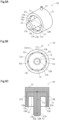
- FIG. 3(A) is a perspective view schematically illustrating an example of the suction portion 10 provided in the head 126 of the apparatus for taking out molded product 120 according to the one embodiment of the present invention.
- FIG. 3(B) is a front view schematically illustrating the suction portion 10.
- FIG. 3(C) is a transverse cross-sectional view schematically illustrating the suction portion 10.
- FIG. 4(A) is a front view schematically illustrating the state where the suction portion 10 illustrated in FIGS. 3(A) to 3(C) holds the hollow molded product 20.
- FIG. 3(B) is a transverse cross-sectional view schematically illustrating the state where the suction portion 10 holds the hollow molded product 20.
- the hollow molded product 20 in this embodiment is a closed-bottom cylindrical beverage container, including an opening portion (21) served as an opening for drinking, a body portion 23 made up of a cylinder with the same diameter, and a shoulder portion 22 smoothly connecting to the opening portion 21. Since the opening portion 21 is configured to be sealed by heat sealing, the hollow molded product 20 does not have a flange portion (cap screw portion) like the flange portion used to hold a molded product by the foregoing related-art apparatus for taking out molded product.
- the opening portion 21 is formed as a thick portion whose entire circumference is thicker than the wall thickness of the other parts of the hollow molded product 20, at the time of injection molding of the foregoing closed-bottom parison as the preform 19.
- each of the plural suction portions 10 provided in the head 126 of the apparatus for taking out molded product 120 has a structure in which an insert portion 12 and an abutting portion 13 are formed at a circular columnar base plate 11.
- the insert portion 12 has a circular columnar shape concentric with the centerline of the base plate 11 and extending along an imaginary centerline of the base plate 11.
- the diameter of the transverse cross section of the insert portion 12 is smaller than the diameter of the opening portion 21 of the hollow molded product 20 to be taken out.
- the opening portion 21 is an extraction port for a blow pin inserted in the hollow molded product 20 in order to blow-mold the hollow molded product 20 in the blow mold, and the insert portion 12 is inserted in the hollow molded product 20 through the opening portion 21.
- the insert portion 12 has, at a distal end part, plural suction ports 12b that suck the ambient atmosphere.
- the insert portion 12 has one suction port 12b at the center of a distal end 12a, and the four suction ports 12b formed at equal intervals on the outer circumferential surface near the distal end 12a.
- Each suction port 12b is connected to an air flow path 12c arranged in the insert portion 12, and the other end of the air flow path 12c is connected to a pipe connection portion 15 protruding from the outer circumferential surface of the base plate 11.
- a vacuum pump or a vacuum generator is, for example, connected to the pipe connection portion 15 through an open/close valve or the like. Switching the opening and closing of the open/close valve and the supply and no-supply of a pressurized gas to the vacuum generator performs on and off the suction by the plural suction ports 12b (sucking state and non-sucking state).
- the non-sucking state includes a pressurized state, as will be described later.
- the abutting portion 13 has a cylindrical shape extending along the imaginary centerline of the base plate 11 so as to be concentric with the imaginary centerline of the base plate 11.
- the length in the axial direction of the abutting portion 13 is smaller than the length in the axial direction of the insert portion 12.
- the outer diameter of the base plate 11 and the outer diameter of the abutting portion 13 are the same, and the outer circumferential surface of the base plate 11 and the outer circumferential surface of the abutting portion 13 form a continuous outer circumferential surface.
- annular recess 14 is provided between the insert portion 12 and the abutting portion 13.
- the annular recess 14 accommodates the opening portion 21 of the hollow molded product 20 to be taken out.
- an annular abutting surface 13b of the cylindrical abutting portion 13 continuously abuts on the outer circumferential surface of the hollow molded product 20 spaced apart by a predetermined distance from the opening portion 21 of the hollow molded product 20.
- the abutting portion 13 abuts on the outer circumferential surface formed of the shoulder portion 22, as illustrated in FIG. 4 (A) and FIG. 4 (B) .
- the annular recess 14 forms a closed space 26 communicating with an internal space 24 of the hollow molded product 20.
- the closed space 26 is not necessary a completely airtight closed space and may be any space that can reduce the pressure in the hollow molded product 20 by the suction through the suction port 12b of the insert portion 12.
- the inside of the hollow molded product 20 can be depressurized by the suction through the suction port 12b of the insert portion 12, for example, a configuration in which a gap exists between the outer circumferential surface of the hollow molded product 20 and the abutting surface 13b of the abutting portion 13, or a configuration in which a penetration hole, an opening portion or the like exists on the cylindrical surface forming the abutting surface 13b of the abutting portion 13, may be adopted.
- an inclined surface aligned with the shoulder portion 22 of the hollow molded product 20 forms the abutting surface 13b, as illustrated in FIG. 4(A) and FIG. 4(B) .
- the abutting surface 13b formed by the inclined surface is provided with a predetermined width at the inner circumferential edge of the abutting portion 13.
- the abutting portion 13 has additional suction ports 13c that suck the outer circumferential surface of the hollow molded product 20, on the inclined surface, which is the abutting surface 13b abutting on the hollow molded product 20.
- the six additional suction ports 13c are arranged at equal intervals on the inclined surface, which is the abutting surface 13b.
- Each additional suction port 13c is connected to an air flow path 13d arranged in the abutting portion 13, and the other end of the air flow path 13d is connected to the air flow path 12c.
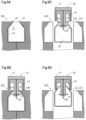
- FIGS. 5(A) to 5(D) are views schematically illustrating the process for the foregoing suction portion 10 to hold the hollow molded product 20.
- FIG. 5(A) is a view illustrating the state where the blow pin-rod 233 or 234 having injected the blow air is extracted from the opening portion 21 of the hollow molded product 20, which is the blow pin extraction port, after the preform 19 [ FIG. 2(A) ] is molded by the blow air into the shape corresponding to the cavity 221 of the movable mold 202, which is the blow mold.
- the movable mold 202 is bisected along a vertical plane including the imaginary centerline of the body portion 23 of the hollow molded product 20.
- a space is formed so that the hollow molded product 20 can be taken out in the vertical direction or the direction in which the imaginary centerline of the body portion 23 extends, without interfering with the movable mold 202.
- a recess aligned with the foregoing thick portion forming the opening portion 21 is provided at a position corresponding to the opening portion 21 of the hollow molded product 20.
- the preform 19 is arranged in the cavity 221 of the movable mold 202, the entirety of the preform 19 is accommodated in the movable mold 202 and the preform 19 (and the hollow molded product 20) has a configuration without having a portion protruding out of the movable mold 202.
- the suction portion 10 is arranged in relation to the hollow molded product 20 so that the opening portion 21 and the insert portion 12 face each other, and the insert portion 12 is inserted in the hollow molded product 20 through the opening portion 21, as illustrated in FIG. 5(B) .
- the insert portion 12 is inserted in the hollow molded product 20 by moving in the horizontal direction.
- the length in the direction of the imaginary centerline of the insert portion 12 is designed in such a way that the distal end 12a of the insert portion 12 is in the state of being arranged nearby a changeover part between the shoulder portion 22 and the body portion 23, in the direction in which the imaginary centerline of the hollow molded product 20 extends.
- the movable mold 202 is put into the split-mold opened state, as illustrated in FIG. 5(C) .
- the hollow molded product 20 moves to the proximal end (base plate 11) of the insert portion 12 due to the air flow flowing in from the opening portion 21.
- the opening portion 21 of the hollow molded product 20 is accommodated in the recess 14 and the shoulder portion 22 of the hollow molded product 20 abuts on the inclined surface, which is the abutting surface 13b of the abutting portion 13, as illustrated in FIG. 5(D) .
- a continuous hollow space is formed by the recess 14 and the internal space of the hollow molded product 20.
- the movement of the opening portion 21 to the recess 14 is prompted by the air flow caused by the suction through the suction ports 13c of the abutting portion 13, and the state where the shoulder portion 22 abuts on the abutting surface 13b is maintained by the suction through the suction ports 13c. Also, since the suction of the ambient atmosphere from the suction ports 12b of the insert portion 12 is continued even in this state, the shoulder portion 22 of the hollow molded product 20 is pressed against the abutting surface 13b and the shoulder portion 22 of the hollow molded product 20 is supported by the abutting portion 13 more securely.
- the hollow molded product 20 can be taken out from the movable mold 202.
- the molding system 100 (apparatus for taking out molded product 120) including the suction portion 10 according to this embodiment, even the hollow molded product 20 without having a portion protruding from the movable mold 202 can be taken out from the movable mold 202 without coming into contact with the opening portion 21 and the inner surface of the hollow molded product 20.
- a hollow molded product to which a reduction in thickness and weight or a material change to use a biodegradable resin or the like is applied can be taken out from the blow mold while avoiding damage to the hollow molded product and contamination of the opening portion.
- the abutting surface 13b formed by the inclined surface at the inner circumferential edge of the abutting portion 13 may be formed by a corner portion or a curved surface.
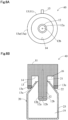
- FIG. 6(A) is a front view schematically illustrating the suction portion 40.
- FIG. 6(B) is a transverse cross-sectional view schematically illustrating the suction portion 40.
- the suction portion 40 illustrated in FIG. 6(A) and FIG. 6 (B) is different from the suction portion 10 described when using FIGS. 3(A) to 3(C) only in the configuration of the abutting portion 13.
- the other configurations are the same and therefore the same elements are denoted by the same reference numerals as in FIGS. 3(A) to 3(C) .
- the suction portion 40 is used in place of the foregoing suction portion 10 in the molding system 100.
- the suction portion 40 differs from the foregoing suction portion 10 in having an elastic member 13e at a position with a predetermined length from a distal end 13a of the abutting portion 13 including an abutting surface abutting on the hollow molded product 20.
- the material of the elastic member 13e is not particularly limited, for example, a rubber material such as silicone rubber, nitrile rubber or urethane rubber can be utilized.
- the suction portion 40 also differs in not having the abutting surface 13b formed by an inclined surface, the additional suction ports 13c, and the air flow path 13d provided in the foregoing suction portion 10, since the elastic member 13e forms the entirety of the distal end 13a of the abutting portion 13.
- any shape such as a curved surface can be adopted as the surface shape of the elastic member 13e.
- a configuration without having the abutting surface 13b formed by an inclined surface, the additional suction ports 13c, and the air flow path 13d is configured in the example illustrated in FIG. 6 , even the abutting portion 13 having the elastic member 13e can have the abutting surface 13b formed by an inclined surface, the additional suction ports 13c, and the air flow path 13d.
- the entirety of the abutting portion 13 or the entirety of the suction portion 40 may be formed by an elastic member.
- the suction ports 12b of the insert portion 12 of the suction portion 10 need to function as an injection port that injects a pressurized gas. Therefore, in this example, a vacuum system that provides a suction force for the suction ports 12b and a gas supply system that supplies a pressurized gas to the suction ports 12b are connected in a switchable manner to the pipe connection portion 15 of the suction portion 10.
- Such a configuration can be achieved, for example, by using a vacuum pump as the vacuum system and using a compressor as the gas supply system, and connecting each system and the pipe connection portion 15 through a three-way valve or the like.
- a vacuum pump as the vacuum system
- a compressor as the gas supply system
- This configuration can achieve the function as the vacuum system by supplying a pressurized gas from the compressor to the ejector and can also make the compressor function as the gas supply system.
- FIG. 7(A) is a view illustrating the state where, after a preform is molded into a shape corresponding to a cavity 241 of a movable mold 204 by a blow air, the blow pin (the foregoing blow pin-rod 233 or 234) that has injected the blow air is extracted from the opening portion 21 of the hollow molded product 20, which is the blow pin extraction port.
- the movable mold 204 is utilized in place of the foregoing movable mold 202 in the molding system 100.
- the movable mold 204 is configured in such a way that a mold portion 242 corresponding to the bottom portion of the hollow molded product 20 does not move when in the split-mold opened state.
- the movable mold 204 except for the mold portion 242 is bisected along a vertical plane including the imaginary centerline of the body portion 23 of the hollow molded product 20 and can perform split-mold opening and closing actions, similarly to the movable mold 202.
- the hollow molded product 20 when in the split-mold opened state, a space is formed so that the hollow molded product 20 can be taken out in the vertical direction or the direction in which the imaginary centerline of the body portion 23 extends, without interfering with the movable mold 204.
- the suction portion 10 is arranged so that the opening portion 21 and the insert portion 12 are in a positional relationship facing each other, and the insert portion 12 is inserted into the hollow molded product 20 through the opening portion 21, as illustrated in FIG. 7(B) .
- the state is switched to a state in which a pressurized gas is injected from the suction ports 12b of the insert portion 12 and the additional suction ports 13c of the abutting portion 13. That is, when the suction ports 13c are switched to the injection port, the hollow molded product 20 turns into the state of being pressed against the movable mold 204.
- the movable mold 204 except for the mold portion 242 facing to the bottom portion of the hollow molded product 20 is put into the split-mold opened state, the hollow molded product 20 is held in the state where the bottom portion of the hollow molded product 20 is pressed against the mold portion 242 facing to the bottom portion, as illustrated in FIG. 7(C) .
- the suction ports 12b of the insert portion 12 and the additional suction ports 13c of the abutting portion 13 are switched to the sucking state.
- the ambient atmosphere is sucked from the suction ports 12b of the insert portion 12 and an air flow flowing into the hollow molded product 20 from outside through the opening portion 21 is generated.
- the hollow molded product 20 moves to the proximal end of the insert portion 12 due to the air flow flowing in from the opening portion 21.
- the opening portion 21 of the hollow molded product 20 is accommodated in the recess 14 and the shoulder portion 22 of the hollow molded product 20 abuts on the abutting surface 13b formed by the inclined surface of the abutting portion 13, as illustrated in FIG.
- the shoulder portion 22 of the hollow molded product 20 is supported by the abutting portion 13 more securely, as in the example illustrated in FIG. 5(D) .
- the abutting surface 13b formed by the inclined surface may be brought closer to the shoulder portion 22 and furthermore the abutting surface 13b formed by the inclined surface may be made to abut on the shoulder portion 22, by moving the suction portion 10 in the direction of the hollow molded product 20.
- the hollow molded product 20 can be taken out from the movable mold 204.
- the hollow molded product 20 without having a portion protruding from the movable mold 204 can be taken out from the movable mold 204 without coming into contact with the opening portion 21 and the inner surface of the hollow molded product 20.
- a molded product to which a reduction in thickness and weight or a material change to use a biodegradable resin or the like is applied can be taken out from the blow mold while avoiding damage to the hollow molded product and contamination of the opening portion.
- the additional suction ports 13c can also be utilized as an injection port to inject a pressurized gas. Therefore, for example, when releasing the hollow molded product 20 that has been taken out, from the apparatus for taking out molded product 120, the hollow molded product 20 can be more securely released by injecting a pressurized gas from the suction ports 13c served as the injection port of the abutting portion 13.
- the abutting portion 13 it is not essential for the abutting portion 13 to include both the suction ports and the injection port, and a configuration in which the abutting portion 13 does not have either one of the suction ports and the injection port or has neither one, can be adopted.
- an ejector is arranged outside the suction portion 10
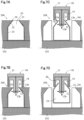
- FIG. 8(A) is a view illustrating the state where, after a preform is molded into a shape corresponding to a cavity 251 of a movable mold 205 by a blow air, the blow pin (the foregoing blow pin-rod 233 or 234) that has injected the blow air is extracted from the opening portion 21 of the hollow molded product 20, which is the blow pin extraction port.
- the movable mold 205 is utilized in place of the foregoing movable mold 202 in the molding system 100.
- the movable mold 205 comprises the first mold member 252 forming a cavity portion abutting on a circumferential edge portion of the bottom portion of the hollow molded product 20, and the second mold member 253 forming a cavity portion abutting on a center portion of the bottom portion of the hollow molded product 20.
- the second mold member 253 is a circular columnar member concentric with the imaginary centerline of the body portion 23 of the hollow molded product 20 and is configured to be able to move forward and backward in the axial direction by a drive source such as a hydraulic cylinder or the like, not illustrated.
- the movable mold 205 is bisected along a vertical plane including the imaginary centerline of the body portion 23 of the hollow molded product 20 and can perform split-mold opening and closing actions, similarly to the movable mold 202.
- a space is formed so that the hollow molded product 20 can be taken out in the vertical direction or the direction in which the imaginary centerline of the body portion 23 extends, without interfering with the movable mold 204.
- the first mold member 252 has a first bottom wall surface portion 251Aa of a bottom wall surface 251A of a cavity 251, as a constituent surface of the cavity.
- the second mold member 253 is provided adjacent to the first mold member 252 and has a second bottom wall surface portion 251Ab of the bottom wall surface 251A of the cavity 251, as a constituent surface of the cavity.
- the first bottom wall surface portion 251Aa of the first mold member 252 and the second bottom wall surface portion 251Ab of the second mold member 253 form the bottom wall surface 251A of the cavity 251 when in the closed-mold state.
- the mold equipment 114 sucks and holds the hollow molded product to the first bottom wall surface portion 251Aa of the first mold member 252.
- the second mold member 253 is moved in such a way as to form the recessed part 254 between the second bottom wall surface portion 251Ab of the second mold member 253 and the outer surface of the hollow molded product. Also, with the movement of the second mold member 253, a suction port 255a is exposed, the suction port 255a being provided in the wall surface of the recessed part 254 formed by the first mold member 252.
- the suction port 255a is connected to an air flow path 255 provided in the first mold member 252, and the other end of the air flow path 255 is connected to a vacuum pump or a vacuum generator through an open/close valve or the like.
- the suction port 255a By switching the opening and closing of the open/close valve and the supply and non-supply of a pressurized gas to the vacuum generator, on and off (sucking state and non-sucking state) of the suction at the suction port 255a are switched.
- the suction port 255a also functions as an injection port that injects a pressurized gas. Therefore, a vacuum system that provides a suction force for the suction port 255a and a gas supply system that supplies a pressurized gas to the suction port 255a are connected in a switchable manner to the other end of the air flow path 255.
- the suction port 255a As the suction port 255a is exposed in the recessed part 254 with the movement of the second mold member 253, the suction port 255a is switched to the sucking state.
- the hollow molded product 20 is in the state of being sucked and held in the state where the circumferential edge portion of the bottom surface abuts on the first mold member 252. That is, the mold equipment 114 can be put in the suction-holding state where the hollow molded product is sucked and held at the first bottom wall surface portion 251Aa of the first mold member 252, by bringing into a depressurized state in the recessed part 254.
- the suction portion 10 is arranged in the state where the opening portion 21 and the insert portion 12 face each other, and the insert portion 12 is inserted into the hollow molded product 20 through the opening portion 21, as illustrated in FIG. 8(B) .
- the suction ports 12b of the insert portion 12 and the suction ports 13c of the abutting portion 13 are switched to the sucking state.
- the ambient atmosphere is sucked from the suction ports 12b of the insert portion 12 and an air flow flowing into the hollow molded product 20 from outside through the opening portion 21 is generated.
- bringing into a nondepressurized state in the recessed part 254 forms the non-suction-holding state where the hollow molded product is not sucked and held at the first bottom wall surface portion 251Aa of the first mold member 252.
- the suction port 255a exposed in the recessed part 254 is switched to the state of injecting the pressurized gas.
- the sucking and holding of the bottom portion of the hollow molded product 20 is cancelled, and the hollow molded product 20 moves to the proximal end side of the insert portion 12 due to the pressurized gas injected from the suction port 255a and the air flow flowing in from the opening portion 21.
- the opening portion 21 of the hollow molded product 20 is accommodated in the recess 14 and the shoulder portion 22 of the hollow molded product 20 abuts on the abutting surface 13b formed by the inclined surface of the abutting portion 13, as illustrated in FIG. 8(D) .
- the shoulder portion 22 of the hollow molded product 20 is supported by the abutting portion 13 more securely, as in the example illustrated in FIG.
- the abutting surface 13b may be brought closer to the shoulder portion 22 and furthermore the abutting surface 13b may be made to abut on the outer circumferential surface forming the shoulder portion 22, by moving the suction portion 10 in the direction of the hollow molded product 20 when the movable mold 205 is put in the split-mold opened state.
- the hollow molded product 20 can be taken out from the movable mold 204.
- the hollow molded product 20 without having a portion protruding from the movable mold 204 can be taken out from the movable mold 204 without coming into contact with the opening portion 21 and the inner surface of the hollow molded product 20.
- a hollow molded product to which a reduction in thickness and weight or a material change to use a biodegradable resin or the like is applied can be taken out from the blow mold in the state where damage to the molded product and contamination of the opening portion are avoided.
- the suction port 255a is also served as an injection port to inject a pressurized gas
- a configuration in which the recessed part 254 has an injection port provided independently of the suction port 255a can be adopted.
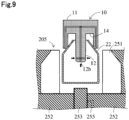
- the second mold member 253 may be provided to be movable in the direction of pressing the hollow molded product 20, as illustrated in FIG. 9 , in place of the injection port to inject the pressurized gas.
- the insert portion 12 is inserted in the hollow molded product 20 when in the split-mold closed state as illustrated in FIG. 8(B) in view of the fall prevention of the hollow molded product 20.
- the insert portion 12 may be inserted into the hollow molded product 20 when after turned into the split-mold opened state.
- the second mold member 253 is driven.
- the first mold member 252 and the second mold member 253 may be required to be movable relatively to each other. Also, it is not essential to provide the suction port 255a.
- a suction force to the molded product can be generated by arranging the cavity constituent surface of the first mold member and the cavity constituent surface of the second mold member differently from the closed-mold state.
- a configuration in which the molded product is sucked and held by this suction force may be also adopted.
- the part of the molded product that is sucked and held is not limited to the bottom portion, and other parts may be sucked and held.
- the number, shape, and arrangement position of suction ports, and the number, shape, and arrangement position of injection ports in the above-described suction portion are simply examples and can be modified where appropriate.
- the number, shape, and arrangement position of recesses and protrusions in the above-described mold equipment are simply examples and can be modified where appropriate.
- the physical shape and material of the foregoing elements can be arbitrarily modified within a scope that achieves the effects of the present invention.
- a molded product without having a portion protruding from the blow mold can be taken out from the blow mold without coming into contact with the opening portion and the inner surface, and this is advantageous as a molding system, an apparatus for taking out molded product, a mold equipment, a molding machine, and a method for driving a mold equipment.
Landscapes
- Engineering & Computer Science (AREA)
- Manufacturing & Machinery (AREA)
- Mechanical Engineering (AREA)
- Moulds For Moulding Plastics Or The Like (AREA)
- Blow-Moulding Or Thermoforming Of Plastics Or The Like (AREA)
Applications Claiming Priority (2)
| Application Number | Priority Date | Filing Date | Title |
|---|---|---|---|
| JP2021159205 | 2021-09-29 | ||
| PCT/JP2022/036438 WO2023054584A1 (fr) | 2021-09-29 | 2022-09-29 | Système de moulage, machine d'extraction d'article moulé, dispositif de moulage et méthode de fabrication d'un article moulé creux |
Publications (2)
| Publication Number | Publication Date |
|---|---|
| EP4410514A1 true EP4410514A1 (fr) | 2024-08-07 |
| EP4410514A4 EP4410514A4 (fr) | 2025-09-24 |
Family
ID=85782886
Family Applications (1)
| Application Number | Title | Priority Date | Filing Date |
|---|---|---|---|
| EP22876448.6A Pending EP4410514A4 (fr) | 2021-09-29 | 2022-09-29 | Système de moulage, machine d'extraction d'article moulé, dispositif de moulage et méthode de fabrication d'un article moulé creux |
Country Status (5)
| Country | Link |
|---|---|
| US (1) | US20240399644A1 (fr) |
| EP (1) | EP4410514A4 (fr) |
| JP (1) | JPWO2023054584A1 (fr) |
| CN (1) | CN118043190A (fr) |
| WO (1) | WO2023054584A1 (fr) |
Family Cites Families (13)
| Publication number | Priority date | Publication date | Assignee | Title |
|---|---|---|---|---|
| US3851030A (en) * | 1971-12-23 | 1974-11-26 | E Valvi | Method for the production of composite containers |
| BE795708A (fr) * | 1972-02-24 | 1973-08-21 | Franc De Comp | Moules et procede pour le soufflage de corps creux en matiere plastique |
| US4437825A (en) * | 1981-11-13 | 1984-03-20 | The Continental Group, Inc. | Blow molding apparatus |
| US5051227A (en) * | 1988-12-05 | 1991-09-24 | Electra Form, Inc. | Production of preforms and blow molded articles |
| JP3317549B2 (ja) * | 1993-05-28 | 2002-08-26 | 日精エー・エス・ビー機械株式会社 | 射出延伸ブロー成形機 |
| JP4283181B2 (ja) | 2004-07-28 | 2009-06-24 | 住友重機械工業株式会社 | 吹込成形方法 |
| JP2006315266A (ja) * | 2005-05-12 | 2006-11-24 | Toppan Printing Co Ltd | 二軸延伸ブロー成形方法 |
| JP2007069241A (ja) | 2005-09-07 | 2007-03-22 | Toyo Seikan Kaisha Ltd | ロータリー式ブロー成形装置及びロータリー式ブロー成形方法 |
| WO2012033888A2 (fr) * | 2010-09-08 | 2012-03-15 | Salflex Polymers, Ltd. | Procédé, appareil et article de moulage par soufflage |
| JP6802741B2 (ja) * | 2017-03-27 | 2020-12-16 | 株式会社吉野工業所 | 容器製造方法 |
| JP6843671B2 (ja) | 2017-03-29 | 2021-03-17 | 住友重機械工業株式会社 | 射出成形機 |
| JP7166439B2 (ja) * | 2019-04-08 | 2022-11-07 | 日精エー・エス・ビー機械株式会社 | 冷却用金型、樹脂成形品の製造装置および製造方法 |
| WO2021060497A1 (fr) * | 2019-09-27 | 2021-04-01 | 日精エー・エス・ビー機械株式会社 | Procédé de production d'un récipient en résine et dispositif de production d'un récipient en résine |
-
2022
- 2022-09-29 CN CN202280065519.0A patent/CN118043190A/zh active Pending
- 2022-09-29 JP JP2023551846A patent/JPWO2023054584A1/ja active Pending
- 2022-09-29 US US18/695,217 patent/US20240399644A1/en active Pending
- 2022-09-29 WO PCT/JP2022/036438 patent/WO2023054584A1/fr not_active Ceased
- 2022-09-29 EP EP22876448.6A patent/EP4410514A4/fr active Pending
Also Published As
| Publication number | Publication date |
|---|---|
| WO2023054584A1 (fr) | 2023-04-06 |
| US20240399644A1 (en) | 2024-12-05 |
| CN118043190A (zh) | 2024-05-14 |
| EP4410514A4 (fr) | 2025-09-24 |
| JPWO2023054584A1 (fr) | 2023-04-06 |
Similar Documents
| Publication | Publication Date | Title |
|---|---|---|
| US11731337B2 (en) | Blow molding device and blow molding method | |
| JP6124920B2 (ja) | 成形装置のシールシステム | |
| US10093048B2 (en) | Molding system and method of manufacturing molded article | |
| US11472091B2 (en) | Two step blow molding unit, apparatus and method | |
| EP3717199B1 (fr) | Appareil de moulage par soufflage | |
| JP2009539639A (ja) | インサート部品内蔵形押出ブロー成形品製造用成形金型 | |
| US9050744B2 (en) | Apparatus and method for shaping plastics material preforms | |
| CN103459119B (zh) | 用于预成形件的模具叠层 | |
| US10350813B2 (en) | Universal in-mold labeling apparatus and system incorporating the apparatus | |
| CN105946202A (zh) | 吹塑模单元和使用该吹塑模单元的吹塑成形机 | |
| AU2016284878B2 (en) | Container manufacturing apparatus | |
| US12325172B2 (en) | Method for producing delamination container and apparatus for producing delamination container | |
| US10442129B2 (en) | Blow molding machine with molds moved mechanically and without the aid of electrical, hydraulic or pneumatic devices | |
| EP4410514A1 (fr) | Système de moulage, machine d'extraction d'article moulé, dispositif de moulage et méthode de fabrication d'un article moulé creux | |
| US12318989B2 (en) | Method for manufacturing resin wide-mouthed container, manufacturing device, and resin wide-mouthed container | |
| KR102227992B1 (ko) | 성형품의 양측 목에 절개선을 형성시키는 블로우 몰딩장치 | |
| KR102225042B1 (ko) | 사출 금형장치 | |
| US20070248713A1 (en) | Vertical alternation type bottle blower | |
| JPWO2023054584A5 (fr) | ||
| EP1839841A1 (fr) | Dispositif de moulage par soufflage de type alternance verticale | |
| JP2003320576A (ja) | 延伸ブロー成形ユニット及び射出延伸ブロー成形機 | |
| CN121179710A (zh) | 一种瓶子加工设备 | |
| KR20020033795A (ko) | 몰딩 머신 | |
| WO2008011702A1 (fr) | Structure pneumatique | |
| US20230219275A1 (en) | Hot-runner mold and device for manufacturing resin container |
Legal Events
| Date | Code | Title | Description |
|---|---|---|---|
| STAA | Information on the status of an ep patent application or granted ep patent |
Free format text: STATUS: THE INTERNATIONAL PUBLICATION HAS BEEN MADE |
|
| PUAI | Public reference made under article 153(3) epc to a published international application that has entered the european phase |
Free format text: ORIGINAL CODE: 0009012 |
|
| STAA | Information on the status of an ep patent application or granted ep patent |
Free format text: STATUS: REQUEST FOR EXAMINATION WAS MADE |
|
| 17P | Request for examination filed |
Effective date: 20240403 |
|
| AK | Designated contracting states |
Kind code of ref document: A1 Designated state(s): AL AT BE BG CH CY CZ DE DK EE ES FI FR GB GR HR HU IE IS IT LI LT LU LV MC MK MT NL NO PL PT RO RS SE SI SK SM TR |
|
| DAV | Request for validation of the european patent (deleted) | ||
| DAX | Request for extension of the european patent (deleted) | ||
| A4 | Supplementary search report drawn up and despatched |
Effective date: 20250825 |
|
| RIC1 | Information provided on ipc code assigned before grant |
Ipc: B29C 45/73 20060101AFI20250819BHEP Ipc: B29C 49/42 20060101ALI20250819BHEP Ipc: B29C 49/70 20060101ALI20250819BHEP Ipc: B29C 49/02 20060101ALN20250819BHEP Ipc: B29C 49/06 20060101ALN20250819BHEP Ipc: B29C 49/28 20060101ALN20250819BHEP Ipc: B29C 49/48 20060101ALN20250819BHEP Ipc: B29C 49/54 20060101ALN20250819BHEP Ipc: B29L 31/00 20060101ALN20250819BHEP |