EP4411121A1 - Dérivation d'échangeur de chaleur à cycle de fond de moteur à turbine - Google Patents
Dérivation d'échangeur de chaleur à cycle de fond de moteur à turbine Download PDFInfo
- Publication number
- EP4411121A1 EP4411121A1 EP24155872.5A EP24155872A EP4411121A1 EP 4411121 A1 EP4411121 A1 EP 4411121A1 EP 24155872 A EP24155872 A EP 24155872A EP 4411121 A1 EP4411121 A1 EP 4411121A1
- Authority
- EP
- European Patent Office
- Prior art keywords
- bottoming
- heat
- heat exchanger
- fluid flow
- flow
- Prior art date
- Legal status (The legal status is an assumption and is not a legal conclusion. Google has not performed a legal analysis and makes no representation as to the accuracy of the status listed.)
- Pending
Links
- 239000012530 fluid Substances 0.000 claims abstract description 108
- 238000011144 upstream manufacturing Methods 0.000 claims abstract description 10
- 239000000446 fuel Substances 0.000 claims description 47
- 238000000034 method Methods 0.000 claims description 8
- 238000004891 communication Methods 0.000 claims description 7
- 238000010438 heat treatment Methods 0.000 claims description 5
- 238000005461 lubrication Methods 0.000 claims description 3
- 230000001105 regulatory effect Effects 0.000 claims description 3
- 239000007789 gas Substances 0.000 description 38
- 230000001141 propulsive effect Effects 0.000 description 4
- OKTJSMMVPCPJKN-UHFFFAOYSA-N Carbon Chemical compound [C] OKTJSMMVPCPJKN-UHFFFAOYSA-N 0.000 description 3
- 229910052799 carbon Inorganic materials 0.000 description 3
- 229910052739 hydrogen Inorganic materials 0.000 description 3
- 239000001257 hydrogen Substances 0.000 description 3
- UFHFLCQGNIYNRP-UHFFFAOYSA-N Hydrogen Chemical compound [H][H] UFHFLCQGNIYNRP-UHFFFAOYSA-N 0.000 description 2
- 238000010521 absorption reaction Methods 0.000 description 2
- 230000000712 assembly Effects 0.000 description 2
- 238000000429 assembly Methods 0.000 description 2
- 238000011084 recovery Methods 0.000 description 2
- 239000002918 waste heat Substances 0.000 description 2
- 230000009286 beneficial effect Effects 0.000 description 1
- 239000002551 biofuel Substances 0.000 description 1
- 230000008030 elimination Effects 0.000 description 1
- 238000003379 elimination reaction Methods 0.000 description 1
- 230000007613 environmental effect Effects 0.000 description 1
- 239000002828 fuel tank Substances 0.000 description 1
- 150000002431 hydrogen Chemical class 0.000 description 1
- 239000007788 liquid Substances 0.000 description 1
- 238000012986 modification Methods 0.000 description 1
- 230000004048 modification Effects 0.000 description 1
Images

Classifications
-
- F—MECHANICAL ENGINEERING; LIGHTING; HEATING; WEAPONS; BLASTING
- F02—COMBUSTION ENGINES; HOT-GAS OR COMBUSTION-PRODUCT ENGINE PLANTS
- F02C—GAS-TURBINE PLANTS; AIR INTAKES FOR JET-PROPULSION PLANTS; CONTROLLING FUEL SUPPLY IN AIR-BREATHING JET-PROPULSION PLANTS
- F02C1/00—Gas-turbine plants characterised by the use of hot gases or unheated pressurised gases, as the working fluid
- F02C1/007—Gas-turbine plants characterised by the use of hot gases or unheated pressurised gases, as the working fluid combination of cycles
-
- F—MECHANICAL ENGINEERING; LIGHTING; HEATING; WEAPONS; BLASTING
- F02—COMBUSTION ENGINES; HOT-GAS OR COMBUSTION-PRODUCT ENGINE PLANTS
- F02C—GAS-TURBINE PLANTS; AIR INTAKES FOR JET-PROPULSION PLANTS; CONTROLLING FUEL SUPPLY IN AIR-BREATHING JET-PROPULSION PLANTS
- F02C6/00—Plural gas-turbine plants; Combinations of gas-turbine plants with other apparatus; Adaptations of gas-turbine plants for special use
- F02C6/18—Plural gas-turbine plants; Combinations of gas-turbine plants with other apparatus; Adaptations of gas-turbine plants for special use using the waste heat of gas-turbine plants outside the plants themselves, e.g. gas-turbine power heat plants
-
- F—MECHANICAL ENGINEERING; LIGHTING; HEATING; WEAPONS; BLASTING
- F02—COMBUSTION ENGINES; HOT-GAS OR COMBUSTION-PRODUCT ENGINE PLANTS
- F02C—GAS-TURBINE PLANTS; AIR INTAKES FOR JET-PROPULSION PLANTS; CONTROLLING FUEL SUPPLY IN AIR-BREATHING JET-PROPULSION PLANTS
- F02C1/00—Gas-turbine plants characterised by the use of hot gases or unheated pressurised gases, as the working fluid
- F02C1/04—Gas-turbine plants characterised by the use of hot gases or unheated pressurised gases, as the working fluid the working fluid being heated indirectly
-
- F—MECHANICAL ENGINEERING; LIGHTING; HEATING; WEAPONS; BLASTING
- F02—COMBUSTION ENGINES; HOT-GAS OR COMBUSTION-PRODUCT ENGINE PLANTS
- F02C—GAS-TURBINE PLANTS; AIR INTAKES FOR JET-PROPULSION PLANTS; CONTROLLING FUEL SUPPLY IN AIR-BREATHING JET-PROPULSION PLANTS
- F02C7/00—Features, components parts, details or accessories, not provided for in, or of interest apart form groups F02C1/00 - F02C6/00; Air intakes for jet-propulsion plants
- F02C7/12—Cooling of plants
- F02C7/14—Cooling of plants of fluids in the plant, e.g. lubricant or fuel
- F02C7/141—Cooling of plants of fluids in the plant, e.g. lubricant or fuel of working fluid
-
- F—MECHANICAL ENGINEERING; LIGHTING; HEATING; WEAPONS; BLASTING
- F03—MACHINES OR ENGINES FOR LIQUIDS; WIND, SPRING, OR WEIGHT MOTORS; PRODUCING MECHANICAL POWER OR A REACTIVE PROPULSIVE THRUST, NOT OTHERWISE PROVIDED FOR
- F03G—SPRING, WEIGHT, INERTIA OR LIKE MOTORS; MECHANICAL-POWER PRODUCING DEVICES OR MECHANISMS, NOT OTHERWISE PROVIDED FOR OR USING ENERGY SOURCES NOT OTHERWISE PROVIDED FOR
- F03G7/00—Mechanical-power-producing mechanisms, not otherwise provided for or using energy sources not otherwise provided for
- F03G7/06—Mechanical-power-producing mechanisms, not otherwise provided for or using energy sources not otherwise provided for using expansion or contraction of bodies due to heating, cooling, moistening, drying or the like
- F03G7/064—Mechanical-power-producing mechanisms, not otherwise provided for or using energy sources not otherwise provided for using expansion or contraction of bodies due to heating, cooling, moistening, drying or the like characterised by its use
- F03G7/0641—Motors; Energy harvesting or waste energy recovery
-
- F—MECHANICAL ENGINEERING; LIGHTING; HEATING; WEAPONS; BLASTING
- F05—INDEXING SCHEMES RELATING TO ENGINES OR PUMPS IN VARIOUS SUBCLASSES OF CLASSES F01-F04
- F05D—INDEXING SCHEME FOR ASPECTS RELATING TO NON-POSITIVE-DISPLACEMENT MACHINES OR ENGINES, GAS-TURBINES OR JET-PROPULSION PLANTS
- F05D2220/00—Application
- F05D2220/30—Application in turbines
- F05D2220/32—Application in turbines in gas turbines
- F05D2220/323—Application in turbines in gas turbines for aircraft propulsion, e.g. jet engines
-
- F—MECHANICAL ENGINEERING; LIGHTING; HEATING; WEAPONS; BLASTING
- F05—INDEXING SCHEMES RELATING TO ENGINES OR PUMPS IN VARIOUS SUBCLASSES OF CLASSES F01-F04
- F05D—INDEXING SCHEME FOR ASPECTS RELATING TO NON-POSITIVE-DISPLACEMENT MACHINES OR ENGINES, GAS-TURBINES OR JET-PROPULSION PLANTS
- F05D2260/00—Function
- F05D2260/20—Heat transfer, e.g. cooling
- F05D2260/213—Heat transfer, e.g. cooling by the provision of a heat exchanger within the cooling circuit
Definitions
- the present disclosure relates generally to a bottoming cycle for a turbine engine and more particularly to a bottom cycle including a heat exchanger bypass flow path for increasing heat recovery compacity.
- Turbine engines compress incoming core airflow, mix the compressed airflow with fuel that is ignited in a combustor to generate a high energy exhaust gas flow. Energy in the high energy exhaust flow is recovered as it is expanded through a turbine section. Heat from the exhaust gas flow may be recovered in a bottoming cycle. The bottoming cycle may also recover heat from other engine and aircraft systems. Increasing heat recovery from other engine and aircraft systems can reduce a capacity of the bottoming cycle to recover heat from the exhaust gas flow.
- Turbine engine manufacturers continue to seek further improvements to engine performance, including improvements to reduce environmental impact while improving thermal and propulsive efficiencies.
- An aircraft propulsion system includes, a core engine assembly that generates an exhaust gas flow, a bottoming cycle that includes a bottoming fluid flow that is expanded through a bottoming turbine, a first heat exchanger where heat from the exhaust gas flow is transferred to heat the bottoming fluid flow, a second heat exchanger where heat from a secondary heat source is transferred to heat the bottoming fluid flow, the second heat exchanger is disposed upstream of the first heat exchanger such that heat from the secondary heat source preheats the bottoming fluid flow prior to accepting heat from the exhaust gas flow in the first heat exchanger, and a bypass flow passage where at least a portion of the bottoming fluid flow is routed around the second heat exchanger and into thermal communication with the exhaust gas flow in the first heat exchanger.
- the bottoming cycle includes a bottoming compressor that compresses the bottoming fluid flow upstream of at least the first heat exchanger.
- the bottoming compressor is coupled to the bottoming turbine.
- an exhaust bottoming fluid flow expelled from the bottoming turbine is communicated through the second heat exchanger for heating the bottoming fluid flow.
- the secondary heat source includes at least one of an engine lubrication system, a power electronic system or an electric machine.
- the aircraft propulsion system includes a control valve that regulates the bottoming fluid flow through the bypass flow passage and a controller that is programmed to operate the control valve to regulate bottoming fluid flow through the bypass flow passage based on temperature differential between the exhaust gas flow and the bottoming fluid flow to maintain a capacity of the bottoming fluid flow to absorb heat from the exhaust gas flow within a predefined range.
- the aircraft propulsion system includes at least a third heat exchanger where heat from a third heat source is communicated into the bottoming fluid flow and the bypass flow passage includes a portion that bypasses the third heat exchanger.
- the bottoming turbine generates shaft power that is coupled to drive at least one auxiliary system.
- the aircraft propulsion system includes a fuel system that is configured to supply a fuel flow to the core engine.
- the fuel system includes at least one fuel system heat exchanger that is configured to accept heat from the bottoming fluid flow.
- the aircraft propulsion system includes a fuel system turboexpander where a fuel flow heated in the fuel system heat exchanger is expanded to generate shaft power.
- the first heat exchanger includes a plurality of stages that are arranged from a forward stage to an aft stage and the bottoming fluid flow communicated through the bypass flow passage is communicated to the aft stage.
- a bottoming cycle assembly for an aircraft propulsion system includes, a first heat exchanger where heat from an exhaust gas flow is transferred to heat the bottoming fluid flow, a second heat exchanger where heat from a secondary heat source is transferred to heat the bottoming fluid flow, the second heat exchanger is disposed upstream of the first heat exchanger such that heat from the secondary heat source preheats the bottoming fluid flow prior to accepting heat from the exhaust gas flow in the first heat exchanger, a bottoming turbine where the heated bottoming fluid flow expands to drive a shaft, and a bypass flow passage where at least a portion of the bottoming fluid flow is routed around the second heat exchanger and into thermal communication with the exhaust gas flow in the first heat exchanger.
- the bottoming cycle includes a bottoming compressor that is coupled to the bottoming turbine.
- the bottoming compressor compresses the bottoming fluid flow upstream of at least the first heat exchanger.
- the bottoming fluid flow expelled from the bottoming turbine is communicated through the second heat exchanger for heating the bottoming fluid flow.
- the first heat exchanger includes a plurality of stages that are arranged from a forward stage to an aft stage and the bottoming fluid flow communicated through the bypass flow passage is communicated to the aft stage.
- the bottoming cycle assembly includes a control valve that regulates the bottoming fluid flow through the bypass flow passage and a controller that is programmed to operate the control valve to regulate bottoming fluid flow through the bypass flow passage based on temperature differential between the exhaust gas flow and the bottoming fluid flow to maintain a capacity of the bottoming fluid flow to absorb heat from the exhaust gas flow within a predefined range.
- the bottoming cycle assembly includes at least one fuel system heat exchanger that is configured to communicate heat from the bottoming flow into a fuel flow and a fuel system turboexpander where a fuel flow heated in the fuel system heat exchanger is expanded to generate shaft power.
- a method of recovering heat energy with a bottoming cycle of an aircraft propulsion system includes configuring a first heat exchanger to transfer heat from an exhaust gas flow of a core engine is transferred to heat a bottoming fluid flow, configuring a second heat exchanger to transfer heat from a secondary heat source into the bottoming fluid flow before transferring heat into the bottoming fluid flow from the exhaust gas flow in the first heat exchanger, bypassing a portion of the bottoming fluid flow around the second heat exchanger through a bypass flow passage such that heat from the secondary heat source is not input into the bottoming fluid flow prior to heat from the exhaust gas flow, and expanding the bottoming fluid flow through a bottoming turbine to generate shaft power.
- the bottoming cycle includes a bottoming compressor that is coupled to the bottoming turbine.
- the bottoming compressor compressing the bottoming fluid flow upstream of at least the first heat exchanger and an exhaust bottoming fluid flow expelled from the bottoming turbine is communicated through the second heat exchanger for heating the bottoming fluid flow before being compressed in the bottoming compressor.
- the method includes regulating a flow of bottoming fluid flow through the bypass flow passage with a control valve that is operated by a controller that is programmed based on temperature differential between the exhaust gas flow and the bottoming fluid flow to maintain a capacity of the bottoming fluid flow to absorb heat from the exhaust gas flow within a predefined range.
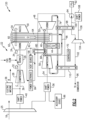
- Figure 1 schematically illustrates an aircraft propulsion system 20 including a core engine 22 and a bottoming cycle 48 with a bypass passage around secondary heat sources for a bottoming cycle flow.
- the bypass passage routes the bottoming cycle flow around other sources of heat to provide a desired amount of waste heat capture from an exhaust gas flow.
- the core engine 22 includes a compressor section 28, a combustor section 26 and the turbine section 24 disposed serially along an engine axis A.
- the turbine section 24 generates shaft power 40 that drives the compressor 28 and a propulsive fan 25 through a shaft 36.
- An inlet airflow 18 is driven along a bypass flow path B and a core flow path C.
- a core flow 32 is compressed and communicated to the combustor 26.
- the compressed core airflow 32 is mixed with fuel and ignited to generate a high energy combusted exhaust gas flow 34 that expands through the turbine 24 where energy is extracted and utilized to drive the compressor 28 and the propulsive fan 25 before being exhausted through nozzle 30.
- An electric machine 38 may be coupled to the shaft 36 and operate as either a generator to produce electric power or as an electric motor to input additional power.
- a fuel system 90 includes at least a fuel tank 92 and a fuel pump 94 to provide a fuel flow 100 that is eventually communicated to the combustor 26.
- the example fuel system 90 is configured to provide a hydrogen-based fuel such as a liquid hydrogen (LH 2 ).
- LH 2 liquid hydrogen
- hydrogen is disclosed by way of example, other non-carbon-based fuels could be utilized and are within the contemplation of this disclosure.
- the disclosed features may also be beneficial in an engine configured to operate with traditional carbon fuels and/or biofuels, such as sustainable aviation fuel.
- the example bottoming cycle 48 includes a bottoming fluid flow 46 that is heated in a heat exchanger 42 by the exhaust gas flow 34.
- the heated bottoming fluid flow 46 is expanded through a turbine 52 to generate shaft power 56.
- the shaft power 56 can be utilized to power engine accessory components and devices and/or be coupled to drive the propulsive fan 25.
- the example bottoming cycle 48 is a closed loop cycle where the bottoming fluid flow 46 is compressed in a bottoming compressor 50 heated by heat communicated from the exhaust gas flow 32 in the first heat exchanger 42 and expanded through the bottoming turbine 52.
- the bottoming turbine 52 produces shaft power 56 through a shaft 54 for driving the compressor section 50 and other accessory devices and/or auxiliary systems, shown schematically at 86.
- the bottoming turbine 52 generates shaft power coupled to drive at least one auxiliary system.
- the bottoming fluid flow 46 from the compressor 50 may also be heated by the exhaust flow from the turbine 52 in a second heat exchanger 44. Additional heat exchangers may also be provided to reject heat energy into the bottoming fluid flow 46.
- a third heat exchanger 80 transfers heat from a secondary heat source 58 and/or a power electronic system 84 into the bottoming fluid flow 46.
- the secondary heat source 58 may be an engine lubrication system, or an electric machine.
- other sources of heat associated with the core engine 22 and the aircraft may provide heat and are within the contemplation and scope of this disclosure.
- the bottoming fluid flow 46 may be cooled utilizing the fuel flow 100 as a heat sink.
- a fuel system heat exchanger 98 provides for thermal communication of a heated bottoming flow 74 exhausted from the turbine 52.
- a heated fuel flow 96 exhausted from the fuel system heat exchanger 98 is communicated to the combustor 26.
- Heat input into the bottoming fluid flow 46 from sources other than the exhaust gas flow 34 reduce the capacity of the bottoming fluid 46 to accept heat from the exhaust gas flow 34.
- heat input into the bottoming fluid 46 in the second heat exchanger 44 and the third heat exchanger 80 reduces the capacity of accepting heat from the exhaust gas flow 34.
- the reduced capacity of heat acceptance reduces the benefit provided by the bottoming cycle 48.
- the example bottoming cycle 48 includes a bypass flow passage 66 that routes at least a portion of the bottoming flow 46 around other heat input sources.
- the bypass passage 66 routes at least a portion of the bottoming fluid 46 around both the second heat exchanger 44 and the third heat exchanger 80.
- a bypassed bottoming fluid flow 72 through the bypass passage 66 is much cooler and therefore has a greater capacity for absorbing heat from the exhaust gas flow 34 than the fluid flow 46 communicated through the second and third heat exchangers 44, 80.
- a valve 68 is provided in the bypass passage 66 to control the amount of bottoming fluid 46 is routed around the other heat input sources.
- the valve 68 is controlled by a controller 70 that is programmed to operate the valve 68 to bypass a desired amount of bypassed bottoming fluid flow 72 around the second heat exchanger 44 and the third heat exchanger 80. All of the bottoming fluid 46 or some portion of the bottoming fluid 46 may be bypassed to provide for predefined amount of heat absorption capacity at the first heat exchanger 42.
- the bypass of bottoming fluid may be based on operational requirements or according to a predefined operating schedule.
- the example controller 70 is a device and system for performing necessary computing or calculation operations of the bottoming cycle 48 including the valve 68 and any other actuators that provide for the communication and control of bottoming cycle operation.
- the controller 70 may be specially constructed for operation of the bottoming cycle 48, including the valve 68, or it may comprise at least a general-purpose computer selectively activated or reconfigured by software instructions stored in a memory device.
- the controller 70 may further be part of full authority digital engine control (FADEC) or an electronic engine controller (EEC).
- the example controller 70 is programmed to control the bottoming cycle 48 by way of at least the control valve 68 to regulate the bottoming fluid flow 72 through the bypass flow passage 70.
- controller 70 is programmed to operate the control valve 68 to regulate bottoming fluid flow 72 through the bypass flow passage based on a temperature differential between the exhaust gas flow 34 and the bottoming fluid flow 72 to maintain a capacity of the bottoming fluid flow 72 to absorb heat from the exhaust gas flow 34 within a predefined range.
- the predefined range is a temperature differential that provides thermal energy to the bottoming cycle sufficient to generate a desired and/or predefined amount of power.
- the first heat exchanger 42 includes a plurality of stages 60 that include a first stage 62 and a last stage 64.
- the first stage 62 is closer to the turbine 24 than the last stage 64 and therefore the exhaust gas flow 34 is hottest within the first stage 62.
- the last stage 64 is furthest from the turbine 24 and therefore the exhaust gas flow 34 is the coolest in the last stage 64.
- the bypass passage 66 communicates the bypass bottoming fluid 72 into communication with the exhaust gas flow 34 within the last stage 64.
- the bypass bottoming fluid 72 could be communicated to other stages within the heat exchanger 42 and remain within the scope and contemplation of this disclosure.
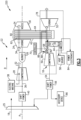
- FIG. 2 another example aircraft propulsion system 120 is schematically shown and includes a fuel system turboexpander 104. Heated fuel flow from the fuel system heat exchanger 98 is expanded through the turboexpander 104 to reclaim a portion of the heat energy input into the fuel flow 100.
- the fuel system turboexpander 104 drives a shaft 106 to generate additional shaft power 108.
- the additional shaft power 108 may be coupled to drive accessory devices or to provide a drive input utilized to generate thrust.
- Fuel exhausted from the turboexpander 104, schematically indicated at 102, is cooled and thereby includes an additional capacity for accepting heat.
- a second fuel system heat exchanger 110 may be used to further cool the bottom fluid flow 46.
- the second fuel system heat exchanger 110 is shown by way of example as accepting additional heat energy from the bottoming fluid flow 46, the second fuel system heat exchanger 110 may be utilized to cool other engine and/or aircraft systems within the contemplation and scope of this disclosure.
- FIG. 3 another example aircraft propulsion system 220 is schematically shown and includes an open loop bottoming cycle 78.
- An inlet flow such as the air inlet flow 18 is pressurized in the bottoming compressor 50, heated with heat from the exhaust gas flow 34 in the first heat exchanger 42 and expanded through the bottoming turbine 52 to generate the shaft power 56.
- the bottoming air flow 82 may be heated in the second heat exchanger 44 with heat communicated from alternate heat source 58 and/or the power electronic system 84.
- a portion of the bottoming air flow 82 may be bypassed as a bypass air flow 88 through the bypass passage 66 directly through the first heat exchanger 42 to enable a maximum amount of heat absorption from the exhaust gas flow 34.
- the controller 70 operates the valve 68 to control the amount of bottoming air flow 82 that is routed around the second heat exchanger 44.
- the valve 68 may be operated from a fully open position to a fully closed position and an infinite number of proportionally open positions between the fully open and closed positions. In the fully open position, all of the bottoming flow is bypassed around the second heat exchanger. In the fully closed position, all of the bottoming fluid flow is directed through the second heat exchanger.
- the controller 70 is programmed and configured to operate the valve 68 regulate bottoming fluid flow 72 through the bypass flow passage 66 based on a temperature differential between the exhaust gas flow 34 and the bottoming fluid flow 72 to maintain a capacity of the bottoming fluid flow 72 to absorb heat from the exhaust gas flow 34 within a predefined range.
- the example bottoming cycle embodiments provide for routing the bottoming cycle fluid around other sources of heat to tailor waste heat capture from the exhaust gas flow to engine operating requirements.
Landscapes
- Engineering & Computer Science (AREA)
- Chemical & Material Sciences (AREA)
- Combustion & Propulsion (AREA)
- Mechanical Engineering (AREA)
- General Engineering & Computer Science (AREA)
- Engine Equipment That Uses Special Cycles (AREA)
Applications Claiming Priority (3)
| Application Number | Priority Date | Filing Date | Title |
|---|---|---|---|
| US202363443113P | 2023-02-03 | 2023-02-03 | |
| US202363443109P | 2023-02-03 | 2023-02-03 | |
| US18/529,081 US12331680B2 (en) | 2023-02-03 | 2023-12-05 | Turbine engine bottoming cycle heat exchanger bypass |
Publications (1)
| Publication Number | Publication Date |
|---|---|
| EP4411121A1 true EP4411121A1 (fr) | 2024-08-07 |
Family
ID=89843752
Family Applications (1)
| Application Number | Title | Priority Date | Filing Date |
|---|---|---|---|
| EP24155872.5A Pending EP4411121A1 (fr) | 2023-02-03 | 2024-02-05 | Dérivation d'échangeur de chaleur à cycle de fond de moteur à turbine |
Country Status (2)
| Country | Link |
|---|---|
| US (1) | US12331680B2 (fr) |
| EP (1) | EP4411121A1 (fr) |
Cited By (1)
| Publication number | Priority date | Publication date | Assignee | Title |
|---|---|---|---|---|
| EP4686813A1 (fr) * | 2024-08-02 | 2026-02-04 | RTX Corporation | Système de commande de cycle de descente cryogénique |
Families Citing this family (1)
| Publication number | Priority date | Publication date | Assignee | Title |
|---|---|---|---|---|
| US20250207529A1 (en) * | 2023-12-21 | 2025-06-26 | The Boeing Company | Non-recuperated supercritical carbon-dioxide brayton cycle heating for liquid natural gas-powered engines |
Citations (3)
| Publication number | Priority date | Publication date | Assignee | Title |
|---|---|---|---|---|
| CN107939528A (zh) * | 2017-11-27 | 2018-04-20 | 北京航空航天大学 | 基于冷却剂与燃料复合冷却的强预冷飞行器推进系统 |
| US11047307B2 (en) * | 2018-09-14 | 2021-06-29 | Raytheon Technologies Corporation | Hybrid expander cycle with intercooling and turbo-generator |
| US20210348561A1 (en) * | 2020-05-05 | 2021-11-11 | RaytheonTechnologies Corporation | Moderate pressure liquid hydrogen storage for hybrid-electric propulsion system |
Family Cites Families (8)
| Publication number | Priority date | Publication date | Assignee | Title |
|---|---|---|---|---|
| US7380749B2 (en) | 2005-04-21 | 2008-06-03 | The Boeing Company | Combined fuel cell aircraft auxiliary power unit and environmental control system |
| US9410451B2 (en) | 2012-12-04 | 2016-08-09 | General Electric Company | Gas turbine engine with integrated bottoming cycle system |
| GB2531775B (en) * | 2014-10-30 | 2018-05-09 | Rolls Royce Plc | A gas turbine using cryogenic fuel passed through a fuel turbine |
| US20170081040A1 (en) | 2015-09-21 | 2017-03-23 | Hamilton Sundstrand Corporation | Heat exchanger and cooling system for generator electronics cooling |
| US10364750B2 (en) * | 2017-10-30 | 2019-07-30 | General Electric Company | Thermal management system |
| US11230948B2 (en) * | 2019-01-16 | 2022-01-25 | Raytheon Technologies Corporation | Work recovery system for a gas turbine engine utilizing an overexpanded, recuperated supercritical CO2 bottoming cycle |
| US11480103B2 (en) * | 2020-01-17 | 2022-10-25 | Raytheon Technologies Corporation | Supercritical CO2 cycle for gas turbine engines using partial core exhaust flow |
| US11480102B2 (en) | 2020-05-01 | 2022-10-25 | Hamilton Sundstrand Corporation | Gearbox mechanically coupled fuel cell and CO2 combined cycle power generation |
-
2023
- 2023-12-05 US US18/529,081 patent/US12331680B2/en active Active
-
2024
- 2024-02-05 EP EP24155872.5A patent/EP4411121A1/fr active Pending
Patent Citations (3)
| Publication number | Priority date | Publication date | Assignee | Title |
|---|---|---|---|---|
| CN107939528A (zh) * | 2017-11-27 | 2018-04-20 | 北京航空航天大学 | 基于冷却剂与燃料复合冷却的强预冷飞行器推进系统 |
| US11047307B2 (en) * | 2018-09-14 | 2021-06-29 | Raytheon Technologies Corporation | Hybrid expander cycle with intercooling and turbo-generator |
| US20210348561A1 (en) * | 2020-05-05 | 2021-11-11 | RaytheonTechnologies Corporation | Moderate pressure liquid hydrogen storage for hybrid-electric propulsion system |
Cited By (1)
| Publication number | Priority date | Publication date | Assignee | Title |
|---|---|---|---|---|
| EP4686813A1 (fr) * | 2024-08-02 | 2026-02-04 | RTX Corporation | Système de commande de cycle de descente cryogénique |
Also Published As
| Publication number | Publication date |
|---|---|
| US12331680B2 (en) | 2025-06-17 |
| US20240318593A1 (en) | 2024-09-26 |
Similar Documents
| Publication | Publication Date | Title |
|---|---|---|
| EP3623604B1 (fr) | Cycle d'expansion hybride avec refroidissement pré-compression et turbogénérateur | |
| EP4279722B1 (fr) | Séparateur d'eau à point de pincement de moteur à turbine alimenté en hydrogène | |
| US12098645B2 (en) | Superheated steam injection turbine engine | |
| EP4411121A1 (fr) | Dérivation d'échangeur de chaleur à cycle de fond de moteur à turbine | |
| US12338768B2 (en) | Hybrid electric hydrogen engine for aircraft | |
| EP4517067A1 (fr) | Refroidissement intermédiare par condensation d'un flux d'échappement partiel. | |
| EP4279718B1 (fr) | Conduit de condenseur de moteur à turbine alimenté en hydrogène | |
| US12180893B2 (en) | Hydrogen steam injected turbine engine with turboexpander heat recovery | |
| US11970970B2 (en) | Adjustable primary and supplemental power units | |
| US20240360786A1 (en) | Cryogenic assisted bottoming cycle | |
| US20240360788A1 (en) | Partial exhaust condensation with cryogenic assisted bottoming cycle | |
| EP4414544A1 (fr) | Capacité d'absorption de chaleur d'eau accrue pour moteur à turbine à injection de vapeur | |
| EP4520934A1 (fr) | Condensation partielle des gaz d'échappement avec contrôle de brayton inverse | |
| EP4450786A2 (fr) | Configuration d'échangeur de chaleur de dérivation pour rediriger un écoulement central | |
| EP4265893B1 (fr) | Récupération de chaleur perdue de purge de moteur à turbine | |
| EP4517070A1 (fr) | Ejecteur de derivation d'echangeur de chaleur | |
| US20240254898A1 (en) | Power electronics waste heat recovery in recuperation cycle | |
| US12529333B2 (en) | Partial exhaust condensation with cryogenic assisted bottoming cycle | |
| EP4678891A2 (fr) | Cycle de fond assisté par cryogénie | |
| US12523172B1 (en) | Cryogenic bottoming cycle adaptable heat rejection loop split | |
| EP4678888A2 (fr) | Condensation partielle d'échappement avec cycle de fond assisté cryogénique | |
| US12589882B2 (en) | Shared cryogenic bottoming cycle | |
| EP4686813A1 (fr) | Système de commande de cycle de descente cryogénique | |
| EP4400700A1 (fr) | Cycle de réchauffage par compression thermique | |
| EP4678897A1 (fr) | Cycle de fond cryogenique partage |
Legal Events
| Date | Code | Title | Description |
|---|---|---|---|
| PUAI | Public reference made under article 153(3) epc to a published international application that has entered the european phase |
Free format text: ORIGINAL CODE: 0009012 |
|
| STAA | Information on the status of an ep patent application or granted ep patent |
Free format text: STATUS: THE APPLICATION HAS BEEN PUBLISHED |
|
| AK | Designated contracting states |
Kind code of ref document: A1 Designated state(s): AL AT BE BG CH CY CZ DE DK EE ES FI FR GB GR HR HU IE IS IT LI LT LU LV MC ME MK MT NL NO PL PT RO RS SE SI SK SM TR |
|
| STAA | Information on the status of an ep patent application or granted ep patent |
Free format text: STATUS: REQUEST FOR EXAMINATION WAS MADE |
|
| 17P | Request for examination filed |
Effective date: 20250207 |