EP4411657A1 - Informationsverarbeitungsvorrichtung, informationsverarbeitungsverfahren und vorrichtung mit beweglichem körper - Google Patents
Informationsverarbeitungsvorrichtung, informationsverarbeitungsverfahren und vorrichtung mit beweglichem körper Download PDFInfo
- Publication number
- EP4411657A1 EP4411657A1 EP22875599.7A EP22875599A EP4411657A1 EP 4411657 A1 EP4411657 A1 EP 4411657A1 EP 22875599 A EP22875599 A EP 22875599A EP 4411657 A1 EP4411657 A1 EP 4411657A1
- Authority
- EP
- European Patent Office
- Prior art keywords
- dimensional
- unit
- projection
- information processing
- processing apparatus
- Prior art date
- Legal status (The legal status is an assumption and is not a legal conclusion. Google has not performed a legal analysis and makes no representation as to the accuracy of the status listed.)
- Withdrawn
Links
Images
















Classifications
-
- G—PHYSICS
- G01—MEASURING; TESTING
- G01C—MEASURING DISTANCES, LEVELS OR BEARINGS; SURVEYING; NAVIGATION; GYROSCOPIC INSTRUMENTS; PHOTOGRAMMETRY OR VIDEOGRAMMETRY
- G01C21/00—Navigation; Navigational instruments not provided for in groups G01C1/00 - G01C19/00
- G01C21/38—Electronic maps specially adapted for navigation; Updating thereof
- G01C21/3804—Creation or updating of map data
- G01C21/3833—Creation or updating of map data characterised by the source of data
- G01C21/3837—Data obtained from a single source
-
- G—PHYSICS
- G01—MEASURING; TESTING
- G01S—RADIO DIRECTION-FINDING; RADIO NAVIGATION; DETERMINING DISTANCE OR VELOCITY BY USE OF RADIO WAVES; LOCATING OR PRESENCE-DETECTING BY USE OF THE REFLECTION OR RERADIATION OF RADIO WAVES; ANALOGOUS ARRANGEMENTS USING OTHER WAVES
- G01S17/00—Systems using the reflection or reradiation of electromagnetic waves other than radio waves, e.g. lidar systems
- G01S17/88—Lidar systems specially adapted for specific applications
- G01S17/89—Lidar systems specially adapted for specific applications for mapping or imaging
-
- G—PHYSICS
- G01—MEASURING; TESTING
- G01C—MEASURING DISTANCES, LEVELS OR BEARINGS; SURVEYING; NAVIGATION; GYROSCOPIC INSTRUMENTS; PHOTOGRAMMETRY OR VIDEOGRAMMETRY
- G01C21/00—Navigation; Navigational instruments not provided for in groups G01C1/00 - G01C19/00
- G01C21/38—Electronic maps specially adapted for navigation; Updating thereof
- G01C21/3804—Creation or updating of map data
- G01C21/3807—Creation or updating of map data characterised by the type of data
- G01C21/3811—Point data, e.g. Point of Interest [POI]
-
- G—PHYSICS
- G06—COMPUTING OR CALCULATING; COUNTING
- G06T—IMAGE DATA PROCESSING OR GENERATION, IN GENERAL
- G06T15/00—Three-dimensional [3D] image rendering
- G06T15/10—Geometric effects
- G06T15/40—Hidden part removal
- G06T15/405—Hidden part removal using Z-buffer
-
- G—PHYSICS
- G06—COMPUTING OR CALCULATING; COUNTING
- G06T—IMAGE DATA PROCESSING OR GENERATION, IN GENERAL
- G06T17/00—Three-dimensional [3D] modelling for computer graphics
- G06T17/05—Geographic models
-
- G—PHYSICS
- G06—COMPUTING OR CALCULATING; COUNTING
- G06T—IMAGE DATA PROCESSING OR GENERATION, IN GENERAL
- G06T5/00—Image enhancement or restoration
- G06T5/20—Image enhancement or restoration using local operators
-
- G—PHYSICS
- G06—COMPUTING OR CALCULATING; COUNTING
- G06T—IMAGE DATA PROCESSING OR GENERATION, IN GENERAL
- G06T5/00—Image enhancement or restoration
- G06T5/70—Denoising; Smoothing
-
- G—PHYSICS
- G06—COMPUTING OR CALCULATING; COUNTING
- G06T—IMAGE DATA PROCESSING OR GENERATION, IN GENERAL
- G06T7/00—Image analysis
- G06T7/50—Depth or shape recovery
-
- G—PHYSICS
- G06—COMPUTING OR CALCULATING; COUNTING
- G06T—IMAGE DATA PROCESSING OR GENERATION, IN GENERAL
- G06T7/00—Image analysis
- G06T7/50—Depth or shape recovery
- G06T7/521—Depth or shape recovery from laser ranging, e.g. using interferometry; from the projection of structured light
-
- G—PHYSICS
- G06—COMPUTING OR CALCULATING; COUNTING
- G06T—IMAGE DATA PROCESSING OR GENERATION, IN GENERAL
- G06T2207/00—Indexing scheme for image analysis or image enhancement
- G06T2207/10—Image acquisition modality
- G06T2207/10028—Range image; Depth image; 3D point clouds
-
- G—PHYSICS
- G06—COMPUTING OR CALCULATING; COUNTING
- G06T—IMAGE DATA PROCESSING OR GENERATION, IN GENERAL
- G06T2207/00—Indexing scheme for image analysis or image enhancement
- G06T2207/20—Special algorithmic details
- G06T2207/20021—Dividing image into blocks, subimages or windows
-
- G—PHYSICS
- G06—COMPUTING OR CALCULATING; COUNTING
- G06T—IMAGE DATA PROCESSING OR GENERATION, IN GENERAL
- G06T2207/00—Indexing scheme for image analysis or image enhancement
- G06T2207/30—Subject of image; Context of image processing
- G06T2207/30248—Vehicle exterior or interior
- G06T2207/30252—Vehicle exterior; Vicinity of vehicle
-
- G—PHYSICS
- G06—COMPUTING OR CALCULATING; COUNTING
- G06T—IMAGE DATA PROCESSING OR GENERATION, IN GENERAL
- G06T2210/00—Indexing scheme for image generation or computer graphics
- G06T2210/12—Bounding box
-
- G—PHYSICS
- G06—COMPUTING OR CALCULATING; COUNTING
- G06T—IMAGE DATA PROCESSING OR GENERATION, IN GENERAL
- G06T2210/00—Indexing scheme for image generation or computer graphics
- G06T2210/56—Particle system, point based geometry or rendering
Definitions
- the technology disclosed in this specification (hereinafter, "the present disclosure") relates to an information processing apparatus, an information processing method, and a mobile device that perform processing for creating an environmental map.
- an environmental map or an obstacle map (hereinafter, the map is unified to "environmental map") representing a region where an object such as an obstacle exists and a region where no object exists in the moving space is required.
- the environmental map is a 2.5 dimensionally expressed environmental map including height information in preparation for a moving space having a slope or a step.
- an information processing apparatus that creates an environmental map including height information on the basis of three-dimensional sensor data obtained from a three-dimensional distance sensor has been proposed (see Patent Document 1).
- the information processing apparatus creates a first environmental map based on first detection data in a first height range, acquires second detection data in a second height range, creates a superimposed image in which a projection image of third detection data in a third height range acquired from the second detection data is superimposed on the first environmental map, and creates a second environmental map by setting an entry prohibited area based on the superimposed image to the first environmental map.
- the three-dimensional sensor data is a huge amount of data including an infinite number of three-dimensional point clouds
- the amount of calculation is enormous to create an environmental map including height information from the three-dimensional sensor data.
- a desktop personal computer (PC) or a cloud equipped with a central processing unit (CPU) capable of high-speed operation or a graphics processing unit (GPU) capable of parallel operation and a large-capacity memory system can cope with a huge amount of data and an enormous amount of operation.
- an embedded device such as a small robot cannot be said to be rich in calculation resources, and thus, it is difficult to create a low-dimensional environmental map on the basis of high-dimensional sensor data.
- Non-Patent Document 1 " Fast Guided Filter” Kaming He Jian Sun, arXiv:1505.00996v1 [cs.CV] 5 May 2015
- An object of the present disclosure is to provide an information processing apparatus, an information processing method, and a mobile device that efficiently create a low-dimensional environmental map on the basis of high-dimensional sensor data.
- the present disclosure has been made in view of the above-described problems, and a first aspect thereof is an information processing apparatus including: an object construction unit that clusters sensor data including a high-dimensional point cloud and constructs a high-dimensional object for each cluster; a projection unit that subjects the high-dimensional object to low-dimensional projection; and a map construction unit that constructs a map on a basis of an object that has been subjected to the low-dimensional projection.
- the object construction unit constructs a high-dimensional object having a size, a shape, and a posture based on geometric information extracted from a set of sensor data included in a cluster.
- the projection unit orthogonally projects the high-dimensional object onto a reference plane parallel to a ground to generate a low-dimensional object. Then, the map construction unit constructs a low-dimensional map on the basis of the object.
- the information processing apparatus further includes a hidden surface removal unit that performs hidden surface removal processing on the object that has been subjected to the low-dimensional projection by the projection unit.
- the hidden surface removal unit performs the hidden surface removal processing using a Z buffer that stores height information or an index of the height information.
- the projection unit holds information necessary for height estimation among high-dimensional information of an object when the projection unit subjects the high-dimensional object to low dimensional projection, and the map construction unit may construct an environmental map to which a height estimated on the basis of the held information is assigned.
- a second aspect of the present disclosure is an information processing method including: an object construction step of clustering sensor data including a high-dimensional point cloud and constructing a high-dimensional object on a basis of geometric information extracted from a cluster; a projection step of subjecting the high-dimensional object to low-dimensional projection; and a map construction step of constructing a map on a basis of an object that has been subjected to the low-dimensional projection.
- a third aspect of the present disclosure is a mobile device including: a main body; a moving unit that moves the main body; a sensor mounted on the main body; a map construction unit that constructs an environmental map on the basis of sensor data from the sensor; a route planning unit that plans a route on the basis of the environmental map; and a control unit that controls an operation of the moving unit on the basis of the planned route, in which the map construction unit clusters the sensor data including a high-dimensional point cloud, and constructs a map on the basis of an object obtained by reducing a dimension of a high-dimensional object constructed on the basis of geometric information extracted from a cluster.
- an information processing apparatus an information processing method, and a mobile device that reduce a data amount and a calculation amount when a low-dimensional environmental map is created from high-dimensional sensor data.
- a low-dimensional environmental map is created from high-dimensional sensor data
- memory access and a calculation amount are reduced by using a hidden surface removal and rasterizing method using a Z buffer which is rendering processing of 3D computer graphics (3DCG) in projection processing on an object.
- 3DCG 3D computer graphics
- the present disclosure it is possible to generate the environmental map including the height information in real time even in a calculation system with limited calculation resources, such as an embedded device such as a small robot. Furthermore, according to the present disclosure, feedback of three-dimensional space information can be performed in real time even in a calculation system with limited calculation resources.
- Fig. 1 schematically illustrates a basic functional configuration of an information processing apparatus 100 that performs environmental map creation processing to which the present disclosure is applied.
- the illustrated information processing apparatus 100 includes functional modules of a data acquisition unit 101, an object construction unit 102, a geometric information extraction unit 103, a projection unit 104, and a map construction unit 105.
- Each of these functional modules 101 to 105 may be, for example, a software module realized by executing a software program on a personal computer (PC), or may be a hardware module realized by a dedicated circuit.
- PC personal computer
- the data acquisition unit 101 acquires sensor data including a high-dimensional point cloud from, for example, a sensor (not illustrated in Fig. 1 ) mounted on a small robot.
- the sensor here is, for example, a depth camera, a light detection and ranging (LiDAR), a distance measurement sensor, a stereo camera, or the like.
- This type of sensor is a sensor mainly intended to measure a distance to a surrounding object, and acquires a three-dimensional point cloud by capturing a reflected signal or reflected light from an object in a visual field, and outputs the three-dimensional point cloud at each predetermined frame rate.
- the data acquisition unit 101 acquires sensor data of a large number of three-dimensional point clouds for each frame rate from this type of sensor.
- the data acquisition unit 101 may be any of the sensors described above.
- the three-dimensional sensor data acquired by the data acquisition unit 101 is temporarily stored in a sensor data accumulation unit 111.
- the object construction unit 102 clusters sensor data including a large number of high-dimensional point clouds accumulated in the sensor data accumulation unit 111.
- the high-dimensional point cloud can be handled in cluster units, and the processing load can be greatly reduced as compared with the case of processing the high-dimensional point cloud as it is.
- a technique of clustering a point cloud by near point search is known.
- calculation resources are limited (described above), it is preferable to perform clustering of the point cloud with a low processing load and a short processing time.
- the geometric information extraction unit 103 analyzes a high-dimensional point cloud included in the cluster, and extracts geometric information regarding the size, shape, and posture of a high-dimensional object corresponding to the cluster. Specifically, the geometric information extraction unit 103 performs principal component analysis (PCA) on the high-dimensional sensor data included in the cluster to obtain an average ⁇ and a variance-covariance matrix (covariance) ⁇ .
- PCA principal component analysis
- the object construction unit 102 constructs a high-dimensional object having a size, a shape, and a posture based on the geometric information extracted from the high-dimensional point cloud included in the cluster by the geometric information extraction unit 103.
- a cluster including a high-dimensional point cloud can be treated as one high-dimensional object.
- the object construction unit 102 constructs a high-dimensional object including an ellipsoid defined by an average ⁇ and a covariance ⁇ obtained by principal component analysis for a cluster. The ellipsoid is centered on the mean ⁇ .
- the object construction unit 102 can greatly reduce the amount of data by expressing the original high-dimensional point cloud as an object having a simple high-dimensional shape such as an ellipsoid by clustering and geometric information extraction.
- the projection unit 104 orthogonally projects the high-dimensional object constructed by the object construction unit 102 in low dimensions. Specifically, the projection unit 104 projects the ellipsoid object constructed by the object construction unit 102 onto the reference plane.
- the reference plane is a plane parallel to the ground, and an axis (z axis) orthogonal to the reference plane is defined as a height.
- an object is projected by an orthogonal projection operation.
- an ellipsoid that is a three-dimensional object representing a cluster is orthogonally projected onto a reference plane and converted into a two-dimensional object made of an ellipsoid flat plate.
- the original three-dimensional sensor data is a two-dimensional object including an ellipsoid flat plate on the reference plane, the data amount is greatly reduced. However, among the three-dimensional information of the three-dimensional object before orthogonal projection, information necessary for height estimation in the subsequent processing is held.
- the map construction unit 105 constructs the environmental map by assigning height information to each point of the low-dimensional object formed of the ellipsoid flat plate on the reference plane on the basis of the height information of the high-dimensional object before the low-dimensional projection. For example, the map construction unit 105 searches for a three-dimensional object nearest to a query point to be estimated in height on the basis of, for example, a KD-tree or a Mahalanobis distance. Then, the found three-dimensional object is approximated to an ellipsoid flat plate on the three-dimensional space, and the height from the query point on the reference plane to the approximated ellipsoid flat plane is calculated. Furthermore, the reliability of the height information calculated at the query point is calculated from the variance in the thickness direction of the three-dimensional object before projection. Then, the map construction unit 105 outputs the constructed low-dimensional environmental map to an environment accumulation unit 112.
- processing from acquisition of sensor data to construction of the environmental map by the information processing apparatus 100 is performed at a frame rate of the sensor, for example.
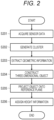
- Fig. 2 illustrates a processing procedure for creating an environmental map from sensor data including a large number of high-dimensional point clouds in the information processing apparatus 100 in the form of a flowchart.
- the illustrated processing procedure is repeatedly performed, for example, for each predetermined frame rate.
- the data acquisition unit 101 acquires sensor data including a large number of three-dimensional point clouds from sensors such as a depth camera, a LiDAR, a distance measurement sensor, and a stereo camera mounted on, for example, a small robot, and accumulates the sensor data in the sensor data accumulation unit 111 (step S201).
- sensors such as a depth camera, a LiDAR, a distance measurement sensor, and a stereo camera mounted on, for example, a small robot.
- the object construction unit 102 clusters the sensor data of the enormous high-dimensional point cloud accumulated in the sensor data accumulation unit 111 to generate one or more clusters including the high-dimensional point cloud (step S202).
- the geometric information extraction unit 103 analyzes the high-dimensional point cloud included in the cluster, and extracts geometric information regarding a size, a shape, and a posture of the high-dimensional object corresponding to the cluster (step S203). Specifically, the geometric information extraction unit 103 performs principal component analysis on the three-dimensional sensor data included in the cluster to obtain an average ⁇ and a covariance ⁇ .
- the object construction unit 102 constructs a high-dimensional object having a size, a shape, and a posture based on the geometric information extracted from the high-dimensional point cloud included in the cluster by the geometric information extraction unit 103 (step S204). Specifically, the object construction unit 102 constructs an ellipsoid based on the average ⁇ and the covariance ⁇ calculated in step S203 as a three-dimensional object corresponding to a cluster.
- the projection unit 104 orthogonally projects the high-dimensional object constructed by the object construction unit 102 onto the low-dimensional plane (step S205). Specifically, the projection unit 104 orthogonally projects the ellipsoid object constructed by the object construction unit 102 onto a reference plane parallel to the ground, and converts the ellipsoid object into a two-dimensional object including an ellipsoid flat plate on the reference plane.
- the map construction unit 105 constructs an environmental map by assigning height information to each point of the low-dimensional object subjected to the low-dimensional projection on the basis of the height information before projection (step S206). Specifically, when the height information is assigned to each point of the two-dimensional object made of the ellipsoid flat plate on the reference plane, the three-dimensional object closest to the query point to be subjected to the height calculation is approximated to the ellipsoid flat plate, and the height from the query point on the reference plane to the approximated ellipsoid plane is approximately calculated. Furthermore, the reliability of the height information calculated at the query point is calculated from the variance in the thickness direction of the three-dimensional object before projection.
- the data acquisition unit 101 acquires sensor data including a large number of three-dimensional point clouds as illustrated in Fig. 3 from a sensor such as a depth camera, a LiDAR, a distance measurement sensor, or a stereo camera mounted on, for example, a small robot.
- the depth camera, the LiDAR, and the distance measurement sensor detect a reflected signal or reflected light from an object in the visual field to output the three-dimensional point cloud at each frame rate.
- the stereo camera the depth of the object in the field of view is estimated on the basis of the left image and the right image captured in synchronization with each other by the left and right cameras, and a similar three-dimensional point cloud is output.
- the object construction unit 102 clusters sensor data including a large number of three-dimensional point clouds. For example, a technique of clustering a point cloud by near point search is known. However, since calculation resources are limited (described above), it is preferable to perform clustering of the point cloud with a low processing load and a short processing time. Therefore, for example, on the basis of the method disclosed in Patent Document 2, clustering of the point cloud may be performed with a low processing load and a short processing time. A clustering method used in the present embodiment will be briefly described.
- the division condition includes one or more of a condition for the number of points included in the point cloud, a condition for the size of the region surrounding the point cloud, a condition for the density of points in the point cloud, and a condition of the point cloud.
- the clustering condition includes one or more of a condition for the number of points included in the point cloud, a condition for the size of the region surrounding the point cloud, a condition for the density of points in the point cloud, and a condition of the point cloud.
- the geometric information extraction unit 103 analyzes a set of three-dimensional sensor data included in the cluster, and extracts geometric information on the size, shape, and posture of the object corresponding to the cluster. Specifically, the geometric information extraction unit 103 performs principal component analysis on the three-dimensional sensor data included in the cluster to obtain an average ⁇ and a covariance ⁇ . Then, the object construction unit 102 constructs a three-dimensional object including an ellipsoid defined by an average ⁇ and a covariance ⁇ as illustrated in Fig. 4 . The ellipsoids illustrated in the drawing are centered on an average ⁇ .
- the covariance ⁇ is subjected to eigenvalue decomposition
- the eigenvector is defined as the inclination of the ellipsoid
- each eigenvalue is defined as the length of the major axis and the length of the minor axis of the ellipse.
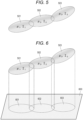
- Fig. 5 illustrates a state in which three consecutive objects 501, 502, and 503 are constructed by clustering a large number of original three-dimensional point clouds.
- the object 501 is an ellipsoid constructed on the basis of the average value ⁇ 1 and the covariance ⁇ 1
- the object 502 is an ellipsoid constructed on the basis of the average value ⁇ 2 and the covariance ⁇ 2
- the object 503 is an ellipsoid constructed on the basis of the average value ⁇ 3 and the covariance ⁇ 3 .
- the data amount can be greatly reduced by using a three-dimensional object constructed on the basis of clustering and geometric information extraction of each cluster instead of the original large number of three-dimensional point clouds.
- the projection unit 104 orthographically projects one or more three-dimensional objects constructed by the object construction unit 102 onto a reference plane parallel to the ground.
- an axis (z axis) orthogonal to the reference plane is defined as a height.
- the three-dimensional object is reduced in dimension to a two-dimensional object on the reference plane, and the data amount can be further reduced.
- information necessary for height estimation in the subsequent map construction processing is held. Examples of the information necessary for the height estimation include the expected value and variance of the three-dimensional point cloud data included in each three-dimensional object, and the normal vector of the object.
- Fig. 6 illustrates a state in which the three three-dimensional objects 501, 502, and 503 illustrated in Fig. 5 are orthogonally projected onto a reference plane 600.
- the three ellipsoids 501, 502, and 503 are orthogonally projected onto the ellipsoid flat plates 601, 602, and 603, respectively, on the reference plane 600.
- the map construction unit 105 constructs an environmental map by assigning height information to each point of a two-dimensional object formed of an ellipsoid flat plate on a reference plane on the basis of the height information of the three-dimensional object before orthogonal projection.
- the map construction unit 105 approximates each three-dimensional object before orthogonal projection to a flat plate on a three-dimensional space.
- the three ellipsoid objects 501, 502, and 503 are approximated to ellipsoid flat plates 701, 702, and 703 in a three-dimensional space, respectively, as illustrated in Fig. 7 .
- the map construction unit 105 searches for a three-dimensional object nearest to a query point to be subjected to height estimation on the basis of, for example, a KD-tree or a Mahalanobis distance.
- the nearest ellipsoid flat plate 702 is searched for.
- the map construction unit 105 linearly interpolates the expected value of the height information from the point corresponding to the query point on the approximate ellipsoid flat plate 702 to calculate the expected value. Furthermore, the map construction unit 105 calculates the variance in the thickness direction of the original ellipsoid object 502 at the point corresponding to the query point on the approximate ellipsoid flat plate 702 as the reliability of the height information calculated at the query point.
- the variance in the thickness direction may be simply calculated by low-dimensionally projecting the variance in the normal direction of the approximate ellipsoid flat plate 702 in the z direction.
- the data acquisition unit 101 acquires sensor data including a three-dimensional point cloud in which the staircase illustrated in Fig. 8 is captured by a sensor such as a depth camera, LiDAR, a distance measurement sensor, or a stereo camera.
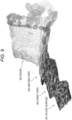
- Fig. 9 illustrates a state in which sensor data including a three-dimensional point cloud capturing the environment illustrated in Fig. 8 is clustered by the object construction unit 102 to construct a large number of ellipsoid objects.
- the floor surface, the first stair step and the riser plate, the second stair step and the riser plate, and the innermost door are respectively expressed by sets 901, 902, 903, and 904 of ellipsoid objects.
- Fig. 10 illustrates a state in which each three-dimensional object illustrated in Fig. 9 is subjected to low-dimensional projection by orthogonal projection on a reference plane parallel to the ground. Furthermore, on the right side of Fig. 10 , the floor surface 1001 near the front, the first step 1002 and the second step 1003 of the staircase are illustrated in an enlarged manner.
- the map construction unit 105 constructs the environmental map by assigning height information to each point of the two-dimensional object that is low-dimensionally projected on the reference plane.
- the map construction unit 105 estimates the expected value of the height at the query point of the two-dimensional object by linear interpolation on an ellipsoid flat plate approximating the three-dimensional elliptic object.
- Fig. 11 illustrates a result of calculating the expected value of the height estimated by linear interpolation from the low-dimensional projection image illustrated on the right side of Fig. 10 .
- Fig. 11 illustrates a result of calculating the expected value of the height estimated by linear interpolation from the low-dimensional projection image illustrated on the right side of Fig. 10 .
- a two-dimensional object having a low expected value is drawn in a dark color
- a two-dimensional object having a high expected value is drawn in a light color
- shading is expressed separately on the basis of the expected value of height. Therefore, it is possible to visually grasp the floor surface near the front and the first and second steps of the stairs.
- Fig. 12 illustrates a result of calculating the variance from the low-dimensional projection image illustrated on the right of Fig. 10 .
- the variance can be obtained by low-dimensionally projecting variance in the thickness direction at the point corresponding to the query point of the original high-dimensional object (ellipsoid) onto the z axis.
- a two-dimensional object having a small variance is drawn in a dark color
- a two-dimensional object having a large variance is drawn in a light color
- shading is expressed separately on the basis of the magnitude of the variance.
- the variance is large in the vicinity of the step of the staircase or in a place where the staircase hangs.
- a place where the variance is large can be said to be a place where the reliability is low and the risk is large.
- the variance is large in the vicinity of the step of the staircase or in a place where the staircase is hung, in other words, it is indicated that the cost for traversing is high.
- the floor surface and the flat portion of the staircase can stably reproduce the original environment.
- the variance becomes large in the vicinity of the step of the staircase, which indicates that the risk is high.
- the variance of the second step of the staircase appears to be slightly large, it is considered that improvement is achieved by the robot moving forward and adding the sensor data of the second step of the staircase.
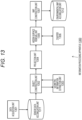
- Fig. 13 illustrates a functional configuration of the information processing apparatus 1300 according to the first example.
- the illustrated information processing apparatus 1300 includes functional modules of a data acquisition unit 1301, an object construction unit 1302, a geometric information extraction unit 1303, a projection unit 1304, a hidden surface removal unit 1305, a Z buffer 1306, and a map construction unit 1307.
- the data acquisition unit 1301, the object construction unit 1302, the geometric information extraction unit 1303, the projection unit 1304, and the map construction unit 1307 are the same as the functional modules having the same names of the information processing apparatus 100 illustrated in Fig. 1 , detailed description thereof is omitted here.
- the hidden surface removal unit 1305 When the projection unit 1304 orthogonally projects a plurality of three-dimensional objects onto the reference plane to make the plurality of three-dimensional objects two-dimensional, the hidden surface removal unit 1305 performs processing of erasing a portion that becomes a shadow of another two-dimensional object and cannot be seen from an upper viewpoint.
- the hidden surface removal processing is performed using the Z buffer 1306 which is a local memory that stores height information for each pixel.
- the hidden surface removal unit 1305 removes the overlapping region of the lower three-dimensional object hidden by the higher three-dimensional object, and further reduces the data amount.
- Fig. 6 illustrates an example of projection of the three-dimensional object onto the reference plane in a case where the hidden surface removal processing is not performed.
- overlapping regions are generated between the adjacent ellipsoid flat plates 601 and 602 and between the adjacent ellipsoid flat plates 602 and 603.
- Fig. 14 illustrates a projection example of the three-dimensional object onto the reference plane in the case of performing the hidden surface removal processing according to the present example.
- the higher ellipsoid flat plate 602 is rendered.
- the higher ellipsoid flat plate 603 is rendered.
- the Z buffer 1306 stores height information of the three-dimensional object orthogonally projected up to the previous time as a Z value for each pixel (alternatively, a region serving as a processing unit) of the reference plane. Then, when the projection unit 1304 orthogonally projects another three-dimensional object to the same pixel next time, the magnitude of the value of the height stored in the Z buffer 1306 up to the previous time and the value of the height of the three-dimensional object orthogonally projected this time are compared (that is, the Z test). At this time, if the current height is higher, orthogonal projection processing of the current three-dimensional object onto the reference plane is performed, and the height information of the pixel in the Z buffer 1306 is updated.
- the hidden surface removal unit 1305 can efficiently perform the hidden surface removal processing of the low-dimensional object after projection by the projection unit 1304.
- the negative elimination method is well known in the field of 3DCG.
- other methods such as a scan line method and a ray tracing method are known in addition to a method of using a Z buffer as hidden surface removal processing.
- the hidden surface removal method using the Z buffer is adopted from the viewpoint of memory access and calculation amount.
- the hidden surface removal processing is performed using the Z buffer.
- the second example is also realized by using the information processing apparatus 1300 having the functional configuration illustrated in Fig. 13 .
- the Z buffer 1306 stores the height information itself for each pixel.
- the Z buffer 1306 indexes the height information, and the Z buffer 1306 stores the index of the height information. Therefore, according to the second example, the capacity of the Z buffer 1306 can be reduced.
- the projection unit 1304 orthogonally projects another three-dimensional object to the same pixel next time
- height information is acquired on the basis of the index previously stored in the Z buffer 1306, and a Z test with the height information of the three-dimensional object orthogonally projected this time is performed.
- the hidden surface removal processing according to the result of the Z test is similar to that of the first example.
- the hidden surface removal processing is performed using the Z buffer.
- the third example is also realized by using the information processing apparatus 1300 having the functional configuration illustrated in Fig. 13 .
- the Z buffer 1306 may store either the height information of the three-dimensional object or the index of the height information.
- a bounding box is obtained in advance for each three-dimensional object before orthographic projection by the projection unit 1304.
- the bounding box is a square box (rectangle) of the size required to just enclose the object.
- the hidden surface removal unit 1305 limits a region to be processed on the Z buffer 1306 on the basis of a bounding box obtained in advance for the three-dimensional object.
- Fig. 15 illustrates a processing region 1503 limited on the basis of the bounding box 1502 obtained for the object 1501 to be processed in the memory region of the Z buffer 1306. Therefore, according to the third example, the memory access amount to the Z buffer 1306 can be reduced.
- the hidden surface removal processing is performed using the Z buffer.
- the fourth example is also realized by using the information processing apparatus 1300 having the functional configuration illustrated in Fig. 13 .
- the Z buffer 1306 may store either the height information of the three-dimensional object or the index of the height information.
- the projection unit 1304 sorts the three-dimensional objects orthogonally projected onto the reference plane in the height direction, and then the hidden surface removal unit 1305 performs the hidden surface removal processing.
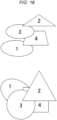
- Fig. 16 illustrates a result of sorting the four objects, for example, in the order of construction.
- Fig. 16 illustrates a state in which each object arranged in a three-dimensional space is viewed in a perspective manner
- Fig. 16 illustrates a state in which each object is viewed from above.
- each object is assigned with an order sorted in the order of construction.
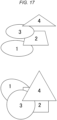
- Fig. 17 illustrates a result of sorting the four objects illustrated in Fig. 16 in the height direction. In the drawing, each object is given an order sorted in the height direction.
- the hidden surface removal unit 1305 performs hidden surface removal processing of the three-dimensional object using the Z buffer 1306, if the height of the three-dimensional object at this time is lower, the three-dimensional object is hidden under the already orthographically-projected two-dimensional object and cannot be seen, so that it is not necessary to newly perform orthographically-projected processing on the reference plane. Therefore, according to the fourth example, the hidden surface removal unit 1305 performs the hidden surface removal processing in the order sorted in the height direction, so that the height of the three-dimensional object at this time is a lower result in the Z test. Therefore, the calculation processing in the Z buffer 1306 can be simplified, and the calculation time can be saved.
- the hidden surface removal processing is performed using the Z buffer.
- the fifth example is also realized by using the information processing apparatus 1300 having the functional configuration illustrated in Fig. 13 .
- the Z buffer 1306 stores the height information of the three-dimensional object.
- the hidden surface removal processing may be performed after the three-dimensional objects are sorted in the height direction.
- the hidden surface removal processing is performed using the Z buffer.
- the sixth example is also realized by using the information processing apparatus 1300 having the functional configuration illustrated in Fig. 13 .
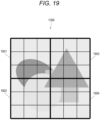
- the Z buffer 1306 is divided into a plurality of tiles, and the hidden surface removal unit 1305 performs height calculation (Z test) for comparing the magnitude of the height value stored in the Z buffer 1306 up to the previous time with the magnitude of the height value of the three-dimensional object orthogonally projected this time on the same memory for each tile.
- Fig. 19 illustrates a state in which the Z buffer 1306 is divided into four tiles 1901 to 1904.
- the method of dividing the Z buffer 1306 into tiles and the number of tiles to be divided are not limited to the example illustrated in Fig. 19 .
- Fig. 20 illustrates a state in which the height calculation of each tile 1901 to 1904 is sequentially executed using one memory.
- the order of tiles for which the height calculation is executed is not limited to the example illustrated in Fig. 20 .
- a seventh example similarly to the first to sixth examples, when the projection unit 1304 orthogonally projects a plurality of three-dimensional objects onto the reference plane to make the plurality of three-dimensional objects two-dimensional, the hidden surface removal processing is performed using the Z buffer. Similarly to the first example, the seventh example is also realized by using the information processing apparatus 1300 having the functional configuration illustrated in Fig. 13 .
- the Z buffer 1306 is divided into a plurality of tiles, but the hidden surface removal unit 1305 simultaneously performs height calculations of a plurality of tiles.
- Fig. 21 illustrates a state in which the height calculation of each tile 1901 to 1904 (see Fig. 19 ) is simultaneously executed.
- the memory resources for simultaneously executing the height calculation are required, but the calculation time can be reduced.
- height calculations of a plurality of tiles may be simultaneously executed using a multi-core CPU or GPU.
- Fig. 22 illustrates a functional configuration of an information processing apparatus 2200 according to an eighth example.
- the illustrated information processing apparatus 2200 includes functional modules of a data acquisition unit 2201, an object construction unit 2202, a geometric information extraction unit 2203, a projection unit 2204, a hidden surface removal unit 2205 and a Z buffer 2206, a post filter processing unit 2207, and a map construction unit 2208.
- the data acquisition unit 2201, the object construction unit 2202, the geometric information extraction unit 2203, the projection unit 2204, the hidden surface removal unit 2205, the Z buffer 2206, and the map construction unit 2208 are the same as the functional modules having the same names of the information processing apparatus 100 illustrated in Fig. 1 or the information processing apparatus 1300 illustrated in Fig. 13 , and thus detailed description thereof is omitted here.
- the post filter processing unit 2207 After performing the hidden surface removal processing of the low-dimensional object by the hidden surface removal unit 2205, the post filter processing unit 2207 performs filter processing such as filling processing of gaps generated between adjacent low-dimensional objects and smoothing processing of discontinuous data (height, expected value, variance, etc.) between adjacent low-dimensional objects.
- Fig. 23 illustrates the state of the reference plane immediately after the hidden surface removal unit 2205 performs the hidden surface removal processing on the low-dimensional object.
- a plurality of low-dimensional objects is arranged on the reference plane.
- Each low-dimensional object is made of an ellipsoid flat plate or the like. An overlapping region between adjacent low-dimensional objects is correctly subjected to the hidden surface removal processing.
- there are not any low-dimensional objects In other words, there is no data.), and there are one or more gaps or "holes”.
- "holes" are generated at four locations indicated by reference numerals 2301 to 2304.
- the "holes" scattered on the reference plane are generated due to the clustering of the high-dimensional point cloud and the data amount reduction by the object construction, and may not exist in the object to be sensed. If such a region of the gap is left as it is, the region becomes a discontinuous region in the map constructed by the subsequent map construction unit 2208.
- Fig. 24 illustrates a result of performing the filling processing by the post filter processing unit 2207 on the reference plane immediately after the hidden surface removal processing illustrated in Fig. 23 .
- the post filter processing unit 2207 performs filling processing using objects around the gap area.
- the post filter processing unit 2207 performs filling processing using a higher object among objects around the gap, or performs filling processing using an object obtained by averaging a plurality of surrounding objects. Therefore, according to the eighth example, by performing the filling processing as described above, it is possible to improve the accuracy of the map by performing smoothing so as not to generate a discontinuous region in the map constructed by the subsequent map construction unit 2208.
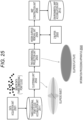
- Fig. 25 illustrates a functional configuration of an information processing apparatus 2500 according to a ninth example.
- the illustrated information processing apparatus 2500 includes functional modules of a data acquisition unit 2501, a clustering unit 2502, a two-dimensional projection unit 2503, a hidden surface removal unit 2504, a Z buffer 2505, and a map construction unit 2506.
- the hidden surface removal unit 2504, the Z buffer 2505, and the map construction unit 2506 are the same as the functional modules having the same names of the information processing apparatus 1300 illustrated in Fig. 13 , detailed description thereof is omitted here.
- the data acquisition unit 2501 acquires sensor data including a three-dimensional point cloud from a sensor mounted on, for example, a small robot, such as a depth camera, a LiDAR, a distance measurement sensor, or a stereo camera.
- the three-dimensional point cloud data acquired by the data acquisition unit 2501 is temporarily stored in a sensor data accumulation unit 2511.
- the clustering unit 2502 clusters a large number of three-dimensional point clouds accumulated in the three-dimensional point cloud accumulation unit 2511.
- the clustering unit 2502 performs the clustering of the three-dimensional point clouds with a low processing load and a short processing time using, for example, the technology disclosed in Patent Document 2.
- the clustering unit 2502 when the clustering unit 2502 performs principal component analysis on the three-dimensional point cloud included in each cluster to obtain the average ⁇ and the covariance ⁇ , the clustering unit further performs eigenvalue decomposition on the covariance ⁇ to generate an ellipsoid object having the average ⁇ as the center, the eigenvector as the inclination of the ellipsoid, and each eigenvalue as the length of the major axis and the minor axis of the ellipse.
- the ninth example it is possible to suitably construct the low-dimensional environmental map by performing the data acquisition unit 2501 in the case of acquiring the sensor data including the three-dimensional point cloud from the depth camera, the LiDAR, the distance measurement sensor, the stereo camera, or the like.
- a tenth example is realized by using the information processing apparatus 2500 having the functional configuration illustrated in Fig. 25 .
- the two-dimensional projection unit 2503 orthogonally projects each cluster output from the clustering unit 2502 onto a reference plane parallel to the ground to generate a two-dimensional object including an ellipsoid flat plate.
- each cluster is treated as an ellipsoid flat plate. Therefore, according to the tenth example, it is possible to obtain an environmental map with necessary and sufficient accuracy while simplifying subsequent processing such as hidden surface removal and map construction.
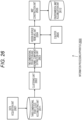
- Fig. 26 illustrates a functional configuration of an information processing apparatus 2600 according to an eleventh example.
- the illustrated information processing apparatus 2600 includes functional modules of a data acquisition unit 2601, a clustering unit 2602, a two-dimensional projection and normal component extraction unit 2603, a hidden surface removal unit 2604 and a Z buffer 2605, and a map construction unit 2606.
- the data acquisition unit 2601, the clustering unit 2602, the hidden surface removal unit 2604, and the Z buffer 2605 are the same as the functional modules having the same names of the information processing apparatus 2500 illustrated in Fig. 25 , and thus, detailed description thereof is omitted here.
- the two-dimensional projection and normal component extraction unit 2603 orthogonally projects each cluster output from the clustering unit 2502 onto a reference plane parallel to the ground to generate a two-dimensional object including an ellipsoid flat plate. At that time, the two-dimensional projection and normal component extraction unit 2603 extracts a normal component of each ellipsoid object as information indicating uncertainty of each original three-dimensional point cloud. Then, the map construction unit 2606 constructs a map to which information indicating uncertainty is assigned to each two-dimensional object after the hidden surface removal processing by the hidden surface removal unit 2603.
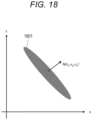
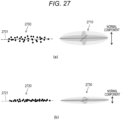
- Fig. 27 illustrates a relationship between a three-dimensional point cloud and an ellipsoid object constructed from the three-dimensional point cloud.
- Fig. 27(a) illustrates a three-dimensional point cloud 2700 and an ellipsoid object 2710 constructed from the three-dimensional point cloud 2700.
- the three-dimensional point cloud 2700 has a large variance from the average ⁇ 1 indicated by the reference number 2701.
- the variance of the three-dimensional point cloud output from the depth camera that captures an uncertain road surface such as a road surface with severe unevenness of the surface or a road surface on which a carpet is laid increases. Therefore, the normal component of the ellipsoid object 2710 constructed from the three-dimensional point cloud 2700 increases.
- Fig. 27 illustrates a relationship between a three-dimensional point cloud and an ellipsoid object constructed from the three-dimensional point cloud.
- Fig. 27(a) illustrates a three-dimensional point cloud 2700 and an ellipsoid object
- FIG. 27(b) illustrates a three-dimensional point cloud 2720 and an ellipsoid object 2730 constructed from the three-dimensional point cloud 2720.
- the three-dimensional point cloud 2720 has a small variance from the average ⁇ 2 indicated by the reference number 2721.
- the variance of the three-dimensional point cloud output from the depth camera that captures a certain road surface such as a flat road surface becomes small.
- the map construction unit 2606 gives information indicating uncertainty to each elliptic flat object after the hidden surface removal processing by the hidden surface removal unit 2603 on the basis of the normal component extracted from the elliptic object before projection.
- the map construction unit 2606 may color-code and express each ellipsoid flat object after the hidden surface removal processing according to the normal component of each ellipsoid object before projection.
- Fig. 28 illustrates an example in which the projected ellipsoid flat plate object is color-coded according to the normal component of the ellipsoid object.
- Fig. 28(a) illustrates an example in which an ellipsoid flat plate object 2800 on which an ellipsoid flat plate object 2810 having a large normal component is projected is drawn in light color to express that the uncertainty of the region of the ellipsoid flat plate object 2810 is large.
- Fig. 28 illustrates an example in which the projected ellipsoid flat plate object is color-coded according to the normal component of the ellipsoid object.
- Fig. 28(a) illustrates an example in which an ellipsoid flat plate object 2800 on which an ellipsoid flat plate object 2810 having a large normal component is projected is drawn in light color to express that the uncertainty of the region of the ellipsoid flat plate object 2810 is large.
- FIG. 28(b) illustrates an example in which the ellipsoid flat plate object 2830 on which the ellipsoid object 2820 having a small normal component is projected is drawn in a dark color to express that the uncertainty of the region of the ellipsoid flat plate object 2830 is small.
- a map reflecting uncertainty of sensor data can be obtained.
- the mobile robot can take a safe action such as selecting a more reliable route by using a map to which information indicating uncertainty is given.
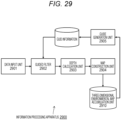
- Fig. 29 illustrates a functional configuration of an information processing apparatus 2900 according to a twelfth example.
- the illustrated information processing apparatus 2900 includes functional modules of a data input unit 2901, a guided filter 2902, a depth calculation unit 2903, an environmental map construction unit 2904, and a guide generation unit 2905, and constructs a three-dimensional environmental map.
- Each of these functional modules 2901 to 2905 may be, for example, a software module realized by executing a software program on a personal computer (PC), or may be a hardware module realized by a dedicated circuit.
- PC personal computer
- the data input unit 2901 inputs sensor data from one or more sensor elements that recognize an external environment or output recognition data corresponding to the recognized external environment.
- the depth calculation unit 2903 inputs sensor data via the guided filter 2902, executes depth calculation, and calculates a three-dimensional position of an object (such as an obstacle) existing in an external environment.
- the environmental map construction unit 2904 constructs the three-dimensional environmental map of the current time on the basis of the result of the depth calculation by the depth calculation unit 2903.
- the environmental map construction unit 2904 stores the constructed three-dimensional environmental map of the current time in the three-dimensional environmental map accumulation unit 2910.
- the guide generation unit 2905 generates the guide information on the basis of the three-dimensional environmental map of the previous time as the feedback information in the processing of constructing the three-dimensional environmental map from the sensor data.
- the guided filter 2902 processes the sensor data input from the data input unit 2901 on the basis of the guide information input from the guide generation unit 2905.
- the guided filter 2902 removes noise or outliers included in the sensor data input from the data input unit 2901 on the basis of the guide information input from the guide generation unit 2905, for example.
- the guided filter 2902 may be configured by, for example, a guided filter (see Non-Patent Document 1).
- the guided filter 2902 may include, for example, a Bayesian filter including a least squares regression (ridge regression) with a regularization term.
- the guided filter 2902 can obtain data from which noise or outliers have been removed.
- the guided filter 2902 outputs the processed data to the depth calculation unit 2903.
- the environmental map construction unit 2904 constructs the environmental map at the current time using a result of depth calculation from the data processed by the guided filter 2902.
- Fig. 30 illustrates an internal configuration of the guide generation unit 2905 that generates guide information as feedback information.
- the guide generation unit 2905 includes functional modules of a clustering unit 3001, a two-dimensional projection unit 3002, a hidden surface removal unit 3003, and a Z buffer 3004.
- each functional module 3001 to 3004 is the same as the functional module having the same name of each of the information processing apparatuses 2500 illustrated in Fig. 25 , a detailed description thereof will be omitted here.
- a three-dimensional point cloud constituting the three-dimensional environmental map of the previous time is input to the guide generation unit 2905.
- the clustering unit 3001 clusters the three-dimensional point cloud, and expresses each cluster by a three-dimensional object including an ellipsoid.
- the two-dimensional projection unit 3002 orthogonally projects each three-dimensional object onto a reference plane to form a two-dimensional object.
- the hidden surface removal unit 3003 performs a hidden surface removal process between the two-dimensional objects using the Z buffer 3004. Then, the guide generation unit 2905 outputs, as the feedback information, the guide information including the reference plane on which each two-dimensional object after the hidden surface removal processing is arranged.
- the guide information as the feedback information is generated on the basis of the present disclosure, whereby the feedback processing can be efficiently performed with lower calculation.
- Fig. 31 illustrates a functional configuration of an information processing apparatus 3100 according to a thirteenth example.
- the illustrated information processing apparatus 3100 includes functional modules of a data acquisition unit 3101, a clustering unit 3102, a two-dimensional projection unit 3103, a hidden surface removal unit 3104, a Z buffer 3105, and a map construction unit 3106, and is configured to construct a two-dimensional environmental map (HeightMap) including height information.
- HeightMap two-dimensional environmental map
- the data acquisition unit 3101 acquires sensor data including three-dimensional point cloud data from a sensor such as a depth camera, a LiDAR, a distance measurement sensor, or a stereo camera, and temporarily stores the sensor data in the sensor data accumulation unit 3111.
- a sensor such as a depth camera, a LiDAR, a distance measurement sensor, or a stereo camera
- the clustering unit 3102 clusters a large number of three-dimensional point clouds accumulated in the three-dimensional point cloud accumulation unit 3111 using, for example, the technology disclosed in Patent Document 2, and expresses each cluster as a three-dimensional object including an ellipsoid as illustrated in Fig. 5 .
- the clustering unit 3102 performs clustering processing on the three-dimensional point cloud capturing the external environment as illustrated in Fig. 8
- the three-dimensional point cloud is represented by a group of three-dimensional objects (ellipsoids) as illustrated in Fig. 9 .
- the two-dimensional projection unit 3103 orthogonally projects each ellipsoid object constructed by the clustering unit 3102 onto a reference plane parallel to the ground to two-dimensionalize the ellipsoid object into an ellipsoid flat plate.
- a two-dimensional projection image representing the two-dimensional object (ellipsoid flat plate) as illustrated in Fig. 10 can be obtained (The vicinity of the front is illustrated in an enlarged manner on the right side of Fig. 10 .).
- the two-dimensional projection unit 3103 projects a three-dimensional object on a reference plane
- information necessary for height estimation among high dimension information of the object is held.
- the information necessary for the height estimation include the expected value and variance of the three-dimensional point cloud data included in each three-dimensional object, and the normal vector of the object.
- the hidden surface removal unit 3104 uses the Z buffer 3105 to perform the hidden surface removal processing on the ellipsoid flat plate orthogonally projected onto the reference plane. Details of the hidden surface removal processing are as described in the first example.
- the map construction unit 3106 constructs a two-dimensional environmental map (HeightMap) including height information by assigning height information to each point on the reference plane after the hidden surface removal processing on the basis of information (expected value, variance, normal vector, and the like) held for each ellipsoid flat plate. Specifically, the map construction unit 3106 approximates an ellipsoid object before projection corresponding to an ellipsoid plane to a plane, and linearly interpolates an expected value of height information at a query point in the ellipsoid flat plate to calculate the height information. For example, the expected value of the height estimated by linear interpolation from the low-dimensional projection image illustrated on the right side of Fig. 10 can be calculated to obtain a HeightMap as illustrated in Fig.
- HeightMap two-dimensional environmental map
- the map construction unit 3106 subjects variance in the thickness direction of the corresponding original three-dimensional object to low-dimensional projection onto the z axis to obtain the variance at the query points in the ellipsoid flat plate.
- the map construction unit 3106 can obtain the calculation result of the variance illustrated in Fig. 12 from the low-dimensional projection image illustrated on the right in Fig. 10 .
- a location with a large variance means a location with a low degree of reliability and a high risk when the robot traverses.
- the HeightMap is a map method widely used in robots that move in a non-planar environment such as legged robots. According to the thirteenth example, it is possible to efficiently construct the HeightMap by reducing the data amount and the operation amount.
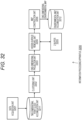
- Fig. 32 illustrates a functional configuration of an information processing apparatus 3200 according to the fourteenth example.
- the illustrated information processing apparatus 3200 includes functional modules of a data acquisition unit 3201, a clustering unit 3202, a one-dimensional projection unit 3203, a hidden surface removal unit 3204, a Z buffer 3205, and a map construction unit 3206.
- the data acquisition unit 3201 acquires sensor data from a two-dimensional sensor (not illustrated).
- the two-dimensional sensor is mounted, for example, so as to set the front or the traveling direction of the small robot as the viewing angle, and outputs sensor data including a two-dimensional point cloud that captures an obstacle or the like existing in front of the small robot.
- the two-dimensional point cloud data acquired by the data acquisition unit 3201 is temporarily stored in a sensor data accumulation unit 3211.
- the clustering unit 3202 clusters a large number of two-dimensional point clouds accumulated in the two-dimensional point cloud accumulation unit 3211 using, for example, the technology disclosed in Patent Document 2, and constructs a two-dimensional object from each cluster.
- the constructed two-dimensional object is an ellipse having an average ⁇ and a covariance ⁇ of the two-dimensional point cloud in the cluster as geometric information.
- the clustering unit 3202 clusters the two-dimensional point cloud to generate ellipsoid objects 3401 to 3405 as illustrated in Fig. 34 .
- the one-dimensional projection unit 3203 orthogonally projects each two-dimensional object constructed by the clustering unit 3202, for example, in a reference straight line orthogonal to the traveling direction of the small robot to make the two-dimensional object one-dimensional.
- Fig. 35 illustrates a result of obtaining line objects 3501 to 3501 by orthogonally projecting each of the ellipsoid objects 3401 to 3405 illustrated in Fig. 34 onto a reference straight line to make them one-dimensional.
- the one-dimensional projection unit 3203 projects the two-dimensional object on the reference straight line
- information necessary for depth estimation among the two-dimensional information of the object is held.
- the information necessary for the depth estimation include the expected value and variance of the two-dimensional point cloud data included in each two-dimensional object, and the normal vector of the object.
- the hidden surface removal unit 3204 performs processing of erasing a portion that becomes a shadow of another one-dimensional object from the viewpoint and cannot be seen.
- the Z buffer 3205 stores depth information of the two-dimensional object orthographically projected up to the previous time as a Z value for each pixel (alternatively, a region serving as a processing unit) of the reference straight line.
- the one-dimensional projection unit 3203 orthogonally projects another two-dimensional object of the same pixel next time
- the values of the depth stored in the Z buffer 3205 up to the previous time are compared with the values of the depth of the two-dimensional object orthogonally projected this time. If the current depth is smaller, the orthogonal projection processing of the current three-dimensional object onto the reference plane is performed, and the depth information of the pixel in the Z buffer 3205 is updated. On the other hand, if the current depth is larger, it is hidden behind the already orthographically projected two-dimensional object and cannot be seen, so that it is not necessary to newly perform orthographic projection processing on the reference straight line.
- Fig. 36 illustrates the reference straight line after the hidden surface removal processing.
- the map construction unit 3206 constructs a one-dimensional environmental map including height information by assigning depth information to each point on the reference straight line after the hidden surface removal processing on the basis of information (expected value, variance, normal vector, and the like) held for each ellipsoid flat plate. Specifically, the map construction unit 3206 approximates the two-dimensional ellipsoid object before projection corresponding to the painted dimensional object to a straight line, and performs linear interpolation on the expected value of the depth information at the query point in the ellipsoid flat plate to calculate the depth information. Furthermore, the map construction unit 3206 subjects variance in the thickness direction of the corresponding original two-dimensional object to low-dimensional projection in the depth direction to obtain the variance at the query points in the one-dimensional object.
- the fourteenth example it is possible to efficiently construct the one-dimensional environmental map with the depth information by reducing the data amount and the calculation amount.
- Conventionally in order to acquire depth information, it has been necessary to perform a ray-cast process of firing a line (ray) invisible from the current position to the scheduled moving destination and determining whether there is a colliding object on the line.
- a line ray
- the fourteenth example such a process is unnecessary.
- the one-dimensional environmental map with depth information constructed using the fourteenth example can be used for route planning of a robot that autonomously moves on a two-dimensional plane.
- the robot can estimate the presence or absence of an obstacle in the traveling direction on the basis of the one-dimensional environmental map with depth information. For example, as illustrated in Fig. 37 , on the one-dimensional environmental map 3700, it can be recognized that the traveling direction #2 in which the one-dimensional object does not exist is a safe direction in which there is no risk of collision with an obstacle, and it can be recognized that the traveling directions #1 and #3 in which the one-dimensional objects 3701 and 3702 exist are unsafe directions in which there is a possibility of collision with an obstacle.
- the information processing apparatus according to the present disclosure can create the environmental map by greatly reducing the data amount and the calculation amount, it is practically possible to mount the information processing apparatus on a small robot with limited calculation resources.
- the small robot can make a route plan using the created environmental map and autonomously perform movement work on the basis of the route plan.
- Fig. 38 schematically illustrates a configuration example of a robot device 3800 to which the present disclosure is applied.
- the illustrated robot device 3800 includes a main body 3801, a visual sensor 3802, a joint 3803, and four legs 3810A to D.
- the visual sensor 3802 is a sensor that visually recognizes the environment around the robot device 3800, and includes, for example, at least one of a camera (including a stereo camera), an infrared camera, a time of flight (TOF) sensor, a LiDAR, and the like, and outputs sensor data including, for example, a three-dimensional point cloud.
- the visual sensor 3802 is attached to the main body 3801 via the joint 3803 for moving a line-of-sight direction of the visual sensor 3802 up, down, left, and right.
- the robot device 3800 may include a sensor other than the visual sensor 3802, such as an inertial measurement unit (IMU) mounted on the main body 3801 or each of the legs 3810A to D, a ground sensor of the sole of each of the legs 3810A to D, or a tactile sensor of a surface of the main body 3801.
- IMU inertial measurement unit
- the legs 3810A to D as a moving means are connected to the main body 3801 via joints 3811A to D corresponding to hip joints, respectively.
- Each of legs 3810A to D includes joints 3812A to D that connect the thigh link and the lower leg link.
- Each of the joints 3811A to D and the joints 3812A to D has at least a degree of freedom around the pitch.
- the joints 3811A to D and the joints 3812A to D are active joints, and include a motor for driving a joint, an encoder for detecting a position of the motor, a speed reducer, and a torque sensor for detecting torque on an output shaft side of the motor (none of them are illustrated). Therefore, the robot device 3800 is a four-legged robot in which a gait by a leg (walking) is selectable.
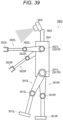
- Fig. 39 schematically illustrates a configuration example of a robot device 3900 to which the present disclosure is applied.
- the robot device 3900 includes a main body 3901, a visual sensor 3902, a joint 3903, two legs of a right leg 3910R and a left leg 3910L, and a right arm 3920R and a left arm 3920L.
- the visual sensor 3902 is a sensor that visually recognizes the environment around the robot device 3900, and includes, for example, at least one of a camera (including a stereo camera), an infrared camera, a TOF sensor, a LiDAR, and the like, and outputs sensor data including, for example, a three-dimensional point cloud.
- the visual sensor 3902 is attached to the main body 3901 via a joint 3903 for moving the line-of-sight direction of the visual sensor 3902 up, down, left, and right.
- the right leg 3910R and the left leg 3910L as moving means are connected to the lower end of the main body 3901 via joints 3911R and 3911L corresponding to the hip joints, respectively.
- Right leg 3910R and left leg 3910L respectively include joints 3912R and 3912L corresponding to a knee joint connecting the thigh link and the lower leg link, and ground contact portions (or foot portions) 3913R and 3913L at the distal end of the lower leg link.
- the right arm 3920R and the left arm 3920L are connected to the vicinity of the upper end of the main body 3901 via joints 3921R and 3921L corresponding to shoulder joints, respectively.
- the right arm 3920R and the left arm 3920L respectively include joints 3922R and 3922L corresponding to elbow joints connecting the upper arm link and the forearm link, and hands (or grips) 3923R and 3923L at the tip of the forearm link.
- the joints 3911R and 3911L, the joints 3912R and 3912L, the joints 3921R and 3921L, and the joints 3922R and 3922L include a motor for driving a joint, an encoder for detecting a position of the motor, a speed reducer, and a torque sensor for detecting torque on an output shaft side of the motor (none of them are illustrated).
- Fig. 40 illustrates a configuration example of a control system 4000 of the robot device 3800.
- the control system 4000 is a device physically independent of the robot device 3800, and is connected to the robot device 3800 in a wireless or wired manner.
- some or all components of the control system 4000 may be installed on a cloud and interconnected with the robot device 3800 via a network.
- the control system of the robot device 3900 has a similar configuration.
- the control system 4000 operates under the overall control of a CPU 4001.
- the CPU 4001 has a multi-core configuration including a processor core 4001A and a processor core 4001B.
- the CPU 4001 is interconnected with each component in the control system 4000 via a bus 4010.
- a storage device 4020 includes, for example, a large-capacity external storage device such as a hard disk drive (HDD) or a solid state drive (SSD), and stores files such as a program executed by the CPU 4001 and data generated by using or executing the program during execution.
- the CPU 4001 executes, for example, a device driver that drives a motor of each joint of the robot device 3800, a map construction program that constructs an environmental map on the basis of three-dimensional point data acquired from the visual sensor 3802, a route planning program that plans a route of the robot device 3800 on the basis of the environmental map, and the like.
- a memory 4021 includes a read only memory (ROM) and a random access memory (RAM).
- the ROM stores, for example, a startup program and a basic input/output program of the control system 4000.
- the RAM is used for loading a program to be executed by the CPU 4001 and temporarily storing data to be used during execution of the program.
- a display unit 4022 includes, for example, a liquid crystal display or an organic electro luminescence (EL) display.
- the display unit 4022 displays data and an execution result during execution of the program by the CPU 4001. For example, sensor data including a three-dimensional point cloud acquired from a sensor, an environmental map constructed from the three-dimensional point cloud, information regarding a movement route of the robot device 3800 planned on the basis of the environmental map, a search situation of the planned route, and the like are displayed on the display unit 4022.
- a sensor input unit 4030 performs signal processing for taking sensor signals from various sensors mounted on the robot device 3800, such as the visual sensor 3802, into the control system 4000.
- a motor input/output unit 4040 performs input/output processing of a signal with each motor, such as outputting a command signal to the motor of each joint of the robot device 3800 and inputting a sensor signal of an encoder for detecting the position of the motor or a torque sensor on a side of an output shaft of the motor.
- a network input/output unit 4050 performs input/output processing between the control system 4000 and the cloud.
- Fig. 41 illustrates a processing procedure for controlling the movement of the robot device 3800 in the control system 4000 in the form of a flowchart. It is assumed that the movement control of the robot device 3900 is also realized by a similar processing procedure.
- the CPU 4001 acquires sensor data including a three-dimensional point cloud from the sensor via the sensor input unit 4030 (step S4101) .
- the CPU 4001 executes the environmental map construction program, and constructs an environmental map (step S4106) through clustering of a three-dimensional point cloud (step S4102), construction of a three-dimensional object (step S4103), two-dimensional projection (step S4104), and hidden surface removal processing (step S4105) .
- the CPU 4001 plans a movement route of the robot device 3800 on the basis of the constructed environmental map (step S4107) .
- the CPU 4001 controls driving of the motor of the active joint of each movable leg so that the robot device 3800 moves according to the planned route (step S4108) .
- the present disclosure can also be similarly applied to a case where an environmental map is created on a high-performance computing system equipped with a high-performance processor and a large-capacity memory system or on a cloud.
- the method of creating an environmental map according to the present disclosure can be applied to various types of autonomous mobile devices such as small robots, automatic conveyance vehicles, and unmanned aerial vehicles such as drones.
Landscapes
- Engineering & Computer Science (AREA)
- Physics & Mathematics (AREA)
- General Physics & Mathematics (AREA)
- Remote Sensing (AREA)
- Radar, Positioning & Navigation (AREA)
- Theoretical Computer Science (AREA)
- Geometry (AREA)
- Software Systems (AREA)
- Computer Graphics (AREA)
- Automation & Control Theory (AREA)
- Computer Vision & Pattern Recognition (AREA)
- Optics & Photonics (AREA)
- Computer Networks & Wireless Communication (AREA)
- Electromagnetism (AREA)
- Image Processing (AREA)
Applications Claiming Priority (2)
| Application Number | Priority Date | Filing Date | Title |
|---|---|---|---|
| JP2021162687 | 2021-10-01 | ||
| PCT/JP2022/030196 WO2023053723A1 (ja) | 2021-10-01 | 2022-08-05 | 情報処理装置及び情報処理方法、並びに移動体装置 |
Publications (2)
| Publication Number | Publication Date |
|---|---|
| EP4411657A1 true EP4411657A1 (de) | 2024-08-07 |
| EP4411657A4 EP4411657A4 (de) | 2025-01-15 |
Family
ID=85782291
Family Applications (1)
| Application Number | Title | Priority Date | Filing Date |
|---|---|---|---|
| EP22875599.7A Withdrawn EP4411657A4 (de) | 2021-10-01 | 2022-08-05 | Informationsverarbeitungsvorrichtung, informationsverarbeitungsverfahren und vorrichtung mit beweglichem körper |
Country Status (5)
| Country | Link |
|---|---|
| US (1) | US20240393132A1 (de) |
| EP (1) | EP4411657A4 (de) |
| JP (1) | JPWO2023053723A1 (de) |
| CN (1) | CN118043852A (de) |
| WO (1) | WO2023053723A1 (de) |
Families Citing this family (2)
| Publication number | Priority date | Publication date | Assignee | Title |
|---|---|---|---|---|
| KR20250161930A (ko) * | 2024-05-09 | 2025-11-18 | 주식회사 베어로보틱스코리아 | 이동로봇 및 그것의 동작방법 |
| WO2025253776A1 (ja) * | 2024-06-03 | 2025-12-11 | ソニーグループ株式会社 | データ処理方法、移動体制御システム、およびプログラム |
Family Cites Families (6)
| Publication number | Priority date | Publication date | Assignee | Title |
|---|---|---|---|---|
| GB2487421A (en) * | 2011-01-21 | 2012-07-25 | Imagination Tech Ltd | Tile Based Depth Buffer Compression |
| JP6919882B2 (ja) * | 2017-03-31 | 2021-08-18 | 株式会社国際電気通信基礎技術研究所 | 人推定システムおよび推定プログラム |
| JP7340350B2 (ja) | 2019-05-07 | 2023-09-07 | 東芝テック株式会社 | 情報処理装置及び情報処理方法 |
| US11790542B2 (en) * | 2019-07-29 | 2023-10-17 | Board Of Trustees Of Michigan State University | Mapping and localization system for autonomous vehicles |
| US11532168B2 (en) * | 2019-11-15 | 2022-12-20 | Nvidia Corporation | Multi-view deep neural network for LiDAR perception |
| JP2021099689A (ja) | 2019-12-23 | 2021-07-01 | ソニーグループ株式会社 | 情報処理装置、情報処理方法、およびプログラム |
-
2022
- 2022-08-05 CN CN202280064565.9A patent/CN118043852A/zh not_active Withdrawn
- 2022-08-05 WO PCT/JP2022/030196 patent/WO2023053723A1/ja not_active Ceased
- 2022-08-05 US US18/693,969 patent/US20240393132A1/en active Pending
- 2022-08-05 JP JP2023550425A patent/JPWO2023053723A1/ja active Pending
- 2022-08-05 EP EP22875599.7A patent/EP4411657A4/de not_active Withdrawn
Also Published As
| Publication number | Publication date |
|---|---|
| JPWO2023053723A1 (de) | 2023-04-06 |
| CN118043852A (zh) | 2024-05-14 |
| WO2023053723A1 (ja) | 2023-04-06 |
| EP4411657A4 (de) | 2025-01-15 |
| US20240393132A1 (en) | 2024-11-28 |
Similar Documents
| Publication | Publication Date | Title |
|---|---|---|
| CN112539749B (zh) | 机器人导航方法、机器人、终端设备及存储介质 | |
| US12372966B2 (en) | Moving apparatus and moving apparatus control method | |
| US20190102613A1 (en) | Posture Estimation System, Posture Estimation Device and Range Image Camera | |
| CN110119698B (zh) | 用于确定对象状态的方法、装置、设备和存储介质 | |
| CN112529963B (zh) | 一种楼梯检测方法、装置及移动机器人 | |
| US7912583B2 (en) | Environment map building method, environment map building apparatus and mobile robot apparatus | |
| EP4411657A1 (de) | Informationsverarbeitungsvorrichtung, informationsverarbeitungsverfahren und vorrichtung mit beweglichem körper | |
| CN115702405A (zh) | 建模和感知地形的楼梯跟踪 | |
| CN115702445A (zh) | 用于楼梯跟踪器的感知和适应 | |
| CN111624622A (zh) | 障碍物检测方法、装置 | |
| WO2017124901A1 (zh) | 一种数据处理方法、装置及终端 | |
| US20250292506A1 (en) | Information processing method, information processing device, and information processing system | |
| US20150310296A1 (en) | Foreground region extraction device | |
| CN115909262A (zh) | 车位检测方法、装置、电子设备以及存储介质 | |
| Braun et al. | Bim-based progress monitoring | |
| CN115861362B (zh) | 地铁限界空间检测方法、装置、设备及存储介质 | |
| Ilyas et al. | Staircase recognition and localization using convolution neural network (cnn) for cleaning robot application | |
| WO2020079309A1 (en) | Obstacle detection | |
| US12538008B2 (en) | Determination device, identification method and recording medium | |
| Liu et al. | Mapping noise optimization of the cartographer on the premise of comparative experimental analysis | |
| CN115248032A (zh) | 一种三维激光点云房屋信息自动化提取方法 | |
| Yang et al. | Locator slope calculation via deep representations based on monocular vision | |
| Goron et al. | 3D laser scanning system and 3D segmentation of urban scenes | |
| KR102783386B1 (ko) | 3차원 맵을 생성하기 위한 방법 및 이를 수행하는 장치 | |
| JP7657689B2 (ja) | 処理システム、制御システム、移動体、撮影位置決定方法及び撮影位置決定プログラム |
Legal Events
| Date | Code | Title | Description |
|---|---|---|---|
| STAA | Information on the status of an ep patent application or granted ep patent |
Free format text: STATUS: THE INTERNATIONAL PUBLICATION HAS BEEN MADE |
|
| PUAI | Public reference made under article 153(3) epc to a published international application that has entered the european phase |
Free format text: ORIGINAL CODE: 0009012 |
|
| STAA | Information on the status of an ep patent application or granted ep patent |
Free format text: STATUS: REQUEST FOR EXAMINATION WAS MADE |
|
| 17P | Request for examination filed |
Effective date: 20240424 |
|
| AK | Designated contracting states |
Kind code of ref document: A1 Designated state(s): AL AT BE BG CH CY CZ DE DK EE ES FI FR GB GR HR HU IE IS IT LI LT LU LV MC MK MT NL NO PL PT RO RS SE SI SK SM TR |
|
| REG | Reference to a national code |
Ref country code: DE Ref legal event code: R079 Free format text: PREVIOUS MAIN CLASS: G06T0017050000 Ipc: G06T0007521000 |
|
| DAV | Request for validation of the european patent (deleted) | ||
| DAX | Request for extension of the european patent (deleted) | ||
| A4 | Supplementary search report drawn up and despatched |
Effective date: 20241217 |
|
| RIC1 | Information provided on ipc code assigned before grant |
Ipc: G01S 17/89 20200101ALI20241212BHEP Ipc: G06T 17/05 20110101ALI20241212BHEP Ipc: G06T 7/521 20170101AFI20241212BHEP |
|
| STAA | Information on the status of an ep patent application or granted ep patent |
Free format text: STATUS: THE APPLICATION HAS BEEN WITHDRAWN |
|
| 18W | Application withdrawn |
Effective date: 20250515 |