EP4411863A1 - Électrode positive pour batterie au lithium rechargeable et batterie au lithium rechargeable la comprenant - Google Patents
Électrode positive pour batterie au lithium rechargeable et batterie au lithium rechargeable la comprenant Download PDFInfo
- Publication number
- EP4411863A1 EP4411863A1 EP23201935.6A EP23201935A EP4411863A1 EP 4411863 A1 EP4411863 A1 EP 4411863A1 EP 23201935 A EP23201935 A EP 23201935A EP 4411863 A1 EP4411863 A1 EP 4411863A1
- Authority
- EP
- European Patent Office
- Prior art keywords
- positive electrode
- active material
- electrode active
- lithium
- nickel
- Prior art date
- Legal status (The legal status is an assumption and is not a legal conclusion. Google has not performed a legal analysis and makes no representation as to the accuracy of the status listed.)
- Pending
Links
Images


Classifications
-
- H—ELECTRICITY
- H01—ELECTRIC ELEMENTS
- H01M—PROCESSES OR MEANS, e.g. BATTERIES, FOR THE DIRECT CONVERSION OF CHEMICAL ENERGY INTO ELECTRICAL ENERGY
- H01M4/00—Electrodes
- H01M4/02—Electrodes composed of, or comprising, active material
- H01M4/13—Electrodes for accumulators with non-aqueous electrolyte, e.g. for lithium-accumulators; Processes of manufacture thereof
- H01M4/131—Electrodes based on mixed oxides or hydroxides, or on mixtures of oxides or hydroxides, e.g. LiCoOx
-
- H—ELECTRICITY
- H01—ELECTRIC ELEMENTS
- H01M—PROCESSES OR MEANS, e.g. BATTERIES, FOR THE DIRECT CONVERSION OF CHEMICAL ENERGY INTO ELECTRICAL ENERGY
- H01M10/00—Secondary cells; Manufacture thereof
- H01M10/05—Accumulators with non-aqueous electrolyte
- H01M10/052—Li-accumulators
-
- H—ELECTRICITY
- H01—ELECTRIC ELEMENTS
- H01M—PROCESSES OR MEANS, e.g. BATTERIES, FOR THE DIRECT CONVERSION OF CHEMICAL ENERGY INTO ELECTRICAL ENERGY
- H01M10/00—Secondary cells; Manufacture thereof
- H01M10/05—Accumulators with non-aqueous electrolyte
- H01M10/052—Li-accumulators
- H01M10/0525—Rocking-chair batteries, i.e. batteries with lithium insertion or intercalation in both electrodes; Lithium-ion batteries
-
- H—ELECTRICITY
- H01—ELECTRIC ELEMENTS
- H01M—PROCESSES OR MEANS, e.g. BATTERIES, FOR THE DIRECT CONVERSION OF CHEMICAL ENERGY INTO ELECTRICAL ENERGY
- H01M4/00—Electrodes
- H01M4/02—Electrodes composed of, or comprising, active material
- H01M4/36—Selection of substances as active materials, active masses, active liquids
- H01M4/362—Composites
- H01M4/364—Composites as mixtures
-
- H—ELECTRICITY
- H01—ELECTRIC ELEMENTS
- H01M—PROCESSES OR MEANS, e.g. BATTERIES, FOR THE DIRECT CONVERSION OF CHEMICAL ENERGY INTO ELECTRICAL ENERGY
- H01M4/00—Electrodes
- H01M4/02—Electrodes composed of, or comprising, active material
- H01M4/36—Selection of substances as active materials, active masses, active liquids
- H01M4/48—Selection of substances as active materials, active masses, active liquids of inorganic oxides or hydroxides
- H01M4/50—Selection of substances as active materials, active masses, active liquids of inorganic oxides or hydroxides of manganese
- H01M4/505—Selection of substances as active materials, active masses, active liquids of inorganic oxides or hydroxides of manganese of mixed oxides or hydroxides containing manganese for inserting or intercalating light metals, e.g. LiMn2O4 or LiMn2OxFy
-
- H—ELECTRICITY
- H01—ELECTRIC ELEMENTS
- H01M—PROCESSES OR MEANS, e.g. BATTERIES, FOR THE DIRECT CONVERSION OF CHEMICAL ENERGY INTO ELECTRICAL ENERGY
- H01M4/00—Electrodes
- H01M4/02—Electrodes composed of, or comprising, active material
- H01M4/36—Selection of substances as active materials, active masses, active liquids
- H01M4/48—Selection of substances as active materials, active masses, active liquids of inorganic oxides or hydroxides
- H01M4/52—Selection of substances as active materials, active masses, active liquids of inorganic oxides or hydroxides of nickel, cobalt or iron
- H01M4/525—Selection of substances as active materials, active masses, active liquids of inorganic oxides or hydroxides of nickel, cobalt or iron of mixed oxides or hydroxides containing iron, cobalt or nickel for inserting or intercalating light metals, e.g. LiNiO2, LiCoO2 or LiCoOxFy
-
- H—ELECTRICITY
- H01—ELECTRIC ELEMENTS
- H01M—PROCESSES OR MEANS, e.g. BATTERIES, FOR THE DIRECT CONVERSION OF CHEMICAL ENERGY INTO ELECTRICAL ENERGY
- H01M4/00—Electrodes
- H01M4/02—Electrodes composed of, or comprising, active material
- H01M2004/021—Physical characteristics, e.g. porosity, surface area
-
- H—ELECTRICITY
- H01—ELECTRIC ELEMENTS
- H01M—PROCESSES OR MEANS, e.g. BATTERIES, FOR THE DIRECT CONVERSION OF CHEMICAL ENERGY INTO ELECTRICAL ENERGY
- H01M4/00—Electrodes
- H01M4/02—Electrodes composed of, or comprising, active material
- H01M2004/026—Electrodes composed of, or comprising, active material characterised by the polarity
- H01M2004/028—Positive electrodes
-
- Y—GENERAL TAGGING OF NEW TECHNOLOGICAL DEVELOPMENTS; GENERAL TAGGING OF CROSS-SECTIONAL TECHNOLOGIES SPANNING OVER SEVERAL SECTIONS OF THE IPC; TECHNICAL SUBJECTS COVERED BY FORMER USPC CROSS-REFERENCE ART COLLECTIONS [XRACs] AND DIGESTS
- Y02—TECHNOLOGIES OR APPLICATIONS FOR MITIGATION OR ADAPTATION AGAINST CLIMATE CHANGE
- Y02E—REDUCTION OF GREENHOUSE GAS [GHG] EMISSIONS, RELATED TO ENERGY GENERATION, TRANSMISSION OR DISTRIBUTION
- Y02E60/00—Enabling technologies; Technologies with a potential or indirect contribution to GHG emissions mitigation
- Y02E60/10—Energy storage using batteries
Definitions
- a positive electrode for a rechargeable lithium battery and a rechargeable lithium battery comprising the same are disclosed.
- Rechargeable lithium batteries are used in various fields, including mobile devices, energy storage systems, and electric vehicles, due to their high energy density, high voltage, long cycle-life, and low self-discharge rate. Recently, as the rechargeable lithium battery is increasingly applied to electric vehicles, higher energy densities are required. This resulted in the use of a high nickel-based lithium metal oxide having a high nickel content as a positive electrode active material.
- a rechargeable lithium battery using a lithium metal oxide with a layered structure and a high nickel content has a critical disadvantage of greatly deteriorating long-term cycle-life characteristics and thermal stability.
- a lithium nickel cobalt-based oxide is widely used, but since cobalt is expensive and has a limited reserve, efforts to minimize a cobalt content is increasing.
- a positive electrode active material with low or no cobalt content has problems of realizing no high performance due to significantly reduced capacity, even when a driving voltage is increased, and lacking structural stability and thermal stability. Accordingly, research on substituting some metals with manganese and the like is being conducted.
- a generally-prepared lithium nickel-based composite oxide is in a form of a secondary particle in which a plurality of primary particles are aggregated, that is, in the form of polycrystals.
- the polycrystals become composed of smaller primary particles, as the nickel content is increased, and thus result in deteriorating performance and reducing thermal stability.
- a lithium nickel-based composite oxide in the form of the single particle has high structural stability and low cation mixing and is suppressed from crack generation during the cycle life and thus realizes stable performance, even when the nickel content is increased.
- the present invention is to provide a positive electrode for a rechargeable lithium battery with improved long-term cycle-life and thermal stability by applying a long-term cycle-life and low-cost positive electrode active material which is reduced from cation mixing due to high structural stability, exhibits an increase in crystal alignment, and is suppressed from crack generation during the charge and discharge, to improve problems of the conventional high nickel-based positive electrode such as low charge/discharge efficiency, thermal runaway, and the like.
- a positive electrode for a rechargeable lithium battery comprises a current collector and a positive electrode active material layer on the current collector, wherein the positive electrode active material layer comprises a positive electrode active material, the positive electrode active material comprises about 75 wt% to about 100 wt% of a first positive electrode active material in a form of a single particle and comprising a lithium nickel-based composite oxide having a nickel content of greater than or equal to about 70 mol% relative to the total metal excluding lithium, and about 0 wt% to about 25 wt% of a second positive electrode active material in a form of a secondary particle in which a plurality of primary particles are aggregated and comprising a lithium nickel-based composite oxide, and in an X-ray diffraction analysis of the positive electrode, a ratio of a peak intensity of the (003) plane to a peak intensity of the (104) plane is greater than or equal to about 4.8.
- Another embodiment provides a rechargeable lithium battery comprising a positive electrode, a negative electrode, and an electrolyte comprising the positive electrode active material.
- the positive electrode for a rechargeable lithium battery according to an embodiment may not only realize structural stability and long-term cycle-life but also overcome the reduced performance problem of the conventional high nickel-based positive electrode and improve charge/discharge efficiency and cycle-life characteristics and thermal stability by applying an economical positive electrode active material.
- layer herein includes not only a shape formed on the whole surface when viewed from a plan view, but also a shape formed on a partial surface.
- the average particle diameter can be measured by a method well known to those skilled in the art, for example, may be measured by a particle size analyzer, or may be measured by a transmission electron microscope image or a scanning electron microscope image. Alternatively, it is possible to obtain an average particle diameter value by measuring using a dynamic light scattering method, performing data analysis, counting the number of particles for each particle size range, and calculating from this. Unless otherwise defined, the average particle diameter may mean the diameter (D50) of particles having a cumulative volume of 50 volume% in the particle size distribution.
- the average particle diameter may be obtained by measuring the size (diameter or length of the major axis) of about 20 particles randomly in a scanning electron microscope image to obtain a particle size distribution, and in the particle size distribution, taking the diameter (D50) of the particles having a cumulative volume of 50 volume% as the average particle diameter.
- metal is interpreted as a concept including general metals, transition metals, and metalloids (semimetals).
- a positive electrode for a rechargeable lithium battery comprises a current collector, and a positive electrode active material layer on the current collector, wherein the positive electrode active material layer comprises a positive electrode active material, the positive electrode active material comprises about 75 wt% to about 100 wt% of a first positive electrode active material in a form of a single particle and comprising a lithium nickel-based composite oxide having a nickel content of greater than or equal to about 70 mol% relative to the total metal excluding lithium, and about 0 wt% to about 25 wt% of a second positive electrode active material in a form of a secondary particle in which a plurality of primary particles are aggregated and comprising a lithium nickel-based composite oxide, and in an X-ray diffraction analysis of the positive electrode a ratio (I 003 /I 104 ) of a peak intensity of the (003) plane to a peak intensity of the (104) plane is greater than or equal to about 4.8.
- the X-ray diffraction analysis may be performed not on an individual positive electrode active material but on a compressed positive electrode plate, wherein the positive electrode plate is completed with initial charge and discharge.
- the peak intensity means intensity indicated by a maximum value (maximum height) of an X-ray diffraction peak shown in an XRD graph.
- the (104) plane means a lattice plane corresponding to a Miller index 104
- the (003) plane means a lattice plane corresponding to a Miller index 003.
- the (003) plane of the positive electrode active material has orientation, and according to an embodiment, a positive electrode plate having a peak intensity ratio of the (003) plane to the (104) plane in a range of greater than or equal to about 4.8 may be obtained.
- This positive electrode may improve initial charge/discharge efficiency cycle-life characteristics and thermal stability due to high crystallinity and high structural stability of the positive electrode active material in the compressed electrode plate.
- the I 003 /I 104 ratio may be, for example, about 4.8 to about 15, about 4.8 to about 10, or about 4.8 to about 8.
- a peak full width at half maximum (FWHM) of the (003) plane may be less than or equal to about 0.12.
- FWHM full width at half maximum
- the positive electrode active material has high crystallinity and high structural stability, realizing long-term cycle-life characteristics and stability.
- the positive electrode may have a density of greater than or equal to about 3.4 g/cc.
- the density of the positive electrode may be expressed as a density of a positive electrode mixture and mean a density of the positive electrode after the compressing.
- the density of the positive electrode may be measured after coating a positive electrode active material composition on a positive electrode current collector followed by drying, and compressing and obtained by dividing a weight of all the other components except for the current collector in the positive electrode by a volume.
- the density of the positive electrode according to an embodiment may be, for example, about 3.4 g/cc to about 4.0 g/cc, about 3.4 g/cc to about 3.9 g/cc, or about 3.4 g/cc to about 3.8 g/cc. When the above density ranges are satisfied, the positive electrode may realize high capacity and high energy density.
- the positive electrode active material may comprise about 90 wt% to about 100 wt% of the first positive electrode active material and about 0 wt% to about 10 wt% of the second positive electrode active material.
- the ratio of the peak intensity of the (003) plane to the peak intensity of the (104) plane in the X-ray diffraction analysis of the positive electrode may be greater than or equal to about 6.5, for example, about 6.5 to about 15, about 6.5 to about 10, or about 7.0 to about 9.0.
- the positive electrode may exhibit very high crystallinity and structural stability, and may implement high initial charge/discharge efficiency and long-term cycle-life characteristics.
- the positive electrode active material may comprise about 75 wt% to about 95 wt% of the first positive electrode active material about 5 wt% to about 25 wt% of the second positive electrode active material.
- the ratio of the peak intensity of the (003) plane to the peak intensity of the (104) plane in the X-ray diffraction analysis of the positive electrode may be about 4.8 to about 6.5, to realize high capacity, initial charge/discharge efficiency, and long-term cycle-life characteristics.
- the first positive electrode active material is in the form of a single particle, exists alone without a grain boundary within the particle, is composed of one particle, and has a monolith structure, an one body structure, or a non-aggregated particle, in which particles are not aggregated with each other but exist as an independent phase in terms of morphology, and may be expressed as a single particle (one body particle, single grain), for example, as a single crystal.
- the first positive electrode active material in the form of the single particle may exhibit improved cycle-life characteristics while realizing high capacity and high energy density.
- the lithium nickel-based composite oxide of the first positive electrode active material may be represented by Chemical Formula 1.
- Chemical Formula 1 may be referred to as a high-nickel-based positive electrode active material.
- M 1 and M 2 are each independently at least one element selected from Al, B, Ba, Ca, Ce, Co, Cr, Cu, Fe, Mg, Mn, Mo, Nb, Si, Sr, Ti, V, W, and Zr; and X is at least one element selected from F, P, and S.
- the lithium nickel-based composite oxide of the first positive electrode active material may be a cobalt-free lithium nickel-based composite oxide, and specific examples thereof may be a layered cobalt-free lithium nickel-based composite oxide, a cobalt-free high nickel-based composite oxide, or cobalt-free lithium nickel-manganese-based composite oxide.
- cobalt-free may mean no cobalt, no use of cobalt, or only trace amounts of cobalt.
- cobalt-free positive electrode active materials have an olivine-based crystal structure such as lithium iron phosphate (LFP), lithium manganese phosphate (LMP), lithium manganese iron phosphate (LMFP), and the like or a spinel crystal structure such as lithium manganese oxide (LMO) and the like rather than a layered structure.
- LFP lithium iron phosphate
- LMP lithium manganese phosphate
- LMFP lithium manganese iron phosphate
- LMO lithium manganese oxide
- a cobalt-free lithium nickel-based oxide with the layered structure has a relatively high lithium content in the structure and thus exhibits excellent capacity and efficiency characteristics and accordingly, is suitable for a high-capacity battery.
- this cobalt-free lithium nickel-based oxide is structurally unstable and thus brings about structural degradation according to the charges and discharges, resultantly deteriorating long-term cycle-life characteristics.
- An embodiment is to introduce a cobalt-free high nickel-based first positive electrode active material in the form of the single particle and set crystallinity on a positive electrode plate, that is, a ratio of peak intensity of the (003) plane to that of the (104) plane in an X-ray diffraction analysis at a predetermined level or higher in order to improve structural stability of the positive electrode active material in a positive electrode and suppress crack generation during the charges and discharges, succeeding in simultaneously securing capacity characteristics, initial charge and discharge characteristics, long-term cycle-life characteristics, and thermal stability of a rechargeable lithium battery.
- a positive electrode active material comprising a cobalt-free lithium nickel-based composite oxide
- a positive electrode active material in a form of a secondary particle in which a plurality of primary particles are aggregated may be often cracked during the charges and discharges due to deteriorated structural stability, failing in realizing long-term cycle-life characteristics.
- an embodiment is to introduce the first positive electrode active material containing cobalt-free lithium nickel-based composite oxide and having the form of the single particle, wherein this positive electrode active material in the form of the single particle has excellent structural stability due to a short lithium migration path and excellent alignment of crystals, improving long-term cycle-life characteristics of a rechargeable lithium battery and resultantly, providing a rechargeable lithium battery having high capacity, long-term cycle-life characteristics, and excellent thermal stability as well as a low cost.
- the cobalt-free lithium nickel-based composite oxide may be represented by Chemical Formula 2.
- Chemical Formula 2 may be referred to as a layered cobalt-free high-nickel positive electrode active material, or may be referred to as a cobalt-free nickel-manganese positive electrode active material.
- M 3 is at least one element selected from Al, B, Ba, Ca, Ce, Cr, Cu, Fe, Mg, Mo, Nb, Si, Sr, Ti, V, W, and Zr
- X is at least one element selected from S, F, and P.
- the average particle diameter (D50) of single particles of the first positive electrode active material may be about 1 ⁇ m to about 12 ⁇ m, for example, about 1 ⁇ m to about 10 ⁇ m, about 1 ⁇ m to about 8 ⁇ m, or about 3 ⁇ m to about 6 ⁇ m.
- the average particle diameter of the first positive electrode active material may be obtained by measuring the size (diameter or length of the major axis) of about 20 particles randomly among single particles in a scanning electron microscope image for the positive electrode to obtain a particle size distribution, and in the particle size distribution, taking the diameter (D50) of the particles having a cumulative volume of 50 volume% as the average particle diameter.
- the first positive electrode active material may be prepared by a general co-precipitation method. For example, a nickel precursor and optionally a precursor of another metal element are co-precipitated to obtain a nickel-based hydroxide, a mixture of this and a lithium raw material is heat-treated to produce a lithium nickel-based composite oxide, and after the heat treatment, pulverizing operation may be added to obtain a powder in a form of a single particle. The pulverizing may take about 10 minutes to about 4 hours.
- the second positive electrode active material is in a form of a secondary particle in which at least two or more primary particles are aggregated while containing lithium nickel-based composite oxide, and may be in the form of, for example, polycrystal. According to an embodiment, when the second positive electrode active material is included, a positive electrode for a rechargeable lithium battery may realize higher energy density.
- the average particle diameter (D50) of the secondary particle of the second positive electrode active material may be about 5 ⁇ m to about 20 ⁇ m, for example, about 8 ⁇ m to about 18 ⁇ m, or about 10 ⁇ m to about 15 ⁇ m. When the particle size range is satisfied, high energy density can be implemented while exhibiting high capacity.
- the average particle diameter of the second positive electrode active material may be obtained by measuring the size (diameter or length of the major axis) of about 20 particles randomly among the particles in the form of the secondary particle in a scanning electron microscope image for the positive electrode to obtain a particle size distribution, and in the particle size distribution, taking the diameter (D50) of the particles having a cumulative volume of about 50 volume% as the average particle diameter.
- composition of the lithium nickel-based composite oxide of the second positive electrode active material may be the same as or different from that of the first positive electrode active material.
- the lithium nickel-based composite oxide of the second positive electrode active material may be represented by Chemical Formula 1.
- the second positive electrode active material may be a layered high-nickel-based positive electrode active material represented by Chemical Formula 1.
- the second positive electrode active material may comprise a cobalt-free lithium nickel-based composite oxide. Details of the cobalt-free or cobalt-free positive electrode active material are as described above.
- the cobalt-free lithium nickel-based composite oxide of the second positive electrode active material may be represented by Chemical Formula 2.
- both the first positive electrode active material and the second positive electrode active material are cobalt-free positive electrode active materials, high capacity and long-term cycle-life characteristics may be implemented while cost is reduced, and energy density may be further improved by mixing two types of positive electrode active materials, single particles and secondary particles.
- the second positive electrode active material may be prepared by a general co-precipitation method.
- a lithium nickel-based composite oxide may be produced by co-precipitating a nickel precursor and optionally a precursor of another metal element to obtain a nickel-based hydroxide, mixing this with a lithium raw material and heat-treating the resultant.
- the positive electrode active material layer may further comprise a binder and/or a conductive material in addition to the positive electrode active material.
- the binder improves binding properties of positive electrode active material particles with one another and with a current collector.
- examples thereof may be polyvinyl alcohol, carboxylmethyl cellulose, hydroxypropyl cellulose, diacetyl cellulose, polyvinylchloride, carboxylated polyvinylchloride, polyvinylfluoride, an ethylene oxide-containing polymer, polyvinylpyrrolidone, polyurethane, polytetrafluoroethylene, polyvinylidene fluoride, polyethylene, polypropylene, a styrene-butadiene rubber, an acrylated styrene-butadiene rubber, an epoxy resin, nylon, and the like, but are not limited thereto.
- a content of the binder in the positive electrode active material layer may be about 1 wt% to about 5 wt% based on the total weight of the positive electrode active material layer.
- the conductive material is included to provide electrode conductivity and any electrically conductive material may be used as a conductive material unless it causes a chemical change.
- the conductive material may comprise a carbon-based material such as natural graphite, artificial graphite, carbon black, acetylene black, ketjen black, a carbon fiber, a carbon nanofiber, a carbon nanotube, and the like; a metal-based material of a metal powder or a metal fiber comprising copper, nickel, aluminum, silver, and the like; a conductive polymer such as a polyphenylene derivative; or a mixture thereof.
- a content of the conductive material in the positive electrode active material layer may be about 1 wt% to about 5 wt% based on the total weight of the positive electrode active material layer.
- An aluminum foil may be used as the positive electrode current collector, but is not limited thereto.
- An embodiment provides a rechargeable lithium battery comprising the positive electrode, the negative electrode, and the electrolyte.
- FIG. 1 is a schematic view illustrating a rechargeable lithium battery according to an embodiment.
- a rechargeable lithium battery 100 according to an embodiment comprises a battery cell comprising a positive electrode 114, a negative electrode 112 facing the positive electrode 114, a separator 113 between the positive electrode 114 and the negative electrode 112, and an electrolyte for a rechargeable lithium battery impregnating the positive electrode 114, negative electrode 112, and separator 113, a battery case 120 housing the battery cell, and a sealing member 140 sealing the battery case 120.
- a negative electrode for a rechargeable lithium battery comprises a current collector and a negative electrode active material layer on the current collector.
- the negative electrode active material layer may comprise a negative electrode active material, and may further comprise a binder and/or a conductive material.
- the negative electrode active material may comprise a material that reversibly intercalates/deintercalates lithium ions, a lithium metal, a lithium metal alloy, a material capable of doping/dedoping lithium, or transition metal oxide.
- the material that reversibly intercalates/deintercalates lithium ions may comprise, for example crystalline carbon, amorphous carbon, or a combination thereof as a carbon-based negative electrode active material.
- the crystalline carbon may be irregular, or sheet, flake, spherical, or fiber shaped natural graphite or artificial graphite.
- the amorphous carbon may be a soft carbon, a hard carbon, a mesophase pitch carbonization product, calcined coke, and the like.
- the lithium metal alloy comprises an alloy of lithium and a metal selected from Na, K, Rb, Cs, Fr, Be, Mg, Ca, Sr, Si, Sb, Pb, In, Zn, Ba, Ra, Ge, Al, and Sn.
- the material capable of doping/dedoping lithium may be a Si-based negative electrode active material or a Sn-based negative electrode active material.
- the Si-based negative electrode active material may comprise silicon, a silicon-carbon composite, SiO x (0 ⁇ x ⁇ 2), a Si-Q alloy (wherein Q is an alkali metal, an alkaline-earth metal, a Group 13 element, a Group 14 element, a Group 15 element, a Group 16 element, a transition metal, a rare earth element, and a combination thereof, but not Si) and the Sn-based negative electrode active material may comprise Sn, SnO 2 , an Sn-R alloy (wherein R is an alkali metal, an alkaline-earth metal, a Group 13 element, a Group 14 element, a Group 15 element, a Group 16 element, a transition metal, a rare earth element, and a combination thereof, but not Sn).
- the elements Q and R may be selected from Mg, Ca, Sr, Ba, Ra, Sc, Y, Ti, Zr, Hf, Rf, V, Nb, Ta, Db, Cr, Mo, W, Sg, Tc, Re, Bh, Fe, Pb, Ru, Os, Hs, Rh, Ir, Pd, Pt, Cu, Ag, Au, Zn, Cd, B, Al, Ga, Sn, In, Tl, Ge, P, As, Sb, Bi, S, Se, Te, Po, and a combination thereof.
- the negative electrode active material may comprise silicon-carbon composite particles.
- An average particle diameter (D50) of the silicon-carbon composite particles may be, for example, about 0.5 ⁇ m to about 20 ⁇ m.
- the average particle diameter (D50) is measured by a particle size analyzer and means a diameter of particles at about 50 volume% of a cumulative volume in a particle size distribution.
- silicon may be comprised in an amount of about 10 wt% to about 60 wt%
- carbon may be comprised in an amount of about 40 wt% to about 90 wt%.
- the silicon-carbon composite particles may comprise, for example, a core containing silicon particles and a carbon coating layer disposed on the surface of the core.
- the silicon particles in the core may have an average particle diameter (D50) of about 10 nm to about 1 ⁇ m or about 10 nm to about 200 nm.
- the silicon particles may exist as silicon alone, in a form of a silicon alloy, or in an oxidized form.
- the oxidized silicon may be expressed as SiO x (0 ⁇ x ⁇ 2).
- the carbon coating layer may have a thickness of about 5 nm to about 100 nm.
- the silicon-carbon composite particle may comprise a core comprising silicon particles and crystalline carbon and a carbon coating layer disposed on the surface of the core and comprising amorphous carbon.
- amorphous carbon may not exist in the core but only in the carbon coating layer.
- the crystalline carbon may be artificial graphite, natural graphite, or a combination thereof, and the amorphous carbon may be coal-based pitch, mesophase pitch, petroleum-based pitch, coal-based oil, petroleum-based heavy oil, or a polymer resin (phenol resin, furan resin, polyimide resin, etc.).
- a content of the crystalline carbon may be about 10 wt% to about 70 wt% and a content of the amorphous carbon may be about 20 wt% to about 40 wt% based on 100 wt% of the silicon-carbon composite particle.
- the core may comprise a pore in the central portion.
- a radius of the pore may be about 30 length% to about 50 length% of a radius of the silicon-carbon composite particle.
- the aforementioned silicon-carbon composite particle may be effectively suppressed from a problem such as volume expansion, structural collapse, particle crushing, or the like according to the charges and discharges and thus blocked from disconnection of a conductive path and realize high capacity and high efficiency and accordingly, advantageously used in high voltage or highspeed charging conditions.
- the Si-based negative electrode active material or Sn-based negative electrode active material may be mixed with the carbon-based negative electrode active material.
- the mixing ratio may be a weight ratio of about 1:99 to about 90:10.
- the negative electrode active material may be comprised in an amount of about 95 wt% to about 99 wt% based on the total weight of the negative electrode active material layer.
- the negative electrode active material layer further comprises a binder, and may optionally further include a conductive material.
- a content of the binder in the negative electrode active material layer may be about 1 wt% to about 5 wt% based on the total weight of the negative electrode active material layer.
- the negative electrode active material layer may comprise about 90 wt% to about 98 wt% of the negative electrode active material, about 1 wt% to about 5 wt% of the binder, and about 1 wt% to about 5 wt% of the conductive material.
- the binder serves to well adhere the negative electrode active material particles to each other and also to adhere the negative electrode active material to the current collector.
- the binder may be a water-insoluble binder, a water-soluble binder, or a combination thereof.
- water-insoluble binder examples include polyvinyl chloride, carboxylated polyvinyl chloride, polyvinyl fluoride, an ethylene oxide-containing polymer, an ethylene propylene copolymer, polystyrene, polyvinylpyrrolidone, polyurethane, polytetrafluoro ethylene, polyvinylidene fluoride, polyethylene, polypropylene, polyamideimide, polyimide, or a combination thereof.
- the water-soluble binder may comprise a rubber binder or a polymer resin binder.
- the rubber binder may be selected from a styrene-butadiene rubber, an acrylated styrene-butadiene rubber, an acrylonitrile-butadiene rubber, an acrylic rubber, a butyl rubber, a fluororubber, and a combination thereof.
- the polymer resin binder may be selected from polyethylene oxide, polyvinylpyrrolidone, polyepichlorohydrin, polyphosphazene, polyacrylonitrile, an ethylene propylene diene copolymer, polyvinylpyridine, chlorosulfonated polyethylene, latex, a polyester resin, an acrylic resin, a phenol resin, an epoxy resin, polyvinyl alcohol, and a combination thereof.
- a cellulose-based compound capable of imparting viscosity may be further included.
- the cellulose-based compound one or more of carboxymethyl cellulose, hydroxypropylmethyl cellulose, methyl cellulose, or alkali metal salts thereof may be mixed and used.
- the alkali metal may be Na, K, or Li.
- the amount of the thickener used may be about 0.1 parts by weight to about 3 parts by weight based on 100 parts by weight of the negative electrode active material.
- the conductive material is included to provide electrode conductivity and any electrically conductive material may be used as a conductive material unless it causes a chemical change.
- the conductive material comprise a carbon-based material such as natural graphite, artificial graphite, carbon black, acetylene black, ketjen black, a carbon fiber, a carbon nanofiber, a carbon nanotube, and the like; a metal-based material of a metal powder or a metal fiber comprising copper, nickel, aluminum, silver, and the like; a conductive polymer such as a polyphenylene derivative; or a mixture thereof.
- the negative electrode current collector may comprise one selected from a copper foil, a nickel foil, a stainless steel foil, a titanium foil, a nickel foam, a copper foam, a polymer substrate coated with a conductive metal, and a combination thereof.
- the electrolyte comprises a non-aqueous organic solvent and a lithium salt.
- the non-aqueous organic solvent serves as a medium for transmitting ions taking part in the electrochemical reaction of a battery.
- the non-aqueous organic solvent may be a carbonate-based, ester-based, ether-based, ketone-based, or alcohol-based solvent, or aprotic solvent.
- the carbonate-based solvent comprise dimethyl carbonate (DMC), diethyl carbonate (DEC), dipropyl carbonate (DPC), methylpropyl carbonate (MPC), ethylpropyl carbonate (EPC), methylethyl carbonate (MEC), ethylene carbonate (EC), propylene carbonate (PC), butylene carbonate (BC), and the like.
- ester-based solvent examples comprise methyl acetate, ethyl acetate, n-propyl acetate, dimethyl acetate, methyl propionate, ethyl propionate, ⁇ -butyrolactone, decanolide, valerolactone, mevalonolactone, caprolactone, and the like.
- the ether-based solvent may be dibutyl ether, tetraglyme, diglyme, dimethoxyethane, 2-methyltetrahydrofuran, tetrahydrofuran, and the like and the ketone-based solvent may be cyclohexanone, and the like.
- the alcohol-based solvent may be ethyl alcohol, isopropyl alcohol, etc. and the aprotic solvent may be nitriles such as R-CN (where R is a C2 to C20 linear, branched, or cyclic hydrocarbon group and may comprise a double bond, an aromatic ring, or an ether bond), amides such as dimethylformamide, dioxolanes such as 1,3-dioxolane, sulfolanes, and the like.
- R-CN where R is a C2 to C20 linear, branched, or cyclic hydrocarbon group and may comprise a double bond, an aromatic ring, or an ether bond
- amides such as dimethylformamide
- dioxolanes such as 1,3-dioxolane
- sulfolanes and the like.
- the non-aqueous organic solvent may be used alone or in a mixture.
- the mixture ratio may be controlled in accordance with a desirable battery performance.
- a mixture of a cyclic carbonate and a chain carbonate may be used.
- the electrolyte may exhibit excellent performance.
- the non-aqueous organic solvent may further comprise an aromatic hydrocarbon-based organic solvent in addition to the carbonate-based solvent.
- the carbonate-based solvent and the aromatic hydrocarbon-based organic solvent may be mixed in a volume ratio of about 1:1 to about 30:1.
- the aromatic hydrocarbon-based solvent may be an aromatic hydrocarbon-based compound represented by Chemical Formula I.
- R 4 to R 9 are the same or different and are selected from hydrogen, a halogen, a C1 to C10 alkyl group, a C1 to C10 haloalkyl group, and a combination thereof.
- aromatic hydrocarbon-based solvent may be selected from benzene, fluorobenzene, 1,2-difluorobenzene, 1,3-difluorobenzene, 1,4-difluorobenzene, 1,2,3-trifluorobenzene, 1,2,4-trifluorobenzene, chlorobenzene, 1,2-dichlorobenzene, 1,3-dichlorobenzene, 1,4-dichlorobenzene, 1,2,3-trichlorobenzene, 1,2,4-trichlorobenzene, iodobenzene, 1,2-diiodobenzene, 1,3-diiodobenzene, 1,4-diiodobenzene, 1,2,3-triiodobenzene, 1,2,4-triiodobenzene, toluene, fluorotoluene, 2,3-difluorotoluene, 2,4-difluorobenz
- the electrolyte may further comprise vinylene carbonate or an ethylene carbonate-based compound represented by Chemical Formula II in order to improve cycle-life of a battery.
- R 10 and R 11 are the same or different and selected from hydrogen, a halogen, a cyano group, a nitro group, and fluorinated C1 to C5 alkyl group, provided that at least one of R 10 and R 11 is a halogen, a cyano group, a nitro group, and fluorinated C1 to C5 alkyl group, and R 10 and R 11 are not simultaneously hydrogen.
- Examples of the ethylene carbonate-based compound may be difluoro ethylene carbonate, chloroethylene carbonate, dichloroethylene carbonate, bromoethylene carbonate, dibromoethylene carbonate, nitroethylene carbonate, cyanoethylene carbonate, or fluoroethylene carbonate.
- the amount of the additive for improving cycle-life may be used within an appropriate range.
- the lithium salt dissolved in the non-aqueous organic solvent supplies lithium ions in a battery, enables a basic operation of a rechargeable lithium battery, and improves transportation of the lithium ions between positive and negative electrodes.
- lithium salt comprise at least one selected from LiPF 6 , LiBF 4 , LiSbF 6 , LiAsF 6 , LiN(SO 2 C 2 F 5 ) 2 , Li(CF 3 SO 2 ) 2 N, LiN(SO 3 C 2 F 5 ) 2 , Li(FSO 2 ) 2 N (lithium bis(fluorosulfonyl)imide: LiFSI), LiC 4 F 9 SO 3 , LiClO 4 , LiAlO 2 , LiAlCl 4 , LiPO 2 F 2 , LiN(C x F 2x+1 SO 2 )(C y F 2y+1 SO 2 ), wherein x and y are natural numbers, for example, an integer ranging from 1 to 20, lithium difluoro(bisoxalato) phosphate, LiCl, LiI, LiB(C 2 O 4 ) 2 (lithium bis(oxalato) borate, LiBOB), and lithium difluoro(oxalato)
- the lithium salt may be used in a concentration ranging from about 0.1 M to about 2.0 M.
- an electrolyte may have excellent performance and lithium ion mobility due to optimal electrolyte conductivity and viscosity.
- the separator 113 separates a positive electrode 114 and a negative electrode 112 and provides a transporting passage for lithium ions and may be any generally-used separator in a lithium ion battery. In other words, it may have low resistance to ion transport and excellent impregnation for an electrolyte.
- the separator 113 may comprise a glass fiber, polyester, polyethylene, polypropylene, polytetrafluoroethylene, or a combination thereof, and may be in the form of a non-woven fabric or a woven fabric.
- a polyolefin-based polymer separator such as polyethylene and polypropylene is mainly used.
- a coated separator comprising a ceramic component or a polymer material may be used.
- it may have a mono-layered or multilayered structure.
- Rechargeable lithium batteries may be classified as lithium ion batteries, lithium ion polymer batteries, and lithium polymer batteries according to the presence of a separator and the type of electrolyte used therein.
- the rechargeable lithium batteries may have a variety of shapes and sizes, and comprise cylindrical, prismatic, coin, or pouch-type batteries, and may be thin film batteries or may be rather bulky in size. Structures and manufacturing methods for these batteries pertaining to this disclosure are well known in the art.
- the rechargeable lithium battery according to an embodiment may be used in an electric vehicle (EV), a hybrid electric vehicle such as a plug-in hybrid electric vehicle (PHEV), and portable electronic device because it implements a high capacity and has excellent storage stability, cycle-life characteristics, and high rate characteristics at high temperatures.
- EV electric vehicle
- PHEV plug-in hybrid electric vehicle
- portable electronic device because it implements a high capacity and has excellent storage stability, cycle-life characteristics, and high rate characteristics at high temperatures.
- Nickel sulfate and manganese sulfate in a mole ratio of 75:25 are solved in distilled water as a solvent to prepare a mixed solution of metal raw materials, and a diluted solution of ammonia water (NH 4 OH) and sodium hydroxide (NaOH) as a precipitant are prepared to form a complex compound.
- a diluted solution of ammonia water (NH 4 OH) and sodium hydroxide (NaOH) as a precipitant are prepared to form a complex compound.
- the mixed solution of the metal raw materials, the ammonia water, and the sodium hydroxide are put and then, reacted for about 20 hours, while stirred.
- a slurry solution in the reactor is filtered and dried with distilled water with high purity for 24 hours, obtaining positive electrode active material precursor (Ni 0.75 Mn 0.25 OH) 2 powder.
- the obtained positive electrode active material precursor is mixed with lithium hydroxide to have a Li/(Ni+Mn) ratio of 1.03 and then, heat-treated under an oxygen atmosphere at about 900 °C for 10 hours.
- the obtained product is pulverized for about 30 minutes, obtaining a first positive electrode active material (Li 1.03 Ni 0.75 Mn 0.25 O 2 ) in a form of a single particle.
- FIG. 2 is a scanning electron microscope (SEM) image of the first positive electrode active material in the form of the single particle according to Preparation Example 1.
- the single particle has an average particle diameter (D50) of about 2.7 ⁇ m, when measured through the SEM image.
- Nickel sulfate and manganese sulfate in a mole ratio of 75:25 are mixed in distilled water of a solvent to prepare a mixed solution of metal raw materials, and in order to form a complex compound, a diluted solution of ammonia water (NH 4 OH) and sodium hydroxide (NaOH) as a precipitant are prepared. After adding the ammonia water dilution to a continuous reactor, the mixed solution of metal raw materials is continuously added thereto, and the sodium hydroxide is added thereto. A reaction slowly proceeds for about 80 hours, and when the reaction is stabilized, a product overflown therefrom is collected and then, washed and dried, obtaining positive electrode active material precursor (Ni 0.75 Mn 0.25 (OH) 2 ) powder.
- NH 4 OH ammonia water
- NaOH sodium hydroxide
- the obtained positive electrode active material precursor and the lithium hydroxide are mixed to have a Li/(Ni+Mn) ratio of 1.03 and then, put in a firing furnace to perform a heat treatment under an oxygen atmosphere at about 840 °C for 15 hours, obtaining a second positive electrode active material (Li 1.03 Ni 0.75 Mn 0.25 O 2 ) in the form of a secondary particle in which a plurality of primary particles are aggregated.
- the secondary particle has an average particle diameter (D50) of about 14 ⁇ m, when measured through an SEM image.
- Positive electrode slurry is prepared by mixing 95 wt% of the first positive electrode active material in the form of the single particle according to Preparation Example 1, 3 wt% of a polyvinylidene fluoride binder, and 2 wt% of carbon nanotube conductive material in an N-methyl pyrrolidone solvent.
- the positive electrode slurry is coated at a loading level of 10 mg/cm 2 on an aluminum current collector, dried at 120 °C for 1 hour or more, and compressed at a density of 3.49 g/cc, manufacturing a 42 ⁇ m-thick positive electrode for a rechargeable lithium battery.
- the positive electrode is assembled with a lithium metal negative electrode and an about 20 ⁇ m-thick porous polyethylene separator therebetween to manufacture an electrode assembly, which is housed in a case, and an electrolyte is injected into the case, manufacturing a coin cell.
- the electrolyte is prepared by dissolving 1.15 M LiPF 6 in a mixed solvent of ethylenecarbonate (EC), ethylmethylcarbonate (EMC), and dimethylcarbonate (DMC) in a volume ratio of 3:3:4.
- a positive electrode and a coin cell are manufactured in the same manner as in Example 1 except that 75 wt% of the first positive electrode active material in the form of the single particle according to Preparation Example 1 and 25 wt% of the second positive electrode active material in a form of a secondary particle according to Preparation Example 2 are used.
- a positive electrode and a coin cell are manufactured in the same manner as in Example 1 except that 50 wt% of the first positive electrode active material in the form of the single particle according to Preparation Example 1 and 50 wt% of the second positive electrode active material in a form of a secondary particle according to Preparation Example 2 are used.
- a positive electrode and a coin cell are manufactured in the same manner as in Example 1 except that 25 wt% of the first positive electrode active material in the form of the single particle according to Preparation Example 1 and 75 wt% of the second positive electrode active material in a form of a secondary particle according to Preparation Example 2 are used.
- a positive electrode and a coin cell are manufactured in the same manner as in Example 1 except that 100 wt% of the second positive electrode active material in a form of a secondary particle according to Preparation Example 2 is used.
- the coin cells of Examples 1 and 2 and Comparative Examples 1 to 3 are initially charged under constant current (0.2 C) and constant voltage (4.25 V, 0.05 C cut-off) conditions, paused for 10 minutes, and discharged to 3.0 V under constant current (0.2 C) conditions to perform an initial charge and discharge.
- Examples 1 and 2 satisfy a I 003 /I 104 ratio of greater than or equal to about 4.8, but Comparative Examples 1 to 3 do not satisfy it, and Examples 1 and 2 satisfy FWHM 003 of less than or equal to 0.12 but Comparative Examples 1 to 3 do not satisfy it.
- Table 2 shows that initial charge, initial discharge, and initial charge/discharge efficiency, which is a ratio of the initial discharge to the initial charge.
- Examples 1 and 2 exhibit somewhat improved initial discharge capacity and initial efficiency, compared with Comparative Examples 1 to 3.
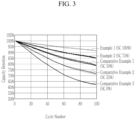
- Examples 1 and 2 exhibit improved capacity retention at the 100 th cycle, compared with Comparative Examples 1 to 3.
- Example 1 satisfies capacity retention of greater than or equal to 90% at the 100 th cycle.
Landscapes
- Chemical & Material Sciences (AREA)
- Chemical Kinetics & Catalysis (AREA)
- Electrochemistry (AREA)
- General Chemical & Material Sciences (AREA)
- Engineering & Computer Science (AREA)
- Inorganic Chemistry (AREA)
- Composite Materials (AREA)
- Materials Engineering (AREA)
- Manufacturing & Machinery (AREA)
- Battery Electrode And Active Subsutance (AREA)
- Secondary Cells (AREA)
Applications Claiming Priority (1)
| Application Number | Priority Date | Filing Date | Title |
|---|---|---|---|
| KR1020220177251A KR20240094715A (ko) | 2022-12-16 | 2022-12-16 | 리튬 이차 전지용 양극 및 이를 포함하는 리튬 이차 전지 |
Publications (1)
| Publication Number | Publication Date |
|---|---|
| EP4411863A1 true EP4411863A1 (fr) | 2024-08-07 |
Family
ID=88290771
Family Applications (1)
| Application Number | Title | Priority Date | Filing Date |
|---|---|---|---|
| EP23201935.6A Pending EP4411863A1 (fr) | 2022-12-16 | 2023-10-05 | Électrode positive pour batterie au lithium rechargeable et batterie au lithium rechargeable la comprenant |
Country Status (4)
| Country | Link |
|---|---|
| US (1) | US20240213470A1 (fr) |
| EP (1) | EP4411863A1 (fr) |
| KR (1) | KR20240094715A (fr) |
| CN (1) | CN118213471A (fr) |
Cited By (1)
| Publication number | Priority date | Publication date | Assignee | Title |
|---|---|---|---|---|
| EP4708394A1 (fr) * | 2024-08-28 | 2026-03-11 | SK On Co., Ltd. | Matériau actif de cathode pour batterie secondaire au lithium, cathode pour batterie secondaire au lithium le comprenant et batterie secondaire au lithium |
Families Citing this family (1)
| Publication number | Priority date | Publication date | Assignee | Title |
|---|---|---|---|---|
| CN119153685B (zh) * | 2024-11-18 | 2025-02-14 | 中创新航科技集团股份有限公司 | 二次电池和用电装置 |
Citations (2)
| Publication number | Priority date | Publication date | Assignee | Title |
|---|---|---|---|---|
| CN110556538A (zh) * | 2018-06-01 | 2019-12-10 | 宁德时代新能源科技股份有限公司 | 正极片及锂离子电池 |
| WO2022124774A1 (fr) * | 2020-12-07 | 2022-06-16 | 주식회사 엘지에너지솔루션 | Matériau actif d'électrode positive pour batterie secondaire au lithium et batterie secondaire au lithium le comprenant |
-
2022
- 2022-12-16 KR KR1020220177251A patent/KR20240094715A/ko active Pending
-
2023
- 2023-09-25 US US18/473,966 patent/US20240213470A1/en active Pending
- 2023-10-05 EP EP23201935.6A patent/EP4411863A1/fr active Pending
- 2023-10-09 CN CN202311297559.0A patent/CN118213471A/zh active Pending
Patent Citations (2)
| Publication number | Priority date | Publication date | Assignee | Title |
|---|---|---|---|---|
| CN110556538A (zh) * | 2018-06-01 | 2019-12-10 | 宁德时代新能源科技股份有限公司 | 正极片及锂离子电池 |
| WO2022124774A1 (fr) * | 2020-12-07 | 2022-06-16 | 주식회사 엘지에너지솔루션 | Matériau actif d'électrode positive pour batterie secondaire au lithium et batterie secondaire au lithium le comprenant |
Cited By (1)
| Publication number | Priority date | Publication date | Assignee | Title |
|---|---|---|---|---|
| EP4708394A1 (fr) * | 2024-08-28 | 2026-03-11 | SK On Co., Ltd. | Matériau actif de cathode pour batterie secondaire au lithium, cathode pour batterie secondaire au lithium le comprenant et batterie secondaire au lithium |
Also Published As
| Publication number | Publication date |
|---|---|
| CN118213471A (zh) | 2024-06-18 |
| US20240213470A1 (en) | 2024-06-27 |
| KR20240094715A (ko) | 2024-06-25 |
Similar Documents
| Publication | Publication Date | Title |
|---|---|---|
| US12300807B2 (en) | Positive active material for rechargeable lithium battery, preparing method thereof and rechargeable lithium battery including the same | |
| KR102818646B1 (ko) | 리튬 이차 전지용 양극 활물질, 이의 제조 방법 및 이를 포함하는 리튬 이차 전지 | |
| KR102816123B1 (ko) | 리튬 이차 전지용 양극 활물질, 이의 제조 방법 및 이를 포함하는 리튬 이차 전지 | |
| KR102796388B1 (ko) | 리튬 이차 전지용 양극 활물질, 이의 제조 방법 및 이를 포함하는 리튬 이차 전지 | |
| KR102761656B1 (ko) | 리튬 이차 전지용 양극 활물질 전구체, 이를 이용한 양극 활물질의 제조 방법 및 리튬 이차 전지용 양극 활물질 | |
| EP4382489A1 (fr) | Matériau actif positif pour batteries au lithium rechargeables, son procédé de préparation et batteries au lithium rechargeables le comprenant | |
| KR102907167B1 (ko) | 리튬 이차 전지용 양극 활물질, 이의 제조 방법 및 이를 포함하는 리튬 이차 전지 | |
| EP4411863A1 (fr) | Électrode positive pour batterie au lithium rechargeable et batterie au lithium rechargeable la comprenant | |
| KR20250050848A (ko) | 리튬 이차 전지용 양극 활물질 및 이를 포함하는 리튬 이차 전지 | |
| KR20250165299A (ko) | 리튬 이차 전지용 양극 활물질, 이의 제조 방법 및 이를 포함하는 리튬 이차 전지 | |
| EP4345067A1 (fr) | Matériau actif positif pour batteries au lithium rechargeables, son procédé de préparation et batteries au lithium rechargeables | |
| EP4140957A1 (fr) | Précurseur de matériau actif positif pour batterie au lithium rechargeable, procédé de préparation de matériau actif positif à l'aide du précurseur et matériau actif positif pour batterie au lithium rechargeable | |
| KR102853968B1 (ko) | 리튬 이차 전지용 양극 활물질 및 이를 포함하는 리튬 이차 전지 | |
| KR102851465B1 (ko) | 리튬 이차 전지용 양극 활물질 및 이를 포함하는 리튬 이차 전지 | |
| EP4286342A1 (fr) | Matériau actif positif pour batterie au lithium rechargeable, électrode positive pour batterie au lithium rechargeable et batterie au lithium rechargeable | |
| EP4385952B1 (fr) | Matériau actif positif pour batterie au lithium rechargeable et batterie au lithium rechargeable le comprenant | |
| KR102820708B1 (ko) | 리튬 이차 전지용 양극 활물질, 이의 제조 방법 및 이를 포함하는 리튬 이차 전지 | |
| US20230098411A1 (en) | Positive electrode active material for rechargeable lithium battery, method of preparing the same, and rechargeable lithium battery | |
| KR20240085142A (ko) | 리튬 이차 전지용 양극 활물질, 이의 제조 방법 및 이를 포함하는 리튬 이차 전지 | |
| KR20240092537A (ko) | 리튬 이차 전지용 양극 활물질 및 이를 포함하는 리튬 이차 전지 |
Legal Events
| Date | Code | Title | Description |
|---|---|---|---|
| PUAI | Public reference made under article 153(3) epc to a published international application that has entered the european phase |
Free format text: ORIGINAL CODE: 0009012 |
|
| STAA | Information on the status of an ep patent application or granted ep patent |
Free format text: STATUS: REQUEST FOR EXAMINATION WAS MADE |
|
| 17P | Request for examination filed |
Effective date: 20231005 |
|
| AK | Designated contracting states |
Kind code of ref document: A1 Designated state(s): AL AT BE BG CH CY CZ DE DK EE ES FI FR GB GR HR HU IE IS IT LI LT LU LV MC ME MK MT NL NO PL PT RO RS SE SI SK SM TR |