EP4414052A1 - Article de catalyseur scr et systèmes de réduction de n2o dans des gaz d'échappement - Google Patents
Article de catalyseur scr et systèmes de réduction de n2o dans des gaz d'échappement Download PDFInfo
- Publication number
- EP4414052A1 EP4414052A1 EP23156120.0A EP23156120A EP4414052A1 EP 4414052 A1 EP4414052 A1 EP 4414052A1 EP 23156120 A EP23156120 A EP 23156120A EP 4414052 A1 EP4414052 A1 EP 4414052A1
- Authority
- EP
- European Patent Office
- Prior art keywords
- catalyst
- catalyst composition
- article
- exhaust gas
- molecular sieve
- Prior art date
- Legal status (The legal status is an assumption and is not a legal conclusion. Google has not performed a legal analysis and makes no representation as to the accuracy of the status listed.)
- Withdrawn
Links
Images
Classifications
-
- B—PERFORMING OPERATIONS; TRANSPORTING
- B01—PHYSICAL OR CHEMICAL PROCESSES OR APPARATUS IN GENERAL
- B01D—SEPARATION
- B01D53/00—Separation of gases or vapours; Recovering vapours of volatile solvents from gases; Chemical or biological purification of waste gases, e.g. engine exhaust gases, smoke, fumes, flue gases, aerosols
- B01D53/34—Chemical or biological purification of waste gases
- B01D53/92—Chemical or biological purification of waste gases of engine exhaust gases
- B01D53/94—Chemical or biological purification of waste gases of engine exhaust gases by catalytic processes
- B01D53/9404—Removing only nitrogen compounds
- B01D53/9409—Nitrogen oxides
- B01D53/9413—Processes characterised by a specific catalyst
- B01D53/9418—Processes characterised by a specific catalyst for removing nitrogen oxides by selective catalytic reduction [SCR] using a reducing agent in a lean exhaust gas
-
- B—PERFORMING OPERATIONS; TRANSPORTING
- B01—PHYSICAL OR CHEMICAL PROCESSES OR APPARATUS IN GENERAL
- B01D—SEPARATION
- B01D53/00—Separation of gases or vapours; Recovering vapours of volatile solvents from gases; Chemical or biological purification of waste gases, e.g. engine exhaust gases, smoke, fumes, flue gases, aerosols
- B01D53/34—Chemical or biological purification of waste gases
- B01D53/92—Chemical or biological purification of waste gases of engine exhaust gases
- B01D53/94—Chemical or biological purification of waste gases of engine exhaust gases by catalytic processes
- B01D53/9404—Removing only nitrogen compounds
- B01D53/9409—Nitrogen oxides
- B01D53/9413—Processes characterised by a specific catalyst
- B01D53/9427—Processes characterised by a specific catalyst for removing nitrous oxide
-
- B—PERFORMING OPERATIONS; TRANSPORTING
- B01—PHYSICAL OR CHEMICAL PROCESSES OR APPARATUS IN GENERAL
- B01D—SEPARATION
- B01D53/00—Separation of gases or vapours; Recovering vapours of volatile solvents from gases; Chemical or biological purification of waste gases, e.g. engine exhaust gases, smoke, fumes, flue gases, aerosols
- B01D53/34—Chemical or biological purification of waste gases
- B01D53/92—Chemical or biological purification of waste gases of engine exhaust gases
- B01D53/94—Chemical or biological purification of waste gases of engine exhaust gases by catalytic processes
- B01D53/9404—Removing only nitrogen compounds
- B01D53/9436—Ammonia
-
- B—PERFORMING OPERATIONS; TRANSPORTING
- B01—PHYSICAL OR CHEMICAL PROCESSES OR APPARATUS IN GENERAL
- B01D—SEPARATION
- B01D53/00—Separation of gases or vapours; Recovering vapours of volatile solvents from gases; Chemical or biological purification of waste gases, e.g. engine exhaust gases, smoke, fumes, flue gases, aerosols
- B01D53/34—Chemical or biological purification of waste gases
- B01D53/92—Chemical or biological purification of waste gases of engine exhaust gases
- B01D53/94—Chemical or biological purification of waste gases of engine exhaust gases by catalytic processes
- B01D53/9459—Removing one or more of nitrogen oxides, carbon monoxide, or hydrocarbons by multiple successive catalytic functions; systems with more than one different function, e.g. zone coated catalysts
- B01D53/9463—Removing one or more of nitrogen oxides, carbon monoxide, or hydrocarbons by multiple successive catalytic functions; systems with more than one different function, e.g. zone coated catalysts with catalysts positioned on one brick
- B01D53/9472—Removing one or more of nitrogen oxides, carbon monoxide, or hydrocarbons by multiple successive catalytic functions; systems with more than one different function, e.g. zone coated catalysts with catalysts positioned on one brick in different zones
-
- B—PERFORMING OPERATIONS; TRANSPORTING
- B01—PHYSICAL OR CHEMICAL PROCESSES OR APPARATUS IN GENERAL
- B01D—SEPARATION
- B01D53/00—Separation of gases or vapours; Recovering vapours of volatile solvents from gases; Chemical or biological purification of waste gases, e.g. engine exhaust gases, smoke, fumes, flue gases, aerosols
- B01D53/34—Chemical or biological purification of waste gases
- B01D53/92—Chemical or biological purification of waste gases of engine exhaust gases
- B01D53/94—Chemical or biological purification of waste gases of engine exhaust gases by catalytic processes
- B01D53/9459—Removing one or more of nitrogen oxides, carbon monoxide, or hydrocarbons by multiple successive catalytic functions; systems with more than one different function, e.g. zone coated catalysts
- B01D53/9477—Removing one or more of nitrogen oxides, carbon monoxide, or hydrocarbons by multiple successive catalytic functions; systems with more than one different function, e.g. zone coated catalysts with catalysts positioned on separate bricks, e.g. exhaust systems
-
- B—PERFORMING OPERATIONS; TRANSPORTING
- B01—PHYSICAL OR CHEMICAL PROCESSES OR APPARATUS IN GENERAL
- B01J—CHEMICAL OR PHYSICAL PROCESSES, e.g. CATALYSIS OR COLLOID CHEMISTRY; THEIR RELEVANT APPARATUS
- B01J29/00—Catalysts comprising molecular sieves
- B01J29/04—Catalysts comprising molecular sieves having base-exchange properties, e.g. crystalline zeolites
- B01J29/06—Crystalline aluminosilicate zeolites; Isomorphous compounds thereof
- B01J29/65—Crystalline aluminosilicate zeolites; Isomorphous compounds thereof of the ferrierite type, e.g. types ZSM-21, ZSM-35 or ZSM-38, as exemplified by patent documents US4046859, US4016245 and US4046859, respectively
- B01J29/66—Crystalline aluminosilicate zeolites; Isomorphous compounds thereof of the ferrierite type, e.g. types ZSM-21, ZSM-35 or ZSM-38, as exemplified by patent documents US4046859, US4016245 and US4046859, respectively containing iron group metals, noble metals or copper
- B01J29/68—Iron group metals or copper
-
- B—PERFORMING OPERATIONS; TRANSPORTING
- B01—PHYSICAL OR CHEMICAL PROCESSES OR APPARATUS IN GENERAL
- B01J—CHEMICAL OR PHYSICAL PROCESSES, e.g. CATALYSIS OR COLLOID CHEMISTRY; THEIR RELEVANT APPARATUS
- B01J29/00—Catalysts comprising molecular sieves
- B01J29/04—Catalysts comprising molecular sieves having base-exchange properties, e.g. crystalline zeolites
- B01J29/06—Crystalline aluminosilicate zeolites; Isomorphous compounds thereof
- B01J29/70—Crystalline aluminosilicate zeolites; Isomorphous compounds thereof of types characterised by their specific structure not provided for in groups B01J29/08 - B01J29/65
- B01J29/72—Crystalline aluminosilicate zeolites; Isomorphous compounds thereof of types characterised by their specific structure not provided for in groups B01J29/08 - B01J29/65 containing iron group metals, noble metals or copper
- B01J29/76—Iron group metals or copper
- B01J29/763—CHA-type, e.g. Chabazite, LZ-218
-
- B—PERFORMING OPERATIONS; TRANSPORTING
- B01—PHYSICAL OR CHEMICAL PROCESSES OR APPARATUS IN GENERAL
- B01J—CHEMICAL OR PHYSICAL PROCESSES, e.g. CATALYSIS OR COLLOID CHEMISTRY; THEIR RELEVANT APPARATUS
- B01J35/00—Catalysts, in general, characterised by their form or physical properties
- B01J35/19—Catalysts containing parts with different compositions
-
- B—PERFORMING OPERATIONS; TRANSPORTING
- B01—PHYSICAL OR CHEMICAL PROCESSES OR APPARATUS IN GENERAL
- B01J—CHEMICAL OR PHYSICAL PROCESSES, e.g. CATALYSIS OR COLLOID CHEMISTRY; THEIR RELEVANT APPARATUS
- B01J35/00—Catalysts, in general, characterised by their form or physical properties
- B01J35/50—Catalysts, in general, characterised by their form or physical properties characterised by their shape or configuration
- B01J35/56—Foraminous structures having flow-through passages or channels, e.g. grids or three-dimensional [3D] monoliths
- B01J35/57—Honeycombs
-
- B—PERFORMING OPERATIONS; TRANSPORTING
- B01—PHYSICAL OR CHEMICAL PROCESSES OR APPARATUS IN GENERAL
- B01J—CHEMICAL OR PHYSICAL PROCESSES, e.g. CATALYSIS OR COLLOID CHEMISTRY; THEIR RELEVANT APPARATUS
- B01J37/00—Processes, in general, for preparing catalysts; Processes, in general, for activation of catalysts
- B01J37/02—Impregnation, coating or precipitation
- B01J37/0201—Impregnation
-
- B—PERFORMING OPERATIONS; TRANSPORTING
- B01—PHYSICAL OR CHEMICAL PROCESSES OR APPARATUS IN GENERAL
- B01J—CHEMICAL OR PHYSICAL PROCESSES, e.g. CATALYSIS OR COLLOID CHEMISTRY; THEIR RELEVANT APPARATUS
- B01J37/00—Processes, in general, for preparing catalysts; Processes, in general, for activation of catalysts
- B01J37/02—Impregnation, coating or precipitation
- B01J37/0236—Drying, e.g. preparing a suspension, adding a soluble salt and drying
-
- B—PERFORMING OPERATIONS; TRANSPORTING
- B01—PHYSICAL OR CHEMICAL PROCESSES OR APPARATUS IN GENERAL
- B01J—CHEMICAL OR PHYSICAL PROCESSES, e.g. CATALYSIS OR COLLOID CHEMISTRY; THEIR RELEVANT APPARATUS
- B01J37/00—Processes, in general, for preparing catalysts; Processes, in general, for activation of catalysts
- B01J37/02—Impregnation, coating or precipitation
- B01J37/024—Multiple impregnation or coating
- B01J37/0246—Coatings comprising a zeolite
-
- B—PERFORMING OPERATIONS; TRANSPORTING
- B01—PHYSICAL OR CHEMICAL PROCESSES OR APPARATUS IN GENERAL
- B01J—CHEMICAL OR PHYSICAL PROCESSES, e.g. CATALYSIS OR COLLOID CHEMISTRY; THEIR RELEVANT APPARATUS
- B01J37/00—Processes, in general, for preparing catalysts; Processes, in general, for activation of catalysts
- B01J37/08—Heat treatment
-
- F—MECHANICAL ENGINEERING; LIGHTING; HEATING; WEAPONS; BLASTING
- F01—MACHINES OR ENGINES IN GENERAL; ENGINE PLANTS IN GENERAL; STEAM ENGINES
- F01N—GAS-FLOW SILENCERS OR EXHAUST APPARATUS FOR MACHINES OR ENGINES IN GENERAL; GAS-FLOW SILENCERS OR EXHAUST APPARATUS FOR INTERNAL-COMBUSTION ENGINES
- F01N3/00—Exhaust or silencing apparatus having means for purifying, rendering innocuous, or otherwise treating exhaust
- F01N3/08—Exhaust or silencing apparatus having means for purifying, rendering innocuous, or otherwise treating exhaust for rendering innocuous
- F01N3/10—Exhaust or silencing apparatus having means for purifying, rendering innocuous, or otherwise treating exhaust for rendering innocuous by thermal or catalytic conversion of noxious components of exhaust
- F01N3/18—Exhaust or silencing apparatus having means for purifying, rendering innocuous, or otherwise treating exhaust for rendering innocuous by thermal or catalytic conversion of noxious components of exhaust characterised by methods of operation; Control
- F01N3/20—Exhaust or silencing apparatus having means for purifying, rendering innocuous, or otherwise treating exhaust for rendering innocuous by thermal or catalytic conversion of noxious components of exhaust characterised by methods of operation; Control specially adapted for catalytic conversion
- F01N3/206—Adding periodically or continuously substances to exhaust gases for promoting purification, e.g. catalytic material in liquid form, NOx reducing agents
- F01N3/2066—Selective catalytic reduction [SCR]
-
- F—MECHANICAL ENGINEERING; LIGHTING; HEATING; WEAPONS; BLASTING
- F01—MACHINES OR ENGINES IN GENERAL; ENGINE PLANTS IN GENERAL; STEAM ENGINES
- F01N—GAS-FLOW SILENCERS OR EXHAUST APPARATUS FOR MACHINES OR ENGINES IN GENERAL; GAS-FLOW SILENCERS OR EXHAUST APPARATUS FOR INTERNAL-COMBUSTION ENGINES
- F01N3/00—Exhaust or silencing apparatus having means for purifying, rendering innocuous, or otherwise treating exhaust
- F01N3/08—Exhaust or silencing apparatus having means for purifying, rendering innocuous, or otherwise treating exhaust for rendering innocuous
- F01N3/10—Exhaust or silencing apparatus having means for purifying, rendering innocuous, or otherwise treating exhaust for rendering innocuous by thermal or catalytic conversion of noxious components of exhaust
- F01N3/24—Exhaust or silencing apparatus having means for purifying, rendering innocuous, or otherwise treating exhaust for rendering innocuous by thermal or catalytic conversion of noxious components of exhaust characterised by constructional aspects of converting apparatus
- F01N3/28—Construction of catalytic reactors
- F01N3/2803—Construction of catalytic reactors characterised by structure, by material or by manufacturing of catalyst support
-
- B—PERFORMING OPERATIONS; TRANSPORTING
- B01—PHYSICAL OR CHEMICAL PROCESSES OR APPARATUS IN GENERAL
- B01D—SEPARATION
- B01D2251/00—Reactants
- B01D2251/20—Reductants
- B01D2251/206—Ammonium compounds
- B01D2251/2062—Ammonia
-
- B—PERFORMING OPERATIONS; TRANSPORTING
- B01—PHYSICAL OR CHEMICAL PROCESSES OR APPARATUS IN GENERAL
- B01D—SEPARATION
- B01D2251/00—Reactants
- B01D2251/20—Reductants
- B01D2251/206—Ammonium compounds
- B01D2251/2067—Urea
-
- B—PERFORMING OPERATIONS; TRANSPORTING
- B01—PHYSICAL OR CHEMICAL PROCESSES OR APPARATUS IN GENERAL
- B01D—SEPARATION
- B01D2255/00—Catalysts
- B01D2255/20—Metals or compounds thereof
- B01D2255/207—Transition metals
- B01D2255/20723—Vanadium
-
- B—PERFORMING OPERATIONS; TRANSPORTING
- B01—PHYSICAL OR CHEMICAL PROCESSES OR APPARATUS IN GENERAL
- B01D—SEPARATION
- B01D2255/00—Catalysts
- B01D2255/20—Metals or compounds thereof
- B01D2255/207—Transition metals
- B01D2255/20738—Iron
-
- B—PERFORMING OPERATIONS; TRANSPORTING
- B01—PHYSICAL OR CHEMICAL PROCESSES OR APPARATUS IN GENERAL
- B01D—SEPARATION
- B01D2255/00—Catalysts
- B01D2255/20—Metals or compounds thereof
- B01D2255/207—Transition metals
- B01D2255/20761—Copper
-
- B—PERFORMING OPERATIONS; TRANSPORTING
- B01—PHYSICAL OR CHEMICAL PROCESSES OR APPARATUS IN GENERAL
- B01D—SEPARATION
- B01D2255/00—Catalysts
- B01D2255/50—Zeolites
-
- B—PERFORMING OPERATIONS; TRANSPORTING
- B01—PHYSICAL OR CHEMICAL PROCESSES OR APPARATUS IN GENERAL
- B01D—SEPARATION
- B01D2255/00—Catalysts
- B01D2255/90—Physical characteristics of catalysts
- B01D2255/903—Multi-zoned catalysts
- B01D2255/9032—Two zones
-
- B—PERFORMING OPERATIONS; TRANSPORTING
- B01—PHYSICAL OR CHEMICAL PROCESSES OR APPARATUS IN GENERAL
- B01D—SEPARATION
- B01D2255/00—Catalysts
- B01D2255/90—Physical characteristics of catalysts
- B01D2255/915—Catalyst supported on particulate filters
- B01D2255/9155—Wall flow filters
-
- B—PERFORMING OPERATIONS; TRANSPORTING
- B01—PHYSICAL OR CHEMICAL PROCESSES OR APPARATUS IN GENERAL
- B01D—SEPARATION
- B01D2257/00—Components to be removed
- B01D2257/40—Nitrogen compounds
- B01D2257/402—Dinitrogen oxide
-
- B—PERFORMING OPERATIONS; TRANSPORTING
- B01—PHYSICAL OR CHEMICAL PROCESSES OR APPARATUS IN GENERAL
- B01D—SEPARATION
- B01D2257/00—Components to be removed
- B01D2257/40—Nitrogen compounds
- B01D2257/404—Nitrogen oxides other than dinitrogen oxide
-
- B—PERFORMING OPERATIONS; TRANSPORTING
- B01—PHYSICAL OR CHEMICAL PROCESSES OR APPARATUS IN GENERAL
- B01D—SEPARATION
- B01D2257/00—Components to be removed
- B01D2257/40—Nitrogen compounds
- B01D2257/406—Ammonia
-
- B—PERFORMING OPERATIONS; TRANSPORTING
- B01—PHYSICAL OR CHEMICAL PROCESSES OR APPARATUS IN GENERAL
- B01D—SEPARATION
- B01D2258/00—Sources of waste gases
- B01D2258/01—Engine exhaust gases
-
- B—PERFORMING OPERATIONS; TRANSPORTING
- B01—PHYSICAL OR CHEMICAL PROCESSES OR APPARATUS IN GENERAL
- B01D—SEPARATION
- B01D2258/00—Sources of waste gases
- B01D2258/01—Engine exhaust gases
- B01D2258/012—Diesel engines and lean burn gasoline engines
-
- B—PERFORMING OPERATIONS; TRANSPORTING
- B01—PHYSICAL OR CHEMICAL PROCESSES OR APPARATUS IN GENERAL
- B01D—SEPARATION
- B01D2258/00—Sources of waste gases
- B01D2258/01—Engine exhaust gases
- B01D2258/016—Methanol engines
-
- F—MECHANICAL ENGINEERING; LIGHTING; HEATING; WEAPONS; BLASTING
- F01—MACHINES OR ENGINES IN GENERAL; ENGINE PLANTS IN GENERAL; STEAM ENGINES
- F01N—GAS-FLOW SILENCERS OR EXHAUST APPARATUS FOR MACHINES OR ENGINES IN GENERAL; GAS-FLOW SILENCERS OR EXHAUST APPARATUS FOR INTERNAL-COMBUSTION ENGINES
- F01N2370/00—Selection of materials for exhaust purification
- F01N2370/02—Selection of materials for exhaust purification used in catalytic reactors
- F01N2370/04—Zeolitic material
-
- F—MECHANICAL ENGINEERING; LIGHTING; HEATING; WEAPONS; BLASTING
- F01—MACHINES OR ENGINES IN GENERAL; ENGINE PLANTS IN GENERAL; STEAM ENGINES
- F01N—GAS-FLOW SILENCERS OR EXHAUST APPARATUS FOR MACHINES OR ENGINES IN GENERAL; GAS-FLOW SILENCERS OR EXHAUST APPARATUS FOR INTERNAL-COMBUSTION ENGINES
- F01N2510/00—Surface coverings
- F01N2510/06—Surface coverings for exhaust purification, e.g. catalytic reaction
- F01N2510/068—Surface coverings for exhaust purification, e.g. catalytic reaction characterised by the distribution of the catalytic coatings
- F01N2510/0684—Surface coverings for exhaust purification, e.g. catalytic reaction characterised by the distribution of the catalytic coatings having more than one coating layer, e.g. multi-layered coatings
-
- F—MECHANICAL ENGINEERING; LIGHTING; HEATING; WEAPONS; BLASTING
- F01—MACHINES OR ENGINES IN GENERAL; ENGINE PLANTS IN GENERAL; STEAM ENGINES
- F01N—GAS-FLOW SILENCERS OR EXHAUST APPARATUS FOR MACHINES OR ENGINES IN GENERAL; GAS-FLOW SILENCERS OR EXHAUST APPARATUS FOR INTERNAL-COMBUSTION ENGINES
- F01N2610/00—Adding substances to exhaust gases
- F01N2610/02—Adding substances to exhaust gases the substance being ammonia or urea
-
- F—MECHANICAL ENGINEERING; LIGHTING; HEATING; WEAPONS; BLASTING
- F01—MACHINES OR ENGINES IN GENERAL; ENGINE PLANTS IN GENERAL; STEAM ENGINES
- F01N—GAS-FLOW SILENCERS OR EXHAUST APPARATUS FOR MACHINES OR ENGINES IN GENERAL; GAS-FLOW SILENCERS OR EXHAUST APPARATUS FOR INTERNAL-COMBUSTION ENGINES
- F01N3/00—Exhaust or silencing apparatus having means for purifying, rendering innocuous, or otherwise treating exhaust
- F01N3/08—Exhaust or silencing apparatus having means for purifying, rendering innocuous, or otherwise treating exhaust for rendering innocuous
- F01N3/10—Exhaust or silencing apparatus having means for purifying, rendering innocuous, or otherwise treating exhaust for rendering innocuous by thermal or catalytic conversion of noxious components of exhaust
- F01N3/105—General auxiliary catalysts, e.g. upstream or downstream of the main catalyst
- F01N3/106—Auxiliary oxidation catalysts
-
- Y—GENERAL TAGGING OF NEW TECHNOLOGICAL DEVELOPMENTS; GENERAL TAGGING OF CROSS-SECTIONAL TECHNOLOGIES SPANNING OVER SEVERAL SECTIONS OF THE IPC; TECHNICAL SUBJECTS COVERED BY FORMER USPC CROSS-REFERENCE ART COLLECTIONS [XRACs] AND DIGESTS
- Y02—TECHNOLOGIES OR APPLICATIONS FOR MITIGATION OR ADAPTATION AGAINST CLIMATE CHANGE
- Y02T—CLIMATE CHANGE MITIGATION TECHNOLOGIES RELATED TO TRANSPORTATION
- Y02T10/00—Road transport of goods or passengers
- Y02T10/10—Internal combustion engine [ICE] based vehicles
- Y02T10/12—Improving ICE efficiencies
Definitions
- the present invention relates to an SCR catalyst article and systems in which the N 2 O emissions ultimately released from the exhaust-gas treatment system can be reduced.
- Exhaust gas from combustion engines and the like typically contains pollutants such as NO x (NO and NO 2 ), which have well known negative effects on the environment and on health. Accordingly, systems for treating such exhaust gas typically comprise catalysts for the abatement of NO x , such as selective catalytic reduction (SCR) catalysts. SCR catalysts, and their mechanism of action, are well known.
- SCR selective catalytic reduction
- Such exhaust gas may also contain nitrous oxide (N 2 O), typically in lower concentrations.
- N 2 O nitrous oxide
- SCR catalysts as well as other known catalysts upstream, may also generate additional N 2 O as a by-product.
- N 2 O also contributes to air pollution.
- conventional exhaust gas treatment systems do not generally contain catalysts for the primary purpose of N 2 O abatement, and little development has been made to produce catalysts that are effective at reducing N 2 O in exhaust gas.
- the present invention seeks to tackle at least some of the problems associated with the prior art or at least to provide a commercially acceptable alternative solution thereto.
- the present invention provides an SCR catalyst article, exhaust gas treatment systems, a fuel combustion and exhaust gas treatment system, a method of treating an exhaust gas and a use of the catalyst described herein according to the claims appended hereto.
- the present invention provides an SCR catalyst article comprising a substrate having thereon a second catalyst composition downstream of a first catalyst composition, wherein the first and second catalyst compositions are different and wherein the first catalyst composition is an SCR catalyst composition and the second catalyst composition comprises an Fe-loaded small- or medium-pore molecular sieve, the small- or medium-pore molecular sieve having a silica-to-alumina ratio (SAR) of from 6 to 19.
- SAR silica-to-alumina ratio
- catalysts comprising Fe-loaded small- and medium-pore molecular sieves may exhibit particularly high N 2 O conversion when treating exhaust gases, and further that reducing the SAR of said molecular sieves may increase the N 2 O conversion of the catalyst even further. This is unexpected.
- Such catalysts may therefore be particularly effective for use in exhaust systems for treating exhaust gas in which there is a relatively high N 2 O concentration, such as downstream of an SCR catalyst, for example.
- the second catalyst composition of the invention may be used to abate N 2 O in an exhaust gas in an analogous manner to an ammonia slip catalyst (ASC) that treats any "slipped" ammonia. That is, the second catalyst composition of the invention may be used to abate "N 2 O slip” through and/or generated by the first catalyst composition. This is advantageous and such a use has not previously been contemplated.
- N 2 O conversion this is intended to refer to the typical chemical reaction that is facilitated by such a catalyst, which is: 2N 2 O ⁇ 2N 2 + O 2 .
- the Inventors have also surprisingly found that the Fe-loaded molecular sieves of the present invention exhibit increased N 2 O conversion compared to Fe-loaded large-pore molecular sieves, and to small- and medium-pore molecular sieves having higher SARs. This has not previously been investigated.
- first is intended as a label and does not limit the relative arrangement or location of the corresponding feature (here, the catalyst compositions) within the exhaust gas treatment system, unless otherwise specified, such as by use of the word “upstream” or “downstream” to define the relative locations in the catalyst article or exhaust gas treatment system.
- upstream indicates a direction in a system towards the source of the exhaust gas.
- downstream indicates a direction in a system away from the source of the exhaust gas.
- the second catalyst composition is downstream of the first catalyst composition.
- this wording is intended to mean that at least a portion of the second catalyst composition is downstream of the first catalyst composition.
- a portion of the first and second catalyst compositions may be overlapping, such that a portion of the first and second catalyst compositions are essentially in the same position in the (literal) upstream-to-downstream direction, or even that a portion of the second catalyst composition may be present upstream of the first catalyst composition.
- first catalyst composition is present in an upper layer, zone, region or washcoat disposed on the substrate, for example, and the second catalyst composition is present in a lower layer, zone, region or washcoat disposed on the substrate, such that the SCR catalyst article is configured such that exhaust gas would contact the first catalyst composition prior to contacting the second catalyst composition in use.
- the upper layer, zone, region or washcoat comprising the first catalyst composition may therefore completely cover the lower layer, zone, region or washcoat comprising the second catalyst composition.
- this wording is intended to encompass that (at least a portion of) the second catalyst composition is downstream of the first catalyst composition in the (literal) upstream-to-downstream direction, such as in a linear upstream-to-downstream direction. More preferably, at least 70 wt.%, even more preferably at least 80 wt.%, still more preferably at least 90 wt.%, yet still more preferably at least 95 wt.%, yet still more preferably at least 99 wt.% and most preferably 100 wt.% of the second catalyst composition is downstream of the first catalyst composition (in the (literal) upstream-to-downstream direction, such as in a linear upstream-to-downstream direction), based on the total weight of the second catalyst composition.
- article or “catalyst article” as used herein may encompass an article in which a catalyst is supported thereon or therein.
- the article may take the form of, for example, a honeycomb monolith, such as a flow-through monolith or a filter, e.g. a wall flow filter.
- the catalyst article may also be in pellet form.
- SCR catalyst article may therefore encompass a catalyst article that is suitable for catalysing the selective catalytic reduction reaction, such as the selective catalytic reduction of NO x , preferably in the presence of a reductant, such as a nitrogenous reductant or methane.
- the SCR catalyst article may be a selective catalytic reduction filter (SCRF). That is, the article/substrate may comprise a filter. In other words, the substrate may be a filtering substrate.
- SCRF selective catalytic reduction filter
- catalyst composition may generally encompass a composition that is catalytically active towards pollutants present in exhaust gas.
- substrate may encompass, for example, a ceramic or metallic flow-through honeycomb, or a filter block, e.g. a wall flow filter.
- the substrate may comprise a ceramic or metallic monolithic substrate.
- the substrate may vary in its material composition, size and configuration, cell shape and density, and wall thickness. Suitable substrate materials are known in the art, such as cordierite.
- first and/or second catalyst compositions are disposed on the substrate and/or that the first and/or second catalyst compositions are present in the substrate, such as in the form of an extruded substrate made from extrudate comprising the first and/or second catalyst composition.
- disposed on may encompass either having a catalytic composition directly disposed on the substrate, i.e. with no intervening material, and/or indirectly disposed on the substrate, i.e. with intervening material. If the substrate is porous, then the term “disposed on” may also encompass having the catalytic composition disposed therein, for example within the pores of the substrate, i.e. wherein the catalytic composition is disposed thereon and/or therein.
- the catalytic composition is typically disposed on the substrate in the form of a washcoat.
- washcoat as used herein is well-known in the field and refers to an adherent coating that is applied to a substrate usually during the production of a catalyst. How the molecular sieve may be disposed on the substrate is not particularly important for the purpose of the present invention.
- first and second catalyst compositions may encompass that the catalyst compositions are completely different, for example if the first catalyst composition does not comprise a molecular sieve or is not molecular-sieve based.
- the term “different” may simply encompass that the framework (i.e. the Framework Type Code) of the molecular sieve, or another property of the molecular sieve, such as the SAR, is different, or even that a metal other than Fe, for example, is present in the first catalyst composition (such as loaded on a molecular sieve).
- the first and second catalyst compositions are also separate.
- the term "separate” as used herein in the context of "separate first and second catalyst compositions” may encompass that the first and second catalyst compositions are disposed on or present in the substrate in distinct, discrete locations. In other words, the first and second catalyst compositions may not be mixed so as to be present in the same catalytic region, layer, zone or washcoat. Of course, it will be appreciated that there may be minor amounts of mixing at any boundary between the first and second catalyst compositions, for example, within practical limitations. In some embodiments, it may be that the mixing of the first and second catalyst compositions may result in an undesirable deactivation of one or both of the catalyst compositions, such that it may be preferably that the first and second catalyst compositions are kept separate.
- SCR catalyst composition may encompass a catalyst composition that is suitable for catalysing the selective catalytic reduction reaction, such as the selective catalytic reduction of NO x , preferably in the presence of a reductant, such as a nitrogenous reductant or methane.
- a reductant such as a nitrogenous reductant or methane.
- the SCR catalyst composition may not be limited to only such a use.
- the SCR catalyst composition may also exhibit further catalytic activity for use as a diesel oxidation catalyst (DOC) and/or a passive NO x adsorber (PNA) and/or an ASC, and/or another type of known exhaust-gas catalyst.
- DOC diesel oxidation catalyst
- PNA passive NO x adsorber
- ASC active NO x adsorber
- the SCR catalyst article in some embodiments, may also comprise further layers, zones, regions or washcoats that comprise catalysts exhibiting this catalytic activity.
- the first catalyst composition is a DOC and/or a PNA and/or an ASC catalyst composition (i.e. and not necessarily an SCR catalyst composition).
- DOCs, PNAs and/or ASCs may also generate additional N 2 O into the exhaust gas.
- Fe-loaded as used herein may encompass that the molecular sieve is metal-promoted with Fe, wherein the Fe maybe loaded into the molecular sieve.
- the loaded metal is a type of "extra-framework metal", that is, a metal that resides within the molecular sieve and/or on at least a portion of the molecular sieve surface. This definition does not include atoms constituting the framework of the molecular sieve.
- Metal-loaded molecular sieves in general, and methods of manufacturing such metal-loaded molecular sieves, are known to the skilled person. For example, several methods have been mentioned in the literature for preparing metal-loaded molecular sieves, in particular metal-loaded zeolites. The direct synthesis of metal-loaded zeolites is a complicated process and depends on the synthesis conditions (see M. Moliner, ISRN Materials Science, 2012, Article ID 789525). An alternative is to use a commercial zeolite support and to subsequently add metal by post-synthesis treatment of the zeolite, for example, by wet impregnation, wet ion exchange or solid-state ion exchange.
- Known wet ion-exchange methods for the addition of metal to molecular sieves typically employ soluble metal salts, such as metal acetates, metal sulphates or metal chlorides, as the active metal precursor, wherein the active metal precursor is reacted with the molecular sieve in aqueous solution.
- soluble metal salts such as metal acetates, metal sulphates or metal chlorides
- the active metal precursor is reacted with the molecular sieve in aqueous solution.
- such processes typically require a heating step, wherein the mixture may be heated to a temperature in the range 70 to 80°C for up to several hours.
- molecular sieve as used herein is well known to the skilled person and may encompass crystalline or quasi-crystalline materials which can be, for example aluminosilicates (zeolites) or silicoaluminophosphates (SAPOs).
- zeolites aluminosilicates
- SAPOs silicoaluminophosphates
- Such molecular sieves are constructed of repeating SiO 4 , AlO 4 , and optionally PO 4 tetrahedral units linked together, for example in rings, to form frameworks having regular intra-crystalline cavities and channels of molecular dimensions.
- the specific arrangement of tetrahedral units (ring members) gives rise to the molecular sieve's framework, and by convention, each unique framework is assigned a unique three-letter code (e.g., "CHA") by the International Zeolite Association (IZA).
- IZA International Zeolite Association
- Molecular sieves may exist as "H + -form” or "NH 4 + form” molecular sieves, for example.
- H + -form in relation to a molecular sieve refers to a molecular sieve having an anionic framework wherein the charge of the framework is counterbalanced by protons (i.e. H + cations).
- NH 4 + form in relation to a molecular sieve refers to a molecular sieve having an anionic framework wherein the charge of the framework is counterbalanced by ammonium cations (NH 4 + cations).
- Molecular sieves may also be categorised by pore size, e.g. a maximum number of tetrahedral atoms present in a molecular sieve's framework.
- a "small-pore” molecular sieve such as CHA
- a "medium-pore” molecular sieve e.g. MFI
- a "large-pore” molecular sieve such as BEA
- the small- or medium-pore molecular sieve is defined as such in accordance with these generally understood definitions.
- the second catalyst composition comprises an Fe-loaded small- or medium-pore molecular sieve.
- the invention may encompass an embodiment in which the second catalyst composition comprises Fe loaded on two or more different small- or medium-pore molecular sieves.
- the term "different" small- or medium-pore molecular sieves may encompass that the framework (i.e. the Framework Type Code) of the molecular sieve, or another property of the molecular sieve, such as the SAR, is different.
- sica-to-alumina ratio may encompass the molar ratio of silicon to aluminium present in the molecular sieve framework, calculated on the basis of the silica (SiO 2 ) and the alumina (Al 2 O 3 ), rather than the silicon and aluminium atoms.
- SiO 2 silica
- Al 2 O 3 alumina
- the silicon and aluminium will not typically be present in the form of discrete silica and alumina.
- the SAR is a term commonly used in the art and would be understood by the skilled person.
- the small-pore molecular sieve may have a framework defined by a Framework Type Code selected from ACO, AEI, AEN, AFN, AFT, AFX, ANA, APC, APD, ATT, CDO, CHA, DDR, DFT, EAB, EDI, EPI, ERI, GIS, GOO, IHW, ITE, ITW, KFI, LEV, LTA, MER, MON, NSI, OWE, PAU, PHI, RHO, RTH, SAT, SAV, SFW, SIV, THO, TSC, UEI, UFI, VNI, YUG, and ZON, and mixtures and/or intergrowths thereof.
- a Framework Type Code selected from ACO, AEI, AEN, AFN, AFT, AFX, ANA, APC, APD, ATT, CDO, CHA, DDR, DFT, EAB, EDI, EPI, ERI, GIS, GOO, IHW,
- the medium-pore molecular sieve may have a framework defined by a Framework Type Code selected from AEL, AFO, AHT, BOF, BOZ, CGF, CGS, CHI, DAC, EUO, FER, HEU, IMF, ITH, ITR, JRY, JSR, JST, LAU, LOV, MEL, MFI, MFS, MRE, MTT, MVY, MWW, NAB, NAT, NES, OBW, PAR, PCR, PON, PUN, RRO, RSN, SFF, SFG, STF, STI, STT, STW, SVR, SZR, TER, TON, TUN, UOS, VSV, WEI, and WEN, and mixtures and/or intergrowths thereof.
- a Framework Type Code selected from AEL, AFO, AHT, BOF, BOZ, CGF, CGS, CHI, DAC, EUO, FER, HEU, IMF, ITH, ITR, JRY, JSR,
- the molecular sieve of the second catalyst composition is a small-pore molecular sieve.
- a small- or medium-pore molecular sieve having a framework defined by a Framework Type Code selected from CHA, FER, MFI, AEI and AEI-CHA intergrowth, preferably selected from CHA, FER, AEI and AEI-CHA intergrowth.
- the small-pore Framework Type Codes CHA and AEI are preferred. That is, the molecular sieve preferably has a framework defined by a Framework Type Code selected from CHA and AEI and most preferably the molecular sieve has a framework defined by a Framework Type Code CHA.
- Fe-loaded molecular sieves having frameworks defined by these preferred specific Framework Type Codes have been shown to exhibit higher N 2 O conversion than small-pore molecular sieves with higher SAR (such as Fe/CHA having a SAR of 25) and Fe-loaded large-pore molecular sieves (such as Fe/BEA).
- the small- or medium-pore molecular sieve of the second catalyst composition is a small- or medium-pore zeolite.
- the small- or medium-pore molecular sieve is preferably a powdered crystalline molecular sieve (i.e. in particulate form), wherein the particles comprise individual crystals, agglomerations of crystals or a combination of both.
- the crystalline molecular sieve may have a mean crystal size, as measured by scanning electron microscopy (SEM), of ⁇ 0.5 ⁇ m, preferably between about 0.5 and about 15 ⁇ m, such as about 0.5 to 10 ⁇ m, about 0.5 to about 5 ⁇ m, about 1 to about 5 ⁇ m, or about 2 to about 5 ⁇ m.
- the SCR catalyst composition may comprise a metal-oxide-based SCR catalyst composition, preferably comprising vanadium or tungsten or a mixture thereof supported on a refractory oxide, the refractory oxide preferably being selected from the group consisting of alumina, silica, titania, zirconia, ceria and combinations thereof.
- the metal-oxide-based SCR catalyst composition may comprise an oxide of vanadium (e.g. V 2 O 5 ) and/or an oxide of tungsten (e.g. WOs) supported on a refractory oxide selected from the group consisting of titania (e.g. TiO 2 ), ceria (e.g.
- the refractory oxide is titania (e.g. TiO 2 )
- the concentration of the oxide of vanadium is from 0.5 to 6 wt.% (e.g. of the metal-oxide-based SCR catalyst composition) and/or the concentration of the oxide of tungsten (e.g. WOs) is from 5 to 20 wt.%. More preferably, the oxide of vanadium (e.g. V 2 O 5 ) and the oxide of tungsten (e.g.
- WOs are supported on titania (e.g. TiO 2 ).
- the refractory oxide is ceria (e.g. CeO 2 )
- the concentration of the oxide of vanadium is from 0.1 to 9 wt.% (e.g. of the metal-oxide-based SCR catalyst composition) and/or the concentration of the oxide of tungsten (e.g. WOs) is from 0.1 to 9 wt%.
- the metal-oxide-based SCR catalyst composition may comprise an oxide of vanadium (e.g. V 2 O 5 ) and optionally an oxide of tungsten (e.g. WOs), supported on titania (e.g. TiO 2 ).
- the SCR catalyst composition may comprise a molecular-sieve-based SCR catalyst composition.
- the molecular-sieve-based SCR catalyst composition comprises a molecular sieve, which is optionally a transition-metal-exchanged molecular sieve. It is preferable that the SCR catalyst composition comprises a transition-metal-exchanged molecular sieve.
- the molecular sieve may be a small- or medium-pore molecular sieve as described herein.
- the molecular sieve may be a large-pore molecular sieve.
- the large-pore molecular sieve may have a framework defined by a Framework Type Code selected from the group consisting of AFI, AFR, AFS, AFY, ASV, ATO, ATS, BEA, BEC, BOG, BPH, BSV, CAN, CON, CZP, DFO, EMT, EON, EZT, FAU, GME, GON, IFR, ISV, ITG, IWR, IWS, IWV, IWW, JSR, LTF, LTL, MAZ, MEI, MOR, MOZ, MSE, MTW, NPO, OFF, OKO, OSI, -RON, RWY, SAF, SAO, SBE, SBS, SBT, SEW, SFE, SFO, SFS, SFV, SOF, SOS, STO, SSF, SSY, USI, UWY, and VET, or a mixture and/or an intergrowth
- a Framework Type Code selected from the group consisting of AFI, AFR
- the large-pore molecular sieve has a framework defined by a Framework Type Code selected from the group consisting of AFI, BEA, MAZ, MOR, and OFF. More preferably, the large-pore molecular sieve has a framework defined by a Framework Type Code selected from the group consisting of BEA, MOR and MFI.
- the zeolite may be a beta zeolite, faujasite, zeolite Y, zeolite X or mordenite.
- the molecular sieve is a zeolite.
- the transition metal may be selected from the group consisting of cobalt, copper, iron, manganese, nickel, palladium, platinum, ruthenium and rhenium. Copper may be particularly preferred due to its known low-temperature NO x reduction activity.
- the first catalyst composition comprises Cu/CHA or a V-based SCR catalyst.
- Cu/CHA or the like as used herein may encompass a molecular sieve having a framework defined by a CHA Framework Type Code and comprising Cu loaded thereon, as is conventionally used in the field.
- the molecular sieve is preferably a zeolite.
- the Cu/CHA is loaded with from 0.1 to 20 wt.% Cu, more preferably from 0.5 to 10 wt.% Cu, even more preferably from 1 to 5 wt.% Cu, based on the total weight of the Cu/CHA.
- V-based catalyst may encompass an SCR catalyst composition that comprises vanadium, such as those described above.
- Such catalyst may typically generate particularly high concentrations of N 2 O as a by-product of the SCR reaction, such as at operating temperatures of from 300 to 500°C, and therefore it may be particularly advantageous to have a second catalyst composition as defined herein downstream thereof.
- the small- or medium-pore molecular sieve of the second catalyst composition has a SAR of from 6 to 18, more preferably from 6 to 17, more preferably from 6 to 15, more preferably from 6 to 13, more preferably from 7 to 12, more preferably from 9 to 11, even more preferably about 10.
- SAR SAR of from 6 to 18, more preferably from 6 to 17, more preferably from 6 to 15, more preferably from 6 to 13, more preferably from 7 to 12, more preferably from 9 to 11, even more preferably about 10.
- lowering the SAR of the Fe-loaded small- or medium-pore molecular sieve may increase the N 2 O conversion that the Fe-loaded molecular sieve can exhibit as a catalyst.
- the above ranges therefore may be particularly preferred.
- the Inventors have found that, unexpectedly, when decreasing the SAR of the molecular sieve, the N 2 O conversion performance appears to plateau at a SAR of about 10.
- a SAR of about 10 may be most preferred. This is because reducing the SAR below this value may return minimal benefit in N 2 O conversion performance while risking reducing the hydrothermal stability of the molecular sieve. In other words, a SAR of about 10 provides an unexpected balance between stability of the molecular sieve and the N 2 O conversion performance of the Fe-loaded molecular sieve as a catalyst.
- the present invention provides an SCR catalyst article comprising a substrate having thereon a second catalyst composition downstream of a first catalyst composition, wherein the first and second catalyst compositions are different and wherein the first catalyst composition is an SCR catalyst composition and the second catalyst composition comprises an Fe-loaded small- or medium-pore zeolite, the small- or medium-pore zeolite having a silica-to-alumina ratio (SAR) of from 6 to 13, preferably wherein the small- or medium-pore zeolite has a framework defined by a Framework Type Code selected from CHA, FER, MFI, AEI and AEI-CHA intergrowth, more preferably CHA or AEI.
- SAR silica-to-alumina ratio
- the small- or medium-pore molecular sieve of the second catalyst composition is loaded with at least 0.5 wt.% Fe, more preferably at least 1.5 wt.% Fe, preferably from 1.5 to 4 wt.% Fe, more preferably about 3 wt.% Fe, based on the total weight of the Fe-loaded small- or medium-pore molecular sieve.
- Catalysts having an Fe loading of about 3 wt.% have been shown to exhibit the advantageous N 2 O conversions described herein.
- the SCR catalyst article is a flow-through monolith or a wall-flow filter.
- the substate preferably takes the form of a flow-through monolith or a wall-flow filter.
- the substrate may also comprise an "all-active extrudate" wherein a substrate comprises an extrusion of the Fe-loaded small- or medium-pore molecular sieve.
- the SCR catalyst article is a wall-flow filter, then the first catalyst composition is preferably coated on the inlet end of the wall-flow filter and the second catalyst composition is preferably coated on the outlet end of the wall-flow filter.
- the inlet channels of the wall-flow filter preferably comprise the first catalyst composition and the outlet channels of the wall-flow filter preferably comprise the second catalyst composition.
- the first catalyst composition is present in a first zone and the second catalyst composition is present in a second zone, and wherein the first zone forms from 40 to 90% of an axial length of the SCR catalyst article and the second zone forms from 60 to 10% of an axial length of the SCR catalyst article, preferably wherein the first zone forms from 75 to 90% of an axial length of the SCR catalyst article and the second zone forms from 25 to 10% of an axial length of the SCR catalyst article.
- the axial length of the SCR catalyst article may correspond to the upstream-to-downstream direction of the SCR catalyst article, for example.
- zone may encompass a discrete region of the SCR catalyst article in which said catalyst composition is present and in which other catalyst compositions are substantially not present, such as in an amount of less than 0.1 wt.% based on the total weight of the zone.
- the first catalyst composition is present in a first zone and the second catalyst composition is present in a second zone, and wherein the first zone extends from an inlet end of the SCR catalyst article and the second zone extends from an outlet end of the SCR catalyst article.
- inlet end may encompass the end of the SCR catalyst article in the upstream direction.
- outlet end may encompass the end of the SCR catalyst article in the downstream direction.
- the small- or medium-pore molecular sieve of the second catalyst composition is substantially free of base metals other than Fe loaded thereon.
- the term "substantially free of” as used herein may encompass that the small- or medium-pore molecular sieve of the second catalyst composition comprises less than 0.1 wt.%, more preferably less than 0.05 wt.%, even more preferably less than 0.01 wt.% and still more preferably less than 0.001 wt.% of the component (here, a base metal other than Fe), based on the total weight of the Fe-loaded small- or medium-pore molecular sieve. More preferably, the small- or medium-pore molecular sieve of the second catalyst composition does not comprise base metals other than Fe loaded thereon.
- the small- or medium-pore molecular sieve of the second catalyst composition is substantially free of transition metals other than Fe loaded thereon. Most preferably, the small- or medium-pore molecular sieve of the second catalyst composition does not comprise transition metals other than Fe loaded thereon.
- Fe is preferably the only base metal that is loaded on the small- or medium-pore molecular sieve and more preferably the only transition metal that is loaded on the small- or medium-pore molecular sieve.
- the catalyst article has other layers or zones disposed thereon, for example, which are for a different purpose and therefore may comprise different components which may contain metals other than Fe. That is, the other metals may be transferred due to physical contact. It is not intended to exclude such embodiments.
- the present invention provide an exhaust gas treatment system comprising the SCR catalyst article according to the first aspect. All preferred embodiments and features described herein in relation to the first aspect apply equally to this aspect.
- the present invention provides an exhaust gas treatment system comprising a first catalyst article comprising the first catalyst composition as defined herein and a second catalyst article downstream of the first catalyst article comprising the second catalyst composition as defined herein. All preferred embodiments and features described herein in relation to the first aspect apply equally to this aspect, where appropriate.
- the exhaust gas treatment system of this aspect further comprises an ASC article located between the first catalyst article and the second catalyst article.
- the ASC article may be present as a separate article or brick to the first catalyst article and/or the second catalyst article.
- the ASC article may be close-coupled or part of the same article or brick as the first catalyst article and/or the second catalyst article, such as in a separate zone on the catalyst article.
- An ASC has the functionality that it can convert residual ammonia present in the exhaust gas to N 2 and H 2 O.
- the ASC may also convert NO x to N 2 and H 2 O. Catalysts suitable for such a function are well-known to the skilled person and the particular form of the ASC article is not particularly limited.
- Suitable ASC articles may comprise a PGM-loaded support material, such as a Pt-loaded zeolite or a Pt-loaded alumina, for example.
- Suitable ASC compositions may also be described in WO2012138405A1 , WO2017134454A1 , WO2018178627A1 , WO2019186121A1 and EP2885514A1 , for example.
- Ammonia may be present in the exhaust gas if there is a means for injecting a nitrogenous reductant upstream thereof, or if the exhaust is from an ammonia-combustion engine, for example.
- the ASC article may also generate further N 2 O in the exhaust gas.
- the same advantages related to having the second catalyst composition of the invention downstream of the first/SCR catalyst composition apply to this ASC article embodiment.
- Such a system therefore also helps to reduce both ammonia and N 2 O slip.
- Such an arrangement may also be particularly advantageous if the exhaust gas is from an ammonia-combustion engine. This is because ammonia concentrations in the exhaust gas may be particularly high when the fuel comprises ammonia.
- Such an exhaust gas treatment system can therefore reduce both ammonia slip and N 2 O slip.
- the exhaust gas treatment system of this aspect or the above aspect further comprises a means for the injection of a nitrogenous reductant upstream of the second catalyst composition, preferably upstream of the first catalyst composition.
- the nitrogenous reductant preferably comprises ammonia and/or urea and more preferably is ammonia and/or urea. Other known ammonia precursors may also be suitable.
- the exhaust gas is from an ammonia-combustion engine (i.e. in which the engine is an ammonia-combustion engine)
- the exhaust gas may already contain an acceptable concentration of ammonia.
- a means for the injection of a nitrogenous reductant may be (only) provided between the SCR catalyst composition and the second catalyst composition of the invention (i.e. between the first and second catalyst articles), for example, so that it is certain that some ammonia will reach the second catalyst composition to achieve the benefits described herein.
- the second catalyst article (comprising the second catalyst composition) may preferably be at least the second or third catalyst article present in the exhaust gas treatment system in the upstream to downstream direction, the temperature of the exhaust gas at the location of the second catalyst article of the invention may be relatively low. This means that the temperature of the second catalyst article itself may be relatively low.
- ensuring that there is ammonia present in the exhaust gas that contacts the second catalyst article provides further advantages because, as described herein, the presence of ammonia may enable the Fe-based molecular sieve of the invention to convert the N 2 O at lower temperature than in the absence of ammonia.
- the exhaust gas treatment system further comprises a first means for the injection of a nitrogenous reductant upstream of the first catalyst article and a second means for the injection of a nitrogenous reductant between the first catalyst and the second catalyst article.
- a first means for the injection of a nitrogenous reductant upstream of the first catalyst article and a second means for the injection of a nitrogenous reductant between the first catalyst and the second catalyst article.
- this arrangement may enable the particular concentration of ammonia in the exhaust gas at different locations in the exhaust gas treatment system to be tuned and/or varied, for example depending on the particular use or the particular conditions. For example, at low temperatures near the start of an engine cycle, it may be beneficial to introduce a relatively higher concentration of nitrogenous reductant immediately upstream of the second catalyst article of the invention, i.e.
- the second catalyst article of the invention starts to warm up to a higher operating temperature.
- the exhaust gas treatment system further comprises an ASC article upstream of the second catalyst article, then the second means for the injection of a nitrogenous reductant is preferably downstream of the ASC article.
- the second catalyst article is the last catalytic component of the exhaust system before the treated exhaust gases are released to the atmosphere.
- the second catalyst article may be configured to be electrically heated.
- the second catalyst article is preferably an electrically heated catalyst (EHC).
- EHC electrically heated catalyst
- the temperature of the exhaust gas at the location of the second catalyst article of the invention may be relatively low. This also means that the activity of the catalyst may be lower than its potential. This problem can be solved by actively heating the second catalyst article by means of an electric heater.
- EHCs in general, are known to the skilled person. This embodiment is not limited to a particular type of EHC.
- the EHC may not be required (or simply less heating may be required), since the ASC may create an exotherm during use that may heat the second catalyst article, particularly if the ASC and the second catalyst article of the invention are close-coupled.
- the present invention provides a fuel combustion and exhaust gas system comprising an engine and the exhaust gas treatment system described herein. It should be understood that the engine is in fluid communication with the exhaust gas treatment system.
- the engine is a diesel-, hydrogen-, methanol- or nitrogen-containing-fuel-combustion engine.
- diesel-, hydrogen-, methanol- or nitrogen-containing-fuel-combustion engine may encompass an engine that is designed to burn a fuel that is or comprises diesel, hydrogen, methanol or molecules comprising nitrogen, respectively.
- a fuel that is or comprises diesel, hydrogen, methanol or molecules comprising nitrogen, respectively.
- greater than 30 mol.% of the molecules in the nitrogen-containing fuel contain nitrogen, more preferably greater than 50 mol.%, even more preferably greater than 70 mol.% and still more preferably greater than 90 mol.%.
- the nitrogen-containing fuel comprises one or more of ammonia, an ammonia precursor (such as amines and/or urea) and organic waste.
- the nitrogen-containing fuel comprises ammonia.
- nitrogen-containing-fuel- or hydrogen-combustion engine or the like may therefore encompass an engine that is designed to burn a dual- or mixed-fuel comprising a nitrogen-containing fuel (preferably ammonia) or hydrogen, such as a fuel mixed with diesel, marine diesel oil, heavy fuel oil and/or natural gas.
- a nitrogen-containing fuel preferably ammonia
- hydrogen such as a fuel mixed with diesel, marine diesel oil, heavy fuel oil and/or natural gas.
- the term “nitrogen-containing-fuel- or hydrogen-combustion engine” may encompass a system that burns such fuels, such as in industrial processes including ammonia cracking and (organic) waste incineration processes, rather than an engine for use in automobiles and the like, for example.
- the engine is an engine in the conventional sense, preferably an engine for use in automobiles and the like.
- the present invention provides a method of treating an exhaust gas, the method comprising passing an exhaust gas through the exhaust gas treatment system described herein, preferably wherein the exhaust gas is provided by a diesel-, hydrogen-, methanol- or nitrogen-containing-fuel-combustion engine.
- the temperature of the exhaust gas and/or the catalyst article is from 350 to 500°C.
- the present invention also provides the use of an Fe-loaded small- or medium-pore molecular sieve having a SAR of from 6 to 19 to reduce the concentration of N 2 O in an exhaust gas.
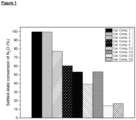
- Figure 1 shows the N 2 O conversion at 400°C for five catalyst compositions corresponding to an Fe-loaded small- or medium-pore zeolite suitable for the second catalyst composition of the invention compared to four comparative catalyst compositions.
- catalyst compositions were manufactured by incipient wetness impregnation of an FeCl 2 salt into a pre-prepared zeolite having a particular framework and SAR. Each catalyst composition was loaded with 3 wt.% Fe, based on the total weight of the Fe/zeolite.
- a metal salt solution using FeCl 2 (Alfa Aesar Iron(II) chloride, anhydrous, 99.5% (metals basis)) and double distilled H 2 O was prepared and then added dropwise to the relevant zeolite sample. The mixture was homogenously mixed until a wet sand appearance was observed. After preparation, the samples were dried for 2 hours at 105°C in a static oven. Once dried, the powders were activated in a tube furnace with a heating rate of 10°C/min up to 500°C for 2 hours in an N 2 atmosphere.
- composition of the zeolite for each Catalyst Composition and each Catalyst Composition's N 2 O performance at each temperature is shown in Table 1 below.
- Catalyst Compositions 1-5 correspond to Fe-loaded small- or medium-pore zeolites suitable for the second catalyst composition of the invention.
- Catalyst Compositions C1-C4 are comparative examples not within the scope of the Fe-loaded small- or medium-pore molecular sieves of the invention.
- Table 1 shows the results of N 2 O performance tests at four different temperatures: 300, 350, 375 and 400°C.
- 0.2 g of pelletised sample was tested in a total flow of 100 ml/min, of which 58% was He, 40% Ar, 1% N 2 O and 1% O 2 .
- the temperatures explored ranged from 300 to 400°C.
- a ramp rate of 10°C/min was set up for each temperature followed by a dwell of 45 minutes.
- the data were analysed using a mass spectrometer.
- the "N 2 O performance” refers to the N 2 O conversion at that particular temperature, i.e. the percentage of N 2 O consumed from the sample gas after passing through the example catalyst, on a ppm basis.
- CHA and AEI are small-pore zeolites
- FER and MFI are medium-pore zeolites
- BEA is a large-pore zeolite.
- the N 2 O performance of the catalyst compositions that may be used in the SCR catalyst article and the exhaust gas treatment systems of the invention is significantly higher than the comparative catalyst compositions, in which the zeolites have higher SAR and/or are large-pore zeolites.
- the N 2 O performance of the catalyst composition increases as the SAR decreases.
- the N 2 O performance of the CHA zeolite having a SAR of 7 and the CHA zeolite having a SAR of 10 (Catalyst Compositions 1 and 2, respectively) is comparable.
- Figure 1 shows the N 2 O conversion at 400°C for five catalyst compositions corresponding to an Fe-loaded small- or medium-pore zeolite suitable for the second catalyst composition of the invention compared to four comparative catalyst compositions.
- Figure 1 is a visual representation of the rightmost column of Table 1. From left to right, the bars in Figure 1 relate to, in order, Catalyst Composition 1, Catalyst Composition 2, Catalyst Composition 3, Catalyst Composition 4, Catalyst Composition 5, Catalyst Composition C1, Catalyst Composition C2, Catalyst Composition C3 and Catalyst Composition C4.
Landscapes
- Chemical & Material Sciences (AREA)
- Engineering & Computer Science (AREA)
- Chemical Kinetics & Catalysis (AREA)
- Organic Chemistry (AREA)
- Materials Engineering (AREA)
- Combustion & Propulsion (AREA)
- Health & Medical Sciences (AREA)
- Biomedical Technology (AREA)
- Oil, Petroleum & Natural Gas (AREA)
- General Chemical & Material Sciences (AREA)
- Analytical Chemistry (AREA)
- Environmental & Geological Engineering (AREA)
- Toxicology (AREA)
- Crystallography & Structural Chemistry (AREA)
- Mechanical Engineering (AREA)
- General Engineering & Computer Science (AREA)
- Thermal Sciences (AREA)
- Physics & Mathematics (AREA)
- Catalysts (AREA)
- Exhaust Gas After Treatment (AREA)
- Processes For Solid Components From Exhaust (AREA)
- Exhaust Gas Treatment By Means Of Catalyst (AREA)
Priority Applications (6)
| Application Number | Priority Date | Filing Date | Title |
|---|---|---|---|
| EP23156120.0A EP4414052A1 (fr) | 2023-02-10 | 2023-02-10 | Article de catalyseur scr et systèmes de réduction de n2o dans des gaz d'échappement |
| CN202480005423.4A CN120390670A (zh) | 2023-02-10 | 2024-02-09 | 用于还原废气中的n2o的scr催化剂制品和系统 |
| EP24706184.9A EP4661995A1 (fr) | 2023-02-10 | 2024-02-09 | Article de catalyseur scr et systèmes de réduction de n2o dans un gaz d'échappement |
| US18/437,280 US20240269611A1 (en) | 2023-02-10 | 2024-02-09 | Scr catalyst article and systems for reducing n2o in exhaust gas |
| JP2025533538A JP2026505687A (ja) | 2023-02-10 | 2024-02-09 | 排気ガス中のn2oを低減するためのscr触媒物品及びシステム |
| PCT/GB2024/050359 WO2024165871A1 (fr) | 2023-02-10 | 2024-02-09 | Article de catalyseur scr et systèmes de réduction de n2o dans un gaz d'échappement |
Applications Claiming Priority (1)
| Application Number | Priority Date | Filing Date | Title |
|---|---|---|---|
| EP23156120.0A EP4414052A1 (fr) | 2023-02-10 | 2023-02-10 | Article de catalyseur scr et systèmes de réduction de n2o dans des gaz d'échappement |
Publications (1)
| Publication Number | Publication Date |
|---|---|
| EP4414052A1 true EP4414052A1 (fr) | 2024-08-14 |
Family
ID=85225234
Family Applications (2)
| Application Number | Title | Priority Date | Filing Date |
|---|---|---|---|
| EP23156120.0A Withdrawn EP4414052A1 (fr) | 2023-02-10 | 2023-02-10 | Article de catalyseur scr et systèmes de réduction de n2o dans des gaz d'échappement |
| EP24706184.9A Pending EP4661995A1 (fr) | 2023-02-10 | 2024-02-09 | Article de catalyseur scr et systèmes de réduction de n2o dans un gaz d'échappement |
Family Applications After (1)
| Application Number | Title | Priority Date | Filing Date |
|---|---|---|---|
| EP24706184.9A Pending EP4661995A1 (fr) | 2023-02-10 | 2024-02-09 | Article de catalyseur scr et systèmes de réduction de n2o dans un gaz d'échappement |
Country Status (5)
| Country | Link |
|---|---|
| US (1) | US20240269611A1 (fr) |
| EP (2) | EP4414052A1 (fr) |
| JP (1) | JP2026505687A (fr) |
| CN (1) | CN120390670A (fr) |
| WO (1) | WO2024165871A1 (fr) |
Citations (12)
| Publication number | Priority date | Publication date | Assignee | Title |
|---|---|---|---|---|
| WO2012138405A1 (fr) | 2011-04-08 | 2012-10-11 | Johnson Matthey Public Limited Company | Catalyseurs destinés à réduire les émissions d'ammoniac issues de la combustion de mélanges riches |
| EP2885514A1 (fr) | 2012-05-03 | 2015-06-24 | Scania CV AB | Système de post-traitement d'échappement et procédé se rattachant à un tel système |
| US20150231620A1 (en) * | 2014-02-19 | 2015-08-20 | Ford Global Technologies, Llc | IRON-ZEOLITE CHABAZITE CATALYST FOR USE IN NOx REDUCTION AND METHOD OF MAKING |
| US20150265969A1 (en) * | 2014-03-24 | 2015-09-24 | Johnson Matthey Public Limited Company | Catalyst for treating exhaust gas |
| US20160038878A1 (en) * | 2014-08-07 | 2016-02-11 | Johnson Matthey Public Limited Company | Zoned Catalyst for Treating Exhaust Gas |
| WO2017134454A1 (fr) | 2016-02-03 | 2017-08-10 | Johnson Matthey Public Limited Company | Catalyseur pour l'oxydation de l'ammoniac |
| US20180043305A1 (en) * | 2015-02-27 | 2018-02-15 | Basf Corporation | Exhaust gas treatment system |
| WO2018178627A1 (fr) | 2017-03-30 | 2018-10-04 | Johnson Matthey Public Limited Company | Élément catalyseur à substrat actif scr, couche de catalyseur à glissement d'ammoniac et couche scr, destinés à être utilisés dans un système de traitement d'émissions |
| US20190168199A1 (en) * | 2016-08-05 | 2019-06-06 | Basf Corporation | Selective catalytic reduction articles and systems |
| US20190275504A1 (en) * | 2016-02-01 | 2019-09-12 | Umicore Ag & Co. Kg | Method for the Removal of Nitrous Oxide from Off Gas in Presence of Catalyst Comprising an Fe-AEI Zeolite Material Essentially Free of Alkali Metal |
| WO2019186121A1 (fr) | 2018-03-29 | 2019-10-03 | Johnson Matthey Public Limited Company | Article catalytique destiné à être utilisé dans un système de traitement d'émission |
| US20190314801A1 (en) * | 2016-12-20 | 2019-10-17 | Umicore Ag & Co. Kg | Scr catalyst device containing vanadium oxide and molecular sieve containing iron |
-
2023
- 2023-02-10 EP EP23156120.0A patent/EP4414052A1/fr not_active Withdrawn
-
2024
- 2024-02-09 US US18/437,280 patent/US20240269611A1/en active Pending
- 2024-02-09 EP EP24706184.9A patent/EP4661995A1/fr active Pending
- 2024-02-09 WO PCT/GB2024/050359 patent/WO2024165871A1/fr not_active Ceased
- 2024-02-09 CN CN202480005423.4A patent/CN120390670A/zh active Pending
- 2024-02-09 JP JP2025533538A patent/JP2026505687A/ja active Pending
Patent Citations (12)
| Publication number | Priority date | Publication date | Assignee | Title |
|---|---|---|---|---|
| WO2012138405A1 (fr) | 2011-04-08 | 2012-10-11 | Johnson Matthey Public Limited Company | Catalyseurs destinés à réduire les émissions d'ammoniac issues de la combustion de mélanges riches |
| EP2885514A1 (fr) | 2012-05-03 | 2015-06-24 | Scania CV AB | Système de post-traitement d'échappement et procédé se rattachant à un tel système |
| US20150231620A1 (en) * | 2014-02-19 | 2015-08-20 | Ford Global Technologies, Llc | IRON-ZEOLITE CHABAZITE CATALYST FOR USE IN NOx REDUCTION AND METHOD OF MAKING |
| US20150265969A1 (en) * | 2014-03-24 | 2015-09-24 | Johnson Matthey Public Limited Company | Catalyst for treating exhaust gas |
| US20160038878A1 (en) * | 2014-08-07 | 2016-02-11 | Johnson Matthey Public Limited Company | Zoned Catalyst for Treating Exhaust Gas |
| US20180043305A1 (en) * | 2015-02-27 | 2018-02-15 | Basf Corporation | Exhaust gas treatment system |
| US20190275504A1 (en) * | 2016-02-01 | 2019-09-12 | Umicore Ag & Co. Kg | Method for the Removal of Nitrous Oxide from Off Gas in Presence of Catalyst Comprising an Fe-AEI Zeolite Material Essentially Free of Alkali Metal |
| WO2017134454A1 (fr) | 2016-02-03 | 2017-08-10 | Johnson Matthey Public Limited Company | Catalyseur pour l'oxydation de l'ammoniac |
| US20190168199A1 (en) * | 2016-08-05 | 2019-06-06 | Basf Corporation | Selective catalytic reduction articles and systems |
| US20190314801A1 (en) * | 2016-12-20 | 2019-10-17 | Umicore Ag & Co. Kg | Scr catalyst device containing vanadium oxide and molecular sieve containing iron |
| WO2018178627A1 (fr) | 2017-03-30 | 2018-10-04 | Johnson Matthey Public Limited Company | Élément catalyseur à substrat actif scr, couche de catalyseur à glissement d'ammoniac et couche scr, destinés à être utilisés dans un système de traitement d'émissions |
| WO2019186121A1 (fr) | 2018-03-29 | 2019-10-03 | Johnson Matthey Public Limited Company | Article catalytique destiné à être utilisé dans un système de traitement d'émission |
Also Published As
| Publication number | Publication date |
|---|---|
| CN120390670A (zh) | 2025-07-29 |
| EP4661995A1 (fr) | 2025-12-17 |
| JP2026505687A (ja) | 2026-02-18 |
| WO2024165871A1 (fr) | 2024-08-15 |
| US20240269611A1 (en) | 2024-08-15 |
Similar Documents
| Publication | Publication Date | Title |
|---|---|---|
| US10807081B2 (en) | Ammonia slip catalyst designed to be first in an SCR system | |
| US10669910B2 (en) | Platinum group metal and base metal on a molecular sieve for PNA-SCR-ASC close-coupled system | |
| US10828603B2 (en) | SCR with turbo and ASC/DOC close-coupled system | |
| RU2709434C2 (ru) | Зонированная система выпуска отработавших газов | |
| US10926221B2 (en) | Single brick SCR/ASC/PNA/DOC close-coupled catalyst | |
| US20200215520A1 (en) | Asc with platinum group metal in multiple layers | |
| US10807040B2 (en) | ASC/DEC with rear-concentrated exotherm generation | |
| US20180111086A1 (en) | Hydrocarbon injection through small pore cu-zeolite catalyst | |
| US11541379B2 (en) | Bimetallic Cu/Mn catalysts for selective catalytic reduction | |
| EP3555437A1 (fr) | Conversion de nox accrue par l'introduction d'ozone | |
| EP4414052A1 (fr) | Article de catalyseur scr et systèmes de réduction de n2o dans des gaz d'échappement | |
| US20180058293A1 (en) | Reduced Sulfation Impact on Cu-SCRs | |
| EP4414051A1 (fr) | Système de traitement de gaz d'échappement d'un brûleur à combustible contenant de l'azote ou d'un brûleur à hydrogène | |
| EP3775510B1 (fr) | Système d'échappement comprenant un catalyseur scrf avec zone d'oxydation |
Legal Events
| Date | Code | Title | Description |
|---|---|---|---|
| PUAI | Public reference made under article 153(3) epc to a published international application that has entered the european phase |
Free format text: ORIGINAL CODE: 0009012 |
|
| STAA | Information on the status of an ep patent application or granted ep patent |
Free format text: STATUS: THE APPLICATION HAS BEEN PUBLISHED |
|
| AK | Designated contracting states |
Kind code of ref document: A1 Designated state(s): AL AT BE BG CH CY CZ DE DK EE ES FI FR GB GR HR HU IE IS IT LI LT LU LV MC ME MK MT NL NO PL PT RO RS SE SI SK SM TR |
|
| P01 | Opt-out of the competence of the unified patent court (upc) registered |
Free format text: CASE NUMBER: APP_53878/2024 Effective date: 20240930 |
|
| RAP3 | Party data changed (applicant data changed or rights of an application transferred) |
Owner name: JOHNSON MATTHEY PUBLIC LIMITED COMPANY |
|
| STAA | Information on the status of an ep patent application or granted ep patent |
Free format text: STATUS: THE APPLICATION IS DEEMED TO BE WITHDRAWN |
|
| 18D | Application deemed to be withdrawn |
Effective date: 20250215 |