EP4414309A2 - Draht-, seil- und kabelverwaltung - Google Patents
Draht-, seil- und kabelverwaltung Download PDFInfo
- Publication number
- EP4414309A2 EP4414309A2 EP24161465.0A EP24161465A EP4414309A2 EP 4414309 A2 EP4414309 A2 EP 4414309A2 EP 24161465 A EP24161465 A EP 24161465A EP 4414309 A2 EP4414309 A2 EP 4414309A2
- Authority
- EP
- European Patent Office
- Prior art keywords
- cables
- elevator
- bar
- cable
- car
- Prior art date
- Legal status (The legal status is an assumption and is not a legal conclusion. Google has not performed a legal analysis and makes no representation as to the accuracy of the status listed.)
- Pending
Links
Images



Classifications
-
- B—PERFORMING OPERATIONS; TRANSPORTING
- B66—HOISTING; LIFTING; HAULING
- B66B—ELEVATORS; ESCALATORS OR MOVING WALKWAYS
- B66B7/00—Other common features of elevators
- B66B7/06—Arrangements of ropes or cables
-
- B—PERFORMING OPERATIONS; TRANSPORTING
- B66—HOISTING; LIFTING; HAULING
- B66B—ELEVATORS; ESCALATORS OR MOVING WALKWAYS
- B66B7/00—Other common features of elevators
- B66B7/06—Arrangements of ropes or cables
- B66B7/064—Power supply or signal cables
-
- B—PERFORMING OPERATIONS; TRANSPORTING
- B66—HOISTING; LIFTING; HAULING
- B66B—ELEVATORS; ESCALATORS OR MOVING WALKWAYS
- B66B9/00—Kinds or types of lifts in, or associated with, buildings or other structures
- B66B9/16—Mobile or transportable lifts specially adapted to be shifted from one part of a building or other structure to another part or to another building or structure
- B66B9/187—Mobile or transportable lifts specially adapted to be shifted from one part of a building or other structure to another part or to another building or structure with a liftway specially adapted for temporary connection to a building or other structure
Definitions
- This disclosure relates to the fields of cable management and elevators.
- Elevators move people and objects vertically along a track, for example between floors or platforms of a building or other structure.
- Traction elevators are suspended and moved by traction cables driven by a motor.
- the traction cables may, for example, be steel ropes which are pulled over a grooved pulley system called a sheave or may be flat belts made of steel or polyethylene.
- Hydraulic elevators are suspended and moved by a piston that is moved through a hydraulic cylinder by means of a pump.
- One or more guide rails may define the track that an elevator car moves along between the upper terminus and the lower terminus of the track.
- an elevator cable management system is configured to provide constraints on cable movements at a point between the top and bottom of an elevator track.
- the elevator cable management system may include a moving retainer bar with a cradle on top of an elevator car, and a fixed retainer bar that retains cables when the elevator car is above the fixed retainer bar
- a cable management system helps to manage the long runs of cables in an elevator shaft.
- an elevator shaft may move or bend, such as when the overall building or structure that the elevator is a part may sway or bend as a result of wind pressure on the side of a building
- retaining the elevator cables in a safe position within the elevator shaft can be important to prevent damage to the cables or damage to any objects, including other cables, that a swaying cable might contact if not retained.
- An example application is a service elevator for a large wind turbine or tall construction crane.
- FIG. 1 is a perspective view of a portion of an elevator system.
- An elevator car 102 or cab moves vertically along a track (not depicted) between stations or stops along the track where humans or other cargo may be added or removed to the car 102.
- Platform 104 is such a stop somewhere midway along the elevator track.
- Gate 106 may protect the elevator shaft and prevent injury or other accidents when the car 102 is not at the platform 104 or when the car 102 is moving near the platform 104.
- a cable management system may include a moving bar 110 and a fixed bar 112 to provide physical constraints cable movement. Cables 120 and 122 may move as the elevator car 102 moves through the shaft and along the track. In the embodiment of FIG.
- cables 120 are traction cables that provide the force to lift and move the car 102, while cable 122 is an electrical cable. Some cables, such as cables 120 may run the full length of the track, while other cables, such as cables 122 may run from one end of the track to the car 102 and terminate in the car 102.
- a cable management system can manage any number and type of cables. Traction cables 120 are often made of steel ropes, but other types of cable materials are possible. In elevators where traction cables are not used, such as where traction belts are used or in a hydraulic elevator, a cable management system may be useful for constraining other types of cables such as an electrical or communications cable. A cable management system can provide useful constraints on many types of cables, such as wires, ropes, chains, or any type of flexible tension element.
- the electrical cable 122 may, for example, provide electrical power to the car 102, such as for lighting the interior of the car 102, communications, such as an emergency telephone, and control, such as to remotely call the elevator to a particular floor or stop.
- the various functions of the electrical cable 122 can be combined into a single cable, for example with multiple electrical conductors running along the length of the cable within an insulating outer layer, or the various functions may be split into separate cables, some or all of which may be managed by a cable management system.
- Other types of cables, such as optical cables for communications can also be managed by a cable management system.
- electrical cable 122 runs from somewhere near the bottom of the track up to the car 102, such upper termination point of electrical cable 122 moves along with the car 102.
- Other arrangements are possible, including running the cables from a midpoint or the top of the track to the car 102.
- Moving bar 110 moves with the elevator car 102 when the car 102 is above a threshold point somewhere midway along the elevator track, and moving bar 110 remains fixed at the threshold point when the elevator car is below the threshold point.
- FIG. 2 is a perspective view of a movable cable constraint bar 110 in its cradle on top of the car 102 when the cradle is above the threshold point. When above the threshold point, the bar 110 moves with the car 102. The weight of the bar 110 may keep the bar 110 sitting in a cradle when above the threshold point.
- the cradle may comprise the left cradle 214 and right cradle 212 which, in the embodiment of FIG. 2 , are attached to the top of the car 102, though attachments to other parts of the car 102 are possible.
- the location on the car 102 of a cable retainer may depend on the type or purpose of the cables retained by the moving bar 110, for example if the cables are hoisting ropes that suspend the car 110, the cradle may be attached close to the center of car, while electrical or communication cables may be more flexibly located.
- Bar 210 may include an opening that serves as a retainer 210 to provide a physical constraint on the movement of cables inside the retainer 210.
- the opening or retainer may be a hoop or other shape that constrains the retained cables along a plane that is perpendicular to the elevator track.
- Pin attachment 204 may be fixed to a point along the track to hold pin 202 at the threshold point.
- Pinhole 218 in the bar 110 maybe aligned with the fixed pin 202 as the car 102 moves along the track and approaches the threshold point.
- the location of the threshold point for suspending the moving bar can be anywhere between ends of the elevator track. In some embodiments, such as that of FIGS. 2-4 , the threshold point can be near or attached to an elevator stop or platform. Alternately, the threshold point may be located at or near the point along the elevator track where the structure holding the elevator is likely to bend the most, such as with a wind turbine tower, or the threshold point can simply be located near or at the halfway point along the track. Other locations for the threshold point are also feasible.
- Multiple thresholds points along a single elevator track can be used with multiple moving bars such that, for example, a first threshold point for a first moving bar may be located one-third of the way down from the top of the track, and a second threshold point may be located two-thirds of the way down from the top of the track.
- FIG. 3 is a perspective view of a movable cable constraint bar in its cradle when the cradle is at the threshold point.
- Pin attachments 206 and 208 are fixed relative to the elevator track, and effectively define the threshold point.
- the pins 202 and 204 are inserted into the pinholes 216 and 218 at the threshold point.
- the bar 110 remains in its cradles 212 and 214, and pin 202 and 204 are also in the pinholes 216 and 218.
- the pins 202 and 204 hold the bar 110 fixed along the track while the car can continue to move lower.
- FIG. 4 is a perspective view of a movable cable constraint bar out of its cradle when the cradle is below the threshold point.
- Retainer 210 provides a constraint on the cables 120 when the car is below the threshold point as the movable bar 110 remains fixed on the pins 202 and 204. In addition to pins and pinholes, other mechanisms for holding bar 110 at the threshold point are possible.
- FIG. 5 is a perspective view of a fixed bar with two cable constraint channels while constraining cables.
- Fixed bar 112 holds separate retainers 510 and 512.
- the left retainer 510 is positioned to retain hoisting cables 120 when the car 102 is above the fixed bar 112
- the right retainer 512 is positioned to retain the electrical cable 122 when the car 102 is above the fixed bar 112.
- Fixed bar 112 is supported by brace 500 which is fixed to platform 104.
- the fixed bar may be supported by any means that hold the bar fixed relative to the elevator track, for example by any other fixed structures inside an elevator shaft, such as the walls of the shaft.
- Hoisting cables 120 and electrical cable 122 emerge out of the back side of the elevator car 102.
- Electrical cable 122 terminates somewhere inside car 102, while hoisting cables 120 pass through a conduit 530 into car 102 and emerge out the top of car 102 as depicted in FIG. 1 .
- Deflectors 520 and 522 aligned immediately above or below retainers 510 and 512, respectively, when car 102 is near the fixed bar 112, while the back side of the car 102 passes next to and near retainers 510 and 512. Deflectors 520 and 522 protect cables 120 and 122 as the car 102 passes by the retainers 510 and 512.
- FIG. 6 is a reverse perspective view of a fixed bar with two empty cable constraint channels, with a closer view of the retainers 510 and 512.
- the retainers 510 and 512 are hoops comprising four rollers each.
- Fixed rollers 602 and 604 are fixed in relation to the fixed bar 112, while hinged rollers 610 and 612 are hinged with a spring configured to maintain the horizontal position of rollers 610 and 612 depicted in FIG. 6 whenever the deflectors 520 and 522 are not passing through the retainer as described below with respect to FIG. 7 and FIG. 8 .
- the rollers form interior edges of the hoop retainers 510 and 512, and are the horizontal physical constraint that helps to manage the cables when the car 102 is above the fixed bar 112.
- rollers there are 3 fixed rollers per retainer and one hinged roller per retainer, forming a square or rectangular hoop retainer.
- Other retainer shapes are feasible, such as a triangle with three straight edges, and curved edges are also possible.
- the edges of the hoop retainer may be configured to reduce friction as cables move vertically through the retainers 510 and 512. Rollers are one mechanism to reduce this friction, but other designs are possible.
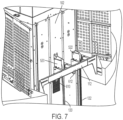
- FIG. 7 is a perspective view of two cable constraint channels when open downward.
- Retainers 510 and 512 are cable constraint channels.
- the deflectors 520 and 522 push the spring rollers 610 and 612, respectively, into a downward pointing position as depicted in FIG.7 , and the cables are removed from the retainers.
- the bottom edge of deflectors 520 and 522 come into contact with the top side of spring rollers 610 and 612.
- the deflectors 520 and 522 push the spring rollers 610 and 612 into a downward pointing position to allow the deflectors to pass through the retainers.
- the car 102 passes the retainers 510 and 512, and the spring rollers 610 and 612 swing back into a horizontal pointing position without the cables in the retainers.
- the retainers 510 and 512 do not retain any cables when the deflectors 520 and 530 are below the bar 112.
- FIG. 8 is a perspective view of two cable constraint channels when open upward, as a result of the car 101 moving upward.
- the top of deflectors 520 and 522 contact the bottom of spring rollers 610 and 620, pushing the rollers up to an upward pointing position as depicted in FIG. 8 .
- the cables are not in the retainers 510 and 512 when the car is below the bar 112.
- the spring rollers 610 and 612 snap back to the horizontal pointing position depicted in FIG. 5 with the cables 120 and 122 inside the retainers. Alternates to the spring rollers 610 and 612 are possible.
- Any vertically deflectable edge may function similarly.
- a device or material will work that is capable of deflecting (or bending or moving) vertically as the deflectors 520 and 522 pass, while still providing a horizontal constraint on cables within the retainers will suffice.
- an elevator cable management system comprises:
- the at least one first cable retainer and the at least one second cable retainer provide a constraint on horizontal movement of the one or more cables.
- the at least one first cables are electrical and the one or more second cables are hoisting ropes.
- the at least one cable retainer provides a constraint on horizontal movement of the one or more cables.
- an elevator cable management system comprises:
- the at least one first cable retainer and the at least one second cable retainer provide a constraint on lateral movement of the one or more cables.
- the constraint on horizontal movement comprises a hoop oriented perpendicular to the guided wire or rope.
- the at least one first cable retainer comprises at least one fixed edge and one movable edge, and wherein the movable edge is configured to deflect as the elevator cab passes the bar.
- the at least one first cables and at least one second cables emerge from a vertical side of the elevator car
- the elevator car comprises at least one deflector where the at least one first cables and the at least one second cables emerge from the elevator car;
- the at least one deflector is configured to cause the movable edge of the at least one first cable retainer to deflect.
- the at least one first cables are electrical, optical, or other communications cables and the one or more second cables are hoisting ropes, cables, or belts.
- the elevator cable management system further comprises:
- an elevator cable management system comprises:
- the at least one cable retainer provides a constraint on lateral movement of the one or more cables.
- the constraint on horizontal movement comprises a hoop oriented perpendicular to the elevator guide.
- the at least one cable retainer comprises at least one fixed edge and one movable edge, and wherein the movable edge is configured to deflect as the elevator cab passes the bar.
- the at least one cable retainer comprises one retainer for retaining one or more cables that are hoisting ropes and one retainer for retaining one or more cables that are electrical, optical, or other communications cables.
- the one or more cables terminate in the elevator car.
- an elevator cable management system comprises:
- the at least one retainer provides a constraint on lateral movement of the one or more cables.
- the constraint on lateral movement comprises a hoop oriented perpendicular to the track or guide.
- the one or more cables are hoisting ropes, cables, or belts.
- the one or more cables extend substantially an entire length of the track or guide.
- the elevator cable management system further comprises at least one first support fixed at the threshold point and configured to engage the bar as the elevator car passes from above the threshold point to below the threshold point and configured to hold the bar when the elevator is below the threshold point.
- the elevator cable management system further comprises at least one second support fixed to the elevator car and configured to engage the bar as the elevator car passes from below the threshold point to above the threshold point and configured to hold the bar when the elevator is above the threshold point.
Landscapes
- Lift-Guide Devices, And Elevator Ropes And Cables (AREA)
- Cage And Drive Apparatuses For Elevators (AREA)
- Types And Forms Of Lifts (AREA)
Applications Claiming Priority (3)
| Application Number | Priority Date | Filing Date | Title |
|---|---|---|---|
| US15/195,968 US10099895B2 (en) | 2016-06-28 | 2016-06-28 | Wire, rope, and cable management |
| EP17737188.7A EP3475207B1 (de) | 2016-06-28 | 2017-06-28 | Seil-, band- und kabelführungsystem |
| PCT/US2017/039664 WO2018005601A1 (en) | 2016-06-28 | 2017-06-28 | Wire, rope and cable management |
Related Parent Applications (1)
| Application Number | Title | Priority Date | Filing Date |
|---|---|---|---|
| EP17737188.7A Division EP3475207B1 (de) | 2016-06-28 | 2017-06-28 | Seil-, band- und kabelführungsystem |
Publications (2)
| Publication Number | Publication Date |
|---|---|
| EP4414309A2 true EP4414309A2 (de) | 2024-08-14 |
| EP4414309A3 EP4414309A3 (de) | 2024-10-30 |
Family
ID=59297444
Family Applications (2)
| Application Number | Title | Priority Date | Filing Date |
|---|---|---|---|
| EP17737188.7A Active EP3475207B1 (de) | 2016-06-28 | 2017-06-28 | Seil-, band- und kabelführungsystem |
| EP24161465.0A Pending EP4414309A3 (de) | 2016-06-28 | 2017-06-28 | Draht-, seil- und kabelverwaltung |
Family Applications Before (1)
| Application Number | Title | Priority Date | Filing Date |
|---|---|---|---|
| EP17737188.7A Active EP3475207B1 (de) | 2016-06-28 | 2017-06-28 | Seil-, band- und kabelführungsystem |
Country Status (5)
| Country | Link |
|---|---|
| US (2) | US10099895B2 (de) |
| EP (2) | EP3475207B1 (de) |
| CA (1) | CA3028166A1 (de) |
| ES (1) | ES2979064T3 (de) |
| WO (1) | WO2018005601A1 (de) |
Families Citing this family (7)
| Publication number | Priority date | Publication date | Assignee | Title |
|---|---|---|---|---|
| DK2923988T4 (da) * | 2014-03-26 | 2024-10-28 | Alimak Group Man Ab | Elevatorsystemer |
| US10099895B2 (en) * | 2016-06-28 | 2018-10-16 | Safeworks, Llc | Wire, rope, and cable management |
| US10669124B2 (en) * | 2017-04-07 | 2020-06-02 | Otis Elevator Company | Elevator system including a protective hoistway liner assembly |
| US10669125B2 (en) * | 2017-05-15 | 2020-06-02 | Otis Elevator Company | Elevator rope guide system |
| DE102018100126A1 (de) * | 2018-01-04 | 2019-07-04 | Wobben Properties Gmbh | Aufstiegshilfe für eine Windenergieanlage und Windenergieanlage |
| US11383955B2 (en) | 2019-01-29 | 2022-07-12 | Otis Elevator Company | Elevator system control based on building and rope sway |
| US11440774B2 (en) * | 2020-05-09 | 2022-09-13 | Otis Elevator Company | Elevator roping sway damper assembly |
Family Cites Families (27)
| Publication number | Priority date | Publication date | Assignee | Title |
|---|---|---|---|---|
| US2017372A (en) * | 1934-05-21 | 1935-10-15 | American Steel & Wire Co | Guideway |
| US3666051A (en) * | 1970-08-06 | 1972-05-30 | Nasa | Cable stabilizer for open shaft cable operated elevators |
| US3662862A (en) * | 1970-10-05 | 1972-05-16 | Missouri Lead Operating Co | Guide rope stabilizer |
| US4117908A (en) * | 1972-11-14 | 1978-10-03 | Hitachi, Ltd. | Elevator having rope guide means |
| JPS5424571B2 (de) * | 1973-01-29 | 1979-08-22 | ||
| US3885773A (en) * | 1974-05-06 | 1975-05-27 | Clark Equipment Co | Magnetic cable takeup device |
| JPS5261035A (en) * | 1975-11-14 | 1977-05-20 | Mitsubishi Electric Corp | Device for preventing ropes for elevator from vibrating |
| US4072213A (en) * | 1976-08-09 | 1978-02-07 | Otis Elevator Company | Suspended cable apparatus |
| JPH01299182A (ja) | 1988-05-27 | 1989-12-01 | Mitsubishi Electric Corp | エレベーター用移動ケーブルの制振装置 |
| JPH02255484A (ja) | 1989-03-28 | 1990-10-16 | Hitachi Elevator Eng & Service Co Ltd | 昇降機の懸垂条体の制振装置 |
| US5609225A (en) * | 1995-04-25 | 1997-03-11 | Inventio Ag | Compensation guidance system |
| FI104814B (fi) | 1998-05-12 | 2000-04-14 | Kone Corp | Järjestely korikaapelin ohjaamiseksi |
| US6364062B1 (en) * | 1999-11-08 | 2002-04-02 | Otis Elevator Company | Linear tracking mechanism for elevator rope |
| JP2007297147A (ja) | 2006-04-28 | 2007-11-15 | Koshihara:Kk | 昇降装置におけるケーブルの振れ止め装置 |
| KR101169011B1 (ko) * | 2006-12-20 | 2012-07-26 | 오티스 엘리베이터 컴파니 | 엘리베이터 시스템 및 흔들림 제어방법 |
| JP3136940U (ja) | 2007-08-24 | 2007-11-08 | 三成研機株式会社 | 工事用エレベーターにおけるケーブル類の抜け止め装置 |
| JP5240687B2 (ja) | 2007-12-11 | 2013-07-17 | 東芝エレベータ株式会社 | エレベータのロープ振れ止め装置 |
| DE102011102815A1 (de) | 2011-05-30 | 2012-12-06 | Geda-Dechentreiter Gmbh & Co. Kg | Aufzug |
| US9758344B2 (en) * | 2012-01-10 | 2017-09-12 | Otis Elevator Company | Elevator travelling cable protection |
| JP5997076B2 (ja) | 2013-03-01 | 2016-09-21 | 株式会社日立製作所 | エレベータ及びこれに備えられるテールコード制振装置 |
| DE102013006146A1 (de) | 2013-04-10 | 2014-10-30 | Geda-Dechentreiter Gmbh & Co. Kg | Aufzug |
| WO2015022737A1 (ja) * | 2013-08-14 | 2015-02-19 | 三菱電機株式会社 | エレベータの制御ケーブルガイド装置 |
| DE102013219825A1 (de) * | 2013-09-30 | 2015-04-02 | Thyssenkrupp Elevator Ag | Aufzuganlage |
| DK2923988T4 (da) * | 2014-03-26 | 2024-10-28 | Alimak Group Man Ab | Elevatorsystemer |
| AU2015221479B2 (en) | 2015-09-02 | 2021-11-11 | Aleksandar Manojlovic | Cable Bracket |
| CN205781374U (zh) | 2016-05-28 | 2016-12-07 | 中际联合(北京)科技股份有限公司 | 一种电缆护套装置 |
| US10099895B2 (en) * | 2016-06-28 | 2018-10-16 | Safeworks, Llc | Wire, rope, and cable management |
-
2016
- 2016-06-28 US US15/195,968 patent/US10099895B2/en active Active
-
2017
- 2017-06-28 WO PCT/US2017/039664 patent/WO2018005601A1/en not_active Ceased
- 2017-06-28 EP EP17737188.7A patent/EP3475207B1/de active Active
- 2017-06-28 ES ES17737188T patent/ES2979064T3/es active Active
- 2017-06-28 EP EP24161465.0A patent/EP4414309A3/de active Pending
- 2017-06-28 CA CA3028166A patent/CA3028166A1/en not_active Abandoned
-
2018
- 2018-09-25 US US16/140,859 patent/US11104546B2/en active Active
Also Published As
| Publication number | Publication date |
|---|---|
| US20170369281A1 (en) | 2017-12-28 |
| EP3475207A1 (de) | 2019-05-01 |
| US10099895B2 (en) | 2018-10-16 |
| EP3475207C0 (de) | 2024-03-06 |
| US20190023534A1 (en) | 2019-01-24 |
| EP3475207B1 (de) | 2024-03-06 |
| ES2979064T3 (es) | 2024-09-24 |
| WO2018005601A1 (en) | 2018-01-04 |
| EP4414309A3 (de) | 2024-10-30 |
| US11104546B2 (en) | 2021-08-31 |
| CA3028166A1 (en) | 2018-01-04 |
Similar Documents
| Publication | Publication Date | Title |
|---|---|---|
| US11104546B2 (en) | Wire, rope, and cable management | |
| CN110023229B (zh) | 电梯设备和用于建造电梯设备的方法 | |
| US9169107B2 (en) | Method and mounting system for mounting lift components | |
| KR102151293B1 (ko) | 리프트의 설치 방법 | |
| EP2939971B1 (de) | Förderkabelklemmanordnung, aufzugsanordnung und verfahren | |
| CN115720568B (zh) | 用于搭建升降机设备的方法以及适合用于执行该方法的升降机设备 | |
| KR960037461A (ko) | 천정주행차 | |
| CN101903278A (zh) | 具有两个电梯轿厢的电梯设备 | |
| CN203699606U (zh) | 一种升降机和铁塔 | |
| KR102023060B1 (ko) | 케이블 방풍부재를 구비한 옥외 전천후형 인화물용 리프트 | |
| US20200216289A1 (en) | Elevator Systems | |
| CN110894039B (zh) | 电梯的行进电缆支撑装置 | |
| CN201793342U (zh) | 建筑物高空竖向吊物双导索系统 | |
| CN101934994A (zh) | 建筑物高空竖向吊物双导索系统及辅助方法 | |
| JP3841616B2 (ja) | エレベータの主ロープ交換方法とその装置 | |
| NL1010908C2 (nl) | Liftkooigeleidingsstelsel. | |
| JP2001048443A (ja) | エレベータ | |
| CN203959701U (zh) | 一种烧结机台车提升装置 | |
| CN215364263U (zh) | 一种电缆导向装置 | |
| RU2784555C1 (ru) | Установка для перемещения грузов для перемещения груза в рабочем пространстве | |
| CN214399591U (zh) | 一种抱杆平衡臂及抱杆 | |
| CN220334462U (zh) | 一种无导绳轮结构的提升平台及曳引施工升降机 | |
| CN211081059U (zh) | 一种曲面外立面幕墙单元板块的吊装装置 | |
| JP2018122965A (ja) | エレベータ用ガバナロープの振れ抑制ガイド装置 | |
| CN108750894B (zh) | 有助电梯轿厢升降的装置 |
Legal Events
| Date | Code | Title | Description |
|---|---|---|---|
| PUAI | Public reference made under article 153(3) epc to a published international application that has entered the european phase |
Free format text: ORIGINAL CODE: 0009012 |
|
| STAA | Information on the status of an ep patent application or granted ep patent |
Free format text: STATUS: THE APPLICATION HAS BEEN PUBLISHED |
|
| AC | Divisional application: reference to earlier application |
Ref document number: 3475207 Country of ref document: EP Kind code of ref document: P |
|
| AK | Designated contracting states |
Kind code of ref document: A2 Designated state(s): AL AT BE BG CH CY CZ DE DK EE ES FI FR GB GR HR HU IE IS IT LI LT LU LV MC MK MT NL NO PL PT RO RS SE SI SK SM TR |
|
| REG | Reference to a national code |
Ref country code: DE Ref legal event code: R079 Free format text: PREVIOUS MAIN CLASS: B66B0009187000 Ipc: B66B0007060000 |
|
| PUAL | Search report despatched |
Free format text: ORIGINAL CODE: 0009013 |
|
| AK | Designated contracting states |
Kind code of ref document: A3 Designated state(s): AL AT BE BG CH CY CZ DE DK EE ES FI FR GB GR HR HU IE IS IT LI LT LU LV MC MK MT NL NO PL PT RO RS SE SI SK SM TR |
|
| RIC1 | Information provided on ipc code assigned before grant |
Ipc: B66B 9/187 20060101ALI20240923BHEP Ipc: B66B 7/06 20060101AFI20240923BHEP |
|
| STAA | Information on the status of an ep patent application or granted ep patent |
Free format text: STATUS: REQUEST FOR EXAMINATION WAS MADE |
|
| 17P | Request for examination filed |
Effective date: 20250429 |
|
| GRAP | Despatch of communication of intention to grant a patent |
Free format text: ORIGINAL CODE: EPIDOSNIGR1 |
|
| STAA | Information on the status of an ep patent application or granted ep patent |
Free format text: STATUS: GRANT OF PATENT IS INTENDED |
|
| INTG | Intention to grant announced |
Effective date: 20260323 |