EP4414334A2 - Verfahren zur herstellung eines glasbehälters und entsprechender behälter - Google Patents
Verfahren zur herstellung eines glasbehälters und entsprechender behälter Download PDFInfo
- Publication number
- EP4414334A2 EP4414334A2 EP24159877.0A EP24159877A EP4414334A2 EP 4414334 A2 EP4414334 A2 EP 4414334A2 EP 24159877 A EP24159877 A EP 24159877A EP 4414334 A2 EP4414334 A2 EP 4414334A2
- Authority
- EP
- European Patent Office
- Prior art keywords
- container
- internal face
- fraction
- sol
- glass
- Prior art date
- Legal status (The legal status is an assumption and is not a legal conclusion. Google has not performed a legal analysis and makes no representation as to the accuracy of the status listed.)
- Pending
Links
Images
Classifications
-
- C—CHEMISTRY; METALLURGY
- C03—GLASS; MINERAL OR SLAG WOOL
- C03C—CHEMICAL COMPOSITION OF GLASSES, GLAZES OR VITREOUS ENAMELS; SURFACE TREATMENT OF GLASS; SURFACE TREATMENT OF FIBRES OR FILAMENTS MADE FROM GLASS, MINERALS OR SLAGS; JOINING GLASS TO GLASS OR OTHER MATERIALS
- C03C17/00—Surface treatment of glass, not in the form of fibres or filaments, by coating
- C03C17/02—Surface treatment of glass, not in the form of fibres or filaments, by coating with glass
-
- A—HUMAN NECESSITIES
- A47—FURNITURE; DOMESTIC ARTICLES OR APPLIANCES; COFFEE MILLS; SPICE MILLS; SUCTION CLEANERS IN GENERAL
- A47G—HOUSEHOLD OR TABLE EQUIPMENT
- A47G19/00—Table service
- A47G19/22—Drinking vessels or saucers used for table service
-
- B—PERFORMING OPERATIONS; TRANSPORTING
- B05—SPRAYING OR ATOMISING IN GENERAL; APPLYING FLUENT MATERIALS TO SURFACES, IN GENERAL
- B05B—SPRAYING APPARATUS; ATOMISING APPARATUS; NOZZLES
- B05B7/00—Spraying apparatus for discharge of liquids or other fluent materials from two or more sources, e.g. of liquid and air, of powder and gas
- B05B7/16—Spraying apparatus for discharge of liquids or other fluent materials from two or more sources, e.g. of liquid and air, of powder and gas incorporating means for heating or cooling the material to be sprayed
- B05B7/22—Spraying apparatus for discharge of liquids or other fluent materials from two or more sources, e.g. of liquid and air, of powder and gas incorporating means for heating or cooling the material to be sprayed electrically, magnetically or electromagnetically, e.g. by arc
-
- B—PERFORMING OPERATIONS; TRANSPORTING
- B05—SPRAYING OR ATOMISING IN GENERAL; APPLYING FLUENT MATERIALS TO SURFACES, IN GENERAL
- B05D—PROCESSES FOR APPLYING FLUENT MATERIALS TO SURFACES, IN GENERAL
- B05D1/00—Processes for applying liquids or other fluent materials
- B05D1/02—Processes for applying liquids or other fluent materials performed by spraying
-
- B—PERFORMING OPERATIONS; TRANSPORTING
- B28—WORKING CEMENT, CLAY, OR STONE
- B28B—SHAPING CLAY OR OTHER CERAMIC COMPOSITIONS; SHAPING SLAG; SHAPING MIXTURES CONTAINING CEMENTITIOUS MATERIAL, e.g. PLASTER
- B28B11/00—Apparatus or processes for treating or working the shaped or preshaped articles
-
- B—PERFORMING OPERATIONS; TRANSPORTING
- B28—WORKING CEMENT, CLAY, OR STONE
- B28B—SHAPING CLAY OR OTHER CERAMIC COMPOSITIONS; SHAPING SLAG; SHAPING MIXTURES CONTAINING CEMENTITIOUS MATERIAL, e.g. PLASTER
- B28B21/00—Methods or machines specially adapted for the production of tubular articles
-
- B—PERFORMING OPERATIONS; TRANSPORTING
- B28—WORKING CEMENT, CLAY, OR STONE
- B28B—SHAPING CLAY OR OTHER CERAMIC COMPOSITIONS; SHAPING SLAG; SHAPING MIXTURES CONTAINING CEMENTITIOUS MATERIAL, e.g. PLASTER
- B28B21/00—Methods or machines specially adapted for the production of tubular articles
- B28B21/70—Methods or machines specially adapted for the production of tubular articles by building-up from preformed elements
- B28B21/72—Producing multilayer tubes
-
- C—CHEMISTRY; METALLURGY
- C03—GLASS; MINERAL OR SLAG WOOL
- C03C—CHEMICAL COMPOSITION OF GLASSES, GLAZES OR VITREOUS ENAMELS; SURFACE TREATMENT OF GLASS; SURFACE TREATMENT OF FIBRES OR FILAMENTS MADE FROM GLASS, MINERALS OR SLAGS; JOINING GLASS TO GLASS OR OTHER MATERIALS
- C03C1/00—Ingredients generally applicable to manufacture of glasses, glazes, or vitreous enamels
-
- C—CHEMISTRY; METALLURGY
- C03—GLASS; MINERAL OR SLAG WOOL
- C03C—CHEMICAL COMPOSITION OF GLASSES, GLAZES OR VITREOUS ENAMELS; SURFACE TREATMENT OF GLASS; SURFACE TREATMENT OF FIBRES OR FILAMENTS MADE FROM GLASS, MINERALS OR SLAGS; JOINING GLASS TO GLASS OR OTHER MATERIALS
- C03C1/00—Ingredients generally applicable to manufacture of glasses, glazes, or vitreous enamels
- C03C1/006—Ingredients generally applicable to manufacture of glasses, glazes, or vitreous enamels to produce glass through wet route
- C03C1/008—Ingredients generally applicable to manufacture of glasses, glazes, or vitreous enamels to produce glass through wet route for the production of films or coatings
-
- C—CHEMISTRY; METALLURGY
- C03—GLASS; MINERAL OR SLAG WOOL
- C03C—CHEMICAL COMPOSITION OF GLASSES, GLAZES OR VITREOUS ENAMELS; SURFACE TREATMENT OF GLASS; SURFACE TREATMENT OF FIBRES OR FILAMENTS MADE FROM GLASS, MINERALS OR SLAGS; JOINING GLASS TO GLASS OR OTHER MATERIALS
- C03C17/00—Surface treatment of glass, not in the form of fibres or filaments, by coating
- C03C17/001—General methods for coating; Devices therefor
- C03C17/003—General methods for coating; Devices therefor for hollow ware, e.g. containers
- C03C17/004—Coating the inside
-
- C—CHEMISTRY; METALLURGY
- C03—GLASS; MINERAL OR SLAG WOOL
- C03C—CHEMICAL COMPOSITION OF GLASSES, GLAZES OR VITREOUS ENAMELS; SURFACE TREATMENT OF GLASS; SURFACE TREATMENT OF FIBRES OR FILAMENTS MADE FROM GLASS, MINERALS OR SLAGS; JOINING GLASS TO GLASS OR OTHER MATERIALS
- C03C2218/00—Methods for coating glass
- C03C2218/10—Deposition methods
- C03C2218/11—Deposition methods from solutions or suspensions
- C03C2218/113—Deposition methods from solutions or suspensions by sol-gel processes
-
- C—CHEMISTRY; METALLURGY
- C03—GLASS; MINERAL OR SLAG WOOL
- C03C—CHEMICAL COMPOSITION OF GLASSES, GLAZES OR VITREOUS ENAMELS; SURFACE TREATMENT OF GLASS; SURFACE TREATMENT OF FIBRES OR FILAMENTS MADE FROM GLASS, MINERALS OR SLAGS; JOINING GLASS TO GLASS OR OTHER MATERIALS
- C03C2218/00—Methods for coating glass
- C03C2218/30—Aspects of methods for coating glass not covered above
- C03C2218/31—Pre-treatment
-
- Y—GENERAL TAGGING OF NEW TECHNOLOGICAL DEVELOPMENTS; GENERAL TAGGING OF CROSS-SECTIONAL TECHNOLOGIES SPANNING OVER SEVERAL SECTIONS OF THE IPC; TECHNICAL SUBJECTS COVERED BY FORMER USPC CROSS-REFERENCE ART COLLECTIONS [XRACs] AND DIGESTS
- Y10—TECHNICAL SUBJECTS COVERED BY FORMER USPC
- Y10T—TECHNICAL SUBJECTS COVERED BY FORMER US CLASSIFICATION
- Y10T428/00—Stock material or miscellaneous articles
- Y10T428/13—Hollow or container type article [e.g., tube, vase, etc.]
- Y10T428/131—Glass, ceramic, or sintered, fused, fired, or calcined metal oxide or metal carbide containing [e.g., porcelain, brick, cement, etc.]
Definitions
- the present invention relates to the general field of hollow bodies provided with a glass surface usable in different industrial sectors, and in particular in the packaging sector (glass containers, such as bottles or pots, intended to contain a liquid or pasty substance, such as for example a cosmetic or pharmaceutical substance).
- the invention also relates to the technical field of the treatment of glass containers, for a functional and/or decorative purpose, in particular in the cosmetic, pharmaceutical or food sectors.
- the invention relates more specifically to a method of manufacturing a container comprising a glass wall delimiting a receiving cavity for a product intended to be administered to a human being or an animal.
- the invention also relates to a container comprising a glass wall delimiting a receiving cavity for a product intended to be administered to a human being or an animal.
- the second reason relates to the environment to which the glass constituting the perfume bottles is subjected and the general context of use of these bottles.
- the inside of a perfume bottle is in direct contact with the perfume itself, which usually consists of an alcoholic liquid.
- any decoration placed on the inner surface of the bottle in order to be visible by transparency from the outside by the consumer, must withstand being permanently and long-term bathed in such an alcoholic solution, without disintegrating, disintegrating, decomposing or dissolving, which constitutes a real technical challenge.
- the objects assigned to the invention therefore aim to remedy the problem set out in the above and to propose a new method of manufacturing a container comprising a glass wall, making it possible to obtain a container which, while being particularly attractive from an aesthetic point of view, has excellent hydrolytic resistance and is also particularly safe for the user.
- Another object of the invention aims to propose a new method of manufacturing a container comprising a glass wall, which makes it possible to obtain a container which is particularly aesthetic and resistant to use, both from a mechanical and chemical point of view, while being perfectly safe from a health point of view.
- Another object of the invention aims to propose a new method of manufacturing a container comprising a glass wall, which is capable of being implemented industrially.
- Another object of the invention is to propose a new method of manufacturing a container comprising a glass wall, which makes it possible to confer specific properties on said container in a particularly stable and safe manner.
- Another object of the invention aims to propose a new method of manufacturing a container comprising a glass wall, making it possible to obtain a bottle which has an excellent appearance, without visible defects.
- Another object of the invention is to propose a new method of manufacturing a container comprising a glass wall, which makes it possible to obtain, particularly quickly and inexpensively, a container with improved properties.
- Another object of the invention aims to propose a new method of manufacturing a container comprising a glass wall, which makes it possible to obtain a container capable of stably and durably accommodating a fluid substance, and in particular a fluid substance which is relatively aggressive from a chemical point of view.
- Another object of the invention is to propose a new container comprising a glass wall, which while being particularly attractive from an aesthetic point of view, is also particularly safe in use for the user.
- Another object of the invention is to propose a new container comprising a glass wall, which is particularly aesthetic and resistant to use, both from a mechanical and chemical point of view, while being perfectly safe from a health point of view.
- Another object of the invention is to propose a new container comprising a glass wall, which is capable of being produced industrially.
- the objects assigned to the invention are achieved using a method of manufacturing a container comprising a glass wall delimiting a receiving cavity for a product intended to be administered to a human being or an animal, said glass wall having an internal face located opposite said receiving cavity, said method being characterized in that it comprises a step of covering at least a fraction of said internal face with a vitreous material produced according to a sol-gel process, so that said vitreous material covers said fraction of the internal face according to a surface mass which does not substantially exceed 70 g/m 2 .
- a container comprising a glass wall delimiting a receiving cavity for a product intended to be administered to a human being or an animal, said glass wall having an internal face located opposite said receiving cavity, characterized in that at least a fraction of said internal face is covered by a vitreous material produced according to a sol-gel process, said vitreous material covering said fraction of the internal face according to a surface mass which does not substantially exceed 70 g/m 2 .
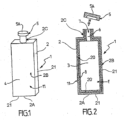
- the invention relates to a method for manufacturing a container 1 comprising a glass wall 2 delimiting a cavity 3 for receiving a product intended to be administered to a human being or an animal.
- the term " administered" must be understood here in an extensive sense, that is to say that it is likely to designate an application of the product by any route and by any means, said product being able to be for example applied to the skin, a mucous membrane or appendages (cosmetic product, pharmaceutical, etc.), or to be ingested (food, medicine, etc.).
- the container 1 is designed to contain a liquid or pasty substance in its cavity 3, and for example an alcoholic liquid such as a body perfume.
- the container 1 is advantageously intended to be closed using a closing member 5, constituted for example by a stopper 5A.
- the container 1 is a bottle intended to receive a body perfume.
- the method according to the invention therefore consists of a method for manufacturing a bottle intended to contain a liquid or pasty cosmetic substance, and preferably a perfumed alcoholic liquid consisting mainly of ethanol, and preferably comprising at least 90% ethanol.
- the method according to the invention it is entirely possible for the method according to the invention to constitute a method for manufacturing a bottle intended to receive a substance other than cosmetic, and for example a pharmaceutical substance, such as a drug.
- a pharmaceutical substance such as a drug.
- Other applications, other than cosmetic or pharmaceutical are of course conceivable.
- only the manufacture of a perfume bottle will be detailed, for purely illustrative and non-limiting purposes.
- the method according to the invention firstly comprises a step of providing, or manufacturing by any known means, a container 1 comprising a glass wall 2 delimiting a cavity 3 for receiving the product intended to be administered.
- a container 1 comprising a glass wall 2 delimiting a cavity 3 for receiving the product intended to be administered.
- the glass constituting the wall 2 is a white, transparent glass, and for example a soda-lime glass or a borosilicate glass.
- the glass constituting the wall 2 is not a crystal, nor a lead glass, that is to say that it has a substantially zero or low lead content, for example less than 20%, and preferably less than 10%.
- the container 1 is constituted by a single piece entirely made of glass.
- the glass wall 2 is formed by a glass base 2A, a glass side wall 2B which rises from and at the periphery of said base 2A and a neck 2C which closes the bottle while providing a filling/dispensing opening 7 allowing the cavity 3 to communicate with the outside.
- the opening 7 cooperates with a closing member 5, preferably consisting of a stopper 5A, to close the bottle.
- a closing member 5 preferably consisting of a stopper 5A
- the glass wall 2 has an internal face 20, located opposite the receiving cavity 3, and an opposite external face 21.
- the glass wall 2 thus forms a hollow hollow body whose internal face 20 directly delimits the cavity 3, which forms an entirely closed empty interior volume, with the exception of the opening 7 towards the outside, the section of which is reduced compared to the average section of the cavity 3, as illustrated in figure 2 .
- Such a configuration is characteristic of a bottle with a neck, that is to say a narrow neck allowing the interior of the bottle to communicate with the exterior.
- the method further comprises a step of covering at least a fraction of said glass wall 2, and more precisely at least a fraction of said internal face 20, with a vitreous material 8 produced using a sol-gel process.
- Sol-gel processes are well known as such. They make it possible to obtain vitreous materials, close or identical to glass, and in particular to silica glass, without resorting to fusion, by simple polymerization of molecular precursors.
- the fraction of the glass wall 2 covered by said vitreous material 8 during the covering step is part of the internal face 20 of the wall 2.
- the vitreous material 8 covers, preferably directly, at least the inner surface of the bottle, which directly delimits the cavity 3.
- the covering step is carried out so that the vitreous material 8 covers said fraction of the internal face 20 according to a surface mass which does not substantially exceed 70 g/m 2 , and which is preferably between substantially 30 and 60 g/m 2 , even more preferably between substantially 40 and 60 g/m 2 , for example approximately 50 g/m 2 .
- the sol contains for example at least one mineral matrix precursor, such as for example a silicon precursor (for example a silicon alkoxide), making it possible to obtain a mineral network, such as for example a silica network.
- a mineral matrix precursor such as for example a silicon precursor (for example a silicon alkoxide)
- the sol contains at least one hybrid matrix precursor (mixed organo-mineral precursor), such as for example an organo-alkoxysilane, making it possible to obtain an organo-mineral network, for example a silica network to which organic functions remain attached.
- metal precursors such as for example an aluminum precursor. Different molecular precursors can be mixed to obtain the sol, the choice of precursors being made in particular with regard to the expected properties of the material.
- vitreous material 8 its content of functional substances (pigments, dyes, etc.) and the nature of said functional substances.
- a vitreous material 8 comprising in particular a mineral network and/or an organo-mineral network (hybrid) and/or a mixed hybrid network (incorporating a metal, such as aluminum).
- said substances mixed to obtain said sol further comprise one or more functional substance(s) chosen from the following group: dye, microbicidal agent, medication.
- said colorant comprises mineral pigments, combined for example with mineral or hybrid or mixed hybrid network precursors, so as to obtain a mineral or hybrid or mixed hybrid network in which the mineral pigments are included. It is also conceivable to use organic pigments or dyes combined with hybrid or mixed hybrid network precursors, so as to obtain a hybrid or mixed hybrid network in which said organic pigments or dyes are included.
- the sol will instead comprise, instead of a colorant, an active substance of the microbicidal agent type making it possible to preserve, or even improve, the health qualities of the product intended to be contained in the bottle.
- the vitreous material 8 covering the internal face 20 is porous, that is to say that it does not provide substantially any anti-migration barrier effect making it possible to prevent the untimely migration into the contents of the container 1 of substances which are either contained in the glass wall 2 or present (for example in the form of a coloring layer) between the latter and the layer of material 8.
- the porous nature of the material 8 goes hand in hand with an absence of release of the molecules constituting said material 8.
- a vitreous material 8 which, while being porous, incorporates a dispersion of pigments (mineral or organic) captured in a stable and permanent manner in the molecular network of the material 8, said pigments therefore not being likely to migrate into the contents of the container 1.
- the glass constituting the wall 2 is not a lead glass, because the vitreous material 8, due to its porous nature, will not constitute a barrier preventing the untimely migration of lead into the contents.
- the method may also comprise, prior to the covering step, a step of activating said fraction of the glass wall 2, in order to facilitate the adhesion of the sol to said fraction of the glass wall 2.
- This activation step may for example consist of a chemical activation using acid (HCl type) or base (soda type).
- the covering step is carried out while the fraction of the glass wall 2 is brought to a temperature of between substantially 18° and 200°C.
- the covering step is carried out while said fraction of the glass wall 2 is at room temperature (approximately 20°C), which makes it possible to save energy.
- room temperature approximately 20°C
- the covering step comprises an operation of depositing, preferably on the bare glass, a layer of the soil on said fraction of the glass wall 2, while said soil is in a substantially liquid state.
- the wall 2, and more precisely the internal face 20, is lacquered with the soil.
- the removal operation consists of depositing the soil layer directly on the fraction of the internal face 20, that is to say on the bare glass forming the internal face 20.
- This deposition of the sol in the liquid state makes it possible to cover in a particularly simple and homogeneous manner, taking into account the fluidity of the sol, the fraction (and preferably substantially the entirety) of the glass wall 2, even when said wall 2 has a complex shape and/or is located inside the container 1.
- the method is in this case particularly suitable for coating the interior of the container, i.e. the internal face 20 of the glass wall 2, as illustrated in FIG. figure 2 .
- the invention is absolutely not limited to a covering of the internal face 20, it is entirely possible that the external face 21 is also coated, or that only said external face 21 is coated.
- the operation of depositing the soil layer is carried out so as to deposit said layer of said soil on said fraction of the internal face 20 according to a surface mass which does not substantially exceed 100 g/m 2 .
- a surface mass which does not substantially exceed 100 g/m 2 .
- the depositing operation is carried out so as to deposit said layer of said soil according to a surface mass which is preferably between substantially 50 and 100 g/m 2 , and even more preferably between substantially 70 and 90 g/m 2 , which makes it possible to obtain excellent stability during the drying operation which will be described below.
- the deposition operation is carried out so as to deposit said layer of said sol according to a surface mass of approximately 85 g/m 2 .
- a surface mass makes it possible, in particular when it is implemented on the internal face 20 of a perfume bottle entirely made of glass with a capacity substantially equal to 130 ml, to obtain at the end of the process an extremely homogeneous coating free of defects (cracks).
- said operation of depositing the soil on the fraction of the glass wall 2 comprises vaporization of said soil on said fraction of the internal face 20.
- the sol is in this case sprayed onto the glass wall 2, and more precisely onto the inner face 20, in the form of fine droplets (spray).
- vaporization can for example be carried out using a spray nozzle introduced into the receiving cavity 3 of the container 1 (for example through the opening 7), a relative rotation and translation movement of the container 1 and the nozzle being implemented so that the sol solution is sprayed uniformly and homogeneously over the entire inner surface (inner face 20) of the container 1 to be treated.
- said substances mixed to obtain the sol further comprise a hydrolysis catalyst, and preferably an acid hydrolysis catalyst such as acetic acid.
- a hydrolysis catalyst such as acetic acid.
- an acid hydrolysis catalyst is of course not obligatory, and it is, for example, entirely possible to use a basic hydrolysis catalyst.
- the sol gelling step is therefore carried out spontaneously, by progressive reaction of the substances constituting said sol, and more precisely by catalyzed hydrolysis of the precursor.
- the sol therefore forms an unstable substance which spontaneously evolves towards a gel.
- the composition of the sol will be chosen so that the latter remains liquid for a sufficient period to allow its industrial application.
- the sol may advantageously be designed to remain in the liquid state for several hours once it is prepared.
- the precursor contained in the sol-gel may be a metal or a metalloid with reactive radicals (typically a mixture of alkoxysilanes) such as TEOS or MTEOS.
- the precursor comprises at least one organometallic compound, preferably an alkoxide.
- the method comprises a step of drying the gel layer obtained at the end of the gelling step and which covers said fraction of the glass wall 2, by heating said gel layer under conditions allowing the extraction of substantially all of the solvent (which is preferably an alcoholic solvent) from the gel, the latter then transforming into said vitreous material 8, which is preferably a silica glass, or at least a silica-based glass, that is to say a vitreous or pseudo-vitreous material having characteristics similar or substantially identical to those of a glass obtained by a conventional glass-making fusion process.
- the solvent which is preferably an alcoholic solvent
- the drying step is carried out in an oven equipped with an atmosphere renewal system, for example ventilation, making it possible to constantly renew the air in the cooking chamber and thus evacuate the solvent extracted from the gel by heating.
- atmosphere renewal system for example ventilation
- the drying step comprises a cycle of heating the container 1 to a temperature of between substantially 60 and 300°C.
- the heating is carried out so as to avoid any cracking of the vitreous material 8 resulting from the gel.
- it is important to adjust the drying time according to the cooking temperature. For example, the implementation of drying at 120°C ventilated for approximately twelve hours of a layer of gel resulting from a sol deposited on a surface mass of approximately 85 g/m 2 makes it possible to obtain good results.
- a vitreous material 8 according to such a surface mass makes it possible to obtain an excellent protective effect, and in particular hydrolytic protection, of the glass wall 2, while allowing the obtaining of remarkable aesthetic effects, for example by including pigments dispersed in the vitreous material 8.
- the vitreous material 8 can thus have an opaque, transparent or translucent color.
- the drying step also makes it possible to bake the gel layer, in order to harden the latter and the vitreous material 8 which results from it.
- the invention also relates as such to a container 1 capable of being obtained by the method according to the invention described above, and preferably directly obtained by the method in question.
- the container 1 comprises a glass wall 2 delimiting a receiving cavity 3 for a product intended to be administered to a human being or an animal.
- At least a fraction of said glass wall 2 is covered by a vitreous material, preferably a silica glass, or silica-based, produced using a sol-gel process.
- the container 1 constitutes a bottle intended to receive, as a product to be administered, an alcoholic liquid, preferably a body perfume.
- an alcoholic liquid preferably a body perfume.
- the use of a vitreous material, of the silica glass type, obtained according to a sol-gel process, is particularly advantageous because it makes it possible to improve the resistance of the glass bottle containing the perfume while giving said bottle a particularly attractive visual appearance, for example for example by coloring the internal face 20 using pigments, for example mineral and/or organic, incorporated and dispersed in the vitreous material 8, which may have an opaque colored appearance or be transparent or even translucent.
- the glass wall 2 is itself preferably translucent or transparent, so that the vitreous material 8 is visible from the outside of the container 1.
- the container is designed so that the vitreous material 8 is in contact, preferably direct, with the product to be administered.
- sol-gel process allows such contact, which avoids having to coat the glassy material 8 with a protective layer, since the sol-gel process makes it possible to obtain an amorphous, stable and non-toxic inorganic material which can therefore be completely brought into contact with a substance likely to be applied or ingested by a living being.
- the vitreous material 8 is advantageously in the form of a layer covering said fraction of the internal face 20 according to a surface mass which does not substantially exceed 70 g/m 2 , and which is preferably between substantially 30 and 60 g/m 2 , even more preferably between substantially 40 and 60 g/m 2 , for example approximately 50 g/m 2 .
- the implementation of such a surface mass allows an excellent compromise between the cost price, the increase in the resistance, in particular hydrolytic resistance of the container 1 and the improvement of its aesthetic appearance, by minimizing the risk of cracking of the sol-gel layer.
- the invention further relates, according to a complementary aspect capable of being the subject of independent protection, to a method of manufacturing a container 1 (preferably a bottle provided with a neck) in one piece comprising a glass wall 2 delimiting a cavity 3 for receiving a product intended to be administered to a human being or an animal, said glass wall 2 having an internal face 20 located opposite said receiving cavity 3, said method comprising a step of covering at least a fraction of said internal face 20 with a vitreous material produced according to a sol-gel process, said vitreous material 8 preferably including coloring pigments, organic or mineral.
- the invention relates to a method for manufacturing a container 1 (preferably a bottle provided with a neck) comprising a wall 2 made of glass with a low or zero lead content (for example less than 20%, preferably less than 10%) delimiting a cavity 3 for receiving a product intended to be administered to a human being or an animal, said glass wall 2 having an internal face 20 located opposite said receiving cavity 3, said method comprising a step of covering at least a fraction of said internal face 20 with a vitreous material produced according to a sol-gel process, said vitreous material 8 preferably including coloring pigments, organic or mineral and/or having a porous character.
- the invention relates to a method for manufacturing a container 1 (preferably a bottle provided with a neck) comprising a glass wall 2 (preferably with a low lead content) delimiting a cavity 3 for receiving a product intended to be administered to a human being or an animal, said glass wall 2 having an internal face 20 located opposite said receiving cavity 3 and an opposite external face 21, said method comprising a step of covering at least a fraction of said internal face 20, and not the external face 21, with a vitreous material 8 produced according to a sol-gel process, said vitreous material 8 preferably including coloring pigments, organic or mineral and/or having a porous character and/or covering said fraction of the internal face (20) according to a surface mass which does not substantially exceed 70 g/m 2 .
- the invention finds its industrial application in the manufacture and decoration of containers, such as bottles.
Landscapes
- Chemical & Material Sciences (AREA)
- Engineering & Computer Science (AREA)
- Geochemistry & Mineralogy (AREA)
- Organic Chemistry (AREA)
- Materials Engineering (AREA)
- Life Sciences & Earth Sciences (AREA)
- Chemical Kinetics & Catalysis (AREA)
- General Chemical & Material Sciences (AREA)
- Mechanical Engineering (AREA)
- Ceramic Engineering (AREA)
- Manufacturing & Machinery (AREA)
- Structural Engineering (AREA)
- Physics & Mathematics (AREA)
- Electromagnetism (AREA)
- Surface Treatment Of Glass (AREA)
- Details Of Rigid Or Semi-Rigid Containers (AREA)
- Table Devices Or Equipment (AREA)
Applications Claiming Priority (5)
| Application Number | Priority Date | Filing Date | Title |
|---|---|---|---|
| FR0952201A FR2944007B1 (fr) | 2009-04-03 | 2009-04-03 | Procede de fabrication d'un recipient en verre et recipient correspondant. |
| EP19183139.5A EP3587369A1 (de) | 2009-04-03 | 2010-04-02 | Herstellungsverfahren eines glasbehälters |
| EP10723201.9A EP2414300B1 (de) | 2009-04-03 | 2010-04-02 | Verfahren zur herstellung eines glasbehälters und entsprechender behälter |
| EP18170199.6A EP3403999B1 (de) | 2009-04-03 | 2010-04-02 | Herstellungsverfahren eines glasbehälters |
| PCT/FR2010/050648 WO2010112792A1 (fr) | 2009-04-03 | 2010-04-02 | Procede de fabrication d'un recipient en verre et recipient correspondant |
Related Parent Applications (4)
| Application Number | Title | Priority Date | Filing Date |
|---|---|---|---|
| EP18170199.6A Division EP3403999B1 (de) | 2009-04-03 | 2010-04-02 | Herstellungsverfahren eines glasbehälters |
| EP10723201.9A Division EP2414300B1 (de) | 2009-04-03 | 2010-04-02 | Verfahren zur herstellung eines glasbehälters und entsprechender behälter |
| PCT/FR2010/050648 Previously-Filed-Application WO2010112792A1 (fr) | 2009-04-03 | 2010-04-02 | Procede de fabrication d'un recipient en verre et recipient correspondant |
| EP19183139.5A Division EP3587369A1 (de) | 2009-04-03 | 2010-04-02 | Herstellungsverfahren eines glasbehälters |
Publications (2)
| Publication Number | Publication Date |
|---|---|
| EP4414334A2 true EP4414334A2 (de) | 2024-08-14 |
| EP4414334A3 EP4414334A3 (de) | 2024-11-13 |
Family
ID=41268389
Family Applications (5)
| Application Number | Title | Priority Date | Filing Date |
|---|---|---|---|
| EP10723201.9A Revoked EP2414300B1 (de) | 2009-04-03 | 2010-04-02 | Verfahren zur herstellung eines glasbehälters und entsprechender behälter |
| EP18170200.2A Revoked EP3395774B1 (de) | 2009-04-03 | 2010-04-02 | Herstellungsverfahren eines glasbehälters, und entsprechender behälter |
| EP24159877.0A Pending EP4414334A3 (de) | 2009-04-03 | 2010-04-02 | Verfahren zur herstellung eines glasbehälters und entsprechender behälter |
| EP19183139.5A Pending EP3587369A1 (de) | 2009-04-03 | 2010-04-02 | Herstellungsverfahren eines glasbehälters |
| EP18170199.6A Revoked EP3403999B1 (de) | 2009-04-03 | 2010-04-02 | Herstellungsverfahren eines glasbehälters |
Family Applications Before (2)
| Application Number | Title | Priority Date | Filing Date |
|---|---|---|---|
| EP10723201.9A Revoked EP2414300B1 (de) | 2009-04-03 | 2010-04-02 | Verfahren zur herstellung eines glasbehälters und entsprechender behälter |
| EP18170200.2A Revoked EP3395774B1 (de) | 2009-04-03 | 2010-04-02 | Herstellungsverfahren eines glasbehälters, und entsprechender behälter |
Family Applications After (2)
| Application Number | Title | Priority Date | Filing Date |
|---|---|---|---|
| EP19183139.5A Pending EP3587369A1 (de) | 2009-04-03 | 2010-04-02 | Herstellungsverfahren eines glasbehälters |
| EP18170199.6A Revoked EP3403999B1 (de) | 2009-04-03 | 2010-04-02 | Herstellungsverfahren eines glasbehälters |
Country Status (7)
| Country | Link |
|---|---|
| US (1) | US8852699B2 (de) |
| EP (5) | EP2414300B1 (de) |
| JP (1) | JP5909177B2 (de) |
| ES (3) | ES2748525T3 (de) |
| FR (1) | FR2944007B1 (de) |
| PL (3) | PL3403999T3 (de) |
| WO (1) | WO2010112792A1 (de) |
Families Citing this family (14)
| Publication number | Priority date | Publication date | Assignee | Title |
|---|---|---|---|---|
| FR2944007B1 (fr) | 2009-04-03 | 2012-06-08 | Sgd Sa | Procede de fabrication d'un recipient en verre et recipient correspondant. |
| DE102012217694A1 (de) * | 2012-09-28 | 2014-06-12 | Beiersdorf Ag | Verhinderung von Wechselwirkungen durch SiOx-Beschichtung von Behältnissen |
| DE102012217713A1 (de) * | 2012-09-28 | 2014-04-03 | Beiersdorf Ag | Verhinderung von Wechselwirkungen durch SiOx-Beschichtung von Behältnissen |
| FR3028777B1 (fr) | 2014-11-26 | 2021-01-15 | Glass Surface Tech | Procede et dispositif de revetement de la surface interne d'un recipient et recipient obtenu avec un tel procede |
| FR3028778B1 (fr) | 2014-11-26 | 2019-04-12 | Glass Surface Technology | Procede de fabrication d'une couche de revetement de la face interne d'un recipient et recipient obtenu avec un tel procede |
| EP3165548A1 (de) | 2015-11-04 | 2017-05-10 | WEILBURGER Coatings ITALIA S.p.A. | Zusammensetzung zur beschichtung der oberfläche eines transparenten materials |
| FR3051690B1 (fr) * | 2016-05-25 | 2020-12-18 | Glass Surface Tech | Procede de fabrication d'une couche de revetement de la face interne d'un recipient et recipient obtenu avec un tel procede |
| FR3051691B1 (fr) | 2016-05-25 | 2020-12-18 | Glass Surface Tech | Procede de fabrication d'une couche ou d'un motif de revetement de la face interne d'un recipient et recipient obtenu avec un tel procede |
| US10626047B2 (en) | 2016-10-18 | 2020-04-21 | Owens-Brockway Glass Container Inc. | Glass container coating process |
| FR3093292B1 (fr) * | 2019-03-02 | 2022-04-15 | Annie Slupecki | Procédé et appareillage pour appliquer un revêtement fluoré et/ou céramique sur une paroi interne d’un récipient à goulot |
| FR3104151B1 (fr) * | 2019-12-05 | 2021-11-26 | Sgd Sa | Installation de traitement de recipients en verre comprenant une chambre de dosage de substance de traitement a double obturateur et procede afferent |
| IT202000016174A1 (it) * | 2020-07-03 | 2022-01-03 | Univ Degli Studi Di Parma | Materiale multistrato, contenitore realizzato in materiale multistrato e processo di fabbricazione di un contenitore |
| FR3126190B1 (fr) * | 2021-08-17 | 2026-02-20 | Verescence France | Procede et installation de decoration interieure d’un recipient a paroi en verre |
| BE1032287B1 (fr) | 2023-12-27 | 2025-07-30 | Baobab Collection Sa | Méthode de décoration d’un contenant en verre avec de la peinture |
Family Cites Families (23)
| Publication number | Priority date | Publication date | Assignee | Title |
|---|---|---|---|---|
| FR2138510A1 (de) | 1971-05-27 | 1973-01-05 | Garreau Jean | |
| US3915114A (en) | 1974-07-10 | 1975-10-28 | Union Carbide Corp | Machine for spray coating irregular shapes |
| FR2401173A1 (fr) | 1977-06-27 | 1979-03-23 | Roussel Uclaf | Nouveaux steroides, leur procede de preparation et leur application dans la synthese de steroides marques au tritium |
| DE2735830A1 (de) | 1977-08-09 | 1979-03-01 | Thomae Gmbh Dr K | Antithrombotische arzneimittelkombination und verfahren zu ihrer herstellung |
| DE2860737D1 (en) | 1977-08-31 | 1981-09-03 | Ici Plc | Titanium trichloride compositions, preparation thereof, catalyst system containing them, and polymerisation of olefins using this system |
| GB2043040B (en) | 1978-12-07 | 1982-12-15 | Tokyo Ohka Kogyo Co Ltd | Method for preventing leaching of contaminants from solid surfaces |
| JPS5626750A (en) * | 1979-08-13 | 1981-03-14 | Tokyo Ohka Kogyo Co Ltd | Bleeding preventing method for contained component from solid surface |
| DE3719339A1 (de) * | 1987-06-10 | 1988-12-22 | Fraunhofer Ges Forschung | Verfahren zur herstellung von glaesern mit erhoehter bruchfestigkeit |
| FR2627768B1 (fr) | 1988-02-29 | 1990-06-29 | Baccarat Cristalleries | Recipient en cristal traite pour empecher la migration du plomb vers son contenu |
| JPH0645481B2 (ja) * | 1989-01-19 | 1994-06-15 | 不二硝子株式会社 | 低アルカリ硝子容器製造方法 |
| US5520855A (en) | 1991-03-20 | 1996-05-28 | Kabushiki Kaisha Toshiba | Coating solution composition for forming glass gel thin film, color glass gel filter, and display device using the same |
| DE4338360A1 (de) | 1993-11-10 | 1995-05-11 | Inst Neue Mat Gemein Gmbh | Verfahren zur Herstellung von funktionellen glasartigen Schichten |
| AU750581B2 (en) | 1997-05-13 | 2002-07-25 | Clean Japan Center Foundation, The | Coating material for forming vitreous coating film, method of coating with the same, and coater |
| DE19801861C2 (de) | 1998-01-20 | 2001-10-18 | Schott Glas | Verfahren zum Herstellen eines hohlen, innenbeschichteten Glasformkörpers |
| FR2851940B1 (fr) | 2003-03-03 | 2007-03-30 | Procede de decoration d'un flacon | |
| JP2005289711A (ja) * | 2004-03-31 | 2005-10-20 | Nippon Glass Sangyo Kk | アンプルまたはバイアル、およびその製造方法 |
| WO2006054227A2 (en) * | 2004-11-18 | 2006-05-26 | Koninklijke Philips Electronics N.V. | Coating for lamps and lamp at least partially provided with such a coating |
| FR2889485B1 (fr) | 2005-08-02 | 2007-10-05 | Lotoise Evaporation Soc Par Ac | Procede de decoration d'un recipient transparent ou translucide |
| ITPD20070272A1 (it) * | 2007-08-03 | 2009-02-04 | Nuova Ompi Srl | Procedimento per la produzione di contenitori in vetro e prodotto ottenuto |
| FR2939615B1 (fr) | 2008-06-16 | 2015-09-25 | Courval Verreries | Procede de decoration d'un flacon transparent ou translucide |
| FR2935594B1 (fr) | 2008-09-10 | 2012-01-20 | Oreal | Recipients revetus par depot d'un sol-gel sur leur surface interne |
| FR2944007B1 (fr) | 2009-04-03 | 2012-06-08 | Sgd Sa | Procede de fabrication d'un recipient en verre et recipient correspondant. |
| KR102167428B1 (ko) | 2016-10-21 | 2020-10-20 | 주식회사 엘지화학 | 듀티 제어를 통한 효과적인 배터리 셀 밸런싱 방법 및 시스템 |
-
2009
- 2009-04-03 FR FR0952201A patent/FR2944007B1/fr active Active
-
2010
- 2010-04-02 PL PL18170199T patent/PL3403999T3/pl unknown
- 2010-04-02 EP EP10723201.9A patent/EP2414300B1/de not_active Revoked
- 2010-04-02 EP EP18170200.2A patent/EP3395774B1/de not_active Revoked
- 2010-04-02 ES ES18170199T patent/ES2748525T3/es active Active
- 2010-04-02 PL PL10723201T patent/PL2414300T3/pl unknown
- 2010-04-02 WO PCT/FR2010/050648 patent/WO2010112792A1/fr not_active Ceased
- 2010-04-02 JP JP2012502759A patent/JP5909177B2/ja active Active
- 2010-04-02 EP EP24159877.0A patent/EP4414334A3/de active Pending
- 2010-04-02 US US12/735,477 patent/US8852699B2/en active Active
- 2010-04-02 ES ES10723201.9T patent/ES2675894T3/es active Active
- 2010-04-02 EP EP19183139.5A patent/EP3587369A1/de active Pending
- 2010-04-02 EP EP18170199.6A patent/EP3403999B1/de not_active Revoked
- 2010-04-02 ES ES18170200T patent/ES2745586T3/es active Active
- 2010-04-02 PL PL18170200T patent/PL3395774T3/pl unknown
Also Published As
| Publication number | Publication date |
|---|---|
| PL3395774T3 (pl) | 2019-11-29 |
| ES2675894T3 (es) | 2018-07-13 |
| JP2012522715A (ja) | 2012-09-27 |
| EP3403999A1 (de) | 2018-11-21 |
| PL2414300T3 (pl) | 2018-11-30 |
| WO2010112792A1 (fr) | 2010-10-07 |
| EP3403999B1 (de) | 2019-07-03 |
| EP4414334A3 (de) | 2024-11-13 |
| EP2414300A1 (de) | 2012-02-08 |
| EP3587369A1 (de) | 2020-01-01 |
| FR2944007B1 (fr) | 2012-06-08 |
| EP2414300B1 (de) | 2018-05-16 |
| PL3403999T3 (pl) | 2020-02-28 |
| US20110100858A1 (en) | 2011-05-05 |
| ES2748525T3 (es) | 2020-03-17 |
| FR2944007A1 (fr) | 2010-10-08 |
| EP3395774A1 (de) | 2018-10-31 |
| ES2745586T3 (es) | 2020-03-02 |
| EP3395774B1 (de) | 2019-06-12 |
| JP5909177B2 (ja) | 2016-04-26 |
| US8852699B2 (en) | 2014-10-07 |
Similar Documents
| Publication | Publication Date | Title |
|---|---|---|
| EP3395774B1 (de) | Herstellungsverfahren eines glasbehälters, und entsprechender behälter | |
| EP2334444B1 (de) | Kochartikel mit nicht klebrigem überzug mit verbesserten substrathaftungseigenschaften | |
| EP2334445B1 (de) | Kochartikel mit nicht klebrigem überzug mit verbesserten substrathaftungseigenschaften | |
| EP2271236B1 (de) | Parfumflasche | |
| EP3045401A1 (de) | Behälter, der mit einer schutz- und rückhalteverkleidung abgedeckt ist, kit zur herstellung einer solchen schutz- und rückhalteverkleidung und entsprechendes herstellungsverfahren | |
| EP3359500B1 (de) | Glasbabyflasche mit überzug zum schutz gegen hitzeschock und zugehöriges herstellungsverfahren | |
| EP3463690B1 (de) | Verfahren zur herstellung einer beschichtung für die innenfläche eines behälters und nach einem derartigen verfahren hergestellter behälter | |
| EP2370614B1 (de) | Hohlkörper aus glas mit innerer oberfläche metallisiert und verfahren zu dessen herstellung | |
| EP3464678B1 (de) | Verfahren zur herstellung einer schicht oder eines musters zur beschichtung der innenfläche eines behälters und durch ein verfahren des besagten typs erhaltener behälter | |
| WO2002055407A2 (fr) | Recipient distribuant des quantites de produit constantes jusqu'a ce que ledit recipient soit presque completement vide | |
| EP0458713A1 (de) | Verfahren zur Verkleinerung der Bleimigration von einer Kristallflasche zu einer in dieser Flasche enthaltenden Flüssigkeit | |
| EP3224387A2 (de) | Verfahren zur herstellung einer beschichtung auf der innenfläche eines behälters und mit diesem verfahren hergestellter behälter | |
| EP3464680B1 (de) | Verfahren zur herstellung einer schicht zum beschichten der kunststoffinnenfläche eines behälters und nach einem derartigen verfahren hergestellter behälter |
Legal Events
| Date | Code | Title | Description |
|---|---|---|---|
| PUAI | Public reference made under article 153(3) epc to a published international application that has entered the european phase |
Free format text: ORIGINAL CODE: 0009012 |
|
| STAA | Information on the status of an ep patent application or granted ep patent |
Free format text: STATUS: REQUEST FOR EXAMINATION WAS MADE |
|
| 17P | Request for examination filed |
Effective date: 20240227 |
|
| AC | Divisional application: reference to earlier application |
Ref document number: 2414300 Country of ref document: EP Kind code of ref document: P Ref document number: 3403999 Country of ref document: EP Kind code of ref document: P Ref document number: 3587369 Country of ref document: EP Kind code of ref document: P |
|
| AK | Designated contracting states |
Kind code of ref document: A2 Designated state(s): AT BE BG CH CY CZ DE DK EE ES FI FR GB GR HR HU IE IS IT LI LT LU LV MC MK MT NL NO PL PT RO SE SI SK SM TR |
|
| REG | Reference to a national code |
Ref country code: DE Ref legal event code: R079 Free format text: PREVIOUS MAIN CLASS: C03C0017000000 Ipc: C03C0017020000 |
|
| PUAL | Search report despatched |
Free format text: ORIGINAL CODE: 0009013 |
|
| P01 | Opt-out of the competence of the unified patent court (upc) registered |
Free format text: CASE NUMBER: APP_50497/2024 Effective date: 20240905 |
|
| AK | Designated contracting states |
Kind code of ref document: A3 Designated state(s): AT BE BG CH CY CZ DE DK EE ES FI FR GB GR HR HU IE IS IT LI LT LU LV MC MK MT NL NO PL PT RO SE SI SK SM TR |
|
| RIC1 | Information provided on ipc code assigned before grant |
Ipc: C03C 17/00 20060101ALI20241008BHEP Ipc: B28B 21/72 20060101ALI20241008BHEP Ipc: B28B 21/00 20060101ALI20241008BHEP Ipc: B28B 11/00 20060101ALI20241008BHEP Ipc: B05D 1/02 20060101ALI20241008BHEP Ipc: B05B 7/22 20060101ALI20241008BHEP Ipc: A47G 19/22 20060101ALI20241008BHEP Ipc: C03C 1/00 20060101ALI20241008BHEP Ipc: C03C 17/02 20060101AFI20241008BHEP |
|
| TPAC | Observations filed by third parties |
Free format text: ORIGINAL CODE: EPIDOSNTIPA |
|
| STAA | Information on the status of an ep patent application or granted ep patent |
Free format text: STATUS: EXAMINATION IS IN PROGRESS |
|
| 17Q | First examination report despatched |
Effective date: 20250715 |
|
| TPAC | Observations filed by third parties |
Free format text: ORIGINAL CODE: EPIDOSNTIPA |