EP4414352A1 - Procédé de production de méthanol à partir de gaz de synthèse contenant une teneur élevée en composants de gaz inertes - Google Patents
Procédé de production de méthanol à partir de gaz de synthèse contenant une teneur élevée en composants de gaz inertes Download PDFInfo
- Publication number
- EP4414352A1 EP4414352A1 EP23155309.0A EP23155309A EP4414352A1 EP 4414352 A1 EP4414352 A1 EP 4414352A1 EP 23155309 A EP23155309 A EP 23155309A EP 4414352 A1 EP4414352 A1 EP 4414352A1
- Authority
- EP
- European Patent Office
- Prior art keywords
- stream
- synthesis
- gas
- pressure
- methanol
- Prior art date
- Legal status (The legal status is an assumption and is not a legal conclusion. Google has not performed a legal analysis and makes no representation as to the accuracy of the status listed.)
- Pending
Links
Images



Classifications
-
- C—CHEMISTRY; METALLURGY
- C07—ORGANIC CHEMISTRY
- C07C—ACYCLIC OR CARBOCYCLIC COMPOUNDS
- C07C29/00—Preparation of compounds having hydroxy or O-metal groups bound to a carbon atom not belonging to a six-membered aromatic ring
- C07C29/15—Preparation of compounds having hydroxy or O-metal groups bound to a carbon atom not belonging to a six-membered aromatic ring by reduction of oxides of carbon exclusively
- C07C29/151—Preparation of compounds having hydroxy or O-metal groups bound to a carbon atom not belonging to a six-membered aromatic ring by reduction of oxides of carbon exclusively with hydrogen or hydrogen-containing gases
- C07C29/1512—Preparation of compounds having hydroxy or O-metal groups bound to a carbon atom not belonging to a six-membered aromatic ring by reduction of oxides of carbon exclusively with hydrogen or hydrogen-containing gases characterised by reaction conditions
-
- C—CHEMISTRY; METALLURGY
- C07—ORGANIC CHEMISTRY
- C07C—ACYCLIC OR CARBOCYCLIC COMPOUNDS
- C07C29/00—Preparation of compounds having hydroxy or O-metal groups bound to a carbon atom not belonging to a six-membered aromatic ring
- C07C29/15—Preparation of compounds having hydroxy or O-metal groups bound to a carbon atom not belonging to a six-membered aromatic ring by reduction of oxides of carbon exclusively
- C07C29/151—Preparation of compounds having hydroxy or O-metal groups bound to a carbon atom not belonging to a six-membered aromatic ring by reduction of oxides of carbon exclusively with hydrogen or hydrogen-containing gases
- C07C29/152—Preparation of compounds having hydroxy or O-metal groups bound to a carbon atom not belonging to a six-membered aromatic ring by reduction of oxides of carbon exclusively with hydrogen or hydrogen-containing gases characterised by the reactor used
-
- C—CHEMISTRY; METALLURGY
- C07—ORGANIC CHEMISTRY
- C07C—ACYCLIC OR CARBOCYCLIC COMPOUNDS
- C07C29/00—Preparation of compounds having hydroxy or O-metal groups bound to a carbon atom not belonging to a six-membered aromatic ring
- C07C29/15—Preparation of compounds having hydroxy or O-metal groups bound to a carbon atom not belonging to a six-membered aromatic ring by reduction of oxides of carbon exclusively
- C07C29/151—Preparation of compounds having hydroxy or O-metal groups bound to a carbon atom not belonging to a six-membered aromatic ring by reduction of oxides of carbon exclusively with hydrogen or hydrogen-containing gases
- C07C29/1516—Multisteps
- C07C29/1518—Multisteps one step being the formation of initial mixture of carbon oxides and hydrogen for synthesis
-
- C—CHEMISTRY; METALLURGY
- C07—ORGANIC CHEMISTRY
- C07C—ACYCLIC OR CARBOCYCLIC COMPOUNDS
- C07C29/00—Preparation of compounds having hydroxy or O-metal groups bound to a carbon atom not belonging to a six-membered aromatic ring
- C07C29/74—Separation; Purification; Use of additives, e.g. for stabilisation
- C07C29/76—Separation; Purification; Use of additives, e.g. for stabilisation by physical treatment
-
- C—CHEMISTRY; METALLURGY
- C07—ORGANIC CHEMISTRY
- C07C—ACYCLIC OR CARBOCYCLIC COMPOUNDS
- C07C31/00—Saturated compounds having hydroxy or O-metal groups bound to acyclic carbon atoms
- C07C31/02—Monohydroxylic acyclic alcohols
- C07C31/04—Methanol
Definitions
- the invention relates to a process for producing methanol from synthesis gas, in particular from synthesis gas with a high proportion of inert gas components.
- Methanol is produced on an industrial scale from synthesis gas, a mixture of carbon oxides and hydrogen.
- Synthesis gas is usually produced from fossil feed gases, such as natural gas, using processes such as steam reforming (SMR) or autothermal reforming (ATR). These are established industrial processes that produce a synthesis gas mixture that consists almost exclusively of carbon monoxide, carbon dioxide, and hydrogen. Inert components such as methane or nitrogen make up only a minor proportion of the synthesis gas mixture.
- Methanol can be produced from feed gases rich in carbon dioxide, using high recycling rates or, in multi-stage syntheses with intermediate condensation of the raw methanol, from feed gases that are practically free of carbon monoxide. In the latter case, the actual synthesis gas converted to methanol is therefore a mixture of carbon dioxide and hydrogen.
- carbon dioxide can either be captured and sequestered (carbon capture and storage, CCS) or, after capture, be used for further utilization (carbon capture and utilization, CCU).
- CCS carbon capture and storage
- CCU carbon capture and utilization
- methanol synthesis based on carbon dioxide-rich feed gases, such as industrial exhaust gases is a good option. At the very least, such feed gases can be mixed with "conventional" synthesis gas, since they are not always immediately suitable for methanol synthesis as such, even after the addition of hydrogen.
- the aforementioned feed gases usually have a high proportion of inert components, more precisely a high proportion of gas components that are inert under methanol synthesis conditions, i.e. do not react, and thus do not contribute to product formation.
- inert components collect at the reactor inlet, which significantly increases the reactor load, causes a high pressure drop across the reactor, and reduces the yield in terms of carbon conversion.
- this also increases the load of the synthesis gas and recycle gas compressor, which leads to higher operating costs (opex).
- the cross-sections of the pipelines must also be dimensioned accordingly, which increases the investment costs (capex).
- the synthesis gas compressor plays a central role here, i.e. the compressor that compresses the synthesis gas mixture to the synthesis pressure required for methanol synthesis. This is usually a machine that is operated with a high expenditure of electrical energy.
- the aim should be to reduce or keep the amount of externally generated electrical energy to be provided for the synthesis gas compressor, even when operating with a feed gas with a high proportion of inert components, compared to operating the synthesis gas compressor with a feed gas without a high proportion of inert components.
- Such a result can be achieved, for example, through improved process integration, for example by using energy generated within the process in such a way that it reduces the effort required to provide energy generated outside the process.
- EP 2 228 357 A1 discloses a process for producing methanol in which a purge gas stream is depressurized using an expander. The mechanical work generated is used within the process, for example to drive a recycle gas compressor.
- the task is to minimize the energy consumption for the synthesis gas compressor.
- An object of the present invention is therefore to at least partially overcome the aforementioned disadvantages of the prior art.
- an object of the present invention is to expand or improve the possibilities of in-process energy utilization.
- One reactor stage of the reactor arrangement has the methanol synthesis catalyst.
- This can be any catalyst known to the person skilled in the art that is suitable for methanol synthesis, for example a copper-based catalyst.
- the catalyst can be designed, for example, as a fixed bed in the form of pellets or as a structured packing.
- a phase separation device is configured to separate the product stream from the residual gas stream.
- the phase separation device has a cooling stage in the form of a heat exchanger for condensing the product stream, as well as a separation stage for separating the condensed (liquid) phase from the gas phase.
- At least part of the crude methanol stream is expanded to a relaxation pressure in a liquid expansion device, and the mechanical work performed by the expansion device is used within the process.
- the use can be made directly, by mechanically driving the synthesis gas compression device, or indirectly, by first converting the mechanical work performed by the expansion device into electrical energy. This is then used to drive the synthesis gas compression device.
- the residual gas stream can be recompressed to synthesis pressure in a residual gas compression device and combined with the compressed residual gas stream.
- the residual gas stream is thus returned to the inlet of the reactor stage and converted with the compressed synthesis gas to form the crude methanol stream.
- the mechanical work performed by the liquid expansion device can also be used on the residual gas compression device to drive the residual gas compression device, or the mechanical work performed by the liquid expansion device is converted into electrical energy and the electrical energy is used to drive the residual gas compression device.
- the liquid expansion device is, for example, an expansion machine that works according to the displacement principle (e.g. piston expansion machine) or the flow principle (e.g. turbo expansion machine, expansion turbine).
- the selection of the liquid expansion device depends on the volume flow of the raw methanol stream to be expanded and the prevailing pressures.
- the relaxation pressure is preferably lower than the synthesis pressure by a factor of at least 5, or at least 10, or at least 15, or at least 20, or at least 25, or at least 50.
- the synthesis pressure is in a range from 60 bar to 90 bar, and the relaxation pressure is in a range from atmospheric pressure (about 1 bar absolute) to 5 bar.
- the work performed by the liquid expansion device is first converted into electrical energy, this can be done, for example, by a generator.
- the electrical current generated in this way can then, for example, drive an electric motor which drives the synthesis gas compression device.
- the synthesis gas compression device consists of one or more compressors connected in parallel and/or in series, which in turn operate either according to the displacement principle (e.g. piston compressor) or according to the flow principle (e.g. turbo compressor).
- the displacement principle e.g. piston compressor
- turbo compressor e.g. turbo compressor
- the synthesis gas stream contains at least one carbon oxide, hydrogen, and an inert gas component.
- a "carbon oxide” is understood to mean carbon monoxide (CO) or carbon dioxide (CO 2 ).
- the inert gas component can be a single gas (for example, exclusively nitrogen) or a mixture of gases (for example, nitrogen, argon, and methane). "Inert” means that the gas component does not react under the conditions of methanol synthesis, i.e. it is neither converted into a product nor into an undesirable by-product.
- At least part of the residual gas stream is returned to the inlet of the or one of the reactor stages.
- a purge stream can be branched off from part of this recycle stream in order to prevent the accumulation of the inert components in the synthesis loop.
- the purge stream can be purged with the aid of a gas expansion device, as shown in EP 2 228 357 A1 known, in addition to performing mechanical work and thus for generating energy within the process.
- An embodiment of the method is characterized in that the reactor arrangement has a plurality of n reactor stages arranged in series and a plurality of p phase separation devices, each of the reactor stages being assigned a phase separation device, the phase separation device being arranged downstream of the associated reactor stage, and in each of the phase separation devices a liquid crude methanol partial stream and a residual gas partial stream are produced and wherein the residual gas partial stream generated in a phase separation device is at least partially introduced into the reactor stage arranged subsequently, and wherein the residual gas partial stream generated in the last phase separation device is discharged from the reactor arrangement.
- the reactor arrangement has at least two reactor stages and at least two phase separation devices. Each reactor stage is assigned a phase separation device which is arranged downstream of the respective reactor stage.
- the partial product stream discharged from a reactor stage is separated in the downstream phase separation stage into a crude methanol partial stream and a residual gas partial stream.
- the crude methanol partial stream is discharged from the reactor arrangement as a crude product partial stream and is subjected to further processing.
- the residual gas partial stream withdrawn from a phase separation stage is preferably fed in its entirety into the subsequent reactor stage arranged in series. It is also possible for only a portion to be fed into the subsequent reactor stage and the remaining portion to be used for another purpose.
- phase separation stages An exception to this is the last of the phase separation stages arranged in series.
- the residual gas stream discharged from this last phase separation stage is discharged from the reactor arrangement and subjected to further use.
- the configuration of the reactor stages and the phase separation devices within the reactor arrangement according to this embodiment can also be referred to as a multi-stage reactor arrangement with intermediate condensation.
- This embodiment relates to the configuration of the reactor arrangement as a multi-stage reactor arrangement.
- the residual gas partial flow discharged from the reactor arrangement is also advantageously used to perform mechanical work by expanding this residual gas partial flow to an expansion pressure in a gas expansion device.
- the residual gas partial stream discharged from the last phase separation stage contains practically no valuable gases, but consists essentially of the gases of the inert gas component. It is therefore particularly useful to use the residual gas partial stream for the in-process generation of mechanical or electrical energy for driving the synthesis gas compressor. This is particularly useful in conjunction with a synthesis gas stream that has an inert gas component with a proportion of at least 1 vol.% in the synthesis gas.
- the expansion pressure of the expanded residual gas partial stream is preferably lower than the synthesis pressure by a factor of at least 5, or at least 10, or at least 15, or at least 20, or at least 25, or at least 50.
- the synthesis pressure is in a range from 60 bar to 90 bar, and the expansion pressure is in a range from atmospheric pressure (approx. 1 bar absolute) to 5 bar.
- the gas expansion device is, for example, an expansion machine that works according to the displacement principle (e.g. piston expansion machine) or the flow principle (e.g. turbo expansion machine, expansion turbine).
- the selection of the gas expansion device depends on the volume flow of the raw methanol stream to be expanded and the prevailing pressures.
- the depressurized residual gas stream it may be useful to feed the depressurized residual gas stream to a hydrogen recovery device and to return the recovered hydrogen to methanol synthesis.
- One embodiment of the process is characterized in that the entire residual gas partial stream discharged from the reactor arrangement is expanded in the gas expansion device.
- the use of the entire residual gas partial stream discharged from the reactor arrangement for the internal production of mechanical or electrical energy is particularly useful if the number n of reactor stages is so high that a complete or essentially complete carbon conversion is achieved across all reactor stages n of the reactor arrangement.
- a portion of the residual gas partial stream discharged from the reactor arrangement may be expanded in the gas expansion device, and a further portion of the residual gas partial stream discharged from the reactor arrangement to be compressed to synthesis pressure in a residual gas compression device, and the compressed residual gas partial stream to be returned to at least one of the plurality of reactor stages arranged in series, preferably to be returned to the first of the plurality of reactor stages arranged in series.
- the residual gas stream discharged from the last phase separation device still contains a usable proportion of carbon oxides and hydrogen.
- the other part is recompressed to synthesis pressure and preferably returned to the first of the plurality of reactor stages arranged in series.
- the mechanical or electrical energy obtained within the process by expanding the residual gas partial flow can optionally also be used to drive the residual gas compression device.
- a portion of the residual gas partial stream expanded to expansion pressure is recompressed to synthesis pressure in the synthesis gas compression device, and the compressed residual gas partial stream is fed to the reactor arrangement.
- the residual gas partial stream has the appropriate composition, it is advisable to return it to the synthesis gas compression device after the pressure has been released.
- the residual gas partial stream is compressed together with the synthesis gas stream to synthesis pressure and then fed to the reactor arrangement.
- An embodiment of the process is characterized in that the proportion of the inert gas component in the synthesis gas stream is at least 1 vol.%, or at least 5 vol.%, or at least 10 vol.%, or at least 20 vol.%.
- the proportion of the inert gas component in the synthesis gas stream is 0.5 vol.% to 30 vol.%, or 1 vol.% to 20 vol.%, or 1 vol.% to 10 vol.%.
- An embodiment of the process is characterized in that the inert gas component comprises nitrogen and/or methane.
- An embodiment of the process is characterized in that the synthesis pressure is at least 70 bar, or at least 75 bar, or at least 80 bar, or at least 85 bar.
- One embodiment of the process is characterized in that the crude methanol stream is expanded in the liquid expansion device to a pressure of 1 bar to 5 bar, preferably to a pressure of 1 bar to 3 bar. According to a preferred embodiment, the crude methanol stream is expanded in the liquid expansion device to a pressure which corresponds to atmospheric pressure, i.e. approximately 1 bar (absolute).
- a particularly preferred embodiment of the process is characterized in that the crude methanol stream is fed to a downstream thermal separation device for separating the crude methanol into methanol and water, wherein the thermal separation device is operated at a predetermined pressure, and the crude methanol stream is expanded in the liquid expansion device to a pressure which corresponds to the predetermined pressure in the thermal separation device.
- the crude methanol stream is expanded in the liquid expansion device to a pressure which substantially corresponds to the predetermined pressure in the thermal separation device.
- This measure allows the depressurized crude methanol stream to be fed directly into the thermal separation device located downstream.
- a low-pressure phase separation device is connected upstream of the thermal separation device.
- the phase separation device immediately downstream of the reactor stage is configured as a high-pressure phase separation device or the phase separation devices downstream of the reactor stages are configured as high-pressure phase separation devices.
- the liquid expansion device is then arranged between the high-pressure phase separation device and the low-pressure phase separation device, or between the high-pressure phase separation devices and the low-pressure phase separation device.
- the thermal separation device is a rectification column or an arrangement of several rectification columns.
- One embodiment of the method is characterized in that the residual gas partial stream is expanded in the liquid expansion device to a pressure of 1 bar to 5 bar, preferably to a pressure of 1 bar to 3 bar. According to a preferred embodiment, the residual gas partial stream is expanded in the liquid expansion device to a pressure which corresponds to atmospheric pressure, i.e. approximately 1 bar (absolute).
- the residual gas partial stream discharged from the reactor arrangement is used to perform mechanical work by expanding this residual gas partial stream to an expansion pressure in a gas expansion device.
- the residual gas partial stream discharged from the last phase separation stage contains practically no valuable gases, but consists essentially of the gases of the inert gas component. It is therefore particularly useful to use the residual gas partial stream for the in-process generation of mechanical or electrical energy for driving the synthesis gas compressor. This is particularly useful in conjunction with a synthesis gas stream that has an inert gas component with a proportion of at least 1 vol.% in the synthesis gas.
- the entire residual gas partial stream discharged from the reactor arrangement is expanded in the gas expansion device.
- a portion of the residual gas partial stream discharged from the reactor arrangement is expanded in the gas expansion device, and a further portion of the residual gas partial stream discharged from the reactor arrangement is compressed to synthesis pressure in a residual gas compression device, and the compressed residual gas partial stream is returned to at least one of the plurality of reactor stages arranged in series, preferably returned to the first of the plurality of reactor stages arranged in series.
- a portion of the residual gas partial stream expanded to expansion pressure is recompressed to synthesis pressure in the synthesis gas compression device, and the compressed residual gas partial stream is fed to the reactor arrangement.
- the proportion of the inert gas component in the synthesis gas stream is at least 1 vol.%, or at least 5 vol.%, or at least 10 vol.%, or at least 20 vol.%.
- the inert gas component comprises nitrogen and/or methane.
- the synthesis pressure is at least 70 bar, or at least 75 bar, or at least 80 bar, or at least 85 bar.
- the residual gas partial stream is expanded in the gas expansion device to a pressure of 1 bar to 3 bar.
- Figure 1 shows a process 1 according to a first example of the invention, in which the synthesis of methanol takes place in a single-stage reactor arrangement.
- a synthesis gas stream 10 comprising hydrogen, carbon monoxide, carbon dioxide, and nitrogen and methane as inert gas components, is provided and compressed in a synthesis gas compression device 12, here a synthesis gas compressor, to a synthesis pressure suitable for methanol synthesis.
- the synthesis pressure can be 90 bar.
- a resulting compressed synthesis gas stream 11 is introduced into a reactor stage 13, in which the compressed synthesis gas stream 11 is converted into an initially gaseous, and after cooling, two-phase product stream 14, which at least Methanol, water, as well as unreacted synthesis gas (hydrogen, carbon monoxide and carbon dioxide) and the inert gas component.
- the reactor stage 13 contains a suitable copper-based methanol synthesis catalyst (not shown).
- the reactor stage 13 is cooled using boiling boiler feed water.
- the steam formed can be exported or used for an upstream process, for example a steam reformer.
- the reactor stage 13 forms part of a reactor arrangement which has at least the reactor stage 13 and a phase separation device 15 downstream of the reactor stage.
- the phase separation device has at least one heat exchanger for cooling and condensing the initially gaseous raw methanol to form the product stream 14, as well as a separator downstream of the heat exchanger for separating the liquid raw methanol phase from the gaseous phase.
- the heat exchanger and the separator are not provided with dedicated reference numbers.
- a liquid crude methanol stream 16 is withdrawn from the phase separation device 15, which contains methanol, water and possibly condensed by-products of the methanol synthesis.
- the separator of the phase separation device 15 is a high-pressure separator, so that the crude methanol stream 16 has a pressure which differs from the synthesis pressure mainly due to unavoidable pressure losses across the reactor arrangement.
- the pressure of the crude methanol stream 16 is sufficiently high to be used for the in-process generation of mechanical and/or electrical energy.
- the crude methanol stream 16 is fed to a liquid expansion device 19, which can be, for example, an expansion turbine. In the liquid expansion device 19, the crude methanol stream 16 is expanded to a pressure of approximately 2 bar.
- This pressure corresponds to the pressure which prevails in a downstream thermal separation device for obtaining pure methanol (not shown).
- the depressurized crude methanol stream 18 is first fed to another separator, here a low-pressure separator 30. There, a further separation of gases takes place, which remain absorbed in the liquid phase of the crude methanol at higher pressures in the high-pressure separator.
- the gases desorbed in the low-pressure separator are used as Exhaust gas stream 31 is discharged from the process.
- the crude methanol stream 29, which has been further freed of gases, is fed to a subsequent distillation for the thermal separation of the crude methanol into methanol, water and by-products (not shown).
- the liquid expansion device 19 is converted into electrical energy with the aid of a generator (not shown).
- the liquid expansion device 19 is operatively connected to a motor 24, which in turn is operatively connected to the synthesis gas compression device 12, which is driven by the motor.
- the liquid expansion device is in indirect operative connection with the synthesis gas compression device 12.
- the liquid expansion device 19 can also be in direct operative connection with the synthesis gas compression device 12, for example via a direct mechanical coupling.
- a residual gas stream 17 is withdrawn from the high-pressure separator of the phase separation device 15 as the gaseous phase of the separation, which has as its main components unreacted synthesis gas (hydrogen, carbon monoxide, carbon dioxide) and the inert gas component (nitrogen, methane).
- This residual gas stream 17 is recompressed to synthesis pressure using a residual gas compression device 27, here a recycle gas compressor, and combined with the compressed synthesis gas stream. Since inert components would concentrate in the synthesis gas stream fed to the reactor stage 13 with continuous recirculation, a purge gas stream 20 is continuously branched off from the residual gas stream 17.
- This purge gas stream 20 is fed to a gas expansion device 22, here a gas expander, in which it is expanded to atmospheric pressure.
- the pressure-relieved purge gas stream 21 is either sent to the flare (not shown) or, if it has a sufficiently high content of valuable gases, fed to a hydrogen recovery plant (not shown).
- the gas expansion device 19 is also, as explained above for the liquid expansion device 21, in direct or indirect operative connection with the synthesis gas compression device 12.
- methanol is produced on the basis of a nitrogen-rich synthesis gas stream which contains 12.1 vol.% carbon dioxide, 12.9 vol.% carbon monoxide, 49.9 vol.% hydrogen and 25.1 vol.% nitrogen.
- the synthesis gas stream is fed to the reactor at a mass flow rate of 8.5 kg/h and compressed using the synthesis gas compressor from an initial pressure of 4 bar to a synthesis pressure of 90 bar.
- a crude methanol stream with a mass flow rate of 3.3 kg/h is obtained, which is expanded from around 90 bar to 2.1 bar using an expansion turbine. At this pressure, the expanded crude methanol stream can be fed directly to the subsequent distillation.
- a saving of 0.011 kW of compressor power is achieved, which corresponds to 0.6% of the total compressor power.
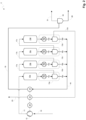
- Figure 2 shows a process 2 according to a second example of the invention, in which the synthesis of methanol takes place in a four-stage reactor arrangement.
- the reactor arrangement according to Figure 2 has four reactor stages 13a to 13d connected in series, each reactor stage being associated with a downstream phase separation device, the phase separation devices being designated accordingly with 15a to 15d.
- the product stream 14a produced in reactor stage 13a is separated in the phase separation device 15a analogously to the process according to Figure 1 with the aid of a heat exchanger and a high-pressure separator into a crude methanol partial stream 16a as a liquid phase and a residual gas partial stream 17a as a gaseous phase.
- the crude methanol partial stream 16a is combined with further crude methanol partial streams 16b, 16c and 16d, resulting in the crude methanol stream 16 (or total crude methanol stream).
- the residual gas partial stream 17a withdrawn from the separator is fed to the subsequent reactor stage 13b for further conversion of the remaining synthesis gas of the residual gas partial stream 17a in the second reactor stage 13b.
- phase separation device 15b associated with the reactor stage 13b and connected downstream, a crude methanol partial stream 16b and a residual gas partial stream 17b.
- Analogous processes take place in the subsequent reactor stages 13c and 13d, as well as the phase separation devices 15c and 15d. Due to the serial arrangement of the reactor stages 13a to 13d and the (intermediate) condensation of the raw methanol in the phase separation devices 15a to 15d, a complete or at least almost complete carbon conversion can be achieved over the entire reactor arrangement with an appropriate design and composition of the synthesis gas.
- the residual gas partial stream 17d withdrawn from the fourth phase separation device 15d therefore contains only small amounts of carbon oxides and hydrogen, and thus consists primarily of the inert gas component.
- the raw methanol stream 16 is fed to the liquid expansion device 19 for the in-process recovery of mechanical or electrical energy.
- the liquid expansion device 19 With regard to the configuration and the operative connections of the liquid expansion device 19, the gas expansion device 22, the motor 24, and the synthesis gas compression device 12, the statements apply as for Figure 1 described.
- methanol is produced on the basis of a nitrogen-rich synthesis gas stream, which contains only carbon dioxide as a carbon oxide component. Since the synthesis gas stream does not contain carbon monoxide, a low equilibrium conversion to the product is to be expected over one reactor stage, which is why a four-stage methanol synthesis with intermediate condensation of the product is chosen for this synthesis gas composition.
- the synthesis gas stream has a mass flow of 15240.1 kg/h in terms of carbon dioxide, a mass flow of 2095.5 kg/h in terms of hydrogen, and a mass flow of 294.1 kg/h.
- the synthesis gas stream is compressed from 10 bar to a pressure of 81 bar using the synthesis gas compressor.
- a crude methanol stream is obtained with a mass flow of 11258 kg/h in relation to the methanol content and a mass flow of 6111 kg/h in relation to the water content.
- the crude methanol stream also has a proportion of 328 kg/h of dissolved carbon dioxide, which was not removed in the high-pressure separators of the phase separation devices 15a to 15d.
- the residual gas stream withdrawn from the last of the serially arranged phase separation devices contains nitrogen with a mass flow of 643 kg/h, carbon dioxide with a mass flow of 573 kg/h, methanol with a mass flow of 78 kg/h, carbon monoxide with a mass flow of 23 kg/h, hydrogen with a mass flow of 85 kg/h, and water with a mass flow of 3 kg/h.
- the main components of the residual gas stream are therefore nitrogen as an inert gas component and carbon dioxide that has not been converted due to its inertness.
- the crude methanol stream is expanded from 81 bar to 2.1 bar in an expansion turbine to be fed to the subsequent distillation.
- the residual gas stream is expanded from 81 bar to 1 bar in an expander.
- the synthesis gas compressor requires 7704 kW of electrical energy. Due to the energy used in the expansion turbine within the process, this requirement can be reduced by 116.3 kW, which corresponds to an energy saving of 1.5%. These are significant savings, particularly in the case of an industrial process, which more than compensate for the additional equipment costs in the long term. At the same time, a comparison with the above example shows that the energy savings achieved are proportional to the scale of the process (comparison of pilot scale and industrial scale).
- the electrical energy requirement for the synthesis gas compressor can be reduced by an additional 53.4 kW due to the energy used by the expander within the process, which corresponds to a further energy saving of 0.7%. This results in a total saving of 2.2% in electrical energy.
- Figure 3 shows a process 3 according to a third example of the invention, in which the synthesis of methanol is carried out analogously to process 2 in a four-stage reactor arrangement.
- the residual gas partial flow 17d can still contain valuable gases, i.e. gases that can be converted to methanol, such as hydrogen, carbon monoxide and carbon dioxide. Depending on the proportion of these valuable gases, it can be worthwhile to branch off a portion of the residual gas partial flow 17d and return it to the first reactor stage of the four-stage reactor arrangement in particular using a residual gas compression device. This is done in process 3 according to Figure 3 realized.
- a partial flow 25 of the residual gas partial flow 17d is recompressed to synthesis pressure in a residual gas compression device 27, here a recycle gas compressor, and combined as compressed partial flow 26 of the residual gas partial flow 17d with the already compressed synthesis gas flow 11.
- Figure 4 shows a process 4 according to a fourth example of the invention, in which the synthesis of methanol is carried out analogously to process 2 in a four-stage reactor arrangement.
- the procedure according to Figure 4 represents an alternative to method 3 with regard to the use of valuable gases contained in the residual gas partial flow 17d.
- a part of the already depressurized residual gas partial flow 23 is branched off as partial flow 28 and combined with the not yet compressed synthesis gas flow 10.
- the compression then takes place in the synthesis gas compression device 12.
- the configuration according to Figure 4 compared to the configuration according to Figure 3
- the advantage is that no residual gas compression device 27 is required.
- the disadvantage is that the recompression of the partial flow 28 requires additional electrical energy in the synthesis gas compression device 12.
Landscapes
- Chemical & Material Sciences (AREA)
- Organic Chemistry (AREA)
- Chemical Kinetics & Catalysis (AREA)
- Organic Low-Molecular-Weight Compounds And Preparation Thereof (AREA)
Priority Applications (3)
| Application Number | Priority Date | Filing Date | Title |
|---|---|---|---|
| EP23155309.0A EP4414352A1 (fr) | 2023-02-07 | 2023-02-07 | Procédé de production de méthanol à partir de gaz de synthèse contenant une teneur élevée en composants de gaz inertes |
| CN202410054835.9A CN118459314A (zh) | 2023-02-07 | 2024-01-12 | 由包含高比例的惰性气体组分的合成气生产甲醇的方法 |
| US18/435,360 US20240262770A1 (en) | 2023-02-07 | 2024-02-07 | Process for producing methanol from synthesis gas comprising a high proportion of inert gas components |
Applications Claiming Priority (1)
| Application Number | Priority Date | Filing Date | Title |
|---|---|---|---|
| EP23155309.0A EP4414352A1 (fr) | 2023-02-07 | 2023-02-07 | Procédé de production de méthanol à partir de gaz de synthèse contenant une teneur élevée en composants de gaz inertes |
Publications (1)
| Publication Number | Publication Date |
|---|---|
| EP4414352A1 true EP4414352A1 (fr) | 2024-08-14 |
Family
ID=85199440
Family Applications (1)
| Application Number | Title | Priority Date | Filing Date |
|---|---|---|---|
| EP23155309.0A Pending EP4414352A1 (fr) | 2023-02-07 | 2023-02-07 | Procédé de production de méthanol à partir de gaz de synthèse contenant une teneur élevée en composants de gaz inertes |
Country Status (3)
| Country | Link |
|---|---|
| US (1) | US20240262770A1 (fr) |
| EP (1) | EP4414352A1 (fr) |
| CN (1) | CN118459314A (fr) |
Citations (4)
| Publication number | Priority date | Publication date | Assignee | Title |
|---|---|---|---|---|
| GB2142331A (en) * | 1983-06-29 | 1985-01-16 | Toyo Engineering Corp | A process for producing methanol |
| EP2228357A1 (fr) | 2009-03-12 | 2010-09-15 | Methanol Casale S.A. | Processus de synthèse de méthanol |
| WO2017021245A1 (fr) * | 2015-08-05 | 2017-02-09 | Siemens Aktiengesellschaft | Procédé et installation pour une synthèse chimique |
| WO2021043560A1 (fr) * | 2019-09-05 | 2021-03-11 | Thyssenkrupp Industrial Solutions Ag | Procédé de préparation d'alcools |
-
2023
- 2023-02-07 EP EP23155309.0A patent/EP4414352A1/fr active Pending
-
2024
- 2024-01-12 CN CN202410054835.9A patent/CN118459314A/zh active Pending
- 2024-02-07 US US18/435,360 patent/US20240262770A1/en active Pending
Patent Citations (4)
| Publication number | Priority date | Publication date | Assignee | Title |
|---|---|---|---|---|
| GB2142331A (en) * | 1983-06-29 | 1985-01-16 | Toyo Engineering Corp | A process for producing methanol |
| EP2228357A1 (fr) | 2009-03-12 | 2010-09-15 | Methanol Casale S.A. | Processus de synthèse de méthanol |
| WO2017021245A1 (fr) * | 2015-08-05 | 2017-02-09 | Siemens Aktiengesellschaft | Procédé et installation pour une synthèse chimique |
| WO2021043560A1 (fr) * | 2019-09-05 | 2021-03-11 | Thyssenkrupp Industrial Solutions Ag | Procédé de préparation d'alcools |
Also Published As
| Publication number | Publication date |
|---|---|
| CN118459314A (zh) | 2024-08-09 |
| US20240262770A1 (en) | 2024-08-08 |
Similar Documents
| Publication | Publication Date | Title |
|---|---|---|
| EP3205622B1 (fr) | Procede de synthese de methanol | |
| EP3390354B1 (fr) | Procédé permettant d'obtenir du dioxyde de carbone pour la synthèse de l'urée | |
| EP3491172B1 (fr) | Procédé et installaton de production de méthane | |
| EP2281793B1 (fr) | Procédé et installation destinés à la fabrication de méthanol | |
| WO2018019875A1 (fr) | Procédé et dispositif de fabrication du méthanol | |
| WO2002042209A1 (fr) | Procede multipression pour la production d'ammoniac | |
| EP2930318A1 (fr) | Procédé et installation de stockage et de récupération d'énergie | |
| EP4197994B1 (fr) | Procédé et installation de production de méthanol | |
| WO2020229261A1 (fr) | Procédé et installation de synthèse de méthanol | |
| EP3147612A1 (fr) | Procédé et installation de traitement technique de séparation d'un mélange de gaz | |
| EP3741738B1 (fr) | Procédé de fabrication de méthanol | |
| DE4210638A1 (de) | Verfahren zur gewinnung von hochreinem wasserstoff und hochreinem kohlenmonoxid | |
| WO2020239754A1 (fr) | Procédé et installation de synthèse du méthanol | |
| EP3307700A1 (fr) | Procédé et installation pour une synthèse chimique | |
| EP4414352A1 (fr) | Procédé de production de méthanol à partir de gaz de synthèse contenant une teneur élevée en composants de gaz inertes | |
| EP3816145B1 (fr) | Procédé et système de fabrication de méthanol à partir de gaz de synthèse riche en hydrogène | |
| EP3782973B1 (fr) | Procédé et installation de fabrication de méthanol | |
| EP4192804A1 (fr) | Dispositif et procédé de production de méthanol à partir de dioxyde de carbone | |
| WO2020212222A1 (fr) | Procédé et installation de synthèse du méthanol | |
| EP4725932A1 (fr) | Procédé et installation de synthèse de l'eméthanol à haute efficacité d'utilisation d'hydrogène | |
| EP3423432B1 (fr) | Synthèse intégrée de l'ammoniac et de l'urée | |
| DE102024115868A1 (de) | Verfahren und Vorrichtung zur elektrochemischen Reduktion von Kohlenstoffdioxid | |
| EP4435365A1 (fr) | Procédé et installation de séparation d'air à basse température, procédé et installation de production d'ammoniac | |
| DE3345027A1 (de) | Verfahren zur aufbereitung von synthesegasen | |
| EP4635908A1 (fr) | Procédé et installation de production d'un produit d'hydrogène à l'aide d'ammoniac |
Legal Events
| Date | Code | Title | Description |
|---|---|---|---|
| PUAI | Public reference made under article 153(3) epc to a published international application that has entered the european phase |
Free format text: ORIGINAL CODE: 0009012 |
|
| STAA | Information on the status of an ep patent application or granted ep patent |
Free format text: STATUS: THE APPLICATION HAS BEEN PUBLISHED |
|
| AK | Designated contracting states |
Kind code of ref document: A1 Designated state(s): AL AT BE BG CH CY CZ DE DK EE ES FI FR GB GR HR HU IE IS IT LI LT LU LV MC ME MK MT NL NO PL PT RO RS SE SI SK SM TR |
|
| STAA | Information on the status of an ep patent application or granted ep patent |
Free format text: STATUS: REQUEST FOR EXAMINATION WAS MADE |
|
| 17P | Request for examination filed |
Effective date: 20250214 |
|
| GRAP | Despatch of communication of intention to grant a patent |
Free format text: ORIGINAL CODE: EPIDOSNIGR1 |
|
| STAA | Information on the status of an ep patent application or granted ep patent |
Free format text: STATUS: GRANT OF PATENT IS INTENDED |
|
| INTG | Intention to grant announced |
Effective date: 20260129 |
|
| GRAS | Grant fee paid |
Free format text: ORIGINAL CODE: EPIDOSNIGR3 |
|
| GRAA | (expected) grant |
Free format text: ORIGINAL CODE: 0009210 |
|
| STAA | Information on the status of an ep patent application or granted ep patent |
Free format text: STATUS: THE PATENT HAS BEEN GRANTED |