EP4414826A1 - Procédé et système de visualisation de données graphiques et textuelles relatives à la sécurité dans les transports ferroviaires - Google Patents
Procédé et système de visualisation de données graphiques et textuelles relatives à la sécurité dans les transports ferroviaires Download PDFInfo
- Publication number
- EP4414826A1 EP4414826A1 EP23155539.2A EP23155539A EP4414826A1 EP 4414826 A1 EP4414826 A1 EP 4414826A1 EP 23155539 A EP23155539 A EP 23155539A EP 4414826 A1 EP4414826 A1 EP 4414826A1
- Authority
- EP
- European Patent Office
- Prior art keywords
- safety
- relevant
- coding
- visualization information
- data
- Prior art date
- Legal status (The legal status is an assumption and is not a legal conclusion. Google has not performed a legal analysis and makes no representation as to the accuracy of the status listed.)
- Withdrawn
Links
Images

Classifications
-
- G—PHYSICS
- G06—COMPUTING OR CALCULATING; COUNTING
- G06F—ELECTRIC DIGITAL DATA PROCESSING
- G06F3/00—Input arrangements for transferring data to be processed into a form capable of being handled by the computer; Output arrangements for transferring data from processing unit to output unit, e.g. interface arrangements
- G06F3/14—Digital output to display device ; Cooperation and interconnection of the display device with other functional units
- G06F3/147—Digital output to display device ; Cooperation and interconnection of the display device with other functional units using display panels
-
- B—PERFORMING OPERATIONS; TRANSPORTING
- B61—RAILWAYS
- B61L—GUIDING RAILWAY TRAFFIC; ENSURING THE SAFETY OF RAILWAY TRAFFIC
- B61L19/00—Arrangements for interlocking between points and signals by means of a single interlocking device, e.g. central control
- B61L19/06—Interlocking devices having electrical operation
-
- B—PERFORMING OPERATIONS; TRANSPORTING
- B61—RAILWAYS
- B61L—GUIDING RAILWAY TRAFFIC; ENSURING THE SAFETY OF RAILWAY TRAFFIC
- B61L25/00—Recording or indicating positions or identities of vehicles or trains or setting of track apparatus
- B61L25/06—Indicating or recording the setting of track apparatus, e.g. of points, of signals
- B61L25/08—Diagrammatic displays
-
- B—PERFORMING OPERATIONS; TRANSPORTING
- B61—RAILWAYS
- B61L—GUIDING RAILWAY TRAFFIC; ENSURING THE SAFETY OF RAILWAY TRAFFIC
- B61L27/00—Central railway traffic control systems; Trackside control; Communication systems specially adapted therefor
- B61L27/20—Trackside control of safe travel of vehicle or train, e.g. braking curve calculation
-
- G—PHYSICS
- G06—COMPUTING OR CALCULATING; COUNTING
- G06F—ELECTRIC DIGITAL DATA PROCESSING
- G06F11/00—Error detection; Error correction; Monitoring
- G06F11/07—Responding to the occurrence of a fault, e.g. fault tolerance
- G06F11/0796—Safety measures, i.e. ensuring safe condition in the event of error, e.g. for controlling element
-
- B—PERFORMING OPERATIONS; TRANSPORTING
- B61—RAILWAYS
- B61L—GUIDING RAILWAY TRAFFIC; ENSURING THE SAFETY OF RAILWAY TRAFFIC
- B61L19/00—Arrangements for interlocking between points and signals by means of a single interlocking device, e.g. central control
- B61L19/06—Interlocking devices having electrical operation
- B61L2019/065—Interlocking devices having electrical operation with electronic means
-
- G—PHYSICS
- G09—EDUCATION; CRYPTOGRAPHY; DISPLAY; ADVERTISING; SEALS
- G09G—ARRANGEMENTS OR CIRCUITS FOR CONTROL OF INDICATING DEVICES USING STATIC MEANS TO PRESENT VARIABLE INFORMATION
- G09G2330/00—Aspects of power supply; Aspects of display protection and defect management
- G09G2330/12—Test circuits or failure detection circuits included in a display system, as permanent part thereof
-
- G—PHYSICS
- G09—EDUCATION; CRYPTOGRAPHY; DISPLAY; ADVERTISING; SEALS
- G09G—ARRANGEMENTS OR CIRCUITS FOR CONTROL OF INDICATING DEVICES USING STATIC MEANS TO PRESENT VARIABLE INFORMATION
- G09G2358/00—Arrangements for display data security
-
- G—PHYSICS
- G09—EDUCATION; CRYPTOGRAPHY; DISPLAY; ADVERTISING; SEALS
- G09G—ARRANGEMENTS OR CIRCUITS FOR CONTROL OF INDICATING DEVICES USING STATIC MEANS TO PRESENT VARIABLE INFORMATION
- G09G2370/00—Aspects of data communication
- G09G2370/10—Use of a protocol of communication by packets in interfaces along the display data pipeline
Definitions
- the present invention relates to the visualization of safety-relevant graphic and textual data or information in a non-safety-relevant, complex hardware and software environment in the railway industry.
- This data is defined in the representation by its form (symbols and/or text content), its size, its color design and its position on the screen.
- the basic object of the present invention is to ensure that the graphic and textual data/information is either displayed correctly or, if errors occur that are very likely not to be detected in a non-safety-relevant hardware and software environment, these errors lead to a changed display of the graphic and textual data that is immediately and clearly recognizable as incorrect for a user of the visualization.
- the document EP3 040 862 discloses a method for the secure visualization of security-relevant data, the method comprising the following steps: decomposing a secure visualization of the at least one variable input parameter into its secure base elements for all its possible states; for each of the decomposed secure base elements, enumerating and storing a set of all possible states of the secure base element visualization; for each of the decomposed secure base elements, transferring the set of all possible states of the secure base element visualization to a target system that provides a secure visualization at runtime; for each of the at least one variable input parameters, entering an actual state of the at least one variable input parameter into the target system and for each of the at least one variable input parameter, determining the secure base element visualization according to the actual state of the at least one variable input parameter and its correct state from the set of possible states of the secure base element visualization; successively displaying and overlaying each of the corresponding safe basic element visualizations on a display means of the target system, thereby generating a safe visualization of the actual state of the at least one variable input parameter.
- the display combinations take effect when EP3 040 862 to secure basic elements that are created on a security-relevant computer. Furthermore, the EP3 040 862 assumes that all possible states of the secure base element visualization are transferred to a target system that provides a secure visualization at runtime. The procedure according to the EP3 040 862 therefore does not work if the visualization of information takes place on a target system that does not provide secure visualization.
- the method according to the invention for visualizing safety-relevant graphic and textual information in a non-safety-relevant hardware and software environment in the railway industry wherein the visualization of the graphic and textual information comprises its representation on a screen as visual elements which are defined by at least one of their shape, their size, their color design, their horizontal and vertical position on the screen, is characterized in that the visual elements are represented on the screen by combining at least two components of the visual elements, wherein the combination reveals a possible error in the non-safety-relevant hardware and software environment as a display error of at least one of the visual elements on the screen.
- the method according to the invention ensures that any hardware and software errors from the storage and processing of the data to the display of the data on the non-safety-relevant computer are easily visually recognizable by the user, even though both the computer and the software environment running on this computer (except for certain functions of the software application) are not safety-relevant, i.e. they are standard hardware and software.
- safety-relevant or “safety-related”, also known as “functionally safe”, means that the system is able to perform safety functions with the required safety integrity. For the exact definition of the term, see standard EN 61508-4:2010.
- the idea underlying the invention is to integrate all relevant functional units of the non-safety-relevant computer that receives the data and processes it up to the display, in particular memory, arithmetic unit, imaging units, and the relevant operating system functions and software libraries, into the process for displaying the data.
- the display In the event of an error (e.g. memory error, arithmetic command error, communication bus error or error in a software library, etc.), the display is obviously incorrect and does not correspond to the user's expectations. A trained user can therefore immediately recognize the error and initiate the appropriate measures.
- the non-safety-related hardware and software environment in the railway sector may comprise many different, undetermined or unknown hardware and software elements, which together can be regarded as a human-machine interface for visualising the graphical and textual information, but which must be regarded as non-deterministic with regard to their possible error behaviour, individually and in combination with each other, and thus represent a "black box" whose error behaviour is not sufficiently known.
- Examples of properties of the visual elements are their color channels and their transparency.
- Combining the visual elements includes combining the properties of their pixels, for example combining color channels, or combining color channels and transparency.
- the essence of the invention lies in designing the combination of the properties of the pixels of the visual elements in such a way that if any error occurs in the non-safety-relevant hardware and software environment, the representation of the graphic and textual information for the human viewer is changed in such a way that it differs from what he or she expects in optical terms at the time of viewing.
- the visual elements are defined by more than one of their shape, their size, their color design, their horizontal and vertical position on the screen, because with an increasing number of definitions, incorrect representations are easier for the user to recognize and thus the usability of the process increases.
- the safety-relevant data can be provided by at least two different safety-relevant computers, wherein the non-safety-relevant software application executes the method steps for all safety-relevant data provided in such a way that all graphical and textual information is displayed on the same screen.
- the safety-relevant data from the at least one safety-relevant computer are packaged into a data telegram for their provision, in which the first coding, the second coding and, if applicable, the further codings of the graphic and textual information are embedded and the data telegram is transmitted to the non-safety-relevant computer, preferably via a non-safety-relevant communication channel.
- the redundant codings support multi-channel processing (conversion into visualization information) in the non-safety-relevant software application. It should be noted that the software application is fundamentally not safety-relevant, but occasionally carries out safety-relevant functions, which are fundamentally supported by the special data preparation of safety-relevant computers.
- the second coding contains a representation of the graphic and textual information that is inverted to the first coding. Additional codings are possible depending on the application.
- the inverted data storage or coding supports multi-channel processing (conversion into visualization information) in the non-safety-relevant software application.
- the representations of the graphic and textual information in the first coding and the second coding or, if applicable, in the further codings have a Hamming distance of at least four.
- the suitable Hamming distance of the codings supports the use of look-up tables with very high error detection when converting into visualization information in the non-safety-relevant software application.
- the packing of the safety-relevant data into the data telegram comprises determining a first checksum of the first coding, determining a second checksum of the second coding, optionally determining further checksums of the further codings and embedding the first and the second and optionally the further checksums in the data telegram, and checking for safety integrity of the data telegram received from the non-safety-relevant computer comprises checking the first coding using the first checksum and checking the second coding using the second checksum and optionally checking the further codings using the further checksums.
- the separate checksums of the codings support that the codings are checked for safety integrity during each read access during conversion into visualization information in the non-safety-relevant software application.
- an identification of the safety-relevant computer is mapped into the checksums of the coding. This ensures the verification of the safety integrity during the conversion into visualization information in the non-safety-relevant software application as well as the assignment of the data source, i.e. the safety-relevant computer.
- the method for visualizing graphic information comprises converting the read-out first coding into first visualization information, creating a first partial image, converting the read-out second coding into second visualization information, creating a second partial image, and optionally converting the read-out further codings into further visualization information, creating further partial images, wherein combining the first visualization information and the second visualization information and optionally the further visualization information to form a combined visualization information comprises superimposing the first partial image and the second partial image and optionally the further partial images on the screen.
- a further development of this embodiment of the invention is characterized in that the creation of the partial images comprises searching for a value entry in a conversion table based on the read data in the associated coding, whereby each value entry in the conversion table comprises a graphic partial symbol, the relative screen position of the partial image and as many color values for the combination of the background colors of all partial symbols as partial symbols are used to create the combined visualization information. Only if all partial images are combined correctly does the shape (symbol), the size, the color design (the background color is combined from the different background colors of all partial images) and the horizontal and vertical position on the screen of the graphic data displayed correspond to the user's expectations, otherwise the display is obviously incorrect.
- a further embodiment of the method according to the invention for visualizing textual data is characterized in that converting the read-out first coding into first visualization information comprises creating a first field, converting the read-out second coding into second visualization information comprises Creating a second field, and optionally converting the read out further codings into further visualization information comprises creating further fields, wherein combining the first visualization information and the second visualization information and optionally the further visualization information to form combined visualization information comprises overlaying the first field and the second field and optionally the further fields on the screen.
- creating a field comprises finding a value entry in a conversion table based on the read out data in the associated coding, wherein each value entry in the conversion table comprises text, the relative screen position of the field, a background color and as many transparency values for combination with the background color of all created fields as there are fields used to create the combined visualization information. Only if all fields are combined correctly does the form (text content), the size, the color design (the transparency of the background color of fields is combined from the various transparency values of all fields and, if correctly combined, is invisible or transparent to the user) and the horizontal and vertical position on the screen of the displayed textual data correspond to the user's expectations; otherwise the display is obviously incorrect.
- the non-safety-relevant computer has a clock generator, which is preferably secured by an external time source, in order to monitor and ensure a reliable temporal validity of the information displayed on the screen.
- the invention also solves the problem by providing a system for visualizing safety-relevant graphic and textual information in a non-safety-relevant hardware and software environment in the railway industry, wherein the system comprises a non-safety-relevant computer with at least one screen, one or more safety-relevant computers and a communication channel between the non-safety-relevant computer and the at least one safety-relevant computer, wherein the non-safety-relevant computer and the safety-relevant computer are equipped with processors, program memories and data memories and are designed to process the method according to the invention, wherein the non-safety-relevant computer is preferably designed as a tablet computer.
- the non-safety-relevant computer The safety-relevant software environment of the non-safety-relevant computer may include an operating system of the computer and software libraries.
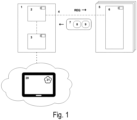
- Fig.1 shows a schematic overview of the hardware and software structure used in the invention.
- This structure comprises a non-safety-relevant computer 1 on which a software application 2 with visualization function and a non-safety-relevant software environment 3 (operating system and software libraries) are installed, with the software application 2 running in the software environment 3.
- the visualized data is displayed on a screen 20 integrated with the non-safety-relevant computer 1.
- the non-safety-relevant computer 1 can be designed, for example, as a tablet computer, laptop or smartphone.
- the safety-relevant data to be visualized is available in at least one safety-relevant computer 5 on which safety-relevant software 6 runs.
- the safety-relevant software 6 prepares the data for transmission to the non-safety-relevant computer 1 via a non-safety-relevant communication channel 4 between the safety-relevant computer 5 and the non-safety-relevant computer 1 and, upon request (REQ) from the software application 2, initiates the data transmission.
- REQ request
- Fig.2 shows a flow chart of the basic sequence of the method according to the invention for visualizing safety-relevant graphic and textual data in the software application 2.
- the processing of this data is carried out by the safety-relevant software 6 in the at least one safety-relevant computer 5, which packages the data into a data telegram 7 described in more detail below, which is transmitted to the non-safety-relevant computer 1 via the communication channel 4 and received by it.
- the data telegram 7 is created, the data is converted into a first coding 8 and a second coding 9 and both codings 8, 9 are embedded in the data telegram 7.
- the first coding 8 and the second coding 9 differ from one another, but both contain the same safety-relevant data and thus represent redundant processing of the safety-relevant graphical and textual data.
- the data telegram 7 is checked for safety integrity in a telegram parser 10, which secures the communication channel 4.
- the telegram parser 10 only allows the use of the codings 8, 9 contained in the data telegram 7 if the check has shown that a correct data telegram 7 has been received. This is in Fig.2 by means of a first and a second decision node 11, 12, which are enabled by the telegram parser 10 (or disabled in the case of an erroneous data telegram 7).
- a first algorithm 13 reads the data contained in the first coding 8 and converts it into first visualization information 15, and a second algorithm 14 reads the data contained in the second coding 9 and converts it into second visualization information 16. Since the data contained in the first and second coding 8, 9 have the same content, the first visualization information 15 and the second visualization information 16 represent different visual information of the same data. Both the first visualization information 15 and the second visualization information 16 would either not be visible to a user if they were displayed directly on the screen 20 or would be recognizable as an incorrect display. In a further step, the invention provides for the first and second visualization information 15, 16 to be combined to form a combined visualization information 17 and for this combined visualization information 17 to be displayed on the screen 20.
- the braking state of a freight car is first determined by the safety-relevant software 6, which runs on the safety-relevant computer 5.
- the safety-relevant computer 5 is mounted on the freight car.
- the braking states determined are the data to be transmitted and visualized.
- the safety-relevant software 6 creates a data telegram 7, which contains the braking states determined in different first and second codings 8, 9.
- the data telegram 7 is transmitted via a non-secure communication channel 4 to a commercially available and thus non-safety-relevant computer 1, e.g. a portable device, preferably a computer tablet.
- This non-safety-relevant computer 1 runs a standard operating system 3 (e.g.
- the received safety telegram 7 is unpacked and displayed in the following way: The measures securing the data telegram 7 are checked by the functionally secured telegram parser 10. If this check is successful, the brake status data that is redundantly present in the data telegram 7 and secured in separate codings 8, 9 is released for display without change or interpretation (decision nodes 11, 12). Both codings 8, 9 of the brake status data sets contain the same logical information in a redundant and inverted data representation. This means that every single byte of the safety-relevant data is also transmitted in its inverted form.
- the brake statuses encoded in the data telegram 7 can thus be converted into visualization information by two independent algorithms 13, 14 or two independent channels.
- the described method is applied to several freight wagons simultaneously, so that the visualization of the brake status information of several freight wagons can be shown on the same screen 20.
- the representations of the data in the first coding 8 and the second coding 9 have a Hamming distance of at least four.
- Each algorithm 13, 14 generates (selected from predefined visual elements, texts and colors) a partial representation of a braking state image as visualization information 15, 16. These partial representations (first and second visualization information 15, 16) are then superimposed on the screen 20 to form an overall image (combined visualization information 17).
- the overall image is checked by the person responsible for the braking test (user) in relation to the possible predefined expectations (shape, size, color, position of the braking images). If the overall image does not match any of the possible expectations, the person responsible for the braking test knows that an error has occurred and initiates appropriate measures. For example, he can reject the displayed result.
- any error in the non-safety-relevant hardware and software environment (computer 1 and standard operating system 3) is revealed at a high level by the visualization.
- the revealed errors include, for example, a processing error in the arithmetic unit, the memory, the bus system of the computer 1, etc., or the software application 2 or the non-safety-relevant software environment 3. All of these types of errors falsify either the original brake status data, their coding 8, 9, or the first or second visualization information 15, 16 and the resulting (directly or indirectly) combined visualization information 17.
- safety-relevant data such as the braking conditions of a freight wagon, which have been determined and processed in a suitable manner by a functionally safe execution environment (computer 5 and software 6 running on it), can be converted into visualization information 15, 16, 17 in a non-safety-relevant execution environment (computer 1 with operating system 3) - after transmission via a non-safety-relevant communication channel 4 - which leads to incorrect representations in the event of an error, so that the safety integrity of the original coded data is guaranteed until complete visualization.
- a functionally safe execution environment computer 5 and software 6 running on it
- a Fig.2 The data structure or telegram structure shown is provided, which is explained in detail below.
- packing the security-relevant data into the data telegram 7 includes converting the data into a first coding 8 and a second coding 9 and embedding both codings 8, 9 into the data telegram 7.
- creating the data telegram 7 according to the preferred telegram structure includes determining a first checksum CRC1 of the first coding 8, determining a second checksum CRC2 of the second coding 9 and embedding the first and second checksums CRC1, CRC2 into the data telegram 7.
- the telegram parser 10 can check the integrity of the received data by checking the first coding 8 using the first checksum CRC1 and the second coding 9 using the second checksum CRC2.
- the telegram structure includes a header 22 created by the security-relevant software 6, which consists of at least the unique address of the security-relevant computer 5, a protocol version, a commands, and nonce data for authenticating the communication between the non-safety-relevant computer 1 and the safety-relevant computer 5.
- a third checksum CRC3 is generated for the header 22, which is used when checking the received data telegram 7 by the telegram parser 10.
- a fourth checksum CRC4 is generated for the entire content of the data telegram 7 and embedded in the data telegram 7, which is used when checking the received data telegram 7 by the telegram parser 10.
- checksums can be determined by cyclic redundancy check (CRC) with defined generator polynomial, start value and byte order.
- CRC cyclic redundancy check
- the unique address of the safety-relevant computer 5 is preferably also included in the checksum of the coded data CRC1, CRC2, so that the verification of the data integrity of coded data also ensures the verification of the correct assignment of the data to a wagon during the processing of the data on the non-safety-relevant computer 1.
- the graphic symbol to be displayed consists of two sub-symbols.
- each algorithm 13, 14 selects one of the two sub-symbols including its relative screen position based on the codes 8, 9 of the brake status information and visualizes it accordingly on screen 20.
- This conversion table also contains two color values, one for the background of each sub-symbol. These color values are added by each algorithm 13, 14 to the background of the sub-symbols. (I.e. each algorithm 13, 14 also adds a background color to the sub-symbol of the other channel The selected partial symbol and the background color pair together make up the visualization information 15, 16 of the respective channel.
- the correct overall image is obtained - in an error-free case - based on the combined visualization information 17. An error that has occurred can be clearly recognized in the overall image.
- the text to be displayed consists of two visual fields that lie on top of each other.
- Each of the two algorithms 13, 14 (channels) writes the text into one of the two fields.
- a clearly recognizable (and identical) color is selected as the background color by both channels.
- the new transparency value determined in this way is less than 49, it is set to 49. This serves to clearly display the error determined in this way.
- this method produces the correct text on the screen 20, which simply appears to be present to the viewing user (i.e. the superimposition of the identical texts is complete), and the background of the text is transparent (there are no color differences from the surrounding background). In the case of an error, this can be clearly recognized from the representation on the screen 20 (e.g. two different texts are written on top of each other or the background of the text differs in color from the surroundings).
Landscapes
- Engineering & Computer Science (AREA)
- Theoretical Computer Science (AREA)
- Mechanical Engineering (AREA)
- Physics & Mathematics (AREA)
- General Engineering & Computer Science (AREA)
- General Physics & Mathematics (AREA)
- Quality & Reliability (AREA)
- Human Computer Interaction (AREA)
- Train Traffic Observation, Control, And Security (AREA)
Priority Applications (2)
| Application Number | Priority Date | Filing Date | Title |
|---|---|---|---|
| EP23155539.2A EP4414826A1 (fr) | 2023-02-08 | 2023-02-08 | Procédé et système de visualisation de données graphiques et textuelles relatives à la sécurité dans les transports ferroviaires |
| PCT/EP2024/053092 WO2024165639A1 (fr) | 2023-02-08 | 2024-02-07 | Procédé et système de visualisation de données graphiques et textuelles pertinentes pour la sécurité pour voies ferrées |
Applications Claiming Priority (1)
| Application Number | Priority Date | Filing Date | Title |
|---|---|---|---|
| EP23155539.2A EP4414826A1 (fr) | 2023-02-08 | 2023-02-08 | Procédé et système de visualisation de données graphiques et textuelles relatives à la sécurité dans les transports ferroviaires |
Publications (1)
| Publication Number | Publication Date |
|---|---|
| EP4414826A1 true EP4414826A1 (fr) | 2024-08-14 |
Family
ID=85222185
Family Applications (1)
| Application Number | Title | Priority Date | Filing Date |
|---|---|---|---|
| EP23155539.2A Withdrawn EP4414826A1 (fr) | 2023-02-08 | 2023-02-08 | Procédé et système de visualisation de données graphiques et textuelles relatives à la sécurité dans les transports ferroviaires |
Country Status (2)
| Country | Link |
|---|---|
| EP (1) | EP4414826A1 (fr) |
| WO (1) | WO2024165639A1 (fr) |
Citations (4)
| Publication number | Priority date | Publication date | Assignee | Title |
|---|---|---|---|---|
| US5805134A (en) * | 1992-06-23 | 1998-09-08 | Hitachi, Ltd. | Method and apparatus of detecting and displaying abnormal conditions utilizing a display control apparatus |
| US20050010762A1 (en) * | 2003-04-17 | 2005-01-13 | Phoenix Contact Gmbh & Co. Kg | Process and device for the packet-oriented transmission of security-relevant data |
| EP3040862A1 (fr) | 2014-12-30 | 2016-07-06 | Matthias Auchmann | Procédé et system pour l'affichage sécurisé des données relatives à la sécurité |
| EP3746877B1 (fr) * | 2018-01-31 | 2022-11-09 | KONCAR - KET d.o.o. | Procédé et dispositif d'affichage de signaux d'unité de sécurité avec des informations concernant la fiabilité de signaux affichés |
-
2023
- 2023-02-08 EP EP23155539.2A patent/EP4414826A1/fr not_active Withdrawn
-
2024
- 2024-02-07 WO PCT/EP2024/053092 patent/WO2024165639A1/fr not_active Ceased
Patent Citations (4)
| Publication number | Priority date | Publication date | Assignee | Title |
|---|---|---|---|---|
| US5805134A (en) * | 1992-06-23 | 1998-09-08 | Hitachi, Ltd. | Method and apparatus of detecting and displaying abnormal conditions utilizing a display control apparatus |
| US20050010762A1 (en) * | 2003-04-17 | 2005-01-13 | Phoenix Contact Gmbh & Co. Kg | Process and device for the packet-oriented transmission of security-relevant data |
| EP3040862A1 (fr) | 2014-12-30 | 2016-07-06 | Matthias Auchmann | Procédé et system pour l'affichage sécurisé des données relatives à la sécurité |
| EP3746877B1 (fr) * | 2018-01-31 | 2022-11-09 | KONCAR - KET d.o.o. | Procédé et dispositif d'affichage de signaux d'unité de sécurité avec des informations concernant la fiabilité de signaux affichés |
Also Published As
| Publication number | Publication date |
|---|---|
| WO2024165639A1 (fr) | 2024-08-15 |
Similar Documents
| Publication | Publication Date | Title |
|---|---|---|
| EP2273369B1 (fr) | Procédé de représentation d'une information relative à la sécurité sur un dispositif d'affichage et dispositif d'exécution du procédé | |
| EP3475824B1 (fr) | Procédé et dispositif de traitement de données redondant | |
| DE2430464A1 (de) | Einrichtung zur fehlergesicherten datenuebertragung | |
| DE102016206630A1 (de) | Verfahren und Vorrichtung zur Vermeidung von Manipulation einer Datenübertragung | |
| EP1043640A2 (fr) | Système d'automatisation à sécurité intrinsèque avec un processeur standard et méthode pour un système d'automatisation à sécurité intrinsèque | |
| DE102012207439A1 (de) | Verfahren zur Darstellung sicherheitskritischer Daten durch eine Anzeigeneinheit; Anzeigeneinheit | |
| EP0856792A2 (fr) | Méthode pour l'affichage sûr d'un image sur un ecran | |
| EP1246033A1 (fr) | Procédé pour surveiller les contenus de mémoire identiques dans un système redondant | |
| DE102004039932A1 (de) | Verfahren und Vorrichtung zur Busankopplung sicherheitsrelevanter Prozesse | |
| DE4005393A1 (de) | Einrichtung zur signaltechnisch sicheren darstellung eines meldebildes | |
| AT402909B (de) | Verfahren zur gewährleistung der signaltechnischen sicherheit der benutzeroberfläche einer datenverarbeitungsanlage | |
| EP2405317B1 (fr) | Procédé de paramétrage assuré sûr d'un appareil | |
| EP3074293B1 (fr) | Procédé de révélation d'erreur dans un système calculateur de poste d'aiguillage et système de calcul de poste d'aiguillage | |
| EP4414826A1 (fr) | Procédé et système de visualisation de données graphiques et textuelles relatives à la sécurité dans les transports ferroviaires | |
| DE102010028485B4 (de) | Verfahren und Vorrichtung zur Absicherung von über eine Schnittstelle zu übertragenden Datenpaketen | |
| DE102008021241B4 (de) | Messwert-Anzeige, insbesondere im Führerstand eines Schienenfahrzeugs | |
| EP1596517B1 (fr) | Procédé de transmission sur un seul canal de données fournies sous forme redondante | |
| DE102012208481B4 (de) | Verfahren und Vorrichtung zum Betreiben eines Computersystems | |
| DE10340236B4 (de) | Anordnung mit einer Datenverarbeitungseinrichtung und einem Speicher | |
| DE4125812C2 (de) | Verfahren zur signaltechnisch sicheren Datenübertragung | |
| EP1738262B1 (fr) | Procede et systeme de commande pour reconnaitre une erreur lors du traitement de donnees dans un systeme de traitement | |
| DE10347381B4 (de) | Verfahren und Vorrichtung zur fehlerabgesicherten Übertragung von Nutzdaten | |
| EP3748620A1 (fr) | Système d'affichage et procédé d'affichage d'une sortie d'un appareil électromédical | |
| EP4432273A1 (fr) | Procédé de fonctionnement assisté par ordinateur d'un affichage optique sécurisé | |
| EP3949192A1 (fr) | Système de transmission de données pour véhicule utilitaire et procédé associé |
Legal Events
| Date | Code | Title | Description |
|---|---|---|---|
| PUAI | Public reference made under article 153(3) epc to a published international application that has entered the european phase |
Free format text: ORIGINAL CODE: 0009012 |
|
| STAA | Information on the status of an ep patent application or granted ep patent |
Free format text: STATUS: THE APPLICATION HAS BEEN PUBLISHED |
|
| AK | Designated contracting states |
Kind code of ref document: A1 Designated state(s): AL AT BE BG CH CY CZ DE DK EE ES FI FR GB GR HR HU IE IS IT LI LT LU LV MC ME MK MT NL NO PL PT RO RS SE SI SK SM TR |
|
| STAA | Information on the status of an ep patent application or granted ep patent |
Free format text: STATUS: THE APPLICATION IS DEEMED TO BE WITHDRAWN |
|
| 18D | Application deemed to be withdrawn |
Effective date: 20250215 |