EP4415202A1 - Procédé mis en uvre par ordinateur, agencement d'analyse de réseau et produit de programme informatique - Google Patents
Procédé mis en uvre par ordinateur, agencement d'analyse de réseau et produit de programme informatique Download PDFInfo
- Publication number
- EP4415202A1 EP4415202A1 EP23156105.1A EP23156105A EP4415202A1 EP 4415202 A1 EP4415202 A1 EP 4415202A1 EP 23156105 A EP23156105 A EP 23156105A EP 4415202 A1 EP4415202 A1 EP 4415202A1
- Authority
- EP
- European Patent Office
- Prior art keywords
- network
- energy
- electrical
- distribution
- data set
- Prior art date
- Legal status (The legal status is an assumption and is not a legal conclusion. Google has not performed a legal analysis and makes no representation as to the accuracy of the status listed.)
- Pending
Links
Images

Classifications
-
- H—ELECTRICITY
- H02—GENERATION; CONVERSION OR DISTRIBUTION OF ELECTRIC POWER
- H02J—ELECTRIC POWER NETWORKS; CIRCUIT ARRANGEMENTS OR SYSTEMS FOR SUPPLYING OR DISTRIBUTING ELECTRIC POWER; SYSTEMS FOR STORING ELECTRIC ENERGY
- H02J3/00—Circuit arrangements for AC mains or AC distribution networks
- H02J3/38—Arrangements for feeding a single network from two or more generators or sources in parallel; Arrangements for feeding already energised networks from additional generators or sources in parallel
-
- H—ELECTRICITY
- H02—GENERATION; CONVERSION OR DISTRIBUTION OF ELECTRIC POWER
- H02J—ELECTRIC POWER NETWORKS; CIRCUIT ARRANGEMENTS OR SYSTEMS FOR SUPPLYING OR DISTRIBUTING ELECTRIC POWER; SYSTEMS FOR STORING ELECTRIC ENERGY
- H02J3/00—Circuit arrangements for AC mains or AC distribution networks
- H02J3/001—Arrangements for handling faults or abnormalities, e.g. emergencies or contingencies
-
- H—ELECTRICITY
- H02—GENERATION; CONVERSION OR DISTRIBUTION OF ELECTRIC POWER
- H02J—ELECTRIC POWER NETWORKS; CIRCUIT ARRANGEMENTS OR SYSTEMS FOR SUPPLYING OR DISTRIBUTING ELECTRIC POWER; SYSTEMS FOR STORING ELECTRIC ENERGY
- H02J13/00—Circuit arrangements for providing remote monitoring or remote control of equipment in a power distribution network
- H02J13/16—Circuit arrangements for providing remote monitoring or remote control of equipment in a power distribution network the power network being controlled at grid-level, e.g. using aggregators
-
- H—ELECTRICITY
- H02—GENERATION; CONVERSION OR DISTRIBUTION OF ELECTRIC POWER
- H02J—ELECTRIC POWER NETWORKS; CIRCUIT ARRANGEMENTS OR SYSTEMS FOR SUPPLYING OR DISTRIBUTING ELECTRIC POWER; SYSTEMS FOR STORING ELECTRIC ENERGY
- H02J3/00—Circuit arrangements for AC mains or AC distribution networks
- H02J3/38—Arrangements for feeding a single network from two or more generators or sources in parallel; Arrangements for feeding already energised networks from additional generators or sources in parallel
- H02J3/381—Dispersed generators
-
- H—ELECTRICITY
- H02—GENERATION; CONVERSION OR DISTRIBUTION OF ELECTRIC POWER
- H02J—ELECTRIC POWER NETWORKS; CIRCUIT ARRANGEMENTS OR SYSTEMS FOR SUPPLYING OR DISTRIBUTING ELECTRIC POWER; SYSTEMS FOR STORING ELECTRIC ENERGY
- H02J2103/00—Details of circuit arrangements for mains or AC distribution networks
- H02J2103/30—Simulating, planning, modelling, reliability check or computer assisted design [CAD] of electric power networks
- H02J2103/35—Grid-level management of power transmission or distribution systems, e.g. load flow analysis or active network management
Definitions
- the present invention relates to a computer-implemented method according to the preamble of claim 1, a network analysis arrangement according to the preamble of claim 8 and a computer program product according to claim 15.
- Energy networks for electrical energy must be managed using a network control system, usually located in a network control center. Due to the increasing use of renewable energies such as wind turbines or photovoltaic systems, electrical energy networks must become increasingly flexible, easier to maintain and/or expand. Furthermore, operations should be optimized, for example by working closer to permissible limit conditions for operating resources. The network should be controlled in such a way that transmission losses and bottlenecks or emergency measures are minimized.
- the first generation of network control system software for the network control center was developed in the 1970s. It uses server computers specially configured for this application, which were installed in the computer room of the network operator's control center.
- the server computers were typically redundant in order to ensure that the network control system functionality was available more than 99.999% of the time. Even today, the redundant server computers are sometimes installed in different locations to make the overall system even more resilient and to withstand disasters such as earthquake or fire in one location nor to ensure control center functionality through the server computers at the other location.
- SCADA Supervisory Control and Data Acquisition
- RTUs Remote Terminal Units
- PLCs programmable logic controllers
- IEDs intelligent electronic devices
- the control center has often had a local data center on which the control center software such as Spectrum Power runs.
- the control center software is usually operated in a central computer arrangement, which can be designed as a data center with processors, data storage and screens, for example.
- central refers to the fact that all measurement data from the energy network and all control commands for the energy network are processed centrally. Technicians are kept on standby in the control center around the clock to check the SCADA displays for the current operating status of the energy network and to take countermeasures in the event of a fault, such as shutting down a section of the network.
- the computer system or the control center software can also be partially or completely implemented as a cloud application, i.e. a server system with decentrally distributed resources for data processing and data storage that are connected via a data network such as the Internet.
- a cloud application i.e. a server system with decentrally distributed resources for data processing and data storage that are connected via a data network such as the Internet.
- DSPF distributed System Power Flow
- the operating personnel in a control center for an electrical power network require software for evaluating measurement data so that a network status can be determined by means of a network analysis, for example.
- measurement data such as voltage, current, active power, reactive power and, if applicable, phase angle can usually be recorded for a large number of measuring points.
- the measurement data is often even available redundantly, so that a high level of accuracy and reliability of the measurement data is achieved.
- this provides operators of network control centres with various options for managing networks the distribution level and the transport or transmission level for a condition estimation.
- TNA or DNA can be used to monitor the distribution network or the transmission network individually.
- a network analysis of an electrical power network typically begins with a state estimation, on the basis of which power flows are calculated.
- other aspects such as optimal power flows, fault detection (actual or potential limit violations of electrical quantities) and countermeasures, fault location, etc. can be calculated.
- the object of the invention is to provide a computer-implemented method that enables a state estimation with improved accuracy even in the event of a dynamic change in the network topology in the electrical energy network.
- the invention solves this problem by a method according to claim 1.
- a key advantage of the invention is that, unlike before, only a static separation of distribution network and transmission network or transport network can be processed for a joint state estimate of the energy network, but also changes that occur during operation, i.e. dynamic changes, in the topology can be considered.
- the topology of the energy network changes dynamically when two low-voltage distribution networks (e.g. in Austria a maximum of 400V) are connected to form a single distribution network by closing a switch between two radial branches of the respective distribution networks.
- the network analysis arrangement can now be used to determine a network division into distribution and transmission networks for the entire system before the state estimate, which increases the accuracy of the state estimate.
- an energy transmission network and one or more energy distribution networks are determined using the method according to the invention, and transfer points between the energy networks are determined.
- the same principle of dynamically dividing the entire energy network into voltage levels can also be used to advantage for a more detailed network analysis to determine optimal power flows and/or fault detection and/or fault location.
- Only one uniform data model needs to be used for the transmission network and the distribution network, which reduces development costs and update requirements.
- the uniform data model can be based on the international CIM standard IEC 61970-301, for example.
- the standard can be extended to the extent that abstract classes are combined, exotic classes that are not relevant to the network analysis according to the invention are omitted, and types for dynamic results are added.
- the uniform data processing according to the invention improves the observability of the network and, as a result, also the network management and forecasts for the network. This means that fewer emergency measures are necessary.
- a network state of the higher-level energy transmission network can first be determined using software for "transmission system state estimation” (TSSE).
- TSSE transmission system state estimation
- This network state of the energy transmission network can be used as an input in the form of so-called “pseudo-measurement values” for a “distribution system state estimation” (DSSE) in order to also determine the network state of the lower-level energy distribution networks.
- DSSE distributed system state estimation
- a further advantage of the invention in this case is that a converged network state can be determined for the transmission network independently.
- a computer-implemented method in the sense of the invention is a sequence of steps that are implemented in software or application-specific hardware and can be processed automatically or partially automatically by a computer. If the steps are implemented in software, they form a computer program product in compiled (i.e. machine-executable) form.
- the computer program product can be executed on a computer, for example a computer with a processor, a graphics card, input means for data and commands and a display device such as a monitor and a data storage device such as a hard disk (SSD, HDD).
- SSD hard disk
- the term arrangement or network analysis arrangement in this context refers to one or more computers that are designed to execute the computer program product.
- the network analysis arrangement can be a system of computers in a network control center - this is where state estimates of the energy networks to be controlled are typically required.
- it can be a cloud facility in whole or in part, where the software is used in one or more data centers with a variety of data storage and data processing resources that are connected via a data communication network such as the Internet.
- Software can be executed in modules as a so-called cloud application wherever sufficient data processing and/or data storage resources are available. This ensures high scalability and availability.
- the network analysis arrangement is designed in accordance with the invention to operate a control center software with which measurement data and switching states of the energy network are received, processed further and control commands derived from this are sent for controllable equipment such as switchgear, tap switches of transformers, network controllers, controllable electrical energy consumers, controllable electrical energy producers, capacitor banks, etc.
- controllable equipment such as switchgear, tap switches of transformers, network controllers, controllable electrical energy consumers, controllable electrical energy producers, capacitor banks, etc.
- control commands are created to avoid disruptions in the energy network and increase availability.
- the aspect of controlling the energy network can also be taken over by a separate control arrangement, i.e. a classic network control system, in conjunction with the network analysis arrangement.
- Devices within the meaning of the invention are components of the above-mentioned arrangement that are designed in software or hardware and can each carry out one or more steps. These can be, for example, individual computers or servers, each of which has comparable data storage and data processing resources as explained above for the cloud infrastructure.
- An energy network comprises, for example, an electrical energy supply network of the low voltage level, which has a Nominal voltage of e.g. maximum 400V and a medium voltage network with e.g. maximum 20 kV nominal voltage. This can be considered as an energy distribution network in the sense of the invention.
- low-voltage networks or medium-voltage networks these are also referred to as distribution network subnetworks.
- the energy supply network of the low-voltage level is connected to the medium-voltage network via a transformer, for example, which in turn is connected to a high-voltage network for energy transmission with a nominal voltage of over 20 kV.
- High-voltage networks are referred to as energy transmission networks in the sense of the invention, although there can be several transmission subnetworks. Meshed, fully observable network areas are referred to as energy transmission networks in the sense of the invention. This usually applies to high-voltage networks and sometimes also to parts of the medium-voltage network.
- a network analysis of an electrical power network includes a status assessment so that the stability of the power network and the occurrence of faults can be monitored.
- a fault is, for example, a violation of permissible voltage limits (e.g. more than +/- 10% of the intended nominal voltage).
- permissible voltage limits e.g. more than +/- 10% of the intended nominal voltage.
- a deviation from the intended network frequency usually 50 Hz can also represent a fault.
- current limits or power limits can also be violated.
- the network allocation data set is designed, for example, as a file or database in which an assignment of lines and/or operating resources to the at least one energy transmission network and the at least one energy distribution network is stored.
- a topology data set of the electrical energy network provides information on the structure and interconnection of the entire energy network. This may include, for example, information on the interconnection of lines, generators, consumers, transformers, network controllers, protective devices, switching devices, measuring devices for voltage, current and phase angle. Measured values at the measuring points of the measuring devices may also be included, eg voltage, current and phase angle.
- the network state provides at least one of the following pieces of information about the energy network: state estimation, power flows, optimized power flows, analysis of faults and countermeasures, detection of fault locations in the energy network.
- the topology data set describes the electrical energy network using edges as electrical lines and nodes as generators and/or loads. This is a particularly simple description of a topology, since the connections between the components are highlighted as an essential factor. Furthermore, transformers and/or shunts can also be described in the topology data set.
- the network distribution device is used to determine the Topology data set network areas in the energy network are identified in such a way that for each network area, lines and/or loads and/or generators whose nominal voltage is below a predetermined threshold for the nominal voltage are assigned to a provisional energy distribution network, and lines and/or loads and/or generators whose nominal voltage is above the predetermined threshold for the nominal voltage are assigned to a provisional energy transmission network.
- This is an advantage because a simple provisional assignment to the different voltage levels can be made.
- the provisional energy transmission network is then either assigned to the energy transmission network or a new energy distribution network is created in the dataset.
- a maximum voltage of 20 kV can be used as a predetermined threshold.
- a level of observability can be selected as a further criterion for dividing up the energy network.
- the part of the network that is typically designed for a transmission network i.e. has a higher voltage level, a meshed structure and full observability with measuring devices for current, voltage and/or phase angle, is identified as an energy transmission network.
- an energy transmission network typically there is one energy transmission network per electrical network area, although there is usually only one electrical network area and therefore only one energy transmission network.
- Network areas are electrically connected.
- electrical islands are not electrically connected. This means that the electrical subnetworks or network areas are recognized within the electrical islands.
- the parts of the network that have typical distribution network characteristics such as medium and low voltage levels, partial non-observability, radial structure or presence of Power metering data and other various input data (pseudo-measurements, historical data, load/generation curve data) are identified as distribution subsystems (usually there are several distribution subsystems in power distribution network). Optimized algorithms can be used for each of these two characteristic subsystem types. Therefore, a transmission system state estimator is used for transmission subsystems and a distribution system state estimator is used for distribution subsystems.
- the provisional energy distribution network is verified as an energy distribution network using at least one evaluation criterion, wherein the at least one evaluation criterion comprises at least one of the following evaluation criteria: number of busbars, number of loads, number of sequential branches, minimum electrical resistance of branches in the provisional energy distribution network, number of radial branches, nominal electrical voltage, number of existing measurements.
- Radial branches in the sense of the invention refer to sequentially connected branches. This is an advantage because the provisional assignment to the various voltage levels can be confirmed using evaluation criteria.
- a threshold value for the number of busbars in the power distribution network can be set to 5.
- the minimum number of loads can be 1.
- the minimum electrical resistance of branches in the preliminary power distribution network can be set to 0.5 ⁇ .
- a minimum number of sequential branches can be set to 3.
- a minimum number of measurements present can include, for example, a current measurement or a combination of an active power and a reactive power measurement.
- the voltage for the basic separation is relatively low in the example at 20 kV. This can vary for other networks and can be up to 52 kV, for example.
- the respective algorithms are optimized for the respective subsystem type.
- the adapted distribution also has the advantage that if the DSSE does not converge for some distribution subsystems, this will affect the convergence the transmission subsystem or other distribution subsystems, since they are calculated independently.
- An alternative workflow can be used to synchronize the computation of the transmission and distribution subsystem.
- the result of the network provider is transmission and distribution subsystems and transfer points that connect them.
- the TSSE uses a Newton-Raphson algorithm to calculate the complex stresses in the subsystem. To do this, a system of equations is created where each equation represents the measurement and its effect on the stresses in the subsystem.
- the TSSE uses weighting factors to increase or decrease the impact of the measurements. These weights are determined using standard deviation values that describe how accurate the measurement is.
- the TSSE uses a Newton-Raphson algorithm with a node voltage state variable (vector) to solve a minimum quadratic optimization problem.
- a TSSE or a DSSE may also be used within the scope of the present invention and may be used to advantage with the described network partitioning algorithm.
- the algorithm for estimating the distribution system is formulated analogously to the procedure for the TSSE.
- the problem is also formulated as a least-mean-square optimization problem and solved with a Newton-Raphson algorithm solved.
- branch currents are used as state variables.
- pseudo-measurements e.g. for loads
- load values are scaled from historical data and/or load curves. In the algorithm, these pseudo-measurements are less trusted than real SCADA measurements from the field (higher sigma).
- the calculation of high-voltage transmission networks and medium-voltage distribution networks described at the beginning can be transferred to the low-voltage area.
- the network division method described it can be determined which parts of the overall network are low-voltage networks. These can then be treated with a method for estimating the state of low-voltage networks, whereby deterministic methods, probability-based methods or artificial intelligence can be used.
- the principle of dividing the entire network into several voltage levels or sub-networks can also be applied in such a way that algorithms optimized for the respective voltage level are used to calculate power flow. For example, a branch current can be calculated in the distribution network because this algorithm can evaluate long radial structures.
- the divided overall network can be analyzed with regard to one of the following aspects: optimized power flow, fault analysis, fault location detection, optimized redispatch.
- At least one technical boundary condition is taken into account for the detection of electrical network areas, wherein the technical boundary condition comprises at least one of the following boundary conditions: minimum number of edges, at least one generator and at least one load.
- the The network status is updated within a specified time period, with the network division data set being updated beforehand.
- the specified time period is, for example, one hour, and the update can be carried out several times within the hour.
- the update preferably takes place at least every 10 minutes.
- the invention also has the object of specifying an arrangement with which a state estimation with improved accuracy is possible even in the event of a dynamic change in the network topology in the electrical energy network.
- the invention further aims to provide a computer program product with which a state estimation with improved accuracy is possible even in the event of a dynamic change in the network topology in the electrical energy network.
- the invention solves this problem by a computer program product according to claim 15.
- the same advantages arise as explained at the beginning for the computer-implemented method according to the invention.
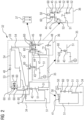
- the Figure 1 shows a first embodiment of an electrical energy network 1.
- Figure 1 shows three outgoing lines (transformers) from the medium-voltage network to the low-voltage network.
- the figure illustrates the possible aggregation of the low-voltage data for use in the distribution network condition estimation.
- Medium-voltage lines 2, 3 are connected to a medium-voltage network 4 with a nominal voltage of 10 kV to 30 kV.
- a complete network is not shown because there are no high-voltage lines.
- the radial feeders in the medium voltage go from one station to the next (lines 2, 3 are connected to the next station). As an example, such a station with its outgoing lines to the low voltage is shown in more detail.
- the medium-voltage network 4 has several outgoing points 7, 8, 9.
- a load can be measured at outgoing point 7.
- a fictitious load is assumed at outgoing point 8.
- a photovoltaic system 15, a wind power system 16, a hydropower system 17 and a load 18 are connected to the low-voltage network 10.
- a photovoltaic system 19 a wind power system 20, a hydropower system 21 and a load 22 is connected.
- a low-voltage network 12 is connected to another outlet 13, to which a photovoltaic system 23, a wind turbine 24, a hydroelectric plant 25 and a load 26 as well as other unspecified generators or consumers 27 are connected.
- bottleneck power or reference measurements 28, 29, 30, 31 are taken into account.
- the Figure 2 shows an embodiment of an energy network 32 divided according to the invention.
- An energy transmission network 53 of the high-voltage level with a nominal voltage of 220 kV to 400 kV is connected via transformers 40, 55 to a high-voltage network 54 with a nominal voltage of 110 kV. Measuring devices are each identified by the reference number 60.
- the high-voltage network 53 can be connected to another high-voltage network at the connection point 56, which would require a calculation using state estimators optimized for transmission networks. However, if the connection point 56 is switched to a lower voltage level, this part would have to be added to a distribution network in the further course.
- the proposed algorithm divides the existing energy network 32 into sub-networks.
- a transmission network 33 is isolated from the high-voltage networks 53, 54. This can be fed into a state estimation using suitable transmission network algorithms.
- the transmission network 33 is connected to a series of medium-voltage networks 51 via transformers 41, 42, 43, 44, 45. These medium-voltage networks are operated at 35 kV or 10 kV, for example. Taking into account the topology or open switch positions, it is possible according to the invention to divide the existing medium-voltage network 51 into several subnetworks 34, 35, 36 and to calculate these separately. For example, the distribution network subsystem 34 is calculated separately, so that at the feed-in points 50 or the contact points to the higher-level transmission network 33 equivalent feed-ins can be transmitted for the state estimator used at the transmission network level.
- the distribution network subsystem 35 is treated in the same way.
- a low-voltage network 52 is connected below the medium-voltage level 51 via the transformers 46, 47, 48. This has a nominal voltage of 0.4 kV, for example.
- the basic idea behind this network separation is to separately estimate the status of the sub-networks and use the results as equivalent feeds at the respective transformer.
- the network below a transformer i.e. in the lower voltage level, is considered a single sub-network if two transformers are connected at one point further along the network topology. This can be done, for example, via a common busbar or via another connection at the low-voltage level or the medium-voltage level.
Landscapes
- Engineering & Computer Science (AREA)
- Power Engineering (AREA)
- Remote Monitoring And Control Of Power-Distribution Networks (AREA)
Priority Applications (2)
| Application Number | Priority Date | Filing Date | Title |
|---|---|---|---|
| EP23156105.1A EP4415202A1 (fr) | 2023-02-10 | 2023-02-10 | Procédé mis en uvre par ordinateur, agencement d'analyse de réseau et produit de programme informatique |
| US18/439,218 US20240275166A1 (en) | 2023-02-10 | 2024-02-12 | Computer-implemented method, network analysis arrangement, and computer program product |
Applications Claiming Priority (1)
| Application Number | Priority Date | Filing Date | Title |
|---|---|---|---|
| EP23156105.1A EP4415202A1 (fr) | 2023-02-10 | 2023-02-10 | Procédé mis en uvre par ordinateur, agencement d'analyse de réseau et produit de programme informatique |
Publications (1)
| Publication Number | Publication Date |
|---|---|
| EP4415202A1 true EP4415202A1 (fr) | 2024-08-14 |
Family
ID=85225192
Family Applications (1)
| Application Number | Title | Priority Date | Filing Date |
|---|---|---|---|
| EP23156105.1A Pending EP4415202A1 (fr) | 2023-02-10 | 2023-02-10 | Procédé mis en uvre par ordinateur, agencement d'analyse de réseau et produit de programme informatique |
Country Status (2)
| Country | Link |
|---|---|
| US (1) | US20240275166A1 (fr) |
| EP (1) | EP4415202A1 (fr) |
Citations (1)
| Publication number | Priority date | Publication date | Assignee | Title |
|---|---|---|---|---|
| CN100505474C (zh) * | 1999-01-29 | 2009-06-24 | 美国超导体公司 | 电压恢复装置、公用电力网及其稳定方法、以及控制系统 |
Family Cites Families (4)
| Publication number | Priority date | Publication date | Assignee | Title |
|---|---|---|---|---|
| CN103155331A (zh) * | 2010-10-14 | 2013-06-12 | 西门子公司 | 用于产生状态信号的方法和装置 |
| DE102015210884A1 (de) * | 2015-06-15 | 2016-12-15 | Siemens Aktiengesellschaft | Netzregelung bei Grenzwertüberschreitungen in einem Nieder- oder Mittelspannungsnetz |
| EP4120508A1 (fr) * | 2021-07-15 | 2023-01-18 | Siemens Aktiengesellschaft | Procédé et agencement informatique centrale destinés à la prévision d'un état de réseau, ainsi que produit-programme informatique |
| US20230327438A1 (en) * | 2022-04-11 | 2023-10-12 | General Electric Company | Scalable state estimation for power distribution grid |
-
2023
- 2023-02-10 EP EP23156105.1A patent/EP4415202A1/fr active Pending
-
2024
- 2024-02-12 US US18/439,218 patent/US20240275166A1/en active Pending
Patent Citations (1)
| Publication number | Priority date | Publication date | Assignee | Title |
|---|---|---|---|---|
| CN100505474C (zh) * | 1999-01-29 | 2009-06-24 | 美国超导体公司 | 电压恢复装置、公用电力网及其稳定方法、以及控制系统 |
Non-Patent Citations (11)
| Title |
|---|
| LIU YIKUI ET AL: "D-PMU based applications for emerging active distribution systems: A review", ELECTRIC POWER SYSTEMS RESEARCH, ELSEVIER, AMSTERDAM, NL, vol. 179, 11 November 2019 (2019-11-11), XP085943420, ISSN: 0378-7796, [retrieved on 20191111], DOI: 10.1016/J.EPSR.2019.106063 * |
| MUSCAS ET AL.: "An efficient method to include equality constraints in branch current distribution system state estimation", EURASIP JOURNAL ON ADVANCES IN SIGNAL PROCESSING, 2015 |
| PRIMADIANTO ANGGORO ET AL: "A Review on Distribution System State Estimation", IEEE TRANSACTIONS ON POWER SYSTEMS, IEEE, USA, vol. 32, no. 5, 1 September 2017 (2017-09-01), pages 3875 - 3883, XP011659115, ISSN: 0885-8950, [retrieved on 20170817], DOI: 10.1109/TPWRS.2016.2632156 * |
| SIEMENS AG, DIGITAL SUBSTATIONS WITH THE FUTURE BUILT IN, no. 5, 2017 |
| SIEMENS AG, SPECTRUM POWER 7 V2.30 SP2 DISTRIBUTION NETWORK APPLICATIONS APPLICATION SHEET, July 2021 (2021-07-01) |
| SIEMENS AG, SPECTRUM POWER 7 V2.30 SP2 TRANSMISSION NETWORK APPLICATIONS APPLICATION SHEET, July 2021 (2021-07-01) |
| SIEMENS AG: "Spectrum Power Aktives Netzwerkmangement", EMFG-B10104-00, 2016 |
| SUNAZHANGA: "Global state estimation for whole transmission and distribution networks", ELECTRIC POWER SYSTEMS RESEARCH, vol. 74, 2005, pages 187 - 195 |
| VON DZAFIC ET AL.: "Real-Time Distribution System State Estimation", IEEE, 2010 |
| VON DZAFIC ET AL.: "Real-Time Estimation of Loads in Radial and Unsymmetrical Three-Phase Distribution Networks", IEE 0885-8950, 2013 |
| YING ZHANG ET AL: "Decentralized Coordinated State Estimation in Integrated Transmission and Distribution Systems", ARXIV.ORG, CORNELL UNIVERSITY LIBRARY, 201 OLIN LIBRARY CORNELL UNIVERSITY ITHACA, NY 14853, 8 November 2021 (2021-11-08), XP091097105 * |
Also Published As
| Publication number | Publication date |
|---|---|
| US20240275166A1 (en) | 2024-08-15 |
Similar Documents
| Publication | Publication Date | Title |
|---|---|---|
| EP3107174B1 (fr) | Procédé, dispositif de commande et système de fonctionnement d'un sous-réseau d'un réseau de distribution d'énergie | |
| EP3751699B1 (fr) | Procédé et dispositif d'estimation d'un état d'un réseau de distribution d'énergie | |
| EP2697888B1 (fr) | Méthode de détermination de la topologie d'un réseau de distribution basse tension | |
| EP3336995B1 (fr) | Procédé, dispositif de commande et système de détermination de valeurs d'état pour décrire des états de fonctionnement dans un sous-réseau d'un réseau de distribution d'énergie | |
| EP3062185B1 (fr) | Systeme de protection de systèmes électriques basé sur des modèles caractérisant des pannes | |
| EP4120508A1 (fr) | Procédé et agencement informatique centrale destinés à la prévision d'un état de réseau, ainsi que produit-programme informatique | |
| Zolin et al. | Digital twins for electric grids | |
| EP4283827A1 (fr) | Procédé permettant de faire fonctionner un réseau électrique basse ou moyenne tension, programme informatique et support de données lisible électroniquement | |
| EP4312329A1 (fr) | Procédé et unité de commande destinés à la commande d'un réseau électrique | |
| EP3667851B1 (fr) | Création de modèles dynamiques de noeuds de réseau dans un réseau de distribution à faible et / ou moyenne tension à l'aide d'un algorithme d' apprentissage automatique | |
| EP3340413B1 (fr) | Procédé, dispositif de commande et système de détermination de données d'état d'un réseau d'alimentation électrique | |
| EP4105810A1 (fr) | Procédé de modélisation d'une topologie réseau d'un réseau basse tension | |
| EP2978096B1 (fr) | Procédé, système et produit de programme informatique pour commander et/ou régler un système d'énergie électrique | |
| EP4415202A1 (fr) | Procédé mis en uvre par ordinateur, agencement d'analyse de réseau et produit de programme informatique | |
| DE102020206672A1 (de) | Niederspannungsverteilnetz, Stromnetz, Verfahren zum Betreiben eines Niederspannungsverteilnetzes | |
| DE102023203031B3 (de) | Netzzustandsschätzung sowie Steuerung eines Stromnetzes | |
| DE102015006868A1 (de) | Verfahren zur Detektion und Identifikation von Betriebsmittelausfällen in einem elektrischen Netz | |
| EP3422522A1 (fr) | Fourniture de puissance électrique à un réseau d'alimentation électrique à l'aide d'un dispositif de fourniture à dynamique accrue | |
| EP4173103A1 (fr) | Système et procédé pour optimiser un état de commutation d'un agencement de commutation d'un agencement de distribution électrique | |
| CH717615A1 (de) | Netz zur Verteilung elektrischer Energie und Verfahren zur Strukturierung eines Netzes. | |
| DE102014214906A1 (de) | Verfahren zur Stabilisierung eines Energieverteilnetzes | |
| EP4462625A1 (fr) | Procédé d'estimation d'état d'un réseau de distribution d'énergie électrique, agencement d'estimation d'état et produit programme informatique | |
| EP4087088A1 (fr) | Agencement et procédé de commande d'un réseau d'énergie électrique | |
| EP4723417A1 (fr) | Procédé de détection de valeurs de mesure erronées, dispositif de détection de défauts et produit de programme informatique | |
| EP4401259A1 (fr) | Procédé de commande d'un réseau de distribution d'énergie électrique, agencement de commande et produit de programme de comuter |
Legal Events
| Date | Code | Title | Description |
|---|---|---|---|
| PUAI | Public reference made under article 153(3) epc to a published international application that has entered the european phase |
Free format text: ORIGINAL CODE: 0009012 |
|
| STAA | Information on the status of an ep patent application or granted ep patent |
Free format text: STATUS: THE APPLICATION HAS BEEN PUBLISHED |
|
| AK | Designated contracting states |
Kind code of ref document: A1 Designated state(s): AL AT BE BG CH CY CZ DE DK EE ES FI FR GB GR HR HU IE IS IT LI LT LU LV MC ME MK MT NL NO PL PT RO RS SE SI SK SM TR |
|
| STAA | Information on the status of an ep patent application or granted ep patent |
Free format text: STATUS: REQUEST FOR EXAMINATION WAS MADE |
|
| 17P | Request for examination filed |
Effective date: 20250204 |