EP4417059A1 - Bildverarbeitungsvorrichtung, bildverarbeitungsprogramm und bildverarbeitungsverfahren - Google Patents
Bildverarbeitungsvorrichtung, bildverarbeitungsprogramm und bildverarbeitungsverfahren Download PDFInfo
- Publication number
- EP4417059A1 EP4417059A1 EP22880920.8A EP22880920A EP4417059A1 EP 4417059 A1 EP4417059 A1 EP 4417059A1 EP 22880920 A EP22880920 A EP 22880920A EP 4417059 A1 EP4417059 A1 EP 4417059A1
- Authority
- EP
- European Patent Office
- Prior art keywords
- image
- image processing
- skin
- boundary
- chicken
- Prior art date
- Legal status (The legal status is an assumption and is not a legal conclusion. Google has not performed a legal analysis and makes no representation as to the accuracy of the status listed.)
- Pending
Links
Images



Classifications
-
- G—PHYSICS
- G06—COMPUTING OR CALCULATING; COUNTING
- G06T—IMAGE DATA PROCESSING OR GENERATION, IN GENERAL
- G06T7/00—Image analysis
- G06T7/10—Segmentation; Edge detection
- G06T7/12—Edge-based segmentation
-
- G—PHYSICS
- G06—COMPUTING OR CALCULATING; COUNTING
- G06T—IMAGE DATA PROCESSING OR GENERATION, IN GENERAL
- G06T7/00—Image analysis
- G06T7/0002—Inspection of images, e.g. flaw detection
- G06T7/0004—Industrial image inspection
-
- A—HUMAN NECESSITIES
- A22—BUTCHERING; MEAT TREATMENT; PROCESSING POULTRY OR FISH
- A22C—PROCESSING MEAT, POULTRY, OR FISH
- A22C17/00—Other devices for processing meat or bones
- A22C17/0073—Other devices for processing meat or bones using visual recognition, X-rays, ultrasounds, or other contactless means to determine quality or size of portioned meat
- A22C17/0086—Calculating cutting patterns based on visual recognition
-
- B—PERFORMING OPERATIONS; TRANSPORTING
- B26—HAND CUTTING TOOLS; CUTTING; SEVERING
- B26D—CUTTING; DETAILS COMMON TO MACHINES FOR PERFORATING, PUNCHING, CUTTING-OUT, STAMPING-OUT OR SEVERING
- B26D1/00—Cutting through work characterised by the nature or movement of the cutting member or particular materials not otherwise provided for; Apparatus or machines therefor; Cutting members therefor
- B26D1/01—Cutting through work characterised by the nature or movement of the cutting member or particular materials not otherwise provided for; Apparatus or machines therefor; Cutting members therefor involving a cutting member which does not travel with the work
- B26D1/04—Cutting through work characterised by the nature or movement of the cutting member or particular materials not otherwise provided for; Apparatus or machines therefor; Cutting members therefor involving a cutting member which does not travel with the work having a linearly-movable cutting member
-
- B—PERFORMING OPERATIONS; TRANSPORTING
- B26—HAND CUTTING TOOLS; CUTTING; SEVERING
- B26D—CUTTING; DETAILS COMMON TO MACHINES FOR PERFORATING, PUNCHING, CUTTING-OUT, STAMPING-OUT OR SEVERING
- B26D5/00—Arrangements for operating and controlling machines or devices for cutting, cutting-out, stamping-out, punching, perforating, or severing by means other than cutting
- B26D5/007—Control means comprising cameras, vision or image processing systems
-
- G—PHYSICS
- G06—COMPUTING OR CALCULATING; COUNTING
- G06T—IMAGE DATA PROCESSING OR GENERATION, IN GENERAL
- G06T7/00—Image analysis
- G06T7/70—Determining position or orientation of objects or cameras
- G06T7/73—Determining position or orientation of objects or cameras using feature-based methods
-
- G—PHYSICS
- G06—COMPUTING OR CALCULATING; COUNTING
- G06V—IMAGE OR VIDEO RECOGNITION OR UNDERSTANDING
- G06V10/00—Arrangements for image or video recognition or understanding
- G06V10/20—Image preprocessing
- G06V10/26—Segmentation of patterns in the image field; Cutting or merging of image elements to establish the pattern region, e.g. clustering-based techniques; Detection of occlusion
-
- G—PHYSICS
- G06—COMPUTING OR CALCULATING; COUNTING
- G06V—IMAGE OR VIDEO RECOGNITION OR UNDERSTANDING
- G06V10/00—Arrangements for image or video recognition or understanding
- G06V10/40—Extraction of image or video features
- G06V10/44—Local feature extraction by analysis of parts of the pattern, e.g. by detecting edges, contours, loops, corners, strokes or intersections; Connectivity analysis, e.g. of connected components
-
- G—PHYSICS
- G06—COMPUTING OR CALCULATING; COUNTING
- G06T—IMAGE DATA PROCESSING OR GENERATION, IN GENERAL
- G06T2207/00—Indexing scheme for image analysis or image enhancement
- G06T2207/30—Subject of image; Context of image processing
- G06T2207/30108—Industrial image inspection
- G06T2207/30128—Food products
-
- G—PHYSICS
- G06—COMPUTING OR CALCULATING; COUNTING
- G06T—IMAGE DATA PROCESSING OR GENERATION, IN GENERAL
- G06T2207/00—Indexing scheme for image analysis or image enhancement
- G06T2207/30—Subject of image; Context of image processing
- G06T2207/30241—Trajectory
Definitions
- the present invention relates to an image processing device, an image processing program, and an image processing method.
- Food which is handled in factories or the like may include extra elements.
- foodstuffs are chicken thighs, skin, fat, tendons, and the like are extra elements. All processes of work for removing skin, fat, tendons, and the like from chicken thighs and shaping the chicken thighs are manually performed. Since edged tools need to be used for this work, this work is dangerous. Since this work needs to be performed at low temperature, burdens imposed on workers are large. A problem with a labor shortage becomes tangible.
- a device disclosed in Non-Patent Document 1 is known. This device cuts foodstuffs using a water-jet.
- the aforementioned device may not be able to appropriately perform work for cutting off elements to be cut off from foodstuffs having unevenness in shape, color, or the like such as chicken thighs.
- An aspect of the present invention provides an image processing device, an image processing program, and an image processing method that can appropriately support work of cutting off an element to be cut off from foodstuffs having unevenness.
- an image processing device including: an image acquiring unit configured to acquire an image in which a subject including an element to be cut off is pictured; a boundary identifying unit configured to identify a boundary between the element and a part other than the element on the image by performing image processing on the image; and a trajectory determining unit configured to determine a trajectory of a cutting edge when the element is cut off from the subject on the basis of the boundary.
- the image processing device may further include a position identifying unit configured to superimpose a predetermined figure on the image and to identify a position of the element in the subject using the predetermined figure.
- the image acquiring unit may acquire the image in which the subject including at least two of the elements are pictured, and the position identifying unit may identify positions of the elements in the subject using a relative positional relationship between the at least two elements.
- the trajectory determining unit may set the trajectory to be separated by a predetermined distance from the boundary.
- an image processing program causing a computer to perform: an image acquiring function of acquiring an image in which a subject including an element to be cut off is pictured; a boundary identifying function of identifying a boundary between the element and a part other than the element on the image by performing image processing on the image; and a trajectory determining function of determining a trajectory of a cutting edge when the element is cut off from the subject on the basis of the boundary.
- an image processing method including: acquiring an image in which a subject including an element to be cut off is pictured by using an image acquiring unit or an image acquiring function; identifying a boundary between the element and a part other than the element on the image by performing image processing on the image by using a boundary identifying unit or a boundary identifying function; and determining a trajectory of a cutting edge when the element is cut off from the subject on the basis of the boundary by using a trajectory determining unit or a trajectory determining function.
- FIGS. 1 to 10 An image processing device, an image processing program, and an image processing method according to an embodiment will be described below with reference to FIGS. 1 to 10 .
- FIG. 1 is a diagram illustrating an example of a hardware configuration of the image processing device according to the embodiment.
- the image processing device 10 includes a processor 11, a main storage device 12, a communication interface 13, an auxiliary storage device 14, an input/output device 15, and a bus 16.
- the processor 11 is, for example, a central processing unit (CPU) and realizes functions illustrated in FIG. 4 by reading and executing an image processing program.
- the processor 11 may realize functions required for realizing each of the functions of the image processing device 10 by reading and executing a program other than the image processing program.
- the main storage device 12 is, for example, a random access memory (RAM) and stores the image processing program and other programs which are read and executed by the processor 11.
- RAM random access memory
- the communication interface 13 is an interface circuit configured to perform communication with an imaging device 154, a control device 200, and other devices via a network.
- the communication interface 13 is connected to, for example, the imaging device 154 and the control device 200 illustrated in FIGS. 1 and 2 .
- the network mentioned herein is, for example, a wide area network (WAN), a local area network (LAN), the Internet, or an intranet.
- the auxiliary storage device 14 is, for example, a hard disk drive (HDD), a solid-state drive (SSD), a flash memory, or a read only memory (ROM).
- HDD hard disk drive
- SSD solid-state drive
- ROM read only memory
- the input/output device 15 is, for example, an input/output port.
- the input/output device 15 is connected to, for example, a mouse 151, a keyboard 152, and a display 153 illustrated in FIG. 1 .
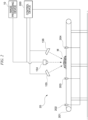
- FIG. 2 is a diagram illustrating an example of the image processing device according to the embodiment, an imaging device, lights, and a food processing line.
- FIG. 3 is a diagram illustrating an example of a chicken thigh illustrated in FIG. 2 and peripheries thereof when seen from above.
- the control device 200 is connected to a light 155, a light 156, a light 157, and a light 158 and controls the four lights.
- the mouse 151 and the keyboard 152 are used for, for example, work of inputting data required to operate the image processing device 10.
- the display 153 is, for example, a liquid crystal display.
- the display 153 displays, for example, a graphical user interface (GUI) of the image processing device 10.
- GUI graphical user interface
- the imaging device 154 is a camera that images a subject in colors.
- the subject is, for example, a chicken thigh M illustrated in FIG. 2 .
- the chicken thigh M is carried by a belt conveyor 201 constituting the food processing line 20 and is sequentially sensed by a photoelectric sensor 202, a photoelectric sensor 203, and a photoelectric sensor 204.
- the belt conveyor 201, the photoelectric sensor 202, the photoelectric sensor 203, and the photoelectric sensor 204 are controlled by the control device 200.
- the imaging device 154 is installed, for example, at a position at which the chicken thigh M can be imaged from above when the chicken thigh M is carried between the photoelectric sensor 203 and the photoelectric sensor 204 by the belt conveyor 201 as illustrated in FIG. 2 .
- the light 155, the light 156, the light 157, and the light 158 are devices that irradiate a subject with light such as white light and include, for example, a light emitting diode (LED).
- the light 155 is installed above the belt conveyor 201 as illustrated in FIG. 2 and irradiates the chicken thigh M with light from an upstream side of the belt conveyor 201 with respect to the imaging device 154.
- the light 156 is installed above the belt conveyor 201 as illustrated in FIG. 2 and irradiates the chicken thigh M with light from a downstream side of the belt conveyor 201 with respect to the imaging device 154.
- the light 157 and the light 158 are installed aside a trajectory along which the chicken thigh M is carried by the belt conveyor 201 as illustrated in FIG. 3 and irradiate the chicken thigh M carried to a position at which the chicken thigh can be imaged by the imaging device 154 by the belt conveyor 201 with light from both sides.
- the bus 16 connects the processor 11, the main storage device 12, the communication interface 13, the auxiliary storage device 14, and the input/output device 15 such that data can be transmitted and received therebetween.
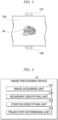
- FIG. 4 is a diagram illustrating an example of a software configuration of the image processing device according to the embodiment.
- the image processing device 10 includes an image acquiring unit 101, a boundary identifying unit 102, a position identifying unit 103, and a trajectory determining unit 104.
- the image acquiring unit 101 acquires an image in which a subject including an element to be cut off is pictured.
- the image acquiring unit 101 acquires an image in which a subject including at least two elements are pictured.
- the image is, for example, a color image which is captured by the imaging device 154 and in which the chicken thigh M is pictured.
- the elements are, for example, a tendon, a first skin, a second skin, and a third skin.
- a tendon is an object of a white string shape which is attached to a part close to a chicken foot tip when a cut is formed from the chicken foot tip to a thigh along a bone and meat is opened.
- the first skin is a skin located firstly when an outer perimeter of the chicken thigh M in a view from the side attached to the bone is traced clockwise from the tendon in the case that the chicken thigh M is meat of a chicken left leg.
- the first skin is a skin located thirdly when an outer perimeter of the chicken thigh M in a view from the side attached to the bone is traced clockwise from the tendon in the case that the chicken thigh M is meat of a chicken right leg. That is, a relative position of the first skin with respect to the tendon is uniquely determined in both cases in which the chicken thigh M is meat of the chicken left leg and in which the chicken thigh M is meat of the chicken right leg.
- the first skin is a skin of a chicken buttock.
- the second skin is a skin located secondly when an outer perimeter of the chicken thigh M in a view from the side attached to the bone is traced clockwise from the tendon in the case that the chicken thigh M is meat of a chicken left leg.
- the second skin is a skin located secondly when an outer perimeter of the chicken thigh M in a view from the side attached to the bone is traced clockwise from the tendon in the case that the chicken thigh M is meat of a chicken right leg. That is, a relative position of the second skin with respect to the tendon is uniquely determined in both cases in which the chicken thigh M is meat of the chicken left leg and in which the chicken thigh M is meat of the chicken right leg.
- the second skin is a skin of a chicken back.
- the third skin is a skin located thirdly when an outer perimeter of the chicken thigh M in a view from the side attached to the bone is traced clockwise from the tendon in the case that the chicken thigh M is meat of a chicken left leg.
- the third skin is a skin located firstly when an outer perimeter of the chicken thigh M in a view from the side attached to the bone is traced clockwise from the tendon in the case that the chicken thigh M is meat of a chicken right leg. That is, a relative position of the third skin with respect to the tendon is uniquely determined in both cases in which the chicken thigh M is meat of the chicken left leg and in which the chicken thigh M is meat of the chicken right leg.
- the third skin is a skin of a chicken buttock or back.
- the boundary identifying unit 102 calculates a difference between a pixel value of each pixel of an image obtained by extracting only red components from a color image acquired by the image acquiring unit 101 and a pixel value of each pixel in an image obtained by extracting only green components from the color image, and generates a differential image in which the pixel value of each pixel is the difference calculated above. Then, the boundary identifying unit 102 separates an area in which the tendon, the first skin, the second skin, or the third skin is pictured and an area in which lean meat other than them is pictured by performing a binarization process on the image and identifies boundaries therebetween.
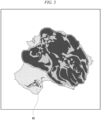
- FIG. 5 is a diagram illustrating an example of a boundary between the first skin, the second skin, the third skin, or the tendon and lean meat which is identified by the image processing device according to the embodiment.
- the chicken thigh M illustrated in FIG. 5 is meat of a chicken left leg.
- the boundary identifying unit 102 identifies the boundary indicated by a dashed line in FIG. 5 , for example, by generating a differential image illustrated in FIG. 5 and performing a binarization process on the differential image.
- a region inside of the dashed line in FIG. 5 is a region in which lean meat of the chicken thigh M is pictured.
- a region outside of the dashed line in FIG. 5 is a region in which the tendon, the first skin, the second skin, or the third skin of the chicken thigh M is pictured.
- the position identifying unit 103 identifies a position of an element to be cut off on the basis of the image acquired by the image acquiring unit 101.
- the position identifying unit 103 identifies a region with the largest area among the regions outside of the boundary, which is identified by the boundary identifying unit 102 and indicated by the dashed line in FIG. 5 , as a region in which the first skin is pictured.
- FIG. 6 is a diagram illustrating an example of a first skin of a chicken thigh identified by the image processing device according to the embodiment.
- the chicken thigh M illustrated in FIG. 6 is meat of a chicken left leg.
- a region inside of the dashed line in FIG. 6 is a region in which a tendon, a first skin, a second skin, or a third skin of the chicken thigh M is pictured.
- the position identifying unit 103 identifies, for example, a region with the largest area in the region inside of the dotted line in FIG. 6 as a region in which the first skin is pictured.
- lengths of the long sides thereof are the same as a width of the region in which lean meat of the chicken thigh M is pictured in a direction parallel to the long sides. These two rectangles share one long side as illustrated in FIG. 6 .
- the position identifying unit 103 compares the sizes of regions in which any of the three skins are pictured in the two rectangles illustrated in FIG. 6 . Then, the position identifying unit 103 determines that the first skin is pictured inside of the rectangle having the larger area in the region in which any of the three skins are pictured.
- the position identifying unit 103 superimposes a predetermined figure on the image and identifies a position of an element in the subject using the predetermined figure.
- the position identifying unit 103 identifies positions of the tendon, the first skin, the second skin, and the third skin in the chicken thigh M using relative positional relationships of these four elements.
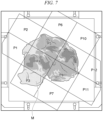
- the position identifying unit 103 superimposes a plurality of rectangles on a color image acquired by the image acquiring unit 101 and identifies a position of the tendon, a position of the first skin, a position of the second skin, and a position of the third skin in the chicken thigh M using the plurality of rectangles.
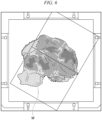
- FIG. 7 is a diagram illustrating an example of 12 rectangles superimposed on an image in which a chicken thigh is pictured according to the embodiment.
- the chicken thigh M illustrated in FIG. 7 is meat of a chicken left leg.
- FIG. 7 illustrates a rectangle P1, a rectangle P2, a rectangle P3, a rectangle P4, a rectangle P5, a rectangle P6, a rectangle P7, a rectangle P8, a rectangle P9, a rectangle P10, a rectangle P11, and a rectangle P12.
- the long sides of these 12 rectangles are inclined by 40 degrees with respect to upper and lower sides of the image illustrated in FIG. 7 and upper and lower sides of a plate-shaped member on which the chicken thigh M is placed.
- a rectangle made up of the rectangle P4, the rectangle P5, the rectangle P8, and the rectangle P9 is circumscribed to the region picturing lean meat of the chicken thigh M, which is identified using the differential image illustrated in FIG. 5 .
- the position identifying unit 103 identifies a part on which the rectangle P3 is superimposed in the chicken thigh M is a region in which the first skin is pictured.
- the position identifying unit 103 identifies a part on which the rectangle P1 or the rectangle P2 is superimposed in the chicken thigh M is a region in which the second skin is pictured.
- the position identifying unit 103 identifies a part on which the rectangle P9 is superimposed in the chicken thigh M is a region in which the third skin is pictured.
- the position identifying unit 103 identifies a part on which the rectangle P8 is superimposed in the chicken thigh M is a region in which the tendon is pictured.
- the position identifying unit 103 identifies a part on which the rectangle P10 is superimposed in the chicken thigh M is a region in which the first skin is pictured.
- the position identifying unit 103 identifies a part on which the rectangle P11 or the rectangle P12 is superimposed in the chicken thigh M is a region in which the second skin is pictured.
- the position identifying unit 103 identifies a part on which the rectangle P4 is superimposed in the chicken thigh M is a region in which the third skin is pictured.
- the position identifying unit 103 identifies a part on which the rectangle P5 is superimposed in the chicken thigh M is a region in which the tendon is pictured.
- the position identifying unit 103 identifies a part on which the rectangle P7 is superimposed in the chicken thigh M is a region in which the first skin is pictured.
- the position identifying unit 103 identifies a part on which the rectangle P11 or the rectangle P12 is superimposed in the chicken thigh M is a region in which the second skin is pictured.
- the position identifying unit 103 identifies a part on which the rectangle P5 is superimposed in the chicken thigh M is a region in which the third skin is pictured.
- the position identifying unit 103 identifies a part on which the rectangle P4 is superimposed in the chicken thigh M is a region in which the tendon is pictured.
- the position identifying unit 103 identifies a part on which the rectangle P6 is superimposed in the chicken thigh M is a region in which the first skin is pictured.
- the position identifying unit 103 identifies a part on which the rectangle P1 or the rectangle P2 is superimposed in the chicken thigh M is a region in which the second skin is pictured.
- the position identifying unit 103 identifies a part on which the rectangle P8 is superimposed in the chicken thigh M is a region in which the third skin is pictured.
- the position identifying unit 103 identifies a part on which the rectangle P9 is superimposed in the chicken thigh M is a region in which the tendon is pictured.
- the boundary identifying unit 102 identifies a boundary between the elements and a part other than the elements in the image by performing image processing on the image. For example, the boundary identifying unit 102 determines a closed curve line circumscribed to the region in which lean meat of the chicken thigh M is pictured in the color image acquired by the image acquiring unit 101 and identifies parts of the closed curve, which pass through regions in which the tendon, the first skin, the second skin, or the third skin is pictured in the color image, as a boundary between the tendon, the first skin, the second skin, or the third skin and the lean meat of the chicken thigh M.
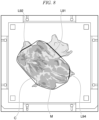
- FIG. 8 is a diagram illustrating an example of a boundary between the first skin and lean meat, a boundary between the second skin and lean meat, and a boundary between the tendon and lean meat which are identified by the image processing device according to the embodiment.
- the chicken thigh M illustrated in FIG. 8 is meat of a chicken right leg.
- the boundary identifying unit 102 determines a closed curve line C circumscribed to a region in which lean meat of the chicken thigh M is pictured as illustrated in FIG. 8 . Then, the boundary identifying unit 102 identifies a segment L91 of the closed curve line C as the boundary between the first skin and lean meat of the chicken thigh M.
- the boundary identifying unit 102 identifies a segment L92 of the closed curve line C as the boundary between the second skin and lean meat of the chicken thigh M. In addition, the boundary identifying unit 102 identifies a segment L94 of the closed curve line C as the boundary between the tendon and lean meat of the chicken thigh M.
- the trajectory determining unit 104 determines a trajectory of a cutting edge when the elements are cut off from the subject on the basis of the boundaries.
- the trajectory determining unit 104 determines, for example, a segment overlapping the boundaries identified by the boundary identifying unit 102 as the trajectory of the cutting edge.
- FIG. 9 is a diagram illustrating an example of a trajectory of a cutting edge when the first skin is cut off from the chicken thigh, a trajectory of a cutting edge when the second skin is cut off from the chicken thigh, and a trajectory of a cutting edge when the tendon is cut off from the chicken thigh which are determined by the image processing device according to the embodiment.
- FIG. 9 illustrates a segment L101 connecting a point P11 and a point P12, a segment L102 connecting a point P21 and a point P22, and a segment L104 connecting a point P41 and a point P42.
- the lateral direction of the image illustrated in FIG. 9 is defined as an X direction
- the vertical direction of the image illustrated in FIG. 9 is defined as a Y direction.
- the point P11 represents a start point of the cutting edge when the first skin is cut off from the chicken thigh M.
- the X coordinate of the point P11 is "242.4" as illustrated in the upper part of the image illustrated in FIG. 9 .
- the Y coordinate of the point P11 is "0" as illustrated in the upper part of the image illustrated in FIG. 9 .
- the point P12 represents an end point of the cutting edge when the first skin is cut off from the chicken thigh M.
- the X coordinate of the point P12 is "10" as illustrated in the upper part of the image illustrated in FIG. 9 .
- the Y coordinate of the point P12 is "-239.8" as illustrated in the upper part of the image illustrated in FIG. 9 .
- the segment L101 indicates a trajectory of the cutting edge when the first skin is cut off from the chicken thigh M.
- T: -0.969 shown below the coordinates of the point P11 in the upper part of the image illustrated in FIG. 9 indicates a speed of the cutting edge when the first skin is cut off from the chicken thigh M.
- ⁇ : -44.09 shown below the coordinates of the point P12 in the upper part of the image illustrated in FIG. 9 indicates an inclination of the segment L101.
- the point P21 represents a start point of the cutting edge when the second skin is cut off from the chicken thigh M.
- the X coordinate of the point P21 is "65.2" as illustrated in the upper part of the image illustrated in FIG. 9 .
- the Y coordinate of the point P21 is "0" as illustrated in the upper part of the image illustrated in FIG. 9 .
- the point P22 represents an end point of the cutting edge when the second skin is cut off from the chicken thigh M.
- the X coordinate of the point P22 is "292.3” as illustrated in the upper part of the image illustrated in FIG. 9 .
- the Y coordinate of the point P22 is "-151.8" as illustrated in the upper part of the image illustrated in FIG. 9 .
- the segment L102 indicates a trajectory of the cutting edge when the second skin is cut off from the chicken thigh M.
- T: 1.404 shown below the coordinates of the point P21 in the upper part of the image illustrated in FIG. 9 indicates a speed of the cutting edge when the second skin is cut off from the chicken thigh M.
- ⁇ : 34.54" shown below the coordinates of the point P22 in the upper part of the image illustrated in FIG. 9 indicates an inclination of the segment L102.
- the point P41 represents a start point of the cutting edge when the tendon is cut off from the chicken thigh M.
- the X coordinate of the point P41 is "70.8" as illustrated in the upper part of the image illustrated in FIG. 9 .
- the Y coordinate of the point P41 is "0" as illustrated in the upper part of the image illustrated in FIG. 9 .
- the point P42 represents an end point of the cutting edge when the tendon is cut off from the chicken thigh M.
- the X coordinate of the point P42 is "90.1" as illustrated in the upper part of the image illustrated in FIG. 9 .
- the Y coordinate of the point P42 is "-370.9” as illustrated in the upper part of the image illustrated in FIG. 9 .
- the segment L104 indicates a trajectory of the cutting edge when the tendon is cut off from the chicken thigh M.
- T: 0.036 shown below the coordinates of the point P41 in the upper part of the image illustrated in FIG. 9 indicates a speed of the cutting edge when the tendon is cut off from the chicken thigh M.
- ⁇ : 2.06 shown below the coordinates of the point P42 in the upper part of the image illustrated in FIG. 9 indicates an inclination of the segment L102.
- the trajectory determining unit 104 determines the segment L101 illustrated in FIG. 9 as the trajectory of the cutting edge when the first skin is cut off from the chicken thigh M on the basis of the segment L91 illustrated in FIG. 8 .
- the trajectory determining unit 104 determines the segment L102 illustrated in FIG. 9 as the trajectory of the cutting edge when the second skin is cut off from the chicken thigh M on the basis of the segment L92 illustrated in FIG. 8 .
- the trajectory determining unit 104 determines the segment L104 illustrated in FIG. 9 as the trajectory of the cutting edge when the tendon is cut off from the chicken thigh M on the basis of the segment L94 illustrated in FIG. 8 .
- the trajectory determining unit 104 may set the trajectory to be separated by a predetermined distance from the above mentioned boundary.
- the trajectory determining unit 104 may set a line obtained by moving the boundary by a predetermined distance in a direction perpendicular to the above mentioned boundary as the trajectory of the cutting edge.
- An example of such a trajectory is a segment obtained by moving the segment L101, the segment L102, or the segment L104 illustrated in FIG. 9 by a predetermined distance in parallel.
- parallel movement in a direction in which it is separated away from the lean meat of the chicken thigh M may be defined as positive parallel movement
- parallel movement in a direction in which it approaches lean meat of the chicken thigh M may be defined as negative parallel movement.
- the trajectory determining unit 104 may set a polyline, a curve line, or the like obtained by moving such boundary by a predetermined distance in parallel as the trajectory of the cutting edge.
- FIG. 10 is a flowchart illustrating an example of the process flow which is performed by the image processing device according to the embodiment.
- Step S1 the image acquiring unit 101 acquires an image in which a subject including an element(s) to be cut off is pictured.
- Step S2 the boundary identifying unit 102 identifies a boundary(ies) between the element(s) to be cut off and a part other than the element(s) in an image by performing image processing on the image.
- Step S3 the position identifying unit 103 superimposes a predetermined figure(s) on the image and identifies a position(s) of the element(s) in the subject using the predetermined figure(s).
- Step S4 the boundary identifying unit 102 identifies a boundary(ies) between the element(s) and a part other than the element(s) on the basis of the position(s) of the element(s) identified in Step S3.
- Step S5 the trajectory determining unit 104 determines a trajectory(ies) of a cutting edge when the element(s) is cut off from the subject on the basis of the boundary(ies) identified in Step S4.
- the image processing device 10 includes the image acquiring unit 101, the boundary identifying unit 102, and the trajectory determining unit 104.
- the image acquiring unit 101 acquires an image in which a subject including an element(s) to be cut off is pictured.
- the boundary identifying unit 102 identifies a boundary(ies) between the element(s) and a part other than the element(s) in the image by performing image processing on the image.
- the trajectory determining unit 104 determines a trajectory(ies) of a cutting edge when the element(s) is cut off from the subject on the basis of the boundary(ies). Accordingly, the image processing device 10 can appropriately support work of cutting off an element(s) to be cut off from foodstuffs having unevenness.
- the image processing device 10 further includes the position identifying unit 103 that superimposes a predetermined figure(s) on the image and identifies a position(s) of the element(s) in the subject using the predetermined figure(s). Accordingly, the image processing device 10 can identify an element(s) to be cut off and appropriately determine the trajectory(ies) of the cutting edge when the element(s) is cut off from the subject.
- the image processing device 10 acquires an image in which a subject including at least two elements are pictured and identifies positions of the elements in the subject using a relative positional relationship between the at least two elements. Accordingly, even when a plurality of elements to be cut off are included in a subject, the image processing device 10 can appropriately identify the positions of the elements and appropriately determine the trajectories of the cutting edge when the elements are cut off from the subject.
- the image processing device 10 illustrated in FIG. 1 is realized by the processor 11 that reads and executes an image processing program, but the present invention is not limited thereto.
- At least part of the image processing device 10 illustrated in FIG. 1 may be realized by hardware including a circuit unit (circuitry) such as a large scale integration (LSI) unit, an application-specific integrated circuit (ASIC), a field-programmable gate array (FPGA), or a graphics processing unit (GPU).
- LSI large scale integration
- ASIC application-specific integrated circuit
- FPGA field-programmable gate array
- GPU graphics processing unit
- at least a part of the image processing device 10 illustrated in FIG. 1 may be cooperatively realized by software and hardware.
- the hardware may be integrated as a unified body or may be divided into a plurality of bodies.
- the subject is a chicken thigh M and elements to be cut off include a tendon, a first skin, a second skin, and a third skin, but the present invention is not limited thereto.
Landscapes
- Engineering & Computer Science (AREA)
- Theoretical Computer Science (AREA)
- Computer Vision & Pattern Recognition (AREA)
- Physics & Mathematics (AREA)
- General Physics & Mathematics (AREA)
- Life Sciences & Earth Sciences (AREA)
- Mechanical Engineering (AREA)
- Forests & Forestry (AREA)
- Multimedia (AREA)
- Quality & Reliability (AREA)
- Wood Science & Technology (AREA)
- Zoology (AREA)
- Food Science & Technology (AREA)
- Image Analysis (AREA)
- Image Processing (AREA)
- Processing Of Meat And Fish (AREA)
- Control Of Cutting Processes (AREA)
Applications Claiming Priority (2)
| Application Number | Priority Date | Filing Date | Title |
|---|---|---|---|
| JP2021168154A JP7566714B2 (ja) | 2021-10-13 | 2021-10-13 | 画像処理装置、画像処理プログラム及び画像処理方法 |
| PCT/JP2022/037496 WO2023063225A1 (ja) | 2021-10-13 | 2022-10-06 | 画像処理装置、画像処理プログラム及び画像処理方法 |
Publications (2)
| Publication Number | Publication Date |
|---|---|
| EP4417059A1 true EP4417059A1 (de) | 2024-08-21 |
| EP4417059A4 EP4417059A4 (de) | 2025-10-15 |
Family
ID=85987714
Family Applications (1)
| Application Number | Title | Priority Date | Filing Date |
|---|---|---|---|
| EP22880920.8A Pending EP4417059A4 (de) | 2021-10-13 | 2022-10-06 | Bildverarbeitungsvorrichtung, bildverarbeitungsprogramm und bildverarbeitungsverfahren |
Country Status (5)
| Country | Link |
|---|---|
| US (1) | US20240404034A1 (de) |
| EP (1) | EP4417059A4 (de) |
| JP (2) | JP7566714B2 (de) |
| TW (1) | TWI852115B (de) |
| WO (1) | WO2023063225A1 (de) |
Families Citing this family (1)
| Publication number | Priority date | Publication date | Assignee | Title |
|---|---|---|---|---|
| JP7413583B1 (ja) * | 2023-03-31 | 2024-01-15 | 株式会社電通 | 魚の品質判定システム |
Family Cites Families (13)
| Publication number | Priority date | Publication date | Assignee | Title |
|---|---|---|---|---|
| US6623348B1 (en) * | 2000-07-06 | 2003-09-23 | O'neill Richard V. | Method and apparatus for slaughtering and processing animals |
| IS7959A (is) * | 2004-12-16 | 2006-06-17 | Skaginn Hf. | Athferth og bunathur vith sj βlfvirka beingarthst”ku, skurth meth vatni og snyrtingu β afurth |
| EP2353395A1 (de) * | 2010-02-07 | 2011-08-10 | Valka Ehf | Küchenmaschine zum Erkennen und Schneiden von Geweben von Lebensmitteln |
| CN102349659B (zh) * | 2011-10-20 | 2013-03-06 | 浙江青莲食品股份有限公司 | 一种炭烤肉脯的加工方法 |
| JP5905346B2 (ja) * | 2012-06-28 | 2016-04-20 | 株式会社前川製作所 | 骨付き肉の骨部位検出方法及び装置 |
| JP6902526B2 (ja) | 2015-07-22 | 2021-07-14 | バイオメリカ・インコーポレイテッドBiomerica, Inc. | 食物感受性試験に基づいて食物勧告を提供するためのシステム及び方法 |
| CN105192046B (zh) * | 2015-09-29 | 2017-12-22 | 大连工业大学 | 扇贝自动脱壳取肉机 |
| CN107771900A (zh) * | 2017-10-27 | 2018-03-09 | 河北滦平华都食品有限公司 | 一种切肛装置及其切割家禽肛门的方法 |
| US11992931B1 (en) * | 2018-01-05 | 2024-05-28 | Tyson Foods, Inc. | Method and apparatus for efficient automated production of deboned and other meat cuts utilizing an ultrasonic knife and coupled controller |
| CN109676657B (zh) * | 2019-01-23 | 2020-09-11 | 莱芜职业技术学院 | 一种牛肉快速切条装置 |
| AU2020237959B2 (en) * | 2019-03-11 | 2025-09-18 | Jbt Marel Corporation | Portioning and trimming of rib primal cuts |
| JP7231530B2 (ja) * | 2019-11-20 | 2023-03-01 | アンリツ株式会社 | X線検査装置 |
| CN110999944B (zh) * | 2019-12-12 | 2022-07-26 | 江苏省农业科学院 | 一种大规格鱼类自动宰杀装置及控制方法 |
-
2021
- 2021-10-13 JP JP2021168154A patent/JP7566714B2/ja active Active
-
2022
- 2022-10-06 US US18/699,197 patent/US20240404034A1/en active Pending
- 2022-10-06 EP EP22880920.8A patent/EP4417059A4/de active Pending
- 2022-10-06 WO PCT/JP2022/037496 patent/WO2023063225A1/ja not_active Ceased
- 2022-10-07 TW TW111138127A patent/TWI852115B/zh active
-
2024
- 2024-09-02 JP JP2024150719A patent/JP7721760B2/ja active Active
Also Published As
| Publication number | Publication date |
|---|---|
| JP2024159977A (ja) | 2024-11-08 |
| EP4417059A4 (de) | 2025-10-15 |
| JP7566714B2 (ja) | 2024-10-15 |
| JP2023058253A (ja) | 2023-04-25 |
| US20240404034A1 (en) | 2024-12-05 |
| TW202333107A (zh) | 2023-08-16 |
| TWI852115B (zh) | 2024-08-11 |
| WO2023063225A1 (ja) | 2023-04-20 |
| JP7721760B2 (ja) | 2025-08-12 |
Similar Documents
| Publication | Publication Date | Title |
|---|---|---|
| KR102251695B1 (ko) | 음식 제조 산업의 제품에 대한 제품-상세 데이터를 평가하고 검색하는 장치, 이를 포함하는 시스템 및 음식 제조 산업의 제품을 제조하는 방법. | |
| EP2801815B1 (de) | Verfahren zur einstellung des prüfbereichs einer bildprüfvorrichtung | |
| EP3553743A3 (de) | Systeme und verfahren zur bildverarbeitung | |
| JP2020183876A (ja) | 特徴点認識システムおよびワーク処理システム | |
| EP4417059A1 (de) | Bildverarbeitungsvorrichtung, bildverarbeitungsprogramm und bildverarbeitungsverfahren | |
| CN107402000A8 (zh) | 用于相对于测量仪器参照显示装置的系统和方法 | |
| EP4588579A3 (de) | System und verfahren zur bestimmung der gesundheit und des geschlechts eines kükens | |
| US9384557B2 (en) | Information processing device, image modification method, and computer program product | |
| US20160300358A1 (en) | Method for partitioning area, and inspection device | |
| US20230162357A1 (en) | Medical image processing device and method of operating the same | |
| US20170147609A1 (en) | Method for analyzing and searching 3d models | |
| Roychowdhury et al. | Computer aided detection of anemia-like pallor | |
| JP2005310101A (ja) | 視線誘導度算出システム、視線誘導度算出プログラムおよび記憶媒体、並びに視線誘導度算出方法 | |
| JP2014016821A5 (de) | ||
| EP3379475A1 (de) | Informationspräsentationvorrichtung und informationspräsentationsverfahren | |
| WO2015184903A1 (zh) | 一种图片处理方法及装置 | |
| EP2503006A1 (de) | Verfahren zum Verfolgen von Zellen | |
| JP6861825B2 (ja) | 薬剤識別装置、画像処理装置、画像処理方法及びプログラム | |
| KR101744863B1 (ko) | 영상을 이용한 2차원 감성 추정 방법 및 시스템 | |
| US11449701B2 (en) | Non-transitory computer readable medium storing image processing program, image processing apparatus, and non-transitory computer readable medium storing program | |
| US20240185451A1 (en) | Computer-readable recording medium storing posture specifying program, posture specifying method, and information processing apparatus | |
| Hardik et al. | The model for extracting a portion of a given image using color processing | |
| JP6170696B2 (ja) | 画像処理装置及び画像処理方法 | |
| KR102178636B1 (ko) | 손가락 분할 방법 | |
| Milella et al. | Computer vision technology for agricultural robotics |
Legal Events
| Date | Code | Title | Description |
|---|---|---|---|
| STAA | Information on the status of an ep patent application or granted ep patent |
Free format text: STATUS: THE INTERNATIONAL PUBLICATION HAS BEEN MADE |
|
| PUAI | Public reference made under article 153(3) epc to a published international application that has entered the european phase |
Free format text: ORIGINAL CODE: 0009012 |
|
| STAA | Information on the status of an ep patent application or granted ep patent |
Free format text: STATUS: REQUEST FOR EXAMINATION WAS MADE |
|
| 17P | Request for examination filed |
Effective date: 20240409 |
|
| AK | Designated contracting states |
Kind code of ref document: A1 Designated state(s): AL AT BE BG CH CY CZ DE DK EE ES FI FR GB GR HR HU IE IS IT LI LT LU LV MC ME MK MT NL NO PL PT RO RS SE SI SK SM TR |
|
| DAV | Request for validation of the european patent (deleted) | ||
| DAX | Request for extension of the european patent (deleted) | ||
| REG | Reference to a national code |
Ref country code: DE Ref legal event code: R079 Free format text: PREVIOUS MAIN CLASS: A22C0021000000 Ipc: A22C0017000000 |
|
| STAA | Information on the status of an ep patent application or granted ep patent |
Free format text: STATUS: EXAMINATION IS IN PROGRESS |
|
| A4 | Supplementary search report drawn up and despatched |
Effective date: 20250915 |
|
| RIC1 | Information provided on ipc code assigned before grant |
Ipc: A22C 17/00 20060101AFI20250909BHEP Ipc: G06T 7/12 20170101ALI20250909BHEP Ipc: B26D 5/00 20060101ALI20250909BHEP Ipc: G06V 10/26 20220101ALI20250909BHEP Ipc: G06V 10/44 20220101ALI20250909BHEP |
|
| 17Q | First examination report despatched |
Effective date: 20251006 |