EP4417855A1 - Système de ventilation - Google Patents
Système de ventilation Download PDFInfo
- Publication number
- EP4417855A1 EP4417855A1 EP22880662.6A EP22880662A EP4417855A1 EP 4417855 A1 EP4417855 A1 EP 4417855A1 EP 22880662 A EP22880662 A EP 22880662A EP 4417855 A1 EP4417855 A1 EP 4417855A1
- Authority
- EP
- European Patent Office
- Prior art keywords
- connecting portion
- ventilation path
- housing
- opening
- tube body
- Prior art date
- Legal status (The legal status is an assumption and is not a legal conclusion. Google has not performed a legal analysis and makes no representation as to the accuracy of the status listed.)
- Pending
Links
- 238000009423 ventilation Methods 0.000 title claims abstract description 233
- 238000011144 upstream manufacturing Methods 0.000 claims abstract description 74
- 230000003584 silencer Effects 0.000 claims abstract description 59
- 230000002093 peripheral effect Effects 0.000 claims description 66
- 229920005989 resin Polymers 0.000 claims description 20
- 239000011347 resin Substances 0.000 claims description 20
- 230000001743 silencing effect Effects 0.000 abstract description 11
- 239000000463 material Substances 0.000 description 23
- 239000011358 absorbing material Substances 0.000 description 21
- 230000000052 comparative effect Effects 0.000 description 16
- 230000008859 change Effects 0.000 description 12
- 239000004745 nonwoven fabric Substances 0.000 description 11
- 230000030279 gene silencing Effects 0.000 description 10
- 230000003247 decreasing effect Effects 0.000 description 9
- 230000007423 decrease Effects 0.000 description 8
- 238000005259 measurement Methods 0.000 description 8
- 239000006260 foam Substances 0.000 description 6
- 238000000034 method Methods 0.000 description 6
- -1 polyalylate Polymers 0.000 description 6
- 238000010521 absorption reaction Methods 0.000 description 5
- 230000000694 effects Effects 0.000 description 5
- 238000005187 foaming Methods 0.000 description 5
- 230000015572 biosynthetic process Effects 0.000 description 4
- 239000007769 metal material Substances 0.000 description 4
- 230000004048 modification Effects 0.000 description 4
- 238000012986 modification Methods 0.000 description 4
- 239000002121 nanofiber Substances 0.000 description 4
- JOYRKODLDBILNP-UHFFFAOYSA-N Ethyl urethane Chemical compound CCOC(N)=O JOYRKODLDBILNP-UHFFFAOYSA-N 0.000 description 3
- 239000004743 Polypropylene Substances 0.000 description 3
- 239000000835 fiber Substances 0.000 description 3
- 229920001155 polypropylene Polymers 0.000 description 3
- NLHHRLWOUZZQLW-UHFFFAOYSA-N Acrylonitrile Chemical compound C=CC#N NLHHRLWOUZZQLW-UHFFFAOYSA-N 0.000 description 2
- KAKZBPTYRLMSJV-UHFFFAOYSA-N Butadiene Chemical compound C=CC=C KAKZBPTYRLMSJV-UHFFFAOYSA-N 0.000 description 2
- 229920002284 Cellulose triacetate Polymers 0.000 description 2
- 229920002943 EPDM rubber Polymers 0.000 description 2
- XEEYBQQBJWHFJM-UHFFFAOYSA-N Iron Chemical compound [Fe] XEEYBQQBJWHFJM-UHFFFAOYSA-N 0.000 description 2
- 239000004952 Polyamide Substances 0.000 description 2
- 239000004698 Polyethylene Substances 0.000 description 2
- VYPSYNLAJGMNEJ-UHFFFAOYSA-N Silicium dioxide Chemical compound O=[Si]=O VYPSYNLAJGMNEJ-UHFFFAOYSA-N 0.000 description 2
- 229910000831 Steel Inorganic materials 0.000 description 2
- PPBRXRYQALVLMV-UHFFFAOYSA-N Styrene Chemical compound C=CC1=CC=CC=C1 PPBRXRYQALVLMV-UHFFFAOYSA-N 0.000 description 2
- NNLVGZFZQQXQNW-ADJNRHBOSA-N [(2r,3r,4s,5r,6s)-4,5-diacetyloxy-3-[(2s,3r,4s,5r,6r)-3,4,5-triacetyloxy-6-(acetyloxymethyl)oxan-2-yl]oxy-6-[(2r,3r,4s,5r,6s)-4,5,6-triacetyloxy-2-(acetyloxymethyl)oxan-3-yl]oxyoxan-2-yl]methyl acetate Chemical compound O([C@@H]1O[C@@H]([C@H]([C@H](OC(C)=O)[C@H]1OC(C)=O)O[C@H]1[C@@H]([C@@H](OC(C)=O)[C@H](OC(C)=O)[C@@H](COC(C)=O)O1)OC(C)=O)COC(=O)C)[C@@H]1[C@@H](COC(C)=O)O[C@@H](OC(C)=O)[C@H](OC(C)=O)[C@H]1OC(C)=O NNLVGZFZQQXQNW-ADJNRHBOSA-N 0.000 description 2
- 229920000122 acrylonitrile butadiene styrene Polymers 0.000 description 2
- 229910052782 aluminium Inorganic materials 0.000 description 2
- XAGFODPZIPBFFR-UHFFFAOYSA-N aluminium Chemical compound [Al] XAGFODPZIPBFFR-UHFFFAOYSA-N 0.000 description 2
- 239000004918 carbon fiber reinforced polymer Substances 0.000 description 2
- 239000011152 fibreglass Substances 0.000 description 2
- 238000009413 insulation Methods 0.000 description 2
- 229920002647 polyamide Polymers 0.000 description 2
- 229920000573 polyethylene Polymers 0.000 description 2
- 239000004800 polyvinyl chloride Substances 0.000 description 2
- 230000008569 process Effects 0.000 description 2
- 230000009467 reduction Effects 0.000 description 2
- 239000002990 reinforced plastic Substances 0.000 description 2
- 239000010959 steel Substances 0.000 description 2
- RNFJDJUURJAICM-UHFFFAOYSA-N 2,2,4,4,6,6-hexaphenoxy-1,3,5-triaza-2$l^{5},4$l^{5},6$l^{5}-triphosphacyclohexa-1,3,5-triene Chemical compound N=1P(OC=2C=CC=CC=2)(OC=2C=CC=CC=2)=NP(OC=2C=CC=CC=2)(OC=2C=CC=CC=2)=NP=1(OC=1C=CC=CC=1)OC1=CC=CC=C1 RNFJDJUURJAICM-UHFFFAOYSA-N 0.000 description 1
- NIXOWILDQLNWCW-UHFFFAOYSA-M Acrylate Chemical compound [O-]C(=O)C=C NIXOWILDQLNWCW-UHFFFAOYSA-M 0.000 description 1
- 229920002972 Acrylic fiber Polymers 0.000 description 1
- 239000004925 Acrylic resin Substances 0.000 description 1
- 229920000178 Acrylic resin Polymers 0.000 description 1
- 229920000049 Carbon (fiber) Polymers 0.000 description 1
- VYZAMTAEIAYCRO-UHFFFAOYSA-N Chromium Chemical compound [Cr] VYZAMTAEIAYCRO-UHFFFAOYSA-N 0.000 description 1
- RYGMFSIKBFXOCR-UHFFFAOYSA-N Copper Chemical compound [Cu] RYGMFSIKBFXOCR-UHFFFAOYSA-N 0.000 description 1
- 244000043261 Hevea brasiliensis Species 0.000 description 1
- FYYHWMGAXLPEAU-UHFFFAOYSA-N Magnesium Chemical compound [Mg] FYYHWMGAXLPEAU-UHFFFAOYSA-N 0.000 description 1
- 229920000877 Melamine resin Polymers 0.000 description 1
- 229920001410 Microfiber Polymers 0.000 description 1
- ISWSIDIOOBJBQZ-UHFFFAOYSA-N Phenol Chemical compound OC1=CC=CC=C1 ISWSIDIOOBJBQZ-UHFFFAOYSA-N 0.000 description 1
- 239000004696 Poly ether ether ketone Substances 0.000 description 1
- 229930182556 Polyacetal Natural products 0.000 description 1
- 239000004697 Polyetherimide Substances 0.000 description 1
- 239000004642 Polyimide Substances 0.000 description 1
- 239000004734 Polyphenylene sulfide Substances 0.000 description 1
- 239000004793 Polystyrene Substances 0.000 description 1
- 229920003027 Thinsulate Polymers 0.000 description 1
- 239000004789 Thinsulate Substances 0.000 description 1
- RTAQQCXQSZGOHL-UHFFFAOYSA-N Titanium Chemical compound [Ti] RTAQQCXQSZGOHL-UHFFFAOYSA-N 0.000 description 1
- BZHJMEDXRYGGRV-UHFFFAOYSA-N Vinyl chloride Chemical compound ClC=C BZHJMEDXRYGGRV-UHFFFAOYSA-N 0.000 description 1
- NIXOWILDQLNWCW-UHFFFAOYSA-N acrylic acid group Chemical group C(C=C)(=O)O NIXOWILDQLNWCW-UHFFFAOYSA-N 0.000 description 1
- 230000001154 acute effect Effects 0.000 description 1
- 239000000853 adhesive Substances 0.000 description 1
- 230000001070 adhesive effect Effects 0.000 description 1
- 229910045601 alloy Inorganic materials 0.000 description 1
- 239000000956 alloy Substances 0.000 description 1
- 230000005540 biological transmission Effects 0.000 description 1
- 230000000903 blocking effect Effects 0.000 description 1
- 229920005549 butyl rubber Polymers 0.000 description 1
- 239000004917 carbon fiber Substances 0.000 description 1
- 239000000919 ceramic Substances 0.000 description 1
- 229910052804 chromium Inorganic materials 0.000 description 1
- 239000011651 chromium Substances 0.000 description 1
- VNTLIPZTSJSULJ-UHFFFAOYSA-N chromium molybdenum Chemical compound [Cr].[Mo] VNTLIPZTSJSULJ-UHFFFAOYSA-N 0.000 description 1
- 229920001577 copolymer Polymers 0.000 description 1
- 229910052802 copper Inorganic materials 0.000 description 1
- 239000010949 copper Substances 0.000 description 1
- 238000004132 cross linking Methods 0.000 description 1
- 230000007547 defect Effects 0.000 description 1
- 229920001971 elastomer Polymers 0.000 description 1
- 230000002708 enhancing effect Effects 0.000 description 1
- 239000004744 fabric Substances 0.000 description 1
- 239000003063 flame retardant Substances 0.000 description 1
- 239000012530 fluid Substances 0.000 description 1
- 239000011521 glass Substances 0.000 description 1
- 239000011491 glass wool Substances 0.000 description 1
- 238000001746 injection moulding Methods 0.000 description 1
- 229910052742 iron Inorganic materials 0.000 description 1
- 239000011777 magnesium Substances 0.000 description 1
- 229910052749 magnesium Inorganic materials 0.000 description 1
- JDSHMPZPIAZGSV-UHFFFAOYSA-N melamine Chemical compound NC1=NC(N)=NC(N)=N1 JDSHMPZPIAZGSV-UHFFFAOYSA-N 0.000 description 1
- 229910052751 metal Inorganic materials 0.000 description 1
- 239000002184 metal Substances 0.000 description 1
- VNWKTOKETHGBQD-UHFFFAOYSA-N methane Chemical compound C VNWKTOKETHGBQD-UHFFFAOYSA-N 0.000 description 1
- 239000003658 microfiber Substances 0.000 description 1
- 239000011490 mineral wool Substances 0.000 description 1
- 229910052750 molybdenum Inorganic materials 0.000 description 1
- 239000011733 molybdenum Substances 0.000 description 1
- 229920003052 natural elastomer Polymers 0.000 description 1
- 229920001194 natural rubber Polymers 0.000 description 1
- 210000002445 nipple Anatomy 0.000 description 1
- 239000002245 particle Substances 0.000 description 1
- 230000000149 penetrating effect Effects 0.000 description 1
- 229920003023 plastic Polymers 0.000 description 1
- 239000004033 plastic Substances 0.000 description 1
- 229920001084 poly(chloroprene) Polymers 0.000 description 1
- 229920003229 poly(methyl methacrylate) Polymers 0.000 description 1
- 229920002492 poly(sulfone) Polymers 0.000 description 1
- 229920001707 polybutylene terephthalate Polymers 0.000 description 1
- 239000004417 polycarbonate Substances 0.000 description 1
- 229920000515 polycarbonate Polymers 0.000 description 1
- 229920000728 polyester Polymers 0.000 description 1
- 229920002530 polyetherether ketone Polymers 0.000 description 1
- 229920001601 polyetherimide Polymers 0.000 description 1
- 229920000139 polyethylene terephthalate Polymers 0.000 description 1
- 239000005020 polyethylene terephthalate Substances 0.000 description 1
- 229920001721 polyimide Polymers 0.000 description 1
- 239000004626 polylactic acid Substances 0.000 description 1
- 239000004926 polymethyl methacrylate Substances 0.000 description 1
- 229920006324 polyoxymethylene Polymers 0.000 description 1
- 229920000069 polyphenylene sulfide Polymers 0.000 description 1
- 230000000644 propagated effect Effects 0.000 description 1
- 230000001902 propagating effect Effects 0.000 description 1
- 239000005060 rubber Substances 0.000 description 1
- 239000000377 silicon dioxide Substances 0.000 description 1
- 229920002379 silicone rubber Polymers 0.000 description 1
- 239000004945 silicone rubber Substances 0.000 description 1
- 239000010935 stainless steel Substances 0.000 description 1
- 229910001220 stainless steel Inorganic materials 0.000 description 1
- 239000000126 substance Substances 0.000 description 1
- 229920003002 synthetic resin Polymers 0.000 description 1
- 239000000057 synthetic resin Substances 0.000 description 1
- 239000010936 titanium Substances 0.000 description 1
- 229910052719 titanium Inorganic materials 0.000 description 1
- WFKWXMTUELFFGS-UHFFFAOYSA-N tungsten Chemical compound [W] WFKWXMTUELFFGS-UHFFFAOYSA-N 0.000 description 1
- 229910052721 tungsten Inorganic materials 0.000 description 1
- 239000010937 tungsten Substances 0.000 description 1
- 210000002268 wool Anatomy 0.000 description 1
Images






Classifications
-
- G—PHYSICS
- G10—MUSICAL INSTRUMENTS; ACOUSTICS
- G10K—SOUND-PRODUCING DEVICES; METHODS OR DEVICES FOR PROTECTING AGAINST, OR FOR DAMPING, NOISE OR OTHER ACOUSTIC WAVES IN GENERAL; ACOUSTICS NOT OTHERWISE PROVIDED FOR
- G10K11/00—Methods or devices for transmitting, conducting or directing sound in general; Methods or devices for protecting against, or for damping, noise or other acoustic waves in general
- G10K11/16—Methods or devices for protecting against, or for damping, noise or other acoustic waves in general
- G10K11/161—Methods or devices for protecting against, or for damping, noise or other acoustic waves in general in systems with fluid flow
-
- F—MECHANICAL ENGINEERING; LIGHTING; HEATING; WEAPONS; BLASTING
- F16—ENGINEERING ELEMENTS AND UNITS; GENERAL MEASURES FOR PRODUCING AND MAINTAINING EFFECTIVE FUNCTIONING OF MACHINES OR INSTALLATIONS; THERMAL INSULATION IN GENERAL
- F16L—PIPES; JOINTS OR FITTINGS FOR PIPES; SUPPORTS FOR PIPES, CABLES OR PROTECTIVE TUBING; MEANS FOR THERMAL INSULATION IN GENERAL
- F16L33/00—Arrangements for connecting hoses to rigid members; Rigid hose-connectors, i.e. single members engaging both hoses
- F16L33/30—Arrangements for connecting hoses to rigid members; Rigid hose-connectors, i.e. single members engaging both hoses comprising parts inside the hoses only
-
- F—MECHANICAL ENGINEERING; LIGHTING; HEATING; WEAPONS; BLASTING
- F16—ENGINEERING ELEMENTS AND UNITS; GENERAL MEASURES FOR PRODUCING AND MAINTAINING EFFECTIVE FUNCTIONING OF MACHINES OR INSTALLATIONS; THERMAL INSULATION IN GENERAL
- F16L—PIPES; JOINTS OR FITTINGS FOR PIPES; SUPPORTS FOR PIPES, CABLES OR PROTECTIVE TUBING; MEANS FOR THERMAL INSULATION IN GENERAL
- F16L55/00—Devices or appurtenances for use in, or in connection with, pipes or pipe systems
- F16L55/02—Energy absorbers; Noise absorbers
- F16L55/033—Noise absorbers
- F16L55/0336—Noise absorbers by means of sound-absorbing materials
-
- F—MECHANICAL ENGINEERING; LIGHTING; HEATING; WEAPONS; BLASTING
- F24—HEATING; RANGES; VENTILATING
- F24F—AIR-CONDITIONING; AIR-HUMIDIFICATION; VENTILATION; USE OF AIR CURRENTS FOR SCREENING
- F24F13/00—Details common to, or for air-conditioning, air-humidification, ventilation or use of air currents for screening
- F24F13/02—Ducting arrangements
-
- F—MECHANICAL ENGINEERING; LIGHTING; HEATING; WEAPONS; BLASTING
- F24—HEATING; RANGES; VENTILATING
- F24F—AIR-CONDITIONING; AIR-HUMIDIFICATION; VENTILATION; USE OF AIR CURRENTS FOR SCREENING
- F24F13/00—Details common to, or for air-conditioning, air-humidification, ventilation or use of air currents for screening
- F24F13/24—Means for preventing or suppressing noise
-
- G—PHYSICS
- G10—MUSICAL INSTRUMENTS; ACOUSTICS
- G10K—SOUND-PRODUCING DEVICES; METHODS OR DEVICES FOR PROTECTING AGAINST, OR FOR DAMPING, NOISE OR OTHER ACOUSTIC WAVES IN GENERAL; ACOUSTICS NOT OTHERWISE PROVIDED FOR
- G10K11/00—Methods or devices for transmitting, conducting or directing sound in general; Methods or devices for protecting against, or for damping, noise or other acoustic waves in general
- G10K11/16—Methods or devices for protecting against, or for damping, noise or other acoustic waves in general
-
- G—PHYSICS
- G10—MUSICAL INSTRUMENTS; ACOUSTICS
- G10K—SOUND-PRODUCING DEVICES; METHODS OR DEVICES FOR PROTECTING AGAINST, OR FOR DAMPING, NOISE OR OTHER ACOUSTIC WAVES IN GENERAL; ACOUSTICS NOT OTHERWISE PROVIDED FOR
- G10K11/00—Methods or devices for transmitting, conducting or directing sound in general; Methods or devices for protecting against, or for damping, noise or other acoustic waves in general
- G10K11/16—Methods or devices for protecting against, or for damping, noise or other acoustic waves in general
- G10K11/172—Methods or devices for protecting against, or for damping, noise or other acoustic waves in general using resonance effects
-
- F—MECHANICAL ENGINEERING; LIGHTING; HEATING; WEAPONS; BLASTING
- F24—HEATING; RANGES; VENTILATING
- F24F—AIR-CONDITIONING; AIR-HUMIDIFICATION; VENTILATION; USE OF AIR CURRENTS FOR SCREENING
- F24F13/00—Details common to, or for air-conditioning, air-humidification, ventilation or use of air currents for screening
- F24F13/24—Means for preventing or suppressing noise
- F24F2013/242—Sound-absorbing material
Definitions
- the present invention relates to a ventilation system in which a silencer is disposed at an intermediate position of a ventilation path.
- a silencer In a configuration where a silencer is disposed at an intermediate position of a ventilation path, it is required for the silencer to sufficiently silence noise propagating in the ventilation path while ensuring a ventilation property in the silencer.
- a box-shaped expansion portion is provided in the middle of a ventilation path, and the expansion portion configures a silencer (see Fig. 5 ).
- the ventilation path (hereinafter, an inner ventilation path) extending from an inlet to an outlet of the expansion portion and a sound absorbing member surrounding the inner ventilation path are disposed. Accordingly, silencing can be performed in the expansion portion while ensuring a ventilation property in the expansion portion.
- the ventilation path narrows at an intermediate position of the inner ventilation path and widens on a downstream side thereof (see Fig. 5 ). Accordingly, as a flow speed of wind (air current) flowing in the ventilation path increases in the inner ventilation path, an effect of the sound absorbing member is more easily exhibited, and accordingly a silencing property improves.
- a cross sectional area of the inner ventilation path is gradually changed at an inlet-side end part and an outlet-side end part of the inner ventilation path, and specifically, the farther from the inlet or the outlet, the larger the cross sectional area. In other words, the closer to the inlet or the outlet, the larger the cross sectional area of the inner ventilation path gradually becomes.
- the thickness of the sound absorbing member surrounding the inner ventilation path changes accordingly.
- the thickness of the sound absorbing member around the inlet and around the outlet of the expansion portion becomes thin. Decreasing the thickness of the sound absorbing member in this manner can decrease a silencing effect of the silencer.
- the size of the entire silencer increases. As a result, it is necessary to ensure a wider provision space for the silencer.
- the present invention is devised in view of the circumstances, and an object thereof is to provide a ventilation system that solves the problems of the related art, specifically, that can ensure a silencing property while a silencer has a compact structure and that can suppress a pressure loss in a ventilation path.
- a ventilation system has the following configurations.
- the closer to the in-housing ventilation path the smaller the size of the cross section of the opening portion of at least one connecting portion of the first connecting portion or the second connecting portion. Accordingly, without decreasing the thickness of the sound absorbing member in the housing, a silencing property is improved, and a pressure loss in the ventilation path reduces. As a result, a silencing property can be ensured while the silencer has a compact structure, and generation of a pressure loss in the ventilation path can be suppressed.
- each member used in order to implement the present invention can be determined in any manner in accordance with the purpose of use of the present invention and the technical level or the like at the time of implementation of the present invention.
- the present invention includes an equivalent thereof.
- a numerical range represented by using “to” means a range including numerical values before and after “to” as a lower limit value and an upper limit value.
- the terms “orthogonal”, “perpendicular”, and “parallel” include a range of errors accepted in the technical field to which the present invention belongs.
- the terms “orthogonal”, “perpendicular”, and “parallel” in this specification mean being in a range of less than ⁇ 10° with respect to being orthogonal, perpendicular, or parallel in a strict sense.
- An error from being orthogonal or parallel in a strict sense is preferably 5° or less and more preferably 3° or less.
- the meanings of "the entire”, “any”, and “all” can include a range of errors generally accepted in the technical field to which the present invention belongs and can include a case of, for example, 99% or more, 95% or more, or 90% or more in addition to a case of 100%.
- “silencing” in the present invention is a concept including both meanings of sound insulation and sound absorption.
- Sound insulation means blocking sound, in other words, not allowing transmission of sound.
- Sound absorption means reducing reflected sound and simply put, means absorbing sound (acoustics) in easy terms.
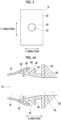
- An X-direction is an extending direction of an in-housing ventilation path 26 to be described later and corresponds to a first direction of the present invention.
- a Z-direction corresponds to a second direction of the present invention, and a Y-direction corresponds to a third direction of the present invention.
- FIG. 3 is a view showing an upstream end surface of a housing 20 included in a silencer 14, and an outlet opening 24 that does not appear in the upstream end surface is shown by a broken line in Fig. 3 .
- the ventilation system 10 silences noise in the system while flowing an air current (wind) along a predetermined route.
- the ventilation system 10 comprises a ventilation path 12 and the silencer 14 disposed at an intermediate position of the ventilation path 12.
- the ventilation path 12 is composed of a tube body, such as a hose and a duct, except for an expansion portion to be described later.
- the tube body may be a cylinder or a square tube.
- an air current (wind) supplied from a non-air supply source flows toward the air outlet positioned at a terminal of the ventilation path 12.
- the silencer 14 forms the expansion portion in the ventilation path 12.
- the expansion portion is a portion of which a cross sectional area of an inner space is wide compared to a portion other than the expansion portion of the ventilation path 12 (hereinafter, also referred to as a general portion).
- cross sectional area corresponds to the size of a cross section
- the cross section is a cross section of which a normal direction is a direction in which the ventilation path 12 extends, in other words, the first direction.
- the silencer 14 has the housing 20, a sound absorbing member 30, a first connecting portion 40, and a second connecting portion 50.
- the silencer 14 silences sound that has entered the housing 20 through resonance (acoustic resonance) in the housing 20 and sound absorption by the sound absorbing member 30.
- the housing 20 is a box-shaped or cylindrical hollow body having an outer wall.
- the outer wall of the housing 20 is a plate material having a relatively thin thickness and forms both end portions of the housing 20 in the XYZ-directions.
- a material for the outer wall is not particularly limited, and for example, a metal material, a resin material, a reinforced plastic material, a carbon fiber, and the like can be used.
- the metal material examples include aluminum, titanium, magnesium, tungsten, iron, steel, chromium, chromium molybdenum, nichrome-molybdenum, copper, steel galvanized cold commercial (SGCC), and an alloy, such as stainless steel.
- the resin material examples include an acrylic resin, polymethyl methacrylate, polycarbonate, polyamide, polyalylate, polyetherimide, polyacetal, polyetheretherketone, polyphenylene sulfide, polysulfone, polyethylene terephthalate, polybutylene terephthalate, polyimide, a copolymer synthetic resin of acrylonitrile, flame-retardant ABS resin, butadiene, and styrene (ABS resin), polypropylene, triacetylcellulose (TAC), polypropylene (PP), polyethylene (PE), polystyrene (PS), an acrylate sthrene acrylonitrile (ASA) resin, a polyvinyl chloride (PVC) resin, and a polylactic acid (PLA) resin.
- acrylic resin polymethyl methacrylate
- polycarbonate polycarbonate
- polyamide polyalylate
- polyetherimide polyacetal
- polyetheretherketone polyphenylene sulfide
- CFRP carbon fiber reinforced plastics
- GFRP glass fiber reinforced plastics
- natural rubber chloroprene rubber, butyl rubber, ethylene propylene diene rubber (EPDM), silicone rubber, and rubber including a crosslinking structure thereof can be further used as a material for the outer wall of the housing 20.
- EPDM ethylene propylene diene rubber
- silicone rubber and rubber including a crosslinking structure thereof can be further used as a material for the outer wall of the housing 20.
- each portion of the outer wall of the housing 20 may be composed of an identical material, or a portion of the housing 20 may be composed of a material different from the material for a peripheral portion thereof.
- a portion of the housing 20 may be made of the same type of material as the peripheral portion and may have a thickness (plate thickness) different from that of the peripheral portion.
- an inlet opening 22 is provided in an upstream end part of the housing 20 in the X-direction, and the outlet opening 24 is provided in a downstream end part.
- the inlet opening 22 and the outlet opening 24 are circular holes penetrating the outer wall of the housing 20 in the X-direction and communicate with an inner space of the housing 20.
- a contour shape of each of the inlet opening 22 and the outlet opening 24 is not limited to a circular shape and may be, for example, a polygonal shape such as a quadrangular shape and a pentagonal shape or more.
- Each of the inlet opening 22 and the outlet opening 24 extends perpendicularly to the outer wall of the housing 20, is formed to penetrate the outer wall, and has a length (depth) corresponding to the thickness of the outer wall.
- a diameter (opening size) of each of the inlet opening 22 and the outlet opening 24 is homogeneous over a range from one end on the upstream side to the other end on the downstream side of each opening.
- a range in which the inlet opening 22 is present and a range in which the outlet opening 24 is present in the Y-direction and the Z-direction overlap each other.
- a range in which each opening is present in the Y-direction and the Z-direction is a range in which each opening is present on an imaginary plane (YZ plane) of which a normal direction is the X-direction in a case where each opening is projected on the imaginary plane.
- the inlet opening 22 and the outlet opening 24 have an identical size, and the range in which the inlet opening 22 is present and the range in which the outlet opening 24 is present completely match each other.
- the size of the opening means the area of the opening.
- the sizes of the inlet opening 22 and the outlet opening 24 may be different from each other. In this case, it is preferable that a range in which a smaller opening is present is within a range in which a larger opening is present. In addition, the range in which the inlet opening 22 is present and the range in which the outlet opening 24 is present may partially overlap each other. Alternatively, due to restrictions on the design of the ventilation path or the like, the range in which the inlet opening 22 is present and the range in which the outlet opening 24 is present may not overlap each other and be separated (shifted) from each other in the Y-direction and the Z-direction. In this case, the in-housing ventilation path 26 is not limited to being linearly extending and may be bent at an intermediate position.
- each of the inlet opening 22 and the outlet opening 24 is provided at a central portion of the housing 20 or a portion near an end of the housing 20 in the Z-direction. That is, in a direction intersecting the in-housing ventilation path 26, the inlet opening 22 and the outlet opening 24 may be provided at central portions of the housing 20 or may be provided at positions biased to an end side of the housing 20.
- the sound absorbing member 30 is disposed in the housing 20 in a state of surrounding the in-housing ventilation path 26. Sound that has entered the housing 20, in particular, high-frequency sound is absorbed.
- a sound absorbing material that converts sound energy into thermal energy to absorb sound can be used as the sound absorbing member 30 as appropriate.
- the sound absorbing material is formed in a cylindrical or tubular shape surrounding the entire periphery of the in-housing ventilation path 26 and is disposed in the housing 20.
- the sound absorbing material examples include a porous sound absorbing material such as a foaming body, a foaming material, and a nonwoven fabric-based sound absorbing material.
- a porous sound absorbing material such as a foaming body, a foaming material, and a nonwoven fabric-based sound absorbing material.
- Specific examples of the foaming body and the foaming material include foaming urethane foam such as CALMFLEX F manufactured by INOAC CORPORATION and urethane foam manufactured by Hikari Co., Ltd., flexible urethane foam, a ceramic particle sintered material, phenol foam, melamine foam, and polyamide foam.
- nonwoven fabric-based sound absorbing material examples include a microfiber nonwoven fabric such as Thinsulate manufactured by 3M Company, a plastic nonwoven fabric such as a polyester nonwoven fabric (including a two-layer fabric that includes a high-density thin nonwoven fabric provided on a surface side and a low-density nonwoven fabric provided on a back side) such as White Kyuon manufactured by TOKYO Bouon and QonPET manufactured by Bridgestone KBG Co., Ltd. and an acrylic fiber nonwoven fabric, a natural fiber nonwoven fabric such as wool and felt, a metal nonwoven fabric, and a glass nonwoven fabric.
- a microfiber nonwoven fabric such as Thinsulate manufactured by 3M Company
- plastic nonwoven fabric such as a polyester nonwoven fabric (including a two-layer fabric that includes a high-density thin nonwoven fabric provided on a surface side and a low-density nonwoven fabric provided on a back side)
- various sound absorbing materials such as a sound absorbing material consisting of a material including a minute amount of air, specifically, a sound absorbing material consisting of glass wool, rock wool, and nanofiber-based fiber, can be used as the sound absorbing material forming the sound absorbing member 30.
- the nanofiber-based fiber include silica nanofiber and acrylic nanofiber, such as XAI manufactured by Mitsubishi Chemical Corporation.
- a flow resistivity of the sound absorbing material is 1,000 (Pa ⁇ s/m 2 ) to 100,000 (Pa ⁇ s/m 2 ).
- the sound absorbing member 30 is a laminated structure obtained by overlapping a plurality of layers, the flow resistance of the entire structure can be measured, and a flow resistivity can be calculated from the thickness of the entire structure.
- a sound absorbing body that consists of a plate or a film in which innumerable through-holes having a diameter of approximately 100 ⁇ m are formed, such as a micro perforated plate, can be used as the sound absorbing member 30.
- sound can be absorbed by the sound absorbing body and a rear space formed on a rear side of the sound absorbing body.
- the micro perforated plate include a micro perforated plate made of aluminum, such as SUONO manufactured by DAIKEN CORPORATION, and a micro perforated plate made of a vinyl chloride resin, such as DI-NOC manufactured by 3M Company.
- another sound absorbing material may be disposed in the rear space, and a plurality of sound absorbing members 30 may be used in combination.
- the sound absorbing member 30 can be considered in other cases.
- the sound absorbing member 30 may be composed of a plate-shaped body or a film-shaped body that resonates as sound having a frequency close to a resonance frequency is incident thereon and may convert sound energy into thermal energy through the internal loss of the plate or the film to absorb sound.
- the sound absorbing member 30 may be a resonator-type sound absorbing structure consisting of a perforated plate. In a case where sound having the same frequency as a resonance frequency hits the sound absorbing member 30, air in hole portions may vibrate and the sound absorbing member 30 may convert sound energy into thermal energy through a viscosity loss in this case.
- the sound absorbing structure and another sound absorbing material may be disposed, and the plurality of sound absorbing members 30 may be used in combination.
- a part of the sound absorbing member 30 may enter the in-housing ventilation path 26 at the intermediate position of the in-housing ventilation path 26.
- the sound absorbing member 30 is in a state of avoiding the in-housing ventilation path 26, that is, is disposed so as not to enter the in-housing ventilation path 26.
- an occupancy ratio of the sound absorbing member 30 is preferably 80% or more, more preferably 90% or more, and particularly preferably 95%.
- the occupancy ratio of the sound absorbing member 30 is a ratio (volume ratio) of a region, which is occupied by the sound absorbing member 30, to the volume of a space excluding the in-housing ventilation path 26 in the inner space of the housing 20.
- the sound absorbing member 30 fills from one end (an end on the upstream side) to the other end (an end on the downstream side) of the inner space of the housing 20 in the X-direction.
- a gap between an inner wall surface of the housing 20 and the sound absorbing member 30 in the Y-direction or the Z-direction may be provided, and the sound absorbing member 30 may fill without the gap.
- the first connecting portion 40 is a tubular portion that protrudes from an edge portion of the inlet opening 22 in one end of the housing 20 in the X-direction (specifically, an edge surface on the upstream side) and functions as a joint of the ventilation path 12.
- An opening portion 42 consisting of a hole formed in a substantially truncated cone shape or a substantially truncated pyramidal shape is provided on an inner side of the first connecting portion 40. The opening portion 42 is adjacent to the inlet opening 22 and communicates with the in-housing ventilation path 26.
- the first connecting portion 40 links an upstream ventilation path 16 and the inlet opening 22 to each other by being connected to an upstream tube body 15.
- the upstream ventilation path 16 is a portion of the ventilation path 12 positioned on the upstream side of the inlet opening 22.
- the upstream tube body 15 is a tube body that forms the upstream ventilation path 16, such as a hose and a duct.
- the first connecting portion 40 is connected to the upstream tube body 15, the upstream ventilation path 16, the opening portion 42, and the in-housing ventilation path 26 are continuously arranged in a straight line.
- the second connecting portion 50 is a tubular portion that protrudes from an edge portion of the outlet opening 24 in the other end of the housing 20 in the X-direction (specifically, an edge surface on the downstream side) and functions as a joint of the ventilation path 12.
- An opening portion 52 consisting of a hole formed in a substantially truncated cone shape or a substantially truncated pyramidal shape is provided on an inner side of the second connecting portion 50. The opening portion 52 is adjacent to the outlet opening 24 and communicates with the in-housing ventilation path 26.
- the second connecting portion 50 links a downstream ventilation path 18 and the outlet opening 24 to each other by being connected to a downstream tube body 17.
- the downstream ventilation path 18 is a portion of the ventilation path 12 positioned on the downstream side of the outlet opening 24.
- the downstream tube body 17 is a tube body that forms the downstream ventilation path 18, such as a hose and a duct.
- the second connecting portion 50 is connected to the downstream tube body 17, the downstream ventilation path 18, the opening portion 52, and the in-housing ventilation path 26 are continuously arranged in a straight line.
- the first connecting portion 40 is connected to the upstream tube body 15 as being inserted into the upstream tube body 15 (a hose in the configuration shown in Fig. 2 ) as shown in Fig. 2 .
- the second connecting portion 50 is connected to the downstream tube body 17 as being inserted into the downstream tube body 17 (a hose in the configuration shown in Fig. 2 ).
- each of the first connecting portion 40 and the second connecting portion 50 is composed of a resin molded product, more specifically, a resin formed product produced through injection molding or the like.
- An example of a resin material configuring each connecting portion is the same as the example of the resin material configuring the housing 20 described above.
- the housing 20, the first connecting portion 40, and the second connecting portion 50 may be integrally formed, that is, may be one component.
- the first connecting portion 40 and the second connecting portion 50 may be bodies separate from the housing 20.
- a unit that attaches the first connecting portion 40 and the second connecting portion 50 to the housing 20 is not particularly limited.
- a flange may be provided at a base end part of each of the first connecting portion 40 and the second connecting portion 50, and the flange may be fixed to the housing 20 by a screw or the like.
- the first connecting portion 40 and the second connecting portion 50 may be fixed to the edge surfaces of the housing 20 with an adhesive or the like.
- first connecting portion 40 and the second connecting portion 50 may be composed of a material different from the housing 20.
- the housing 20 may be composed of a resin material, and the first connecting portion 40 and the second connecting portion 50 may be composed of a metal material.
- the housing 20 may be composed of a metal material, and the first connecting portion 40 and the second connecting portion 50 may be composed of a resin material.
- the closer to the in-housing ventilation path 26 in the X-direction the smaller the diameters of the respective opening portions 42 and 52 of the first connecting portion 40 and the second connecting portion 50 gradually become. More specifically, in a portion of the ventilation path 12 adjacent to the in-housing ventilation path 26 (that is, the opening portions 42 and 52), the closer to the in-housing ventilation path 26, the smaller the cross sectional area of the ventilation path 12 gradually becomes.
- the cross sectional areas of the opening portions 42 and 52 linearly change in proportion to a distance from the in-housing ventilation path 26.
- the silencer 14 With such a configuration, generation of a pressure loss and wind noise in the inlet opening 22 or the outlet opening 24 can be suppressed while enhancing a silencing effect by the silencer 14.
- the flow speed (wind speed) of an air current in the housing 20 increases, sound absorption performance of the sound absorbing member 30 is effectively exhibited, and a silencing property of the silencer 14 improves.
- the cross sectional area of a portion of the ventilation path 12 provided in the housing 20, that is, the in-housing ventilation path 26 is smaller than the cross sectional area of the general portion.
- the cross sectional area of the ventilation path 12 gradually changes. Specifically, the cross sectional area on an inlet opening 22 side gradually decreases toward the downstream side, and the cross sectional area on an outlet opening 24 side gradually decreases toward the upstream side. Accordingly, a pressure loss at a place of the ventilation path 12 where the cross sectional area changes can be decreased, and generation of wind noise can be suppressed.
- the thickness of the sound absorbing material 110 becomes thin around an inlet opening 102 and around an outlet opening 104 of the silencer 100. Due to the decrease in the thickness of the sound absorbing material 110, there is a possibility that the silencing effect of the silencer 100 decreases.
- the thickness of the sound absorbing material 110 increases as a whole, so that the size of the silencer 100 increases. In this case, it is necessary to ensure a wider provision space for the silencer 100, and a place for providing the silencer 100 can be restricted.
- the silencer 14 of the present embodiment in the first connecting portion 40 and the second connecting portion 50 on an outer side of the housing 20 accommodating the sound absorbing member 30, the closer to the in-housing ventilation path 26, the smaller the cross sectional area of the ventilation path 12. Accordingly, without decreasing the thickness of the sound absorbing member 30 in the housing 20, the in-housing ventilation path 26 can be made narrower than the general portion. As a result, without impairing a silencing property, a pressure loss in the ventilation path 12 can be reduced, and generation of wind noise is suppressed.
- the silencer 14 of the present embodiment can exhibit a good silencing property while having a compact structure and can decrease a pressure loss in the ventilation path 12.
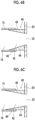
- first connecting portion 40 and the second connecting portion 50 have outer peripheral portions 44 and 54 surrounding the opening portions 42 and 52, respectively, as shown in Figs. 4A and 4B .
- the outer peripheral portions 44 and 54 have inner peripheral surfaces 46 and 56 facing the opening portions 42 and 52 and outer peripheral surfaces 48 and 58 positioned on an opposite side to the inner peripheral surfaces 46 and 56, respectively.
- the respective inner peripheral surfaces 46 and 56 of the first connecting portion 40 and the second connecting portion 50 are tapered surfaces as shown in Figs. 4A and 4B and are inclined with respect to the X-direction (first direction).
- the tapered surface is a surface in which the size of a cross section of which a normal direction is the X-direction changes concentrically.
- an inclined angle of each portion of the inner peripheral surfaces 46 and 56 with respect to the X-direction is 0.1 degrees or more and 45 degrees or less.
- the inclined angle of each portion of the inner peripheral surfaces 46 and 56 is an angle at which a bus bar of each portion of the inner peripheral surfaces 46 and 56 in a circumferential direction of the inner peripheral surfaces 46 and 56 is inclined with respect to the X-direction (in a strict sense, an acute angle) and is indicated by a symbol ⁇ in Figs. 4A and 4B .
- the bus bar of each portion of the inner peripheral surfaces 46 and 56 is an intersection line between a cut surface orthogonal to the inner peripheral surfaces 46 and 56 at each portion and the inner peripheral surfaces 46 and 56.
- the inclined angle ⁇ may be homogeneous in the circumferential direction of the inner peripheral surfaces 46 and 56 or may change according to positions in the circumferential direction.
- the magnitude of the inclined angle ⁇ is preferably 0.1 degrees to 30 degrees, more preferably 0.1 degrees to 20 degrees, and particularly preferably 0.1 degrees to 10 degrees.
- a cross sectional area of a downstream end (that is, an end on an in-housing ventilation path 26 side) of the opening portion 42 of the first connecting portion 40 and an opening area of the inlet opening 22 adjacent to the downstream end are identical to each other.
- a cross sectional area of an upstream end (that is, an end on the in-housing ventilation path 26 side) of the opening portion 52 of the second connecting portion 50 and an opening area of the outlet opening 24 adjacent to the upstream end are identical to each other.
- the opening area of each of the inlet opening 22 and the outlet opening 24 is a size of each opening and is an area surrounded by the edge of the opening.
- a level difference is not formed at a boundary position between the opening portion 42 of the first connecting portion 40 and the inlet opening 22 and a boundary position between the opening portion 52 of the second connecting portion 50 and the outlet opening 24. Accordingly, a defect caused by the level difference, specifically, generation of a pressure loss and wind noise caused by generation of a turbulent flow around the level difference can be suppressed.
- each of the first connecting portion 40 and the second connecting portion 50 is composed of a hose nipple type joint.
- unevenness is formed along the X-direction in the outer peripheral surfaces 48 and 58 of the respective connecting portions.
- the outer peripheral surfaces 48 and 58 are provided by connecting a plurality of portions having a convex shape (hereinafter, convex portions 60) in the X-direction.
- convex portions 60 the outer peripheral surfaces 48 and 58 project to the outer side at an end on a side closest to the housing 20, and the farther from the housing 20, the smaller the outer diameter of the convex portion 60 gradually becomes. That is, each convex portion 60 has a tapered shape.
- the first connecting portion 40 inserted inside the upstream tube body 15 consisting of a hose or the like can be prevented from coming off the upstream tube body 15, and a connection state of the upstream tube body 15 and the first connecting portion 40 can be well maintained.
- the second connecting portion 50 inserted inside the downstream tube body 17 consisting of a hose or the like can be prevented from coming off the downstream tube body 17, and a connection state of the downstream tube body 17 and the second connecting portion 50 can be well maintained.
- the wall thicknesses correspond to intervals between the inner peripheral surfaces 46 and 56 and the outer peripheral surfaces 48 and 58 of the outer peripheral portions 44 and 54, respectively.
- the wall thicknesses are defined with imaginary planes (shown by broken lines in Fig. 4C ) passing through a place of each convex portion 60 protruding most to the outer side as the outer peripheral surfaces 48 and 58.
- an inner diameter of the downstream end (the end on the in-housing ventilation path 26 side) of the opening portion 42 of the first connecting portion 40 that is, a minimum value of the inner diameter of the opening portion 42 is 150 mm or less.
- an inner diameter of the upstream end (the end on the in-housing ventilation path 26 side) of the opening portion 52 of the second connecting portion 50 that is, a minimum value of the inner diameter of the opening portion 52 is than 150 mm or less.
- the flow speed of an air current (wind) in the ventilation path becomes relatively high. Under the circumstances where the flow speed is high, an effect enabled by the ventilation system 10 of the present embodiment is significant. That is, as the flow speed becomes high, the pressure loss increases, and wind noise is easily generated. However, with the configuration described above, generation of a pressure loss and wind noise in the silencer 14 is effectively suppressed.
- the flow speed of the in-housing ventilation path 26 is, for example, 10 m/s or more under a general ventilation amount. Under such circumstances, an effect of suppressing generation of a pressure loss and wind noise in the silencer 14 is well exhibited.
- the inner diameter of the end on the in-housing ventilation path 26 side of each of the opening portions 42 and 52 is preferably 150 mm or less, more preferably 100 mm or less, and particularly preferably 50 mm or less.
- the inner diameter is preferably 1 mm or more from a perspective of forming accuracy.
- the invention is not limited thereto.
- each of the first connecting portion 40 and the second connecting portion 50 the farther from the housing 20, the smaller the wall thicknesses of the outer peripheral portions 44 and 54 in the embodiment described above, the invention is not limited thereto. The farther from the housing 20, the smaller the wall thicknesses of the outer peripheral portions 44 and 54 at any one tip portion may become.
- the cross sectional areas of the respective opening portions 42 and 52 of the first connecting portion 40 and the second connecting portion 50 linearly change in proportion to a distance from the in-housing ventilation path 26 in the X-direction.
- the cross sectional areas of the opening portions 42 and 52 may change non-linearly, for example, exponentially with respect to the distance from the in-housing ventilation path 26. That is, the respective inner peripheral surfaces 46 and 56 of the first connecting portion 40 and the second connecting portion 50 which are the tapered surfaces may be surfaces curved with respect to the X-direction.
- the inner peripheral surfaces 46 and 56 are surfaces in which the sizes of cross sections, of which normal directions are the X-direction, change concentrically in the embodiment described above, but without being limited thereto, as shown in Fig. 6B , may be surfaces in which the sizes of the cross sections change eccentrically.
- the respective outer peripheral surfaces 48 and 58 of the first connecting portion 40 and the second connecting portion 50 are surfaces in which unevenness is formed along the X-direction in the embodiment described above, the invention is not limited thereto.
- the outer peripheral surfaces 48 and 58 may be smooth surfaces in which unevenness is not formed.
- the first connecting portion 40 is inserted into the upstream tube body 15 and is connected to the upstream tube body 15, and the second connecting portion 50 is inserted into the downstream tube body 17 and is connected to the downstream tube body 17.
- a connecting mode of each connecting portion is not particularly limited. In a state where a tip of the first connecting portion 40 and a tip of the upstream tube body 15 abut against each other, both may be connected to each other. Similarly, in a state where a tip of the second connecting portion 50 and a tip of the downstream tube body 17 abut against each other, both may be connected to each other.
- both may be connected to each other.
- both may be connected to each other.
- a relationship between a degree of change in the cross sectional area of the opening portion and the pressure loss was acquired through calculation.
- a pressure loss in a case of passing through the opening portion 42 was acquired for each of a case where the cross sectional area of the opening portion 42 of the first connecting portion 40 changed (hereinafter, a case 1A) and a case where the cross sectional area did not change (hereinafter, a case 1B).
- a calculation model in which the upstream ventilation path 16, the opening portion 42, and the in-housing ventilation path 26 were configured as in Fig. 8A was adopted.
- an inclined angle (indicated by the symbol ⁇ in Fig. 8A ) of a tapered surface forming the inner peripheral surface 46 of the first connecting portion 40 was defined as a degree of change in the cross sectional area of the opening portion.
- the inclined angle ⁇ was set to 50 degrees, 45 degrees, 27 degrees, 15 degrees, and 9 degrees.
- an inner diameter (written as D1 in Figs. 8A and 8B ) of the upstream ventilation path 16 was set to 30 mm
- an inner diameter (written as D2 in Figs. 8A and 8B ) of the in-housing ventilation path 26 was set to 24 mm.
- a minimum value of the inner diameter of the opening portion 42 was set to the inner diameter D2 of the in-housing ventilation path 26.
- a relationship between a pressure at a predetermined position (a position written as x1 in Figs. 8A and 8B ) of the upstream ventilation path 16 and a flow speed at a predetermined position (a position written as x2 in Figs. 8A and 8B ) of the in-housing ventilation path 26 was acquired.
- a value of the flow speed at the position x2 was set, and a pressure required at the position x1 in order to achieve the set flow speed was acquired.
- a set value of the flow speed at the position x2 was changed, and a pressure at the position x1 was acquired for each set value.
- the flow speed was set to approximately 10 m/s, approximately 15 m/s, and approximately 23 m/s.
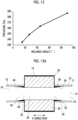
- Calculation results in Calculation example 1 are shown in Fig. 9 .
- an approximate curve showing a relationship between a pressure at the position x1 and a flow speed (wind speed) at the position x2 was acquired for each inclined angle ⁇ .
- the inclined angle ⁇ in a case where the inclined angle ⁇ was 45 degrees or less, a pressure at the position x1 decreased. For this reason, it was found that by making the inclined angle ⁇ 45 degrees or less, a resistance between the opening portion 42 of the first connecting portion 40 and the upstream ventilation path 16 was significantly reduced, and generation of a pressure loss at the position was suppressed. In addition, from Fig. 10 , it was found that a degree of reduction in the pressure loss increased as the inclined angle ⁇ decreased. For this reason, it is considered that the inclined angle ⁇ is preferably 30 degrees or less, more preferably 20 degrees or less, and particularly preferably 10 degrees or less.
- a pressure loss in a case of passing through the opening portion 52 was acquired for each of a case where the cross sectional area of the opening portion 52 of the second connecting portion 50 changed (hereinafter, a case 2A) and a case where the cross sectional area did not change (hereinafter, a case 2B).
- an inner diameter of the downstream ventilation path 18 was set to 30 mm, and an inner diameter of the in-housing ventilation path 26 was set to 24 mm.
- a minimum value of the inner diameter of the opening portion 52 was set to the inner diameter of the in-housing ventilation path 26.
- Example 1 the ventilation system 10 shown in Fig. 13A was produced.
- PVC polyvinyl chloride
- the sound absorbing member 30 consisting of a cylindrical sound absorbing material in which a hole having an inner diameter of 24 mm was open was disposed inside the housing 20.
- first connecting portion 40 was provided at an upstream end of the housing 20, and the second connecting portion 50 was provided at a downstream end.
- the length (protruding length) of each of the first connecting portion 40 and the second connecting portion 50 in the X-direction was 50 mm.
- an inner diameter of the end of each of the opening portions 42 and 52 on the side closest to the housing 20, that is, a minimum value of the inner diameter was 24 mm.
- the silencer 14 was disposed at the intermediate position of the ventilation path 12.
- Example 1 silencing characteristics of the silencer 14 were measured for the ventilation system 10 configured as described above. Specifically, a hose made of a resin, which was connected to one connecting portion, was connected to a speaker, which was a sound source, and white noise was flowed from the speaker. In addition, a hose made of a resin, which was connected to the other connecting portion, was disposed in a reverberant chamber, and a sound pressure in a case of flowing white noise was measured in the reverberant chamber.
- Measurement of the sound pressure was made in each of a case where there was the silencer 14 and a case where there was no silencer 14, and a silencing amount of the silencer 14 was calculated from a difference between both measurement results.
- Example 1 the hose made of a resin connected to the one connecting portion was connected to a fan (not shown), and a wind speed meter was attached to the hose made of a resin, which was connected to the other connecting portion. Then, a wind speed in a case where the fan was driven while changing an applied voltage to the fan (in other words, a rotation speed of the fan) and the silencer 14 was used was measured by the wind speed meter at a hose terminal.
- a ventilation system 10X shown in Fig. 13B was produced.
- cross sectional areas of respective opening portions 42X and 52X of a first connecting portion 40X and a second connecting portion 50X were constant.
- each of inner diameters of the opening portions 42X and 52X was constant specifically at 24 mm without being changed over a range from one end to the other end of the opening portion.
- FIG. 14 Measurement results of the silencing amount of the silencer for each of Example 1 and Comparative example are shown in Fig. 14 .
- a horizontal axis of Fig. 14 indicates a frequency of sound (the unit is Hz), and a vertical axis indicates a silencing amount (the unit is dB).
- the same degree of silencing amount was obtained. For this reason, it was found that an effect of the inclined angle of the inner peripheral surface (tapered surface) of each of the first connecting portion and the second connecting portion on the silencing amount was relatively small.
- Example 1 measurement results of the wind speed in a case where the silencer was used are shown in Table 1.
- Table 1 Wind speed (m/s) Voltage (V) Comparative Example Example 1 1.0 13.4 14.9 1.5 29.8 29.8 2.0 43.2 44.7 2.5 56.6 58.1 4.0 92.3 93.8
- Example 1 As can be seen from Table 1, a wind speed in a case where an applied voltage to the fan was adjusted to each set value of Table 1 was larger in Example 1 than in Comparative example. For this reason, in Example 1, it was found that a pressure loss in the ventilation path was smaller than Comparative example, and ventilation performance was improved.
Landscapes
- Engineering & Computer Science (AREA)
- General Engineering & Computer Science (AREA)
- Mechanical Engineering (AREA)
- Chemical & Material Sciences (AREA)
- Combustion & Propulsion (AREA)
- Physics & Mathematics (AREA)
- Acoustics & Sound (AREA)
- Multimedia (AREA)
- Aviation & Aerospace Engineering (AREA)
- Fluid Mechanics (AREA)
- Duct Arrangements (AREA)
Applications Claiming Priority (2)
| Application Number | Priority Date | Filing Date | Title |
|---|---|---|---|
| JP2021166659 | 2021-10-11 | ||
| PCT/JP2022/033290 WO2023062966A1 (fr) | 2021-10-11 | 2022-09-05 | Système de ventilation |
Publications (2)
| Publication Number | Publication Date |
|---|---|
| EP4417855A1 true EP4417855A1 (fr) | 2024-08-21 |
| EP4417855A4 EP4417855A4 (fr) | 2025-01-29 |
Family
ID=85987456
Family Applications (1)
| Application Number | Title | Priority Date | Filing Date |
|---|---|---|---|
| EP22880662.6A Pending EP4417855A4 (fr) | 2021-10-11 | 2022-09-05 | Système de ventilation |
Country Status (5)
| Country | Link |
|---|---|
| US (1) | US20240255177A1 (fr) |
| EP (1) | EP4417855A4 (fr) |
| JP (1) | JP7702494B2 (fr) |
| CN (1) | CN118076828A (fr) |
| WO (1) | WO2023062966A1 (fr) |
Families Citing this family (1)
| Publication number | Priority date | Publication date | Assignee | Title |
|---|---|---|---|---|
| WO2023062965A1 (fr) * | 2021-10-11 | 2023-04-20 | 富士フイルム株式会社 | Système de ventilation |
Family Cites Families (20)
| Publication number | Priority date | Publication date | Assignee | Title |
|---|---|---|---|---|
| FI56584C (fi) * | 1976-01-21 | 1980-02-11 | Temet Oy | Ljuddaempare foer luft- eller gasstoemningar |
| JPS6214472Y2 (fr) * | 1979-03-27 | 1987-04-13 | ||
| JPS63275887A (ja) * | 1987-04-30 | 1988-11-14 | 株式会社ブリヂストン | 消音器 |
| JPH02302552A (ja) * | 1989-05-16 | 1990-12-14 | Ryoko:Kk | 空調用消音器 |
| JPH08233346A (ja) * | 1995-02-24 | 1996-09-13 | Matsushita Seiko Co Ltd | 消音装置 |
| DE19533270C2 (de) * | 1995-09-08 | 1999-12-09 | Trinova Gmbh | Schalldämpfungsvorrichtung |
| US6116375A (en) * | 1995-11-16 | 2000-09-12 | Lorch; Frederick A. | Acoustic resonator |
| JP3508592B2 (ja) * | 1998-12-21 | 2004-03-22 | 日産自動車株式会社 | 吸音ダクト構造体 |
| JP4261379B2 (ja) | 2004-02-05 | 2009-04-30 | 株式会社荏原製作所 | サイレンサ |
| JP4764183B2 (ja) * | 2006-01-17 | 2011-08-31 | タイガースポリマー株式会社 | 冷却用消音ダクト |
| JP4791946B2 (ja) * | 2006-12-11 | 2011-10-12 | アロン化成株式会社 | 合成樹脂製の管継手 |
| SE532660C2 (sv) * | 2007-05-31 | 2010-03-16 | Swegon Ab | Ljuddämpare för ventilationskanaler |
| JP2015194335A (ja) * | 2014-03-26 | 2015-11-05 | 株式会社荏原製作所 | 消音チャンバ |
| CZ308291B6 (cs) * | 2014-04-10 | 2020-04-22 | Hanon Systems | Tlumicí zařízení a způsob jeho výroby |
| JP6869110B2 (ja) * | 2017-05-31 | 2021-05-12 | 株式会社荏原製作所 | 消音ユニットおよびこの消音ユニットを用いた消音構造体 |
| WO2019005858A1 (fr) * | 2017-06-28 | 2019-01-03 | 3M Innovative Properties Company | Conduit microperforé |
| SE543236C2 (en) * | 2018-03-02 | 2020-10-27 | Lindab Ab | A silencer for airflow in ventilation |
| JP7039440B2 (ja) * | 2018-11-01 | 2022-03-22 | 富士フイルム株式会社 | 消音換気構造 |
| CN112629002B (zh) * | 2021-01-06 | 2022-02-18 | 滁州市新华建筑安装有限责任公司 | 一种建筑工程暖通气流消声器 |
| WO2023062965A1 (fr) * | 2021-10-11 | 2023-04-20 | 富士フイルム株式会社 | Système de ventilation |
-
2022
- 2022-09-05 CN CN202280068240.8A patent/CN118076828A/zh active Pending
- 2022-09-05 EP EP22880662.6A patent/EP4417855A4/fr active Pending
- 2022-09-05 JP JP2023554992A patent/JP7702494B2/ja active Active
- 2022-09-05 WO PCT/JP2022/033290 patent/WO2023062966A1/fr not_active Ceased
-
2024
- 2024-04-10 US US18/631,524 patent/US20240255177A1/en active Pending
Also Published As
| Publication number | Publication date |
|---|---|
| WO2023062966A1 (fr) | 2023-04-20 |
| CN118076828A (zh) | 2024-05-24 |
| EP4417855A4 (fr) | 2025-01-29 |
| US20240255177A1 (en) | 2024-08-01 |
| JP7702494B2 (ja) | 2025-07-03 |
| JPWO2023062966A1 (fr) | 2023-04-20 |
Similar Documents
| Publication | Publication Date | Title |
|---|---|---|
| US11976673B2 (en) | Blower with silencer | |
| US20240255177A1 (en) | Ventilation system | |
| US20240183569A1 (en) | Air passage type silencer | |
| US20240255176A1 (en) | Ventilation system | |
| US20240183576A1 (en) | Silencer for ventilation passage | |
| US20240003275A1 (en) | Acoustic impedance change structure and air passage type silencer | |
| US20240426514A1 (en) | Ventilation-type silencer | |
| US12529487B2 (en) | Ventilation path with soundproof structure | |
| CN118742951A (zh) | 带消音器的风道 | |
| EP4425066A1 (fr) | Silencieux de ventilation | |
| US20250191565A1 (en) | Ventilation type silencer | |
| CN117859171A (zh) | 通风型消音器 | |
| US20240280290A1 (en) | Air passage type silencer | |
| US20240393001A1 (en) | Wind duct with silencer | |
| CN117859172A (zh) | 通气路用消声器 | |
| CN118235002A (zh) | 通风型消音器 | |
| CN121866396A (zh) | 声压降低构造 | |
| CN119836656A (zh) | 带消声器的风道 |
Legal Events
| Date | Code | Title | Description |
|---|---|---|---|
| STAA | Information on the status of an ep patent application or granted ep patent |
Free format text: STATUS: THE INTERNATIONAL PUBLICATION HAS BEEN MADE |
|
| PUAI | Public reference made under article 153(3) epc to a published international application that has entered the european phase |
Free format text: ORIGINAL CODE: 0009012 |
|
| STAA | Information on the status of an ep patent application or granted ep patent |
Free format text: STATUS: REQUEST FOR EXAMINATION WAS MADE |
|
| 17P | Request for examination filed |
Effective date: 20240327 |
|
| AK | Designated contracting states |
Kind code of ref document: A1 Designated state(s): AL AT BE BG CH CY CZ DE DK EE ES FI FR GB GR HR HU IE IS IT LI LT LU LV MC MK MT NL NO PL PT RO RS SE SI SK SM TR |
|
| DAV | Request for validation of the european patent (deleted) | ||
| DAX | Request for extension of the european patent (deleted) | ||
| A4 | Supplementary search report drawn up and despatched |
Effective date: 20250108 |
|
| RIC1 | Information provided on ipc code assigned before grant |
Ipc: G10K 11/172 20060101ALI20241223BHEP Ipc: F16L 33/30 20060101ALI20241223BHEP Ipc: B60H 1/00 20060101ALI20241223BHEP Ipc: G10K 11/16 20060101ALI20241223BHEP Ipc: F24F 13/24 20060101ALI20241223BHEP Ipc: F24F 13/02 20060101ALI20241223BHEP Ipc: F16L 33/24 20060101ALI20241223BHEP Ipc: F16L 55/033 20060101AFI20241223BHEP |