EP4420599A1 - Appareil et système de détection d'anomalie d'implant - Google Patents
Appareil et système de détection d'anomalie d'implant Download PDFInfo
- Publication number
- EP4420599A1 EP4420599A1 EP22876989.9A EP22876989A EP4420599A1 EP 4420599 A1 EP4420599 A1 EP 4420599A1 EP 22876989 A EP22876989 A EP 22876989A EP 4420599 A1 EP4420599 A1 EP 4420599A1
- Authority
- EP
- European Patent Office
- Prior art keywords
- unit
- signal
- pressure
- implant
- sensor
- Prior art date
- Legal status (The legal status is an assumption and is not a legal conclusion. Google has not performed a legal analysis and makes no representation as to the accuracy of the status listed.)
- Pending
Links
- 239000007943 implant Substances 0.000 title claims abstract description 243
- 230000005856 abnormality Effects 0.000 title claims abstract description 167
- 230000002159 abnormal effect Effects 0.000 claims abstract description 51
- 230000008859 change Effects 0.000 claims description 36
- 210000004369 blood Anatomy 0.000 claims description 8
- 239000008280 blood Substances 0.000 claims description 8
- 230000036772 blood pressure Effects 0.000 claims description 7
- 230000036760 body temperature Effects 0.000 claims description 7
- 230000036387 respiratory rate Effects 0.000 claims description 4
- 210000000481 breast Anatomy 0.000 description 141
- 208000019738 Abnormality of the breast Diseases 0.000 description 23
- 238000010586 diagram Methods 0.000 description 16
- 230000004888 barrier function Effects 0.000 description 14
- 238000000034 method Methods 0.000 description 13
- 229920001296 polysiloxane Polymers 0.000 description 12
- 238000001356 surgical procedure Methods 0.000 description 11
- 206010062575 Muscle contracture Diseases 0.000 description 10
- 208000006111 contracture Diseases 0.000 description 10
- 230000000694 effects Effects 0.000 description 6
- 102000004887 Transforming Growth Factor beta Human genes 0.000 description 4
- 108090001012 Transforming Growth Factor beta Proteins 0.000 description 4
- 239000002775 capsule Substances 0.000 description 4
- 238000002595 magnetic resonance imaging Methods 0.000 description 4
- 239000000463 material Substances 0.000 description 4
- ZRKFYGHZFMAOKI-QMGMOQQFSA-N tgfbeta Chemical compound C([C@H](NC(=O)[C@H](C(C)C)NC(=O)CNC(=O)[C@H](CCC(O)=O)NC(=O)[C@H](CCCNC(N)=N)NC(=O)[C@H](CC(N)=O)NC(=O)[C@H](CC(C)C)NC(=O)[C@H]([C@@H](C)O)NC(=O)[C@H](CCC(O)=O)NC(=O)[C@H]([C@@H](C)O)NC(=O)[C@H](CC(C)C)NC(=O)CNC(=O)[C@H](C)NC(=O)[C@H](CO)NC(=O)[C@H](CCC(N)=O)NC(=O)[C@@H](NC(=O)[C@H](C)NC(=O)[C@H](C)NC(=O)[C@@H](NC(=O)[C@H](CC(C)C)NC(=O)[C@@H](N)CCSC)C(C)C)[C@@H](C)CC)C(=O)N[C@@H]([C@@H](C)O)C(=O)N[C@@H](C(C)C)C(=O)N[C@@H](CC=1C=CC=CC=1)C(=O)N[C@@H](C)C(=O)N1[C@@H](CCC1)C(=O)N[C@@H]([C@@H](C)O)C(=O)N[C@@H](CC(N)=O)C(=O)N[C@@H](CCC(O)=O)C(=O)N[C@@H](C)C(=O)N[C@@H](CC=1C=CC=CC=1)C(=O)N[C@@H](CCCNC(N)=N)C(=O)N[C@@H](C)C(=O)N[C@@H](CC(C)C)C(=O)N1[C@@H](CCC1)C(=O)N1[C@@H](CCC1)C(=O)N[C@@H](CCCNC(N)=N)C(=O)N[C@@H](CCC(O)=O)C(=O)N[C@@H](CCCNC(N)=N)C(=O)N[C@@H](CO)C(=O)N[C@@H](CCCNC(N)=N)C(=O)N[C@@H](CC(C)C)C(=O)N[C@@H](CC(C)C)C(O)=O)C1=CC=C(O)C=C1 ZRKFYGHZFMAOKI-QMGMOQQFSA-N 0.000 description 4
- WQZGKKKJIJFFOK-GASJEMHNSA-N Glucose Natural products OC[C@H]1OC(O)[C@H](O)[C@@H](O)[C@@H]1O WQZGKKKJIJFFOK-GASJEMHNSA-N 0.000 description 3
- 206010061218 Inflammation Diseases 0.000 description 3
- 239000000945 filler Substances 0.000 description 3
- 239000008103 glucose Substances 0.000 description 3
- 230000004054 inflammatory process Effects 0.000 description 3
- 238000007689 inspection Methods 0.000 description 3
- 230000029058 respiratory gaseous exchange Effects 0.000 description 3
- 238000002604 ultrasonography Methods 0.000 description 3
- 238000002316 cosmetic surgery Methods 0.000 description 2
- 210000002950 fibroblast Anatomy 0.000 description 2
- 230000005484 gravity Effects 0.000 description 2
- 238000005259 measurement Methods 0.000 description 2
- 210000001616 monocyte Anatomy 0.000 description 2
- 230000002085 persistent effect Effects 0.000 description 2
- 230000001681 protective effect Effects 0.000 description 2
- 239000000758 substrate Substances 0.000 description 2
- 230000002123 temporal effect Effects 0.000 description 2
- 208000019901 Anxiety disease Diseases 0.000 description 1
- 206010006187 Breast cancer Diseases 0.000 description 1
- 208000026310 Breast neoplasm Diseases 0.000 description 1
- 102000008186 Collagen Human genes 0.000 description 1
- 108010035532 Collagen Proteins 0.000 description 1
- 206010016275 Fear Diseases 0.000 description 1
- 206010025282 Lymphoedema Diseases 0.000 description 1
- 230000009471 action Effects 0.000 description 1
- 230000036506 anxiety Effects 0.000 description 1
- 230000003796 beauty Effects 0.000 description 1
- 230000008901 benefit Effects 0.000 description 1
- 210000001772 blood platelet Anatomy 0.000 description 1
- 229920001436 collagen Polymers 0.000 description 1
- 229920001940 conductive polymer Polymers 0.000 description 1
- 238000005516 engineering process Methods 0.000 description 1
- 230000006870 function Effects 0.000 description 1
- 238000002347 injection Methods 0.000 description 1
- 239000007924 injection Substances 0.000 description 1
- 210000000265 leukocyte Anatomy 0.000 description 1
- 210000001165 lymph node Anatomy 0.000 description 1
- 208000002502 lymphedema Diseases 0.000 description 1
- 210000002540 macrophage Anatomy 0.000 description 1
- 238000002558 medical inspection Methods 0.000 description 1
- 230000004048 modification Effects 0.000 description 1
- 238000012986 modification Methods 0.000 description 1
- 230000001151 other effect Effects 0.000 description 1
- 239000012466 permeate Substances 0.000 description 1
- 238000007789 sealing Methods 0.000 description 1
- 230000007480 spreading Effects 0.000 description 1
- 230000006641 stabilisation Effects 0.000 description 1
- 238000011105 stabilization Methods 0.000 description 1
- 208000024891 symptom Diseases 0.000 description 1
- 230000008719 thickening Effects 0.000 description 1
- 210000001519 tissue Anatomy 0.000 description 1
Images




Classifications
-
- A—HUMAN NECESSITIES
- A61—MEDICAL OR VETERINARY SCIENCE; HYGIENE
- A61B—DIAGNOSIS; SURGERY; IDENTIFICATION
- A61B5/00—Measuring for diagnostic purposes; Identification of persons
- A61B5/0002—Remote monitoring of patients using telemetry, e.g. transmission of vital signals via a communication network
- A61B5/0031—Implanted circuitry
-
- A—HUMAN NECESSITIES
- A61—MEDICAL OR VETERINARY SCIENCE; HYGIENE
- A61B—DIAGNOSIS; SURGERY; IDENTIFICATION
- A61B5/00—Measuring for diagnostic purposes; Identification of persons
- A61B5/0048—Detecting, measuring or recording by applying mechanical forces or stimuli
- A61B5/0053—Detecting, measuring or recording by applying mechanical forces or stimuli by applying pressure, e.g. compression, indentation, palpation, grasping, gauging
-
- A—HUMAN NECESSITIES
- A61—MEDICAL OR VETERINARY SCIENCE; HYGIENE
- A61B—DIAGNOSIS; SURGERY; IDENTIFICATION
- A61B5/00—Measuring for diagnostic purposes; Identification of persons
- A61B5/48—Other medical applications
- A61B5/4851—Prosthesis assessment or monitoring
-
- A—HUMAN NECESSITIES
- A61—MEDICAL OR VETERINARY SCIENCE; HYGIENE
- A61B—DIAGNOSIS; SURGERY; IDENTIFICATION
- A61B5/00—Measuring for diagnostic purposes; Identification of persons
- A61B5/68—Arrangements of detecting, measuring or recording means, e.g. sensors, in relation to patient
- A61B5/6846—Arrangements of detecting, measuring or recording means, e.g. sensors, in relation to patient specially adapted to be brought in contact with an internal body part, i.e. invasive
- A61B5/6847—Arrangements of detecting, measuring or recording means, e.g. sensors, in relation to patient specially adapted to be brought in contact with an internal body part, i.e. invasive mounted on an invasive device
- A61B5/686—Permanently implanted devices, e.g. pacemakers, other stimulators, biochips
-
- A—HUMAN NECESSITIES
- A61—MEDICAL OR VETERINARY SCIENCE; HYGIENE
- A61B—DIAGNOSIS; SURGERY; IDENTIFICATION
- A61B5/00—Measuring for diagnostic purposes; Identification of persons
- A61B5/68—Arrangements of detecting, measuring or recording means, e.g. sensors, in relation to patient
- A61B5/6846—Arrangements of detecting, measuring or recording means, e.g. sensors, in relation to patient specially adapted to be brought in contact with an internal body part, i.e. invasive
- A61B5/6885—Monitoring or controlling sensor contact pressure
-
- A—HUMAN NECESSITIES
- A61—MEDICAL OR VETERINARY SCIENCE; HYGIENE
- A61F—FILTERS IMPLANTABLE INTO BLOOD VESSELS; PROSTHESES; DEVICES PROVIDING PATENCY TO, OR PREVENTING COLLAPSING OF, TUBULAR STRUCTURES OF THE BODY, e.g. STENTS; ORTHOPAEDIC, NURSING OR CONTRACEPTIVE DEVICES; FOMENTATION; TREATMENT OR PROTECTION OF EYES OR EARS; BANDAGES, DRESSINGS OR ABSORBENT PADS; FIRST-AID KITS
- A61F2/00—Filters implantable into blood vessels; Prostheses, i.e. artificial substitutes or replacements for parts of the body; Appliances for connecting them with the body; Devices providing patency to, or preventing collapsing of, tubular structures of the body, e.g. stents
- A61F2/02—Prostheses implantable into the body
- A61F2/12—Mammary prostheses
-
- A—HUMAN NECESSITIES
- A61—MEDICAL OR VETERINARY SCIENCE; HYGIENE
- A61F—FILTERS IMPLANTABLE INTO BLOOD VESSELS; PROSTHESES; DEVICES PROVIDING PATENCY TO, OR PREVENTING COLLAPSING OF, TUBULAR STRUCTURES OF THE BODY, e.g. STENTS; ORTHOPAEDIC, NURSING OR CONTRACEPTIVE DEVICES; FOMENTATION; TREATMENT OR PROTECTION OF EYES OR EARS; BANDAGES, DRESSINGS OR ABSORBENT PADS; FIRST-AID KITS
- A61F2/00—Filters implantable into blood vessels; Prostheses, i.e. artificial substitutes or replacements for parts of the body; Appliances for connecting them with the body; Devices providing patency to, or preventing collapsing of, tubular structures of the body, e.g. stents
- A61F2/02—Prostheses implantable into the body
- A61F2/48—Operating or control means, e.g. from outside the body, control of sphincters
-
- A—HUMAN NECESSITIES
- A61—MEDICAL OR VETERINARY SCIENCE; HYGIENE
- A61B—DIAGNOSIS; SURGERY; IDENTIFICATION
- A61B2562/00—Details of sensors; Constructional details of sensor housings or probes; Accessories for sensors
- A61B2562/02—Details of sensors specially adapted for in-vivo measurements
- A61B2562/0247—Pressure sensors
-
- A—HUMAN NECESSITIES
- A61—MEDICAL OR VETERINARY SCIENCE; HYGIENE
- A61B—DIAGNOSIS; SURGERY; IDENTIFICATION
- A61B5/00—Measuring for diagnostic purposes; Identification of persons
- A61B5/43—Detecting, measuring or recording for evaluating the reproductive systems
- A61B5/4306—Detecting, measuring or recording for evaluating the reproductive systems for evaluating the female reproductive systems, e.g. gynaecological evaluations
- A61B5/4312—Breast evaluation or disorder diagnosis
-
- A—HUMAN NECESSITIES
- A61—MEDICAL OR VETERINARY SCIENCE; HYGIENE
- A61F—FILTERS IMPLANTABLE INTO BLOOD VESSELS; PROSTHESES; DEVICES PROVIDING PATENCY TO, OR PREVENTING COLLAPSING OF, TUBULAR STRUCTURES OF THE BODY, e.g. STENTS; ORTHOPAEDIC, NURSING OR CONTRACEPTIVE DEVICES; FOMENTATION; TREATMENT OR PROTECTION OF EYES OR EARS; BANDAGES, DRESSINGS OR ABSORBENT PADS; FIRST-AID KITS
- A61F2/00—Filters implantable into blood vessels; Prostheses, i.e. artificial substitutes or replacements for parts of the body; Appliances for connecting them with the body; Devices providing patency to, or preventing collapsing of, tubular structures of the body, e.g. stents
- A61F2/02—Prostheses implantable into the body
-
- A—HUMAN NECESSITIES
- A61—MEDICAL OR VETERINARY SCIENCE; HYGIENE
- A61F—FILTERS IMPLANTABLE INTO BLOOD VESSELS; PROSTHESES; DEVICES PROVIDING PATENCY TO, OR PREVENTING COLLAPSING OF, TUBULAR STRUCTURES OF THE BODY, e.g. STENTS; ORTHOPAEDIC, NURSING OR CONTRACEPTIVE DEVICES; FOMENTATION; TREATMENT OR PROTECTION OF EYES OR EARS; BANDAGES, DRESSINGS OR ABSORBENT PADS; FIRST-AID KITS
- A61F2250/00—Special features of prostheses classified in groups A61F2/00 - A61F2/26 or A61F2/82 or A61F9/00 or A61F11/00 or subgroups thereof
- A61F2250/0001—Means for transferring electromagnetic energy to implants
- A61F2250/0002—Means for transferring electromagnetic energy to implants for data transfer
Definitions
- the present disclosure relates to a system and an apparatus for sensing an abnormality of a breast implant.
- a breast with beauty and volume is the shared wishes of most women.
- the breast implant is one of the easiest and most effective methods to realize the wishes of such women.
- the breast reconstruction employing the breast implant is a method of securing a space for inserting the breast implant in a breast and increasing the volume of the breast by inserting the breast implant in the secured space.
- Such breast implants are generally manufactured using a cohesive gel that is a silicone having a high cohesive force.
- the cohesive gel has an advantage in that an outer cover (shell) is strong and a shape is naturally formed after a surgery, remedying disadvantages of a conventional silicone gel (see, for example, Korean Pat. No. 10-1235284 , Korean Pat. No. 10-1966979 , and Japanese Pat. Laid-Open No. 2010-534551 ).
- the silicone component When a rupture is generated and a silicone component is remained in the body for a long time, the silicone component may permeate through the breast tissue, possibly causing a breast feeding hard and a difficulty in a breast cancer examination. Sometimes the silicone penetrates into a lymph node due to the rupture of the breast implant, and in this case, the penetrated silicone may be incompletely removed and a lymphedema after removing the silicone or a spreading of the silicone to the whole body may occur.
- the capsular contracture is a phenomenon generated from thickening of a capsule newly formed surrounding a breast implant, which is generated within the first two years after a surgery, which is one of the most popular side effects of the breast reconstruction employing the breast implant.
- a capsular contracture causes deformation and pain, and in a worse case, a reoperation is needed to remove the breast implant and to remove the capsule.
- US Pat. Pub. No 2009/0012372 describes a system and a method for sensing for the rupture of an implant.
- the abnormality of the implant is determined simply by attaching a sensor on the implant and receiving an abnormality signal from the sensor, there may be a risk of a false positive or a false negative.
- an apparatus for sensing an implant abnormality which includes: a wireless power transmitting unit for wirelessly transmitting power to at least one sensor module mounted on an implant inserted into the human body; a sensor signal receiving unit for receiving a pressure signal indicating a pressure applied to the implant from the sensor module; a storing unit for storing a predetermined reference pressure value and a first tolerance; an abnormality determining unit for determining whether the implant is abnormal based on the pressure signal received by the sensor signal receiving unit, and the reference pressure value and the first tolerance stored in the storing unit; a determination signal output unit for outputting the determination signal indicating whether the implant is abnormal, which is determined based on the pressure signal, and the reference pressure value and the first tolerance by the abnormality determining unit; a control unit for controlling the wireless power transmitting unit, the sensor signal receiving unit, the storing unit, the abnormality determining unit, and the determination signal output unit; and a power source unit for supplying the power to the wireless power transmitting unit, the sensor signal receiving
- the storing unit further stores a second tolerance
- the control unit compares an absolute value of a difference between the first pressure value and the second pressure value, and the second tolerance through the abnormality determining unit when the second pressure value is larger than the reference pressure value, and outputs the determination signal indicating whether the implant is abnormal through the determination signal output unit when the ab solute value of the difference between the fist pressure value and the second pressure value is smaller than a second tolerance.
- the control unit ignores the predetermined period when the first pressure value is larger than the reference pressure value, and receives a second pressure signal from the sensor module after the first time lapse, when receiving a first pressure signal from the sensor module according to a predetermined period, and ignores the manipulation of the user when the first pressure value is larger than the reference pressure value, and receives a second pressure signal from the sensor module after the first time lapse, when receiving the first pressure signal from the sensor module according to an arbitrary manipulation of a user.
- the sensor module includes a plurality of sensor modules, and the storing unit sets and stores the first tolerance differently for each of the plurality of sensor modules.
- the sensor module includes a plurality of sensor modules, and the storing unit sets and stores the first tolerance for any one sensor module among the plurality of sensor modules differently from other sensor modules.
- an apparatus for sensing an implant abnormality which includes: wireless power transmitting unit for wirelessly transmitting power to at least one sensor module mounted on an implant inserted into the human body; a sensor signal receiving unit for receiving a pressure signal indicating a pressure applied to the implant from the sensor module; a storing unit for storing a predetermined first tolerance; an abnormality determining unit for determining whether the implant is abnormal based on the pressure signal received by the sensor signal receiving unit, and the first tolerance stored in the storing unit; a determination signal output unit for outputting the determination signal indicating whether the implant is abnormal, which is determined based on the pressure signal, and the first tolerance by the abnormality determining unit; a control unit for controlling the wireless power transmitting unit, the sensor signal receiving unit, the storing unit, the abnormality determination unit and the determination signal output unit; and a power source unit for supplying the power to the wireless power transmitting unit, the sensor signal receiving unit, the storing unit, the abnormality determination unit, and the determination signal output unit through
- the storing unit further stores a predetermined second tolerance
- the control unit compares an absolute value of a difference between the first change amount and the second change amount, and the second tolerance through the abnormality determining unit when the second change amount is larger than the first tolerance, and outputs the determination signal indicating whether the implant is abnormal through the determination signal output unit when the absolute value of the difference between the first change amount and the second change amount is smaller than the second tolerance.
- the control unit ignores the predetermined period when the first change amount is larger than the first tolerance, and receives a second pressure signal from the sensor module after the first time lapse, when receiving a first pressure signal from the sensor module according to a predetermined period, and ignores the manipulation of the user when the first change amount is larger than the first tolerance, and receives a second pressure signal from the sensor module after the first time lapse, when receiving the first pressure signal from the sensor module according to an arbitrary manipulation of a user.
- the sensor module includes a plurality of sensor modules, and the storing unit sets and stores the first tolerance differently for each of the plurality of sensor modules.
- the sensor module includes a plurality of sensor modules, and the storing unit sets and stores the first tolerance for any one sensor module among the plurality of sensor modules differently from other sensor modules.
- the sensor signal receiving unit further receives a biometric signal representing at least one of heart rate, pulse, body temperature, blood pressure, respiratory rate, and blood sugar from the sensor module or the plurality of sensor modules, and the storing unit further stores the biometric signal received by the sensor signal receiving unit.
- a system for sensing an implant abnormality which includes: a user terminal receiving a pressure signal indicating a pressured applied to an implant from at least one sensor module mounted on the implant inserted into the human body, and transmitting the received pressure signal to the outside; and a remote server receiving the pressure signal from the user terminal, and determining whether the implant is abnormal based on the received pressure signal,
- the user terminal includes a wireless power transmitting unit for wirelessly transmitting power to the sensor module, a sensor signal receiving unit for receiving a pressure signal indicating a pressure applied to the implant from the sensor module, a signal transmitting unit for transmitting the pressure signal received by the sensor signal receiving unit to the remote server, a terminal control unit for controlling the wireless power transmitting unit, the sensor signal receiving unit, and the signal transmitting unit, and a terminal power source unit for supplying power to the wireless power transmitting unit, the sensor signal receiving unit, and the signal transmitting unit through the terminal control unit
- the remote server includes a signal receiving unit for receiving a
- a system for sensing an implant abnormality which includes: a user terminal receiving a pressure signal indicating a pressured applied to an implant from at least one sensor module mounted on the implant inserted into the human body, and transmitting the received pressure signal to the outside; and a remote server receiving the pressure signal from the user terminal, and determining whether the implant is abnormal based on the received pressure signal,
- the user terminal includes a wireless power transmitting unit for wirelessly transmitting power to the sensor module, a sensor signal receiving unit for receiving a pressure signal indicating a pressure applied to the implant from the sensor module, a signal transmitting unit for transmitting the pressure signal received by the sensor signal receiving unit to the remote server, a terminal control unit for controlling the wireless power transmitting unit, the sensor signal receiving unit, and the signal transmitting unit, and a terminal power source unit for supplying power to the wireless power transmitting unit, the sensor signal receiving unit, and the signal transmitting unit through the terminal control unit
- the remote server includes a signal receiving unit for receiving a
- the sensor signal receiving unit further receives a biometric signal representing at least one of heart rate, pulse, body temperature, blood pressure, respiratory rate, and blood sugar from the sensor module, the signal transmitting unit transmits the biometric signal received by the sensor signal receiving unit to the remote server, the signal receiving unit receives the biometric signal from the user terminal, and the storing unit further stores the biometric signal received from the user terminal.
- an apparatus for sensing an implant abnormality which includes: a wireless power transmitting unit for wirelessly transmitting power to a plurality of sensor modules mounted on an implant inserted into the human body; a sensor signal receiving unit for receiving a pressure signal indicating a pressure applied to the implant from each of the plurality of sensor modules; a storing unit for storing a reference pressure value predetermined for each of the plurality of sensor modules; an abnormality determining unit for determining whether the implant is abnormal based on the pressure signal received for each of the plurality of sensor modules and the reference pressure value stored in the storing unit for each of the plurality of sensor modules; a determination signal output unit for outputting the determination signal indicating whether the implant is abnormal, which is determined based on the pressure signal and the reference pressure value by the abnormality determining unit; a control unit for controlling the wireless power transmitting unit, the sensor signal receiving unit, the storing unit, the abnormality determination unit and the determination signal output unit; and a power source unit for supplying the power to
- an apparatus for sensing implant abnormality to minimize the false positive rate and the false negative rate by effectively sensing the abnormality of the implant after the procedure can be provided.
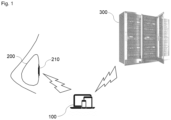
- Fig. 1 is a schematic diagram of a system and an apparatus 100 for sensing an abnormality of a breast implant according to at least one embodiment of the present disclosure.
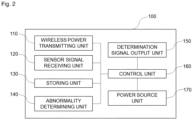
- Fig. 2 is a functional block diagram of the apparatus 100 for sensing an abnormality of a breast implant according to at least one embodiment of the present disclosure.
- the system for sensing an abnormality of a breast implant includes an apparatus 100 for sensing an abnormality of a breast implant 200 configured to receive a pressure signal indicating a pressure applied to the breast implant 200 from at least one sensor module 210 disposed on the breast implant 200 inserted in a body (breast) and to sense an abnormality of the breast implant 200 based on the pressure signal received from the sensor module 210 and a server 300 that is remotely connected with the apparatus 100 and configured to receive various pieces of data from the apparatus 100 and to store received data.
- the apparatus 100 is configured to receive a pressure signal indicating a pressure applied to the breast implant 200 from the sensor module 210 disposed on the breast implant 200, to output a determination signal by determining an abnormality in the breast implant 200 based on the pressure signal received from the sensor module 210, and to transmit various pieces of data including the pressure signal and the determination signal to the server 300 to allow the data to be stored in the server 300.
- the apparatus 100 includes a wireless power transmitting unit 110 configured to wirelessly transmit a power to the sensor module 210 disposed on the breast implant 200 that is to be inserted in a body (breast), a sensor signal receiving unit 120 configured to receive the pressure signal indicating the pressure applied to the breast implant 200 from the sensor module 210, a storing unit 130 configured to store a predetermined reference pressure value and a predetermined first tolerance, an abnormality determining unit 140 configured to determine an abnormality of the breast implant 200 based on the pressure signal received by the sensor signal receiving unit 120 and the reference pressure value and the first tolerance stored in the storing unit 130, a determination signal output unit 150 configured to output a determination signal indicating an abnormality or no abnormality in the breast implant 200 determined by the abnormality determining unit 140 based on the pressure signal, the reference pressure value, and the first tolerance, a control unit 160 configured to control the units 110 to 150, and a power source unit 170 configured to supply a power to the
- the control unit 160 controls the sensor signal receiving unit 120 to receive a first pressure signal from the sensor module 210 in a predetermined (set) period or in an arbitrary manner by an operation of a user, the abnormality determining unit 140 to compare a first pressure value indicated by the first pressure signal and the reference pressure value, when an absolute value of a difference between the first pressure value and the reference pressure value is larger than the first tolerance, the sensor signal receiving unit 120 to receive a second pressure signal from the sensor module 210 after a predetermined first time lapse, the abnormality determining unit 140 to compare a second pressure value indicated by the second pressure signal with the reference pressure value, and when an absolute value of a difference between the second pressure value and the reference pressure value is larger than the first tolerance, the determination signal output unit 150 to output a determination signal indicating an abnormality in the breast implant 200.
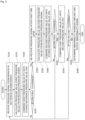
- Fig. 3 is a flowchart for explaining a method of sensing an abnormality of the breast implant 200 according to at least one embodiment of the present disclosure.
- each operation is performed by the control unit 160 to control each corresponding function module implemented as a program module in a processor and each corresponding hardware component.
- step S310 a pressure signal is received from a sensor (sensor module) of a breast implant in a predetermined period or by an arbitrary operation of a user.
- a pressure value (first pressure value) applied to the breast implant is calculated from the pressure signal received in step S310 (step S315).
- the first pressure value calculated in the above manner is then compared with a reference pressure value stored in advance (step S320).
- the reference pressure value is an actual pressure value measured in a predetermined stabilization time after a surgery and stored in a storing unit (memory).
- the reference pressure value is updated by re-measuring the actual pressure value in a predetermined time period.
- the reference pressure value indicates a pressure applied to the breast implant in a normal state; and therefore, when a pressure value indicated by a received pressure signal is larger or smaller than the reference pressure value by a predetermined amount, it is possible to determine that a rupture or a capsular contracture has occurred in the breast implant.
- step S330 As a result of comparing the calculated first pressure value with the stored reference pressure value, if an absolute value of a difference between the first pressure value and the reference pressure value is larger than the stored first tolerance (step S325, Yes), a second pressure signal is received from the sensor module after a predetermined first time lapse (step S330).
- a pressure value (second pressure value) is calculated from the received second pressure signal (step S335).
- the calculated second pressure value is then compared with the stored reference pressure value (step S340).
- step S345 if an absolute value of a difference between the second pressure value and the reference pressure value is larger than the first tolerance (step S345, Yes), a determination signal indicating an abnormality in the breast implant is outputted (step S360).
- step S325 if the absolute value of the difference between the first pressure value and the reference pressure value is larger than the first tolerance, that is, if it is determined that an abnormal pressure is applied to the sensor disposed on the breast implant, it may be necessary to determine whether such an abnormal pressure is temporary or persisting.
- the second pressure signal is received from the sensor module after the predetermined first time lapse.
- the control unit upon receiving the pressure signal from the sensor module in the predetermined period, when the first pressure value is larger than the reference pressure value, the control unit receives the second pressure signal from the sensor module after the first time lapse, ignoring the predetermined period.
- the control unit upon receiving the pressure signal from the sensor module by an arbitrary operation of a user, when the first pressure value is larger than the reference pressure value, the control unit receives the second pressure signal from the sensor module after the first time lapse, ignoring the operation of the user.
- the first time is a time for determining whether the abnormal pressure is applied to the sensor disposed on the breast implant temporarily or constantly, which can be set longer or shorter than the predetermined period.
- the time obtained by dividing t1 by a predetermined integer can be set as the first time.
- t1 is set to 12 hours
- 2 hours which is the value of t1 divided by 6 can be set as the first time (sixth rule)
- 2.4 hours which is the value of t1 divided by 5 can be set as the first time (quintile method)
- 3 hours which is the value of t1 divided by 4 can be set as the first time (quarter method)
- 4 hours which is the value of t1 divided by 3 can be set as the first time (trichotomous method)
- 6 hours which is the value of t1 divided by 2 can be set as the first time (dichotomy).
- the predetermined integer may be set to a value of 6 or more depending on the setting value of t1, and the larger this value is, the shorter the interval to the first time can be set, and the smaller this value, the longer the interval to the first time can be set.
- step S350 as a result of comparing the second pressure value with the reference pressure value, if the absolute value of the difference between the second pressure value and the reference pressure value is larger than the first tolerance (step S345, Yes), the first pressure value is compared with the second pressure value (step S350).
- step S355 if an absolute value of a difference between the first pressure value and the second pressure value is smaller than a second tolerance (step S355, No), a determination signal indicating an abnormality in the breast implant is outputted (step S360).
- the first pressure value is compared with the second pressure value in the above manner because, if there is a big difference between the pressure values before and after the first time, it is possible to determined that the abnormal pressure is more likely applied to the breast implant in a temporal manner, and if there is a small difference between the pressure values before and after the first time within the second tolerance, it is possible to determine that the abnormal pressure is applied to the breast implant constantly for the first time, meaning that an abnormality has occurred in the breast implant.
- the apparatus 100 can sense an abnormality in a breast implant after a surgery in an effective manner, thus minimizing the risk of the false positive and the false negative.
- Fig. 4 is a flowchart for explaining a method of sensing an abnormality of the breast implant 200 according to at least one embodiment of the present disclosure.
- a pressure signal (first pressure signal) is received from a sensor (sensor module) of a breast implant in a predetermined period or by an arbitrary operation of a user.
- a first variation indicating a difference between a current first pressure signal and a previous first pressure signal is calculated (step S415).
- the calculated first variance is then compared with a first tolerance stored in advance (step S420).
- step S425, Yes a second pressure signal is received from the sensor module after a predetermined first time lapse (step S430).
- a second variance indicating a difference between the first pressure signal and the second pressure signal is calculated (step S435).
- the calculated second variance is then compared with the first tolerance (step S440).
- step S445 if the second variance is larger than the first tolerance (step S445, Yes), a determination signal indicating an abnormality in the breast implant is outputted (step S460).
- the first variance calculated in step S425 if the first variance is larger than the first tolerance, that is, if it is determined that an abnormal pressure is applied to the sensor disposed on the breast implant, it may be necessary to determine whether such an abnormal pressure is temporary or persisting.
- the second pressure signal is received from the sensor module after the predetermined first time lapse.
- the control unit upon receiving the pressure signal from the sensor module in the predetermined period, when the first variance is larger than the first tolerance, the control unit receives the second pressure signal from the sensor module after the first time lapse, ignoring the predetermined period.
- the control unit upon receiving the pressure signal from the sensor module by an arbitrary operation of a user, when the first variance is larger than the first tolerance, the control unit receives the second pressure signal from the sensor module after the first time lapse, ignoring the operation of the user.
- the first time is a time for determining whether the abnormal pressure is applied to the sensor disposed on the breast implant temporarily or constantly, which can be set equal to or longer or shorter than the predetermined period.
- step S450 as a result of comparing the second variance with the first tolerance, if the second variance is larger than the first tolerance (step S445, Yes), the first variance is compared with the second variance (step S450).
- step S455 if an absolute value of a difference between the first variance and the second variance is smaller than a second tolerance (step S455, No), a determination signal indicating an abnormality in the breast implant is outputted (step S460).
- the first variance is compared with the second variance in the above manner because, if there is a big difference between the pressure values before and after the first time, it is possible to determined that the abnormal pressure is more likely applied to the breast implant in a temporal manner, and if there is a small difference between the pressure values before and after the first time within the second tolerance, it is possible to determine that the abnormal pressure is applied to the breast implant constantly for the first time, meaning that an abnormality has occurred in the breast implant.
- the apparatus 100 can sense an abnormality in a breast implant after a surgery in an effective manner, thus minimizing the risk of the false positive and the false negative.
- the sensor signal receiving unit 120 further receives a bio-signal indicating at least one of heart rate, pulse, body temperature, blood pressure, breathing rate, and blood glucose from the sensor module 210, and the storing unit 130 further stores the bio-signal received by the sensor signal receiving unit 120.
- control unit 160 stores various pieces of data including the pressure signal, the determination signal, and the bio-signal in the storing unit 130, and in at least one embodiment of the present disclosure, the control unit 160 transmits the data to the server 300 so that the server 300 stores therein the data.
- Fig. 5 is a functional block diagram an apparatus for sensing an abnormality of a breast implant in a system for sensing an abnormality of a breast implant according to at least one embodiment of the present disclosure.
- Fig. 6 is a functional block diagram a server for sensing an abnormality of a breast implant in a system for sensing an abnormality of a breast implant according to at least one embodiment of the present disclosure.
- the system for sensing an abnormality of a breast implant includes an apparatus (user terminal) 500 for sensing an abnormality in a breast implant configured to receive a pressure signal indicating a pressure applied to a breast implant from at least one sensor module dispose on the breast implant inserted in a body and to transmit the pressure signal to outside and a server (remote server) 600 for sensing an abnormality of a breast implant configured to receive the pressure signal from the user terminal 500 and to determine an abnormality in the breast implant based on the received pressure signal.
- an apparatus (user terminal) 500 for sensing an abnormality in a breast implant configured to receive a pressure signal indicating a pressure applied to a breast implant from at least one sensor module dispose on the breast implant inserted in a body and to transmit the pressure signal to outside
- a server 600 for sensing an abnormality of a breast implant configured to receive the pressure signal from the user terminal 500 and to determine an abnormality in the breast implant based on the received pressure signal.
- the user terminal 500 includes a wireless power transmitting unit 510 configured to wirelessly transmit a power to the sensor module 210, a sensor signal receiving unit 520 configured to receive a pressure signal indicating a pressure applied to the breast implant 200 from the sensor module 210, a signal transmitting unit 530 configured to transmit the pressure signal received by the sensor signal receiving unit 520 to the remote server 600, a terminal control unit 540 configured to control the units 510 to 530, and a terminal power source unit 550 configured to supply a power to the units 510 to 530 through the terminal control unit 540.
- a wireless power transmitting unit 510 configured to wirelessly transmit a power to the sensor module 210
- a sensor signal receiving unit 520 configured to receive a pressure signal indicating a pressure applied to the breast implant 200 from the sensor module 210
- a signal transmitting unit 530 configured to transmit the pressure signal received by the sensor signal receiving unit 520 to the remote server 600
- a terminal control unit 540 configured to control the units 510 to 530
- the remote server 600 includes a signal receiving unit 610 from the user terminal 500, a storing unit 620 configured to store a predetermined reference pressure value and a predetermined first tolerance, an abnormality determining unit 630 configured to determine an abnormality of the breast implant based on the pressure signal received from the user terminal 500 and the reference pressure value and the first tolerance stored in the storing unit 620, a determination signal output unit 640 configured to output a determination signal indicating an abnormality or no abnormality in the breast implant determined by the abnormality determining unit 630 based on the pressure signal, the reference pressure value, and the first tolerance, a server control unit 650 configured to control the units 610 to 640, and a server power source unit 660 configured to supply a power to the units 610 to 640 through the server control unit 650.
- a server control unit 650 configured to control the units 610 to 640
- a server power source unit 660 configured to supply a power to the units 610 to 640 through the server control unit 650.
- the server control unit 650 receives a first pressure signal through the terminal control unit 540, the first pressure signal is received from the sensor module 210 in a predetermined (set) period or in an arbitrary manner by an operation of a user, the abnormality determining unit 630 to compare a first pressure value indicated by the first pressure signal and the reference pressure value, when an absolute value of a difference between the first pressure value and the reference pressure value is larger than the first tolerance, receive a second pressure signal through the terminal control unit 540, the second pressure signal is received from the sensor module 210 after a predetermined first time lapse, the abnormality determining unit 630 to compare a second pressure value indicated by the second pressure signal with the reference pressure value, and when an absolute value of a difference between the second pressure value and the reference pressure value is larger than the first tolerance, the determination signal output unit 640 to output a determination signal indicating an abnormality in the breast implant 200.
- the remote server 600 includes a receiving unit 610, a storing unit 620, an abnormality determining unit 630, a determination signal output unit 640, a server control unit 650, and a server power source unit 660.
- the signal receiving unit 610 is configured to receive the pressure signal from the user terminal 500
- the storing unit 620 is configured to store a predetermined first tolerance
- the abnormality determining unit 630 is configured to determine an abnormality in the breast implant 200 based on the pressure signal received from the user terminal 500 and the first tolerance stored in the storing unit 620
- the determination signal output unit 640 is configured to output a determination signal indicating an abnormality in the breast implant 200 determined by the abnormality determining unit 630 based on the pressure signal and the first tolerance
- the server control unit 650 is configured to control the units 610 to 640
- the server power source unit 660 is configured to supply a power to the units 610 to 640 through the server control unit 650.
- the server control unit 650 receives a first pressure signal through the terminal control unit 540, the first pressure signal is received from the sensor module 210 in a predetermined (set) period or in an arbitrary manner by an operation of a user, the abnormality determining unit 630 to compare a first variance indicating a difference between the current first pressure signal and the previous first pressure signal with the first tolerance, when the first variance is larger than the first tolerance, receive a second pressure signal through the terminal control unit 540, the second pressure signal is received from the sensor module 210 after a predetermined first time lapse, the abnormality determining unit 630 to compare a second variance indicating a difference between the first pressure signal and the second pressure signal, and if the second variance is larger than the first tolerance, the determination signal output unit 640 to output a determination signal indicating an abnormality in the breast implant 200.
- the sensor signal receiving unit 520 further receives a bio-signal indicating at least one of heart rate, pulse, body temperature, blood pressure, breathing rate, and blood glucose from the sensor module 210, and the signal transmitting unit 530 transmits the bio-signal received by the sensor signal receiving unit 520 alone or with the pressure signal and the determination signal to outside.
- the user terminal 500 shown in Fig. 5 is configured to receive the pressure signal from the sensor module 210 and to transmit the pressure signal to the remote server 600 without storing the pressure signal or determining an abnormality of the breast implant, which makes the structure simple.
- the pressure signal transmitted from the user terminal 500 is stored in the remote server 600 so that the abnormality of the breast implant is determined in the remote server 600.
- the remote server 600 receives and stores the bio-signal.
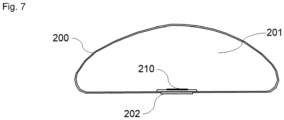
- Fig. 7 is a schematic diagram of the breast implant 200 including a sensor patch according to at least one embodiment of the present disclosure.
- the breast implant 200 is manufactured with, for example, a silicone material and is used for a plastic surgery of a breast, a hip, or the like, which is inserted in a body and forms and maintains a consistent shape in the body.
- the breast implant and the apparatus for sensing an abnormality of a breast implant can be applied to most implants including a shell and a gel-type filler and being inserted in a body for a specific purpose.
- the breast implant 200 includes a shell 201 forming an outer cover of teardrop type or round type, a silicone gel as a filler injected into the shell 201, and a patch 202 for sealing an injection hole for injecting the silicone gel.
- the patch 202 includes a sensor module 210 including a pressure sensor for sensing a pressure applied to the breast implant 200.
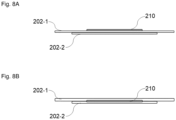
- Figs. 8A and 8B are schematic diagrams patches each including a pressure sensor according to at least one embodiment of the present disclosure.
- the patch 202 includes a first barrier (inner barrier) 202-1 forming a first side facing inside the breast implant 200 upon being attached on the breast implant 200 with the filler of the gel state injected, a second barrier (outer barrier) 202-2 facing the first barrier 202-1 and forming a second side opposite to the first side.
- the sensor module 210 is disposed on the first side of the first barrier 202-1.
- the sensor module 210 is disposed between the first barrier 202-1 and the second barrier 202-2.
- the patch 202 is a unit member formed by a first barrier 211 and a second barrier 212 making contact with each other.
- the first barrier 202-1 forms the inner side of the patch 202
- the second barrier 202-2 forms the outer side of the patch 202.
- Fig. 9 is an exploded view of the sensor module 210 according to at least one embodiment of the present disclosure.
- the sensor module 210 is formed as a film including two protective films 910, 930 and a substrate 920 between the two protective films 910, 930.
- the substrate 920 On the substrate 920, at least one pressure sensor 923 for sensing a pressure applied on the breast implant and outputting a pressure signal, a controller 922 for transmitting the pressure signal from the pressure sensor 923 to the outside, and a wireless power receiving unit 921 for receiving a power from the outside and providing the power to the controller 922.
- the pressure sensor 923 is an element that, when a predetermined pressure or force is applied, generates a signal proportional to the pressure or the force applied.
- the pressure sensor 923 includes a diaphragm sensor that curves according to the pressure or the force applied, a force sensing resistor (FSR) including two conductive plate and a conductive polymer between the two conductive plate, and a piezoelectric element that generates a voltage when a pressure is applied.
- FSR force sensing resistor
- a tension sensor that senses a tension of the shell of the breast implant can be used instead of the pressure sensor; however, as a change of the tension is also a physical amount proportional to a change of the pressure due to the rupture or the capsular contracture of the breast implant, the tension sensor is considered as a type of the pressure sensor in the present specification.
- the sensor module 210 further includes a battery 924 for storing the power received by the wireless power receiving unit 921 in a wireless manner.
- the sensor module 210 can operate either by receiving the power in a wireless manner without a battery or by charging a battery with the power received in a wireless manner.
- the sensor module 210 includes at least one of a heart rate sensor, a pulse sensor, a body temperature sensor, a blood pressure sensor, a breathing rate sensor, and a blood glucose sensor.
- Fig. 10A is a schematic diagram for explaining pressures applied to the breast implant 200 inserted in a breast in at least one embodiment of the present disclosure.
- Fig. 10B is a schematic diagram showing an example of attaching a patch including a sensor module according to at least one embodiment of the present.
- a pressure A is applied on the breast implant 200 from outside a body
- a pressure B is applied on the breast implant 200 from or against inside the body
- pressure C is applied on the breast implant 200 due to the gravity.
- a silicone gel is inserted in a shell of a breast implant.
- the breast implant is sealed by a patch at a position on the bottom of the breast implant (near a position indicated by B) in a manner that a consistent tension is maintained.
- B a position on the bottom of the breast implant
- at least one of the pressures A, B, and C is changed.
- MRI magnetic resonance imaging
- TGF- ⁇ transforming growth factor ⁇
- monocytes The monocyte is a sort of the white blood cell, which develops into a macrophage near the inflammation and secretes the TGF- ⁇ again. This results in a fibroblast near the inflammation and a collagen synthesized from the fibroblast generates the capsular contracture.
- a pressure A is applied on the breast implant 200 from outside a body
- a pressure B is applied on the breast implant 200 from or against inside the body
- pressure C is applied on the breast implant 200 due to the gravity. Therefore, with a patch including a pressure sensor disposed on at least one of sites A, B, and C, it is possible to notify a user of an abnormality of the breast implant by sending a change of the pressure when the abnormality occurred on the breast implant.
- a patch including a sensor module 210-1 can be disposed on the site A
- a patch including a sensor module 210-2 can be disposed on the site B
- a patch including a sensor module 210-3 can be disposed on the site C.
- the apparatus for sensing the abnormality of the breast implant and the system for sensing the abnormality of the breast implant store the reference pressure and the first tolerance for each of a plurality of positions, for example, the sites A, B, and C shown in Fig. 10A , in the memory.
- the apparatus for sensing the abnormality of the breast implant and the system for sensing the abnormality of the breast implant are supposed to output an abnormality of the breast implant when, for example, a difference between at least one of a plurality of pressure signals received respectively from the sensor modules disposed at a plurality of sites and a reference pressure stored in association with the corresponding site exceeds a predetermined value.
- the apparatus for sensing the abnormality of the breast implant and the system for sensing the abnormality of the breast implant can set the first tolerance for determining the abnormality in a pressure signal received from one sensor module larger than the first tolerances for determining the abnormality in pressure signals received from the other sensor modules.
- the apparatus for sensing the abnormality of the breast implant and the system for sensing the abnormality of the breast implant can set different first tolerances for a plurality of sites from each other to determine the abnormality.
- the apparatus for sensing the abnormality of the breast implant and the system for sensing the abnormality of the breast implant according to at least one embodiment of the present disclosure can set, for example, the first tolerance for the bottom of the breast implant (the site C in Fig. 10A ) larger or smaller than those for the other sites.
- a user when there is a change in the pressure due to the rupture or the capsular contracture, a user is notified of the rupture or the capsular contracture of the breast implant according to the change of the pressure, to enable the user to take a proper action at the right time.
- This can help the user to remove an anxiety about maintaining the breast with safety for a long time after inserting the breast implant in the breast, and at the same time, to relieve an inconvenience of taking an ultrasound inspection or an MRI inspection on a regular basis.
- an apparatus for sensing an abnormality of a breast implant which can minimize a false positive and a false negative by sensing the abnormality of the breast implant in an effective manner after a surgery.
- a system for sensing an abnormality of a breast implant which can minimize a false positive and a false negative by sensing the abnormality of the breast implant in an effective manner after a surgery.
- patients can quickly sense an abnormal state of the implant in real time immediately after surgery or even after a certain period of time, and do not have to visit the hospital with vague fears, leading to a better quality of life.
- the present disclosure can also help to more quickly and accurately recognize the need to visit the hospital.
- the present disclosure provides an apparatus for sensing an implant abnormality to minimize a false positive rate and a false negative rate by effectively sensing the abnormality of an implant after a procedure, so the apparatus for sensing an implant abnormality can be applied to medical treatment and plastic surgery using implants.
Landscapes
- Health & Medical Sciences (AREA)
- Life Sciences & Earth Sciences (AREA)
- Engineering & Computer Science (AREA)
- Animal Behavior & Ethology (AREA)
- General Health & Medical Sciences (AREA)
- Veterinary Medicine (AREA)
- Public Health (AREA)
- Biomedical Technology (AREA)
- Heart & Thoracic Surgery (AREA)
- Medical Informatics (AREA)
- Molecular Biology (AREA)
- Surgery (AREA)
- Biophysics (AREA)
- Physics & Mathematics (AREA)
- Pathology (AREA)
- Transplantation (AREA)
- Cardiology (AREA)
- Oral & Maxillofacial Surgery (AREA)
- Vascular Medicine (AREA)
- Computer Networks & Wireless Communication (AREA)
- Measuring And Recording Apparatus For Diagnosis (AREA)
- Physiology (AREA)
- Pulmonology (AREA)
- Prostheses (AREA)
Applications Claiming Priority (2)
| Application Number | Priority Date | Filing Date | Title |
|---|---|---|---|
| KR1020210131279A KR102639503B1 (ko) | 2021-10-03 | 2021-10-03 | 보형물 이상 감지 장치 및 보형물 이상 감지 시스템 |
| PCT/KR2022/014862 WO2023055218A1 (fr) | 2021-10-03 | 2022-09-30 | Appareil et système de détection d'anomalie d'implant |
Publications (2)
| Publication Number | Publication Date |
|---|---|
| EP4420599A1 true EP4420599A1 (fr) | 2024-08-28 |
| EP4420599A4 EP4420599A4 (fr) | 2025-04-23 |
Family
ID=84357721
Family Applications (1)
| Application Number | Title | Priority Date | Filing Date |
|---|---|---|---|
| EP22876989.9A Pending EP4420599A4 (fr) | 2021-10-03 | 2022-09-30 | Appareil et système de détection d'anomalie d'implant |
Country Status (6)
| Country | Link |
|---|---|
| US (1) | US20240122480A1 (fr) |
| EP (1) | EP4420599A4 (fr) |
| JP (1) | JP7185367B1 (fr) |
| KR (2) | KR102639503B1 (fr) |
| CN (1) | CN118055729A (fr) |
| WO (1) | WO2023055218A1 (fr) |
Families Citing this family (2)
| Publication number | Priority date | Publication date | Assignee | Title |
|---|---|---|---|---|
| ES2721007T3 (es) * | 2012-09-17 | 2019-07-26 | Jamm Tech Inc | Implantes de mama con transpondedores integrados |
| CN117255643A (zh) * | 2021-02-21 | 2023-12-19 | W.人工智能有限公司 | 乳房植入体和用于感测乳房植入体的异常的装置 |
Family Cites Families (38)
| Publication number | Priority date | Publication date | Assignee | Title |
|---|---|---|---|---|
| US5833603A (en) * | 1996-03-13 | 1998-11-10 | Lipomatrix, Inc. | Implantable biosensing transponder |
| US20040162613A1 (en) * | 2003-02-06 | 2004-08-19 | Thomas Roballey | Cosmetic and reconstructive prosthesis containing a biologically compatible rupture indicator |
| US20050149186A1 (en) * | 2003-02-06 | 2005-07-07 | Rfs Health Sciences, Inc. | Cosmetic and reconstructive prosthesis containing a biologically compatible rupture indicator |
| JP2005291122A (ja) | 2004-04-01 | 2005-10-20 | Toyota Motor Corp | 自動車用蒸発燃料処理装置の故障診断方法および故障診断装置 |
| US7682313B2 (en) * | 2005-11-23 | 2010-03-23 | Vital Sensors Holding Company, Inc. | Implantable pressure monitor |
| US20090012372A1 (en) | 2006-06-12 | 2009-01-08 | Novalert, Inc. | External sensing for implant rupture |
| ES2787705T3 (es) | 2007-07-27 | 2020-10-16 | Allergan Inc | Prótesis mamarias rellenas de gel elastomérico de barrera total |
| ES2472322T3 (es) * | 2008-10-17 | 2014-06-30 | Allergan, Inc. | Envoltorio de implante prot�sico |
| WO2011022235A2 (fr) * | 2009-08-18 | 2011-02-24 | Allergan, Inc. | Implant prothétique renforcé avec enveloppe souple |
| US20110077719A1 (en) * | 2009-09-30 | 2011-03-31 | Broadcom Corporation | Electromagnetic power bio-medical unit |
| FR2952806B1 (fr) * | 2009-11-20 | 2012-08-10 | Thierry Brinon | Implant destine a la reconstruction anatomique ou l'augmentation volumetrique |
| US20120302874A1 (en) * | 2009-12-01 | 2012-11-29 | Hollstien David S | Non-invasive implant rupture detection system |
| BR112012013276A2 (pt) * | 2009-12-01 | 2019-09-24 | Stuart David | sistema de detecção de ruptura,dispositivo para detectar descontinuidade em um revestimento,método para detectar descontinuidade em um revestimento de implantes de mama |
| CN102145689B (zh) | 2011-02-14 | 2013-06-05 | 中国铁道科学研究院机车车辆研究所 | 一种用于检测列车自动空气制动系统故障的方法及装置 |
| KR101235284B1 (ko) | 2011-06-23 | 2013-02-21 | 유원석 | 응력집중을 최소화한 실리콘 인공유방 보형물 및 그 제조방법 |
| US9826904B2 (en) * | 2012-09-14 | 2017-11-28 | Vanderbilt University | System and method for detecting tissue surface properties |
| US10874496B2 (en) | 2014-06-25 | 2020-12-29 | Canary Medical Inc. | Devices, systems and methods for using and monitoring implants |
| EP3413788B1 (fr) * | 2016-02-09 | 2025-08-06 | Establishment Labs S.A. | Transpondeurs et capteurs pour dispositifs médicaux implantables |
| US11191479B2 (en) * | 2016-03-23 | 2021-12-07 | Canary Medical Inc. | Implantable reporting processor for an alert implant |
| IL305116A (en) * | 2016-05-11 | 2023-10-01 | Estab Labs S A | Medical implants and methods for their preparation |
| WO2018026945A1 (fr) * | 2016-08-03 | 2018-02-08 | Yuri Smirnov | Capteurs passifs et structures associées destinés à des dispositifs biomédicaux implantables |
| US10631975B2 (en) * | 2016-09-23 | 2020-04-28 | Biosense Webster (Israel) Ltd. | Detection of leakage in implants |
| GB201805484D0 (en) * | 2018-04-04 | 2018-05-16 | Gc Aesthetics Mfg Ltd | Implant |
| KR101966979B1 (ko) | 2018-04-25 | 2019-08-27 | 김한조 | 인체 주입 필러를 이용한 가슴보형물의 제조방법 |
| US11647990B2 (en) * | 2018-12-05 | 2023-05-16 | Verathon Inc. | Implant assessment using ultrasound and optical imaging |
| WO2020160498A1 (fr) * | 2019-01-31 | 2020-08-06 | The University Of Chicago | Sein bionique |
| US10702635B1 (en) * | 2019-04-10 | 2020-07-07 | A LaRue Company | Suction device for medical use in removing material from a surgical site or similar |
| US11751806B2 (en) * | 2019-08-12 | 2023-09-12 | Tyler Richard Train | Biophotonic medical imaging device for detection of abnormalities in human tissue and methods for using same |
| KR102260203B1 (ko) | 2019-09-06 | 2021-06-04 | 오스템임플란트 주식회사 | 보형 디바이스 |
| BR112022018883A2 (pt) * | 2020-03-22 | 2022-12-13 | Collplant Ltd | Formulações à base de colágeno utilizáveis como preenchimentos de tecidos moles e/ou implantes |
| KR102580424B1 (ko) * | 2021-02-19 | 2023-09-18 | 오스템임플란트 주식회사 | 다양한 물성의 실리콘 겔을 포함하는 유방 보형물 |
| JP6952209B1 (ja) * | 2021-02-21 | 2021-10-20 | キム ジェホンKim, Jae Hong | 豊胸用インプラントバッグ及び豊胸用インプラントバッグの異常感知装置 |
| EP4295752A4 (fr) * | 2021-02-21 | 2024-12-25 | W.Al Co., Ltd. | Prothèse mammaire et appareil de détection d'anomalies dans une prothèse mammaire |
| US20230044611A1 (en) * | 2021-08-06 | 2023-02-09 | Smart Funnel Llc | Reusable Breast Implant Delivery Apparatus with External Fluid Pressure Delivery System |
| US20230320664A1 (en) * | 2021-12-03 | 2023-10-12 | City University Of Hong Kong | Vascular graft system and a method of processing an arterial pressure pulse trace |
| KR20230119541A (ko) * | 2022-02-07 | 2023-08-16 | 사회복지법인 삼성생명공익재단 | 유방 재건술 예후를 예측하기 위한 정보의 제공 방법 및 시스템 |
| CA3255368A1 (fr) * | 2022-06-01 | 2023-12-07 | Harlock Creative Llc | Dispositif à porter sur soi configuré pour évaluer une zone de poitrine d'un utilisateur et pour fournir une prédiction |
| US20240215826A1 (en) * | 2023-01-03 | 2024-07-04 | Board Of Regents, The University Of Texas System | Devices and methods for in vivo tissue evaluation |
-
2021
- 2021-10-03 KR KR1020210131279A patent/KR102639503B1/ko active Active
-
2022
- 2022-08-04 JP JP2022124585A patent/JP7185367B1/ja active Active
- 2022-09-30 CN CN202280067146.0A patent/CN118055729A/zh active Pending
- 2022-09-30 EP EP22876989.9A patent/EP4420599A4/fr active Pending
- 2022-09-30 WO PCT/KR2022/014862 patent/WO2023055218A1/fr not_active Ceased
-
2023
- 2023-12-22 US US18/394,375 patent/US20240122480A1/en active Pending
-
2024
- 2024-02-19 KR KR1020240023188A patent/KR20240025581A/ko not_active Withdrawn
Also Published As
| Publication number | Publication date |
|---|---|
| KR20240025581A (ko) | 2024-02-27 |
| WO2023055218A1 (fr) | 2023-04-06 |
| JP2023053896A (ja) | 2023-04-13 |
| KR102639503B1 (ko) | 2024-02-22 |
| CN118055729A (zh) | 2024-05-17 |
| KR20230048473A (ko) | 2023-04-11 |
| JP7185367B1 (ja) | 2022-12-07 |
| US20240122480A1 (en) | 2024-04-18 |
| EP4420599A4 (fr) | 2025-04-23 |
Similar Documents
| Publication | Publication Date | Title |
|---|---|---|
| US20250281121A1 (en) | Breast implant and apparatus for sensing abnormality of the same | |
| EP4420599A1 (fr) | Appareil et système de détection d'anomalie d'implant | |
| JP5730467B2 (ja) | 胃制限装置データ処理装置および方法 | |
| ES2353497T3 (es) | Sensor extensométrico. | |
| AU2020201630B2 (en) | Implantable sensor apparatus and methods | |
| BRPI0901306B1 (pt) | sistema de restrição para formar uma restrição em um paciente | |
| JP2009178550A (ja) | 胃制限システムの動作を診断するための方法および装置 | |
| JP6480440B2 (ja) | 生体内圧力モニタリングシステム | |
| EP2925218B1 (fr) | Moniteur de pression implantable | |
| US20190321642A1 (en) | Implantable system | |
| JP2024534866A (ja) | ストレッチ装置 | |
| US12329541B2 (en) | Breast implant and apparatus for sensing abnormality of the same | |
| JP2024534867A (ja) | 制限装置 | |
| KR20100093331A (ko) | 디스크자극 검사시스템 | |
| US20020091310A1 (en) | Apparatus and system for monitoring objects contained inside a living body | |
| EP3955987B1 (fr) | Dispositif d'assistance cardiaque intelligent | |
| WO2024123547A1 (fr) | Prédiction ou détection d'événements cardiaques indésirables majeurs par rupture dans une réponse sympathique | |
| WO2021040734A1 (fr) | Attache de détection souple pour systèmes de biocapteurs implantables | |
| JP2024534868A (ja) | 埋め込み式尿道制限装置 | |
| US20100114146A1 (en) | Methods and devices for predicting intra-gastric satiety and satiation creation device system performance | |
| CN117255643A (zh) | 乳房植入体和用于感测乳房植入体的异常的装置 | |
| US20100114144A1 (en) | Intra-gastric satiety creation device with data handling devices and methods | |
| TR201920906A2 (tr) | Vücut ( karin ) i̇ç basincinin ölçümü , taki̇bi̇ ve kayidi ci̇hazi | |
| TWI551313B (zh) | 胰島素注射裝置 | |
| KR102315044B1 (ko) | 전류 또는 전압 센서 기반의 실시간 구형 구축 모니터링과 치료가 가능한 유방 재건용 조직 확장기 및 이와 연계된 환자 정보 시스템 |
Legal Events
| Date | Code | Title | Description |
|---|---|---|---|
| STAA | Information on the status of an ep patent application or granted ep patent |
Free format text: STATUS: THE INTERNATIONAL PUBLICATION HAS BEEN MADE |
|
| PUAI | Public reference made under article 153(3) epc to a published international application that has entered the european phase |
Free format text: ORIGINAL CODE: 0009012 |
|
| STAA | Information on the status of an ep patent application or granted ep patent |
Free format text: STATUS: REQUEST FOR EXAMINATION WAS MADE |
|
| 17P | Request for examination filed |
Effective date: 20240502 |
|
| AK | Designated contracting states |
Kind code of ref document: A1 Designated state(s): AL AT BE BG CH CY CZ DE DK EE ES FI FR GB GR HR HU IE IS IT LI LT LU LV MC MK MT NL NO PL PT RO RS SE SI SK SM TR |
|
| DAV | Request for validation of the european patent (deleted) | ||
| DAX | Request for extension of the european patent (deleted) | ||
| A4 | Supplementary search report drawn up and despatched |
Effective date: 20250325 |
|
| RIC1 | Information provided on ipc code assigned before grant |
Ipc: A61F 2/02 20060101ALN20250319BHEP Ipc: A61B 5/0205 20060101ALI20250319BHEP Ipc: A61F 2/48 20060101ALI20250319BHEP Ipc: A61F 2/12 20060101ALI20250319BHEP Ipc: A61B 5/00 20060101AFI20250319BHEP |