EP4420708A2 - Instrument de dilatation avec guide malléable - Google Patents
Instrument de dilatation avec guide malléable Download PDFInfo
- Publication number
- EP4420708A2 EP4420708A2 EP24159269.0A EP24159269A EP4420708A2 EP 4420708 A2 EP4420708 A2 EP 4420708A2 EP 24159269 A EP24159269 A EP 24159269A EP 4420708 A2 EP4420708 A2 EP 4420708A2
- Authority
- EP
- European Patent Office
- Prior art keywords
- guidewire
- dilation catheter
- distal end
- malleable
- distal portion
- Prior art date
- Legal status (The legal status is an assumption and is not a legal conclusion. Google has not performed a legal analysis and makes no representation as to the accuracy of the status listed.)
- Pending
Links
Images










Classifications
-
- A—HUMAN NECESSITIES
- A61—MEDICAL OR VETERINARY SCIENCE; HYGIENE
- A61B—DIAGNOSIS; SURGERY; IDENTIFICATION
- A61B1/00—Instruments for performing medical examinations of the interior of cavities or tubes of the body by visual or photographical inspection, e.g. endoscopes; Illuminating arrangements therefor
- A61B1/06—Instruments for performing medical examinations of the interior of cavities or tubes of the body by visual or photographical inspection, e.g. endoscopes; Illuminating arrangements therefor with illuminating arrangements
- A61B1/07—Instruments for performing medical examinations of the interior of cavities or tubes of the body by visual or photographical inspection, e.g. endoscopes; Illuminating arrangements therefor with illuminating arrangements using light-conductive means, e.g. optical fibres
-
- A—HUMAN NECESSITIES
- A61—MEDICAL OR VETERINARY SCIENCE; HYGIENE
- A61B—DIAGNOSIS; SURGERY; IDENTIFICATION
- A61B1/00—Instruments for performing medical examinations of the interior of cavities or tubes of the body by visual or photographical inspection, e.g. endoscopes; Illuminating arrangements therefor
- A61B1/233—Instruments for performing medical examinations of the interior of cavities or tubes of the body by visual or photographical inspection, e.g. endoscopes; Illuminating arrangements therefor for the nose, i.e. nasoscopes, e.g. testing of patency of Eustachian tubes
-
- A—HUMAN NECESSITIES
- A61—MEDICAL OR VETERINARY SCIENCE; HYGIENE
- A61B—DIAGNOSIS; SURGERY; IDENTIFICATION
- A61B17/00—Surgical instruments, devices or methods
-
- A—HUMAN NECESSITIES
- A61—MEDICAL OR VETERINARY SCIENCE; HYGIENE
- A61B—DIAGNOSIS; SURGERY; IDENTIFICATION
- A61B17/00—Surgical instruments, devices or methods
- A61B17/24—Surgical instruments, devices or methods for use in the oral cavity, larynx, bronchial passages or nose; Tongue scrapers
-
- A—HUMAN NECESSITIES
- A61—MEDICAL OR VETERINARY SCIENCE; HYGIENE
- A61M—DEVICES FOR INTRODUCING MEDIA INTO, OR ONTO, THE BODY; DEVICES FOR TRANSDUCING BODY MEDIA OR FOR TAKING MEDIA FROM THE BODY; DEVICES FOR PRODUCING OR ENDING SLEEP OR STUPOR
- A61M25/00—Catheters; Hollow probes
- A61M25/01—Introducing, guiding, advancing, emplacing or holding catheters
- A61M25/0105—Steering means as part of the catheter or advancing means; Markers for positioning
- A61M25/0113—Mechanical advancing means, e.g. catheter dispensers
-
- A—HUMAN NECESSITIES
- A61—MEDICAL OR VETERINARY SCIENCE; HYGIENE
- A61M—DEVICES FOR INTRODUCING MEDIA INTO, OR ONTO, THE BODY; DEVICES FOR TRANSDUCING BODY MEDIA OR FOR TAKING MEDIA FROM THE BODY; DEVICES FOR PRODUCING OR ENDING SLEEP OR STUPOR
- A61M25/00—Catheters; Hollow probes
- A61M25/01—Introducing, guiding, advancing, emplacing or holding catheters
- A61M25/0105—Steering means as part of the catheter or advancing means; Markers for positioning
- A61M25/0133—Tip steering devices
- A61M25/0136—Handles therefor
-
- A—HUMAN NECESSITIES
- A61—MEDICAL OR VETERINARY SCIENCE; HYGIENE
- A61M—DEVICES FOR INTRODUCING MEDIA INTO, OR ONTO, THE BODY; DEVICES FOR TRANSDUCING BODY MEDIA OR FOR TAKING MEDIA FROM THE BODY; DEVICES FOR PRODUCING OR ENDING SLEEP OR STUPOR
- A61M25/00—Catheters; Hollow probes
- A61M25/01—Introducing, guiding, advancing, emplacing or holding catheters
- A61M25/09—Guide wires
-
- A—HUMAN NECESSITIES
- A61—MEDICAL OR VETERINARY SCIENCE; HYGIENE
- A61M—DEVICES FOR INTRODUCING MEDIA INTO, OR ONTO, THE BODY; DEVICES FOR TRANSDUCING BODY MEDIA OR FOR TAKING MEDIA FROM THE BODY; DEVICES FOR PRODUCING OR ENDING SLEEP OR STUPOR
- A61M29/00—Dilators with or without means for introducing media, e.g. remedies
- A61M29/02—Dilators made of swellable material
-
- A—HUMAN NECESSITIES
- A61—MEDICAL OR VETERINARY SCIENCE; HYGIENE
- A61B—DIAGNOSIS; SURGERY; IDENTIFICATION
- A61B17/00—Surgical instruments, devices or methods
- A61B2017/00831—Material properties
- A61B2017/00946—Material properties malleable
-
- A—HUMAN NECESSITIES
- A61—MEDICAL OR VETERINARY SCIENCE; HYGIENE
- A61M—DEVICES FOR INTRODUCING MEDIA INTO, OR ONTO, THE BODY; DEVICES FOR TRANSDUCING BODY MEDIA OR FOR TAKING MEDIA FROM THE BODY; DEVICES FOR PRODUCING OR ENDING SLEEP OR STUPOR
- A61M25/00—Catheters; Hollow probes
- A61M25/01—Introducing, guiding, advancing, emplacing or holding catheters
- A61M25/09—Guide wires
- A61M2025/09008—Guide wires having a balloon
-
- A—HUMAN NECESSITIES
- A61—MEDICAL OR VETERINARY SCIENCE; HYGIENE
- A61M—DEVICES FOR INTRODUCING MEDIA INTO, OR ONTO, THE BODY; DEVICES FOR TRANSDUCING BODY MEDIA OR FOR TAKING MEDIA FROM THE BODY; DEVICES FOR PRODUCING OR ENDING SLEEP OR STUPOR
- A61M25/00—Catheters; Hollow probes
- A61M25/01—Introducing, guiding, advancing, emplacing or holding catheters
- A61M25/09—Guide wires
- A61M2025/09116—Design of handles or shafts or gripping surfaces thereof for manipulating guide wires
Definitions
- an anatomical passageway in a patient. This may include dilation of ostia of paranasal sinuses (e.g., to treat sinusitis), dilation of the larynx, dilation of the Eustachian tube, dilation of other passageways within the ear, nose, or throat, etc.
- One method of dilating anatomical passageways includes using a guide wire and catheter to position an inflatable balloon within the anatomical passageway, then inflating the balloon with a fluid (e.g., saline) to dilate the anatomical passageway.
- a fluid e.g., saline
- the expandable balloon may be positioned within an ostium at a paranasal sinus and then be inflated, to thereby dilate the ostium by remodeling the bone adjacent to the ostium, without requiring incision of the mucosa or removal of any bone.
- the dilated ostium may then allow for improved drainage from and ventilation of the affected paranasal sinus.
- a system that may be used to perform such procedures may be provided in accordance with the teachings of U.S. Pat. No. 11,534,192, entitled “Methods and Apparatus for Treating Disorders of the Sinuses," issued December 27, 2022 , the disclosure of which is incorporated by reference herein, in its entirety; U.S. Pat. No.
- a dilation catheter or other dilation instrument may be inserted into the Eustachian tube and then be inflated or otherwise expanded to thereby dilate the Eustachian tube.
- the dilated Eustachian tube may provide improved ventilation from the nasopharynx to the middle ear and further provide improved drainage from the middle ear to the nasopharynx.
- Methods and devices for dilating the Eustachian tube are disclosed in U.S. Pat. No. 10,206,821, entitled “Eustachian Tube Dilation Balloon with Ventilation Path," issued February 19, 2019 , the disclosure of which is incorporated by reference herein, in its entirety; and U.S. Pat. No. 11,013,896, entitled “Method and System for Eustachian Tube Dilation,” issued May 25, 2021 , the disclosure of which is incorporated by reference herein, in its entirety.
- Image-guided surgery is a technique where a computer is used to obtain a real-time correlation of the location of an instrument that has been inserted into a patient's body to a set of preoperatively obtained images (e.g., a CT or MRI scan, 3-D map, etc.), such that the computer system may superimpose the current location of the instrument on the preoperatively obtained images.
- a digital tomographic scan e.g., CT or MRI, 3-D map, etc.
- a specially programmed computer is then used to convert the digital tomographic scan data into a digital map.
- special instruments having sensors (e.g., electromagnetic coils that emit electromagnetic fields and/or are responsive to externally generated electromagnetic fields) are used to perform the procedure while the sensors send data to the computer indicating the current position of each surgical instrument.
- the computer correlates the data it receives from the sensors with the digital map that was created from the preoperative tomographic scan.
- the tomographic scan images are displayed on a video monitor along with an indicator (e.g., crosshairs or an illuminated dot, etc.) showing the real-time position of each surgical instrument relative to the anatomical structures shown in the scan images.
- an indicator e.g., crosshairs or an illuminated dot, etc.
- proximal and distal are used herein with reference to a clinician gripping a handpiece assembly.
- an end effector is distal with respect to the more proximal handpiece assembly.
- spatial terms such as “top” and “bottom” also are used herein with respect to the clinician gripping the handpiece assembly.
- surgical instruments are used in many orientations and positions, and these terms are not intended to be limiting and absolute.
- FIG. 1 shows an example of a IGS navigation system (100) enabling an ENT procedure to be performed using image guidance.
- IGS navigation system (100) may be constructed and operable in accordance with at least some of the teachings of U.S. Pat. No.
- IGS navigation system (100) of the present example comprises a field generator assembly (102), which comprises magnetic field generators (106) that are integrated into a horseshoe-shaped frame (104). Field generators (106) are operable to generate alternating magnetic fields of different frequencies around the head (H) of the patient (P).
- a navigation guidewire (120) is inserted into the head (H) of the patient (P) in this example. Navigation guidewire (120) may be a standalone device or may be positioned on an end effector or other location of a medical instrument such as a surgical cutting instrument or dilation instrument.
- frame (104) is mounted to a chair (130), with the patient (P) being seated in the chair (130) such that frame (104) is located adjacent to the head (H) of the patient (P).
- chair (130) and/or field generator assembly (102) may be configured and operable in accordance with at least some of the teachings of U.S. Pat. No. 10,561,370, entitled “Apparatus to Secure Field Generating Device to Chair,” issued February 18, 2020 , the disclosure of which is incorporated by reference herein, in its entirety.
- IGS navigation system (100) of the present example further comprises a processor (108), which controls field generators (106) and other elements of IGS navigation system (100).
- processor (108) is operable to drive field generators (106) to generate alternating electromagnetic fields; and process signals from navigation guidewire (120) to determine the location of a sensor in navigation guidewire (120) within the head (H) of the patient (P).
- Processor (108) comprises a processing unit communicating with one or more memories.
- Processor (108) may further include a central processing unit (CPU) of a computer system, a microprocessor, an application-specific integrated circuit (ASIC), other kinds of hardware components, and combinations thereof.
- CPU central processing unit
- ASIC application-specific integrated circuit
- Processor (108) of the present example is mounted in a console (110), which comprises operating controls (112) that include a keypad and/or a pointing device such as a mouse or trackball.
- operating controls (112) that include a keypad and/or a pointing device such as a mouse or trackball.
- a physician uses operating controls (112) to interact with processor (108) while performing the surgical procedure.
- Navigation guidewire (120) includes a sensor (not shown) that is responsive to positioning within the alternating magnetic fields generated by field generators (106).
- a coupling unit (116) is secured to the proximal end of navigation guidewire (120) and is configured to provide communication of data and other signals between console (110) and navigation guidewire (120).
- Coupling unit (116) may provide wired or wireless communication of data and other signals between console (110) and navigation guidewire (120).
- the sensor of navigation guidewire (120) comprises at least one electrically conductive coil at the distal end of navigation guidewire (120).
- the alternating magnetic field may generate electrical current in the coil, and this electrical current may be communicated proximally along the electrical conduit(s) in navigation guidewire (120) and further to processor (108) via coupling unit (116).
- This phenomenon may enable IGS navigation system (100) to determine the location of the distal end of navigation guidewire (120) or other medical instrument (e.g., dilation instrument, surgical cutting instrument, etc.) within a three-dimensional space (i.e., within the head (H) of the patient (P), etc.).
- processor (108) executes an algorithm to calculate location coordinates of the distal end of navigation guidewire (120) from the position related signals of the coil(s) in navigation guidewire (120). While the position sensor is located in guidewire (120) in this example, such a position sensor may be integrated into various other kinds of instruments, including those described in greater detail below.
- Processor (108) uses software stored in a memory of processor (108) to calibrate and operate IGS navigation system (100). Such operation includes driving field generators (106), processing data from navigation guidewire (120), processing data from operating controls (112), and a driving display screen (114). In some implementations, operation may also include monitoring and enforcement of one or more safety features or functions of IGS navigation system (100). Processor (108) is further operable to provide video in real time via display screen (114), showing the position of the distal end of navigation guidewire (120) in relation to a video camera image of the patient's head (H), a CT scan image of the patient's head (H), and/or a computer generated three-dimensional model of the anatomy within and adjacent to the patient's nasal cavity.
- Display screen (114) may display such images (118) simultaneously and/or superimposed on each other during the surgical procedure.
- Such displayed images (118) may also include graphical representations of instruments that are inserted in the patient's head (H), such as navigation guidewire (120), such that the operator may view the virtual rendering of the instrument at its actual location in real time.
- display screen (114) may provide images (118) in accordance with at least some of the teachings of U.S. Pat. No. 10,463,242, entitled “Guidewire Navigation for Sinuplasty,” issued November 5, 2019 , the disclosure of which is incorporated by reference herein, in its entirety.
- the endoscopic image may also be provided on display screen (114).
- the images (118) provided through display screen (114) may help guide the operator in maneuvering and otherwise manipulating instruments within the patient's head (H) when such instruments incorporate navigation guidewire (120). It should also be understood that other components of a surgical instrument and other kinds of surgical instruments, as described below, may incorporate a sensor like the sensor of navigation guidewire (120).
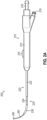
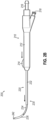
- FIGS. 2A-2C show an example of a dilation instrument (200) that may be used to dilate the ostium or other drainage passageway of a paranasal sinus, to dilate a Eustachian tube, or to dilate some other anatomical passageway (e.g., within the ear, nose, or throat, etc.).
- dilation instrument (200) may be configured and operable in accordance with at least some of the teachings of any of the patent references cited herein.
- Dilation instrument (200) of the present example comprises a handle assembly (210) and a shaft assembly (220).
- Handle assembly (210) includes a body (212) that may be grasped and operated by a single hand of an operator.
- a pair of ports (216, 218) extend proximally from body (212); while shaft assembly (220) extends distally from body (212).
- a slider (214) is slidably positioned along body (212) and is operable to drive translation of a dilation catheter (230) relative to body (212) as will be described in greater detail below.
- Shaft assembly (220) includes dilation catheter (230) and a malleable guide member (240).
- Dilation catheter (230) includes a rigid proximal portion (230) and a flexible distal portion (234). Rigid proximal portion (230) is fixedly secured relative to slider (214).
- proximal portion (230) comprises a metallic hypotube while distal portion (234) comprises a polymeric material.
- An inflatable balloon (236) is integrated into distal portion (234).
- Balloon (236) is fluidically coupled with port (218), such that an inflation fluid (e.g., saline, etc.) may be communicated to or from port (218) to selectively inflate or deflate balloon (236), respectively.
- an inflation fluid e.g., saline, etc.
- balloon (236) comprises a non-extensible material; while in other versions, balloon (236) comprises an extensible material.
- Balloon (236) is configured such that, in a deflated state ( FIGS. 2A-2B ), balloon (236) may be slidably positioned in a paranasal sinus ostium, another drainage passageway of a paranasal sinus, a Eustachian tube, or some other anatomical passageway. Balloon (236) is further configured such that, in an inflated state ( FIG. 2C ), balloon (236) will dilate the opening or other passageway in which balloon (236) is disposed.
- Guide member (240) of the present example is in the form of a rail, with dilation catheter (230) being slidably disposed about the exterior of malleable guide member (240).
- the outer diameter of guide member (240) is thus smaller than the inner diameter of dilation catheter (230).
- Guide member (240) is malleable such that guide member (240) may be manually bent to achieve a desired bend angle; and maintain that bend angle as guide member (240) is inserted through a nasal cavity (or other access site) to reach a targeted anatomical opening or other anatomical passageway.
- Guide member (240) thus has sufficient flexibility to bend to form a desired bend angle; while having sufficient rigidity to maintain the desired bend angle during a dilation procedure.
- guide member (240) may comprise a metallic hypotube.
- the proximal portion of guide member (240) is fixedly secured relative to body (212) of handle assembly (210).
- Guide member (240) of the present example further includes an enlarged tip in the form of a ball tip (242).
- ball tip (242) is substantially spherical.
- ball tip (242) has a shape similar to that of a blueberry.
- ball tip (242) may have any other suitable configuration.
- ball tip (242) is small enough to allow ball tip (242) to traverse a paranasal sinus ostium, another drainage passageway of a paranasal sinus, or a Eustachian tube; yet is large enough to prevent ball tip (242) from traversing an isthmus between a Eustachian tube and a middle ear region of a patient.
- ball tip (242) is omitted.
- the distal tip of guide member (240) is still atraumatic but is not enlarged.
- one or more electrically powered components may be positioned in ball tip (242); and port (216) may provide a corresponding coupling between instrument (200) and an external power source.
- an example of how such components may be integrated into ball tip (242) will be described in greater detail below with reference to FIG. 3 .
- guide member (240) may include an internal lumen; and ball tip (242) may include a corresponding opening.
- a guidewire or other instrument may be inserted via port (216) and be positioned in the lumen of guide member (240); and may further pass through the opening of ball tip (242). An example of such an arrangement is described in greater detail below with reference to FIGS.
- port (216) may be used to communicate suction, irrigation fluid, therapeutic fluid, and or other fluid through a lumen of guide member (240) and opening of ball tip (242).
- port (216) may be used in any other suitable fashion; or may be simply omitted.
- the operator may form a desired bend in guide member (240) before inserting guide member (240) into the patient.
- This bending step may be performed while slider (214) and dilation catheter (230) are proximally positioned as shown in FIG. 2A .
- the entirety of distal portion (234), and a substantial portion of proximal portion (232) are exposed when dilation catheter (230) is in the proximal position in this example.
- a portion of guide member (240) is exposed relative to dilation catheter (230) when dilation catheter (230) is in the proximal position in this example. It should be understood that the bend angle shown in FIG.
- the bend angle may be more acute or more obtuse than the bend angle shown in FIG. 2A .
- guide member (240) may be left substantially straight in some examples.
- the bend angle may be chosen based on the location and access path of the targeted anatomical opening or other anatomical passageway.
- the operator may insert shaft assembly (220) into the nasal cavity or other access passageway; and further insert guide member (240) into the targeted anatomical opening or other anatomical passageway. This insertion may be performed while dilation catheter (230) remains in the proximal position as shown in FIG. 2A .
- the operator may hold body (212) stationary while advancing slider (214) distally, thereby advancing dilation catheter (230) along guide member (240) until slider (214) and dilation catheter (230) reach a distal position as shown in FIG. 2B .
- dilation catheter (230) may advance into the targeted anatomical opening or other anatomical passageway, such that balloon (236) may be positioned the targeted anatomical opening or other anatomical passageway. It should be understood that balloon (236) may remain in the deflated state during this positioning of balloon (236) in the targeted anatomical opening or other anatomical passageway.
- balloon (236) may be inflated as shown in FIG. 2C .
- inflation may be provided by communicating fluid (e.g., saline, etc.) via port (218).
- the inflated balloon (236) may dilate the targeted anatomical opening or other anatomical passageway.
- the operator may maintain the inflated state of balloon (236) for any desired duration while balloon (236) is disposed in the targeted anatomical opening or other anatomical passageway. Balloon (236) may then be deflated.
- the operator may repeatedly inflate and deflate balloon (236) while balloon (236) is disposed in the targeted anatomical opening or other anatomical passageway. After the targeted anatomical opening or other anatomical passageway has been sufficiently dilated by balloon (236), the operator may remove shaft assembly (220) from the patient while balloon (236) is in a deflated state. In some scenarios, the operator may bend guide member (240) again to achieve a different bend angle, then repeat the steps described above to dilate another anatomical opening or other anatomical passageway in the patient.
- instrument (200) may be used as a seeker device and/or to atraumatically move tissue within the ear, nose, or throat of the patient.
- guide member (240) may be bent to a desired bend angle, and ball tip (242) may be utilized to probe tissue within an anatomical cavity, to move tissue within an anatomical cavity, or to otherwise engage tissue in an anatomical cavity. This may be done before, during, and/or after a dilation procedure as described above. This may also be done even in procedures where no dilation is performed.
- instrument (200) may provide clinically meaningful uses even in scenarios where dilation catheter (230) is not utilized.
- guide member (240) may include one or more illuminating features and/or one or more position sensors to assist the operator in positioning guide member (240) in the targeted anatomical opening or other anatomical passageway.
- FIG. 3 shows one example of an alternative guide member (340) that may be incorporated into instrument (200) in place of guide member (240).
- Guide member (340) may be configured and operable like guide member (240) except as otherwise described below.
- Guide member (340) of this example includes a ball tip (342) that is configured and operable just like ball tip (242) of guide member (240).
- ball tip (342) of this example includes an integral illuminating feature (344) that is operable to project light distally from ball tip (342).
- illuminating feature (344) includes one or more LEDs.
- one or more wires, conductive traces, or other electrically conductive elements may extend along the length of guide member (340) and into handle assembly (210). Such electrically conductive elements may be further coupled with port (216) or some other feature of handle assembly (210) to allow electrical power to be communicated to illuminating feature (344).
- an electrical power source e.g., one or more batteries is integrated into handle assembly (210) to provide electrical power to illuminating feature (344).
- At least a portion of ball tip (342) comprises an optically transmissive material (e.g., glass, plastic, etc.) and is in optical communication with one or more optical fibers that extend along the length of guide member (340) and into handle assembly (210).
- an optically transmissive material e.g., glass, plastic, etc.
- Such one or more optical fibers may be optically coupled with an external light source via port (216) or via some other coupling of handle assembly (210).
- a light source may be integrated into handle assembly (210) to provide light to illuminating feature (344) via one or more optical fibers.
- illuminating feature (344) may facilitate positioning guide member (240) in the targeted anatomical opening or other anatomical passageway by providing transillumination. For instance, when ball tip (342) passes through a maxillary sinus ostium and enters a maxillary sinus cavity, illuminating feature (344) may provide transillumination through the cheek of the patient, thereby providing visual confirmation that guide member (340) has traversed the maxillary sinus ostium.
- illuminating feature (344) may provide transillumination through the forehead of the patient, thereby providing visual confirmation that guide member (340) has traversed the frontal recess.
- Ball tip (342) of the present example further comprises a position sensor (346) that is configured to cooperate with an IGS navigation system (100) to thereby provide signals indicating the position of ball tip (342) in three-dimensional space.
- Position sensor (346) may comprise one or more coils, as described above in the context of guidewire (120) of IGS navigation system (100).
- One or more wires, conductive traces, or other electrically conductive elements may extend along the length of guide member (340) and into handle assembly (210). Such electrically conductive elements may be further coupled with port (216) or some other feature of handle assembly (210) to allow signals from position sensor (346) to be communicated to IGS navigation system (100).
- Port (216) may thus function similar to coupling unit (116) as described above.
- the operator may rely on navigation system (100) to determine the real-time position of ball tip (342) in three-dimensional space, as described above in the context of tracking the position of guidewire (120), to determine when guide member (340) has reached the targeted anatomical opening or other anatomical passageway.
- ball tip (342) of the present example includes illuminating feature (344) and position sensor (346), some variations may include illuminating feature (344) and omit position sensor (346). Similarly, some variations may include position sensor (346) and omit illuminating feature (344).
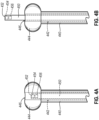
- FIGS. 4A-4B show another example of an alternative guide member (440) that may be incorporated into instrument (200) in place of guide member (240).
- Guide member (440) may be configured and operable like guide member (240) except as otherwise described below.
- Guide member (440) of this example includes a ball tip (444) that is configured and operable just like ball tip (242) of guide member (240). However, ball tip (444) of this example defines an opening (446) that communicates with a lumen (442) formed through guide member (440).
- a guidewire (450) is positioned in lumen (442).
- Guidewire (450) of this example includes an integral illuminating feature (454) and a position sensor (456) at a distal end (452) of guidewire (450).
- An example of how guidewire (450) may be configured to include illuminating feature (454) and position sensor (456) at distal end (452) is described in greater detail below with reference to FIGS. 5-6 .
- Illuminating feature (454) may facilitate positioning guidewire (450), and also guide member (440) in the targeted anatomical opening or other anatomical passageway by providing transillumination. For instance, when distal end (452) passes through a maxillary sinus ostium and enters a maxillary sinus cavity, illuminating feature (454) may provide transillumination through the cheek of the patient, thereby providing visual confirmation that guidewire (450) has traversed the maxillary sinus ostium. Similarly, when distal end (452) passes through a frontal recess and enters a frontal sinus cavity, illuminating feature (454) may provide transillumination through the forehead of the patient, thereby providing visual confirmation that guidewire (450) has traversed the frontal recess.
- Position sensor (456) is configured to cooperate with an IGS navigation system (100) to thereby provide signals indicating the position of distal end (452) in three-dimensional space.
- Position sensor (456) may comprise one or more coils, as described above in the context of guidewire (120) of IGS navigation system (100).
- One or more wires, conductive traces, or other electrically conductive elements may extend along the length of guidewire (450). Such electrically conductive elements may be further coupled with a feature like coupling unit (116), to allow signals from position sensor (456) to be communicated to IGS navigation system (100).
- the operator may rely on navigation system (100) to determine the real-time position of distal end (452) in three-dimensional space, as described above in the context of tracking the position of guidewire (120), to determine when guidewire (450) has reached the targeted anatomical opening or other anatomical passageway.
- guidewire (450) of the present example includes illuminating feature (454) and position sensor (456)
- some variations of guidewire (450) may include illuminating feature (454) and omit position sensor (456).
- ball tip (444) may include an integral position sensor (346).
- some variations may include position sensor (456) and omit illuminating feature (454).
- ball tip (444) may include an integral illuminating feature (344).
- Still other variations of guidewire (450) may omit both position sensor (456) and illuminating feature (454).
- ball tip (444) may include an integral position sensor (346) and/or an integral illuminating feature (344).
- guidewire (450) may translate longitudinally relative to guide member (440) between a proximal position ( FIG. 4A ) and a distal position ( FIG. 4B ).
- distal end (452) With guidewire (450) in the proximal position as shown in FIG. 4A , distal end (452) is recessed relative to ball tip (444).
- distal end (452) With guidewire (450) in the distal position as shown in FIG. 4B , distal end (452) is exposed distally relative to ball tip (444).
- handle assembly (210) may be modified to include an additional slider that is operable to actuate guidewire (450), to thereby transition guidewire (450) between the proximal position ( FIG.
- an instrument may be configured such that longitudinal translation of a dilation catheter will drive longitudinal translation of guidewire (450) between the proximal position ( FIG. 4A ) and the distal position ( FIG. 4B ).
- longitudinal translation of a dilation catheter will drive longitudinal translation of guidewire (450) between the proximal position ( FIG. 4A ) and the distal position ( FIG. 4B ).
- guidewire (450) is not configured to translate to the distal position in FIG. 4B .
- guidewire (450) is secured relative to guide member (440) with distal end (452) being positioned at or near ball tip (444).
- guidewire (450) may be inserted via port (216); and may include a feature that selectively locks with port (216) to thereby secure the longitudinal position of guidewire (450) relative to guide member (440).
- signals from position sensor (456) may effectively indicate the real-time position of ball tip (444) in three-dimensional space.
- Lumen (442) of guide member (440) may also be used for other purposes, in addition to or as an alternative to accommodating guidewire (450).
- lumen (442) and opening (446) may be used to communicate suction, irrigation fluid, or other fluid to a cavity or passageway within the ear, nose, or throat of a patient.
- suction, irrigation fluid, or other fluid may be communicated through lumen (442) and opening (446) while guidewire (450) is disposed in lumen (442).
- guidewire (450) is removed from lumen (442) to allow suction, irrigation fluid, or other fluid may be communicated through lumen (442) and opening (446).
- lumen (442) may be configured to slidably receive other instrumentation, such as fluid delivery needles, ablation needles, or other working instruments.
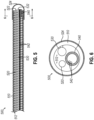
- FIGS. 5-6 show an example of a guidewire (500) representing a form that may be taken by guidewire (450) of FIGS. 4A-4B .
- Guidewire (500) of this example includes an outer coil (510) that is distally coupled with a tip member (524). Outer coil (510) defines a lumen (512).
- An optical fiber (520), a core wire (530), and a pair of electrical wires (542) are positioned within lumen (512).
- optical fiber (520) may be optically coupled with a light source.
- Optical fiber (520) has a distal end (522) that is fixedly secured in tip member (524).
- Tip member (524) comprises an optically transmissive material (e.g., plastic, etc.), such that light conveyed along optical fiber (520) may be emitted through tip member (524).
- Optical fiber (520) and tip member (524) may thus cooperate to form an illuminating feature like illuminating features (344, 454) described above.
- an LED or other light source is integrated into guidewire (500), at or near tip member (524), with electrical wires or conductive traces extending through lumen (512) to provide electrical power to the LED.
- optical fiber (520) may be omitted.
- optical fiber (520) may be configured to provide a Fiber-Bragg grating sensor, which may provide strain sensing, pressure sensing, temperature sensing, and/or sensing.
- guidewire (500) may enable passive patient registration with IGS navigation system (100), such as by cross-referencing pressure increases with known landmarks in a preoperative image (e.g., CT scan) stored in processor (108).
- the proximal end (not shown) of core wire (530) may be fixedly secured relative to the proximal end (not shown) of outer coil (510).
- Core wire (530) has a distal end (532) that is fixedly secured to tip member (524), such that distal end (532) is fixedly secured relative to the distal end of outer coil (510). While distal end (532) is secured to outer coil (510) via tip member (524) in this example, distal end (532) may be secured to outer coil (510) in any other suitable fashion.
- Core wire (530) of the present example is formed of a non-extensible material (e.g., steel wire, steel ribbon, one or more polymeric strands, etc.), such that core wire (530) is configured to provide tensile strength to guidewire (500).
- Outer coil (510) and core wire (530) together provide substantial lateral flexibility to guidewire (500), allowing guidewire (500) to be readily navigated along tortuous paths; while core wire (530) prevents outer coil (510) from stretching longitudinally.
- the proximal ends (not shown) of electrical wires (542) are coupled with an electrical interface that ultimately communicates with an IGS navigation system like system (100) described above.
- the proximal ends of electrical wires (542) may be coupled with a feature like coupling unit (116).
- the distal ends of electrical wires (542) are coupled with a position sensor (540), which is further secured relative to tip member (524).
- Position sensor (540) may be configured and operable like any other position sensor (346, 456) described herein, such that position sensor (540) may generate signals indicating the real-time position of tip member (524) in three-dimensional space. While electrical wires (542) are used to convey signals from position sensor (540) in this example, some other variations may provide conductive traces (e.g., on a flexible circuit substrate) to convey signals from position sensor (540).
- Guidewire (500) may be further configured and operable in accordance with at least some of the teachings of U.S. Pat. No. 10,772,489, entitled “Guidewire Navigation for Sinuplasty,” issued September 15, 2020 , the disclosure of which is incorporated by reference herein, in its entirety.
- FIGS. 7A-7D show another example of a dilation instrument (600) that may be used to dilate the ostium or other drainage passageway of a paranasal sinus, to dilate a Eustachian tube, or to dilate some other anatomical passageway (e.g., within the ear, nose, or throat, etc.).
- dilation instrument (600) may be configured and operable in accordance with at least some of the teachings of any of the patent references cited herein.
- Dilation instrument (600) of the present example comprises a handle assembly (610) and a shaft assembly (620).
- Handle assembly (610) includes a body (612) that may be grasped and operated by a single hand of an operator.
- a port (618) extends proximally from body (612); while shaft assembly (620) extends distally from body (612).
- a first slider (614) is slidably positioned along body (612) and is operable to drive translation of a dilation catheter (660) relative to body (612) as will be described in greater detail below.
- a second slider (616) is also slidably positioned along body (612) and is operable to drive translation of a guidewire (650) relative to body (612) as will be described in greater detail below.
- Shaft assembly (620) of this example includes a rigid outer guide tube (630), an inner malleable guide member (640), guidewire (650), and dilation catheter (660).
- Outer guide tube (630) is fixedly secured relative to handle assembly (610) and terminates in a distal end (632).
- Outer guide tube (630) is fully rigid in this example, such that outer guide tube (630) is not configured to bend. In some other variations, outer guide tube (630) is configured to bend. In still other variations, outer guide tube (630) is omitted. It should therefore be understood that that it is not necessary to include outer guide tube (630) in all versions of instrument (600).
- Guide member (640) is positioned within outer guide tube (630) and extends distally relative to outer guide tube (630), such that a distal end (642) of guide member (640) is positioned distally relative to distal end (632) of outer guide tube (630).
- the proximal end of guide member (640) fixedly secured relative to handle assembly (610), such that guide member (640) does not translate relative to handle assembly (610) in this example.
- a proximal portion of guide member (640) is rigid.
- At least a distal region of guide member (640) is malleable such that guide member (640) may be manually bent to achieve a desired bend angle; and maintain that bend angle as guide member (640) is inserted through a nasal cavity (or other access site) to reach a targeted anatomical opening or other anatomical passageway.
- Guide member (640) thus has sufficient flexibility to bend to form a desired bend angle; while having sufficient rigidity to maintain the desired bend angle during a dilation procedure. Use of instrument (600) in a dilation procedure will thus not cause guide member (640) to undesirably unbend or re-bend.
- guide member (640) may comprise a metallic hypotube. While guide member (640) is shown as being straight in FIGS. 7A-7D , guide member (640) may be bent to achieve any desired bend angle.
- Dilation catheter (660) is slidably disposed within a radial gap formed between the inner diameter of outer guide tube (630) and the outer diameter of guide member (640), such that dilation catheter (660) is positioned internally relative to guide tube (630) and externally relative to guide member (640).
- the proximal portion of dilation catheter (660) is fixedly secured to slider (614), such that slider (614) is operable to drive longitudinal translation of dilation catheter (660) relative to body (612).
- Dilation catheter (660) includes an inflatable balloon (664) near a distal end (662) of dilation catheter (660).
- Balloon (664) is fluidically coupled with port (618), such that an inflation fluid (e.g., saline, etc.) may be communicated to or from port (618) to selectively inflate or deflate balloon (664), respectively.
- balloon (664) comprises a non-extensible material; while in other versions, balloon (664) comprises an extensible material.
- Balloon (664) is configured such that, in a deflated state ( FIG. 7C ), balloon (664) may be slidably positioned in a paranasal sinus ostium, another drainage passageway of a paranasal sinus, a Eustachian tube, or some other anatomical passageway. Balloon (664) is further configured such that, in an inflated state ( FIG. 7D ), balloon (664) will dilate the opening or other passageway in which balloon (664) is disposed.
- an inflation fluid e.g., saline, etc.
- Guidewire (650) is slidably disposed within dilation catheter (660), such that guidewire (650) is positioned internally relative to dilation catheter (660).
- the proximal portion of guidewire (650) is fixedly secured to slider (616), such that slider (616) is operable to drive longitudinal translation of guidewire (650) relative to body (612).
- Guidewire (650) includes a ball tip (652) at the distal end of guidewire (650).
- Ball tip (652) is positioned distally relative to distal ends (632, 642, 662) of other components of shaft assembly (620), such that ball tip (652) presents the distal-most feature of shaft assembly (620) in this example.
- ball tip (652) is substantially spherical.
- ball tip (652) has a shape similar to that of a blueberry.
- ball tip (652) may have any other suitable configuration.
- ball tip (652) is small enough to allow ball tip (652) to traverse a paranasal sinus ostium, another drainage passageway of a paranasal sinus, or a Eustachian tube; yet is large enough to prevent ball tip (652) from traversing an isthmus between a Eustachian tube and a middle ear region of a patient.
- ball tip (652) is omitted.
- the distal tip of guidewire (650) is still atraumatic but is not enlarged.
- ball tip (652) may include an illuminating feature and/or a position sensor.
- An illuminating feature of ball tip (652) may be configured and operable like any of the illuminating features (344, 454, 522, 524) described herein.
- a position sensor of ball tip (652) may be configured and operable like any of the position sensors (346, 456, 540) described herein.
- the operator may form a desired bend in guide member (640) before inserting guidewire (650) and guide member (640) into the patient.
- This bending step may be performed while sliders (614, 616), guidewire (650), and dilation catheter (660) are proximally positioned as shown in FIG. 7A .
- ball tip (652) is positioned at distal end (642) of guide member (640) when guidewire (650) is in the proximal position in this example.
- FIG. 7A shows guide member (640) in a straight configuration, though it should be understood that guide member (640) may instead define any suitable bend angle (e.g., based on the location and access path of the targeted anatomical opening or other anatomical passageway).
- guidewire (650) may follow the bend formed by guide member (640) as guidewire (650) is advanced distally through guide member (640). The distal advancement of guidewire (650) may ultimately drive guidewire (650) into the targeted anatomical opening or other anatomical passageway. This insertion may be performed while dilation catheter (660) remains in the proximal position.
- the operator only drives guidewire (650) into the targeted anatomical opening or other anatomical passageway, without also advancing guide member (640) through the targeted anatomical opening or other anatomical passageway.
- the operator drives a distal portion of guide member (640) through the targeted anatomical opening or other anatomical passageway after guidewire (650) has traversed the targeted anatomical opening or other anatomical passageway.
- the operator may rely on transillumination from ball tip (652), and/or feedback from IGS navigation system (100) based on signals from a position sensor in ball tip (652), to confirm that guidewire (650) has been appropriately positioned in relation to the targeted anatomical opening or other anatomical passageway.
- the operator may hold body (612) stationary while advancing slider (614) distally, thereby advancing dilation catheter (660) along guide member (640), and further along guidewire (650), until slider (614) and dilation catheter (660) reach a distal position as shown in FIG. 7C .
- body (612) stationary while advancing slider (614) distally, thereby advancing dilation catheter (660) along guide member (640), and further along guidewire (650), until slider (614) and dilation catheter (660) reach a distal position as shown in FIG. 7C .
- distal end (662) and balloon (664) translate past distal end (642) of guide member (640), distal end (662) and balloon (664) translate along guidewire (650).
- ball tip (652) may serve two purposes in some scenarios, including preventing guidewire (650) from traversing an isthmus between a Eustachian tube and a middle ear region of a patient and preventing dilation catheter (660) from advancing past guidewire (650) (thereby preventing dilation catheter (660) from traversing the isthmus).
- dilation catheter (660) may advance into the targeted anatomical opening or other anatomical passageway, such that balloon (664) may be positioned the targeted anatomical opening or other anatomical passageway. It should be understood that balloon (664) may remain in the deflated state during this positioning of balloon (664) in the targeted anatomical opening or other anatomical passageway. After balloon (664) has been suitably positioned in the targeted anatomical opening or other anatomical passageway, balloon (664) may be inflated as shown in FIG. 7D . As noted above, such inflation may be provided by communicating fluid (e.g., saline, etc.) via port (618).
- fluid e.g., saline, etc.
- the inflated balloon (664) may dilate the targeted anatomical opening or other anatomical passageway.
- the operator may maintain the inflated state of balloon (664) for any desired duration while balloon (664) is disposed in the targeted anatomical opening or other anatomical passageway.
- Balloon (664) may then be deflated.
- the operator may repeatedly inflate and deflate balloon (664) while balloon (664) is disposed in the targeted anatomical opening or other anatomical passageway.
- the operator may remove shaft assembly (620) from the patient while balloon (664) is in a deflated state.
- the operator may bend guide member (640) again to achieve a different bend angle, then repeat the steps described above to dilate another anatomical opening or other anatomical passageway in the patient.
- instrument (600) may be used as a seeker device and/or to atraumatically move tissue within the ear, nose, or throat of the patient.
- guide member (640) may be bent to a desired bend angle, and ball tip (652) (e.g., while remaining positioned at distal end (642) of guide member (640)) may be utilized to probe tissue within an anatomical cavity, to move tissue within an anatomical cavity, or to otherwise engage tissue in an anatomical cavity. This may be done before, during, and/or after a dilation procedure as described above. This may also be done even in procedures where no dilation is performed.
- instrument (600) may provide clinically meaningful uses even in scenarios where dilation catheter (660) is not utilized.
- FIGS. 8A-8D show another example of a dilation instrument (700) that may be used to dilate the ostium or other drainage passageway of a paranasal sinus, to dilate a Eustachian tube, or to dilate some other anatomical passageway (e.g., within the ear, nose, or throat, etc.).
- dilation instrument (700) may be configured and operable in accordance with at least some of the teachings of any of the patent references cited herein.
- Dilation instrument (700) of the present example comprises a handle assembly (710) and a shaft assembly (720).
- Handle assembly (710) includes a body (712) that may be grasped and operated by a single hand of an operator.
- a port (718) extends proximally from body (712); while shaft assembly (720) extends distally from body (712).
- a slider (714) is slidably positioned along body (712) and is operable to drive translation of a dilation catheter (760) relative to body (712) as will be described in greater detail below.
- Shaft assembly (720) of this example includes a rigid outer guide tube (730), an inner malleable guide member (740), guidewire (750), and dilation catheter (760).
- Outer guide tube (730) is fixedly secured relative to handle assembly (710) and terminates in a distal end (732).
- Outer guide tube (730) is fully rigid in this example, such that outer guide tube (730) is not configured to bend. In some other variations, outer guide tube (730) is configured to bend. In still other variations, outer guide tube (730) is omitted. It should therefore be understood that that it is not necessary to include outer guide tube (730) in all versions of instrument (700).
- Guide member (740) is positioned within outer guide tube (730) and extends distally relative to outer guide tube (730), such that a distal end (742) of guide member (740) is positioned distally relative to distal end (732) of outer guide tube (730).
- the proximal end of guide member (740) fixedly secured relative to handle assembly (710), such that guide member (740) does not translate relative to handle assembly (710) in this example.
- a proximal portion of guide member (740) is rigid.
- At least a distal region of guide member (740) is malleable such that guide member (740) may be manually bent to achieve a desired bend angle; and maintain that bend angle as guide member (740) is inserted through a nasal cavity (or other access site) to reach a targeted anatomical opening or other anatomical passageway.
- Guide member (740) thus has sufficient flexibility to bend to form a desired bend angle; while having sufficient rigidity to maintain the desired bend angle during a dilation procedure. Use of instrument (700) in a dilation procedure will thus not cause guide member (740) to undesirably unbend or re-bend.
- guide member (740) may comprise a metallic hypotube. While guide member (740) is shown as being straight in FIGS. 8A-8D , guide member (740) may be bent to achieve any desired bend angle.
- Dilation catheter (760) is slidably disposed within a radial gap formed between the inner diameter of outer guide tube (730) and the outer diameter of guide member (740), such that dilation catheter (760) is positioned internally relative to guide tube (730) and externally relative to guide member (740).
- the proximal portion of dilation catheter (760) is fixedly secured to slider (714), such that slider (714) is operable to drive longitudinal translation of dilation catheter (760) relative to body (712).
- Dilation catheter (760) includes an inflatable balloon (764) near a distal end (762) of dilation catheter (760).
- Balloon (764) is fluidically coupled with port (718), such that an inflation fluid (e.g., saline, etc.) may be communicated to or from port (718) to selectively inflate or deflate balloon (764), respectively.
- balloon (764) comprises a non-extensible material; while in other versions, balloon (764) comprises an extensible material.
- Balloon (764) is configured such that, in a deflated state ( FIG. 8B ), balloon (764) may be slidably positioned in a paranasal sinus ostium, another drainage passageway of a paranasal sinus, a Eustachian tube, or some other anatomical passageway. Balloon (764) is further configured such that, in an inflated state ( FIG. 8C ), balloon (764) will dilate the opening or other passageway in which balloon (764) is disposed.
- an inflation fluid e.g., saline, etc.
- Guidewire (750) is slidably disposed within dilation catheter (760), such that guidewire (750) is positioned internally relative to dilation catheter (760). Unlike guidewire (650) of instrument (600), guidewire (750) of instrument (700) is not secured to a slider. Instead, guidewire (750) is driven longitudinally by translation of dilation catheter (760) as described below.
- Guidewire (750) includes a ball tip (752) at the distal end of guidewire (750). Ball tip (752) is positioned distally relative to distal ends (732, 742, 762) of other components of shaft assembly (720), such that ball tip (752) presents the distal-most feature of shaft assembly (720) in this example. In some versions, ball tip (752) is substantially spherical.
- ball tip (752) has a shape similar to that of a blueberry.
- ball tip (752) may have any other suitable configuration.
- ball tip (752) is small enough to allow ball tip (752) to traverse a paranasal sinus ostium, another drainage passageway of a paranasal sinus, or a Eustachian tube; yet is large enough to prevent ball tip (752) from traversing an isthmus between a Eustachian tube and a middle ear region of a patient.
- ball tip (752) is omitted.
- the distal tip of guidewire (750) is still atraumatic but is not enlarged.
- ball tip (752) may include an illuminating feature and/or a position sensor.
- An illuminating feature of ball tip (752) may be configured and operable like any of the illuminating features (344, 454, 522, 524) described herein.
- a position sensor of ball tip (752) may be configured and operable like any of the position sensors (346, 456, 540) described herein.
- the operator may form a desired bend in guide member (740) before inserting ball tip (752) and guide member (740) into the patient.
- This bending step may be performed while slider (714), guidewire (750), and dilation catheter (760) are proximally positioned as shown in FIG. 8A .
- ball tip (752) is positioned at distal end (742) of guide member (740) when guidewire (750) is in the proximal position in this example. In this proximal position, ball tip (752) is at a first distance (D1) from distal end (732) of outer guide tube (730).
- a first distance may instead be defined between the distal end of body (712) and ball tip (752).
- FIG. 8A shows guide member (740) in a straight configuration, though it should be understood that guide member (740) may instead define any suitable bend angle (e.g., based on the location and access path of the targeted anatomical opening or other anatomical passageway).
- the operator may insert shaft assembly (720) into the nasal cavity or other access passageway.
- the operator further advances ball tip (752) and a distal portion of guide member (740) into the targeted anatomical opening or other anatomical passageway, such that ball tip (752) and a distal portion of guide member (740) traverse the targeted anatomical opening or other anatomical passageway.
- the operator advances ball tip (752) to a position adjacent to the targeted anatomical opening or other anatomical passageway; but stops just short of advancing ball tip (752) into the targeted anatomical opening or other anatomical passageway, such that ball tip (752) and a distal portion of guide member (740) do not traverse the targeted anatomical opening or other anatomical passageway.
- the insertion may be performed while dilation catheter (760) remains in the proximal position.
- the operator may rely on transillumination from ball tip (752), and/or feedback from IGS navigation system (100) based on signals from a position sensor in ball tip (752), to confirm that guide member (740) has been appropriately positioned in relation to the targeted anatomical opening or other anatomical passageway.
- Dilation catheter (760) may follow the bend formed by guide member (740) as dilation catheter (760) is advanced distally along guide member (740). As dilation catheter (760) is advanced distally, the distal end (762) of dilation catheter (760) engages ball tip (752).
- dilation catheter (760) With distal end (762) of dilation catheter (760) engaging ball tip (752), dilation catheter (760) pushes ball tip (752) and the rest of guidewire (750) distally. In other words, ball tip (752) and the rest of guidewire (750) translate distally relative to body (712) with dilation catheter (760). At this stage, ball tip (752) is at a second distance (D2) from distal end (732) of outer guide tube (730). In versions of instrument that lack guide tube (730), a second distance may instead be defined between the distal end of body (712) and ball tip (752).
- dilation catheter (760) and ball tip (752) may ultimately drive ball tip (752) through the targeted anatomical opening or other anatomical passageway; and balloon (764) into the targeted anatomical opening or other anatomical passageway.
- dilation catheter (760) may advance into the targeted anatomical opening or other anatomical passageway, such that balloon (764) may be positioned the targeted anatomical opening or other anatomical passageway.
- Balloon (764) may remain in the deflated state during this positioning of balloon (764) in the targeted anatomical opening or other anatomical passageway.
- ball tip (752) will prevent distal end (762) of dilation catheter (760) from advancing distally past ball tip (752). Moreover, ball tip (752) may prevent dilation catheter (760) from traversing the isthmus between a Eustachian tube and a middle ear region of a patient. It should also be understood that the operator may rely on transillumination from ball tip (752), and/or feedback from IGS navigation system (100) based on signals from a position sensor in ball tip (752), to confirm that dilation catheter (760) has been appropriately positioned in relation to the targeted anatomical opening or other anatomical passageway.
- handle assembly (710) includes one or more features configured to provide tactile, audible, and/or visual feedback to the operator indicating when distal end (762) of dilation catheter (760) has engaged ball tip (752), such that further advancement of dilation catheter (760) will cause distal advancement of ball tip (752) and dilation catheter (750).
- the proximal end of guidewire (750) may include a detent feature that engages a complementary detent feature within handle assembly (710).
- Such detent features may prevent inadvertent distal advancement of guidewire (750) relative to body (712); yet may permit distal advancement of guidewire (750) relative to body (712) when dilation catheter (760) is advanced distally after distal end (762) of dilation catheter (760) has engaged ball tip (752).
- detent features may provide tactile feedback (e.g., a slight resistance or clicking feel, etc.) and/or audible feedback (e.g., a clicking sound, etc.) when dilation catheter (760) is advanced distally after distal end (762) of dilation catheter (760) has engaged ball tip (752).
- a hall effect sensor or other kind of proximity sensor, reed switch, optical sensor, or other feature may be configured to generate an electrical signal indicating when distal end (762) of dilation catheter (760) has engaged ball tip (752).
- the signal generated by such a sensor may activate a haptic feedback device (e.g., vibration generator, etc.), an audible feedback device (e.g., providing a tone through a speaker, etc.), and/or a visual feedback device (e.g., an LED or a display, etc.).
- a haptic feedback device e.g., vibration generator, etc.
- an audible feedback device e.g., providing a tone through a speaker, etc.
- a visual feedback device e.g., an LED or a display, etc.
- any other suitable features may be used to provide tactile, audible, and/or visual feedback to the operator indicating when distal end (762) of dilation catheter (760) has engaged ball tip (752).
- balloon (764) may be inflated as shown in FIG. 8C .
- inflation may be provided by communicating fluid (e.g., saline, etc.) via port (718).
- the inflated balloon (764) may dilate the targeted anatomical opening or other anatomical passageway.
- the operator may maintain the inflated state of balloon (764) for any desired duration while balloon (764) is disposed in the targeted anatomical opening or other anatomical passageway.
- Balloon (764) may then be deflated. In some scenarios, the operator may repeatedly inflate and deflate balloon (764) while balloon (764) is disposed in the targeted anatomical opening or other anatomical passageway.
- dilation catheter (760) may also retract guidewire (750) proximally.
- guidewire (750) may be provided in various ways.
- distal end (762) of dilation catheter (760) has a feature that selectively couples with a complementary feature of ball tip (752) or elsewhere at the distal end of guidewire (762).
- Such selective coupling features may be mechanical (e.g., detent features), magnetic, or be otherwise configured.
- some other portion of dilation catheter (760) e.g., proximal to balloon (764)
- complementary coupling features of dilation catheter (760) and guidewire (750) may engage each other after distal end (762) of dilation catheter engages ball tip (752); and may remain engaged during a certain range of proximal travel of dilation catheter (760) and guidewire (750).
- the complementary coupling features may remain engaged during an initial range of proximal travel of dilation catheter (760) and guidewire (750), such that of dilation catheter (760) and guidewire (750) translate proximally concomitantly during this initial range of proximal travel, until ball tip (752) engages distal end (742) of guide member (740).
- distal end (742) of guide member (740) may arrest further proximal movement of ball tip (752) and the rest of guidewire (750), such that ball tip (752) may remain positioned at the first distance (D1) from distal end (732) of outer guide tube (730) while dilation catheter (760) continues to translate proximally relative to body (712).
- engagement between ball tip (752) and distal end (742) of guide member (740) during concomitant proximal retraction of dilation catheter (760) and guidewire (750) may cause the complementary coupling features of dilation catheter (760) and guidewire (750) to disengage each other.
- dilation catheter (760) and guidewire (750) are selectively coupled in accordance with at least some of the teachings of U.S. Pat. No. 11,419,623, entitled “Sinuplasty Instrument with Moveable Navigation Sensor,” issued August 23, 2022 , the disclosure of which is incorporated by reference herein, in its entirety.
- the operator may remove shaft assembly (720).
- the operator may bend guide member (740) again to achieve a different bend angle, then repeat the steps described above to dilate another anatomical opening or other anatomical passageway in the patient.
- instrument (700) may be used as a seeker device and/or to atraumatically move tissue within the ear, nose, or throat of the patient.
- guide member (740) may be bent to a desired bend angle, and ball tip (752) (e.g., while remaining positioned at distal end (742) of guide member (740)) may be utilized to probe tissue within an anatomical cavity, to move tissue within an anatomical cavity, or to otherwise engage tissue in an anatomical cavity. This may be done before, during, and/or after a dilation procedure as described above. This may also be done even in procedures where no dilation is performed.
- instrument (700) may provide clinically meaningful uses even in scenarios where dilation catheter (760) is not utilized.
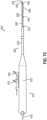
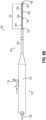
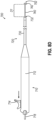
- FIGS. 9-10 show another example of a dilation instrument (800) that may be used to dilate the ostium or other drainage passageway of a paranasal sinus, to dilate a Eustachian tube, or to dilate some other anatomical passageway (e.g., within the ear, nose, or throat, etc.).
- dilation instrument (800) may be configured and operable in accordance with at least some of the teachings of any of the patent references cited herein.
- Dilation instrument (800) of the present example comprises a handle assembly (810) and a shaft assembly (820).
- Handle assembly (810) includes a body (812) that may be grasped and operated by a single hand of an operator.
- a cable (840) and an inflation tube (830) extend proximally from body (812); while shaft assembly (820) extends distally from body (812).
- Shaft assembly (820) includes a rigid proximal portion (822) and a malleable distal portion (824). Portions (822, 824) are fixedly secured relative to each other and relative to body (812), such that neither portion (822, 824) translates longitudinally relative to body (812) in this example.
- Malleable distal portion (824) is configured to be manually bent to achieve a desired bend angle; and maintain that bend angle as distal portion (824) is inserted through a nasal cavity (or other access site) to reach a targeted anatomical opening or other anatomical passageway.
- Malleable distal portion (824) thus has sufficient flexibility to bend to form a desired bend angle; while having sufficient rigidity to maintain the desired bend angle during a dilation procedure.
- distal portion (824) may comprise a metallic hypotube. While distal portion (824) is shown as being straight in FIGS. 9-10 , distal portion (824) may be bent to achieve any desired bend angle. In the present example, a distal end (828) of malleable distal portion (824) has an atraumatic configuration. In some versions, distal end (828) is in the form of a ball tip, like any of the ball tips (242, 342, 444, 652, 752) described herein. In some other versions, distal end (828) has some other atraumatic configuration that is not a ball tip.
- a balloon (826) is fixedly secured about malleable distal portion (824), near distal end (828) of malleable distal portion (824).
- Balloon (826) is coupled with tubes (830, 834, 836), such that inflation fluid (e.g., saline, etc.) may be communicated along at least one of tubes (830, 834, 836) to selectively inflate balloon (826).
- a luer fitting (832) is secured to the proximal end of tube (830), allowing tube (830) to be readily coupled with any suitable source of inflation fluid.
- balloon (826) comprises a non-extensible material; while in other versions, balloon (826) comprises an extensible material.
- Balloon (826) is configured such that, in a deflated state, balloon (826) may be slidably positioned in a paranasal sinus ostium, another drainage passageway of a paranasal sinus, a Eustachian tube, or some other anatomical passageway. Balloon (826) is further configured such that, in an inflated state, balloon (826) will dilate the opening or other passageway in which balloon (826) is disposed.
- a navigation wire (842) is fixedly positioned within shaft assembly (820). Navigation wire (842) extends distally from cable (840).
- a polyimide tube (846) is positioned about navigation wire (842), within rigid and malleable portions (822, 824) of shaft assembly (820).
- a heat shrink tube (850) is positioned about one or more of tubes (834, 836, 846), to secure these components together.
- a position sensor (844) is at the distal end of navigation wire (842), within malleable distal portion (824). With instrument (800) fully assembled, position sensor (844) is positioned at distal end (828) of malleable distal portion (824).
- Position sensor (844) is configured to cooperate with an IGS navigation system (100) to thereby provide signals indicating the position of distal end (828) in three-dimensional space.
- Position sensor (844) may comprise one or more coils, as described above in the context of guidewire (120) of IGS navigation system (100).
- a connector (848) is positioned at the proximal end of cable (840) and includes features that are in electrical communication with position sensor (844) via wire (842) and cable (840).
- Connector (848) is configured to couple with IGS navigation system (100). Connector (848) may thus function similar to coupling unit (116) as described above.
- the operator may rely on navigation system (100) to determine the real-time position of distal end (828) in three-dimensional space, as described above in the context of tracking the position of guidewire (120), to determine balloon (826) has reached the targeted anatomical opening or other anatomical passageway.
- an illuminating feature (not shown) is positioned at distal end (828) of malleable distal portion (824).
- Such an illuminating feature may be configured and operable like any of the other illuminating features (344, 454, 522, 524) described herein.
- Such an illuminating feature may be provided in addition to, or instead of, position sensor (844).
- the operator may form a desired bend in malleable distal portion (824) before inserting shaft assembly (820) into the patient. After the desired bend angle has been formed in malleable distal portion (824) the operator may insert shaft assembly (820) into the nasal cavity or other access passageway, to thereby position balloon (826) in the targeted anatomical opening or other anatomical passageway.
- the operator may rely on feedback from IGS navigation system (100) to determine when balloon (826) has reached the targeted anatomical opening or other anatomical passageway, based on signals from position sensor (844). It should be understood that balloon (826) may remain in the deflated state during this positioning of balloon (826) in the targeted anatomical opening or other anatomical passageway.
- balloon (826) may be inflated. As noted above, such inflation may be provided by communicating fluid (e.g., saline, etc.) via luer fitting (832).
- the inflated balloon (826) may dilate the targeted anatomical opening or other anatomical passageway.
- the operator may maintain the inflated state of balloon (826) for any desired duration while balloon (826) is disposed in the targeted anatomical opening or other anatomical passageway.
- Balloon (826) may then be deflated. In some scenarios, the operator may repeatedly inflate and deflate balloon (826) while balloon (826) is disposed in the targeted anatomical opening or other anatomical passageway.
- the operator may remove shaft assembly (820) from the patient while balloon (826) is in a deflated state.
- the operator may bend malleable distal portion (824) again to achieve a different bend angle, then repeat the steps described above to dilate another anatomical opening or other anatomical passageway in the patient.
- instrument (800) may be used as a seeker device and/or to atraumatically move tissue within the ear, nose, or throat of the patient.
- instrument (800) may be bent to a desired bend angle, and distal end (828) may be utilized to probe tissue within an anatomical cavity, to move tissue within an anatomical cavity, or to otherwise engage tissue in an anatomical cavity. This may be done before, during, and/or after a dilation procedure as described above. This may also be done even in procedures where no dilation is performed.
- instrument (800) may provide clinically meaningful uses even in scenarios where dilation catheter (660) is not utilized.
- An apparatus comprising: (a) a body; and (b) a shaft assembly extending distally from the body, the shaft assembly including; (i) a malleable distal portion having a distal end, (ii) an enlarged tip positioned at the distal end of the malleable distal portion, (iii) a position sensor positioned within the enlarged tip, the position sensor being configured to generate a signal indicating a position of the enlarged tip in three-dimensional space, (iv) an illuminating element positioned within the enlarged tip, the illuminating element being configured to emit light, (v) an inflatable balloon positioned proximal to the enlarged tip, the inflatable balloon being configured to dilate a passageway in an ear, nose, or throat of a patient.
- Example 1 The apparatus of Example 1, the body being configured for grasping by a single hand of an operator.
- the shaft assembly further comprising a rigid proximal portion, the rigid proximal portion being positioned proximally in relation to the malleable distal portion.
- Example 4 The apparatus of Example 4, the rigid proximal portion being fixedly secured relative to the body.
- Example 6 The apparatus of Example 6, the ball shape being spherical.
- Example 8 The apparatus of Example 8, the malleable distal portion defining a lumen, the guidewire being positioned in the lumen.
- Example 9 The apparatus of Example 9, the enlarged tip defining an opening.
- Example 10 The apparatus of Example 10, the guidewire being translatable along the lumen and through the opening.
- Example 11 The apparatus of Example 11, further comprising a first slider, the first slider being translatable along the body to drive translation of the guidewire along the lumen and through the opening.
- the shaft assembly further comprising a dilation catheter, the dilation catheter being slidably positioned about the malleable distal portion, the dilation catheter including the inflatable balloon; the apparatus further comprising a second slider, the second slider being translatable along the body to drive translation of the dilation catheter along the malleable distal portion.
- Example 13 The apparatus of Example 13, the first slider and the second slider being translatable along the body independently relative to each other.
- the guidewire having a distal end, the position sensor being positioned within the distal end of the guidewire, the distal end of the guidewire being positioned at the enlarged tip.
- the guidewire having a distal end, the illuminating element being positioned within the distal end of the guidewire, the distal end of the guidewire being positioned at the enlarged tip.
- the shaft assembly further comprising a dilation catheter, the dilation catheter being slidably positioned about the malleable distal portion, the dilation catheter including the inflatable balloon; the apparatus further comprising a slider, the slider being translatable along the body to drive translation of the dilation catheter along the malleable distal portion.
- the malleable distal portion defining a lumen
- the guidewire being slidably positioned in the lumen
- the dilation catheter having a distal end configured to engage the enlarged tip to thereby drive distal translation of the guidewire and the enlarged tip relative to the malleable distal portion as the dilation catheter translates distally relative to the malleable distal portion.
- the dilation catheter further including a first engagement feature, one or both of the guidewire or the enlarged tip including a second engagement feature, the first and second engagement features being configured to couple with each other to thereby cause the dilation catheter to drive proximal translation of the guidewire and the enlarged tip relative to the malleable distal portion as the dilation catheter translates proximal relative to the malleable distal portion.
- the shaft assembly further comprising a dilation catheter, the dilation catheter being slidably positioned about the malleable distal portion, the dilation catheter including the inflatable balloon.
- the dilation catheter including a rigid proximal portion and a flexible distal portion, the flexible distal portion including the inflatable balloon.
- the illuminating element comprising an LED.
- the illuminating element comprising an optical fiber.
- Example 26 The apparatus of Example 26, the illuminating element further comprising a distally facing optically transmissive element in optical communication with the optical fiber.
- An apparatus comprising: (a) a body; (b) a shaft assembly extending distally from the body, the shaft assembly including; (i) a malleable distal portion having a distal end, (ii) a guidewire slidably disposed within the malleable distal portion, the guidewire including: (A) an enlarged tip, and (B) a position sensor positioned within the enlarged tip, the position sensor being configured to generate a signal indicating a position of the enlarged tip in three-dimensional space, (v) a dilation catheter slidably positioned about the malleable distal portion, the dilation catheter having a distal end and an inflatable balloon positioned proximal to the distal end of the dilation catheter, the inflatable balloon being configured to dilate a passageway in an ear, nose, or throat of a patient; and (c) an actuator, the actuator being operable to drive translation of the dilation catheter along the malleable distal portion; the distal end of the dilation catheter being configured to engage the enlarged
- Example 28 The apparatus of Example 28, the shaft assembly further including an illuminating element positioned within the enlarged tip, the illuminating element being configured to emit light.
- the dilation catheter further including a first engagement feature, one or both of the guidewire or the enlarged tip including a second engagement feature, the first and second engagement features being configured to couple with each other to thereby cause the dilation catheter to drive proximal translation of the guidewire and the enlarged tip relative to the malleable distal portion as the dilation catheter translates proximal relative to the malleable distal portion.
- Example 30 The apparatus of Example 30, the distal end of the malleable distal portion being configured to engage the enlarged tip and thereby arrest proximal movement of the enlarged tip and guidewire.
- Example 31 The apparatus of Example 31, the dilation catheter being translatable between a proximal position and a distal position, the distal end of the dilation catheter being proximal to the distal end of the malleable distal portion when the dilation catheter is in the proximal position, the distal end of the dilation catheter being distal to the distal end of the malleable distal portion when the dilation catheter is in the distal position.
- Example 32 The apparatus of Example 32, the dilation catheter and the enlarged tip being configured to cooperate to position the enlarged tip distally in relation to the distal end of the malleable distal portion when the dilation catheter is in the distal position.
- the distal end of the malleable distal portion being configured to cooperate to position the enlarged tip at the distal end of the malleable distal portion when the dilation catheter is in the proximal position.
- Example 34 The apparatus of Example 34, the distal end of the malleable distal portion being configured to cooperate to decouple the first and second engagement features from each other as the dilation catheter travels from the distal position to the proximal position.
- a method comprising: (a) inserting a distal portion of a shaft assembly into an ear, nose, or throat of a patient, the shaft assembly including a dilation catheter, a malleable shaft portion, and a guidewire, the dilation catheter being slidably positioned about the malleable shaft portion, the dilation catheter including a balloon, the guidewire being slidably disposed in the malleable shaft portion, the guidewire having an enlarged tip; (b) driving the dilation catheter distally in relation to the malleable shaft portion through a range of motion, the range of motion being from a proximal position to a distal position, a distal end of the dilation catheter engaging the enlarged tip of the guidewire as the dilation catheter translates distally from the proximal position to the distal position, the distal end of the dilation catheter driving the guidewire distally via the enlarged tip as the dilation catheter advances distally to the distal position; (c) inflating the balloon of the dilation catheter while the di
- Example 37 further comprising forming a bend in the malleable shaft portion before inserting the distal portion of the shaft assembly into the ear, nose, or throat of the patient.
- the range of motion further including an intermediate position between the proximal position and the distal position, the distal end of the dilation catheter engaging the enlarged tip of the guidewire at the intermediate position.
- Example 40 The method of Example 40, the guidewire remaining stationary relative to the malleable shaft portion as the dilation catheter travels from the proximal position to the intermediate position.
- Example 42 The method of Example 42, the guidewire traveling proximally with the dilation catheter as the dilation catheter travels from the distal position to the intermediate position.
- Example 43 The method of Example 43, the proximal travel of the guidewire being arrested when the dilation catheter reaches the intermediate position, such that the guidewire no longer travels proximally with the dilation catheter as the dilation catheter continues to travel proximally from the intermediate position.
- Example 44 the malleable shaft portion having a distal end, the distal end of the malleable shaft portion engaging the enlarged tip to arrest proximal travel of the guidewire when the dilation catheter reaches the intermediate position.
- Example 45 The method of Example 45, the enlarged tip being positioned at the distal end of the malleable shaft as the dilation catheter travels distally from the proximal position to the intermediate position.
- any of Examples 44 through 46 the method further comprising coupling a first engagement feature of the dilation catheter with a second engagement feature of the guidewire, the coupling of the first engagement feature of the dilation catheter with the second engagement feature of the guidewire providing concomitant proximal translation of the dilation catheter and the guidewire as the dilation catheter travels from the distal position to the intermediate position.
- Example 47 The method of Example 47, the malleable shaft portion having a distal end, the distal end of the malleable shaft portion engaging the enlarged tip and thereby decoupling the first engagement feature from the second engagement feature when the dilation catheter reaches the intermediate position.
- Example 49 The method of Example 49, the act of inflating resulting in dilation of the Eustachian tube or passageway associated with drainage of a paranasal sinus.
- the shaft assembly further including a position sensor, the method further comprising tracking the real-time position of the distal portion of the shaft assembly within the patient, based at least in part on signals from the position sensor.
- Example 51 The method of Example 51, the position sensor being positioned within the enlarged tip.
- the shaft assembly further including an illuminating element
- the method further comprising confirming a position of the distal portion of the shaft assembly within the patient, based at least in part on a transillumination effect provided by the illuminating element.
- Example 53 The method of Example 53, the illuminating element being positioned within the enlarged tip.
- any of the examples described herein may include various other features in addition to or in lieu of those described above.
- any of the examples described herein may also include one or more of the various features disclosed in any of the various references that are incorporated by reference herein.
- Versions of the devices disclosed herein can be designed to be disposed of after a single use, or they can be designed to be used multiple times. Versions may, in either or both cases, be reconditioned for reuse after at least one use. Reconditioning may include any combination of the steps of disassembly of the device, followed by cleaning or replacement of particular pieces, and subsequent reassembly. In particular, versions of the device may be disassembled, and any number of the particular pieces or parts of the device may be selectively replaced or removed in any combination. Upon cleaning and/or replacement of particular parts, versions of the device may be reassembled for subsequent use either at a reconditioning facility, or by a surgical team immediately prior to a surgical procedure.
- reconditioning of a device may utilize a variety of techniques for disassembly, cleaning/replacement, and reassembly. Use of such techniques, and the resulting reconditioned device, are all within the scope of the present application.
- versions described herein may be processed before surgery.
- a new or used instrument may be obtained and if necessary cleaned.
- the instrument may then be sterilized.
- the instrument is placed in a closed and sealed container, such as a plastic or TYVEK bag.
- the container and instrument may then be placed in a field of radiation that can penetrate the container, such as gamma radiation, x-rays, or high-energy electrons.
- the radiation may kill bacteria on the instrument and in the container.
- the sterilized instrument may then be stored in the sterile container.
- the sealed container may keep the instrument sterile until it is opened in a surgical facility.
- a device may also be sterilized using any other technique known in the art, including but not limited to beta or gamma radiation, ethylene oxide, or steam.
- Some versions of the examples described herein may be implemented using a processor, which may be part of a computer system and communicate with a number of peripheral devices via bus subsystem. Versions of the examples described herein that are implemented using a computer system may be implemented using a general-purpose computer that is programmed to perform the methods described herein. Alternatively, versions of the examples described herein that are implemented using a computer system may be implemented using a specific-purpose computer that is constructed with hardware arranged to perform the methods described herein. Versions of the examples described herein may also be implemented using a combination of at least one general-purpose computer and at least one specific-purpose computer.
- each processor may include a central processing unit (CPU) of a computer system, a microprocessor, an application-specific integrated circuit (ASIC), other kinds of hardware components, and combinations thereof.
- a computer system may include more than one type of processor.
- the peripheral devices of a computer system may include a storage subsystem including, for example, memory devices and a file storage subsystem, user interface input devices, user interface output devices, and a network interface subsystem. The input and output devices may allow user interaction with the computer system.
- the network interface subsystem may provide an interface to outside networks, including an interface to corresponding interface devices in other computer systems.
- User interface input devices may include a keyboard; pointing devices such as a mouse, trackball, touchpad, or graphics tablet; a scanner; a touch screen incorporated into the display; audio input devices such as voice recognition systems and microphones; and other types of input devices.
- pointing devices such as a mouse, trackball, touchpad, or graphics tablet
- audio input devices such as voice recognition systems and microphones
- input device is intended to include all possible types of devices and ways to input information into computer system.
- a user interface output device may include a display subsystem, a printer, a fax machine, or non-visual displays such as audio output devices.
- the display subsystem may include a cathode ray tube (CRT), a flat-panel device such as a liquid crystal display (LCD), a projection device, or some other mechanism for creating a visible image.
- the display subsystem may also provide a non-visual display such as audio output devices.
- output device is intended to include all possible types of devices and ways to output information from computer system to the user or to another machine or computer system.
- a storage subsystem may store programming and data constructs that provide the functionality of some or all of the modules and methods described herein. These software modules may be generally executed by the processor of the computer system alone or in combination with other processors.
- Memory used in the storage subsystem may include a number of memories including a main random-access memory (RAM) for storage of instructions and data during program execution and a read only memory (ROM) in which fixed instructions are stored.
- RAM main random-access memory
- ROM read only memory
- a file storage subsystem may provide persistent storage for program and data files, and may include a hard disk drive, a floppy disk drive along with associated removable media, a CD-ROM drive, an optical drive, or removable media cartridges.
- the modules implementing the functionality of certain implementations may be stored by file storage subsystem in the storage subsystem, or in other machines accessible by the processor.
- the computer system itself may be of varying types including a personal computer, a portable computer, a workstation, a computer terminal, a network computer, a television, a mainframe, a server farm, a widely-distributed set of loosely networked computers, or any other data processing system or user device.
- a personal computer a portable computer
- a workstation a computer terminal
- a network computer a television
- mainframe a mainframe
- server farm a widely-distributed set of loosely networked computers, or any other data processing system or user device.
- a non-transitory computer readable medium may be loaded with program instructions executable by a processor.
- the program instructions when executed, implement one or more of the computer-implemented methods described above.
- the program instructions may be loaded on a non-transitory CRM and, when combined with appropriate hardware, become a component of one or more of the computer-implemented systems that practice the methods disclosed.
Landscapes
- Health & Medical Sciences (AREA)
- Life Sciences & Earth Sciences (AREA)
- Surgery (AREA)
- Heart & Thoracic Surgery (AREA)
- Public Health (AREA)
- Engineering & Computer Science (AREA)
- Biomedical Technology (AREA)
- Veterinary Medicine (AREA)
- Animal Behavior & Ethology (AREA)
- General Health & Medical Sciences (AREA)
- Biophysics (AREA)
- Molecular Biology (AREA)
- Nuclear Medicine, Radiotherapy & Molecular Imaging (AREA)
- Medical Informatics (AREA)
- Hematology (AREA)
- Pulmonology (AREA)
- Anesthesiology (AREA)
- Pathology (AREA)
- Physics & Mathematics (AREA)
- Optics & Photonics (AREA)
- Radiology & Medical Imaging (AREA)
- Otolaryngology (AREA)
- Vascular Medicine (AREA)
- Dentistry (AREA)
- Oral & Maxillofacial Surgery (AREA)
- Surgical Instruments (AREA)
- Media Introduction/Drainage Providing Device (AREA)
- Endoscopes (AREA)
Applications Claiming Priority (2)
| Application Number | Priority Date | Filing Date | Title |
|---|---|---|---|
| US202363447976P | 2023-02-24 | 2023-02-24 | |
| US18/539,855 US20240285158A1 (en) | 2023-02-24 | 2023-12-14 | Dilation instrument with malleable guide |
Publications (2)
| Publication Number | Publication Date |
|---|---|
| EP4420708A2 true EP4420708A2 (fr) | 2024-08-28 |
| EP4420708A3 EP4420708A3 (fr) | 2025-04-02 |
Family
ID=90057304
Family Applications (1)
| Application Number | Title | Priority Date | Filing Date |
|---|---|---|---|
| EP24159269.0A Pending EP4420708A3 (fr) | 2023-02-24 | 2024-02-23 | Instrument de dilatation avec guide malléable |
Country Status (4)
| Country | Link |
|---|---|
| US (1) | US20240285158A1 (fr) |
| EP (1) | EP4420708A3 (fr) |
| JP (1) | JP2024120885A (fr) |
| IL (1) | IL310793A (fr) |
Citations (12)
| Publication number | Priority date | Publication date | Assignee | Title |
|---|---|---|---|---|
| US7720521B2 (en) | 2004-04-21 | 2010-05-18 | Acclarent, Inc. | Methods and devices for performing procedures within the ear, nose, throat and paranasal sinuses |
| US9155492B2 (en) | 2010-09-24 | 2015-10-13 | Acclarent, Inc. | Sinus illumination lightwire device |
| US9579448B2 (en) | 2012-04-13 | 2017-02-28 | Acclarent, Inc. | Balloon dilation catheter system for treatment and irrigation of the sinuses |
| US10206821B2 (en) | 2007-12-20 | 2019-02-19 | Acclarent, Inc. | Eustachian tube dilation balloon with ventilation path |
| US10463242B2 (en) | 2014-07-09 | 2019-11-05 | Acclarent, Inc. | Guidewire navigation for sinuplasty |
| US10561370B2 (en) | 2017-04-26 | 2020-02-18 | Accalrent, Inc. | Apparatus to secure field generating device to chair |
| US10772489B2 (en) | 2014-07-09 | 2020-09-15 | Acclarent, Inc. | Guidewire navigation for sinuplasty |
| US11013896B2 (en) | 2012-04-13 | 2021-05-25 | Acclarent, Inc. | Method and system for eustachian tube dilation |
| US11065061B2 (en) | 2004-04-21 | 2021-07-20 | Acclarent, Inc. | Systems and methods for performing image guided procedures within the ear, nose, throat and paranasal sinuses |
| US20210361912A1 (en) | 2020-05-22 | 2021-11-25 | Acclarent, Inc. | Shaft deflection control assembly for ent guide instrument |
| US11419623B2 (en) | 2018-12-12 | 2022-08-23 | Acclarent, Inc. | Sinuplasty instrument with moveable navigation sensor |
| US11534192B2 (en) | 2010-09-22 | 2022-12-27 | Acclarent, Inc. | Methods and apparatus for treating disorders of the sinuses |
Family Cites Families (6)
| Publication number | Priority date | Publication date | Assignee | Title |
|---|---|---|---|---|
| JPWO2012132114A1 (ja) * | 2011-03-29 | 2014-07-24 | テルモ株式会社 | 耳鼻咽喉用治療装置 |
| US9486614B2 (en) * | 2011-06-29 | 2016-11-08 | Entellus Medical, Inc. | Sinus dilation catheter |
| US11260208B2 (en) * | 2018-06-08 | 2022-03-01 | Acclarent, Inc. | Dilation catheter with removable bulb tip |
| US10016580B2 (en) * | 2013-12-17 | 2018-07-10 | Biovision Technologies, Llc | Methods for treating sinus diseases |
| US20180304032A9 (en) * | 2015-09-08 | 2018-10-25 | Michael Alexander Trzecieski | Method and Device for Vaporizing of Phyto Material |
| US20190388156A1 (en) * | 2018-06-20 | 2019-12-26 | Acclarent, Inc. | Medical instrument with multi-coil position sensor |
-
2023
- 2023-12-14 US US18/539,855 patent/US20240285158A1/en active Pending
-
2024
- 2024-02-12 IL IL310793A patent/IL310793A/en unknown
- 2024-02-22 JP JP2024025303A patent/JP2024120885A/ja active Pending
- 2024-02-23 EP EP24159269.0A patent/EP4420708A3/fr active Pending
Patent Citations (12)
| Publication number | Priority date | Publication date | Assignee | Title |
|---|---|---|---|---|
| US7720521B2 (en) | 2004-04-21 | 2010-05-18 | Acclarent, Inc. | Methods and devices for performing procedures within the ear, nose, throat and paranasal sinuses |
| US11065061B2 (en) | 2004-04-21 | 2021-07-20 | Acclarent, Inc. | Systems and methods for performing image guided procedures within the ear, nose, throat and paranasal sinuses |
| US10206821B2 (en) | 2007-12-20 | 2019-02-19 | Acclarent, Inc. | Eustachian tube dilation balloon with ventilation path |
| US11534192B2 (en) | 2010-09-22 | 2022-12-27 | Acclarent, Inc. | Methods and apparatus for treating disorders of the sinuses |
| US9155492B2 (en) | 2010-09-24 | 2015-10-13 | Acclarent, Inc. | Sinus illumination lightwire device |
| US9579448B2 (en) | 2012-04-13 | 2017-02-28 | Acclarent, Inc. | Balloon dilation catheter system for treatment and irrigation of the sinuses |
| US11013896B2 (en) | 2012-04-13 | 2021-05-25 | Acclarent, Inc. | Method and system for eustachian tube dilation |
| US10463242B2 (en) | 2014-07-09 | 2019-11-05 | Acclarent, Inc. | Guidewire navigation for sinuplasty |
| US10772489B2 (en) | 2014-07-09 | 2020-09-15 | Acclarent, Inc. | Guidewire navigation for sinuplasty |
| US10561370B2 (en) | 2017-04-26 | 2020-02-18 | Accalrent, Inc. | Apparatus to secure field generating device to chair |
| US11419623B2 (en) | 2018-12-12 | 2022-08-23 | Acclarent, Inc. | Sinuplasty instrument with moveable navigation sensor |
| US20210361912A1 (en) | 2020-05-22 | 2021-11-25 | Acclarent, Inc. | Shaft deflection control assembly for ent guide instrument |
Also Published As
| Publication number | Publication date |
|---|---|
| JP2024120885A (ja) | 2024-09-05 |
| US20240285158A1 (en) | 2024-08-29 |
| IL310793A (en) | 2024-09-01 |
| EP4420708A3 (fr) | 2025-04-02 |
Similar Documents
| Publication | Publication Date | Title |
|---|---|---|
| US11419623B2 (en) | Sinuplasty instrument with moveable navigation sensor | |
| US20210177523A1 (en) | Low profile ent probe with distal shaft length and rigidity adjustment | |
| WO2019123323A1 (fr) | Instrument de dilatation doté d'un capteur de type cathéter guide | |
| EP4364687A2 (fr) | Curette à capteur de navigation | |
| WO2019123319A1 (fr) | Fil-guide de navigation réutilisable | |
| US12465204B2 (en) | Instrument with integral imaging and irrigation features | |
| WO2018175412A1 (fr) | Fil-guide de navigation avec bobine de capteur protégée | |
| EP3893791B1 (fr) | Instrument combiné de sinuplastie et de recherche avec modalités de navigation et d'éclairage | |
| US20240050720A1 (en) | Dilation Instrument with Malleable Guide and Dilation Catheter with Integral Position Sensor | |
| EP4420708A2 (fr) | Instrument de dilatation avec guide malléable | |
| US20200107726A1 (en) | Suction instrument with dissecting tip and axially offset sensors | |
| US20190184142A1 (en) | Guidewire assembly with offset core wires | |
| CN118542729A (zh) | 具有可延展引导件的扩张器械 | |
| US20240382725A1 (en) | Balloon dilation instrument with translating guide tip element | |
| US20250194916A1 (en) | Dilation instrument with laterally offset guide feature | |
| EP4480439A1 (fr) | Appareil et procédé pour superposer des informations sur des images endoscopiques | |
| WO2024241099A1 (fr) | Instrument de dilatation par ballonnet avec élément de pointe de guidage en translation | |
| EP3539499A1 (fr) | Instrument de navigation comportant une bobine de détection orientée de manière oblique |
Legal Events
| Date | Code | Title | Description |
|---|---|---|---|
| PUAI | Public reference made under article 153(3) epc to a published international application that has entered the european phase |
Free format text: ORIGINAL CODE: 0009012 |
|
| STAA | Information on the status of an ep patent application or granted ep patent |
Free format text: STATUS: THE APPLICATION HAS BEEN PUBLISHED |
|
| AK | Designated contracting states |
Kind code of ref document: A2 Designated state(s): AL AT BE BG CH CY CZ DE DK EE ES FI FR GB GR HR HU IE IS IT LI LT LU LV MC ME MK MT NL NO PL PT RO RS SE SI SK SM TR |
|
| RIC1 | Information provided on ipc code assigned before grant |
Ipc: A61M 29/02 20060101ALI20241204BHEP Ipc: A61B 17/24 20060101ALI20241204BHEP Ipc: A61M 25/01 20060101AFI20241204BHEP |
|
| PUAL | Search report despatched |
Free format text: ORIGINAL CODE: 0009013 |
|
| AK | Designated contracting states |
Kind code of ref document: A3 Designated state(s): AL AT BE BG CH CY CZ DE DK EE ES FI FR GB GR HR HU IE IS IT LI LT LU LV MC ME MK MT NL NO PL PT RO RS SE SI SK SM TR |
|
| RIC1 | Information provided on ipc code assigned before grant |
Ipc: A61M 29/02 20060101ALI20250225BHEP Ipc: A61B 17/24 20060101ALI20250225BHEP Ipc: A61M 25/01 20060101AFI20250225BHEP |
|
| STAA | Information on the status of an ep patent application or granted ep patent |
Free format text: STATUS: REQUEST FOR EXAMINATION WAS MADE |
|
| 17P | Request for examination filed |
Effective date: 20251001 |