EP4420721A2 - Procédés de contraception utilisant de l'acétate de nomégestrol et de l'estradiol - Google Patents
Procédés de contraception utilisant de l'acétate de nomégestrol et de l'estradiol Download PDFInfo
- Publication number
- EP4420721A2 EP4420721A2 EP24173453.2A EP24173453A EP4420721A2 EP 4420721 A2 EP4420721 A2 EP 4420721A2 EP 24173453 A EP24173453 A EP 24173453A EP 4420721 A2 EP4420721 A2 EP 4420721A2
- Authority
- EP
- European Patent Office
- Prior art keywords
- coc
- woman
- vte
- estradiol
- contraception
- Prior art date
- Legal status (The legal status is an assumption and is not a legal conclusion. Google has not performed a legal analysis and makes no representation as to the accuracy of the status listed.)
- Pending
Links
Images




Classifications
-
- A—HUMAN NECESSITIES
- A61—MEDICAL OR VETERINARY SCIENCE; HYGIENE
- A61K—PREPARATIONS FOR MEDICAL, DENTAL OR TOILETRY PURPOSES
- A61K31/00—Medicinal preparations containing organic active ingredients
- A61K31/56—Compounds containing cyclopenta[a]hydrophenanthrene ring systems; Derivatives thereof, e.g. steroids
- A61K31/57—Compounds containing cyclopenta[a]hydrophenanthrene ring systems; Derivatives thereof, e.g. steroids substituted in position 17 beta by a chain of two carbon atoms, e.g. pregnane or progesterone
- A61K31/573—Compounds containing cyclopenta[a]hydrophenanthrene ring systems; Derivatives thereof, e.g. steroids substituted in position 17 beta by a chain of two carbon atoms, e.g. pregnane or progesterone substituted in position 21, e.g. cortisone, dexamethasone, prednisone or aldosterone
-
- A—HUMAN NECESSITIES
- A61—MEDICAL OR VETERINARY SCIENCE; HYGIENE
- A61K—PREPARATIONS FOR MEDICAL, DENTAL OR TOILETRY PURPOSES
- A61K31/00—Medicinal preparations containing organic active ingredients
- A61K31/56—Compounds containing cyclopenta[a]hydrophenanthrene ring systems; Derivatives thereof, e.g. steroids
- A61K31/565—Compounds containing cyclopenta[a]hydrophenanthrene ring systems; Derivatives thereof, e.g. steroids not substituted in position 17 beta by a carbon atom, e.g. estrane, estradiol
-
- A—HUMAN NECESSITIES
- A61—MEDICAL OR VETERINARY SCIENCE; HYGIENE
- A61K—PREPARATIONS FOR MEDICAL, DENTAL OR TOILETRY PURPOSES
- A61K31/00—Medicinal preparations containing organic active ingredients
- A61K31/56—Compounds containing cyclopenta[a]hydrophenanthrene ring systems; Derivatives thereof, e.g. steroids
- A61K31/565—Compounds containing cyclopenta[a]hydrophenanthrene ring systems; Derivatives thereof, e.g. steroids not substituted in position 17 beta by a carbon atom, e.g. estrane, estradiol
- A61K31/567—Compounds containing cyclopenta[a]hydrophenanthrene ring systems; Derivatives thereof, e.g. steroids not substituted in position 17 beta by a carbon atom, e.g. estrane, estradiol substituted in position 17 alpha, e.g. mestranol, norethandrolone
-
- A—HUMAN NECESSITIES
- A61—MEDICAL OR VETERINARY SCIENCE; HYGIENE
- A61K—PREPARATIONS FOR MEDICAL, DENTAL OR TOILETRY PURPOSES
- A61K31/00—Medicinal preparations containing organic active ingredients
- A61K31/56—Compounds containing cyclopenta[a]hydrophenanthrene ring systems; Derivatives thereof, e.g. steroids
- A61K31/57—Compounds containing cyclopenta[a]hydrophenanthrene ring systems; Derivatives thereof, e.g. steroids substituted in position 17 beta by a chain of two carbon atoms, e.g. pregnane or progesterone
-
- A—HUMAN NECESSITIES
- A61—MEDICAL OR VETERINARY SCIENCE; HYGIENE
- A61K—PREPARATIONS FOR MEDICAL, DENTAL OR TOILETRY PURPOSES
- A61K31/00—Medicinal preparations containing organic active ingredients
- A61K31/56—Compounds containing cyclopenta[a]hydrophenanthrene ring systems; Derivatives thereof, e.g. steroids
- A61K31/575—Compounds containing cyclopenta[a]hydrophenanthrene ring systems; Derivatives thereof, e.g. steroids substituted in position 17 beta by a chain of three or more carbon atoms, e.g. cholane, cholestane, ergosterol, sitosterol
-
- A—HUMAN NECESSITIES
- A61—MEDICAL OR VETERINARY SCIENCE; HYGIENE
- A61K—PREPARATIONS FOR MEDICAL, DENTAL OR TOILETRY PURPOSES
- A61K9/00—Medicinal preparations characterised by special physical form
- A61K9/0012—Galenical forms characterised by the site of application
- A61K9/0053—Mouth and digestive tract, i.e. intraoral and peroral administration
-
- A—HUMAN NECESSITIES
- A61—MEDICAL OR VETERINARY SCIENCE; HYGIENE
- A61K—PREPARATIONS FOR MEDICAL, DENTAL OR TOILETRY PURPOSES
- A61K9/00—Medicinal preparations characterised by special physical form
- A61K9/20—Pills, tablets, discs, rods
- A61K9/2004—Excipients; Inactive ingredients
- A61K9/2022—Organic macromolecular compounds
- A61K9/2027—Organic macromolecular compounds obtained by reactions only involving carbon-to-carbon unsaturated bonds, e.g. polyvinyl pyrrolidone, poly(meth)acrylates
-
- A—HUMAN NECESSITIES
- A61—MEDICAL OR VETERINARY SCIENCE; HYGIENE
- A61P—SPECIFIC THERAPEUTIC ACTIVITY OF CHEMICAL COMPOUNDS OR MEDICINAL PREPARATIONS
- A61P15/00—Drugs for genital or sexual disorders; Contraceptives
- A61P15/18—Feminine contraceptives
-
- A—HUMAN NECESSITIES
- A61—MEDICAL OR VETERINARY SCIENCE; HYGIENE
- A61P—SPECIFIC THERAPEUTIC ACTIVITY OF CHEMICAL COMPOUNDS OR MEDICINAL PREPARATIONS
- A61P7/00—Drugs for disorders of the blood or the extracellular fluid
- A61P7/02—Antithrombotic agents; Anticoagulants; Platelet aggregation inhibitors
Definitions
- the present invention relates to methods of contraception comprising at least the step of selecting a combined oral contraceptive (COC) composition comprising nomegestrol acetate (NOMAC) and estradiol or an ester thereof as a first line combined oral contraceptive.
- COC combined oral contraceptive
- NOMAC nomegestrol acetate
- estradiol or an ester thereof as a first line combined oral contraceptive.
- Said compositions are associated with a lower risk of venous thromboembolism (VTE) as compared to other CHCs.
- VTE venous thromboembolism
- the compositions may also be used in methods of treatment in women having conditions linked to menstruation and/or fertility.
- CHCs Combined hormonal contraceptives
- COCs combined oral contraceptives
- Examples include the reduction of heavy menstrual bleeding, regulation of the menstrual cycle, alleviation of dysmenorrhea, treatment of polycystic ovary syndrome, treatment of hirsutism and treatment of premenstrual syndrome ( Carey and Allen, The Obstetrician & Gynaecologist 2012; 14: 223-228 ).
- CHCs typically include an estrogen and a progestogen.
- an estrogen and a progestogen are used in different CHCs.
- progestogens used in CHCs currently on the market are levonorgestrel, norethisterone, desogestrel, gestodene, cyproterone acetate, drospirenone, dienogest and nomegestrol acetate.
- progestogens used in CHCs currently on the market are levonorgestrel, norethisterone, desogestrel, gestodene, cyproterone acetate, drospirenone, dienogest and nomegestrol acetate.
- Examples of different estrogens used in CHCs currently on the market are ethinylestradiol, mestranol, estradiol valerate and estradiol.
- VTE venous thromboembolism
- AEs adverse events
- VTE is characterised by a series of events whereby a blood clot or "thrombus" forms in a vein, a portion of the clot breaks away and is carried in the circulation to a distal site where it lodges and causes a blockage in a blood vessel.
- a pulmonary embolism describes blockage in one of the pulmonary arteries in the lungs caused by a blood clot that has travelled from a vein at a distal site, typically a deep vein of the legs.
- CHCs e.g. COCs
- COCs CHCs having the lowest associated risk of VTE are used as first line CHCs. That is, for women who have not previously used a CHC or for whom there has been a significant hiatus in their use of CHCs, it is important that the first CHC regimen they receive is associated with the lowest risk of VTE.
- NOMAC-E2 a COC marketed by Theramex HQ UK Limited as ZOELY ® .
- NOMAC-E2 is a monophasic oral contraceptive containing a fixed dose of nomegestrol acetate (2.5mg) and 17 ⁇ -estradiol (1.5mg).
- NOMAC-E2 pills are typically taken by women for 24 days followed by 4 days of placebo.
- the progestogen contained in NOMAC-E2, nomegestrol acetate or "NOMAC”, is a derivative of 19-norprogesterone and is thus structurally very similar to the naturally-occurring progesterone produced by the human body. It has a strong affinity for the progesterone receptor and has strong anti-gonadotropic activity and progesterone receptor-mediated anti-estrogenic activity. It also has moderate anti-androgenic activity, and is devoid of estrogenic, androgenic, glucocorticoid or mineralocorticoid activity.
- the estrogen contained in NOMAC-E2 is 17 ⁇ -estradiol or "E2".
- E2 is a synthetically produced estrogen but is identical to the natural estrogen - 17 ⁇ -estradiol - produced by the human body; it is classified as a "bio-identical" hormone.
- NOMAC-E2 has been in clinical use for some time without any serious health concerns.
- the present application reveals, for the first time, the opportunity to use COCs containing NOMAC and estradiol as a first line contraceptive.
- the present application reports the results of a study in which NOMAC-E2 was found to have a low risk of VTE when tested alongside comparator COCs.
- the comparator COCs included those containing the synthetic progesterone levonorgestrel (LNG).
- LNG synthetic progesterone levonorgestrel
- Products containing levonorgestrel are considered in the art to be one of the CHC products associated with the lowest risk of VTE, as are CHC products containing norgestimate and norethisterone.
- CHC products e.g. COC products
- levonorgestrel containing levonorgestrel, norgestimate or norethisterone are currently considered as "first line” contraceptives.
- the present application reveals, for the first time, that the use of COCs containing NOMAC and estradiol is associated with a lower risk of VTE relative to COCs currently used as first line contraceptives.
- COCs containing NOMAC and estradiol are suitable for use as a first line combined hormonal contraceptive (CHC).
- the invention provides a method of contraception, comprising:
- the methods further comprise step (i-a) between steps (i) and (ii).
- the method of contraception comprises:
- the method comprises:
- the invention provides use of a composition comprising nomegestrol acetate and estradiol or an ester thereof in a method of contraception according to the first aspect of the invention.
- the invention also provides a composition for use in a method of treating a disease or condition, the method comprising the steps of:
- the combined oral contraceptive (COC) composition comprising nomegestrol acetate and estradiol or an ester thereof comprises nomegestrol acetate and 17 ⁇ -estradiol.
- Combined oral contraceptive (COC) - as used herein a “combined oral contraceptive” or “COC” refers to a hormonal combination treatment for women that includes an estrogen and a progestogen. Combined oral contraceptives are also referred to in the literature as “combined hormonal contraceptives” or “CHCs”. A variety of different combinations of estrogens and progestogens are known to be used in different forms of COCs.
- the COCs for use according to the present invention comprise nomegestrol acetate (NOMAC) as the progestogen and estradiol or an ester thereof as the estrogen.
- NOMAC nomegestrol acetate
- progestogens refers to a class of synthetic steroid hormones which produce similar or equivalent effects to progesterone - the naturally occurring progestogen. Progestogens are also referred to as "gestagens”. Progestogens possess antiestrogenic and antigonadotropic properties. Many examples of progestogens are derivatives or metabolites of the naturally-occurring progesterone.
- Nomegestrol acetate as used herein "nomegestrol acetate” or “NOMAC” or “NOMAc” refers to a kind of progestogen as represented by the formula:
- NOMAC is also known as 17a-acetoxy-6-methyl- ⁇ 6-19-norprogesterone or as 17 ⁇ -acetoxy-6-methyl-19-norpregna-4,6-diene-3,20-dione. It is a derivative of progesterone belonging to the 19-norprogesterone and 17 ⁇ -hydroxyprogesterone groups.
- Estrogens refers to a class of steroid hormones of which the endogenous or naturally-occurring forms are estrone (E1), estradiol (E2), estriol (E3) and estetrol (E4). Estrogens perform a multitude of functions within the human body including regulation of the menstrual cycle, ovulation and fertility.
- Estradiol as used herein the term “estradiol” or “E2” refers to the estrogen as represented by the formula:
- Estradiol is the predominant estrogen produced by the human body during a woman's reproductive years.
- “Woman of child-bearing age” refers to a post-pubescent and pre-menopausal woman.
- a woman of child-bearing age is a woman who is most likely to use the compositions described herein as a means of contraception.
- Means of contraception refers to the use of a composition as described herein for the prevention of pregnancy.
- Non-contraceptive use refers to the use of a composition as described herein for a purpose other than the prevention of pregnancy.
- “Woman identified as at increased risk of VTE” - as used herein this term refers to a woman who is classified as at higher risk of VTE on the basis of having one or more risk factors known to predispose women to VTE.
- Body mass index ( BMI ) - as used herein this term refers to the body mass of an individual divided by the square of their body height and is universally expressed in units of kg/m 2 . According to the World Health Organisation (WHO), an individual with a BMI value of above 30 (>30) is classed as obese. Obesity is a condition in which the excess body fat of an individual has accumulated to such an extent that it can have a negative impact on the health of the individual.
- WHO World Health Organization
- Film-coated tablet refers to a tablet encapsulated by a polymer-based coating. The coating may be used to prevent the tablet from degrading in the stomach.
- “Sugar-coated tablet” refers to a tablet encapsulated by a mono-, di-, oligo- or poly-saccharide coating.
- the coating may be used to mask the flavour of particularly unpalatable drugs.
- the coating can also be used to prevent light or moisture from entering the tablet, which could prevent a drug from breaking down prematurely.
- Soft gelatin capsule refers to a dosage form in which a liquid or semi-solid centre (inner fill) is encapsulated by a solid capsule (outer shell).
- the outer shell may comprise, for example, a combination of gelatin, water, opacifier and a plasticizer such as glycerin and/or sorbitol(s).
- Cachets or " wafer capsules” - as used herein, these terms refer to a seal-shaped capsule or wafer made of flour for enclosing powders of disagreeable taste.
- the sealed dosage form is wetted and swallowed.
- pill - as used herein this term refers to any solid form of medication.
- Powder refers to a mixture of solid non-compressed, active drug (e.g. NOMAC-E2) and excipients.
- Excipient refers to a compound that is generally safe, non-toxic and neither biologically nor otherwise undesirable.
- the excipient is substantially inert.
- Oral administration as used herein this term means that the dosage form is taken by mouth and is thereby delivered into the gastrointestinal tract.
- “Monophasic" - as used herein this term means that a fixed quantity or dosage of the estrogen and/or the progestogen in the COC is administered throughout a treatment cycle. For example, if a treatment cycle consists of 24 daily doses of the COC, a fixed quantity or dosage of the estrogen and/or the progestogen is administered to the woman each day of the 24-day period.
- the NOMAC-E2 compositions described herein may be administered as monophasic oral contraceptives. For example, a fixed dosage of 2.5 mg and 1.5 mg E2 may be administered daily for a period of 24 days.
- Multiphasic as used herein this term means that the quantity or dosage of the estrogen and/or the progestogen varies throughout a treatment cycle. For example, if a treatment cycle consists of daily doses of a COC over a period of several days, the amount of estrogen and/or progestogen administered to the woman on different days of the treatment cycle can vary.
- Acne refers to a long-term skin disease that occurs when dead skin cells and oil from the skin clog hair follicles. Typical features of the condition include blackheads or whiteheads, pimples, oily skin, and possible scarring.
- “Ovarian cysts” refers to fluid-filled sacs that develop in or on the ovaries. Typically, an ovarian cyst only causes symptoms if it ruptures, is very large or blocks the blood supply to the ovaries. Symptoms associated with ovarian cysts are pelvic pain, pain during sex, difficulty emptying the bowels, a frequent need to urinate, heavy periods, irregular periods, lighter periods than normal, bloating or a swollen stomach, feeling very full after only eating a little and difficulty getting pregnant.
- PCOS Polycystic ovary syndrome
- Premenstrual syndrome refers to a recurring, cyclical disorder involving behavioural, emotional, social and physical symptoms ( Steiner et al., Annu. Rev. Med. (1997) 48: 447-455 ). Symptoms may include, irritability, mood swings, depression, hostility and social withdrawal. Physical symptoms include, bloating, breast tenderness, myalgia, migraines, headaches, or fatigue.
- Endotriosis refers to a condition where tissue similar to the lining of the womb starts to grow elsewhere in the reproductive system, such as the ovaries and fallopian tubes. Symptoms may include any one or more of: abdominal pain, back pain, period pain, pain during or after sex, pain during defecation or urination, feeling sick, constipation, diarrhoea, blood in the stool, difficulty getting pregnant, heavy periods or depression.
- PMDD Premenstrual dysphoric disorder
- Symptoms can include any one or more of: mood swings, feeling upset or tearful, feeling angry or irritable, feelings of anxiety, feeling hopeless, feelings of tension or being on edge, difficulty concentrating, feeling overwhelmed, lack of energy, less interest in activities normally enjoyed, suicidal feelings, breast tenderness or swelling, pain in your muscles and joints, headaches, feeling bloated, changes in appetite or sleep problems.
- Menstrual cycle regulation refers to the regulation of the menstrual cycle using hormonal treatment. Hormonal treatments may be used to regulate the menstrual cycle in women who exhibit problems including but not limited to menstrual cycles of differing length, painful menstruation, very heavy bleeding at menstruation.
- VTE Vascular thromboembolism
- Hormone-based medicines include, for example, CHCs, oral contraceptives and hormone replacement therapies for women.
- DVT Deep vein thrombosis
- Symptoms associated with DVT are pain or tenderness in the arms or legs (typically in the thigh or calf), swollen legs or arms, skin that is red or warm to the touch, red streaks on the skin or a change in colour of the skin.
- PE pulmonary embolism
- pulmonary embolism a blood clot or thrombus that has travelled to the lungs from a distal site in the circulation and is blocking or partially blocking a blood vessel of the lungs.
- Symptoms associated with PE are a sudden unexplained shortness of breath, rapid breathing, sudden unexplained coughs, sharp chest pain, rapid or irregular heart rate, light-headedness and severe pain in the stomach.
- “Placebo” - as used herein refers to a dosage form containing no active ingredient.
- CHCs containing any one of levonorgestrel, norethisterone and norgestimate are considered as CHCs associated with the lowest incidences of blood clotting and associated with the lowest risk of VTE out of the tested CHCs. This property means that typically CHCs containing levonorgestrel, norethisterone or norgestimate are favoured by clinicians for use as first line contraceptives.
- COCs containing levonorgestrel such as COC LNG are considered to be one of the CHCs associated with the lowest risk of VTE (other CHCs associated with the lowest risk of VTE areCOCs containing norethisterone or norgestimate).
- CHCs associated with the lowest risk of VTE areCOCs containing norethisterone or norgestimate.
- women taking a COC containing NOMAC and estradiol had a lower risk of VTE than those taking COC LNG .
- a method of contraception comprising the steps of:
- the method further comprises step (i-a) between steps (i) and (ii), wherein step (i-a) comprises:
- the method further comprises step (i-a) between steps (i) and (ii), wherein step (i-a) comprises:
- the method further comprises step (i-a) between steps (i) and (ii), wherein step (i-a) comprises:
- the methods of contraception according to the invention require identifying a woman desirous of contraception suitable for receiving a combined hormonal contraceptive (CHC).
- CHC combined hormonal contraceptive
- the woman's risk of VTE is determined. For example, in one embodiment, the risk of VTE is determined for the woman in step (i). In another embodiment, the risk of VTE is determined prior to step (i).
- the "risk of VTE" of the woman refers to the woman's likelihood of developing VTE prior to administration of the COC composition comprising nomegestrol acetate and estradiol or an ester thereof in accordance with the methods of the invention. Whilst there is no single cause of blood clots and/or VTE, numerous factors are known to increase a woman's risk of developing VTE. Exemplary contributory factors include: genetic predisposition to blood clotting, previous incidences of blood clots and/or VTE, increasing age, higher BMI, lifestyle factors and thrombophilia.
- a clinician is able to determine the risk of VTE in a woman or women based on the incidence and severity of known risk factors that each contribute in part to the overall risk of blood clots and/or VTE. These factors are described in further detail elsewhere (see “ (iii) Women desirous of contraception").
- the woman or women desirous of contraception may have no known risk factors that pre-dispose her or them to blood clots and/or VTE.
- the woman is identified as not a woman at increased risk of VTE. In other embodiments, the woman is identified as at increased risk of VTE.
- risk of VTE is determined as an incidence or risk of "idiopathic VTE".
- Idiopathic VTE is also known as "unprovoked VTE” or “spontaneous VTE”.
- Idiopathic VTE encompasses all forms of VTE that are not associated with temporary risk factors; temporary risk factors include but are not limited to pregnancy, delivery, trauma, immobilization, long-haul travel, surgery and chemotherapy.
- risk of VTE is determined as an incidence or risk of deep vein thrombosis (DVT). In some embodiments, a risk of VTE is determined as an incidence or risk of pulmonary embolism (PE). In some embodiments, a risk of VTE is determined as an incidence or risk or DVT and PE. As described above, DVT and PE are both common occurrences in the chain of events associated with VTE and thus determining the incidence or risk of one or both of these occurrences is directly linked to the risk of VTE.
- the methods of contraception in accordance of the invention will be particularly beneficial to women at increased risk of unintended pregnancy.
- the woman desirous of contraception is identified as suitable for receiving a combined hormonal contraceptive (CHC) based on a determination of the unintended pregnancy risk of the woman.
- the method comprises the step of determining the unintended pregnancy risk of the woman desirous of contraception.
- First line CHCs such as COC LNG are typically adopted as first line COCs because they are associated with the lowest risk of VTE.
- a significant decrease in the incidence of VTE was observed in women taking a COC containing NOMAC and estradiol as compared with women taking first line COCs typically associated with lowest risk of VTE, such as COC LNG .
- the results presented herein therefore reveal for the first time that a COC composition comprising nomegestrol acetate and estradiol or an ester thereof has a VTE risk lower than current first line COC compositions.
- a COC composition comprising nomegestrol acetate and estradiol or an ester thereof can be a first line combined oral contraceptive - i.e. a COC that is a CHC associated with the lowest risk of VTE.
- the method of contraception in accordance with the invention comprises selecting the combined oral contraceptive (COC) composition comprising nomegestrol acetate and estradiol or an ester thereof as a CHC associated with lowest risk of VTE.
- COC oral contraceptive
- the methods of contraception in accordance with the invention are aimed at providing a CHC associated with the lowest risk of VTE to a woman desirous of contraception, where that CHC is in the form of a COC.
- the CHC is selected from a group of CHCs that have been identified as CHCs associated with lowest risk of VTE.
- the CHC associated with lowest risk of VTE is selected from the group comprising: a combined oral contraceptive (COC) composition comprising nomegestrol acetate and estradiol or an ester thereof.
- COC combined oral contraceptive
- the CHC associated with lowest risk of VTE is selected from the group comprising a combined oral contraceptive (COC) composition comprising nomegestrol acetate and estradiol or an ester thereof, and a combined oral contraceptive (COC) composition comprising levonorgestrel.
- the CHC associated with lowest risk of VTE is selected from the group comprising: a combined oral contraceptive (COC) composition comprising nomegestrol acetate and estradiol or an ester thereof, a combined oral contraceptive (COC) composition comprising levonorgestrel and a combined oral contraceptive (COC) composition comprising norgestimate.
- the CHC associated with lowest risk of VTE is selected from the group comprising a combined oral contraceptive (COC) composition comprising nomegestrol acetate and estradiol or an ester thereof, and one or more of a combined oral contraceptive (COC) composition comprising norgestimate.
- the CHC associated with lowest risk of VTE is selected from the group comprising a combined oral contraceptive (COC) composition comprising nomegestrol acetate and estradiol or an ester thereof, and a combined oral contraceptive (COC) composition comprising norethisterone.
- the group of CHCs that have been identified as CHCs associated with lowest risk of VTE comprises: a combined oral contraceptive (COC) comprising nomegestrol acetate and estradiol or an ester thereof; a combined oral contraceptive (COC) comprising levonorgestrel; a combined oral contraceptive (COC) comprising norgestimate; and a combined oral contraceptive (COC) comprising norethisterone.
- a combined oral contraceptive comprising nomegestrol acetate and estradiol or an ester thereof
- a combined oral contraceptive (COC) comprising levonorgestrel
- a combined oral contraceptive (COC) comprising norgestimate
- a combined oral contraceptive (COC) comprising norethisterone.
- the CHC is selected from a group of CHCs associated with lowest risk of VTE, the group comprising: a COC composition comprising nomegestrol acetate and estradiol or an ester thereof, and a COC composition comprising levonorgestrel, norethisterone, desogestrel, gestodene, cyproterone acetate, drospirenone, or dienogest.
- the COC composition comprising levonorgestrel, the COC composition comprising norgestimate or COC composition comprising norethisterone further comprises a synthetic estrogen.
- the synthetic estrogen may be selected from the group including but not limited to ethinylestradiol, or mestranol. In certain embodiments the synthetic estrogen is ethinylestradiol.
- the COC composition containing levonorgestrel further comprises ethinylestradiol.
- COC containing levonorgestrel is monophasic. In some embodiments, the monophasic COC contains levonorgestrel and 20-30 mcg ethinylestradiol. In some embodiments, the monophasic COC contains levonorgestrel and 20 mcg ethinylestradiol. In some embodiments, the COC containing levonorgestrel is multiphasic. In other embodiments, the multiphasic COC contains levonorgestrel and 40 mcg ethinylestradiol.
- the dose of levonorgestrel in the COC may be in the range from 100 mcg to 250 mcg. In certain embodiments, the dose of levonorgestrel in the COC is 150 mcg.
- Women administered a COC composition comprising nomegestrol acetate and estradiol or an ester thereof in accordance with the invention will benefit from a reduced risk of VTE compared to the risk associated with use of other COCs.
- the risk of VTE is at least 10%, at least 20%, at least 25%, at least 30%, at least 40% lower in a woman or women administered nomegestrol acetate and estradiol or an ester thereof in accordance with the invention, as compared with the risk associated with other COCs used by women.
- the risk of VTE is lowered by at least 20% in women administered compositions comprising NOMAC and estradiol or an ester thereof as compared with women taking COC LNG .
- the risk of VTE is lowered by at least 25% in women administered compositions comprising NOMAC and estradiol or an ester thereof as compared with women taking COC LNG .
- the risk of VTE is lowered by at least 30% in women administered compositions comprising NOMAC and estradiol or an ester thereof as compared with women taking COC LNG .
- the risk of VTE is lowered by at least 35% in women administered compositions comprising NOMAC and estradiol or an ester thereof as compared with women taking COC LNG .
- the risk of VTE is lowered by at least 40% in women administered compositions comprising NOMAC and estradiol or an ester thereof as compared with women taking COC LNG . In further preferred embodiments, the risk of VTE is lowered by 50% or halved in women administered compositions comprising NOMAC and estradiol or an ester thereof as compared with women taking COC LNG .
- the methods of contraception in accordance with the invention are generally applicable to any woman or women desirous of contraception.
- the woman or women desirous of contraception is/are of child-bearing age. Accordingly, in some embodiments, the compositions are administered to a woman or women aged 12-55. In some embodiments, the woman or women is/are aged 15-55. In some embodiments, the woman or women is/are aged 15-50. In some embodiments, the woman or women is/are aged 15-45.
- the woman or women is/are 35 years of age or above; optionally 36 years of age or above; optionally 37 years of age or above; optionally 38 years of age or above; optionally 39 years of age or above; optionally 40 years of age or above.
- the woman or women is/are less than 35 years of age.
- the woman or women is/are 15, 16, 17, 18, 19, 20, 21, 22, 23, 24, 25, 26, 27, 28, 29, 30, 31, 32, 33 or 34 years of age.
- COC compositions comprising NOMAC and estradiol or an ester thereof significantly reduces the risk of unintended pregnancy during the period of contraceptive use compared to other COCs such as COC LNG .
- the woman desirous of contraception is at risk of unintended pregnancy - i.e. of becoming pregnant during a period of contraceptive use.
- the woman is less than 35 years of age.
- the method of contraception according to the invention is especially beneficial to a woman or women who may be at increased risk of VTE.
- the increased risk of VTE is associated with COC use.
- Certain groups of women are also known to be at increased risk of developing VTE per se as compared with the general population or with the risk seen in women generally. Accordingly, in certain embodiments, the woman or women desirous of contraception is/are classified as at increased risk of VTE. A woman or women classified as "at increased risk of VTE" may have an increased risk of VTE that is independent of the elevated VTE risk associated with COC use.
- the woman or women desirous of contraception is an overweight woman or are overweight women. In some embodiments, the woman or women desirous of contraception is/are obese. In some embodiments, the woman or women desirous of contraception has/have a body mass index (BMI) of >23 kg/m 2 . In some embodiments, the woman or women desirous of contraception has/have a BMI of >25 kg/m 2 . In some embodiments, the woman or women desirous of contraception has/have a BMI ⁇ 30 kg/m 2 .
- BMI body mass index
- the woman or women desirous of contraception has/have a BMI >30 kg/m 2 In some embodiments, the woman or women desirous of contraception has/have a BMI >35 kg/m 2 . In some embodiments, the woman or women desirous of contraception has/have a BMI
- the woman or women desirous of contraception has/have a BMI of 30 kg/m 2 to 35 kg/m 2 .
- the woman or women desirous of contraception is/are categorised as overweight or obese according to one or measures used in clinical practice.
- the woman or women desirous of contraception has/have hypertension or who has/have a history of hypertension (for example during pregnancy).
- the woman or women desirous of contraception is/are smokers.
- the woman or women desirous of contraception has/have diabetes.
- a woman or women desirous of contraception has or have a condition selected from: cancer; systemic lupus erythematosus (SLE); haemolytic uraemic syndrome; chronic inflammatory bowel disease (such as Crohn's disease or ulcerative colitis); and sickle cell disease.
- a woman or women desirous of contraception does not have any condition in the list consisting of: cancer; systemic lupus erythematosus (SLE); haemolytic uraemic syndrome; chronic inflammatory bowel disease (such as Crohn's disease or ulcerative colitis); and sickle cell disease.
- a woman or women desirous of contraception has or have cancer.
- the cancer may be selected from breast cancer or cervical cancer.
- a woman or women desirous of contraception does not have cancer.
- a woman or women desirous of contraception is or are postpartum.
- the risk of VTE is significantly increased in pregnant and postpartum women. For example, incidence rates typically rise to 5-20/10,000 women years in pregnancy and 40-65/10,000 women years postpartum (see Practice Committee of the American Society for Reproductive Medicine, Fertility and Sterility. (2016) 107(1): 43-51 ).
- the woman or women desirous of contraception is or are breastfeeding 6 weeks to 6 months postpartum.
- the woman or women desirous of contraception is or are not breastfeeding 3 weeks to 6 weeks postpartum.
- a woman or women desirous of contraception has or have a family history of VTE (especially VTE in a parent or sibling).
- a woman or women desirous of contraception have an acquired predisposition for VTE, for example by virtue of having a condition that affects blood clotting.
- Non-limiting examples of conditions that affect blood clotting are protein C deficiency, antithrombin III deficiency, Factor V Leiden thrombophilia and antiphospholipid syndrome (APS).
- a woman or women desirous of contraception has or have undergone major surgery. This could include but is not limited to surgery to the legs or pelvis, neurosurgery, or major trauma.
- a woman or women desirous of contraception exhibit(s) long-term immobility, for example by virtue of wheelchair use.
- DVT deep vein thrombosis
- PE pulmonary embolism
- the woman or women may have a clinical history that is indicative of an increased risk of VTE.
- a woman or women desirous of contraception has or have a plurality of risk factors associated with increased risk of developing VTE.
- the woman desirous of contraception is identified as suitable for receiving a combined hormonal contraceptive (CHC) if the woman is identified as not a woman at increased risk of VTE.
- CHC combined hormonal contraceptive
- the methods of contraception according to the invention are for a woman or women desirous of contraception.
- the woman or women has/have not previously been administered a CHC.
- the woman or women may not have taken any contraceptives or may not have required any contraceptives.
- the woman or women has/have not previously been administered a COC.
- the woman may have previously received a non-oral form of contraceptive.
- the woman has previously been administered a COC in their lifetime. Such women may be classified as "restarters".
- the woman may not have been administered a COC for at least 4 weeks.
- the woman may not have been administered a COC for at least 1 week, at least 2 weeks, at least 3 weeks, at least 5 weeks, at least 6 weeks, at least 7 weeks or at least 8 weeks.
- the woman may not have been administered a COC for at least 2 months.
- the woman may not have been administered a COC for 3 months or more, 4 months or more, 5 months or more, 6 months or more or, 12 months or more.
- the woman has previously been administered a CHC in their lifetime.
- the woman may not have been administered a CHC (e.g. a COC) for at least 2 months or more, 3 months or more, 4 months or more, 5 months or more, 6 months or more or, 12 months or more.
- a CHC e.g. a COC
- the woman desirous of contraception is administered the selected CHC of lowest VTE risk solely for the purposes of contraception.
- the risk of VTE can be particularly high in women restarting COC treatment - see Table 7, which reports an incidence of 5.0 per 10,000 WY in women restarting COC LNG use as compared with an incidence of 3 per 10,000 WY for the total population of women receiving COC LNG .
- this increase in VTE risk was not seen in restarters administered NOMAC-E2 - an incidence of 2.4 per 10,000 WY was observed in women restarting NOMAC-E2 as compared with an incidence of 2 per 10,000 WY for the total population of women receiving NOMAC-E2.
- This indicates that the compositions comprising nomegestrol acetate and estradiol or an ester thereof as described herein are particularly beneficial for a woman who has previously received COCs or CHCs.
- compositions comprising NOMAC and estradiol or an ester thereof
- COC compositions described herein for use in the methods in accordance with the invention comprise NOMAC and estradiol or an ester thereof.
- the compositions are thus themselves COCs wherein the progestogen active ingredient is NOMAC and the estrogen active ingredient is estradiol or an ester thereof.
- the NOMAC and estradiol or ester thereof are present in a weight ratio of 5 to 0.5. In some embodiments, the NOMAC and estradiol or ester thereof are present in a weight ratio of 3 to 1. In a preferred embodiment, the NOMAC and estradiol or ester thereof are present in a weight ratio of 1.67 to 1.
- the NOMAC is present in an amount ranging from 1.5 mg to 3.75 mg. In some embodiments, the estradiol or ester thereof is present in an amount ranging from 0.5 mg to 3 mg. In some embodiments, the NOMAC is present in an amount of about 2.5 mg and the estradiol or ester thereof is present in an amount of about 1.5 mg.
- the NOMAC is present in an amount of 2.5 mg and the estradiol or ester thereof is present in an amount of 1.5 mg.
- compositions for use comprise NOMAC in combination with an estradiol ester.
- estradiol esters include but are not limited to estradiol valerate, estradiol benzoate, estradiol phenylpropionate, estradiol enanthate, estradiol acetate, estradiol cypionate, estradiol dipropionate, estradiol undecylate and polyestradiol phosphate (an estradiol ester in polymeric form).
- the composition comprises NOMAC in combination with 17 ⁇ -estradiol (also referred to herein as E2).
- 17 ⁇ -estradiol also referred to herein as E2).
- the 17 ⁇ -estradiol is in hemihydrate form.
- the composition comprises 2.5 mg NOMAC and 1.5 mg 17 ⁇ -estradiol.
- compositions comprising NOMAC and 17 ⁇ -estradiol might be beneficial as a first line contraceptive since the progestogen and estrogen ingredients present in these compositions are structurally very similar (in the case of NOMAC) and identical (in the case of 17 ⁇ -estradiol) to the naturally-occurring forms of these hormones found in women.
- compositions that are used in the methods according to the invention may be formulated so as to comprise one or more pharmaceutically acceptable carriers or excipients.
- compositions for use according to the invention may be formulated as to comprise one or more additional agents selected from but not limited to: binding agents; disintegrants; lubricants; glidants; fillers; and/or diluents.
- the composition comprises one or more additional agents selected from: lactose monohydrate; anhydrous lactose; spray-dried lactose; sifted/sieved/milled lactose; crystalline lactose; sucrose; trehalose; dextrose; fructose; dextrates; dextrin; dextrose anhydrous; sorbitol; mannitol; xylitol; maltitol solution; glucose liquid; and polydextrose.
- additional agents selected from: lactose monohydrate; anhydrous lactose; spray-dried lactose; sifted/sieved/milled lactose; crystalline lactose; sucrose; trehalose; dextrose; fructose; dextrates; dextrin; dextrose anhydrous; sorbitol; mannitol; xylitol; maltitol solution; glucose liquid; and polydext
- the composition may comprise one or more additional agents selected from: microcrystalline cellulose; cellulose powder or derivatives thereof with different molecular weights including other forms such as gel, gum, crystal, cotton, sugar, alpha-grade, paste, guar gum; pre-gelatinised maize starch; croscarmellose sodium; alginic acid; acacia; calcium phosphate (dibasic anhydrous/ dihydrate, tribasic); carboxymethylcellulose sodium; carrageenan; silicified microcrystalline cellulose; cellulose acetate; cellulose acetate phthalate; carbomer; hydroxypropyl cellulose (or low substituted); hydroxypropyl starch; hypromellose (and acetate succinate and phthalate); hydroxyethyl cellulose; hydroxyethylmethyl cellulose; hydroxypropyl cellulose; sodium phosphate (dibasic or monobasic); sodium starch glycolate; maize starch; sucralose; povidone; polyoxyethyl
- the composition may comprise one or more additional agents selected from: crospovidone; PVP; polyvinyl N-pyrrolidone; povidone, plasdon; polypasdone (including its XL/ XL-10/ INF-10) with differing particle size distribution (standard, fine, superfine, micronized); guar gum; hydroxypropyl betadex; hydroxypropyl starch; sodium starch glycolate; Kollidon ® (with full range of K value - PVP K12, PVP K15, PVP K17, PVP K30, PVP K60, PVP K90, bulk density, hydration capacity, and peroxide levels); and croscarmellose sodium.
- additional agents selected from: crospovidone; PVP; polyvinyl N-pyrrolidone; povidone, plasdon; polypasdone (including its XL/ XL-10/ INF-10) with differing particle size distribution (standard, fine, superfine, micronized); guar gum;
- the composition may comprise one or more additional agents selected from: talc; magnesium silicate (monoclinic or triclinic); aluminium magnesium silicate; talcum; corn starch; kaolin; saponite; montmorillonite; and titanium dioxide.
- magnesium silicate monoclinic or triclinic
- aluminium magnesium silicate titanium dioxide
- talcum corn starch
- kaolin kaolin
- saponite montmorillonite
- titanium dioxide titanium dioxide
- the composition may comprise one or more additional agents selected from: magnesium stearate (generally a mixture of crystalline forms - anhydrate, monohydrate, dihydrate and trihydrate with Mg, Ca, Na); stearic acid; a composition consisting of magnesium stearate to palmitate, and other fatty acid esters, such as palmitic acid, myristic acid, glyceride esters (glyceryl monostearate, glyceryl tribehenate, glyceryl dibehenate or Compritol 888) and sugar esters (sorbitan monostearate and sucrose monopalmitate); sodium stearyl fumarate; hydrogenated vegetable oil; hydrogenated castor oil; sterotex; talc; waxes (such as anionic emulsifying, carnauba, cetyl esters, microcrystalline, nonionic emulsifying, white or yellow); Stear-O-Wet; boric acid; carbowax (PEG) 4000/6000; sodium stearyl fuma
- the composition may comprise one or more additional agents selected from: colloidal anhydrous silica or silicon dioxide colloidal; Aerosil; Cab-O-Sil; fumed silica; anhydrous silicic acid; silicic anhydride; silicon dioxide fumed; silicon dioxide amorphous; magnesium trisilicate; magnesium silicate; and magnesium aluminium silicate.
- additional agents selected from: colloidal anhydrous silica or silicon dioxide colloidal; Aerosil; Cab-O-Sil; fumed silica; anhydrous silicic acid; silicic anhydride; silicon dioxide fumed; silicon dioxide amorphous; magnesium trisilicate; magnesium silicate; and magnesium aluminium silicate.
- the composition comprises at least one additional agent selected from: lactose monohydrate; microcrystalline cellulose; crospovidone; talc; magnesium stearate; and colloidal anhydrous silica; or any combination thereof.
- the composition comprises the additional agents: lactose monohydrate; microcrystalline cellulose; crospovidone; talc; magnesium stearate; and colloidal anhydrous silica.
- the composition comprises or consists of: Constituent Amount (mg) NOMAC 1.5-3.5 17 ⁇ -estradiol 0.5-2.5 lactose monohydrate 15-98 microcrystalline cellulose 5-90 crospovidone 1-5 talc 0.2-2 magnesium stearate 0.2-2 colloidal anhydrous silica 0.2-2
- the composition comprises or consists of: Constituent Amount (mg) NOMAC 2.5 17 ⁇ -estradiol 1.5 lactose monohydrate 57.7 microcrystalline cellulose 14 crospovidone 2.4 talc 0.7 magnesium stearate 0.7 colloidal anhydrous silica 0.44
- the composition comprises or consists of: Constituent Amount (mg) NOMAC 2.5 17 ⁇ -estradiol hemihydrate 1.55 * lactose monohydrate 57.7 microcrystalline cellulose 14 crospovidone 2.4 talc 0.7 magnesium stearate 0.7 colloidal anhydrous silica 0.44 * Equivalent to 1.5 mg estradiol
- the composition is formulated for oral administration.
- the composition is in the form of plain or film-coated tablets, sugar-coated tablets, soft gelatin capsules, wafer capsules, pills, cachets or powders.
- the composition is in the form of a film-coated tablet.
- the film-coating comprises one or more of: poly(vinyl alcohol); titanium dioxide; macrogol 3350; and/or talc.
- compositions that are used in accordance with the methods of the invention are, in some embodiments, administered at a frequency of once per day i.e. daily. In some embodiments, the compositions are administered daily for a period of between 21 and 28 days. In some embodiments, the compositions are administered daily for a period of between 21 and 28 days per cycle. In some embodiments, the compositions are administered for a period of between 21 and 28 consecutive days per cycle. In other embodiments, the compositions are administered for a period of 21 to 28 days intermittently per cycle. In a preferred embodiment, the compositions are administered once a day for a period of 24 consecutive days per cycle.
- compositions may be administered once a day for a period of 24 consecutive days followed by a hormone-free period of 4 consecutive days.
- the compositions may administered once a day for a period of 24 consecutive days followed by administration of a placebo tablet once a day for a period of 4 consecutive days.
- the administration of 24 consecutive daily doses of the composition followed by 4 consecutive daily doses of placebo may constitute one cycle.
- One cycle may be followed directly by one or more consecutive cycles.
- the composition is administered as a monophasic composition for the duration of the period of administration.
- compositions that are used in accordance with the methods of the invention are provided in the form of pharmaceutical kits, optionally wherein the kits contain instructions for use.
- a pharmaceutical kit may comprise a plurality of dosage units of compositions as described herein.
- the pharmaceutical kit may optionally further comprise at least one placebo dosage unit.
- the pharmaceutical kits comprise or consist of 24 dosage units of a composition as described herein and 4 dosage units of a placebo.
- the invention provides use of a composition comprising NOMAC and estradiol or an ester thereof as a method of contraception in accordance with the methods of the invention.
- the invention provides a composition for use in a method of treating a disease or condition, the method comprising the steps of:
- the invention provides a method of treating a condition selected from: painful menstrual bleeding; heavy and/or prolonged menstrual bleeding; acne; ovarian cysts; polycystic ovary syndrome (PCOS); premenstrual syndrome (PMS); endometriosis; and premenstrual dysphoric disorder (PMDD), wherein the method comprises the steps of:
- the method comprises step (i-a) between steps (i) and (ii), wherein step (i-a) comprises: (i-a) identifying a group of CHCs associated with lowest risk of VTE, wherein the identified group of CHCs associated with lowest risk of VTE comprises: a combined oral contraceptive (COC) composition comprising nomegestrol acetate and estradiol or an ester thereof, and one or more of a combined oral contraceptive (COC) composition comprising levonorgestrel, a combined oral contraceptive (COC) composition comprising norgestimate, and a combined oral contraceptive (COC) composition comprising norethisterone; and wherein the selection in step (ii) is made from the group identified in step (i-a).
- COC combined oral contraceptive
- the condition is a menstrual disorder. In some embodiments, the condition is painful menstrual bleeding. In some embodiments, the condition is dysmenorrhea. In some embodiments, the condition is heavy and/or prolonged menstrual bleeding. In some embodiments, the condition is metrorrhagia. In some embodiments, the condition is polymenorrhea. In some embodiments, the condition is ovarian cysts. In some embodiments, the condition is polycystic ovary syndrome (PCOS). In some embodiments, the condition is premenstrual syndrome (PMS). In some embodiments, the condition is endometriosis.
- PCOS polycystic ovary syndrome
- PMS premenstrual syndrome
- the condition is endometriosis.
- the condition is premenstrual dysphoric disorder (PMDD). In some embodiments, the condition is acne. In some embodiments, the condition is hirsutism.
- PMDD premenstrual dysphoric disorder
- the condition is acne. In some embodiments, the condition is hirsutism.
- a composition as described herein is administered to a woman or women so as to prevent or treat one or more, two or more, three or more, four or more, five or more conditions selected from: painful menstrual bleeding; heavy and/or prolonged menstrual bleeding; acne; ovarian cysts; polycystic ovary syndrome (PCOS); premenstrual syndrome (PMS); endometriosis; and premenstrual dysphoric disorder (PMDD).
- PCOS polycystic ovary syndrome
- PMS premenstrual syndrome
- PMDD premenstrual dysphoric disorder
- the condition is irregular menstrual cycle lengths.
- the method of treatment as disclosed herein may normalise the duration of the menstrual cycle in a woman or women having irregular menstrual cycle lengths.
- the method of treatment as disclosed herein may be used to normalise the frequency of ovulation in a woman or women having irregular patterns of ovulation.
- the steps of the method are all performed by the same person.
- VTE venous thromboembolism
- DVT deep vein thrombosis
- PE pulmonary embolism
- COCs other than NOMAC-E2 or COC LNG users of COCs other than NOMAC-E2 or COC LNG
- other hormonal contraceptives e.g. users of progestin-only OCs, vaginal rings, intrauterine devices or implants
- Ex-users i.e. women not using a hormonal contraceptive
- NOMAC-E2 The NOMAC-E2 cohort had a higher mean age than the COC LNG cohort and the difference was statistically significant (NOMAC-E2: 31.0 years; COC LNG : 29.3 years). NOMAC-E2 users and COC LNG users had a similar mean weight (NOMAC-E2: 63.3 kg; COC LNG : 63.1 kg) and mean BMI (NOMAC-E2: 23.2; COC LNG : 23.3). Gynaecological history and baseline risk factors differed little between the cohorts.
- SMAC Safety Monitoring and Advisory Council
- VTEs were included in the analysis of the secondary outcome of all VTE (i.e. not restricted to DVT of the lower extremities and PE): 12 NOMAC-E2 (2.5 per 10,000 WY; 95% CI, 1.3 - 4.3), 20 COC LNG (3.7 per 10,000 WY; 95% Cl, 2.3 - 5.7), 5 COC Other (6.0 per 10,000 WY; 95% CI, 2.0 - 14.1), 1 OHC (4.2 per 10,000 WY; 95% Cl 0.1 - 23.5) and 8 ex-users (2.6 per 10,000 WY; 95% CI, 1.1 - 5.0).
- VTEs were considered idiopathic VTEs.
- the numbers and incidence rates for each (sub-)cohort were as follows: NOMAC-E2 10 VTEs (2.0 per 10,000 WY; 95% CI, 1.0 3.8), COC LNG 15 VTEs (2.8 per 10,000 WY; 95% Cl, 1.6 - 4.6), COC Other 5 VTEs (6.0 per 10,000 WY; 95% CI, 2.0 - 14.1), OHC 1 VTE (4.2 per 10,000 WY. 95% CI, 0.1 - 23.5) and ex-users 4 VTEs (1.3 per 10,000 WY; 95% CI, 0.35 - 3.3).
- the a priori expert model yielded an HR crude of 0.68 (95% Cl, 0.36 - 1.27) and, after adjusting for age, BMI, current duration of HC use, family history of VTE and family history of ATE, an HR adj of 0.64 (95% CI, 0.34 - 1.20).
- 65 were in NOMAC-E2 users (13.3 per 10,000 WY; 95% CI, 10.3 - 17.0), 63 in COC LNG users (11.7 per 10,000 WY; 95% CI, 9.0 - 14.9), 12 in COC Other users (14.5 per 10,000 WY; 95% CI, 7.5 - 25.2), 6 in OHC users (25.4 per 10,000 WY; 95% CI, 9.3 - 55.2) and 45 in ex-users (14.4 per 10,000 WY; 95% CI, 10.5 - 19.2).
- NOMAC-E2 users appeared to experience more of an improvement in their acne during follow-up (in comparison with baseline) than COC LNG users.
- NOMAC-E2 is a monophasic OC containing a fixed dose of nomegestrol acetate (2.5mg) and 17 ⁇ -estradiol (1.5mg), which is taken for 24 days followed by 4 days of placebo.
- Nomegestrol acetate has a strong affinity for the progesterone receptor and has strong anti-gonadotropic activity and progesterone receptor-mediated anti-estrogenic activity, moderate anti-androgenic activity, and is devoid of estrogenic, androgenic, glucocorticoid or mineralocorticoid activity.
- the estrogen contained in NOMAC-E2 is 17 ⁇ -estradiol, an estrogen identical to the endogenous human 17 ⁇ -estradiol.
- the PRO-E2 study was conducted as a required post-authorization safety study in accordance with Article 10a of the EU Regulation 726/2004.
- the objective of the PRO-E2 Study was to assess the cardiovascular and other health risks associated with the use of NOMAC-E2 compared with the use of COC LNG during standard clinical practice.
- the study included women who have been newly prescribed NOMAC-E2 or COC LNG (either as first-ever users or as restarters with a COC intake break of at least 2 months).
- sub-cohorts formed as women switched to other COCs (forming a COC Other sub-cohort), other hormonal contraceptives such as progestin-only methods, injections, implants, levonorgestrel-releasing intrauterine devices and contraceptive patches (forming an OHC sub-cohort), or stopped hormonal contraceptive use (forming an Ex-user sub-cohort).
- other hormonal contraceptives such as progestin-only methods, injections, implants, levonorgestrel-releasing intrauterine devices and contraceptive patches (forming an OHC sub-cohort), or stopped hormonal contraceptive use (forming an Ex-user sub-cohort).
- the primary objective of the study was to characterize and compare the risks of NOMAC-E2 use with COC LNG use in a study population that is representative of the actual users of the individual preparations.
- VTE The main clinical outcomes of interest were VTE, specifically:
- This observational study provides standardized, comprehensive, reliable information on these treatments in a routine clinical practice setting.
- Study participants were recruited via an international network of COC-prescribing health care professionals (e.g. gynecologists, general practitioners, midwives). After study entry, study participants were followed for a period of 12 to 24 months for rare serious safety outcomes. Regular, active contact with the study participants provided the necessary information on health-related events or changes in health status. Additional follow-up procedures were used to validate self-reported events.
- COC-prescribing health care professionals e.g. gynecologists, general practitioners, midwives.
- the PRO-E2 Study was divided into 2 phases: a patient-completed baseline survey, which involved an initial consultation at baseline with a participating physician during routine clinical practice; and a follow-up phase, which included two follow-up contacts with the patient during the first year, and then a follow-up at 24 months after study entry.
- the overall recruitment target was 101,000 study participants (50,500 NOMAC-E2 users and 50,500 COC LNG users) recruited by participating physicians. This was planned to provide approximately 150,000 WY, assuming a drop-out rate of approximately 0.7% per month.
- a study participant could discontinue (and restart) use of hormonal contraception or could switch to another hormonal contraceptive at any time.
- ID number ID number
- new SAEs / AEs hospitalization (planned/unplanned, reason, operation performed); hormonal contraceptive use since last contact (stopped/switched/unchanged, reason for stopping/switching); concomitant medication; pregnancy (occurrence, planned/unplanned, length of time to become pregnant, pregnant despite OC use, possible reasons for contraceptive failure); delivery; serious health issues of the newborn; mood over the past four weeks; acne; impact of severe acne on self-esteem; smoking status and number of cigarettes smoked per day; weight; date of completion; change of personal contact details; name of treating physician in case of SAE/AE.
- Cohort 1 NOMAC-E2
- Cohort 2 Levonorgestrel-containing COCs: 1) monophasic preparations containing 20 - 30mcg of ethinylestradiol; 2) multiphasic preparations containing up to 40mcg of ethinylestradiol
- the primary endpoint was VTE.
- VTE Specific VTEs - DVT of the lower extremities and PE - were the primary outcomes of interest.
- Inferential statistics are based on the VTE HR for NOMAC-E2 vs. COC LNG . This study provides data that are sufficiently robust to eliminate a 1.5-fold risk in VTE for NOMAC-E2 compared to COC LNG .
- the covariates include age, BMI, duration of current use and family history of VTE.
- the follow-up questionnaires addressed the occurrence of adverse events (in particular, SAEs). If applicable, reasons for COC discontinuation or a switch to another hormonal contraceptive were requested.
- the exposure data reported by the patients was validated via the prescribing physicians. Definite and probable events were classified as 'confirmed events'.
- sample size considerations were based on the expected VTE incidence for COC LNG .
- Sample size calculations were based on an incidence rate of 10 VTE per 10,000 WY 1 for COC LNG . 1 'idiopathic' PE and DVT of the lower extremities
- the study was powered to test non-inferiority of NOMAC-E2 treatment regarding VTE risk in comparison to COC LNG use.
- the study was sufficiently powered to exclude a 1.5-fold VTE risk for NOMAC-E2 users compared to COC LNG users in the event that the true VTE risk among NOMAC-E2 users is not higher than among COC LNG users.
- the study used a non-inferiority design to investigate the VTE risk of NOMAC-E2.
- the a priori assumption was that use of NOMAC-E2 is not associated with an increased risk of VTE compared to COC LNG (i.e. a statistical comparison of NOMAC-E2 and COC LNG is not expected to show a difference).
- starters and restarters of COCs are included in the study population. Starters comprised 62.2% of NOMAC-E2 users and 64.4% of COC LNG users. Restarters comprised 37.8% and 35.6% of NOMAC-E2 and COC LNG users, respectively.
- the SMAC assessed that in 19 of the deaths there was no relationship to hormonal contraceptive use.
- One case involving a NOMAC-E2 user with a history of heart disease who died due to an unknown cause was assessed by the SMAC as having a possible relationship to hormonal contraceptive use because the cause of death was unknown.
- One case involving an Ex-user who died of an unknown cause was assessed as unlikely to be related to hormonal contraceptive use.
- the SMAC assessed the relationship with hormonal contraceptive use as 'indeterminate' because insufficient information is known to enable an assessment of a causal relationship.
- An SAE is defined in this study as an adverse event that results in death, a life-threatening experience, inpatient hospitalization, persistent or significant disability/incapacity, or requires medical/surgical intervention to prevent one of these outcomes.
- a comparison of the user (sub-)cohorts showed no relevant difference: 41 NOMAC-E2 (8.4 per 10,000 WY; 95% CI, 6.0 - 11.4), 43 COC LNG (8.0 per 10,000 WY; 95% CI, 5.8 - 10.7), 5 COC Other (6.0 per 10,000 WY; 95% CI, 2.0 - 14.1), 1 OHC (4.2 per 10,000 WY; 95% CI, 0.1 - 23.5) and 40 ex-users (12.8 per 10,000 WY; 95% CI, 9.1 - 17.4).
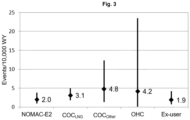
- VTE comprising the primary outcome of interest (DVT of the lower extremities and PE): 10 in NOMAC-E2 users (2.0 per 10,000 WY; 95% CI, 1.0 - 3.8), 17 in COC LNG users (3.1 per 10,000 WY; 95% Cl, 1.8 - 5.0), 4 in COC Other users (4.8 per 10,000 WY; 95% CI, 1.3 - 12.3), 1 in an OHC user (4.2 per 10,000 WY; 95% CI, 0.1 - 23.5) and 6 in ex-users (1.9 per 10,000 WY; 95% CI, 0.7 - 4.2) ( Figure 3 ).
- Five women (2 COC LNG users and 3 COC Other users) experienced both a DVT of a lower extremity and a PE.
- the point estimates and 95% confidence intervals per user (sub)-cohort are in Table 3.
- VTE may be influenced by women who are pregnant within 3 months of treatment initiation, have a history of cancer/chemotherapy or an increased genetic risk of VTE (e.g. Factor V Leiden, Protein S or C deficiency). Therefore, an analysis was planned which would exclude all women who reported these pre-defined risk factors at study entry. This resulted in the exclusion of 4 VTE being excluded from the analysis: 2 COC LNG users and 1 ex-user who had been pregnant within 3 months of study entry and 1 NOMAC-E2 user who had a history of cancer/chemotherapy.
- VTE Factor V Leiden, Protein S or C deficiency
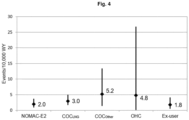
- VTE comprising the primary outcome of interest (DVT of the lower extremities and PE): 9 in NOMAC-E2 users (2.0 per 10,000 WY; 95% Cl, 0.9 - 3.7), 15 in COC LNG users (3.0 per 10,000 WY; 95% CI, 1.7 - 5.0), 4 in COC Other users (5.2 per 10,000 WY; 95% CI, 1.4 - 13.4), 1 in an OHC user (4.8 per 10,000 WY; 95% CI, 0.1 - 26.8) and 5 in ex-users (1.8 per 10,000 WY; 95% CI, 0.6 - 4.1) ( Figure 4 ).
- the number of (primary outcome) VTE, point estimates and 95% confidence intervals for the (sub)-cohorts are presented in Table 4.
- NOMAC-E2 use does not appear to be associated with a higher risk of VTE compared with the use of other COCs.
- HR adj was 0.59 (95% Cl, 0.25 - 1.35).
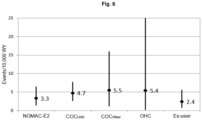
- VTEs There were a total of 17 VTEs (2.4 per 10,000 WY; 95% Cl, 1.4 - 3.9) in women who reported that their motivation for using the COC was for contraceptive reasons only: 4 VTEs in NOMAC-E2 users (1.6 per 10,000 WY; 95% Cl, 0.45 - 4.2), 10 VTEs in COC LNG users (3.6 per 10,000 WY; 95% CI, 1.7 - 6.7), 1 VTE in a COC Other user (2.8 per 10,000 WY; 95% CI, 0.1 - 15.7) and 2 VTEs in ex-users (1.5 per 10,000 WY; 95% CI, 0.2 - 5.5)( Figure 5 ). Table 5 displays the number of VTE, point estimates and 95% confidence intervals for the (sub)-cohorts.
- VTE observed in the Russian study participants who comprise a large proportion (39.5%) of the PRO-E2 study population.
- VTE per user status did not indicate a higher VTE risk for NOMAC-E2.
- the risk of VTE in NOMAC-E2 users was compared with the risk in users of monophasic COC LNG preparations containing 20 mcg EE (COC LNGMono/20mcg ), COC LNG preparations containing 30 mcg EE (COC LNGMono/30mcg ) and in users of multiphasic COC LNG preparations (COC LNGMulti ).
- VTEs were confirmed.
- DVTs of the lower extremities or PE (the primary outcome of interest) referred to in Table 33
- the numbers and incidence rates for each (sub-)cohort were as follows: NOMAC-E2 12 VTEs (2.5 per 10,000 WY; 95% CI, 1.3 - 4.3), COC LNG 20 VTEs (3.7 per 10,000 WY; 95% CI, 2.3 - 5.7), COC Other 5 VTEs (6.0 per 10,000 WY; 95% CI, 2.0 - 14.1), OHC 1 VTE (4.2 per 10,000 WY; 95% CI, 0.1 - 23.5) and ex-users 8 VTEs (2.6 per 10,000 WY; 95% CI, 1.1 - 5.0) ( Figure 7 ).
- VTEs were considered idiopathic VTEs.
- the numbers and incidence rates for each (sub-)cohort are as follows: NOMAC-E2 10 VTEs (2.0 per 10,000 WY; 95% CI, 1.0 - 3.8), COC LNG 15 VTEs (2.8 per 10,000 WY; 95% CI, 1.6 - 4.6), COC Other 5 VTEs (6.0 per 10,000 WY; 95% CI, 2.0 - 14.1), OHC 1 VTE (4.2 per 10,000 WY. 95% CI, 0.1 - 23.5) and ex-users 4 VTEs (1.3 per 10,000 WY; 95% CI, 0.35 - 3.3).
- ATEs 2 ischemic strokes, 1 TIA and 1 myocardial infarction
- NOMAC-E2 0.8 per 10,000 WY; 95% Cl, 0.2 - 2.1
- 7 ATEs (4 ischemic strokes and 3 AMI) in COC LNG users (1.3 per 10,000 WY; 95% Cl, 0.5 - 2.7)
- 1 ATE an AMI
- 4 ATEs (3 ischemic strokes and 1 AMI) in ex-users (1.3 per 10,000 WY; 95% CI, 0.35 - 3.3).
- 65 were in NOMAC-E2 users (13.3 per 10,000 WY; 95% CI, 10.3 - 17.0), 63 in COC LNG users (11.7 per 10,000 WY; 95% CI, 9.0 - 14.9), 12 in COC Other users (14.5 per 10,000 WY; 95% CI, 7.5 - 25.2), 6 in OHC users (25.4 per 10,000 WY; 95% CI, 9.3 - 55.2) and 45 in ex-users (14.4 per 10,000 WY; 95% CI, 10.5 - 19.2).
- NOMAC-E2 users appeared to experience more of an improvement in their acne during follow-up (in comparison with baseline) than COC LNG users.
- the results presented herein indicate that at this point in time, the risk of VTE is not equal among NOMAC-E2 users and COC LNG users.
- the HR crude for NOMAC-E2 vs. COC LNG is 0.6 with a 95% confidence interval of 0.2 to 1.5.
- the HR adj for NOMAC-E2 vs. COC LNG remained 0.6 (0.2 - 1.5).
- NOMAC-E2 users are not at higher risk of ATE, death, SAE, cholelithiasis, inflammatory bowel disease, general hepatobiliary disorders, depressive disorders, mood changes, weight changes or acne changes compared to COC LNG users. They also demonstrate the NOMAC-E2 users are at a reduced risk of unintended pregnancy compared to COC LNG users.
- the study was designed to reflect routine clinical use of COCs. Study participants were recruited by COC-prescribing healthcare professionals (e.g. gynecologists, general practitioners, midwives) and all new users of COCs could participate in the study. Participation was not limited by medical inclusion and exclusion criteria. Therefore, the ability to generalize the results of this study is high.
- COC-prescribing healthcare professionals e.g. gynecologists, general practitioners, midwives
Landscapes
- Health & Medical Sciences (AREA)
- Chemical & Material Sciences (AREA)
- Medicinal Chemistry (AREA)
- Pharmacology & Pharmacy (AREA)
- Life Sciences & Earth Sciences (AREA)
- Animal Behavior & Ethology (AREA)
- General Health & Medical Sciences (AREA)
- Public Health (AREA)
- Veterinary Medicine (AREA)
- Epidemiology (AREA)
- Bioinformatics & Cheminformatics (AREA)
- General Chemical & Material Sciences (AREA)
- Engineering & Computer Science (AREA)
- Organic Chemistry (AREA)
- Nuclear Medicine, Radiotherapy & Molecular Imaging (AREA)
- Chemical Kinetics & Catalysis (AREA)
- Physiology (AREA)
- Nutrition Science (AREA)
- Reproductive Health (AREA)
- Endocrinology (AREA)
- Gynecology & Obstetrics (AREA)
- Diabetes (AREA)
- Hematology (AREA)
- Pharmaceuticals Containing Other Organic And Inorganic Compounds (AREA)
- Steroid Compounds (AREA)
Applications Claiming Priority (5)
| Application Number | Priority Date | Filing Date | Title |
|---|---|---|---|
| GBGB2016428.1A GB202016428D0 (en) | 2020-10-16 | 2020-10-16 | Use of combined oral contraceptives containing nomegestrol acetate and estradiol |
| GBGB2105401.0A GB202105401D0 (en) | 2021-04-15 | 2021-04-15 | Use of combined oral contraceptives containing nomegestrol acetate and estradiol |
| GBGB2105398.8A GB202105398D0 (en) | 2021-04-15 | 2021-04-15 | Methods of contraception using nomegestrol acetate and estradiol |
| PCT/IB2021/059354 WO2021229558A2 (fr) | 2020-10-16 | 2021-10-12 | Procédés de contraception utilisant de l'acétate de nomégestrol et de l'estradiol |
| EP21794984.1A EP4013425A2 (fr) | 2020-10-16 | 2021-10-12 | Procédés de contraception utilisant de l'acétate de nomégestrol et de l'estradiol |
Related Parent Applications (1)
| Application Number | Title | Priority Date | Filing Date |
|---|---|---|---|
| EP21794984.1A Division EP4013425A2 (fr) | 2020-10-16 | 2021-10-12 | Procédés de contraception utilisant de l'acétate de nomégestrol et de l'estradiol |
Publications (2)
| Publication Number | Publication Date |
|---|---|
| EP4420721A2 true EP4420721A2 (fr) | 2024-08-28 |
| EP4420721A3 EP4420721A3 (fr) | 2024-10-23 |
Family
ID=78302841
Family Applications (5)
| Application Number | Title | Priority Date | Filing Date |
|---|---|---|---|
| EP21794983.3A Withdrawn EP4013424A2 (fr) | 2020-10-16 | 2021-10-12 | Utilisation de contraceptifs oraux combinés contenant de l'acétate de nomégestrol et de l'estradiol |
| EP24173453.2A Pending EP4420721A3 (fr) | 2020-10-16 | 2021-10-12 | Procédés de contraception utilisant de l'acétate de nomégestrol et de l'estradiol |
| EP21794985.8A Withdrawn EP4013426A2 (fr) | 2020-10-16 | 2021-10-12 | Utilisation de contraceptifs oraux combinés contenant de l'acétate de nomégestrol et de l'estradiol |
| EP21794984.1A Withdrawn EP4013425A2 (fr) | 2020-10-16 | 2021-10-12 | Procédés de contraception utilisant de l'acétate de nomégestrol et de l'estradiol |
| EP24173450.8A Pending EP4420720A3 (fr) | 2020-10-16 | 2021-10-12 | Utilisation de contraceptifs oraux combinés contenant de l'acétate de nomégestrol et de l'estradiol |
Family Applications Before (1)
| Application Number | Title | Priority Date | Filing Date |
|---|---|---|---|
| EP21794983.3A Withdrawn EP4013424A2 (fr) | 2020-10-16 | 2021-10-12 | Utilisation de contraceptifs oraux combinés contenant de l'acétate de nomégestrol et de l'estradiol |
Family Applications After (3)
| Application Number | Title | Priority Date | Filing Date |
|---|---|---|---|
| EP21794985.8A Withdrawn EP4013426A2 (fr) | 2020-10-16 | 2021-10-12 | Utilisation de contraceptifs oraux combinés contenant de l'acétate de nomégestrol et de l'estradiol |
| EP21794984.1A Withdrawn EP4013425A2 (fr) | 2020-10-16 | 2021-10-12 | Procédés de contraception utilisant de l'acétate de nomégestrol et de l'estradiol |
| EP24173450.8A Pending EP4420720A3 (fr) | 2020-10-16 | 2021-10-12 | Utilisation de contraceptifs oraux combinés contenant de l'acétate de nomégestrol et de l'estradiol |
Country Status (6)
| Country | Link |
|---|---|
| US (2) | US20230398127A1 (fr) |
| EP (5) | EP4013424A2 (fr) |
| AU (2) | AU2021271338A1 (fr) |
| CA (2) | CA3194584A1 (fr) |
| DE (3) | DE21794983T1 (fr) |
| WO (3) | WO2021229559A2 (fr) |
Families Citing this family (1)
| Publication number | Priority date | Publication date | Assignee | Title |
|---|---|---|---|---|
| CN114569567B (zh) * | 2021-12-20 | 2023-03-14 | 南通联亚药业股份有限公司 | 一种稳定的双醋炔诺酮炔雌醇复方片及其制备方法 |
Family Cites Families (2)
| Publication number | Priority date | Publication date | Assignee | Title |
|---|---|---|---|---|
| FR2754179B1 (fr) * | 1996-10-08 | 1998-12-24 | Theramex | Nouvelle composition hormononale et son utilisation |
| US20080242650A1 (en) | 2007-03-26 | 2008-10-02 | Jean-Louis Thomas | Oral contraceptive regimen |
-
2021
- 2021-10-12 AU AU2021271338A patent/AU2021271338A1/en active Pending
- 2021-10-12 WO PCT/IB2021/059355 patent/WO2021229559A2/fr not_active Ceased
- 2021-10-12 US US18/031,748 patent/US20230398127A1/en active Pending
- 2021-10-12 EP EP21794983.3A patent/EP4013424A2/fr not_active Withdrawn
- 2021-10-12 EP EP24173453.2A patent/EP4420721A3/fr active Pending
- 2021-10-12 CA CA3194584A patent/CA3194584A1/fr active Pending
- 2021-10-12 WO PCT/IB2021/059354 patent/WO2021229558A2/fr not_active Ceased
- 2021-10-12 CA CA3194580A patent/CA3194580A1/fr active Pending
- 2021-10-12 DE DE21794983.3T patent/DE21794983T1/de active Pending
- 2021-10-12 EP EP21794985.8A patent/EP4013426A2/fr not_active Withdrawn
- 2021-10-12 DE DE21794984.1T patent/DE21794984T1/de active Pending
- 2021-10-12 US US18/031,749 patent/US12616703B2/en active Active
- 2021-10-12 WO PCT/IB2021/059353 patent/WO2021229557A2/fr not_active Ceased
- 2021-10-12 EP EP21794984.1A patent/EP4013425A2/fr not_active Withdrawn
- 2021-10-12 EP EP24173450.8A patent/EP4420720A3/fr active Pending
- 2021-10-12 DE DE202021004490.6U patent/DE202021004490U1/de active Active
- 2021-10-12 AU AU2021273384A patent/AU2021273384A1/en active Pending
Non-Patent Citations (6)
| Title |
|---|
| CAREYALLEN, THE OBSTETRICIAN & GYNAECOLOGIST, vol. 14, 2012, pages 223 - 228 |
| DINGER JC ET AL., CONTRACEPTION, vol. 75, 2007, pages 344 - 354 |
| DRAGOMAN ET AL., INT. J. GYNAECOL OBSTET., vol. 141, no. 3, 2018, pages 287 - 294 |
| FERTILITY AND STERILITY., vol. 107, no. 1, 2016, pages 43 - 51 |
| STEINER ET AL., ANNU. REV. MED., vol. 48, 1997, pages 447 - 455 |
| THE LANCET., vol. 346, 1995, pages 1575 - 82 |
Also Published As
| Publication number | Publication date |
|---|---|
| WO2021229557A3 (fr) | 2022-02-24 |
| WO2021229558A2 (fr) | 2021-11-18 |
| US12616703B2 (en) | 2026-05-05 |
| US20230390306A1 (en) | 2023-12-07 |
| DE202021004490U1 (de) | 2025-06-18 |
| EP4420721A3 (fr) | 2024-10-23 |
| AU2021273384A1 (en) | 2023-06-22 |
| DE21794983T1 (de) | 2022-11-17 |
| EP4420720A2 (fr) | 2024-08-28 |
| WO2021229558A3 (fr) | 2022-02-24 |
| EP4420720A3 (fr) | 2024-10-23 |
| EP4013426A2 (fr) | 2022-06-22 |
| AU2021271338A1 (en) | 2023-06-22 |
| CA3194580A1 (fr) | 2021-11-18 |
| DE21794984T1 (de) | 2022-11-17 |
| WO2021229559A3 (fr) | 2022-02-24 |
| US20230398127A1 (en) | 2023-12-14 |
| EP4013425A2 (fr) | 2022-06-22 |
| WO2021229559A2 (fr) | 2021-11-18 |
| EP4013424A2 (fr) | 2022-06-22 |
| CA3194584A1 (fr) | 2021-11-18 |
| WO2021229557A2 (fr) | 2021-11-18 |
| AU2021271338A9 (en) | 2024-08-08 |
Similar Documents
| Publication | Publication Date | Title |
|---|---|---|
| CN111989105B (zh) | 化合物以及它们在缓解绝经相关症状中的用途 | |
| CN113750108B (zh) | 用于过重女性患者的基于屈螺酮的避孕药 | |
| US20070238713A1 (en) | Methods for prevention and treatment of conditions arising from local estrogen deficiency | |
| CN119424448A (zh) | 化合物以及它们在缓解绝经相关症状中的用途 | |
| TW200902030A (en) | Progesterone for the treatment or prevention of spontaneous preterm birth | |
| US12616703B2 (en) | Methods of contraception using nomegestrol acetate and estradiol | |
| Jaithitivit et al. | Cycle control, safety and acceptability of a new oral contraceptive containing ethinylestradiol 15 micrograms and gestodene 60 micrograms | |
| Bruni et al. | Hormonal contraception | |
| KR20250151374A (ko) | 통증의 완화 및 치료에 사용되는 에스테트롤 및 드로스피레논을 포함하는 조성물 | |
| Radia et al. | Demystifying long-acting reversible contraception (LARC): a low-maintenance guide for low-maintenance contraception | |
| HK40061928A (en) | Drospirenone-based contraceptive for a female patient affected with excess weight | |
| Label | FDA Label for Yaz | |
| No | Management of premenstrual syndrome | |
| Start | 1 INDICATIONS AND USAGE | |
| TW200930377A (en) | Use of gestagens in combination with (6s)-5-methyltetrahydrofolate for therapy of endometriosis with simultaneous reduction of therapy side effects and reduction of the risk of congenital abnormalities at the onset of a pregnancy | |
| Start | FULL PRESCRIBING INFORMATION: CONTENTS | |
| Label | FDA Label for Officella | |
| Kerkhof et al. | Nausea• vomiting• malaise• frequent urination• Dx? | |
| PI | Your rights | |
| Stevenson et al. | Comparison of calcium-regulating hormones and calcitonin gene-related peptide levels in osteoporotic and non-osteoporotic women. | |
| Contraceptive et al. | PrOVRAL® 21 | |
| Drospirenone | FDA Label for Drospirenone, Ethinyl Estradiol And Levomefolate Calcium And Levomefolate Calcium | |
| HK1255216B (zh) | 用於过重女性患者的基於屈螺酮的避孕药 | |
| MXPA06000467A (en) | Methods of hormonal treatment utilizing contraceptive regimens with continuous estrogen administration | |
| CN106265694A (zh) | 用于过重女性患者的基于屈螺酮的避孕药 |
Legal Events
| Date | Code | Title | Description |
|---|---|---|---|
| PUAI | Public reference made under article 153(3) epc to a published international application that has entered the european phase |
Free format text: ORIGINAL CODE: 0009012 |
|
| STAA | Information on the status of an ep patent application or granted ep patent |
Free format text: STATUS: REQUEST FOR EXAMINATION WAS MADE |
|
| 17P | Request for examination filed |
Effective date: 20240430 |
|
| AC | Divisional application: reference to earlier application |
Ref document number: 4013425 Country of ref document: EP Kind code of ref document: P |
|
| AK | Designated contracting states |
Kind code of ref document: A2 Designated state(s): AL AT BE BG CH CY CZ DE DK EE ES FI FR GB GR HR HU IE IS IT LI LT LU LV MC MK MT NL NO PL PT RO RS SE SI SK SM TR |
|
| REG | Reference to a national code |
Ref country code: DE Ref legal event code: R079 Free format text: PREVIOUS MAIN CLASS: A61P0015180000 Ipc: A61K0031565000 |
|
| PUAL | Search report despatched |
Free format text: ORIGINAL CODE: 0009013 |
|
| AK | Designated contracting states |
Kind code of ref document: A3 Designated state(s): AL AT BE BG CH CY CZ DE DK EE ES FI FR GB GR HR HU IE IS IT LI LT LU LV MC MK MT NL NO PL PT RO RS SE SI SK SM TR |
|
| RIC1 | Information provided on ipc code assigned before grant |
Ipc: A61P 15/18 20060101ALI20240919BHEP Ipc: A61K 31/575 20060101ALI20240919BHEP Ipc: A61K 31/565 20060101AFI20240919BHEP |
|
| P01 | Opt-out of the competence of the unified patent court (upc) registered |
Free format text: CASE NUMBER: APP_52656/2024 Effective date: 20240919 |
|
| STAA | Information on the status of an ep patent application or granted ep patent |
Free format text: STATUS: EXAMINATION IS IN PROGRESS |
|
| 17Q | First examination report despatched |
Effective date: 20260115 |