EP4420876A1 - Stratifié d'emballage à haute barrière présentant une meilleure aptitude à l'usinage - Google Patents
Stratifié d'emballage à haute barrière présentant une meilleure aptitude à l'usinage Download PDFInfo
- Publication number
- EP4420876A1 EP4420876A1 EP24158771.6A EP24158771A EP4420876A1 EP 4420876 A1 EP4420876 A1 EP 4420876A1 EP 24158771 A EP24158771 A EP 24158771A EP 4420876 A1 EP4420876 A1 EP 4420876A1
- Authority
- EP
- European Patent Office
- Prior art keywords
- polymer layer
- packaging laminate
- polymer
- layer arrangement
- arrangement
- Prior art date
- Legal status (The legal status is an assumption and is not a legal conclusion. Google has not performed a legal analysis and makes no representation as to the accuracy of the status listed.)
- Pending
Links
- 238000004806 packaging method and process Methods 0.000 title claims abstract description 143
- 230000004888 barrier function Effects 0.000 title claims abstract description 34
- 229920000642 polymer Polymers 0.000 claims abstract description 232
- 229920000098 polyolefin Polymers 0.000 claims abstract description 42
- 229910052751 metal Inorganic materials 0.000 claims abstract description 29
- 239000002184 metal Substances 0.000 claims abstract description 29
- 239000000463 material Substances 0.000 claims abstract description 28
- QVGXLLKOCUKJST-UHFFFAOYSA-N atomic oxygen Chemical compound [O] QVGXLLKOCUKJST-UHFFFAOYSA-N 0.000 claims abstract description 17
- 239000001301 oxygen Substances 0.000 claims abstract description 17
- 229910052760 oxygen Inorganic materials 0.000 claims abstract description 17
- 238000012546 transfer Methods 0.000 claims abstract description 12
- 229920002451 polyvinyl alcohol Polymers 0.000 claims abstract description 11
- 229910044991 metal oxide Inorganic materials 0.000 claims abstract description 10
- 150000004706 metal oxides Chemical class 0.000 claims abstract description 10
- 239000002105 nanoparticle Substances 0.000 claims abstract description 7
- 239000010410 layer Substances 0.000 claims description 285
- -1 polyethylene Polymers 0.000 claims description 27
- 239000004698 Polyethylene Substances 0.000 claims description 19
- 229920000573 polyethylene Polymers 0.000 claims description 19
- XLYOFNOQVPJJNP-UHFFFAOYSA-N water Chemical compound O XLYOFNOQVPJJNP-UHFFFAOYSA-N 0.000 claims description 13
- VGGSQFUCUMXWEO-UHFFFAOYSA-N Ethene Chemical compound C=C VGGSQFUCUMXWEO-UHFFFAOYSA-N 0.000 claims description 12
- 229920001903 high density polyethylene Polymers 0.000 claims description 11
- 239000004700 high-density polyethylene Substances 0.000 claims description 11
- 239000002356 single layer Substances 0.000 claims description 11
- 239000000203 mixture Substances 0.000 claims description 10
- 229920006254 polymer film Polymers 0.000 claims description 9
- 229920000219 Ethylene vinyl alcohol Polymers 0.000 claims description 8
- HGVPOWOAHALJHA-UHFFFAOYSA-N ethene;methyl prop-2-enoate Chemical compound C=C.COC(=O)C=C HGVPOWOAHALJHA-UHFFFAOYSA-N 0.000 claims description 8
- 229920006225 ethylene-methyl acrylate Polymers 0.000 claims description 8
- 239000005043 ethylene-methyl acrylate Substances 0.000 claims description 8
- BLDFSDCBQJUWFG-UHFFFAOYSA-N 2-(methylamino)-1,2-diphenylethanol Chemical compound C=1C=CC=CC=1C(NC)C(O)C1=CC=CC=C1 BLDFSDCBQJUWFG-UHFFFAOYSA-N 0.000 claims description 6
- 239000005977 Ethylene Substances 0.000 claims description 6
- 239000004743 Polypropylene Substances 0.000 claims description 6
- 239000004372 Polyvinyl alcohol Substances 0.000 claims description 6
- 229920001684 low density polyethylene Polymers 0.000 claims description 6
- 239000004702 low-density polyethylene Substances 0.000 claims description 6
- 229920001179 medium density polyethylene Polymers 0.000 claims description 6
- 239000004701 medium-density polyethylene Substances 0.000 claims description 6
- 229920001155 polypropylene Polymers 0.000 claims description 6
- 229920000092 linear low density polyethylene Polymers 0.000 claims description 5
- 239000004707 linear low-density polyethylene Substances 0.000 claims description 5
- SMZOUWXMTYCWNB-UHFFFAOYSA-N 2-(2-methoxy-5-methylphenyl)ethanamine Chemical compound COC1=CC=C(C)C=C1CCN SMZOUWXMTYCWNB-UHFFFAOYSA-N 0.000 claims description 4
- NIXOWILDQLNWCW-UHFFFAOYSA-N 2-Propenoic acid Natural products OC(=O)C=C NIXOWILDQLNWCW-UHFFFAOYSA-N 0.000 claims description 4
- 229920000089 Cyclic olefin copolymer Polymers 0.000 claims description 4
- 239000004713 Cyclic olefin copolymer Substances 0.000 claims description 4
- 229920000034 Plastomer Polymers 0.000 claims description 4
- 229920002988 biodegradable polymer Polymers 0.000 claims description 4
- 239000004621 biodegradable polymer Substances 0.000 claims description 4
- 229920001971 elastomer Polymers 0.000 claims description 4
- 239000000806 elastomer Substances 0.000 claims description 4
- 229920000578 graft copolymer Polymers 0.000 claims description 4
- 229920000554 ionomer Polymers 0.000 claims description 4
- FPYJFEHAWHCUMM-UHFFFAOYSA-N maleic anhydride Chemical compound O=C1OC(=O)C=C1 FPYJFEHAWHCUMM-UHFFFAOYSA-N 0.000 claims description 4
- 229920005989 resin Polymers 0.000 claims description 4
- 239000011347 resin Substances 0.000 claims description 4
- 239000005020 polyethylene terephthalate Substances 0.000 claims description 2
- 229920000139 polyethylene terephthalate Polymers 0.000 claims description 2
- 238000004519 manufacturing process Methods 0.000 description 12
- 238000001125 extrusion Methods 0.000 description 10
- 239000000047 product Substances 0.000 description 7
- VYPSYNLAJGMNEJ-UHFFFAOYSA-N Silicium dioxide Chemical compound O=[Si]=O VYPSYNLAJGMNEJ-UHFFFAOYSA-N 0.000 description 3
- 239000004715 ethylene vinyl alcohol Substances 0.000 description 3
- 230000009969 flowable effect Effects 0.000 description 3
- 238000010030 laminating Methods 0.000 description 3
- 229920001912 maleic anhydride grafted polyethylene Polymers 0.000 description 3
- 238000001465 metallisation Methods 0.000 description 3
- TWNQGVIAIRXVLR-UHFFFAOYSA-N oxo(oxoalumanyloxy)alumane Chemical compound O=[Al]O[Al]=O TWNQGVIAIRXVLR-UHFFFAOYSA-N 0.000 description 3
- 238000004064 recycling Methods 0.000 description 3
- 229910052814 silicon oxide Inorganic materials 0.000 description 3
- 239000000853 adhesive Substances 0.000 description 2
- 230000001070 adhesive effect Effects 0.000 description 2
- 230000015572 biosynthetic process Effects 0.000 description 2
- 230000000694 effects Effects 0.000 description 2
- 238000013508 migration Methods 0.000 description 2
- 230000005012 migration Effects 0.000 description 2
- 239000000178 monomer Substances 0.000 description 2
- 230000003647 oxidation Effects 0.000 description 2
- 238000007254 oxidation reaction Methods 0.000 description 2
- 238000012856 packing Methods 0.000 description 2
- 239000002861 polymer material Substances 0.000 description 2
- 238000012545 processing Methods 0.000 description 2
- 238000007789 sealing Methods 0.000 description 2
- 230000003068 static effect Effects 0.000 description 2
- 230000003746 surface roughness Effects 0.000 description 2
- 229910000838 Al alloy Inorganic materials 0.000 description 1
- 229910016909 AlxOy Inorganic materials 0.000 description 1
- RYGMFSIKBFXOCR-UHFFFAOYSA-N Copper Chemical compound [Cu] RYGMFSIKBFXOCR-UHFFFAOYSA-N 0.000 description 1
- 229910052774 Proactinium Inorganic materials 0.000 description 1
- BQCADISMDOOEFD-UHFFFAOYSA-N Silver Chemical compound [Ag] BQCADISMDOOEFD-UHFFFAOYSA-N 0.000 description 1
- 229910052782 aluminium Inorganic materials 0.000 description 1
- XAGFODPZIPBFFR-UHFFFAOYSA-N aluminium Chemical compound [Al] XAGFODPZIPBFFR-UHFFFAOYSA-N 0.000 description 1
- 230000005540 biological transmission Effects 0.000 description 1
- 239000000919 ceramic Substances 0.000 description 1
- 229910010293 ceramic material Inorganic materials 0.000 description 1
- 229910052802 copper Inorganic materials 0.000 description 1
- 239000010949 copper Substances 0.000 description 1
- 230000006866 deterioration Effects 0.000 description 1
- 230000002708 enhancing effect Effects 0.000 description 1
- 230000001747 exhibiting effect Effects 0.000 description 1
- PCHJSUWPFVWCPO-UHFFFAOYSA-N gold Chemical compound [Au] PCHJSUWPFVWCPO-UHFFFAOYSA-N 0.000 description 1
- 229910052737 gold Inorganic materials 0.000 description 1
- 239000010931 gold Substances 0.000 description 1
- 238000007373 indentation Methods 0.000 description 1
- 238000002347 injection Methods 0.000 description 1
- 239000007924 injection Substances 0.000 description 1
- 229910010272 inorganic material Inorganic materials 0.000 description 1
- 239000011147 inorganic material Substances 0.000 description 1
- 239000013067 intermediate product Substances 0.000 description 1
- 238000003475 lamination Methods 0.000 description 1
- 238000000034 method Methods 0.000 description 1
- 229910052709 silver Inorganic materials 0.000 description 1
- 239000004332 silver Substances 0.000 description 1
- 239000002904 solvent Substances 0.000 description 1
- 238000004804 winding Methods 0.000 description 1
Images


Classifications
-
- B—PERFORMING OPERATIONS; TRANSPORTING
- B65—CONVEYING; PACKING; STORING; HANDLING THIN OR FILAMENTARY MATERIAL
- B65D—CONTAINERS FOR STORAGE OR TRANSPORT OF ARTICLES OR MATERIALS, e.g. BAGS, BARRELS, BOTTLES, BOXES, CANS, CARTONS, CRATES, DRUMS, JARS, TANKS, HOPPERS, FORWARDING CONTAINERS; ACCESSORIES, CLOSURES, OR FITTINGS THEREFOR; PACKAGING ELEMENTS; PACKAGES
- B65D65/00—Wrappers or flexible covers; Packaging materials of special type or form
- B65D65/38—Packaging materials of special type or form
- B65D65/40—Applications of laminates for particular packaging purposes
-
- B—PERFORMING OPERATIONS; TRANSPORTING
- B32—LAYERED PRODUCTS
- B32B—LAYERED PRODUCTS, i.e. PRODUCTS BUILT-UP OF STRATA OF FLAT OR NON-FLAT, e.g. CELLULAR OR HONEYCOMB, FORM
- B32B1/00—Layered products having a non-planar shape
- B32B1/08—Tubular products
-
- B—PERFORMING OPERATIONS; TRANSPORTING
- B32—LAYERED PRODUCTS
- B32B—LAYERED PRODUCTS, i.e. PRODUCTS BUILT-UP OF STRATA OF FLAT OR NON-FLAT, e.g. CELLULAR OR HONEYCOMB, FORM
- B32B27/00—Layered products comprising a layer of synthetic resin
- B32B27/06—Layered products comprising a layer of synthetic resin as the main or only constituent of a layer, which is next to another layer of the same or of a different material
- B32B27/08—Layered products comprising a layer of synthetic resin as the main or only constituent of a layer, which is next to another layer of the same or of a different material of synthetic resin
-
- B—PERFORMING OPERATIONS; TRANSPORTING
- B32—LAYERED PRODUCTS
- B32B—LAYERED PRODUCTS, i.e. PRODUCTS BUILT-UP OF STRATA OF FLAT OR NON-FLAT, e.g. CELLULAR OR HONEYCOMB, FORM
- B32B27/00—Layered products comprising a layer of synthetic resin
- B32B27/18—Layered products comprising a layer of synthetic resin characterised by the use of special additives
-
- B—PERFORMING OPERATIONS; TRANSPORTING
- B32—LAYERED PRODUCTS
- B32B—LAYERED PRODUCTS, i.e. PRODUCTS BUILT-UP OF STRATA OF FLAT OR NON-FLAT, e.g. CELLULAR OR HONEYCOMB, FORM
- B32B27/00—Layered products comprising a layer of synthetic resin
- B32B27/30—Layered products comprising a layer of synthetic resin comprising vinyl (co)polymers; comprising acrylic (co)polymers
- B32B27/306—Layered products comprising a layer of synthetic resin comprising vinyl (co)polymers; comprising acrylic (co)polymers comprising vinyl acetate or vinyl alcohol (co)polymers
-
- B—PERFORMING OPERATIONS; TRANSPORTING
- B32—LAYERED PRODUCTS
- B32B—LAYERED PRODUCTS, i.e. PRODUCTS BUILT-UP OF STRATA OF FLAT OR NON-FLAT, e.g. CELLULAR OR HONEYCOMB, FORM
- B32B27/00—Layered products comprising a layer of synthetic resin
- B32B27/32—Layered products comprising a layer of synthetic resin comprising polyolefins
-
- B—PERFORMING OPERATIONS; TRANSPORTING
- B65—CONVEYING; PACKING; STORING; HANDLING THIN OR FILAMENTARY MATERIAL
- B65D—CONTAINERS FOR STORAGE OR TRANSPORT OF ARTICLES OR MATERIALS, e.g. BAGS, BARRELS, BOTTLES, BOXES, CANS, CARTONS, CRATES, DRUMS, JARS, TANKS, HOPPERS, FORWARDING CONTAINERS; ACCESSORIES, CLOSURES, OR FITTINGS THEREFOR; PACKAGING ELEMENTS; PACKAGES
- B65D35/00—Pliable tubular containers adapted to be permanently or temporarily deformed to expel contents, e.g. collapsible tubes for toothpaste or other plastic or semi-liquid material; Holders therefor
- B65D35/02—Body construction
-
- B—PERFORMING OPERATIONS; TRANSPORTING
- B65—CONVEYING; PACKING; STORING; HANDLING THIN OR FILAMENTARY MATERIAL
- B65D—CONTAINERS FOR STORAGE OR TRANSPORT OF ARTICLES OR MATERIALS, e.g. BAGS, BARRELS, BOTTLES, BOXES, CANS, CARTONS, CRATES, DRUMS, JARS, TANKS, HOPPERS, FORWARDING CONTAINERS; ACCESSORIES, CLOSURES, OR FITTINGS THEREFOR; PACKAGING ELEMENTS; PACKAGES
- B65D35/00—Pliable tubular containers adapted to be permanently or temporarily deformed to expel contents, e.g. collapsible tubes for toothpaste or other plastic or semi-liquid material; Holders therefor
- B65D35/02—Body construction
- B65D35/04—Body construction made in one piece
- B65D35/08—Body construction made in one piece from plastics material
-
- B—PERFORMING OPERATIONS; TRANSPORTING
- B32—LAYERED PRODUCTS
- B32B—LAYERED PRODUCTS, i.e. PRODUCTS BUILT-UP OF STRATA OF FLAT OR NON-FLAT, e.g. CELLULAR OR HONEYCOMB, FORM
- B32B2250/00—Layers arrangement
- B32B2250/05—5 or more layers
-
- B—PERFORMING OPERATIONS; TRANSPORTING
- B32—LAYERED PRODUCTS
- B32B—LAYERED PRODUCTS, i.e. PRODUCTS BUILT-UP OF STRATA OF FLAT OR NON-FLAT, e.g. CELLULAR OR HONEYCOMB, FORM
- B32B2255/00—Coating on the layer surface
- B32B2255/10—Coating on the layer surface on synthetic resin layer or on natural or synthetic rubber layer
-
- B—PERFORMING OPERATIONS; TRANSPORTING
- B32—LAYERED PRODUCTS
- B32B—LAYERED PRODUCTS, i.e. PRODUCTS BUILT-UP OF STRATA OF FLAT OR NON-FLAT, e.g. CELLULAR OR HONEYCOMB, FORM
- B32B2255/00—Coating on the layer surface
- B32B2255/20—Inorganic coating
-
- B—PERFORMING OPERATIONS; TRANSPORTING
- B32—LAYERED PRODUCTS
- B32B—LAYERED PRODUCTS, i.e. PRODUCTS BUILT-UP OF STRATA OF FLAT OR NON-FLAT, e.g. CELLULAR OR HONEYCOMB, FORM
- B32B2255/00—Coating on the layer surface
- B32B2255/20—Inorganic coating
- B32B2255/205—Metallic coating
-
- B—PERFORMING OPERATIONS; TRANSPORTING
- B32—LAYERED PRODUCTS
- B32B—LAYERED PRODUCTS, i.e. PRODUCTS BUILT-UP OF STRATA OF FLAT OR NON-FLAT, e.g. CELLULAR OR HONEYCOMB, FORM
- B32B2307/00—Properties of the layers or laminate
- B32B2307/70—Other properties
- B32B2307/724—Permeability to gases, adsorption
- B32B2307/7242—Non-permeable
- B32B2307/7244—Oxygen barrier
-
- B—PERFORMING OPERATIONS; TRANSPORTING
- B32—LAYERED PRODUCTS
- B32B—LAYERED PRODUCTS, i.e. PRODUCTS BUILT-UP OF STRATA OF FLAT OR NON-FLAT, e.g. CELLULAR OR HONEYCOMB, FORM
- B32B2307/00—Properties of the layers or laminate
- B32B2307/70—Other properties
- B32B2307/724—Permeability to gases, adsorption
- B32B2307/7242—Non-permeable
- B32B2307/7246—Water vapor barrier
-
- B—PERFORMING OPERATIONS; TRANSPORTING
- B32—LAYERED PRODUCTS
- B32B—LAYERED PRODUCTS, i.e. PRODUCTS BUILT-UP OF STRATA OF FLAT OR NON-FLAT, e.g. CELLULAR OR HONEYCOMB, FORM
- B32B2307/00—Properties of the layers or laminate
- B32B2307/70—Other properties
- B32B2307/732—Dimensional properties
- B32B2307/737—Dimensions, e.g. volume or area
- B32B2307/7375—Linear, e.g. length, distance or width
- B32B2307/7376—Thickness
-
- B—PERFORMING OPERATIONS; TRANSPORTING
- B32—LAYERED PRODUCTS
- B32B—LAYERED PRODUCTS, i.e. PRODUCTS BUILT-UP OF STRATA OF FLAT OR NON-FLAT, e.g. CELLULAR OR HONEYCOMB, FORM
- B32B2307/00—Properties of the layers or laminate
- B32B2307/70—Other properties
- B32B2307/746—Slipping, anti-blocking, low friction
-
- B—PERFORMING OPERATIONS; TRANSPORTING
- B32—LAYERED PRODUCTS
- B32B—LAYERED PRODUCTS, i.e. PRODUCTS BUILT-UP OF STRATA OF FLAT OR NON-FLAT, e.g. CELLULAR OR HONEYCOMB, FORM
- B32B2439/00—Containers; Receptacles
- B32B2439/40—Closed containers
-
- B—PERFORMING OPERATIONS; TRANSPORTING
- B32—LAYERED PRODUCTS
- B32B—LAYERED PRODUCTS, i.e. PRODUCTS BUILT-UP OF STRATA OF FLAT OR NON-FLAT, e.g. CELLULAR OR HONEYCOMB, FORM
- B32B2439/00—Containers; Receptacles
- B32B2439/70—Food packaging
Definitions
- the present application refers to a packaging laminate comprising
- the present application particularly refers to a tube laminate as a packaging laminate that is particularly suitable and dedicated to forming tube bodies for squeezable and foldable tube containers.
- Tube laminates as packaging laminates with barrier properties against a migration of oxygen and water vapor through the respective laminate are known from WO 2021/037347 A , WO 2018/202479 A , WO 2022/070214 A , and WO 2012/020426 A .
- the packaging laminate must exhibit good machinability, to allow for an easy, reliable and error-free production process of a packaging on the basis of the packaging laminate.
- the blank In particular during the formation of a tube body out of a blank of the packaging laminate the blank is rolled around a mandrel with a metal surface.
- the kind of contact and in particular the ability of the blank to slide relative to the mandrel surface is an important factor to the machinability of the packaging laminate.
- the surface of the packaging laminate contacting the metal surface of the mandrel is the exposed innermost surface of the packaging laminate and of the tube body formed out of it.
- the outer surface of the tube body comes into contact with itself during the manufacturing process of the tube body out of the packaging laminate. Also in case of this contact the nature of this contact is an important factor to the machinability of the packaging laminate. Usually, the surface of the packaging laminate that comes into contact with itself during a manufacturing process is the exposed outermost surface of the packaging laminate and of the tube body formed out of it.
- a packaging laminate as described at the beginning of this specification, wherein the packaging laminate has an overall oxygen transfer rate of not more than 0.5 cm 3 /(m 2 ⁇ d ⁇ bar) determined at 23°C and 75 % relative humidity according to DIN 53380-3.
- the oxygen transfer rate can be adjusted at least by dimensioning the metal-based layer and the barrier layer of the first polymer layer arrangement.
- the coefficient of friction of an exposed outer polymer surface can be adjusted by selecting the conditions of a chill arrangement of a production line processing the individual components of the packaging laminate to produce the packaging laminate.
- the coefficient of friction mentioned in this application refers to a coefficient of static friction and/or to a coefficient of dynamic friction. Coefficients of static friction and coefficients of dynamic friction of polymers do not differ largely, irrespective of whether a polymer is paired with itself or with a metal.
- the chill arrangement comprises a, preferably water-cooled, chill roll with a diameter in the range of 700 mm to 1000 mm and with a surface roughness of 0,4 to 0,8 ⁇ m Rz determined pursuant to DIN EN ISO 13565-2.
- the chill arrangement further comprises a pressure roll cooperating with the chill roll in forming a nip therebetween, with the pressure roll having a diameter in the range of 200 mm to 350 mm and a Shore-A hardness in the range of 60 to 90, determined pursuant to DIN ISO 7619-1.
- the pressure executed by the chill roll and the pressure roll on the web running through the nip between pressure and chill roll ranges between 1 ⁇ 10 5 to 5 ⁇ 10 5 Pa.
- the coefficient of friction on either exposed polymer surface can be adjusted by the conditions of the chill arrangement as set forth above, irrespective of whether the exposed polymer surface is in immediate and direct contact with the chill roll surface and/or whether the exposed polymer surface is in immediate and direct contact with the pressure roll.
- the packaging laminate comprises at least one extruded polymer layer not only as a reason to use at all the chill arrangement with the chill roll and the pressure roll, but also to introduce thermal energy into the entire laminate through the extruded layer.
- This thermal energy introduced by the at least one extruded polymer layer allows for a slight softening of the outermost polymer layers exhibiting the exposed surfaces.
- the at least one extruded polymer layer can be an intermediate layer of the resulting packaging laminate.
- the values for coefficients of friction given above under i.) and ii.) are maximum values for the coefficient of friction. Lower values are possible by adjusting the chill arrangement in the production line. With a small effort of trial of varying the parameters of the chill arrangement within the above-listed parameter ranges in a refinement of the present invention the chill arrangement can be set up to achieve a value of the coefficient of friction of an exposed surface with itself of 0.60 or less. Even more preferably the coefficient of the coefficient of friction of the exposed surface with itself can be 0.35 or less.
- the value of the coefficient of friction of an exposed surface with metal can be arranged to be 0.50 or less. More preferably, this coefficient of friction of the exposed surface with metal can be 0.25 or less.
- both opposite exposed polymer surfaces have a particularly low coefficient of friction, so that one of the exposed surfaces has a coefficient of friction with itself of less than 0.90, preferably less than 0.60, more preferably less than 0.35, determined according to DIN EN ISO 8295 and the respective other exposed surface has a coefficient of friction with a metal surface of less than 0.80, preferably less than 0.50, more preferably less than 0.25, determined according to DIN EN ISO 8295.
- the oxygen transfer rate of the packaging laminate can be adjusted to lower values by correspondingly designing the barrier material layer of the first polymer layer arrangement which is present in addition to the metal-based deposited layer. Consequently, the oxygen transfer rate can exhibit even a value of less than 0.1 cm 3 /(m 2 ⁇ d ⁇ bar) determined under the conditions defined above, i. e. at 23°C and 75 % relative humidity according to DIN 53380-3.
- the packaging laminate shield the packaged product from oxygen, but also from humidity, i. e. water vapor.
- the packaging laminate preferably has an overall water vapor transfer rate of not more than 0.5 g/(m 2 ⁇ d), more preferably not more than 0.1 g/(m 2 ⁇ d), determined at 23°C and 85 % relative humidity according to DIN EN ISO 15106-3.
- the water vapor transmission rate may be adjusted by selecting suitable polyolefins for the polyolefin film, like for example HDPE, which provides a good water vapor barrier compared to a reference polyolefin film of the same thickness made out of a different polyethylene variety or polypropylene. Additionally, arranging vapor deposited metal oxide barrier material layers, like for example an aluminum oxide layer and/or an silicon oxide layer, in the first polymer layer arrangement further lowers not only the oxygen transfer rate (OTR) of the packaging laminate, but also its water vapor transfer rate (WVTR).
- OTR oxygen transfer rate
- WVTR water vapor transfer rate
- the polyolefin film of the first polymer layer arrangement can be a polyolefin monolayer film or a polyolefin multilayer film.
- each layer of the film is composed by a polyolefin layer.
- the polyolefin of the polyolefin film, of the individual layers in case of a multilayer film is preferably selected from at least one of LLDPE, LDPE, MDPE, HDPE or at least one blend of the listed polyethylene varieties.
- the polyolefin film of the first polymer layer arrangement can be a blown film or a cast film.
- the polyolefin film of the first polymer layer arrangement can be oriented, for example by stretching, in one direction as machine-direction oriented (MDO) film or into directions as a biaxially oriented film. Orienting the polyolefin film further enhances its water vapor barrier properties and lowers the WVTR of the polyolefin film.
- MDO machine-direction oriented
- the metal-based layer of the first polymer layer arrangement can be a deposited metal layer, such as a gold layer, silver layer, copper layer or aluminum layer, or can be a metal oxide layer, like preferably an Al x O y layer, which is the basic denomination of an aluminum oxide layer, or a SiO x layer, which is the basic denomination of a silicon oxide layer.
- the second polymer layer arrangement can be a polymer monolayer or a polymer multilayer arrangement.
- the at least one polymer of the second polymer layer arrangement can be selected from at least one of LLDPE, LDPE, MDPE, HDPE, polyvinyl alcohol, ethylene vinyl alcohol copolymer, ethylene and acrylic acid, ethylene methyl acrylate, cyclic olefin copolymer, polypropylene, a maleic anhydride grafted polymer, a plastomer/elastomer, a ionomer, a peelable resin based on ethylene methyl acrylate, a biodegradable polymer, a compostable polymer, a blend of the listed polymers.
- the second polymer layer arrangement can be used either to enhance the mechanical stability of the packaging laminate or to enhance its barrier properties.
- mechanical stability and barrier properties may be increased, since polyethylene may provide additional stability and provides considerable water vapor barrier properties.
- the second polymer layer arrangement is an extruded polymer layer arrangement.
- the second polymer layer arrangement can then be an extruded monolayer or coextruded multilayer arrangement.
- the second polymer layer arrangement can be used to extrusion laminate polymer layer arrangements containing prefabricated films to one another.
- the first polymer layer arrangement preferably has an overall thickness in the range of 15 ⁇ m to 80 ⁇ m.
- the second polymer layer arrangement preferably has an overall thickness in the range of 15 ⁇ m to 90 ⁇ m.
- the packaging laminate in particular as a preferred tube laminate, preferably has an overall thickness in the range of 130 ⁇ m to 400 ⁇ m.
- the overall thickness is to be measured from the exposed surface of the laminate on one side to the exposed surface of the laminate on the opposite side.
- exposed surface indicates that the surfaces are exposed at the end of the manufacturing process. This does not exclude that one of the surfaces, in particular the outermost surface, will be covered by printing and, if printed, preferably also by an overlaquer in subsequent processing steps.
- the packaging laminate in a further refinement of the present invention can comprise at least one third polymer layer arrangement, wherein the at least one third polymer layer arrangement comprises a polymer film, wherein the polymer of the polymer film of the third polymer layer arrangement comprises at least one polymer of polyethylene, polyethylene terephthalate, polypropylene, polyvinyl alcohol, ethylene vinyl alcohol copolymer, ethylene and acrylic acid, ethylene methyl acrylate, cyclic olefin copolymer, a maleic anhydride grafted polymer, a plastomer/elastomer, a ionomer, a peelable resin based on ethylene methyl acrylate, a biodegradable polymer, a compostable polymer, a blend of the listed polymers.
- the third polymer layer arrangement is similar to the first polymer layer arrangement in that it comprises a prefabricated film, which in contrast to the first polymer layer arrangement is not necessarily made of polyolefin.
- the prefabricated polymer film of the third polymer layer arrangement can be a monolayer or multilayer film.
- the prefabricated films at least are made of the same class of polymer, i. e. polyolefin due to the polyolefin film used for the first polymer layer arrangement, or more preferably of polymer based on the same monomer.
- the prefabricated polymer films of the packaging laminate are therefore polyethylene films. This applies also to the case that more than two polymer films are present in the packaging laminate. This should not exclude polypropylene from being used as material for the prefabricated polymer films.
- the third polymer layer arrangement does not contain a metallization layer, i. e. a vapor deposited metal layer.
- At least 90 weight-% of the polymer used to form the packaging laminate is based on the same monomer, particularly preferred ethylene, to facilitate recycling of the packaging laminate and a container formed using the packaging laminate.
- At least one third polymer layer arrangement of the at least one third polymer layer arrangement can additionally comprise a barrier material layer.
- the barrier material layer preferably comprises at least one of a vinyl alcohol polymer layer, a metal oxide layer, and a polymer layer filled with nanoparticles.
- the nanoparticles mentioned in this application can for example be made out of polymer and/or ceramic and/or inorganic material.
- the nanoparticles within a polymer mentioned in this application can have a mixture of shapes or can have a prevailing shape or can have a specific shape, like e. g. globular, flake-shaped, platelet-shaped, cubic, bar-shaped, and so on.
- the at least one third polymer layer arrangement preferably has an overall thickness in the range of 40 ⁇ m to 200 ⁇ m.
- the packaging laminate preferably has only one vapor deposited metal layer, but may have no, one, or more than one metal oxide layer as an additional barrier material layer.
- the packaging laminate to render it particularly mechanically stable and particularly impermeable to oxygen, and preferably also impermeable to water vapor, may comprise two first polymer layer arrangements which are bonded to each other by the second polymer layer arrangement.
- the second polymer layer arrangement then is preferably an extruded layer arrangement, extrusion laminating the two first polymer layer arrangements together.
- the two, or possibly even more, first polymer layer arrangements may structurally differ from each other as long as each first polymer layer arrangement corresponds to the definition of a first polymer layer arrangement given above.
- the different first polymer layer arrangements may have different barrier material layers and/or may have different metal-based deposited layers and/or may have polyolefin films made out of different polyolefins and/or may have polyolefin films made of different varieties of the same polyolefin type and/or may have polyolefin films made up by a different amount of layers. These possible differences apply to the selected materials as well as to the respective dimensions, in particular thickness dimensions.
- the packaging laminate may comprise a first polymer layer arrangement and a third polymer layer arrangement, which are bonded to each other by the second polymer layer arrangement.
- the second polymer layer arrangement then is preferably an extruded layer arrangement, extrusion laminating the first polymer layer arrangement and the third polymer layer arrangement together.
- the packaging laminate may also comprise three polymer layer arrangements, one of which is a first polymer layer arrangement, and the two remaining of which are selected out of the first polymer layer arrangement and the third polymer layer arrangement.
- three polymer layer arrangements one of which is a first polymer layer arrangement, and the two remaining of which are selected out of the first polymer layer arrangement and the third polymer layer arrangement.
- two of the three polymer layer arrangements formed by the first polymer layer arrangement and a further first or a third polymer layer arrangement are extrusion laminated by a second polymer layer arrangement.
- the remaining two of the three polymer layer arrangements can then be adhesion laminated by using a solvent-based adhesive that is not thermally curing like an extrusion laminating polymer layer arrangement.
- the two, or possibly even more, second polymer layer arrangements may structurally differ from each other as long as each second polymer layer arrangement corresponds to the definition of a second polymer layer arrangement given above.
- Two or more second polymer layer arrangements may, for example, differ from one another by at least one polymer selected for the individual second polymer layer arrangements and/or by the number of polymer layers within the individual second polymer layer arrangements. The possible differences apply to the selected materials as well as to the respective dimensions, in particular thickness dimensions.
- the third polymer layer arrangement is preferably located closer to the outside or exposed outermost surface of the packaging laminate than the first polymer layer arrangement, and the first polymer layer arrangement is located closer to the inside or exposed innermost surface of the packaging laminate than the third polymer layer arrangement.
- Polymer layers arranged between the opposed exposed surfaces of the packaging laminate and the metal-based layer of the first polymer layer arrangement are preferably at least partially or entirely transparent, in order to make the shiny surface of the metal-based layer visible to the outside, if the metal-based layer is a metal layer.
- the packaging laminate can, as already indicated above, comprise two third polymer layer arrangements, which are bonded to each other by a second polymer layer arrangement or by an adhesive. Since a first polymer layer arrangement is mandatory for the presently described packaging laminate, the first polymer layer arrangement in the presence of two third polymer layer arrangements is preferably arranged between the two third polymer layer arrangement or is arranged as an inner neighbor, being closest to the innermost polymer surface, of the two third polymer layer arrangements, which are then both arranged closer to the outside of the packaging laminate than the first polymer layer arrangement.
- the two, or possibly even more, third polymer layer arrangements may structurally differ from each other as long as each third polymer layer arrangement corresponds to the definition of a third polymer layer arrangement given above.
- the different first polymer layer arrangements may have different barrier material layers and/or may have polyolefin films made out of different polyolefins and/or may have polyolefin films made of different varieties of the same polyolefin type and/or may have polyolefin films made up by a different amount of layers.
- the present application further refers to a tube body for a tube container as a preferred packaging.
- the tube body comprises the packaging laminate as described and refined above.
- the tube body extends along a tube axis and has a longitudinal seam extending along the tube axis.
- Opposite ends of a blank containing the packaging laminate are connected to form a tubular body.
- the blank is usually rolled around the longitudinal tube axis so that originally opposite end portions of the blank are bent to meet to form the longitudinal seam.
- the tube body has a cross seam at one of its longitudinal end portions, which closes the tubular body at the longitudinal end, wherein the cross seam extends in a crosswise direction relative to the tube axis.
- the cross seam extends orthogonal to the tube axis.
- the present application refers to a tube container comprising the tube body as described above and a tube head bonded to an open longitudinal end of the tube body.
- the open longitudinal end is located opposite to the closed longitudinal end which has the cross seam.
- the tube head has an opening by which a surrounding environment of the tube container is accessible from the container space of the tube container. Through the opening of the tube head content packaged in the tube container can be released to the outside by squeezing the tube body.
- the tube head usually has a cover or a lid to close the opening of the tube head in times when the tube container is not used.
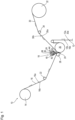
- Fig. 1 shows a simplified section of a manufacturing line 10 to manufacture a multi-layer packaging laminate 12 of the present invention with advantageously low coefficients of friction on the opposing exposed surfaces 12a and 12b of the packaging laminate 12.
- exposed surface 12a is the outermost surface of the packaging laminate 12, forming an outer surface of a packing formed out of the packaging laminate 12
- exposed surface 12b is the innermost surface of the packaging laminate 12, forming an inner surface of a packing formed out of the packaging laminate 12.
- the manufacturing process starts on the left side of figure 1 with a stock roll 14 of a prefabricated first polymer layer arrangement 16.
- the first polymer layer arrangement 16 which comes wound on the stock roll 14, is unwound.
- the first polymer layer arrangement 16 is a multilayer arrangement as will be described in the context of fig. 2 . It is fed to an extruder station 18.
- the feed direction of the first polymer layer arrangement 16 is indicated by little arrows parallel to the surfaces of the first polymer layer arrangement 16.
- the first polymer layer arrangement 16 has a first exposed surface 16a which in the packaging laminate 12 becomes contacted by a second polymer layer arrangement 20 and after establishing the contact is no longer exposed.
- the first polymer layer arrangement 16 has a second exposed surface 16b which in the packaging laminate 12 remains an exposed surface and becomes the exposed inner packaging laminate surface 12b.
- All roll axes of rolls in the manufacturing line 10 as well as the extension of all polymer layer arrangements 12, 16, 20, and 30 in transverse or cross direction are oriented orthogonal to the drawing plane of fig. 1 .
- the first polymer layer arrangement 16 is led around a first support roll 22, and reaches the extruder station 18. At the extruder station 18 the first polymer layer arrangement 16 enters a nip 24 between a water-cooled chill roll 26 and a pressure roll 28.
- a third polymer layer arrangement 30 is fed from a further stock roll 32 via a support roll 34.
- the third polymer layer arrangement 30 is also a multilayer arrangement that will be explained in detail in the context of fig. 2 .
- the third polymer layer arrangement 30, the feeding movement of which is also indicated by little arrows parallel to the surface of the third polymer layer arrangement 30, has a first exposed surface 30a which in the packaging laminate 12 remains an exposed surface and becomes the exposed outer packaging laminate surface 30a.
- the first polymer layer arrangement 16 has a second exposed surface 30b which in the packaging laminate 12 becomes contacted by the second polymer layer arrangement 20 and after establishing this contact is no longer exposed.
- the extruder station 18 extrudes the, as an example only, three-ply second polymer layer arrangement 20 onto the surface 16a facing towards the extruder station 18.
- the extruder station 18 in the depicted example has two extruder devices 36 and 38 and three extruder nozzles 40, 42 and 44.
- the extruder device 36 feeds flowable polymer material to extruder nozzle 40, while the extruder device 38 feeds another, different flowable polymer material to the extruder nozzles 42 and 44.
- extruder nozzle 32 emits flowable ethylene vinyl alcohol copolymer (EVOH), while the extruder nozzles 34 and 36 each emit a tie layer material, for example a maleic anhydride grafted polyethylene.
- EVOH flowable ethylene vinyl alcohol copolymer
- the then-created packaging laminate 12 is transported further downstream in the manufacturing line 10, with the feeding direction indicated by little arrows, and is collected by winding the packaging laminate 12 up on an undepicted stock roll, as it is generally known in the art.
- the packaging laminate 12 after leaving the chill roll 26 may be transported to a further extrusion station where another third polymer layer arrangement can be extrusion laminated by another second polymer layer arrangement to create the second embodiment of packaging laminate 112.
- the chill arrangement comprising the chill roll 26 and the pressure roll 28 is set up in a particular manner that allows the exposed outer surface 12a of the packaging laminate 12 to end up with a coefficient of friction with itself of 0.33, determined pursuant to DIN EN ISO 8295, and allows the exposed inner surface 12b of the packaging laminate 12 to end up with a coefficient of friction with a metal surface of 0.23, determined pursuant to DIN EN ISO 8295.
- the chill roll 26 has a diameter in the range of 700 mm to 1000 mm, in the given example of 850 mm, and has a surface roughness of 0.4 to 0.8 ⁇ m Rz determined pursuant to DIN EN ISO 13565-2, in the given example of 0.5 ⁇ m Rz.
- the pressure roll 28 cooperating with the chill roll 26 in forming the nip therebetween has a diameter in the range of 200 mm to 350 mm, in the given example of 240 mm, and a Shore-A hardness in the range of 60 to 90, determined pursuant to DIN ISO 7619-1, in the given example of 77.
- the pressure executed by the chill roll 26 and the pressure roll 28 on the material running through the nip 24 between pressure roll 28 and chill roll 26 ranges between 1 ⁇ 10 5 to 5 ⁇ 10 5 Pa, and in the given example has value of 3.6 ⁇ 10 5 Pa.
- the layer structure provides for a low oxygen transfer rate (OTR) of 0.12 cm 3 /(m 2 ⁇ d ⁇ bar) determined under the conditions defined above, i. e. at 23°C and 75 % relative humidity according to DIN 53380-3, and further provides for a low water vapor transfer rate (WVTR) of 0.16 g/(m 2 ⁇ d) determined at 23°C and 85 % relative humidity according to DIN EN ISO 15106-3.
- OTR oxygen transfer rate
- WVTR water vapor transfer rate
- the layer structure of the first embodiment of the packaging laminate 12 is illustrated in detail in figure 2 .
- the first polymer layer arrangement 16 has as a base layer a polyethylene film 50 which is formed out of a blend of HDPE and LDPE.
- a sealable LLDPE layer 52 Bonded to the one side of the polyethylene film 50 is a sealable LLDPE layer 52 which, as a sealable layer, forms the exposed inner surface 12b of the packaging laminate 12 and the exposed surface 16b of the first polymer layer arrangement 16.
- the opposite side of the polyethylene film 50 is coated with a barrier material layer 54 of polyvinyl alcohol (PVOH) to provide a first oxygen barrier material layer.
- the barrier material layer 54 carries a vapor deposited metallization layer 56 using an aluminum alloy as the deposited metal.
- the metallization layer 56 not only presents a shiny outer surface, which used to be the exposed surface 16a of the first polymer layer arrangement 16, but also presents a barrier against the migration of oxygen and water vapor through the packaging laminate 12.
- the three-ply extruded second polymer layer arrangement 20 comprises a central EVOH layer 60 with maleic anhydride grafted polyethylene layer 62 and 64, respectively, on either side as tie layers to bond the second polymer layer arrangement 22 to the first polymer layer arrangement 16 and to the third polymer layer arrangement 30 and thereby to extrusion laminate the first and the third polymer layer arrangements 16 and 30, respectively, together.
- the third polymer layer arrangement 30 has, as a base layer, a polyolefin layer 70 made of HDPE and being mono axially directed.
- the HDPE layer 70 exhibits an exposed surface 30a which is also the exposed outer surface 12a of the packaging laminate 12.
- a metal oxide layer 72 in particular aluminum oxide layer, is deposited, which in turn is coated with a further barrier material layer 74 made of EVOH.
- primer layers can be interposed to enhance the bonding strength between neighboring layers.
- Figure 3 shows a second embodiment of a packaging laminate according to the present invention.
- Structurally and/or functionally equal components and component sections as in the first embodiment of the packaging laminate 12 are labeled by the same reference numerals in the second embodiment, but increased by the number 100.
- the layers 116, 120, and 130 fully correspond to the above-described layers 16, 20, and 30 of the first embodiment of the packaging laminate 12. Therefore, the packaging laminate 12 can be further processed, for example by feeding the packaging laminate 12 to a further extruder station to extrusion laminate a further third polymer laminate arrangement 131 in the form of a prefabricated polymer film to the packaging laminate 12 by a further second polymer laminate arrangement 121.
- the further second polymer layer arrangement 121 is extruded onto the previously exposed surface 12a of the first embodiment of packaging laminate 12, and the further third polymer layer arrangement 131 is thereby bonded, i. e. extrusionlaminated, to the already existing packaging laminate 12 which in the case of the second embodiment acts as an intermediate product for the finished packaging laminate 112.
- the further second polymer layer arrangement 121 and the further third polymer layer arrangement 131 are each monolayer arrangements. Since the layer arrangements 116, 120 and 130 all carry at least one barrier material layer, for economic reasons no further barrier material layers are added by the further second and third polymer layer arrangements 121 and 131, respectively.
- the further second polymer layer arrangement 121 for example can be a monolayer made of a blend of LDPE and MDPE, and this further third polymer layer arrangement 131 can be a monolayer polyethylene film made of HDPE or a blend of MDPE and HDPE.
- the second embodiment of a packaging laminate 112 can be further extended by another extruded second polymer layer arrangement 123, and/or a still another extruded second polymer layer arrangement 125.
- extruded second polymer layer arrangements 123 and 125 are depicted in figure 3 as monolayer extruded layers, in particular as polyethylene layers.
- layers 123 and 125 are sealable polyethylene layers. It may however not be excluded that at least one of the another extruded second polymer layer arrangements 123 and 125 is formed as a coextruded multilayer arrangement.
- the respective another extruded second polymer layer arrangement 123 and/or 125 forms an exposed surface 112a' and/or 112b'.
- the entire packaging laminate 12 as well as the structural polymer layers 150, 152, 170, and 131 of the packaging laminate 112 are made of polyethylene
- the entire packaging laminate is preferably formed by more than 90 weight-% of ethylene based polymers, including the maleic anhydride grafted polyethylene layers 62, 64, and 160, 164, respectively, and also including the extruded further second polymer layer arrangement 121.
- the packaging laminate according to the shown embodiments is therefore particularly easy to recycle and can be recycled in the polyethylene recycling stream.
- Figure 4 shows a schematic front view of a tube packaging container 90, having a tube body 92 made of the multi-layer packaging laminate 12 and a tube head 94 formed integrally with a pivotable lid 96 on which the tube packaging container 90 can stand.
- the tube body 92 can as well be made of the second embodiment of the multi-layer packaging laminate 112.
- a blank piece of the multi-layer packaging laminate 12 is rolled around a mandrel such that the circumferential end portions of the rolled blank piece overlap.
- the exposed innermost polymer surface 12b overlaps the exposed outermost polymer surface 12a axially along a tube body longitudinal axis TLA and circumferentially around the tube body longitudinal axis TLA.
- Both exposed polymer surfaces 12a and 12b, as well as the polyethylene layers 52 and 70 forming them, are connected by heat sealing in the overlapping region 98 to create longitudinal connecting seam 100 in a lap seal configuration.
- the tube body 92 is closed by a cross seam 102 in a fin seal configuration.
- a cross seam 102 is closed by opposing areas of the inner surface 12b in the cross seam 102 in the cross seam 102.
- the tube body 92 at the open longitudinal end 92b close to the tube head 94 surrounds a part of the tube head 94 and overlaps this part in the axial direction and completely in the circumferential direction.
- the overlapping parts of the tube body 92 and the tube head 94 are also connected by heat sealing.
- the tube head 94 is formed of injection molded polyethylene, so that the materials of the tube head 94 and polyethylene layer 52 of the multi-layer packaging laminate 12 are compatible.
- a paste-like product can for example be accommodated and can be released through a tube head opening 97.
- the lid 96 is pivotable about a pivot axis PA, for example through a film joint connecting the lid 96 integrally with the tube head 94 to cover the tube head opening 97.
- An indentation 104 facilitates lifting the lid 96 from the tube head 94 to open the tube packaging container 90.
Landscapes
- Engineering & Computer Science (AREA)
- Mechanical Engineering (AREA)
- Laminated Bodies (AREA)
- Wrappers (AREA)
Applications Claiming Priority (1)
| Application Number | Priority Date | Filing Date | Title |
|---|---|---|---|
| DE102023104566.0A DE102023104566A1 (de) | 2023-02-24 | 2023-02-24 | Hochbarriere-Verpackungslaminat mit verbesserter Maschinenverarbeitbarkeit |
Publications (1)
| Publication Number | Publication Date |
|---|---|
| EP4420876A1 true EP4420876A1 (fr) | 2024-08-28 |
Family
ID=90038207
Family Applications (1)
| Application Number | Title | Priority Date | Filing Date |
|---|---|---|---|
| EP24158771.6A Pending EP4420876A1 (fr) | 2023-02-24 | 2024-02-21 | Stratifié d'emballage à haute barrière présentant une meilleure aptitude à l'usinage |
Country Status (4)
| Country | Link |
|---|---|
| US (1) | US20240286811A1 (fr) |
| EP (1) | EP4420876A1 (fr) |
| DE (1) | DE102023104566A1 (fr) |
| MX (1) | MX2024002345A (fr) |
Families Citing this family (1)
| Publication number | Priority date | Publication date | Assignee | Title |
|---|---|---|---|---|
| DE102024125714A1 (de) | 2024-09-06 | 2026-03-12 | Huhtamaki Flexible Packaging Germany Gmbh & Co. Kg | Flexibler Lagenverbund mit heißsiegelfähiger Polyolefinlage mit darauf abgeschiedener Lage aus einem Material auf Metallbasis |
Citations (8)
| Publication number | Priority date | Publication date | Assignee | Title |
|---|---|---|---|---|
| EP2100728A1 (fr) * | 2008-03-13 | 2009-09-16 | Alcan Technology & Management Ltd. | Film multicouche pour le conditionnement de denrées sèches, en pâte et liquides |
| WO2012020426A1 (fr) | 2010-08-10 | 2012-02-16 | Essel Propack Ltd. | Feuille multicouche et procédé associé |
| JP2016104564A (ja) * | 2015-11-27 | 2016-06-09 | 大日本印刷株式会社 | バリア性積層フィルム |
| WO2018202479A1 (fr) | 2017-05-05 | 2018-11-08 | Constantia Hueck Folien Gmbh & Co. Kg | Stratifié d'emballage recyclable, facilement déchirable, à effet barrière satisfaisant, et son procédé de fabrication |
| US20190270288A1 (en) * | 2016-12-09 | 2019-09-05 | Jindal Films Americas Llc | High-barrier, metal oxide films |
| WO2021037347A1 (fr) | 2019-08-27 | 2021-03-04 | Hoffmann Neopac Ag | Tube pliable recyclable ayant des propriétés de barrière |
| JP2022047775A (ja) * | 2020-09-14 | 2022-03-25 | 凸版印刷株式会社 | ラミネートチューブ容器 |
| WO2022070214A1 (fr) | 2020-10-01 | 2022-04-07 | Hariharan Krishnan Nair | Stratifié barrière et ses mises en œuvre |
-
2023
- 2023-02-24 DE DE102023104566.0A patent/DE102023104566A1/de active Pending
-
2024
- 2024-02-20 US US18/582,610 patent/US20240286811A1/en active Pending
- 2024-02-21 EP EP24158771.6A patent/EP4420876A1/fr active Pending
- 2024-02-22 MX MX2024002345A patent/MX2024002345A/es unknown
Patent Citations (8)
| Publication number | Priority date | Publication date | Assignee | Title |
|---|---|---|---|---|
| EP2100728A1 (fr) * | 2008-03-13 | 2009-09-16 | Alcan Technology & Management Ltd. | Film multicouche pour le conditionnement de denrées sèches, en pâte et liquides |
| WO2012020426A1 (fr) | 2010-08-10 | 2012-02-16 | Essel Propack Ltd. | Feuille multicouche et procédé associé |
| JP2016104564A (ja) * | 2015-11-27 | 2016-06-09 | 大日本印刷株式会社 | バリア性積層フィルム |
| US20190270288A1 (en) * | 2016-12-09 | 2019-09-05 | Jindal Films Americas Llc | High-barrier, metal oxide films |
| WO2018202479A1 (fr) | 2017-05-05 | 2018-11-08 | Constantia Hueck Folien Gmbh & Co. Kg | Stratifié d'emballage recyclable, facilement déchirable, à effet barrière satisfaisant, et son procédé de fabrication |
| WO2021037347A1 (fr) | 2019-08-27 | 2021-03-04 | Hoffmann Neopac Ag | Tube pliable recyclable ayant des propriétés de barrière |
| JP2022047775A (ja) * | 2020-09-14 | 2022-03-25 | 凸版印刷株式会社 | ラミネートチューブ容器 |
| WO2022070214A1 (fr) | 2020-10-01 | 2022-04-07 | Hariharan Krishnan Nair | Stratifié barrière et ses mises en œuvre |
Also Published As
| Publication number | Publication date |
|---|---|
| DE102023104566A1 (de) | 2024-08-29 |
| MX2024002345A (es) | 2024-08-26 |
| US20240286811A1 (en) | 2024-08-29 |
Similar Documents
| Publication | Publication Date | Title |
|---|---|---|
| EP1263654B1 (fr) | Structure stratifiee multicouche de resine/papier contenant au moins une couche composite de polymere/argile nanoparticulaire et materiaux d'emballage fabriques | |
| KR100674777B1 (ko) | 적층 포장 재료 및 그 제조 방법 | |
| EP4045428B1 (fr) | Emballage-coque, produit pharmaceutique ou nutritionnel conditionné et procédé de fabrication d'un tel produit | |
| US4590126A (en) | Packing laminate | |
| US5689935A (en) | Product package having reliable openability | |
| CA2878104C (fr) | Stratifie multicouche pour tubes pourvu d'une couche barriere integree ainsi que tube fabrique a partir de ce stratifie et utilisation d'un tel stratifie | |
| EP4253047A1 (fr) | Matériau d'emballage stratifié et récipient d'emballage fabriqué à partir de celui-ci | |
| US20200391489A1 (en) | Recyclable Packaging Laminate with Improved Heat Resistance for Sealing | |
| TWI801583B (zh) | 噴口袋及製造其之方法 | |
| EP3423276A1 (fr) | Stratifié barrière en aluminium et revêtement barrière au niveau d'un épaulement pour un récipient | |
| JP2709849B2 (ja) | 酸素バリヤーラミネート構造体 | |
| US20070187279A1 (en) | Strip tape, a packaging container having such a strip tape, and a method of producing such a strip tape | |
| CN115257108A (zh) | 包装用阻隔层、包装用片状复合层及其包装容器 | |
| EP4420876A1 (fr) | Stratifié d'emballage à haute barrière présentant une meilleure aptitude à l'usinage | |
| US6949275B2 (en) | Packaging laminate and container including it | |
| US6815057B2 (en) | Laminated thermoformable film structures useful for packaging food products | |
| US20250114995A1 (en) | A film composition | |
| CN201989385U (zh) | 一种重包装聚乙烯膜 | |
| US20230364844A1 (en) | Method for manufacturing a tube laminate, tube laminate and tube packaging | |
| EP1666363B1 (fr) | Methode d'application d'une bande d'etancheite, bande d'etancheite et recipient en papier equipe de ladite bande d'etancheite longitudinale | |
| CN222699057U (zh) | 一种抗拉塑料袋 | |
| BR102024002307A2 (pt) | Laminado de embalagem de alta barreira com capacidade de usinagem aperfeiçoada | |
| EP3368302B1 (fr) | Matériau d'emballage stratifié comprenant un film barrière et contenants d'emballage ainsi fabriques | |
| JP2021181331A (ja) | 紙容器用積層シート及び紙容器 | |
| US20260002322A1 (en) | Extensible high puncture-resistant recyclable paper-based packaging structures |
Legal Events
| Date | Code | Title | Description |
|---|---|---|---|
| PUAI | Public reference made under article 153(3) epc to a published international application that has entered the european phase |
Free format text: ORIGINAL CODE: 0009012 |
|
| STAA | Information on the status of an ep patent application or granted ep patent |
Free format text: STATUS: REQUEST FOR EXAMINATION WAS MADE |
|
| 17P | Request for examination filed |
Effective date: 20240221 |
|
| AK | Designated contracting states |
Kind code of ref document: A1 Designated state(s): AL AT BE BG CH CY CZ DE DK EE ES FI FR GB GR HR HU IE IS IT LI LT LU LV MC ME MK MT NL NO PL PT RO RS SE SI SK SM TR |