EP4420877A1 - Procédé de fabrication d'un matériau stratifié avec une structure de surface - Google Patents
Procédé de fabrication d'un matériau stratifié avec une structure de surface Download PDFInfo
- Publication number
- EP4420877A1 EP4420877A1 EP23157986.3A EP23157986A EP4420877A1 EP 4420877 A1 EP4420877 A1 EP 4420877A1 EP 23157986 A EP23157986 A EP 23157986A EP 4420877 A1 EP4420877 A1 EP 4420877A1
- Authority
- EP
- European Patent Office
- Prior art keywords
- resin
- string
- circular section
- mesh
- substrate
- Prior art date
- Legal status (The legal status is an assumption and is not a legal conclusion. Google has not performed a legal analysis and makes no representation as to the accuracy of the status listed.)
- Pending
Links
Images



Classifications
-
- B—PERFORMING OPERATIONS; TRANSPORTING
- B32—LAYERED PRODUCTS
- B32B—LAYERED PRODUCTS, i.e. PRODUCTS BUILT-UP OF STRATA OF FLAT OR NON-FLAT, e.g. CELLULAR OR HONEYCOMB, FORM
- B32B37/00—Methods or apparatus for laminating, e.g. by curing or by ultrasonic bonding
- B32B37/14—Methods or apparatus for laminating, e.g. by curing or by ultrasonic bonding characterised by the properties of the layers
- B32B37/26—Methods or apparatus for laminating, e.g. by curing or by ultrasonic bonding characterised by the properties of the layers with at least one layer which influences the bonding during the lamination process, e.g. release layers or pressure equalising layers
-
- B—PERFORMING OPERATIONS; TRANSPORTING
- B32—LAYERED PRODUCTS
- B32B—LAYERED PRODUCTS, i.e. PRODUCTS BUILT-UP OF STRATA OF FLAT OR NON-FLAT, e.g. CELLULAR OR HONEYCOMB, FORM
- B32B15/00—Layered products comprising a layer of metal
- B32B15/04—Layered products comprising a layer of metal comprising metal as the main or only constituent of a layer, which is next to another layer of the same or of a different material
- B32B15/10—Layered products comprising a layer of metal comprising metal as the main or only constituent of a layer, which is next to another layer of the same or of a different material of wood
-
- B—PERFORMING OPERATIONS; TRANSPORTING
- B32—LAYERED PRODUCTS
- B32B—LAYERED PRODUCTS, i.e. PRODUCTS BUILT-UP OF STRATA OF FLAT OR NON-FLAT, e.g. CELLULAR OR HONEYCOMB, FORM
- B32B17/00—Layered products essentially comprising sheet glass, or glass, slag, or like fibres
- B32B17/02—Layered products essentially comprising sheet glass, or glass, slag, or like fibres in the form of fibres or filaments
- B32B17/04—Layered products essentially comprising sheet glass, or glass, slag, or like fibres in the form of fibres or filaments bonded with or embedded in a plastic substance
-
- B—PERFORMING OPERATIONS; TRANSPORTING
- B32—LAYERED PRODUCTS
- B32B—LAYERED PRODUCTS, i.e. PRODUCTS BUILT-UP OF STRATA OF FLAT OR NON-FLAT, e.g. CELLULAR OR HONEYCOMB, FORM
- B32B21/00—Layered products comprising a layer of wood, e.g. wood board, veneer, wood particle board
- B32B21/04—Layered products comprising a layer of wood, e.g. wood board, veneer, wood particle board comprising wood as the main or only constituent of a layer, which is next to another layer of the same or of a different material
-
- B—PERFORMING OPERATIONS; TRANSPORTING
- B32—LAYERED PRODUCTS
- B32B—LAYERED PRODUCTS, i.e. PRODUCTS BUILT-UP OF STRATA OF FLAT OR NON-FLAT, e.g. CELLULAR OR HONEYCOMB, FORM
- B32B21/00—Layered products comprising a layer of wood, e.g. wood board, veneer, wood particle board
- B32B21/04—Layered products comprising a layer of wood, e.g. wood board, veneer, wood particle board comprising wood as the main or only constituent of a layer, which is next to another layer of the same or of a different material
- B32B21/047—Layered products comprising a layer of wood, e.g. wood board, veneer, wood particle board comprising wood as the main or only constituent of a layer, which is next to another layer of the same or of a different material of foam
-
- B—PERFORMING OPERATIONS; TRANSPORTING
- B32—LAYERED PRODUCTS
- B32B—LAYERED PRODUCTS, i.e. PRODUCTS BUILT-UP OF STRATA OF FLAT OR NON-FLAT, e.g. CELLULAR OR HONEYCOMB, FORM
- B32B21/00—Layered products comprising a layer of wood, e.g. wood board, veneer, wood particle board
- B32B21/04—Layered products comprising a layer of wood, e.g. wood board, veneer, wood particle board comprising wood as the main or only constituent of a layer, which is next to another layer of the same or of a different material
- B32B21/06—Layered products comprising a layer of wood, e.g. wood board, veneer, wood particle board comprising wood as the main or only constituent of a layer, which is next to another layer of the same or of a different material of paper or cardboard
-
- B—PERFORMING OPERATIONS; TRANSPORTING
- B32—LAYERED PRODUCTS
- B32B—LAYERED PRODUCTS, i.e. PRODUCTS BUILT-UP OF STRATA OF FLAT OR NON-FLAT, e.g. CELLULAR OR HONEYCOMB, FORM
- B32B21/00—Layered products comprising a layer of wood, e.g. wood board, veneer, wood particle board
- B32B21/10—Next to a fibrous or filamentary layer
-
- B—PERFORMING OPERATIONS; TRANSPORTING
- B32—LAYERED PRODUCTS
- B32B—LAYERED PRODUCTS, i.e. PRODUCTS BUILT-UP OF STRATA OF FLAT OR NON-FLAT, e.g. CELLULAR OR HONEYCOMB, FORM
- B32B3/00—Layered products comprising a layer with external or internal discontinuities or unevennesses, or a layer of non-planar shape; Layered products comprising a layer having particular features of form
- B32B3/26—Layered products comprising a layer with external or internal discontinuities or unevennesses, or a layer of non-planar shape; Layered products comprising a layer having particular features of form characterised by a particular shape of the outline of the cross-section of a continuous layer; characterised by a layer with cavities or internal voids ; characterised by an apertured layer
- B32B3/30—Layered products comprising a layer with external or internal discontinuities or unevennesses, or a layer of non-planar shape; Layered products comprising a layer having particular features of form characterised by a particular shape of the outline of the cross-section of a continuous layer; characterised by a layer with cavities or internal voids ; characterised by an apertured layer characterised by a layer formed with recesses or projections, e.g. hollows, grooves, protuberances, ribs
-
- B—PERFORMING OPERATIONS; TRANSPORTING
- B32—LAYERED PRODUCTS
- B32B—LAYERED PRODUCTS, i.e. PRODUCTS BUILT-UP OF STRATA OF FLAT OR NON-FLAT, e.g. CELLULAR OR HONEYCOMB, FORM
- B32B38/00—Ancillary operations in connection with laminating processes
- B32B38/06—Embossing
-
- B—PERFORMING OPERATIONS; TRANSPORTING
- B32—LAYERED PRODUCTS
- B32B—LAYERED PRODUCTS, i.e. PRODUCTS BUILT-UP OF STRATA OF FLAT OR NON-FLAT, e.g. CELLULAR OR HONEYCOMB, FORM
- B32B5/00—Layered products characterised by the non- homogeneity or physical structure, i.e. comprising a fibrous, filamentary, particulate or foam layer; Layered products characterised by having a layer differing constitutionally or physically in different parts
- B32B5/02—Layered products characterised by the non- homogeneity or physical structure, i.e. comprising a fibrous, filamentary, particulate or foam layer; Layered products characterised by having a layer differing constitutionally or physically in different parts characterised by structural features of a fibrous or filamentary layer
- B32B5/022—Non-woven fabric
-
- B—PERFORMING OPERATIONS; TRANSPORTING
- B32—LAYERED PRODUCTS
- B32B—LAYERED PRODUCTS, i.e. PRODUCTS BUILT-UP OF STRATA OF FLAT OR NON-FLAT, e.g. CELLULAR OR HONEYCOMB, FORM
- B32B5/00—Layered products characterised by the non- homogeneity or physical structure, i.e. comprising a fibrous, filamentary, particulate or foam layer; Layered products characterised by having a layer differing constitutionally or physically in different parts
- B32B5/02—Layered products characterised by the non- homogeneity or physical structure, i.e. comprising a fibrous, filamentary, particulate or foam layer; Layered products characterised by having a layer differing constitutionally or physically in different parts characterised by structural features of a fibrous or filamentary layer
- B32B5/024—Woven fabric
-
- B—PERFORMING OPERATIONS; TRANSPORTING
- B32—LAYERED PRODUCTS
- B32B—LAYERED PRODUCTS, i.e. PRODUCTS BUILT-UP OF STRATA OF FLAT OR NON-FLAT, e.g. CELLULAR OR HONEYCOMB, FORM
- B32B5/00—Layered products characterised by the non- homogeneity or physical structure, i.e. comprising a fibrous, filamentary, particulate or foam layer; Layered products characterised by having a layer differing constitutionally or physically in different parts
- B32B5/18—Layered products characterised by the non- homogeneity or physical structure, i.e. comprising a fibrous, filamentary, particulate or foam layer; Layered products characterised by having a layer differing constitutionally or physically in different parts characterised by features of a layer of foamed material
-
- B—PERFORMING OPERATIONS; TRANSPORTING
- B29—WORKING OF PLASTICS; WORKING OF SUBSTANCES IN A PLASTIC STATE IN GENERAL
- B29C—SHAPING OR JOINING OF PLASTICS; SHAPING OF MATERIAL IN A PLASTIC STATE, NOT OTHERWISE PROVIDED FOR; AFTER-TREATMENT OF THE SHAPED PRODUCTS, e.g. REPAIRING
- B29C59/00—Surface shaping of articles, e.g. embossing; Apparatus therefor
- B29C59/02—Surface shaping of articles, e.g. embossing; Apparatus therefor by mechanical means, e.g. pressing
- B29C59/026—Surface shaping of articles, e.g. embossing; Apparatus therefor by mechanical means, e.g. pressing of layered or coated substantially flat surfaces
-
- B—PERFORMING OPERATIONS; TRANSPORTING
- B32—LAYERED PRODUCTS
- B32B—LAYERED PRODUCTS, i.e. PRODUCTS BUILT-UP OF STRATA OF FLAT OR NON-FLAT, e.g. CELLULAR OR HONEYCOMB, FORM
- B32B2262/00—Composition or structural features of fibres which form a fibrous or filamentary layer or are present as additives
- B32B2262/10—Inorganic fibres
- B32B2262/101—Glass fibres
-
- B—PERFORMING OPERATIONS; TRANSPORTING
- B32—LAYERED PRODUCTS
- B32B—LAYERED PRODUCTS, i.e. PRODUCTS BUILT-UP OF STRATA OF FLAT OR NON-FLAT, e.g. CELLULAR OR HONEYCOMB, FORM
- B32B2307/00—Properties of the layers or laminate
- B32B2307/50—Properties of the layers or laminate having particular mechanical properties
- B32B2307/538—Roughness
-
- B—PERFORMING OPERATIONS; TRANSPORTING
- B32—LAYERED PRODUCTS
- B32B—LAYERED PRODUCTS, i.e. PRODUCTS BUILT-UP OF STRATA OF FLAT OR NON-FLAT, e.g. CELLULAR OR HONEYCOMB, FORM
- B32B2307/00—Properties of the layers or laminate
- B32B2307/70—Other properties
- B32B2307/744—Non-slip, anti-slip
-
- B—PERFORMING OPERATIONS; TRANSPORTING
- B32—LAYERED PRODUCTS
- B32B—LAYERED PRODUCTS, i.e. PRODUCTS BUILT-UP OF STRATA OF FLAT OR NON-FLAT, e.g. CELLULAR OR HONEYCOMB, FORM
- B32B2317/00—Animal or vegetable based
- B32B2317/12—Paper, e.g. cardboard
- B32B2317/125—Paper, e.g. cardboard impregnated with thermosetting resin
-
- B—PERFORMING OPERATIONS; TRANSPORTING
- B32—LAYERED PRODUCTS
- B32B—LAYERED PRODUCTS, i.e. PRODUCTS BUILT-UP OF STRATA OF FLAT OR NON-FLAT, e.g. CELLULAR OR HONEYCOMB, FORM
- B32B2471/00—Floor coverings
-
- B—PERFORMING OPERATIONS; TRANSPORTING
- B32—LAYERED PRODUCTS
- B32B—LAYERED PRODUCTS, i.e. PRODUCTS BUILT-UP OF STRATA OF FLAT OR NON-FLAT, e.g. CELLULAR OR HONEYCOMB, FORM
- B32B2605/00—Vehicles
- B32B2605/003—Interior finishings
Definitions
- the present invention pertains to a method for producing a layered material with a surface structure, and the layered material produced thereby.
- Layered materials with surface structures allow for an improved friction over smooth surfaces and therefore provide an increased safety against slipping, in particular when used for flooring.
- Layered materials can be manufactured by overlaying a substrate, typically a board, with a resin-containing carrier, e.g. a resin-impregnated film, and apply the well-known method of hot-pressing to establish a firm connection between the substrate and the film. It is also known to use press plates having a structured surface (profile), which serve as a negative to imprint a surface structure on the film. However, structured press plates are expensive, difficult to handle due to their weight, and often result in poor aesthetics of the final layered material.
- a resin-containing carrier e.g. a resin-impregnated film
- press plates are used in conjunction with a wire mesh, that represents a removable intermediate layer between the press plates and the film.
- a mesh leads to prolonged press times and/or to an unsatisfying friction and wear resistance.
- the use of meshes often leads to unsatisfying aesthetics, such as the formation of dust during the pressing process or irregularities of the surface structure.
- At least one string with at least one section 10 with a non-circular cross-section can be used in an optimized pressing process to provide layered materials with surface structures.
- a resin is applied to a substrate, to which the at least one string with a non-circular section 10 is then contacted, thereby providing a layered formation.
- heat and pressure are applied (hot-pressing) to said layered formation, wherein the at least one string with a non-circular section 10 can serve as a negative for embossing a surface structure.
- the at least one string is removed from the layered material with a surface structure.
- the method according to the invention advantageously can lead to a faster curing of the resin, whereby the hot-pressing time required to cure the resin can be significantly reduced; in particular, compared to the state-of-the-art methods (e.g. using wire meshes composed of round strings).
- the inventors in particular found that the string/s comprising a polymeric composition used in one method according to the invention provides superior curing than state-of-the-art methods with strings made of metal. This was surprising, as the main reason in the prior art to use metal wire meshes are short hot-pressing times, due to the high heat conductivity of the material.
- the hot-pressing time can be reduced without diminishing the product quality of the so produced layered material.
- the method according to the invention provides means for manufacturing such layered materials with a reduced energy consumption and thus higher efficacy.
- the layered materials according to the invention advantageously display superior aesthetics. Besides, they can exhibit an improved wear resistance, moisture resistance and/or static friction coefficients.
- the invention relates to a formation comprising a substrate, resin and at least a string as defined in claim 1.
- the invention relates, in yet a further aspect, to the use of string/s with a non-circular section 10 for a method of embossing a surface structure onto a combination comprising resin and a substrate.
- the invention relates to a method of manufacturing layered materials with a surface structure, wherein a profile with a weave pattern and a surface shape as conveyed by the string/s according to the invention is used.
- the invention relates to the layered material obtained or obtainable from the method according to the invention.
- the string comprises at least one planar surface, preferably at least two planar surfaces. Examples of a non-circular cross-section with at least two planar surfaces is shown in Fig. 12 . More preferably the string is essentially flat. Even more preferably, the cross-section of the string has a rectangular shape.
- the string/s with a non-circular section 10 is/are used as a mesh, preferably a mesh with a weave pattern.
- the mesh is preferably tightly knit, such that neighboring string/s of either weft or preferably warp are in contact with each other.
- a mesh with a weave pattern is preferably a woven article.
- the inventors also found that the resin, in particular a resin-impregnated carrier (film), bonds to the substrate, which comprises a hydrophobic composition on its surface, when producing a layered material with a surface structure with the method according to the invention.
- the resin in particular a resin-impregnated carrier (film) bonds to the substrate, which comprises a hydrophobic composition on its surface, when producing a layered material with a surface structure with the method according to the invention.
- the resin in particular a resin-impregnated carrier (film) bonds to the substrate, which comprises a hydrophobic composition on its surface
- the formation formed from resin and the substrate further comprises a layer composed of a plastic polymer material.
- the polymer in this plastic polymer material is preferably a polyamide (PA), preferably selected from the group consisting of PA 6, PA 66, and PA 69. Most preferably the polyamide is PA 6.
- the resin in the method according to the invention is preferably a thermosetting resin.
- the resin is a phenolic resin, more preferably a resole resin.
- the carrier is a paper, more preferably kraft paper.
- the present invention provides a method for producing layered materials with a surface structure.
- the layered material is particularly suitable for flooring under harsh conditions, such as in particular for the flooring of vehicles.
- the method of the invention is a method of manufacturing a layered material with a surface structure comprising the following steps:
- string describes an object that extends primarily in one direction (length), but further has a width and a height, which are all perpendicular to each other. Further, the term “string” encompasses yarn, wire, filament, or thread.
- the section of non-circular section 10 comprises at least one planar surface. More preferably the section of non-circular section 10 comprises at least two planar surfaces, most preferably the section of non-circular section 10 comprises four planar surfaces. In a more preferred embodiment, the string comprises at least one, more preferably at least two, most preferably at four, planar surfaces.
- the surface/s of the non-circular section 10 is/are planar for at least 10%, preferably at least 50%, more preferably at least 70%, most preferably at least 90%, of the width 20 of said non-circular section 10.
- the surface of the string is planar for at least 10%, preferably at least 50%, more preferably at least 70%, most preferably at least 90%, of the width of the string.
- the surface of the non-circular section 10 is planar for at least 10%, preferably at least 50%, more preferably at least 70%, most preferably at least 90%, of the height 30 of said non-circular section 10.
- the surface of the string is planar for at least 10%, preferably at least 50%, more preferably at least 70%, most preferably at least 90%, of the height of the string.
- this non-circular cross-section is preferably an ellipsoid or a parallelogram, even more preferred the cross-section is rectangular. Most preferred is the use of at least one string that throughout is evenly rectangular in its cross-section.
- the non-circular section 10 most preferably has a rectangular cross-section.
- This rectangular non-circular section 10 is not limited to have sharp corners, rather it has two sets of parallel sides that are orthogonal to each other.
- the surface of the non-circular section 10 is planar for at least 10%, preferably at least 50%, more preferably at least 70%, most preferably at least 90%, of the width 20 and the height 30 of said non-circular section 10.
- the surface of the non-circular section 10 is planar for at least 10%, preferably at least 50%, more preferably at least 70%, most preferably at least 90%, of the width and the height of the string.
- the string comprises at least one non-circular section 10 for at least 50%, preferably at least 70%, more preferably at least 90%, most preferably 100%, of its length. This holds particularly true for the above embodiments, whereby the string becomes essentially flat.
- the string has a non-circular cross-section, more preferably a rectangular cross-section.
- the layered material obtainable or obtained by the method according to the invention preferably has an improved surface in terms of structure and aesthetic appearance.
- the layered material exhibits an improved durability and/or wear resistance.
- the invention therefore also in one aspect pertains to layered materials obtained or obtainable from a method according to the invention.
- the high quality of the surface structure renders the layered materials according to the invention suitable for engraving.
- the board thus can be engraved in order to carry logos, codes or other means for the identification of the product and/or their origin.
- a preferred method of engraving is laser-engraving.
- the width 20 of the non-circular section 10 used in the present invention is preferably in the range of 0.1 to 20 mm, more preferably 0.5 to 10 mm, even more preferably 1 to 5 mm, most preferred is a width 20 between 1.0 and 2.0 mm.
- the width of the string is in the range of 0.1 to 20 mm, more preferably 0.5 to 10 mm, even more preferably 1 to 5 mm, most preferably 1.0 to 2.0 mm. This applies in particular when the string has a rectangular cross-section, even more so when they are arranged in a mesh with a weave pattern, in particular a woven mesh.
- the height 30 of the non-circular section 10 preferably is 0.1 to 10 mm, more preferably 0.15 to 5 mm, even more preferably 0.2 to 4 mm, most preferably 0.25 to 0.40 mm.
- the width of the string is in the range of 0.1 to 10 mm, more preferably 0.15 to 5 mm, even more preferably 0.2 to 4 mm, most preferably 0.25 to 0.40 mm.
- the ratio of the width 20 to the height 30 of the the non-circular section 10 is at least as wide as it is high.
- the ratio between the width 20 and height 30 is in the range of 1:1 and 20:1, preferably 1.5:1 and 10:1, more preferably of 2:1 and 6:1, most preferably 2.5:1 and 4:1.
- the ratio between the width and height of the string is in the range of 1:1 and 20:1, preferably 1.5:1 and 10:1, more preferably of 2:1 and 6:1, most preferably 2.5:1 and 4:1. This applies in particular, when the strings form a mesh, especially a mesh with a weave pattern, in particular a woven mesh.
- the surface structure of the layered material obtainable by a method according to the invention can be influenced also by the ratio of the width 20 and the distance between neighboring strings.
- the ratio between the width 20 and the distance between neighboring strings in at least one direction is at least 1:10, preferably least 1:1, more preferably least 10:1, most preferably at least 100:1.
- the strings form a mesh, especially a woven mesh.
- this is the case for strings in warp and/or weft, preferably warp.
- the mesh is tightly knit.
- strings in warp are in contact with their at least one neighboring string, preferably both neighboring strings.
- the strings used in the method according to the invention can be composed of one or more material.
- the string comprises at least one part comprising a metal, a polymer, or both. More preferably, the at least one part of the string comprises a polymer, even more preferably consists of a polymeric composition. Most preferred is that the string consists of a polymeric composition.
- the polymer in the polymeric composition is preferably selected from the group consisting of polyphenylenesulfide (PPS), polysulfone (PSU), polyethersulfone (PES), polyester, polyaryletherketone (PAEK), polybenzimidazole (PBI), aromatic polyamides, most preferably polyethersulfone (PES).
- the polyester is preferably obtainable from an aromatic dicarboxylic acid, in particular terephthalic acid, and an aliphatic diol.
- the polyesters is preferably selected from polyethyleneterephthalate (PET) and polybutylenetherephthalate (PBT), more preferably is PET.
- a preferred polyaryletherketone is polyether ether ketone (PEEK).
- the at least one string is arranged in a network, most preferred as a mesh.
- the mesh has a weave pattern.
- Meshes can be produced by different methods depending on the material they are composed of. Preferred meshes are woven, extruded, injection-molded, braided, or knitted. Most preferably the mesh is woven.
- the mesh typically is essentially composed of warp and weft.
- warp and weft are perpendicular in the weave pattern. This leads to surface structures wherein the friction constants across and along the layered material are essentially even.
- weave pattern is a plain weave, satin weave, twill weave, or basket weave. More preferably the strings form a woven mesh in a plain weave.
- Meshes can comprise strings with sections with both circular and non-circular cross-sections.
- strings used for warp have a non-circular cross-section, more preferably strings with a non-circular cross-section are used for warp and weft.
- Warp and weft can each comprise one or more strings.
- warp comprises at least one string, preferably only one string.
- weft comprises at least one string, preferably only one string.
- warp and weft comprise at least one string each, most preferably only one string each.
- Meshes typically have a mesh count, i.e. a certain number of strings in each warp and weft per distance unit. These are respectively referred to as warp mesh count and weft mesh count.
- the mesh has a warp mesh count of 0.5 to 10 strings per cm, preferably 1 to 9 strings per cm, most preferably 4 to 7 strings per cm. In a further preferred embodiment mesh has a weft mesh count of 0.2 to 8 strings per cm, preferably 0.5 to 6 strings per cm, most preferably 2 to 4 strings per cm. In a more preferred embodiment, the mesh has a warp mesh count of 0.5 to 10 strings per cm, preferably 1 to 9 strings per cm, most preferably 4 to 7 strings per cm, and a weft mesh count of 0.2 to 8 strings per cm, preferably 0.5 to 6 strings per cm, most preferably 2 to 4 strings per cm.
- strings can differ in dimensions, shape and material.
- the non-circular section 10 of strings respectively used for warp and weft have the same width 20 and/or height 30.
- strings respectively used for warp and weft have the same width and height.
- the at least one string in the most preferred embodiment of the invention is applied as a woven mesh, wherein
- the at least one string can be contacted to the formation formed in step a) in multiple ways.
- the at least one string is directly applied to the formation formed in step a).
- Preferably at least one planar surface is contacted to the formation formed in step a).
- pressure is then applied to the formation formed in step b) by contacting it with a press plate.
- the invention therefore relates to the layered formation formed in step b).
- the at least one string is attached to a press plate.
- contacting happens by moving the formation formed in step a) and/or the press plate, which the at least one string is attached to.
- the resin is preferably applied as an overlay.
- overlay refers to substantially covering at least one side of the board with a resin.
- the at least one side is covered by at least 90%, more preferably by at least 95%, most preferably by 100% of its surface area.
- the resin is preferably applied to a side of the carrier perpendicular to the carrier's shortest axis, i.e. top-side or bottom-side.
- the resin is applied to the top-side of the carrier.
- “Hot-pressing”, i.e. the application of heat and pressure, is generally known to the skilled person in the art.
- the temperature is chosen such that it is sufficient to cure the resin.
- Preferred temperatures are in the range of 100 to 250 °C, more preferably in the range of 120 to 180 °C, most preferably in the range of 130 to 150 °C.
- Preferred pressures are 0.5 to 4 N/mm 2 , more preferably 1.0 to 3.0 N/mm 2 , most preferably 1.5 to 2.5 N/mm 2 .
- the resin is preferably a thermosetting resin, i.e. a resin which irreversibly hardens ("cures") upon treatment with heat.
- the resin is a phenolic resin, an amino resin or an amino-phenolic resin.
- Such resins are available from the reaction of a cross-linker with at least one monomer.
- a typical and preferred cross-linker is formaldehyde.
- Monomers for phenolic resins belong to the class of phenols, preferably is phenol.
- the monomer belonging to the class of phenols can also be at least partially replaced by lignin, preferably kraft lignin, or a derivative thereof.
- Monomers for amino resins are typically and preferably urea and/or melamine.
- Amino-phenolic resins are available by either combining the monomers of both phenolic and amino resins with a cross-linker or combining a preformed phenolic resin with an amino resin.
- the resin is a phenolic resin, more preferably a resole resin.
- the resin is applied in the form of a resin-impregnated carrier (film). While using one resin-impregnated carrier already led to improved friction of layered materials obtainable from a method according to the invention, this effect was increasingly observed when multiple layers of resin-impregnated carriers were applied. In a more preferred embodiment, the resin is applied as at least two resin-impregnated carriers.
- the carrier material is preferably selected from the group consisting of paper, card board, glass fiber, textiles, plastics, mineral material, metal. More preferably the carrier material is paper. Preferred papers are kraft paper or sack paper, in particular kraft paper. Textiles include woven and non-woven fabrics. Preferable plastics are rigid foams and foam plastic. Preferred mineral materials are ceramics and cellular concrete. A preferred metal carrier is a metal foil.
- the carrier comprises at least one friction-enhancing additive, such as and preferably corundum. This applies in particular to paper.
- the carrier has a grammage in the range of 25 to 400 g/m 2 , preferably 40 to 200 g/m 2 , more preferably 60 to 150 g/m 2 .
- the resin-impregnated paper has grammage in the range of 50 to 550 g/m 2 , preferably 80 to 300 g/m 2 , most preferably 110 to 230 g/m 2 .
- At least two (multiple) resins are applied, in particular, multiple layers of resin, wherein the same resin can be used multiple times or different resins can be used.
- Preferably at least one of the multiple resins is applied as a resin-impregnated carrier.
- the multiple resins can be applied as multiple films and/or a carrier material impregnated with multiple resins. When a carrier is impregnated multiple times, it is preferred, that the solvent, is removed from the film after a first impregnation and prior to a second impregnation. This is generally referred to as "wet-on-dry method".
- the solvent content of the film was reduced to at least 15 wt.-%, more preferably at least 10 wt.-%, most preferably at least 5 wt.-%, before the film was impregnated with a further resin.
- the solvent is water. Removal of solvent from the film can be accomplished e.g. by drying in air and/or infrared radiation. It was found that a film obtained from a wet-on-dry method can stop bleeding of a hydrophobic layer.
- the substrate used for forming the layered material according to the invention can be made of any material suitable for hot-pressing.
- the substrate preferably a board, according to the invention has a top-side, a bottom-side and lateral side/s.
- the substrate is a wood article.
- the substrate is a wood article selected from the group consisting of wood, plywood, chipboard, block board, fiber board, oriented strand board (OSB), glue wood, laminated veneer lumber (LVL), parallel strand lumber (PSL), oriented strand lumber (OSL), 3-layer boards, more preferably plywood or block board, most preferably plywood.
- the substrate comprises at least one layer of a hydrophobic composition on its surface, preferably the surface upon which the resin is applied, more preferably top-side. It was surprisingly found that with a method according to the invention good bonding could be established between the resin and the board, which is not possible with meshes used in the state of the art. It was further found that addition of a hydrophobic agent not only further increases the moisture resistance but also surprisingly increases the layered materials rolling resistance.
- the hydrophobic composition comprises a hydrophobic agent, preferably in an amount of 60 to 100 wt.-%, more preferably 80 to 100 wt.-%.
- the hydrophobic agent is selected from the group of waxes, oils, fats, fatty acids, alkanes, alkenes, their derivatives, and mixtures thereof. More preferably the hydrophobic agent is selected from the group consisting of paraffin wax, silicone oil, and alkene ketene dimer, and mixtures thereof. Most preferably the hydrophobic agent is an alkene ketene dimer.
- the layer consisting of a hydrophobic composition has an area density of 20 to 150 g/m 2 , preferably 30 to 100 g/m 2 , more preferably 40 to 50 g/m 2 . Most preferably the substrate comprises two layers of a hydrophobic composition with an area density of 40 to 50 g/m 2 each.
- the resin-impregnated carrier used with a substrate comprising at least one layer of a hydrophobic composition is preferably obtained or obtainable from the wet-on-dry method.
- the formation formed in step a) can further comprise at least one layer comprising a plastic polymer material. It was found that the use of a plastic polymer material can increase the wear resistance of layered materials. It was further found, that this layer shows particularly good bonding with the resin, in particular phenolic resins, when the plastic polymer material has a water absorption of at least 5 wt.-% as measurable according to ASTM D570 as an equilibrium value using water having a temperature of 23 °C, and a melting point of at least 200 °C. Particularly good bonding is established when the plastic polymer material comprises a polyamide (PA), preferably a polyamide with six to nine carbon atoms per nitrogen atom.
- PA polyamide
- this polyamide is selected from the group consisting of PA 6, PA 66, and PA 69.
- Polyamides made from only one monomer, such as PA 6, are generally available ring-opening polymerization of lactams, ⁇ -caprolactam in the case of PA 6.
- Polyamides with alternating monomers are available from the polycondensation of diamines with dicarboxylic acids, in particular where both are aliphatic. Examples for this are hexamethylenediamine with either adipic acid (PA 66) or azelaic acid (PA 69).
- PA 6 hexamethylenediamine with either adipic acid (PA 66) or azelaic acid (PA 69).
- PA 6 hexamethylenediamine with either adipic acid (PA 66) or azelaic acid (PA 69).
- PA 6 hexamethylenediamine with either adipic acid (PA 66) or azelaic acid (PA 69).
- the at least one layer comprising a plastic polymer material is comprised in the formation formed in step a) and is in contact with two layers of resin. This leads to a reinforced surface of the layered material.
- the substrate prefferably comprises at least one layer comprising a hydrophobic agent and the formation formed in step a) to further comprise at least one such layer comprising a plastic polymer material.
- a further aspect of the invention relates to the provision of a layered material with a surface structure comprising an image. It was found that the strings could be formed in a mesh, preferably a woven mesh, and the inverse of an image could be removed from the mesh, e.g. by abrasive methods, prior to step a) of the method according to the invention.
- the invention therefore also relates to a layered materials with a surface structure comprising an image and their method of manufacture.
- Abrasive methods used are preferably selected from the group consisting of abrasive blasting, scraping, and sanding.
- Preferred abrasive blasting methods are shot blasting, bead blasting, sand blasting, and soda blasting, more preferably soda blasting.
- the invention further relates to the use of string/s as described above, preferably as a mesh, for a method of embossing a surface structure into a formation comprising at least one resin and a substrate. Embossing necessitates the application of pressure, but preferably also comprises the application of heat.
- the invention relates in yet a further aspect to a method of manufacturing a layered material with a surface structure comprising the following steps:
- Examples according to the invention and comparative examples were prepared according to the following procedure unless specified otherwise: A plywood birch board with a thickness of 9 mm was overlaid with a resin-impregnated paper (film), a mesh, and placed in a hot press. Hot-pressing was conducted over 7 minutes at a temperature of 135 °C and a pressure of 1.8 N/mm 2 . After the hot-pressing was completed, the mesh was removed from the layered material with a surface structure.
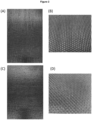
- polyester (hydrolysis resistant grade) strings with a height 30 of 0.35 mm and a width 20 of 1.06 mm and planar surfaces for at least 90% of both width 20 and height 30 extending for the entire length of the string, were woven into a plain weave mesh with a total thickness of 0.7 mm.
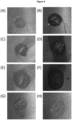
- a photographic image of such a mesh is shown in Figure 1A and a close-up in Figure 1B .
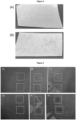
- FIG. 2A A photographic image of a layered material obtained from a method according to the invention is shown in Figure 2A and a close-up thereof in Figure 2B .
- polyphenylene sulfide (PPS) strings with a circular cross-section and a diameter of 0.8 mm woven into a plain weave mesh with a total thickness of 1.6 mm were used.
- PPS polyphenylene sulfide
- FIG. 2C A photographic image of a layered material obtained from a comparative example is shown in Figure 2C and a close-up thereof in Figure 2D .
- layered materials were prepared according to the invention and according to the comparative procedure above.
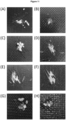
- Figure 4 shows, that layered materials according to the invention are superior in masking panel flaws. This is particularly apparent by comparing Figures 4C and 4F .
- thermal conductivities materials used in the method according to the invention and the comparative examples are similar.
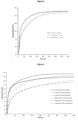
- the layered materials were produced using plywood with differing thicknesses, i.e., 9 mm, 18 mm, and 36 mm.
- a thermocouple was placed between the plywood and the resin-impregnated paper at the center of the layered material.
- the temperature curves from these experiments are presented in Figure 6 .
- using thicker boards leads to a slower increase in temperature as more mass needs to be heated.
- Heat conductivity in the method according to the invention was significantly faster than in the comparative examples at the same board thickness.
- the temperature in the thinnest formation (i.e. 9 mm) from the comparative examples only overtook the temperature in methods according the invention using formations having twice and four times the thickness (i.e. 18 and 36 mm), when the temperature in the latter already started plateauing.
- the method according to the invention enables much shorter hot-pressing times.
- aqueous NaOH 5 wt.-%) was applied to the structured surface of the layered material for 1h and the color of the solution was observed. Subsequently, a portion of the film was partially scraped off. If the film is fully cured, the solution should be colorless. Severely insufficiently cured resins on the other hand color the solution brown.
- the cure level was further assessed by the softness of the film after the layered material had been exposed to aqueous NaOH (5 wt.-%) for 2h. The cure level was assessed by the perceived hardness of the film. The analysis differentiated between the following levels of curing:
- the resin was cured better in the method according to the invention than in the comparative examples. Even after 7 min of curing film types B or G, the comparative examples were only fully cured, when an aluminium-foil was additionally added. Meanwhile full curing was accomplished with the method according to the invention without this additional measure. Notably, the thinner film type H could be cured within 5 min with the method according to the invention, whereas the comparative method resulted in a very incomplete curing.
- Friction coefficients were measured by pulling a sledge across the top of the test samples. The force required to move the sled was measured using a scale attached to the sled.
- Layered materials according to the invention obtained using a mesh mentioned as above are not symmetric along warp and weft, hence two friction coefficients were determined and averaged for said samples. Each measurement was carried out six times and the average friction coefficient was determined. Layered materials obtained for comparative examples are symmetric along weave and weft, thus only one friction constant was determined for these samples.
- Table 3 Static friction coefficients Sample Static friction coefficient Film type layers acc. to invention comparative Difference [%] A 1 0.44 0.30 +47 B 2 0.41 0.36 +14 3 0.50 0.41 +22 C 1 0.39 0.27 +44 D 1 0.49 0.29 +69 E 1 0.39 0.28 +39 3 0.35 0.20 +75
- the film was pressed on both sides of a plywood and cut to a 12,5 x 12,5 cm square.
- the Cobb-values were determined as follows: The initial weight of the samples was measured, documented, and the sample was subsequently strained in the Cobb apparatus. The cylinders of the apparatus were filled with deionized water. After 7 days the samples were dried, weighted and the final weight was documented. From the difference between the initial weight and the final weight the Cobb-value was calculated.
- Layered materials according to the invention exhibit a significantly lower water uptake when compared to those produced using strings with a round diameter. The moisture penetration through films in layered materials produced with a method according to the invention is therefore greatly improved.
- Wear resistance can be determined by the Taber Abrasion Method using a test sample which rotates under loaded cylindrical and emery strip covered friction wheels. The abrasion resistance is determined by the number of rotations (r) needed until a predetermined level of abrasion (initial wear point) was observed.
- the Taber test is based on DIN EN 13329 resp. DIN EN 438-2 11, which include the latest improvements regarding the abrasion test. Therefore, a calibrated sandpaper S 42 was used.
- the test samples are cut out of the wood products comprising the film according to the invention and have a size of 10 x 10 cm and a centered hole with a size of 6 mm.
- Table 5 Result of the Taber test Parameter Film type A B E F Initial Wear Point [r] Inv. 258 720 696 211 Comp. 204 605 595 162 Diff. [%] +27 +19 +17 +30 Wear Resistance [r] Inv. 360 894.5 826.5 314.5 Comp. 308 737 682.5 235 Diff. [%] +17 +21 +21 +34 Wear Index [mg/100r] Inv. 103.9 69.2 73.1 98.1 Comp. 123.8 87:5 103.9 152.6 Diff. [%] -16 -21 -30 -36
- step a Three sets (one experiment according to the invention and one comparative example each) of layered materials were manufactured, differing only in step a): In the first set, the substrate was overlaid with a film and a layer composed of a polyamide material. In the second set, the substrate was overlaid with a first film and a layer composed of a polyamide material, which was then overlaid with a second film. In the third set, 40 g/m 2 of an alkene ketene dimer was applied to the substrate, after which the procedure of the second set was carried out.
- samples (50 mm x 50 mm) of the layered materials were subjected to treatment in boiling water for 4h.
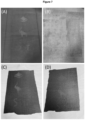
- layered materials were cut with a knife to investigate bonding between resin and substrate. Photographic images are shown in Fig. 11 .
- layers are easily removed from the substrate as exhibited by adhesive failure.
- Layered materials according to the invention exhibit strong bonding between resin and substrate, as indicated by the cohesive failure of the wooden substrate. This stark contrast was particularly evident after the samples had been subjected to treatment in boiling water.
Landscapes
- Engineering & Computer Science (AREA)
- Life Sciences & Earth Sciences (AREA)
- Wood Science & Technology (AREA)
- Textile Engineering (AREA)
- Laminated Bodies (AREA)
Priority Applications (2)
| Application Number | Priority Date | Filing Date | Title |
|---|---|---|---|
| EP23157986.3A EP4420877A1 (fr) | 2023-02-22 | 2023-02-22 | Procédé de fabrication d'un matériau stratifié avec une structure de surface |
| PCT/EP2024/054407 WO2024175649A1 (fr) | 2023-02-22 | 2024-02-21 | Procédé de production d'un matériau stratifié ayant une structure de surface |
Applications Claiming Priority (1)
| Application Number | Priority Date | Filing Date | Title |
|---|---|---|---|
| EP23157986.3A EP4420877A1 (fr) | 2023-02-22 | 2023-02-22 | Procédé de fabrication d'un matériau stratifié avec une structure de surface |
Publications (1)
| Publication Number | Publication Date |
|---|---|
| EP4420877A1 true EP4420877A1 (fr) | 2024-08-28 |
Family
ID=85384472
Family Applications (1)
| Application Number | Title | Priority Date | Filing Date |
|---|---|---|---|
| EP23157986.3A Pending EP4420877A1 (fr) | 2023-02-22 | 2023-02-22 | Procédé de fabrication d'un matériau stratifié avec une structure de surface |
Country Status (2)
| Country | Link |
|---|---|
| EP (1) | EP4420877A1 (fr) |
| WO (1) | WO2024175649A1 (fr) |
Citations (3)
| Publication number | Priority date | Publication date | Assignee | Title |
|---|---|---|---|---|
| EP1125971A1 (fr) * | 2000-02-18 | 2001-08-22 | DEKODUR GmbH & Co. KG | Procédé de préparation de laminés en forme de plaque avec un décor à structure en relief |
| KR20120063476A (ko) * | 2009-08-03 | 2012-06-15 | 에스 디 와렌 컴패니 | 경화된 분말 코팅에 텍스처 부여 방법 |
| EP3392031B1 (fr) * | 2017-04-21 | 2020-03-04 | UPM Plywood Oy | Panneau de contreplaqué et son procédé de fabrication |
-
2023
- 2023-02-22 EP EP23157986.3A patent/EP4420877A1/fr active Pending
-
2024
- 2024-02-21 WO PCT/EP2024/054407 patent/WO2024175649A1/fr not_active Ceased
Patent Citations (3)
| Publication number | Priority date | Publication date | Assignee | Title |
|---|---|---|---|---|
| EP1125971A1 (fr) * | 2000-02-18 | 2001-08-22 | DEKODUR GmbH & Co. KG | Procédé de préparation de laminés en forme de plaque avec un décor à structure en relief |
| KR20120063476A (ko) * | 2009-08-03 | 2012-06-15 | 에스 디 와렌 컴패니 | 경화된 분말 코팅에 텍스처 부여 방법 |
| EP3392031B1 (fr) * | 2017-04-21 | 2020-03-04 | UPM Plywood Oy | Panneau de contreplaqué et son procédé de fabrication |
Also Published As
| Publication number | Publication date |
|---|---|
| WO2024175649A1 (fr) | 2024-08-29 |
Similar Documents
| Publication | Publication Date | Title |
|---|---|---|
| EP0788576B1 (fr) | Procede de production d'une lame de revetement de sol | |
| EP1985426B1 (fr) | Appareil et procédé pour la sélection d'un procédé de transmission multi-antenne dans un système de diffusion | |
| EP1289778B1 (fr) | Revetement pour stratifie pourvu d'une protection de plaque de presse et procedes de production dudit revetement | |
| JPH08503748A (ja) | フィルム複合材料 | |
| CN102076764B (zh) | 采用杂化树脂的浸渍 | |
| CN100473544C (zh) | 装饰纸和浸渍装饰纸的方法 | |
| US7799735B2 (en) | Chemically modified melamine resin for use in sublimation dye imaging | |
| EP4420877A1 (fr) | Procédé de fabrication d'un matériau stratifié avec une structure de surface | |
| WO2013055757A1 (fr) | Stratifiés sensiblement exempts de formaldéhyde et leurs procédés de fabrication | |
| CA2890617C (fr) | Procede de traitement d'un panneau en materiau derive du bois et panneau de construction possedant une ame en materiau derive du bois | |
| EP1169139B1 (fr) | Film en resine synthetique pour produits stratifies et procede de fabrication correspondant | |
| EA037387B1 (ru) | Слоистый материал для нанесения на несущую плиту и способ его изготовления | |
| AU2007316459B2 (en) | Laminated panel | |
| KR100361893B1 (ko) | 유리섬유층으로 보강된 고압 멜라민 적층판이 적층된 내수합판 강화마루판 및 그 제조방법 | |
| JP2009202376A (ja) | 繊維板および化粧材の製造方法 | |
| JP2007313889A (ja) | 合板とこれを用いた建築板および木質防音床材並びに合板の製造方法 | |
| KR102375839B1 (ko) | 열경화성 수지 화장판 및 이의 제조방법 | |
| WO2000069630A1 (fr) | Feuille decor resistante a l'abrasion | |
| JP2001105405A (ja) | 木質仕上材 | |
| JPH07195315A (ja) | 木材に基づく組成物 | |
| CN116888212A (zh) | 改性三聚氰胺-甲醛树脂、浸渍有改性三聚氰胺-甲醛树脂的纸、用于制造地板镶板的方法及双氰胺作为三聚氰胺-甲醛树脂中的改性剂的用途 | |
| JP2021017774A (ja) | 床材 |
Legal Events
| Date | Code | Title | Description |
|---|---|---|---|
| PUAI | Public reference made under article 153(3) epc to a published international application that has entered the european phase |
Free format text: ORIGINAL CODE: 0009012 |
|
| STAA | Information on the status of an ep patent application or granted ep patent |
Free format text: STATUS: THE APPLICATION HAS BEEN PUBLISHED |
|
| AK | Designated contracting states |
Kind code of ref document: A1 Designated state(s): AL AT BE BG CH CY CZ DE DK EE ES FI FR GB GR HR HU IE IS IT LI LT LU LV MC ME MK MT NL NO PL PT RO RS SE SI SK SM TR |
|
| STAA | Information on the status of an ep patent application or granted ep patent |
Free format text: STATUS: REQUEST FOR EXAMINATION WAS MADE |
|
| 17P | Request for examination filed |
Effective date: 20250228 |
|
| STAA | Information on the status of an ep patent application or granted ep patent |
Free format text: STATUS: EXAMINATION IS IN PROGRESS |
|
| 17Q | First examination report despatched |
Effective date: 20250509 |