EP4421937A1 - Batterie rechargeable au lithium - Google Patents
Batterie rechargeable au lithium Download PDFInfo
- Publication number
- EP4421937A1 EP4421937A1 EP23197391.8A EP23197391A EP4421937A1 EP 4421937 A1 EP4421937 A1 EP 4421937A1 EP 23197391 A EP23197391 A EP 23197391A EP 4421937 A1 EP4421937 A1 EP 4421937A1
- Authority
- EP
- European Patent Office
- Prior art keywords
- chemical formula
- group
- substituted
- unsubstituted
- lithium battery
- Prior art date
- Legal status (The legal status is an assumption and is not a legal conclusion. Google has not performed a legal analysis and makes no representation as to the accuracy of the status listed.)
- Pending
Links
Images
Classifications
-
- H—ELECTRICITY
- H01—ELECTRIC ELEMENTS
- H01M—PROCESSES OR MEANS, e.g. BATTERIES, FOR THE DIRECT CONVERSION OF CHEMICAL ENERGY INTO ELECTRICAL ENERGY
- H01M10/00—Secondary cells; Manufacture thereof
- H01M10/05—Accumulators with non-aqueous electrolyte
- H01M10/058—Construction or manufacture
-
- H—ELECTRICITY
- H01—ELECTRIC ELEMENTS
- H01M—PROCESSES OR MEANS, e.g. BATTERIES, FOR THE DIRECT CONVERSION OF CHEMICAL ENERGY INTO ELECTRICAL ENERGY
- H01M10/00—Secondary cells; Manufacture thereof
- H01M10/05—Accumulators with non-aqueous electrolyte
- H01M10/056—Accumulators with non-aqueous electrolyte characterised by the materials used as electrolytes, e.g. mixed inorganic/organic electrolytes
- H01M10/0564—Accumulators with non-aqueous electrolyte characterised by the materials used as electrolytes, e.g. mixed inorganic/organic electrolytes the electrolyte being constituted of organic materials only
- H01M10/0566—Liquid materials
- H01M10/0568—Liquid materials characterised by the solutes
-
- H—ELECTRICITY
- H01—ELECTRIC ELEMENTS
- H01M—PROCESSES OR MEANS, e.g. BATTERIES, FOR THE DIRECT CONVERSION OF CHEMICAL ENERGY INTO ELECTRICAL ENERGY
- H01M10/00—Secondary cells; Manufacture thereof
- H01M10/05—Accumulators with non-aqueous electrolyte
- H01M10/052—Li-accumulators
-
- H—ELECTRICITY
- H01—ELECTRIC ELEMENTS
- H01M—PROCESSES OR MEANS, e.g. BATTERIES, FOR THE DIRECT CONVERSION OF CHEMICAL ENERGY INTO ELECTRICAL ENERGY
- H01M10/00—Secondary cells; Manufacture thereof
- H01M10/05—Accumulators with non-aqueous electrolyte
- H01M10/052—Li-accumulators
- H01M10/0525—Rocking-chair batteries, i.e. batteries with lithium insertion or intercalation in both electrodes; Lithium-ion batteries
-
- H—ELECTRICITY
- H01—ELECTRIC ELEMENTS
- H01M—PROCESSES OR MEANS, e.g. BATTERIES, FOR THE DIRECT CONVERSION OF CHEMICAL ENERGY INTO ELECTRICAL ENERGY
- H01M10/00—Secondary cells; Manufacture thereof
- H01M10/05—Accumulators with non-aqueous electrolyte
- H01M10/056—Accumulators with non-aqueous electrolyte characterised by the materials used as electrolytes, e.g. mixed inorganic/organic electrolytes
- H01M10/0564—Accumulators with non-aqueous electrolyte characterised by the materials used as electrolytes, e.g. mixed inorganic/organic electrolytes the electrolyte being constituted of organic materials only
- H01M10/0566—Liquid materials
- H01M10/0567—Liquid materials characterised by the additives
-
- H—ELECTRICITY
- H01—ELECTRIC ELEMENTS
- H01M—PROCESSES OR MEANS, e.g. BATTERIES, FOR THE DIRECT CONVERSION OF CHEMICAL ENERGY INTO ELECTRICAL ENERGY
- H01M10/00—Secondary cells; Manufacture thereof
- H01M10/42—Methods or arrangements for servicing or maintenance of secondary cells or secondary half-cells
- H01M10/44—Methods for charging or discharging
-
- H—ELECTRICITY
- H01—ELECTRIC ELEMENTS
- H01M—PROCESSES OR MEANS, e.g. BATTERIES, FOR THE DIRECT CONVERSION OF CHEMICAL ENERGY INTO ELECTRICAL ENERGY
- H01M4/00—Electrodes
- H01M4/02—Electrodes composed of, or comprising, active material
- H01M4/36—Selection of substances as active materials, active masses, active liquids
- H01M4/48—Selection of substances as active materials, active masses, active liquids of inorganic oxides or hydroxides
- H01M4/52—Selection of substances as active materials, active masses, active liquids of inorganic oxides or hydroxides of nickel, cobalt or iron
- H01M4/525—Selection of substances as active materials, active masses, active liquids of inorganic oxides or hydroxides of nickel, cobalt or iron of mixed oxides or hydroxides containing iron, cobalt or nickel for inserting or intercalating light metals, e.g. LiNiO2, LiCoO2 or LiCoOxFy
-
- H—ELECTRICITY
- H01—ELECTRIC ELEMENTS
- H01M—PROCESSES OR MEANS, e.g. BATTERIES, FOR THE DIRECT CONVERSION OF CHEMICAL ENERGY INTO ELECTRICAL ENERGY
- H01M4/00—Electrodes
- H01M4/02—Electrodes composed of, or comprising, active material
- H01M2004/026—Electrodes composed of, or comprising, active material characterised by the polarity
- H01M2004/028—Positive electrodes
-
- H—ELECTRICITY
- H01—ELECTRIC ELEMENTS
- H01M—PROCESSES OR MEANS, e.g. BATTERIES, FOR THE DIRECT CONVERSION OF CHEMICAL ENERGY INTO ELECTRICAL ENERGY
- H01M2300/00—Electrolytes
- H01M2300/0017—Non-aqueous electrolytes
- H01M2300/0025—Organic electrolyte
-
- Y—GENERAL TAGGING OF NEW TECHNOLOGICAL DEVELOPMENTS; GENERAL TAGGING OF CROSS-SECTIONAL TECHNOLOGIES SPANNING OVER SEVERAL SECTIONS OF THE IPC; TECHNICAL SUBJECTS COVERED BY FORMER USPC CROSS-REFERENCE ART COLLECTIONS [XRACs] AND DIGESTS
- Y02—TECHNOLOGIES OR APPLICATIONS FOR MITIGATION OR ADAPTATION AGAINST CLIMATE CHANGE
- Y02E—REDUCTION OF GREENHOUSE GAS [GHG] EMISSIONS, RELATED TO ENERGY GENERATION, TRANSMISSION OR DISTRIBUTION
- Y02E60/00—Enabling technologies; Technologies with a potential or indirect contribution to GHG emissions mitigation
- Y02E60/10—Energy storage using batteries
Definitions
- This disclosure relates to a rechargeable lithium battery.
- a rechargeable lithium battery may be recharged and has three or more times higher energy density per unit weight than a conventional lead storage battery, nickelcadmium battery, nickel hydrogen battery, nickel zinc battery and the like, and may be highly charged and thus, is commercially manufactured for a laptop, a cell phone, an electric tool, an electric bike, and the like, and researches on improvement of additional energy density have been actively made.
- Such a rechargeable lithium battery is manufactured by injecting an electrolyte solution into a battery cell, which comprises a positive electrode comprising a positive electrode active material capable of intercalating/deintercalating lithium ions and a negative electrode comprising a negative electrode active material capable of intercalating/deintercalating lithium ions.
- An embodiment is to increase the energy density of a rechargeable lithium battery while improving safety at room temperature and/or high temperature without deterioration in performance.
- R 1 and R 2 may each independently be a fluoro group or a C1 to C4 alkyl group substituted with at least three fluoro groups.
- R 1 and R 2 may be the same.
- Chemical Formula 1 may be Chemical Formula 1-1 or 1-2:
- the lithium salt may further comprise one or two or more selected from LiPF 6 , LiBF 4 , lithium difluoro(oxalate)borate (LiDFOB), LiPO 2 F 2 , LiSbF 6 , LiAsF 6 , LiN(SO 2 C 2 F 5 ) 2 , Li(CF 3 SO 2 ) 2 N, LiN(SO 3 C 2 F 5 ) 2 , LiC 4 F 9 SO 3 , LiClO 4 , LiAlO 2 , LiAlCl 4 , LiN(C p F 2p+1 SO 2 )(C q F 2q+1 SO 2 ), wherein, p and q are integers from 1 to 20, LiCl, LiI, and LiB(C 2 O 4 ) 2 (lithium bis(oxalato) borate: LiBOB).
- LiPF 6 LiBF 4
- LiAsF 6 LiN(SO 2 C 2 F 5 ) 2
- Li(CF 3 SO 2 ) 2 N LiN(SO 3
- the lithium salt may comprise the compound represented by Chemical Formula 1 and LiPF 6 .
- the compound represented by Chemical Formula 1 maybe comprised in an amount of about 10 wt% to about 50 wt%, and LiPF 6 may be comprised in a balance amount.
- a total amount of the lithium salt may correspond to a molar concentration of about 0.1 M to about 2.0 M in the electrolyte solution.
- Chemical Formula 2 may be Chemical Formula 2-1: wherein, in Chemical Formula 2-1,
- Chemical Formula 2 may be Chemical Formula 2-2: wherein, in Chemical Formula 2-2, L 5 is a substituted or unsubstituted C2 to C5 alkylene group.
- Chemical Formula 2-2 may be Chemical Formula 2-2a or 2-2b: wherein, in Chemical Formulas 2-2a and 2-2b, R 7 to R 16 are each independently hydrogen, a halogen, or a substituted or unsubstituted C1 to C5 alkyl group.
- the additive may be any one selected from:
- the additive may be comprised in an amount of about 0.05 wt% to about 5.0 wt% based on a total weight of the electrolyte solution.
- the positive electrode active material may comprise a composite oxide represented by Chemical Formula 3: [Chemical Formula 3] Li a Ni x M 1 y M 2 z O 2-b X b wherein, in Chemical Formula 3,
- the positive electrode active material may comprise a composite oxide represented by Chemical Formula 3-1, a composite oxide represented by Chemical Formula 3-2, or a combination thereof: [Chemical Formula 3-1] Li a1 Ni x1 Mn y1 M 2 z1 O 2-b1 X b1 [Chemical Formula 3-2] Li a2 Ni x2 Al y2 M2 z2 O 2-b2 X b2 wherein, in Chemical Formulas 3-1 and 3-2,
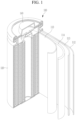
- FIG. 1 is a schematic view showing a rechargeable lithium battery according to an embodiment of the present invention.
- substituted refers to a replacement of at least one hydrogen of a substituent or a compound by deuterium, a halogen, a hydroxyl group, an amino group, a substituted or unsubstituted C1 to C30 amine group, a nitro group, a substituted or unsubstituted C1 to C40 silyl group, a C1 to C30 alkyl group, a C1 to C10 alkylsilyl group, a C6 to C30 arylsilyl group, a C3 to C30 cycloalkyl group, a C3 to C30 heterocycloalkyl group, a C6 to C30 aryl group, a C2 to C30 heteroaryl group, a C1 to C20 alkoxy group, a C1 to C10 alkyl group, a cyano group, or a combination thereof.
- substituted refers to replacement of at least one hydrogen of a substituent or a compound by deuterium, a halogen, a C1 to C30 alkyl group, a C1 to C10 alkylsilyl group, a C6 to C30 arylsilyl group, a C3 to C30 cycloalkyl group, a C3 to C30 heterocycloalkyl group, a C6 to C30 aryl group, a C2 to C30 heteroaryl group, a C1 to C10 alkyl group, or a cyano group.
- substituted refers to replacement of at least one hydrogen of a substituent or a compound by deuterium, a halogen, a C1 to C20 alkyl group, a C6 to C30 aryl group, a C1 to C10 alkyl group, or a cyano group.
- substituted refers to replacement of at least one hydrogen of a substituent or a compound by deuterium, a halogen, a C1 to C5 alkyl group, a C6 to C18 aryl group, a C1 to C5 alkyl group, or a cyano group.
- substituted refers to replacement of at least one hydrogen of a substituent or a compound by deuterium, a cyano group, a halogen, a methyl group, an ethyl group, a propyl group, a butyl group, a phenyl group, a biphenyl group, a terphenyl group, a trifluoromethyl group, or a naphthyl group.
- a lithium rechargeable battery may be classified into a lithium ion battery, a lithium ion polymer battery, and a lithium polymer battery depending on kinds of a separator and an electrolyte solution. It also may be classified to be cylindrical, prismatic, coin-type, pouch-type, and the like depending on shape. In addition, it may be bulk type and thin film type depending on sizes. Structures and manufacturing methods for lithium ion batteries pertaining to this disclosure are well known in the art.
- FIG. 1 schematically illustrates the structure of a rechargeable lithium battery according to an embodiment.
- a rechargeable lithium battery 100 according to an embodiment comprises a battery cell comprising a positive electrode 114, a negative electrode 112 facing the positive electrode 114, a separator 113 between the positive electrode 114 and the negative electrode 112, and an electrolyte solution (not shown) impregnating the positive electrode 114, the negative electrode 112, and the separator 113, a battery case 120 housing the battery cell, and a sealing member 140 sealing the battery case 120.
- a rechargeable lithium battery comprises a positive electrode comprising a positive electrode active material; a negative electrode comprising a negative electrode active material; and an electrolyte solution comprising a non-aqueous organic solvent, a lithium salt, and an additive.
- the first lithium salt is a compound comprising a lithium sulfonylimide salt.
- a film is formed on the surface of the positive and negative electrodes.
- the first lithium salt is reduced and decomposed before a carbonate-based solvent comprised in the non-aqueous organic solvent and forms a SEI (solid electrolyte interface) film on the negative electrode. Accordingly, the decomposition of the electrolyte solution and the resulting decomposition reaction of the electrode may be prevented, resulting in suppressing an increase in internal resistance due to gas generation.
- SEI solid electrolyte interface
- the SEI film formed on the negative electrode may be partially decomposed through the reduction reaction during the charging and discharging. Components of the SEI films decomposed on the negative electrode may move onto the positive electrode surface.
- the SEI film components moved onto the positive electrode surface also may form a film on the positive electrode surface through an oxidation reaction to prevent decomposition of the positive electrode surface and the oxidation reaction of the electrolyte solution. Resultantly, the negative electrode SEI film and the positive electrode SEI film may contribute to improving high-temperature and lowtemperature cycle-life characteristics of the rechargeable lithium battery.
- the additive comprises a compound represented by Chemical Formula 2: wherein, in Chemical Formula 2,
- a fluorophosphite-based compound such as the additive may stabilize the lithium salt comprising the first lithium salt in the electrolyte solution. Through this, it is possible to suppress decomposition of the electrolyte solution at high temperature, suppress generation of gas inside the battery, and simultaneously improve safety and cycle-life characteristics of the rechargeable lithium battery.
- R 1 and R 2 in Chemical Formula 1 may each independently be a fluoro group or a C1 to C4 alkyl group substituted with at least two fluoro groups.
- R 1 and R 2 in Chemical Formula 1 may each independently be a fluoro group or a C1 to C4 alkyl group substituted with at least three fluoro groups.
- R 1 and R 2 in Chemical Formula 1 may each independently be a fluoro group or a C1 to C3 alkyl group substituted with at least three fluoro groups.
- R 1 and R 2 in Chemical Formula 1 may each independently be a fluoro group or a C1 to C2 alkyl group substituted with at least three fluoro groups.
- R 1 and R 2 in Chemical Formula 1 may be the same.
- the lithium salt may further comprise one or two or more lithium salts selected from LiPF 6 , LiBF 4 , lithium difluoro(oxalate)borate (LiDFOB), LiPO 2 F 2 , LiSbF 6 , LiAsF 6 , LiN(SO 2 C 2 F 5 ) 2 , Li(CF 3 SO 2 ) 2 N, LiN(SO 3 C 2 F 5 ) 2 , LiC 4 F 9 SO 3 , LiClO 4 , LiAlO 2 , LiAlCl 4 , LiN(C p F 2p+1 SO 2 )(C q F 2q+1 SO 2 ) wherein p and q are integers from 1 to 20, LiCl, LiI and LiB(C 2 O 4 ) 2 (lithium bis(oxalato) borate: LiBOB) (hereinafter referred to as 'second lithium salt' in some cases).
- the second lithium salt is dissolved in a non-fluoro(oxalate)borate
- the lithium salt may comprise the compound represented by Chemical Formula 1 and LiPF 6 .
- the compound represented by Chemical Formula 1 (first lithium salt) may be comprised in an amount of greater than or equal to about to wt%, greater than or equal to about 20 wt%, or greater than or equal to about 30 wt% and less than or equal to about 50 wt%, or less than or equal to about 40 wt% based on a total amount of the lithium salt
- the LiPF 6 (second lithium salt) may be comprised in a balance amount.
- the total amount of the lithium salt may correspond to a molar concentration of about 0.1 M to about 2.0 M in the electrolyte solution.
- One of X 1 and X 2 in Chemical Formula 2 is a fluoro group, and the other is - O-L 2 -R 4 ;
- L 2 is a single bond or a substituted or unsubstituted C1 to C10 alkylene group; and
- R4 may be a cyano group (-CN) or a difluorophosphite group (-OPF 2 ).
- Chemical Formula 2 may be Chemical Formula 2-1.
- m is an integer of 1 to 5;
- R 4 is a cyano group (-CN) or a difluorophosphite group (-OPF 2 ).
- X 1 may be -O-L 3 -R 5 and X 2 may be -O-L 4 -R 6 ; wherein L 3 and L 4 may each independently be a single bond or a substituted or unsubstituted C1 to C10 alkylene group; R 5 and R 6 may each independently be a substituted or unsubstituted C1 to C10 alkyl group, and R 5 and R 6 may be linked to each other to form a substituted or unsubstituted monocyclic or polycyclic aliphatic heterocycle.
- Chemical Formula 2 may be Chemical Formula 2-2.
- L 5 is a substituted or unsubstituted C2 to C5 alkylene group.
- Chemical Formula 2-2 may be Chemical Formula 2-2a or Formula 2-2b.
- R 7 to R 16 are each independently hydrogen, a halogen, or a substituted or unsubstituted C1 to C5 alkyl group.
- the additive may be comprised in an amount of greater than or equal to about 0.05 wt%, greater than or equal to about 0.1 wt%, greater than or equal to about 0.2 wt%, greater than or equal to about 0.3 wt%, greater than or equal to about 0.4 wt%, or greater than or equal to about 0.05 wt%; and 5.0 wt%, less than or equal to about 4.0 wt%, less than or equal to about 3.0 wt%, less than or equal to about 2.0 wt%, or less than or equal to about 1.0 wt% based on a total weight of the electrolyte solution.
- the rechargeable lithium battery of an embodiment comprises an electrolyte solution comprising a non-aqueous organic solvent; a lithium salt comprising lithium bis(fluorosulfonyl)imide or cesium bis(trifluoromethanesulfonyl)imide (first lithium salt) and LiPF 6 (second lithium salt) in a balance amount; and at least one (additive) of the compounds listed above.
- concentration or content of each compound in the electrolyte solution is as described above.
- the non-aqueous organic solvent serves as a medium for transmitting ions taking part in the electrochemical reaction of a battery.
- the non-aqueous organic solvent may comprise a carbonate-based, ester-based, ether-based, ketone-based, alcohol-based, or aprotic solvent.
- the carbonate-based solvent may comprise dimethyl carbonate (DMC), diethyl carbonate (DEC), dipropyl carbonate (DPC), methylpropyl carbonate (MPC), ethylpropyl carbonate (EPC), ethylmethyl carbonate (EMC), ethylene carbonate (EC), propylene carbonate (PC), butylene carbonate (BC), and the like.
- the ester-based solvent may comprise methyl acetate, ethyl acetate, n-propyl acetate, t-butyl acetate, methylpropionate, ethylpropionate, propylpropionate, decanolide, mevalonolactone, caprolactone, and the like.
- the ether-based solvent may comprise dibutyl ether, tetraglyme, diglyme, dimethoxyethane, 2-methyltetrahydrofuran, tetrahydrofuran, and the like.
- the ketone-based solvent may comprise cyclohexanone and the like.
- the alcohol-based solvent may comprise ethyl alcohol, isopropyl alcohol, and the like, and examples of the aprotic solvent comprise nitriles such as R 15 -CN (wherein R 15 is a C2 to C20 linear, branched, or cyclic hydrocarbon group, a double bond, an aromatic ring, or an ether bond), amides such as dimethylformamide, dioxolanes such as 1,3-dioxolane, sulfolanes, and the like.
- nitriles such as R 15 -CN (wherein R 15 is a C2 to C20 linear, branched, or cyclic hydrocarbon group, a double bond, an aromatic ring, or an ether bond)
- amides such as dimethylformamide
- dioxolanes such as 1,3-dioxolane, sulfolanes, and the like.
- the non-aqueous organic solvent may be used alone or in a mixture.
- their mixing ratio may be controlled in accordance with a desirable battery performance.
- the carbonate-based solvent is prepared by mixing a cyclic carbonate and a linear carbonate.
- the cyclic carbonate and chain carbonate are mixed together in a volume ratio of about 1:9 to about 9:1.
- the mixture When the mixture is used as an electrolyte solution, it may have enhanced performance.
- the non-aqueous organic solvent may comprise the cyclic carbonate and the chain carbonate in a volume ratio of about 2:8 to about 5:5.
- the cyclic carbonate and the chain carbonate may be comprised in a volume ratio of about 2:8 to about 4:6.
- the cyclic carbonate and the chain carbonate may be comprised in a volume ratio of about 2:8 to about 3:7.
- the non-aqueous organic solvent may further comprise an aromatic hydrocarbon-based solvent as well as the carbonate-based solvent.
- the carbonate-based solvent and aromatic hydrocarbon-based solvent may be mixed together in a volume ratio of about 1:1 to about 30:1.
- the aromatic hydrocarbon-based solvent may be an aromatic hydrocarbon-based compound represented by Chemical Formula 4.
- R17 to R22 are the same or different and are selected from hydrogen, a halogen, a C1 to C10 alkyl group, a haloalkyl group, and a combination thereof.
- aromatic hydrocarbon-based solvent may be selected from benzene, fluorobenzene, 1,2-difluorobenzene, 1,3-difluorobenzene, 1,4-difluorobenzene, 1,2,3-trifluorobenzene, 1,2,4-trifluorobenzene, chlorobenzene, 1,2-dichlorobenzene, 1,3-dichlorobenzene, 1,4-dichlorobenzene, 1,2,3-trichlorobenzene, 1,2,4-trichlorobenzene, iodobenzene, 1,2-diiodobenzene, 1,3-diiodobenzene, 1,4-diiodobenzene, 1,2,3-triiodobenzene, 1,2,4-triiodobenzene, toluene, fluorotoluene, 2,3-difluorotoluene, 2,4-difluorobenz
- the positive electrode comprises a positive electrode current collector and a positive electrode active material layer on the positive electrode current collector, and the positive electrode active material layer comprises a positive electrode active material.
- the positive electrode active material may comprise lithiated intercalation compounds that reversibly intercalate and deintercalate lithium ions.
- At least one composite oxide of lithium and a metal of cobalt, manganese, nickel, or a combination thereof may be used.
- the composite oxide having a coating layer on the surface thereof may be used, or a mixture of the composite oxide and the composite oxide having a coating layer may be used.
- the coating layer may comprise a coating element compound of an oxide or hydroxide of a coating element, oxyhydroxide of a coating element, oxycarbonate of a coating element, or hydroxycarbonate of a coating element.
- the compound for the coating layer may be either amorphous or crystalline.
- the coating element comprised in the coating layer may be Mg, Al, Co, K, Na, Ca, Si, Ti, V, Sn, Ge, Ga, B, As, Zr, or a mixture thereof.
- the coating process may comprise any conventional processes as long as it does not cause any side effects on the properties of the positive electrode active material (e.g., spray coating, dipping), which is well known to persons having ordinary skill in this art, and thus a detailed description thereof is omitted.
- the positive electrode active material may be, for example, at least one of lithium composite oxides represented by Chemical Formula 3: [Chemical Formula 3] Li a Ni x M 1 y M 2 z O 2-b X b wherein, in Chemical Formula 3,
- the positive electrode active material may comprise a composite oxide represented by Chemical Formula 3-1, a composite oxide represented by Chemical Formula 3-2, or a combination thereof: [Chemical Formula 3-1] Li a1 Ni x1 Mn y1 M 2 z1 O 2-b1 X b1 [Chemical Formula 3-2] Li a2 Ni x2 Al y2 M 2 z2 O 2-b2 X b2 wherein, in Chemical Formulas 3-1 and 3-2,
- a content of the positive electrode active material may be about 90 wt% to about 98 wt% based on a total weight of the positive electrode active material layer.
- the positive electrode active material layer may optionally comprise a conductive material and a binder.
- a content of the binder may be about 1 wt% to about 5 wt% based on a total weight of the positive electrode active material layer.
- Each content of the conductive material and the binder may be about 1 wt% to about 5 wt%, respectively, based on a total weight of the positive electrode active material layer.
- the conductive material is used to impart conductivity to the negative electrode, and any electrically conductive material may be used as a conductive material unless it causes a chemical change in a battery.
- the conductive material may comprise a carbon-based material such as natural graphite, artificial graphite, carbon black, acetylene black, ketjen black, carbon fiber, and the like; a metal-based material of a metal powder or a metal fiber comprising copper, nickel, aluminum, silver, and the like; a conductive polymer such as a polyphenylene derivative; or a mixture thereof.
- the binder improves binding properties of positive electrode active material particles with one another and with a current collector and examples thereof may be polyvinyl alcohol, carboxylmethyl cellulose, hydroxypropyl cellulose, diacetyl cellulose, polyvinylchloride, carboxylated polyvinylchloride, polyvinylfluoride, an ethylene oxide-containing polymer, polyvinylpyrrolidone, polyurethane, polytetrafluoroethylene, polyvinylidene fluoride, polyethylene, polypropylene, a styrene-butadiene rubber, an acrylated styrene-butadiene rubber, an epoxy resin, nylon, and the like, but are not limited thereto.
- Al may be used as the positive electrode current collector, but is not limited thereto.
- the negative electrode comprises a negative electrode current collector and a negative electrode active material layer comprising the negative electrode active material on the negative electrode current collector.
- the negative electrode active material may be a material that reversibly intercalates/deintercalates lithium ions, a lithium metal, a lithium metal alloy, a material capable of doping and dedoping lithium, or a transition metal oxide.
- the material that reversibly intercalates/deintercalates lithium ions comprises carbon materials.
- the carbon material may be any generally-used carbon-based negative electrode active material in a rechargeable lithium battery.
- Examples of the carbon material comprise crystalline carbon, amorphous carbon, and a combination thereof.
- the crystalline carbon may be non-shaped, or sheet, flake, spherical, or fiber shaped natural graphite or artificial graphite.
- the amorphous carbon may be a soft carbon, a hard carbon, a mesophase pitch carbonized product, fired coke, and the like.
- the lithium metal alloy may comprise lithium and a metal selected from Na, K, Rb, Cs, Fr, Be, Mg, Ca, Sr, Si, Sb, Pb, In, Zn, Ba, Ra, Ge, Al, and Sn.
- the material capable of doping and dedoping lithium may comprise Si, SiO x (0 ⁇ x ⁇ 2), a Si-Q alloy (wherein Q is selected from an alkali metal, an alkaline-earth metal, a Group 13 element, a Group 14 element, a Group 15 element, a Group 16 element, a transition metal, a rare earth element, and a combination thereof, and not Si), Sn, SnO 2 , a Sn-R alloy (wherein R is an alkali metal, an alkaline-earth metal, a Group 13 element, a Group 14 element, a Group 15 element, a Group 16 element, a transition element, a rare earth element, or a combination thereof, and not Sn), and the like. At least one of them may be mixed with SiO 2 .
- the elements Q and R may be selected from Mg, Ca, Sr, Ba, Ra, Sc, Y, Ti, Zr, Hf, Rf, V, Nb, Ta, Db, Cr, Mo, W, Sg, Tc, Re, Bh, Fe, Pb, Ru, Os, Hs, Rh, Ir, Pd, Pt, Cu, Ag, Au, Zn, Cd, B, Al, Ga, Sn, In, Tl, Ge, P, As, Sb, Bi, S, Se, Te, Po, and combination thereof.
- the transition metal oxide may be a vanadium oxide, a lithium vanadium oxide, and the like.
- the negative electrode active material may comprise at least one of graphite and a Si composite.
- the Si composite may comprise a core comprising Si particles and amorphous carbon, for example, the Si particles may comprise at least one of Si composite, SiO x (0 ⁇ x ⁇ 2), and an Si alloy.
- the Si-C composite may comprise a core comprising Si particles and amorphous carbon.
- the central portion of the core may comprise pores, and the radius of the central portion may correspond to about 30% to about 50% of the radius of the Si-C composite.
- the Si particles may have an average particle diameter of about 10 nm to about 200 nm.
- the average particle diameter may be a particle size (D50) at a volume ratio of 50% in a cumulative size-distribution curve.
- the average particle diameter of the Si particle is within the above range, volume expansion occurring during charging and discharging maybe suppressed, and a disconnection of a conductive path due to particle crushing during charging and discharging may be prevented.
- the Si particle may be comprised in an amount of about 1 wt% to about 60 wt%, for example, about 3 wt% to about 60 wt%, based on a total weight of the Si-C composite.
- the central portion may not comprise amorphous carbon, but the amorphous carbon may be present only on the surface portion of the negative electrode active material.
- the surface portion indicates a region from the central portion of the negative electrode active material to the outermost surface of the negative electrode active material.
- the Si particles are substantially uniformly comprised over the negative electrode active material, that is, present at a substantially uniform concentration in the central portion and the surface portion thereof.
- the amorphous carbon may be soft carbon, hard carbon, mesophase pitch carbonized product, calcined coke, or a combination thereof.
- the negative electrode active material may further comprise crystalline carbon.
- the Si-C composite and crystalline carbon may be comprised in the form of a mixture, and in this case, the Si-C composite and crystalline carbon may be comprised in a weight ratio of about 1:99 to about 50:50. More specifically, the Si-C composite and crystalline carbon may be comprised in a weight ratio of 3 : 97 to 20 : 80 or 5 : 95 to 20 : 80.
- the crystalline carbon may be for example graphite, and more specifically natural graphite, artificial graphite, or a mixture thereof.
- the crystalline carbon may have an average particle diameter of about 5 ⁇ m to about 30 ⁇ m.
- the amorphous carbon precursor may comprise a coal-based pitch, mesophase pitch, petroleum-based pitch, coal-based oil, petroleum-based heavy oil, or a polymer resin such as a phenol resin, a furan resin, or a polyimide resin.
- the negative electrode active material may be comprised in an amount of about 95 wt% to about 99 wt% based on a total weight of the negative electrode active material layer.
- the negative electrode active material layer may comprise a binder, and optionally a conductive material.
- the amount of the binder may be about 1 wt% to about 5 wt% based on a total weight of the negative electrode active material layer.
- the conductive material it may comprise about 90 wt% to about 98 wt% of the negative electrode active material, about 1 wt% to about 5 wt% of the binder, and about 1 wt% to about 5 wt% of the conductive material.
- the binder improves binding properties of negative electrode active material particles with one another and with a current collector.
- the binder may be a non-water-soluble binder, a water-soluble binder, or a combination thereof.
- the non-water-soluble binder may be polyvinylchloride, carboxylated polyvinylchloride, polyvinylfluoride, polyurethane, polytetrafluoroethylene, polyvinylidene fluoride, polyethylene, polypropylene, polyamideimide, polyimide, or a combination thereof.
- the water-soluble binder may be a rubber-based binder or a polymer resin binder.
- the rubber-based binder may be selected from a styrene-butadiene rubber, an acrylated styrene-butadiene rubber (SBR), an acrylonitrile-butadiene rubber, an acrylic rubber, a butyl rubber, a fluorine rubber, and a combination thereof.
- the polymer resin binder may be selected from polytetrafluoroethylene, ethylenepropylene copolymer, polyethyleneoxide, polyvinylpyrrolidone, polyepichlorohydrine, polyphosphazene, polyacrylonitrile, polystyrene, an ethylene propylenediene copolymer, polyvinylpyridine, chlorosulfonatedpolyethylene, latex, a polyester resin, an acrylic resin, a phenolic resin, an epoxy resin, polyvinylalcohol, and a combination thereof.
- a cellulose-based compound may be further used to provide viscosity as a thickener.
- the cellulose-based compound comprises one or more of carboxylmethyl cellulose, hydroxypropylmethyl cellulose, methyl cellulose, or alkali metal salts thereof.
- the alkali metal may be Na, K, or Li.
- Such a thickener may be comprised in an amount of about 0.1 to about 3 parts by weight based on 100 parts by weight of the negative electrode active material.
- the conductive material is comprised to provide electrode conductivity and any electrically conductive material may be used as a conductive material unless it causes a chemical change.
- any electrically conductive material may be used as a conductive material unless it causes a chemical change.
- Examples thereof may be a carbon-based material such as natural graphite, artificial graphite, carbon black, acetylene black, ketjen black, carbon fiber and the like; a metal-based material such as a metal powder or a metal fiber and the like of copper, nickel, aluminum, silver, and the like; a conductive polymer such as a polyphenylene derivative and the like, or a mixture thereof.
- the negative electrode current collector may be selected from a copper foil, a nickel foil, a stainless steel foil, a titanium foil, a nickel foam, a copper foam, a polymer substrate coated with a conductive metal, and a combination thereof.
- the rechargeable lithium battery may further comprise a separator between the negative electrode and the positive electrode, depending on a type of the rechargeable lithium battery.
- These separators are porous substrates; or it may be a composite porous substrate.
- the porous substrate may be a substrate comprising pores, and lithium ions may move through the pores.
- the porous substrate may be for example may comprise polyethylene, polypropylene, polyvinylidene fluoride, and multi-layers thereof such as a polyethylene/polypropylene double-layered separator, a polyethylene/polypropylene/polyethylene triple-layered separator, and a polypropylene/polyethylene/polypropylene triple-layered separator.
- the composite porous substrate may have a form comprising a porous substrate and a functional layer on the porous substrate.
- the functional layer may be, for example, at least one of a heat-resistant layer and an adhesive layer from the viewpoint of enabling additional function.
- the heat-resistant layer may comprise a heat-resistant resin and optionally a filler.
- the adhesive layer may comprise an adhesive resin and optionally a filler.
- the filler may be an organic filler or an inorganic filler.
- LiNi 0.88 Co 0.105 Al 0.015 O 2 as a positive electrode active material, polyvinylidene fluoride as a binder, and ketjen black as a conductive material were mixed respectively in a weight ratio of 97:2:1, and then, dispersed in N-methyl pyrrolidone to prepare positive electrode active material slurry.
- the positive electrode active material slurry was coated on a 14 ⁇ m-thick Al foil, dried at 110 °C, and pressed to manufacture a positive electrode.
- a mixture of artificial graphite and Si-C composite in a weight ratio of 93:7 was prepared as a negative electrode active material, and the negative electrode active material, a styrene-butadiene rubber as a binder, and carboxylmethyl cellulose as a thickener in a weight ratio of 97:1:2 were dispersed in distilled water to prepare negative electrode active material slurry.
- the Si-C composite comprised a core comprising artificial graphite and silicon particles and coal pitch coated on the surface of the core.
- the negative electrode active material slurry was coated on a 10 ⁇ m-thick Cu foil, dried at 100 °C, and pressed to manufacture a negative electrode.
- the manufactured positive and negative electrodes and a polyethylene separator having a thickness of 25 ⁇ m were assembled to manufacture an electrode assembly, and the electrolyte solution was injected to prepare a rechargeable lithium battery cell.
- a composition of the electrolyte solution is as follows.
- An additive (Chemical Formula 2-2a-4) comprised in 1 wt% based on a total weight of the electrolyte solution (first lithium salt+ second lithium salt+ non-aqueous organic solvent + additive)
- a rechargeable lithium battery cell was manufactured in the same manner as in Example 1-1 except that a mixture of 35 wt% of the first lithium salt (LiFSI, Chemical Formula 1-1) and 65 wt% of the second lithium salt (LiPF 6 ) was used as the lithium salts.
- a rechargeable lithium battery cell was manufactured in the same manner as in Example 1-1 except that a mixture of 50 wt% of the first lithium salt (LiFSI, Chemical Formula 1-1) and 50 wt% of the second lithium salt (LiPF 6 ) was used as the lithium salts.
- a rechargeable lithium battery cell was manufactured in the same manner as in Example 1-1 except that the first lithium salt (LiFSI, Chemical Formula 1-1) was not used, but the second lithium salt (LiPF 6 ) alone was used as the lithium salts.
- the first lithium salt LiFSI, Chemical Formula 1-1
- the second lithium salt LiPF 6
- a rechargeable lithium battery cell was manufactured in the same manner as in Example 1-1 except that a mixture of 80 wt% of the first lithium salt (LiFSI, Chemical Formula 1-1) and 20 wt% of the second lithium salt (LiPF 6 ) was used as the lithium salts.
- Each rechargeable lithium battery cell was manufactured in the same manner as in
- Examples 1-1 to 1-3 except that LiNi 0.91 Co 0.075 Al 0.015 O 2 was used as the positive electrode active material.
- Each rechargeable lithium battery cell was manufactured in the same manner as in Comparative Example 1-1 and 1-2 except that LiNi 0.91 Co 0.075 Al 0.015 O 2 was used as the positive electrode active material.
- Each rechargeable lithium battery cell was manufactured in the same manner as in Examples 1-1 to 1-3 except that LiNi 0.94 Co 0.045 Al 0.015 O 2 was used as the positive electrode active material.
- Each rechargeable lithium battery cell was manufactured in the same manner as in Comparative Examples 1-1 and 1-2, respectively except that LiNi 0.94 Co 0.045 Al 0.015 O 2 was used as the positive electrode active material.
- Each rechargeable lithium battery cell was manufactured in the same manner as in Examples 1-1 to 1-3, respectively except that LiNi 0.80 Co 0.185 Al 0.015 O 2 was used as the positive electrode active material.
- Each rechargeable lithium battery cell was manufactured in the same manner as in Examples 1-1 to 1-3, respectively except that LiNi 0.60 Co 0.2 Mn 0.2 O 2 was used as the positive electrode active material.
- Each rechargeable lithium battery cell was manufactured in the same manner as in Examples 1-1 to 1-3, respectively except that LiNi 0.50 Co 0.2 Mn 0.3 O 2 was used as the positive electrode active material.
- Each rechargeable lithium battery cell was manufactured in the same manner as in Examples 1-1 to 1-3, respectively except that LiNi 0.30 Co 0.35 Mn 0.35 O 2 was used as the positive electrode active material.
- mol% of the nickel content was based on 100 mol% of a total amount of metals excluding lithium in each positive electrode active material.
- the weight ratio of the first lithium salt : the second lithium salt was a ratio of contents (parts by weight) of each lithium salt.
- High-temperature characteristics of the cells are evaluated under the following conditions, and the results are shown in Tables 3 and 4.
- High-temperature leaving characteristics The rechargeable lithium battery cells of the examples and the comparative examples were allowed to stand in a 60 °C chamber for 30 days to measure direct current internal resistance (DC-IR).
- DC-IR direct current internal resistance
- (2) Storage characteristics at a high temperature The rechargeable lithium battery cells of the examples and the comparative examples were allowed to stand at 60 °C for 30 days and then, measured with respect to direct current internal resistance (DC-IR).
- the safety of the rechargeable lithium battery cells may fall below the target level under room-temperature and/or high-temperature conditions.
- Examples 1-1 to 1-3 and Comparative Examples 1-1 and 1-2 in which the positive electrode active materials with the same nickel content were applied Examples 1-1 to 1-3 using the electrolyte solutions comprising combinations of lithium salts comprising less than 10 wt% or greater than 50 wt% of the first lithium salt and the additive, compared with Comparative Examples 1-1 and 1-2 using the electrolyte solutions comprising combinations of lithium salts comprising about 10 wt% to about 50 wt% of the first lithium salt and the additive, exhibited improved safety of the rechargeable lithium battery cells without deteriorating performance under the high temperature conditions such as high temperature cycle-life, etc. when allowed to stand at the high temperature.
Landscapes
- Chemical & Material Sciences (AREA)
- Chemical Kinetics & Catalysis (AREA)
- Electrochemistry (AREA)
- General Chemical & Material Sciences (AREA)
- Engineering & Computer Science (AREA)
- Manufacturing & Machinery (AREA)
- Inorganic Chemistry (AREA)
- Condensed Matter Physics & Semiconductors (AREA)
- Physics & Mathematics (AREA)
- General Physics & Mathematics (AREA)
- Materials Engineering (AREA)
- Secondary Cells (AREA)
- Battery Electrode And Active Subsutance (AREA)
Applications Claiming Priority (1)
| Application Number | Priority Date | Filing Date | Title |
|---|---|---|---|
| KR1020230025397A KR20240131833A (ko) | 2023-02-24 | 2023-02-24 | 리튬 이차 전지 |
Publications (1)
| Publication Number | Publication Date |
|---|---|
| EP4421937A1 true EP4421937A1 (fr) | 2024-08-28 |
Family
ID=88068355
Family Applications (1)
| Application Number | Title | Priority Date | Filing Date |
|---|---|---|---|
| EP23197391.8A Pending EP4421937A1 (fr) | 2023-02-24 | 2023-09-14 | Batterie rechargeable au lithium |
Country Status (4)
| Country | Link |
|---|---|
| US (1) | US20240297335A1 (fr) |
| EP (1) | EP4421937A1 (fr) |
| KR (1) | KR20240131833A (fr) |
| CN (1) | CN118554012A (fr) |
Citations (5)
| Publication number | Priority date | Publication date | Assignee | Title |
|---|---|---|---|---|
| US20200052334A1 (en) * | 2016-09-30 | 2020-02-13 | Samsung Sdi Co., Ltd. | Electrolyte for lithium secondary battery, and lithium secondary battery comprising electrolyte |
| US20200119398A1 (en) * | 2018-10-11 | 2020-04-16 | Sk Innovation Co., Ltd. | Electrolyte for Secondary Battery and Lithium Secondary Battery Including the Same |
| CN112421108A (zh) * | 2019-08-22 | 2021-02-26 | 珠海冠宇电池股份有限公司 | 一种电解液及其制备方法和锂离子电池 |
| EP4009410A1 (fr) * | 2020-12-01 | 2022-06-08 | Samsung SDI Co., Ltd. | Électrolyte pour batterie au lithium rechargeable et batterie au lithium rechargeable |
| WO2022158703A1 (fr) * | 2021-01-22 | 2022-07-28 | 삼성에스디아이 주식회사 | Électrolyte pour batterie au lithium rechargeable et batterie au lithium rechargeable le comprenant |
-
2023
- 2023-02-24 KR KR1020230025397A patent/KR20240131833A/ko active Pending
- 2023-09-14 EP EP23197391.8A patent/EP4421937A1/fr active Pending
- 2023-09-14 US US18/467,566 patent/US20240297335A1/en active Pending
- 2023-10-12 CN CN202311322261.0A patent/CN118554012A/zh active Pending
Patent Citations (6)
| Publication number | Priority date | Publication date | Assignee | Title |
|---|---|---|---|---|
| US20200052334A1 (en) * | 2016-09-30 | 2020-02-13 | Samsung Sdi Co., Ltd. | Electrolyte for lithium secondary battery, and lithium secondary battery comprising electrolyte |
| US20200119398A1 (en) * | 2018-10-11 | 2020-04-16 | Sk Innovation Co., Ltd. | Electrolyte for Secondary Battery and Lithium Secondary Battery Including the Same |
| CN112421108A (zh) * | 2019-08-22 | 2021-02-26 | 珠海冠宇电池股份有限公司 | 一种电解液及其制备方法和锂离子电池 |
| EP4009410A1 (fr) * | 2020-12-01 | 2022-06-08 | Samsung SDI Co., Ltd. | Électrolyte pour batterie au lithium rechargeable et batterie au lithium rechargeable |
| WO2022158703A1 (fr) * | 2021-01-22 | 2022-07-28 | 삼성에스디아이 주식회사 | Électrolyte pour batterie au lithium rechargeable et batterie au lithium rechargeable le comprenant |
| EP4216332A1 (fr) * | 2021-01-22 | 2023-07-26 | Samsung SDI Co., Ltd. | Électrolyte pour batterie au lithium rechargeable et batterie au lithium rechargeable le comprenant |
Also Published As
| Publication number | Publication date |
|---|---|
| US20240297335A1 (en) | 2024-09-05 |
| CN118554012A (zh) | 2024-08-27 |
| KR20240131833A (ko) | 2024-09-02 |
Similar Documents
| Publication | Publication Date | Title |
|---|---|---|
| KR102906057B1 (ko) | 리튬 이차 전지용 전해액 및 이를 포함하는 리튬 이차 전지 | |
| EP4210143A1 (fr) | Additif, électrolyte le comprenant pour batterie au lithium rechargeable et batterie au lithium rechargeable | |
| KR102906058B1 (ko) | 리튬 이차 전지용 전해액 및 이를 포함하는 리튬 이차 전지 | |
| EP4142005B1 (fr) | Batterie rechargeable au lithium | |
| EP4261975A1 (fr) | Batterie rechargeable au lithium | |
| EP4283734A1 (fr) | Électrolyte pour batterie au lithium rechargeable et batterie au lithium rechargeable le comprenant | |
| EP3817121A1 (fr) | Électrolyte pour batterie au lithium rechargeable, et batterie au lithium rechargeable le comprenant | |
| EP4312284B1 (fr) | Électrode positive et batterie au lithium rechargeable la comprenant | |
| EP4517900A1 (fr) | Additif et batterie au lithium rechargeable le comprenant | |
| EP4239747A1 (fr) | Électrolyte pour batterie au lithium rechargeable et batterie au lithium rechargeable le comprenant | |
| EP4354578A1 (fr) | Batterie rechargeable au lithium | |
| EP4358177A1 (fr) | Batterie rechargeable au lithium | |
| EP4435922B1 (fr) | Batterie rechargeable au lithium | |
| EP4372847A1 (fr) | Batterie rechargeable au lithium | |
| EP4354542A1 (fr) | Batterie rechargeable au lithium | |
| EP4354579A1 (fr) | Batterie rechargeable au lithium | |
| EP4358185A1 (fr) | Batterie rechargeable au lithium | |
| EP4435893A1 (fr) | Batterie rechargeable au lithium | |
| EP4261976A1 (fr) | Électrolyte pour batterie secondaire au lithium et batterie secondaire au lithium le comprenant | |
| EP4475232A1 (fr) | Électrolyte pour batterie au lithium rechargeable et batterie au lithium rechargeable le comprenant | |
| EP4329030B1 (fr) | Électrolyte pour batterie au lithium rechargeable et batterie au lithium rechargeable le comprenant | |
| EP4468437A1 (fr) | Électrolyte pour batterie au lithium rechargeable et batterie au lithium rechargeable le comprenant | |
| EP4239748A1 (fr) | Batterie au lithium rechargeable | |
| EP4485580A1 (fr) | Batterie rechargeable au lithium | |
| EP4475224A2 (fr) | Batterie rechargeable au lithium |
Legal Events
| Date | Code | Title | Description |
|---|---|---|---|
| PUAI | Public reference made under article 153(3) epc to a published international application that has entered the european phase |
Free format text: ORIGINAL CODE: 0009012 |
|
| STAA | Information on the status of an ep patent application or granted ep patent |
Free format text: STATUS: REQUEST FOR EXAMINATION WAS MADE |
|
| 17P | Request for examination filed |
Effective date: 20230914 |
|
| AK | Designated contracting states |
Kind code of ref document: A1 Designated state(s): AL AT BE BG CH CY CZ DE DK EE ES FI FR GB GR HR HU IE IS IT LI LT LU LV MC ME MK MT NL NO PL PT RO RS SE SI SK SM TR |