EP4424497A1 - Modulare wagenanordnung zum verschmelzen von polyolefinrohren - Google Patents
Modulare wagenanordnung zum verschmelzen von polyolefinrohren Download PDFInfo
- Publication number
- EP4424497A1 EP4424497A1 EP24172152.1A EP24172152A EP4424497A1 EP 4424497 A1 EP4424497 A1 EP 4424497A1 EP 24172152 A EP24172152 A EP 24172152A EP 4424497 A1 EP4424497 A1 EP 4424497A1
- Authority
- EP
- European Patent Office
- Prior art keywords
- guide rod
- cylinder
- carriage
- jaw
- rod
- Prior art date
- Legal status (The legal status is an assumption and is not a legal conclusion. Google has not performed a legal analysis and makes no representation as to the accuracy of the status listed.)
- Pending
Links
Images








Classifications
-
- B—PERFORMING OPERATIONS; TRANSPORTING
- B29—WORKING OF PLASTICS; WORKING OF SUBSTANCES IN A PLASTIC STATE IN GENERAL
- B29C—SHAPING OR JOINING OF PLASTICS; SHAPING OF MATERIAL IN A PLASTIC STATE, NOT OTHERWISE PROVIDED FOR; AFTER-TREATMENT OF THE SHAPED PRODUCTS, e.g. REPAIRING
- B29C66/00—General aspects of processes or apparatus for joining preformed parts
- B29C66/50—General aspects of joining tubular articles; General aspects of joining long products, i.e. bars or profiled elements; General aspects of joining single elements to tubular articles, hollow articles or bars; General aspects of joining several hollow-preforms to form hollow or tubular articles
- B29C66/51—Joining tubular articles, profiled elements or bars; Joining single elements to tubular articles, hollow articles or bars; Joining several hollow-preforms to form hollow or tubular articles
- B29C66/52—Joining tubular articles, bars or profiled elements
- B29C66/522—Joining tubular articles
- B29C66/5221—Joining tubular articles for forming coaxial connections, i.e. the tubular articles to be joined forming a zero angle relative to each other
-
- B—PERFORMING OPERATIONS; TRANSPORTING
- B25—HAND TOOLS; PORTABLE POWER-DRIVEN TOOLS; MANIPULATORS
- B25B—TOOLS OR BENCH DEVICES NOT OTHERWISE PROVIDED FOR, FOR FASTENING, CONNECTING, DISENGAGING OR HOLDING
- B25B5/00—Clamps
- B25B5/06—Arrangements for positively actuating jaws
- B25B5/061—Arrangements for positively actuating jaws with fluid drive
-
- B—PERFORMING OPERATIONS; TRANSPORTING
- B25—HAND TOOLS; PORTABLE POWER-DRIVEN TOOLS; MANIPULATORS
- B25B—TOOLS OR BENCH DEVICES NOT OTHERWISE PROVIDED FOR, FOR FASTENING, CONNECTING, DISENGAGING OR HOLDING
- B25B5/00—Clamps
- B25B5/06—Arrangements for positively actuating jaws
- B25B5/061—Arrangements for positively actuating jaws with fluid drive
- B25B5/062—Arrangements for positively actuating jaws with fluid drive with clamping means pivoting around an axis parallel to the pressing direction
-
- B—PERFORMING OPERATIONS; TRANSPORTING
- B25—HAND TOOLS; PORTABLE POWER-DRIVEN TOOLS; MANIPULATORS
- B25B—TOOLS OR BENCH DEVICES NOT OTHERWISE PROVIDED FOR, FOR FASTENING, CONNECTING, DISENGAGING OR HOLDING
- B25B5/00—Clamps
- B25B5/06—Arrangements for positively actuating jaws
- B25B5/061—Arrangements for positively actuating jaws with fluid drive
- B25B5/064—Arrangements for positively actuating jaws with fluid drive with clamping means pivoting around an axis perpendicular to the pressing direction
-
- B—PERFORMING OPERATIONS; TRANSPORTING
- B25—HAND TOOLS; PORTABLE POWER-DRIVEN TOOLS; MANIPULATORS
- B25B—TOOLS OR BENCH DEVICES NOT OTHERWISE PROVIDED FOR, FOR FASTENING, CONNECTING, DISENGAGING OR HOLDING
- B25B5/00—Clamps
- B25B5/14—Clamps for work of special profile
- B25B5/147—Clamps for work of special profile for pipes
-
- B—PERFORMING OPERATIONS; TRANSPORTING
- B29—WORKING OF PLASTICS; WORKING OF SUBSTANCES IN A PLASTIC STATE IN GENERAL
- B29C—SHAPING OR JOINING OF PLASTICS; SHAPING OF MATERIAL IN A PLASTIC STATE, NOT OTHERWISE PROVIDED FOR; AFTER-TREATMENT OF THE SHAPED PRODUCTS, e.g. REPAIRING
- B29C65/00—Joining or sealing of preformed parts, e.g. welding of plastics materials; Apparatus therefor
- B29C65/02—Joining or sealing of preformed parts, e.g. welding of plastics materials; Apparatus therefor by heating, with or without pressure
-
- B—PERFORMING OPERATIONS; TRANSPORTING
- B29—WORKING OF PLASTICS; WORKING OF SUBSTANCES IN A PLASTIC STATE IN GENERAL
- B29C—SHAPING OR JOINING OF PLASTICS; SHAPING OF MATERIAL IN A PLASTIC STATE, NOT OTHERWISE PROVIDED FOR; AFTER-TREATMENT OF THE SHAPED PRODUCTS, e.g. REPAIRING
- B29C65/00—Joining or sealing of preformed parts, e.g. welding of plastics materials; Apparatus therefor
- B29C65/78—Means for handling the parts to be joined, e.g. for making containers or hollow articles, e.g. means for handling sheets, plates, web-like materials, tubular articles, hollow articles or elements to be joined therewith; Means for discharging the joined articles from the joining apparatus
- B29C65/7841—Holding or clamping means for handling purposes
-
- B—PERFORMING OPERATIONS; TRANSPORTING
- B29—WORKING OF PLASTICS; WORKING OF SUBSTANCES IN A PLASTIC STATE IN GENERAL
- B29C—SHAPING OR JOINING OF PLASTICS; SHAPING OF MATERIAL IN A PLASTIC STATE, NOT OTHERWISE PROVIDED FOR; AFTER-TREATMENT OF THE SHAPED PRODUCTS, e.g. REPAIRING
- B29C66/00—General aspects of processes or apparatus for joining preformed parts
- B29C66/01—General aspects dealing with the joint area or with the area to be joined
- B29C66/05—Particular design of joint configurations
- B29C66/10—Particular design of joint configurations particular design of the joint cross-sections
- B29C66/11—Joint cross-sections comprising a single joint-segment, i.e. one of the parts to be joined comprising a single joint-segment in the joint cross-section
- B29C66/114—Single butt joints
- B29C66/1142—Single butt to butt joints
-
- B—PERFORMING OPERATIONS; TRANSPORTING
- B29—WORKING OF PLASTICS; WORKING OF SUBSTANCES IN A PLASTIC STATE IN GENERAL
- B29C—SHAPING OR JOINING OF PLASTICS; SHAPING OF MATERIAL IN A PLASTIC STATE, NOT OTHERWISE PROVIDED FOR; AFTER-TREATMENT OF THE SHAPED PRODUCTS, e.g. REPAIRING
- B29C66/00—General aspects of processes or apparatus for joining preformed parts
- B29C66/70—General aspects of processes or apparatus for joining preformed parts characterised by the composition, physical properties or the structure of the material of the parts to be joined; Joining with non-plastics material
- B29C66/71—General aspects of processes or apparatus for joining preformed parts characterised by the composition, physical properties or the structure of the material of the parts to be joined; Joining with non-plastics material characterised by the composition of the plastics material of the parts to be joined
-
- B—PERFORMING OPERATIONS; TRANSPORTING
- B29—WORKING OF PLASTICS; WORKING OF SUBSTANCES IN A PLASTIC STATE IN GENERAL
- B29C—SHAPING OR JOINING OF PLASTICS; SHAPING OF MATERIAL IN A PLASTIC STATE, NOT OTHERWISE PROVIDED FOR; AFTER-TREATMENT OF THE SHAPED PRODUCTS, e.g. REPAIRING
- B29C66/00—General aspects of processes or apparatus for joining preformed parts
- B29C66/70—General aspects of processes or apparatus for joining preformed parts characterised by the composition, physical properties or the structure of the material of the parts to be joined; Joining with non-plastics material
- B29C66/73—General aspects of processes or apparatus for joining preformed parts characterised by the composition, physical properties or the structure of the material of the parts to be joined; Joining with non-plastics material characterised by the intensive physical properties of the material of the parts to be joined, by the optical properties of the material of the parts to be joined, by the extensive physical properties of the parts to be joined, by the state of the material of the parts to be joined or by the material of the parts to be joined being a thermoplastic or a thermoset
- B29C66/739—General aspects of processes or apparatus for joining preformed parts characterised by the composition, physical properties or the structure of the material of the parts to be joined; Joining with non-plastics material characterised by the intensive physical properties of the material of the parts to be joined, by the optical properties of the material of the parts to be joined, by the extensive physical properties of the parts to be joined, by the state of the material of the parts to be joined or by the material of the parts to be joined being a thermoplastic or a thermoset characterised by the material of the parts to be joined being a thermoplastic or a thermoset
- B29C66/7392—General aspects of processes or apparatus for joining preformed parts characterised by the composition, physical properties or the structure of the material of the parts to be joined; Joining with non-plastics material characterised by the intensive physical properties of the material of the parts to be joined, by the optical properties of the material of the parts to be joined, by the extensive physical properties of the parts to be joined, by the state of the material of the parts to be joined or by the material of the parts to be joined being a thermoplastic or a thermoset characterised by the material of the parts to be joined being a thermoplastic or a thermoset characterised by the material of at least one of the parts being a thermoplastic
- B29C66/73921—General aspects of processes or apparatus for joining preformed parts characterised by the composition, physical properties or the structure of the material of the parts to be joined; Joining with non-plastics material characterised by the intensive physical properties of the material of the parts to be joined, by the optical properties of the material of the parts to be joined, by the extensive physical properties of the parts to be joined, by the state of the material of the parts to be joined or by the material of the parts to be joined being a thermoplastic or a thermoset characterised by the material of the parts to be joined being a thermoplastic or a thermoset characterised by the material of at least one of the parts being a thermoplastic characterised by the materials of both parts being thermoplastics
-
- B—PERFORMING OPERATIONS; TRANSPORTING
- B29—WORKING OF PLASTICS; WORKING OF SUBSTANCES IN A PLASTIC STATE IN GENERAL
- B29C—SHAPING OR JOINING OF PLASTICS; SHAPING OF MATERIAL IN A PLASTIC STATE, NOT OTHERWISE PROVIDED FOR; AFTER-TREATMENT OF THE SHAPED PRODUCTS, e.g. REPAIRING
- B29C66/00—General aspects of processes or apparatus for joining preformed parts
- B29C66/80—General aspects of machine operations or constructions and parts thereof
- B29C66/82—Pressure application arrangements, e.g. transmission or actuating mechanisms for joining tools or clamps
- B29C66/824—Actuating mechanisms
- B29C66/8242—Pneumatic or hydraulic drives
-
- B—PERFORMING OPERATIONS; TRANSPORTING
- B29—WORKING OF PLASTICS; WORKING OF SUBSTANCES IN A PLASTIC STATE IN GENERAL
- B29L—INDEXING SCHEME ASSOCIATED WITH SUBCLASS B29C, RELATING TO PARTICULAR ARTICLES
- B29L2023/00—Tubular articles
- B29L2023/22—Tubes or pipes, i.e. rigid
-
- F—MECHANICAL ENGINEERING; LIGHTING; HEATING; WEAPONS; BLASTING
- F16—ENGINEERING ELEMENTS AND UNITS; GENERAL MEASURES FOR PRODUCING AND MAINTAINING EFFECTIVE FUNCTIONING OF MACHINES OR INSTALLATIONS; THERMAL INSULATION IN GENERAL
- F16L—PIPES; JOINTS OR FITTINGS FOR PIPES; SUPPORTS FOR PIPES, CABLES OR PROTECTIVE TUBING; MEANS FOR THERMAL INSULATION IN GENERAL
- F16L1/00—Laying or reclaiming pipes; Repairing or joining pipes on or under water
- F16L1/024—Laying or reclaiming pipes on land, e.g. above the ground
- F16L1/06—Accessories therefor, e.g. anchors
- F16L1/10—Accessories therefor, e.g. anchors for aligning
-
- F—MECHANICAL ENGINEERING; LIGHTING; HEATING; WEAPONS; BLASTING
- F16—ENGINEERING ELEMENTS AND UNITS; GENERAL MEASURES FOR PRODUCING AND MAINTAINING EFFECTIVE FUNCTIONING OF MACHINES OR INSTALLATIONS; THERMAL INSULATION IN GENERAL
- F16L—PIPES; JOINTS OR FITTINGS FOR PIPES; SUPPORTS FOR PIPES, CABLES OR PROTECTIVE TUBING; MEANS FOR THERMAL INSULATION IN GENERAL
- F16L47/00—Connecting arrangements or other fittings specially adapted to be made of plastics or to be used with pipes made of plastics
- F16L47/02—Welded joints; Adhesive joints
Definitions
- the present invention relates to carriage assemblies for fusing two ends of polymer pipe.
- the carriage of the present disclosure is part of a fusion system that is designed to be modular and light weight in order to easily use in tight spaces.
- the disclosure includes a modular carriage where the jaws are removable preferably without the requirement of tools in order to allow the carriage to be assembled on existing pipe that is in place in the rafters or running up a wall of a structure.
- the carriage of the present disclosure may be sized to accommodate six different sizes of pipe for which butt fusion is required: I) 355mm; 2) 400mm; 3) 450mm; 4) 500mm; 5) 560mm; or 6) 630mm.
- Each of these exemplary sizes requires its own size jaws and guide rod support.
- the hydraulic cylinders and guide rods of the present disclosure are able to be used on all sizes of the carriage system for the above examples. This allows a cost reduction and increase in the flexibility of the fusion system. This increased flexibility is characterized by the ability to:
- Additional benefits of the modular carriage of the present disclosure include:
- the carriage of the present disclosure is configurable so that the right size tools for any specific fusion requirement on a job site, even when different sizes of pipes are presented.
- the carriage assembly of the present disclosure includes in one embodiment, generally, a fixed jaw; moveable inner jaw and moveable outer jaw, and a guide preferably for each size of pipe.
- a combined hydraulic carriage cylinder and associated guide rod may be included.
- the hydraulic carriage cylinder/guide rod; a guide rod cap, and a guide rod sleeve may also be provided and be the same and employed with all pipe and jaw sizes.
- a fourth, fixed jaw is added for increased stability.
- the modular carriage of the present disclosure is adaptable for varying spacing between ends of polymer pipe during fusion.
- the present modular design allows for many different sizes of pipe to be fused with the same fusion apparatus without the use of inserts.
- the modular carriage includes in a basic embodiment a fixed jaw; an inner and outer movable jaw; and a plurality of guide rods.
- the fixed jaw is adapted for tool free engagement with the plurality of guide rods.
- a carriage cylinder is associated with each of at least two of the guide rods.
- the carriage cylinder may be mounted for reciprocal travel on its associated guide rod.
- Each movable jaw is adapted for tool free engagement with a cylinder for reciprocal travel therewith.
- Each moveable jaw is preferably adapted for engagement with at least two carriage cylinders for alignment and stability purposes.
- the guide rods each include a longitudinal axis.
- Each associate carriage cylinder also includes a longitudinal axis which is concentric with the longitudinal axis of its associated guide rod.
- a guide rod support is adapted for tool free engagement preferably with at least two of the plurality of guide rods.
- a latching assembly is operable to secure the guide rod support to the guide rods by tool free engagement.
- the movable jaws include at least two latching assemblies being operable to secure each movable jaw to at least two carriage cylinders by tool free engagement.
- the fixed jaw includes at least two latching assemblies being operable to secure the fixed jaw to at least two guide rods by tool free engagement.
- the plurality of guide rods are each substantially cylindrical with an external surface and an internal surface.
- the guide rods each include a first end and a second end.
- a guide rod sleeve is positioned at least partially over the external surface of each guide rod adjacent its first end.
- the fixed jaw is secured to the plurality of guide rods adjacent their first end.
- a guide rod cap is in contact with (threaded into) the internal surface at the first end.
- the fixed jaw is positioned between the guide rod sleeve and the guide rod cap and secured by the latching mechanism.
- Each guide rod sleeve may include a shoulder for retaining the guide rod sleeve adjacent the first end of its respective guide rod.
- Each carriage cylinder may be hydraulically actuated for reciprocal travel on its associated guide rod.
- Each of the plurality of guide rods has a length and each carriage cylinder has a length and two ends.
- Each carriage cylinder may surround its associated guide rod. The length of each carriage cylinder is less than the length of its associated guide rod so as to allow reciprocal hydraulic travel of each carriage cylinder along the length of its associated guide rod.
- Each carriage cylinder may include a rod gland at each end.
- Each rod gland is operable to hydraulically seal the carriage cylinder at each end.
- the rod gland surrounds its associated guide rod.
- Each rod gland includes a channel for receiving and supporting a movable jaw. As stated previously, in one embodiment there are two moveable jaws, an inner moveable jaw and an outer moveable jaw. In a preferred embodiment each moveable jaw is supported.
- a latching mechanism secures the moveable jaws.
- the movable jaw is secured in the channel by the latching mechanism.
- the latching mechanism is a lock over (also known as a cam over) clamp.
- the movable jaws are secured to the rod glands by tool free engagement.
- the rod glands are mounted on the carriage cylinder so as to maintain the first movable jaw and the second movable jaw in a parallel orientation.
- a movable jaw (inner or outer) is secured to a rod gland at each opposing end of each of at least two guide rods.
- two carriage cylinders, one of each of the at least two guide rods are positioned substantially parallel to one another.
- the carriage cylinder of the present invention may employ a cylinder assembly which may be of a known design.
- the cylinder may be powered in any known manner, such as pneumatically, or hydraulically.
- the cylinder includes in one embodiment a guide rod; cylinder tube; a rod gland on each end of the cylinder tube; and a plurality of the rods extending between the rod glands.
- the piston includes an internally ported body with machined in sealing features for proper hydraulic functions.
- the hydraulic cylinder tube is preferably a composite tube for encasing the hydraulic cylinder.
- the rod gland on each end of the cylinder tube seals on the cylinder rod and cylinder tube and seals the cylinder tube.
- the rod gland also pilots on the cylinder bore to properly align the carriage jaws.
- the tie rods connect the two rod glands at the ends of the cylinder tube.
- the guide rod of the present disclosure in one embodiment includes three separate elements that are preferably threaded together to form the guide rod/cylinder rod and piston. This split embodiment allows for the hydraulic functions of the carriage to be routed through the piston as a manifold in order to move the associated (required) hydraulic connections away from the outside of the cylinder where they are more susceptible to damage.
- the cylinder tube is adapted for reciprocal travel along a guide rod.
- hydraulic fluid flows into an annular area defined between the hydraulic cylinder tube and the split guide rod, the hydraulic cylinder tube and rod glands (with jaws attached) will reciprocate back and forth. This is accomplished because one hydraulic fluid chamber (and port therefor) is separated from a second hydraulic fluid chamber (and port therefor) via a seal to separate the first and second annular hydraulic fluid chambers of the cylinder.
- the combined hydraulic cylinder and guide rod of the present disclosure is self-contained and when adapted for the modular carriage described above, does not require bolts to be inserted through the jaws as is the case with certain prior art hydraulic cylinder designs.
- the present cylinders are attached to the moveable jaws with the clamp attachment assembly directly.
- Each carriage cylinder may be hydraulically actuated for reciprocal travel on its associated guide rod.
- Each of the plurality of guide rods has a length and each carriage cylinder has a length and two ends.
- Each carriage cylinder may surround its associated guide rod. The length of each carriage cylinder is less than the length of its associated guide rod so as to allow reciprocal hydraulic travel of each carriage cylinder along the length of its associated guide rod.
- Each carriage cylinder may include a rod gland at each end.
- Each rod gland is operable to hydraulically seal the carriage cylinder at each end.
- the rod gland surrounds its associated guide rod.
- Each rod gland includes a channel for receiving and supporting a movable jaw. As stated previously, in one embodiment there are two moveable jaws, an inner moveable jaw and an outer moveable jaw. In a preferred embodiment each moveable jaw is supported.
- a latching mechanism secures the moveable jaws.
- the movable jaw is secured in the channel by the latching mechanism.
- the latching mechanism is a lock over (also known as a cam over) clamp.
- the movable jaws are secured to the rod glands by tool free engagement.
- the rod glands are mounted on the carriage cylinder so as to maintain the first movable jaw and the second movable jaw in a parallel orientation.
- a movable jaw (inner or outer) is secured to a rod gland at each opposing end of each of at least two guide rods.
- two carriage cylinders, one of each of the at least two guide rods are positioned substantially parallel to one another.
- carriage cylinders of the carriage of the present disclosure described above may employ a cylinder assembly which may be of a known design.
- the cylinder may be powered in any known manner, such as pneumatically, or hydraulically.
- the cylinder tube is adapted for reciprocal travel along a guide rod.
- hydraulic fluid flows into an annular area defined between the hydraulic cylinder tube and the split guide rod, the hydraulic cylinder tube and rod glands (with jaws attached) will reciprocate back and forth. This is accomplished because one hydraulic fluid chamber (and port therefor) is separated from a second hydraulic fluid chamber (and port therefor) via a seal to separate the first and second annular hydraulic fluid chambers of the cylinder.
- the combined hydraulic cylinder and guide rod of the present disclosure is self-contained and when adapted for the modular carriage described above, does not require bolts to be inserted through the jaws as is the case with certain prior art hydraulic cylinder designs.
- the present cylinders are attached to the moveable jaws with the clamp attachment assembly directly.
- Some, non-limiting benefits of the present combined hydraulic cylinder/guide rod assembly designs include:
- a fourth jaw and a skid when used in conjunction with the three jaw skid, create a four jaw carriage that may be used when fusing on the ground in a traditional manner.
- the four jaw skid provides a stable base that allows precise alignment of pipe with minimum effort.
- the three jaw carriage and the outer fixed jaw attach to the skid in a tool less manner through the use of interlocking D-shaped cams.
- the outer fixed jaw (fourth jaw) is attached to the inner fixed jaw (third jaw) with the usage of two jaw braces.
- the skid is comprised of two sections that can be folded flat and pinned rigidly in the flat configuration with the use of four detent pins, or can be folded in half and latched in the closed position using the same D-shaped cams that latch the carriage into the skid.
- the folding of the skid allows for shipping the carriage in a compact manner.
- the ability to fold the skid allows the entire package to be packed into four foot shipping pallets.
- Benefits of the fourth jaw and skid include the following, without limitation:
- This present disclosure in one embodiment discloses the modular carriage assembly as a three jaw unit and including its modular components as well as general how the carriage assembles. It is the modular design that allows for many different sizes of pipe to be fused with the same fusion system without the use of inserts.
- a fourth jaw may be added as described below.
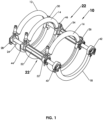
- the modular carriage assembly of the present disclosure 10 includes in one embodiment, generally, a fixed jaw 12; moveable inner jaw 14, moveable outer jaw 16, and a guide 18 preferably for each size of pipe.
- two combined hydraulic carriage cylinder/guide rod assemblies 20 and 22 may be included.
- Modular carriage 10 of the present disclosure is adaptable for varying spacing between ends of polymer (polyolefin) pipe during fusion.
- the present modular design of carriage 10 allows for many different sizes of pipe to be fused with the same fusion apparatus without the use of inserts.
- the modular carriage includes in a basic embodiment fixed jaw 12; an inner moveable jaw 14 and outer movable jaw 16; and two cylinder assemblies 20 and 22.
- the hydraulic cylinder assemblies 20 and 22 each include a guide rod 24 and 26.
- the fixed jaw is adapted for tool free engagement of first ends 25 and 27 of guide rods 24 and 26 using clamp/latch assemblies 28 and 30 (discussed further below).
- a carriage cylinder 32 and 34 is associated with each of the two guide rods 24 and 26, respectively.
- Carriage cylinders 32 and 34 are mounted for reciprocal travel along guide rod 24 and 26, respectively.
- Outer movable jaw 14 is adapted for tool free engagement with cylinders 32 and 34 for reciprocal travel therewith.
- inner moveable jaw 16 is adapted for tool free engagement with cylinders 32 and 34 for reciprocal travel therewith.
- Each moveable jaw 14 and 16 is adapted for engagement with carriage cylinders 32 and 34 for alignment and stability purposes.
- Guide rods 24 and 26 each include a longitudinal axis.
- Each associated carriage cylinder 32 and 34 also includes a longitudinal axis which is concentric with the longitudinal axis of its associated guide rod 24 and 26 (discussed further below).
- Guide rod support 18 is adapted for tool free engagement with second ends 36 and 38 of guide rods 24 and 26.
- Latching assemblies 40 and 42 are each operable to secure guide rod support 18 (and adjacent) to the second ends 36 and 38 of guide rods 24 and 26 by tool free engagement.
- Outer movable jaw 14 includes two latching assemblies 44 and 46 being operable to secure outer movable jaw 14 onto first ends 48 and 50 of carriage cylinders 32 and 34 respectively by tool free engagement.
- Inner jaw 16 includes two latching assemblies 52 and 54 operable to secure moveable inner jaw 16 onto second ends 56 and 58 of carriage cylinders 32 and 34 by tool free engagement.
- Guide rods 24 and 26 are each substantially cylindrical with an external surface and an internal surface. (Such as external surface 60 and internal surface 62 of guide rod 24 depicted in FIG. 5 ).
- a guide rod sleeve 64 and 66 is positioned at least partially over the external surface of each guide rod, 24 and 26 respectively, adjacent first ends 25 and 27.
- the fixed jaw is secured to the plurality of guide rods adjacent their first end.
- Guide rod caps 68 and 70 are in contact with (threaded into) the internal surface 62 at first ends 25 and 27.
- Fixed jaw 12 is positioned between guide rod sleeve 64 and 66 and guide rod caps 68 and 70 and secured by the latching mechanisms 28 and 30.
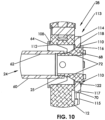
- Each guide rod sleeve such as sleeve 64 of FIG. 10 , may include a shoulder 72 for retaining the guide rod sleeve 64 adjacent the first end 25 of its respective guide rod 24.
- Carriage cylinders 32 and 34 may be hydraulically actuated for reciprocal travel on its associated guide rod 24 and 26.
- Latching mechanisms 44 and 46 secure moveable jaw 14. Movable jaw 14 is secured in a channel by the latching mechanism ( FIG. 11 ).
- the latching mechanism is a lock over (also known as a cam over) clamp 76.
- movable jaw 14 is secured to the first ends 48 and 50 of cylinders 32 and 34 by tool free engagement.
- Latching mechanisms 52 and 54 secure inner moveable jaw 16 to the ends 56 and 58 of cylinders 32 and 34.
- Moveable jaw 16 is secured in a channel in the same way as jaw 14 of FIG. 11 and described above.
- Moveable jaw 16 is secured to second ends 56 and 58 of cylinders 32 by clamps 52 and 54 respectively.
- Sleeve 72 is secured over end 25 of guide rod 24.
- Sleeve 72 includes a shoulder 75 retaining sleeve 72 from being forced over end 25.
- Sleeve 72 includes a second wall 110.
- Fixed jaw 12 is then placed over sleeve 72.
- Cap 68 is then threaded inside surface 62 of end 25.
- Cap 68 includes a first wall 110.
- Sleeve 72 and cap 68 together define a channel 112 for receiving fixed jaw 12.
- Fixed jaw 12 is in contact with second wall 108 and adapted to transfer force to second wall 108.
- First wall 110 includes a tapered surface 116 which mates the taper of tapered surface 118 of a clamping segments 114 and 117 of clamp 113.
- Latching mechanism 102 includes clamp 136 adapted to exert a clamping force upon moveable jaw 100.
- Clamp 113 includes two clamp segments 138 and 139 each having a tapered interface 140 and 142 which is adapted to wedge against a tapered interface 131 of first wall 130.
- Tapered interfaces 140 and 142 further are adapted for receiving a clamping force exerted by clamp 136 and for transferring that force against tapered interface 131 of the first wall 130.
- Clamp segments 138 and 139 are positioned between first wall 130 and moveable jaw 100 and are adapted for transferring force from clamp 136 to moveable jaw 100.
- Application of clamping force by clamp 136 on clamp segments 138 and 139 forces their respective tapered interface 140 and 142 against the mating tapered interface 131 of first wall 130. This results in a force which translates from clamp segments 138 and 139, through moveable jaw 100, and against second wall 132 thereby securing moveable jaw 100, and clamp 136 within channel 134.
- FIG. 1 An identical latching mechanism 40 ( FIG. 1 ) secures guide 18 onto second end 36 in the same manner as fixed jaw 12.
- Second guide rod caps 69 and 71, second guide rod sleeves 65 and 67, and cam over clamps 53 and 55 are depicted in FIG. 2 .
- FIG. 1 An identical latching mechanism 40 ( FIG. 1 ) secures a guide 18 onto second end 36 in the same manner as fixed jaw 12. Second guide rod caps 69 and 71, second guide rod sleeves 65 and 67, and cam over clamps 53 and 55 are depicted in FIG. 2 .
- FIG. 11 an example latching mechanism 102 for securing an example moveable jaw 100 of carriage 10 is depicted in one embodiment employing the combination hydraulic cylinder tube/guide rod 80 of the present disclosure and described below in relation to FIGs. 5-9 .
- cylinder tube 80 includes rod gland 86 onto which example moveable jaw 100 is secured.
- Rod gland 86 includes a first wall 130 and second wall 132 defining a channel 134 therebetween for receiving at least moveable jaw 100 and clamp 136 of latching mechanism 102.
- carriage cylinders 20 and 22 of the carriage of the present disclosure described above may employ a cylinder assembly which may be of a known design.
- the cylinder may be powered in any known manner, such as pneumatically, or hydraulically.
- Cylinder 80 includes in one embodiment a guide rod 82; cylinder tube 84; a rod gland 86 and 88 on each end of cylinder tube 84; and a plurality of tie rods collectively 90, extending between the rod glands 86 and 88. It should be understood that in the preferred embodiment of FIGs. 1-3 , combination hydraulic cylinder/guide rod 80 is employed as cylinders 20 and 22.
- the guide rod 82 of the present disclosure in one embodiment includes three separate (split) elements ( FIG. 5 ) that are preferably threaded together to form guide rod 82. These elements include a first guide rod segment 84, second guide rod segment 87 and a piston 88.
- This split embodiment allows for the hydraulic functions of carriage 80 to be routed through piston 88 as a manifold in order to move the associated (required) hydraulic connections away from the outside of the cylinder where they are more susceptible to damage.
- Piston 88 includes an internally ported body with machined in sealing features for proper hydraulic functions.
- Hydraulic cylinder tube 84 is preferably a composite tube for encasing the hydraulic cylinder piston/guide rod.
- Rod gland 86 and 88 on each end of cylinder tube 84 seals on the cylinder rod and cylinder tube and seals the cylinder tube.
- the rod gland also pilots on the cylinder bore to properly align the carriage jaws.
- the tie rods connect the two rod glands at the ends of the cylinder tube.
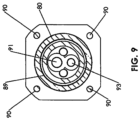
- Cylinder tube 84 is adapted for reciprocal travel along guide rod 82. As hydraulic fluid flows into an annular area defined between hydraulic cylinder tube 84 and split guide rod 82, hydraulic cylinder tube 84 and rod glands 86, 88 (with jaws attached) will reciprocate back and forth. This is accomplished because first hydraulic fluid chamber 89 (and port 91 therefor) is separated from a second hydraulic fluid chamber 92 (and port 93 therefor) via a seal 94 to separate first 89 and second 90 annular hydraulic fluid chambers of the cylinder 80.
- the combined hydraulic cylinder and guide rod 80 of the present disclosure is self-contained and when adapted for the modular carriage 10 described above with respect to FIGs. 1-3 , does not require bolts to be inserted through jaws 12, 14, and 16 as is the case with certain prior art hydraulic cylinder designs.
- the moveable jaws 14 and 16 are attached to rod glands 86 and 88, respectively, with latch mechanisms 44 and 52.
- FIG. 12 is an isometric view of the carriage assembly 10 of the present disclosure as depicted in FIG. 1 with the exception that clamps 28, 30, 40, 42, 44, 46, 52, and 54 of FIG. 1 have been replaced with a slightly modified embodiment clamps 28a, 30a, 40a, 42a, 44a, 46a, 52a, and 54a.
- new clamps 28a, (and 30a, 40a, 42a, 44a, 46a, 52a, and 54a) has been modified so as to provide a spring on the pivot end and a modified latch mechanism which does not protrude from the exterior of the clamp.
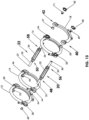
- FIG. 13 is the exploded view of FIG. 2 again modified to include modified clamps 28a, 30a, 40a, 42a, 44a, 46a, 52a, and 54a.
- FIG. 14 depicts a skid 150 configured to receive carriage assembly 10 of the present disclosure.
- Skid 150 is comprised of a substantially rectangular frame in a preferred embodiment.
- the frame includes stabilizer feet 174 and 176 separated by a plurality of longitudinal segments 162, 164, 166, and 168.
- Each of longitudinal segments 162, 164, 166, and 168 are secured to a respective foot 174 or 176 on one end and a joint, either joint 170 as in the case of longitudinal segments 162 and 166 or joint 172 as in the case of longitudinal segments 164 and 168.
- the skid 150 includes a plurality of cradles 156, 158, and 160 such that, in a preferred arrangement, cradle 156 is positioned over stabilizer foot 174 while cradle 160 is positioned over an adjacent stabilizer foot 176.
- Cradle 158 spans longitudinal segment 166 and 168 and is spaced a distance from cradle 160.
- Cradles 156, 158, and 160 are designed to receive skid interfaces 152 and 154 of FIG. 12 and 13 .
- Skid 150 is designed to pivot flat and pin rigidly with use of a plurality of detent pins, collectively 178.
- pins 178 can be removed from joints 170, 172 such that skid 150 can be folded over itself as depicted in FIGs. 15 and 16 .
- Cradles 156, 158, and 160 include a plurality of D-shaped cams, collectively 180, which are articulated through the use of respective rotation levers, collectively, 182 in order to secure carriage 10 of the present disclosure to provide a stable platform.
- FIG. 15 depicts skid 150 in a folded, shipping configuration.
- longitudinal segments 166 and 168 are pivoted over longitudinal segments 162 and 164 respectively at joints 170 and 172.
- pins 178 are removed from joints 170 and 172 and may be inserted into longitudinal segments 162, 164, 166 and 168 for safekeeping during transport.
- Longitudinal segments 166 and 168 are by design in a preferred arrangement slightly longer than longitudinal segments 162 and 164 such that when longitudinal segments 166 and 168 are folded over longitudinal segments 162 and 164 at joints 170 and 172, cradle 160 interlocks (nests) with cradle 156 and is secured therein.
- cradle 156 includes receiver segments 157, collectively, which receive pins 180 of cradle 160. Once D-shaped cams 180 are received in segments 157, levers 182 are rotated 180 degrees so as to secure and nest cradle 160 into cradle 156.
- FIG. 16 is a view of the folded cradle 150 of FIG. 15 rotated approximately 90 degrees in order to illustrate the unfolding procedure.
- rotation levers 182 are rotated 180 degrees so as to release D-shaped cams from nesting segments 157 ( FIG. 14 ).
- stabilizer foot 174, as well as longitudinal segments 166 and 167 may be rotated flat at joints 170 and 172 as depicted in FIG. 17 and arrow 186.
- detent pins 178 are once again inserted into joints 170, 172 and through respective longitudinal segments 162, 164, 166, or 168 so as to secure skid 150 in a flat or open position.
- carriage assembly 10 of the present disclosure may be secured to skid 150 by inserting skid interfaces 152 and 154 ( FIG. 12 ) into cradles 156, 158, respectively.
- Rotation levers 182 are then rotated so as to rotate D-shaped cams 180 to secure skid interface 152 with cradle 158 and skid interface 154 in cradle 156.
- a fourth jaw 190 having a skid interface 191 may be added for stability.
- Fourth jaw 190 may be inserted such that skid interface 191 is inserted into cradle 160 and secured therein via D-shaped cams 180 via rotation levers 182.
- the fourth jaw 190 may be used in conjunction with the carriage assembly 10 of the present disclosure to create a four jaw carriage which may be used when fusing pipe on the ground in a traditional manner.
- the fourth jaw 190 provides additional stability such that a four jaw skid allows a stable base that may allow more precise alignment of pipe than a three jaw configuration.
- a plurality of jaw braces 194 may bridge between fourth jaw 190 and jaw 12 and are secured as depicted in arrow 196.
- FIG. 21 is an enlarged view of fourth jaw 190 including its associated skid interface 191 positioned in cradle 160.
- FIG. 21 depicts D-shaped cam positioned in an unlocked state for insertion and removal of skid interface 191 into cradle 160.
- Rotation lever 182 is depicted to include a locking mechanism 196 to prevent unintentional unlocking.
- FIG. 22 depicts the opposite end of the assembly of FIG. 21 in a close up wherein a partial cutaway showing a cam slot 198 created in skid interface 191 into which D-shaped cam 180 is positioned.
- D-shaped cam 180 is in the unlocked position such that skid interface 191 may be lifted such that D-shaped cam is protracted out of cam slot 198.
- FIG. 23 depicts the close up view of the assembly of FIG. 21 except in a locked position such that rotation lever 182 is rotated approximately 180 degrees which in turn rotates D-shaped cam 180 within cam slot 198.
- FIG. 24 depicts the view of the assembly of FIG. 22 showing D-shaped cam 180 rotated into a locked position such that it is secured against an eccentric segment of cam slot 198. In this position, skid interface 191 cannot be pulled away from or separated from cradle 160.
- FIG. 25 is an isometric view of the carriage assembly 10 of the present disclosure in a four jaw embodiment secured to a skid 150 as fully assembled. As shown, skid 150 is in an open or flat position so as to receive skid interfaces 152, 154, and 191.
- Methods of the present invention may be implemented by performing or completing manually, automatically, or a combination thereof, selected steps or tasks.
- method may refer to manners, means, techniques and procedures for accomplishing a given task including, but not limited to, those manners, means, techniques and procedures either known to, or readily developed from known manners, means, techniques and procedures by practitioners of the art to which the invention belongs.
- the term "at least” followed by a number is used herein to denote the start of a range beginning with that number (which may be a range having an upper limit or no upper limit, depending on the variable being defined). For example, “at least 1” means 1 or more than 1.
- the term “at most” followed by a number is used herein to denote the end of a range ending with that number (which may be a range having 1 or 0 as its lower limit, or a range having no lower limit, depending upon the variable being defined). For example, “at most 4" means 4 or less than 4, and "at most 40%” means 40% or less than 40%.
- a range is given as "(a first number) to (a second number)" or "(a first number) - (a second number)"
- 25 to 100 should be interpreted to mean a range whose lower limit is 25 and whose upper limit is 100.
- every possible subrange or interval within that range is also specifically intended unless the context indicates to the contrary.
- ranges for example, if the specification indicates a range of 25 to 100 such range is also intended to include subranges such as 26-100, 27-100, etc., 25-99, 25-98, etc., as well as any other possible combination of lower and upper values within the stated range, e.g., 33-47, 60-97, 41-45, 28-96, etc.
- integer range values have been used in this paragraph for purposes of illustration only and decimal and fractional values (e.g., 46.7 - 91.3) should also be understood to be intended as possible subrange endpoints unless specifically excluded.
- the defined steps can be carried out in any order or simultaneously (except where context excludes that possibility), and the method can also include one or more other steps which are carried out before any of the defined steps, between two of the defined steps, or after all of the defined steps (except where context excludes that possibility).
- the Carriage is a fusion system that is designed to be light weight in order to easily use in tight spaces.
- This is a modular carriage for this product where the jaws are removable in order to allow the carriage to be assembled on pipe that is in place in the rafters or running up a wall.
- the Hydraulic cylinders/Guide Rods are able to be used on all sizes of the carriage system to reduce cost and increase the flexibility of the fusion system. This increased flexibility is characterized by the ability to:
- This drawing is to illustrate carriage assembly as a 3-Jaw unit (4 th Jaw to come at a later date that will include a carriage skid) and to show the components and general how the carriage assembles with the exploded view.
- This is a modular design that allows for many different sizes of pipe to be fused with the same fusion system without the use of inserts.
- This drawing illustrates the Hydraulic Cylinder/Guide Rod. Included is a Hydraulic Flow Diagram to highlight the function of the internally ported cylinder. As the hydraulic fluid flows into the annular area between the Hydraulic Cylinder Tube (Item 10) and the Split Guide Rod (Item 9b) the Hydraulic Cylinder Tube and Rod Glands (with Jaw Circles attached) will move from back and forth. This is accomplished because the port that is shown on top (arrows entering port) is separated from the port shown on bottom (arrows exiting port) via a seal to separate the left and right annular areas of the cylinder.
- the Fixed Jaw Circle and Guide Rod Support Connections are identical just on the opposite ends of the Guide Rod.
- the load path is shown above Going from the shoulder in the jaw to the Clamp Half to the Guide Rod Sleeve to the Split Guide Rod via mechanical connection to the shoulder of the Guide Rod Sleeve to the other shoulder against the opposite side of the jaw.
Landscapes
- Engineering & Computer Science (AREA)
- Mechanical Engineering (AREA)
- Physics & Mathematics (AREA)
- Fluid Mechanics (AREA)
- Lining Or Joining Of Plastics Or The Like (AREA)
- Supports For Pipes And Cables (AREA)
- Earth Drilling (AREA)
Applications Claiming Priority (4)
| Application Number | Priority Date | Filing Date | Title |
|---|---|---|---|
| US201762560666P | 2017-09-19 | 2017-09-19 | |
| US201762561008P | 2017-09-20 | 2017-09-20 | |
| PCT/US2018/051747 WO2019060412A1 (en) | 2017-09-19 | 2018-09-19 | MODULAR TROLLEY ASSEMBLY FOR FUSION OF POLYOLEFIN PIPES |
| EP18826840.3A EP3684599B1 (de) | 2017-09-19 | 2018-09-19 | Modulare wagenanordnung zum verschmelzen von polyolefinrohren |
Related Parent Applications (2)
| Application Number | Title | Priority Date | Filing Date |
|---|---|---|---|
| EP18826840.3A Division EP3684599B1 (de) | 2017-09-19 | 2018-09-19 | Modulare wagenanordnung zum verschmelzen von polyolefinrohren |
| EP18826840.3A Division-Into EP3684599B1 (de) | 2017-09-19 | 2018-09-19 | Modulare wagenanordnung zum verschmelzen von polyolefinrohren |
Publications (1)
| Publication Number | Publication Date |
|---|---|
| EP4424497A1 true EP4424497A1 (de) | 2024-09-04 |
Family
ID=64901058
Family Applications (2)
| Application Number | Title | Priority Date | Filing Date |
|---|---|---|---|
| EP24172152.1A Pending EP4424497A1 (de) | 2017-09-19 | 2018-09-19 | Modulare wagenanordnung zum verschmelzen von polyolefinrohren |
| EP18826840.3A Active EP3684599B1 (de) | 2017-09-19 | 2018-09-19 | Modulare wagenanordnung zum verschmelzen von polyolefinrohren |
Family Applications After (1)
| Application Number | Title | Priority Date | Filing Date |
|---|---|---|---|
| EP18826840.3A Active EP3684599B1 (de) | 2017-09-19 | 2018-09-19 | Modulare wagenanordnung zum verschmelzen von polyolefinrohren |
Country Status (5)
| Country | Link |
|---|---|
| US (2) | US11312088B2 (de) |
| EP (2) | EP4424497A1 (de) |
| AU (2) | AU2018337819B2 (de) |
| CA (2) | CA3156481A1 (de) |
| WO (1) | WO2019060412A1 (de) |
Families Citing this family (10)
| Publication number | Priority date | Publication date | Assignee | Title |
|---|---|---|---|---|
| US10584808B1 (en) * | 2017-04-13 | 2020-03-10 | Jared Tanner | Pipe guide |
| CN110497619A (zh) * | 2018-05-18 | 2019-11-26 | 中冶宝钢技术服务有限公司 | 塑料管热熔对接装置及其作业方法 |
| TWI689386B (zh) * | 2019-06-27 | 2020-04-01 | 和碩聯合科技股份有限公司 | 夾持裝置 |
| CN111451956B (zh) * | 2020-04-10 | 2021-09-10 | 山西远扬钢结构有限公司 | 一种管件钢结构制造加工方法 |
| CN111497268A (zh) * | 2020-04-30 | 2020-08-07 | 杨燕荷 | 一种适应多口径的热熔塑胶管道对接装置 |
| CN112606404B (zh) * | 2020-12-30 | 2022-04-05 | 辽宁希泰科技有限公司 | 一种波纹管接头的热熔焊接机 |
| CN112899814B (zh) * | 2021-02-03 | 2022-12-06 | 广西大学 | 一种仿生纤维功能材料及其制备方法和应用 |
| CN112571806B (zh) * | 2021-03-01 | 2021-05-07 | 烟台华港能源科技有限公司 | 燃气管道加工用对接固定装置 |
| CN114038662B (zh) * | 2021-11-22 | 2024-11-05 | 中国南方电网有限责任公司超高压输电公司广州局 | 换流变呼吸器更换装置 |
| US20250297449A1 (en) * | 2024-03-22 | 2025-09-25 | Federal Signal Corporation | Digging lance with adjustable vavle handle & methods |
Citations (10)
| Publication number | Priority date | Publication date | Assignee | Title |
|---|---|---|---|---|
| US3729360A (en) * | 1971-03-08 | 1973-04-24 | A Mcelroy | Portable thermoplastic pipe fusion apparatus |
| US3789493A (en) * | 1972-02-07 | 1974-02-05 | Ridge Tool Co | Hydraulic actuated fusion unit for plastic pipe |
| US4008118A (en) * | 1975-12-30 | 1977-02-15 | Emerson Electric Co. | Butt fusion machine |
| US4990209A (en) * | 1986-06-27 | 1991-02-05 | Rakes George C | Self propelled pipe fusion machine |
| US5692285A (en) * | 1995-10-31 | 1997-12-02 | Workman Developments, Inc. | Butt fusion apparatus with means for changing quickly between straight pipe and pipe fitting attachment positions, and method |
| US5743992A (en) * | 1995-10-31 | 1998-04-28 | Hughes Supply, Inc. | Butt fusion apparatus with constant pressure accumulator |
| EP0852996A2 (de) * | 1997-01-13 | 1998-07-15 | Tdw Delaware, Inc. | Stumpfschweissmachine zur Herstellung von massgenauen Rohrkrümmern aus Rohrsegmenten |
| EP0903215A1 (de) * | 1997-09-19 | 1999-03-24 | McElroy Manufacturing, Inc. | Selbständige und selbstfahrende Vorrichtung und Verfahren zum Heisssiegeln von Polyolefinrohren |
| DE102010048612A1 (de) * | 2010-10-15 | 2012-04-19 | Rothenberger Ag | Verfahren und Vorrichtung zum Verschweißen von Rohrabschnitten aus Kunststoffen zu Rohren |
| US20150075722A1 (en) * | 2013-09-17 | 2015-03-19 | Mcelroy Manufacturing, Inc. | Top-Loading Straddle-Mounted Pipe Fusion Machine |
Family Cites Families (10)
| Publication number | Priority date | Publication date | Assignee | Title |
|---|---|---|---|---|
| DE2734910B1 (de) | 1977-08-03 | 1978-09-28 | Dommer Soehne Widos | Vorrichtung zum Stumpfschweissen von thermoplastischen Kunststoffrohren |
| US4352708A (en) * | 1980-09-08 | 1982-10-05 | Mcelroy Arthur H | Defined force fusion machine for joining plastic pipe |
| ES2128792T3 (es) * | 1994-11-21 | 1999-05-16 | Omicron S R L | Dispositivo y procedimiento para la soldadura a tope de tubos de material termoplastico. |
| DE19601258A1 (de) * | 1995-01-17 | 1996-07-18 | Diebolt Int Inc | Drehzapfenbefestigung in einem Zylinder |
| US5830312A (en) * | 1995-10-31 | 1998-11-03 | Hughes Supply, Inc. | Butt fusion apparatus with clamping jaws for clamping pipe to be fused without interference between the clamps and the pipe |
| US5843271A (en) * | 1997-02-06 | 1998-12-01 | Tdw Delaware, Inc. | Plastic pipe butt fusion machine and cart assembly |
| US6550514B1 (en) * | 2000-03-29 | 2003-04-22 | Connectra Fusion Technologies, Llc | Indexer system for use with a plastic pipe butt-fusion machine |
| ITPD20070023A1 (it) * | 2007-01-29 | 2008-07-30 | Ritmo Spa | Carro per il trasporto di una saldatrice per saldatura di testa di porzioni di tubazioni |
| US9278441B2 (en) * | 2011-01-31 | 2016-03-08 | Lokring Technology, Llc | Installation tool for pipe fittings |
| US10449724B2 (en) * | 2015-07-28 | 2019-10-22 | Ahmet KOYUN | Butt welding machine with a cutter for a plastic pipe comprising a drive gear unit |
-
2018
- 2018-09-19 EP EP24172152.1A patent/EP4424497A1/de active Pending
- 2018-09-19 US US16/135,306 patent/US11312088B2/en active Active
- 2018-09-19 EP EP18826840.3A patent/EP3684599B1/de active Active
- 2018-09-19 CA CA3156481A patent/CA3156481A1/en active Pending
- 2018-09-19 CA CA3072815A patent/CA3072815C/en active Active
- 2018-09-19 WO PCT/US2018/051747 patent/WO2019060412A1/en not_active Ceased
- 2018-09-19 AU AU2018337819A patent/AU2018337819B2/en active Active
-
2022
- 2022-04-25 US US17/728,408 patent/US20220281179A1/en active Pending
-
2023
- 2023-07-12 AU AU2023204629A patent/AU2023204629A1/en not_active Abandoned
Patent Citations (10)
| Publication number | Priority date | Publication date | Assignee | Title |
|---|---|---|---|---|
| US3729360A (en) * | 1971-03-08 | 1973-04-24 | A Mcelroy | Portable thermoplastic pipe fusion apparatus |
| US3789493A (en) * | 1972-02-07 | 1974-02-05 | Ridge Tool Co | Hydraulic actuated fusion unit for plastic pipe |
| US4008118A (en) * | 1975-12-30 | 1977-02-15 | Emerson Electric Co. | Butt fusion machine |
| US4990209A (en) * | 1986-06-27 | 1991-02-05 | Rakes George C | Self propelled pipe fusion machine |
| US5692285A (en) * | 1995-10-31 | 1997-12-02 | Workman Developments, Inc. | Butt fusion apparatus with means for changing quickly between straight pipe and pipe fitting attachment positions, and method |
| US5743992A (en) * | 1995-10-31 | 1998-04-28 | Hughes Supply, Inc. | Butt fusion apparatus with constant pressure accumulator |
| EP0852996A2 (de) * | 1997-01-13 | 1998-07-15 | Tdw Delaware, Inc. | Stumpfschweissmachine zur Herstellung von massgenauen Rohrkrümmern aus Rohrsegmenten |
| EP0903215A1 (de) * | 1997-09-19 | 1999-03-24 | McElroy Manufacturing, Inc. | Selbständige und selbstfahrende Vorrichtung und Verfahren zum Heisssiegeln von Polyolefinrohren |
| DE102010048612A1 (de) * | 2010-10-15 | 2012-04-19 | Rothenberger Ag | Verfahren und Vorrichtung zum Verschweißen von Rohrabschnitten aus Kunststoffen zu Rohren |
| US20150075722A1 (en) * | 2013-09-17 | 2015-03-19 | Mcelroy Manufacturing, Inc. | Top-Loading Straddle-Mounted Pipe Fusion Machine |
Also Published As
| Publication number | Publication date |
|---|---|
| CA3072815A1 (en) | 2019-03-28 |
| AU2023204629A1 (en) | 2023-08-03 |
| US20220281179A1 (en) | 2022-09-08 |
| EP3684599B1 (de) | 2024-06-05 |
| US20190210297A1 (en) | 2019-07-11 |
| EP3684599A1 (de) | 2020-07-29 |
| WO2019060412A1 (en) | 2019-03-28 |
| AU2018337819A1 (en) | 2020-03-05 |
| CA3156481A1 (en) | 2019-03-28 |
| CA3072815C (en) | 2022-04-26 |
| US11312088B2 (en) | 2022-04-26 |
| AU2018337819B2 (en) | 2023-04-13 |
Similar Documents
| Publication | Publication Date | Title |
|---|---|---|
| EP4424497A1 (de) | Modulare wagenanordnung zum verschmelzen von polyolefinrohren | |
| US11813804B2 (en) | Assembly and method of coupling pipes | |
| US9976365B2 (en) | Apparatus to support a tubular member | |
| CN105364598B (zh) | 夹紧装置 | |
| US9132993B1 (en) | Load spreader bar pipe connecting sleeve with offset end plate | |
| US12103247B2 (en) | Assembly and method of coupling pipes | |
| US8702349B2 (en) | Pipe bursting apparatus | |
| CA2869062A1 (en) | Load spreader bar system | |
| AU2022211799B2 (en) | Subsea horizontal connection arrangement | |
| FR3020654A1 (fr) | Troncon de colonne montante equipee d'une bague de verrouillage interne et d'un moyen de reglage de jeu entre les elements de tube auxiliaire et les elements de tube principal. | |
| WO2017040441A1 (en) | Tubing system having alternate path | |
| US10760723B2 (en) | Fluid system connection nozzle assembly | |
| CN215715176U (zh) | 一种新型探杆夹持器 | |
| NO319487B1 (no) | Apparat for a holde to rorstrenger | |
| JP2824033B2 (ja) | マスト機構 | |
| NO333634B1 (no) | Rørkonnektor for frigjørbar kobling av to konnektordeler i forbindelse med gasstett kopling av stigerør til fartøy | |
| WO2023082460A1 (zh) | 管汇橇的连接装置、压裂系统及其操作方法 | |
| US20220003646A1 (en) | Connection test apparatus | |
| US20230002200A1 (en) | Spreader Structures for Lifting Loads | |
| US20150136417A1 (en) | Method for handling tubulars and rigidizer therefor | |
| CN207795495U (zh) | 钻井泥浆泵活塞密封橡胶的更换装置 | |
| CN205869284U (zh) | 一种可张开式便携缩管机头 | |
| CN113829258A (zh) | 一种液压卡管设备 | |
| NO20220641A1 (en) | A clamp and a method of clamping a pair of flanges | |
| NO159555B (no) | Innretning for kopling av undervanns-ledninger. |
Legal Events
| Date | Code | Title | Description |
|---|---|---|---|
| PUAI | Public reference made under article 153(3) epc to a published international application that has entered the european phase |
Free format text: ORIGINAL CODE: 0009012 |
|
| STAA | Information on the status of an ep patent application or granted ep patent |
Free format text: STATUS: REQUEST FOR EXAMINATION WAS MADE |
|
| 17P | Request for examination filed |
Effective date: 20240424 |
|
| AC | Divisional application: reference to earlier application |
Ref document number: 3684599 Country of ref document: EP Kind code of ref document: P |
|
| AK | Designated contracting states |
Kind code of ref document: A1 Designated state(s): AL AT BE BG CH CY CZ DE DK EE ES FI FR GB GR HR HU IE IS IT LI LT LU LV MC MK MT NL NO PL PT RO RS SE SI SK SM TR |
|
| STAA | Information on the status of an ep patent application or granted ep patent |
Free format text: STATUS: EXAMINATION IS IN PROGRESS |