EP4424729A1 - Vernetztes polymer aus einer alpha,beta-ungesättigten carbonsäureverbindung und anwendung davon - Google Patents
Vernetztes polymer aus einer alpha,beta-ungesättigten carbonsäureverbindung und anwendung davon Download PDFInfo
- Publication number
- EP4424729A1 EP4424729A1 EP22887043.2A EP22887043A EP4424729A1 EP 4424729 A1 EP4424729 A1 EP 4424729A1 EP 22887043 A EP22887043 A EP 22887043A EP 4424729 A1 EP4424729 A1 EP 4424729A1
- Authority
- EP
- European Patent Office
- Prior art keywords
- crosslinked polymer
- mass
- particle size
- carboxylic acid
- unsaturated carboxylic
- Prior art date
- Legal status (The legal status is an assumption and is not a legal conclusion. Google has not performed a legal analysis and makes no representation as to the accuracy of the status listed.)
- Pending
Links
Images
Classifications
-
- C—CHEMISTRY; METALLURGY
- C08—ORGANIC MACROMOLECULAR COMPOUNDS; THEIR PREPARATION OR CHEMICAL WORKING-UP; COMPOSITIONS BASED THEREON
- C08F—MACROMOLECULAR COMPOUNDS OBTAINED BY REACTIONS ONLY INVOLVING CARBON-TO-CARBON UNSATURATED BONDS
- C08F220/00—Copolymers of compounds having one or more unsaturated aliphatic radicals, each having only one carbon-to-carbon double bond, and only one being terminated by only one carboxyl radical or a salt, anhydride ester, amide, imide or nitrile thereof
- C08F220/02—Monocarboxylic acids having less than ten carbon atoms; Derivatives thereof
- C08F220/04—Acids; Metal salts or ammonium salts thereof
- C08F220/06—Acrylic acid; Methacrylic acid; Metal salts or ammonium salts thereof
-
- A—HUMAN NECESSITIES
- A61—MEDICAL OR VETERINARY SCIENCE; HYGIENE
- A61K—PREPARATIONS FOR MEDICAL, DENTAL OR TOILETRY PURPOSES
- A61K8/00—Cosmetics or similar toiletry preparations
- A61K8/18—Cosmetics or similar toiletry preparations characterised by the composition
- A61K8/72—Cosmetics or similar toiletry preparations characterised by the composition containing organic macromolecular compounds
- A61K8/81—Cosmetics or similar toiletry preparations characterised by the composition containing organic macromolecular compounds obtained by reactions involving only carbon-to-carbon unsaturated bonds
- A61K8/8141—Compositions of homopolymers or copolymers of compounds having one or more unsaturated aliphatic radicals, each having only one carbon-to-carbon double bond, and at least one being terminated by only one carboxyl radical, or of salts, anhydrides, esters, amides, imides or nitriles thereof; Compositions of derivatives of such polymers
- A61K8/8147—Homopolymers or copolymers of acids; Metal or ammonium salts thereof, e.g. crotonic acid, (meth)acrylic acid; Compositions of derivatives of such polymers
-
- A—HUMAN NECESSITIES
- A61—MEDICAL OR VETERINARY SCIENCE; HYGIENE
- A61Q—SPECIFIC USE OF COSMETICS OR SIMILAR TOILETRY PREPARATIONS
- A61Q19/00—Preparations for care of the skin
-
- C—CHEMISTRY; METALLURGY
- C08—ORGANIC MACROMOLECULAR COMPOUNDS; THEIR PREPARATION OR CHEMICAL WORKING-UP; COMPOSITIONS BASED THEREON
- C08F—MACROMOLECULAR COMPOUNDS OBTAINED BY REACTIONS ONLY INVOLVING CARBON-TO-CARBON UNSATURATED BONDS
- C08F2/00—Processes of polymerisation
- C08F2/04—Polymerisation in solution
- C08F2/06—Organic solvent
-
- A—HUMAN NECESSITIES
- A61—MEDICAL OR VETERINARY SCIENCE; HYGIENE
- A61K—PREPARATIONS FOR MEDICAL, DENTAL OR TOILETRY PURPOSES
- A61K2800/00—Properties of cosmetic compositions or active ingredients thereof or formulation aids used therein and process related aspects
- A61K2800/10—General cosmetic use
-
- A—HUMAN NECESSITIES
- A61—MEDICAL OR VETERINARY SCIENCE; HYGIENE
- A61K—PREPARATIONS FOR MEDICAL, DENTAL OR TOILETRY PURPOSES
- A61K2800/00—Properties of cosmetic compositions or active ingredients thereof or formulation aids used therein and process related aspects
- A61K2800/40—Chemical, physico-chemical or functional or structural properties of particular ingredients
- A61K2800/48—Thickener, Thickening system
-
- C—CHEMISTRY; METALLURGY
- C08—ORGANIC MACROMOLECULAR COMPOUNDS; THEIR PREPARATION OR CHEMICAL WORKING-UP; COMPOSITIONS BASED THEREON
- C08F—MACROMOLECULAR COMPOUNDS OBTAINED BY REACTIONS ONLY INVOLVING CARBON-TO-CARBON UNSATURATED BONDS
- C08F2/00—Processes of polymerisation
- C08F2/12—Polymerisation in non-solvents
- C08F2/14—Organic medium
-
- C—CHEMISTRY; METALLURGY
- C08—ORGANIC MACROMOLECULAR COMPOUNDS; THEIR PREPARATION OR CHEMICAL WORKING-UP; COMPOSITIONS BASED THEREON
- C08F—MACROMOLECULAR COMPOUNDS OBTAINED BY REACTIONS ONLY INVOLVING CARBON-TO-CARBON UNSATURATED BONDS
- C08F222/00—Copolymers of compounds having one or more unsaturated aliphatic radicals, each having only one carbon-to-carbon double bond, and at least one being terminated by a carboxyl radical and containing at least one other carboxyl radical in the molecule; Salts, anhydrides, esters, amides, imides, or nitriles thereof
- C08F222/02—Acids; Metal salts or ammonium salts thereof, e.g. maleic acid or itaconic acid
-
- C—CHEMISTRY; METALLURGY
- C08—ORGANIC MACROMOLECULAR COMPOUNDS; THEIR PREPARATION OR CHEMICAL WORKING-UP; COMPOSITIONS BASED THEREON
- C08F—MACROMOLECULAR COMPOUNDS OBTAINED BY REACTIONS ONLY INVOLVING CARBON-TO-CARBON UNSATURATED BONDS
- C08F2400/00—Characteristics for processes of polymerization
- C08F2400/02—Control or adjustment of polymerization parameters
Definitions
- the present disclosure relates to a specific crosslinked polymer of an ⁇ , ⁇ -unsaturated carboxylic acid compound and the use of the crosslinked polymer.
- Polymers of a water-soluble ethylenically unsaturated monomer are used as hydrophilic thickeners.
- such polymers are preferably used in improving the viscosity of external preparation compositions in the pharmaceutical and cosmetic fields.
- a crosslinked polymer of an ⁇ , ⁇ -unsaturated carboxylic acid compound i.e., a polymer of an ⁇ , ⁇ -unsaturated carboxylic acid compound crosslinked by a crosslinking agent
- BG 1,3-butylene glycol
- the inventors also found that the properties of a crosslinked polymer of an ⁇ , ⁇ -unsaturated carboxylic acid compound as a thickener could possibly be examined by measuring parameter R using a BG dispersion of the crosslinked polymer of an ⁇ , ⁇ -unsaturated carboxylic acid compound and a neutralized aqueous solution of the crosslinked polymer of an ⁇ , ⁇ -unsaturated carboxylic acid compound.
- parameter R within a specific range in order to solve the problem and further found that a crosslinked polymer of an ⁇ , ⁇ -unsaturated carboxylic acid compound that satisfies parameter R within the specific range can be prepared by precipitation polymerization at lower temperatures than before.
- the inventors made further improvements on the basis of the findings.
- a crosslinked polymer of an ⁇ , ⁇ -unsaturated carboxylic acid compound that can be used in preparing an external composition that is less sticky and gives a refreshing sensation and lightness in use, while also achieving an excellent moist texture and ease of blending into the skin (ease of spreading) in use.
- the crosslinked polymer is particularly suitable for cosmetic compositions and external pharmaceutical compositions among external compositions.
- Viscous compositions containing a crosslinked polymer of an ⁇ , ⁇ -unsaturated carboxylic acid compound may also contain other organic compounds. From a safety perspective, it is not desirable for the compositions to contain such organic compounds.
- the crosslinked polymer of an ⁇ , ⁇ -unsaturated carboxylic acid compound provided by the present disclosure can be used together with water, butylene glycol, or other safe ingredients to prepare a composition that exhibits suitable viscosity. Thus, the resulting external composition is safer and more desirable in this respect as well.
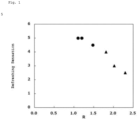
- Fig. 1 is a graph showing the relation between value R and refreshing sensation.
- the disclosure preferably encompasses, but is not limited to, a crosslinked polymer of an ⁇ , ⁇ -unsaturated carboxylic acid compound (i.e., a polymer of an ⁇ , ⁇ -unsaturated carboxylic acid compound crosslinked by a crosslinking agent), a production method for the crosslinked polymer, use of the crosslinked polymer, an external composition containing the crosslinked polymer, etc.
- a crosslinked polymer of an ⁇ , ⁇ -unsaturated carboxylic acid compound i.e., a polymer of an ⁇ , ⁇ -unsaturated carboxylic acid compound crosslinked by a crosslinking agent
- a production method for the crosslinked polymer i.e., a polymer of an ⁇ , ⁇ -unsaturated carboxylic acid compound crosslinked by a crosslinking agent
- a production method for the crosslinked polymer i.e., use of the crosslinked polymer, an external composition containing the crosslinked polymer, etc.
- the crosslinked polymer of an ⁇ , ⁇ -unsaturated carboxylic acid compound (i.e., a polymer of an ⁇ , ⁇ -unsaturated carboxylic acid compound crosslinked by a crosslinking agent, which may sometimes be referred to as a "crosslinked ⁇ , ⁇ -unsaturated carboxylic acid compound polymer") included in the present disclosure shows specific parameter R, within the range of 1.0 to 1.6, as measured using a BG dispersion of the crosslinked polymer and a neutralized aqueous solution of the crosslinked polymer.
- the crosslinked polymer may sometimes be referred to as "the crosslinked polymer of the present disclosure.”
- the crosslinked polymer of the present disclosure is a polymer formed from an ⁇ , ⁇ -unsaturated carboxylic acid compound, as described above, and is crosslinked by a crosslinking agent.
- the crosslinked polymer is typically used as a hydrophilic thickener in the form of polymer particles. Adding these polymer particles to water or an aqueous solution containing water allows a particulate swollen gel to form, and neutralization causes the aqueous solution to thicken.
- a hydrophilic thickener containing the crosslinked polymer of the present disclosure may sometimes be referred to as "the thickener of the present disclosure.”
- Examples of ⁇ , ⁇ -unsaturated carboxylic acid compounds include acrylic acid, methacrylic acid, crotonic acid, maleic acid, fumaric acid, itaconic acid, and salts thereof.
- Examples of the salts include sodium salts and potassium salts. Of these, (meth)acrylic acid (i.e., methacrylic acid and/or acrylic acid) and salts thereof are more preferred.
- These ⁇ , ⁇ -unsaturated carboxylic acid compounds may be used alone or in a combination of two or more.
- the crosslinking agent is preferably a compound having two or more ethylenically unsaturated groups. More specifically, examples of crosslinking agents include acrylic acid esters with two or more substitutions of a polyol, such as ethylene glycol, diethylene glycol, propylene glycol, polyoxyethylene glycol, polyoxypropylene glycol, glycerin, polyglycerin, trimethylolpropane, pentaerythritol, saccharose, and sorbitol; methacrylic acid esters with two or more substitutions of these polyols; allyl ethers with two or more substitutions of these polyols; diallyl phthalate, triallyl phosphate, allyl methacrylate, tetraallyloxyethane, triallyl cyanurate, divinyl adipate, vinyl crotonate, 1,5-hexadiene, divinylbenzene, etc.
- a polyol such as ethylene glycol, di
- pentaerythritol triallyl ether pentaerythritol tetraallyl ether, diethylene glycol diallyl ether, and polyarylsaccharose are more preferred.
- These crosslinking agents may be used alone or in a combination of two or more.
- the crosslinked polymer of the present disclosure is preferably a polymer comprising about 0.15 to 2 parts by mass of the crosslinking agent per 100 parts by mass of the ⁇ , ⁇ -unsaturated carboxylic acid compound.
- the upper or lower limit of the range (0.15 to 2 parts by mass) may be 0.2, 0.3, 0.4, 0.5, 0.6, 0.7, 0.8, 0.9, 1, 1.1, 1.2, 1.3, 1.4, 1.5, 1.6, 1.7, 1.8, or 1.9 parts by mass.
- the range may be, for example, 0.4 to 1.5 parts by mass.
- the specific parameter R of the crosslinked polymer of an ⁇ , ⁇ -crosslinked unsaturated carboxylic acid compound is measured by using a BG dispersion of the crosslinked polymer and a neutralized aqueous solution of the crosslinked polymer.
- the crosslinked polymer of the present disclosure has a parameter R of 1.0 to 1.6.
- the upper or lower limit of the range may be, for example, 1.05, 1.1, 1.15, 1.2, 1.25, 1.3, 1.35, 1.4, 1.45, 1.5, or 1.55.
- the range may be, for example, 1.05 to 1.55.
- Intrinsic viscosity [ ⁇ ] and interaction coefficient k of the crosslinked polymer solution are more specifically determined as follows. Specifically, flow time (t) of the solution and flow time (t 0 ) of the solvent alone are measured with an Ubbelohde dilution viscometer in accordance with JIS K-7367-1, and ⁇ sp is determined according to the following relational expression. ⁇ sp is a specific viscosity (indicating the rate of increase in viscosity caused by a solute in a solvent).
- S1 satisfies the range of values for parameter R above and is preferably about 2.5 to 3.2.
- the upper or lower limit of the range may be, for example, 2.55, 2.6, 2.65, 2.7, 2.75, 2.8, 2.85, 2.9, 2.95, 3, 3.05, 3.1, or 3.15.
- the range may be, for example, 2.55 to 3.15.
- K[ ⁇ ] BG satisfies the range of values for S1 above and is preferably about 1.5 to 2.3.
- the upper or lower limit of the range may be, for example, 1.55, 1.6, 1.65, 1.7, 1.75, 1.8, 1.85, 1.9, 1.95, 2, 2.05, 2.1, 2.15, 2.2, or 2.25.
- the range may be, for example, 1.55 to 2.25.
- K[ ⁇ ] aq satisfies the range of values for S1 above and is preferably about 35 to 55.
- the upper or lower limit of the range may be, for example, 36, 37, 38, 39, 40, 41, 42, 43, 44, 45, 46, 47, 48, 49, 50, 51, 52, 53, or 54.
- the range may be, for example, 36 to 54.
- the volume average particle size is determined according to laser diffractometry.
- the volume average particle size can be determined with a laser diffraction particle size distribution analyzer (Shimadzu Corporation, model: SALD-2300).
- S2 satisfies the range of values for parameter R and is preferably about 2 to 2.5.
- the upper or lower limit of the range may be, for example, 2.05, 2.1, 2.15, 2.2, 2.25, 2.3, 2.35, 2.4, or 2.45.
- the range may be, for example, 2.05 to 2.45.
- a 0.5 mass% neutralized aqueous solution of the crosslinked polymer of the present disclosure at 25°C preferably has a yield stress of 20 Pa or lower, and preferably 1 to 20 Pa.
- the upper or lower limit of the range may be, for example, 2, 3, 4, 5, 6, 7, 8, 9, 10, 11, 12, 13, 14, 15, 16, 17, 18, or 19 Pa.
- the range may be 5 to 19 Pa.
- the yield stress is measured with a rheometer.
- the yield stress is measured by using a dynamic viscoelasticity analyzer (AR-2000ex from TA Instruments Japan) with a 60-mm (diameter), 4-degree cone. More specifically, the steady-state flow viscosity at a shear stress of 1.0 ⁇ 10 -5 to 1.0 ⁇ 10 3 (Pa) is measured under steady-state conditions that satisfy the following three items: (1) percentage tolerance 1.0, (2) consecutive within tolerance 3, and (3) maximum point time 10 min. The point at which the strain changes abruptly with respect to shear stress is determined to be the yield value (yield stress, Pa).
- the neutralized aqueous solution of the crosslinked polymer used for the measurement is a 0.5 mass% neutralized aqueous solution of the polymer, as described above.
- the neutralized aqueous solution of the crosslinked polymer is prepared as follows. 288.8 g of ion-exchanged water is placed in a 500-mL beaker, and 1.5 g of a crosslinked polymer of an ⁇ , ⁇ -unsaturated carboxylic acid compound is gradually added with stirring at 1500 rpm with a dispersion mixer.
- the dispersion mixer is turned off, and 9.7 g of a 6 mass% aqueous sodium hydroxide solution is added and stirred with a handheld mixer for 30 seconds to obtain a 0.5 mass% neutralized aqueous solution of the crosslinked polymer.
- aqueous solution with a pH of 7 (measured with a pH meter at 25°C) is designated as a neutralized aqueous solution.
- a pH adjuster can be used for neutralization; for example, sodium hydroxide is suitable as described above. The same applies below.
- the crosslinked polymer of the present disclosure can be obtained by reacting an ⁇ , ⁇ -unsaturated carboxylic acid compound with a crosslinking agent in an inert solvent at a specific temperature in the presence of a radical polymerization catalyst.
- the amount of the ⁇ , ⁇ -unsaturated carboxylic acid compound is, for example, preferably 6 to 25 parts by volume, more preferably 8 to 22 parts by volume, and still more preferably 13 to 20 parts by volume, per 100 parts by volume of the inert solvent.
- radical polymerization catalysts include, but are not particularly limited to, azobisisobutyronitrile, 2,2'-azobis-2,4-dimethylvaleronitrile, dimethyl-2,2'-azobisisobutyrate, benzoyl peroxide, lauroyl peroxide, cumene hydroperoxide, and tert-butyl hydroperoxide. These radical polymerization catalysts may be used alone or in a combination of two or more. In particular, 2,2'-azobis-2,4-dimethylvaleronitrile is preferably used from the viewpoint of its suitably exhibited catalytic activity at a reaction temperature.
- the amount of the radical polymerization catalyst is, for example, preferably about 0.01 to 0.45 parts by mass, and more preferably about 0.01 to 0.35 parts by mass, per 100 parts by mass of the ⁇ , ⁇ -unsaturated carboxylic acid compound.
- the inert solvent is a solvent that dissolves an ⁇ , ⁇ -unsaturated carboxylic acid compound and a crosslinking agent, but does not dissolve the resulting crosslinked polymer of the ⁇ , ⁇ -unsaturated carboxylic acid compound.
- examples of such solvents include n-pentane, n-hexane, isohexane, n-heptane, n-octane, isooctane, cyclopentane, methylcyclopentane, cyclohexane, methylcyclohexane, benzene, toluene, xylene, chlorobenzene, ethylene dichloride, ethyl acetate, isopropyl acetate, methyl ethyl ketone, and methyl isobutyl ketone. These may be used alone or in a combination of two or more. In particular, n-hexane is preferred from the viewpoint of its suitably
- the atmosphere for the reaction is, for example, preferably an inert gas atmosphere such as nitrogen gas or an argon gas.
- the reaction is performed at relatively lower temperatures than in conventional methods.
- the reaction performed at relatively lower temperatures than in conventional methods preferably gives the crosslinked polymer of the present disclosure with parameter R within the range of 1.0 to 1.6.
- the reaction is preferably performed at about 40 to 48°C.
- the upper or lower limit of the temperature range may be, for example, 41, 42, 43, 44, 45, 46, or 47°C.
- the temperature range may be 43 to 47°C.
- the reaction time can be set as appropriate, preferably to about 2 to 10 hours, and more preferably about 3 to 7 hours.
- Polymerization can preferably be performed, for example, by precipitation polymerization.
- reaction solution can be heated to, for example, about 80 to 130°C to volatilize and remove the inert solvent. This gives a white fine powder of a crosslinked carboxyl group-containing polymer.
- the crosslinked polymer of the present disclosure can preferably be used as a thickener (in particular, a hydrophilic thickener).
- the present disclosure also preferably encompasses thickeners containing the crosslinked polymer of the present disclosure.
- such thickeners can preferably be used for preparing an external composition.
- Preferred examples of external compositions include pharmaceutical compositions and cosmetic compositions.
- the present disclosure also preferably encompasses external compositions containing the crosslinked polymer of the present disclosure. Such external compositions may sometimes be referred to as "the external composition of the present disclosure.”
- the content of the crosslinked polymer of the present disclosure in the external composition of the present disclosure is preferably 1.0 mass% or lower, and more preferably 0.9, 0.8, 0.7, 0.6, or 0.5 mass% or lower.
- the lower limit of the content is, for example, but is not particularly limited to, 0.01 mass% or 0.05 mass%.
- a 500-mL round separable flask was prepared as a reaction vessel, and 35 g (33 mL) of acrylic acid and 0.35 g of 2,2'-azobis(2,4-dimethylvaleronitrile) were placed in the flask. Further, a solution of 0.24 g of pentaerythritol tetraallyl ether in 248 g (366 mL) of n-hexane was added gently.
- the separable flask containing the solution was fixed to a four-necked separable cover equipped with a stirrer, a thermometer, a glass tube for nitrogen feeding, and a cooling tube.
- An agitator was equipped with four inclined paddle blades and an anchor-shaped agitator blade, and the inclined paddle blades were a combination of blades with different lengths.
- the generated white slurry was heated to 95 to 105°C to remove n-hexane, and then dried under reduced pressure at 120°C at 4 to 5 mmHg for 8 hours, thereby obtaining 33 g of a white fine powder of a crosslinked polymer of an ⁇ , ⁇ -unsaturated carboxylic acid compound.
- Example 1 The operation of the production method of Example 1 was performed in the same manner, except that 45 g (43 mL) of acrylic acid, 0.45 g of 2,2'azobis(2,4-dimethylvaleronitrile), and 0.25 g of pentaerythritol tetraallyl ether were used, thereby obtaining 43 g of a white fine powder of a crosslinked polymer of an ⁇ , ⁇ -unsaturated carboxylic acid compound.
- Example 1 The operation of the production method of Example 1 was performed in the same manner, except that 57 g (55 mL) of acrylic acid, 0.46 g of 2,2'-azobis(2,4-dimethylvaleronitrile), and 0.48 g of pentaerythritol tetraallyl ether were used, thereby obtaining 50 g of a white fine powder of a crosslinked polymer of an ⁇ , ⁇ -unsaturated carboxylic acid compound.
- 63 g (60 mL) of acrylic acid, 0.44 g of pentaerythritol tetraallyl ether, 0.016 g of azobisisobutyronitrile, and 375 g (300 mL) of ethylene dichloride were placed in a 500-mL four-necked flask equipped with a stirrer, a thermometer, a nitrogen-feeding tube, and a cooling tube. Subsequently, the mixture was uniformly stirred and mixed, and then nitrogen gas was blown into the solution to remove oxygen present in the upper space of the reaction vessel, in the starting materials, and in the solvent. The mixture was then allowed to react for 3 hours while being kept at 70 to 75°C in a nitrogen atmosphere. After the reaction was complete, the generated slurry was heated to 110°C to distill ethylene dichloride, thereby obtaining 63 g of a white fine powder of a crosslinked polymer of an ⁇ , ⁇ -unsaturated carboxylic acid compound.
- Comparative Example 1 The operation of the production method of Comparative Example 1 was performed in the same manner, except that 44 g (42 mL) of acrylic acid, 0.22 g of lauroyl peroxide, and 0.31 g of pentaerythritol triallyl ether were used, and the reaction time was 6 hours, thereby obtaining 40 g of a white fine powder of a crosslinked polymer of an ⁇ , ⁇ -unsaturated carboxylic acid compound.
- Comparative Example 1 The operation of the production method of Comparative Example 1 was performed in the same manner, except that 44 g (42 mL) of acrylic acid, 0.18 g of lauroyl peroxide, and 0.22 g of pentaerythritol triallyl ether were used, and the reaction time was 6 hours, thereby obtaining 41 g of a white fine powder of a crosslinked polymer of an ⁇ , ⁇ -unsaturated carboxylic acid compound.
- a 0.3 mass% solution of the crosslinked polymer particles of an ⁇ , ⁇ -unsaturated carboxylic acid compound obtained in the individual Examples in 1,3-butylene glycol (1 mM lithium chloride) was prepared. More specifically, 297 g of 1,3-butylene glycol was placed in a 500-mL beaker. With stirring at 1500 rpm with a dispersion mixer, 3.0 g of crosslinked polymer particles of an ⁇ , ⁇ -unsaturated carboxylic acid compound were gradually added, and the mixture was further stirred for 30 minutes, followed by stirring the mixture in a water bath at 60 to 80°C for 24 hours.
- the obtained 0.3 mass% BG solution of the polymer was measured for flow time at 30.0 ⁇ 0.01°C with an Ubbelohde dilution viscometer.
- the Ubbelohde dilution viscometer for use was one with a flow time of 100 to 200 seconds during solvent measurement in accordance with JIS K-7367-1 (Asahi Glassplant Inc. 2B (Cat. No. 4804-09)).
- the measurement method was performed in accordance with JIS K-7367-1. More specifically, the flow time of the 0.3 mass% solution was first measured, and then a predetermined amount of a solvent was further added to dilute the 0.3 mass% solution, followed by measuring the flow time.
- ⁇ sp is a specific viscosity (indicating the rate of increase in viscosity caused by a solute in a solvent).
- the intrinsic viscosity of the BG solution of the polymer may be denoted as [ ⁇ ] BG
- the interaction coefficient may be denoted as k BG
- the product of these may be denoted as k[ ⁇ ] BG
- the intrinsic viscosity of the neutralized aqueous solution of the polymer may be denoted as [ ⁇ ] aq
- the interaction coefficient may be denoted as k aq
- the product of these may be denoted as k[ ⁇ ] aq .
- a 0.015 mass% neutralized aqueous solution of crosslinked polymer particles of an ⁇ , ⁇ -unsaturated carboxylic acid compound was also prepared. More specifically, 288.8 g of ion-exchanged water was placed in a 500-mL beaker, and 1.5 g of crosslinked carboxyl group-containing polymer particles were gradually added with stirring at 1500 rpm with a dispersion mixer. After subsequent stirring for 30 minutes, the dispersion mixer was turned off, and 9.7 g of a 6 mass% aqueous sodium hydroxide solution was added, followed by stirring the mixture for 30 seconds with a handheld mixer, thereby obtaining a 0.5 mass% neutralized aqueous solution of crosslinked carboxyl group-containing polymer particles.
- the neutralized aqueous solution was then further diluted with ion-exchanged water to 0.015 mass%.
- the 0.015 mass% neutralized aqueous solution was measured with an Ubbelohde dilution viscometer at 25.0 ⁇ 0.01°C.
- the solution was successively diluted in the same manner as above and measured in the same manner.
- the results of measurement with the Ubbelohde dilution viscometer were plotted to determine the value of k[ ⁇ ] aq according to the Martin's equation.
- K[ ⁇ ] is considered to be an index reflecting the spread of crosslinked carboxyl group-containing polymer particles in each solution. If k[ ⁇ ] is small, the spread in a solution is small, whereas if k[ ⁇ ] is large, the spread in a solution is large.
- S1 which is the ratio of the spread in the BG solution to the spread in the neutralized aqueous system, can be considered to be the index of spread of the polymer particles in a solution.
- Crosslinked polymer particles of an ⁇ , ⁇ -unsaturated carboxylic acid compound were prepared into a 0.1 mass% neutralized aqueous solution and a 0.3 mass% 1,3-butylene glycol solution.
- the particle size distribution and volume average particle size (median diameter) of the polymer particles in each of these solutions were measured with a laser diffraction particle size distribution analyzer (Shimadzu Corporation, model: SALD-2300).
- the ratio of the volume average particle size in the neutralized aqueous solution to the volume average particle size in the 1,3-butylene glycol solution was determined to be S2.
- the viscosity of a 0.5 mass% neutralized aqueous solution of crosslinked polymer particles of an ⁇ , ⁇ -unsaturated carboxylic acid compound was measured with a dynamic viscoelasticity analyzer (rheometer: AR-2000ex from TA Instruments).
- the steady-state flow viscosity at a shear stress of 1.0 ⁇ 10 -5 to 1.0 ⁇ 10 3 (Pa) was measured by using a 60-mm (diameter), 4-degree cone with the temperature set to 25°C under steady-state conditions that satisfied the following three items: (1) percentage tolerance 1.0, (2) consecutive within tolerance 3, and (3) maximum point time 10 min.
- the point at which the strain changed abruptly with respect to shear stress was determined to be the yield value (yield stress, Pa).
- the resulting neutralized aqueous solutions were evaluated for texture.
- Table 2 shows the results of texture evaluation.
- Table 1 1,3-Butylene Glycol Solution Neutralized Aqueous Solution Ubbelohde Dilution Viscometer SALD-2300 Rheometer Ubbelohde Dilution Viscometer SALD-2300 [ ⁇ ] BG k[ ⁇ ] BG Average Particle Size ( ⁇ m) Yield Value (Pa) [ ⁇ ] aq k[ ⁇ ] aq Average Particle Size ( ⁇ m) S1 S2 R
- Example 1 1.5 2.1 8.3 13 30.7 37.6 19.6 2.60 2.36 1.10
- Example 2 1.5 1.9 9.5 12 25.5 40.9 22.0 2.78 2.32 1.20
- Example 3 1.5 1.7 19.0 17 25.7 53.4 40.7 3.16 2.14 1.47
- Fig. 1 is a graph showing the relation between value R and refreshing sensation. In Fig. 1 , "•” indicates the results of the Examples, whereas “ ⁇ ” indicates the results of the Comparative Examples.
Landscapes
- Health & Medical Sciences (AREA)
- Chemical & Material Sciences (AREA)
- Life Sciences & Earth Sciences (AREA)
- Polymers & Plastics (AREA)
- Animal Behavior & Ethology (AREA)
- General Health & Medical Sciences (AREA)
- Public Health (AREA)
- Veterinary Medicine (AREA)
- Chemical Kinetics & Catalysis (AREA)
- Medicinal Chemistry (AREA)
- Organic Chemistry (AREA)
- Dermatology (AREA)
- Epidemiology (AREA)
- Birds (AREA)
- Cosmetics (AREA)
- Addition Polymer Or Copolymer, Post-Treatments, Or Chemical Modifications (AREA)
Applications Claiming Priority (2)
| Application Number | Priority Date | Filing Date | Title |
|---|---|---|---|
| JP2021175458 | 2021-10-27 | ||
| PCT/JP2022/039822 WO2023074718A1 (ja) | 2021-10-27 | 2022-10-26 | α,β-不飽和カルボン酸化合物の架橋重合体及びその用途 |
Publications (2)
| Publication Number | Publication Date |
|---|---|
| EP4424729A1 true EP4424729A1 (de) | 2024-09-04 |
| EP4424729A4 EP4424729A4 (de) | 2025-11-26 |
Family
ID=86157950
Family Applications (1)
| Application Number | Title | Priority Date | Filing Date |
|---|---|---|---|
| EP22887043.2A Pending EP4424729A4 (de) | 2021-10-27 | 2022-10-26 | Vernetztes polymer aus einer alpha,beta-ungesättigten carbonsäureverbindung und anwendung davon |
Country Status (2)
| Country | Link |
|---|---|
| EP (1) | EP4424729A4 (de) |
| WO (1) | WO2023074718A1 (de) |
Family Cites Families (8)
| Publication number | Priority date | Publication date | Assignee | Title |
|---|---|---|---|---|
| JPH0222312A (ja) * | 1988-05-26 | 1990-01-25 | Sumitomo Seika Chem Co Ltd | 架橋型カルボキシル基含有重合体の製造方法 |
| JP4883844B2 (ja) * | 2001-04-05 | 2012-02-22 | 住友精化株式会社 | カルボキシル基含有重合体粒子 |
| JP4261307B2 (ja) * | 2003-10-14 | 2009-04-30 | 住友精化株式会社 | カルボキシル基含有水溶性重合体の製造方法 |
| JP4630101B2 (ja) | 2005-03-30 | 2011-02-09 | 株式会社ナリス化粧品 | ジェル状組成物 |
| JP5943798B2 (ja) | 2012-09-27 | 2016-07-05 | 株式会社マンダム | 皮膚外用剤組成物 |
| JP6182975B2 (ja) | 2013-05-21 | 2017-08-23 | 日油株式会社 | ジェル状皮膚化粧料 |
| CN112041390A (zh) * | 2018-06-20 | 2020-12-04 | 住友精化株式会社 | 含有漂白剂成分的组合物及其制造方法 |
| KR20210136015A (ko) * | 2019-03-01 | 2021-11-16 | 스미토모 세이카 가부시키가이샤 | 폴리머 수분산 조성물 |
-
2022
- 2022-10-26 EP EP22887043.2A patent/EP4424729A4/de active Pending
- 2022-10-26 WO PCT/JP2022/039822 patent/WO2023074718A1/ja not_active Ceased
Also Published As
| Publication number | Publication date |
|---|---|
| WO2023074718A1 (ja) | 2023-05-04 |
| EP4424729A4 (de) | 2025-11-26 |
Similar Documents
| Publication | Publication Date | Title |
|---|---|---|
| JP5221958B2 (ja) | アルキル変性カルボキシル基含有水溶性共重合体 | |
| US20200095356A1 (en) | Polymer Comprising Certain Level Of Bio-Based Carbon | |
| EP3205694B1 (de) | Carboxylgruppenhaltige polymerzusammensetzung | |
| JP5149626B2 (ja) | アルキル変性カルボキシル基含有水溶性共重合体 | |
| EP3932962A1 (de) | Wässrige polymerdispersionszusammensetzung | |
| CN101501084A (zh) | 聚合物粘度调节剂 | |
| EP4424729A1 (de) | Vernetztes polymer aus einer alpha,beta-ungesättigten carbonsäureverbindung und anwendung davon | |
| CN108883051B (zh) | 凝胶组合物、化妆料、及凝胶组合物的制造方法 | |
| EP4424730A1 (de) | Vernetztes polymer aus einer alpha, beta-ungesättigten carbonsäureverbindung und verwendung davon | |
| JPWO2019044680A1 (ja) | カルボキシル基含有重合体組成物及びその製造方法 | |
| JP4883844B2 (ja) | カルボキシル基含有重合体粒子 | |
| CN114195943A (zh) | 一种能快速润湿分散的卡波姆增稠剂及制备方法 | |
| KR19990028785A (ko) | 카르복실기 함유 중합체 조성물 | |
| JPWO2003016382A1 (ja) | 架橋型カルボキシル基含有重合体粒子 | |
| JP6606343B2 (ja) | ジェル状制汗剤組成物 | |
| EP4491644A1 (de) | Vernetztes (meth)acrylsäure/(meth)acrylsäurealkylester-copolymer und verwendung davon | |
| WO2023127738A1 (ja) | カルボキシル基含有水溶性共重合体及びその用途 | |
| EP3991799A1 (de) | Viskose zusammensetzung | |
| JP2546219B2 (ja) | ポリ(メタ)アクリル酸系粉体組成物、該組成物の製造方法および該組成物を用いたパップ剤用基材 | |
| EP4424727A1 (de) | Vernetztes polymer aus einer alpha, beta-ungesättigten carbonsäureverbindung und verwendung davon | |
| CN108883052A (zh) | 凝胶组合物、化妆料、及凝胶组合物的制造方法 | |
| EP3932980A1 (de) | Viskose zusammensetzung | |
| JPH10265345A (ja) | 毛髪化粧料 | |
| WO2024004982A1 (ja) | アルコール含有粘性組成物 | |
| EP3970805A1 (de) | Zusatz für medizinische wirkstoffe |
Legal Events
| Date | Code | Title | Description |
|---|---|---|---|
| STAA | Information on the status of an ep patent application or granted ep patent |
Free format text: STATUS: THE INTERNATIONAL PUBLICATION HAS BEEN MADE |
|
| PUAI | Public reference made under article 153(3) epc to a published international application that has entered the european phase |
Free format text: ORIGINAL CODE: 0009012 |
|
| STAA | Information on the status of an ep patent application or granted ep patent |
Free format text: STATUS: REQUEST FOR EXAMINATION WAS MADE |
|
| 17P | Request for examination filed |
Effective date: 20240523 |
|
| AK | Designated contracting states |
Kind code of ref document: A1 Designated state(s): AL AT BE BG CH CY CZ DE DK EE ES FI FR GB GR HR HU IE IS IT LI LT LU LV MC ME MK MT NL NO PL PT RO RS SE SI SK SM TR |
|
| DAV | Request for validation of the european patent (deleted) | ||
| DAX | Request for extension of the european patent (deleted) | ||
| A4 | Supplementary search report drawn up and despatched |
Effective date: 20251027 |
|
| RIC1 | Information provided on ipc code assigned before grant |
Ipc: C08F 222/02 20060101AFI20251021BHEP Ipc: C08F 220/06 20060101ALI20251021BHEP Ipc: C08F 2/06 20060101ALI20251021BHEP Ipc: A61Q 19/00 20060101ALN20251021BHEP |