EP4424862A1 - Procédés de fabrication de fil machine pour forgeage à froid et partie de vis, ayant d'excellentes caractéristiques de forage - Google Patents
Procédés de fabrication de fil machine pour forgeage à froid et partie de vis, ayant d'excellentes caractéristiques de forage Download PDFInfo
- Publication number
- EP4424862A1 EP4424862A1 EP22907909.0A EP22907909A EP4424862A1 EP 4424862 A1 EP4424862 A1 EP 4424862A1 EP 22907909 A EP22907909 A EP 22907909A EP 4424862 A1 EP4424862 A1 EP 4424862A1
- Authority
- EP
- European Patent Office
- Prior art keywords
- wire rod
- screw part
- temperature
- austenite
- less
- Prior art date
- Legal status (The legal status is an assumption and is not a legal conclusion. Google has not performed a legal analysis and makes no representation as to the accuracy of the status listed.)
- Pending
Links
Images

Classifications
-
- C—CHEMISTRY; METALLURGY
- C21—METALLURGY OF IRON
- C21D—MODIFYING THE PHYSICAL STRUCTURE OF FERROUS METALS; GENERAL DEVICES FOR HEAT TREATMENT OF FERROUS OR NON-FERROUS METALS OR ALLOYS; MAKING METAL MALLEABLE, e.g. BY DECARBURISATION OR TEMPERING
- C21D9/00—Heat treatment, e.g. annealing, hardening, quenching or tempering, adapted for particular articles; Furnaces therefor
- C21D9/52—Heat treatment, e.g. annealing, hardening, quenching or tempering, adapted for particular articles; Furnaces therefor for wires; for strips ; for rods of unlimited length
-
- C—CHEMISTRY; METALLURGY
- C21—METALLURGY OF IRON
- C21D—MODIFYING THE PHYSICAL STRUCTURE OF FERROUS METALS; GENERAL DEVICES FOR HEAT TREATMENT OF FERROUS OR NON-FERROUS METALS OR ALLOYS; MAKING METAL MALLEABLE, e.g. BY DECARBURISATION OR TEMPERING
- C21D9/00—Heat treatment, e.g. annealing, hardening, quenching or tempering, adapted for particular articles; Furnaces therefor
- C21D9/0093—Heat treatment, e.g. annealing, hardening, quenching or tempering, adapted for particular articles; Furnaces therefor for screws; for bolts
-
- B—PERFORMING OPERATIONS; TRANSPORTING
- B21—MECHANICAL METAL-WORKING WITHOUT ESSENTIALLY REMOVING MATERIAL; PUNCHING METAL
- B21B—ROLLING OF METAL
- B21B1/00—Metal-rolling methods or mills for making semi-finished products of solid or profiled cross-section; Sequence of operations in milling trains; Layout of rolling-mill plant, e.g. grouping of stands; Succession of passes or of sectional pass alternations
- B21B1/16—Metal-rolling methods or mills for making semi-finished products of solid or profiled cross-section; Sequence of operations in milling trains; Layout of rolling-mill plant, e.g. grouping of stands; Succession of passes or of sectional pass alternations for rolling wire rods, bars, merchant bars, rounds wire or material of like small cross-section
-
- C—CHEMISTRY; METALLURGY
- C21—METALLURGY OF IRON
- C21D—MODIFYING THE PHYSICAL STRUCTURE OF FERROUS METALS; GENERAL DEVICES FOR HEAT TREATMENT OF FERROUS OR NON-FERROUS METALS OR ALLOYS; MAKING METAL MALLEABLE, e.g. BY DECARBURISATION OR TEMPERING
- C21D1/00—General methods or devices for heat treatment, e.g. annealing, hardening, quenching or tempering
- C21D1/18—Hardening; Quenching with or without subsequent tempering
-
- C—CHEMISTRY; METALLURGY
- C21—METALLURGY OF IRON
- C21D—MODIFYING THE PHYSICAL STRUCTURE OF FERROUS METALS; GENERAL DEVICES FOR HEAT TREATMENT OF FERROUS OR NON-FERROUS METALS OR ALLOYS; MAKING METAL MALLEABLE, e.g. BY DECARBURISATION OR TEMPERING
- C21D1/00—General methods or devices for heat treatment, e.g. annealing, hardening, quenching or tempering
- C21D1/84—Controlled slow cooling
-
- C—CHEMISTRY; METALLURGY
- C21—METALLURGY OF IRON
- C21D—MODIFYING THE PHYSICAL STRUCTURE OF FERROUS METALS; GENERAL DEVICES FOR HEAT TREATMENT OF FERROUS OR NON-FERROUS METALS OR ALLOYS; MAKING METAL MALLEABLE, e.g. BY DECARBURISATION OR TEMPERING
- C21D6/00—Heat treatment of ferrous alloys
- C21D6/002—Heat treatment of ferrous alloys containing Cr
-
- C—CHEMISTRY; METALLURGY
- C21—METALLURGY OF IRON
- C21D—MODIFYING THE PHYSICAL STRUCTURE OF FERROUS METALS; GENERAL DEVICES FOR HEAT TREATMENT OF FERROUS OR NON-FERROUS METALS OR ALLOYS; MAKING METAL MALLEABLE, e.g. BY DECARBURISATION OR TEMPERING
- C21D6/00—Heat treatment of ferrous alloys
- C21D6/005—Heat treatment of ferrous alloys containing Mn
-
- C—CHEMISTRY; METALLURGY
- C21—METALLURGY OF IRON
- C21D—MODIFYING THE PHYSICAL STRUCTURE OF FERROUS METALS; GENERAL DEVICES FOR HEAT TREATMENT OF FERROUS OR NON-FERROUS METALS OR ALLOYS; MAKING METAL MALLEABLE, e.g. BY DECARBURISATION OR TEMPERING
- C21D6/00—Heat treatment of ferrous alloys
- C21D6/008—Heat treatment of ferrous alloys containing Si
-
- C—CHEMISTRY; METALLURGY
- C21—METALLURGY OF IRON
- C21D—MODIFYING THE PHYSICAL STRUCTURE OF FERROUS METALS; GENERAL DEVICES FOR HEAT TREATMENT OF FERROUS OR NON-FERROUS METALS OR ALLOYS; MAKING METAL MALLEABLE, e.g. BY DECARBURISATION OR TEMPERING
- C21D8/00—Modifying the physical properties of ferrous metals or ferrous alloys by deformation combined with, or followed by, heat treatment
-
- C—CHEMISTRY; METALLURGY
- C21—METALLURGY OF IRON
- C21D—MODIFYING THE PHYSICAL STRUCTURE OF FERROUS METALS; GENERAL DEVICES FOR HEAT TREATMENT OF FERROUS OR NON-FERROUS METALS OR ALLOYS; MAKING METAL MALLEABLE, e.g. BY DECARBURISATION OR TEMPERING
- C21D8/00—Modifying the physical properties of ferrous metals or ferrous alloys by deformation combined with, or followed by, heat treatment
- C21D8/06—Modifying the physical properties of ferrous metals or ferrous alloys by deformation combined with, or followed by, heat treatment during manufacturing of rods or wires
-
- C—CHEMISTRY; METALLURGY
- C21—METALLURGY OF IRON
- C21D—MODIFYING THE PHYSICAL STRUCTURE OF FERROUS METALS; GENERAL DEVICES FOR HEAT TREATMENT OF FERROUS OR NON-FERROUS METALS OR ALLOYS; MAKING METAL MALLEABLE, e.g. BY DECARBURISATION OR TEMPERING
- C21D9/00—Heat treatment, e.g. annealing, hardening, quenching or tempering, adapted for particular articles; Furnaces therefor
-
- C—CHEMISTRY; METALLURGY
- C21—METALLURGY OF IRON
- C21D—MODIFYING THE PHYSICAL STRUCTURE OF FERROUS METALS; GENERAL DEVICES FOR HEAT TREATMENT OF FERROUS OR NON-FERROUS METALS OR ALLOYS; MAKING METAL MALLEABLE, e.g. BY DECARBURISATION OR TEMPERING
- C21D9/00—Heat treatment, e.g. annealing, hardening, quenching or tempering, adapted for particular articles; Furnaces therefor
- C21D9/52—Heat treatment, e.g. annealing, hardening, quenching or tempering, adapted for particular articles; Furnaces therefor for wires; for strips ; for rods of unlimited length
- C21D9/525—Heat treatment, e.g. annealing, hardening, quenching or tempering, adapted for particular articles; Furnaces therefor for wires; for strips ; for rods of unlimited length for wire, for rods
-
- C—CHEMISTRY; METALLURGY
- C22—METALLURGY; FERROUS OR NON-FERROUS ALLOYS; TREATMENT OF ALLOYS OR NON-FERROUS METALS
- C22C—ALLOYS
- C22C38/00—Ferrous alloys, e.g. steel alloys
- C22C38/001—Ferrous alloys, e.g. steel alloys containing N
-
- C—CHEMISTRY; METALLURGY
- C22—METALLURGY; FERROUS OR NON-FERROUS ALLOYS; TREATMENT OF ALLOYS OR NON-FERROUS METALS
- C22C—ALLOYS
- C22C38/00—Ferrous alloys, e.g. steel alloys
- C22C38/02—Ferrous alloys, e.g. steel alloys containing silicon
-
- C—CHEMISTRY; METALLURGY
- C22—METALLURGY; FERROUS OR NON-FERROUS ALLOYS; TREATMENT OF ALLOYS OR NON-FERROUS METALS
- C22C—ALLOYS
- C22C38/00—Ferrous alloys, e.g. steel alloys
- C22C38/04—Ferrous alloys, e.g. steel alloys containing manganese
-
- C—CHEMISTRY; METALLURGY
- C22—METALLURGY; FERROUS OR NON-FERROUS ALLOYS; TREATMENT OF ALLOYS OR NON-FERROUS METALS
- C22C—ALLOYS
- C22C38/00—Ferrous alloys, e.g. steel alloys
- C22C38/06—Ferrous alloys, e.g. steel alloys containing aluminium
-
- C—CHEMISTRY; METALLURGY
- C22—METALLURGY; FERROUS OR NON-FERROUS ALLOYS; TREATMENT OF ALLOYS OR NON-FERROUS METALS
- C22C—ALLOYS
- C22C38/00—Ferrous alloys, e.g. steel alloys
- C22C38/18—Ferrous alloys, e.g. steel alloys containing chromium
- C22C38/28—Ferrous alloys, e.g. steel alloys containing chromium with titanium or zirconium
-
- C—CHEMISTRY; METALLURGY
- C22—METALLURGY; FERROUS OR NON-FERROUS ALLOYS; TREATMENT OF ALLOYS OR NON-FERROUS METALS
- C22C—ALLOYS
- C22C38/00—Ferrous alloys, e.g. steel alloys
- C22C38/18—Ferrous alloys, e.g. steel alloys containing chromium
- C22C38/32—Ferrous alloys, e.g. steel alloys containing chromium with boron
-
- C—CHEMISTRY; METALLURGY
- C21—METALLURGY OF IRON
- C21D—MODIFYING THE PHYSICAL STRUCTURE OF FERROUS METALS; GENERAL DEVICES FOR HEAT TREATMENT OF FERROUS OR NON-FERROUS METALS OR ALLOYS; MAKING METAL MALLEABLE, e.g. BY DECARBURISATION OR TEMPERING
- C21D2211/00—Microstructure comprising significant phases
- C21D2211/001—Austenite
-
- C—CHEMISTRY; METALLURGY
- C21—METALLURGY OF IRON
- C21D—MODIFYING THE PHYSICAL STRUCTURE OF FERROUS METALS; GENERAL DEVICES FOR HEAT TREATMENT OF FERROUS OR NON-FERROUS METALS OR ALLOYS; MAKING METAL MALLEABLE, e.g. BY DECARBURISATION OR TEMPERING
- C21D2211/00—Microstructure comprising significant phases
- C21D2211/002—Bainite
-
- C—CHEMISTRY; METALLURGY
- C21—METALLURGY OF IRON
- C21D—MODIFYING THE PHYSICAL STRUCTURE OF FERROUS METALS; GENERAL DEVICES FOR HEAT TREATMENT OF FERROUS OR NON-FERROUS METALS OR ALLOYS; MAKING METAL MALLEABLE, e.g. BY DECARBURISATION OR TEMPERING
- C21D2211/00—Microstructure comprising significant phases
- C21D2211/005—Ferrite
-
- C—CHEMISTRY; METALLURGY
- C21—METALLURGY OF IRON
- C21D—MODIFYING THE PHYSICAL STRUCTURE OF FERROUS METALS; GENERAL DEVICES FOR HEAT TREATMENT OF FERROUS OR NON-FERROUS METALS OR ALLOYS; MAKING METAL MALLEABLE, e.g. BY DECARBURISATION OR TEMPERING
- C21D2211/00—Microstructure comprising significant phases
- C21D2211/008—Martensite
-
- C—CHEMISTRY; METALLURGY
- C21—METALLURGY OF IRON
- C21D—MODIFYING THE PHYSICAL STRUCTURE OF FERROUS METALS; GENERAL DEVICES FOR HEAT TREATMENT OF FERROUS OR NON-FERROUS METALS OR ALLOYS; MAKING METAL MALLEABLE, e.g. BY DECARBURISATION OR TEMPERING
- C21D2211/00—Microstructure comprising significant phases
- C21D2211/009—Pearlite
Definitions
- the present disclosure relates to a method for manufacturing a wire rod for cold forging enabling manufacture of parts with excellent drilling characteristics only by quenching heat treatment and a method for manufacturing a screw part.
- a high hardness of 500 HV or more is required to withstand abrasion caused during a drilling operation for mechanical coupling.
- a manufacturing method to have a lower bainite structure has been conventionally considered by increasing a C content compared to conventional materials for bolts and using austempering heat treatment, which is high-cost, constant temperature heat treatment (See FIG. 2 ), but uses thereof are limited due to the problem of low economic feasibility.
- cold forging provides excellent surface texture and dimensional accuracy of forged parts
- parts manufactured by cold forging have lower manufacturing costs and higher yields than parts manufactured by hot forging.
- cold forging has been widely applied to the manufacture of parts of industrial machines and building structure as well as parts of automobiles such as gears, shafts, and bolts.
- Patent Document 1 Japanese Patent No. 3966493 (Published on June 8, 2007 )
- the present disclosure provides a manufacturing method to obtain hardness to reduce abrasion during drilling in the manufacture of a high-strength wire rod for cold forging having excellent drilling characteristics only by quenching heat treatment instead of austempering heat treatment that has been conventionally used.
- a part manufactured by the method according to the present disclosure is characterized to have a hardness of 500 HV or more.
- a method for manufacturing a wire rod for cold forging having excellent drilling characteristics includes: providing a billet including, in percent by weight (wt%), 0.30 to 0.50% of carbon (C), 0.30 to 0.50% of silicon (Si), 0.35 to 0.75% of manganese (Mn), 0.40 to 0.70% of chromium (Cr), 0.010 to 0.050% of titanium (Ti), 0.01 to 0.05% of aluminum (Al), 0.0010 to 0.0050% boron (B), 0.002 to 0.020% of nitrogen (N), and the balance of iron (Fe) and other inevitable impurities; heating the billet to a temperature of 900 to 1200°C and finish hot rolling the billet at a temperature of 800 to 1000°C to prepare a wire rod; coiling the wire rod at a temperature of 700 to 900°C to control an average crystal grain size of austenite to 30 ⁇ m or less; and cooling the coiled wire rod at
- a microstructure of the prepared wire rod may include, in area fraction, 45 to 60% of ferrite and 40 to 55% of pearlite.
- a method for manufacturing a screw part includes: softening heat-treating the prepared wire rod for cold forging at a temperature of 600 to 800°C; cold forging the softening heat-treated wire rod to form a screw part shape having a body diameter of 3 to 6 mm; heating the cold-forged product at a temperature of 850 to 950°C for 500 to 4,000 seconds to control the average crystal grain size of austenite to 15 ⁇ m or less; and quenching the product in a refrigerant at a temperature of 20 to 100°C after the heating.
- the product in the quenching, may be controlled to have a microstructure including 70% or more of autotempered martensite, 0.1 to 5.0% of bainite, 1 to 28% of fresh martensite, and 0.1 to 1.0% of retained austenite.
- an average thickness of a carbide precipitated in crystal grains of prior austenite may be controlled to 20 nm or less in the quenching.
- the screw part may have a hardness of 500 HV or more at room temperature.
- a screw part manufactured by the method has a microstructure including, in an area fraction, 70% or more of autotempered martensite, 0.1 to 5% of bainite, 1 to 28% of fresh martensite, and 0.1 to 1% of retained austenite, wherein an average thickness of a carbide precipitated in crystal grains of prior austenite is 20 nm or less, and a hardness is 500 HV or more at room temperature.
- the method for manufacturing a wire rod for cold forging according to the present disclosure is performed only by quenching heat treatment instead of high-cost austempering heat treatment that is conventionally widely used, thereby providing a part having a microstructure including 70% or more of autotempered martensite, 0.1 to 5% of bainite, 1 to 28% of fresh martensite, and 0.1 to 1% of retained austenite, particularly, a part having an average carbide thickness of 20 nm or less and a hardness of 500 HV or more, wherein the carbide is precipitated in crystal grains of prior austenite.
- a method for manufacturing a wire rod for cold forging having excellent drilling characteristics includes: providing a billet including, in percent by weight (wt%), 0.30 to 0.50% of carbon (C), 0.30 to 0.50% of silicon (Si), 0.35 to 0.75% of manganese (Mn), 0.40 to 0.70% of chromium (Cr), 0.010 to 0.050% of titanium (Ti), 0.01 to 0.05% of aluminum (Al), 0.0010 to 0.0050% boron (B), 0.002 to 0.020% of nitrogen (N), and the balance of iron (Fe) and other inevitable impurities; heating the billet to a temperature of 900 to 1200°C and finish hot rolling the heated billet at a temperature of 800 to 1000°C to prepare a wire rod; coiling the wire rod at a temperature of 700 to 900°C to control an average crystal grain size of austenite to 30 ⁇ m or less; and cooling the coiled wire rod at a rate of 0.4 to 1.0°C/
- the present disclosure is characterized in that excellent hardness is obtained by using only quenching heat treatment instead of high-cost austempering heat treatment that is conventionally widely used in order to obtain hardness to reduce abrasion during drilling.
- An embodiment of the present disclosure provides a method for manufacturing a wire rod for cold forging having excellent drilling characteristics including: providing a billet including, in percent by weight (wt%), 0.30 to 0.50% of carbon (C), 0.30 to 0.50% of silicon (Si), 0.35 to 0.75% of manganese (Mn), 0.40 to 0.70% of chromium (Cr), 0.010 to 0.050% of titanium (Ti), 0.01 to 0.05% of aluminum (Al), 0.0010 to 0.0050% boron (B), 0.002 to 0.020% of nitrogen (N), and the balance of iron (Fe) and other inevitable impurities; heating the billet to a temperature of 900 to 1200°C and finish hot rolling the heated billet at a temperature of 800 to 1000°C to prepare a wire rod; coiling the wire rod at a temperature of 700 to 900°C to control an average crystal grain size of austenite to 30 ⁇ m or less; and cooling the coiled wire rod at a rate of 0.4 to 1.0°C
- the wire rod has a strength of 800 MPa by controlling the microstructure to include, in area fraction, 45 to 60% of ferrite and 40 to 55% of pearlite
- drawing may directly be applied thereto without conducting additional softening heat treatment.
- Softening heat treatment was required twice for conventional materials for parts, but the wire rod according to the present disclosure may be cold-forged by performing softening heat treatment only once.
- another embodiment of the present disclosure provides a method for manufacturing a screw part including: softening heat-treating the prepared wire rod for cold forging at a temperature of 600 to 800°C; cold forging the softening heat-treated wire rod to form a screw part shape having a body diameter of 3 to 6 mm; heating the cold-forged product at a temperature of 850 to 950°C for 500 to 4,000 seconds to control an average crystal grain size of austenite after the cold forging to 15 ⁇ m or less; and quenching the product in a refrigerant at a temperature of 20 to 100°C after the heating.
- the microstructure in the quenching process, by adjusting the microstructure to include, in area fraction, 70% or more of autotempered martensite, 0.1 to 5.0% of bainite, 1 to 28% of fresh martensite, and 0.1 to 1.0% of retained austenite, brittleness of the parts may be reduced compared to parts formed of only fresh martensite.
- the screw part may have a hardness of 500 HV or more, preferably, 500 to 700 HV, at room temperature.
- abrasion caused during a drilling operation for mechanical coupling may be withstood.
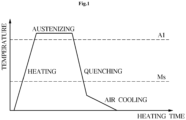
- FIG. 1 is a schematic diagram of a quenching heat treatment process performed in the present disclosure, wherein only quenching heat treatment is performed without performing a separate austempering heat treatment for forming a microstructure.
- FIG. 2 is a schematic diagram of common austempering heat treatment performed in conventional products to have a lower bainite structure by austempering heat treatment, but such austempering heat treatment requires high-cost constant-temperature heat treatment, thereby decreasing economic feasibility.
- the C content is less than 0.30%, it is difficult to obtain sufficient hardness of a material and it is not easy to obtain sufficient hardenability during final heat treatment. In addition, if the C content exceeds 0.50%, hardenability excessively increases, causing delayed fraction in the case of omitting tampering.
- silicon is not only useful for deoxidation of steel but also effective to obtain strength by solid solution strengthening, impact properties are deteriorated thereby. If the Si content is less than 0.30%, it is not sufficient to obtain strength by deoxidation and solid solution strengthening of steel. If the Si content exceeds 0.50%, it is not desirable due to a concern that formability may be deteriorated due to solid solution strengthening.
- Mn is an alloying element advantageous for obtaining strength by improving hardenability of a steel material and plays a role in increasing rollability and reducing brittleness. If the Mn content is less than 0.35%, it is difficult to obtain sufficient hardness. If the Mn content exceeds 0.75%, hard structure is easily formed during cooling after hot rolling and a large amount of MnS inclusions is produced, resulting in occurrence of inner cracks during cold forging. Thus, the Mn content needs to be limited.
- Chromium (Cr), together with Mn, is effective on improvement of hardenability and may be added in an amount of 0.40% or more as an element to obtain hardness. However, if the Cr content is excessive, a problem of coarse carbide formation may occur, and thus an upper limit thereof may be controlled to 0.70%.
- Titanium binds to nitrogen introduced into steel to form titanium carbonitride, preventing boron from binding to nitrogen.
- a Ti content less than 0.010% is not sufficient to form titanium carbonitride from nitrogen introduced during a steelmaking process, and thus it is difficult to obtain the effect of boron.
- a Ti content exceeding 0.050% is not desirable, because coarse carbonitride is formed to cause fine cracks. Thus, resistance to delayed fraction may deteriorate.
- Al is widely used as a deoxidizer in a steelmaking process and binds to N to form AlN which decreases the crystal grain size of austenite.
- the number of nitrogen compounds is not sufficient to deteriorate grain refining effect.
- non-metallic inclusions such as alumina are excessively produced, worsening occurrence of defects, and thus there is a need to limit the Al content.
- Boron is an element improving hardenability. If the B content is less than 0.0010%, it is difficult to obtain the effect on improvement of hardenability. A B content exceeding 0.0050% is not desirable because Fe 23 (CB) 6 carbide is formed in grain boundaries, causing brittleness of austenite grain boundaries.
- Nitrogen is an element widely used instead of expensive alloying elements because N binds to Al to form AlN which is effective on refinement of austenite crystal grains.
- a N content less than 0.002% causes insufficient number of N compounds, deteriorating the effect on refinement of austenite crystal grains.
- a N content exceeding 0.020% causes migration and multiplication of dislocation in a material by forging heat generated during cold forging and free nitrogen is fixed to the dislocation to increase deformation strength, resulting in deterioration of mold life.
- the remaining component of the present disclosure is iron (Fe).
- the composition may include unintended impurities inevitably incorporated from raw materials or surrounding environments, and thus addition of other alloy components is not excluded.
- the impurities are not specifically mentioned in the present disclosure, as they are known to any person skilled in the art of manufacturing.
- another embodiment of the present disclosure provides a screw part manufactured according to the method of the present disclosure.
- the screw part is characterized to have a microstructure including, in area fraction, 70% or more of autotempered martensite, 0.1 to 5% of bainite, 1 to 28% of fresh martensite, and 0.1 to 1% of retained austenite, and an average thickness of a carbide precipitated in crystal grains of prior austenite is 20 nm or less.
- the screw part according to the present disclosure is characterized to have a hardness of 500 HV or more at room temperature.
- a billet having the compositions shown in Table 1 below was heated to a temperature of 900 to 1200°C, and a wire rod was finish rolled at a temperature of 800 to 1000°C to a diameter of ⁇ 7 mm, the rolled product was coiled at a temperature of 700 to 900°C and cooled at a cooling rate of 0.4 to 1.0°C/s, the product was softening heat treated at a temperature of 600 to 800°C to reduce strength and cold forged to form a screw part shape having a body diameter of 4 mm, and the resultant was heated at a temperature of 850 to 950°C and quenched in a refrigerant at 60°C to prepare a screw part.
- the screw part prepared as described above was tested.
- Example 1 (wt%) C Si Mn Cr Ti Al B N
- Example 2 0.45 0.41 0.45 0.54 0.022 0.03 0.0022 0.004
- Example 3 0.40 0.40 0.36 0.52 0.024 0.03 0.0021 0.004
- Example 4 0.41 0.44 0.49 0.52 0.024 0.03 0.0024 0.004
- Example 5 0.39 0.41 0.44 0.46 0.026 0.03 0.0021 0.004
- Example 6 0.42 0.41 0.43 0.59 0.021 0.02 0.0023 0.004
- Example 7 0.43 0.31 0.42 0.52 0.023 0.04 0.0024 0.004
- Example 8 0.41 0.48 0.44 0.53 0.027 0.03 0.0019 0.004 Comparative Example 1-1 0.27 0.41 0.46 0.52 0.025 0.02 0.0022 0.004 Comparative Example 1-2 0.52 0.42 0.47 0.52 0.023 0.03 0.0021 0.004 Comparative Example 1-3 0.38 0.25 0.45 0.50 0.022 0.03 0.0023
- the delayed fraction performance evaluation method was performed by delayed fraction simulation. After heat treatment of the final product, the part was coupled to a corresponding part and immersed in a 5% hydrochloric acid + 95% distilled water solution for 10 minutes. Before and after the immersion, occurrence of cracks at the screw thread that is a region to which stress is concentrated was observed.
- the compositions of alloying elements of Examples 1 to 8 were within the range of the present disclosure, and the carbides after heat treatment had a thickness of 20 nm or less and a hardness of 500 HV or more.
- the compositions of alloying elements of Comparative Examples 1-1 to 1-6 were out of the range of the present disclosure, the carbides after heat treatment had a thickness greater than 20 nm, a hardness less than 500 HV, or cracks occurred due to delayed fraction.
- screw parts were manufactured by performing austempering heat treatment using the compositions of alloying elements of Table 1 in order to identify the effects of the present disclosure in which only quenching heat treatment was performed without the austempering heat treatment. Hardness thereof was measured by using a Vickers hardness tester.
- Comparative Examples 2-1 to 2-8 show hardness of parts manufactured by conducting austempering heat treatment by using the compositions of Examples 1 to 8 of Table 1
- Comparative Examples 3-1 to 3-6 show hardness of parts manufactured by conducting heat treatment by using the compositions of Comparative Examples 1-1 to 1-6 of Table 1.
Landscapes
- Chemical & Material Sciences (AREA)
- Engineering & Computer Science (AREA)
- Mechanical Engineering (AREA)
- Materials Engineering (AREA)
- Metallurgy (AREA)
- Organic Chemistry (AREA)
- Physics & Mathematics (AREA)
- Thermal Sciences (AREA)
- Crystallography & Structural Chemistry (AREA)
- Manufacturing & Machinery (AREA)
- Heat Treatment Of Articles (AREA)
- Heat Treatment Of Steel (AREA)
Applications Claiming Priority (2)
| Application Number | Priority Date | Filing Date | Title |
|---|---|---|---|
| KR1020210180892A KR20230091619A (ko) | 2021-12-16 | 2021-12-16 | 드릴링 특성이 우수한 냉간단조용 선재 및 스크류 부품의 제조방법 |
| PCT/KR2022/020274 WO2023113442A1 (fr) | 2021-12-16 | 2022-12-13 | Procédés de fabrication de fil machine pour forgeage à froid et partie de vis, ayant d'excellentes caractéristiques de forage |
Publications (2)
| Publication Number | Publication Date |
|---|---|
| EP4424862A1 true EP4424862A1 (fr) | 2024-09-04 |
| EP4424862A4 EP4424862A4 (fr) | 2025-11-12 |
Family
ID=86773086
Family Applications (1)
| Application Number | Title | Priority Date | Filing Date |
|---|---|---|---|
| EP22907909.0A Pending EP4424862A4 (fr) | 2021-12-16 | 2022-12-13 | Procédés de fabrication de fil machine pour forgeage à froid et partie de vis, ayant d'excellentes caractéristiques de forage |
Country Status (6)
| Country | Link |
|---|---|
| US (1) | US20250043376A1 (fr) |
| EP (1) | EP4424862A4 (fr) |
| JP (1) | JP2025500864A (fr) |
| KR (1) | KR20230091619A (fr) |
| CN (1) | CN118382715A (fr) |
| WO (1) | WO2023113442A1 (fr) |
Families Citing this family (2)
| Publication number | Priority date | Publication date | Assignee | Title |
|---|---|---|---|---|
| KR20250091916A (ko) * | 2023-12-14 | 2025-06-23 | 주식회사 포스코 | 선재, 볼트 및 이들의 제조방법 |
| KR20250091580A (ko) * | 2023-12-14 | 2025-06-23 | 주식회사 포스코 | 풍력타워 체결용 선재, 볼트 및 이들의 제조방법 |
Family Cites Families (12)
| Publication number | Priority date | Publication date | Assignee | Title |
|---|---|---|---|---|
| JPH0713257B2 (ja) * | 1990-05-30 | 1995-02-15 | 新日本製鐵株式会社 | 圧延ままで表面異常相のない軟質線材の製造方法 |
| JP3535754B2 (ja) * | 1998-02-10 | 2004-06-07 | 株式会社神戸製鋼所 | 冷間加工性と耐遅れ破壊性に優れたb含有鋼およびその製造方法並びにボルト |
| JP3966493B2 (ja) | 1999-05-26 | 2007-08-29 | 新日本製鐵株式会社 | 冷間鍛造用線材及びその製造方法 |
| KR100428581B1 (ko) * | 1999-12-28 | 2004-04-30 | 주식회사 포스코 | 강도 및 인성이 우수한 비조질강 및 이를 이용한 선재의 제조방법 |
| JP2003183733A (ja) * | 2001-12-14 | 2003-07-03 | Sumitomo Metal Ind Ltd | 線材の製造方法 |
| TWI318645B (en) * | 2005-02-16 | 2009-12-21 | Nippon Steel Corp | Hot rolled steel wire material having superior processability for cold forgine after spheroidization, spheroidized steel wire having superior processability for cold forgine and methods for manufacturing the same |
| JP2010138718A (ja) * | 2008-12-09 | 2010-06-24 | Ntn Corp | ラッシュアジャスタ |
| JP6034632B2 (ja) * | 2012-03-26 | 2016-11-30 | 株式会社神戸製鋼所 | 耐遅れ破壊性に優れたボロン添加高強度ボルト用鋼および高強度ボルト |
| KR101758491B1 (ko) * | 2015-12-17 | 2017-07-17 | 주식회사 포스코 | 강도 및 냉간가공성이 우수한 비조질 선재 및 그 제조방법 |
| CN205625560U (zh) * | 2016-04-21 | 2016-10-12 | 佛山市顺德区美的电热电器制造有限公司 | 螺杆及原汁机 |
| KR102224044B1 (ko) * | 2018-12-18 | 2021-03-09 | 주식회사 포스코 | 흑연화 열처리용 선재와 흑연강 및 그 제조방법 |
| KR102314433B1 (ko) * | 2019-12-17 | 2021-10-19 | 주식회사 포스코 | 우수한 수소취성 저항성을 가지는 고강도 냉간압조용 선재 및 그 제조방법 |
-
2021
- 2021-12-16 KR KR1020210180892A patent/KR20230091619A/ko active Pending
-
2022
- 2022-12-13 EP EP22907909.0A patent/EP4424862A4/fr active Pending
- 2022-12-13 CN CN202280082388.7A patent/CN118382715A/zh active Pending
- 2022-12-13 WO PCT/KR2022/020274 patent/WO2023113442A1/fr not_active Ceased
- 2022-12-13 JP JP2024535603A patent/JP2025500864A/ja active Pending
- 2022-12-13 US US18/719,104 patent/US20250043376A1/en active Pending
Also Published As
| Publication number | Publication date |
|---|---|
| EP4424862A4 (fr) | 2025-11-12 |
| KR20230091619A (ko) | 2023-06-23 |
| JP2025500864A (ja) | 2025-01-15 |
| WO2023113442A1 (fr) | 2023-06-22 |
| US20250043376A1 (en) | 2025-02-06 |
| CN118382715A (zh) | 2024-07-23 |
Similar Documents
| Publication | Publication Date | Title |
|---|---|---|
| EP3395980B1 (fr) | Matériau d'acier non magnétique ayant une excellente aptitude au façonnage à chaud et son procédé de fabrication | |
| EP2796587A1 (fr) | Tuyau en acier sans soudure de résistance élevée présentant une excellente résistance à la corrosion fissurante provoquée par l'hydrogène sulfuré pour puits de pétrole et son procédé de production | |
| WO2001048258A1 (fr) | Produit en barre ou en fil a utiliser dans le forgeage a froid et procede de production de ce produit | |
| KR101714916B1 (ko) | 냉간단조성이 우수한 선재 및 그 제조방법 | |
| WO1999005333A1 (fr) | Acier cemente particulierement capable d'empecher la recristallisation secondaire des particules pendant la cementation, procede de fabrication, et matiere brute formee pour pieces cementees | |
| EP2746420B1 (fr) | Acier à ressort, et ressort | |
| JP7508469B2 (ja) | せん断加工性に優れた超高強度鋼板及びその製造方法 | |
| EP4079907A1 (fr) | Fil-machine pour acier de qualité de frappe à froid à haute résistance présentant une excellente résistance à la fragilisation par l'hydrogène, et procédé de fabrication associé | |
| US20250043376A1 (en) | Methods for manufacturing wire rod for cold forging and screw part, having excellent drilling characteristics | |
| EP4060072A1 (fr) | Fil machine et composant pour forgeage à froid ayant chacun d'excellentes caractéristiques de résistance à la rupture différée, et leurs procédés de fabrication | |
| KR102326263B1 (ko) | 초고강도 스프링용 선재, 강선 및 그 제조방법 | |
| EP3050987B1 (fr) | Acier pour boulons à haute résistance qui a d'excellentes résistance à la rupture différée et aptitude au formabilité de boulons et boulon | |
| JP6798557B2 (ja) | 鋼 | |
| KR102042062B1 (ko) | 냉간압조용 선재 및 이의 제조방법 | |
| JP2003328079A (ja) | 加工性に優れた冷間鍛造用鋼管とその製造方法。 | |
| EP4261313A1 (fr) | Fil machine à haute résistance pour matriçage à froid, doté d'excellentes caractéristiques de traitement thermique et de rupture différée par l'hydrogène, élément de traitement thermique et procédés de fabrication associés | |
| JP6390685B2 (ja) | 非調質鋼およびその製造方法 | |
| JP2023094168A (ja) | 浸炭用温間鍛造部品及びその製造方法 | |
| EP4692406A1 (fr) | Feuille d'acier laminé à froid, élément d'estampage et procédé de fabrication de feuille d'acier laminé à froid | |
| KR100833079B1 (ko) | 냉간압조특성이 우수한 연질 보론강 선재의 제조방법 | |
| EP4502221A1 (fr) | Fil de tige en acier non trempé et revenu pour forgeage à chaud présentant une usinabilité et une ténacité améliorées et son procédé de fabrication | |
| JP2004124190A (ja) | ねじり特性に優れる高周波焼もどし鋼 | |
| JP2023547090A (ja) | 熱的安定性に優れた高強度鋼板及びその製造方法 | |
| JPH11106866A (ja) | 粗大粒防止特性に優れた肌焼鋼とその製造方法 | |
| JPH0313544A (ja) | 高Mn非磁性鉄筋棒鋼の製造方法 |
Legal Events
| Date | Code | Title | Description |
|---|---|---|---|
| STAA | Information on the status of an ep patent application or granted ep patent |
Free format text: STATUS: THE INTERNATIONAL PUBLICATION HAS BEEN MADE |
|
| PUAI | Public reference made under article 153(3) epc to a published international application that has entered the european phase |
Free format text: ORIGINAL CODE: 0009012 |
|
| STAA | Information on the status of an ep patent application or granted ep patent |
Free format text: STATUS: REQUEST FOR EXAMINATION WAS MADE |
|
| 17P | Request for examination filed |
Effective date: 20240531 |
|
| AK | Designated contracting states |
Kind code of ref document: A1 Designated state(s): AL AT BE BG CH CY CZ DE DK EE ES FI FR GB GR HR HU IE IS IT LI LT LU LV MC ME MK MT NL NO PL PT RO RS SE SI SK SM TR |
|
| DAV | Request for validation of the european patent (deleted) | ||
| DAX | Request for extension of the european patent (deleted) | ||
| A4 | Supplementary search report drawn up and despatched |
Effective date: 20251010 |
|
| RIC1 | Information provided on ipc code assigned before grant |
Ipc: C22C 38/28 20060101AFI20251006BHEP Ipc: C22C 38/32 20060101ALI20251006BHEP Ipc: C22C 38/00 20060101ALI20251006BHEP Ipc: B21B 1/16 20060101ALI20251006BHEP Ipc: C21D 9/52 20060101ALI20251006BHEP Ipc: C21D 1/18 20060101ALI20251006BHEP Ipc: C21D 1/84 20060101ALI20251006BHEP |