EP4425105A1 - Verfahren und vorrichtung zur flugverwaltung bei erschwerten bedingungen bei unfähigheit von mindestens einem kommandierenden piloten - Google Patents
Verfahren und vorrichtung zur flugverwaltung bei erschwerten bedingungen bei unfähigheit von mindestens einem kommandierenden piloten Download PDFInfo
- Publication number
- EP4425105A1 EP4425105A1 EP24152466.9A EP24152466A EP4425105A1 EP 4425105 A1 EP4425105 A1 EP 4425105A1 EP 24152466 A EP24152466 A EP 24152466A EP 4425105 A1 EP4425105 A1 EP 4425105A1
- Authority
- EP
- European Patent Office
- Prior art keywords
- altitude
- aircraft
- waypoint
- pilot
- flight plan
- Prior art date
- Legal status (The legal status is an assumption and is not a legal conclusion. Google has not performed a legal analysis and makes no representation as to the accuracy of the status listed.)
- Granted
Links
Images


Classifications
-
- G—PHYSICS
- G01—MEASURING; TESTING
- G01C—MEASURING DISTANCES, LEVELS OR BEARINGS; SURVEYING; NAVIGATION; GYROSCOPIC INSTRUMENTS; PHOTOGRAMMETRY OR VIDEOGRAMMETRY
- G01C23/00—Combined instruments indicating more than one navigational value, e.g. for aircraft; Combined measuring devices for measuring two or more variables of movement, e.g. distance, speed or acceleration
-
- B—PERFORMING OPERATIONS; TRANSPORTING
- B64—AIRCRAFT; AVIATION; COSMONAUTICS
- B64D—EQUIPMENT FOR FITTING IN OR TO AIRCRAFT; FLIGHT SUITS; PARACHUTES; ARRANGEMENT OR MOUNTING OF POWER PLANTS OR PROPULSION TRANSMISSIONS IN AIRCRAFT
- B64D45/00—Aircraft indicators or protectors not otherwise provided for
-
- G—PHYSICS
- G08—SIGNALLING
- G08G—TRAFFIC CONTROL SYSTEMS
- G08G5/00—Traffic control systems for aircraft
- G08G5/30—Flight plan management
-
- B—PERFORMING OPERATIONS; TRANSPORTING
- B64—AIRCRAFT; AVIATION; COSMONAUTICS
- B64F—GROUND OR AIRCRAFT-CARRIER-DECK INSTALLATIONS SPECIALLY ADAPTED FOR USE IN CONNECTION WITH AIRCRAFT; DESIGNING, MANUFACTURING, ASSEMBLING, CLEANING, MAINTAINING OR REPAIRING AIRCRAFT, NOT OTHERWISE PROVIDED FOR; HANDLING, TRANSPORTING, TESTING OR INSPECTING AIRCRAFT COMPONENTS, NOT OTHERWISE PROVIDED FOR
- B64F5/00—Designing, manufacturing, assembling, cleaning, maintaining or repairing aircraft, not otherwise provided for; Handling, transporting, testing or inspecting aircraft components, not otherwise provided for
- B64F5/60—Testing or inspecting aircraft components or systems
-
- G—PHYSICS
- G08—SIGNALLING
- G08G—TRAFFIC CONTROL SYSTEMS
- G08G5/00—Traffic control systems for aircraft
- G08G5/50—Navigation or guidance aids
- G08G5/55—Navigation or guidance aids for a single aircraft
-
- G—PHYSICS
- G08—SIGNALLING
- G08G—TRAFFIC CONTROL SYSTEMS
- G08G5/00—Traffic control systems for aircraft
- G08G5/70—Arrangements for monitoring traffic-related situations or conditions
-
- B—PERFORMING OPERATIONS; TRANSPORTING
- B64—AIRCRAFT; AVIATION; COSMONAUTICS
- B64D—EQUIPMENT FOR FITTING IN OR TO AIRCRAFT; FLIGHT SUITS; PARACHUTES; ARRANGEMENT OR MOUNTING OF POWER PLANTS OR PROPULSION TRANSMISSIONS IN AIRCRAFT
- B64D45/00—Aircraft indicators or protectors not otherwise provided for
- B64D2045/0085—Devices for aircraft health monitoring, e.g. monitoring flutter or vibration
-
- G—PHYSICS
- G08—SIGNALLING
- G08G—TRAFFIC CONTROL SYSTEMS
- G08G5/00—Traffic control systems for aircraft
- G08G5/50—Navigation or guidance aids
- G08G5/58—Navigation or guidance aids for emergency situations, e.g. hijacking or bird strikes
Definitions
- the present invention relates to a method and a device for flight management in difficult circumstances implemented by a processing unit of an avionics computer of an aircraft, when the aircraft is in a flight phase in which only one pilot is at the controls ("pilot flying" in English) of the aircraft instead of two pilots.
- the difficult context may correspond to a trajectory phase of an aircraft flying over high-altitude terrain (high mountains) or to a trajectory phase meeting an ETOPS regulation ("Extended-range Twin-engine Operation Performance Standards" in English for "long-haul twin-engine operations over oceans” in French).
- ETOPS regulation allows aircraft equipped with two engines to take trajectories crossing sectors more than one hour from a diversion airport.
- eMCO Extended Minimum Crew Operations
- the pilot in command can enter a secondary flight plan into the aircraft's avionics computer.
- the sole pilot in command is not able to manage the piloting of the aircraft, for example, because of a deterioration in his psychophysiological state or for other reasons.
- the sole pilot in command can then enter erroneous data for the secondary flight plan.
- the present invention relates to a method and a device for flight management in difficult circumstances making it possible to overcome this drawback.
- the flight management method is intended to be implemented for an aircraft flying according to a main flight plan.
- the method is implemented when the aircraft is in a flight phase in which only one pilot is at the controls of the aircraft.
- the emergency trajectory corresponds to an emergency trajectory towards a diversion airport, said emergency trajectory corresponding to an emergency trajectory towards a diversion airport depending on the current position of the aircraft.
- the escape trajectory corresponds to a survival evacuation trajectory to a survival altitude.
- the activation step comprises an inhibition sub-step for inhibiting an altitude protection system to reach the survival altitude in a time corresponding to an oxygen autonomy time of the aircraft if a depressurization of the cabin is detected or to reach an equilibrium altitude if a failure of at least one engine is detected.
- the invention also relates to a flight management device in difficult circumstances, the device being carried on board an aircraft flying according to a main flight plan.
- the emergency trajectory corresponds to an emergency trajectory towards a diversion airport, said emergency trajectory corresponding to an emergency trajectory towards a diversion airport depending on the current position of the aircraft.
- the escape trajectory corresponds to a survival evacuation trajectory to a survival altitude.
- the fifth module is configured to inhibit an altitude protection system to reach the survival altitude within a time corresponding to an oxygen autonomy time of the aircraft if a depressurization of the cabin is detected or to reach an equilibrium altitude if a failure of at least one engine is detected.
- the invention also relates to an aircraft comprising a flight management device, such as that specified above.
- Device 1 for managing flight in difficult situations hereinafter referred to as “device 1”, is shown very schematically on the figure 1 .
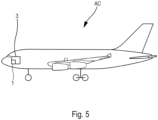
- Device 1 is intended to be carried on board an aircraft ( figure 5 ) likely to fly according to a primary flight plan.
- the device may be implemented when the AC aircraft is in a flight phase in which only one pilot is at the controls of the AC aircraft. However, it may also be implemented when the AC aircraft is in a flight phase in which at least two pilots are at the controls of the AC aircraft.
- the device 1 can be included in at least one avionics computer 3 of an aircraft AC.
- An avionics computer 3 corresponds to a computer on board the aircraft AC.
- an avionics computer 3 may correspond to a flight management system FMS (flight management system) of the aircraft AC, to a primary flight control computer PRIM (primary flight control computer), to a secondary flight control computer SEC (secondary flight control computer), to a full authority digital engine control system FADEC (full authority digital engine control), a cabin pressure control system (cabin pressure control system) or to any other avionics computers on board the aircraft AC.
- FMS flight management system
- PRIM primary flight control computer
- SEC secondary flight control computer
- FADEC full authority digital engine control
- cabin pressure control system cabin pressure control system
- device 1 is put into service in the event of a difficult context.
- the difficult context may correspond to a trajectory phase of an AC aircraft flying over high altitude terrain or to a trajectory phase meeting ETOPS regulations.
- activation of the device 1 may be accomplished using a button in the cockpit of the aircraft AC.
- a pilot in command may press the button to activate the device.
- the commissioning of the device 1 can be carried out using parameters defined in the main flight plan in which a a start waypoint and an end waypoint delimit the commissioning of the device 1.
- the pilot When the aircraft AC is in a difficult context, the pilot in command prepares a secondary flight plan. To do this, he enters secondary flight plan data into a first memory 6 of the avionics computer(s) 3 on board the aircraft AC using an input device 4.
- the secondary flight plan data entered by the pilot in command includes at least one identifier of at least one waypoint and at least one altitude constraint of the waypoint(s).
- Secondary flight plan data are also determined by the avionics computer(s) 3, for example the FMS, from the secondary flight plan data entered by the pilot in command and from the performance of the aircraft AC.
- the performance of the aircraft AC may correspond to a set of qualities that characterize the performance (acceleration, maximum speed, range, etc.) of which the aircraft AC is capable.
- the secondary flight plan data determined include at least one position of the waypoint(s) and at least one backup trajectory.
- the secondary flight plan data determined by the avionics computer(s) 3 may also be stored in the first memory 6 of the avionics computer(s) 3.
- the device 1 comprises a first module 21 configured to detect and warn the pilot in command of the aircraft AC that erroneous data has been entered into the first memory 6 of the avionics computer(s) 3 when the pilot in command has entered the secondary flight plan data into the first memory 6.
- the first module 21 or the avionics computer(s) 3 can then be configured to prompt the pilot in command to enter new secondary flight plan data.
- the first module 21 can correspond to the FMS calculator.
- the second module 22 can thus detect a depressurization of the cabin if the pressure in the cabin measured by the pressure sensors S1 is less than or equal to a predetermined threshold pressure.
- the third module 23 can also detect a failure of at least one engine M based on data transmitted by the operating sensors S2 of engine M.
- the avionics computer 3 implementing the second module 2 may be a cabin pressure control system.
- the avionics computer 3 implementing the third module 23 may be a FADEC computer.
- the device 1 also comprises a fourth module 24 configured to determine a capacity of the pilot at the controls.
- the pilot's capacity can be determined using sensors such as physiological parameter sensors 26 of the pilot at the controls.
- the fourth module 24 is able to determine the pilot's capacity at the controls.
- the fourth module 24 is configured to determine an incapacity of the pilot at the controls depending on the physiological parameters.
- the pilot's capability may be determined based on a response expected by the avionics computer(s) 3, such as the FMS computer, following an invitation to enter secondary flight plan data.
- the fourth module 24 is configured to determine an incapacity of the pilot at the controls if no data is entered after a predetermined time.
- the device 1 also comprises a fifth module 25 configured to automatically activate an emergency trajectory corresponding to the emergency trajectory defined between the positions of two consecutive waypoints between which the aircraft AC is located.
- the avionics computer 3 implementing the fifth module 25 may be a primary flight control computer PRIM.
- An activation of a trajectory or a flight plan corresponds to an implementation of the trajectory or the flight plan by a control device 21 of the aircraft AC, such as an automatic pilot, configured so that the aircraft AC flies according to the trajectory or the flight plan.
- the device 1 comprises a processing unit 2 comprising the first module 21, the second module 22, the third module 23, the fourth module 24 and the fifth module 25.
- the processing unit 2 is included in an avionics computer 3.
- the modules 21 to 25 are included in a single avionics computer 3 or are distributed in several avionics computers 3 which can be located at different locations on board the aircraft AC.
- the modules 21 to 25 and/or the processing unit 2 can be duplicated.
- the modules 21 to 25 can be integrated in software in the avionics computer(s) 3.
- the signaling to the pilot in command may be made by any means such as an alert message on the aircraft navigation screen AC, an alert message on the flight plan page, an audible alarm or a combination thereof.
- the altitude database 5 may correspond to an aircraft environmental monitoring system AESS (Aircraft Environmental Surveillance System).
- the identifier(s) of the waypoint(s) of the secondary flight plan and one or more identifiers of at least one waypoint are previously stored in the second memory 7 of the avionics computer(s) 3 by the airline.
- the second memory 7 may correspond to a navigation database of the avionics computer(s) 3.
- the emergency trajectory may correspond to an emergency trajectory to a diversion airport if the difficult context corresponds to a trajectory phase meeting an ETOPS regulation.
- Said emergency trajectory corresponds to an emergency trajectory to a diversion airport depending on the current position of the aircraft AC.
- At least one backup trajectory to a diversion airport is defined in the secondary flight plan.
- the pilot in command defines equal time points on the trajectory of the aircraft.
- a diversion airport is defined between each of the equal time points.
- the aircraft AC is therefore likely to be diverted to the diversion airport defined according to the current position of the aircraft AC. This configuration makes it possible to avoid a discontinuity between the secondary flight plan and the backup trajectory.
- the avionics computer(s) 3 can implement the DIR-TO function.
- the emergency trajectory is carried out by implementing an automatic emergency descent function (AED) of the avionics computer(s) 3 according to a standard procedure.
- AED automatic emergency descent function
- the avionics computer(s) 3 implement a usual guidance mode in the event of a failure of engine M.
- the emergency route can correspond to a survival evacuation route ("oxygen escape route" in English).
- This configuration makes it possible to avoid a discontinuity between the secondary flight plan and the backup trajectory.
- the avionics computer(s) 3 can implement the DIR-TO function.
- the AC aircraft is required to descend to an altitude at which the outside temperature, pressure and oxygen concentration in the air are sufficient for the survival of the passengers and crew of the AC aircraft.
- This altitude is referred to as the "survival altitude" in the remainder of the description.
- the AC aircraft may remain at as high an altitude as possible to avoid obstacles until it can descend to reach the survival altitude within the oxygen endurance time interval.
- At least one survival evacuation trajectory is defined in the secondary flight plan.
- the difficult context trajectory is divided into several segments. For each segment, a survival evacuation trajectory is defined starting from an escape fix.
- the evacuation fix may correspond to a waypoint originating from a ground-based air navigation aid or to a waypoint stored in the avionics computer(s) 3.
- the altitude protection system implements a "safety net" of the AC aircraft to protect the AC aircraft from erroneous guidance commands by stabilizing the AC aircraft at a predetermined safety altitude.
- the altitude of predetermined safety is determined from an altitude database.
- This altitude database provides a minimum flight altitude grid (MORA). This grid provides an obstacle clearance margin of 2000 feet (approximately 610 m) if the highest point is above 5000 feet (approximately 1525 m) and 1000 feet (approximately 305 m) otherwise.
- MORA minimum flight altitude grid
- the emergency trajectory ER1 is carried out by implementing the AED function of the avionics computer(s) 3.
- Guidance by this AED function makes it possible to achieve altitude constraints chosen by the pilot in command in the secondary flight plan, in particular to reach an altitude below the predetermined safety altitude MORA by constructing successive descents D1, D2. The complete descent is stopped when the survival altitude is reached.
- the AED function also defines a target speed of the aircraft AC.
- the trajectory profile T corresponds to a trajectory profile constructed by the avionics computer(s) 3 if no depressurization had been detected.
- the avionics computer(s) 3 determine a maximum long-range cruise altitude in the event of an engine failure (LRC EO MAX altitude for “long-range cruise engine-out maximum altitude” in English).
- LRC EO MAX altitude for “long-range cruise engine-out maximum altitude” in English.
- the vertical guidance and speed of the aircraft AC are, for example, managed by a PRIM (primary flight control computer) main flight control computer.
- the aircraft AC is leveled off by the PRIM computer until it reaches a speed called “greendot”.
- the “greendot” speed corresponds to a speed for which the lift-to-drag ratio is the greatest for the aircraft AC.
- the PRIM computer commands the aircraft to descend to the LRC EO MAX altitude.
- the invention also relates to a method for managing flight in difficult circumstances ( figure 2 ).
- the method is intended to be implemented for an AC aircraft flying according to a main flight plan.
- the method may be capable of being implemented by at least one avionics computer 3 of the AC aircraft.
- the pilot in control of the aircraft AC enters secondary flight plan data into a first memory 6 of the avionics computer(s) 3 using an input device 4.
- the secondary flight plan data entered by the pilot in control comprises at least one identifier of at least one waypoint and at least one altitude constraint of the waypoint(s).
- the avionics computer(s) 3 determine secondary flight plan data from the secondary flight plan data.
- the secondary flight plan data determined includes at least one waypoint(s) position and at least one backup trajectory.
Landscapes
- Engineering & Computer Science (AREA)
- Aviation & Aerospace Engineering (AREA)
- Physics & Mathematics (AREA)
- General Physics & Mathematics (AREA)
- Radar, Positioning & Navigation (AREA)
- Remote Sensing (AREA)
- Manufacturing & Machinery (AREA)
- Transportation (AREA)
- Traffic Control Systems (AREA)
- Alarm Systems (AREA)
Applications Claiming Priority (1)
| Application Number | Priority Date | Filing Date | Title |
|---|---|---|---|
| FR2300886 | 2023-01-31 |
Publications (2)
| Publication Number | Publication Date |
|---|---|
| EP4425105A1 true EP4425105A1 (de) | 2024-09-04 |
| EP4425105B1 EP4425105B1 (de) | 2026-04-15 |
Family
ID=85937085
Family Applications (1)
| Application Number | Title | Priority Date | Filing Date |
|---|---|---|---|
| EP24152466.9A Active EP4425105B1 (de) | 2023-01-31 | 2024-01-17 | Verfahren und vorrichtung zur flugverwaltung bei erschwerten bedingungen bei unfähigheit von mindestens einem kommandierenden piloten |
Country Status (3)
| Country | Link |
|---|---|
| US (1) | US12612180B2 (de) |
| EP (1) | EP4425105B1 (de) |
| CN (1) | CN118430344A (de) |
Families Citing this family (1)
| Publication number | Priority date | Publication date | Assignee | Title |
|---|---|---|---|---|
| JP7684918B2 (ja) * | 2022-02-08 | 2025-05-28 | 株式会社日立製作所 | 管制装置、及び管制方法 |
Citations (4)
| Publication number | Priority date | Publication date | Assignee | Title |
|---|---|---|---|---|
| US20070043482A1 (en) * | 2005-07-05 | 2007-02-22 | The Boeing Company | Emergency descent system |
| US20080243315A1 (en) * | 2007-02-07 | 2008-10-02 | Airbus France | Device and method for assisting in the management of an engine failure on an aircraft |
| EP2506105A2 (de) * | 2011-03-28 | 2012-10-03 | Honeywell International Inc. | Verfahren und Systeme zur Translation eines Warnsignals eines Notfallsystems zu einem automatisierten Flugsystemmanöver |
| US20170249852A1 (en) * | 2016-02-29 | 2017-08-31 | Garmin International, Inc. | Emergency autoload system |
-
2024
- 2024-01-12 US US18/411,195 patent/US12612180B2/en active Active
- 2024-01-17 EP EP24152466.9A patent/EP4425105B1/de active Active
- 2024-01-31 CN CN202410142154.8A patent/CN118430344A/zh active Pending
Patent Citations (4)
| Publication number | Priority date | Publication date | Assignee | Title |
|---|---|---|---|---|
| US20070043482A1 (en) * | 2005-07-05 | 2007-02-22 | The Boeing Company | Emergency descent system |
| US20080243315A1 (en) * | 2007-02-07 | 2008-10-02 | Airbus France | Device and method for assisting in the management of an engine failure on an aircraft |
| EP2506105A2 (de) * | 2011-03-28 | 2012-10-03 | Honeywell International Inc. | Verfahren und Systeme zur Translation eines Warnsignals eines Notfallsystems zu einem automatisierten Flugsystemmanöver |
| US20170249852A1 (en) * | 2016-02-29 | 2017-08-31 | Garmin International, Inc. | Emergency autoload system |
Non-Patent Citations (1)
| Title |
|---|
| ANONYMOUS TAB: "FMS-3000 (excerpt)", 24 June 2005 (2005-06-24), XP093073159, Retrieved from the Internet <URL:https://www.smartcockpit.com/docs/P180_Avanti-FMS-3000_Guide.pdf> [retrieved on 20230811] * |
Also Published As
| Publication number | Publication date |
|---|---|
| US12612180B2 (en) | 2026-04-28 |
| US20240253812A1 (en) | 2024-08-01 |
| EP4425105B1 (de) | 2026-04-15 |
| CN118430344A (zh) | 2024-08-02 |
Similar Documents
| Publication | Publication Date | Title |
|---|---|---|
| FR3076679A1 (fr) | Systèmes et procédés de localisation de détresse autonome dans des véhicules aériens | |
| CA2615681C (fr) | Procede et dispositif de securisation d'un vol automatique a basse altitude d'un aeronef | |
| CA2746580C (fr) | Procede et dispositif de recalage d'une altitude cible pour une descente d'urgence d'un aeronef | |
| US6697718B2 (en) | Device for monitoring a plurality of systems of an aircraft, in particular of a transport aircraft | |
| EP1797488B1 (de) | Ausweichverfahren und -system für ein flugzeug | |
| CA2755408C (fr) | Procede et dispositif d'aide a la conduite d'operations aeriennes necessitant une garantie de performance de navigation et de guidage | |
| EP1625454A1 (de) | System zum automatischen schutz des fluges eines flugzeuges | |
| EP2425309B1 (de) | Navigationshilfeverfahren zur bestimmung der bahn eines flugzeugs | |
| FR2885439A1 (fr) | Procede et dispositif d'aide au pilotage d'un avion lors d'une phase d'approche en vue d'un atterrissage | |
| US9096328B2 (en) | Method and device for automatically estimating a degradation in fuel consumption and in drag of an aircraft | |
| FR2981778A1 (fr) | Procede et dispositif d'atterrissage automatique d'un aeronef sur une piste a forte pente. | |
| FR2970093A1 (fr) | Procede et dispositif de surveillance automatique d'operations aeriennes necessitant une garantie de performance de navigation et de guidage. | |
| FR2912242A1 (fr) | Dispositif et procede d'aide a la gestion d'une panne moteur d'un aeronef | |
| FR2912243A1 (fr) | Dispositif et procede d'aide a la gestion d'une panne moteur d'un aeronef | |
| CA2478777C (fr) | Procede et dispositif d'evitement de terrain pour un aeronef | |
| FR3067491A1 (fr) | Dispositif, systeme et procede d'assistance a un pilote d'un aeronef | |
| EP4425105B1 (de) | Verfahren und vorrichtung zur flugverwaltung bei erschwerten bedingungen bei unfähigheit von mindestens einem kommandierenden piloten | |
| FR3072948B1 (fr) | Systeme d’aide a l’atterrissage d’un aeronef en phase d’approche d’une piste d’atterrissage | |
| FR2908533A1 (fr) | Methode et systeme de surveillance du suivi d'une trajectoire de reference par un aeronef | |
| FR2901893A1 (fr) | Dispositif de surveillance d'informations de commande d'un aeronef | |
| EP1598271B1 (de) | Steuerungsanzeige zum Anzeigen von Schubinformationen eines Luftfahrzeuges | |
| EP3474030A1 (de) | Landungshilfssystem und -verfahren für ein luftfahrzeug | |
| EP1598722B1 (de) | Verfahren und Vorrichtung zum Absichern eines Tieffluges eines Luftfahrzeuges | |
| FR2963859A1 (fr) | Procede et systeme de transmission des donnees d'enregistreurs de vol en cas d'urgence | |
| EP1895268B1 (de) | Systeme und Verfahren zur Erkennung und Meldung der Fehleinstellung eines barometrischen Altimeters oberhalb einer Übergangshöhe |
Legal Events
| Date | Code | Title | Description |
|---|---|---|---|
| PUAI | Public reference made under article 153(3) epc to a published international application that has entered the european phase |
Free format text: ORIGINAL CODE: 0009012 |
|
| STAA | Information on the status of an ep patent application or granted ep patent |
Free format text: STATUS: THE APPLICATION HAS BEEN PUBLISHED |
|
| AK | Designated contracting states |
Kind code of ref document: A1 Designated state(s): AL AT BE BG CH CY CZ DE DK EE ES FI FR GB GR HR HU IE IS IT LI LT LU LV MC ME MK MT NL NO PL PT RO RS SE SI SK SM TR |
|
| STAA | Information on the status of an ep patent application or granted ep patent |
Free format text: STATUS: REQUEST FOR EXAMINATION WAS MADE |
|
| 17P | Request for examination filed |
Effective date: 20250303 |
|
| RIC1 | Information provided on ipc code assigned before grant |
Ipc: G01C 23/00 20060101AFI20250709BHEP |
|
| GRAP | Despatch of communication of intention to grant a patent |
Free format text: ORIGINAL CODE: EPIDOSNIGR1 |
|
| STAA | Information on the status of an ep patent application or granted ep patent |
Free format text: STATUS: GRANT OF PATENT IS INTENDED |
|
| INTG | Intention to grant announced |
Effective date: 20250919 |
|
| GRAJ | Information related to disapproval of communication of intention to grant by the applicant or resumption of examination proceedings by the epo deleted |
Free format text: ORIGINAL CODE: EPIDOSDIGR1 |
|
| STAA | Information on the status of an ep patent application or granted ep patent |
Free format text: STATUS: REQUEST FOR EXAMINATION WAS MADE |
|
| GRAS | Grant fee paid |
Free format text: ORIGINAL CODE: EPIDOSNIGR3 |
|
| STAA | Information on the status of an ep patent application or granted ep patent |
Free format text: STATUS: GRANT OF PATENT IS INTENDED |
|
| GRAP | Despatch of communication of intention to grant a patent |
Free format text: ORIGINAL CODE: EPIDOSNIGR1 |
|
| INTC | Intention to grant announced (deleted) | ||
| INTG | Intention to grant announced |
Effective date: 20260126 |
|
| GRAA | (expected) grant |
Free format text: ORIGINAL CODE: 0009210 |
|
| STAA | Information on the status of an ep patent application or granted ep patent |
Free format text: STATUS: THE PATENT HAS BEEN GRANTED |
|
| AK | Designated contracting states |
Kind code of ref document: B1 Designated state(s): AL AT BE BG CH CY CZ DE DK EE ES FI FR GB GR HR HU IE IS IT LI LT LU LV MC ME MK MT NL NO PL PT RO RS SE SI SK SM TR |
|
| REG | Reference to a national code |
Ref country code: CH Ref legal event code: F10 Free format text: ST27 STATUS EVENT CODE: U-0-0-F10-F00 (AS PROVIDED BY THE NATIONAL OFFICE) Effective date: 20260415 |