EP4425732A1 - Fehlerüberbrückungssystem für ein stromnetz - Google Patents
Fehlerüberbrückungssystem für ein stromnetz Download PDFInfo
- Publication number
- EP4425732A1 EP4425732A1 EP23159716.2A EP23159716A EP4425732A1 EP 4425732 A1 EP4425732 A1 EP 4425732A1 EP 23159716 A EP23159716 A EP 23159716A EP 4425732 A1 EP4425732 A1 EP 4425732A1
- Authority
- EP
- European Patent Office
- Prior art keywords
- power
- bipole
- chopper
- transformer
- power network
- Prior art date
- Legal status (The legal status is an assumption and is not a legal conclusion. Google has not performed a legal analysis and makes no representation as to the accuracy of the status listed.)
- Pending
Links
Images


Classifications
-
- H—ELECTRICITY
- H02—GENERATION; CONVERSION OR DISTRIBUTION OF ELECTRIC POWER
- H02J—ELECTRIC POWER NETWORKS; CIRCUIT ARRANGEMENTS OR SYSTEMS FOR SUPPLYING OR DISTRIBUTING ELECTRIC POWER; SYSTEMS FOR STORING ELECTRIC ENERGY
- H02J3/00—Circuit arrangements for AC mains or AC distribution networks
- H02J3/001—Arrangements for handling faults or abnormalities, e.g. emergencies or contingencies
-
- H—ELECTRICITY
- H02—GENERATION; CONVERSION OR DISTRIBUTION OF ELECTRIC POWER
- H02J—ELECTRIC POWER NETWORKS; CIRCUIT ARRANGEMENTS OR SYSTEMS FOR SUPPLYING OR DISTRIBUTING ELECTRIC POWER; SYSTEMS FOR STORING ELECTRIC ENERGY
- H02J3/00—Circuit arrangements for AC mains or AC distribution networks
- H02J3/12—Arrangements for adjusting voltage in AC networks by changing a characteristic of the network load
- H02J3/14—Arrangements for adjusting voltage in AC networks by changing a characteristic of the network load by switching loads on to, or off from, the networks, e.g. progressively balanced loading
-
- H—ELECTRICITY
- H02—GENERATION; CONVERSION OR DISTRIBUTION OF ELECTRIC POWER
- H02J—ELECTRIC POWER NETWORKS; CIRCUIT ARRANGEMENTS OR SYSTEMS FOR SUPPLYING OR DISTRIBUTING ELECTRIC POWER; SYSTEMS FOR STORING ELECTRIC ENERGY
- H02J3/00—Circuit arrangements for AC mains or AC distribution networks
- H02J3/36—Arrangements for transfer of electric power between AC networks via high-voltage DC [HVDC] links; Arrangements for transfer of electric power between generators and networks via HVDC links
Definitions
- the present disclosure generally relates to power network. More particularly, it relates to a fault ride through system for a power network.
- renewable energy plays a major role in moving towards a carbon-neutral energy system.
- Renewable energy based power transmission requires changes in how power is transmitted and distributed to have a dynamic, flexible, and stable power network/power grid.
- a power network such as a High-Voltage Direct Current, HVDC, parallel symmetric monopole or bipole system can offer flexibility, controllability, and resilience required for large-scale integration of renewable energy. Low losses associated with the HVDC system make the HVDC system suitable for massive bulk transmission, enabling trade of renewable resources between countries and regions.
- VSC Voltage Source Converter
- AC choppers can be used for dissipating excessive renewable power (i.e., excessive active power).
- the AC chopper comprises thyristors (in an antiparallel configuration) and resistors.
- the thyristors can be used as controllable switches to control power dissipation by the resistors of the AC chopper.
- designing of a single AC chopper unit at very high voltage level is not economical.
- a stepdown transformer is used to optimize voltage ratings of the AC chopper and parallel units are used to optimize current ratings of the AC chopper.
- the dedicated stepdown transformer is required for connection of the AC chopper at a point of common coupling, PCC of the power network. Since, the AC chopper uses its own transformer and the transformer is required to have a high voltage winding, a unit cost for the AC chopper unit is relatively high.
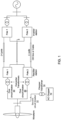
- Fig. 1 discloses a schematic diagram of an example of a Fault Ride Through, FRT, system in which a dedicated transformer is provided for Alternating Current, AC, chopper banks, according to the prior art.
- the power network can be a bipole or parallel symmetric monopole HVDC system comprising two poles, a pole 1 and a pole 2 at a rectifier station.
- a HVDC link is connected to a renewable energy source like a windfarm/wind turbine generator, solar PV or similar at the rectifier station.
- the FRT system comprises the AC chopper banks 10.
- the AC chopper banks 10 are connected at the PCC of the HVDC link through dedicated transformer 14 (referred as chopper transformer).
- Each AC chopper bank 10 in each pole connected to the chopper transformer 14 may consist of several AC chopper units connected in parallel.
- the AC chopper banks 10 are designed to operate during disturbances such as faults in a DC line, an inverter AC grid, or the like.
- the corresponding pole is disconnected/tripped and a converter (half-bridge based) associated with the corresponding pole is blocked.
- the corresponding pole is disconnected/tripped by opening an AC breaker/circuit breaker, CB, connected between the PCC and a line side/primary winding of the converter transformer of the corresponding pole.
- CB AC breaker/circuit breaker
- Other pole/healthy pole continues to transfer power up to its rated capacity. Excessive power from the renewable source (i.e., above the capacity of the healthy pole) can be dissipated in one of the AC chopper banks 10.
- the AC chopper banks at the PCC absorb the excessive power from the renewable source.
- the AC chopper banks 10 are designed to operate during disturbances such as faults in a DC line, an inverter AC grid, or the like.
- disturbances/faults are less frequent and may persist for short duration,
- utilization of the dedicated chopper transformer14 for the AC chopper banks 10 may be extremely less as compared to the converter transformers.
- the chopper transformer become expensive and underutilized, which increases a cost of the AC chopper banks 10.
- an FRT system for controlling power in a power network.
- the FRT system is operatively coupled to the power network at a point of common coupling, PCC.
- the FRT system comprises an Alternating Current, AC, chopper connected in a delta configuration in a bipole or parallel symmetric monopole HVDC power network, wherein the AC chopper is configured to handle power imbalance in the bipole or parallel symmetric monopole HVDC power network.
- the FRT system further comprises a transformer with at least three windings. The transformer comprises a primary winding being connected to an input from the bipole or parallel symmetric monopole HVDC power network through the PCC.
- the transformer comprises a secondary winding being connected to a pole of the bipole or parallel symmetric monopole HVDC power network.
- the transformer comprises a tertiary winding being connected to the AC chopper.
- connecting the AC chopper to the tertiary winding of the transformer (i.e., converter transformer) connected between the input and the output of the bipole or parallel symmetric monopole HVDC power network eliminates a requirement for a dedicated transformer for the AC chopper. As there is no additional dedicated transformer for the AC chopper,
- the AC chopper may be used in any kind of bipole or parallel symmetric monopole HVDC power network connected to large windfarm, Photovoltaic, PV, source, or any other similar renewable source.
- the primary winding of the transformer may be common for power exchange with both the secondary winding and the tertiary winding.
- a conductor material requirement may be significantly less in contrast to the power control system of the prior art in which the dedicated transformer is used for the AC chopper.
- the power control system described in the prior art requires spares for both winding voltages of the chopper transformer connected to the AC chopper.
- the system described in the present disclosure requires an additional spare only for the tertiary winding of the transformer.
- the transformer comprises the tertiary winding being connected to the AC chopper and an auxiliary supply.
- the tertiary winding of the transformer may be used for diverting the power to the AC chopper during disturbances and providing auxiliary power to the station.
- the FRT system further comprises a first circuit breaker, CB, installed between the input to the transformer and the primary winding of the transformer for each of poles in the bipole or parallel symmetric monopole HVDC power network, wherein the first CB is configured to be closed in normal operation of the bipole or parallel symmetric monopole HVDC power network and to be opened while the transformer is disconnected from the circuit.
- CB first circuit breaker
- the FRT system further comprises a second CB installed between the pole (50/60) of the bipole or parallel symmetric monopole HVDC power network and the secondary winding of the transformer for each of poles in the bipole or parallel symmetric monopole HVDC power network, wherein the second CB is configured to be closed in normal operation of the bipole or parallel symmetric monopole HVDC power network and while the transformer is connected and energized and to be opened in case of occurrence of any fault in the FRT system.
- additional circuit breakers are used to connect or disconnect chopper transformers (i.e., dedicated transformers) connected to the AC choppers.
- the FRT system described in the present disclose comprises the first and second CBs connected at the primary and secondary windings of the transformer that is connected between the input and the output of the bipole or parallel symmetric monopole HVDC power network.
- the second CB may perform the similar functionality of the CBs of the prior art to isolate the pole of the bipole or parallel symmetric monopole HVDC power network and ensure availability of the AC chopper for diverting the excessive power.
- handling power imbalance efficiently in the bipole or parallel symmetric monopole HVDC power network without using the dedicated transformers for the AC choppers.
- the AC chopper is further configured to absorb excessive active power in the bipole or parallel symmetric monopole HVDC power network in case of occurrence of any fault. Thereby, the power imbalance may be handled.
- a part of the power input from the bipole or parallel symmetric monopole HVDC power network is divided into AC chopper power and pole power.
- the AC chopper power is diverted to the AC chopper via the primary winding and the tertiary winding of the transformer.
- the pole power is diverted to the pole (50/60) of the bipole or parallel symmetric monopole HVDC power network via the primary winding and the secondary winding of the transformer.
- the excessive renewable power/active power i.e., the AC chopper power
- Dissipation of the excessive active power avoids tripping of the DC link, which may be triggered by continuous increase of cell capacitor voltages and DC voltage due to occurrence of any fault in the bipole or parallel symmetric monopole HVDC power network.
- the primary winding of the transformer carries total power, which is a sum of the AC chopper and the pole power.
- the bipole or parallel symmetric monopole HVDC power network is a High Voltage Direct Current, HVDC, system.
- a power compensation module is provided.
- the power compensation module is operatively coupled to a power network at a point of common coupling, PCC.
- the power compensation module comprises an Alternating Current, AC, chopper connected in a delta configuration in a bipole or parallel symmetric monopole HVDC power network, wherein the AC chopper is configured to handle any power imbalance in the bipole or parallel symmetric monopole HVDC power network.
- the power compensation module further comprises a transformer with at least three windings.
- the transformer comprises a primary winding being connected to an input from the bipole or parallel symmetric monopole HVDC network through the PCC.
- the transformer comprises a secondary winding being connected to a pole (50/60) of the bipolar power network.
- the transformer comprises a tertiary winding being connected to the AC chopper.
- the power compensation module is configured to absorb AC power in the bipole or parallel symmetric monopole HVDC power network.
- connecting the AC chopper to the tertiary winding of the transformer connected between the input and the output of the bipole or parallel symmetric monopole HVDC power network eliminates a requirement of a separate stepdown transformer/chopper transformer for the AC chopper.
- a capital expenditure, CAPEX, cost associated with the chopper transformer may be reduced.
- any of the above aspects may additionally have features identical with or corresponding to any of the various features as explained above for any of the other aspects.
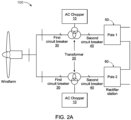
- Figs. 2A and 2B disclose a circuit diagram of an example FRT system 100.
- the FRT system 100 referred herein is operatively coupled to a power network.
- the power network may be connected to renewable sources such as large windfarm, photovoltaic, PV, sources, or the like, for supporting high power onshore and offshore renewable energy transmissions.
- renewable sources such as large windfarm, photovoltaic, PV, sources, or the like.
- One of the common requirements among the high power onshore and offshore renewable energy transmissions is a need to absorb/dissipate excessive power present in the power network during disturbances such as faults in a Direct Current, DC, line, an inverter Alternating Current, AC, grid, or the like.
- the power control system comprises AC choppers, which are connected to a point of common coupling, PCC, of the power network through dedicated chopper transformers and circuit breakers.
- the AC choppers can be operated during disturbances/faults in the power network to absorb excessive renewable power/active power.
- occurrence of such disturbances/faults may be less frequent and may persist for short duration.
- utilization of the chopper transformers is extremely less.
- the chopper transformers become expensive and underutilized transformers, which increases a cost of the AC chopper.
- embodiments disclosed herein provide the FRT system 100 for controlling power in the power network by eliminating a requirement for a dedicated chopper transformer for the AC chopper.
- the FRT system 100 is operatively coupled to the power network at a point of common coupling, PCC for controlling power.
- the power network may include a bipole or parallel symmetric monopole HVDC power network with two links/poles (pole 1 and pole 2).
- Example of the bipole or parallel symmetric monopole HVDC power network may be a High Voltage Direct Current, HVDC, system.
- the HVDC system uses Direct Current, DC, for transmission of bulk power over long distances, in contrast to High-Voltage Alternating Current, HVAC, system that operates on Alternating Current, AC.
- a DC link/HVDC link of the bipole or parallel symmetric monopole HVDC power network/HVDC system may be connected to at least one renewable source at a rectifier station for supporting high power onshore and offshore renewable energy transmissions.
- the renewable source may include, but are not limited to, large windfarms/wind turbine generators, photovoltaic, PV, sources, and so on.
- the DC link/HVDC link of the bipole or parallel symmetric monopole HVDC power network/HVDC system connected to a windfarm at the rectifier station is depicted in Figs. 2A and 2B .
- the windfarm or any type of energy source may be connected to the DC link/HVDC link of the bipole or parallel symmetric monopole HVDC power network directly or through a power electronics converter.
- the FRT system 100 comprises an AC chopper bank 10 and a transformer 20 (converter transformer).
- transformer 20 converter transformer
- the AC chopper 10 (also be referred to as a crowbar circuit) referred herein may include an AC chopper bank comprising a plurality of AC chopper units connected in parallel.
- the AC chopper 10 is connected in a delta configuration and is operated during occurrence of any disturbances/faults in the bipole or parallel symmetric monopole HVDC power network.
- the faults may include, but are not limited to, a fault in the DC line, a fault in an inverter AC grid, and so on.
- the AC chopper 10 connected in the delta configuration is configured to handle power imbalance in the bipole or parallel symmetric monopole HVDC power network.
- the AC chopper 10 may handle power imbalance by dissipating/absorbing excessive power in the bipole or parallel symmetric monopole HVDC power network, which is due to occurrence of any disturbances/faults.
- the excessive power may be active power.
- the delta configured AC chopper 10 is described in detail in conjunction with Fig. 3 .
- the transformer 20 referred herein may be a main converter transformer, which is arranged between an input from the bipole or parallel symmetric monopole HVDC power network through the PCC and an output to the bipole or parallel symmetric monopole HVDC power network.
- the main converter transformer may be configured to provide auxiliary power.
- the transformer 20 comprises at least three windings, a primary winding, a secondary winding, and a tertiary winding.
- the primary winding of the transformer 20 (also be referred to as line winding) is connected to the input from the bipole or parallel symmetric monopole HVDC power network through the PCC.
- the primary winding of the transformer 20 may be connected in a star configuration.
- the secondary winding of the transformer 20 (also be referred to as valve winding) is connected to the pole of the bipole or parallel symmetric monopole HVDC power network.
- the secondary winding of the transformer 20 may be connected in a delta configuration.
- the tertiary winding of the transformer 20 (also be referred to as AC chopper winding) is connected to the AC chopper 10.
- AC chopper winding also be referred to as AC chopper winding
- connecting the AC chopper 10 to the tertiary winding of the transformer 20 eliminates a need for dedicated chopper transformer for the AC chopper.
- initial capital cost and expenditure cost/footprint associated with the dedicated transformer is reduced.
- maintenance (time and cost) and magnetic core material requirement for the FRT system 100 may be reduced in contrast to a FRT system described in the prior art.
- the tertiary winding of the transformer 20 is connected to the AC chopper 10 and an auxiliary supply 70.
- the tertiary winding may be used to divert the power the AC chopper 10 during disturbances and providing auxiliary power to the station.
- the tertiary winding of the transformer 20 may be connected to reactive power compensation devices or Flexible AC Transmission Systems, FACTs, devices or filters, or the like, along with the AC chopper 10.
- reactive power compensation devices or FACTs devices may be, but are not limited to, Static Synchronous Compensator, STATCOM, Static VAR Compensator, and so on.
- the tertiary winding of the transformer 20 may be designed in accordance with connection requirements of the AC chopper 10. In some examples the tertiary winding of the transformer 20 may be connected in a delta configuration.
- the FRT system 100 comprises a first circuit breaker, CB, 30 and a second CB 40.
- the second CB 40 may also be referred to as a converter bus and indicated as "CBx".
- the first CB 30 may be installed between the input to the transformer 20 and the primary winding of the transformer 20.
- the first CB 30 may be configured to be closed in normal operation of the bipole or parallel symmetric monopole HVDC power network and to be opened while the transformer 20 is disconnected from the circuit.
- the second CB 40 may be installed between the pole 50/60 of the bipole or parallel symmetric monopole HVDC power network and the secondary winding of the transformer 20.
- the second CB 40 may be configured to be closed in normal operation of the bipole or parallel symmetric monopole HVDC power network and while the transformer 20 is connected to get energized and to be opened in case of occurrence of any fault in the FRT system 100.
- the second CB 40 may be opened in case of any other desired operation identified by an operator of the FRT system 100.
- any fault for example, a fault in a DC line, a fault in an inverter AC grid, or the like
- a part of the power input from the bipole or parallel symmetric monopole HVDC power network is divided into AC chopper power and pole power (also be referred to as HVDC pole power).
- the AC chopper power is diverted to the AC chopper 10 via the primary winding and the tertiary winding of the transformer 20.
- the pole power is diverted to the pole of the bipole or parallel symmetric monopole HVDC power network via the primary winding and the secondary winding of the transformer 20.
- the primary winding of the transformer 20 may carry total power, which is a sum of the AC chopper power and the pole power.
- the suitable AC chopper 10 or the suitable number of AC chopper units of the AC chopper 10 may be diverted to the activated AC chopper 10 through the primary winding to the tertiary winding of the transformer 20.
- the remaining power that is the pole power may be diverted to the pole (50/60) of the bipole or parallel symmetric monopole HVDC power network through the primary winding to the secondary winding of the transformer 20.
- ratings of the tertiary windings of the transformer 20 may not be varied compared to the prior art (as disclosed in Fig. 1 ), however a direction of the power flow to the AC chopper 10 is modified.
- the disturbance like a DC line fault on one of the poles 1 or 2 affects PCC voltages and hence the other pole. Therefore, as soon as the DC line fault (permanent or temporary) is identified, the second CB of the corresponding faulted pole is opened.
- the second CB connected at the secondary winding of the transformer 20 may isolate the faulted pole during the DC line fault.
- the excessive power present in the bipole or parallel symmetric monopole HVDC power network due to the DC line fault may be diverted to the AC chopper 10 by ensuring availability/activation of the AC chopper 10.
- the AC chopper 10 absorbs the excessive active power and handles power imbalance in the bipole or parallel symmetric monopole HVDC power network.
- the AC chopper 10 may dissipate/absorb the excessive active power by receiving the AC chopper power via the primary winding and the tertiary winding of the main converter transformer 20 instead of using the dedicated chopper transformer. As a result, a cost of the FRT system is reduced.
- Fig. 3 discloses the delta configured AC chopper 10.
- the AC chopper 10 is connected to the tertiary winding of the main converter transformer (which is connected between the input and the output of the bipole or parallel symmetric monopole HVDC power network).
- the AC chopper 10 is configured for handling power imbalance by absorbing excessive active power present in the bipole or parallel symmetric monopole HVDC power network due to occurrence of any fault.
- the AC chopper 10 may comprise controllers forming the delta configuration. Each controller may comprise electronic components connected back to back.
- the AC chopper 10 comprises three controllers forming the delta configuration, wherein each controller comprises thyristors connected back to back with a resistor.
- a first controller is formed by thyristors T1 and T4.
- a second controller is formed by thyristors T3 and T6.
- a third controller is formed by thyristors T2+T5. It should be understood that the AC chopper 10 may comprise other electronic components including the thyristors.
- the AC chopper 10 connected in the delta configuration may be majorly used in the power network (for example, a HVDC transmission system) connected to renewable sources such as large windfarm, PV sources, or the like.
- Fig. 4 discloses a power compensation module 400 for controlling power in the power network.
- the FRT system (as depicted in Fig. 2 ) may comprise the power compensation module 400.
- the power compensation module 400 is operatively coupled to the power network at a PCC.
- the power network may be a bipole or parallel symmetric monopole HVDC power network comprising two poles for power transmission.
- example of the bipole or parallel symmetric monopole HVDC power network may be a HVDC system.
- the power compensation module 400 is configured to absorb excess power in the bipole or parallel symmetric monopole HVDC power network.
- the power compensation module 400 comprises the AC chopper 10, the transformer 20, the first CB 30, and the second CB 40.
- the AC chopper 10 is connected in a delta configuration in the bipole or parallel symmetric monopole HVDC power network and is configured to handle any power imbalance in the bipole or parallel symmetric monopole HVDC power network.
- the AC chopper 10 may handle power imbalance by absorbing excessive active power present in the bipole or parallel symmetric monopole HVDC power network due to any disturbances such as fault in a DC line, an inverter AC grid, or the like.
- the transformer 20 (i.e., the main converter transformer) comprises at least three windings.
- a primary winding of the transformer 20 is connected to an input from the bipole or parallel symmetric monopole HVDC power network via the PCC.
- a secondary winding of the transformer 20 is connected to the pole of the bipole or parallel symmetric monopole HVDC power network.
- a tertiary winding of the transformer 20 is connected to the AC chopper 10. In some embodiments, the tertiary winding of the transformer 20 may also be connected to the AC chopper 10 and the auxiliary supply (as depicted in Fig. 2B ).
- the first CB 30 is installed between the input of the transformer 20 and the primary winding of the transformer 20 for each of the poles in the bipole or parallel symmetric monopole HVDC power network.
- the first CB 30 may be configured to be closed in normal operation of the bipole or parallel symmetric monopole HVDC power network and open while the transformer 20 is disconnected from the circuit.
- the second CB 40 is installed between the pole of the bipole or parallel symmetric monopole HVDC power network and the secondary winding of the transformer 20 for each of the poles in the bipole or parallel symmetric monopole HVDC power network.
- the second CB 40 is configured to be closed in normal operation of the bipole or parallel symmetric monopole HVDC power network and while the transformer 20 is connected to get energized and open in case of occurrence of any fault. Thereby isolating the pole of the bipole or parallel symmetric monopole HVDC power network.
- whole or a part of power input to the bipole or parallel symmetric monopole HVDC power network may be divided into AC chopper power and pole power.
- the AC chopper power may be diverted to the AC chopper 10 via the primary winding and the tertiary winding of the transformer 20.
- the pole power may be diverted to the pole of the bipole or parallel symmetric monopole HVDC power network via the primary winding and the secondary winding of the transformer 20.
Landscapes
- Engineering & Computer Science (AREA)
- Power Engineering (AREA)
- Ac-Ac Conversion (AREA)
Priority Applications (1)
| Application Number | Priority Date | Filing Date | Title |
|---|---|---|---|
| EP23159716.2A EP4425732A1 (de) | 2023-03-02 | 2023-03-02 | Fehlerüberbrückungssystem für ein stromnetz |
Applications Claiming Priority (1)
| Application Number | Priority Date | Filing Date | Title |
|---|---|---|---|
| EP23159716.2A EP4425732A1 (de) | 2023-03-02 | 2023-03-02 | Fehlerüberbrückungssystem für ein stromnetz |
Publications (1)
| Publication Number | Publication Date |
|---|---|
| EP4425732A1 true EP4425732A1 (de) | 2024-09-04 |
Family
ID=85461959
Family Applications (1)
| Application Number | Title | Priority Date | Filing Date |
|---|---|---|---|
| EP23159716.2A Pending EP4425732A1 (de) | 2023-03-02 | 2023-03-02 | Fehlerüberbrückungssystem für ein stromnetz |
Country Status (1)
| Country | Link |
|---|---|
| EP (1) | EP4425732A1 (de) |
Cited By (1)
| Publication number | Priority date | Publication date | Assignee | Title |
|---|---|---|---|---|
| CN120184988A (zh) * | 2025-05-19 | 2025-06-20 | 浙江大学 | 耗能子模块电动势重构的交流低电压不平衡故障穿越方法 |
Citations (6)
| Publication number | Priority date | Publication date | Assignee | Title |
|---|---|---|---|---|
| WO2014075740A1 (de) * | 2012-11-19 | 2014-05-22 | Siemens Aktiengesellschaft | Umspannvorrichtung |
| EP2771956A1 (de) * | 2011-10-27 | 2014-09-03 | ABB Technology AG | Schnittstellenanordnung zwischen ac- und dc-systemen zur zuverlässigen zeitgerechten öffnung eines schutzschalters |
| US20150236611A1 (en) * | 2012-11-29 | 2015-08-20 | Kabushiki Kaisha Toshiba | Electric power conversion apparatus |
| EP2993771A2 (de) * | 2014-08-25 | 2016-03-09 | General Electric Company | Systeme und verfahren zum verbesserte betrieb und schutz von leistungswandlern |
| WO2016055106A1 (de) * | 2014-10-08 | 2016-04-14 | Siemens Aktiengesellschaft | Stromrichteranordnung mit kurzschlusseinheit sowie verfahren zum trennen einer wechselspannungsleitung |
| EP3026803A1 (de) * | 2014-11-25 | 2016-06-01 | Alstom Technology Ltd | Anfahren von HVDC-Wandlern |
-
2023
- 2023-03-02 EP EP23159716.2A patent/EP4425732A1/de active Pending
Patent Citations (6)
| Publication number | Priority date | Publication date | Assignee | Title |
|---|---|---|---|---|
| EP2771956A1 (de) * | 2011-10-27 | 2014-09-03 | ABB Technology AG | Schnittstellenanordnung zwischen ac- und dc-systemen zur zuverlässigen zeitgerechten öffnung eines schutzschalters |
| WO2014075740A1 (de) * | 2012-11-19 | 2014-05-22 | Siemens Aktiengesellschaft | Umspannvorrichtung |
| US20150236611A1 (en) * | 2012-11-29 | 2015-08-20 | Kabushiki Kaisha Toshiba | Electric power conversion apparatus |
| EP2993771A2 (de) * | 2014-08-25 | 2016-03-09 | General Electric Company | Systeme und verfahren zum verbesserte betrieb und schutz von leistungswandlern |
| WO2016055106A1 (de) * | 2014-10-08 | 2016-04-14 | Siemens Aktiengesellschaft | Stromrichteranordnung mit kurzschlusseinheit sowie verfahren zum trennen einer wechselspannungsleitung |
| EP3026803A1 (de) * | 2014-11-25 | 2016-06-01 | Alstom Technology Ltd | Anfahren von HVDC-Wandlern |
Cited By (1)
| Publication number | Priority date | Publication date | Assignee | Title |
|---|---|---|---|---|
| CN120184988A (zh) * | 2025-05-19 | 2025-06-20 | 浙江大学 | 耗能子模块电动势重构的交流低电压不平衡故障穿越方法 |
Similar Documents
| Publication | Publication Date | Title |
|---|---|---|
| Huber et al. | Applicability of solid-state transformers in today’s and future distribution grids | |
| US11641102B2 (en) | Modular FACTS devices with external fault current protection within the same impedance injection module | |
| Divan et al. | Distributed FACTS-A new concept for realizing grid power flow control | |
| EP2638613B1 (de) | Verfahren für den betrieb einer fotovoltaikanlage zur stromeinspeisung in ein mittelspannungsenergieversorgungsnetz | |
| US9917443B2 (en) | Photovoltaic system and method for operating a photovoltaic system for feeding electrical power into a medium-voltage network | |
| US7447568B2 (en) | Electric power network | |
| US20130271888A1 (en) | Photovoltaic System and Apparatus for Operating a Photovoltaic System | |
| EP3026803A1 (de) | Anfahren von HVDC-Wandlern | |
| EP2993771B1 (de) | Systeme und verfahren zum verbesserte betrieb und schutz von leistungswandlern | |
| EP4087082B1 (de) | Nullstromkompensator mit wirkleistungsinjektor für ein dreiphasiges stromsystem | |
| Moawwad et al. | Novel configuration and transient management control strategy for VSC-HVDC | |
| Psaras et al. | DC fault management strategy for continuous operation of HVDC grids based on customized hybrid MMC | |
| EP4425732A1 (de) | Fehlerüberbrückungssystem für ein stromnetz | |
| Woodford | Symmetrical monopole VSC transmission | |
| Haeusler et al. | HVDC solutions for integration of the renewable energy resources | |
| Nazir et al. | Hybrid bypass protection of hybrid smart transformers for advanced grid support | |
| Kandula et al. | Design considerations and experimental results for a 12.47-kV 3-phase 1 MVA power router | |
| Qi et al. | Fault interruption and protection coordination in converter interfaced distribution systems | |
| US20220271536A1 (en) | Device for connecting two alternating voltage networks and method for operating the device | |
| Grunbaum et al. | SVC for 69 kV direct grid connection | |
| Adibi et al. | The impacts of FACTS and other new technologies on power system restoration dynamics | |
| Jones et al. | Current Compensators for Unbalanced Electric Distribution Systems | |
| Hagh et al. | Improving fault ride-through of three phase voltage source inverter during symmetrical fault using DC link fault current limiter | |
| CN113950785A (zh) | 两用转换器 | |
| EP4447251A1 (de) | Leistungssteuerungssystem für ein stromnetz |
Legal Events
| Date | Code | Title | Description |
|---|---|---|---|
| PUAI | Public reference made under article 153(3) epc to a published international application that has entered the european phase |
Free format text: ORIGINAL CODE: 0009012 |
|
| STAA | Information on the status of an ep patent application or granted ep patent |
Free format text: STATUS: THE APPLICATION HAS BEEN PUBLISHED |
|
| AK | Designated contracting states |
Kind code of ref document: A1 Designated state(s): AL AT BE BG CH CY CZ DE DK EE ES FI FR GB GR HR HU IE IS IT LI LT LU LV MC ME MK MT NL NO PL PT RO RS SE SI SK SM TR |
|
| STAA | Information on the status of an ep patent application or granted ep patent |
Free format text: STATUS: REQUEST FOR EXAMINATION WAS MADE |
|
| 17P | Request for examination filed |
Effective date: 20250221 |